


Abstract
Every new phrasal preposition results from a process of grammaticalization, through which elements originally considered lexical acquire grammatical functions. At the same time, their complex status also entails a process of lexicalization, given that these constructions lose their syntactic analyzability. To address this apparent contradiction, the aim of this article is to provide a theoretical account within the theories of grammaticalization and lexicalization. Based on new empirical evidence taken from the historical analysis of the Spanish complex preposition por vía de ‘by way of’, as documented in the Corpus del Diccionario histórico de la lengua española (CDH), this research demonstrates the relationship between grammaticalization and lexicalization. The diachronic data show that the locative noun vía undergoes grammaticalization. This process involves semantic bleaching (locative-perlative, perlative-figurative intermediation, perlative-figurative mediation, cause, purpose; e.g., por vía de Francia ‘by way of France’, por vía de intérprete ‘through an interpreter’, por vía de matrimonio ‘by means of marriage’, por vía de padre ‘on my father’s side’), recategorization, loss of morphological properties, external fixation, and condensation. However, this development is conditioned by lexicalization, as the noun is grammaticalized only when it becomes fixed in combination with the two prepositions (por and de). Nonetheless, the diachronic evidence also shows that the degree of syntactic analyzability varies according to meaning, indicating that analyzability does not necessarily entail semantic compositionality.
Keywords:
grammaticalization; lexicalization; phrasal preposition; por vía de; vía; locative nouns; diachrony; Spanish 1. Introduction
In Spanish, the inventory of prepositions expands considerably when phrasal prepositions are considered (Morera Pérez, 1998; Pavón Lucero, 1999, §9.2.4.1; Codita, 2017, p. 59; Real Academia Española & ASALE, 2025, §29.9). These constructions are “expressions consisting of several words that together acquire the meaning and grammatical function of prepositions” (Real Academia Española & ASALE, 2025, §29.9a). According to the Real Academia Española and ASALE (2025), the formation of such constructions is a productive process that enables speakers to express more specific meanings than those conveyed by simple prepositions (Codita, 2017, p. 32). This process typically involves grammaticalization, through which the lexical item within the expression acquires a grammatical meaning (Cifuentes Honrubia, 2003). Thus, certain nouns inside these constructions undergo grammaticalization and come to express different grammatical values. Examples include body-part nouns (cara ‘face’, frente ‘forehead’, and pie ‘foot’) (see Insausti Muñoz, 2020), quantifying nouns (mar ‘sea’, oleada ‘wave’, and tira ‘strip’) (see Buenafuentes de la Mata, 2016), and locative nouns (camino ‘way’, orilla ‘shore or bank’, esquina ‘corner’, and ribera ‘shore/bank’) (see Plaza de la Ossa, 2006; Buenafuentes de la Mata & Sánchez Lancis, 2012; Sánchez Lancis, 2016). These nouns may denote a range of grammatical values in their respective complex preposition: quantification (la mar de difícil ‘very difficult’), direction (ribera de un río ‘to the river’), position (de cara a la pared ‘facing the wall’), or figurative direction (camino del suicidio ‘on the way to suicide’). Similarly, the locative noun vía1 ‘way’, when used within the phrasal preposition por vía de ‘by way of’, acquires functional values that distance it—to different degrees—from its original locative meaning, as illustrated in the following examples from the Corpus del Español del siglo XXI (CORPES XXI, n.d.):
| (1) | a | Siempre por vía de Europa llegan al Continente Americano instrumentos membranófonos de origen africano, […]. (José Balvino Camposeco, in Nuestra música y danzas tradicionales, 2003, Costa Rica, CORPES XXI). |
| ‘Always by way of Europe, membranophone instruments of African origin arrive in the American Continent […]’. | ||
| b | […] conocidos éstos principalmente por vía de Yomí García Ascot. (Carlos Blanco Aguinaga, De mal asiento, 2010, Spain, CORPES XXI). | |
| ‘[…] known mainly through Yomí García Ascot’. | ||
| c | Abandonaría toda frivolidad y toda estrategia de salvación económica por vía del matrimonio. (Rosa María Lojo, Árbol de familia, 2010, Argentina, CORPES XXI). | |
| ‘She/he would abandon all frivolity and any strategy for economic salvation by means of marriage’. | ||
| d | […], un día sacó Cané un libro de su bolsillo, para leerlo por vía de pasatiempo. (Laura Ramos, “Un joven tucumano en el Colegio Nacional”, in Clarín.com, 2011, Argentina, CORPES XXI). | |
| ‘[…] One day Cané took a book out of his pocket to read it as a pastime’. | ||
| e | […] una manera de ayudar a desbloquearla es que el dinero se deprecie por vía de generar algo de inflación. (Juan Ignacio Crespo, Las dos próximas recesiones. Cómo, dónde, cuándo y por qué se producirán, 2012, Spain, CORPES XXI). | |
| ‘[…] one way to help unblock it is for money to depreciate in order to generate some inflation’. | ||
| f | —Mi padre heredó un pequeño negocio que le llegó por vía de su hermano, […]. (Antonio Soler, Sur, 2018, Spain, CORPES XXI). | |
| ‘My father inherited a small business that came to him through his brother […]’. |
The literature on phrasal prepositions (Cifuentes Honrubia, 2003; Codita, 2017) generally assumes that all new complex prepositions arise through grammaticalization. However, these constructions raise a theoretical problem, since phrasal prepositions consist of several words whose combination becomes fixed through lexicalization (Brinton & Traugott, 2005; Elvira, 2015), whereby the construction acquires its own lexical properties and loses its syntactic analyzability.
Given the theoretical challenges posed by these phrasal prepositions, the aim of this paper is to provide a theoretical account grounded in grammaticalization and lexicalization. We first outline the main features of these two processes with respect to multi-word expressions (§2). Second, we support this account with a diachronic analysis of por vía de (§4), based on its attestations in the Corpus del Diccionario histórico de la lengua española (CDH). Historical evidence allows us to explain the formation of this phrasal preposition and the development of its grammatical values (grammaticalization) within a fixed expression that is, apparently, no longer syntactically analyzable (lexicalization).
In short, this paper contributes to the theoretical discussion about grammaticalization and lexicalization through a diachronic analysis of the Spanish phrasal preposition por vía de and examines in this complex preposition the relationship between the loss of syntactic analyzability and the acquisition of grammatical and lexical values (through grammaticalization and lexicalization, respectively).
2. Grammaticalization, Lexicalization, and Complex Prepositions: Theoretical Aspects
As noted in the introduction, this section outlines the main properties of grammaticalization and lexicalization2 and their relevance for the formation of Spanish phrasal prepositions and adverbs3. These theoretical aspects are applied in Section 4, which examines the diachronic analysis of the phrasal preposition por vía de.
Interest in grammaticalization theory has increased in recent years (Hopper & Traugott, 1993/2003; Lehmann, 1995/2015). Its origins can be traced to the early 20th century, when Meillet (1912)4 introduced the classic definition later refined by Kuryłowicz (1965)5. According to this formulation, grammaticalization involves both loss and gain: the grammaticalized unit loses lexical content to acquire additional grammatical values.
The loss of values has both formal and, more importantly, functional consequences. Formally, grammaticalization may involve phonetic reduction or fusion phenomena (univerbation)6. Similar effects appear in phrasal prepositions: for example, the complex preposition camino de ‘on the way to’ loses the preposition de in its directional use (voy camino de Soria > voy camino Soria), after which the locative noun becomes a preposition with a value comparable to hacia ‘to’ (voy camino Soria ‘I’m going to Soria’) (Buenafuentes de la Mata & Sánchez Lancis, in press).
The functional effects associated with grammaticalization are especially significant and may contribute to the loss of syntactic analyzability. Beyond the loss of lexical properties, the grammaticalized unit may lose functional autonomy and become dependent. The process may also lead to paradigmatization, integrating the unit into an obligatory paradigm (Elvira, 2009, p. 159). Complex prepositions, however, do not attain a level of grammaticalization that results in functional dependence, likely because they also undergo lexicalization (in a particular way, as discussed below).
A further functional consequence of grammaticalization is morphological attrition, that is, the loss of “the morphological properties that are characteristic of the former lexical unit” (Elvira, 2009, p. 200), such as its inflectional features and positional freedom, which results in the development of external fixation. This is illustrated by the phrasal adverb la mar de ‘very’ (lit. ‘the sea of’) (la mar de contento ‘very happy’), in which the quantifying noun mar is fixed both in number singular and in feminine gender (constructions such as *el mar de contento or *las mares de contentos are ungrammatical).
Despite the loss of lexical and functional values, grammaticalization generates new grammatical meanings. This semantic change involves abstraction from “a specific cognitive domain to a more abstract or grammatical one” (Tornel Sala, 2000, p. 118). From a cognitive perspective7, this semantic abstraction or bleaching is driven by metaphor and/or metonymy. Heine et al. (1991, p. 48) propose the following hierarchy of metaphorical abstraction, ranging from lower to higher levels: person > object > process > space > time > quality. On the basis of this scale, for example, time can be conceptualized in spatial terms, as in the locative noun camino ‘way’ when it develops a prospective temporal reading in the phrasal preposition camino de ‘on the way to’ (Juan va camino del suicidio ‘Juan is heading towards suicide’ > ‘Juan is going to commit suicide’) (see Buenafuentes de la Mata & Sánchez Lancis, in press).
Metonymy, by contrast, is primarily a referential process, using a salient entity to evoke another that is less accessible (Santos Domínguez & Espinosa Elorza, 1996, p. 47). Metonymy-based change underlies cases of grammaticalization driven by the conventionalization of pragmatic inferences8 (subjectivization) (Sweetser, 1990; Traugott, 1995). For example, the phrasal adverb la mar (de) acquires the meaning ‘much’ through repeated use in exclamatory contexts (¡Me divertí la mar! ‘I had a lot of fun’) (Buenafuentes de la Mata, 2016). This relationship between grammaticalization and subjectivization allows discursive traditions to be integrated into this theoretical framework (Kabatek, 2005). Text typology, genre, and written varieties closer to oral discourse have a significant impact on the emergence of linguistic change and on the course of grammaticalization (Company Company, 2016, p. 385).
Semantic change in grammaticalization may be accompanied by additional developments. As meaning becomes more abstract, the unit’s combinatorial possibilities expand (condensation, see Lehmann, 1995/2015). For example, camino de ‘on the way to’ first combined with place names (camino de la ciudad ‘on the way to the city’), later with abstract nouns (camino de la muerte ‘on the way to death’), and eventually with infinitives or clauses (camino de veros ‘on the way to see you’). This expansion in syntactic combinability of this phrasal preposition indicates the progress of its grammaticalization (Buenafuentes de la Mata & Sánchez Lancis, in press).
At the same time, grammaticalization may involve recategorization; which may result in categorical polysemy or polyfunctionality. In the examples discussed, nouns evolve into phrasal prepositions (camino ‘way’ > camino (de) ‘on the way to’) and into phrasal adverbs or interjective expressions (mar ‘sea’ > la mar de contento ‘very happy’ > ¡la mar! ‘too much!’)9.
The concept of lexicalization is closely connected to grammaticalization. Its distinction from grammaticalization is a much-debated issue within the theory of grammaticalization itself (see Brinton & Traugott, 2005, pp. 18–22). Lexicalization is generally defined as “the process by which an expression, which was previously obtained or accessed by grammatical or analytical means, is stored as a block in memory or mental dictionary and is used globally, without the need for prior analysis” (Elvira, 2006, p. 24). In short, lexicalization proceeds in the opposite direction to grammaticalization, moving from grammar towards the lexicon. However, both processes also show similar formal effects, as lexicalization may result in phonetic reduction (erosion) and graphic fusion (univerbation). Similarly, lexicalization also entails involving the loss of semantic compositionality and the emergence of idiomaticity. At the same time, the lexicalized item acquires functional autonomy and no longer shows restrictions on inflection or positional mobility. Thus, unlike grammaticalization, lexicalization does not lead to external fixation. Instead, it involves internal fixation: the expression cannot modify its internal structure and has lost syntactic analyzability10. Finally, contrary to grammaticalization—which entails an expansion of the contexts in which a form can occur (condensation)—, lexicalization restricts the predicative potential of the lexicalized unit.
Nonetheless, although grammaticalization and lexicalization are distinct processes, the interrelationship between these processes “is crucial for having a better understanding of the evolutionary dynamics of lexical and grammatical elements” (Moreno Cabrera, 1998, p. 223). In this regard, phrasal prepositions demonstrate that grammaticalization and lexicalization interact in their historical development. The literature acknowledges a relationship between these processes (Traugott & Trousdale, 2013), but, in our view, this interaction between grammaticalization and lexicalization manifests itself in two distinct ways. The first situation involves a sequential ordering of the two processes, such that grammaticalization follows lexicalization or, conversely, lexicalization follows grammaticalization. However, neither of these directional sequences is attested in the case of phrasal prepositions.
The second type of interaction involves grammaticalization conditioned by lexicalization. In this scenario, grammaticalization occurs only within an already lexicalized structure, and the conditions for grammaticalization are activated inside this fixed construction. This pattern emerges in the formation of phrasal prepositions and adverbs: the outcome is a new grammatical element, with the lexicalization of its constituent elements serving as a necessary but secondary catalyst in its development. In sum, this grammaticalization conditioned by lexicalization helps explain the nature of phrasal prepositions and adverbs, which are fixed and non-compositional constructions but nonetheless display grammatical properties. The analysis of the phrasal preposition por vía de ‘by way of’ presented in § 4 will illustrate this interaction pattern between grammaticalization and lexicalization on the evidence of diachronic data.
3. Methodology and Corpus Data
The diachronic analysis of the phrasal preposition por vía de is based on data obtained from the Corpus del Diccionario Histórico de la lengua española (CDH, n.d.) of the Real Academia Española. The dataset comprises 3072 attestations of por vía de (including its formal variants) extracted from texts dated between the 13th and 20th centuries, as shown in Table 1:
Table 1.
Number of different documents by century according to the date of composition indicated by the CDH.
The corpus was selected according to the following criteria. First, we excluded texts whose philological reliability could not be ensured (Octavio de Toledo & Rodríguez Molina, 2017), those belonging to Ibero-Romance varieties other than Spanish, and those whose dating spanned multiple centuries.
Second, to examine the relationship between lexicalization, grammaticalization, and syntactic analyzability, we considered structural variation. This includes modifications of the noun vía through the insertion of modifiers between the prepositions por and de—por (modifier) vía de, por vía (modifier) de, and por (modifier) vía (modifier) de—as well as inflection (por vías de)11 (520 occurrences). A summary of the data analyzed is presented in the Table 2:
Table 2.
Number of cases by structure of por vía de.
Finally, the corpus data were classified according to the CDH parameters—author, title, date, country, and thematic category12. Using these criteria, the examples were analyzed semantically to manually assign the values developed by the phrasal preposition over time. To ensure dataset representativeness and analytical robustness, relative frequencies and percentage distributions were included alongside absolute counts.
4. Diachrony of the Phrasal Preposition por vía de
The locative value of the phrasal preposition por vía de derives from the noun vía. According to the Diccionario Crítico Etimológico Castellano e Hispánico (DECH) (Corominas, 1980–1991, s.v. vía), the noun comes from Latin vĭa ‘way, road, street, journey’, with its earliest documentation in the Poema de Mio Cid (c. 1140; Cop.13: c. 1325–1330). In the CDH, the first locative uses of vía outside this complex preposition appear in early 13th century texts, both in a literal sense (2a) and in its metaphorical extension14 (2b):
| (2) | a | Dixo: “Iré; todo lo mio, tuyo es”. Dixo: “Por qual via iremos?” “Por el desiert de Ydumea”. (Almerich, La fazienda de Ultra Mar, c1200, CDH. Cop.: 1211–1235). |
| ‘He said: I will go; all that is mine is yours. He said: By which way shall we go? Through the desert of Edom’. | ||
| b | […] e fo mal rei & andido en las uias malas de Manase so padre, & adoro las ydolas. (Anónimo, Liber Regum, c1194–1211, CDH. Cop.: 1201–1220). | |
| ‘[…] and he was an evil king and walked in the wicked ways of Manasseh, his father, and worshiped the idols’. |
Although vía is widely attested across all periods and Western Romance languages, its semantic development was constrained by competition from equivalent terms, especially the noun camino ‘way’, which shares the same locative meaning and is attested earlier (1084, according to Corominas, 1980–1991, s.v. camino). As a result, the two nouns may co-occur to express spatial directions, whether literal or figurative:
| (3) | a | E por estas guerras mi padre e tío, no pudiendo tornar por el camino que avían ido, deliberaron passar adelante por la vía de oriente e dar la buelta a Costantinopla. (Rodrigo Fernández de Santaella, Traducción del Libro de Marco Polo, 1503, CDH). |
| ‘And because of these wars my father and uncle, unable to return by the road they had taken, decided to continue onward by the way of the East and make their way back to Constantinople’. | ||
| b | Este buen christiano endereça su camino a la vida virtuosa por la vía de los adalides, que son los varones sanctos […]. (Francisco de Osuna, Quinta parte del Abecedario espiritual, a1540, CDH). | |
| ‘This good Christian directs his path toward the virtuous life by way of the guides, who are the holy men, our predecessors, whose examples we must follow […]’. |
At the same time, vía develops a specialized meaning in the domain of correspondence and, by extension, of shipments. The earliest attestations of this use in the corpus date from the 13th century, where it appears frequently with prepositions por and de (por vía de). In this context, vía has a locative-perlative value because denotes the route a shipment must pass through before reaching its destination. That is, “The operator vía creates a trajectory that passes through a region bounded by the reference frame” (Espinosa Elorza, 2010, p. 210), as can be seen in (4). In this context, it is equivalent to the noun camino ‘way’, as reflected in the definition provided by the Diccionario de Autoridades (Real Academia Española, 1726–1739: s.v. vía): “It also means the road or postal route: thus, we can say send a letter via France, etc.”.
| (4) | a | E dixo Ezechiel: “Menom * a la puerta que catava de parte de orient, e he la gloria de Dios de Israel vinie por via de orient […] (Almerich, La fazienda de Ultra Mar, c1200, CDH. Cop.: 1211–1235). |
| ‘And Ezekiel said: I turned to the gate that looked toward the east, and behold, the glory of the God of Israel was coming by way of the east […]’. | ||
| b | Vos continuament tendreys studio en saber nueuas, assi por via de Rossellon, como de Jacobo Vernegal y otros mercaderes por via de Auinyon y de Prohença […]. (Anónimo, Carta de don Fernando a Guillermo Sánchez aludiendo a la paz con Francia, y a la guerra portuguesa (Documentos sobre relaciones internacionales de los Reyes Católicos), 1479, CDH). | |
| ‘You shall continually take an interest to learn the news, both by way of Roussillon and through Jacobo Vernegal and other merchants by way of Avignon and Provence […]’. | ||
| c | Aqui ha venido nueva por via de Alicante que la carraca y galeon que eran armados en Genova é hezieron lo que en este puerto se hizo […]. (Diego de Vera, Carta de Diego de Vera y Juan del Río al Cardenal Cisneros, 1516, CDH). | |
| ‘News has arrived here by way of Alicante that the carrack and the galleon that were being fitted out in Genoa […]’. |
From this locative-perlative context—where vía is understood as the point of passage between two places (origin and destination)—the noun develops additional meanings within the complex preposition. These new meanings arise through a process of abstraction15 rooted in the spatial domain (localism) originally expressed by vía (Elvira, 2009, p. 169). This semantic bleaching is evidenced by the fact that vía is no longer equivalent to camino (‘way’) in these contexts.
Firstly, when the prepositional object is a noun referring to a person—or is personified (see 5a)—vía within the construction conveys intermediation. In this use, por vía de + person takes on a figurative (and therefore more abstract) value, denoting the agent through whom an action is carried out (see 5). In sum, the construction extends its meaning from its locative-perlative value (a point of passage between two places) to a figurative-perlative one (an intermediary agent). This new figurative-perlative (intermediation) meaning is attested in the late 15th century:
| (5) | a | […] y al mismo tiempo vino fama, por via de ciertas naues venecianas, que sallian de Candia y tocaron en Mallorcas […]. (Anónimo, Fernando al maestre de Rodes, agradeciéndole las nuevas de la armada turca y de la victoria del sultán de Babilonia […], 1488, CDH). |
| ‘[…] and at the same time there came news, through certain Venetian ships that were sailing from Candia and had touched at Majorca […]’. | ||
| b | […] y desde a otros quince días o treinta venía nueva por vía de Indios, que le habían muerto; […] (Rodrigo de Albornoz, Carta del contador Rodrigo de Albornoz, al emperador, 1525, CDH). | |
| ‘[…] and after another fifteen or thirty days, news came through the Indians that they had killed him […]’. | ||
| c | […], por vía de intérprete le dijeron que qué era lo que mandaba con el mensajero que había enviado, […]. (Alonso de Santa Cruz, Crónica del Emperador Carlos V, c1550, CDH). | |
| ‘[…], through an interpreter they told him what it was that he ordered by means of the messenger he had sent, […]’. |
Related to this figurative-perlative value, vía is first attested from the early 15th century with an intermediation meaning in the context of familial lineage. Here, the prepositional object is typically a kinship term—though not always (see sangre ‘blood’ in 6a)—and the expression denotes genealogical transmission through a family member, such as padre ‘father’ or madre ‘mother’ (por vía de padre = ‘on the father’s side’):
| (6) | a | Esta sangre divina, este linage divino por vía de sangre en Christo començó. (Francisco de Osuna, Primera parte del Abecedario espiritual, 1528, CDH). |
| ’This divine blood, this divine lineage began in Christ through the blood line’. | ||
| b | […], y acordaron que fuesse este, y no el bastardo, por ser legítimo y pariente muy cercano de Motecçuma por vía de muger; […] (Francisco López de Gómara, Segunda parte de la Crónica general de las Indias, 1553, CDH). | |
| ‘[…], and they agreed that it should be this one, and not the bastard, because he was legitimate and a very close relative of Motecçuma through the female line […]’. | ||
| c | […], porque Chimalpopoca, aunque era de su sangre, era por vía de madre, y que la parte del padre había de tirar de él más. (José de Acosta, Historia natural y moral de las Indias, 1590, CDH). | |
| ‘[…], because Chimalpopoca, although he was of his blood, was so through the mother, and the father’s side ought to pull more strongly on him’. |
Although vía is a locative noun in Latin, it also has another basic figurative meanings attested in this language (see Lewis & Short, 1879: s.v. via; OLD, 1968: s.v. via). In contexts such as Buscaremos la mejor vía para salir de la crisis (‘We will seek the best way to get out of the crisis’), vía is equivalent to manera ‘manner’ or medio ‘means’. The noun retains its manner-based interpretation when used in the construction por vía de, but also develops additional meanings as a result of semantic bleaching (instrument, cause or purpose).
Firstly, <por vía de + X> is semantically equivalent to por medio de ‘by means of’ and encodes the means through which a given goal is achieved. In this figurative-perlative value, the means is conceptualized as the intermediate stage between an intention and its fulfillment. In the CDH, the earliest attestations of this figurative-perlative (mediation) meaning16 date from the late 14th and early 15th centuries. This contrasts with the earliest instances of the locative-perlative meaning, which do appear in the 13th century17 (see 4).
| (7) | a | […] et fizies costrenyr por via de excomunicacion o en otra manera qualquier al conde Simon […]. (Anónimo, Gestas del rey don Jayme de Aragon, a1396, CDH. Cop. 1376–1396). |
| ‘[…] and you should compel Count Simon by means of excommunication or by any other manners whatsoever […]’. | ||
| b | Et estas cosas que non proçedan por via de juyzio, mas sumaria e breue mente, faziendo luego la esecucion rreal. (Anónimo, Cortes de Segovia, 1390, CDH. Cop. c 1401–1425). | |
| ‘And these matters shall not proceed by means of judicial process, but in a summary and brief manner, carrying out the royal execution immediately’. |
The prepositional object of the construction por vía de ‘by means of’ is followed by nouns of any kind (amistad ‘friendship’, amor ‘love’, apelación ‘appeal’, armas ‘weapons’, ayuda ‘help’, casamiento ‘marriage’, consejo ‘advice’, concordia ‘harmony’, donaire ‘charm’, fuerza ‘strength’, gracia ‘grace’, guerra ‘war’, indemnización ‘compensation’, justicia ‘justice’, limosna ‘alms’, paz ‘peace’, restitución ‘restitution’, salario ‘salary’, tributo ‘tribute’, among others18), but it can also be combined with other constructions such as infinitives and, less frequently, noun clauses:
| (8) | a | Pero a los elementos, y al sol y a las estrellas, ay operaçiones por vía de calentar e rresfriar, y desecar y humedesçer, y cosas que siguen a estas […] (Anónimo, Traducción castellana del Libro de El Kuzari de Yehudah Halevi, c1450, CDH. Cop.: c1451–1500). |
| ‘But in the elements, and in the sun and the stars, there are operations by means of heating and cooling, and drying and moistening, and the things that follow from these […]’. | ||
| b | Fermosa señora, si me lo dezís por vía de mandármelo, hazer lo he, porque mi costumbre es servir las tales como vós; […]. (Feliciano de Silva, Lisuarte de Grecia, 1514, CDH). | |
| ‘Fair lady, if you say it to me by means of commanding it, I shall do it, for it is my custom to serve those such as you […]’. | ||
| c | Del impedimento y daño que puede haber en las aprehensiones del entendimiento por vía de lo que sobrenaturalmente se representa a los sentidos corporales exteriores, […]. (San Juan de la Cruz, Subida del Monte Carmelo, 1578–c1583, CDH). | |
| ‘On the impediment and harm that may arise in the apprehensions of the understanding by means of what is supernaturally presented to the external bodily senses […]’. |
Likewise, in some cases the means is construed as an instrument for achieving the goal, as the following examples show:
| (9) | a | […] en caso que algunos o algunas personas quisieren de fecho por via de armas tentar e ynsistir en la perturbaçion e dapnificaçion […]. (Anónimo, Escritura de conveniencia (Colección documental del archivo municipal de Hondarribia), 1489, CDH). |
| ‘[…] in the event that any persons should indeed attempt and persist by means of arms in causing disturbance and harm […]’. | ||
| b | […], porque sé que acabaré con él por vía de paz más que he podido hazer por vía de guerra. (Diego Ortúñez de Calahorra, Espejo de príncipes y caballeros [El caballero del Febo], 1555, CDH). | |
| ‘[…], because I know that I will deal with him by means of peace more than I have been able to do by means of war’. |
From the manner-based interpretation of vía, the noun within por vía de may foreground manner rather than means. In such cases, the construction is equivalent to the complex preposition a modo de (‘by way of, like, as’), as illustrated in the following examples:
| (10) | a | […] agua de leche ques el suero estando de noche al sereno tomada de mañana es buena por via de medicina […]. (Licenciado Flores, Tratado útil contra toda pestilencia. Toledo, Catedral R/10104, 1507, CDH). |
| ‘[…] Whey water that is, the liquid remaining from milk left out overnight and taken in the morning is beneficial as a medicine […]’. | ||
| b | El emperador Domiciano, por vía de juego y passatiempo tirava saetas, […]. (Alonso de Villegas, Fructus sanctorum y quinta parte del Flossanctorum, 1594, CDH). | |
| ‘The emperor Domitian, by way of play and pastime, would shoot arrows, […]’. | ||
| c | […], mandó que saliesen caballos y infantes, como por via de regocijo, á escaramuzar al campo. (Luis de Mármol Carvajal, Rebelión y castigo de los moriscos, 1600, CDH). | |
| ‘[…], He ordered that horsemen and infantry should go out, as if by way of festivity, to skirmish in the field’. |
Although por vía de in (10) expresses clearly a modo de (‘by way of, like, as’), in many examples in the corpus both readings—por medio de ‘by means of’ or a modo de ‘by way of/like’—are possible. The examples in (11) reflect this ambiguity19: por medio ∼ a modo de comparación ‘by means ∼ by way of comparison’ (11a), por medio ∼ a modo de martirio ‘by means ∼ by way of martyrdom’ (11b), and por medio ∼ a modo de sonrisa ‘by means ∼ by way of a smile’ (11c):
| (11) | a | & por via de comparaçion venia de exercition exercitissimo como de exercitation viene exercitatissimo. (Alonso de Palencia, Universal vocabulario en latín y en romance, 1490, CDH). |
| ‘And by way of comparison it came from exercition exercitissimo, just as from exercitation comes exercitatissimo’. | ||
| b | […] porque dios no quiere tales offrendas y sacrificios con derramamiento de sangre humana sino fuesse por via de martirio (Fray Martín de Castañega, Tratado de las supersticiones y hechicerías y de la possibilidad y remedio dellas, 1529, CDH). | |
| ‘[…] because God does not desire such offerings and sacrifices involving the shedding of human blood, unless it were by way of martyrdom’. | ||
| c | […] mientras que su desdentada boca me hizo una mueca horrible por vía de sonrisa… (Pedro Antonio de Alarcón, Relatos, 1852–1882, CDH). | |
| ‘[…] while her toothless mouth gave me a horrible grimace by way of a smile…’. |
Because means, cause, and purpose constitute a conceptual continuum—in which the means functions as the instrumental cause enabling the attainment of an end—vía within the construction encodes grammatical meanings such as causal and purposive relations. From the late 15th century onward, por vía de ‘because of’ is attested primarily in disease-related contexts, though also in other domains:
| (12) | a | […], de melanconía no natural causada por vía de quemamiento de la cólera e de la sangre. (Anónimo, Traducción del Lilio de medicina de Gordonio, 1495, CDH). |
| ‘[…], of unnatural melancholy caused because of the burning of choler and of the blood’. | ||
| b | Esto lo prueba también la razón, porque las tales apostemas siempre se engendran por vía de flujo y no por congestión. (Diego Álvarez Chanca, Tratado nuevo no menos útil que necesario en que se declara de qué manera se ha de curar el mal de costado epidémico, 1506, CDH). | |
| ‘Reason also proves this, for such abscesses are always produced because of flux and not because of congestion’. | ||
| c | […], matavan en ella los malhechores que estavan presos, y también el señor hazía matar algunos esclavos por vía de superstición. (Fray Bernardino de Sahagún, Historia general de las cosas de Nueva España, 1576–1577, CDH). | |
| ‘[…] They killed in it the wrongdoers who were imprisoned, and the lord also had some slaves put to death because of superstition’. | ||
| d | […] no hablo aquí de la calva que por vía de enfermedad suele proceder, como la alopeçia […]. (Juan de Cárdenas, Primera parte de los problemas y secretos maravillosos de las Indias, 1591, CDH). | |
| ‘[…] I am not speaking here of baldness that usually arises because of illness, such as alopecia […]’. |
Similarly, por vía de is attested from the late 15th century with a purposive value (por vía de = para ‘in order to’). This value arises first with infinitives (13a–b) and later extends to event nouns (13c).
| (13) | a | […] que el no los arriende y que por via de cobrallos, commo se suele hazer, pongan una persona que ge los cobre; […] (Anónimo, Libro de Acuerdos del Concejo Madrileño, 1486–1492, CDH). |
| ‘[…] that he should not lease them out, and that, in order to collect them, as is usually done, they should appoint a person to collect them for him […]’. | ||
| b | […], y le mandó que saliesse a cavallo con el Conde por vía de acompañarlo, y fuesse con él algún trecho, […]. (Lucas Gracián Dantisco, Galateo español, 1593, CDH). | |
| ‘[…], and he ordered him to go out on horseback with the Count in order to accompany him, and to ride with him for some distance, […]’. | ||
| c | —Señor gentilhombre, ¿no habéis traído con vos cualquier cosa fiambre por vía de almuerzo? (Francisco Navarro Villoslada, Doña Urraca de Castilla, 1849, CDH). | |
| ‘—Gentle sir, have you not brought with you any cold food in order to have lunch?’ |
As shown in Table 3, por vía de is rarely attested with a locative-perlative meaning (3.36%), with most cases concentrated in the 16th and 17th centuries. Although this value appears earlier, the manner meaning becomes dominant from the 15th century onward (87.52%) and increases in subsequent periods. The predominance of this value likely contributed to the persistence of por vía de over its competitor camino ‘way’.
Table 3.
Number of cases (nº) and relative frequency (Rel. Fr.) by century of the meanings of the noun vía in por vía de, and percentage by meaning.
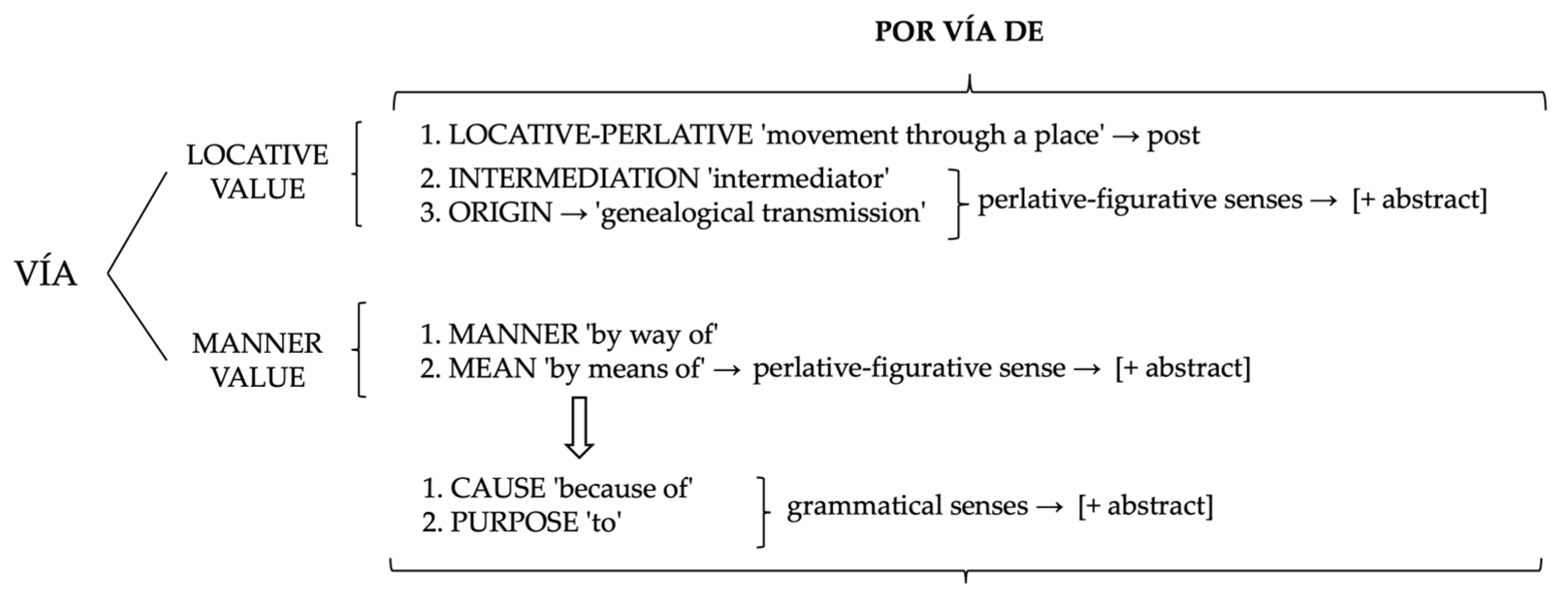
In summary, between the late 14th century and the early 16th century, vía grammaticalizes only some of its basic meanings (locative and manner) (Svorou, 1994) through semantic abstraction. In this regard, this noun within the construction incorporates more figurative values, mainly mediation (por vía de matrimonio ‘by means of marriage’) and others such as intermediation (por vía de un amigo ‘through a friend’; por vía de padre ‘on the father’s side’), cause (por vía de enfermedad ‘because of the illness’), or purpose (por vía de acompañarlo ‘in order to accompany him/her’). In the development of these more grammatical meanings, not only the noun but also the two prepositions that accompany it play a structuring role. In particular, the preposition por exerts the greatest influence on the acquisition of these more grammatical values by the noun within the complex preposition.
Figure 1.
Meanings of complex preposition por vía de.
This semantic bleaching provides evidence for the grammaticalization of the noun vía, as discussed in § 2. Nevertheless, semantic change on its own is insufficient to establish the grammaticalization of vía, so additional evidence is presented below.
First, as noted above, the semantic bleaching of the noun vía is accompanied by an expansion of the range of elements that can function as its prepositional object (condensation), providing further evidence of its grammaticalization. For example, while the locative-perlative meaning requires a locative noun as the prepositional object, the figurative meanings (mediation, intermediation, origin, cause, purpose) expand the types of complements to include person-denoting nouns, abstract nouns, event nouns and more complex structures such as noun clauses or infinitives.
Second, por vía de is semantically equivalent to prepositions such as de ‘of’ (origin), para ‘to’ (purpose), por ‘for’ (cause) or mediante ‘by means of’ (mediation), as well as to other complex prepositions such as a través de ‘through’ (intermediation) or a modo de ‘by way of’ (manner). Consequently, vía undergoes decategorization as a noun and is reanalyzed as part of a complex preposition. This reanalysis leads to the recategorization of vía as a functional noun that loses its nominal features (such as modification and inflection); however, “the properties of the noun do not disappear tout court” (Amaral & Delicado Cantero, 2018, p. 44) and the semantic features “remain in the construction and influence its development” (Amaral & Delicado Cantero, 2018, p. 44). In other words, vía is recategorized as a functional element within the expression, retaining certain nominal values (specifically some features of its locative and manner meaning) and, together with the prepositions por and de, functions as a prepositional element.
Formally, further evidence of grammaticalization appears in the loss of morphological properties and external fixation of vía. In the locative-perlative use, the noun is restricted to the singular, with no instances of por vías de in the corpus; likewise, plural forms are unattested for the causal and purposive meanings. The few occurrences of por vías de express intermediation ‘through’ (1 case; see 14a) or manner (‘by means of’/’by way of’) (14 cases; see 14b,c) and appear only sporadically across the centuries:
| (14) | a | […] porque a causa del mucho trato, en muchas de ellas tienen de mí noticia y de las cosas de México por vías de mercaderes. (Hernán Cortés, Cartas de relación, 1519–1526, CDH). |
| ‘[…] because, due to the extensive trade, in many of those places they have news of me and of the affairs of Mexico through merchants’. | ||
| b | […] sabed que catorze vezes e tenido en que entender en armas por vías de empresas e requestas e desafíos, […]. (Lope de Estúñiga, Réplica al conde de Fuensalida (Documentos relativos a Lope de Estúñiga), 1472, CDH). | |
| ‘[…] know that fourteen times I have had to engage in arms by means of enterprises, challenges, and duels […]’. | ||
| c | […] os tuve en mi casa, que os trastorné el sentido y que por vías de la solicitud codiciosa os hice hacer esto. (Miguel de Cervantes, Los trabajos de Persiles y Sigismunda, 1616, CDH). | |
| ‘[…] I kept you in my house, that I unsettled your senses, and that by means of greedy persuasion I induced you to do this’. |
The 15 instances of por vías de (0.49%), attested between the 15th and 20th centuries, are negligible compared with the dominant singular form por vía de (3072 cases, 99.51%). This distribution indicates that vía has undergone morphosyntactic fixation in the singular within the phrasal preposition and has lost its inflectional variability, providing robust evidence of both recategorization and grammaticalization.
The grammaticalization of the noun vía occurs only within the context of a lexicalized multi-word expression, indicating that such a lexicalized environment constitutes a necessary enabling condition for the process. Accordingly, por vía de exemplifies grammaticalization conditioned by lexicalization, as discussed in § 2. Nonetheless, the corpus data show that the degree of lexicalization of this phrasal preposition—and thus the syntactic analyzability—varies as a function of its meaning. The diachronic trajectory of this complex preposition therefore demonstrates that syntactic analyzability and semantic compositionality do not necessarily evolve in parallel, as presented below.
In this sense, the construction—regardless of the meaning it conveys—maintains a basic formal structure consisting of three elements in fixed order: por, vía, and de. This fixed configuration provides initial evidence of lexicalization. However, por vía de does not always remain intact, but instead exhibits internal variation. In the corpus, the noun vía may appear modified by the definite article (la) and, less frequently, by other modifiers, such as adjectives (e.g., ordinaria ‘ordinary, typical’ or frecuentada ‘frequented’) or the indefinite article un(a), as shown in these examples:
| (15) | a | […] en pago de los servicios recebidos, ha Josué començado a usar fazer mandones a los tales por una vía de agradecimiento. (Francisco de Osuna, Segunda parte del Abecedario espiritual, 1530, CDH). |
| ‘[…] in return for the services received, Joshua has begun to appoint such men as leaders by means of gratitude’. | ||
| b | […] se hará efectivo el importe de los expresados honorarios por la vía ordinaria de apremio que establece la ley de Enjuiciamiento civil. (Anónimo, Real Decreto (Leyes, reales decretos, reglamentos y circulares de más frecuente aplicación en los tribunales ordinarios por orden cronológico), 1893, CDH). | |
| ‘[…] the amount of the stated fees shall be enforced through the ordinary enforcement procedure established by the Civil Procedure Act. | ||
| c | […] una carta bien larga que escribí estando no buena, y envié por la vía de Medina, adonde decía de mi mal y de mi bien. (Santa Teresa de Jesús, Carta al P. Domingo Báñez en Valladolid. Salamanca, enero de 1574 (Epistolario), 1574, CDH). | |
| ‘[…] a very long letter that I wrote when I was unwell, and sent by way of Medina, in which I spoke of my troubles and of my well-being’. | ||
| d | En esto aparecieron en la misma ciudad de San Fernando, por la vía frecuentada de Sancti Petri, procedentes de Gibraltar, […]. (Antonio Alcalá Galiano, Memorias, 1847–1849, CDH). | |
| ‘At this point they appeared in the very city of San Fernando, by the well-traveled way of Sancti Petri, coming from Gibraltar, […]. | ||
| e | […] porque a la mañana lo supe por cierta vía de un amigo. (Miguel de Castro, Vida de Miguel de Castro, c1612, CDH). | |
| ‘[…] because in the morning I learned of it by the certain way of a friend’. | ||
| f | ¡El mayor de los nacidos por vía ordinaria de mujer, en la naturaleza hombre, […]! (Fray Alonso de Cabrera, Consideraciones sobre los Evangelios de los domingos de Adviento, a1598, CDH). | |
| ‘¡The greatest of those born by the ordinary way of woman, in his nature a man, […]! |
As we noted above, the internal variation is constrained by the meaning encoded by the complex preposition, indicating that the degree of lexicalization and, consequently, its syntactic analyzability decrease as the construction acquires more abstract semantic values. As shown in Table 4, the causal and purposive readings of por vía de exhibit no attestations of internal structural variation. With these meanings, therefore, the construction displays a high degree of lexicalization, resulting in a complete loss of syntactic analyzability.
Table 4.
Absolute occurrences and percentage of the formal variants of por vía de according to its meaning.
In contrast, the locative-perlative meaning (15c,d) has a markedly higher incidence of internal structural variation (por + modifier + vía + de, 72.89%) than the unmodified configuration (por + vía + de, 26.34%). Although the difference is not substantial, its degree of internal variation in por vía de with the intermediation meaning (15e) is nevertheless noteworthy: 16.91% for por + modifier + vía + de and 5.15% for por + vía + modifier + de, compared with 77.94% of cases showing no structural change. These quantitative patterns indicate that meanings closest to the locative domain—conceived as “transfer” events, whether across places or through persons—activate the residual nominal properties of vía through modification. Therefore, this phrasal preposition, with these meanings, exhibits a lower degree of lexicalization and a higher degree of syntactic analyzability.
Finally, with respect to the manner of reading (15a,b), the quantitative evidence shows that although occurrences with no internal modification are overwhelmingly dominant (93.69%), all three patterns of internal structural alternation are nevertheless attested (modifier-preposed, modifier-postposed, and double-modification). A comparable distributional pattern can be observed for the ‘origin’ meaning (15f); however, the attested examples are too sparsely distributed across the relevant structural configurations to permit any robust generalizations.
Documentation by century also reveals a difference between locative and manner values. As shown in Table 5, cases involving modification of the structure with a locative value decrease progressively from the 16th to the 20th century, whereas in manner value increases from the 19th century onward and becomes consolidated in the 20th century, with 69.4% of the cases attested in these two centuries. Modification with a locative value, although more frequent in the corpus overall, decreases over time, which would suggest a higher degree of grammaticalization/lexicalization. By contrast, the increase in cases of modification with a manner value points to a reactivation of the nominal features of vía from the 19th century onward, possibly because this noun retains that meaning outside the phrasal preposition20.
Table 5.
Occurrences by document (o/d) and percentage (%) of the modification of por vía de according to its meaning.
As evidenced by empirical data, preservation of the construction’s canonical structural configuration is predominant. Only in the locative-perlative reading does internal reconfiguration (specifically, the pre-posed placement of the modifier) become the dominant pattern, even though this pattern has progressively weakened over the centuries. In the manner reading, instances of modification are very infrequent; however, an increase can be observed from the 19th century onwards. The noun reactivates its nominal properties when it retains its basic meanings (place and manner/means) within the complex preposition. In this context, the construction displays reduced lexicalization and increased analyzability, although this does not preclude its status as a lexicalized unit. As Codita (2017, pp. 21–22) points out, there are a few complex prepositions that do “allow for some alteration of their structure”. These modifications are accounted for as instances of potential phraseological variation in certain complex prepositions, since the observed structural changes do not affect their meaning. Although such variation is limited, its presence demonstrates that syntactic analyzability and semantic compositionality do not necessarily correlate.
In sum, the diachronic analysis of vía has shown that this locative noun has undergone grammaticalization, manifested through semantic abstraction, recategorization, loss of morphological properties, external fixation, and condensation. However, this development is restricted to a lexicalized multi-word construction in which vía appears with two prepositions (por and de). The construction exhibits degrees of internal fixation depending on its interpretation: uses nearest to the locative domain (i.e., transfer events) permit internal structural variation and thus display higher syntactic analyzability. In contrast, in more abstract or grammatical meanings (such as causal or purposive values) the structure becomes morphosyntactically fixed and does not permit internal modification. This pattern indicates that higher degrees of grammaticalization of vía within the phrasal preposition correlate with greater structural fixation, lower analyzability, and, consequently, with increased lexicalization.
5. Conclusions
The analysis of the phrasal preposition por vía de confirms that the inventory of units with prepositional function (traditionally assumed to be a closed class) can undergo expansion. Such expansion arises through the formation of complex prepositions in which a noun, in this case a locative noun, undergoes grammaticalization within a lexicalized multi-word construction. This indicates, therefore, that prepositions are not resistant to diachronic change, but instead undergo its consequences (Cifuentes Honrubia, 2003; Codita, 2017).
Second, the emergence of phrasal prepositions through grammaticalization raises a challenge within the theoretical framework, since complex prepositions are lexicalized expressions that are syntactically opaque and therefore exhibit structural fixation, but have grammatical meaning. The diachronic evidence presented here shows that this apparent contradiction is resolved if we assume that such constructions undergo grammaticalization conditioned by lexicalization. In this view, the resulting phrasal preposition constitutes a new grammatical element, through grammaticalization of one of its constituents, with lexicalization functioning as a necessary—but secondary—factor for its development. This interaction between the two processes in which grammaticalization operates due to lexicalized structure also helps explain other syntactic constructions, such as phrasal adverbs and conjunctions (Elvira, 2020).
This study has provided evidence for the grammaticalization of the noun vía from its two basic semantic domains—locative and manner—within a lexicalized multi-word expression. One indication of this process is the development of increasingly abstract meanings through the expansion of its combinatory possibilities (condensation). In the locative domain, vía within por vía de denotes the space between two physical places, and its prepositional object is typically a place noun, often a toponym (e.g., por vía de Madrid ‘by way of Madrid’). From this locative-perlative value, attested since the 13th century, vía extends to more figurative (and thus more abstract) meanings when the complement refers to a person (or personified noun) (e.g., por vía de Juan ‘through Juan’, por vía de padre ‘on the father’s side’). In these figurative uses, vía undergoes semantic bleaching: it loses its concrete spatial meaning but retains the notion of ‘transfer’ between two entities. Diachronically, the intermediation reading appears in the late 15th century, while the origin reading emerges somewhat later, in the first half of the 16th century.
From the late 14th century, vía within the construction develops a figurative-perlative meaning of mediation, where the means is viewed as the intermediate stage between an intention and its fulfillment (e.g., por vía de matrimonio ‘by means of marriage’). Because means, cause, and purpose are closely related (since the means functions as the instrumental cause through which an end is achieved), vía subsequently undergoes semantic bleaching and comes to express cause (e.g., por vía de enfermedad ‘because of illness’) and purpose (e.g., por vía de pagar ‘in order to pay’). These more abstract meanings emerge somewhat later, in the late 15th century.
The semantic bleaching of vía results in its recategorization: the noun no longer functions as a nominal element but assumes a functional role, though only within the construction por vía de. Consequently, the expression becomes functionally equivalent to prepositions or other phrasal prepositions (para ‘to’, mediante ‘by means of’, a causa de ‘because of’, a través de ‘thought’). Its loss of nominal properties is evidenced by the absence of inflection. Diachronic data further show external fixation: plural forms of vía (por vías de) appear only sporadically, in contrast to the predominant singular form por vía de.
From a formal perspective, substantial differences among the meanings encoded by vía within the phrasal preposition have been identified, and these differences directly affect its degree of analyzability. The construction undergoes two phases of internal fixation. In the first phase, the three elements of the expression (por, vía, and de) and their linear order become fixed, regardless of the meaning conveyed by the complex preposition. In the second phase, internal fixation depends on the semantic value encoded: the greater the abstraction of the expression’s meaning and the weaker its association with its basic meanings outside the construction (locative and manner), the higher the degree of internal fixation it exhibits. Thus, within the locative domain, the locative-perlative meaning shows a high degree of analyzability, as the insertion of a modifier (particularly in preverbal position) is highly frequent.
From a semantic perspective, this value preserves the spatial concreteness associated with physical location, which facilitates its analyzability. The few cases of internal modification found in the ‘intermediation’ and ‘origin’ meanings can be explained by the partial retention of the original locative sense, grounded in the underlying notion of ‘transfer’ that persists in these interpretations. By contrast, in the manner domain por vía de is not analyzable—especially when it expresses ‘cause’ or ‘purpose’—since no instances are attested in which a modifier intervenes between the elements of the construction. When the complex preposition denotes ‘manner’ or ‘means’, occasional examples do show the insertion of a modifier before the noun vía. Although these cases are marginal, their presence nevertheless demonstrates that syntactic analyzability and semantic compositionality do not always align.
The data presented in this study demonstrate that the formation of complex prepositions reveals that grammaticalization may be conditioned by prior lexicalization, as exemplified by vía and the phrasal preposition por vía de. Future research may extend the analysis of por vía de into the 21st century, explore its diatopic variation or its relationship with por vía + adjective (por vía oral ‘by oral route’), and assess whether the interaction pattern proposed here (grammaticalization conditioned by lexicalization) applies to other phrasal prepositions and adverbs.
Funding
This research was funded by Ministerio de Ciencia e Innovación of the Government of Spain, grant number PID2021-123617NB-C41, and by Departament d’Universitats, Recerca i Societat de la Informació of Generalitat de Catalunya, grant number 2021 SGR 00157.
Institutional Review Board Statement
Not applicable.
Informed Consent Statement
Not applicable.
Data Availability Statement
Data are available upon request from the author.
Conflicts of Interest
The author declares no conflicts of interest.
Notes
| 1 | The noun vía also appears in the phrasal preposition en vías de ‘in the process of’, where it acquires a prospective temporal value (e.g., La humanidad está en vías de desaparecer ‘Humanity is in the process of disappearing’). We leave the analysis of this complex preposition for future research. |
| 2 | See Sáez Rivera (2014) for a comprehensive survey of studies on the history of Spanish from the perspective of grammaticalization and lexicalization. |
| 3 | Although this paper focuses on a phrasal preposition (por vía de), in this section we also use phrasal adverbs to illustrate more clearly the effects of grammaticalization and lexicalization in these multi-word expressions. |
| 4 | Meillet’s classic definition of grammaticalization is “l’attribution du caractère grammatical à un mot jadis autonome” (Meillet, 1912, p. 131). |
| 5 | That is, the “increase of the range of a morpheme advancing from a lexical to a grammatical, or from a less grammatical to a more grammatical, status” (Kuryłowicz, 1965, p. 52). For an overview of the definitions of grammaticalization, see Campbell and Janda (2001). |
| 6 | Evidently, the formal changes are accompanied by functional ones, but here we simply illustrate the erosion and fusion observed in camino (de). |
| 7 | For further discussion of the relationship between the Cognitive framework and grammaticalization theory, see the extensive literature on the topic, particularly Sweetser (1990) and Heine et al. (1991). |
| 8 | According to Garachana Camarero (2015, p. 339), “pragmatic approaches involve a view of grammaticalization as expansion (not reduction)”. |
| 9 | In fact, many “grammatical words” are the result of grammaticalization that originates in one of the major categories (verbs, nouns, adjectives) and results in an adverb, preposition, or conjunction (see Espinosa Elorza, 2010). |
| 10 | There is a theoretical debate about the relationship between semantic compositionality and analyzability. As shown in the analysis of por vía de and noted by several authors (Traugott & Trousdale, 2013; Vincent, 2015; Amaral & Delicado Cantero, 2021), some constructions may lose compositionality while still retaining analyzability. |
| 11 | Data were collected through a lemma-based search for vía, allowing the retrieval of all orthographic and inflectional variants, and through a proximity search with a one-element distance between this noun and the preceding preposition por and the following preposition de. Related patterns involving vía—such as vía + adjective or en vías de—were omitted due to space constraints and left for future research. |
| 12 | The CDH’s textual classification is imprecise and inconsistently applied. A more accurate text classification—such as that used in other historical corpora (e.g., CODEA)—would be preferable. |
| 13 | We use the abbreviation Cop. (copied) to indicate the date of the testimony according to Octavio de Toledo and Rodríguez Molina (2017) whenever it differs from the CDH. If no such indication is given, it is because the document is not included among the texts considered by these authors. |
| 14 | The noun can express either a locative meaning referring to a physical place or a figurative meaning denoting, for example, the course taken by a person. |
| 15 | The basic meanings of the noun vía are the locative and the manner values. Therefore, any figurative extensions of the noun vía constitute a semantic abstraction and thus instances of semantic bleaching. |
| 16 | The association of this meaning with the domain of manner is supported by the frequent co-occurrence of the noun manera ‘manner’ with the phrasal preposition (see example 7a). |
| 17 | Although there is a logical connection between the locative-perlative meaning and the figurative-perlative (mediation) meaning, both values were already present in the Latin noun vĭa. Consequently, the difference attested in the earliest documentation does not imply that the locative-perlative value gave rise to the value of mediation. |
| 18 | Despite the variety of nouns, the corpus shows frequent occurrences of terms denoting taxes, payments, legal procedures, or penalties in legal and administrative texts, particularly in the medieval period. |
| 19 | Due to the frequent ambiguity between the two interpretations, they were operationally merged for quantitative analysis. |
| 20 | In fact, Amaral and Delicado Cantero (2021) demonstrate that the persistence of the link between recategorized functional nouns in the domain of connectives and their status as full nouns outside the construction is especially evident with respect to the preservation of their combinatorial properties. |
References
- Amaral, P., & Delicado Cantero, M. (2018). Subcategorization and change. A diachronic analysis of sin embargo (de que). In J. E. MacDonald (Ed.), Contemporary trends in hispanic and lusophone linguistics (pp. 31–48). John Benjamins. [Google Scholar] [CrossRef] [Scilit]
- Amaral, P., & Delicado Cantero, M. (2021). Noun-based constructions in the history of Portuguese and Spanish. Oxford University Press. [Google Scholar] [CrossRef] [Scilit]
- Brinton, L. J., & Traugott, E. C. (2005). Lexicalization and language change. Cambridge University Press. [Google Scholar] [CrossRef] [Scilit]
- Buenafuentes de la Mata, C. (2016). Construcciones con sustantivos cuantificadores en español: Entre la gramaticalización y la lexicalización. In R. González Ruiz, C. Llamas, & A. Jimeno (Eds.), Lingüística y pragmática. Estudios sobre gramática (pp. 39–54). Síntesis. [Google Scholar]
- Buenafuentes de la Mata, C., & Sánchez Lancis, C. (2012). Procesos de gramaticalización y lexicalización a la luz de los corpus académicos. In T. E. Jiménez, B. López, V. Vázquez, & A. Veiga (Eds.), Cum corde et in nova grammatica: Estudios ofrecidos a Guillermo Rojo (pp. 153–165). Universidade de Santiago de Compostela. Available online: http://hdl.handle.net/10347/12192 (accessed on 1 September 2025).
- Buenafuentes de la Mata, C., & Sánchez Lancis, C. (in press). Camino (de) Soria: Gramaticalización y lexicalización del sustantivo locativo camino en español. In Actas del XI congreso internacional de historia de la lengua Española. Peter Lang.
- Campbell, L., & Janda, R. D. (2001). Introduction: Conceptions of grammaticalization and their problems. Language Sciences, 23(2–3), 93–112. [Google Scholar] [CrossRef] [Scilit]
- Cifuentes Honrubia, J. L. (2003). Locuciones prepositivas. Sobre la gramaticalización preposicional en español. Universidad de Alicante. [Google Scholar]
- Codita, V. (2017). La conformación y el uso de las locuciones prepositivas en castellano medieval. Iberoamericana. [Google Scholar]
- Company Company, C. (2016). Sintaxis histórica y tradiciones discursivas. El género textual como macrolocus del cambio sintáctico. In A. López Serena (Ed.), El español a través del tiempo. Estudios ofrecidos a Rafael Cano Aguilar (pp. 385–415). Publicaciones de la Universidad de Sevilla. [Google Scholar]
- Corominas, J. (1980–1991). Diccionario crítico etimológico, castellano e hispánico (DECH). Gredos. [Google Scholar]
- Elvira, J. (2006). Aproximación al concepto de lexicalización. In J. Rodríguez Molina, & D. M. Sáez Rivera (Eds.), Diacronía, lengua española y lingüística (pp. 21–41). Síntesis. [Google Scholar]
- Elvira, J. (2009). Evolución lingüística y cambio sintáctico. Peter Lang. [Google Scholar] [CrossRef] [Scilit]
- Elvira, J. (2015). Lingüística histórica y cambio gramatical. Síntesis. [Google Scholar]
- Elvira, J. (2020). Lexicalización primero, gramaticalización después: Aproximación a la génesis de cualquiera. In M. J. Martínez Alcalde, J. P. Sánchez Méndez, F. J. Satorre, M. Quilis, A. Ricós, A. G. Valle, F. P. Pla Colomer, & S. Vicente (Eds.), El español y las lenguas peninsulares en su diacronía: Miradas sobre una historia compartida. Estudios dedicados a M.ª Teresa Echenique Elizondo (pp. 153–168). Tirant lo Blanch. [Google Scholar]
- Espinosa Elorza, R. M. (2010). Procesos de formación y cambio en las “palabras gramaticales”. Cilengua. [Google Scholar]
- Garachana Camarero, M. (2015). Teoría de la gramaticalización. Estado de la cuestión. In J. M. García Martín (Ed.), Actas del IX congreso internacional de historia de la lengua Española (pp. 331–360). Iberoamericana-Vervuert. [Google Scholar]
- Heine, B., Claudi, U., & Hünnemeyer, F. (1991). Grammaticalization. A conceptual framework. The University of Chicago Press. [Google Scholar]
- Hopper, P., & Traugott, E. C. (1993/2003). Grammaticalization. Cambridge University Press. [Google Scholar]
- Insausti Muñoz, C. (2020). Variación diacrónica y diatópica en la formación de locuciones preposicionales: El caso de de cara a. In M. Martínez-Atienza de Dios, M. C. García, & S. Rodríguez (Eds.), Entre la morfología, la sintaxis y la semántica: Límites e intersecciones (pp. 327–334). Tirant lo Blanch. [Google Scholar]
- Kabatek, J. (2005). Tradiciones discursivas y cambio lingüístico. Lexis, 29(2), 151–177. [Google Scholar] [CrossRef] [Scilit]
- Kuryłowicz, J. (1965). The evolution of grammatical categories. Enquisses Linguistiques, 2, 38–45. [Google Scholar] [CrossRef] [Scilit]
- Lehmann, C. (2015). Thoughts on grammaticalization. Language Science Press. (Original work published 1995). [Google Scholar] [CrossRef]
- Lewis, C. T., & Short, C. (1879). A Latin dictionary. Oxford University Press. [Google Scholar]
- Meillet, A. (1912). L’évolution des formes grammaticales. In Linguistique historique et linguistique générale (pp. 130–148). Champion. [Google Scholar]
- Moreno Cabrera, J. C. (1998). On the relationship between grammaticalization and lexicalization. In A. Giacalone, & P. J. Hopper (Eds.), The limits of grammaticalization (pp. 211–227). John Benjamins. [Google Scholar] [CrossRef] [Scilit]
- Morera Pérez, M. (1998). Teoría preposicional y origen y evolución del sistema preposicional español. Servicio de Publicaciones del Cabildo Insular de Fuerteventura. [Google Scholar]
- Octavio de Toledo, Á. S., & Rodríguez Molina, J. (2017). La imprescindible distinción entre texto y testimonio: El CORDE y los criterios de fiabilidad lingüística. Scriptum Digital, 6, 5–68. [Google Scholar] [CrossRef] [Scilit]
- Oxford University Press. (1968). Oxford Latin dictionary (OLD). Oxford University Press. [Google Scholar]
- Pavón Lucero, M. V. (1999). Clases de partículas: Preposición, conjunción y adverbio. In I. Bosque, & V. Demonte (Eds.), Gramática descriptiva de la lengua española (pp. 565–655). Espasa Calpe. [Google Scholar]
- Plaza de la Ossa, M. (2006). Orilla, un caso de gramaticalización. Interlingüística, 17, 817–826. [Google Scholar]
- Real Academia Española. (1726–1739). Diccionario de autoridades. Imprenta de Francisco del Hierro. Available online: https://webfrl.rae.es/DA.html (accessed on 1 September 2025).
- Real Academia Española & ASALE. (n.d.). Corpus del Diccionario histórico de la lengua Española (CDH). Available online: https://apps.rae.es/CNDHE (accessed on 1 September 2025).
- Real Academia Española & ASALE. (n.d.). Corpus del Español del siglo XXI (CORPES XXI). Available online: https://www.rae.es/corpes/ (accessed on 1 September 2025).
- Real Academia Española & ASALE. (2025). Nueva gramática de la lengua Española. Espasa. [Google Scholar]
- Santos Domínguez, L. A., & Espinosa Elorza, R. M. (1996). Manual de semántica histórica. Síntesis. [Google Scholar]
- Sáez Rivera, D. M. (2014). Bibliografía PROGRAMMES sobre gramaticalización y lexicalización. In J. L. Girón Alconchel, & D. M. Sáez Rivera (Eds.), Procesos de gramaticalización en la historia del español (pp. 23–44). Iberoamericana. [Google Scholar]
- Sánchez Lancis, C. (2016). Procesos de lexicalización y gramaticalización en la formación de locuciones preposicionales: (con/en) dirección a. In R. González Ruiz, C. Llamas, & A. Jimeno (Eds.), Lingüística y pragmática. Estudios sobre gramática (pp. 155–169). Síntesis. [Google Scholar]
- Svorou, S. (1994). The grammar of space. John Benjamins. [Google Scholar] [CrossRef] [Scilit]
- Sweetser, E. (1990). From etymology to pragmatics. Cambridge University Press. [Google Scholar] [CrossRef] [Scilit]
- Tornel Sala, J. L. (2000). Gramaticalización y cognición: Pautas definitorias e interrelación. Letras de Deusto, 30(88), 111–140. [Google Scholar]
- Traugott, E. C. (1995). Subjectification in grammaticalisation. In D. Stein, & S. Wright (Eds.), Subjectivity and subjectivisation (pp. 31–54). Cambridge University Press. [Google Scholar] [CrossRef] [Scilit]
- Traugott, E. C., & Trousdale, G. (2013). Constructionalization and constructional changes. Oxford University Press. [Google Scholar] [CrossRef] [Scilit]
- Vincent, N. (2015). Compositionality and change. In C. Bowern, & B. Evans (Eds.), The Routledge handbook of historical linguistics (pp. 103–123). Routledge. [Google Scholar] [CrossRef] [Scilit]

Disclaimer/Publisher’s Note: The statements, opinions and data contained in all publications are solely those of the individual author(s) and contributor(s) and not of MDPI and/or the editor(s). MDPI and/or the editor(s) disclaim responsibility for any injury to people or property resulting from any ideas, methods, instructions or products referred to in the content. |
© 2026 by the author. Licensee MDPI, Basel, Switzerland. This article is an open access article distributed under the terms and conditions of the Creative Commons Attribution (CC BY) license.