Article

The Variety of Adramytti and Its Relationship to Modern Lesbian: Dialect Formation and Classification


1
Institute of Modern Greek Studies, Aristotle University of Thessaloniki, 54124 Thessaloniki, Greece
2
Research Centre for Modern Greek Dialects, Academy of Athens, 10673 Athens, Greece
*
Authors to whom correspondence should be addressed.
Languages 2026, 11(4), 75; https://doi.org/10.3390/languages11040075
Submission received: 15 February 2026 / Revised: 13 March 2026 / Accepted: 17 March 2026 / Published: 10 April 2026
(This article belongs to the Special Issue The Modern Dialect of Lesbos: Selected Topics)

Abstract

Modern Greek was spoken along the northwestern coast of Asia Minor until the early 20th century, yet neither its precise geographical extent nor its dialectal classification is well established. This paper seeks to clarify both issues by focusing on the variety of Adramytti (Edremit). The available evidence suggests that Adramyttian, despite its close relationship to and partial origin in Modern Lesbian, was essentially a mixed variety that leveled out many characteristic Modern Lesbian features, such as the raising of unstressed mid vowels and certain morphological phenomena. Such differences can be attributed to the diverse character of the speech community that led to contact between speakers of Modern Lesbian origin and speakers of other Greek dialects. In addition to providing a grammatical description of Adramyttian, which demonstrates its mixed profile, the paper offers a tentative classification of this variety in relation to Modern Lesbian and the other insular varieties of northeastern Aegean, as well as in relation to other neighboring varieties of northwestern Asia Minor (Aeolis, Mysia, northern Ionia).

1. Introduction

Very little is known about the form of Modern Greek spoken until the early 20th century in the regions of northwestern Asia Minor traditionally known as Aeolis, Mysia, and the Troad, which lie to the east, northeast, and north of Lesbos. The only exception is the variety of Aivalí (Ayvalık)–Moschonisia (Alibey Adası)1, which has been studied in sufficient detail (Sakkaris, 1940; Ralli, 2007; Melissaropoulou, 2007, among others). A crucial problem is that even today, more than one hundred years after the population exchange between Greece and Turkey, which led to the almost complete eradication of local Greek and its transplantation within the borders of the Greek state, we still lack a clear picture of the number and precise location of Greek settlements in the area, the proportion of native Greek speakers among the inhabitants, and, above all, the dialectological classification of the Greek varieties spoken there.
Triantafyllidis (1938/1993, p. 247), in referring to the western and northwestern coasts of Asia Minor, merely observes that these varieties did not resemble Cappadocian or Pontic, since they did not derive from an indigenous Medieval Greek variety but rather from more recent migrations from Lesbos and other regions. Kontosopoulos (2008, pp. 92–94), using northern vocalism (i.e., the deletion of unstressed /i, u/ and the raising of unstressed /e, o/ to [i, u]) as a criterion, classifies the varieties spoken from Lampsakos (Lapseki) to Pergamon (Bergama) as “Northern Greek”. He later, however, refers to a group of “Western Asia Minor” varieties (Kontosopoulos, 2008, pp. 114–115) which, apparently on geographical grounds, include all dialects spoken from Bithynia in the north to Livisi (Kayaköy) in the south.
More recently, Ralli and Vogiatzis (2024) provided comparative typological information on selected phonological features (e.g., deletion, insertion, and change in phonemes), inflectional morphology (nominal and verbal), and derivation, drawing on data from all the islands of the central and northern Aegean (except for Skyros and Chios) and from three settlements of northwestern Asia Minor (Aivalí–Moschonisia, Alaklise, and Kouvouklia). Although the study does not arrive at a definitive conclusion regarding the relationship between the insular varieties and the Asia Minor varieties examined, the authors observe, in their discussion of nominal inflection, that “the [nominal] systems of both groups developed under the same evolutionary forces, despite occasional idiosyncratic differences.”
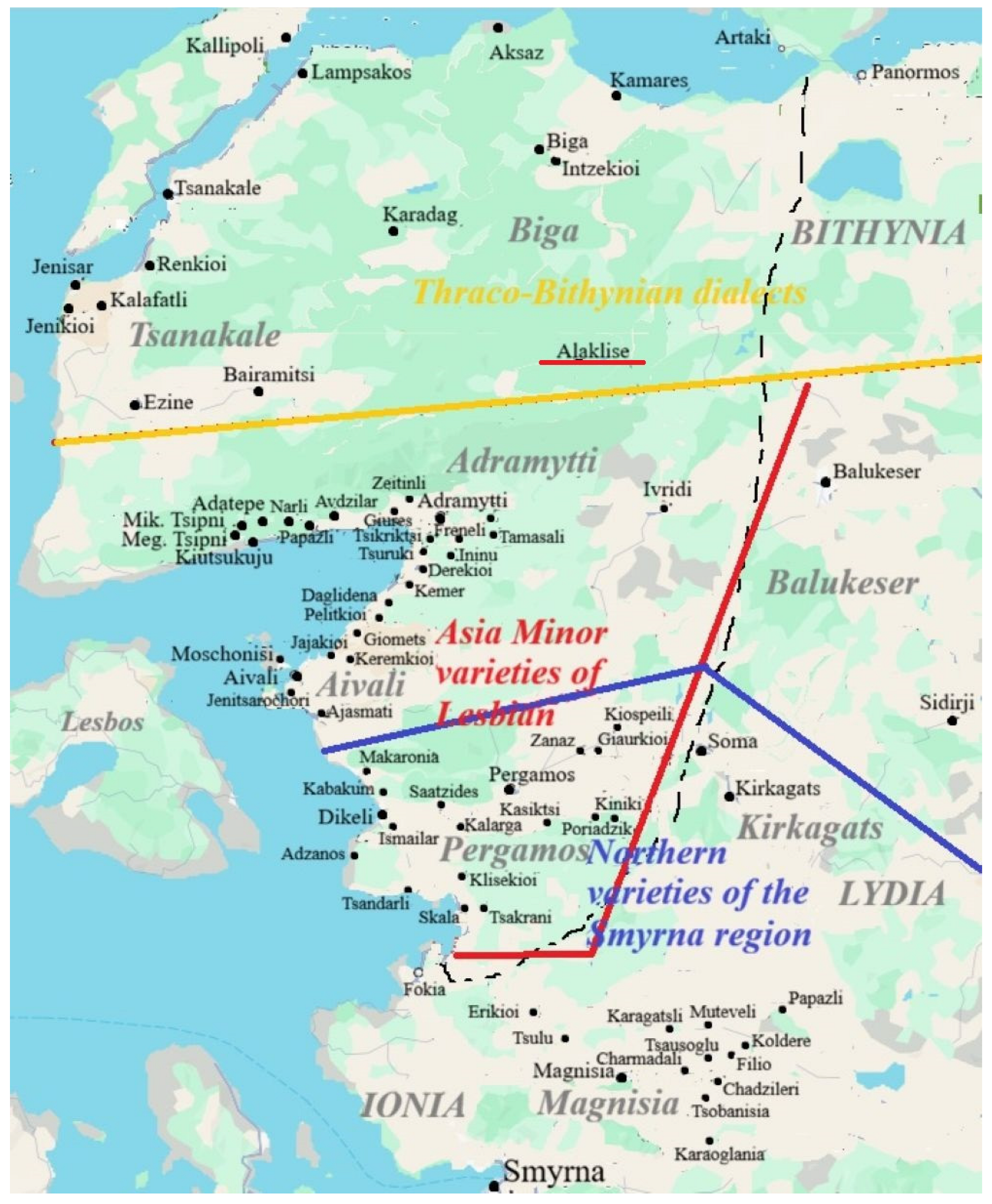
Finally, Mertyris and Liosis (forthcoming) seek to fill this gap in Modern Greek dialectological research concerning the identity and classification of the Greek dialects of northwestern Asia Minor based on unpublished primary linguistic material2. Their study focuses on the intermediate area between the Thraco-Bithynian dialects to the north and northeast (for which see Liosis, forthcoming) and the varieties of the Smyrna region (İzmir; Ionia) to the south (for which see Liosis, 2016; Markopoulos, 2019). Specifically, they test the hypothesis that the Greek dialects spoken in this intermediate area historically derive primarily from the Modern Lesbian dialect, despite some structural and lexical differences. These differences can, in principle, be attributed either to substrate features surviving from the pre-Ottoman period (cf. Manolessou (2019) for the presence of such features in neighboring eastern Bithynia) or to the incorporation of dialectal elements from other Aegean islands, various regions of mainland Greece and Thrace, or other, usually neighboring, Asia Minor settlements. In many cases, the coexistence of diverse features appears to be the result of dialectal mixing, which contributed to the formation of the distinctive identity of these varieties. Mertyris and Liosis (forthcoming) also consider multiple testimonies by inhabitants concerning the origin and composition of their settlements, as well as the inhabitants’ own metalinguistic comments on the dialect of their locality and on perceived similarities to or differences from neighboring varieties (cf. the recurring expression μιλούσαμε όπως στη Μυτιλήνη “we used to speak like [they speak] in Mytilene”). Their proposed classification of the dialects of the wider area is illustrated in Map 1 below.
The varieties spoken throughout the entire zone to the left of the red line share so many features with Modern Lesbian that Mertyris and Liosis (forthcoming) describe them as Asia Minor varieties of Modern Lesbian, and their speakers are generally aware of their common origin. Specifically, the dialects of the settlements between the yellow and blue lines (the regions of Adramytti and Aivali) show close affinity to or near identity with Modern Lesbian, while those between the red and the horizontal blue lines (the region of Pergamos) also share many grammatical features with Modern Lesbian, albeit fewer than those of the first group; additionally, according to the two authors the complete or partial Modern Lesbian origin of their inhabitants is explicitly mentioned in the sources for almost all the villages of the red zone. In contrast, the Thraco-Bithynian group, which lies north of the yellow line, includes varieties that are linguistically closer to Imbros and Eastern Thrace, and the presence of exclusively or predominantly Modern Lesbian features (e.g., diminutives in -έλι) is limited. The so-called Northern varieties of the Smyrna region (below the horizontal red line) may occasionally exhibit some common features with Modern Lesbian and other (semi)northern varieties (e.g., sporadic deletion of unstressed /i, u/ in Koldere), but, overall, they show greater affinity to the zone of Smyrna itself (cf. Liosis, 2016).
Map 1. The Greek-speaking settlements of northwestern Asia Minor (adapted from Mertyris & Liosis, forthcoming). The names of the settlements have been transliterated into the Latin alphabet according to their Greek orthography or of their orthography adapted from Turkish into Greek.
Languages 11 00075 g001
The present paper constitutes a case study focusing on the description and analysis of Adramyttian, a variety that belongs to the core group of the Modern Lesbian varieties of Asia Minor (see Map 1), within the broader effort to elucidate, also at the micro-level, the dialectal landscape of northwestern Asia Minor. As will be shown below, however, this variety is not the result of passive transfer or simple imitation of Modern Lesbian features. Nor could it be, since the Modern Lesbian population of Adramytti came from different parts of the island, where distinct subvarieties are spoken, and arrived in successive migration waves that were not always permanent (see the subsection Adramytti: Demographic and Historical Background below).
Beyond this, Adramyttian displays quite a few “unusual” or unexpected features, in the sense that they are either entirely absent from Modern Lesbian or occur there with reduced distribution and frequency. Some of the features that are absent from Modern Lesbian are attested in the other islands of the northeast Aegean and/or further north and east in various Thraco-Bithynian dialects; others, however, appear to constitute genuine innovations in Adramyttian or to have assumed a different function in comparison with the source system from which they likely derive. Another striking characteristic of Adramyttian is the pervasive presence of variation at virtually every level of linguistic analysis: very often two or even three different variants of the same grammatical feature are tolerated side by side. This results in a degree of heterogeneity that is unusual even for communities with an exclusively oral tradition and without overt processes of elaboration or codification. Such phenomena of dialect contact and dialect formation have long been recognized in the literature (see Section 2), but they have not been studied in sufficient depth with respect to Greek varieties and are of clear theoretical interest.
Another reason for focusing on Adramyttian is that, in this case, we are relatively fortunate: apart from Aivaliot, this Modern Lesbian-related variety is the only one in the area that has been documented in sufficient detail, since primary dialectal material from other settlements in the region is extremely limited, fragmentary, and oftentimes not particularly reliable. The material at our disposal derives primarily from manuscript no. 1446 of the Hellenic Folklore Research Center of the Academy of Athens3. This manuscript was submitted in September 1940 by D. Loukatos, who conducted fieldwork on Lesbos, where he encountered refugees from Adramytti in Mytilene, the island’s capital. The material was collected through interviews with six informants (two elderly speakers, aged 72 and 65, and four younger ones, probably in their fifties; see Loukatos, 1957, p. 101). The substantial size of the manuscript, together with the relatively high degree of accuracy with which the researcher recorded the informants’ narratives (albeit using the Greek alphabet), allows us to reconstruct a comprehensive picture of the variety’s profile and to describe its features in considerable detail. A smaller amount of additional dialectal material from Adramytti is also included in a later publication by Loukatos (1957), which is primarily of ethnological interest.
Taking all the above observations into account, and based on a set of predefined grammatical isoglosses, we therefore attempt to make an informed assessment of the character of Adramyttian and to classify it in relation to Modern Lesbian and the other insular varieties of the northeastern Aegean, as well as to northwestern Asia Minor Greek. To this end, we also consulted broader studies on the dialects of western Asia Minor (Liosis, 2016, forthcoming; Manolessou, 2019), as well as specialized studies on the dialects of Lesbos, Aivali, and Moschonisia (Anagnostou, 1903; Kretschmer, 1905; Alexelli, 2021; Sakkaris, 1940, 1948–1952; Ralli, 2006, 2007, 2017, 2019; Melissaropoulou, 2006, 2007; Ralli & Melissaropoulou, 2007, etc.), on Bithynian (e.g., Danguitsis, 1943; Deligiannis, 2002; Konstantinidou, 2005; Papadopoulou, 2010, etc.), and on the islands of the northeastern Aegean (Kontonatsiou, 1988 [Limnos]; Tompaidis, 1967; Vogiatzis, 2021 [Thasos]; Tsolaki, 2009 [Samothraki]; Tzavaras, 2016 [Imbros]; Papameri, 2005; Kerkineoglou, 2009 [Tenedos], etc.).

Adramytti: Demographic and Historical Background

Adramytti (Edremit) is a city located at the innermost part of the Gulf of Adramytti, directly opposite Lesbos (see Map 1) in the modern province of Balıkesir, Turkey. Its current name preserves the name of the ancient city of Adramyttion. According to the Oral Tradition Archive of the Center for Asia Minor Studies (as cited in Mertyris & Liosis, forthcoming), prior to the expulsions of Christians residing in various parts of western Asia Minor in 1914 and the subsequent population exchange between Greece and Turkey between 1922 and 1924, most Greek-speaking inhabitants of Adramytti were originally from Lesbos. However, this was not the only group present, as other Greek speakers had come from neighboring Aivalí and other villages of the region, as well as from other nearby islands and (Eastern) Thrace (e.g., Ganochora). In addition, a smaller “local” Greek-speaking population is also mentioned, though its precise origin is difficult to determine. It may reflect an indigenous Greek-speaking population of medieval origin or, more likely, Greek speakers who settled in the area before the migrations that are documented to us (possibly during the 18th century or even earlier).
An early 19th c. source mentions that Adramytti was only populated by a few Greek fishermen (Dearborn, 1819, pp. 51–52). This situation apparently changed when during the next decades many Greeks (mainly from Lesbos) settled in the area. According to Kalfoglous (1899/2002, p. 113), Kontogiannis (1921/2000, pp. 271–272), and the Oral Tradition Archive of the Center for Asia Minor Studies, the number of Greeks was approximately 7000 at the beginning of the 20th c., but they were still slightly outnumbered by the Turkish population. There was also a small number of Armenians, Jews, and Tatars, with the total population reaching 17,000.

2. Some Theoretical Considerations

The above historical and demographic data allow us to hypothesize that Adramyttian was essentially a new variety that emerged in the area through contact and mixing between Modern Lesbian subvarieties and other Modern Greek varieties as input dialects. There are two main theoretical models that describe the processes through which new dialects arise and acquire a specific profile (cf. Hickey, 2018, pp. 33–34): Trudgill’s (2004, 2008) model of “New Dialect Formation” and Schneider’s (2003, 2007) “Dynamic Model”.
The former incorporates a historically oriented developmental trajectory that includes an initial stage of extreme variation and rudimentary leveling, an intermediate stage characterized by further leveling, and a final stage in which the new dialect becomes focused (stabilized). Although leveling, understood as the elimination of marked features (i.e., typologically unusual, minority, or stereotyped traits), is the primary and most common cross-linguistic mechanism in dialect formation in contact settings, it is not the only one. Simplification is also frequently observed, i.e., a process aimed at regularizing linguistic structure (e.g., fewer grammatical categories and distinctions, fewer constraints on variation, etc., than those present in the input dialects of the initial mix), as is the reallocation of functions between two variants that survive but acquire complementary roles in the output variety. In some cases, a leveling or simplifying change may remain incomplete or may not be particularly “successful”, resulting in an intermediate outcome: an interdialectal form that does not correspond exactly to any feature of the source dialects of a given speech community. For these processes, which are commonly subsumed under the umbrella term koineization, see the now classic work of Trudgill (1986), and cf. Britain (2018, pp. 149–152).
The latter model emphasizes the fundamental relationship between social identities and linguistic forms, as well as the role of language contact not only among the dialects involved but also with other languages that may be used within a community. Schneider’s (2003, 2007) framework posits an initial stage of dialect mixing and koineization leading to exonormative stabilization (i.e., the new dialect becomes focused through reliance on an external, usually overwhelmingly dominant, ambient variety). Subsequently, the output variety undergoes nativization through the emergence of local patterns as well as distinct collective identities and solidarity sentiments. Finally, it enters a phase of endonormative stabilization, that is, it becomes firmly established as the norm, evaluated internally by its own speakers and involving the integration of local vocabulary, grammar, and pronunciation into a newly and clearly delimited dialect.
Trudgill’s model has been subject to considerable criticism, mainly centered on the claim that it is deterministic: the distinction between majority (frequent) forms and constructions, which typically prevail, and minority (rare) ones, which are usually leveled out, amounts to a quantitative representation of features in the input dialects that overlooks sociolinguistic factors of contact by treating the speech community as a uniform and horizontally structured entity (Hickey, 2018, p. 34). An alternative scenario would be that the survival or loss of a given form may simply be random.
Schneider’s model is designed for and works best within a colonial context, where the distinction between a dominant external variety and an emerging internal postcolonial variety is taken for granted and ultimately leads to social and national conditions that further reinforce this distinction. Judging by this latter view, it is rather clear that Schneider’s model cannot be applied, at least in its original contrastive logic, to the reality of Modern Greek dialects, and especially to those of Asia Minor. There is no reason to believe that the local collective identity of the Greek-speaking community of Adramytti was articulated through the local dialect or that it ever extended beyond the fundamental opposition between Christians and Muslims, which was in any case the prevailing mode of social organization in the pre-nationalist framework of the Ottoman state until the early twentieth century (cf. Kim & Bashkin, 2022). On the contrary, speakers appear to have been consistently oriented toward Modern Lesbian4, that is, a geographical dialect with the status of a vernacular which, like the other input dialects, could not assume the role of a dominant external norm, whether on sociolinguistic or ideological grounds, against which an explicit differentiation could be constructed so as to motivate the subsequent endonormative focusing of a new Adramyttian variety.
In examining the features of Adramyttian, we rely primarily on Trudgill’s model. Nevertheless, Schneider’s conceptualization remains useful insofar as it allows for a role for third languages that may feed the pool of ambient features after the contact “event”. In our case, this language is clearly Turkish, and its presence makes it plausible that lexical and structural borrowings introduced additional options and contributed to an increase in differentiating features during dialect formation, especially if we consider that at least the male Greek-speaking population was, overall, bilingual. Unfortunately, beyond a cursory reference to certain lexical borrowings and replicated constructions in Section 4, a systematic examination of this hypothesis lies outside the scope of the present exploratory study.
As Britain (2018, p. 148) aptly observes, research has gradually shifted toward the examination of “long-term outcomes of accommodation and acquisition where there is no straightforward dominant variety and often, indeed, no indigenous dialect of that language spoken at all before migration has brought different varieties together.” This appears to be precisely the case with Adramyttian; however, an additional difficulty arises here: it is impossible to know exactly which other varieties constituted the initial mix beyond Modern Lesbian, and, even more so, what the relative weight of their contribution to the ambient pool of features may have been. Consequently, in many cases we can only speculate about the identity of these varieties indirectly and retrospectively, that is, based on their effects on the final output, such as the preservation of features that were otherwise exclusive to them. A further peculiarity of this variety is that, regardless of the stage reached in its process of formation and focusing, this process was abruptly interrupted by the Exodus of Asia Minor Hellenism, and Adramyttian was subsequently immersed in a renewed environment of dialect contact in its later settlement areas (in Mytilene and elsewhere), where it also had to compete with the decisive influence of an encroaching Standard/Common Modern Greek (CMG)5. It should be noted, however, that this influence had already begun while the variety was still on Asia Minor soil. Most likely, it was mediated through institutions such as education6, and perhaps to a lesser extent through the presence of speakers who used the vernacular variety (Common Modern Greek), e.g., merchants and sailors.

3. Setting the Stage: The Position of Modern Lesbian Among the Modern Greek Dialects

Modern Lesbian is quite remarkable for many reasons. First, it exhibits further fronting and affrication of palatals (in most of its varieties, cf. Alexelli, 2021, pp. 139–141; also in Aivali (Mpimpelas, 1957), a phenomenon very rarely found in varieties with northern vocalism, namely in Tenedos (Papameri, 2005, pp. 106–107), a few areas on the opposite peninsula of Kallipoli [Gelibolu] (Saflekou, 2019, pp. 22, 28), partially in Limnos (Kontonatsiou, 1988, pp. 54–55), and in some peripheral northern and semi-northern varieties of eastern Central Greece (Manolessou & Pantelidis, 2013, p. 279). Furthermore, it is the only dialect with northern vocalism that belongs to the so-called zone of ίντα “what” (Kontosopoulos, 1983–1984), as it exhibits the interrogative form τίντα [tida], a phonetically less reduced variant of the cleft construction τι είναι τα “what are the ones that”, instead of the pronoun τι, found in Common Modern Greek and elsewhere. Other characteristic features of Modern Lesbian not attested in the other insular varieties of northeastern Aegean include: (a) in some areas, occasional marking of the indirect object with the genitive7, although the accusative is the default strategy (Alexelli, 2021, p. 77); (b) third person plural suffixes -ουσι and -ασ(ι) (only before verbal enclitics and only in Plomari; see Alexelli, 2021, pp. 168, 190), e.g., αγαπούσι μι “they love me”; (c) second-position clitics in verb-initial clauses, e.g., δουτσίμασές του (cl) του φαγί; “did you try (it) the food?”.
All the above features demonstrate the transitional position of Modern Lesbian on the dialectological map: although it is usually examined within the framework of the northern dialects (as the northern vocalism and as the accusative case of the indirect object indicate), the interrogative cleft, the use of the genitive as an indirect object, the 3pl ending -σι, and the postverbal placement of clitics (with restrictions) are characteristic of southern–southeastern insular Greek (Chios, partly of the Erythraia peninsula, the Dodecanese, Cyprus, etc.) whereas some of these phenomena (3pl -σι and postverbal clitics) also occur in Eastern Greek (e.g., in the neighboring Bithynian group, cf. Kontosopoulos, 2008; Tzitzilis, 2016).

4. The Variety of Adramytti

The most representative phonetic-phonological, morphological, syntactic and lexical features are presented in the following sections.

4.1. Phonetics and Phonology

4.1.1. Northern Vocalism

Adramyttian exhibits northern vocalism, e.g., πουδάρ’ (< ποδάρι) “leg”. Nevertheless, of the two components of this feature, namely (a) deletion of unstressed high vowels /i, u/ and (b) raising of unstressed mid vowels /e, o/ to [i, u], the former occurs very frequently, both word-internally and word-finally, and appears to have a largely systematic character, e.g., ραφ’στάδες (< *ραβδιστάδες) “olive workers”, ντεψίσ’κος (< *ντεψίστικος) “shameful”, όρθα (< όρνιθα) “hen”, Χ’στός “Christ” (< Χριστός), etc. In these examples we also observe the well-known processes characteristic of (semi)northern dialects affecting secondary consonant clusters that arise through vowel deletion (e.g., simplification [vðst] > [fst], [stk] > [sk], [rnθ] > [rθ], [xrst] > [xst]; assimilation [vst] > [fst], etc.) (see Papadopoulos, 1926; Kontosopoulos, 2008, a.o.). By contrast, unstressed mid-vowel raising is rather erratic: we find forms such as νιρό (< νερό) “water” and κουπριά (< κοπριά) “dung”, but also unaffected forms such as νερό and φωτιά “fire”; sometimes even loanwords from Turkish exhibit vowel raising, e.g., ουλάκ’ (< oğlak) “kid” and κουλμπατσής “dance leader” (< kolbaşı “head of troup”). It is, however, possible that the frequent absence of overt raising in the manuscript reflects, at least in some cases, partial raising. For instance, when Loukatos records the weak pronominal form τονε “him”, what may have been realized is [t o ̝ n e ̝ ] rather than the Common Modern Greek [tone]. In that case, he may either have genuinely failed to perceive the phonetic distinction or lacked an adequate means of representing it using the Greek alphabet8.
Similarly, when the deletion of unstressed /i, u/ is not noted, e.g., γέροι “old men”, it is not certain whether this reflects a “genuine” non-northern dialectal feature or is due to Loukatos’ inconsistent documentation, or even the result of incomplete deletion, e.g., [ˈʝeri̯] rather than [ˈʝeri]9. It is important to bear in mind that the compilers of such manuscripts containing dialectal material may not always record the phonetics of a variety with full accuracy, both because of their limited dialectological awareness of fine acoustic distinctions and because of the influence of their own Common Modern Greek variety, which may interfere with the faithful documentation of dialectal phenomena. An even more plausible interpretation, in our view, is that cases in which the rules of deletion and raising do not apply are in fact the result of the influence either of Common Modern Greek on the speakers’ language or of other (southern, semi-northern) dialects which, as noted above, were present in Adramytti. From this perspective, the close realizations of mid vowels and the retention of a (semivocalic) trace of high vowels could be nothing more than intermediate variants within a phonetic system that is highly unstable and still in the process of formation.
The deletion of unstressed “secondary” [i, u], i.e., vowels that developed through the raising of /e/, is also attested, albeit not systematically: (i) deletion of secondary [i], e.g., Μπογιατζίδ’να (instead of Μπογιατζίδινα < Μπογιατζίδαινα) “wife of Boyatzis”, για να κατ’βεί (instead of κατιβεί < *κατεβεί10) “so that he goes down”, τσ’κούρ’ (instead of τσικούρι < τσεκούρι) “axe”, γ’λάδα (instead of γιλάδα < γελάδα) “cow”, etc.; (ii) deletion of secondary [u] > μιταξ’τή “silken”, θα π’θάν’ (instead of πουθάνει < αποθάνει) “he will die”, etc. The deletion of secondary /i/ is a phenomenon mentioned in (EDAL, n.d.) for a few Modern Lesbian varieties, where, however, it is very limited in scope.
Another phenomenon related to northern vocalism is the so-called anti-raising (αντικώφωση), i.e., the change of unstressed etymological /i, u/ to [e, o], which can occasionally be observed in the available data: σεμαίνουν (< σημαίνουν) “they signal”, κοιμήσο (< κοιμήσου) “sleep” (imperative), σοπιά (< σουπιά) “cuttlefish”, τεμόνι “steering wheel”, φελώ “I kiss”, γεναίκα “woman”, θελ’κό “feminine”, etc. This phenomenon has often been described as a type of hypercorrection (cf. Pantelidis, 2025, p. 45), that is, as reflecting speakers’ uncertainty as to which high vowels result from raising and which do not, especially when compared to more prestigious spoken varieties of Greek. It is likely that in these cases—as well as in cases where the high vowel is not deleted for phonotactic reasons (cf. βουβάλ’ instead of *β’βάλ’; Alexelli, 2021, pp. 29–30)—the actual pronunciation of these vowels was more raised than suggested by their orthographic representation in the manuscript: σοπιά may in fact reflect [s o ̝ ˈpça] rather than [soˈpça], thus hinting at a phonetic merger of non-deleted unstressed /i, u/ with partially raised /e, o/. In words such as τερί, κερά, etc., it is preferable to attribute the vowel change to the lowering influence of /r/, a cross-dialectal phenomenon in Modern Greek (see Newton, 1972 and cf. colloquial υπερέτης instead of υπηρέτης “servant”).
It is evident that such (possibly hypercorrective) developments as the excessive deletion of vowels that had already undergone raising and the perceived restoration of mid vowels (as well as intermediate realizations such as [ e ̝ , o ̝ ]), tend to arise under conditions of contact between two (or more) linguistic systems and presuppose the imperfect acquisition and application of the rules of one of them (cf. Thomason, 2019, pp. 116–119). In conclusion, the instability of northern vocalism in Adramyttian, as opposed to Modern Lesbian, where the phenomenon is far more systematic and predictable, can be attributed to dialect mixing, that is, contact between speakers of Modern Lesbian origin and speakers of other varieties lacking northern vocalism, or at least lacking the raising of unstressed mid vowels (as is the case with some semi-northern varieties of Thrace (Andriotis, 1943–1944) and Bithynia (Liosis, forthcoming)). Moreover, there must also have been some degree of exposure to (Standard) Common Modern Greek through primary education, commerce, and related domains, not only in Adramytti itself but also following the speakers’ relocation to Mytilene in both 1914 and 1922. The interviews were conducted in 1940, and consequently there had been more than sufficient time for the emergence of such mesolectal phenomena.

4.1.2. “Tsitacism”

Even though affrication to [tʃ, dʒ] and further fronting (= depalatalization) to [ts, dz] of the velars /k, g/ is attested in various Modern Lesbian sub-dialects (cf. EDAL, n.d.), the only example found in our data is αντιπρούτσι (< αντιπροίκι) “counter-dowry”11. Tsitacism constitutes a rather marked feature, a fact which most likely accounts for its absence from our material, since it may have been leveled out during the process of formation of Adramyttian. This is particularly plausible if one considers that even among the Modern Lesbian settlers themselves, many originated from areas of the island where the phenomenon was absent in the first place. Due to the limitations of the Greek alphabet, it is impossible to determine whether the digraph τσ represents an alveolar or a postalveolar realization of the affricate. Nevertheless, a handful of loanwords from Turkish (among the many found in the text) were identified in which Loukatos has added a diacritic mark above the sibilant or fricative consonants: τ σ ̆ ιλίκ τ σ ̆ ουμάκ “tipcat game” (< çelik çomak), μα σ ̆ άτ’ (< maşat) “grave”, μα σ ̆ ά (< maşa) “tongs”, etc. This allows the hypothesis that these postalveolar consonants were marginal phonemes in the variety (i.e., they existed only in the loans that contained them) and that the digraph τσ in αντιπρούτσι indeed represents [ts].

4.1.3. /ɣ/-Epenthesis and Deletion

Τhe consonant /ɣ/ is frequently epenthesized to avoid vowel sequences, either word-internally or across word boundaries, e.g., μπαγούλα (< μπαούλα) “chests (storage)”, νιράγιδες (< νεράιδες) “fairies”, θα του γουργώσ’ (< θα το οργώσει) “he will plow it”, etc. The opposite process is observed in forms such as αντρόενο (< αντρόγυνο) “married couple”, Χριστούεννα (< Χριστούγεννα) “Christmas”, να ένεις (< γένεις), etc. Epenthesis of [ɣ] (or its preservation in etymological position) appears to be more frequent when a back vowel follows.

4.1.4. Epenthetic [i] Between Final /s/ and the Possessive μ(ου)

In Modern Lesbian, when the first person singular possessive enclitic μου “my” is preceded by a nominal ending in -ς an epenthetfic /i/ appears and /s/ may become voiced (Alexelli, 2021, pp. 188–189). In the available data from Adramytti, this morphonemic phenomenon, although attested, is not frequent, e.g., τ’ς ελιέζ-ι-μ’ [tseˈʎezim] “my olives” and and τ’ς γούνας-ι-μ [tsˈɣunasim] “of my fur”. The observed σ/ζ alternation (which also occurs in Limnos) is difficult to interpret: other insular varieties of the north-eastern Aegean, i.e., Imvros, Samothraki, and Thasos, have only [z] (Papadopoulos, 1926), whereas Aivali (Ralli, 2017) and the older sources for Lesbos (Kretschmer, 1905) have only [s].

4.1.5. Prenasalization of Voiced Stops

Similarly to Modern Lesbian and many other varieties of the northern Aegean (Kontosopoulos, 2008, p. xxiii), the lack of prenasalization is the norm. Loukatos often uses the Latin letters ⟨b, d, g⟩ to indicate the absence of prenasalization in Adramyttian, e.g., έρωdας [ˈerodas] “eros”. However, there is a small number of instances in which he explicitly marks word-internal prenasalization by means of the digraph ⟨νd⟩: άνdιχαν “they endured”, δένdρα “trees”, ερχόνdαν “they were coming”, etc. Such examples—again, if they represent accurate renderings of genuine pronunciation—most likely reflect the instability and polymorphism of the system, resulting from contact either with a variety that exhibits prenasalization (e.g., Chian; Pernot, 1907) or with Common Modern Greek, in which clusters with and without the nasal element may occur in “free” variation (cf. Arvaniti & Joseph, 1999). It should be noted that a defining characteristic of the Eastern Macedonian and Thraco-Bithynian groups is precisely the occlusivization of nasal clusters (Liosis, forthcoming). The preservation of the original cluster in the loanword τουλουμbατζής (< Turk. tulumbacı) “fireman” is also notable: the possible reinforcement of nasal clusters in Turkish loans may account for why, in Adramyttian, the alternation between nasal-stop clusters and plain voiced stops was not resolved in favor of the latter, as it was in all other dialects of the wider area.

4.1.6. Simplification of Vowel Sequences /CiV/ > [CV]

Similarly to many Greek varieties, vowel sequences in which the first element is /i/ undergo simplification (synizesis), whereby the consonantalized /i/ is deleted after a sibilant or affricate. In Adramyttian, this is rarely documented either due to Loukatos’ lack of attention to the phenomenon or, more likely, due to influence from Common Modern Greek. The following examples are indicative: σπιτίσα (< σπιτίσια) “homemade”, κρασά (< κρασιά) “wines”, δεξά “right”, and οξά “beech”. It is not possible to determine whether these forms represent postalveolar realizations of the sibilant (e.g., [spiˈtiʃa]), as is the case in a large part of Lesbos (Ralli, 2019). Among the dialects relevant to the present discussion, the phenomenon is also attested in Limnos and Samos, and to a lesser extent in Aivalí–Moschonisia (Alexelli, 2021, pp. 149–150).
Of interest are also forms such as γριγιά [ɣriˈʝa] (< γριά) “old lady”, αποκριγιά “Halloween”, καπίστριγια “halters”, οβριγιός “Jew”, παλαίστριγια “woman wrestler”, etc., where at least according to one interpretation (Arvaniti, 2007, p. 124), i-epenthesis results from the failure of the glide [j] (< /i/) to syllabify as part of a syllable onset containing /r/ (*[ɣrʝ-], *[krʝ-], etc.).

4.1.7. Prothetic a-

Similarly to many other dialectal forms of Modern Greek, initial α- is observed sporadically in verbs and nominals: απηδώ “I jump”, αψηλώνω “I grow taller”; ακκλησιά/αγκλησά “church”, αμυαλός “brain”, αλυγαριά “wicker”, α(γ)κρυφός “hidden”, etc.

4.1.8. r-Metathesis

All cases of metathesis in our material involve the displacement of /r/, e.g., αδρεφή “sister”, ποίκρα “dowry”, τρουκάλες “Turkish women”, Aδαρμύτ’, γριλάντες “garlands”, etc.

4.1.9. Consonant Cluster Breaking

In primary and secondary clusters with a sonorant consonant as the second member, [i] (or [u]) develops sporadically, e.g., τιραγδώ “I sing”, τιραβώ “I pull”, άσπιρο “white”, πινιγμένος “drowned”, πουλούσιος “rich”, and φουλώ (< φ’λώ) “I kiss”. More rarely, it also occurs in other clusters, e.g., πουγάδ’ (< π’γάδ’) “well”, ζουβώ “I put out”. As shown in the examples, if a labial consonant is present, the result of the development is [u] rather than [i], though not always (see also Alonso Déniz & Tsolakidis, 2024).

4.1.10. Τhree-Syllable Rule

The partial or idiosyncratic application of the three-syllable rule is one of the most striking examples of the disruption experienced by a system that combines variations with conflicting constraints: cases of stress up to the third syllable from the end of the word are more common, but we also encountered many examples of violations of the rule, either with stress on the fourth syllable from the end, e.g., έσφαζανι “they slaughtered”, χάλασανι “they broke”, or with the development of secondary stress, e.g., τό ‘κανάνι “they did it”, λούζουντάνε “she was washing herself”, or with the retention of only the latter, usually as a result of the loss of syllabic augment, e.g., κανάνι “they did”, βανάνι “they put”, and απλωνάνι “they spread”. These forms, however, should be treated with caution due to the many inconsistencies in the manuscript’s stress patterns, which are exacerbated by the erratic use of the polytonic system.

4.2. Morphology

4.2.1. Nominal Inflection

The masculine article (nominative singular) is usually realized as η (e.g., η μάστορης “the handyman”)12, more rarely as ου (ου κιαχαγιάς “the overseer”) and may occasionally be absent altogether (e.g., ηθελα ζέψ’ κατιρτζής “the porter was about to yoke”). All three options are also found in Lesbos, where ου is the most frequent variant; η is mainly found in Agiasos and five villages in the vicinity of Pappados (cf. EDAL, n.d.; Alexelli, 2021, p. 226). We are therefore observing here the initial stages of the coexistence and alternation, within the same speech community, of three different forms that were originally geographically distributed. Moreover, if we consider their frequencies in Loukatos’ manuscript, the tendency appears to be for η to prevail rather than the least marked form (i.e., ου, which arises in a predictable way from Standard ο). This, in turn, suggests that η must have been the majority form, namely the one used by most speakers within the community. It is also the dominant form in Samothrace (Tsolaki, 2009, p. 126), in Imbros (Tzavaras, 2016, p. 281), in Thasos (Vogiatzis, 2021), and in Limnos (Kontonatsiou, 1988, p. 75), as well as in many mainland northern dialects (Papadopoulos, 1926). In only two examples does the vocalism [i] appear to extend to the genitive as well, e.g., στη Κώστα “to Kostas”, στη βασιλιά “to the king’s”, a phenomenon that constitutes a typical characteristic of the Thracobithynian dialects (Liosis, forthcoming). The fact that in both cases the so-called “prepositional” article (< (ει)ς ‘to’ + a t-form) is involved indicates, however, that this may simply be a phonetic process concerning the breaking up of the secondary triconsonantal cluster through the development of [i]: [stuˈkosta] > [stˈkosta] > [stiˈkosta] (cf. Section 4.1.9).
The morphological merger of the nominative and accusative plural in ος-masculines is quite frequent, e.g., σε λάκκοι “in pits”, a fact which points to the emergence of a plural system essentially without morphologically distinct cases, with the nominative morpheme becoming general (for Lesbos, see Alexelli, 2021, p. 49; for Limnos, Kontonatsiou, 1988, p. 79; for Samothrace, Tsolaki, 2009, p. 139; for Thasos, Vogiatzis, 2021). However, the suffix -ους is found in a few instances possibly indicating influence from Common Modern Greek or from another dialect that preserves the inflectional opposition between the two cases, e.g., από τ’ς φούρνους “through the ovens”. Similar alternations between the two endings are also observed in the cosmopolitan dialect of Smyrna, which in practice functioned as a melting pot of varieties of both northern and southern origin (Liosis, 2016). As regards the genitive plural, it is rarely attested and is probably the result of CMG influence, e.g., το μάζωμα των ελιών “olive harvesting”, στους φούρνους των σπιτιών “in the oven of the houses”, although the possessive use of the prepositional phrase από “from” + plural accusative instead of the genitive is not found at all in our data, unlike other northern varieties (cf. Mertyris, 2014; for Modern Lesbian see Ralli et al., 2004). Only fixed genitives of nouns denoting type or time span are relatively well-preserved, e.g., ντριώ λογιού “of three kinds”, ειδώ “sorts”, χρονώ “years”, μηνού (< μηνών) “months”, μιρού/μιρώνε (< ημερών) “days”, etc.
The formation of the imparisyllabic proparoxytone plural of masculine nouns in -ας/-ης with the suffix -ηδoι is a frequent phenomenon in the eastern Aegean and in western Asia Minor (e.g., Minas, 2020, p. 81) and is also attested in Adramytti, e.g., κοτζαμπάσηδοι “chieftains” (< Turkish kocabaş) (cf. άντροι [< άντρες] “men”, δημογέροντοι “squirearchy” with the ending -οι instead of -ες). The general Asia Minor tendency for animate nouns to form an imparisyllabic plural (cf. Melissaropoulou, 2019) is also reflected in our data, e.g., Τούρκηδες “Turks”, Γιοβραίηδες “Jews”, although the ending -ες instead of -οι in these words (and cf. ταμπάκηδες “tanners”, αράπ’δες “black men”, etc.) should most likely be attributed to the influence of the corresponding imparisyllabic plurals of Common Modern Greek and other dialects. However, a few masculine nouns in -oς and the substantivized adjectives in -άρης form the plural in -οί instead of the expected imparisyllabic plural (cf. Modern Lesbian, Alexelli, 2021, p. 49), e.g., τζομπανοί (instead of τσομπάνηδες/τσομπάνηδ(οι)) “shepherds”, τσακαλοί “jackals”, νοματοί “persons”, συντροφοί “comrades”; ψωριαροί (instead of ψωριάρηδ-) “scabby people”, τραταροί “fishermen”, κεραμεροί “ceramicists”, etc.
Τhe imparisyllabic genitive singular forms with the suffix -αδιού, e.g., του ντουναδιού (instead of του ντουνιά [nom. ο ντουνιάς]) “of the world”, are also notable. This pattern of genitive formation has been interpreted as a mechanism of neuterization, at least within the context of the Asia Minor dialects (Karatsareas, 2011), insofar as the ending -ιού from the inflectional class of neuter nouns in is adopted and generalized (cf. also αλογιού “of the horse” instead of αλόγου). Such forms are also attested in Modern Lesbian (cf. Alexelli, 2021, pp. 50–51), e.g., τ’ χαζνιδιού (instead of του χαζνέ) “of the treasure” (Kretschmer, 1905, p. 496) and τ’ καφινιδιού (instead of τ’ καφενέ) “of the coffeehouse” (Anagnostou, 1903, p. 173). It is important to note that all the examples in Adramyttian and Modern Lesbian are loanwords from Turkish, a language that does not make distinctions of grammatical gender.
The third person plural possessive clitic is consistently τ(ου)ς, e.g., τα ξύλα τους “their wood”, although Modern Lesbian and northeastern Aegean (ν)τουν (< των) (Mertyris, 2011) is also sporadically attested, e.g., η θρησκειά ντουν “their religion”. Sometimes even the more southerly forms των and τως appear, as in τα κιφάλια των “their heads”, τα συγγενικά ντως “their relatives” (cf., e.g., Liosis, 2016 for their presence in Ionia), but this may be the result of the restoration of mid [o]. The prevalence of τους is another instance of the co-occurrence of competing forms, which ultimately results in the retreat of typical marked Modern Lesbian and other dialectal features in favor of more widespread and “regular” ones. The alternation of initial d-/t- (with t- being far mor frequent) also affects the forms of the definite article and the personal pronoun, e.g., ντου γκουτσό “the lame”, ντου χρόνου “the year”; ντην έπαιρν’ “he took her”, ντο μπάνε “they take him”; η μάνα ντου “his mother”, το στόμα ντους “their mouth”, and στα χέρια ντ’ς “in their hands”.

4.2.2. Verbal Morphology

The ending of the third person plural in the present tense and the subjunctive occasionally displays the characteristic Modern Lesbian form -ιν, e.g., πιάνιν “they catch”, which resulted from the loss of unstressed /u/, eventually leading to the epenthesis of an /i/ for reasons of articulatory ease and morphological transparency. Apart from this, the more common endings -ουν(-ε/-ι) (e.g., να του το πάρουνε “so that they take it from him”, παίρνουν “they take”, and κάνουνι “they do”) and -’ν (e.g., έχ’ν “they have”) are also attested. A form in -ουνα is recorded once and may reflect influence from Thraco-Bithynian varieties, where the extension is rather typical (cf. Liosis, forthcoming): μονιάσουνα “(that they) reconcile”; and cf. the copular forms ήμανα “I was” and ήdανα “(s)he/it/they were”. By contrast, the archaic endings -ουσι (present) and -ασι (aorist) are not attested in the available sources. In Modern Lesbian, as already mentioned, their occurrence is syntactically conditioned (they appear only before postverbal clitics; Stergellis, 2017, p. 28; Alexelli, 2021, pp. 170–171), and their absence in Adramyttian constitutes yet another example of simplification through leveling, whereby the less frequent and more marked variant is eliminated.
The first person plural suffix -με sporadically loses its vocalic element, e.g., διασκεδάζαμ’ “we were having fun”, να δευτερώσουμ’ “that we repeat”. This is another typical feature of the Bithynian varieties (Liosis, forthcoming), which is attested residually in certain dialects of the northern group of the Smyrna area (Liosis, 2016) as well as in Limnian (Kontonatsiou, 1988), but not in Modern Lesbian, where only -μι is found.
The augment is rarely attested in an unstressed syllable (e.g., ετελειώνανι “they finished”, επιριχόντανε “she was pouring [water] over herself”, ιγνώρισε “he recognized”, etc.) effectively replicating the Modern Lesbian pattern in which the augment is retained merely as a syllable hosting stress, which also holds for Common Modern Greek and a few other dialect groups (cf. Tzitzilis, 2016). Moreover, exactly as in Modern Lesbian (Alexelli, 2021, pp. 162–164), variation between ή- and έ- is sometimes observed, e.g., ήπρεπε ~ έπρεπε “(s)he/it should”, ήδωκι “(s)he/it gave” ~ έδωκις “you gave”; ήπαιρνι ~ έπιρνι “(s)he/it took”, ήγλεπε “(s)he/it saw”, ήκανες “you did”, etc. The loss of the initial unstressed vowel in certain verbs leads to their regularization in the imperfect and the aorist through the normal addition of the syllabic augment ε-, e.g., στράφτει “it sparkles’”~ έστραφτε (impf.), σάζω “I straighten” ~ έσαξα (aor.).
The imperfect tense of oxytone verbs (Inflectional Class 2) exhibits variation with respect to the use of forms in -ούσ- and those in -γ-. The former occur mainly in the plural (e.g., κ’βανούσαν “they were carrying”) and only occasionally in the third person singular (e.g., βαστούσι “he held”, πλημμυρούσι “it flooded”), whereas the latter are almost exclusively attested in the singular (e.g., μόλαγα “I let”, αγάπαγε “he was loving”, γένναε “she was giving birth”, and μπόρεγε “he was able”) and very rarely in the plural (only two attestations: κρεμάγανι “they were hanging”, ζουλείγανε “they were pressing”). In other words, there is a clear tendency toward a functional redistribution of the two imperfect suffixes, with -- specializing for the singular and -ούσ- for the plural. It should be noted that such a reorganization of the two morphemes is not observed in Modern Lesbian (cf. Alexelli, 2021, pp. 55–56), where the singular is conservative and is formed without vocalic extensions (-ουμ(να) [< -ουν], -ας, -α). The source of --, whose origin is clearly Southern, should therefore be sought either in Common Modern Greek or in other Southern dialects.
The only aorists in -κ- found in our sample are ήδωκα “I gave”, άφηκα “I let”, γίν’κα “I became”, and πάηκα “I went”. A paroxytone form δώκα “I gave” is attested alongside έδωκα/ήδωκα, which can be found in many varieties of the northern Aegean as well (Alexelli, 2021, p. 164). According to the Historical Dictionary of Modern Greek (ILNE), the paroxytone aorist of δίνω13 “give” (and occasionally of other verbs, e.g., χάσα [pres. χάνω “lose”]) is found in a very wide range diatopically (Pontic, Cappadocian, Bithynian, Tsakonian, Apulian; also, in other insular varieties such as Cretan (Kontosopoulos, 2008)). Similarly to Lesbos and the northeast Aegean, but also more generally in Macedonia and Thrace (cf. Tsolaki, 2009, p. 376), sigmatic aorists have become generalized, except for these few archaic aorists in -κ-, which in any case alternate with their sigmatic variants: άφησα, έδωσα, πάησα. The lack of -κ-forms in the aorist is also reflected in the cross-dialectally very common forms ήβγα (cf. CMG βγήκα) “Ι got out”, ήμπα (cf. CMG μπήκα) “Ι got in”, and ηύρα (cf. CMG βρήκα) “Ι found”.
Turning to mediopassive forms, considerable variation is observed in the imperfect tense. First, the third person singular and plural forms are often formed with the ending -ό(ν)ταν, e.g., ’ρχόνταν “(s)he/it/they were coming” (cf. also ήνταν “(s)he/it/they were”), or with -ι(ν)ταν/-ιταν when unstressed, e.g., κρύβγινταν “they were hiding”, έρχιταν “they were coming”. The latter endings are also attested in Modern Lesbian and Aivaliot (cf. Papadopoulos, 1926, p. 94; Alexelli, 2021, p. 58). The highly marked first person singular suffix -μ’νταν (< *-μουνταν), which arose through the generalization within the verbal paradigm of the third person ending -νταν (cf. Pantelidis, 2006, p. 291; Ralli, 2019; Mertyris, forthcoming), is attested once with the copula (ήμ’νταν “I was”; cf. also ήμουναν) and is also found sporadically in Modern Lesbian (Alexelli, 2021, pp. 160–162). Finally, the Common Modern Greek suffix -όντουσαν (of Peloponnesian origin, (Pantelidis, 2011), and cf. Liosis, 2016 for its presence in Ionia) is also attested rarely: πληρωνόντουσαν, γινόντουσαν.
In the mediopassive aorist, the most noteworthy phenomenon is the quite frequent attestation of the element -ού- in the plural endings: συνεννοηθούκαν “they understood each other”, σκεφτούκανι “they thought”, μαζωχτούκανι “they gathered”, χαθούκανε “they got lost”, καούκανι “they got burnt”, παντρευτούκαμε “we got married”, and βρούκατε “you (pl.) found”. This constitutes an innovative typical Modern Lesbian feature, which Alexelli (2021, p. 167) relates to the plural endings -ούμι, -ούτι, -ούνι of the mediopassive perfective subjunctive, which is also attested in Adramyttian, e.g., να παντρευτούτι “that you (pl.) marry” (and cf. active perfective subjunctives in our sample such as μη πούτε “do not say (pl.)”, να διούτι “that you (pl.) see”). Another interpretation could be that the -ού- in these endings arose from originally unstressed forms (χάθηκαν) with regular deletion of unstressed /i/ (χάθ’καν), followed by false restoration of /u/ on the model of -ουν/-ιν and -ουνταν/-ινταν (χάθουκαν), and finally by paradigmatic stress assignment to the penultimate syllable (χαθούκαν) due to the crossdialectal alternation of proparoxytone and paroxytone forms in the 3pl (χάθηκαν/χαθήκαν(ε)).
Adramyttian, like the dialects in the wider area of Thrace, Bithynia, and the islands of the northeast Aegean together with Chios, belongs to the group of transitional dialects which, in forming the 2sg mediopassive imperative, do not rely exclusively on the active stem, as do the Western dialects and Common Modern Greek, but also make use of the passive stem, as do the Eastern ones (Liosis, 2025, pp. 343–344), e.g., χάρου “be happy”. The element -ού- in the 2pl could be based on the 2sg with the addition of -τε/-τι: χάρου ~ χαρούτε, σ’κωθούτε “get up”, μαζευτούτι “gather”, etc. If this interpretation is correct, it means that -ού- originated in the 2pl forms of the mediopassive aorist imperative and subsequently spread to the subjunctive and not vice versa, as it has been previously thought (Alexelli, 2021, p. 60) that it was the -ού- of the 1pl and 3pl subjunctive forms that resulted in the 2pl -oύτε(-ι).
The future marker θα preserves the less grammaticalized form θαν (more rarely θα να) before a vowel, e.g., θαν έχει “he will have”. Ιrrealis and habitual past events are expressed with the indeclinable (and proclitic) marker ηθελα (more rarely ηθε να), which originally developed from the imperfect tense of θέλω “I want” plus the subjunctive marker (ήθελε να), e.g., τ’ bαρασκευή ηθελα μαζευτούν τα κορίτσια “on Fridays the girls would gather up” (for comparable structures in various Modern Greek dialects see Tsolakidis, 2009).
The pluperfect is formed periphrastically, as in Common Modern Greek, with είχα “I had” and the infinitive; however, it is characterized by greater linear looseness, in that several other elements may intervene between the two components, e.g., είχανε στον τάφο μέσα φτιάξει “they had built inside the grave”, είχατι κάτ’ κάν’ “you had done something”, etc. In one instance, the lexical verb appears in finite form: είχα κι εγώ τ’ ακούσω “I had heard it too” (for comparable structures in various Modern Greek dialects see Tsolakidis et al., 2019). No examples of the perfect tense were found in our sample; this may be accidental or due to the generally low frequency of this tense in vernacular narrative texts14.
Several verbs originating from old barytone vowel-final stems are preserved as oxytones, and the glide is often lost, e.g., περιχώ “Ι pour around” (< περιχέω), ανελώ “Ι dissolve” (< αναλύω), ζουβώ “put out, extinguish”, φτ(υ)ώ “spit”, λυώ “loosen”, κλειώ “close” (cf. also ζ’νουριέμαι “quarrel” [= συνερίζομαι]). For their presence in the Ionian varieties, see Liosis (2016).
In the verbal suffix -εύω and other verbs ending in -βω, a /ɣ/ develops, e.g., παντρεύγομαι “Ι marry”; τρίβγου “Ι rub”, κάβγω “Ι burn”, ράβγω “Ι sew”, κρύβγω “I hide”, ανάβγω “I light up”, κλέβγω “I steal”, etc. This feature is particularly widespread throughout eastern Greek and especially in the dialects of Western Asia Minor and the islands of the eastern Aegean (Nicholas, 2007). Many of these verbs exhibit variation in the shape of their stem, π.χ. κοβ(γ)-/κοφτ- “to cut”, στραβ-/στραφτ- “to sparkle”, τρίβ(γ)- “to rub”, etc., which constitutes further evidence of Adramyttian’s highly transregional profile.

4.2.3. Derivation

Derivatives appear to be particularly susceptible to variability, since the parallel presence of various suffixes of diverse origin is tolerated: the main diminutive suffix is the well-known Modern Lesbian -έλ(ι) (often in the extended form -αρέλι/-αδέλι/-ουδέλι), e.g., τραγ’δέλια “little songs”, κουδουνέλια “little bells”, κοτέλια “little chickens”, σκ’λαρέλια “little dogs”, ζουρναδέλια “little zithers”, πετραδέλι “small stone”, λακ’δέλι “small pit”, μαυραδέλια “small black spots”, ανηφορέλια “hillsides”, καλ’κατζαρέλια “goblins”, but sometimes the -ούδι (highly associated with Thracian) and the common -(αδ)άκι also appear, e.g., κοπελούδια “young girls”, γλυγούδια “delicacies”, μπριζολούδια “small steaks”; σκυλάκ’ “little dog”, τρουβαδάκ’ “small bag”, χορταράκι “a little bit grass”. The manuscript also contains several attestations of the diminutive suffix -ούδα, e.g., γωνιούδα “hearth”, εκκλησούδα “chapel”, χερούδα “handful”, κοπελούδα “young girl”, πλατούδα “small plateau”, μπριζολούδα “small steak”, as well as a single instance of -έρι: λιμνέρι “small lake”.
With the suffix -αριό, nouns denoting places of professional activity are formed, e.g., γαμ’σταριό “bridal market”, τσ’καλαριό “crockery shop”, κεραμαριό “pottery shop”, etc.
Privative adjectives both in -γος (of southern origin) and in -(σ)τος (of northern/common origin) are also attested: Χώρισ’ αχώριγε “Separate, you inseparable” (in a folksong), αβάφτιστα παιδιά “unbaptized children”, άγγιχτος “untouched”, etc. See Papanastasiou (2008) for the distribution of these suffixes.
Finally, noteworthy is the prefix (α)νε-, which typically appears as a preverbal element and derives from the reanalysis of forms with augment, e.g., ανελώ “dissolve”, ανεγνώνω “read”, ανεγελώ “mock”, ανεκατώνω “mix up”, ανεσταίνω “resurrect”, νεγκάζω “force”; ανεκούρκουδα “cross-legged”, ανιμπουμπούλα “commotion”, ανέπλαγα “slopes”, etc. This prefix is attested across the major dialect groups of the wider area (Thraco-Bithynian, Ionian, Chian, Dodecanese), cf. ILNE s.v. ανά.

4.3. Syntax

Perhaps the most interesting feature in the available data is the alternation between the accusative and the genitive as markers of the indirect object (and other related functions) similarly to the Modern Lesbian folktales in Anagnostou (1903) and Kretschmer (1905). The use of the accusative is much more frequent, e.g., μιacc παίρνουν αίμα “they take blood from me”, η γαμπρός έδινε μια κλωτσιά τη νύφ’acc “the groom gave the bride a kick”, τα λέει το βασιλιάacc “he tells them to the king”. The genitive is also well attested, e.g., μυριζ’ του γαμπρούgen “the groom smells sth.” (genitivus personalis/experiencer). It is more often used when both the indirect and direct object pronominal clitics are present, e.g., να τουgen το πάρουνε “so that they take it from him”, and infrequently even without the direct object clitic, e.g., τούgen ’πε το πάθημά του “he told him what happened to him”. In some cases it is impossible to determine whether a form reflects the genitive or the accusative due to northern vocalism; for example, in the structure να δώσει του χαχάμ’ να πγιει “to give the rabbi (something) to drink”, του χαχάμ’ could either reflect an accusative with raising /o/ > [u] in the definite article (/ton xaˈxami/) or a genitive without deletion of the unstressed /u/ (/tu xaˈxami/).
In terms of word order, the position of clitics is exclusively preverbal, as the previous examples indicate. This is yet another case of a marked typical Modern Lesbian and Thraco-Bithynian feature (cf. Alexelli, 2021, pp. 189–190; Liosis, forthcoming) that retreats in favor of a pattern found in Common Modern Greek and the Western dialects.
However, in noun phrases with a genitive modifier, the head noun more often than not appears in final position, a pattern that points to Turkish influence (cf. Dawkins, 1916, pp. 200–203 on the same phenomenon in the Cappadocian dialects), e.g., στη Κώστα το μνημόρ’ “at Kostas’s grave”, τ’ς αυγής τ’ άστρο “the star of the dawn”, στης νύφης το κιφάλ’ “on the bride’s head”, στη βασιλιά τα μέρ’ “in the king’s lands”, etc. The same ordering is observed even in constructions with a possessive use of the accusative (cf. Mertyris, 2013), e.g., στ’ αξεβράκωτους το μαχαλά “in the neighborhood of the ragged ones”. Finally, in at least one instance the corresponding Turkish izafet construction is replicated almost verbatim (for such borrowings see Kyranoudis, 2009, pp. 192–237), e.g., απ’ τ’ αρνί απ’ το πόδι του (cf. Turk. kuzu bud-u-n-dan [lamb leg-3sg.poss-link-abl]) “from the lamb’s leg”.

4.4. Vocabulary

The interrogative pronoun is τί, since the Modern Lesbian τίντα is not attested in the data. Indeclinable items (adverbs, conjunctions, prepositions, etc.) frequently take the “ending” -(ι)ς, -ου, or -ε: όντα(ς) “when”, μπροχού “before”; απισπιρού/αποσπορού “in the evening”, μούνι “only”, πάρε “than”, τίπ(ο)τις “nothing”, ύστερις “later”, πέρου “far”, μπρόμ’του “prone”, ποτές “never”, τότε(νε)ς “then”, etc. The preposition από appears as απέ and, before the [t] of the definite article, as αφ’ or αμ’, e.g., αμ’ τα γιατρικά “from the medicines”. Other forms of words that exhibit phonetic, morphological and semantic peculiarities include: πα(γ)αίνω (< υπαγ-) “I go”, γλέπω “Ι see”, μνίσκω “I stay”, ανέσα “injection”, βάρσανο “trouble”, βέντρα “ox goad”, πρόχωρος “spacious”, τροφαντό “squirting cucumber”, επίζερβος “aside”, κά’dαν “(s)he/it/they sat”, παπούδα “clove”, κατίλα “hernia”, κατίνα “back”, ίδρους “sweat”, γάδαρους “donkey”, παραματ’νός “ancillary”, σωντικά “intestines”, άχλια “ash”, παραντωμένος “latched”, νιώσμα “riddle”, (η) μπ’ρήνα “kernel”, ματσόβεργα “rolling pin”, πελεμώ “I fight”, ξεστόματος “loudly”, κ’λύφ’ “honeycomb”, ακρίθα “grasshopper”, μάγ’λου “face”, πουρνιακό “morning”, βασκανάρ’ “talisman”, τζουγκράνα “comb”, πεταχτός “eagle”, γεννητό “calf”, βασιλές “king”, etc.
Turkish influence on the lexicon affects not only highly borrowable categories such as nouns but also items lower on borrowing scales (cf. Matras, 2007). Specifically, morphologically adapted nouns and verbs: τουλουμbατζής “fireman”, τσάρκι (< çark) “lathe”; καπαντίζουμι “I shut up” (< aor. kapadı), αβλαντιάζου “to aim, take aim” (< aor. avladı “to hunt”), etc.; adjectives: ξίκ’κου “underweight” (< eksik “missing, deficient”), etc.; adverbs and conjunctions: μαξούς “on purpose” (< mahsus), εμ…εμ “either…or”, νε…νε “neither…nor”; izafet compounds: κιστράκ παζαρί (< kısrak pazarı) “mare market”, etc. By contrast, Italo-Romance loans are clearly fewer and may have entered the variety via Turkish and/or other Greek dialects: αλαφράγκα “the European way”, αλατούρκα “the Turkish way”, σπίρτο ντιβίνο “fire water”, νέτο “plain”, πρίμο “first”, αλάργα “far away”, φουμέρνω “to smoke”, etc.
Exposure to the learned elements of Standard/Common Modern Greek is also visible, since Loukatos’ informants had already lived for two decades in Lesbos (i.e., in Greek territory) at the time of his fieldwork. Some indicative examples include διορία “deadline”, έναν γκωροφύλακα “a police officer”, κύκλου σχηματίζανε “they were forming a cycle”, etc.

5. Conclusions

It is quite obvious that, at its core, Adramyttian constitutes a Modern Lesbian variety, as it displays a number of features (such as the third person plural imperfect ending -ιν, the first person singular mediopassive imperfect ending -μ’νταν, the element -ού- in the plural of the mediopassive aorist [in all three moods], among others) that are found exclusively or predominantly in Lesbos, as well as most of the features that Modern Lesbian shares with the other varieties of the broader northeastern Aegean area (see Table 1). On the other hand, none of the transitional features of Modern Lesbian defined in Section 3 (i.e., the affrication of velar stops, the interrogative cleft, the third person plural endings -ουσι/-ασι, and postverbal clitics) are attested, except for the alternation between the accusative and the genitive for the expression of the indirect object. Even in that case, however, we observe a clear tendency toward vertical alternation within an urban environment (rather than the horizontal, geographical distribution found in Lesbos), which moreover shows signs of functional reallocation, i.e., the genitive is used primarily with clitics. The absence of these transitional features, which in Modern Lesbian represent the northernmost extensions of southeastern (insular) dialectal traits, points to the mixing of Adramyttian with one or more even more northerly varieties (e.g., those of the other northeastern Aegean islands, [eastern] Thrace, and Bithynia), which did not originally possess them. This observation is reinforced by the fact that we have identified in the material a small number of features that belong to the core or typical traits of Thraco-Bithynian dialects, such as the extension of -(ν)α to verbal forms and the first person plural ending -μ’.
That Adramytti constituted a site of encounter and competition between forms and structures originating either in other northern varieties or in varieties with southern features (to which we must of course add CMG) is evidenced by the pervasive heterogeneity and the constant permutations that we encountered at almost every level of the system: in phonetics, the numerous hypercorrect forms and hybrid realizations in relation to the application of northern vocalism, the alternation between voiced stops and their prenasalized variants, the loose application of the trisyllabicity rule, etc.; in inflectional morphology, the threefold article system in the masculine nominative singular, the (inconsistent) syncretism of the accusative with the nominative plural of masculines, the coexistence of imparisyllabic forms in -ηδες/-ηδοι and isosyllabic forms in -οί for the same classes of masculine nouns, the possessive clitics in (ν)τουν or (ν)τ(ου)ς (pl.), the unpredictable alternation between the unstressed vowels /i/ and /u/ in third person plural verbal endings (-ιν/-ουν, -ινταν/-ουνταν) and the more general variation in this person (-ινε, -ούνε, -όντουσαν, etc.), the stressed augment ή- but also έ- and, in parallel though not consistently, the absence of an unstressed augment, etc.; in derivational morphology, the preference for the Modern Lesbian -έλι but also the attestation of many forms with the Thracian -ούδι, the verbal adjectives in -τος as well as in -γος, and so forth.
Ιt is most likely that Adramyttian did not remain at this initial stage of encounter and parallel use of heterogeneous dialectal elements, but instead proceeded to processes of leveling and simplification of features that were either perceived by speakers as marked and complex or were in a minority within the available feature pool (e.g., the postalveolar consonants, the second-position clitics, etc.). In a few cases, the existing variants were reorganized into different roles (e.g., the suffixes -αγα and -ούσα of the imperfect of oxytone verbs, which were distributed between singular and plural respectively). All this indicates that Adramyttian reached a rather advanced stage of dialectal formation and stabilization, and it is likely that Turkish influence at the lexical and structural level (cf. the changes in word order and the calquing or replicating of izafet constructions) contributed to the increase in divergent features, before this trajectory was abruptly interrupted by its sudden relocation to Lesbos and elsewhere in Greece. Taken together, these characteristics also justify treating Adramyttian as a Modern Greek variety with an organized, independent dialectal status, which not only contributes to the traditional historical study and classification of Modern Greek dialects but also presents theoretical interest for social and contact dialectology.

Author Contributions

Conceptualization, N.L. and D.M.; methodology, N.L. and D.M.; writing—review and editing, N.L. and D.M. All authors have read and agreed to the published version of the manuscript.

Funding

This research received no external funding.

Institutional Review Board Statement

Not applicable.

Informed Consent Statement

Not applicable.

Data Availability Statement

We have collected data from the manuscript archive of the Hellenic Folklore Research Center (Academy of Athens) and the oral archive of the Center for Asia Minor Studies.

Acknowledgments

We would like to thank the Hellenic Folklore Research Center (Academy of Athens) and the Center for Asia Minor Studies for providing access to their archives.

Conflicts of Interest

The authors declare no conflicts of interest.

Notes

1
The placenames are given in their Greek form. Τhe Turkish form (in many cases the original form from which the Greek ones derive) is provived in brackets the first time a placename is mentioned.
2
A detailed mapping of the Greek-speaking settlements of northwestern Asia Minor and their dialects is included in the interactive digital map of Modern Greek dialect groups “Language Museum” (Research Center for Modern Greek Dialects, Academy of Athens: https://museum-kendi.academyofathens.gr/ (accessed on 8 January 2026), which has been available since 2024. This project, primarily based on geographical, demographic, and linguistic data from the Oral Tradition Archive of the Center for Asia Minor Studies and the Research Center for Modern Greek Dialects (Academy of Athens), served as an essential aid and guide for the present study.
3
We would like to thank the Research Center of Hellenic Folklore of the Academy of Athens for providing access to this invaluable manuscript. The manuscript contains folklore material from various areas of Lesbos and not only interviews with Adramyttians. The material relating to Adramytti includes narratives of customs, folktales, short stories, and a few songs. Further information about the content and length of the manuscript can be found at the following link: https://kentrolaografias.gr/el/content/handwrittens (accessed on 8 January 2026).
4
Even though in the Oral Tradition Archive of CMS an informant claims that Adramyttian was “proper” Greek and did not have the pronunciation of Mytilene, the prevailing perception is that Adramyttian was Modern Lesbian or very similar to Modern Lesbian. The informant’s view clearly reveals a degree of metalinguistic awareness regarding the leveling of the highly marked feature of unstressed mid-vowel raising (see Section 4.1.1) and pinpoints the role of dominant Standard/Common Modern Greek as an exonormative referent.
5
In this paper we adopt the distinction between Common Modern Greek and its standardized form (cf. Mertyris & Sampanis, forthcoming), i.e., between the vernacular koine of the end of the 19th c. vs. its standardized version that is closely tied to written speech (e.g., mass media, education, etc.) and exhibits learned elements. Despite the fact that the two varieties largely overlap, the distinction is important because Common Modern Greek had not become the official language of the Greek state until 1976 and its partial standardization only took place in the 1910s, i.e., many decades after the development of the variety of Adramytti.
6
Dieterich (1918, p. 45) reports the operation of 19 schools (with 600 pupils) in which Greek was taught, evidently in its official archaizing form; cf. also Section 4.4. for the presence of learned borrowings in the speech of Adramyttians.
7
Note the following structures from Agiasos and Mantamados/Sykamnia respectively: λέει τ’ ’νού τ’ αλλ’νού “he says to the one and the other” (Kretschmer, 1905, p. 486); είπι του βασ’λουπαίδ’ τ’ς κουπέλας “the king’s son said to the girl” (Kretschmer, 1905, p. 499).
8
The partial raising of unstressed /e, o/ in Northern Greek varieties has been acoustically examined in Lengeris et al. (2016) with regard to the northern variety of Kozani.
9
Cf. Gkaraliakos (2016, p. 88) on the word-final incomplete deletion of /i/ in the northern variety of Gílofos (Prefecture of Grevena).
10
Alternatively, this could be a case of regular deletion in the analogically generalized form κατηβαίνω based on perfective stem with “temporal” augment, which is attested in some varieties of the Smyrna region (Liosis, 2016), cf. SMG κατεβαίνω.
11
This form is significant in that it also preserves the lexicalized pronunciation [u] of Medieval Greek οι [y] (Newton, 1972; cf. also the hypercorrect form προκιά < προυκιά “dowry”).
12
[j] (or [ʝ]) before vowels, e.g., γιοκνός [joknos] “the lazy man”, γήλιος “the sun”, λέει γη Oβραίος [jovreos] “the Jew says”, etc.
13
The verbs αφήνω “let” and ποιώ “do” frequently exhibit such paroxytone aorist forms as well, but the former inherited the paroxytone pattern from Ancient Greek (ἀφῆκα) and the aorist with -κ- of the latter most likely reflects a medieval development (cf. Holton et al., 2019, p. 1272: Ancient Greek ἐποίησα > Medieval Greek ἐποίηκα > dialectal Modern Greek (ε)ποίκα.
14
According to one of the anonymous reviewers, a third explanation could be that Adramyttian (similarly to Modern Lesbian) does not belong to those Modern Greek dialects that had developed a Present Perfect construction without the influence of Common or Standard Modern Greek (cf. Tsolakidis et al., 2020, p. 514).

References

  1. Alexelli, B. (2021). Χαρτογράφηση της διαλεκτικής ποικιλίας της Λέσβου [Ph.D. thesis, University of Patras]. [Google Scholar]
  2. Alonso Déniz, A., & Tsolakidis, S. (2024). Anaptyxis. In G. K. Giannakis (Ed.), Encyclopedia of Greek language and linguistics online. Brill. [Google Scholar] [CrossRef]
  3. Anagnostou, S. (1903). Λεσβιακά. Καλλιγέρης. [Google Scholar]
  4. Andriotis, N. (1943–1944). Τα όρια των βορείων, ημιβορείων και των νοτίων ιδιωμάτων της Θράκης. Aρχείον Θρακικού, Λαογραφικού και Γλωσσικού Θησαυρού, 10, 131–185. [Google Scholar]
  5. Arvaniti, A. (2007). Greek phonetics. The state of the art. Journal of Greek Linguistics, 8, 97–208. [Google Scholar] [CrossRef]
  6. Arvaniti, A., & Joseph, B. (1999). Variation in voiced stop prenasalisation in Greek. Glossologia, 11–12, 121–156. [Google Scholar]
  7. Britain, D. (2018). Dialect contact and new dialect formation. In C. Boberg, J. Nerbonne, & D. Watt (Eds.), The handbook of dialectology (pp. 143–158). Wiley-Blackwell. [Google Scholar]
  8. Danguitsis, C. (1943). Étude descriptive du dialecte de Démirdési. Maisonneuve. [Google Scholar]
  9. Dawkins, R. (1916). Modern Greek in Asia Minor. Cambridge University Press. [Google Scholar]
  10. Dearborn, H. (1819). A memoir on the commerce and navigation of the Black Sea: And the trade and maritime geography of Turkey and Egypt (Vol. 2). Wells & Lilly. [Google Scholar]
  11. Deligiannis, K. (2002). Κουβουκλιώτικα: Ένα μικρασιατικό ιδίωμα [Ph.D. thesis, University of Ioannina]. [Google Scholar]
  12. Dieterich, K. (1918). Hellenism in Asia Minor (C. N. Brown, Trans.). Oxford University Press. [Google Scholar]
  13. Electronic dialectal atlas of Lesbos. (n.d.). Department of Geography of the University of the Aegean. Available online: http://geo-apps.aegean.gr/linguisticatlas/ (accessed on 8 January 2026).
  14. Gkaraliakos, D. (2016). Το γλωσσικό ιδίωμα της περιοχής των Χασίων (ν. Γρεβενών) [Ph.D. thesis, University of the Aegean]. [Google Scholar]
  15. Hickey, R. (2018). Dialectology, philology, and historical linguistics. In C. Boberg, J. Nerbonne, & D. Watt (Eds.), The handbook of dialectology (pp. 23–28). Wiley-Blackwell. [Google Scholar]
  16. Holton, D., Horrocks, G., Janssen, M., Lendari, T., Manolessou, I., & Toufexis, N. (2019). The Cambridge grammar of medieval and early modern Greek. Cambridge University Press. [Google Scholar]
  17. Kalfoglous, I. (1899/2002). Ιστορική γεωγραφία της Μικρασιατικής Χερσονήσου. Center for Asia Minor Studies. (Original work published 1899). [Google Scholar]
  18. Karatsareas, P. (2011). A study of Cappadocian Greek nominal morphology from a diachronic and dialectological perspective [Ph.D. thesis, University of Cambridge]. [Google Scholar]
  19. Kerkineoglou, A. (2009). H Τένεδος χωρίς τενέδιους. Σύλλογος Τενεδίων. [Google Scholar]
  20. Kim, S., & Bashkin, O. (2022). Revisiting multilingualism in the Ottoman Empire. Review of Middle East Studies, 55, 130–145. [Google Scholar] [CrossRef]
  21. Konstantinidou, M. (2005). Μικρασιατικά ιδιώματα περιοχής Βιθυνίας και Ιωνίας. Λεξικογραφικόν Δελτίον, 25, 119–148. [Google Scholar]
  22. Kontogiannis, P. (1921/2000). Γεωγραφία της Μικράς Aσίας. Πετράκος. (Original work published 1921). [Google Scholar]
  23. Kontonatsiou, D. (1988). H διάλεκτος της Λήμνου. Εθνογλωσσολογική προσέγγιση [Ph.D. thesis, Aristotle University of Thessaloniki]. [Google Scholar]
  24. Kontosopoulos, N. (1983–1984). La Grèce du τι et la Grèce du είντα. Glossologia, 2–3, 149–162. [Google Scholar]
  25. Kontosopoulos, N. (2008). Διάλεκτοι και ιδιώματα της νέας ελληνικής. Γρηγόρης. [Google Scholar]
  26. Kretschmer, P. (1905). Der heutige lesbische Dialekt. Holder. [Google Scholar]
  27. Kyranoudis, P. (2009). Μορφολογία των τουρκικών δανείων της ελληνικής γλώσσας. Institute of Modern Greek Studies. [Google Scholar]
  28. Lengeris, A., Kainada, E., & Topintzi, N. (2016). Vowel raising, deletion and diphthongization in Kozani Greek. In A. Ralli, N. Koutsoukos, & S. Bompolas (Eds.), Proceedings of the 6th international conference on modern Greek dialects and linguistic theory (pp. 102–113). University of Patras. [Google Scholar]
  29. Liosis, N. (2016). Cosmopolitan or local? The dialects of the Smyrna region. In A. Ralli, N. Koutsoukos, & S. Bompolas (Eds.), Proceedings of the 6th international conference on modern Greek dialects and linguistic theory (pp. 93–101). University of Patras. [Google Scholar]
  30. Liosis, N. (2025). On the imperative mood in the history of Greek and its dialects. In V. Stojičić, A. Elaković-Nenadović, & M. Lampropoulou (Eds.), Proceedings of the 15th international conference in Greek linguistics (Vol. 2, pp. 339–355). University of Belgrade. [Google Scholar]
  31. Liosis, N. (forthcoming). Thraco-Bithynian. In G. Giannakis (Ed.), On-line Encyclopedia of Greek language and linguistics. Brill. [Google Scholar]
  32. Loukatos, D. (1957). H λαϊκή ελαιοκομία και ελαιουργία στο Aδραμύττι. Μικρασιατικά Χρονικά, 7, 101–115. [Google Scholar]
  33. Manolessou, I. (2019). The historical background of the Asia Minor dialects. In A. Ralli (Ed.), The morphology of Asia Minor Greek (pp. 20–65). Brill. [Google Scholar]
  34. Manolessou, I., & Pantelidis, N. (2013). Velar fronting in modern Greek dialects. In B. Joseph, M. Janse, & A. Ralli (Eds.), Proceedings of the 5th international conference on modern Greek dialects and linguistic theory, Ghent 20–22 September 2012 (pp. 272–286). University of Patras. [Google Scholar]
  35. Markopoulos, T. (2019). The Smyrna dialect: Loanword adaptation in a multilingual setting. In A. Ralli (Ed.), The morphology of Asia Minor Greek (pp. 199–220). Brill. [Google Scholar]
  36. Matras, Y. (2007). The borrowability of structural categories. In Y. Matras, & J. Sakel (Eds.), Grammatical borrowing in cross-linguistic perspective (pp. 31–73). Mouton de Gruyter. [Google Scholar]
  37. Melissaropoulou, D. (2006). H μείωση της πολυτυπίας των κλιτικών τάξεων στο ονοματικό παράδειγμα της διαλέκτου του Aϊβαλιού και των Μοσχονησίων: η περίπτωση των ονομάτων σε -΄aris και -΄anis. In Μ. Janse, B. Joseph, & A. Ralli (Eds.), Proceedings of the 2nd international conference on modern Greek dialects and linguistic theory, Mytilene, 30 September–3 October 2004 (pp. 256–271). University of Patras. [Google Scholar]
  38. Melissaropoulou, D. (2007). Μορφολογική περιγραφή και ανάλυση του μικρασιατικού ιδιώματος της περιοχής Κυδωνιών και Μοσχονησίων [Ph.D. thesis, University of Patras]. [Google Scholar]
  39. Melissaropoulou, D. (2019). Morphological innovations in Propontis Tsakonian. In A. Ralli (Ed.), The morphology of Asia Minor Greek (pp. 284–314). Brill. [Google Scholar]
  40. Mertyris, D. (2011). The loss of the genitive plural in the personal pronouns of medieval and modern Greek. In K. Chatzopoulou, A. Ioannidou, & S. Yoon (Eds.), On-line proceedings of the 9th international conference on Greek linguistics, Chicago, 29–31 October 2009 (pp. 480–491). Ohio State University. [Google Scholar]
  41. Mertyris, D. (2013). Accusative-genitive syncretism in the nominal inflection of modern Greek dialects. In M. Janse, B. Joseph, A. Ralli, & M. Bagriacik (Eds.), On-line proceedings of the fifth international conference of modern Greek dialects and linguistic theory, Ghent, 20–22 September 2012 (pp. 335–352). University of Patras. [Google Scholar]
  42. Mertyris, D. (2014). Deflexion in northern Greek: The loss of the genitive. In G. Kotzoglou, K. Nikolou, E. Karantzola, K. Frantzi, I. Galantomos, M. Georgalidou, V. Kourti-Kazoullis, C. Papadopoulou, & E. Vlachou (Eds.), Selected papers of the 11th international conference on Greek linguistics (pp. 1100–1112). University of the Aegean. [Google Scholar]
  43. Mertyris, D. (forthcoming). Τα μορφήματα του ενικού του μεσοπαθητικού παρατατικού υπό διαχρονική και διαλεκτολογική εξέταση. Lexicographic Bulletin, 29. [Google Scholar]
  44. Mertyris, D., & Liosis, N. (forthcoming). H σχέση της λεσβιακής με τις ποικιλίες της Aιολίδας και της Τρωάδας. In A. Ralli (Ed.), Proceedings of the international conference on the dialect of Lesbos. Reprographics. [Google Scholar]
  45. Mertyris, D., & Sampanis, K. (forthcoming). Πρότυπη και Κοινή Νέα Ελληνική: μια μεθοδολογική διάκριση. In C. Tzitzilis, & G. Papanastasiou (Eds.), Koine, koines, and the koineization of standard modern Greek 2. Institute of Modern Greek Studies. [Google Scholar]
  46. Minas, K. (2020). Γλωσσικός άτλαντας Δωδεκανήσου. Institute of Modern Greek Studies. [Google Scholar]
  47. Mpimpelas, P. (1957). Λαογραφικά Κυδωνιών (Aϊβαλή), Μοσχονησίων και Γενητσαροχωρίου. Χαρτοπωλείο Πέτρα. [Google Scholar]
  48. Newton, B. (1972). The generative interpretation of dialect: A study of modern Greek phonology. Cambridge University Press. [Google Scholar]
  49. Nicholas, N. (2007). The Greek cluster vɣ in Southern Italy. Glotta, 83, 192–221. [Google Scholar] [CrossRef]
  50. Pantelidis, N. (2006). Reanalysis in inflectional morphology: Evidence from modern Greek dialects. In A. Ralli, B. Joseph, & M. Janse (Eds.), Proceedings of the 2nd international conference on modern Greek dialects and linguistic theory, Mytilene, 30 September–3 October 2004 (pp. 282–297). University of Patras. [Google Scholar]
  51. Pantelidis, N. (2011). The reshaping of mediopassive endings: Evidence from modern Greek dialects. In A. Ralli, B. Joseph, & M. Janse (Eds.), Proceedings of the 4th international conference on modern Greek dialects and linguistic theory (pp. 315–328). University of Patras. [Google Scholar]
  52. Pantelidis, N. (2025). Investigating the diachronic phonology of medieval and modern Greek through graphemic evidence. In D. Holton, & I. Manolessou (Eds.), The Greek language after Antiquity (pp. 42–66). Oxford University Press. [Google Scholar]
  53. Papadopoulos, A. (1926). Γραμματική των Βορείων Ιδιωμάτων. Σακελλάριος. [Google Scholar]
  54. Papadopoulou, E. (2010). Το γλωσσικό ιδίωμα της Τρίγλιας Βιθυνίας [Ph.D. thesis, University of Ioannina]. [Google Scholar]
  55. Papameri, E. (2005). Το ιδίωμα της Τενέδου [Master’s thesis, Aristotle University of Thessloniki]. [Google Scholar]
  56. Papanastasiou, G. (2008). Νεοελληνική ορθογραφία: ιστορία, θεωρία, εφαρμογή. Institute of Modern Greek Studies. [Google Scholar]
  57. Pernot, H. (1907). Études de Linguistique Néo-hellénic. I. Phonétique des parlers de Chio. Fontenaysous-Bois (Seine). [Google Scholar]
  58. Ralli, A. (2006). Allomorphy in inflection: Evidence from the dialects of Lesbos, Kydonies and Moschonisia. In A. Ralli, Β. Joseph, & M. Janse (Eds.), Proceedings of the 2nd international conference on modern Greek dialects and linguistic theory, Mytilene, 30 September–3 October 2004 (pp. 329–349). University of Patras. [Google Scholar]
  59. Ralli, A. (2007). H διάλεκτος Κυδωνιών-Μοσχονησίων: μια πρώτη προσέγγιση. In P. Kitromilidis, & P. Michailaris (Eds.), Πρακτικά. Έ διεθνούς συνεδρίου ιστορίας. Μυτιλήνη και Aϊβαλί (Κυδωνίες): μια αμφίδρομη σχέση στο βορειοανατολικό Aιγαίο (pp. 187–202). National Hellenic Research Foundation. [Google Scholar]
  60. Ralli, A. (2017). Λεξικό της διαλεκτικής ποικιλίας Κυδωνιών, Μοσχονησίων και Βορειοανατολικής Λέσβου. Institute of Historical Research. [Google Scholar]
  61. Ralli, A. (2019). Affixoids and verb borrowing in Aivaliot morphology. In A. Ralli (Ed.), The morphology of Asia Minor Greek. Selected topics (pp. 221–254). Brill. [Google Scholar]
  62. Ralli, A., & Melissaropoulou, D. (2007). Το ρηματικό σύστημα της Μικρασιατικής διαλέκτου Κυδωνιών και Μοσχονησίων. In P. Kitromilidis, & P. Michailaris (Eds.), Πρακτικά Έ διεθνούς συνεδρίου ιστορίας. Μυτιλήνη και Aϊβαλί (Κυδωνίες): μια αμφίδρομη σχέση στο βορειοανατολικό Aιγαίο (pp. 203–211). National Hellenic Research Foundation. [Google Scholar]
  63. Ralli, A., Melissaropoulou, D., & Tsiamas, A. (2004). Φαινόμενα αναδιάρθρωσης του ονοματικού κλιτικού παραδείγματος της διαλέκτου των Κυδωνιών και Μοσχονησίων. Studies in Greek Linguistics, 24, 568–579. [Google Scholar]
  64. Ralli, A., & Vogiatzis, N. (2024). Northern dialects of modern Greek. In G. Giannakis (Ed.), Encyclopedia of Greek language and linguistics online. Brill. [Google Scholar]
  65. Saflekou, K. (2019). H ανάδειξη της τοπικής ιστορίας μέσα από στοιχεία πολιτισμού ως διδακτική πρόταση για το δημοτικό σχολείο [Master’s thesis, University of Western Macedonia]. [Google Scholar]
  66. Sakkaris, G. (1940). Περί της διαλέκτου των Κυδωνιέων εν συγκρίσει προς τα λεσβιακά. Μικρασιατικά Χρονικά, 3, 74–141. [Google Scholar]
  67. Sakkaris, G. (1948–1952). Περί της διαλέκτου των Κυδωνιέων. Λεξιλόγιον. Μικρασιατικά Χρονικά, 4–5, 49–81, 49–101. [Google Scholar]
  68. Schneider, E. (2003). The dynamics of New Englishes: From identity construction to dialect birth. Language, 79(2), 233–281. [Google Scholar] [CrossRef]
  69. Schneider, E. (2007). Postcolonial English: Varieties around the world. Cambridge University Press. [Google Scholar]
  70. Stergellis, A. (2017). Το γλωσσικό ιδίωμα του Πλωμαρίου. Μελέτη -συλλογή υλικού -αναδρομικό λεξιλόγιο. Σύνδεσμος Πλωμαριτών Aττικής. [Google Scholar]
  71. Thomason, S. G. (2019). Εισαγωγή στη γλωσσική επαφή (N. Liosis, Trans.). Institute of Modern Greek Studies. (In Greek) [Google Scholar]
  72. Tompaidis, D. (1967). Το γλωσσικό ιδίωμα της Θάσου. Aristotle University of Thessaloniki. [Google Scholar]
  73. Triantafyllidis, Μ. (1938/1993). Άπαντα (3ος τόμος). Ιστορική εισαγωγή. Institute of Modern Greek Studies. (Original work published 1938). [Google Scholar]
  74. Trudgill, P. (1986). Dialects in contact. Blackwell. [Google Scholar]
  75. Trudgill, P. (2004). New dialect formation: The inevitability of colonial Englishes. Edinburgh University Press. [Google Scholar]
  76. Trudgill, P. (2008). Colonial dialect contact, in the history of European languages: On the irrelevance of identity to new-dialect formation. Language in Society, 37(2), 241–254. [Google Scholar] [CrossRef]
  77. Tsolaki, M. (2009). Μορφολογία του ιδιώματος της Σαμοθράκης: Oνοματική και ρηματική κλιτική μορφολογία [Ph.D. thesis, Aristotle University of Thessaloniki]. [Google Scholar]
  78. Tsolakidis, S. (2009). Aντιγεγονοτικές περιφράσεις με το HΘΕΛA ΝA στις νεοελληνικές διαλέκτους. Studies in Greek Linguistics, 29, 413–427. [Google Scholar]
  79. Tsolakidis, S., Melissaropoulou, D., & Ralli, A. (2019). H μορφή και η λειτουργία του υπερσυντελίκου (A’) στις νεοελληνικές διαλέκτους. In I. Kappa, & M. Tzakosta (Eds.), Proceedings of the 7th international conference on modern Greek dialects and linguistic theory (pp. 206–217). University of Patras. [Google Scholar]
  80. Tsolakidis, S., Melissaropoulou, D., & Ralli, A. (2020). H μορφή και η λειτουργία του παρακειμένου A στις νεοελληνικές διαλέκτους. Studies in Greek Linguisitcs, 40, 513–523. [Google Scholar]
  81. Tzavaras, X. (2016). Το μορφολογικό σύστημα του Ιμβριακού ιδιώματος. Σύλλογος Ιμβρίων. [Google Scholar]
  82. Tzitzilis, C. (2016). H διαμόρφωση της κοινής νεοελληνικής Ι: το διαλεκτικό υπόβαθρο. Studies in Greek Linguistics, 36, 451–464. [Google Scholar]
  83. Vogiatzis, N. (2021). Language documentation and description: A morphophonological analysis of the Thasian dialect based on fieldwork study [Ph.D. thesis, Aristotle University of Thessaloniki]. [Google Scholar]

Table 1. The features of Adramyttian in comparison to Lesbos and the northeastern Aegean islands.
PhenomenonLesbosAdramyttiNortheastern Aegean
northern vocalism++/−
(reduced raising and occasionally deletion)
+
affrication of palatals+/(−)−/(+)−/+
(Tenedos and parts of Limnos)
postverbal clitics+/−
neuter diminutive
suffix -έλ’
+
(for the use of other suffixes, see EDAL, n.d.)
+
(other suffixes also used)
+/−
(mostly in Tenedos and Limnos)
imparisyllabic gen. -ιδιού of masculines in -ές++
oxytone nom.pl of paroxytone masculines in -ης++−/+ (Limnos)
1sg. -μ’νταν of mediopassive perfect+/−+/−
mediopassive aorist forms with -ού- for -ή-+/−+
indirect objectACC/GENACC/GENACC
Disclaimer/Publisher’s Note: The statements, opinions and data contained in all publications are solely those of the individual author(s) and contributor(s) and not of MDPI and/or the editor(s). MDPI and/or the editor(s) disclaim responsibility for any injury to people or property resulting from any ideas, methods, instructions or products referred to in the content.