
Article

How Effective Are the Different Family Policies for Heritage Language Maintenance and Transmission in Australia?

by
Gloria Pino Escobar
1,
Chloé Diskin-Holdaway
2 and
Paola Escudero
1,*
1
The MARCS Institute for Brain, Behaviour and Development, Western Sydney University, Westmead, NSW 2145, Australia
2
School of Languages and Linguistics, Faculty of Arts, The University of Melbourne, Melbourne, VIC 3010, Australia
*
Author to whom correspondence should be addressed.
Languages 2025, 10(12), 290; https://doi.org/10.3390/languages10120290
Submission received: 18 April 2025 / Revised: 8 October 2025 / Accepted: 16 October 2025 / Published: 27 November 2025
(This article belongs to the Special Issue Second Language Acquisition and Sociolinguistic Studies)

Abstract

The one-parent-one-language (OPOL) approach has traditionally been considered a widely recommended strategy for heritage-language (HL) maintenance in bilingual families. However, alternative strategies, such as both parents consistently speaking the HL, may be equally or more effective. This study examines families’ language policies and their effectiveness in HL maintenance in Australia, where minority languages often hold lower status than English and receive minimal institutional support beyond the home. Using data from a nationwide survey of 280 families, we analyzed parental language-use patterns and their impact on HL transmission. Most mothers, who more often identified as primary caregivers, reported speaking a HL with their children, while secondary caregivers’ language use was varied. Families were categorized into four language-use approaches: OPOL, mixed-language use from one or both caregivers, HL-only from both caregivers, and single-caregiver only. Comparisons across these categories revealed that families following the HL-only and OPOL approaches reported significantly greater success in maintaining the HL than the other two groups, which showed no significant differences in self-reported outcomes. Follow-up analyses showed that Mixed-language families with high HL use achieved success comparable to HL-only and OPOL policies. Our findings suggest that language input is a central, but not exclusive, contributor to HL transmission. Families who reported higher perceived success showed strong commitment to HL maintenance, with caregivers likely reinforcing each other's efforts beyond direct language input. This study contributes to discussions on bilingual parenting and family language policy, providing empirical insights to inform HL maintenance strategies in diverse linguistic settings.

1. Introduction

Australia is home to over 300 languages, making it one of the most linguistically diverse nations in the world (ABS, 2022). While this figure includes a wide variety of heritage or home languages (HLs), English dominates as the primary language in education, media, and social life (Sawir, 2005). A HL is an ancestral, indigenous, or immigrant language that holds personal significance, often motivating individuals to maintain or reconnect with it, and is closely tied to one’s cultural background (Cho et al., 1997; He, 2010; Liddicoat, 2017). HLs in Australia are mostly confined to the home, making families the primary agents of HL transmission, and largely responsible for maintaining bilingualism in their children (Shen & Jiang, 2023). HL maintenance in Australia is particularly challenged by limited institutional support in educational settings (Escudero et al., 2025a, but see Escudero et al. 2025b, under review a for HL support in preschool settings), declining intergenerational transmission (Karidakis & Arunachalam, 2016), and a marked preference for English from a very young age due to social and economic pressures (Grasso, 2024; Walker et al., 2024). However, HL maintenance is deeply connected with identity and emotional well-being (Tang & Calafato, 2024). While families often prioritize their HL to preserve their ethnic identity, culture, family cohesion, and intergenerational communication, the loss of a HL can create emotional distance and feelings of shame and depression (Y. Wang et al., 2023). Our goal is to explore the agency and practices of Australian families in contemporary society, identifying successful strategies and approaches for achieving intergenerational HL maintenance.

1.1. Home Language Policy: Type of Approach and Maintenance Level

Parents may intentionally or unintentionally develop a set of strategies, practices, and routine management to integrate their HL into family life, aiming to preserve and transmit it to their children. This gives rise to a family language policy (FLP), which includes implicit or explicit language use and practices between family members (Curdt-Christiansen & Palviainen, 2023; King et al., 2008; Spolsky, 2012). One recognized approach to bilingual language maintenance is the One-Parent-One-Language (OPOL) approach, referring to a choice in multilingual households for each parent to consistently speak in one of the family’s languages to their children (Barron-Hauwaert, 2004, pp. 1–22). In most cases, each parent chooses to speak their native language or the societal language (Venables et al., 2014).
OPOL has been extensively promoted in bilingual education and parenting literature, as it facilitates balanced bilingualism through consistent exposure, enabling children to acquire both languages with similar proficiency levels, while receiving structured division between the two languages that arguably reduces confusion and mixing (Barron-Hauwaert, 2004). The OPOL approach may effectively contribute to fostering minority language development and maintenance, especially when the majority language parent also works towards HL maintenance by encouraging children to have maximum interaction with the HL parent exclusively in the HL. Additional support can be provided by the majority language parent to repair communication problems in comprehension and use or to address HL avoidance between the HL parent and their children (Venables et al., 2014). OPOL’s success, however, may depend on the community linguistic environment. Families who actively engage with HL-speaking communities are more successful in maintaining bilingualism, as children see more real-world value for their HL (Fishman, 1991). OPOL success may also depend on the quantity and quality of HL parental input, as inconsistent language use leads to reduced HL fluency (De Houwer, 2007, 2011; Hoff & Core, 2013).
Consequently, while OPOL is recognized as a successful strategy for HL maintenance and the fostering of simultaneous bilingualism, rigid adherence to this strategy may not be as effective in English-dominant societies like Australia, where little to no support for HLs is provided outside of the home (Escudero et al., 2025). Other factors also come into play, such as the fact that speakers of certain HLs may be subject to racism and discrimination (see Piller et al., 2024) and may avoid speaking HLs outside of the home. This can contribute to discourses around HL maintenance that frame HLs as a covert practice to be hidden from public view (Escudero et al., 2025, p. 454).
English dominance outside the home encourages language shift, making it difficult for children to see the practical value of their HL as they become aware that most interlocutors use the majority language (Clyne, 2004), especially when books, media, and literacy materials are in English and much less in the HL (Pauwels, 2016). In communities where HLs are not supported, HL use becomes limited to occasional intergenerational communication with grandparents and family members, ultimately leading to HL loss (Pauwels, 2005). Recent studies advocate for adaptive- and context-based strategies to maintain bilingualism (Lanza & Gomes, 2020), including tailor-made language policies based on each family’s specific needs and circumstances (Eisenchlas & Schalley, 2017). Children’s preference plays a strong role, suggesting that parents should ensure that HL use remains natural and engaging rather than forced (De Houwer, 2020), however parental attitudes are often reflected in children’s preferences (Humeau et al., 2025). Considering that higher HL exposure leads to better bilingual outcomes, while inconsistent HL input may result in HL attrition (De Houwer, 2007, 2017, 2020), maximizing HL use at home might lead to better maintenance results, especially if one of the languages is English.
Two common alternative FLPs to OPOL for language use in multilingual families are (a) mixed-language-practice (referring to caregiver input) or (b) HL-only use. Currently the field of FLP is moving away from viewing OPOL as a default ideal, with the viability of mixed-language practices as effective strategies for HL transmission (e.g., Koelewijn et al., 2023). In mixed-language use, parents speak to their children in a language depending on the context, interlocutor, or topic, e.g., English for school, extracurricular activities, or academic topics, and HL for home, cultural events, emotional discussions, and extended family members (Barron-Hauwaert, 2004, pp. 163–191). Mixed-language practice can be effective when children receive enough HL input, but they require active parental management to prevent English or another majority language from taking over (Lanza, 2007). However, inconsistency may lead to reduced HL proficiency, as children may prefer the majority language over time, particularly if they perceive the HL as less valuable in their daily lives (De Houwer, 2007; Humeau et al., 2025). In contrast, the HL-only approach ensures children receive maximum exposure to the HL or minority language (Pearson, 2008; Verhagen et al., 2022), helping counteract a potential language shift to the majority language. An HL-only practice enhances HL proficiency, particularly when supplemented by literacy activities and community support (Pearson, 2008), and increases children’s confidence and their likelihood of engaging in interactions in the HL with other HL speakers. However, the HL-only approach can be difficult to sustain, especially when children resist using the HL due to peer influences or when they connect the majority language with academic success and social integration, resulting in HL use being considered restrictive rather than natural. It can be even harder to sustain when children start mainstream school, as children use the majority language most of the day, resulting in increased use in the home.
One often overlooked factor in heritage-language (HL) maintenance research is the implicit yet significant role of secondary caregivers. Traditional perspectives on bilingual upbringing have predominantly centered on mothers as the primary agents of HL transmission, largely due to their role as the main caregivers in many households (Torsh, 2022). However, emerging research highlights the influence of fathers in fostering HL development. Fathers who actively engage in HL interaction, whether through play, storytelling, or routine conversations, enhance their children’s HL proficiency and overall linguistic competence (Kim & Starks, 2010; Romanowski, 2022). Moreover, contemporary family structures are increasingly diverse, encompassing single-parent households, same-sex parents, and co-parenting arrangements, yet they can still share a common aspiration to support their children’s HL development (De Houwer, 2020; Tannenbaum & Berkovich, 2005; Tannenbaum & Howie, 2002). Regardless of family composition, recognizing how caregivers contribute to HL transmission within different family models is not only important for developing strategies, but also for understanding the effectiveness of language-maintenance strategies.

1.2. Practical Difficulty in Defining Home Language Policy

Despite efforts to define home language policy, families’ circumstances and actual practices are diverse, resulting in multiple definitions and classifications across studies that are in need of a unified framework (H. Wang & Hatoss, 2024). Additionally, the reliance on self-reports in research often requires parents having to rationalize their language choices (e.g., What FLP or approach does your family use?) rather than objectively reflecting on their linguistic practices. This can lead to discrepancies between their stated policy and their actual language use (Romanowski, 2021). To address these inconsistencies, some studies categorize FLPs based on the observed language practice, such as the proportion of interaction time in the HL (Koelewijn et al., 2023; Verhagen et al., 2022). Capturing real-time family interactions remains complex, as linguistic environments are dynamic and influenced by multiple contextual factors. Previous FLP research indicates that success is inherently subjective, and can manifest in diverse ways, including children’s active HL use, communicative competence, and the achievement of family language goals, all shaped by interactional dynamics, ideologies, and supportive environments (Schwartz & Verschik, 2013). Given that parents’ self-reported beliefs and attitudes toward their HL correlate with children’s HL proficiency (Cangelosi et al., 2024), this challenge can be addressed, at least in part, by developing robust classification criteria that integrate both parental language use and broader environmental interactions influencing bilingual development.
Verhagen et al. (2022) and Koelewijn et al. (2023) employed complementary approaches to categorizing FLPs from parental self-reports of language use in the home. Verhagen et al. (2022) adopted a framework aligned with De Houwer’s (2007) classification, assessing family language patterns by measuring the proportion of Dutch (the majority language) and the minority language used by each caregiver. A threshold of 5% was set to distinguish between monolingual and bilingual parental input from the non-HL parent, ensuring that incidental language use (e.g., occasional words or phrases in a secondary language) did not misclassify predominantly monolingual inputs. This approach enabled a nuanced classification of family language environments into HL-only, OPOL, and Mixed languages, incorporating input distribution, with findings suggesting that reports of FLPs were not as important as input measures.
Koelewijn et al. (2023), in contrast, focused on distinguishing between OPOL and mixed-language FLPs. Families were classified as OPOL if each parent spoke a single language at least 95% of the time, while in mixed-language families, where one or both parents used two or more languages, no single language exceeded 80%. The authors found that OPOL families tended to be more prepared and deliberate in their HL use with their children compared to mixed-language families. Moreover, parents in mixed-language households reported greater challenges than OPOL parents when raising their multilingual children. This may suggest that deliberate language management in child-rearing may make HL transmission more consistent and less stressful than relying on spontaneous, situational usage of the language. Nonetheless, this pattern may not apply universally, as some mixed-language families with a high use of HL, or those using only HL at home, may experience similar outcomes to OPOL families. In sum, accurately defining FLPs remains challenging, as families reported practices rarely align perfectly with their real-life interactions and contextual dynamics.

1.3. The Present Study

We aimed at demonstrating the relative success of different language-use practices in multilingual families in Australia. We used data from a nationwide survey, which included questions on language practices in multilingual Australian families (Escudero et al., 2025b). We examined both first- and secondary-caregiver involvement in HL maintenance, including families with a single caregiver, as it is not known how this may impact HL transmission. We categorized the different FLPs that families reportedly adopted and tested whether their specific practice or strategy resulted in higher levels of self-reported success in HL maintenance. Building on previous research on HL strategies and outcomes (De Houwer, 2007, 2017, 2020), we predicted that HL maintenance would be most successful when both caregivers adopted a HL-only FLP,. This strategy was expected to be more effective than other FLPs, such as OPOL or mixed-language, due to cumulative exposure to the HL (De Houwer, 2007, 2017). We also predicted that single parents who implemented a HL-only FLP would achieve similar success rates to those following OPOL, where only one parent consistently speaks the HL. This aligns with findings suggesting that family structure does not inherently shape linguistic outcomes (Tannenbaum & Berkovich, 2005); rather, the key determinant of HL maintenance is the quantity of HL input (De Houwer, 2007). Finally, as self-perceived success is shaped by parental values and goals, we acknowledge that self-reports may vary depending on respondents’ views and expectations, which in some cases may extend beyond language skills to encompass cultural identity and connection (Tang & Calafato, 2025; Y. Wang et al., 2023).

2. Materials and Methods

This study examines a subset of the data collected using a large-scale online survey on HL maintenance in Australia first reported in Escudero et al. (2025). The survey was approved by the Western Sydney University Human Research Ethics Committee (H11022), with participants providing voluntary consent for their anonymous responses to be recorded and used for research purposes (Escudero et al., 2025). The survey included 71 questions on HL speakers’ perceptions, challenges, and needs related to the transmission of their HL to their children, with five questions on the availability and needs of HL community support reported in Escudero et al. (2025). Here, we analyze responses to eleven questions concerning primary and secondary caregivers’ relationships with their children, their language use, and their self-rated success in raising multilingual children (See Appendix A).

Participants

The HL survey first reported in Escudero et al. (2025) noted that respondents’ most frequently reported home languages other than English were Spanish (18.37%), Vietnamese (5.10%), French (4.76%), and Mandarin Chinese (4.08%). Additionally, 11.9% of respondents listed a mix of languages or multilingual backgrounds (e.g., “English–Greek,” “English–Farsi,” “Bosnian–Croatian–Serbian”). The survey also reports that from respondents who included their postcode (n = 244), the majority were from New South Wales (73%), followed by Victoria (16%), Queensland (5.7%), Western Australia (3.3%), South Australia (1.2%), and the Northern Territory (0.8%).
To be eligible to take part in the survey, respondents needed to be (1) parents of at least one child; (2) living in a household where languages other than English were spoken; and (3) residing in Australia at the time of filling out the survey. Respondents reported between one and five children, with a median of two, totaling 534 children. The majority (141) had two children, while 108 had one, 37 had three, 7 had four, and 1 respondent reported five children. Age data were available for 512 children, with an average age of 6.72 years (SD = 5.83, range = 0.1–36 years). Of these, 292 were preschool-aged (M = 2.89 years, SD = 1.52, range = 0.1–5 years), 187 were school-aged (M = 10.01 years, SD = 3.29, range = 6–17 years), and 33 were adults (M = 21.94 years, SD = 4.79, range = 18–36 years). For a more detailed demographic analysis, refer to Escudero et al. (2025).
We excluded respondents who did not reside in Australia (16), did not have children (88), or did not complete survey questions on children (42), HL maintenance (48), or HL transmission success (14). The final sample thus included 280 multilingual Australian-based respondents who were raising children and self-rated their success at transmitting their HL to their children.

3. Results

Responses were analyzed using the JASP statistical analysis software (JASP Team, 2024). To address our first aim, we used responses to questions 1 to 10, which asked about the caregivers’ relationship with their children (whether they were primary vs. secondary caregivers), and time spent with them (Table 1), as well as the amount of time a caregiver spent speaking the HL to their children (Table 2). The tables include 37 respondents that were sole caregivers for their children, which we grouped in a new category of households with No Secondary Carer (No-SC), including 31 mothers, 5 fathers, and 1 foster carer. The tables show that the mother was the primary carer (PC) in most households, spending most of her time with the children and speaking the HL the most with them. Fathers who were primary carers and No-SC carers reported similar percentages of HL use with children. Fathers were the secondary caregivers (SCs) in most households, reporting higher HL use with children than mothers who were secondary caregivers.
For our second aim regarding the relationship between HL-maintenance success and type of FLP, we first used the data in Table 2 to classify the FLPs according to the proportion of HL used by the primary (PC) and secondary caregiver (SC), as summarized in Table 3. Our classification thresholds were guided by prior studies that similarly categorized caregivers’ self-reports to define FLP such as OPOL or Mixed (Koelewijn et al., 2023; Verhagen et al., 2022) and adapted to better accommodate the full range of language-use situations reported by participating families. While these cut-offs are not absolute, they are assigned to capture ecologically meaningful usage patterns as reported by participants in comparable FLP contexts (See Barron-Hauwaert, 2004 for a detailed analysis). We classified families as OPOL when one parent reported speaking the HL 95–100% of the time, while the other parent used it less than 5%, consistent with the 95% cut-offs used by Koelewijn et al. (2023), based on earlier methodological precedent (Verhagen et al., 2022). Families were classified as HL-only if all caregivers used the HL 95–100% of the time, and as Mixed FLP if one or more caregivers used both English and the HL in proportions that did not meet the OPOL or HL-only criteria (i.e., HL between 5% and 95% from at least one caregiver). Nineteen families were classified as ENG-Only, as they included carers who spoke to their children exclusively in English (n = 10) or more than 95% of the time in English (n = 9), despite one or both of them having HL proficiency. Families were classified as having an OPOL FLP if (1) the PC spoke the HL at least 95% of the time while the SC spoke only English (n = 32) or (2) the PC spoke only English and the SC spoke the HL at least 95% of the time (n = 1). Families who used a combination of English and the HL in varying proportions (where the HL was spoken more than 5% of the time by one or two caregivers) were classified as having a mixed-language FLP (MIXED, n = 133). Finally, families who exclusively spoke in the HL to their children (n = 60) and those who spoke the HL at least 95% of the time (n = 2) were classified as HL-only (n = 62). Importantly, within the OPOL families, HL input was predominantly provided by PCs (>95% of the time), whereas SCs generally used English with their children, with only one exception in which the SC spoke to their children in the HL (see Table 3). Thirty three out of thirty seven single carers also spoke in their HL to their children almost 60% of the time.
We used the classification data in Table 3 to examine which FLP yielded higher self-perceived HL transmission success, which was measured in question 11 (“How would you rate your success in transferring and maintaining your home languages and raising your children multilingually?”) with results summarized in Table 4. Figure 1 shows the self-rated HL transmission success per FLP.
To test whether the differences across the categories in Figure 1 were statistically significant, we used a Kruskal–Wallis test with success levels (Table 4) as the dependent variable and FLP categories (Table 3) as the independent variable. This non-parametric test was chosen as an alternative to a one-way ANOVA, suitable for comparing more than two groups (in this case, five categories) without assuming normality. The analysis yielded a significant effect of FLP, H(4) = 46.517, p < 0.001, ε2 = 0.17. Table 5 shows the results of Dunn’s post hoc comparisons, which corroborated the visual differences in Figure 1, where ENG-Only exhibited the lowest success scores, while HL-only and the OPOL FLP had the highest success scores, significantly outperforming the other categories (i.e., Mixed, Single carer, and Only English). No significant differences were found between MIXED and No-SC groups.
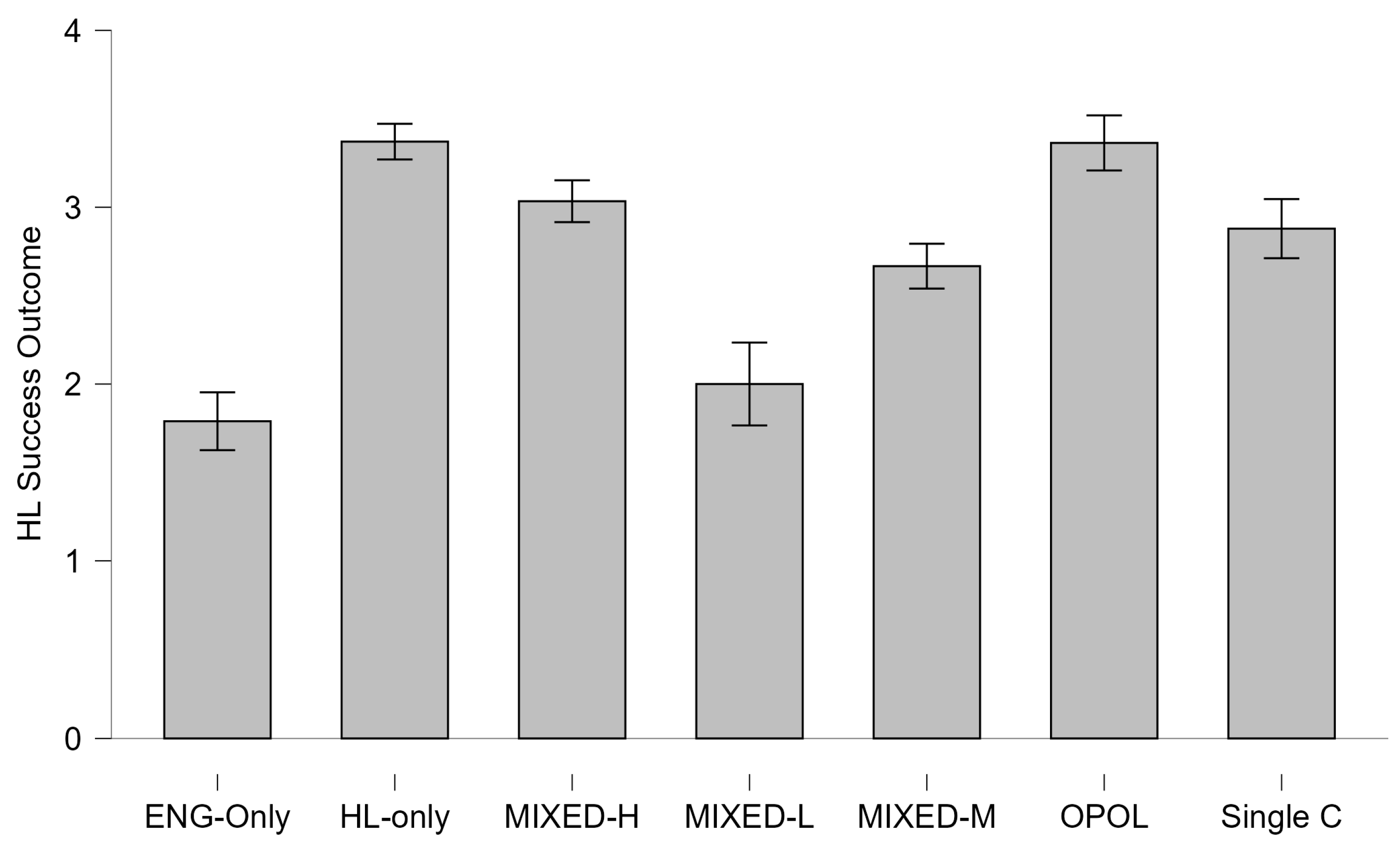
Considering the wide variation in input patterns within the Mixed-language group (ranging from 0% to 100% HL use by one caregiver, while the other uses the HL either less than 95% or more than 5%), we further sub-divided the mixed languages category using a 20–80% threshold into three subgroups: (1) Mixed-High HL (Mixed-H) when at least one caregiver used the HL more than 80% of the time with their children, (2) Mixed-Mid HL (Mixed-M) when at least one caregiver spoke the HL between 20% and 80% of the time, and (3) Mixed-Low HL (Mixed-L) when both caregivers spoke the HL less than 20% of the time. Table 6 shows the input patterns across these subgroups.
We then included the sub-classification into a new Kruskal–Wallis test with success level as the dependent variable and all FLP categories, including the Mixed-language subgroups (Table 6), as the independent variable. The analysis yielded a significant effect of FLP, H(6) = 58.877, p < 0.001, ε2 = 0.216. Table 7 shows the results of Dunn’s post hoc comparisons and visual differences in Figure 2, where Eng-Only and Mixed-L exhibited similar lowest success scores, while the HL-only and OPOL FLPs had the highest success scores, closely followed by Mixed-H, significantly outperforming Single-carer and Mixed-M. No significant differences were found between English-only and Mixed-L nor between OPOL, HL-only, and Mixed-H groups.
Finally, as a follow-up exploratory analysis, we performed a linear regression with HL transmission success as the dependent variable, including the number of children, age of the first child, and language policy subtype (including subtype classification for Mixed language from Table 6 and Table 7) as predictors. In our sample, families had between one and five children, with the mode and median both at two children. For consistency, we used the age of the first child in our analyses. First child’s age distribution showed that 47.4% (n = 130) were 2 years or younger, 44.22% (n = 121) were between 5 and 17 years, and 6.6% (n = 18) were 18 years or older. Meanwhile, age data for the first child were missing in 1.8% of cases (n = 5) due to incorrect reporting. The overall model significantly predicted self-perceived HL transmission success (R2 = 0.243, p < 0.001). Child age was a modest but significant positive predictor (β = 0.144, p = 0.017), indicating that parents of older children tended to report slightly higher HL success. However, the number of children was not a significant predictor (p = 0.841), suggesting that family size did not impact perceived HL transmission success. Language policy subtype remained a strong predictor, and all FLP subtypes, other than Mixed-Low, predicted significantly higher HL success than the reference group (English-Only), consistent with Figure 2 and Table 7.

4. Discussion

This study examined the effectiveness of different family language strategies for heritage language (HL) maintenance and transmission in multilingual Australian households, using previously unexamined data from a nationwide survey. We assessed the impact of various language practices, focusing on primary and secondary caregiver involvement as well as on families with a single caregiver, to determine their relative success in HL transmission. Results revealed that the HL-only and OPOL strategies were most successful, significantly outperforming Mixed, Single-carer, and English-only strategies. Contrary to our prediction, HL-only (M Input: PC = 1, SC = 1) and OPOL (M Input: PC = 0.96, SC = 0.03) did not differ statistically in outcomes, suggesting that consistent HL use by at least one caregiver could be as effective.
Our further division of Mixed families revealed that consistent HL input influenced HL transmission outcomes, as the MIXED-H subgroup (PC = 0.75, SC = 0.56) showed higher success than Mixed-M and Mixed-L. As expected, English-only families reported the lowest success, aligning with evidence that minimal HL exposure compromised HL maintenance (De Houwer, 2007; Hoff & Core, 2013; Verhagen et al., 2022). Importantly, single-caregiver households with consistent HL use (M input = 0.66) achieved similar success to MIXED-M families, reinforcing the central role of sustained HL exposure.
Findings indicate that OPOL families typically had HL-speaking primary caregivers (M input = 0.96), while secondary caregivers contributed minimally. Despite this asymmetry, OPOL outcomes matched those of HL-only households, likely due to deliberate language planning and high HL commitment (Koelewijn et al., 2023; Verhagen et al., 2022). The high HL input provided by the primary caregiver suggests that the non-HL-speaking parent may be supportive of HL use, potentially contributing indirectly through encouragement, cultural reinforcement, or passive exposure (Venables et al., 2014). Moreover, it is plausible that OPOL families were more intentional in their language planning and demonstrate a heightened awareness of HL maintenance goals (Koelewijn et al., 2023), compensating for input asymmetries through deliberate and sustained efforts to foster bilingual development. Our findings suggest that OPOL, when consistently implemented, it can effectively support HL maintenance, even in English-dominant contexts like Australia (Escudero et al., 2025). Similarly, families adopting an HL-only FLP (Pearson, 2008; Verhagen et al., 2022) in our sample reported the highest level of success in HL transmission (although not significantly different from OPOL families). These findings align with prior research indicating that sustained HL-only exposure strongly supports outcomes, particularly when families maintain frequent, naturalistic interactions in the HL (De Houwer, 2007; Verhagen et al., 2022), and that continuous input maximizes HL maintenance (De Houwer, 2007). Our results emphasize the effectiveness of HL-only practices in supporting HL development and fostering high levels of linguistic and cultural identity (Schalley & Eisenchlas, 2022).
The Mixed-language FLPs offer flexibility, allowing families to adapt their language use to different contexts (Lanza, 2007). However, without careful management, this flexibility may lead to a gradual shift toward English dominance, as we could observe from the diverse levels of HL input among the Mixed-language sub-categories. Parents often vary language use by context (e.g., using HL at home and English in public settings), which may inadvertently favor English. However, when the HL input remains high (MIXED-H), these strategies can still support strong HL outcomes. Traditionally, mothers have been regarded as the primary agents of HL transmission; however, emerging research highlights the significant role of fathers and secondary caregivers in the HL maintenance (Torsh, 2022; Torsh & Lising, 2022). We extended our perspective to include a broad spectrum of secondary caregivers, such as grandparents, other family members, foster carers, and even close family friends who spend substantial time with children as crucial support on HL maintenance.
Among the most decisive factors for lack of HL transmission success was insufficient HL input from both caregivers, as observed in the English-only and MIXED-L groups. Consistent with prior research (De Houwer, 2007, 2011; Hoff & Core, 2013), low HL exposure drastically reduces the likelihood of maintenance, particularly in English-dominant environments (Montrul & Silva-Corvalán, 2019).
Our exploratory analysis revealed that the number of children did not affect self-perceived HL transmission success, possibly because most families in our sample had two children, potentially limiting variability in the data. In contrast, children’s age had a small but significant effect, with families with older children reporting higher perceived success. One possible explanation is that there were a good number of families with children aged two or younger (n = 46), and children at this stage typically have limited speaking proficiency; therefore, parents of young children may perceive HL transmission as less successful. Conversely, a notable number of respondents had adult children who may have reconnected with their HL later in life, further contributing to higher reported success.
Overall, our findings suggest that HL input patterns are reflected and embedded in FLPs, determining outcomes of perceived HL transmission success, regardless of family structure. Although positive, these results should be taken with caution, as the survey relied on self-reported estimates of language input and outcomes that do not fully capture language-use patterns in daily interactions. As we stated above, self-reports are subjective and vary among families (Schwartz & Verschik, 2013). It is worth mentioning that because most respondents were from the state of New South Wales (73%), the findings may not generalize to all of Australia. However, we believe that other states had some representation and that the experiences in New South Wales may be similar to those in other states. Future research could apply the same survey more widely in Australia and worldwide. Additionally, the survey did not request specific HL input sources in different contexts such as through community programs, extended family, or digital media, which may have contributed to the observed outcomes. It is worth noting that Australia’s linguistic landscape remains overwhelmingly English-dominant, with limited institutional support for HLs in education and media, creating additional challenges for families striving to maintain their HLs. Parental beliefs about multilingualism strongly shape FLP practices and are closely linked to identity and belonging. Families that value the HL to preserve ethnic identity, strengthen family cohesion, and maintain intergenerational communication are more likely to implement FLPs (Tang & Calafato, 2025). Although identity was beyond the scope of this study, parents often aim to foster cultural and emotional ties to the HL (Tang & Calafato, 2025; Y. Wang et al., 2023). Broader societal ideologies can also hinder HL transmission (Diskin-Holdaway & Escudero, under review), highlighting the needs of community-based initiatives to support HL maintenance (Escudero et al., under review b). Together, these factors highlight the complex interplay between external constraints and parental values that shape FLP and HL outcomes.
Our results challenge the OPOL policy as the ideal strategy and show that many families effectively foster HL transmission through diverse, adaptive approaches. Future research should explore targeted interventions that provide greater institutional and community support for HL maintenance in multilingual families such as the interventions reported in Escudero et al. (2025b, under review a).

5. Conclusions

Using the results of a large-scale parental survey, the present study clearly demonstrates that consistent HL input through a variety of family language policies (FLPs), is key to successful HL transmission in multilingual households. Specifically, the FLPs with HL-only OPOL or Mixed-High-HL lead to higher perceived success than Mixed-Mid, Mixed-Low or predominantly English approaches, underscoring the importance of sustained and purposeful HL language use. Importantly, Mixed-language FLPs proved effective only when HL input remained high, reaffirming the central role of caregiver consistency and engagement. These findings extend previous evidence on bilingual development by showing that even in an English-dominant context such the Australian society, HL maintenance is achievable when families adopt intentional and context-sensitive strategies. Supporting families through institutional and community initiatives , such as those reported in Escudero et al. (2025b, under review a, under review b) remains essential to strengthen HL use across generations and ensure that multilingualism continues to thrive.

Author Contributions

Conceptualization, G.P.E.; methodology, G.P.E., P.E. and C.D.-H.; formal analysis, G.P.E.; investigation, G.P.E., P.E. and C.D.-H.; data curation, G.P.E.; writing—original draft preparation, G.P.E.; writing—review and editing, G.P.E., P.E. and C.D.-H.; visualization, G.P.E.; supervision, P.E.; project administration, P.E.; funding acquisition, P.E. and C.D.-H. All authors have read and agreed to the published version of the manuscript.

Funding

This research was supported by P.E.’s Australian Research Council (ARC) Future Fellowship (FT160100514) and by the ARC Centre of Excellence for the Dynamics of Language (CE140100041), where P.E. was a chief investigator, G.P.E. was a PhD student, and C.D.-H. was an affiliate. It was also supported by the Head of School Investment Fund (HOSIF) provided by the School of Languages and Linguistics at the University of Melbourne. G.P.E.’s work on the paper was funded by an ARC Linkage grant (LP210300631) awarded to P.E. and C.D.-H. where G.P.E is postdoctoral fellow.

Institutional Review Board Statement

The present study was conducted in accordance with the Declaration of Helsinki, approved by the Western Sydney University Human Research Ethics Committee (protocol H11022, date of approval 10 August 2020).

Informed Consent Statement

Informed consent was obtained from all subjects involved in the study.

Data Availability Statement

The original contributions presented in this study are included in the article. Further inquiries can be directed at the corresponding author.

Conflicts of Interest

The authors declare no conflicts of interest.

Appendix A

Table A1. Questions analyzed in the present study.
Questions Used for AnalysesIf Respondent Was the Primary CaregiverIf Respondent Was the Secondary Caregiver
1. Caregiver roleAre you their primary caregiver?
Yes—I am the primary caregiver
☐ No—I am the secondary caregiver
Are you their primary caregiver?
☐ Yes—I am the primary caregiver
No—I am the secondary caregiver
2. Relationship to children☐ Mother
☐ Father
☐ Grandmother
☐ Grandfather
☐ Foster carer
☐ Other—please specify ___________
☐ Mother
☐ Father
☐ Grandmother
☐ Grandfather
☐ Foster carer
☐ Other—please specify ___________
3. Time spent with children on a regular day, averaged over the week☐ 0%
☐ 25%
☐ 50%
☐ 75%
☐ 100%
☐ 0%
☐ 25%
☐ 50%
☐ 75%
☐ 100%
4. Languages spoken with children(Dropdown of respondent’s previously selected language(s) to select)(Dropdown of respondent’s previously selected language(s) to select)
5. Percentage of time speaking each language to children; the total should not exceed 100 percent(Dropdown with language(s) chosen in previous question and percentage section to fill in)(Dropdown with language(s) chosen in previous question and percentage section to fill in)
6. Presence of another caregiverDo your children have a secondary caregiver?
☐ Yes
☐ No
---Not applicable---
7. Relationship of other caregiver to childrenHow is your children’s secondary caregiver related to them?
☐ Mother
☐ Father
☐ Grandmother
☐ Grandfather
☐ Foster carer
☐ Other—please specify ___________
How is your children’s primary caregiver related to them?
☐ Mother
☐ Father
☐ Grandmother
☐ Grandfather
☐ Foster carer
☐ Other—please specify ___________
8. Time the other caregiver spends with children on a regular day, averaged over the week☐ 0%
☐ 25%
☐ 50%
☐ 75%
☐ 100%
☐ 0%
☐ 25%
☐ 50%
☐ 75%
☐ 100%
9. Languages spoken by other caregiver with children(Dropdown of previously indicated languages for secondary caregiver)(Dropdown of previously indicated languages for primary caregiver)
10. Percentage of time other caregiver speaks these languages to children; the total should not exceed 100 percent(Dropdown with language(s) chosen in previous question and percentage section to fill in)(Dropdown with language(s) chosen in previous question and percentage section to fill in)
11. Perceived success in raising children multilinguallyHow would you rate your success in transferring and maintaining your home languages and raising your children multilingually?How would you rate your success in transferring and maintaining your home languages and raising your children multilingually?

References

  1. ABS—Australian Bureau of Statistics. (2022). Cultural diversity of Australia. Available online: https://www.abs.gov.au/articles/cultural-diversity-australia (accessed on 20 September 2022).
  2. Barron-Hauwaert, S. (2004). Language strategies for bilingual families: The one-parent-one-language approach. Multilingual Matters. [Google Scholar]
  3. Cangelosi, M., Borghetti, C., & Bonifacci, P. (2024). How parents’ perceived value of the heritage language predicts their children’s skills. Languages, 9(3), 80. Available online: https://www.mdpi.com/2226-471X/9/3/80 (accessed on 15 October 2025). [CrossRef]
  4. Cho, G., Cho, K. S., & Tse, L. (1997). Why ethnic minorities want to develop their heritage language: The case of Korean-Americans. Language, Culture and Curriculum, 10(2), 106–112. [Google Scholar] [CrossRef]
  5. Clyne, M. (2004). Empowerment through the community language—Does it work? In Empowerment through language (p. 22). Linguistic Agency. [Google Scholar]
  6. Curdt-Christiansen, X. L., & Palviainen, Å. (2023). Ten years later: What has become of FLP? Language Policy, 22(4), 379–389. [Google Scholar] [CrossRef]
  7. De Houwer, A. (2007). Parental language input patterns and children’s bilingual use. Applied Psycholinguistics, 28(3), 411–424. [Google Scholar] [CrossRef]
  8. De Houwer, A. (2011). Language input environments and language development in bilingual acquisition. Applied Linguistics Review, 2(2), 221–240. [Google Scholar] [CrossRef]
  9. De Houwer, A. (2017). Bilingual language input environments, intake, maturity and practice. Bilingualism: Language and Cognition, 20(1), 19–20. [Google Scholar] [CrossRef]
  10. De Houwer, A. (2020). 4 Harmonious Bilingualism: Well-being for families in bilingual settings. In Handbook of home language maintenance and development (pp. 63–83). De Gruyter Mouton. [Google Scholar] [CrossRef]
  11. Diskin-Holdaway, C., & Escudero, P. (under review). Parental language attitudes towards their children’s accent: Findings from a nationwide survey in Australia. Languages. [Google Scholar]
  12. Eisenchlas, S. A., & Schalley, A. C. (2017). Reaching out to migrant and refugee communities to support home language maintenance. International Journal of Bilingual Education and Bilingualism, 1–12. [Google Scholar] [CrossRef]
  13. Escudero, P., Diskin-Holdaway, C., Pino Escobar, G., & Hajek, J. (2025a). Needs and demands for heritage language support in Australia: Results from a nationwide survey. Journal of Multilingual and Multicultural Development, 46, 437–454. [Google Scholar] [CrossRef]
  14. Escudero, P., Pino Escobar, G., Diskin-Holdaway, C., & Hajek, J. (2025b). Enhancing heritage and additional language learning in the preschool years: Longitudinal implementation of the Little Multilingual Minds program. Frontiers in Language Sciences, 4, 1604196. [Google Scholar] [CrossRef]
  15. Escudero, P., Pino Escobar, G., Tran, M. A., Tran, M. L., & Hajek, J. (under review a). Addressing the needs and demands of heritage language and additional language preschool learners: An evaluation of a Vietnamese immersion program in Australia.
  16. Escudero, P., Tran, M. A., Pino Escobar, G., & Diskin-Holdaway, C. (under review b). Parental attitudes toward Vietnamese language learning for heritage and non-heritage preschool children in Australia. Languages. [Google Scholar]
  17. Fishman, J. A. (1991). Reversing language shift: Theoretical and empirical foundations of assistance to threatened languages (Vol. 76). Multilingual Matters. [Google Scholar]
  18. Grasso, S. (2024). Navigating language maintenance challenges with health professionals: Reflections from Spanish speaking families in Australia. Australian Journal of Linguistics, 44(1), 1–28. [Google Scholar] [CrossRef]
  19. He, A. W. (2010). The heart of heritage: Sociocultural dimensions of heritage language learning. Annual Review of Applied Linguistics, 30, 66–82. [Google Scholar] [CrossRef]
  20. Hoff, E., & Core, C. (2013). Input and language development in bilingually developing children. Seminars in Speech and Language, 34(4), 215–226. [Google Scholar] [CrossRef]
  21. Humeau, C., Guimard, P., Nocus, I., & Galharret, J.-M. (2025). Parental language practices and children’s use of the minority language: The mediating role of children’s language attitudes. International Journal of Bilingualism, 29(1), 40–56. [Google Scholar] [CrossRef]
  22. JASP Team. (2024). JASP (Version 0.19.0) [Computer software]. Available online: https://jasp-stats.org/info/ (accessed on 1 October 2024).
  23. Karidakis, M., & Arunachalam, D. (2016). Shift in the use of migrant community languages in Australia. Journal of Multilingual and Multicultural Development, 37(1), 1–22. [Google Scholar] [CrossRef]
  24. Kim, S. H. O., & Starks, D. (2010). The role of fathers in language maintenance and language attrition: The case of Korean–English late bilinguals in New Zealand. International Journal of Bilingual Education and Bilingualism, 13(3), 285–301. [Google Scholar] [CrossRef]
  25. King, K. A., Fogle, L., & Logan-Terry, A. (2008). Family language policy. Language and Linguistics Compass, 2(5), 907–922. [Google Scholar] [CrossRef]
  26. Koelewijn, I. M., Hoevenaars, E., & Verhagen, J. (2023). How do parents think about multilingual upbringing? Comparing OPOL parents and parents who mix languages. Journal of Multilingual and Multicultural Development, 46, 765–781. [Google Scholar] [CrossRef]
  27. Lanza, E. (2007). 2. Multilingualism and the family. In A. Peter, & W. Li (Eds.), Handbook of multilingualism and multilingual communication (pp. 45–68). De Gruyter Mouton. [Google Scholar] [CrossRef]
  28. Lanza, E., & Gomes, R. L. (2020). Family language policy: Foundations, theoretical perspectives and critical approaches. In Handbook of home language maintenance and development: Social and affective factors (Vol. 18, pp. 153–173). Walter de Gruyter. [Google Scholar]
  29. Liddicoat, A. J. (2017). Indigenous and immigrant languages in Australia. In Heritage language policies around the world (pp. 237–253). Routledge. [Google Scholar]
  30. Montrul, S., & Silva-Corvalán, C. (2019). The social context contributes to the incomplete acquisition of aspects of heritage languages. Studies in Second Language Acquisition, 41(2), 269–273. [Google Scholar] [CrossRef]
  31. Pauwels, A. (2005). Maintaining the community language in Australia: Challenges and roles for families. International Journal of Bilingual Education and Bilingualism, 8(2–3), 124–131. [Google Scholar] [CrossRef]
  32. Pauwels, A. (2016). Language maintenance and shift. Cambridge University Press. [Google Scholar]
  33. Pearson, B. Z. (2008). Raising a bilingual child. Random House. [Google Scholar]
  34. Piller, I., Butorac, D., Farrell, E., Lising, L., Motaghi-Tabari, S., & Williams Tetteh, V. (2024). Life in a new language. Oxford University Press. [Google Scholar] [CrossRef]
  35. Romanowski, P. (2021). A deliberate language policy or a perceived lack of agency: Heritage language maintenance in the Polish community in Melbourne. International Journal of Bilingualism, 25(5), 1214–1234. [Google Scholar] [CrossRef]
  36. Romanowski, P. (2022). Paternal agency in heritage language maintenance in Australia: Polish fathers in action. International Journal of Bilingual Education and Bilingualism, 25(9), 3320–3332. [Google Scholar] [CrossRef]
  37. Sawir, E. (2005). Language difficulties of international students in Australia: The effects of prior learning experience. International Education Journal, 6(5), 567–580. Available online: https://files.eric.ed.gov/fulltext/EJ855010.pdf (accessed on 15 October 2025).
  38. Schalley, A. C., & Eisenchlas, S. A. (2022). Parental Input in the Development of children’s multilingualism. In A. Stavans, & U. Jessner (Eds.), The Cambridge handbook of childhood multilingualism (pp. 278–303). Cambridge University Press. [Google Scholar] [CrossRef]
  39. Schwartz, M., & Verschik, A. (2013). Achieving success in family language policy: Parents, children and educators in interaction. In Successful family language policy: Parents, children and educators in interaction (pp. 1–20). Springer. [Google Scholar]
  40. Shen, C., & Jiang, W. (2023). Parents’ planning, children’s agency and heritage language education: Re-storying the language experiences of three Chinese immigrant families in Australia. Frontiers in Psychology, 13. [Google Scholar] [CrossRef]
  41. Spolsky, B. (2012). Family language policy—The critical domain. Journal of Multilingual and Multicultural Development, 33(1), 3–11. [Google Scholar] [CrossRef]
  42. Tang, F., & Calafato, R. (2024). “You have to repeat Chinese to mother!”: Multilingual identity, emotions, and family language policy in transnational multilingual families. Applied Linguistics Review, 15(2), 427–448. [Google Scholar] [CrossRef]
  43. Tang, F., & Calafato, R. (2025). Family language policy: The impact of multilingual experiences at university and language practices at home. International Journal of Bilingual Education and Bilingualism, 28(1), 92–107. [Google Scholar] [CrossRef]
  44. Tannenbaum, M., & Berkovich, M. (2005). Family relations and language maintenance: Implications for language educational policies. Language Policy, 4(3), 287–309. [Google Scholar] [CrossRef]
  45. Tannenbaum, M., & Howie, P. (2002). The association between language maintenance and family relations: Chinese immigrant children in Australia. Journal of Multilingual and Multicultural Development, 23(5), 408–424. [Google Scholar] [CrossRef]
  46. Torsh, H. I. (2022). ‘Maybe if you talk to her about it’: Intensive mothering expectations and heritage language maintenance. Multilingua, 41(5), 611–628. [Google Scholar] [CrossRef]
  47. Torsh, H. I., & Lising, L. (2022). Multilingual family language policy in monolingual Australia: Multilingual desires and monolingual realities. Multilingua, 41(5), 519–527. [Google Scholar] [CrossRef]
  48. Venables, E., Eisenchlas, S. A., & Schalley, A. C. (2014). One-parent-one-language (OPOL) families: Is the majority language-speaking parent instrumental in the minority language development? International Journal of Bilingual Education and Bilingualism, 17(4), 429–448. [Google Scholar] [CrossRef]
  49. Verhagen, J., Kuiken, F., & Andringa, S. (2022). Family language patterns in bilingual families and relationships with children’s language outcomes. Applied Psycholinguistics, 43(5), 1109–1139. [Google Scholar] [CrossRef]
  50. Walker, J. A., Hajek, J., Loakes, D., Diskin-Holdaway, C., & Docherty, G. (2024). The sociolinguistics of urban multilingualism. In Multifaceted multilingualism (Vol. 66, p. 395). John Benjamins Publishing Company. [Google Scholar]
  51. Wang, H., & Hatoss, A. (2024). Language policy and planning for heritage language maintenance: A scoping review. Current Issues in Language Planning, 25(5), 612–632. [Google Scholar] [CrossRef]
  52. Wang, Y., Williams Tetteh, V., & Dube, S. (2023). Parental emotionality and power relations in heritage language maintenance: Experiences of Chinese and African immigrant families in Australia. Frontiers in Psychology, 14, 1076418. [Google Scholar] [CrossRef] [PubMed]
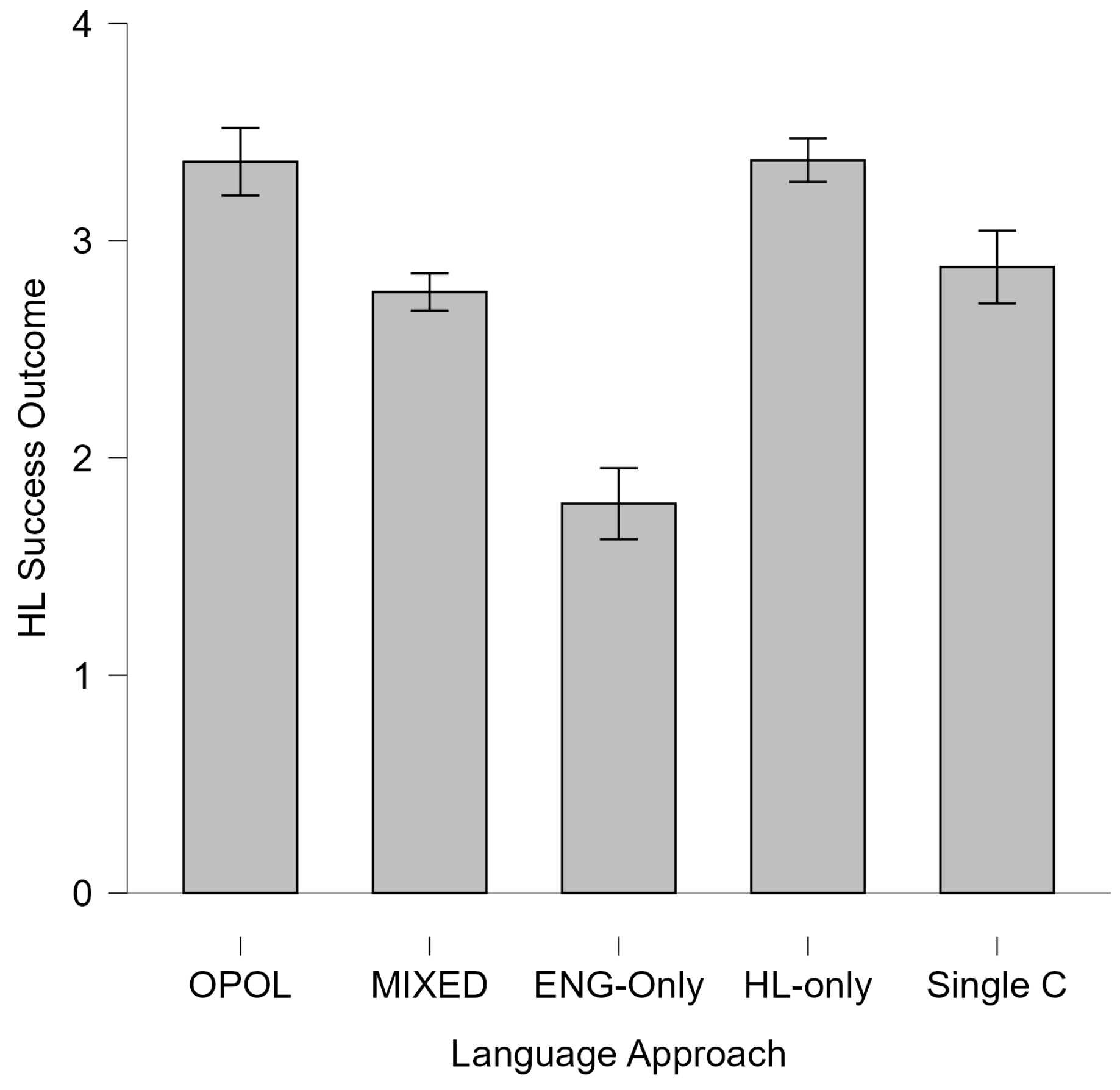
Figure 1. Success outcome by FLP.
Languages 10 00290 g001
Figure 2. Success outcome by FLP with Mixed subgroups.
Languages 10 00290 g002
Table 1. Percentage of time primary and secondary caregivers spent with their children.
Primary Carern%Secondary Carern%
Mother24788.21Father19870.71
Father3211.43Mother258.93
Other10.36Other207.14
No-SC3713.21
Total280100.00Total280100.00
Note: Other Secondary carers included grandparents (n = 14), aunts (n = 2), uncles (n = 2), close friends (n = 1) and foster carers (n = 1). The one Other for Primary caregivers was a foster carer (n = 1). No-SC = no secondary carer reported.
Table 2. Percentage of time that the primary carer (PC) and secondary carer (SC) spend with their children and speaking their HL to their children on a regular day, averaged over the week (1 = 100%).
Relationship with Children (n)% Time Spent with Children
M (SD)
% Time Speaking HL to Children
M (SD)
PCMother (n = 216)0.63 (0.24)0.66 (0.37)
Father (n = 27)0.43 (0.18)0.60 (0.41)
Single Carer (n = 37)0.57 (0.29)0.59 (0.38)
SCMother (n = 25)0.48 (0.20)0.58 (0.43)
Father (n = 198)0.43 (0.20)0.46 (0.44)
Other (n = 20)0.44 (0.26)0.51 (0.48)
Table 3. Proportion of HL use by the primary caregiver (PC) and secondary caregiver (SC) with children from each family language policy (FLP).
OPOL
n = 33
ENG-Only
n = 19
No-SC
n = 33
MIXED
n = 133
HL-Only
n = 62
PCSCPCSCPCSCPCSCPCSC
Mean0.960.030.010.010.66-0.540.381.001.00
SD0.170.310.020.010.34 0.310.360.010.00
Min0.000.000.000.000.05 0.000.000.951.00
Max1.001.000.050.051.00 1.001.001.001.00
Note: Six SC-MIXED did not specify relative proportion and were therefore excluded from subsequent analysis.
Table 4. Self-rated HL maintenance and transmission success outcome.
Success Leveln%
4 Very successful10336.79
3 Moderately successful7928.21
2 Somewhat successful7426.43
1 Not successful248.57
Total280100
Table 5. Dunn’s post hoc comparisons for FLP.
ComparisonzWiWjrrbppbonf
OPOL–MIXED3.26173.08124.910.360.0010.011
OPOL–ENG-only5.42173.0855.050.79<0.001<0.001
OPOL–HL-only0.06173.08172.070.020.9511
OPOL–No-SC2.16173.08132.890.290.0310.308
MIXED–ENG-only3.76124.9155.050.55<0.0010.002
MIXED–HL-only−4.03124.91172.070.35<0.001<0.001
MIXED–No-SC−0.54124.91132.890.050.5891
ENG-only–HL-only−5.9055.05172.070.81<0.001<0.001
ENG-only–No-SC−3.5855.05132.890.59<0.0010.003
HL-only–No-SC2.41172.07132.890.290.0160.162
Note. Rank–biserial correlation based on individual Mann–Whitney tests with Bonferroni corrections. z = standardized test statistic, Wi and Wj = rank sums; rrb = rank-biserial correlation; p = statistical significance before correction; pbonf = Bonferroni-adjusted p-value for multiple comparisons. Bolded text depicts significance.
Table 6. Proportion of HL use by PC and SC with children within the Mixed FLP.
MIXED-HMIXED-MMIXED-L
n = 59n = 54n = 14
PCSCPCSCPCSC
Mean0.750.560.380.270.100.05
SD0.230.400.190.250.050.05
Min0.10000.010
Max110.750.750.20.13
Table 7. Dunn’s post hoc comparisons for FLPs including Mixed-language sub-classification.
ComparisonzWiWjrrbppbonf
ENG-Only–HL-only−5.9055.05172.070.81<0.001<0.001
ENG-Only–MIXED-H−4.5355.05145.280.68<0.001<0.001
ENG-Only–OPOL−5.4255.05173.080.79<0.001<0.001
ENG-Only–No-SC−3.5855.05132.890.59<0.0010.007
ENG-Only–MIXED-M−3.0755.05116.980.510.0020.045
ENG-Only–MIXED-L−0.5555.0569.640.120.5841
MIXED-L–MIXED-M−2.0969.64116.980.400.0370.773
MIXED-L–OPOL−4.2969.64173.080.69<0.001<0.001
MIXED-L–No-SC−2.6269.64132.890.480.0090.183
MIXED-M–OPOL−3.36116.98173.080.42<0.0010.016
MIXED-M–No-SC−0.95116.98132.890.110.3411
MIXED-H–MIXED-L3.37145.2869.640.57<0.0010.016
MIXED-H–MIXED-M1.99145.28116.980.220.0470.984
MIXED-H–OPOL−1.69145.28173.080.220.0911
MIXED-H–No-SC0.75145.28132.890.100.4511
HL-only–OPOL−0.06172.07173.080.020.9511
HL-only–MIXED-H1.95172.07145.280.210.0511
HL-only–MIXED-M3.92172.07116.980.42<0.0010.002
HL-only–MIXED-L4.58172.0769.640.72<0.001<0.001
HL-only–No-SC2.41172.07132.890.290.0160.34
OPOL–No-SC2.16173.08132.890.290.0310.648
Note. Rank–biserial correlation based on individual Mann–Whitney tests with Bonferroni corrections. z = standardized test statistic, Wi and Wj = rank sums; rrb = rank-biserial correlation; p = statistical significance before correction; pbonf = Bonferroni-adjusted p-value. Bolded text depicts significance.
Disclaimer/Publisher’s Note: The statements, opinions and data contained in all publications are solely those of the individual author(s) and contributor(s) and not of MDPI and/or the editor(s). MDPI and/or the editor(s) disclaim responsibility for any injury to people or property resulting from any ideas, methods, instructions or products referred to in the content.