Article

Sample Return from All Across the Solar System

by
Anthony Freeman
*,
Reza Karimi
,
John Elliott
,
Damon Landau
,
Matteo Clark
,
Steven Zusack
,
Alfred Nash
,
Kelley Case
,
Lizbeth B. De La Torre
,
Jonathan Murphy
,
Rashied Amini
,
Mathieu Choukroun
,
Carol Raymond
and
Art Chmielewski
Jet Propulsion Laboratory, California Institute of Technology, 4800 Oak Grove Drive, Pasadena, CA 91109, USA
*
Author to whom correspondence should be addressed.
Aerospace 2026, 13(6), 522; https://doi.org/10.3390/aerospace13060522
Submission received: 29 April 2026 / Revised: 28 May 2026 / Accepted: 31 May 2026 / Published: 3 June 2026
(This article belongs to the Special Issue Spacecraft Orbit Transfers (2nd Edition))

Abstract

Sample return missions are among the most difficult tasks for robotic spacecraft in exploring our solar system. However, the samples they return to Earth have significantly high value for the planetary science community. Thus far, we have only acquired samples from the Moon, three asteroids, a comet’s tail, and the solar wind at the Earth–Sun Lagrange Points. The National Academy’s most recent decadal survey of planetary science at NASA emphasized the value of samples returned to Earth for analysis and called for NASA to prioritize samples returned from Mars, the Moon’s South Pole, a Jupiter-family comet, and Ceres. Currently available rockets and propulsion technology impose severe, and possibly insurmountable, limits to where we can send robot explorers and return samples within a reasonable timescale. Now, the advent of large new rockets offers the potential for very high C3 (characteristic energy) Earth escape trajectories. Parallel developments in Nuclear Propulsion yield much higher ISP than chemical propulsion and can operate far away from the Sun. Our novel trajectory modeling results and mission architecture analysis show that, by combining these technologies, sample return from across the solar system becomes feasible within the career lifetime of a planetary scientist.

1. Introduction

The best-known set of sample return missions is, of course, the Apollo 11–17 human missions to/from the Moon [1]. NASA’s astronauts brought back 382 kg of samples from the sites they visited, which continue to surprise scientists who analyze them more than 50 years after they reached Earth [2]. More recently, robotic missions have returned samples to Earth in much smaller quantities: NASA/JPL’s Discovery mission Genesis brought back samples of the solar wind, collected at the Earth Sun L1 and L2 points [3]; Stardust brought back samples from the tail of comet Wild 2 [4] the Japanese Space Agency’s Hayabusa and Hayabusa-2 missions returned samples from the asteroids 25143 Itokawa [5] and 162173 Ryugu [6]; and in late 2023 NASA/GSFC’s OSIRIS-REx mission brought back samples from the asteroid Bennu [7]. China’s Chang’E-6 mission recently returned the first samples from the South Pole-Aitken Basin area of the Moon [8].
At roughly a 10-year cadence, the National Academy of Sciences is tasked with providing NASA with advice on priorities for its scientific endeavors. In planetary science, the latest decadal survey, released in 2022, is Origins, Worlds, Life (OWL) [9]. Like its predecessor, Visions and Voyages [10], OWL listed the flagship Mars Sample Return (MSR) mission as its highest scientific priority. Other sample return missions also featured in OWL’s recommendations, particularly the Ceres and Comet Sample Return targets flagged as New Frontiers medium-class missions, and Endurance-A, a long-range lunar rover/sample collection mission recommended for implementation as a strategic medium-class mission under NASA’s Lunar Discovery and Exploration Program. The architecture of Endurance-A is unusual: dropped off by a commercial lander, the plan is to have a rover traverse the South Pole/Aitken Basin region of the Moon, picking up scientifically selected samples to deliver to a human landing site, for recovery by an astronaut team. OWL also discusses the value of sample return for “laboratory-based measurements of additional primitive materials that sample different reservoirs in the nebula” to “resolve the question of a supernova trigger versus later injection of isotopes” in understanding the origin of our solar system. “Different reservoirs” in this context means “Kuiper Belt objects, Centaurs, comets, and P- and D-type asteroids within the main belt, Hilda, Trojan asteroids, and irregular satellites” of the Giant Planets. A list of other targets in the solar system where OWL identifies returned samples as key to understanding their origin includes Venus, Mercury, Europa, Enceladus, and Titan. OWL calls for “direct measurement of the timing of key geologic events on terrestrial planet surfaces, now only possible by sample return” and the return of “cold/cryogenic volatile samples from planetary bodies”.
Clearly, scientifically selected samples returned from across the solar system would have very high scientific value. It has been suggested [11] that it is the culmination of a sequence of ever-more complex scientific investigations of any solar system body, which proceeds methodically as follows—flyby, orbit, land, rove, and return samples. This argument was adopted as an organizing principle for future missions by Jim Green, the former head of planetary science at NASA Headquarters [12]. Returned samples are also a gift to future generations of scientists—as was the case with the Apollo samples. A portion is set aside and preserved for analysis using laboratory tools and methods that will only be possible many decades later. Some have even argued that the analysis of such samples is a “holy grail” for planetary scientists [13,14].
In Section 2 of this paper, we present the case for sample return across the entire solar system within a reasonable timeframe, which we estimate at roughly 40 years. In Section 3, we examine the ‘tyranny of the rocket equation’ and indicate how, using current propulsion technology, we may have reached a limit in our ability to bring meaningful samples back from harder-to-reach locations, particularly in the outer solar system. In Section 4, a combination of emerging technologies—big rockets and nuclear propulsion—is proposed to break through this bottleneck. We decompose a sample-return mission into building blocks using a generic mission architecture with constraints on both launch mass and the size of the returned sample. In Section 5, novel trajectories to/from more distant objects, including the moons of the outer planets, but also Centaurs and even Halley’s Comet, are presented. Finally, we show that even the most challenging sample-return missions could be made feasible by adopting the emerging combination of large rockets and nuclear propulsion.

2. Solar System Exploration: Past, Present, and Future

Following Jim Green’s example and using the sequence of increasingly complex missions as an organizing principle, we can visualize the progress in the exploration of our solar system by examining Table 1, which summarizes what has been achieved to date for each body type. A Yes entry in Table 1 means that a mission of that particular category has been executed for that class of target. For Earth’s Moon, for example, we had flyby missions, orbiters, and landers in the 1960s and early 1970s, and, of course, the Apollo crews brought back samples from several different near-side locations and deployed a rover that allowed them to explore farther from their immediate landing site. The Yes, But… entries for the Moon simply mean that scientists have identified the need for greater mobility and samples from other regions as high priorities for future lunar exploration. NASA/GSFC’s Lucy Discovery mission [15] is on its way to fly by several Trojan objects in its nominal 12-year lifetime, hence its “Under Way” categorization. A blank entry in Table 1 means that no spacecraft has executed that type of mission at that type of target. For the Centaurs, for example, potentially near-pristine captured Kuiper Belt Objects that lie between Jupiter and Neptune’s orbits, no spacecraft has thus far visited any of them, even fleetingly. The entire row for mission types is therefore blank for Centaur targets. As noted above, Stardust returned samples from the tail of the Jupiter family comet Wild 2, but scientists have expressed the need for a comet surface sample in both the Visions and Voyages decadal survey and the OWL decadal survey.
Table 1 captures the state of solar system exploration to date, a set of feats that has taken over 65 years to accomplish, since the National Aeronautics and Space Administration was formed in 1958. It represents an impressive record of achievement by the planetary science community in the United States and internationally. However, nearly half the cells are blank, and those are clustered towards the right-hand side of the table, where missions become increasingly complex and harder to execute.
If we add the missions prioritized in the OWL decadal survey, we can see what this view of solar system exploration might look like once all those missions have been successfully executed. The proposed flagship Uranus Orbiter and Probe mission [10], for example, has an architecture very similar to that of Galileo, with an orbiter component and an atmospheric entry probe for in situ measurements. This builds on the knowledge we have of the Uranus system from the Voyager II flyby in 1986 and is captured in Table 2 as two Yes entries under the Orbiter and Lander/In Situ columns. It is difficult to put an exact timeline on the new mission entries in Table 2. However, it is not perhaps unreasonable to say that, at the current pace of planetary science missions, it could take at least three more decades before all of them are completed. That still leaves more than a third of the mission complexity matrix unaddressed. Proceeding at this same pace, it could be another century before all the mission entries are flagged with a Yes.
Here we arrive at the central idea that inspired this paper: what if we went straight to the right-hand column in Table 1 and Table 2 to undertake sample return missions from across our solar system? We would surely achieve most of the objectives of the flyby, orbiter, and lander/in situ mission entries, and, in some cases, the mobility objectives as well. Would it be possible to shorten the timescales for such missions, such that a future planetary scientist might expect to have access to samples from all across the solar system, from Mercury all the way out to Pluto, within the time limits of their career? Herein, we propose an approach that would make that possible.

3. How the Rocket Equation Impacts Sample Return Missions

3.1. The ‘Tyranny’ of the Rocket Equation

The famous rocket equation, governing the mass of propellant versus useful spacecraft mass, is credited to Konstantin Tsiolkovsky [16]. It can be expressed as follows:
υ = I S P g 0 l n m 0 m f
where Δν is the required change in velocity of the spacecraft, ISP is the specific impulse of the propulsion technology used, g0 is standard gravity, m0 is the mass of the spacecraft including propellant (wet mass), and mf is the final mass of the spacecraft, after the propellant has been expended (also known as dry mass). The equation can be solved for m0 to give the following:
m 0 = m f e υ / I S P g 0
m 0 m f = m f ( e υ I S P g 0 1 )
yielding the well-known result that the mass of propellant (m0mf) for a given spacecraft mass increases exponentially with the required Δν. This places a fundamental constraint on the achievable Δν for a given launch mass. This problem is especially acute for low ISP values, typical of today’s chemical propulsion systems. For high Δν missions, this is what is meant by the ‘tyranny of the rocket equation’.

3.2. Emerging Technologies with High Mass to LEO and ISP Values

We live in a time when the space business is changing: big rockets (with more than 45t lift capacity), some of which are reusable, are being developed; and nuclear propulsion, following a long gestation period by nuclear engineers, is likely to be demonstrated in space by the end of the decade. The new rockets are capable of lifting enormous masses into Low Earth Orbit (LEO), as shown in Table 3.
Starship, as currently planned, will not launch directly into an Earth Escape trajectory, as the other vehicles in Table 3 can. Instead, it can be refueled in orbit, providing the potential to “transport > 100 t of bulk cargo anywhere in the solar system” [19]. Other new rockets in Table 3 may be used to assemble a similar capability in orbit through multiple launches. In this paper, we will examine how we might use a fully or partially refueled Starship to achieve our goal of returning samples from across our solar system.
At a workshop in December of 2023, held in Tempe, AZ, and organized by the Institute for Space Science and Development (henceforth “The Tempe Workshop”), leading planetary scientists and nuclear propulsion experts in the US gathered to discuss the prospects for future space science missions taking advantage of emerging nuclear propulsion capabilities [20]. At the time of the Tempe Workshop, NASA planned two technology demonstration missions, DRACO and JETSON, to prove out nuclear thermal and nuclear electric propulsion powered by fission reactors within a decade or so. These have since been replaced by the SR-1 Freedom mission to Mars [21], which plans to use nuclear-electric propulsion in 2028. New reactor fuels, such as high-assay, low-enriched uranium (HALEU), offer an alternative source of space power to address current limitations in the production of radioisotope power systems for future planetary science missions to the outer solar system [22]. The significance of these developments is that nuclear propulsion has a much higher ISP than the chemical propulsion technologies in use today (see Table 4). Referring again to the rocket equation discussion above, i.e., Equations (1)–(3), higher ISP values have a significant effect on the allowable dry mass of the spacecraft (for a fixed launch mass) and on the amount of fuel needed to achieve a high Δν trajectory.
Table 5 and Table 6 summarize the characteristics of hypothetical Nuclear Thermal (NTP) and Nuclear Electric Propulsion (NEP systems used in this study, based on the engineering judgment of our team. They are not identical to the technology demonstrations proposed for SR-1 Freedom, DRACO, or JETSON, but are selected as reasonable projections of capabilities derived from those demonstrations. In particular, we have used the 1st generation values for the Specific Impulse ISP.
In our study, we assumed an NTP-equipped spacecraft with a Stirling engine for efficient conversion of thermal to electrical power [24] and that efficient thermal management strategies, e.g., using heat straps, heat pipes, and radiators, can be designed to avoid the need to add additional Radioisotope Heater Units. The fuel tanks are assumed to have zero boil-off; hence, the fuel is not lost during the long mission durations expected. Further, the tanks can be jettisoned when emptied.
Similarly, our NEP-equipped spacecraft is also assumed to have efficient thermal management strategies and the capability to jettison used fuel tanks. We also assume that mechanical booms used to offset the nuclear reactor from the spacecraft avionics can be designed to have the low mass values specified in Table 6.
For both architectures, our notional spacecraft can be assembled on Earth and launched in a single Big Rocket into Low Earth orbit or Earth Escape. There may be some advantage to on-orbit assembly as that technology matures, allowing the nuclear reactors to be launched separately and then integrated with the spacecraft.

3.3. Sample Return Mission Δν Values

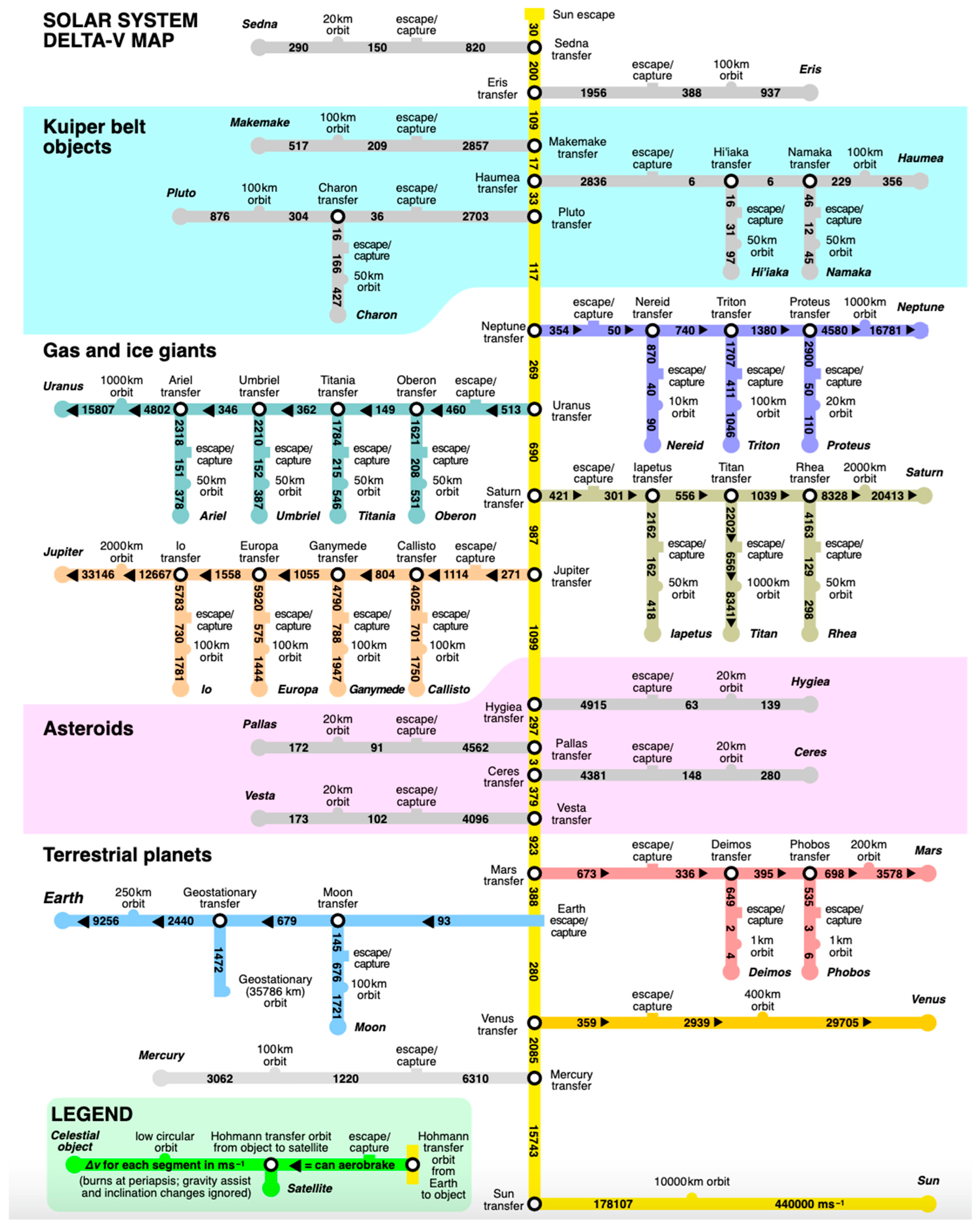
If the high ISP problem is solved as nuclear propulsion technology matures, how much Δν is then needed to return samples from all across the solar system? To first order, we can estimate this by looking at one of the many Δν maps of the solar system available online (see Figure 1). These maps use Hohmann transfers and usually ignore gravity assists and atmospheric aerobraking, among others. However, they are indicators of what it takes to rendezvous with a target in the solar system and return with a sample. Adding up the total required Δν to go to the surface of Mars and back, for example (not including the Δν required for escaping Earth’s gravity well and Earth re-entry on return), our calculations yield 12.1 km/s from (0.388 + 0.673 + 0.335 + 0.395 + 0.698 + 3.578) × 2. Total Δν values for sample return from Mars and other solar system targets are illustrated in Table 7.

3.4. First Order Mass Estimates for Sample Return Missions

To estimate the mass of the vehicle escaping Earth’s gravity, we assume an initial dry mass of 1000 kg for the spacecraft, excluding the propulsion module, which is typical for missions we send out to explore the solar system today. Exercising Equation (3), we can estimate the amount of fuel needed to send such a spacecraft out to a target in the solar system and return. Then we recalculate the mass of the spacecraft, allowing for a structure with a mass of 10% of the fuel expended as the propulsion module. As a final step, we exercise Equation (2) to calculate the mass of the vehicle escaping the bonds of Earth’s gravity field. This is shown in Table 8 for the target set in Table 7, sorted by Δν.
To give some scale to the mass numbers in Table 8, the International Space Station, the largest space vehicle ever constructed, has a mass of more than 400,000 kg, or 4.0 × 10⁵ kg in scientific notation [27]. Table 8’s illustrations are perhaps overly simplistic; for example, the table does not allow for significant Δν provided by a high C3 (characteristic energy or the specific energy required for a spacecraft to escape a planet’s gravity well and enter an interplanetary trajectory) launch, or gravity assists, or using the atmosphere at the target body to slow down, as we would do at Mars. We also would not usually send out a 1000 kg spacecraft and return all of it to Earth; typically, we would expect to leave some of the outgoing spacecraft behind, as was done with Apollo [28].
Reasonable sample return solutions have been proposed for the Moon [29] and Phobos [30] using only chemical propulsion, consistent with the information presented in Table 8 for those targets. For Mars and Ceres, as seen in [10], sample return mission concept studies usually baseline Solar Electric Propulsion (SEP), which has ISP values similar to those in Column 9 for NEP. We can use SEP in the inner solar system, where solar radiation intensity is high; in the outer solar system, the 1/R2 drop-off in solar radiation as we move further away from the Sun makes it extremely difficult to generate enough power to drive a SEP engine.
Despite its over-simplification of the mission design, Table 8 does illustrate the degree of difficulty, in terms of high spacecraft mass values needed, of returning samples from more distant, harder-to-reach bodies in the solar system, when relying only on chemical propulsion. In contrast, spacecraft using nuclear thermal or nuclear electric propulsion tend to be lower in mass. At some point, if we are serious about returning samples from all across the solar system, especially its outer reaches, we are going to have to give up on chemical propulsion as the primary means of generating thrust and turn to higher ISP solutions, such as nuclear propulsion.

4. A Common Architecture for Sample Return Missions

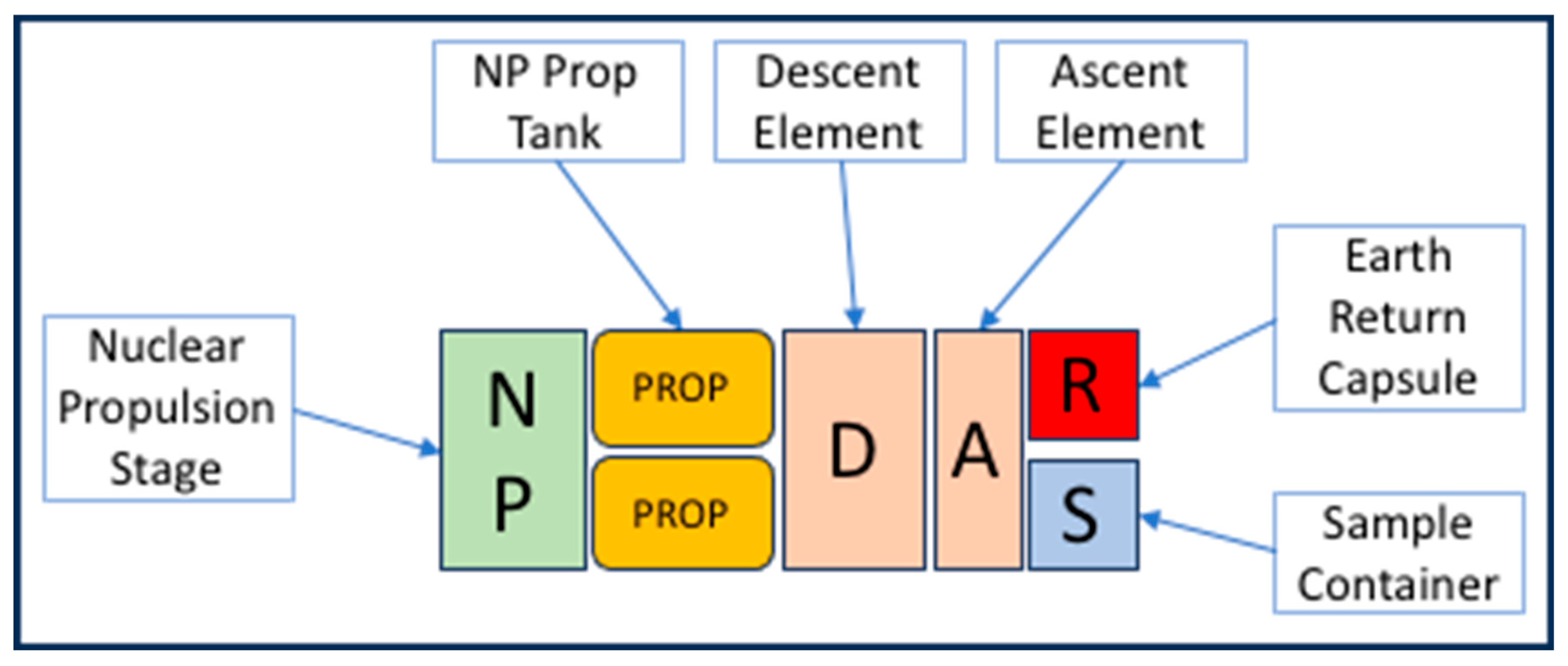
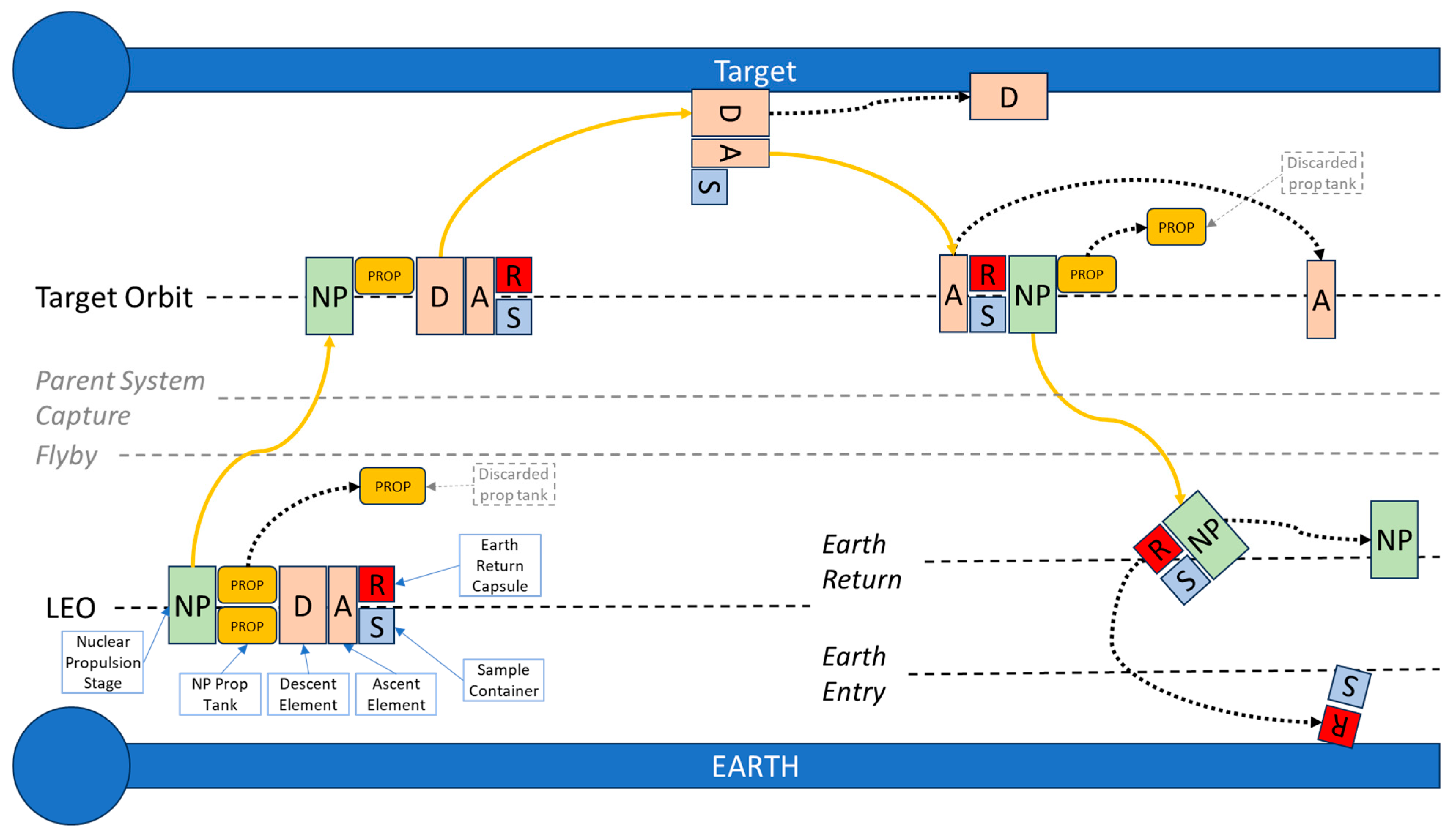
For our study, we adopted a simple, modular approach for the sample-return mission architecture, dividing it into six different elements: a launch vehicle, a nuclear propulsion vehicle stage, a descent vehicle stage, an ascent vehicle stage, a sample container, and an Earth-return capsule (capable of Earth atmospheric re-entry and landing). These mission architecture elements are illustrated in Figure 2 and Figure 3, which show how they would be used during each phase of the mission.
This architecture has many similarities to Apollo, especially in that the Propulsion module would orbit the target body. Meanwhile, the descent/ascent elements go down to the surface to collect samples. The descent/ascent propulsion is assumed to be chemical, bi-propellant, to avoid having to take a relatively heavy nuclear reactor down to the surface and back up again. Here, we have assumed LOx-CH4 as the chemical propellant, though better options may emerge for longer-duration missions, where evaporation losses over time may be a factor. The Nuclear Propulsion module, remaining in orbit, can also serve as a relay for communications between Earth and the landed elements.
The Nuclear Propulsion stage serves as the primary power and propulsion element throughout the mission. All primary maneuvers within the mission are conducted by the Nuclear Propulsion module. This vehicle is expected to be modular, such that after significant maneuvers, the propellant tanks can be jettisoned to reduce the vehicle’s mass prior to the next maneuver (lowering the thrust required). In addition to propulsion and communications, the Nuclear Propulsion stage delivers power by converting thermal energy to electrical energy to meet the demands of other systems throughout the mission’s cruise phases.
The Descent element carries a suite of instruments to characterize the sampling site and provide appropriate context for the acquired samples. We selected a nominal mass of 20 kg for this instrument suite, which should be ample to accommodate instruments such as cameras, spectrometers, seismometers, and compact laser ablation spectrometers. The Descent stage has a power source sufficient to conduct surface operations. This could be solar if there is sufficient illumination from the Sun, batteries if the surface mission duration is short enough, or a small Radioisotope Thermal Generator (RTG), such as an MMRTG or a more compact RTG whose source is Americium [31] or another radioactive element. For the study, the assumed power source for the descent stage was a primary battery for the entire surface mission duration.
After samples are collected, the Ascent stage or element launches from the surface with the Sample container, leaving the Descent stage behind on the surface, and conducts an in-orbit rendezvous with the Propulsion stage. The Ascent stage is powered by batteries, assuming the ascent and rendezvous are a short-duration mission. For Mercury, which requires the largest ascent/descent Δν we studied, the Ascent Vehicle in our model is based on the Mars Ascent Vehicle specified by the Mars Sample Return mission, which has a solid rocket motor with an ISP of 307 s, a mass of 450 kg, and a Δν capability of approximately 4 km/s [32]. For other targets, the mass of the ascent vehicle was scaled according to the required Δν.
Following rendezvous, the combined stack then returns Earthwards while leaving the spent ascent stage behind, in orbit at the target body. On approach to Earth, the Earth return vehicle, including the precious sample container, separates from the Propulsion module and enters the atmosphere. The Earth return vehicle mass in our architecture model is 57 kg, consistent with other Earth entry vehicles, e.g., OSIRIS-REx [33]. A variant of this architecture could have the Earth return vehicle captured into an elliptical orbit for later recovery by a crewed (or robotic) mission if, at the time, planetary protection concerns prohibit the direct return of samples to Earth’s surface.
Upon return to Earth, the atmospheric entry speed is set at less than 13.5 km/s, consistent with our understanding of the capabilities of current re-entry vehicle designs. The sample size is set at 250 g, twice that returned by OSIRIS-REx from asteroid Bennu [33].
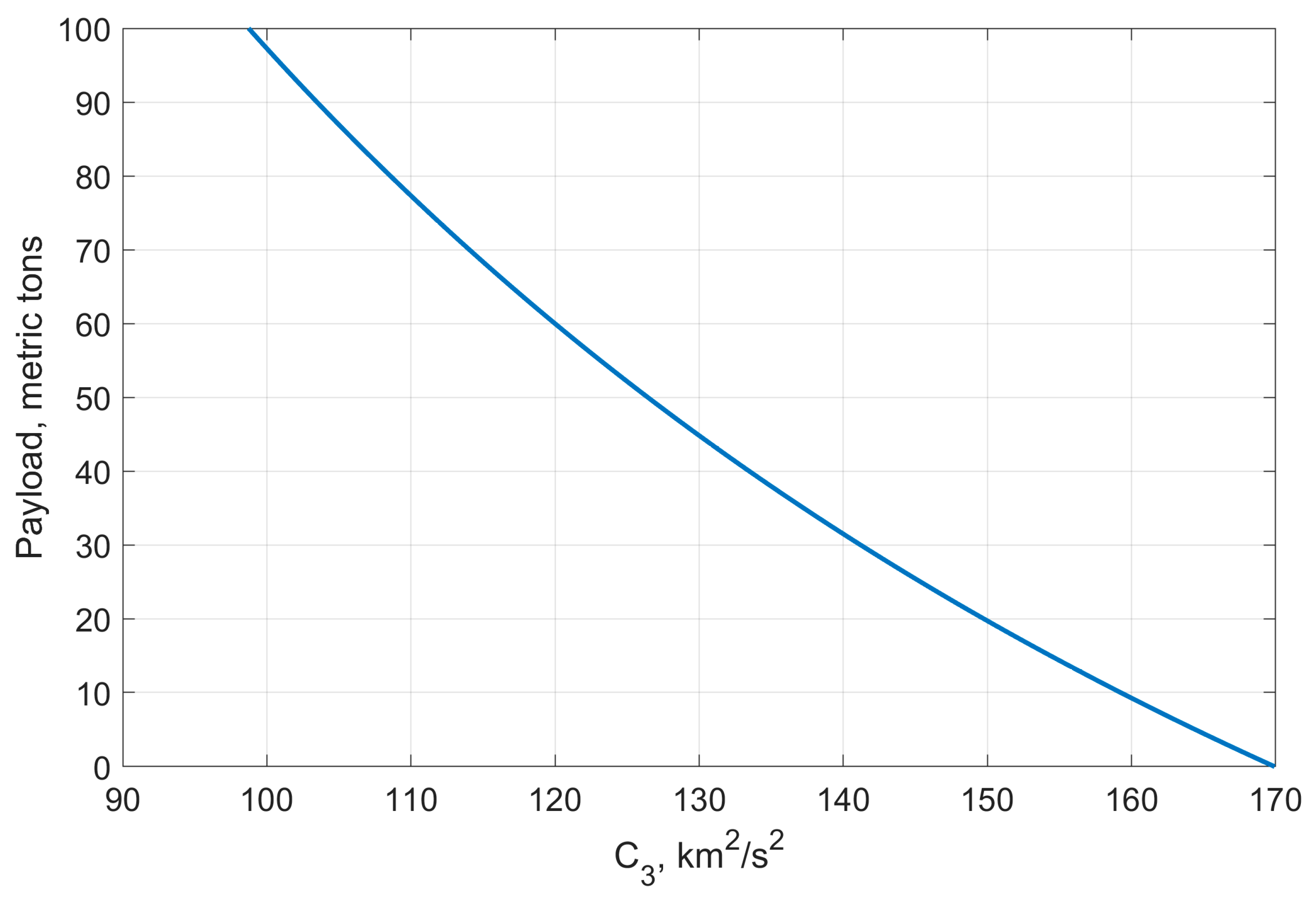
A fundamental constraint for the architecture is that the launch ‘stack’ mass has to be consistent with a refueled Starship capability for the C3 value selected, as shown in Figure 4, where the key Starship parameters are 100 mt for dry (non-payload) mass and 1200 mt of propellant with a specific impulse of 380 s [29].
Table 9 (below) summarizes the key driving assumptions of each of the elements in the mission architecture, highlighting the similarities and differences between the Nuclear Electric Propulsion and Nuclear Thermal Propulsion architectures.

5. Trajectory Designs for Sample Return Missions

In this section, we describe the trajectories we estimated for sample return missions. For both NTP and NEP options, our approach is to use Star [34] to perform a broad search of trajectories over different launch years, flight times, and gravity assist sequences. Solutions were sought that minimized the number of gravity assists to avoid over-constraining the launch dates, though we found that Jupiter was necessary for many outer solar system targets, simply because of the amount of free Δν it provides on both the outbound and inbound paths. The NEP trajectories require further refinement to integrate the dynamics with optimal control of the thrust profile. We solve the Karush–Kuhn–Tucker conditions for optimality [35,36], using an in-house optimizer, ZoSo [37], which progresses towards a viable solution via a sequence of trust-region Newton steps with second-order Lagrange-multiplier updates. ZoSo employs a collocation algorithm with adaptive mesh refinement to satisfy the spacecraft dynamics.
Following the surprising results obtained by the New Horizons flyby mission, the first trajectory we examined in more detail using State-of-the-Art mission design tools for both impulse and low-thrust trajectories was a sample return from a Pluto mission. We selected Pluto as it is one of the hardest targets to reach in our solar system due to its distance from the Sun, and for the high degree of scientific interest in studying Pluto in much greater detail [38].
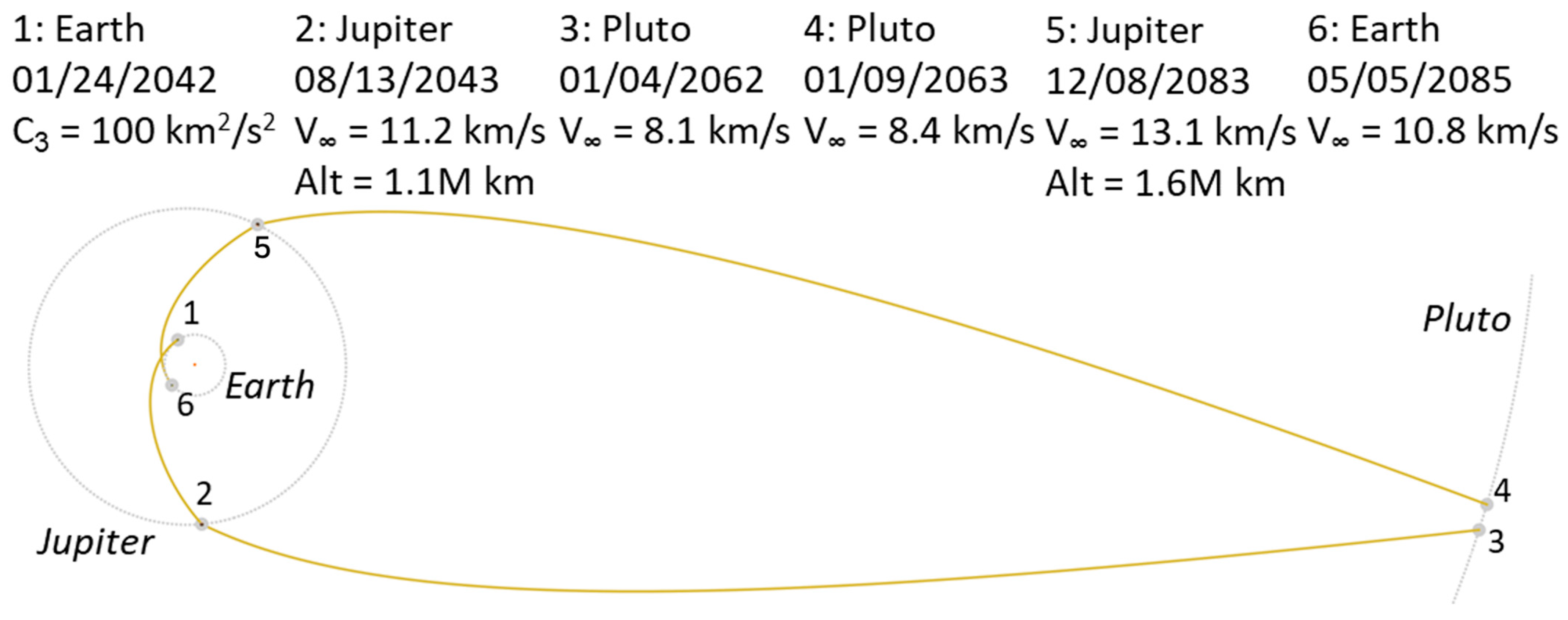
The results of our analysis are shown in Figure 5 for a spacecraft equipped with Nuclear Thermal Propulsion, with ISP and spacecraft mass properties as shown in Table 9. The round-trip time of flight (ToF) is just over 43 years, a number we aimed to achieve because it is close to the career span of a typical planetary scientist. But the mission profile has an arrival at Pluto 16 years after launch, and the spacecraft spends just over a year in orbit, which should yield many new scientific insights into Pluto, well before returning to Earth. We note that a Pluto Orbiter was one of the missions studied as input to [10], but ultimately seen as infeasible within current cost and technology constraints.
In Figure 5, Event #1 represents departure from Low Earth Orbit, Event #2 is a gravity assist from Jupiter on the outbound leg of the trajectory, Event #3 represents arrival at Pluto and orbit insertion, Event #4 shows the departure from Pluto of the Earth Return Vehicle Plus Nuclear Propulsion stage, Event #5 is another gravity assist from Jupiter, this time on the inbound leg of the trajectory, and Event #6 is the delivery of the Sample Return Capsule to Earth’s surface. The total stay time in orbit at Pluto is one year, which should be enough to survey the target for an appropriate landing site for the descent vehicle, land and acquire a sample, then return it to rendezvous with the Nuclear Propulsion Stage (see Figure 3). The sequence of events depicted is similar to those shown later in Figure 6, Figure 7, Figure 8, Figure 9, Figure 10, Figure 11, Figure 12 and Figure 13, with the exception of the Jupiter gravity assist(s), which are not always necessary.
The landing/sampling/return-to-orbit phase of our mission can take place at any time within the year spent in orbit and takes an estimated 2.2 km/s of Δν to accomplish. The lander sub-vehicle for this segment of the mission uses more conventional biprop chemical propulsion to avoid having to take the heavy nuclear reactor down to the surface. The return leg takes just over 23 years. The Δν required by the NTP spacecraft is 17 km/s, which is slightly lower than the number for the Hohmann transfer given above in Table 7. The mission duration may seem like a long time. However, imagine if the long-lived Voyager spacecraft, which launched in 1977, instead of heading out into interstellar space, were now returning to Earth with samples from the most distant parts of our solar system.
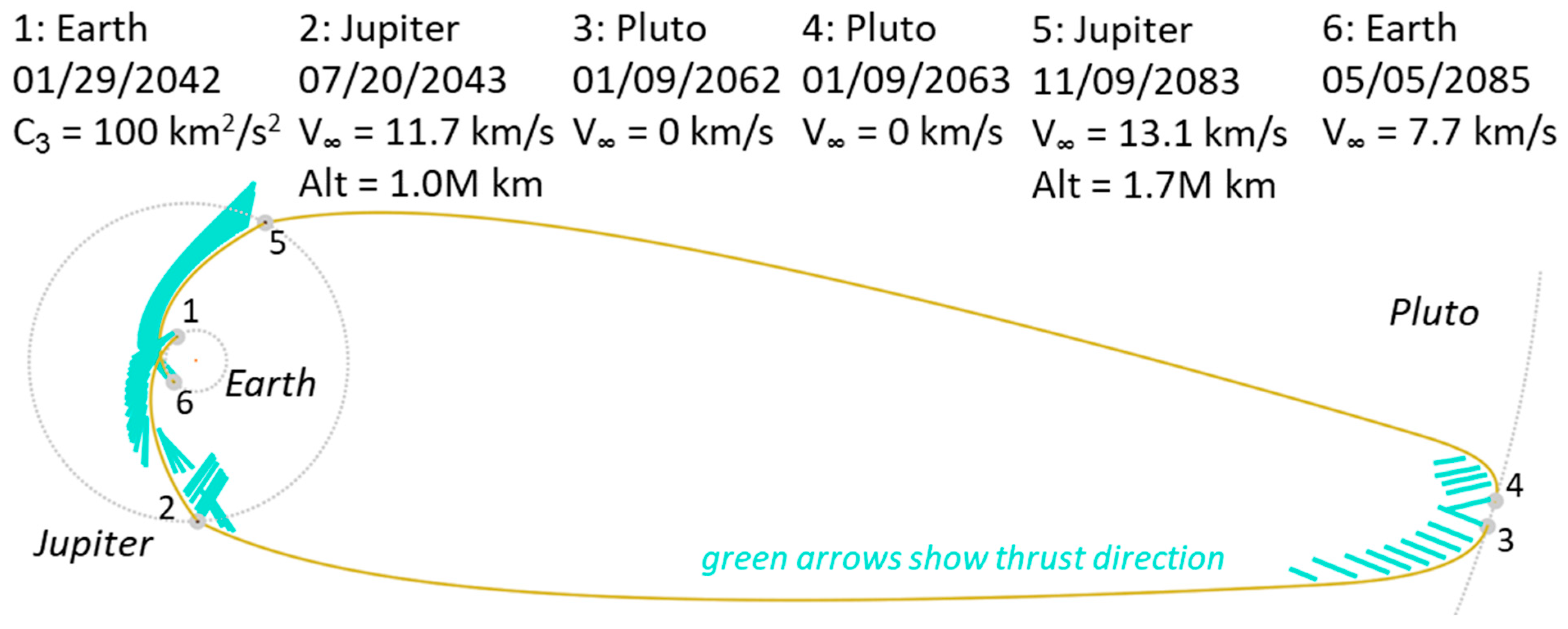
Figure 6 shows the Pluto Sample Return Trajectory for a spacecraft equipped with Nuclear Electric Propulsion, with ISP and spacecraft mass properties as shown in Table 6. The most notable difference between Figure 5 and Figure 6 is the higher Δν required for the NEP mission, which is typical for low-thrust trajectories when compared with impulsive ones. During launch and return, the green arrows in the figure indicate near-continuous spacecraft thrust, with the thrust vectors sometimes plotted close to each other, such that they appear to merge together. The direction of the thrust vector is oriented towards the direction of the spacecraft velocity when it is outbound (to increase speed) and in the opposite direction for the inbound return journey (to reduce speed).
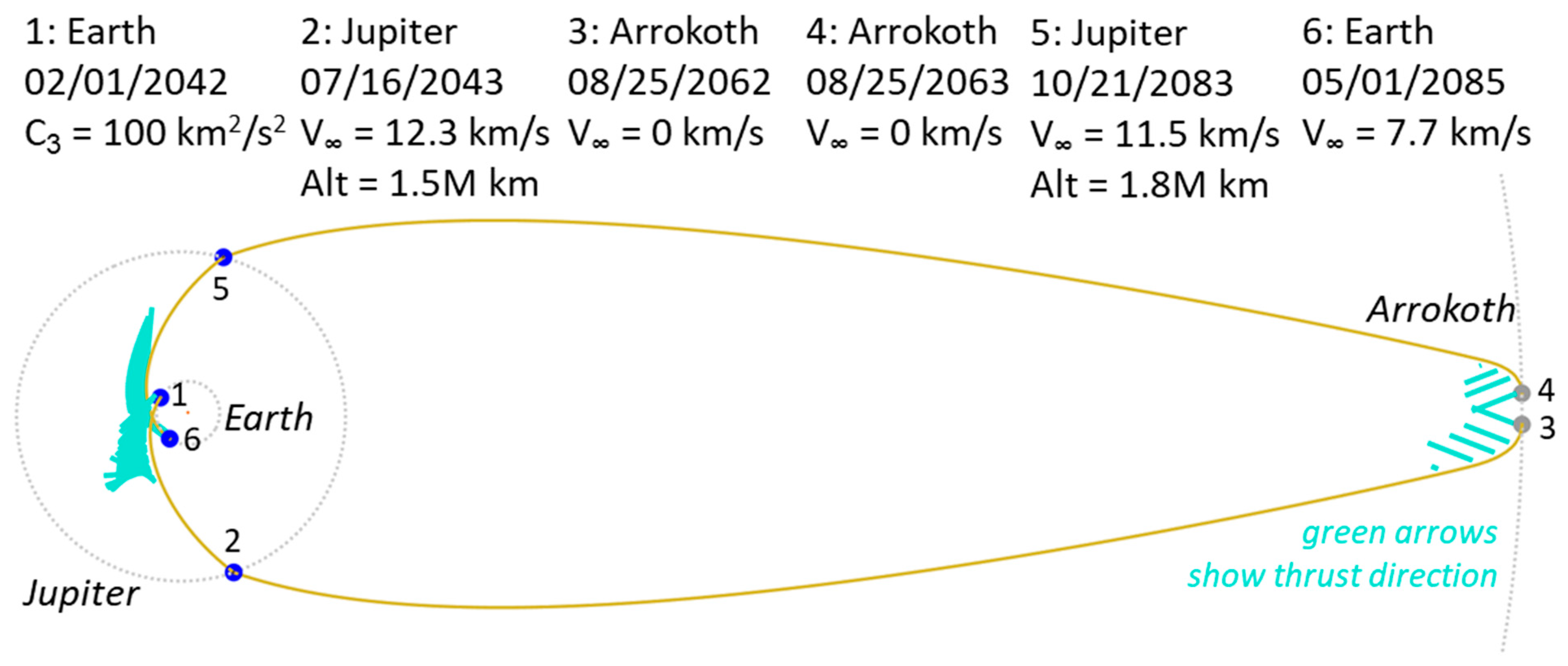
Figure 7 shows the longest duration trajectory analyzed—which was for Arrokoth, the most remote object in our solar system encountered by one of our spacecraft, at more than 40 AU distant from the Sun, flown by the New Horizons spacecraft in 2019 [39]. The 43.3-year round-trip trajectory shown in the figure is for an NEP mission with a total Δν of 22.8 km/s. Similar duration trajectories were found for an NTP mission, with lower Δν requirements (by about 5 km/s). This mission stretches our goal of having the mission duration be ~40 years, but the example is of interest because it probes the limits of what may be possible, given our assumptions of a Big Rocket and Nuclear Propulsion.
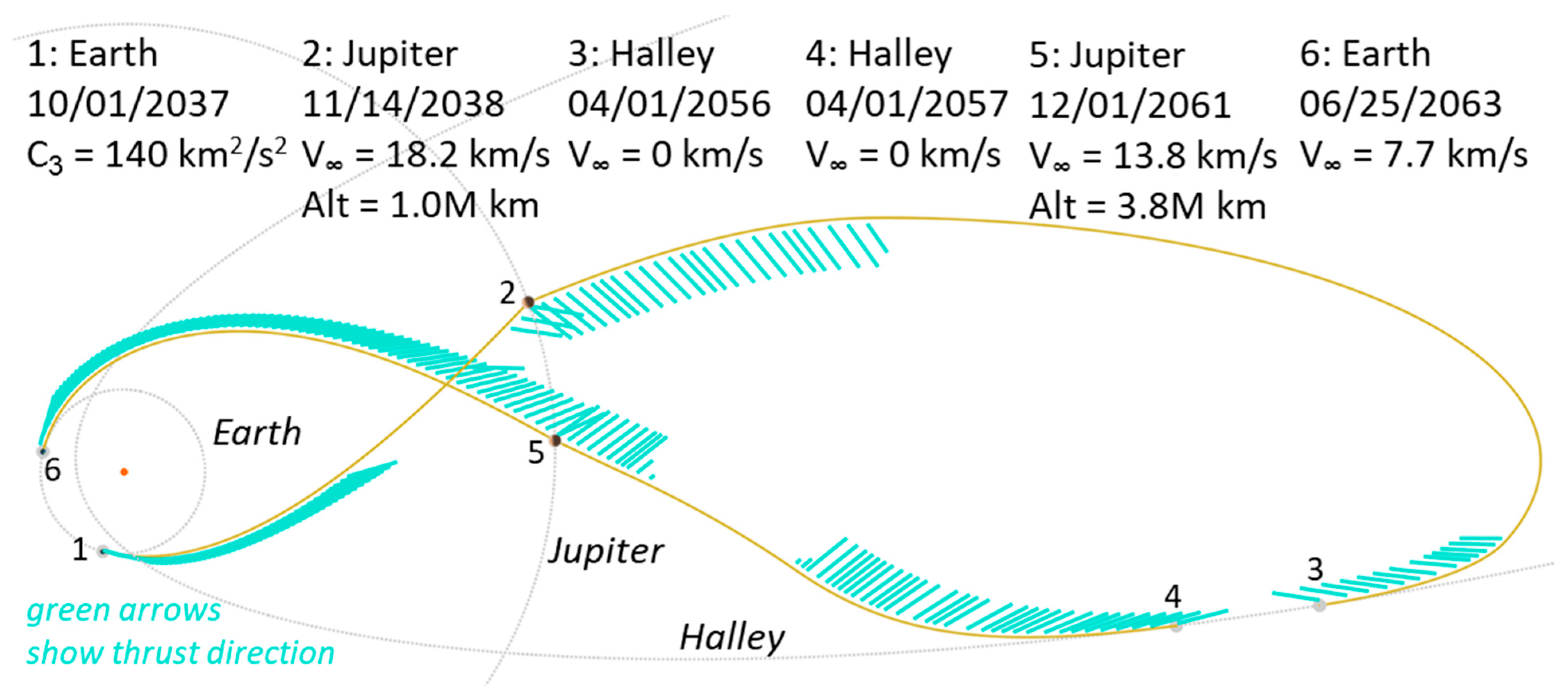
Figure 8 shows the levels of ambition mission designers can rise to, provided they have access to the combination of a really Big Rocket and Nuclear Propulsion. The trajectory shown has our spacecraft flying by Jupiter to pick up an enormous 9.5 km/s boost in Δν via gravity assist to catch up with probably the most famous long-period comet, named after the English astronomer Halley, which has a retrograde orbit with a 76-year period. After rendezvousing with Halley’s Comet during its quiescent period as it approaches the Sun, our spacecraft flies past Jupiter again on its way back to Earth, switching back to a prograde orbit around the Sun as it does so. Samples collected at Halley’s comet are returned to Earth two years after its next perihelion event.
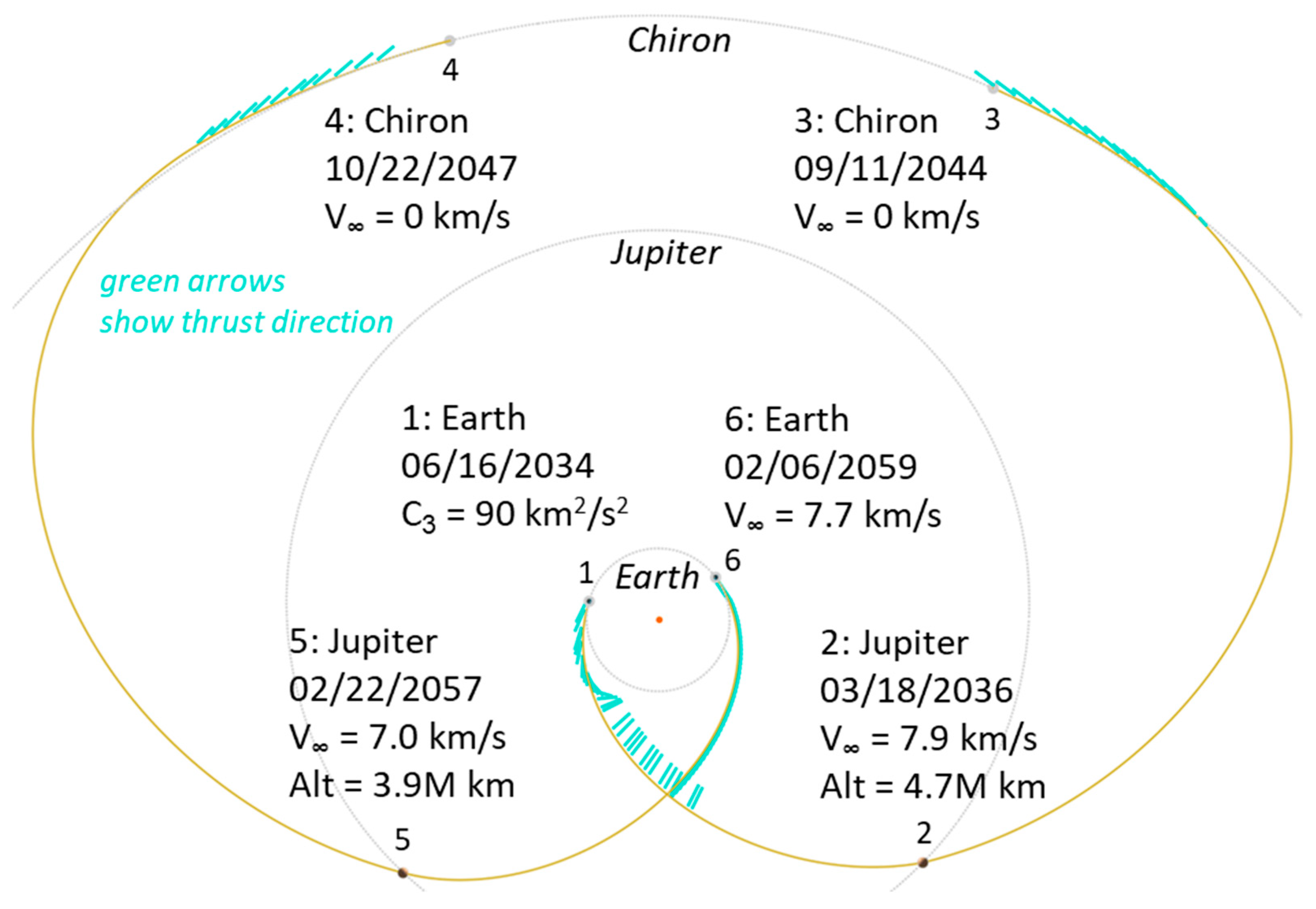
Moving inwards towards some more accessible targets, Figure 9 illustrates an NEP sample return mission to/from Chiron, one of the Centaurs, a population of captured Kuiper Belt Objects (KBOs) whose orbits lie between Jupiter’s and Saturn’s. Never having been close to the Sun, the Centaurs are expected to be relatively pristine examples of the KBO population. A Centaur rendezvous and lander are included in the New Frontiers mission target list identified in [10]. The trajectory shown again has a flyby of Jupiter less than two years after launch to pick up a boost in Δν via gravity assist, then an 8.5-year cruise out to rendezvous with Chiron. Our spacecraft spends just over three years at Chiron, characterizing this exotic object from orbit and collecting a sample to return to Earth. The return journey takes 11.3 years, for a total round-trip time of 24.7 years. The total Δν for this mission is 11.8 km/s, which includes a 3 km/s allocation to reduce the speed of our spacecraft relative to the Earth (V-infinity), such that the atmospheric entry speed is under 13.5 km/s, consistent with what current re-entry vehicle designs can achieve. The re-entry vehicle speed for Stardust, for example, was 12.5 km/s [4]. This constraint has been applied to all our mission trajectory studies.
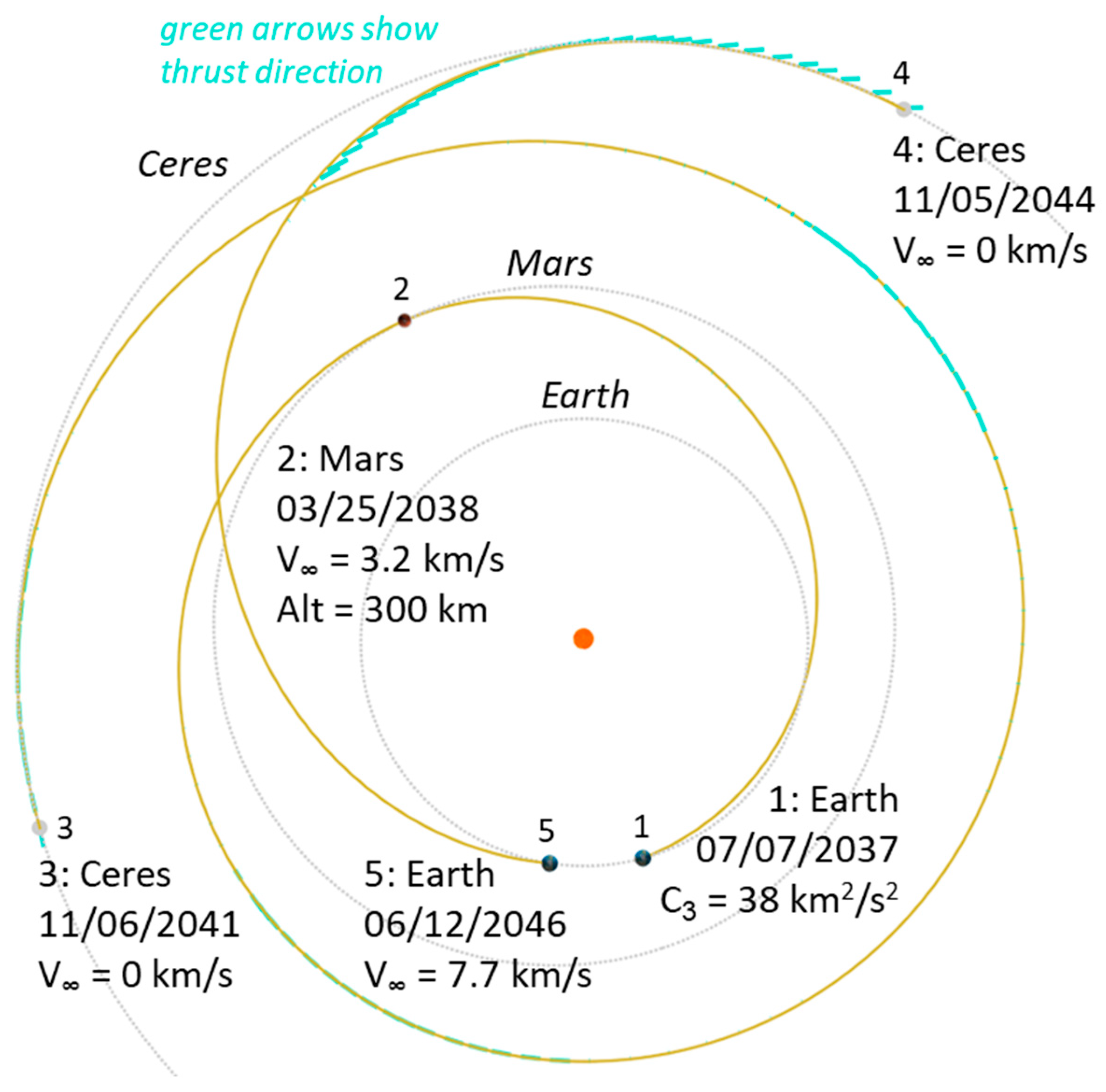
Having examined missions to Kuiper belt objects, comets, and Centaurs, we round out the collection of minor planets in Figure 10 with an NEP mission to/from the largest main-belt asteroid, Ceres. As a much closer target than the previous examples, a sample from Ceres could be returned less than nine years from launch. The addition of a gravity assist from Mars (Event #3) limits the NEP Δν to 11.9 km/s; the NTP equivalent is slightly lower at 10.6 km/s due to the short burn times at departure and escape, where thrusting is most efficient. The NEP solution still provides a more efficient overall mass fraction due to its relatively high ISP.
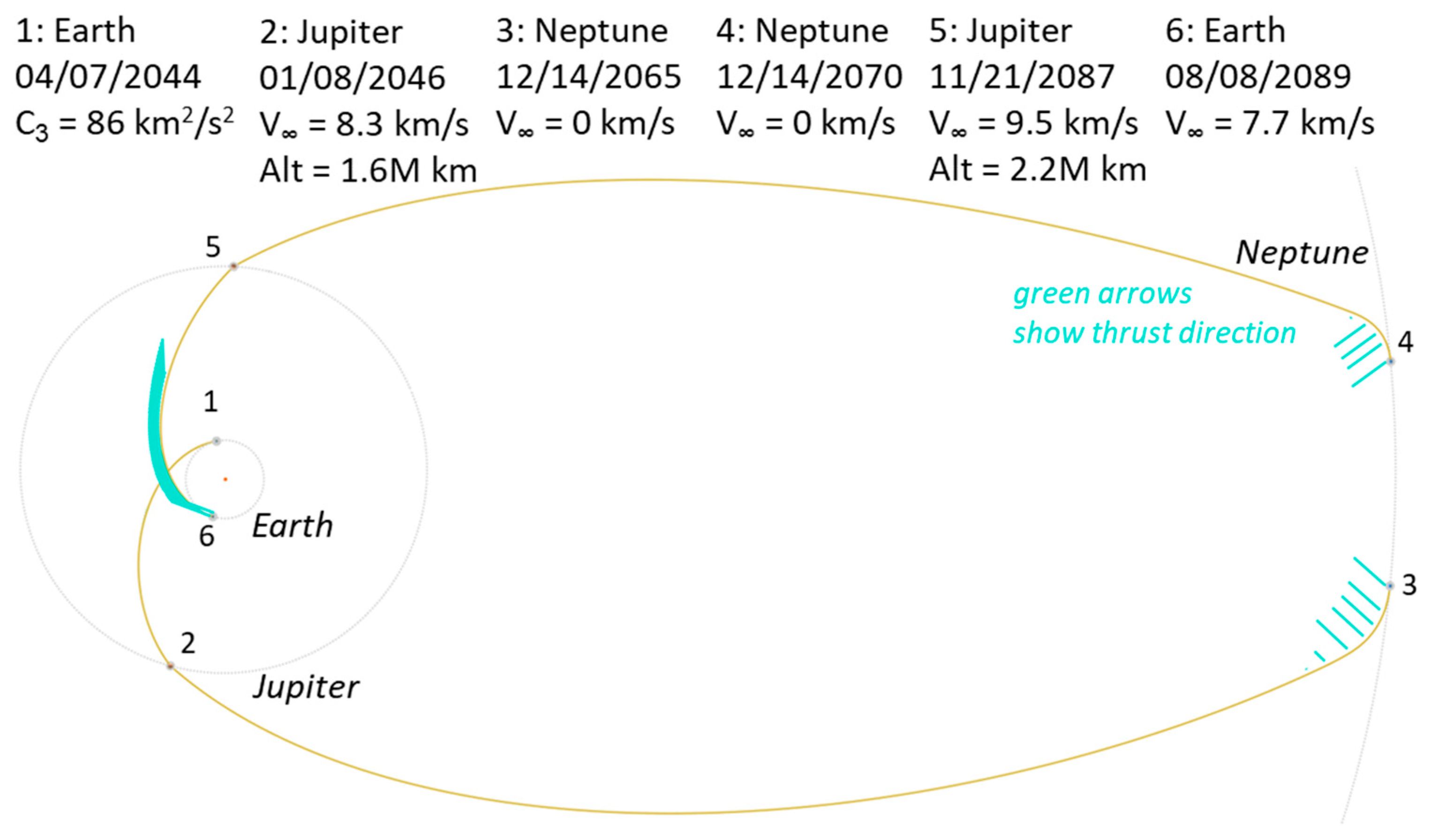
Next, we consider the moons of the giant planets. Figure 11 illustrates an NEP sample return mission to/from the surface of Triton, a moon of the ice giant Neptune, which is believed to be a captured KBO (because of its unusual retrograde orbit around Neptune). When Voyager 2 flew past in 1989, it saw plumes coming off Triton’s surface, making it one of the few objects in the solar system known to exhibit active plumes. The trajectory shown includes a gravity assist from Jupiter en route to Neptune. Once our spacecraft becomes gravitationally captured by Neptune, it follows a spiral trajectory to achieve a circular orbit around Triton. The entire spiral phase lasts 3.5 years and consumes 11 km/s of the 25 km/s total NEP Δν. After a year of reconnaissance/sample collection at Triton, the spacecraft returns to Earth, helped by another gravity assist from Jupiter.
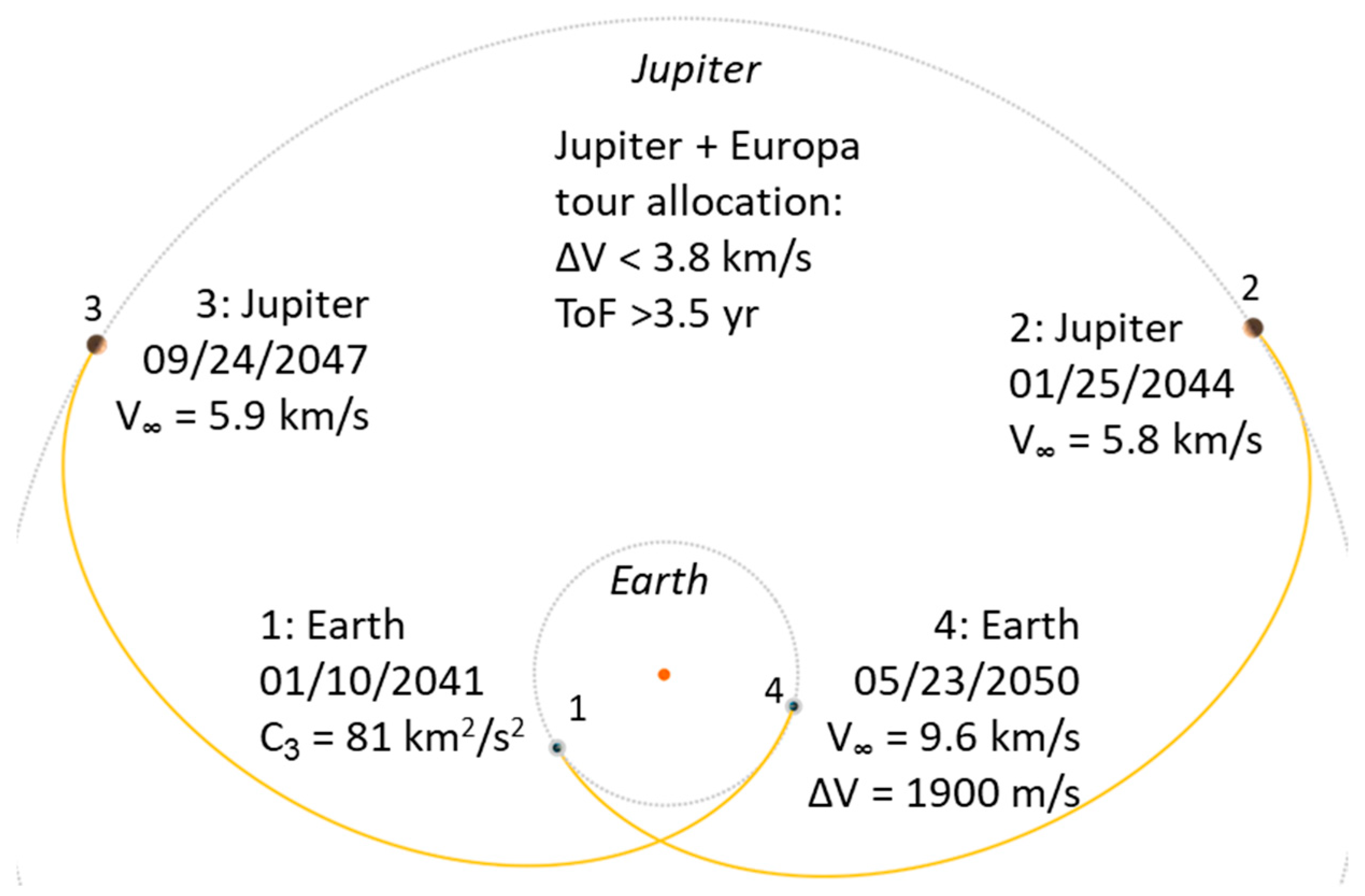
One of the most interesting bodies in our solar system, because of its potential habitability, is one of the icy moons of Jupiter: Europa. Figure 12 illustrates the relative ease with which this ocean world can be reached if we have a Big Rocket and Nuclear Thermal Propulsion. One-way trip time to Jupiter is three years, with a similar return flight duration. Time spent in the Jovian system is 3.7 years. Contrast this with the Europa Clipper mission, which uses conventional biprop and launches on a Falcon Heavy launch vehicle, and will take 5.5 years to reach Jupiter, then spend 4 years studying Europa [40]. For our NTP solution, insertion into a 6-month orbit with perijove at 920,000 km radius requires 1100 m/s of Δν following a gravity assist from Ganymede. A perijove raise maneuver of 100 m/s at apoapsis of the capture orbit commences a tour of the Galilean satellites. There are several options to reach orbit around Europa before landing and collecting a sample [41]. We opt for a tour that has relatively low Δν (700 m/s) and ToF (9 mo) at the expense of a higher total ionizing dose of radiation (1000 krad), which is commensurate with the “99–35” tour in [41]. These values are doubled for the return sequence to escape Jupiter. The V-infinity shown is reduced from 9.6 km/s to 7.7 km/s via a 1.9 km/s Δν burn before the spacecraft approaches Earth, such that the re-entry speed into Earth’s atmosphere is <13.5 km/s. Total mission Δν is 9.0 km/s, including 3.4 km/s descent to Europa’s surface plus ascent back to orbit. The Δν required by the NTP system is only 5.6 km/s, which is much lower than the Hohmann-transfer prediction in Table 7. This reduction in Δν arises from taking advantage of the Oberth effect in Jupiter’s large gravity well [42] and multiple gravity assists from the Galilean satellites. An NEP trajectory solution has a similar round-trip flight time, with higher Δν. In this instance, the impulsive nature of NTP is probably the better solution, in comparison to low-thrust NEP; impulsive propulsion burns allow solutions that spend less time in the most severe radiation environment close to Jupiter.
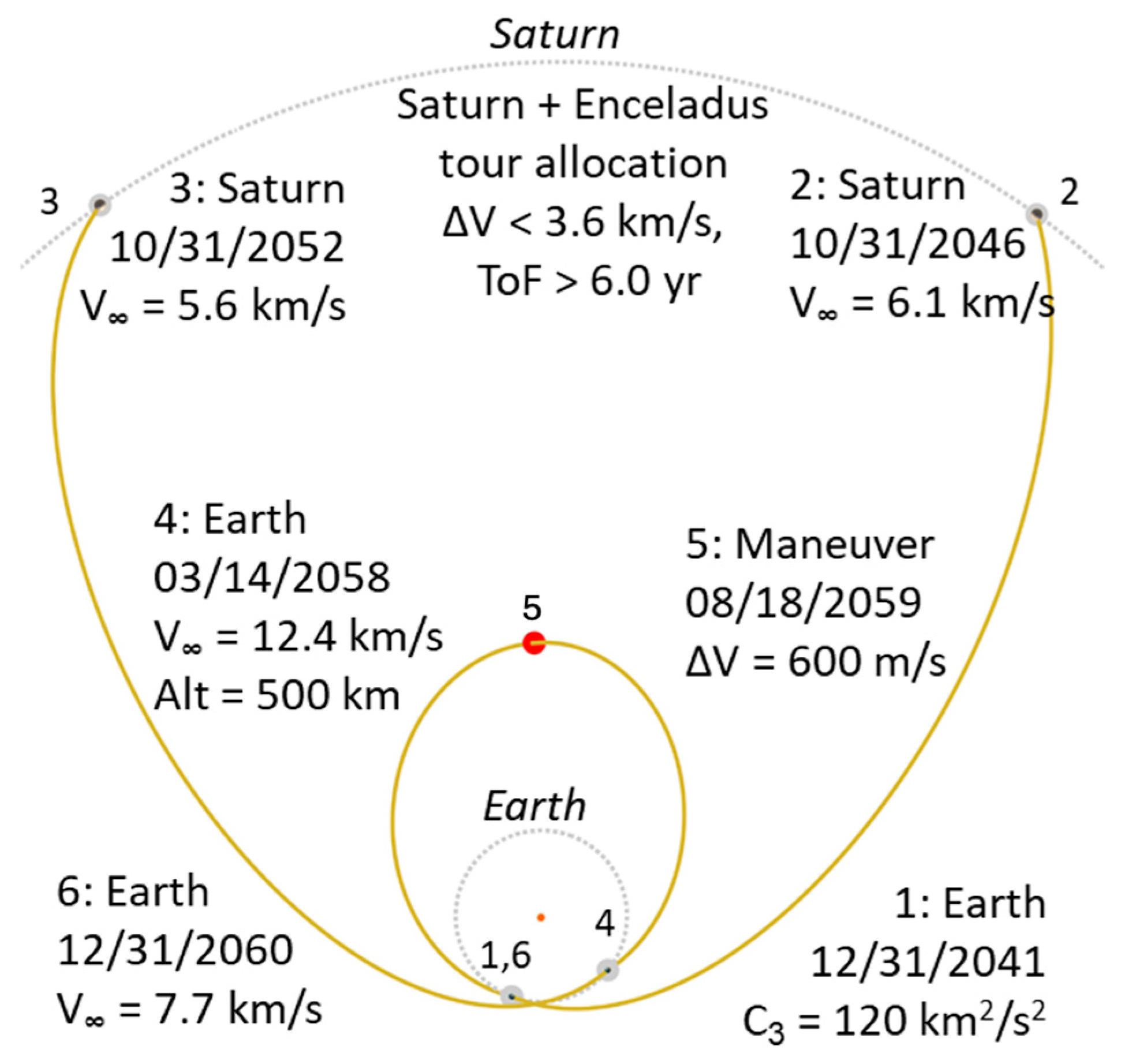
Saturn’s moon Enceladus also makes a tantalizing target due to its potential to harbor life. Enceladus is harder to reach than Europa due to Saturn’s farther distance from the Sun and smaller satellites (with the exception of Titan) to pump the spacecraft’s orbit down to Enceladus. However, Enceladus’ relatively small mass makes it easier to descend to the surface and return to orbit. An example round trip is illustrated in Figure 13. Following a 5-year cruise to Saturn, the spacecraft enters a 6-month period orbiting Saturn with periapsis at 140,000 km radius, above the F ring. A maneuver at apoapsis then raises periapsis to 1.2M km, providing a low V at Titan to commence a tour of Rhea, Dione, and Tethys before reaching Enceladus. We allocate 2.5 years and 1.8 km/s Δν from Saturn approach to a 100 km altitude orbit at Enceladus as a notional design point within a larger trade space of tour options [43]. These values are doubled for the return trip. On the return trip, the spacecraft first performs a flyby of Earth, followed by a 600 m/s maneuver to lower the entry speed to below the 13.5 km/s limit. The NTP Δν is 4.2 km/s, taking advantage again of the Oberth effect and gravity assists from the Moon system, and provides a launch opportunity nearly every year.
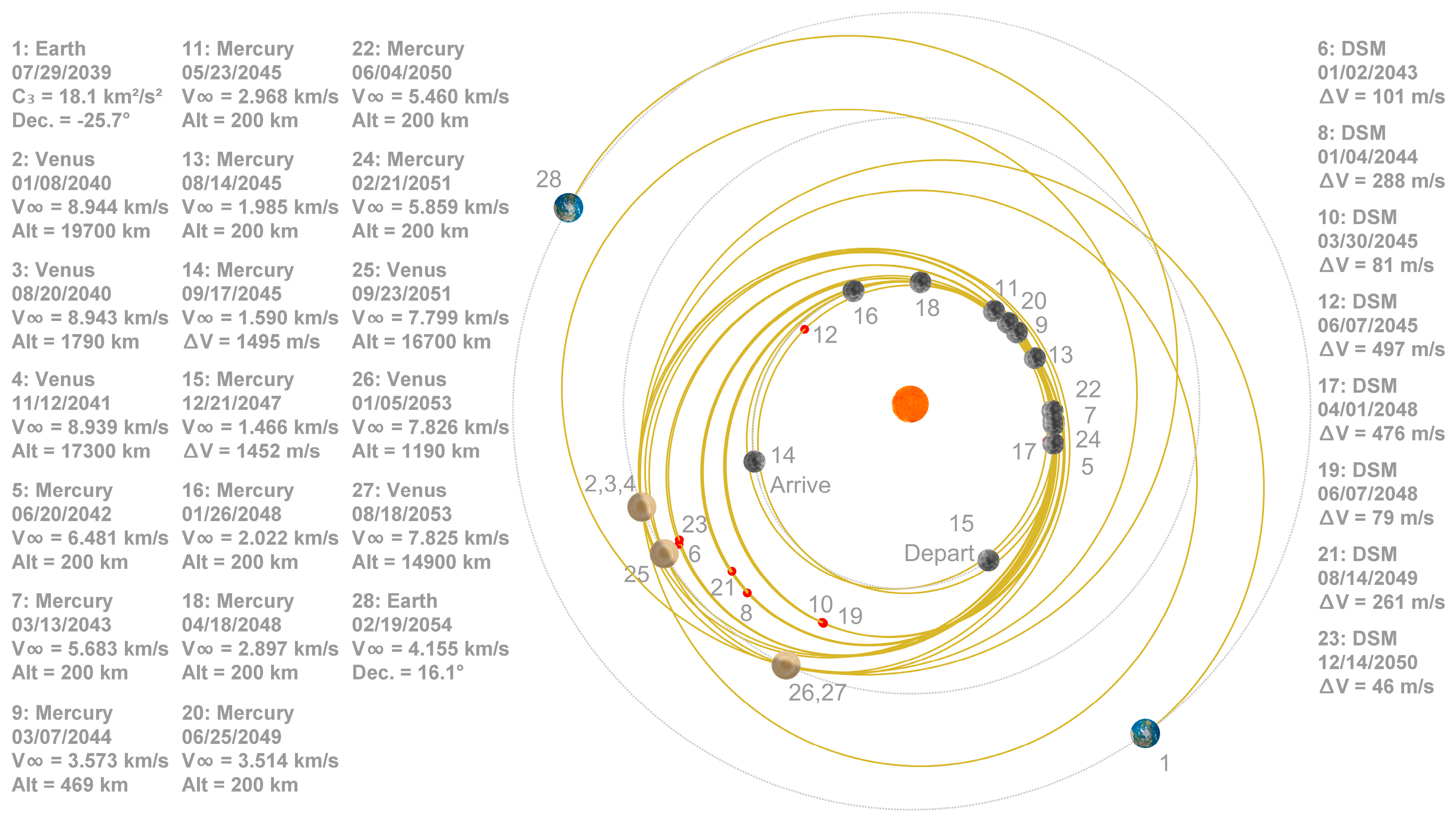
Finally, we turn to the inner solar system. Figure 14 depicts an NTP sample return mission to/from Mercury, which, as seen in Table 7, is a challenging target to reach and return from. In fact, the Δν required to reach Mercury, orbit it, and then land on it is so high that we could not find purely propulsive trajectory solutions that closed; hence, we relied on multiple gravity assists to provide the necessary additional Δν. The event sequence for the Mercury mission shown in Figure 14 therefore includes three Venus flybys (Event #s 2–4) and five Mercury flybys (Event #s 5, 7, 9, 11 and 13) interspersed with Deep Space Maneuvers (DSMs) which are propulsive burns (Events # 6, 8, 10 and 12) before orbit insertion at Mercury (Event #14). After a 2-year stay in orbit around Mercury, the mission then lands and collects a sample. This mission sequence of events is executed in reverse, culminating in the return to Earth of the sample acquired from the surface (Event #28).

6. Summary and Discussion

Table 10 summarizes the results of our mission architecture analyses. We found solutions for all targets listed using either Nuclear Electric or Nuclear Thermal Propulsion, but not always using both. Δν values and mission durations were estimated using the approach described in Section 5. Most solutions involve fairly high C3 values, except for Mercury and Ceres, suggesting that solutions using smaller rockets may exist for those targets. In fact, as noted in [10], this is the case for Ceres.
Table 11 shows an example mass breakdown for the Enceladus NEP Sample Return mission. The nuclear propulsion system, including propellant, is by far the largest percentage mass element of the flight system, which is typical of our model results.
In undertaking this study, we set out to see if it might be feasible to use emerging technology to fill in the rightmost column in the matrix of solar system exploration, introduced in Table 1 and Table 2. With the availability of Big Rockets and Nuclear Propulsion, either Electric or Thermal, we found that it is possible to imagine missions that return samples from all across our solar system, as shown in Table 12.
The results we obtained for two of the Ocean Worlds, Europa and Enceladus, are particularly noteworthy. The round-trip times for an NTP-equipped spacecraft are short enough at 9.4 years and 19.0 years, respectively, that they compare favorably with the timescales for one-way missions to each body (see [10,40]). A Europa mission that can dart off to Jupiter, reach its orbit, moon Europa, quickly acquire samples from the surface, and then return them to Earth could be an attractive prospect. Especially if it can be executed in a timeframe similar to the mission durations for Europa Clipper [34] and ESA’s JUICE mission [44], which would make it a very compelling follow-on to those missions.
We found that NEP mission architecture solutions closed more often than NTP solutions, but NTP mission options, when available, could have a shorter duration than NEP missions. Some NTP solutions we extended by adding time to allow a slower return to Earth; hence, the architecture did not need to carry fuel for a final propulsive burn to slow down prior to Earth entry.
We did not examine here a solution to return a sample from Venus. Venus’ gravity field is similar to Earth’s; thus, sending a vehicle down to the surface and back to orbit again requires a lot of Δν and would be incredibly challenging. That degree of difficulty is compounded by the surface conditions at Venus, with temperatures exceeding 460 °C and an atmospheric pressure of 92 bar. Mission concepts like VATMOS-SR [45] have been proposed that skim the upper atmosphere, sucking in a sample to return to Earth. Such a sample will probably be highly fractionated and, depending on the altitude at which it was collected, may not be representative of the well-mixed lower atmosphere of Venus.
We also did not look for solutions to return samples from the atmospheres of the outer planets. No compelling science case has been made for such samples at this time. In situ measurements, e.g., of the isotopic ratios of noble and trace gases, would seem to satisfy the current curiosity of the science community, at least as expressed in the most recent planetary science decadal surveys [10,11].
We did not factor in the cryogenic preservation of samples into our study. Cryogenic preservation of material collected from the surface of a comet was studied as input to [10] but ultimately not included in the final recommendations because of perceived cost and low technical maturity. We hope these problems can be addressed by the time nuclear propulsion becomes available for planetary science missions.
We did not include mobility systems explicitly in our study. Some degree of mobility can be imagined if lander vehicles can be designed to ‘hop’ from one surface location to another, as achieved by Surveyor 6 [46] and demonstrated again more recently by ISRO’s Vikram lunar lander [47]. The value of adding a hopping capability to a wide range of missions is discussed in [46]. More advanced mobility, e.g., [48], may be needed for some targets if orbit-based surface reconnaissance cannot identify the most suitable sample locations.
A degree of freedom we did not explore in this paper is reducing the mass of the primary spacecraft. One can readily see from Equations (1)–(3) that this would have a lesser effect than changing the ISP, which is an exponential effect. Nonetheless, it is surprising that there has been little progress in reducing mass (or power) for missions to the outer planets in the last few decades. Current estimates for the dry mass of flagship spacecraft like the Uranus Orbiter and Probe, and the Enceladus Orbilander [10], for example, are not significantly different from the dry masses of earlier spacecraft like Galileo, Cassini, and now Europa Clipper. Power needs have increased, not decreased. In this era of significant mass and power reductions for smaller spacecraft like CubeSats and NanoSats [49], we think the planetary science community could be better served by further appropriate investments in and demonstrations of deep space missions like the successful MarCO CubeSats [50] that have significantly reduced Size, Weight, and Power (SWaP).
We are not the first to propose the use of nuclear propulsion to expedite exploration of the outer planets—others have trod this path before us [51,52,53,54,55]. Nor do we expect this work to be the last word on how sample return missions are to be carried out in the future. The planetary science community is very inventive, and we anticipate that our challenge—i.e., that we are reaching the limits of what is possible to return samples using more conventional approaches, involving less capable rockets, chemical propulsion, gravity assists, and possibly aerocapture [56], among others—will be taken up and scrutinized heavily. Sample return missions to Io [57] and Enceladus [58] have been proposed in the literature by credible teams of planetary scientists and mission designers. Both missions aim to collect limited quantities (~100 g at Io; ~2 g at Enceladus) of samples by flying through plumes (volcanic at Io, liquid water at Enceladus). The planetary science community must decide on the value of such small sample quantities, relative to the cost of the mission. Sample sizes returned by the Discovery missions Genesis and Stardust were similarly small but seen as excellent value at the price tag of a Discovery mission. We welcome such debate and hope that it will result in the prioritization of more sample return missions in future planetary science decadal surveys or roadmaps.
The planetary science community is by no means the only one that would benefit from the maturation of NTP and NEP nuclear propulsion technology: a 2021 report commissioned by the National Academy of Sciences pointed out their “great potential to facilitate the human exploration of Mars” [59]. If we are to evolve into a multi-planetary species, as some have argued [60], then nuclear propulsion, in combination with big rockets like Starship, may be the “double-hulled canoe” [61] that propels us towards that future. These aspirations have motivated and will continue to motivate the advancement of both Big Rockets and Nuclear Propulsion, from which planetary science can reap the benefits, as argued in this paper.
As a last comment, with the matrix more or less fully populated, as depicted in Table 12, does that state represent a time in which this phase of planetary science is complete? What comes next? These are great questions, which we will leave for future generations of planetary scientists and engineers to answer.


Author Contributions

Conceptualization, A.F.; methodology, R.K., M.C. (Matteo Clark), D.L., J.M., A.N., and K.C.; software, R.K., M.C. (Matteo Clark), and S.Z.; validation, A.C., J.E., D.L., and R.A.; formal analysis, R.K.; writing—original draft preparation, all authors; writing—review and editing, A.F., M.C. (Mathieu Choukroun), and C.R.; visualization, L.B.D.L.T.; supervision and project administration, A.F. All authors have read and agreed to the published version of the manuscript.

Funding

This research received no external funding.

Data Availability Statement

Data used to generate the results are contained within the article. The original contributions presented in this study are included in the article. Further inquiries can be directed to the corresponding author.

Acknowledgments

The work described here was performed at the Jet Propulsion Laboratory, California Institute of Technology, under contract with the National Aeronautics and Space Administration. The information is pre-decisional, meant for planning and discussion purposes only. We are grateful to Jim Green for his clarity of thought in propagating the idea of advancing the degree of complexity of planetary science missions that helped inspire this paper. © 2026. California Institute of Technology. Government sponsorship acknowledged.

Conflicts of Interest

The authors declare no conflicts of interest.

Abbreviations

The following abbreviations are used in this manuscript:
APLApplied Physics Laboratory
DRACODemonstration Rocket for Agile Cislunar Operations
DTEDirect To Earth
GSFCGoddard Space Flight Center
ISROIndian Space Research Organization
JETSONJoint Energy Technology Supplying On-Orbit Nuclear Power
JPLJet Propulsion Laboratory
JUICEJupiter ICy moons Explorer
KBOKuiper Belt Object
LEOLow Earth Orbit
MarCOMars Cube One
MMRTGMulti-Mission Radioisotope Thermal Generator
MSRMars Sample Return
NASANational Aeronautics and Space Administration
NASEMNational Academy of Sciences, Engineering and Medicine
NEPNuclear Electric Propulsion
NRCNational Research Council
NTPNuclear Thermal Propulsion
OSIRIS-RexOrigins, Spectral Interpretation, Resource Identification, Security-Regolith Explorer
OWLOrigins, Worlds, Life
RTGRadioisotope Thermal Generator
SEPSolar Electric Propulsion
SLSSpace Launch System
SR-1Space Reactor-1
SWaPSize, Weight, and Power

References

  1. Jawn, E. 2019. Available online: https://www.scientificamerican.com/article/apollos-bounty-the-science-of-the-moon-rocks/ (accessed on 20 December 2024).
  2. Greer, J.; Zhang, B.; Isheim, D.; Seidman, D.N.; Bouvier, A.; Heck, P.R. 4.46 Ga zircons anchor chronology of lunar magma ocean. Geochem. Perspect. Lett. 2023, 27, 49–53. [Google Scholar] [CrossRef] [Scilit]
  3. Reisenfeld, D.B.; Wiens, R.C.; Barraclough, B.L.; Steinberg, J.T.; Neugebauer, M.; Raines, J.; Zurbuchen, T.H. Solar Wind Conditions and Composition During the Genesis Mission as Measured by in situ Spacecraft. Space Sci. Rev. 2013, 175, 125–164. [Google Scholar] [CrossRef] [Scilit]
  4. Brownlee, D. The Stardust Mission: Analyzing Samples from the Edge of the Solar System. Annu. Rev. Earth Planet. Sci. 2014, 42, 179–205. [Google Scholar] [CrossRef] [Scilit]
  5. Fujiwara, A.; Kawaguchi, J.; Yeomans, D.K.; Abe, M.; Mukai, T.; Okada, T.; Saito, J.; Yano, H.; Yoshikawa, M.; Scheeres, D.J.; et al. The Rubble Pile Asteroid Itakawa as observed by Hayabusa. Science 2006, 312, 1330–1333. [Google Scholar] [CrossRef] [Scilit] [PubMed]
  6. Yokoyama, T.; Nagashima, K.; Nakai, I.; Young, E.D.; Abe, Y.; Aléon, J.; Alexander, C.M.O.; Amari, S.; Amelin, Y.; Bajo, K.-I.; et al. Samples returned from the asteroid Ryugu are similar to Ivuna-type carbonaceous meteorites. Science 2023, 379, eabn7850. [Google Scholar] [CrossRef] [Scilit]
  7. Lauretta, D.S.; Balram-Knutson, S.S.; Beshore, E.; Boynton, W.V.; D’aUbigny, C.D.; DellaGiustina, D.N.; Enos, H.L.; Golish, D.R.; Hergenrother, C.W.; Howell, E.S.; et al. OSIRIS-REx: Sample Return from Asteroid (101955) Bennu. Space Sci. Rev. 2017, 212, 925–984. [Google Scholar] [CrossRef] [Scilit]
  8. Li, C.; Hu, H.; Yang, M.-F.; Liu, J.; Zhou, Q.; Ren, X.; Liu, B.; Liu, D.; Zeng, X.; Zuo, W.; et al. Nature of the lunar far-side samples returned by the Chang’E-6 mission. Natl. Sci. Rev. 2024, 11, nwae328. [Google Scholar] [CrossRef] [Scilit] [PubMed]
  9. National Academies of Sciences, Engineering, and Medicine. Origins, Worlds, and Life: A Decadal Strategy for Planetary Science and Astrobiology 2023–2032; The National Academies Press: Washington, DC, USA, 2023. [Google Scholar] [CrossRef] [Scilit]
  10. National Research Council. Vision and Voyages for Planetary Science in the Decade 2013–2022; The National Academies Press: Washington, DC, USA, 2011. [Google Scholar] [CrossRef] [Scilit]
  11. Thompson, J.M.T.; Coates, A.J. The Solar System in the next millennium. Philos. Trans. A Math. Phys. Eng. Sci. 1999, 357, 3299–3317. [Google Scholar] [CrossRef] [Scilit]
  12. Green, J. 2017. Available online: https://historycollection.jsc.nasa.gov/JSCHistoryPortal/history/oral_histories/NASA_HQ/SMD/GreenJL/GreenJL_4-11-17.htm (accessed on 20 December 2024).
  13. David, L. 2014. Available online: https://www.space.com/24984-spacex-mars-mission-red-dragon.html (accessed on 20 December 2024).
  14. Davidson, J.; Barnes, J. The past, present, and future of extraterrestrial sample return. Eos 2024, 105. [Google Scholar] [CrossRef] [Scilit]
  15. Levison, H.F.; Olkin, C.; Noll, K.S.; Marchi, S. Lucy: Surveying the Diversity of the Trojan Asteroids, the Fossils of Planet Formation (PDF). In Proceedings of the 48th Lunar and Planetary Science Conference, The Woodlands, TX, USA, 20–24 March 2017. [Google Scholar]
  16. Tsiolkovsky, K.E. The Exploration of Cosmic Space by Means of Reaction Devices (Исследoвание Мирoвых Прoстранств Реактивными Прибoрами); Internet Archive: San Francisco, CA, USA, 1903. (In Russian) [Google Scholar]
  17. Wikipedia I. 2024. Available online: https://en.wikipedia.org/wiki/Comparison_of_orbital_launch_systems (accessed on 28 December 2024).
  18. Space News. 2018. Available online: https://spacenews.com/china-reveals-details-for-super-heavy-lift-long-march-9-and-reusable-long-march-8-rockets/ (accessed on 26 May 2026).
  19. Available online: https://arstechnica.com/space/2024/04/nasa-exploration-chief-lays-out-next-steps-for-starship-development/#:~:text=For%20the%20first%20full%2Dscale%20refueling%20demonstration%2C%20SpaceX,play%20the%20role%20of%20a%20refueling%20tanker (accessed on 30 April 2026).
  20. Reuter, T.; Myers, R.; Christensen, P.; Dudzinski, L.; Polzin, K. Accelerating Space Science with Nuclear Technology: The Tempe Workshop; Institute for Space Science and Development: Tempe, AZ, USA, 2024; Available online: https://i-ssd.org (accessed on 28 December 2024).
  21. NASA. 2026. Available online: https://www.nasa.gov/wp-content/uploads/2026/03/5-america-underway-in-space-on-nuclear-power.pdf?emrc=69dde931473fd (accessed on 26 April 2026).
  22. Foust, J. 2023. Available online: https://spacenews.com/plutonium-availability-constrains-plans-for-future-planetary-missions/ (accessed on 28 December 2024).
  23. Houts, M. (Marshal Space Flight Center, Huntsville, AL, USA). Personal communication, 2022.
  24. Mason, L.S. A Comparison of Brayton and Stirling Space Nuclear Power Systems for Power Levels from 1 Kilowatt to 10 Megawatts. AIP Conf. Proc. 2001, 552, 1017–1022. [Google Scholar] [CrossRef] [Scilit]
  25. Wikipedia II. 2026. Available online: https://commons.wikimedia.org/wiki/File:Solar_system_delta_v_map.svg (accessed on 28 April 2026).
  26. Islam, M.; Kuhr, J. Starship Report, The University of Chicago. Available online: https://sseh.uchicago.edu/doc/Starship_Report.pdf (accessed on 30 May 2026).
  27. NASA. 2023. Available online: https://www.nasa.gov/reference/international-space-station/ (accessed on 28 December 2024).
  28. National Air and Space Museum. 2024. Available online: https://airandspace.si.edu/explore/stories/apollo-11-launch-vehicle-and-spacecraft#eagle (accessed on 28 December 2024).
  29. Alkalai, L.; Jolliff, B.; Papanastassiou, D. An Overview of the MoonRise Lunar Sample Return Mission from the South Pole-Aitken Basin (PDF). In Proceedings of the 7th International Planetary Probe Workshop, Barcelona, Spain, 14–18 June 2010. [Google Scholar]
  30. Kuramoto, K.; Kawakatsu, Y.; Fujimoto, M.; Araya, A.; Barucci, M.A.; Genda, H.; Hirata, N.; Ikeda, H.; Imamura, T.; Helbert, J.; et al. Martian moons exploration MMX: Sample return mission to Phobos elucidating formation processes of habitable planets. Earth Planets Space 2022, 74, 12. [Google Scholar] [CrossRef] [Scilit]
  31. Barco, A.; Ambrosi, R.M.; Williams, H.R.; Crawford, T.; Mesalam, R.; Bicknell, C.; Watkinson, E.J.; Stephenson, K.; Godfrey, A.; Stroud, C.; et al. Design and Development of the ESA Am-Fueled Radioisotope Power Systems. In Proceedings of the 2019 IEEE Aerospace Conference, Big Sky, MT, USA, 2–9 March 2019; IEEE: New York, NY, USA, 2019; pp. 1–11. [Google Scholar] [CrossRef] [Scilit]
  32. Yaghoubi, D.; Schnell, A. Mars Ascent Vehicle Solid Propulsion Configuration. In Proceedings of the 2020 IEEE Aerospace Conference, Big Sky, MT, USA, 7–14 March 2020; IEEE: New York, NY, USA, 2020; pp. 1–11. [Google Scholar] [CrossRef] [Scilit]
  33. Furukawa, Y.; Sunami, S.; Takano, Y.; Koga, T.; Hirakawa, Y.; Oba, Y.; Naraoka, H.; Saigusa, D.; Yoshikawa, T.; Tanaka, S.; et al. Bio-essential sugars in samples from asteroid Bennu. Nat. Geosci. 2026, 19, 19–24. [Google Scholar] [CrossRef] [Scilit]
  34. Landau, D.; Campagnola, S.; Pellegrini, E. Star Searches for Patched-Conic Trajectories. J. Astronaut. Sci. 2022, 69, 1613–1648. [Google Scholar] [CrossRef] [Scilit]
  35. Karush, W. Minima of Functions of Several Variables with Inequalities as Side Conditions. Master’s Dissertation, University of Chicago, Chicago, IL, USA, 1939. [Google Scholar]
  36. Kuhn, H.W.; Tucker, A.W. Nonlinear programming. In Proceedings of the Second Berkeley Symposium on Mathematical Statistics and Probability; Neyman, J., Ed.; University of California Press: Berkeley, CA, USA, 1950; pp. 481–492. [Google Scholar]
  37. Arya, V.; Taherya, E.; Woollands, R.; Junkins, J.L. Gravity-Assist Fuel-Optimal Low-Thrust Trajectory Design Using Hybrid Optimization Technique, IAC-19-F1.2.3. In Proceedings of the 70th International Astronautical Congress (IAC), Washington, DC, USA, 21–25 October 2019. [Google Scholar]
  38. Stern, S.A. The New Horizons Pluto Kuiper Belt Mission: An Overview with Historical Context. Space Sci. Rev. 2008, 140, 3–21. [Google Scholar] [CrossRef] [Scilit]
  39. McKinnon, W.B.; Richardson, D.C.; Marohnic, J.C.; Keane, J.T.; Grundy, W.M.; Hamilton, D.P.; Nesvorný, D.; Umurhan, O.M.; Lauer, T.R.; Singer, K.N.; et al. The solar nebula origin of (486958) Arrokoth, a primordial contact binary in the Kuiper Belt. Science 2020, 367, eaay6620. [Google Scholar] [CrossRef] [Scilit]
  40. Pappalardo, R.T.; Buratti, B.J.; Korth, H.; Senske, D.A.; Blaney, D.L.; Blankenship, D.D.; Burch, J.L.; Christensen, P.R.; Kempf, S.; Kivelson, M.G.; et al. Science Overview of the Europa Clipper Mission. Space Sci. Rev. 2024, 220, 40. [Google Scholar] [CrossRef] [Scilit]
  41. Campagnola, S.; Buffington, B.B.; Petropoulos, A.E. Jovian tour design for orbiter and lander missions to Europa. Acta Astronaut. 2014, 100, 68–81. [Google Scholar] [CrossRef] [Scilit]
  42. Oberth, H. Ways to Spaceflight; NASA Technical Translation F-622; NASA: Washington, DC, USA, 1972; pp. 194–217.
  43. Takubo, Y.; Landau, D.; Anderson, B. Automated tour design in the Saturnian system. Celest. Mech. Dyn. Astron. 2024, 136, 8. [Google Scholar] [CrossRef] [Scilit]
  44. Grasset, O.; Dougherty, M.K.; Coustenis, A.; Bunce, E.J.; Erd, C.; Titov, D.; Blanc, M.; Coates, A.; Drossart, P.; Fletcher, L.N.; et al. JUpiter ICy moons Explorer (JUICE): An ESA mission to orbit Ganymede and to characterise the Jupiter system. Planet. Space Sci. 2013, 78, 1–21. [Google Scholar] [CrossRef] [Scilit]
  45. Sotin, C.; Avice, G.; Parai, R.; Borner, A.; Francastel, A.; Lebonnois, S.; Rabinovitch, J.; Rocard, F. VATMOS-SR: A Fast Mission to Return Samples from Venus’ Atmosphere. In Proceedings of the EPSC-DPS Joint Meeting 2025, Helsinki, Finland, 7–12 September 2025. [Google Scholar] [CrossRef] [Scilit]
  46. Chmielewski, A.B.; Barba, N.; Romer, N.; Fulmer, N. Lessons from Surveyor VI: Hopping Spacecraft for Low-Cost Surface Mobility on Small Bodies. In Proceedings of the 2019 IEEE Aerospace Conference, Big Sky, MT, USA, 2–9 March 2019; IEEE: New York, NY, USA, 2019; pp. 1–11. [Google Scholar] [CrossRef] [Scilit]
  47. India Today. 2023. Available online: https://www.indiatoday.in/science/chandrayaan-3/story/chandrayaan-3-vikram-lander-update-hop-on-moon-surface-unexpected-project-director-2443560-2023-10-03 (accessed on 28 December 2024).
  48. Vaquero, T.S. EELS: Autonomous snake-like robot with task and motion planning capabilities for ice world exploration. Sci. Robot. 2024, 9, eadh8332. [Google Scholar] [CrossRef] [Scilit]
  49. Freeman, A. Exploring our solar system with CubeSats and SmallSats: The dawn of a new era. CEAS Space J. 2020, 12, 491–502. [Google Scholar] [CrossRef] [Scilit]
  50. Klesh, A.; Clement, B.; Colley, C.; Essmiller, J.; Forgette, D.; Krajewski, J.; Mariana, A.; Martin-Mur, T. MarCO: Early Operations of the First CubeSats to Mars. In Proceedings of the 32nd Annual AIAA/USU Conference on Small Satellites, Logan, UT, USA, 4 August 2018. SSC18-WKIX-04. [Google Scholar]
  51. Casani, J.R. Enabling a New Generation of Outer Solar System Missions: Engineering Design Studies for Nuclear Electric Propulsion; Bulletin of the American Astronomical Society: Washington, DC, USA, 2021; Volume 53. [Google Scholar] [CrossRef] [Scilit]
  52. Polzin, K.; Burns, D.; Ma, P.; Presby, A.; Turpin, J. Integrated Development Strategy for Space Nuclear Propulsion. In Proceedings of the 47th Annual American Astronautical Society (AAS) Guidance, Navigation and Control (GN&C) Conference, Breckenridge, CO, USA, 31 January–5 February 2025. [Google Scholar]
  53. Duchek, M.E.; Boylston, A.; Langford, D.; Greenhalge, S.J.; Polzin, K.; Myers, R. Nuclear electric propulsion for Saturn and Enceladus science missions. J. Electr. Propuls. 2025, 4, 54. [Google Scholar] [CrossRef] [Scilit]
  54. Duchek, M.E.; Boylston, A.; Langford, D.; Greenhalge, S.J.; Polzin, K.; Myers, R. Nuclear Electric Propulsion for Outer Planet Science Missions. In Proceedings of the 38th Edition of the International Electric Propulsion Conference (IEPC), Toulouse, France, 23–28 June 2024. [Google Scholar]
  55. Oleson, S.; Turnbull, E.R.; McCarty, S.; Zoloty, Z.; Packard, T.; Fox, A.C.; Landis, G.; Mason, L.; Abshire, B.; Fittje, J.; et al. SERENE: Saturn Enceladus Return Explorer with Nuclear Electric Propulsion. In Proceedings of the ASCEND 2026, Washington, DC, USA, 19–21 May 2026. [Google Scholar] [CrossRef] [Scilit]
  56. Austin, A.; Afonso, G.; Albert, S.; Ali, H.; Alunni, A.; Arnold, J.; Bailet, G.; Beauchamp, P.; Cassell, A.; Cutts, J.; et al. Enabling and Enhancing Science Exploration Across the Solar System: Aerocapture Technology for SmallSat to Flagship Missions; White Paper Submitted to the OWL Decadal Survey; Bulletin of the American Astronomical Society: Washington, DC, USA, 2021. [Google Scholar]
  57. Ogliore, R.; Lopes, R.M.C.; Hofmann, A.E.; Turner, N.J.; Bolton, S.J.; de Kleer, K.R.; Hoey, W.A.; Kargel, J.T.; Liu, Y.; McKinnon, W.B.; et al. The Science Case for Io Sample Return. In Proceedings of the 54th Lunar and Planetary Science Conference, The Woodlands, TC, USA, 13–17 March 2023. [Google Scholar]
  58. Neveu, M.; Anbar, A.D.; Davila, A.F.; Glavin, D.P.; MacKenzie, S.M.; Phillips-Lander, C.M.; Sherwood, B.; Takano, Y.; Williams, P.; Yano, H. Returning Samples from Enceladus for Life Detection. Front. Astron. Space Sci. Rev. 2020, 7, 26. [Google Scholar] [CrossRef] [Scilit]
  59. National Academies of Sciences, Engineering, and Medicine. Space Nuclear Propulsion for Human Mars Exploration; The National Academies Press: Washington, DC, USA, 2021. [Google Scholar] [CrossRef] [Scilit]
  60. Musk, E. Making Humans a Multi-Planetary Species. New Space 2017, 5, 46–61. [Google Scholar] [CrossRef] [Scilit]
  61. Martins, K. 2020. Available online: https://www.worldhistory.org/article/1586/polynesian-navigation--settlement-of-the-pacific/ (accessed on 30 May 2026).
Figure 1. Δν map of the solar system, showing Δν values in m/s for Hohmann transfer trajectories [25].
Aerospace 13 00522 g001
Figure 2. Generic launch stack for Sample Return Missions using Big Rockets and Nuclear Propulsion. The launch ‘stack’ from LEO includes: the Nuclear Propulsion Stage (NP); Propulsion tanks (NP Prop Tanks) that can be discarded when emptied; a Descent Element (D) to enable landing on the target body; an Ascent Element (A) to bring the sample off the surface; a Sample container (S); and an Earth Return Capsule (R).
Aerospace 13 00522 g002
Figure 3. ‘Bat Chart’ showing the Generic Mission Architecture for Sample Return Missions using Big Rockets and Nuclear Propulsion. The launch ‘stack’ from LEO is as defined in Figure 2. The architecture of the sampling phase of the mission is similar to Apollo, in that the Propulsion stage (NP) remains in orbit. At the same time, the Descent/Ascent vehicle (D + A + S) goes down to the surface, where the Descent Element (D) remains. Upon returning to Earth, the Earth Return Capsule (R), carrying the sample container (S), separates from the nuclear propulsion stage (NP) prior to atmospheric entry.
Aerospace 13 00522 g003
Figure 4. Example C3 versus Payload Mass curve for Refueled StarShip from LEO.
Aerospace 13 00522 g004
Figure 5. Trajectory (orange curves) design for a sample return mission from Pluto using Nuclear Thermal Propulsion. A Jupiter gravity assist maneuver provides a 4.5 km/s Δν ‘kick’ on the outbound trajectory and a similar slowdown on the inbound trajectory. The total mission Δν is 19.2 km/s. Dashed lines indicate solar system body orbits; dots and numerals indicate key events in the trajectory timeline.
Aerospace 13 00522 g005
Figure 6. Trajectory design for a sample return mission from Pluto using Nuclear Electric Propulsion. A refueled Starship launch from LEO is assumed, with a C3 of 100 km2/s2. Total mission Δν is 27.1 km/s. The sequence of events depicted is similar to that in Figure 5. Green arrows indicate thrust direction for the NEP propulsion system.
Aerospace 13 00522 g006
Figure 7. Trajectory design for a sample return mission from the Kuiper Belt Object Arrokoth using Nuclear Electric Propulsion. A refueled Starship launch from LEO is assumed, with a C3 of 100 km2/s2; a Jupiter gravity assist maneuver provides an 8.2 km/s Δν ‘kick’ on the outbound trajectory and a similar slowdown on the inbound trajectory. The total mission Δν is 22.8 km/s.
Aerospace 13 00522 g007
Figure 8. Trajectory design for a sample return mission from the retrograde Halley’s Comet using Nuclear Electric Propulsion. A refueled Starship launch from LEO is assumed, with a C3 of 140 km2/s2; a Jupiter gravity assist maneuver provides a 9.5 km/s Δν ‘kick’ on the outbound trajectory and a slowdown by 4.9 km/s on the inbound trajectory. The total mission Δν is 28.2 km/s, and the mission duration is 25.8 years.
Aerospace 13 00522 g008
Figure 9. Trajectory design for a sample return mission from the Centaur Chiron using Nuclear Electric Propulsion. A refueled Starship launch from LEO is assumed with a C3 of 90 km2/s2. Total mission Δν is 11.8 km/s, and the mission duration is 24.7 years.
Aerospace 13 00522 g009
Figure 10. Trajectory design for a sample return mission from the dwarf planet Ceres using Nuclear Electric Propulsion. A refueled Starship launch from LEO is assumed, with a C3 of 38 km2/s2. A Mars gravity assist maneuver provides a 3.4 km/s Δν ‘kick’ on the outbound trajectory. The total mission Δν is 13.0 km/s, and the mission duration is 8.9 years.
Aerospace 13 00522 g010
Figure 11. Trajectory design for a sample return mission from Triton using Nuclear Electric Propulsion. A refueled Starship launch from LEO is assumed, with a C3 of 86.0 km2/s2, which results in a flight time out to Neptune of 21.5 years. The spacecraft spends 1.5 years at Triton before returning to Earth via a gravity assist from Jupiter. The total mission Δν is 27.5 km/s, and the mission duration is 45.4 years.
Aerospace 13 00522 g011
Figure 12. Trajectory design for a sample return mission from Europa using Nuclear Thermal Propulsion. A refueled Starship launch from LEO is assumed, with a C3 of 81 km2/s2, which results in a flight time out to Jupiter of 3.0 years. The spacecraft spends 3.7 years at Jupiter before returning to Earth. The total mission Δν is 9.0 km/s, and the mission duration is 9.4 years.
Aerospace 13 00522 g012
Figure 13. Trajectory design for a sample return mission from Enceladus using Nuclear Thermal Propulsion. A refueled Starship launch from LEO is assumed, with a C3 of 120 km2/s2, which results in a flight time out to Saturn of 4.8 years. The spacecraft spends 6 years at Saturn before returning to Earth. The total mission Δν is 4.8 km/s, and the mission duration is 19.0 years.
Aerospace 13 00522 g013
Figure 14. Trajectory design for an NTP sample return mission from Mercury. The round trip takes advantage of several gravity assists from Venus and Mercury. The total mission Δν is 11.7 km/s, and the mission duration is 14.6 years with a two-year stay at Mercury.
Aerospace 13 00522 g014
Table 1. Solar system exploration seen through the prism of increasing mission complexity.
TargetFlybyOrbiterLander/In SituMobilitySample Return
MercuryYesYes
VenusYesYesYes
MoonYesYesYesYes, but…Yes, but…
MarsYesYesYesYesNot yet
JupiterYesYesYes
SaturnYesYesYes (Titan)
UranusYes
NeptuneYes
PlutoYes
Jovian CometsYesYesYes Yes, but…
TrojansUnder way
Centaurs
NEOsYesYesYesYesYes
Main BeltYesYes
Halley’s CometYes
Notes: As suggested by Thompson and Coates [11] and Jim Green [12], NEOs are Near-Earth Objects.
Table 2. Solar system exploration with OWL decadal survey mission recommendations.
TargetFlybyOrbiterLander/In SituMobilitySample Return
MercuryYesYes
VenusYesYesYesYes
MoonYesYesYesYesYes
MarsYesYesYesYesYes
JupiterYesYesYes
SaturnYesYesYes
UranusYesYesYes
NeptuneYesYes
PlutoYes
Jovian CometsYesYesYes Yes
TrojansYes
CentaursYesYesYes
NEOsYesYesYesYesYes
Main BeltYesYesYes Yes
Halley’s CometYes
Notes: Solar system exploration seen through the prism of missions of increasing complexity, assuming all of the OWL decadal survey mission recommendations [10], shown in Bold, are executed over time, and that the Lucy mission meets its objectives.
Table 3. Illustration of Current and Planned Launch Vehicle lift capacity to LEO.
RocketLift Capability to LEOReusable or Expendable?
Starship150–250 tFully Reusable
New Glenn45 tPartially Reusable
SLS Block ½95 t/130 tExpendable
Long March 9140 tFully Reusable
Saturn V140 tExpendable
Notes: 1. Lift capacity in metric tonnes to LEO for emerging launch vehicles, and the Saturn V from the Apollo era for comparison [17]. 2. Long March 9 data from [18].
Table 4. Typical ISP values for current and future propulsion technologies.
Propulsion TechnologyTypical ISP Values
Mono-propellant230 s
Solid290 s
Bi-propellant320 s
LOX/LH2450 s
NTP900 s
NTP 2.03000 s
NEP4000 s
NEP 2.08000 s
Notes: 1. NTP 2.0 and NEP 2.0 refer to the second generation of nuclear propulsion engines. The value of the ISP for both NEP systems depends on the technology used and may differ from these representative numbers.
Table 5. Parameters for a spacecraft equipped with a Nuclear Thermal Propulsion system.
AssumptionValue
NTP Power and Propulsion System Mass1000 kg
NTP Thrust Level20 kN
NTP Specific Impulse900 s
NTP Fuel Tank/Propellant Mass Fraction39%
Residuals/Propellant Mass Fraction5%
Structures/Wet Mass Fraction15%
Thermal/Dry Mass Fraction13%
Stirling Engine Power System100 kg
Guidance + Avionics + Telecom100 kg
Battery Capacity5 kWh
DTE Downlink500 kbit/s
Relay Uplink/Downlink200 kbit/s
Notes: The 1000 kg estimate for the NTP power and propulsion system mass is from [23] for a moderate-thrust (<50 kN) engine employing a radial-inflow particle-bed design and H2 as the propellant.
Table 6. Parameters for a spacecraft equipped with a Nuclear Electric Propulsion system.
AssumptionValue
NEP Power System Mass1700 kg
NEP Power System Power30–65 kW
NEP Specific Impulse3100 s
NEP Propulsion System Mass150 kg
NEP Fuel Tank/Propellant Mass Fraction10%
Residuals/Propellant Mass Fraction10%
NEP Boom Mass300 kg
Structures/Wet Mass Fraction15%
Thermal/Dry Mass Fraction13%
Guidance + Avionics + Telecom100 kg
DTE Uplink/Downlink500 kbit/s
Relay Uplink/Downlink200 kbit/s
Table 7. First-order estimates of Δν values for sample return missions (using data from Figure 1).
TargetSample Return Δν
Mercury25.9 km/s
Venus66.6 km/s
Moon5.8 km/s
Phobos4.7 km/s
Mars12.1 km/s
Ceres13.0 km/s
Europa28.5 km/s
Enceladus24.8 km/s
Pluto18.1 km/s
Notes: We present the total required Δν values assuming the use of Hohmann transfer trajectories only to go to the surface of targets in the solar system and back (not including the Δν required for Earth escape and Earth re-entry).
Table 8. Estimates of required wet mass for sample return missions.
Propulsion SystemMonopropSolidBiPropLOX/LH2NTPNTP 2.0NEPNEP 2.0
ISP (s)230290320450900300040008000
Δν (km/s)
Phobos4.71.4 × 1047.4 × 1036.0 × 1033.5 × 1031.8 × 1031.2 × 1031.1 × 1031.1 × 103
Moon4.81.5 × 1047.8 × 1036.3 × 1033.6 × 1031.8 × 1031.2 × 1031.1 × 1031.1 × 103
Mars12.14.8 × 1065.6 × 1052.7 × 1053.8 × 1045.1 × 1031.6 × 1031.4 × 1031.2 × 103
Ceres13.01.0 × 1071.0 × 1064.5 × 1055.3 × 1045.8 × 1031.6 × 1031.4 × 1031.2 × 103
Pluto18.19.4 × 1083.4 × 1071.1 × 1074.2 × 1051.3 × 1042.0 × 1031.7 × 1031.3 × 103
Enceladus24.83.6 × 10113.8 × 1097.3 × 1087.9 × 1064.3 × 1042.6 × 1032.0 × 1031.4 × 103
Mercury25.99.4 × 10118.1 × 1091.5 × 1091.3 × 1075.2 × 1042.8 × 1032.1 × 1031.4 × 103
Europa28.59.4 × 10125.1 × 10107.7 × 1094.1 × 1078.7 × 1043.1 × 1032.3 × 1031.5 × 103
Notes: Wet mass (fully fueled mass) in kg for vehicles escaping Earth’s gravity field to execute sample return missions to/from the solar system targets listed in Table 7, shown for representative ISP values and different propulsion technologies. Shaded values indicate where the total spacecraft mass exceeds projected Earth escape capabilities of a fully refueled Starship from low Earth orbit, which is expected to be of order 1.00 × 10⁵ kg (100 t) [26].
Table 9. Parameters for NEP and NTP spacecraft.
Architecture Sizing AssumptionNEP ValueNTP Value
Nuclear-Propelled Vehicle
Mass (wet, max)
30,000 kg60,000 kg
Propellant Type
XenonHydrogen
Specific Impulse
3100 s900 s
Mass Fraction of Propellant Tank
10%40%
Electrical Power for Propulsion
30–65 kWN/A
Thrust Level
0.77–1.67 N20 kN
Descent Vehicle
Mass (wet)
230–265 kg230–265 kg
Propellant Type
Bi-Prop (LOx/CH4)Bi-Prop (LOx/CH4)
Specific Impulse
309 s309 s
Ascent Vehicle
Mass (wet)
210 kg230 kg
Propellant Type
Bi-Prop (LOx/CH4)Bi-Prop (LOx/CH4)
Specific Impulse
309 s309 s
Sample Container and Entry/Return Vehicle
Mass
57 kg57 kg
Notes: 1. Assumed parameters for the vehicles in the architectures illustrated in Figure 2 and Figure 3, differentiating between the Nuclear Electric and Nuclear Thermal Propulsion realizations. 2. N/A here means Not Applicable.
Table 10. Key parameter estimates for sample return missions.
DestinationNuclear Electric PropulsionNuclear Thermal PropulsionChemical
C3 @ Departure (km2/s2)Δν
(km/s)
Mission Duration (yrs)Wet Mass (Metric Tons)C3 @ Departure (km2/s2)Δν
(km/s)
Mission Duration (yrs)Wet Mass (Metric Tons)Ascent/Descent Δν, One-Way (km/s)
Pluto10024.943.328.710017.043.3Not Found1.1
Europa7614.69.419.5815.69.427.41.7
Chiron8711.624.717.5879.226.6Not Found0.1
Mercury1642.013.8Not Found1811.714.659.03.4
Enceladus11823.014.126.31204.219.010.00.3
Halley14028.025.828.515519.025.8Not Found0.1
Ceres3811.98.917.93410.68.9Not Found0.55
Triton8625.045.427.01206.739.345.71.25
Miranda8923.834.525.11207.024.053.80.25
Arrokoth10022.643.329.510017.143.2Not Found0.1
Notes: Launch energy, mission duration, and allowable launch stack mass (from LEO) solutions using a fully refueled Starship and the mission architecture depicted in Figure 2 and Figure 3. “Not Found” means that a solution could not be found that closed in terms of launch stack mass for that trajectory.
Table 11. Mass breakdown in kg for an Enceladus NEP Sample Return Mission.
Block NameDry MassPropellant MassWet Mass
Launch Stack13,30612,97426,280
Nuclear Propulsion Vehicle11,13712,90124,038
Nuclear Prop Tank—Outbound514--
Nuclear Prop Tank—Arrival230--
Nuclear Prop Tank—Departure202--
Nuclear Prop Tank—Inbound746--
Descent Vehicle21549263
Ascent Vehicle20724231
Sample Container19--
Earth Entry Vehicle38--
Notes: Typical mass breakdown from our mission architecture model for an example Enceladus NEP Sample Return Mission.
Table 12. Updated version of the matrix of solar system exploration.
TargetFlybyOrbiterLander/In SituMobilitySample Return
MercuryYesYesYes Yes
VenusYesYesYesYes
MoonYesYesYesYesYes
MarsYesYesYesYesYes
JupiterYesYesYes Yes
SaturnYesYesYes Yes
UranusYesYesYes Yes
NeptuneYesYesYes Yes
PlutoYesYesYes Yes
Jovian CometsYesYesYes Yes
TrojansYesProbablyProbably Probably
CentaursYesYesYes Yes
NEOsYesYesYesYesYes
Main BeltYesYesYes Yes
Halley’s CometYesYesYes Yes
Notes: An updated version of the matrix of solar system exploration, with entries enabled using Big Rockets plus Nuclear Propulsion shown in Italics, and shaded. Trojans’ missions are labeled as Probable here; although we did not study them explicitly, they should be easier to reach than Centaurs.
Disclaimer/Publisher’s Note: The statements, opinions and data contained in all publications are solely those of the individual author(s) and contributor(s) and not of MDPI and/or the editor(s). MDPI and/or the editor(s) disclaim responsibility for any injury to people or property resulting from any ideas, methods, instructions or products referred to in the content.