
Simulation of Single-Choked Supersonic Ejectors. Part 1: Turbulence Modelling



Abstract
1. Introduction
2. Supersonic Ejector
- The jet nozzle.
- The suction chamber before the jet exit, where the secondary stream is induced by the pressure below the upstream ambient.
- The mixing duct, where turbulent transport leads to uniformity among the two coflowing streams, allowing for jet diffusion.
- The diffuser, where the flow velocity is further reduced.
3. Averaged Equations and Eddy Viscosity Models
3.1. Constitutive Relationship
3.2. Balance Equations of Turbulent Scales
4. Turbulence Modelling and Jets
4.1. Jet Development
4.2. Shear Intensity Effects on Turbulence
4.2.1. Medium and High Shear in Homogeneous Shear Flows
4.2.2. Medium-to-Low Shear in Inhomogeneous Shear Flows
4.2.3. Modelling the Turbulence Response to Shear
4.3. Turbulence in a Supersonic Jet
4.3.1. Compressibility Effects on the Turbulence Structure
4.3.2. Interaction Between Shock Waves and Shear Layer
5. Common Eddy Viscosity Models
- A Reynolds stress constitutive relationship, as shown in Equation (13).
- The EV definition shown in Equation (14).
- The use of TKE (and the related transport equation) as the velocity scale used in the EV, as shown in Equation (30).
5.1. Model
5.2. RNG Model
5.3. Realizable Model
5.4. Model
5.5. SST Model
6. Consistent Realizable Model
6.1. Constitutive Relationship
6.2. Balance Equation
6.3. Model Analysis and Comparison
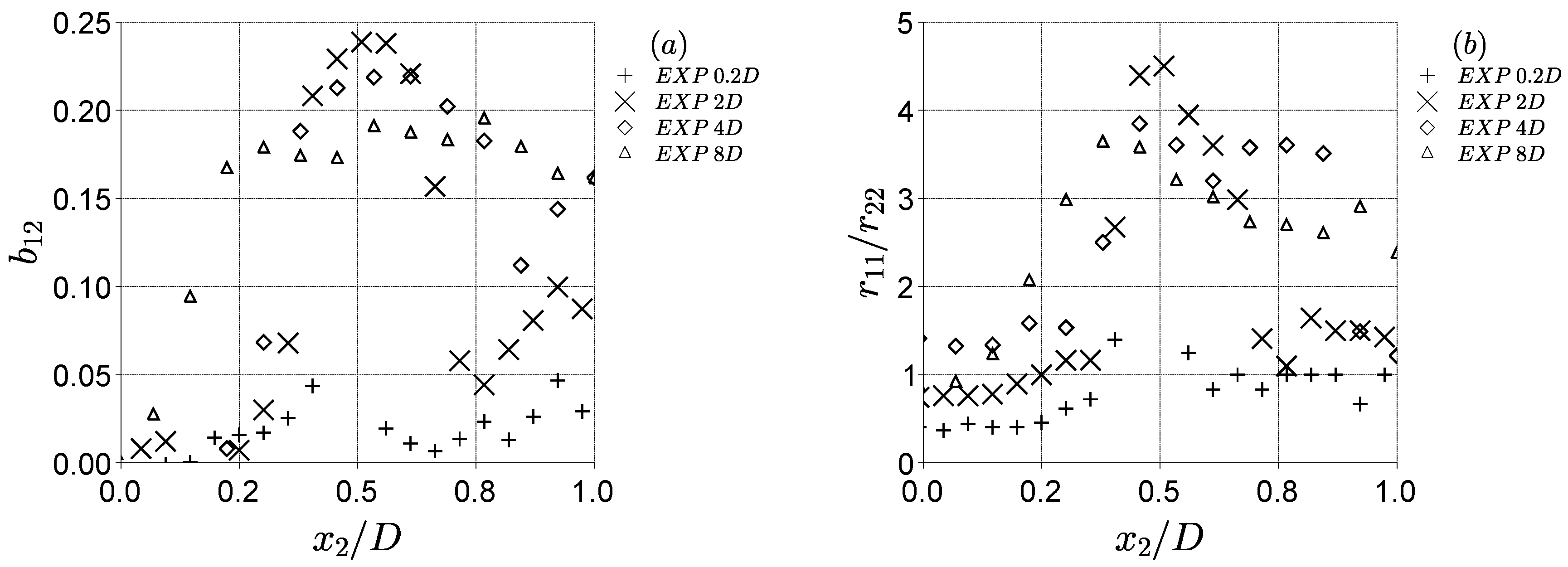
6.3.1. Shear Stress Anisotropy
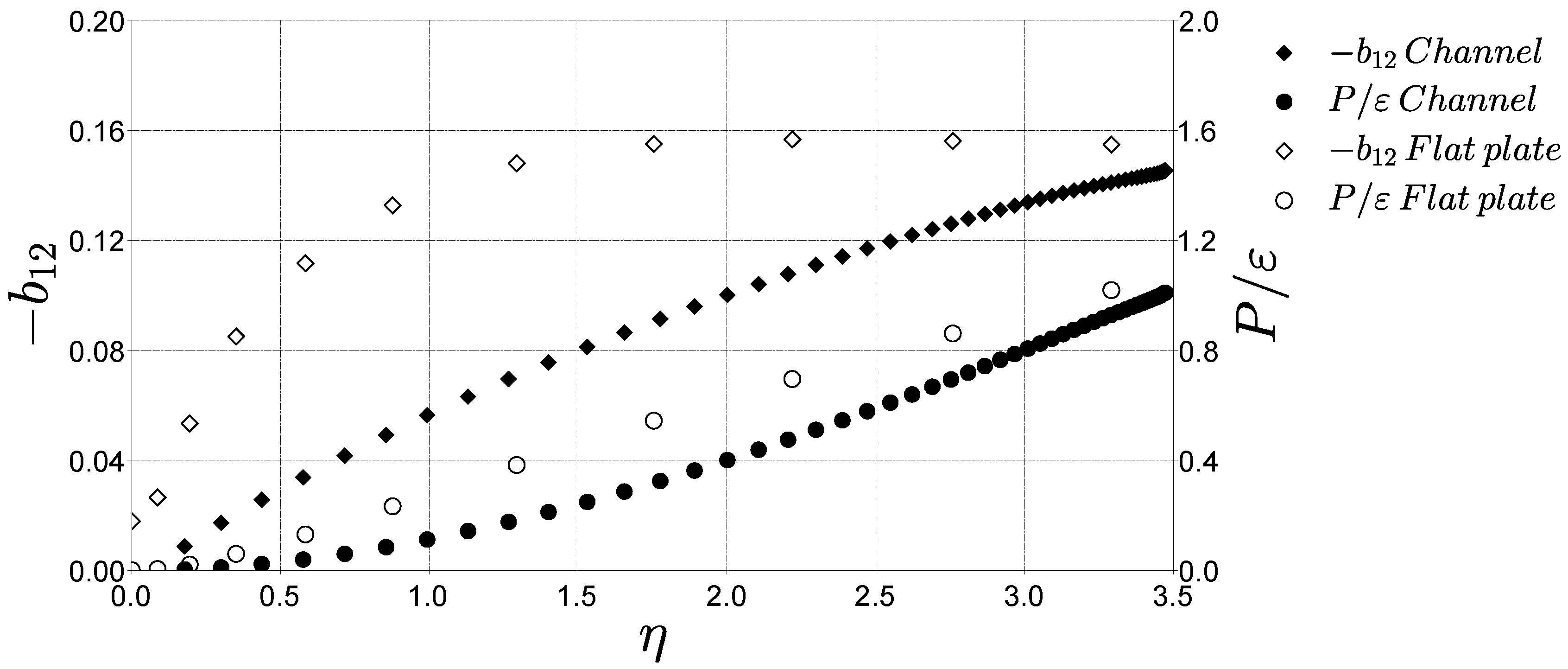
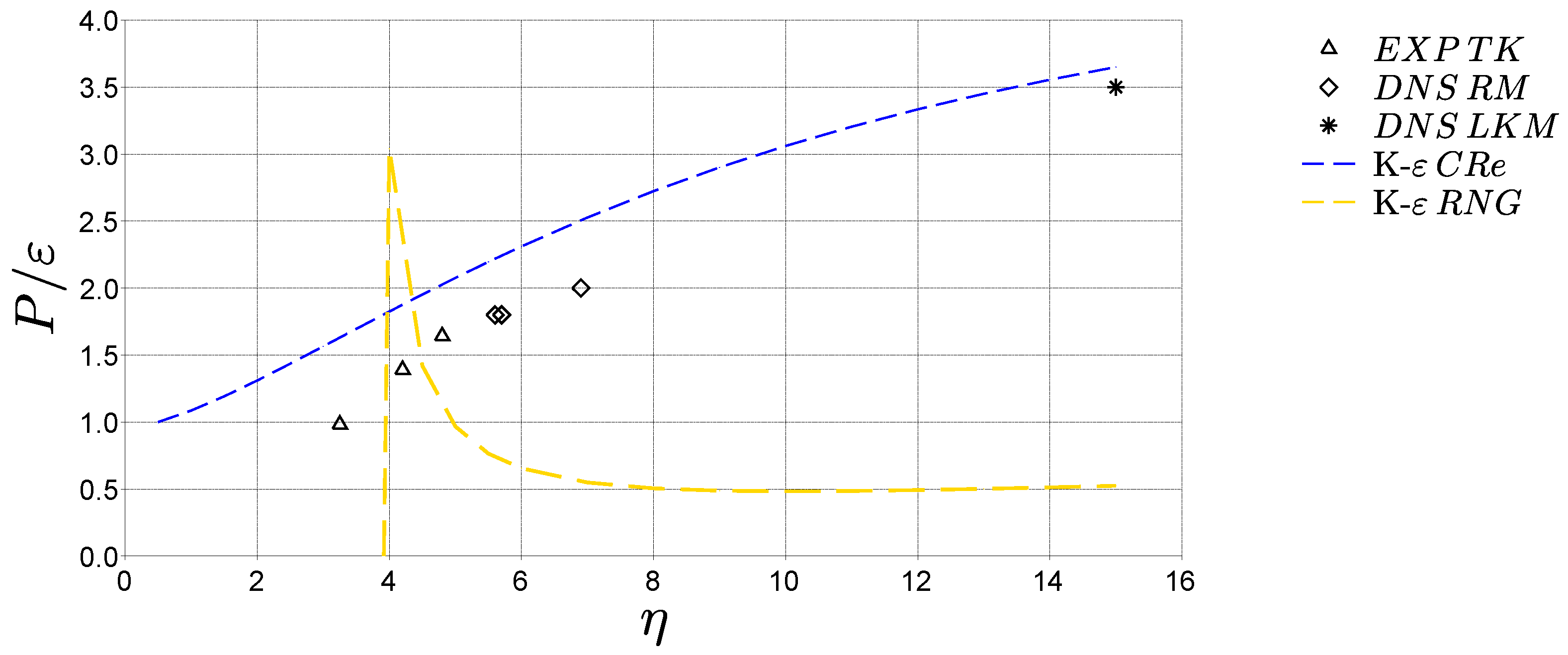
6.3.2. Production/Destruction Balance
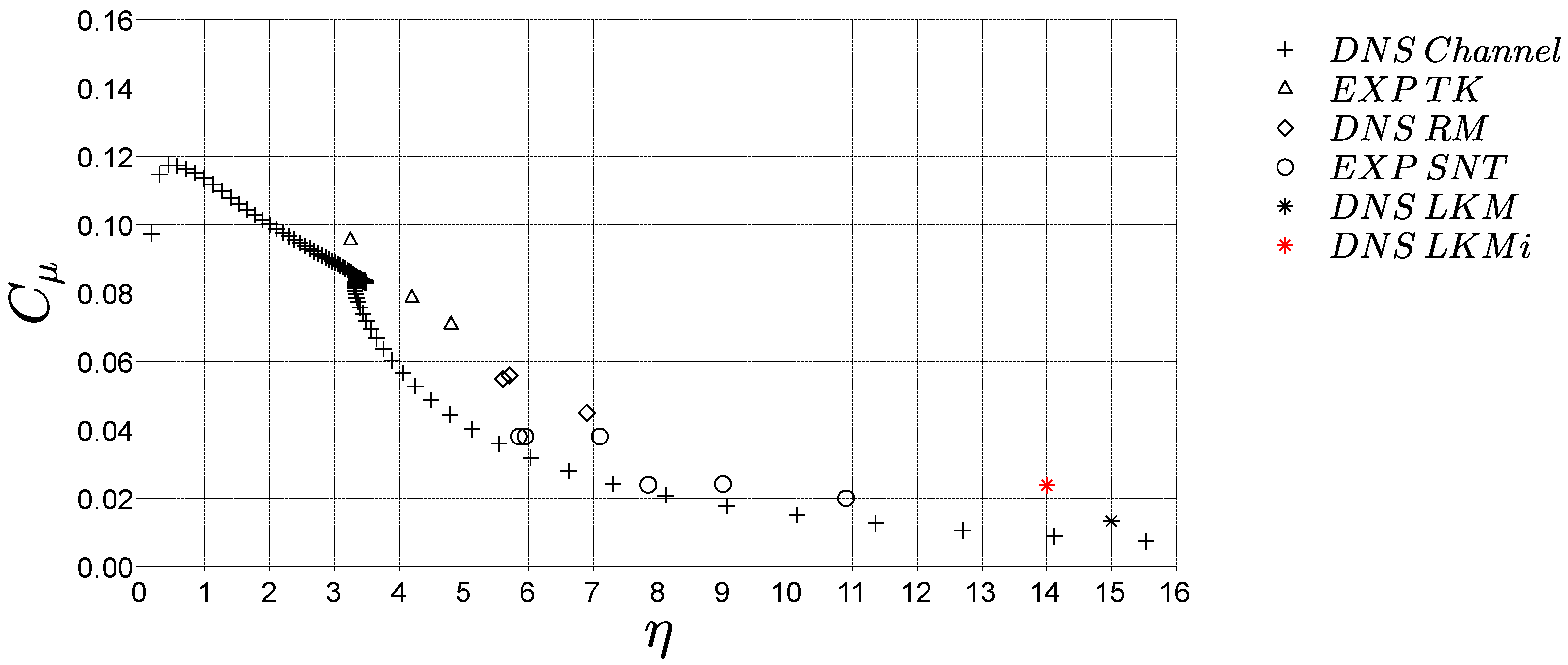
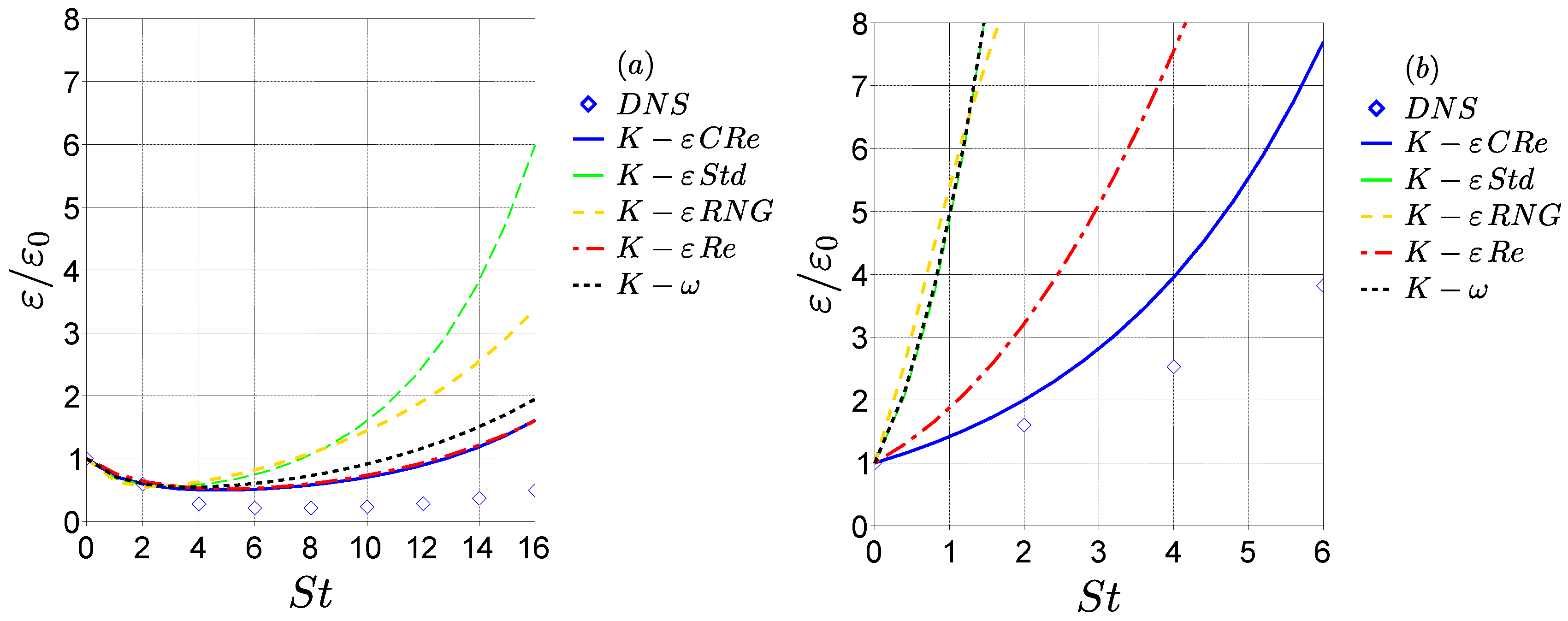
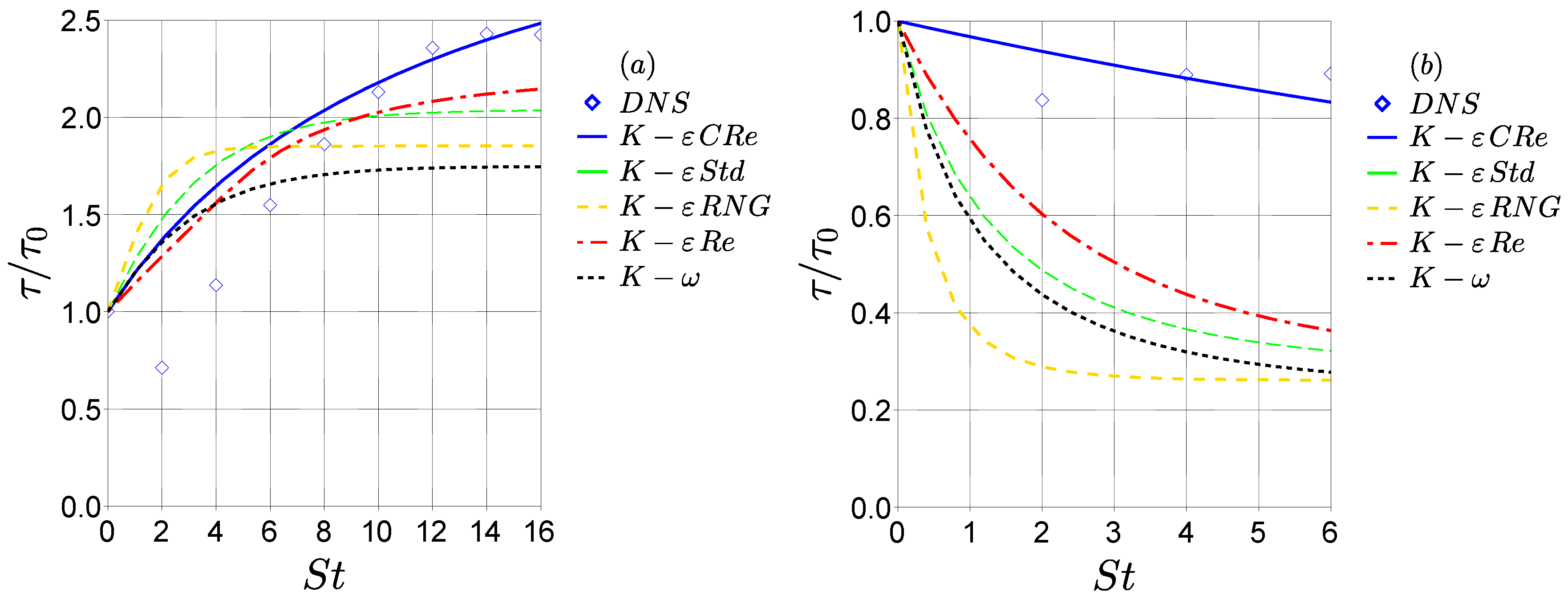
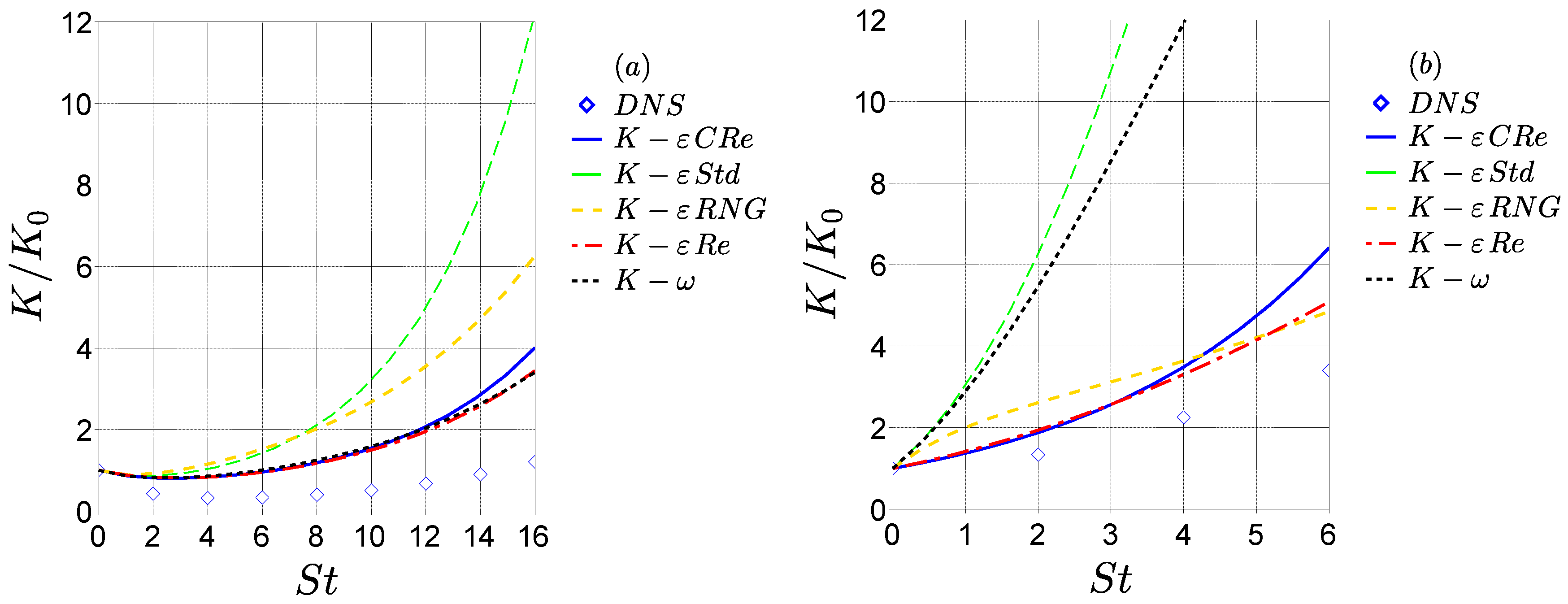
6.3.3. Response to Homogeneous Shear Flow
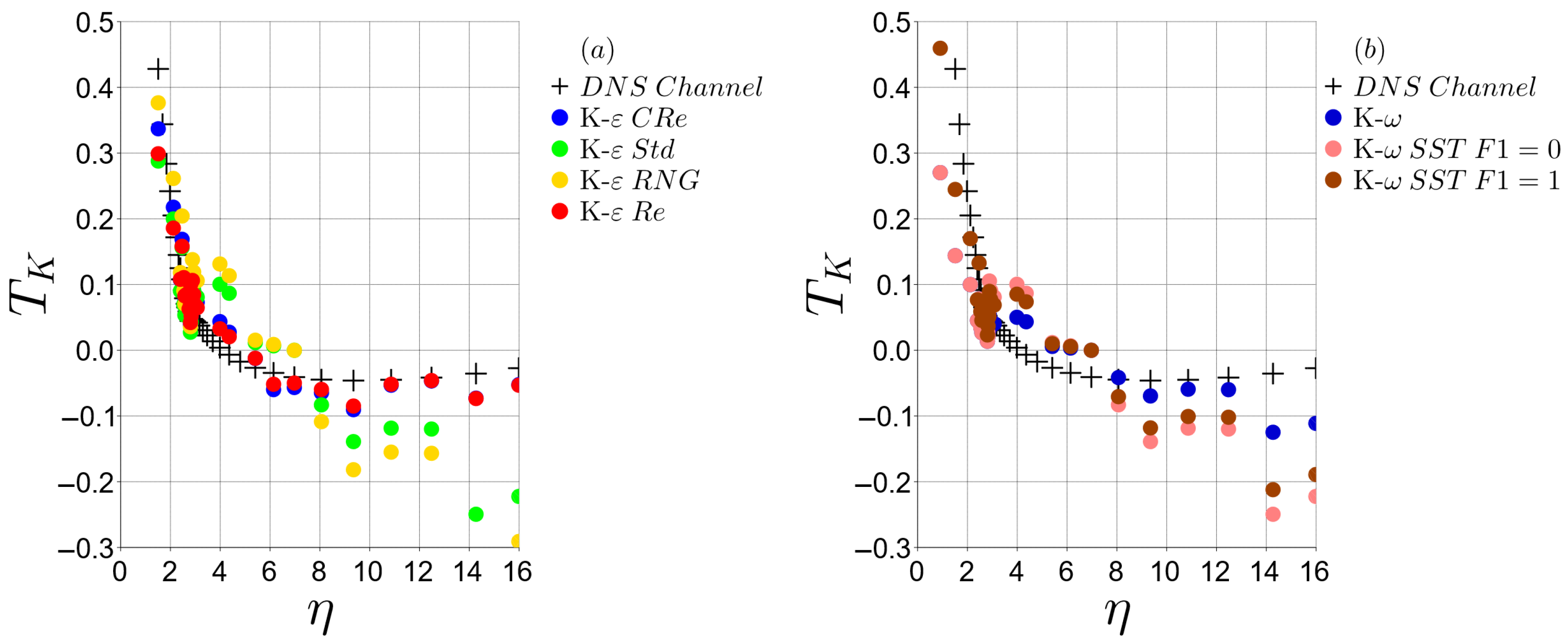
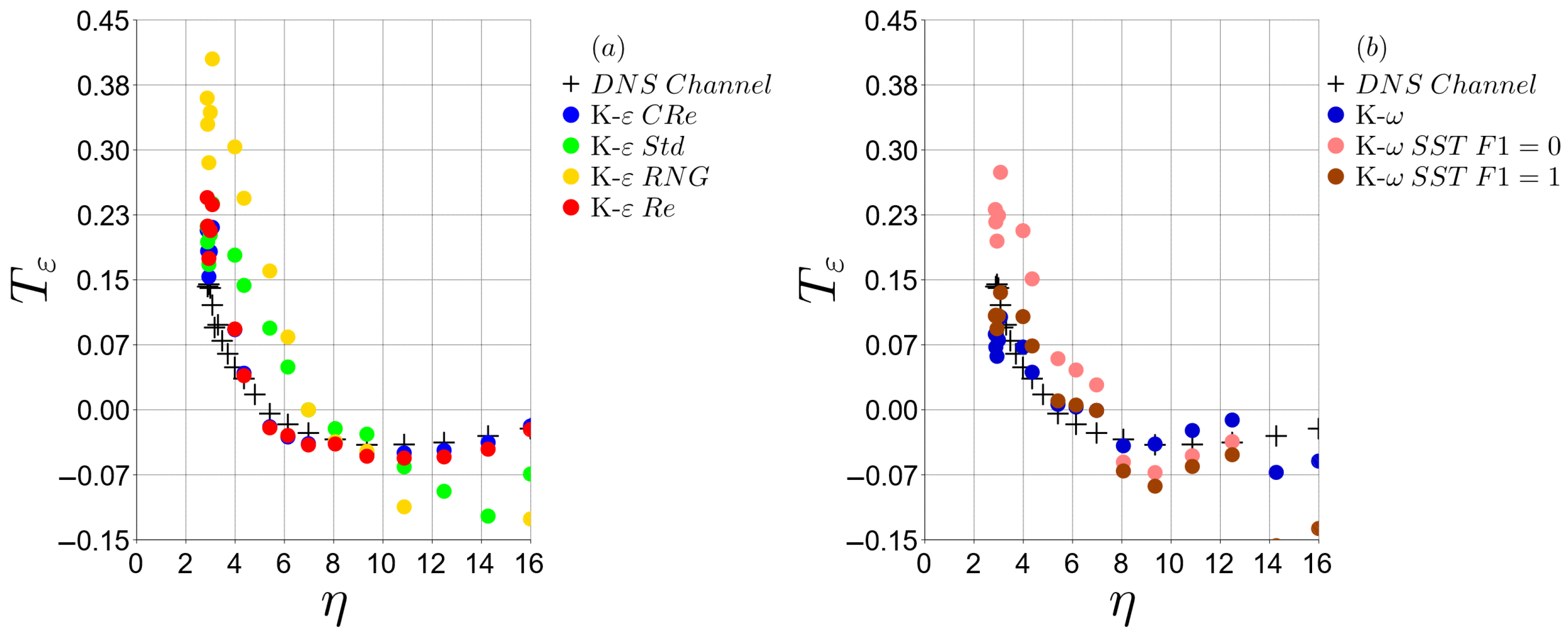
6.3.4. Turbulent Transport
7. Conclusions
Author Contributions
Funding
Data Availability Statement
Conflicts of Interest
Nomenclature
| sound speed | |
| Reynolds stress anisotropy tensor | |
| turbulence structural parameter | |
| specific heat at constant pressure | |
| internal energy | |
| K, TKE | turbulent kinetic energy |
| thermal conductivity | |
| turbulence distortion Mach number | |
| turbulent Mach number | |
| production of turbulent kinetic energy | |
| production of dissipation rate | |
| p | pressure |
| Prandtl number | |
| Reynolds stress tensor | |
| strain rate tensor | |
| strain rate invariant | |
| T | temperature |
| time | |
| viscous stress tensor | |
| turbulent transport of dissipation rate | |
| turbulent transport of turbulent kinetic energy | |
| velocity component | |
| cartesian coordinate | |
| destruction of dissipation rate | |
| rotation rate tensor | |
| rotation rate invariant | |
| dissipation rate of turbulent kinetic energy | |
| turbulence strain intensity | |
| turbulence rotation intensity | |
| dynamic viscosity | |
| eddy viscosity | |
| density | |
| eddy lifetime | |
| specific dissipation rate of turbulent kinetic energy | |
| Superscripts | |
| ¯ | Reynolds average |
| ′ | Fluctuating component |
| Abbreviations | |
| CRe | Consistent Realizable |
| EV | eddy viscosity |
| EXP | experiment |
| RANS | Reynolds Averaged Navier-Stokes |
| RNG | Renormalization Group |
| SST | Shear Stress Transport |
| Re | Realizable |
| Std | Standard |
References
- Tashtoush, B.M.; Al-Nimr, M.d.A.; Khasawneh, M.A. A comprehensive review of ejector design, performance, and applications. Appl. Energy 2019, 240, 138–172. [Google Scholar] [CrossRef]
- Liu, Y.; Tu, Z.; Chan, S.H. Applications of ejectors in proton exchange membrane fuel cells: A review. Fuel Process. Technol. 2021, 214, 106683. [Google Scholar] [CrossRef]
- Li, D.; Zhao, H.; Kong, F.; Zhang, G. Application of Ejector in Solid Oxide Fuel Cell Anode Circulation System. J. Therm. Sci. 2022, 31, 634–649. [Google Scholar] [CrossRef]
- Chunnanond, K.; Aphornratana, S. Ejectors: Applications in refrigeration technology. Renew. Sustain. Energy Rev. 2004, 8, 129–155. [Google Scholar] [CrossRef]
- Besagni, G.; Mereu, R.; Inzoli, F. Ejector refrigeration: A comprehensive review. Renew. Sustain. Energy Rev. 2016, 53, 373–407. [Google Scholar] [CrossRef]
- Li, Y.; Huang, H.; Liu, S.; Ge, C.; Huang, J.; Shen, S.; Guo, Y.; Yang, Y. Overview of the Energy Conservation and Sustainable Transformation of Aerospace Systems with Advanced Ejector Technology. Energies 2026, 19, 221. [Google Scholar] [CrossRef]
- Li, Y.; Huang, H.; Shen, S.; Guo, Y.; Yang, Y.; Liu, S. Application Advances and Prospects of Ejector Technologies in the Field of Rail Transit Driven by Energy Conservation and Energy Transition. Energies 2025, 18, 3951. [Google Scholar] [CrossRef]
- Keenan, J.H.; Neumann, E.P.; Lustwerk, F. Investigation of ejector design by analysis and experiment. J. Appl. Mech. 1950, 27, 299–309. [Google Scholar] [CrossRef]
- Fabri, J.; Siestrunck, R. Supersonic air ejectors. Adv. Appl. Mech. 1958, 5, 1–34. [Google Scholar]
- Matsuo, K.; Sasaguchi, K.; Kiyotoki, Y.; Mochizuki, H. Investigation of supersonic air ejectors. Part 1, Performance in the case of zero-secondary flow. Bull. JSME 1981, 24, 2090–2097. [Google Scholar] [CrossRef]
- Matsuo, K.; Sasaguchi, K.; Kiyotoki, Y.; Mochizuki, H. Investigation of supersonic air ejectors. Part 2. Effects of throat-area-ratio on ejector performance. Bull. JSME 1982, 25, 1898–1905. [Google Scholar] [CrossRef]
- Hickman, K.E.; Hill, P.G.; Gilbert, G.B. Analysis and Testing of Compressible Flow Ejectors with Variable Area Mixing Tubes. J. Basic Eng. 1972, 94, 407–416. [Google Scholar] [CrossRef]
- Hedges, K.R. Compressible Jet Mixing in Converging-Diverging Ducts. Ph.D. Thesis, Queen’s University, Kingston, ON, Canada, 1973. [Google Scholar]
- Hedges, K.R.; Hill, P.G. Compressible Flow Ejectors, Part I—Development of a finite-difference flow model. J. Fluids Eng. 1974, 96, 272–281. [Google Scholar] [CrossRef]
- Hedges, K.R.; Hill, P.G. Compressible Flow Ejectors, Part II—Flow Field measurements and Analysis. J. Fluids Eng. 1974, 96, 282–288. [Google Scholar] [CrossRef]
- Rao, S.M.V. Experimental Investigation on Supersonic Ejectors. Ph.D. Thesis, Indian Institute of Science, Karnataka, Indian, 2013. [Google Scholar]
- Karthick, S.K. Experimental Studies on Gaseous Mixing in a Low Area Ratio Rectangular Supersonic Confined Jet. Ph.D. Thesis, Indian Institute of Science, Karnataka, Indian, 2017. [Google Scholar]
- Bartosiewicz, Y.; Aidoun, Z.; Desevaux, P.; Mercadier, Y. CFD-experiments integration in the evaluation of six turbulence models for supersonic ejectors modeling. In Proceedings of the Integrating CFD and Experiments Conference, Glasgow, UK, 8–9 September 2003. [Google Scholar]
- Bartosiewicz, Y.; Aidoun, Z.; Desevaux, P.; Mercadier, Y. Numerical and experimental investigations on supersonic ejectors. Int. J. Heat Fluid Flow 2005, 26, 56–70. [Google Scholar] [CrossRef]
- Besagni, G.; Mereu, R.; Leo, G.; Inzoli, F. An Integrated Lumped Parameter-CFD approach for off-design ejector performance evaluation. Energy Convers. Manag. 2015, 105, 697–715. [Google Scholar] [CrossRef]
- Gilbert, G.B.; Hill, P.G. Analysis and Testing of Two-Dimensional Slot Nozzle Ejectors with Variable Area Mixing Sections; NASA: Washington, DC, USA, 1973.
- Sriveerakul, T.; Aphornratana, S.; Chunnanond, K. Performance prediction of steam ejector using computational fluid dynamics: Part 1. Validation of the CFD results. Int. J. Therm. Sci. 2007, 46, 812–822. [Google Scholar] [CrossRef]
- García del Valle, J.; Sierra-Pallares, J.; Garcia Carrascal, P.; Castro Ruiz, F. An experimental and computational study of the flow pattern in a refrigerant ejector. Validation of turbulence models and real-gas effects. Appl. Therm. Eng. 2015, 89, 795–811. [Google Scholar] [CrossRef]
- Croquer, S.; Poncet, S.; Aidoun, Z. Turbulence modeling of a single-phase R134a supersonic ejector. Part 1: Numerical benchmark. Int. J. Refrig. 2016, 61, 140–152. [Google Scholar] [CrossRef]
- Mazzelli, F.; Little, A.B.; Garimella, S.; Bartosiewicz, Y. Computational and experimental analysis of supersonic air ejector: Turbulence modeling and assessment of 3D effects. Int. J. Heat Fluid Flow 2015, 56, 305–316. [Google Scholar] [CrossRef]
- Besagni, G.; Inzoli, F. Computational fluid-dynamics modeling of supersonic ejectors: Screening of turbulence modeling approaches. Appl. Therm. Eng. 2017, 117, 122–144. [Google Scholar] [CrossRef]
- Lamberts, O.; Chatelain, P.; Bartosiewicz, Y. Numerical and experimental evidence of the Fabri-choking in a supersonic ejector. Int. J. Heat Fluid Flow 2018, 69, 194–209. [Google Scholar] [CrossRef]
- Besagni, G.; Cristiani, N.; Croci, L.; Guédon, G.R.; Inzoli, F. Computational fluid-dynamics modelling of supersonic ejectors: Screening of modelling approaches, comprehensive validation and assessment of ejector component efficiencies. Appl. Therm. Eng. 2021, 186, 116431. [Google Scholar] [CrossRef]
- Croquer, S.; Lamberts, O.; Poncet, S.; Moreau, S.; Bartosiewicz, Y. Large Eddy Simulation of a supersonic air ejector. Appl. Therm. Eng. 2022, 209, 118177. [Google Scholar] [CrossRef]
- Debroeyer, R.; Toulorge, T.; Rasquin, M.; Winckelmans, G.; Bartosiewicz, Y. Analysis of entrainment and mixing in a supersonic air ejector using Large-Eddy Simulation. Int. J. Heat Fluid Flow 2025, 116, 109978. [Google Scholar] [CrossRef]
- Debroeyer, R.; Winckelmans, G.; Bartosiewicz, Y. Numerical and experimental characterization of a cylindrical supersonic air ejector. Int. J. Heat Fluid Flow 2026, 117, 110128. [Google Scholar] [CrossRef]
- Reynolds, O. On the Dynamical Theory of Incompressible Viscous Fluids and the Determination of the Criterion. Philos. Trans. A Math. Phys. Eng. Sci. 1895, 186, 123–164. [Google Scholar] [CrossRef]
- Favre, A. Equations des Gaz Turbulents Compressibles. J. Mec. 1965, 4, 361–390. [Google Scholar]
- Hanjalić, K.; Launder, B.E. Reassessment of modeling turbulence via Reynolds averaging: A review of second-moment transport strategy. Phys. Fluids 2021, 33, 091302. [Google Scholar] [CrossRef]
- Lumley, J.L. Toward a turbulent constitutive equation. J. Fluid Mech. 1970, 41, 413–434. [Google Scholar] [CrossRef]
- Pope, S.H. A more general effective viscosity hypothesis. J. Fluid Mech. 1975, 72, 33–40. [Google Scholar] [CrossRef]
- Shih, T.H.; Lumley, J.L. Remarks on turbulent constitutive relations. Math. Comp. Model. 1993, 18, 9–16. [Google Scholar] [CrossRef]
- Gatski, T.B.; Speziale, C.G. On Explicit Algebraic Stress Models for Complex Turbulent Flows. J. Fluid Mech. 1993, 254, 59–78. [Google Scholar] [CrossRef]
- Townsend, A.A. The Structure of Turbulent Shear Flow; Cambridge University Press: Cambridge, UK, 1956. [Google Scholar]
- Rodi, W.; Spalding, D.B. A Two Parameter Model of Turbulence and its Application to Free Jets. Wärme Stoffübertragung 1970, 3, 85–95. [Google Scholar] [CrossRef]
- Rodi, W. A Note on the Empirical Constant in the Kolmogorov-Prandtl Eddy-Viscosity Expression. J. Fluids Eng. 1975, 97, 386–389. [Google Scholar] [CrossRef]
- Reynolds, W.C. Fundamentals of turbulence for turbulence modeling and simulation. In Lectures Notes for Von Karman Institute; AGARD Lecture Series 86; North Atlantic Treaty Organization: Brussels, Belgium, 1987. [Google Scholar]
- Shih, T.H.; Zhu, J.; Lumley, J.L. A new Reynolds stress algebraic equation model. Comput. Methods Appl. Mech. Eng. 1995, 125, 287–302. [Google Scholar] [CrossRef]
- Davidov, B.I. On the statistical dynamics of an incompressible turbulent fluid. Dokl. Akad. Nauk. SSSR 1961, 136, 47–50. [Google Scholar]
- Harlow, F.H.; Nakayama, P.I. Transport of Turbulence Energy Decay Rate; Rep. LA 3854; Los Alamos Scientific Laboratory of the University of California: Los Alamos, NM, USA, 1968. [Google Scholar]
- Lumley, J.L.; Khajeh-Nouri, B. Computational Modeling of Turbulent Transport. Adv. Geophys. 1975, 18, 169–192. [Google Scholar]
- Lumley, J.L. Computational Modeling of Turbulent Flows. Adv. Appl. Mech. 1978, 18, 123–176. [Google Scholar]
- Speziale, C.G.; Gatski, T.B. Analysis and modelling of anisotropies in the dissipation rate of turbulence. J. Fluid Mech. 1997, 234, 155–180. [Google Scholar] [CrossRef]
- Speziale, C.G. Analytical Methods for the Development of Reynolds-Stress Closures in Turbulence. Annu. Rev. Fluid Mech. 1991, 23, 107–157. [Google Scholar] [CrossRef]
- Jones, W.P.; Launder, B.E. The prediction of laminarization with a two-equation model of turbulence. Int. J. Heat Mass Transf. 1972, 15, 301–314. [Google Scholar] [CrossRef]
- Launder, B.E.; Spalding, D.B. The numerical computation of turbulent flows. Comp. Meth. Appl. Mech. Eng. 1974, 3, 269–289. [Google Scholar] [CrossRef]
- Hanjalic, K.; Launder, B.E. Sensitizing the Dissipation Equation to Irrotational Strains. J. Fluids Eng. 1980, 102, 34–40. [Google Scholar] [CrossRef]
- Bardina, J.; Ferziger, J.H.; Rogallo, R.S. Effect of rotation on isotropic turbulence: Computation and modelling. J. Fluid Mech. 1985, 154, 321–336. [Google Scholar] [CrossRef]
- Rodi, W.; Scheuerer, G. Scrutinizing the K − ε turbulence Model Under Adverse Pressure Gradient Conditions. J. Fluids Eng. 1986, 107, 174–179. [Google Scholar] [CrossRef]
- Yakhot, V.; Orszag, S.A.; Thangam, S.; Gatski, T.B.; Speziale, C.G. Development of turbulence models for shear flows by a double expansion technique. Phys. Fluids A 1992, 4, 1510–1520. [Google Scholar] [CrossRef]
- Lumley, J.L. Some comments on turbulence. Phys. Fluids A 1992, 4, 203–211. [Google Scholar] [CrossRef]
- Amielh, M.; Djeridane, T.; Anselmet, F.; Fulachier, L. Velocity near-field of variable density turbulent jets. Int. J. Heat Mass Transf. 1996, 39, 2149–2164. [Google Scholar] [CrossRef]
- Georgiadis, N.J.; Wernet, M.P.; Locke, R.J.; Eck, D.G. Mach Number and Heating Effects on Turbulent Supersonic Jets. AIAA J. 2024, 62, 31–51. [Google Scholar] [CrossRef]
- Wang, P.; Fröhlich, J.; Michelassi, V.; Rodi, W. Large-eddy simulation of variable-density turbulent axisymmetric jets. Int. J. Heat Fluid Flow 2008, 29, 654–664. [Google Scholar] [CrossRef]
- Jimenez, J.; Hoyas, S.; Simens, M.P.; Mizuno, Y. Turbulent boundary layers channels at moderate Reynolds numbers. J. Fluid Mech. 2010, 657, 335–360. [Google Scholar] [CrossRef]
- Tavoularis, S.; Corrsin, S. Experiments in Nearly Homogeneous Turbulent Shear Flow with Uniform Mean Temperature Gradient. Part I. J. Fluid Mech. 1981, 104, 311–347. [Google Scholar] [CrossRef]
- Tavoularis, S.; Karnik, U. Further Experiments on the Evolution of Turbulent Stresses and Scales in Uniformly Sheared Turbulence. J. Fluid Mech. 1989, 204, 457. [Google Scholar] [CrossRef]
- de Souza, F.A.; Nguyen, V.D.; Tavoularis, S. The structure of highly sheared turbulence. J. Fluid Mech. 1995, 303, 155–167. [Google Scholar] [CrossRef]
- Rogers, M.; Moin, P.; Reynolds, W. The structure and modeling of the hydrodynamic and passive scalar fields inhomogeneous turbulent shear flow. In Stanford University Report TF-25; Stanford University: Stanford, CA, USA, 1986. [Google Scholar]
- Lee, M.J.; Kim, J.; Moin, P. Structure of turbulence at high shear rate. J. Fluid Mech. 1990, 216, 561–583. [Google Scholar] [CrossRef]
- Kim, J.; Moin, P.; Moser, R. Turbulence statistics in fully developed channel flow at low Reynolds number. J. Fluid Mech. 1987, 177, 133–166. [Google Scholar] [CrossRef]
- Spalart, P.R. Direct simulation of a turbulent boundary layer up to Rθ = 1410. J. Fluid Mech. 1988, 187, 61–98. [Google Scholar] [CrossRef]
- Batchelor, G.K.; Proudman, I. The Effect of Rapid Distortion of a Fluid in Turbulent Motion. Q. J. Mech. Appl. Math. 1954, 7, 83–103. [Google Scholar] [CrossRef]
- Kobasyashi, T.; Togashi, S. Comparison of Turbulence Models Applied to Backward-Facing Step Flow. JSME Int. J. Ser. B 1996, 39, 453–460. [Google Scholar] [CrossRef][Green Version]
- Sarkar, S.; Erlebacher, G.; Hussaini, M.Y.; Kreiss, O. The analysis and modelling of dilatational terms in compressible turbulence. J. Fluid Mech. 1991, 227, 473–493. [Google Scholar] [CrossRef]
- Sarkar, S. The stabilizing effect of compressibility in turbulent shear flow. J. Fluid Mech. 1995, 282, 163–186. [Google Scholar] [CrossRef]
- Simone, A.; Coleman, G.N.; Cambon, C. The effect of compressibility on turbulent shear flow: A rapid-distortion-theory and direct-numerical-simulation study. J. Fluid Mech. 1997, 330, 307–338. [Google Scholar] [CrossRef]
- Georgiadis, N.J.; Wernet, M.P.; Winkler, C.M.; Benton, S.I.; Connolly, B.J. Summary of the 6th AIAA Propulsion Aerodynamics Workshop Nozzle Test Case: Heated Supersonic Axisymmetric Jets. In Proceedings of the AIAA 2024-0749. AIAA SCITECH 2024 Forum, Orlando, FL, USA, 8–12 January 2024. [Google Scholar]
- Shih, T.H.; Liou, W.W.; Shabbir, A.; Yang, Z.; Zhu, J. A New K − ε Eddy Viscosity Model for High Reynolds Number Turbulent Flows: Model Development and Validation. NASA TM 106721. 1 August 1994.
- Wilcox, D.C. Reassessment of the Scale-Determining Equation for Advanced Turbulence Models. AIAA J. 1988, 26, 1299–1310. [Google Scholar] [CrossRef]
- Wilcox, D.C. Turbulence Modeling for CFD, 2nd ed.; DCW Industries, Inc.: La Canada, CA, USA, 1998. [Google Scholar]
- Menter, F.R. Two-Equation Eddy-Viscosity Turbulence Models for Engineering Application. AIAA J. 1994, 32, 1598–1605. [Google Scholar] [CrossRef]
- Jones, W.P.; Launder, B.E. The calculation of low-Reynolds-number phenomena with a two-equation model of turbulence. Int. J. Heat Mass Transf. 1973, 16, 1119–1130. [Google Scholar] [CrossRef]
- Yakhot, V.; Orszag, S.A. Renormalization group analysis of turbulence. J. Sci. Comput. 1986, 1, 3–51. [Google Scholar] [CrossRef]
- Yakhot, V.; Smith, L.M. The renormalization group, the ε-expansion and derivation of turbulence models. J. Sci. Comput. 1992, 7, 35–61. [Google Scholar] [CrossRef]
- Wilcox, D.C. Formulation of the k-omega Turbulence Model Revisited. AIAA J. 2008, 46, 2823–2838. [Google Scholar] [CrossRef]
- Pope, S.B. An explanation of the turbulent round-jet/plane-jet anomaly. AIAA J. 1978, 16, 279–281. [Google Scholar] [CrossRef] [PubMed]
- Mansour, N.N.; Kim, J.; Moin, P. Reynolds-stress and dissipation-rate budgets in a turbulent channel flow. J. Fluid Mech. 1988, 194, 15–44. [Google Scholar] [CrossRef]
- Scilab, 5.5.2; Dassault Systems: Vélizy-Villacoublay, France, 2015.





| Cre | Std | RNG | |
| Constitutive relationship | Equations (13) and (14) | Equations (13) and (14) | Equations (13) and (14) |
| transport equation | Equation (30) | Equation (30) | Equation (30) |
| production destruction balance | Equation (27) | Equation (27) | Equation (27) |
| turbulent transport | Equation (29) | Equation (29) | Equation (29) |
| Re | SST | ||
| Constitutive relationship | Equations (13) and (14) | Equations (13) and (14) | Equations (13) and (14) |
| transport equation | Equation (30) | Equation (30) with | Equation (30) |
| production destruction balance | Equation (27) | Equation (27) | |
| turbulent transport | Equation (29) | + | + |
| 2.09 | 1.54 | 2.09 | 1.5 |
Disclaimer/Publisher’s Note: The statements, opinions and data contained in all publications are solely those of the individual author(s) and contributor(s) and not of MDPI and/or the editor(s). MDPI and/or the editor(s) disclaim responsibility for any injury to people or property resulting from any ideas, methods, instructions or products referred to in the content. |
© 2026 by the authors. Licensee MDPI, Basel, Switzerland. This article is an open access article distributed under the terms and conditions of the Creative Commons Attribution (CC BY) license.
Share and Cite
Milanese, G.; Canepa, E.; Rivarolo, M.; Magistri, L. Simulation of Single-Choked Supersonic Ejectors. Part 1: Turbulence Modelling. Aerospace 2026, 13, 478. https://doi.org/10.3390/aerospace13050478
Milanese G, Canepa E, Rivarolo M, Magistri L. Simulation of Single-Choked Supersonic Ejectors. Part 1: Turbulence Modelling. Aerospace. 2026; 13(5):478. https://doi.org/10.3390/aerospace13050478
Chicago/Turabian StyleMilanese, Gabriele, Edward Canepa, Massimo Rivarolo, and Loredana Magistri. 2026. "Simulation of Single-Choked Supersonic Ejectors. Part 1: Turbulence Modelling" Aerospace 13, no. 5: 478. https://doi.org/10.3390/aerospace13050478
APA StyleMilanese, G., Canepa, E., Rivarolo, M., & Magistri, L. (2026). Simulation of Single-Choked Supersonic Ejectors. Part 1: Turbulence Modelling. Aerospace, 13(5), 478. https://doi.org/10.3390/aerospace13050478