Article

Simulation of Single-Choked Supersonic Ejectors. Part 1: Turbulence Modelling

Dipartimento di Ingegneria, Meccanica, Energetica, Gestionale e dei Trasporti (DIME), Università di Genova, Via Montallegro 1, 16145 Genova, Italy
*
Author to whom correspondence should be addressed.
Aerospace 2026, 13(5), 478; https://doi.org/10.3390/aerospace13050478
Submission received: 30 March 2026 / Revised: 13 May 2026 / Accepted: 14 May 2026 / Published: 19 May 2026
(This article belongs to the Special Issue Advances in Thermal Fluid, Dynamics and Control)

Abstract

The use of computational fluid dynamics provides an important tool for the design of supersonic ejectors. Within Reynolds/Favre-averaged simulations, the turbulence model plays an essential role in determining results’ reliability. Existing validation studies show general accuracy problems, whose relevance, partially masked in the double-choked regime, becomes fully evident for the single-choked regime. For this flow regime, errors reported in the literature are strongly erratic, reaching magnitudes higher than 50% in terms of global performance. The absence of clear, unified conclusions by different authors motivates the present work, focused on single-choked ejectors. In the first part, the main ejector flow features are discussed, highlighting the importance of adequately reproducing the turbulence response to different shear intensities. To properly address this point, an original analysis is conducted, exploiting data from previous studies on jets and basic shear flows. The developed analysis explains how the prediction of an ejector jet is influenced by the constitutive relationship of eddy viscosity models and by the modelled balance of the turbulent-dissipation rate. The modelling failures of these two elements are discussed for existing models in common use and addressed through the development of a new Consistent Realizable Kε model. In Part 2, the analyzed models are used to simulate two test cases, with detailed measurements available.

1. Introduction

An ejector is a geometrically simple device which exploits the suction effect exerted by a jet (primary stream), issuing from a nozzle in a coaxial duct and producing a secondary stream. Since its first appearance, it has been used in many different engineering fields, taking advantage of its multifaceted characteristics: flow recirculation for fuel cells, pumping work for refrigeration cycles, and thrust augmentation for jet propulsion are just a few examples of its well-known and significantly different applications. A notable number of reviews can be found in the literature, showing the widespread interest in this topic as well as the variety of scientific works being published. Looking just at the present century, Tashtoush et al. [1] provided an overview of ejector design methods and numerical and experimental studies, mainly focusing on refrigeration systems; ejector applications in PEM (proton exchange membrane) and SOFC fuel cells were reviewed respectively by Liu et al. [2] and Li et al. [3]; Chunnanond et al. [4] and Besagni et al. [5] conducted reviews of ejectors in refrigeration systems; and Li et al. [6] and Li et al. [7] developed overviews on ejectors’ applications in aerospace systems and railway transit, respectively. In most applications, supersonic ejectors have attracted a great deal of attention and, despite their apparent simplicity, their fluid dynamics are still the subject of experimental and numerical studies. Some of the most cited papers that contributed to the provision of a framework for supersonic ejectors are as follows: Keenan et al. [8] conducted a systematic study on the performance of constant-area and constant-pressure ejectors, Fabri and Siestrunck [9] identified and analyzed the main flow regimes of a supersonic ejector, and Matsuo et al. [10,11] further refined the analysis of flow regimes. Most recent works are related to the double-choked condition, where the secondary stream becomes sonic downstream of the primary exit. For this flow regime, a large bibliography can be compiled on the development of simplified design methods, whose validation typically relies on global measurements of the ejector performance. A few studies are dedicated to the single-choked condition, where the secondary stream is subsonic, a typical design condition of applications with a medium/high secondary-to-primary mass flow ratio (MFR). Among them, Hickman et al. [12] studied an ejector with a primary Mach number of 2.72 and a mixing-section-to-nozzle area ratio (AR) of about 300 at the nozzle exit; Hedges [13,14,15] conducted an experimental and numerical study using an ejector with a nozzle Mach number of 1.8 and an AR of 13 at the nozzle exit. Recently, Rao [16] and Karthik [17] developed experimental studies on a plane ejector, with an AR of 10, analyzing the influence that the operating conditions exert on the mixing, with a specific focus on overexpanded/underexpanded conditions. The use of computational fluid dynamics (CFD) simulations, mainly relying on the solution of the Reynolds-averaged Navier–Stokes equations (RANS), has clear relevance in the design of the ejector components and also in the understanding of their fluid dynamics. Nevertheless, a limited number of CFD validations, relying on detailed flow field measurements, are available in the literature, (i.e., pressure and velocity distributions).
Among works dealing with subsonic secondary flow, the pioneering work of Hedges [13,14,15] provides a detailed study using a finite difference model which, relying on a mixing length turbulence model, requires ad hoc calibrations. Bartosiewicz et al. [18,19] conducted a validation study on six turbulence models ( K ε standard; K ε RNG; K ε Realizable; K ω ; K ω SST; and a Reynolds Stress Transport model), using the pressure distribution measured on the ejector axis, without secondary flow, and the non-mixed length for the ejector operation with secondary flow. Results without secondary flow indicate that the K ε RNG and the K ω SST models better reproduce the pressure distribution pattern due to shock waves. Compared with the K ε RNG, the K ω SST models lead to slightly better agreement in terms of non-mixed length. Besagni et al. [20] compared the results obtained with several turbulence models ( K ε standard; K ε RNG; K ε Realizable K ω ; K ω SST; Spalart–Allmaras; and a linear Reynolds Stress Transport model), with global performance, velocity and total temperature profiles, measured by Gilbert and Hill [21] on a rectangular symmetric ejector without diffuser, working under moderately underexpanded single-choked conditions. Results show that the K ω SST and the Spalart–Allmaras models perform better than the others, though the simulated jet spreading rate differs significantly from measurements. Other information must be extracted from studies that mainly focused on the double-choked regime. The validation work of Sriveerakul et al. [22] was carried out using the K ε Realizable model, relying on wall pressure distributions measured for different working points on different ejector geometries. Results indicate relevant discrepancies in terms of MFR for the single-choked condition. Garcia del Valle et al. [23] developed an analysis, using the K ε standard, K ε RNG, K ε Realizable, and K ω SST models to simulate different complementary cases: a supersonic free jet, the interaction between a turbulent boundary layer and a shock wave, and a supersonic ejector operating at double-choked and single-choked conditions. The tested models show accuracies that depend on the ejector working condition, with the K ε standard giving the closest wall pressure distribution to measurements under single-choked operation. Models tested by Garcia del Valle et al. [23] were also analyzed by Croquer et al. [24], who simulated an ejector geometry, comparing global performance with the corresponding measurements. The reported performance data show that the K ε standard delivers the lowest error in terms of MFR in the double-choked as well as in the single-choked conditions. Croquer et al. speculate on the differing flowfields and shocks patterns predicted by the K ε standard and the K ω SST models, although without the reference experimental data for the studied case. Mazzelli et al. [25] tested the K ε standard, K ε Realizable, K ω SST and the ω -based Reynolds Stress Transport models on a planar ejector, comparing the simulated performance curves with measurements at different pressure values for the primary nozzle. Once more, it is shown that, even for a single-ejector geometry, the best-performing model depends on the ejector’s working condition. Besagni and Inzoli [26] used the database provided by Sriveerakul et al. [18] as a reference for the predictions of seven turbulence models ( K ε standard; K ε RNG; K ε Realizable; K ω ; K ω SST; Spalart–Allmaras; and a linear Reynolds Stress Transport model). The study shows the K ω SST as the best-performing model; however, for different cases, large discrepancies are highlighted in the pressure recovery region, downstream of the shock waves. Lamberts et al. [27] compared CFD results with global measurements and Schlieren images, using the K ω SST model and the ejector geometry used by Mazzelli et al. [25]. Large differences between CFD results and measurements, in terms of global performance, are present under single-choked conditions. Besagni et al. [28] carried out a systematic study on different ejector geometries, evaluating the accuracy of the K ε RNG and K ω SST models with different datasets. An average error of 63% is reported for the single-choked condition. Croquer et al. [29] and Debroeyer et al. [30,31] used large-eddy simulations (LES) to study a supersonic air ejector, showing that even high-fidelity techniques have difficulties reproducing the flowfield development. Overall, these studies, as well as other similar works which could be included, provide useful information, showing that the simulation accuracy varies significantly depending on the considered working condition and the ejector geometry. This raises the question of the actual possibility of properly reproducing the different interacting flow mechanisms by means of Reynolds/Favre-averaged simulations. The present study, focusing on supersonic ejectors operating in a single-choked (i.e., mixed flow) regime, aims to make a contribution to this subject. In the first part of the present work, an analysis is conducted of the main characteristics of a supersonic ejector jet and on the related use of eddy-viscosity turbulence models. In Section 2, a preliminary overview of supersonic ejector fluid dynamics is provided. The Reynolds-averaged equations and the basic elements underlying eddy viscosity models are presented in Section 3. The main turbulence features relevant to the development of a jet (confined and free) are discussed in Section 4, in relation with turbulence modelling. The importance of properly modelling the influence of the mean shear intensity on the turbulent shear stress anisotropy and on the dissipation rate balance is highlighted. In Section 5, the principal characteristics of common EV models are critically reviewed. In Section 6, the development of a new model is presented, whose characteristics are discussed and compared with those of the other considered models, using different complementary reference data.

2. Supersonic Ejector

A supersonic ejector consists of a jet (primary stream) issuing from a convergent-divergent nozzle, in a confined environment, where momentum diffusion takes place.
Usually, four main elements (Figure 1) can be identified:
  • The jet nozzle.
  • The suction chamber before the jet exit, where the secondary stream is induced by the pressure below the upstream ambient.
  • The mixing duct, where turbulent transport leads to uniformity among the two coflowing streams, allowing for jet diffusion.
  • The diffuser, where the flow velocity is further reduced.
The ejector geometry can show slight differences, depending on the design intent. The ratio between the areas of the mixing duct and of the nozzle exit is the main geometrical parameter determining the ratio between the secondary and the primary flow rates, as shown by analytical models derived from conservation principles (mass, momentum, energy). A short length with a decreasing area is often used after the nozzle exit, which was historically conceived as a constant-pressure mixing region and is now considered as the element where both the primary and secondary stream accelerate before reaching their effective area ratio. The mixing duct, where the flow approaches uniformity, can consist of a converging element (used to reduce uniformization losses and to limit possible flow separations at low MFRs) and a constant-area duct, also called the ejector throat. The diffuser makes the final contribution to the pressure rise provided by the ejector.
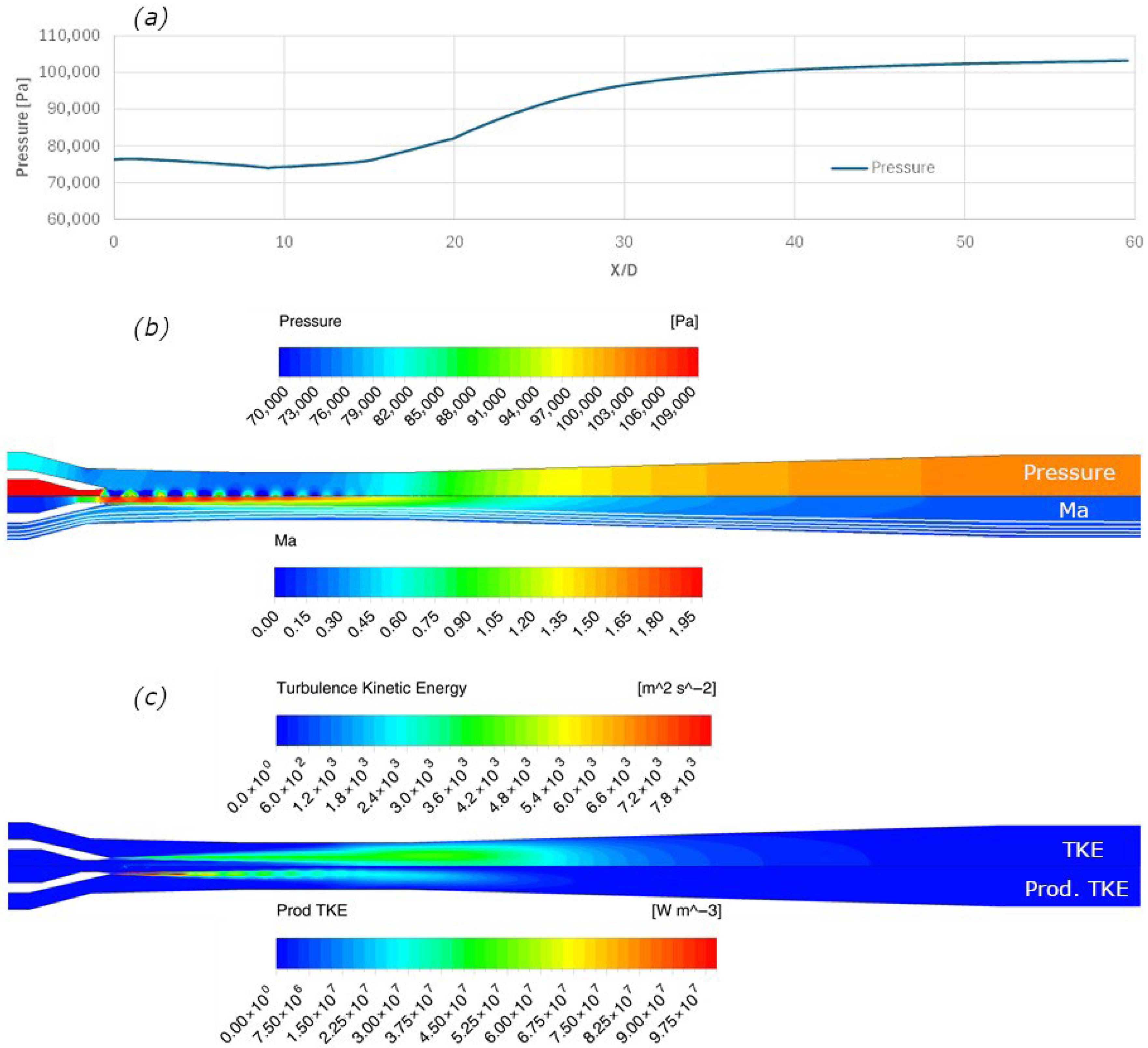
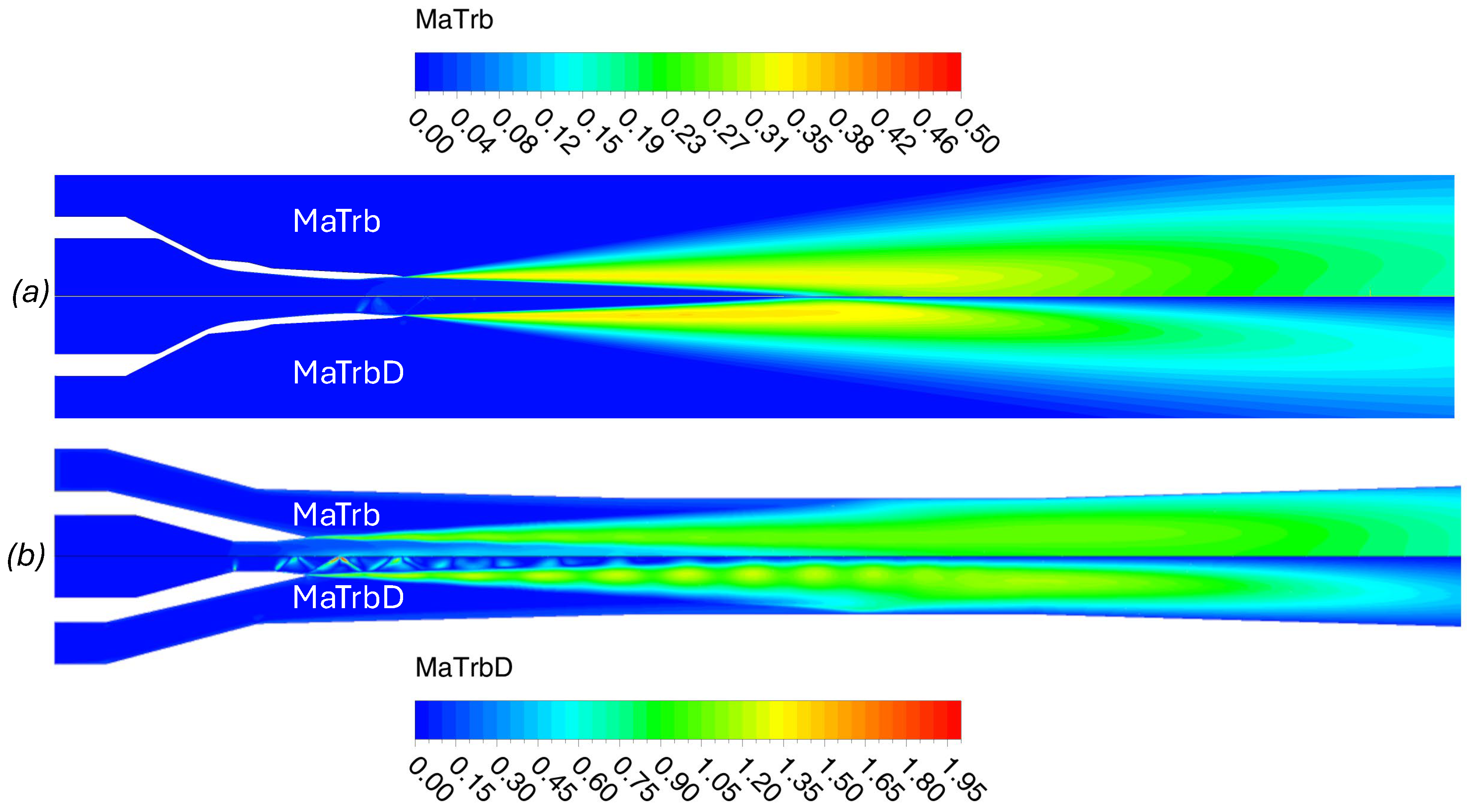
The ejector heart is the shear layer, where turbulence produces an intense transport of momentum (and of the other transported quantities) between the primary and the secondary streams. Considering an ejector operating with a subsonic secondary flow, the following qualitative description can be given with reference to the results (Figure 2) obtained with the CFD model validated in the Part 2 of this study. A high shear near the nozzle exit results in the strong production of turbulent kinetic energy (TKE). A medium shear drives the process leading to the collapse of the centreline velocity; a medium/low shear characterizes the momentum exchange with the secondary stream until the mixing layer reaches the ejector wall. The latter behaviour leads to uniformity over a short axial distance, which can be characterized by the ‘non-mixed length’ and ‘the mixed length’ studied by Rao [16] and Karthick [17]. When the primary stream is not correctly expanded, the presence of shock waves interacting with the shear layer further enhances the production of turbulence and the corresponding transport mechanism. Despite the efforts made in experiments and high-fidelity simulations (LES), a detailed description of the evolution of the interplaying characteristics of the mean flow and of the turbulence fields remains a non-trivial task.
This fluid dynamic complexity is also the reason for the difficulties found in simulating supersonic ejectors by solving the Reynolds/Favre-averaged Navier–Stokes equations. In fact, this approach provides a computational tool whose cost is compatible with its iterative use in the ejector design process; however, it requires the adoption of turbulence models with sufficient validity for the different conditions that characterize an ejector flow field.

3. Averaged Equations and Eddy Viscosity Models

The Reynolds/Favre-averaged [32,33] conservation equations are obtained through a statistical procedure: first by decomposing each variable into the sum of its mean and fluctuating components and then by applying an ensemble average to each equation according to the Reynolds rules. In the following, we adopt the Reynolds decomposition for each dependent variable Φ , assuming that the correlation between its instantaneous value and the instantaneous density is zero (i.e., Reynolds decomposition equals Favre decomposition):
Φ = Φ ¯ +   Φ ; Φ ¯ = 0
where the overbar indicates the averaging operator.
In a Cartesian frame of reference, the mass, momentum and total energy balance equations, for compressible flows, are expressed with the following averaged differential form:
ρ ¯ t + ρ ¯ u i ¯ x i = 0
ρ ¯ u i ¯ t + ρ ¯ u i ¯ u j ¯ x j = p ¯ x i + x j t i j ρ u i u j ¯
ρ ¯ e ¯ + 1 2 u i ¯ u i ¯ t + ρ ¯ e ¯ + 1 2 u i ¯ u i ¯ u j ¯ x j = x j k t T ¯ x j + ρ u j e ¯ + x k u i ¯ p ¯ δ i k + t i k ¯ ρ u i u j ¯
where x i denotes the coordinates’ components (the summation convention over repeated indices is adopted); u i ¯ , ρ ¯ , p ¯ , T ¯ , and e ¯ , are, respectively, the mean values of velocity components, density, pressure, temperature and internal energy; k t is the thermal conductivity; ρ u i u j ¯ , is the Reynolds stress tensor; and t i j ¯ is the molecular stress tensor modelled with:
t i j ¯ = 2 μ S i j 1 3 μ S k k δ i j
S i j = 1 2 u i ¯ x j + u j ¯ x i
μ is the molecular dynamic viscosity. The averaged equations, compared to their corresponding unfiltered form, contain additional variables which need to be modelled in order to close the system. Eddy viscosity (EV) models and second-order closures are the two main approaches used to model the effects of turbulent fluctuations. Second-order models [34], based on the transport equations of the Reynolds stress tensor, offer a clear advantage in representing the turbulence physics underlying the evolution of the turbulent stress tensor, but a relevant distance exists between their development works, their implementation in the most common available solvers and their numerical robustness in simulations of complex flows. This means that EV models still play a major role and motivates their use and development in the present study. EV models, despite their simplicity compared to second-order closures, are not just a matter of empiricism, as it is often thought. While recent works have mainly developed corrections, based on machine learning techniques, for existing models, the present study focusses on the basic characteristics of the model. As a matter of fact, the effectiveness of corrections depends on the original model characteristics: the stronger the base turbulence model is, the higher the benefits of the corresponding augmented model. In the following, the main underlying assumptions common to the different EV models that can be found in the literature are summarized.

3.1. Constitutive Relationship

A framework for a general EV model in incompressible turbulence is provided by the works of Lumley [35], Pope [36], Shih and Lumley [37], and Gatski and Speziale [38]. These authors, following the work of Townsend [39], show that the Reynolds stress anisotropy tensor, under structural equilibrium conditions, is determined by the local values of the mean velocity gradients and a turbulent timescale. This leads to a general constitutive relationship for the anisotropy tensor, expressed as a tensor polynomial which, for a two-dimensional flow, reduces to a quadratic form. The shear component (i.e., the relevant component for shear-dominated flows) includes only the linear term, as shown in Equation (7):
b i j = ρ u i u j ¯ ρ ¯ 2 K 1 3 δ i j = G τ S i j
where Κ = 1 2 u i u i ¯ is the TKE, τ = K ε is the ‘eddy lifetime’, and ε is the turbulent dissipation rate. The definition of the turbulent timescale τ implicitly assumes the equilibrium of the spectral cascade; that is to say, the spectral consumption at large scales, determining their lifetime, equals the dissipation rate taking place at the smallest turbulent scales. The structural parameter G is a function of the invariants η and ξ :
η = τ S
ξ = τ W
where
S = 2 S i j S i j
W = 2 W i j W i j
W i j = 1 2 u i ¯ x j u j ¯ x i
It can be readily recognized in Equation (7) that for the usual EV relations, shown in Equations (13) and (14), it is clear that the turbulent timescale sets the structure anisotropy and the velocity scale sets the stress intensity:
r i j = ρ u i u j ¯ = ρ ¯ 2 K b i j + 1 3 δ i j = 2 3 ρ ¯ K δ i j μ t 2 S i j
μ t = C μ ρ ¯ τ K = C μ ρ ¯ K 2 ε
Structural parameter C μ , appearing in the usual definition of the EV μ t in the early EV models, was evaluated as a constant based on the experimental data for the logarithmic region of fully developed boundary layers. The lack of universality of a constant C μ value was pointed out from the beginning [40], even in the limited class of shear flows [41], with the axisymmetric jets being the most critical case. Two main approaches are followed to obtain a functional form of C μ : one relying on the explicit solution of the algebraic Reynolds stress transport model [36,38], the other directly guessing the function equation. The latter approach can take advantage of the physical (realizability) constraints [42,43] which characterize turbulence’s statistical behaviour. The EV is also used to model the turbulent transport of internal energy in Equation (4), which is analogous to the corresponding molecular transport:
ρ u j e ¯ = c p μ t P r t T ¯ x j  
where c p and P r t are respectively the specific heat at constant pressure and the Prandtl number.

3.2. Balance Equations of Turbulent Scales

A complete EV model needs two transport equations in order to provide the timescale and the velocity/energy scale used in the constitutive relationship of the Reynolds stress tensor. For this purpose, any two linearly independent combinations of K and ε can be used. Whatever the choice is, it can take advantage of the balance equations of K and ε , obtained analytically [32,44,45]:
ρ ¯ K t + u ¯ i ρ ¯ K x i = ρ ¯ P +   T K + μ 2 K ρ ¯ ε
where
P = 1 ρ ¯ r i j u i ¯ x j = 1 ρ ¯ r i j S i j   ( K   p r o d u c t i o n )
T K = x i 1 2 u k u k u i ¯ + p u i ¯   ( K   t u r b u l e n t   t r a n s p o r t )
ρ ¯ ε t + u ¯ i ρ ¯ ε x i = P ε 1 + P ε 2 + P ε 3 + P ε 4 + T ε + μ 2 ε Y ε
where
P ε 1 = 2 ν u i x j u k x j   ¯ S i k ( ε   m i x e d   p r o d u c t i o n )
P ε 2 = 2 ν u i x k u i x m ¯ S k m   ( ε   p r o d u c t i o n   b y   m e a n   v e l o c i t y   g r a d i e n t )
P ε 3 = 2 ν u k u i x m ¯ 2 u ¯ i x k x j   ε   g r a d i e n t   p r o d u c t i o n
P ε 4 = 2 ν u i x k u i x m u k x m ¯   ε   t u r b u l e n t   p r o d u c t i o n
T ε = ν x k u k u i x m u i x m ¯ 2 ν x k p x m u k x m ¯   ε   t u r b u l e n t   t r a n s p o r t
Y ε = 2 ν 2 u i x k x m 2 u i x k x m   ¯ ε   d e s t r u c t i o n  
In the K balance in Equation (16), P represents the production of TKE due to the vortex stretching mechanism exerted by the mean velocity field on the large-scale turbulent structures; T K is the transport achieved by the turbulence itself through velocity and pressure fluctuations. In the ε balance in Equation (19), the turbulent production P ε 4 represents the production of dissipation by the fluctuating strain rate, and the destruction Y ε , represents the decay of the dissipative structures; these are the leading terms when turbulence is subjected to medium distortion intensities by the mean flowfield. The turbulent production terms P ε 1 , P ε 2 and P ε 3 , involving mean velocity gradients, become relevant at high distortion intensities. In turbulent inhomogeneous flows, like jets and boundary layers, the turbulent transport T ε has a magnitude comparable to the ε production/destruction imbalance. The T K and T ε terms are particularly relevant in regions where the mean velocity gradient vanishes (e.g., on the centreline and at the edge of a jet). Under this condition, local values of K and ε are mainly determined in neighbouring regions with higher mean velocity gradients. Within the K ε models, the production and destruction terms of K do not involve additional variables, while the corresponding mechanisms for ε need to be modelled. The works of Lumley and Khajeh-Nouri [46], Lumley [47], and Speziale and Gatski [48] provide a general framework which encompasses the majority of models found in the literature. For isotropic decaying turbulence, the balance between production and destruction of dissipation is usually modelled by the following approximation:
P ε 4 Y ε = c ε 2 ρ ¯ ε 2 K
where the coefficient   c ε 2 can be determined from the initial period of decay, with the eventual introduction of a dependency on the turbulent Reynolds number, to reproduce the final period. For strained, weakly anisotropic turbulence, a common approach consists of the introduction of a term proportional to the K production, leading to the following modelled form for the ε production/destruction balance:
P Y ε = P ε 1 + P ε 2 + P ε 3 + P ε 4 Y ε = c ε 1 ε K ρ ¯ P c ε 2 ρ ¯ ε 2 K  
The turbulent transport terms of K and ε are generally modelled with a gradient-type approximation [49]:
T K = x i μ T σ k K x i  
T ε = x i μ T σ ε ε x i  
From the above equations, the usual form of the modelled transport equations of K and ε is obtained:
ρ ¯ K t + u ¯ i ρ ¯ K x i = r i j S i j +   x i μ + μ T σ k K x i ε  
ρ ¯ ε t + u ¯ i ρ ¯ ε x i = c ε 1 ε K r i j S i j c ε 2 ρ ¯ ε 2 K + x i μ + μ T σ ε ε x i
In the first two equations [50,51] for EV models, the c ε 1 coefficient is considered as a constant and the ε equation is used to obtain a relation between coefficients c ε 1 , c ε 2 and σ ε . Several works have been completed, e.g., [52,53,54,55], in the context of both EV models and second-order closures, which aimed to properly reproduce the influence that different deformation/rotation fields exert on the mechanisms setting the dissipation rate. A series linear in the velocity gradients, depending on the main invariants, is proposed by Lumley [47] as a general form for the dissipation production/destruction balance. The work of Speziale [48] provides a model that can take into account the effect of anisotropies on the dissipation rate balance. Lumley [56] conducted an interesting analysis, which highlighted the importance of considering the local dissipation rate, as the results of the non-local process cause energy to enter the spectral pipeline. The critical role played by the modelled dissipation equation is emphasized by the fact that the dissipation value enters both the EV and the K equation. Related to this aspect and to the context of the complex flowfield of ejectors, it seems appropriate to recall the still-valid Lumley sentence in which ‘the mechanism that sets the level of dissipation in a turbulent flow, particularly in changing circumstances’ is ‘the part of modelling in serious need of work.’ The above overview provides a first idea of the key aspects that characterize an EV model. Taking these elements into consideration, the following section focusses on the turbulence features that need to be properly modelled to provide a reliable description of the development of an ejector jet.

4. Turbulence Modelling and Jets

As briefly outlined in Section 2, the characteristics of the mean and turbulent flowfield of a supersonic ejector undergo substantial changes during its development. In order to overcome the current lack of information on the details of the evolution of turbulence, it is useful to take advantage of the fact that the ejector shear layer shares the same basic characteristics of a free jet, at least in its initial region. This means that, keeping in mind the substantial differences between the two flows (i.e., a constant massflow with varying momentum for the ejector, and a constant momentum with increasing mass flow for the free jet), it is possible to take advantage of the studies developed on free jets. In addition, fundamental information on turbulence’s response to the shear intensity can be gained from studies on basic shear flows (i.e., homogeneous shear flows and boundary layers).

4.1. Jet Development

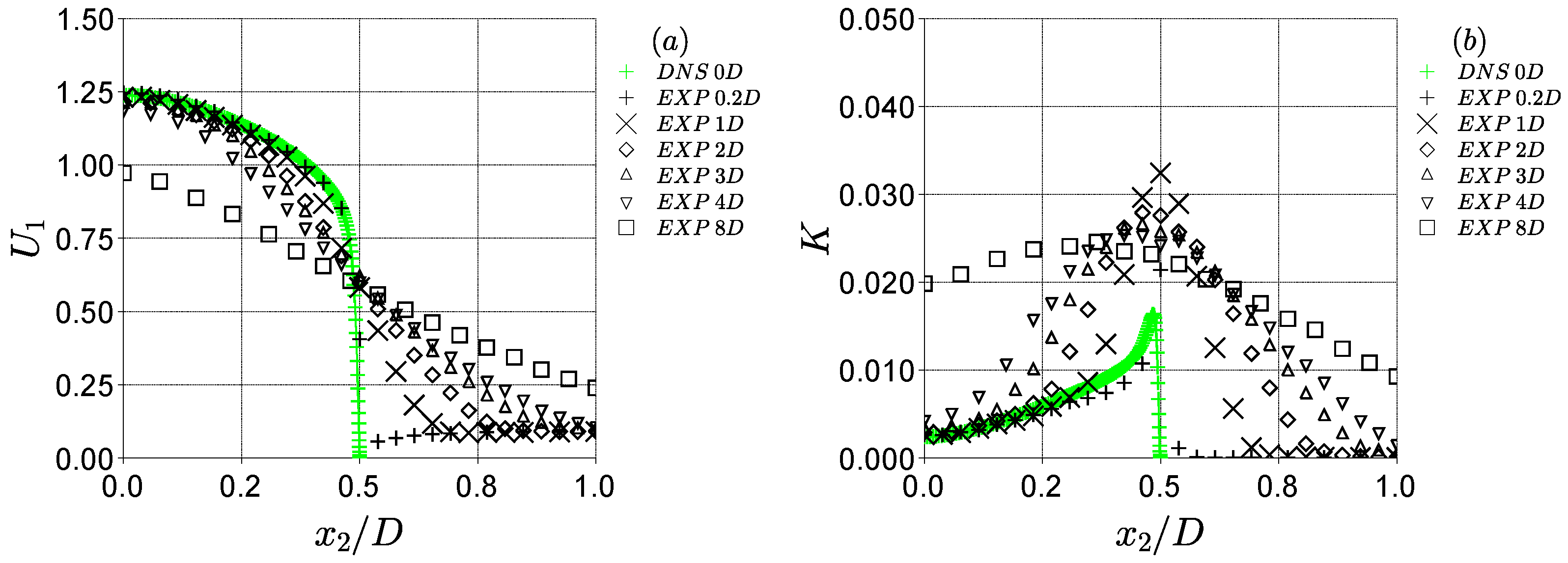
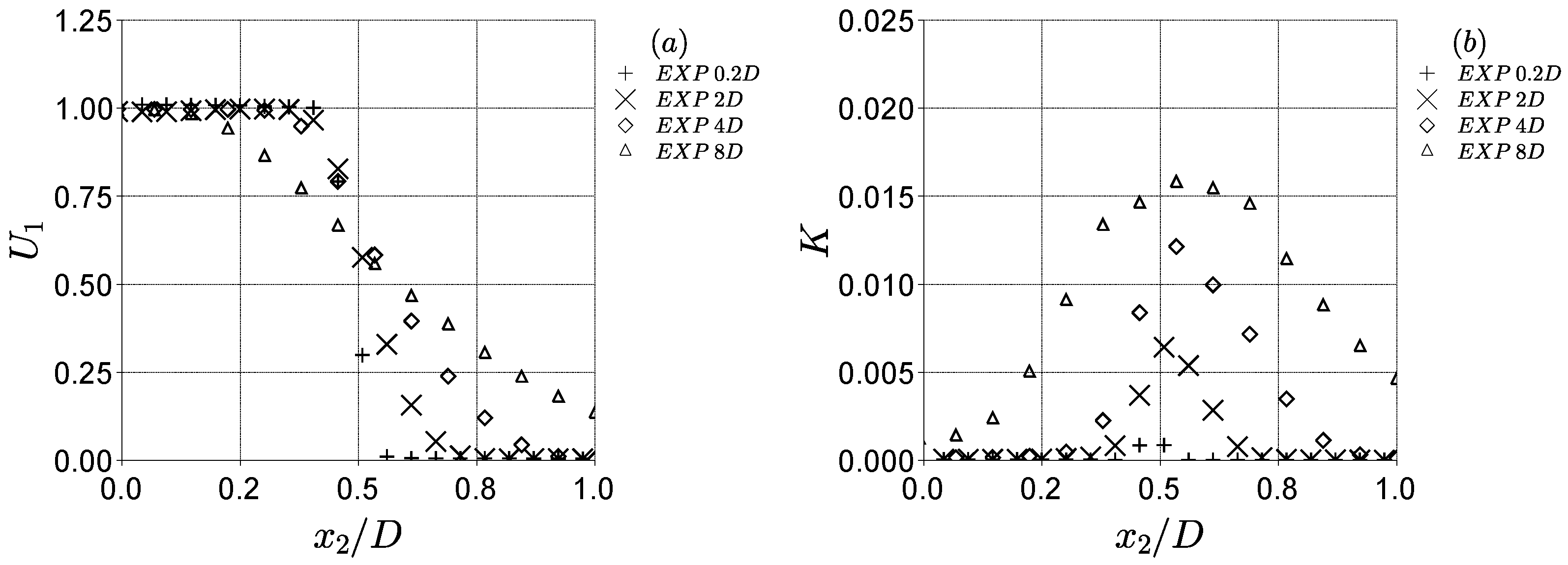
Analyzing jet development, a first distinction is typically made between the regions of flow establishment and of self-similarity. The former, which is the path leading to the latter, is strongly influenced by the conditions of the jet and of the surrounding environment at the nozzle exit plane. The self-similarity region is where the radial distributions of each flow variable, taken at different axial positions and properly scaled, collapse on single curves. It is hardly debated whether the self-similarity character depends on the initial conditions. Without entering this debate, it is possible to state that the jet memory is long enough to make the fluid dynamics of a supersonic ejector in a mixed-flow regime largely influenced by its initial conditions. In fact, depending on the ejector AR and on the working conditions, it could be that the shear layer reaches the ejector wall and the flow achieves uniformity before self-similarity takes place. Within the flow establishment region, it is important to focus on particular aspects. A first distinct feature when the nozzle boundary layer is turbulent arises at a distance of a few nozzle diameters from the jet exit. Experiments [57,58] and simulations [59] highlight that, once nozzle wall damping ceases, the high shear that characterizes the near-wall region is free to deliver the very strong production of TKE. This feature is shown in Figure 3 and Figure 4, where the radial profiles of the mean axial velocity (U1) and of K , measured at different axial distances from the nozzle exit, are shown for an incompressible jet [57] and a supersonic jet [58]. The axial and radial positions ( x 2 ) are expressed in terms of the nozzle diameter D; velocity and TKE are nondimensionalized using the mean jet exit velocity and the ideal jet velocity (corresponding to the nozzle pressure ratio), respectively, for the incompressible jet and the supersonic jet. The profiles obtained from the DNS results of Jimenez et al. [60], corresponding to the Reynolds number of the incompressible jet, are plotted in Figure 3 as an additional reference for the fully developed boundary layer values at the nozzle exit (i.e., at distance 0D).
The intensity of the described action is also the reason for its limited extent (i.e., the high shear stresses that are produced rapidly smooth the high gradient). A second important feature of jets is the medium-to-low shear that characterizes the initial development of the mixing layer toward the jet axis and toward the external region, vanishing at the edges of both sides. Once the axis is reached, the potential core (i.e., the region where the centreline velocity value remains almost constant) ends and the centreline decay begins, starting the process that leads to the self-similarity region. The wall of the ejector mixing duct, when reached by the developing shear layer, leads to another region of high shear, whose production of K makes a significant contribution to the completion of the uniformization process. From these brief observations, it follows that while the majority of works that evaluate turbulence models on jets (and other free shear flows) focus on the self-similar solution, a different approach is required to fully reproduce the ejector behaviour. In this context, a key aspect is the ability of the model to reproduce the turbulence response to different shear intensities.

4.2. Shear Intensity Effects on Turbulence

Theoretical, experimental and numerical studies have been conducted on the influence that the distortion type and intensity exert on the turbulence structure and related quantities, such as the Reynolds stress anisotropy and the production-to-dissipation ratio. In the following, a brief summary is presented of the main elements that help the subsequent turbulence modelling analysis and development.
Considering only 2D shear flows, useful information can be gained from works on homogeneous shear flows [61,62,63,64,65] and boundary layers [60,66,67]. In both flow types, it has been shown experimentally and numerically that a given shear intensity, maintained for sufficient time, leads turbulence to a structural equilibrium, where the Reynolds stress anisotropy and the production-to-dissipation ratio are determined by the local distortion value. A proper quantity that expresses the distortion intensity relative to the turbulence timescale is the invariant η which, for a 2D shear flow, reduces to τ u 1 ¯ x 2 (with the indices 1 and 2 indicating the flow and the transverse directions, respectively). Based on this variable, two fundamental conditions can be distinguished: one produced by medium-shear intensities, where all the turbulent mechanisms are at work; the second where the high shear value makes the slower mechanisms (i.e., the so called non-linear scrambling) ineffective, a condition described by the rapid distortion theory [68].

4.2.1. Medium and High Shear in Homogeneous Shear Flows

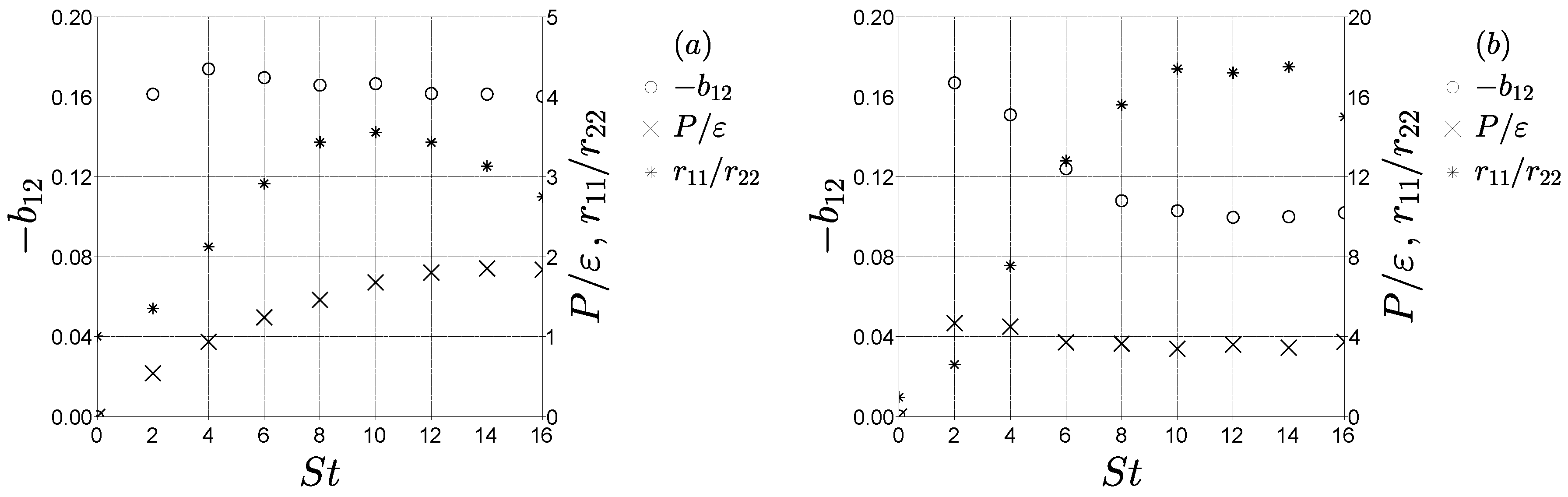
Studies on homogeneous shear flows, which are characterized by a transversely constant velocity gradient, provide valuable insights into these different conditions. For instance, the DNS simulations of Rogers et al. [64] and Lee et al. [65] may be considered to describe the effects of medium and high shear. In these studies, starting from isotropic turbulence, the simulated flows are characterized respectively by a medium/high η value of 4.7 (run C128U of Rogers et al. [64]) and a high η value of 16.
Figure 5 shows the evolution of the shear stress anisotropy b 12 , the structural parameter r 11 r 22 and the production-to-dissipation P ε as a function of the total strain u 1 ¯ x 2 t . The anisotropy b 12 and the P ε ratio are quantities that, in the following, are used in the construction of models for structural parameter C μ and for the ε production/destruction balance. The r 11 r 22 ratio, together with b 12 , provides information that can be used to identify the turbulence distortion intensity with measurements usually available in jets (and other shear flows). Differences can be seen both on the story and the equilibrium values. The medium shear produces an equilibrium b 12 value of about −0.16, a r 11 r 22 that slowly relaxes after a peak value of 3.5 and an asymptotic P ε value of about 1.8. This high shear leads to an initial b 12 peak close to −0.17, followed by a decrease to −0.1, a r 11 r 22 peak value of 17 and a P ε value that relaxes to about 3.5, after an initial value higher than 4.5. The DNS equilibrium values provide an experimental confirmation of the works of Tavoularis [61,62] and Souza et al. [63].
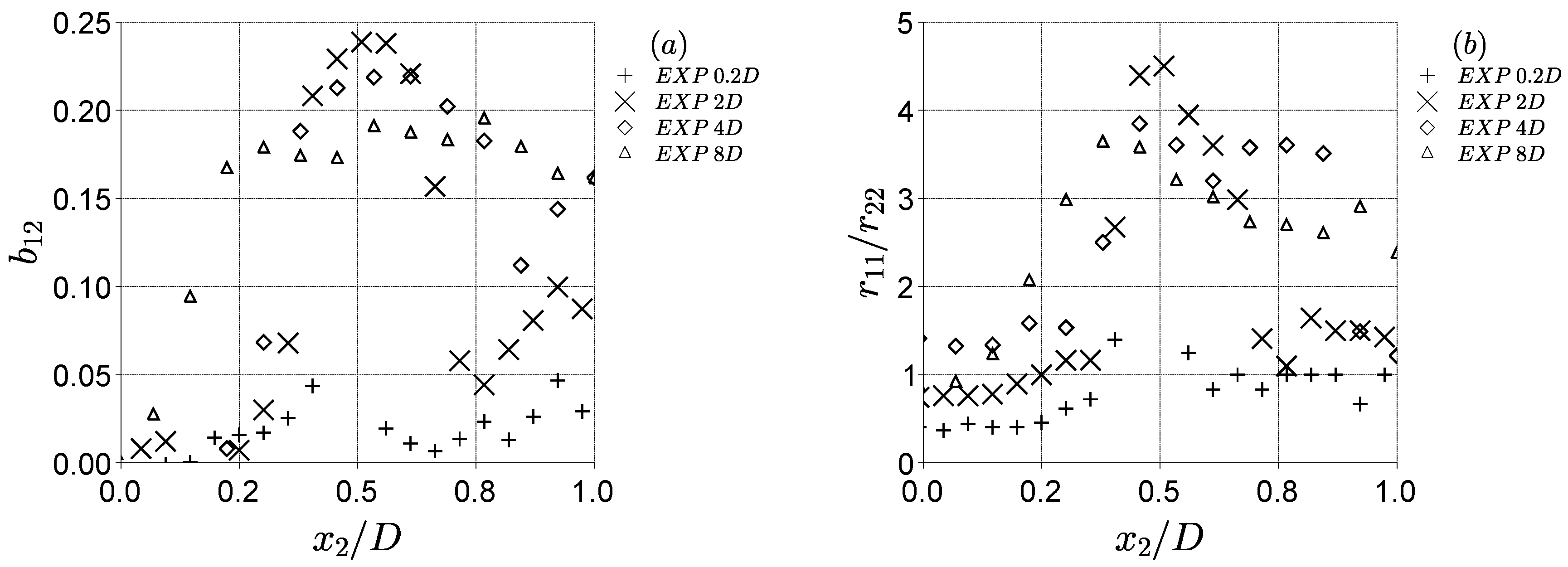
The behaviour of homogeneous shear flows can be compared with the corresponding measurements on supersonic jets by Georgiadis et al. [58], whose radial profiles are shown in Figure 6 for the initial axial stations. It can be observed that at x 2 D = 0.5 (i.e., the nozzle lip line), r 11 r 22 reaches the highest values of about 5 at the axial distance 2D. At this location, b 12 achieves values near 0.25 (note that the b 12 sign changes between the homogeneous shear flows and the jet is due to the sign change of u 1 ¯ x 2 , with b 12 always having the opposite sign of u 1 ¯ x 2 ). Both r 11 r 22 and b 12 relax to lower values in the downstream axial stations.
This suggests that, for the considered jet, turbulence is under rapid distortion conditions near the nozzle exit, without achieving the corresponding equilibrium structure, then relaxes to conditions that span from medium–high (near the nozzle lip line) to low values (on the axis and at the shear layer free edge). This point is further discussed in the following paragraph, related to compressibility effects.

4.2.2. Medium-to-Low Shear in Inhomogeneous Shear Flows

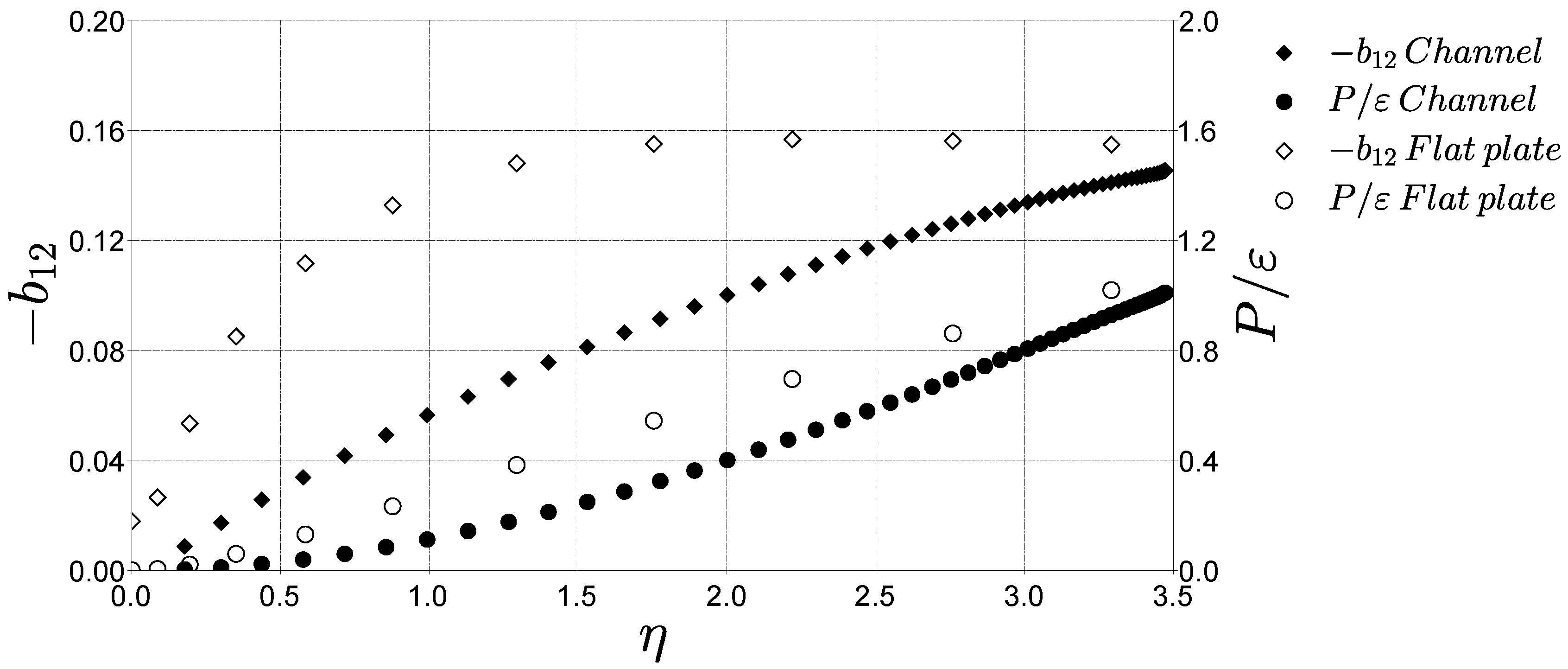
Moving to boundary layers, the attention is then focused on the medium-to-low shear conditions in the context of simple inhomogeneous flows. To achieve this aim, the results of the DNS simulations of Jimenez et al. [60] (fully developed boundary layer) and of Spalart [67] (flat plate developing boundary layer) are discussed. Figure 7 shows the distributions of b 12 and P ε , plotted as a function of η , in the region far from the wall. Both results show the decrease of b 12 and P ε toward zero as η vanishes, though with clearly visible differences. In fact, under these conditions, the influence of non-local effects (e.g., through diffusion of the different Reynolds stress components) on the local turbulence structure is increased. The symmetry constraint on the axis of the fully developed boundary layer results in an earlier decrease. The absence of constraints on the free stream side of the flat plate boundary layer means that b 12 and P ε reduce more slowly to zero.
Considering the jet development, the first condition is met when the shear layer reaches the axis, while the second condition is present in the upstream region and the external region of the jet. It is fairly evident that while second-order closures are able to distinguish the two behaviours, due to the modelling of convective and diffusive effects on the Reynolds stress tensor evolution, the constitutive relation of an EV model, at best, can reproduce just one of the two.

4.2.3. Modelling the Turbulence Response to Shear

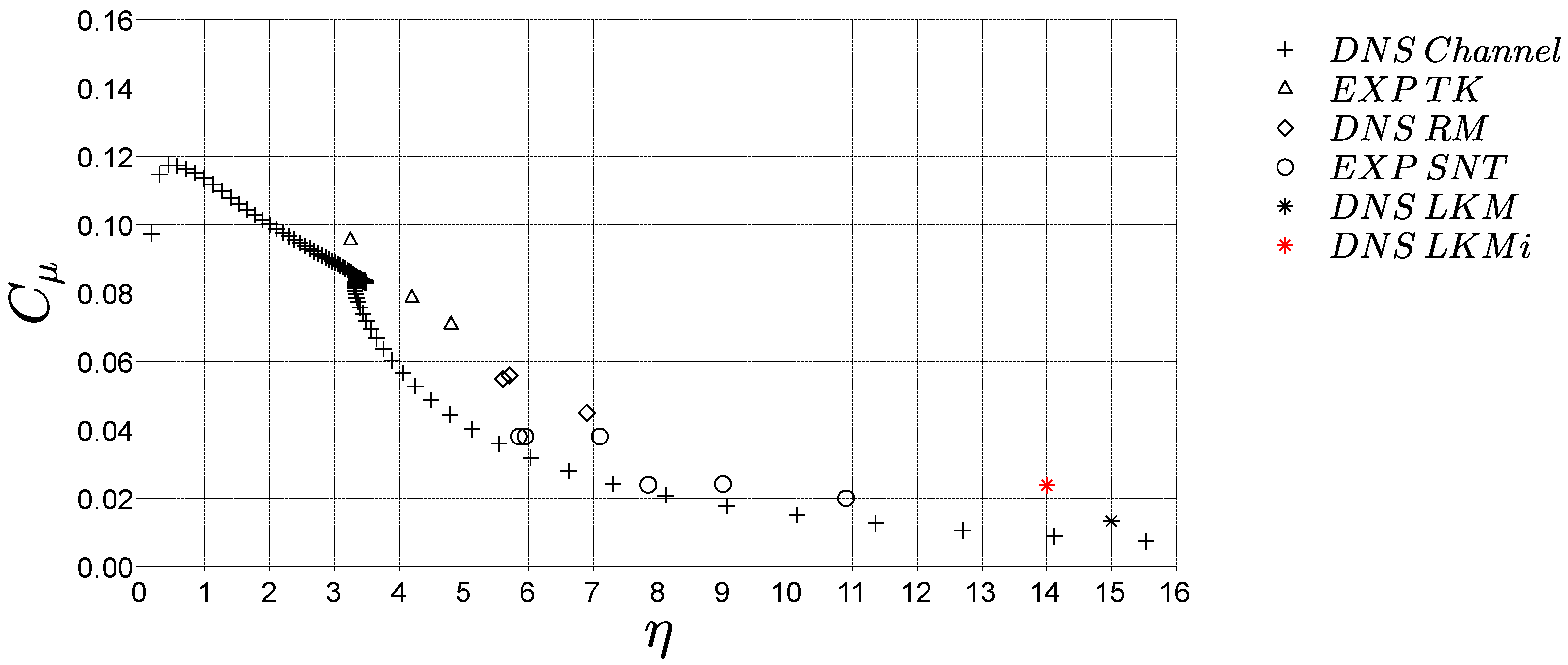
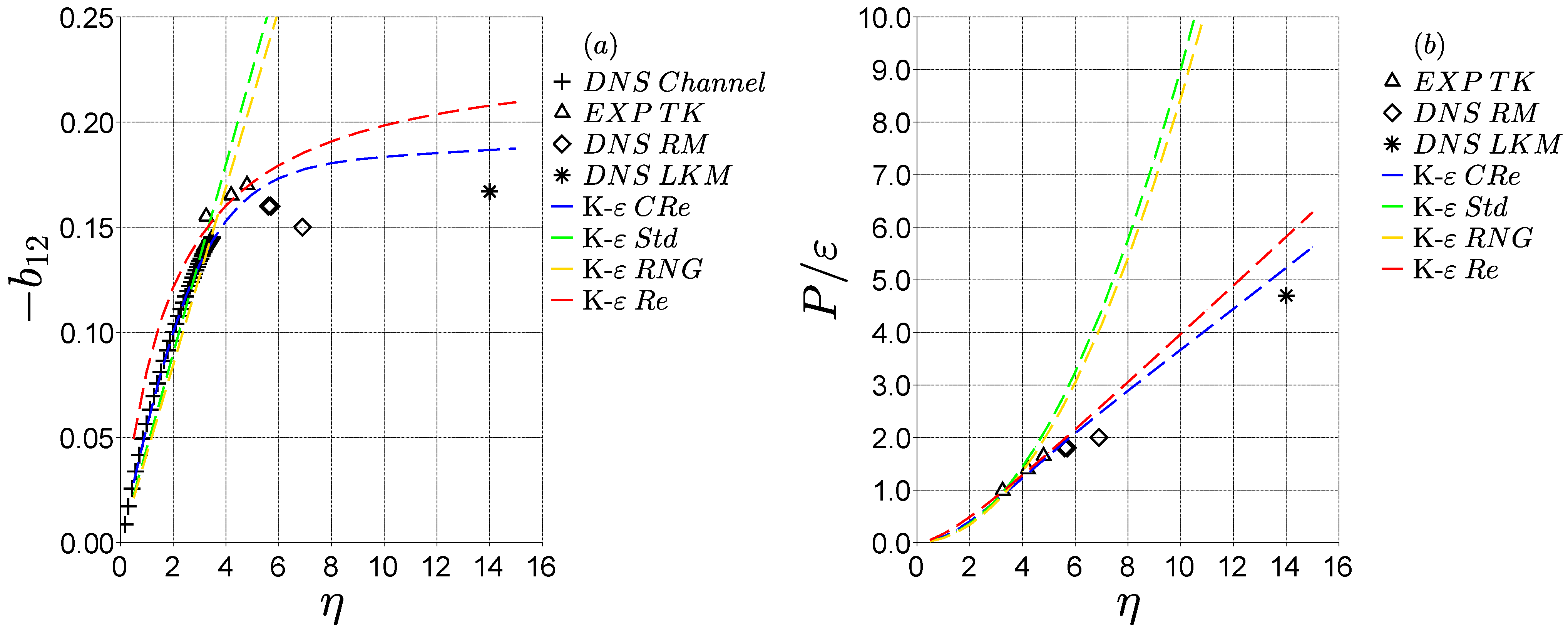
The DNS data of Jimenez et al. (Channel) [60], Rogers et al. (RM) [64] and Lee et al. (LKM) [65], together with the measurements (cases A, D and L) of Tavoularis and Karnik (TK) [62] and De Souza et al. (SNT) [63], can be used to obtain a reference for the C μ dependence on the shear intensity. To this aim, the relation C μ = 2 b 12 η , derived from Equations (13) and (14), is exploited and the results are presented in Figure 8. The consistent response of homogeneous and inhomogeneous shear flows under structural equilibrium conditions is highlighted. A limited difference between boundary layer and homogeneous shear flow values can be seen, particularly at intermediate shear intensities, due to turbulent diffusion and the wall influence. At a high shear rate, the difference between the value corresponding to the initial turbulence response (LKMi) and the asymptotic value (LKM) can be noticed. The degree of approximation corresponding to the usual assumption of C μ = 0.09 can be clearly appreciated.
Similarly to what is achieved for C μ , the considered DNS and experimental data can be used as a reference to build the production/destruction model of the dissipation rate. The adopted procedure is less straightforward and is discussed in Section 6.3, where the use of DNS data to determine the coefficients of the turbulent diffusion models for K and ε is also shown. A final consideration of the turbulence structural equilibrium, which, once reached, adapts to changes in the shear intensity, can be useful provided that the timescale of shear changes is long enough compared to the turbulent timescale. The work of Kobasyashi and Togashi [69] is also instructive, where a backward-facing step flow is analyzed, a case whose flow topology closely represents the behaviour of an ejector working under vacuum conditions. Their analysis shows excellent agreement between the Reynolds stress components obtained with an LES simulation and those computed with an algebraic Reynolds stress model (i.e., the model resulting from the application of the structural equilibrium hypothesis to a second-order closure), directly substituting the LES values of K ,   ε and the velocity gradients in the model relations. This ‘a priori test’ of the turbulence model provides an indication of the appropriateness of the structural equilibrium concept when the flow conditions are changing.

4.3. Turbulence in a Supersonic Jet

A supersonic jet, compared to an incompressible jet, can feature differences whose relevance depends on the Mach number and on the presence of shock waves. Surprisingly, in the existing literature on simulations of supersonic ejectors and free jets, these aspects are seldom discussed. A brief summary is given here to provide complete information that allows for a proper evaluation of the cases studied in Part 2.

4.3.1. Compressibility Effects on the Turbulence Structure

The influence that compressibility exerts on shear flows turbulence has been studied by Sarkar et al. [70], Sarkar [71], and Simone et al. [72]. Sarkar focused on the stabilizing effect that the Mach number has on shear layers. Sarkar et al. [70] studied the influence of dilatational effects and provided a model for compressible dissipation (known in turbulence modelling as ‘compressibility correction’) as a function of the turbulent Mach number M a t = 2 K a . Sarkar 1995 [71] demonstrated that the stabilizing effect is mainly due to the influence of compressibility on b 12 , whose asymptotic value is lower than that for incompressible turbulence. Simone et al. [72] extended the work of Sarkar et al. [71], focusing on rapid-distortion conditions. The distortion Mach number M a d = M a t 2 η is used as a suitable quantity to characterize the influence of compressibility. DNS simulations, performed for an initial M a d ranging between 2.7 and 66.7, show that the stabilizing effect is preceded by a destabilizing one that increases the initial b 12 peak value seen in Figure 6. These two effects are weak at M a d 2.7. Figure 9 shows the contour plots of M a t and M a d , obtained in the validation study of Part 2, for the free jet of Georgiadis et al. [58] and the ejector jet of Hedges [13]. The two test cases, with jet Mach numbers of 1.63 and 1.8, respectively, show maximum values of about 0.3 for M a t and close to 2 for M a d . This indicates a slightly destabilized condition, consistent with measurements of Georgiadis et al. [58] shown in Figure 6. In fact, the peak value of   b 12 in the nozzle exit region is slightly higher than the values found in Figure 5b for the incompressible homogeneous shear flow of Lee et al. [65] (as well as in incompressible jets [57]).

4.3.2. Interaction Between Shock Waves and Shear Layer

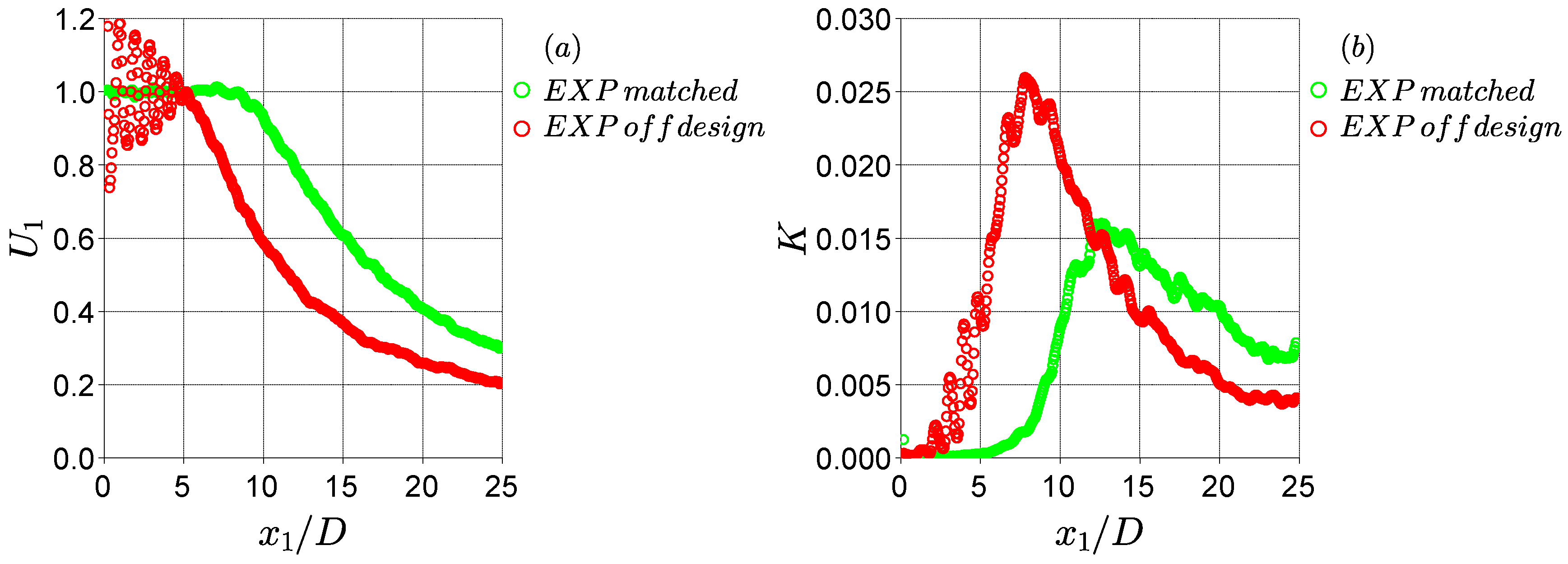
Another aspect to be taken into consideration is the shock–shear interaction that takes place when shock waves are present. The measurements of Georgiadis et al. [58] at matched and off-design conditions clearly show (Figure 10) the impact that shock waves have on the centreline distributions of K and mean velocity. Based on the results of Georgiadis et al. [73], and also on the present authors’ preliminary studies, it is clear that, regardless of the agreement (better or worse) on the jet spreading rate and of the related shear stress distribution, this mechanism is missed by the tested models. Regarding this point, the authors chose, in Part 2 of this work, to consider validation cases where the jet is matched or nearly matched to limit additional complexities which, within an already complex picture, would make appropriate analysis and reliable conclusions difficult. Nevertheless, as can be seen in Figure 2b and Figure 9b, even under nearly matched conditions, the considered ejector test case shows weak shock waves whose effects are not completely negligible.

5. Common Eddy Viscosity Models

Section 4 has shown the importance and possibility of modelling the response of the shear stress anisotropy and P ε to the local shear intensity in order to reproduce the key flow features of confined and free jets. Keeping these considerations in mind, the related elements of EV models that are widely employed in ejector simulations and used in the validation study of Part 2 are now analyzed. The considered models are the K ε standard [51], the K ε RNG [55], the Realizable K ε [74], the K ω [75,76] and the K ω SST [77]. All of these models share the following elements:
  • A Reynolds stress constitutive relationship, as shown in Equation (13).
  • The EV definition shown in Equation (14).
  • The use of TKE (and the related transport equation) as the velocity scale used in the EV, as shown in Equation (30).
Essential differences concerning the second turbulent scale (i.e., the turbulent scale used to determine the turbulent dissipation ε and the related timescale τ ) and the adopted coefficients are summarized in the following. The behaviour in the boundary layer is not discussed, playing a role which can be considered secondary, at least in the majority of the flowfield of ejectors, with AR (>10) studied in the present context. The reader is referred to the bibliography for further details of each model.

5.1. K ε Model

The K ε model was developed through the works of Jones and Launder [50,78] and Launder and Spalding [51]. The Reynolds stress constitutive relationship is expressed by Equations (13) and (14), where C μ is determined, according to Rodi and Spalding [40], using the following relations:
b 12 = 1 2 C μ η
P ε = r 12 ρ ¯ ε u 1 ¯ x 2 = C μ η 2
whose combination, assuming P ε = 1 (i.e., a condition representative of the logarithmic region of a boundary layer), gives:
C μ = 2 b 12 2
where the measured value b 12 = 0.3 gives C μ = 0.09 . The transport equations of K and ε take the form of Equations (29) and (30), with the diffusion coefficients σ k and σ ε fixed to 1 and 1.3, respectively, by numerical optimization (i.e., being tuned by simulation results). The c ε 2 value of 1.92 is determined on the basis of the measured decay of grid turbulence. In order to compute c ε 1 , the relation among c ε 1 , c ε 2 and σ ε is derived via simplification of the ε equation. With reference to the logarithmic region of a fully developed boundary layer, where convection is zero, Equation (30) reduces to
0 = c ε 1 ε K ρ ¯ P c ε 2 ρ ¯ ε 2 K + d d y μ T σ ε d ε d y
replacing the following relations:
d U d y = u τ κ y f r o m   t h e   l o g   l a w
r 12 ρ ¯ u τ 2 f o r   t h e   c o n s t a n t   s t r e s s   l a y e r
ε P = r 12 ρ ¯ d U d y
u τ 2 K = b 12 2 = C μ
μ T = ρ ¯ u τ 2 d U d y = ρ ¯ u τ κ y
a constraint is obtained:
c ε 1 = c ε 2 κ 2 σ ε C μ
which gives c ε 1 = 1.44 . It is worth noting that the above relation, derived as a support to the coefficients’ evaluation at the time of the early turbulence models, involves rough approximations. Specifically, from DNS simulations, it is known that for P 2 ε near the top of the viscous sublayer, r 12 ρ ¯ u τ 2 , while P ε in the logarithmic layer, where r 12 , decreases linearly.

5.2. K ε RNG Model

The RNG model is developed in the works of Yakhot and Orszag [79], Yakhot and Smith [80], and Yakhot et al. [55], exploiting the renormalization group theory, which is used to evaluate the constant coefficients. The Reynolds stress tensor and the transport equation of K have the same form as the standard K ε . The constant coefficients are C μ = 0.0845 , c ε 2 = 1.68 , σ k = 1 1.39 , and σ ε = 1 1.39 . The following functional form is derived for the c ε 1 coefficient through the use of a double-expansion technique:
c ε 1 = c ε 1 , r n g η 1 η η 0 1 + β η 3
where c ε 1 , r n g = 1.42 is obtained with the RNG approach, η 0 = 4.38 is assumed as fixed point and β = 0.012 is obtained by using the constraint Equation (36).

5.3. Realizable K ε Model

The development of the Realizable K ε model, starting from the suggestions of Reynolds [42], is presented in the works of Shih et al. [43,74]. The EV coefficient C μ is expressed as
C μ = 1 A 1 + A S U * τ
where, for a non-rotating frame of reference:
U * = S i j S i j + W i j W i j
A s = 6 c o s Φ
Φ = 1 3 a r c c o s 6 W *
W * = S i j S j k S k i S i j S i j 3 2
this form allows the constitutive relationship to satisfy the realizability constraint requiring that b 11 approaches 1 3 as S 11 for any combination of other S i j . The ε balance equation obtained from the equation of the mean–square vorticity fluctuation, has the following form:
ρ ¯ ε t + u ¯ i ρ ¯ ε x i = c 1 ρ ¯ S ε c 2 ρ ¯ ε 2 K + ν ε + x i μ + μ T σ ε ε x i
where c 1 has the following functional form:
c 1 = m a x 0.43 , η 5 + η
The derivation and calibration of Equation (44) is obtained, referring to the experimental data on homogeneous shear flow [60] and boundary layer flows (not specified). Shih et al. [74] write that the term c 1 ρ ¯ S ε is similar to the corresponding one proposed by Lumley [56]; in fact, it seems to differ in both the form and the underlying hypothesis. Lumley [56] keeps firm the hypothesis that ‘the rate at which energy enters the spectral pipeline should be determined by the local value of the energy, and the local value of the timescale, the latter being determined by history’. On the contrary, the term c 1 ρ ¯ S ε depends on the local value of the energy (i.e., K ) only through the value of τ , used to determine η , which enters the functional form of c 1 . In addition, this dependence ceases below η = 3.8 , when the ratio η 5 + η becomes lower than 0.43. The form c 1 ρ ¯ S ε implies that τ is the local timescale determining the spectral consumption while, according to the considerations of Lumley [56], this assumption is valid only for homogeneous shear flows and in regions of inhomogeneous flows ‘where most of the fluid has been subjected to the same strain history during living memory’ [56]. Things are different in regions of inhomogeneous flows where the strain vanishes, like the boundaries of the developing shear layer in a jet. The coefficient c 2 is chosen as 1.9 based on the decay of grid turbulence; σ ε = 1.2 is obtained using a constraint equation analogous to Equation (36).

5.4. K ω Model

In the K ω model, described in the works of Wilcox [75,76,81], the second turbulent scale is ω = ε 0.09 K , which includes the C μ coefficient of the K ε model. In the present study, the 1998 version is considered. This model is implemented in the Ansys Fluent 17.1 software and used for the simulations presented in Part 2. The dissipation rate is computed by
ε = β * ρ ¯ ω K f β *
f β * = 1   f o r   χ k 0
f β * = 1 + 680 χ k 2 1 + 400 χ k 2   f o r   χ k > 0
χ k = 1 ω 3 K x i ω x i  
The f β * term limits the sensitivity to free stream values. In the 2008 version, f β * is dismissed and a corresponding cross-diffusion term is introduced in the ω equation, similarly to the K ω SST model. The ω transport equation is expressed by
ρ ¯ ω t + u ¯ i ρ ¯ ω x i = γ ρ ¯ μ T r i j S i j Y ω + x i μ + μ T σ ω ω x i
where:
Y ω = β ρ ¯ ω 2 K f β
f β = 1 + 70 χ ω 1 + 80 χ ω
χ ω = W i j W j k S k i 0.09 ω 3
The f β term represents the round-jet correction, adopted following Pope [82]. The Pope correction was proposed to reduce the excessive spreading rate produced by the K ε model in round jet simulations. Pope [82] hypothesized that the mean vortex stretching produced in axisymmetric jets enhances the turbulence rate of scale reduction and the corresponding dissipation. The quantity W i j W j k S k i , which is a measure of the vortex stretching action, was then used to construct an additional term in the ε equation, increasing the production of dissipation in axisymmetric jets. In simple shear flows (e.g., 2D), the correction term is zero. The β coefficient value of 9 125 is fixed on the basis of the experiments on decaying isotropic turbulence, while σ k and σ ω are set to 2 based on the analysis of the defect layer in boundary layers. The γ coefficient is 13 25 , computed exploiting a simplified ω balance, derived as in Equation (36).

5.5. K ω SST Model

The K ω SST model was constructed by Menter [77] using an empirical approach, combining the K ω and the K ε models. To this end, the ω equation is derived from the K ε model:
ρ ¯ ω t + u ¯ i ρ ¯ ω x i = γ ρ ¯ μ T r i j S i j β ρ ¯ ω 2 K + x i μ + μ T σ ω ω x i + 2 1 F 1 ρ ¯ σ ω 2 1 ω K x i ω x i
and a blending function is defined that works as a smooth switch between the two formulations. The blending function F 1 , whose details can be found in [77], is 1 in the near-wall region and 0 in the free field. The coefficients appearing in the K and ω equations are computed in the following way:
ϕ = ϕ 1 F 1 + ϕ 0 1 F 1
where ϕ stands for coefficients γ , β , σ k and σ ω .
The two sets of coefficients are shown in Table 1.
The EV is expressed as
μ t = ρ ¯ K ω 1 m a x 1 ; S F 2 a 1 ω
where a 1 = 0.31 and F 2 is a second blending function (see Menter [77] for details) which, similarly to F 1 , is 1 in the near-wall region and 0 in the free field. This form works as a limiter of b 12 , in the near-wall region, as is readily shown, considering its expression for a pure shear flow:
b 12 = ρ u i u j ¯ ρ ¯ 2 K = μ t 2 S 12 ρ ¯ 2 K = a 1 S 12 S = a 1 2
where 2 S 12 = S = u 1 ¯ x 2 is used. A similar limiter is introduced in the 2008 version of the K ω model. A K production limiter is adopted in the SST model, with the following form:
P = m i n P , ε P l i m
with a P l i m default value of 10. The same limiter is used for the K ω model in Ansys Fluent. It is worth highlighting that both K ω SST limiters aim to reduce model failures due to the constancy of C μ and c ε 1 .

6. Consistent Realizable K ε Model

The new K ε model presented in this study is part of a more comprehensive work on nonreactive and reactive jets, with/without density difference effects. The model, at the current stage of development, focusses on the proper response to the turbulence distortion intensity in shear-dominated flows. Specific attention is dedicated to the necessary consistency of the different elements forming the model. Effects due to streamline curvature and system rotation, which are negligible in the present context, are the subject of a parallel work and are not considered. In the following, the basic elements are summarized.

6.1. Constitutive Relationship

The model relies on the constitutive relationship defined by Equations (13) and (14) and on the transport equations of K , Equation (16), and ε , Equation (19). The structural parameter C μ in Equation (14) is expressed by a new functional form, as the sum of two contributions:
C μ = 1 A 1 + A S η + 1 A 2 + A 3 η 2
the first one is the only relevant at high deformation rates; the second is significant at medium/low strain rates. This feature allows the model to better represent the anisotropy dependence on the strain intensity. An analogy can be seen with the distinction between rapid and slow terms, used for the pressure–strain correlation models, in second-order closures. In addition, the second term of Equation (57) recovers the inverse proportionality to η 2 that is found in explicit algebraic Reynolds stress models [36,38]. As the original Reynolds [42] model, the adopted constitutive relationship satisfies the realizability constraint that b 11 approaches 1 3 as S 11 for any combination of other S i j . The model coefficients A 1 , A 2 and A 3 are set respectively to 27.0, 12.7 and 0.5 using data from experimental and numerical studies on homogeneous shear flows and boundary layers, as shown in Section 6.3. The fully developed boundary layer is used as a reference in the low-shear region (see the observations in Section 4), a choice that makes the model properly behav when the jet shear layer reaches the axis.

6.2. ε Balance Equation

The model for the ε production/destruction balance takes the form shown in Equation (27), and was c ε 2 = 1.83 , according to Reynolds [42]. The coefficient c ε 1 has the following functional form:
c ε 1 = B 1 + 1 B 2 + B 3 η N
As described in Section 3, the term c ε 1 ε K ρ ¯ P in Equation (27) represents the turbulence anisotropy influence on the ε production/destruction balance. The first coefficient of Equation (58) is related to mechanisms relevant at high shear rate ( P ε 1 , P ε 2 and P ε 3 ). The second term of Equation (58), being relevant at medium-to-low shear conditions, models the response of P ε 4 Y ε to the anisotropy. The adopted form reproduces the inverse proportionality to η found in the available data (experiments, DNS), similarly to the model of Speziale and Gatski [48]. The coefficients B 1 , B 2 , B 3 and N are set, respectively, to 1.166, 1.416, 0.256 and 1.5, using different complementary methods. A first evaluation is made using the production/destruction balance P Y ε   = P ε 1 + P ε 2 + P ε 3 + P ε 4 Y ε , computed from the DNS data of Mansour et al., as a reference [83]. A second reference is provided by homogenous shear flows, as described in Section 6.3. The c ε 1 value is limited to the value of c ε 2 , below η = 0.5 , according to Lumley [47], who suggests the following constraint:
K D ε D t = n ε D K D t = n ε P ε
to assure that dissipation vanishes at the proper rate at the edges of jets and wakes. A fine-tuning is finally done based on the jet simulation results. The usual gradient-diffusion relations, Equations (28) and (29), are adopted to model the turbulent transport of K and ε , with the respective coefficients σ k = 0.9 and σ ε = 1.3 determined on the basis of DNS data for fully developed boundary layers (Kim et al. [65], Jimenez et al. [60], Mansour et al. [83]). For shear-dominated flows nearly parallel to the x 1 axis, as in the jet cases considered in Part 2, the model implementation can be simplified in the following way:
η = τ 4 S 12 S 12
A S = 3 2
Equation (58) can be used only for the shear-related component of the production/destruction term, with the constant value B 1 being adopted for the other components.

6.3. Model Analysis and Comparison

The response to the shear intensity of each component of the new model and of the models described in Section 5 is compared with reference data obtained from DNS simulations and experiments. Different techniques are employed to evaluate the models, without the use of CFD simulations. The attention is focused on the influence that the different components have on the jet shear layer’s evolution. The analysis provides the necessary elements to interpret the results of CFD simulations, where the different modelling errors interact between themselves and with the predicted flowfield. To allow for a direct comparison between K ε -based and K ω -based models, the ε equation corresponding to K ω formulations is derived using the following relation:
D ω D t = D ε K 0.09 D t = 1 0.09 1 K D ε D t ε K 2 D K D t
from which it follows that
D ε D t = 0.09   K D ω D t + ε K D K D t
Table 2 shows a comparative summary of the main elements forming the different models. Consistent with the following analysis, terms are expressed in the form for 2D shear flows. For the sake of compactness, the K ω SST form corresponding to F 1 = 0 is presented in Table 2, showing its response to the shear intensity in the absence of wall effects (i.e., the condition of the shear layer in an ejector jet).

6.3.1. Shear Stress Anisotropy

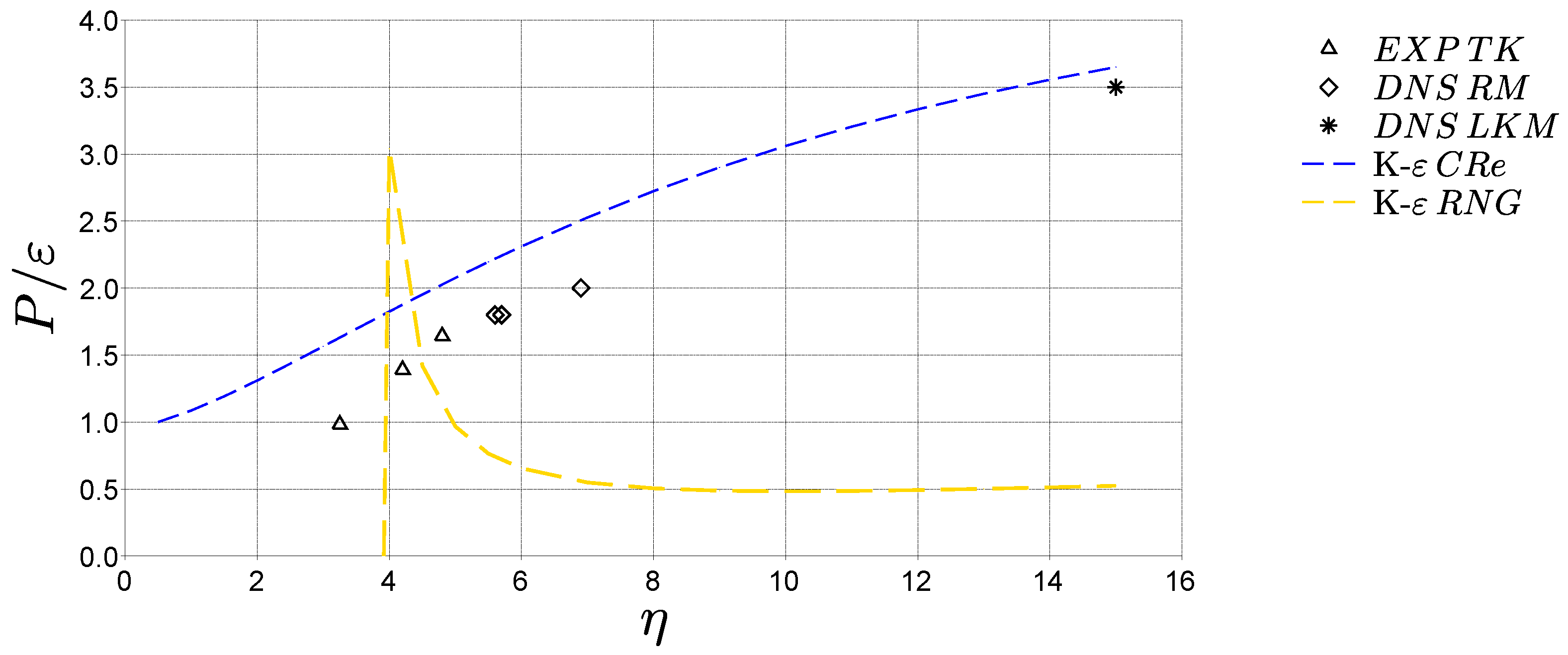
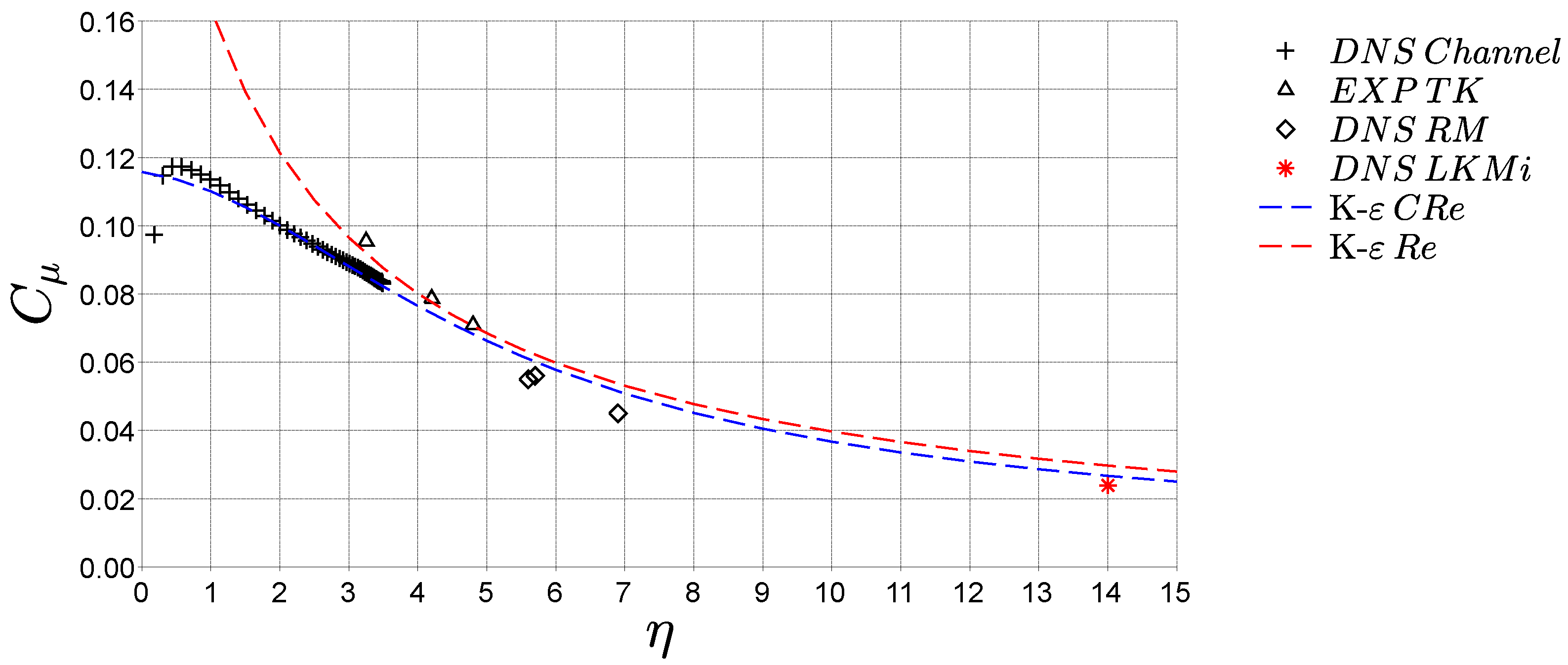
As described in Section 6.1, the coefficients appearing in the C μ functional form of the new model are defined on the basis of different datasets. The DNS data for the fully developed boundary layer [60] are used as the main reference at medium/low shear intensities, together with measurements (cases A, D and L) on the homogeneous shear flow of Tavoularis and Karnik (TK) [62]. The high shear data are computed from the DNS of Rogers et al. (RM) [64] and Lee et al. (LKM) [65]. In the highest shear region, the observations in Section 4.2 and Section 4.3 lead the value obtained from the data of Lee et al. [65] to be used as a main reference at the initial stage of the anisotropy history (i.e., the higher value shown in Figure 8 near η = 14). Figure 11 compares the functional form of C μ in the Consistent Realizable K ε model ( K ε C R e ) and in the Realizable K ε ( K ε R e ) with the reference values. It can be noticed that the relation of the Realizable K ε has slightly higher values at high shear rates and significantly higher values at low shear intensities, reaching 0.25 at η = 0. The latter condition delivers too-high EV values on the jet axis, impacting the centreline velocity decay. In addition, the same model feature, coupled with the ε production/destruction model adopted by Shih et al. [74], is responsible for the excessive jet spreading rate produced by the Realizable K ε .
Figure 12a shows the shear stress anisotropy values as a function of the shear intensity η . The standard K ε ( K ε S t d ) and the K ε RNG ( K ε R N G ) models, using a constant C μ value, imply a linear proportionality between b 12 and η which, at high shear rates, results in a large overprediction of the shear stress and the related production-to-dissipation P ε = C μ η 2 (Figure 12b). Models K ω and K ω SST (far from the walls), have the same behaviour as the standard K ε . The overprediction of r 12 and P ε at high shear rates is responsible for the excessive jet-spreading rate in the region near the nozzle exit.

6.3.2. ε Production/Destruction Balance

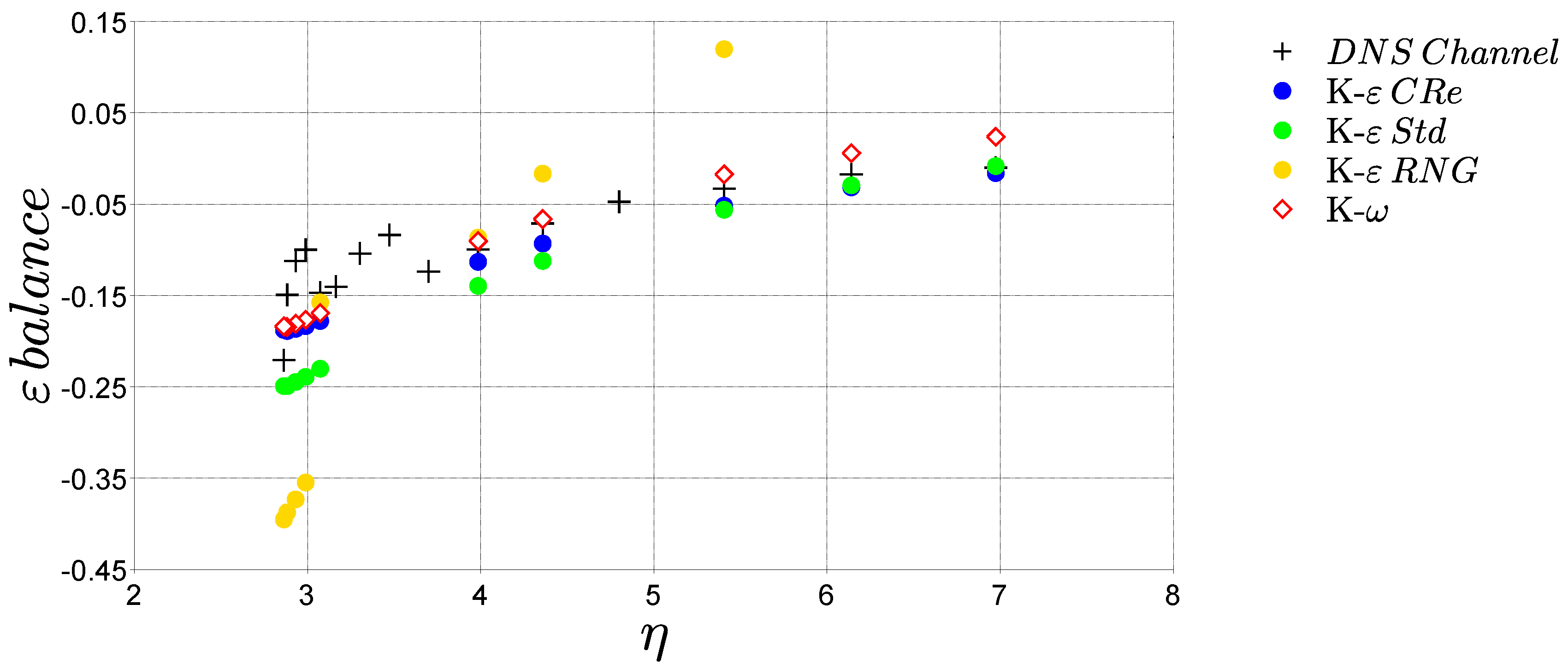
Figure 13 presents an a priori test for the production/destruction balance, which was completed using the data of the fully developed boundary layer DNS simulation of Mansour et al. [83]. The model predictions were obtained, substituting the constitutive relationships for the values of K , ε , r i j and u i ¯ x j available from the DNS simulation. This method allows the appropriateness of a constitutive relationship alone to be evaluated, without introducing the additional modelling errors that affect K , ε , r i j and u i ¯ x j in CFD simulations. The balance values are made non-dimensional with the local value of S ε , resulting in a quantity which can be understood as the local contribution to the ε growth rate. The Consistent Realizable K ε and the K ω models show the best accordance with the DNS data. The standard K ε returns slightly lower values at a low shear rate, indicating a lack of ε production under this condition. The K ε RNG has a significantly different slope, with the ε production being overestimated at high shear rate and underpredicted at low shear intensity. The form of the Realizable K ε does not allow for this a priori test due to the absence of dependence on r i j . A useful complementary comparison can be made with the P ε values near equilibrium conditions, where P ε provides information on the fraction of the K that flows through the spectral cascade. To this end, a transport equation for the timescale τ can be obtained from the K and ε equations, showing the following:
D τ D t = 1 ε D K D t K ε 2 D ε D t
which, after substituting the right term of the corresponding balance equation for D K D t and D ε D t , gives:
D τ D t 1 ε T K + K ε 2 T ε = P ε 1 K ε 2 P Y ε
By imposing the condition D τ D t 1 ε T K + K ε 2 T ε 0 and replacing P ε + Y with the modelled form, a relation is obtained that can be used to compute the near-equilibrium value P ε e q . For the models using the ω equation, P ε e q can be obtained simply by imposing D ω D t T ω 0 . The values found with this method are representative of those produced by the model in CFD simulations for slowly evolving flows. For the new K ε , the standard K ε and the K ε RNG models are as follows:
P ε e q = c ε 2 1 c ε 1 1
For the models using the ω equation:
P ε e q = β γ 0.09
For the Realizable K ε , the adopted method cannot be used due to the absence of P in the production/destruction balance.
The values of P ε e q for the new K ε and the K ε RNG models, with a functional dependence on η , are shown in Figure 14, together with the reference values of homogeneous shear flows.
Looking at the new model it can be seen that the high η , was chosen to match the long-time P ε e q value found in Section 4.2 (Figure 5b), while at medium/low η the results of jet simulations lead to values slightly higher than the reference data. The latter observation makes it clear that, in inhomogeneous flows, the adopted form of the production/destruction balance also includes the influence of non-local effects and of possible errors in the other model components. The RNG model, due to its form, returns a maximum at η 0 = 4.38 .
The constant values produced by the K ε , K ω and K ω S S T (with F1 = 0 and F1 = 1) are reported in Table 3.
The comparison with the reference data indicates that these models tend to underpredict (each to a different extent) the dissipation rate at low shear and to overestimate it at high shear. In addition, a lack of consistency can be seen between the P ε e q values given by these models and the C μ = 0.09 value obtained assuming P ε = 1 . It is particularly important to highlight that the underprediction of the dissipation rate at low shear significantly impacts the boundary regions of jets (i.e., where shear vanishes). This fact increases eddy viscosity values, contributing to an excessive jet-spreading rate, over its entire evolution.

6.3.3. Response to Homogeneous Shear Flow

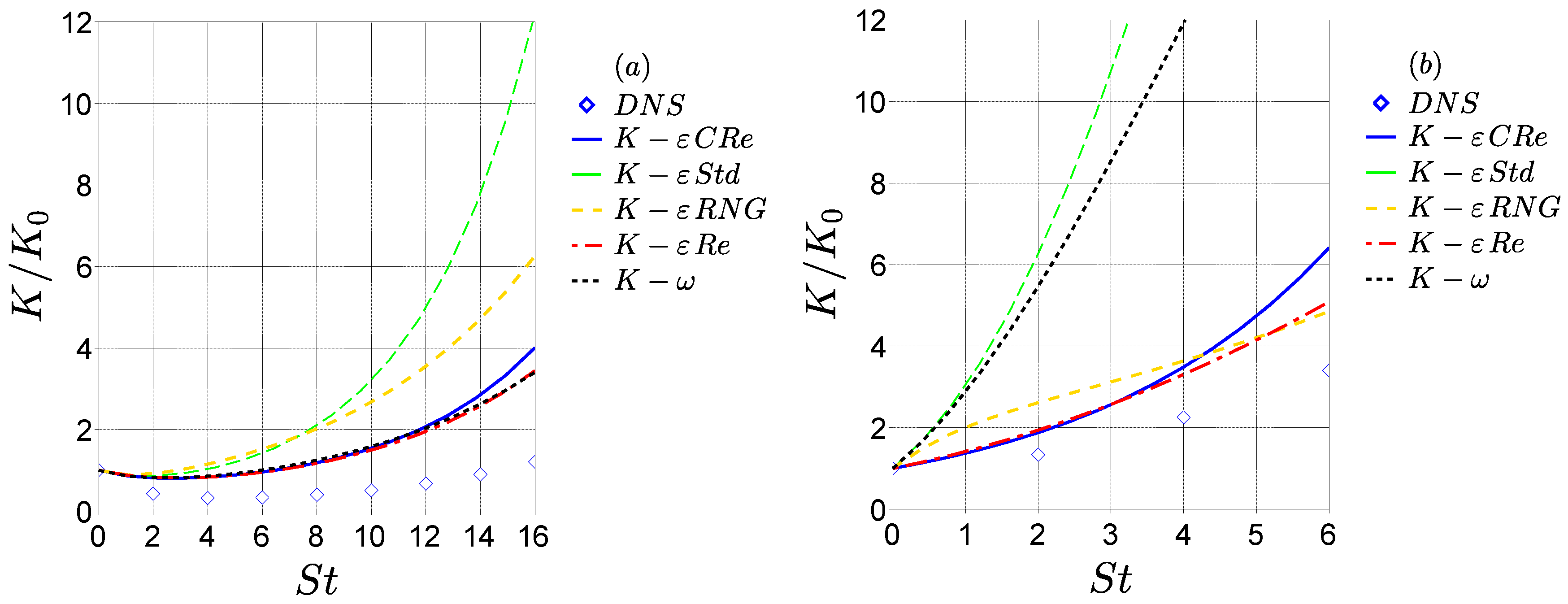
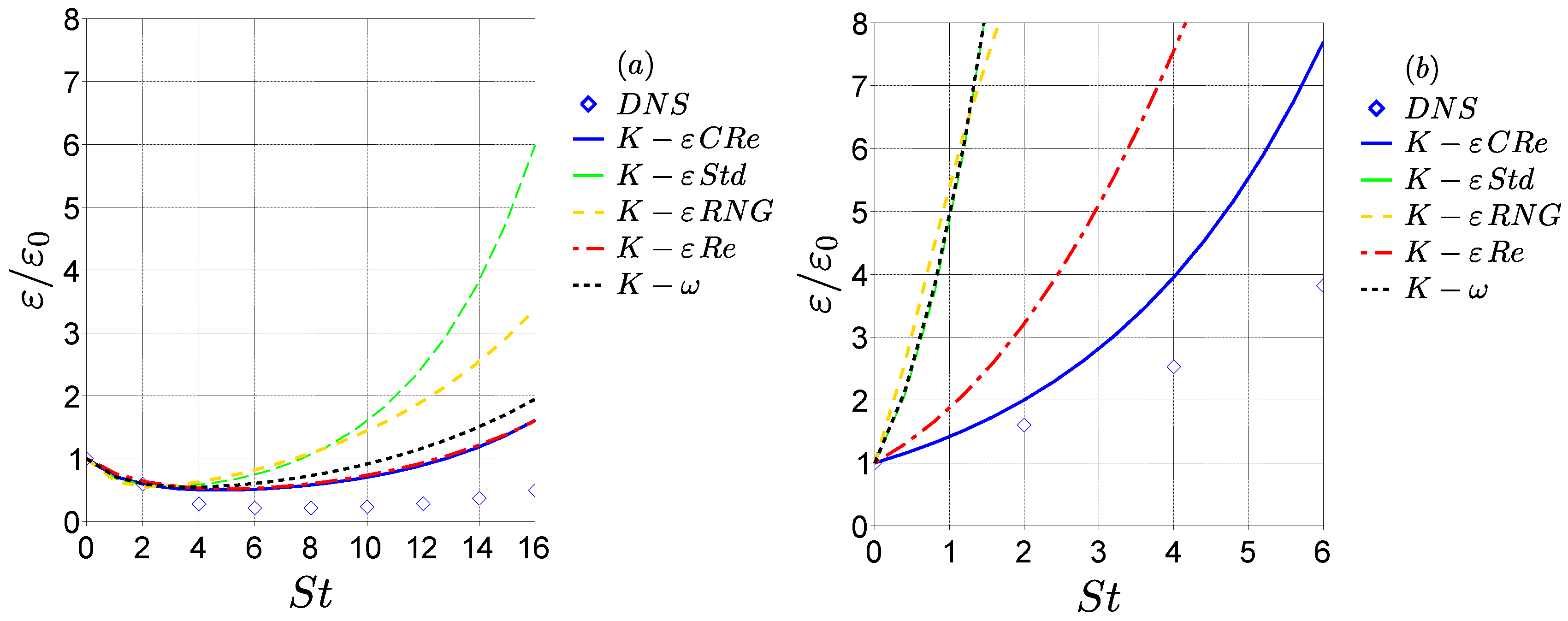
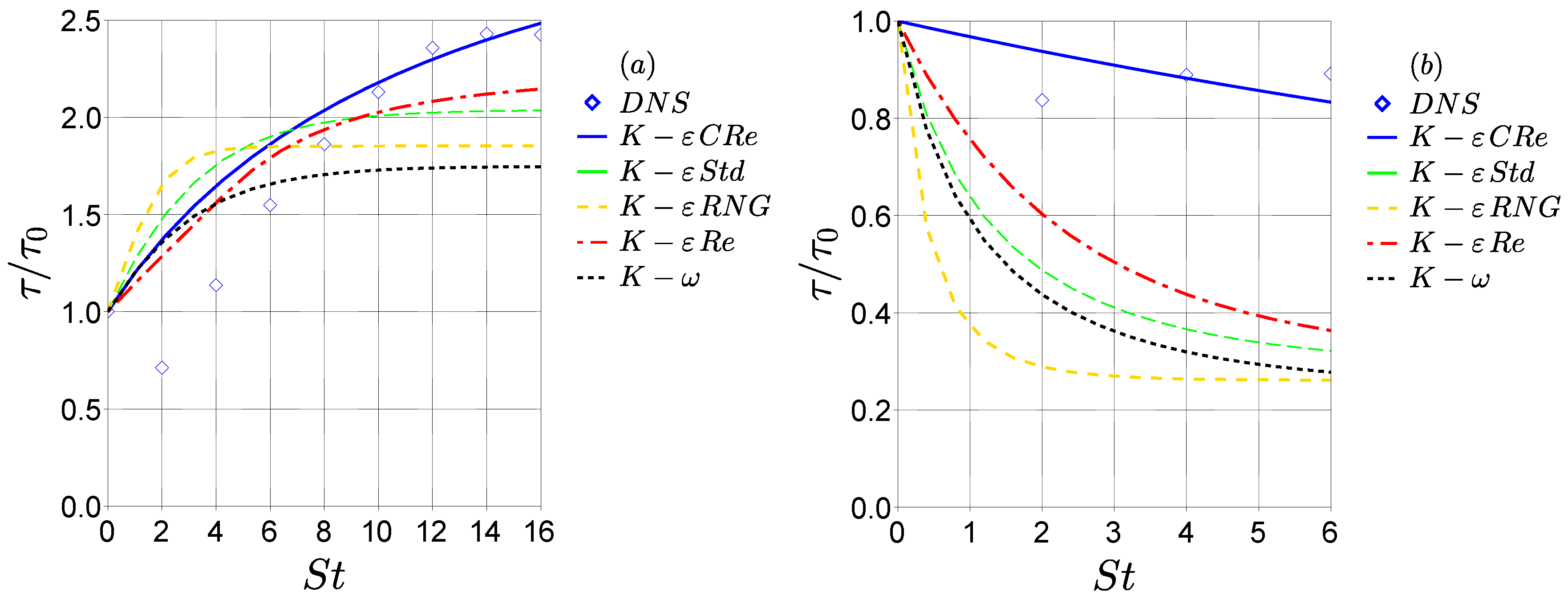
An additional useful analysis can be done, evaluating the response of the turbulence model under the conditions simulated in the DNS of homogeneous shear flows, as analyzed in Section 4.2. To this end, the balance equations determining the two turbulent scales ( K and ε or K and ω , depending on the considered model) are solved together with the shear stress constitutive relationship. The solution is obtained through a code developed in Scilab 5.5.2 [84], presenting a numerical solution to ordinary differential equations. The adopted solver automatically switches between the non-stiff predictor-corrector Adams method and the stiff Backward Differentiation Formula method. The viscosity and the initial conditions values of K and ε of the DNS simulations are used. Figure 15a, Figure 16a and Figure 17a show the histories of K , ε and τ , made non-dimensional with the initial values, for the medium-shear case [59]. All models, due to the structural equilibrium hypothesis underlying the EV concept, share the same immediate response to the imposed shear while, as seen in Section 4.2, the real turbulence needs a certain amount of time to adapt to the imposed distortion when starting from isotropic conditions. This behaviour is visible in the initial response (i.e., at low S t values). The standard K ε and the K ε RNG models produce too fast an in increase in K and ε , mainly due to the fact that, at the imposed shear intensity ( η 4.7 ), the constant value of C μ = 0.09 is too high. The higher values of ε resulting from the RNG production/destruction model (see considerations of P ε e q ), attenuate the corresponding K growth rate. The latter effect is further amplified in the K ω model results, where the good agreement in the K evolution is due to an excess of dissipation. The Consistent Realizable K ε and the Realizable K ε lead to a similar acceptable response. The Consistent Realizable K ε model gives the most consistent prediction of the eddy lifetime τ . The K ω SST prediction is not shown, the model being coincident with the standard K ε when F 1 = 0 and almost identical with the K ω model when F 1 = 1 . Figure 15b, Figure 16b and Figure 17b show the histories of K / K 0 , ε / ε 0 and τ / τ 0 , for the high-shear case [65], focusing on the initial period, consistent with the analysis in Section 4.2. At the imposed distortion ( η 16 ), the too-high value of C μ = 0.09 is responsible of the excessive growth rate of K and ε predicted by the standard K ε and the K ω models. The excess of dissipation predicted by the RNG model leads to better agreement with the K / K 0 history. Similar behaviour is shown by the Realizable K ε , with better agreement with the ε / ε 0 values. Compared with the other models, the Consistent Realizable K ε model delivers fairly good agreement with the DNS data, providing an overestimate of the growth rate of K and ε at the higher S t values, which is consistent with the choices in the definition of the constants appearing in the C μ function. It is remarkable the good prediction provided by the new model for the eddy lifetime, which is significantly underestimated by the other models. An important consideration when interpreting these results is that, in the context of jet flows (and more generally in inhomogeneous shear flows), they are representative of regions far from the boundaries of the developing shear layer, ‘where most of the fluid has been subjected to the same strain history during living memory’ [56].

6.3.4. Turbulent Transport

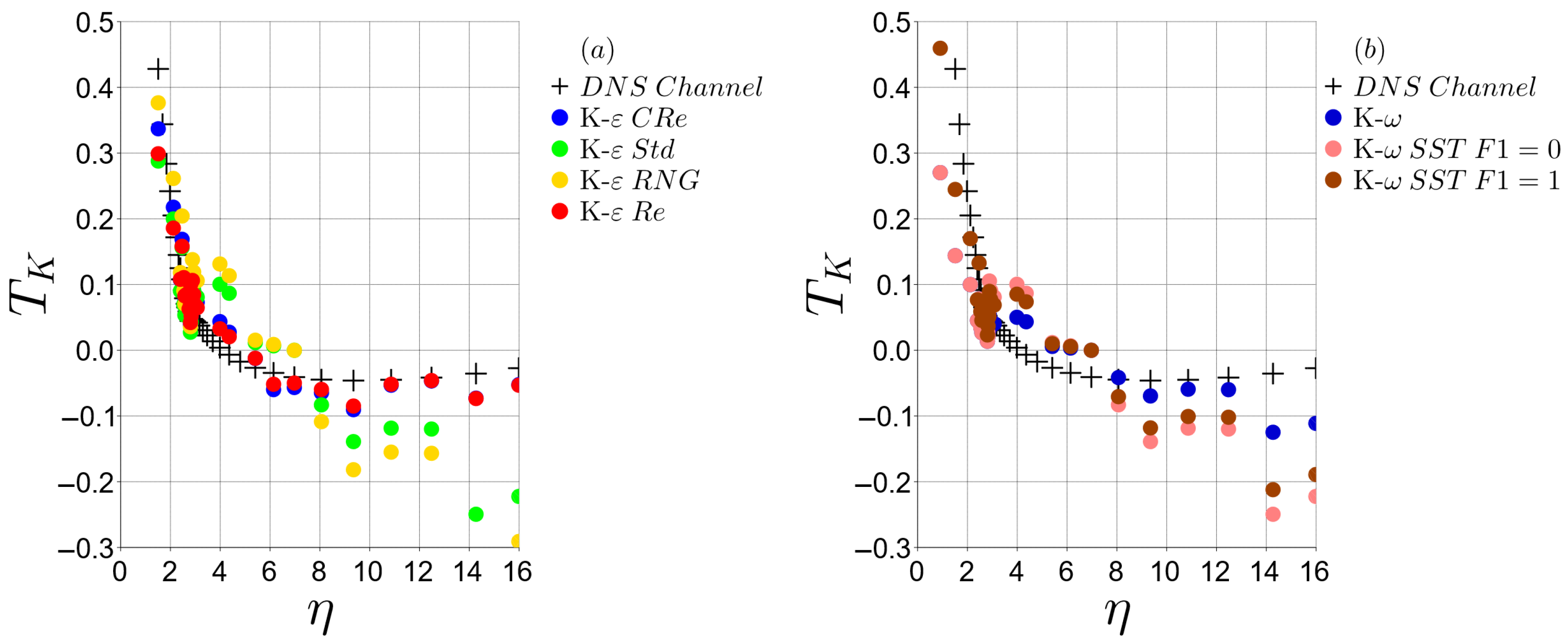
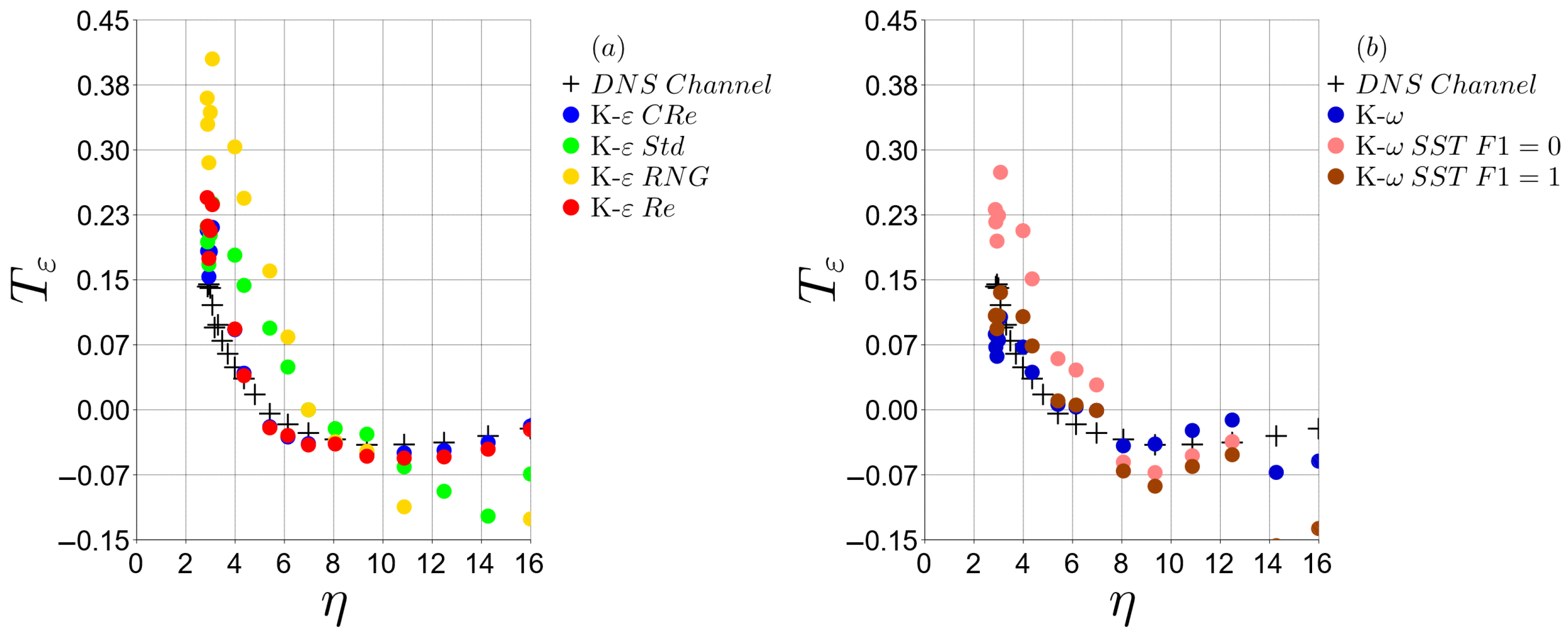
The conditions of homogeneous shear flows can significantly differ from those found in inhomogeneous flows, particularly in regions with vanishing shear, where non-local effects (e.g. turbulent transport of K and ε ) become more relevant. The comparison shown in Figure 18 and Figure 19, where the modelled turbulent transport of K and ε are compared with DNS data of Kim et al. [66] and Mansour et al. [83] is related to this latter point. The analysis was conducted using the a priori technique used for the evaluation of the ε production/destruction models. The T K and T ε values were made non-dimensional by S K and S ε respectively, allowing for better visualization at low shear intensities. In addition, a direct evaluation can be made of the relative importance of T ε in the ε balance, compared with the corresponding values of the ε production/destruction balance (Figure 13). Looking at Figure 18, minor differences can be noticed; the models using a constant C μ value slightly overestimate the turbulent transport of K in the medium-to-high range of η . More interesting information that is useful in the interpretation of CFD results can be gained from the inspection of Figure 19. The new K ε , the Realizable K ε and the K ω models show a similar good agreement with the DNS data. The standard and the K ε RNG show significantly overestimated values in the medium-to-low range of η , where the turbulent transport of ε makes an increasing positive (i.e., the local dissipation rate is increased by dissipation produced in regions with higher shear) contribution to balance the ε production/destruction mechanism. Recalling the lack of ε production at low shear rates, as previously highlighted for all existing models, it can be said that this will be partially compensated by the excess of turbulent diffusion in the standard and the K ε RNG models. This behaviour will be particularly important in the external regions of the jet shear layer, where the shear intensity tends toward zero. It can finally be noticed in the above analysis that the new K ε model achieves remarkable consistency among all the involved elements.

7. Conclusions

The relevant flow features of the mean flow field of a supersonic ejector operating in single-choked condition are analyzed, with specific attention to their interactions with turbulence. A detailed description is presented of aspects involved in the use of EV models within the context of Reynolds/Favre-averaged simulations, introducing the role played by structural parameter C μ and by the modelled production/destruction balance in the dissipation rate equation. The influence exerted on the turbulence structure by the shear intensity is presented, considering the widely different conditions that characterize the ejector jet’s development. The impact of compressibility-related effects at a moderate Mach number is discussed. A detailed critical description of the EV models in common use is provided and a new model is presented to better represent the turbulence response to different intensity values within homogeneous and inhomogeneous flows. The models’ predictions are analyzed using reference data obtained from experiments and DNS simulations on homogeneous shear flows and boundary layers. The analysis explains that the erratic accuracy of the simulations reported in the literature is due to basic failures in existing models. These case-independent flaws combine to differing extents depending on the ejector geometry and working condition. The ability of the new Consistent Realizable K ε to address the above failures is shown. The developed study provides the robust background necessary to support fruitful validation studies on supersonic ejector simulations, as shown in Part 2 of the present work.

Author Contributions

G.M.: writing—review and editing, writing—original draft, visualization, validation, software, methodology, investigation, formal analysis, data curation, conceptualization. E.C.: writing—review and editing, writing—original draft, formal analysis. M.R. and L.M.: writing—review and editing, supervision, resources, project administration, funding acquisition. All authors have read and agreed to the published version of the manuscript.

Funding

This research was developed within the project “Network 4 Energy Sustainable Transition—NEST” funded under the National Recovery and Resilience Plan (NRRP), Mission 4 Component 2 Investment 1.3—Call for tender No. 1561 of 11 October 2022 of Ministero dell’Università e della Ricerca (MUR); funded by the European Union—NextGenerationEU.

Data Availability Statement

The research data presented in this work are available on demand.

Conflicts of Interest

The authors declare no conflicts of interest.

Nomenclature

a sound speed
b i j Reynolds stress anisotropy tensor
C μ turbulence structural parameter
c p specific heat at constant pressure
e internal energy
K, TKEturbulent kinetic energy
k t thermal conductivity
M a d turbulence distortion Mach number
M a t turbulent Mach number
P production of turbulent kinetic energy
P ε i production of dissipation rate
ppressure
P r t Prandtl number
r i j Reynolds stress tensor
S i j strain rate tensor
S strain rate invariant
Ttemperature
t time
t i j viscous stress tensor
T ε turbulent transport of dissipation rate
T K turbulent transport of turbulent kinetic energy
u i velocity component
x i cartesian coordinate
Y ε destruction of dissipation rate
W i j rotation rate tensor
W rotation rate invariant
ε dissipation rate of turbulent kinetic energy
η turbulence strain intensity
ξ turbulence rotation intensity
μ dynamic viscosity
μ t eddy viscosity
ρ density
τ eddy lifetime
ω specific dissipation rate of turbulent kinetic energy
Superscripts
¯Reynolds average
Fluctuating component
Abbreviations
CReConsistent Realizable
EVeddy viscosity
EXPexperiment
RANSReynolds Averaged Navier-Stokes
RNGRenormalization Group
SSTShear Stress Transport
ReRealizable
StdStandard

References

  1. Tashtoush, B.M.; Al-Nimr, M.d.A.; Khasawneh, M.A. A comprehensive review of ejector design, performance, and applications. Appl. Energy 2019, 240, 138–172. [Google Scholar] [CrossRef]
  2. Liu, Y.; Tu, Z.; Chan, S.H. Applications of ejectors in proton exchange membrane fuel cells: A review. Fuel Process. Technol. 2021, 214, 106683. [Google Scholar] [CrossRef]
  3. Li, D.; Zhao, H.; Kong, F.; Zhang, G. Application of Ejector in Solid Oxide Fuel Cell Anode Circulation System. J. Therm. Sci. 2022, 31, 634–649. [Google Scholar] [CrossRef]
  4. Chunnanond, K.; Aphornratana, S. Ejectors: Applications in refrigeration technology. Renew. Sustain. Energy Rev. 2004, 8, 129–155. [Google Scholar] [CrossRef]
  5. Besagni, G.; Mereu, R.; Inzoli, F. Ejector refrigeration: A comprehensive review. Renew. Sustain. Energy Rev. 2016, 53, 373–407. [Google Scholar] [CrossRef]
  6. Li, Y.; Huang, H.; Liu, S.; Ge, C.; Huang, J.; Shen, S.; Guo, Y.; Yang, Y. Overview of the Energy Conservation and Sustainable Transformation of Aerospace Systems with Advanced Ejector Technology. Energies 2026, 19, 221. [Google Scholar] [CrossRef]
  7. Li, Y.; Huang, H.; Shen, S.; Guo, Y.; Yang, Y.; Liu, S. Application Advances and Prospects of Ejector Technologies in the Field of Rail Transit Driven by Energy Conservation and Energy Transition. Energies 2025, 18, 3951. [Google Scholar] [CrossRef]
  8. Keenan, J.H.; Neumann, E.P.; Lustwerk, F. Investigation of ejector design by analysis and experiment. J. Appl. Mech. 1950, 27, 299–309. [Google Scholar] [CrossRef]
  9. Fabri, J.; Siestrunck, R. Supersonic air ejectors. Adv. Appl. Mech. 1958, 5, 1–34. [Google Scholar]
  10. Matsuo, K.; Sasaguchi, K.; Kiyotoki, Y.; Mochizuki, H. Investigation of supersonic air ejectors. Part 1, Performance in the case of zero-secondary flow. Bull. JSME 1981, 24, 2090–2097. [Google Scholar] [CrossRef]
  11. Matsuo, K.; Sasaguchi, K.; Kiyotoki, Y.; Mochizuki, H. Investigation of supersonic air ejectors. Part 2. Effects of throat-area-ratio on ejector performance. Bull. JSME 1982, 25, 1898–1905. [Google Scholar] [CrossRef]
  12. Hickman, K.E.; Hill, P.G.; Gilbert, G.B. Analysis and Testing of Compressible Flow Ejectors with Variable Area Mixing Tubes. J. Basic Eng. 1972, 94, 407–416. [Google Scholar] [CrossRef]
  13. Hedges, K.R. Compressible Jet Mixing in Converging-Diverging Ducts. Ph.D. Thesis, Queen’s University, Kingston, ON, Canada, 1973. [Google Scholar]
  14. Hedges, K.R.; Hill, P.G. Compressible Flow Ejectors, Part I—Development of a finite-difference flow model. J. Fluids Eng. 1974, 96, 272–281. [Google Scholar] [CrossRef]
  15. Hedges, K.R.; Hill, P.G. Compressible Flow Ejectors, Part II—Flow Field measurements and Analysis. J. Fluids Eng. 1974, 96, 282–288. [Google Scholar] [CrossRef]
  16. Rao, S.M.V. Experimental Investigation on Supersonic Ejectors. Ph.D. Thesis, Indian Institute of Science, Karnataka, Indian, 2013. [Google Scholar]
  17. Karthick, S.K. Experimental Studies on Gaseous Mixing in a Low Area Ratio Rectangular Supersonic Confined Jet. Ph.D. Thesis, Indian Institute of Science, Karnataka, Indian, 2017. [Google Scholar]
  18. Bartosiewicz, Y.; Aidoun, Z.; Desevaux, P.; Mercadier, Y. CFD-experiments integration in the evaluation of six turbulence models for supersonic ejectors modeling. In Proceedings of the Integrating CFD and Experiments Conference, Glasgow, UK, 8–9 September 2003. [Google Scholar]
  19. Bartosiewicz, Y.; Aidoun, Z.; Desevaux, P.; Mercadier, Y. Numerical and experimental investigations on supersonic ejectors. Int. J. Heat Fluid Flow 2005, 26, 56–70. [Google Scholar] [CrossRef]
  20. Besagni, G.; Mereu, R.; Leo, G.; Inzoli, F. An Integrated Lumped Parameter-CFD approach for off-design ejector performance evaluation. Energy Convers. Manag. 2015, 105, 697–715. [Google Scholar] [CrossRef]
  21. Gilbert, G.B.; Hill, P.G. Analysis and Testing of Two-Dimensional Slot Nozzle Ejectors with Variable Area Mixing Sections; NASA: Washington, DC, USA, 1973.
  22. Sriveerakul, T.; Aphornratana, S.; Chunnanond, K. Performance prediction of steam ejector using computational fluid dynamics: Part 1. Validation of the CFD results. Int. J. Therm. Sci. 2007, 46, 812–822. [Google Scholar] [CrossRef]
  23. García del Valle, J.; Sierra-Pallares, J.; Garcia Carrascal, P.; Castro Ruiz, F. An experimental and computational study of the flow pattern in a refrigerant ejector. Validation of turbulence models and real-gas effects. Appl. Therm. Eng. 2015, 89, 795–811. [Google Scholar] [CrossRef]
  24. Croquer, S.; Poncet, S.; Aidoun, Z. Turbulence modeling of a single-phase R134a supersonic ejector. Part 1: Numerical benchmark. Int. J. Refrig. 2016, 61, 140–152. [Google Scholar] [CrossRef]
  25. Mazzelli, F.; Little, A.B.; Garimella, S.; Bartosiewicz, Y. Computational and experimental analysis of supersonic air ejector: Turbulence modeling and assessment of 3D effects. Int. J. Heat Fluid Flow 2015, 56, 305–316. [Google Scholar] [CrossRef]
  26. Besagni, G.; Inzoli, F. Computational fluid-dynamics modeling of supersonic ejectors: Screening of turbulence modeling approaches. Appl. Therm. Eng. 2017, 117, 122–144. [Google Scholar] [CrossRef]
  27. Lamberts, O.; Chatelain, P.; Bartosiewicz, Y. Numerical and experimental evidence of the Fabri-choking in a supersonic ejector. Int. J. Heat Fluid Flow 2018, 69, 194–209. [Google Scholar] [CrossRef]
  28. Besagni, G.; Cristiani, N.; Croci, L.; Guédon, G.R.; Inzoli, F. Computational fluid-dynamics modelling of supersonic ejectors: Screening of modelling approaches, comprehensive validation and assessment of ejector component efficiencies. Appl. Therm. Eng. 2021, 186, 116431. [Google Scholar] [CrossRef]
  29. Croquer, S.; Lamberts, O.; Poncet, S.; Moreau, S.; Bartosiewicz, Y. Large Eddy Simulation of a supersonic air ejector. Appl. Therm. Eng. 2022, 209, 118177. [Google Scholar] [CrossRef]
  30. Debroeyer, R.; Toulorge, T.; Rasquin, M.; Winckelmans, G.; Bartosiewicz, Y. Analysis of entrainment and mixing in a supersonic air ejector using Large-Eddy Simulation. Int. J. Heat Fluid Flow 2025, 116, 109978. [Google Scholar] [CrossRef]
  31. Debroeyer, R.; Winckelmans, G.; Bartosiewicz, Y. Numerical and experimental characterization of a cylindrical supersonic air ejector. Int. J. Heat Fluid Flow 2026, 117, 110128. [Google Scholar] [CrossRef]
  32. Reynolds, O. On the Dynamical Theory of Incompressible Viscous Fluids and the Determination of the Criterion. Philos. Trans. A Math. Phys. Eng. Sci. 1895, 186, 123–164. [Google Scholar] [CrossRef]
  33. Favre, A. Equations des Gaz Turbulents Compressibles. J. Mec. 1965, 4, 361–390. [Google Scholar]
  34. Hanjalić, K.; Launder, B.E. Reassessment of modeling turbulence via Reynolds averaging: A review of second-moment transport strategy. Phys. Fluids 2021, 33, 091302. [Google Scholar] [CrossRef]
  35. Lumley, J.L. Toward a turbulent constitutive equation. J. Fluid Mech. 1970, 41, 413–434. [Google Scholar] [CrossRef]
  36. Pope, S.H. A more general effective viscosity hypothesis. J. Fluid Mech. 1975, 72, 33–40. [Google Scholar] [CrossRef]
  37. Shih, T.H.; Lumley, J.L. Remarks on turbulent constitutive relations. Math. Comp. Model. 1993, 18, 9–16. [Google Scholar] [CrossRef]
  38. Gatski, T.B.; Speziale, C.G. On Explicit Algebraic Stress Models for Complex Turbulent Flows. J. Fluid Mech. 1993, 254, 59–78. [Google Scholar] [CrossRef]
  39. Townsend, A.A. The Structure of Turbulent Shear Flow; Cambridge University Press: Cambridge, UK, 1956. [Google Scholar]
  40. Rodi, W.; Spalding, D.B. A Two Parameter Model of Turbulence and its Application to Free Jets. Wärme Stoffübertragung 1970, 3, 85–95. [Google Scholar] [CrossRef]
  41. Rodi, W. A Note on the Empirical Constant in the Kolmogorov-Prandtl Eddy-Viscosity Expression. J. Fluids Eng. 1975, 97, 386–389. [Google Scholar] [CrossRef]
  42. Reynolds, W.C. Fundamentals of turbulence for turbulence modeling and simulation. In Lectures Notes for Von Karman Institute; AGARD Lecture Series 86; North Atlantic Treaty Organization: Brussels, Belgium, 1987. [Google Scholar]
  43. Shih, T.H.; Zhu, J.; Lumley, J.L. A new Reynolds stress algebraic equation model. Comput. Methods Appl. Mech. Eng. 1995, 125, 287–302. [Google Scholar] [CrossRef]
  44. Davidov, B.I. On the statistical dynamics of an incompressible turbulent fluid. Dokl. Akad. Nauk. SSSR 1961, 136, 47–50. [Google Scholar]
  45. Harlow, F.H.; Nakayama, P.I. Transport of Turbulence Energy Decay Rate; Rep. LA 3854; Los Alamos Scientific Laboratory of the University of California: Los Alamos, NM, USA, 1968. [Google Scholar]
  46. Lumley, J.L.; Khajeh-Nouri, B. Computational Modeling of Turbulent Transport. Adv. Geophys. 1975, 18, 169–192. [Google Scholar]
  47. Lumley, J.L. Computational Modeling of Turbulent Flows. Adv. Appl. Mech. 1978, 18, 123–176. [Google Scholar]
  48. Speziale, C.G.; Gatski, T.B. Analysis and modelling of anisotropies in the dissipation rate of turbulence. J. Fluid Mech. 1997, 234, 155–180. [Google Scholar] [CrossRef]
  49. Speziale, C.G. Analytical Methods for the Development of Reynolds-Stress Closures in Turbulence. Annu. Rev. Fluid Mech. 1991, 23, 107–157. [Google Scholar] [CrossRef]
  50. Jones, W.P.; Launder, B.E. The prediction of laminarization with a two-equation model of turbulence. Int. J. Heat Mass Transf. 1972, 15, 301–314. [Google Scholar] [CrossRef]
  51. Launder, B.E.; Spalding, D.B. The numerical computation of turbulent flows. Comp. Meth. Appl. Mech. Eng. 1974, 3, 269–289. [Google Scholar] [CrossRef]
  52. Hanjalic, K.; Launder, B.E. Sensitizing the Dissipation Equation to Irrotational Strains. J. Fluids Eng. 1980, 102, 34–40. [Google Scholar] [CrossRef]
  53. Bardina, J.; Ferziger, J.H.; Rogallo, R.S. Effect of rotation on isotropic turbulence: Computation and modelling. J. Fluid Mech. 1985, 154, 321–336. [Google Scholar] [CrossRef]
  54. Rodi, W.; Scheuerer, G. Scrutinizing the Kε turbulence Model Under Adverse Pressure Gradient Conditions. J. Fluids Eng. 1986, 107, 174–179. [Google Scholar] [CrossRef]
  55. Yakhot, V.; Orszag, S.A.; Thangam, S.; Gatski, T.B.; Speziale, C.G. Development of turbulence models for shear flows by a double expansion technique. Phys. Fluids A 1992, 4, 1510–1520. [Google Scholar] [CrossRef]
  56. Lumley, J.L. Some comments on turbulence. Phys. Fluids A 1992, 4, 203–211. [Google Scholar] [CrossRef]
  57. Amielh, M.; Djeridane, T.; Anselmet, F.; Fulachier, L. Velocity near-field of variable density turbulent jets. Int. J. Heat Mass Transf. 1996, 39, 2149–2164. [Google Scholar] [CrossRef]
  58. Georgiadis, N.J.; Wernet, M.P.; Locke, R.J.; Eck, D.G. Mach Number and Heating Effects on Turbulent Supersonic Jets. AIAA J. 2024, 62, 31–51. [Google Scholar] [CrossRef]
  59. Wang, P.; Fröhlich, J.; Michelassi, V.; Rodi, W. Large-eddy simulation of variable-density turbulent axisymmetric jets. Int. J. Heat Fluid Flow 2008, 29, 654–664. [Google Scholar] [CrossRef]
  60. Jimenez, J.; Hoyas, S.; Simens, M.P.; Mizuno, Y. Turbulent boundary layers channels at moderate Reynolds numbers. J. Fluid Mech. 2010, 657, 335–360. [Google Scholar] [CrossRef]
  61. Tavoularis, S.; Corrsin, S. Experiments in Nearly Homogeneous Turbulent Shear Flow with Uniform Mean Temperature Gradient. Part I. J. Fluid Mech. 1981, 104, 311–347. [Google Scholar] [CrossRef]
  62. Tavoularis, S.; Karnik, U. Further Experiments on the Evolution of Turbulent Stresses and Scales in Uniformly Sheared Turbulence. J. Fluid Mech. 1989, 204, 457. [Google Scholar] [CrossRef]
  63. de Souza, F.A.; Nguyen, V.D.; Tavoularis, S. The structure of highly sheared turbulence. J. Fluid Mech. 1995, 303, 155–167. [Google Scholar] [CrossRef]
  64. Rogers, M.; Moin, P.; Reynolds, W. The structure and modeling of the hydrodynamic and passive scalar fields inhomogeneous turbulent shear flow. In Stanford University Report TF-25; Stanford University: Stanford, CA, USA, 1986. [Google Scholar]
  65. Lee, M.J.; Kim, J.; Moin, P. Structure of turbulence at high shear rate. J. Fluid Mech. 1990, 216, 561–583. [Google Scholar] [CrossRef]
  66. Kim, J.; Moin, P.; Moser, R. Turbulence statistics in fully developed channel flow at low Reynolds number. J. Fluid Mech. 1987, 177, 133–166. [Google Scholar] [CrossRef]
  67. Spalart, P.R. Direct simulation of a turbulent boundary layer up to Rθ = 1410. J. Fluid Mech. 1988, 187, 61–98. [Google Scholar] [CrossRef]
  68. Batchelor, G.K.; Proudman, I. The Effect of Rapid Distortion of a Fluid in Turbulent Motion. Q. J. Mech. Appl. Math. 1954, 7, 83–103. [Google Scholar] [CrossRef]
  69. Kobasyashi, T.; Togashi, S. Comparison of Turbulence Models Applied to Backward-Facing Step Flow. JSME Int. J. Ser. B 1996, 39, 453–460. [Google Scholar] [CrossRef][Green Version]
  70. Sarkar, S.; Erlebacher, G.; Hussaini, M.Y.; Kreiss, O. The analysis and modelling of dilatational terms in compressible turbulence. J. Fluid Mech. 1991, 227, 473–493. [Google Scholar] [CrossRef]
  71. Sarkar, S. The stabilizing effect of compressibility in turbulent shear flow. J. Fluid Mech. 1995, 282, 163–186. [Google Scholar] [CrossRef]
  72. Simone, A.; Coleman, G.N.; Cambon, C. The effect of compressibility on turbulent shear flow: A rapid-distortion-theory and direct-numerical-simulation study. J. Fluid Mech. 1997, 330, 307–338. [Google Scholar] [CrossRef]
  73. Georgiadis, N.J.; Wernet, M.P.; Winkler, C.M.; Benton, S.I.; Connolly, B.J. Summary of the 6th AIAA Propulsion Aerodynamics Workshop Nozzle Test Case: Heated Supersonic Axisymmetric Jets. In Proceedings of the AIAA 2024-0749. AIAA SCITECH 2024 Forum, Orlando, FL, USA, 8–12 January 2024. [Google Scholar]
  74. Shih, T.H.; Liou, W.W.; Shabbir, A.; Yang, Z.; Zhu, J. A New Kε Eddy Viscosity Model for High Reynolds Number Turbulent Flows: Model Development and Validation. NASA TM 106721. 1 August 1994.
  75. Wilcox, D.C. Reassessment of the Scale-Determining Equation for Advanced Turbulence Models. AIAA J. 1988, 26, 1299–1310. [Google Scholar] [CrossRef]
  76. Wilcox, D.C. Turbulence Modeling for CFD, 2nd ed.; DCW Industries, Inc.: La Canada, CA, USA, 1998. [Google Scholar]
  77. Menter, F.R. Two-Equation Eddy-Viscosity Turbulence Models for Engineering Application. AIAA J. 1994, 32, 1598–1605. [Google Scholar] [CrossRef]
  78. Jones, W.P.; Launder, B.E. The calculation of low-Reynolds-number phenomena with a two-equation model of turbulence. Int. J. Heat Mass Transf. 1973, 16, 1119–1130. [Google Scholar] [CrossRef]
  79. Yakhot, V.; Orszag, S.A. Renormalization group analysis of turbulence. J. Sci. Comput. 1986, 1, 3–51. [Google Scholar] [CrossRef]
  80. Yakhot, V.; Smith, L.M. The renormalization group, the ε-expansion and derivation of turbulence models. J. Sci. Comput. 1992, 7, 35–61. [Google Scholar] [CrossRef]
  81. Wilcox, D.C. Formulation of the k-omega Turbulence Model Revisited. AIAA J. 2008, 46, 2823–2838. [Google Scholar] [CrossRef]
  82. Pope, S.B. An explanation of the turbulent round-jet/plane-jet anomaly. AIAA J. 1978, 16, 279–281. [Google Scholar] [CrossRef] [PubMed]
  83. Mansour, N.N.; Kim, J.; Moin, P. Reynolds-stress and dissipation-rate budgets in a turbulent channel flow. J. Fluid Mech. 1988, 194, 15–44. [Google Scholar] [CrossRef]
  84. Scilab, 5.5.2; Dassault Systems: Vélizy-Villacoublay, France, 2015.
Figure 1. Example of ejector geometry.
Aerospace 13 00478 g001
Figure 2. Ejector flow features: (a) wall static pressure, (b) static pressure (top half) and Mach number distributions, with secondary flow streamlines (bottom half), (c) TKE (top half) and TKE production distributions (bottom half).
Aerospace 13 00478 g002
Figure 3. Normalized mean axial velocity (a) and TKE (b) development near the nozzle exit of an incompressible free jet [57].
Aerospace 13 00478 g003
Figure 4. Normalized mean axial velocity (a) and TKE (b) development near the nozzle exit of a supersonic free jet [58].
Aerospace 13 00478 g004
Figure 5. Turbulent structure evolution in a homogeneous shear flow at medium shear (a) [64] and high shear (b) [65].
Aerospace 13 00478 g005
Figure 6. Turbulent structure development near the nozzle exit of a free supersonic jet: b 12 (a), r 11 r 22 (b).
Aerospace 13 00478 g006
Figure 7. Turbulent structure in boundary layers.
Aerospace 13 00478 g007
Figure 8. Dependence of C μ on the shear intensity.
Aerospace 13 00478 g008
Figure 9. Free jet (a) and ejector cases (b); distributions of turbulent Mach number (top half of (a,b)) and distortion Mach number (bottom half of (a,b)).
Aerospace 13 00478 g009
Figure 10. Supersonic jet under matched and off design conditions, normalized centreline velocity (a) and TKE (b) profiles.
Aerospace 13 00478 g010
Figure 11. Functional dependence of C μ on the shear intensity.
Aerospace 13 00478 g011
Figure 12. Dependence of shear stress anisotropy (a) and P ε (b) on the shear intensity.
Aerospace 13 00478 g012
Figure 13. Dissipation rate production/destruction balance in a fully developed boundary layer.
Aerospace 13 00478 g013
Figure 14. Near-equilibrium P ε values for models with non-constant c ε 1 .
Aerospace 13 00478 g014
Figure 15. TKE evolution in a homogeneous shear flow at medium shear (a) [59] and high shear (b) [60].
Aerospace 13 00478 g015
Figure 16. Turbulent dissipation rate evolution in a homogeneous shear flow at medium shear (a) [59] and high shear (b) [60].
Aerospace 13 00478 g016
Figure 17. Eddy lifetime evolution in a homogeneous shear flow at medium shear (a) [59] and high shear (b) [60].
Aerospace 13 00478 g017
Figure 18. TKE turbulent transport in a fully developed boundary layer: (a) K ε -based models; (b) K ω -based models.
Aerospace 13 00478 g018
Figure 19. Dissipation turbulent transport in a fully developed boundary layer: (a) K ε -based models; (b) K ω -based models.
Aerospace 13 00478 g019
Table 1. K ω SST model coefficients.
γ β σ k σ ω
F 1 = 0   ( K ε ) 0.44 0.0828 1 1 0.856
F 1 = 1   ( K ω ) 0.553 0.075 1 0.85 2
Table 2. Main elements forming the considered turbulence models.
K ε  Cre K ε  Std K ε  RNG
Constitutive relationshipEquations (13) and (14)
C μ = 1 27 + A S η + 1 12.7 + 0.5 η 2
Equations (13) and (14)
C μ = 0.09
Equations (13) and (14)
C μ = 0.0845
K transport
equation
Equation (30)
σ k = 0.9
Equation (30)
σ k = 1.0
Equation (30)
σ k = 1 1.39
ε production
destruction
balance
Equation (27)
c ε 1 = 1.166 + 1 1.416 + 0.256 η 1.5
c ε 2 = 1.83
Equation (27)
c ε 1 = 1.44
c ε 2 = 1.92
Equation (27)
c ε 1 = 1.42 η 1 η 4.38 1 + 0.012 η 3
c ε 2 = 1.68
ε turbulent transportEquation (29)
σ ε = 1.3
Equation (29)
σ ε = 1.3
Equation (29)
σ ε = 1 1.39
K ε  Re K ω K ω  SST
Constitutive relationshipEquations (13) and (14)
C μ = 1 4 + A S η
Equations (13) and (14)
C μ = 0.09
Equations (13) and (14)
C μ = 0.09
K transport
equation
Equation (30)
σ k = 1.0
Equation (30)
with ε = 0.09 * ρ ¯ ω K f β *
σ k = 2.0
Equation (30)
σ k = 1
ε production
destruction
balance
c 1 ρ ¯ S ε c 2 ρ ¯ ε 2 K + ν ε
c 1 = m a x 0.43 , η 5 + η
c 2 = 1.9
Equation (27)
c ε 1 = 1.538
c ε 2 = 1.8
Equation (27)
c ε 1 = 1.44
c ε 2 = 1.92
ε turbulent transportEquation (29)
σ ε = 1.2
ε K   E q u a t i o n   ( 30 ) +
0.09   K x i μ + μ T σ ω ω x i
σ ω = 2.0
ε K   E q u a t i o n   ( 30 ) +
0.09   K x i μ + μ T σ ω ω x i + 2 ρ ¯ σ ω 1 ω K x i ω x i
σ ω = 1 0.856
Table 3. Near-equilibrium P ε values for models with constant c ε 1 .
K ε K ω K ω   S S T   F 1 = 0 K ω   S S T   F 1 = 1
2.091.542.091.5
Disclaimer/Publisher’s Note: The statements, opinions and data contained in all publications are solely those of the individual author(s) and contributor(s) and not of MDPI and/or the editor(s). MDPI and/or the editor(s) disclaim responsibility for any injury to people or property resulting from any ideas, methods, instructions or products referred to in the content.