The Evolving Paradigm of Reliability Engineering for Complex Systems: A Review from an Uncertainty Control Perspective

Abstract
1. Introduction
1.1. The Growth of Complexity in Safety-Critical Systems
1.2. The Emerging Crisis of Traditional Reliability Paradigms
- The Boeing 737 MAX
- 2.
- The Uber ATG Accident
- 3.
- Phantom Braking Events
1.3. The Shifting Nature of Uncertainty: From Aleatory to Epistemic
- Aleatory uncertainty
- Epistemic uncertainty
- Model uncertainty: As systems like eVTOL operate in novel flight regimes (e.g., transition flight in urban canyons), the physics-based simulation models used for their design become less reliable. The discrepancy between the model and reality grows, representing a significant form of epistemic uncertainty [25].
- Algorithmic uncertainty: The behavior of advanced control algorithms, especially those based on AI/ML, introduces a new form of epistemic uncertainty. For a deep neural network, we lack the complete “knowledge” to predict its output for every possible input, particularly for out-of-distribution scenarios not seen during training [26,27].
- Operational uncertainty: For entirely new operational concepts like Urban Air Mobility (UAM), there is no historical data to build probabilistic models of the environment. This “zero-sample” problem—where we lack knowledge of traffic densities, weather patterns in urban microclimates, or novel human–machine interaction failure modes—is a pure form of epistemic uncertainty [28].
1.4. The Necessity of Change in Uncertainty Management Process
1.5. The Contributions and Innovations
- We provide a unified evolutionary narrative based on uncertainty
- 2.
- We propose the synthesis of the uncertainty control (UC) Framework
- 3.
- We invent architectural guidance to enhance system resilience
1.6. The Organization of This Article
2. The Statistical Era: Reliability as an Empirical Science
2.1. Core Philosophy: Treating Failure as a Black-Box Stochastic Process
2.2. Key Methodologies: Population-Based Statistical Modeling
2.2.1. Exponential Distribution: Modeling Random Failures for Electronic Systems
2.2.2. Weibull Distribution: A Flexible Model for the Full Lifecycle
2.2.3. System Reliability Modeling: From Components to Systems
2.3. Limitations: Unable to Explain Causality of Failure
3. The Physics-of-Failure Era: Modeling Causal Chains of Failure
3.1. Core Philosophy: Opening the Black Box for Proactive Design
3.2. Key Methodologies: Physical Modeling and Logical Analysis
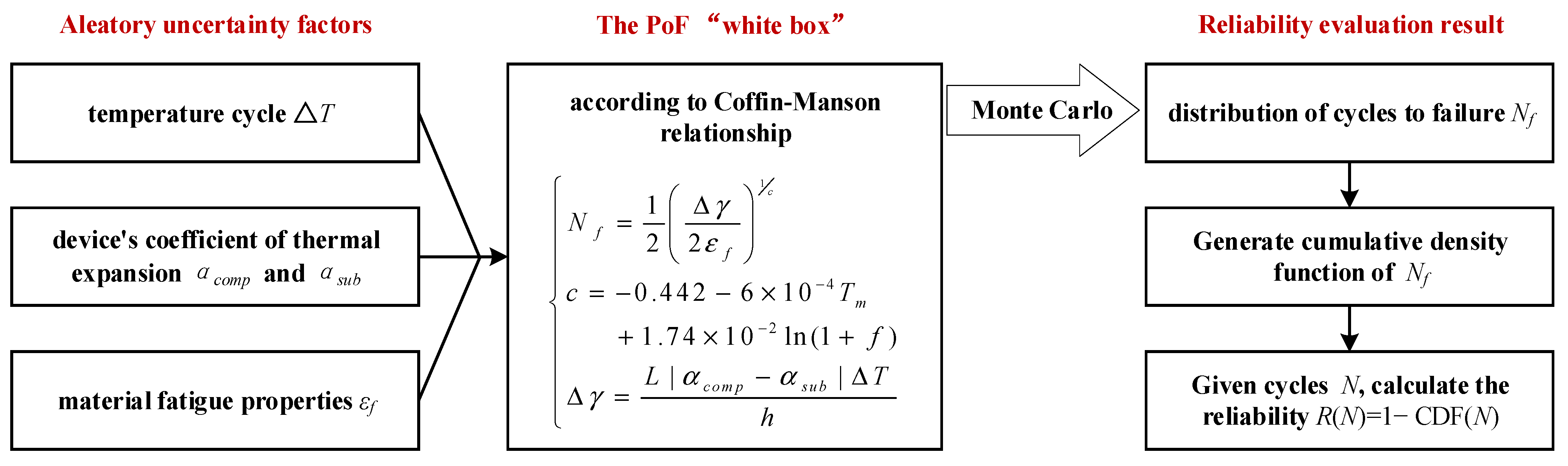
3.2.1. Physics-Based Failure Mechanism Modeling
3.2.2. Structured System Safety and Reliability Analysis
3.3. Limitations: When the Whole System Is Beyond the Sum of Its Parts
4. The Prognostics Era: Predicting Failures Through Real-Time Monitoring
4.1. Core Philosophy: From Static Uncertainty to Dynamic Health Management
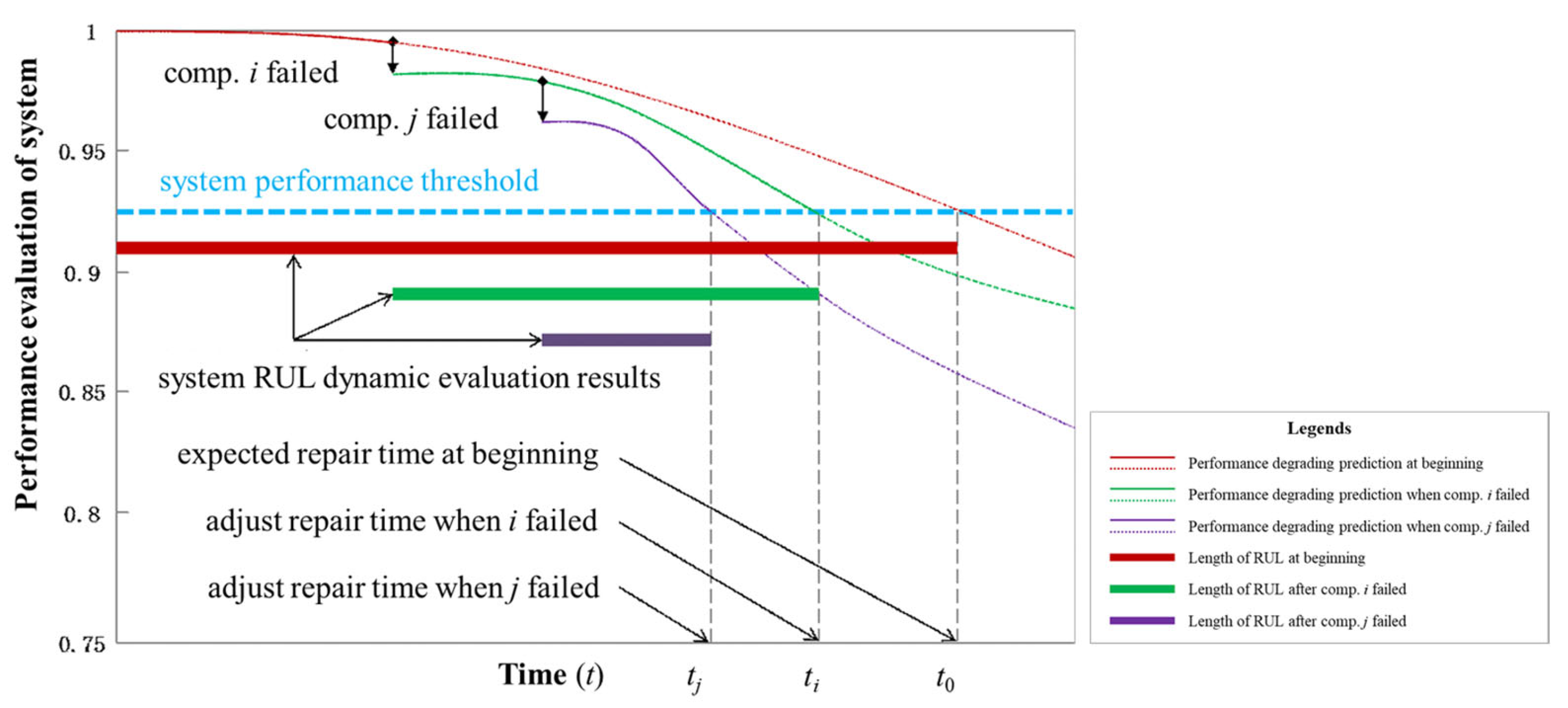
4.2. Key Methodologies: Apply RUL to Predict Failure Trend
4.2.1. Physics-Based (or Model-Based) Approaches
4.2.2. Data-Driven Approaches
4.2.3. Physics and Data Integrated Hybrid Approaches
4.3. Limitations: Distribution-Shift and OOD
5. The Resilience Era: Focusing on Mission Success Under Uncertainty
5.1. Core Philosophy: Operating Beyond the Limits of Knowledge
5.1.1. The Limit of Predictability and the “State-Space Explosion”
5.1.2. From “Fail-Safe” (Safety-I) to “Safe-to-Fail” (Safety-II)
- Safety-I (The Absence of Negatives): This traditional view defines safety as a condition where the number of adverse outcomes (accidents/incidents) is as low as possible. It focuses on “bimodal” outcomes: the system either works perfectly or fails.
- Safety-II (The Presence of Positives): As articulated by Hollnagel in his recent works [122], Safety-II defines safety as the system’s ability to succeed under varying conditions. It acknowledges that performance variability is inevitable and necessary for adaptation.
5.1.3. Regarding Safety as a Control Problem
5.2. The Strategic Shift: From Uncertainty Quantification (UQ) to Uncertainty Control (UC)
5.2.1. Defining Uncertainty Control: The Safety Envelope
5.2.2. Decoupling Assurance from Complexity
- The Complex Core: An AI-based flight controller that optimizes fuel efficiency and passenger comfort. Its internal uncertainty is high.
- The Assurance Layer: A deterministic, physics-based RTA safety monitor that only enforces basic flight envelope limits, e.g., angle of attack or G-load < 2.5 g.
5.3. Key Methodologies: STPA and RTA
5.3.1. Designing for Control with STPA
- 1.
- The Standardized Workflow of STPA
- Step 1: Define Purpose of Analysis.
- Step 2: Model the Control Structure.
- Step 3: Identify Unsafe Control Actions (UCAs).
- Step 4: Identify Loss Scenarios.
- 2.
- Handling Interactional Risks in the Design Phase
- A control action required for safety is not provided.
- An unsafe control action is provided.
- A control action is provided too early or too late.
- A control action is stopped too soon or applied too long.
- 3.
- Evidence of Superiority: Beyond Component Failure
- A Brief Case Study: eVTOL Transition Phase
- 4.
- The Output: From Probabilities to Safety Constraints
5.3.2. Executing Control with RTA
- 1.
- The Necessity for Bridging the Traceability Gap Involved by AI/ML
- 2.
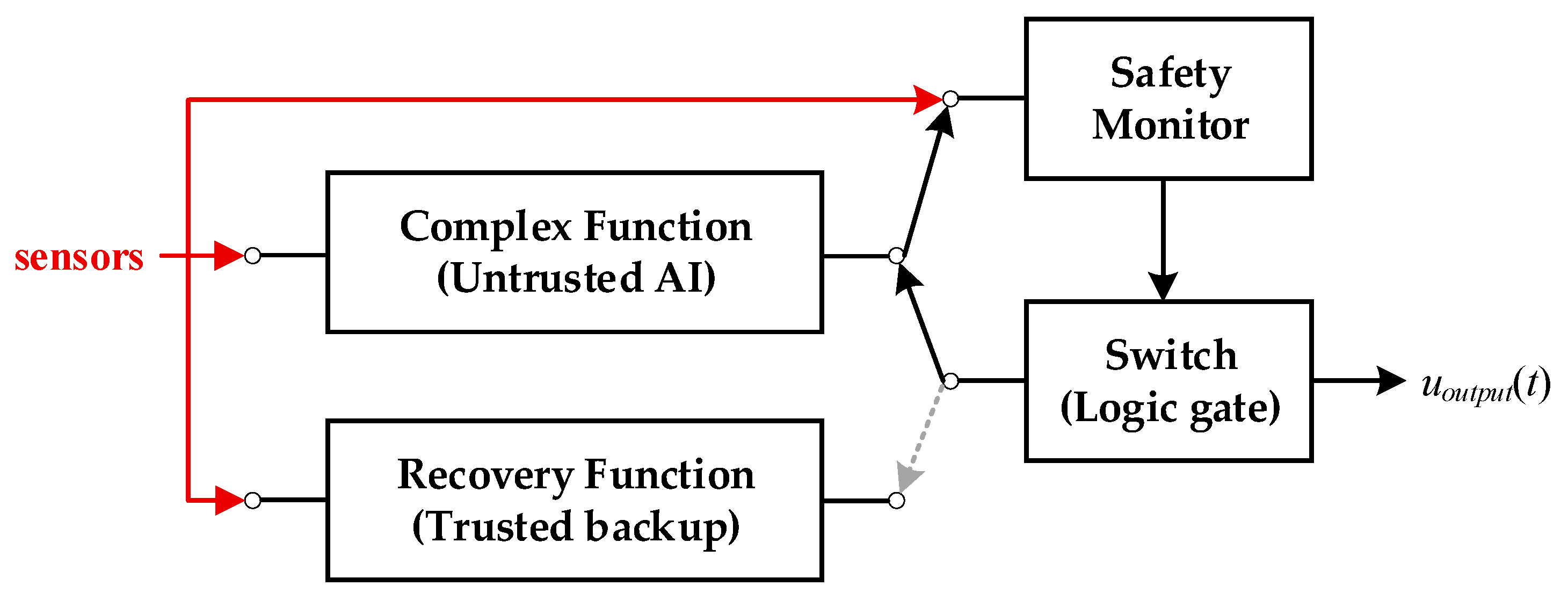
- Design the Monitor–Switch Architecture for RTA
- Complex Function (CF): The high-performance, AI-driven controller (e.g., an adaptive dynamic inversion flight control algorithm). It has high uncertainty and is treated as untrusted.
- Recovery Function (RF): A simplified, low-performance controller (e.g., a classic PID loop). It is deterministic, physics-based, and formally verified to be trusted.
- Safety Monitor (SM): A logic block that observes the system state , according to the sensor input and the Complex Function’s proposed action .
- Switch: A logical gate to determine which output between CF and RF to choose as the final output. It is by default set to connect CF unless the safety monitor predicts that the system state would violate the safety boundary and triggers it to transit to RF.
- A Brief Case Study: Neural Network Flight Control
- 3.
- Closing the Evidence Chain: From Probabilistic to Deterministic
- The Recovery Function is verified to DAL A using traditional methods (safe by design).
- The safety monitor is verified to DAL A (simple logic, no complex math).
- The Switching Logic covers all STPA-identified hazardous states.
5.3.3. Implementation Challenges for STPA and RTA
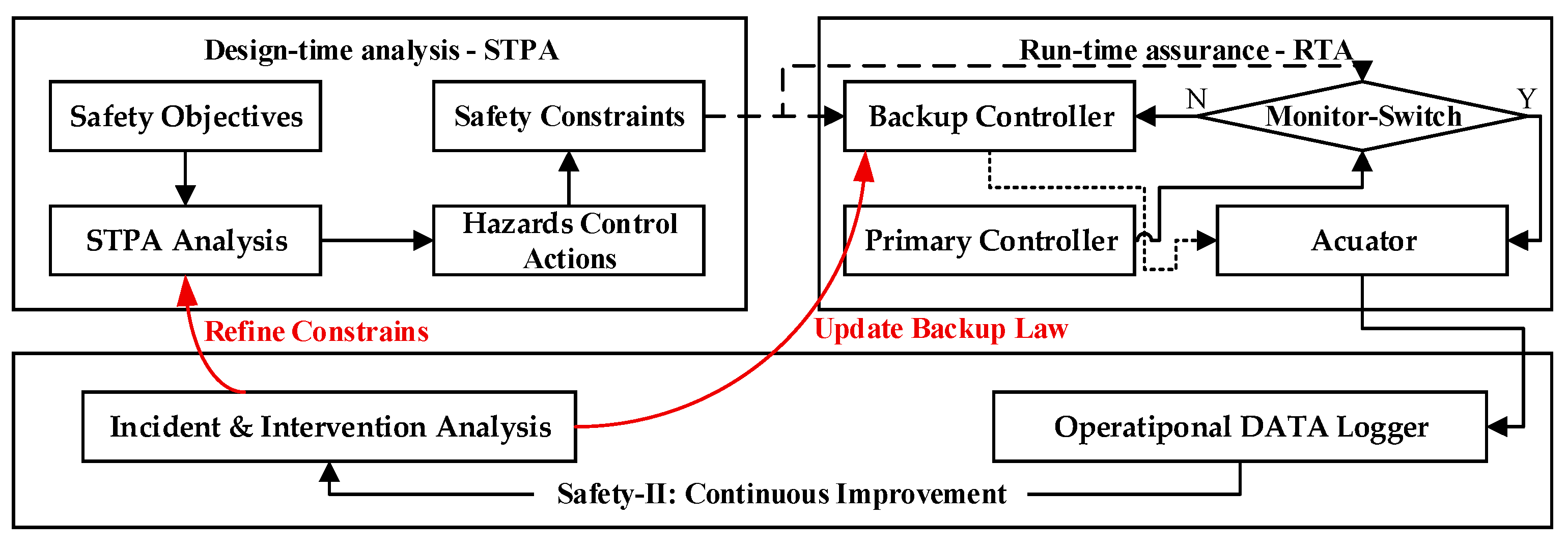
5.3.4. From Assurance to Evolution: The Closed-Loop Learning Mechanism
5.4. The New Identity: The Engineer as a System Resilience Architect
5.4.1. Synthesis of Disciplines: The T-Shaped Expert
- Control Theory: To understand stability, feedback loops, and STPA-based constraints.
- Software Engineering: To architect RTA wrappers and understand AI/ML behaviors.
- Systems Engineering: To manage the emergent interactions between hardware, software, and humans.
5.4.2. Role Definition: Designing the “Immune System”
5.4.3. Conclusion of the New Era: Enveloping, Not Replacing
- We still need statistics to model the stochastic failure of the hardware components used in the system.
- We still need physics-of-failure to design the sensors and actuators that constitute the physical plant.
- We still need prognostics to feed accurate state data to manage the uncertainty dynamically.
6. Conclusions
Funding
Data Availability Statement
Acknowledgments
Conflicts of Interest
Abbreviations
| AFRL | Air Force Research Laboratory |
| AI | Artificial Intelligence |
| ARP | Aerospace Recommended Practice |
| ASIC | Application-Specific Integrated Circuit |
| ASTM | American Society for Testing and Materials |
| CALCE | Center for Advanced Life Cycle Engineering |
| CBF | Control Barrier Function |
| CBM | Condition-Based Maintenance |
| CCA | Common Cause Analysis |
| CCF | Common Cause Failure |
| CEA | Cascading Effects Analysis |
| CF | Complex Function |
| CMS | Central Maintenance System |
| CNN | Convolutional Neural Network |
| DAL | Design Assurance Level |
| DEP | Distributed Electric Propulsion |
| DNN | Deep Neural Network |
| EASA | European Union Aviation Safety Agency |
| eVTOL | electric Vertical Take-Off and Landing |
| FMEA | Failure Modes and Effects Analysis |
| FTA | Fault Tree Analysis |
| GRU | Gated Recurrent Unit |
| HUMS | Health and Usage Monitoring Systems |
| IMA | Integrated Modular Avionics |
| IRU | Inertial Reference Unit |
| KF | Kalman Filter |
| LSTM | Long Short-Term Memory |
| MCAS | Maneuvering Characteristics Augmentation System |
| MIL-HDBK | Military Handbook |
| ML | Machine Learning |
| MOSFET | Metal-Oxide-Semiconductor Field-Effect Transistor |
| MPC | Model Predictive Control |
| MSE | Mean Squared Error |
| MTBF | Mean Time Between Failures |
| MTTF | Mean Time To Failure |
| NASA | National Aeronautics and Space Administration |
| NTSB | National Transportation Safety Board |
| OOD | Out-of-Distribution |
| PDE | Partial Differential Equation |
| Probability Density Function | |
| PF | Particle Filter |
| PHM | Prognostics and Health Management |
| PINN | Physics-Informed Neural Network |
| PoF | Physics-of-Failure |
| PRA | Probabilistic Risk Assessment |
| PSA | Probabilistic Safety Assessment |
| RBD | Reliability Block Diagram |
| RF | Recovery Function |
| RNN | Recurrent Neural Network |
| RPN | Risk Priority Number |
| RTA | Run-Time Assurance |
| RUL | Remaining Useful Life |
| SAE | Society of Automotive Engineers |
| SEI | Solid-Electrolyte Interphase |
| SM | Safety Monitor |
| SPC | Statistical Process Control |
| STAMP | Systems-Theoretic Accident Model and Processes |
| STPA | Systems-Theoretic Process Analysis |
| UAM | Urban Air Mobility |
| UC | Uncertainty Control |
| UCA | Unsafe Control Action |
| UQ | Uncertainty Quantification |
References
- Faruk, M.J.H.; Miner, P.; Coughlan, R.; Masum, M.; Shahriar, H.; Clincy, V.; Cetinkaya, C. Smart Connected Aircraft: Towards Security, Privacy, and Ethical Hacking. In Proceedings of the 2021 14th International Conference on Security of Information and Networks (SIN), Edinburgh, UK, 15–17 December 2021; Volume 1, pp. 1–5. [Google Scholar] [CrossRef]
- Koopman, P.; Wagner, M. Autonomous Vehicle Safety: An Interdisciplinary Challenge. IEEE Intell. Transp. Syst. Mag. 2017, 9, 90–96. [Google Scholar] [CrossRef]
- Brelje, B.J.; Martins, J.R.R.A. Electric, Hybrid, and Turboelectric Fixed-Wing Aircraft: A Review of Concepts, Models, and Design Approaches. Prog. Aerosp. Sci. 2019, 104, 1–19. [Google Scholar] [CrossRef]
- Kabzan, J.; Hewing, L.; Liniger, A.; Zeilinger, M.N. Learning-Based Model Predictive Control for Autonomous Racing. IEEE Robot. Autom. Lett. 2019, 4, 3363–3370. [Google Scholar] [CrossRef]
- Liu, X.; Yuan, Z.; Gao, Z.; Zhang, W. Reinforcement Learning-Based Fault-Tolerant Control for Quadrotor UAVs Under Actuator Fault. IEEE Trans. Ind. Inform. 2024, 20, 13926–13935. [Google Scholar] [CrossRef]
- Gaska, T.; Watkin, C.; Chen, Y. Integrated Modular Avionics—Past, Present, and Future. IEEE Aerosp. Electron. Syst. Mag. 2015, 30, 12–23. [Google Scholar] [CrossRef]
- Zhao, C.; Dong, L.; Li, H.; Wang, P. Safety Assessment of the Reconfigurable Integrated Modular Avionics Based on STPA. Int. J. Aerosp. Eng. 2021, 2021, 8875872. [Google Scholar] [CrossRef]
- Wise, K.A.; Lavretsky, E.; Hovakimyan, N. Adaptive Control of Flight: Theory, Applications, and Open Problems. In Proceedings of the 2006 American Control Conference, Minneapolis, MN, USA, 14–16 June 2006; p. 6. [Google Scholar]
- Soukkou, Y.; Tadjine, M.; Zhu, Q.M.; Nibouche, M. Robust Adaptive Sliding Mode Control Strategy of Uncertain Nonlinear Systems. Proc. Inst. Mech. Eng. Part G J. Aerosp. Eng. 2023, 237, 62–74. [Google Scholar] [CrossRef]
- Leveson, N. Safety III: A Systems Approach to Safety and Resilience; Mit Engineering Systems Lab: Cambridge, MA, USA, 2020. [Google Scholar]
- Patriarca, R.; Chatzimichailidou, M.; Karanikas, N.; Gravio, G.D. The Past and Present of System-Theoretic Accident Model and Processes (STAMP) and Its Associated Techniques: A Scoping Review. Saf. Sci. 2022, 146, 105566. [Google Scholar] [CrossRef]
- Endsley, M.R. Autonomous Driving Systems: A Preliminary Naturalistic Study of the Tesla Model S. J. Cogn. Eng. Decis. Mak. 2017, 11, 225–238. [Google Scholar] [CrossRef]
- Banks, V.A.; Plant, K.L.; Stanton, N.A. Driver Error or Designer Error: Using the Perceptual Cycle Model to Explore the Circumstances Surrounding the Fatal Tesla Crash on 7th May 2016. Saf. Sci. 2018, 108, 278–285. [Google Scholar] [CrossRef]
- Dekker, S. The Field Guide to Understanding ‘Human Error’, 3rd ed.; CRC Press: Boca Raton, FL, USA, 2014. [Google Scholar]
- Hollnagel, E. Safety-I and Safety-II: The Past and Future of Safety Management; CRC Press: Boca Raton, FL, USA, 2014. [Google Scholar]
- Carlson, C.S. Effective FMEAs: Achieving Safe, Reliable, and Economical Products and Processes Using Failure Mode and Effects Analysis; John Wiley & Sons, Inc.: Hoboken, NJ, USA, 2012. [Google Scholar]
- National Transportation Safety Board. Response to Final Aircraft Accident Investigation Report Ethiopian Airlines Flight 302 Boeing 737-8 MAX, ET-AVJ Ejere, Ethiopia 10 March 2019; National Transportation Safety Board: Washington, DC, USA, 2019.
- Sadeqi, O. Applying Stpa for Safety Analysis of Autonomous Vehicles; Mälardalen University: Eskilstuna, Sweden, 2024. [Google Scholar]
- JATR Team. Boeing 737 MAX Flight Control System; JATR Team: Washington, DC, USA, 2019. [Google Scholar]
- National Transportation Safety Board. Collision Between Vehicle Controlled by Developmental Automated Driving System and Pedestrian Tempe, Arizona 18 March 2018; National Transportation Safety Board: Washington, DC, USA, 2019.
- National Highway Traffic Safety Administration (NHTSA), Department of Transportation. Federal Motor Vehicle Safety Standards; Automatic Emergency Braking Systems for Light Vehicles; National Highway Traffic Safety Administration (NHTSA), Department of Transportation: Washington, DC, USA, 2024.
- Helton, J.C.; Johnson, J.D.; Oberkampf, W.L. An Exploration of Alternative Approaches to the Representation of Uncertainty in Model Predictions. Reliab. Eng. Syst. Saf. 2004, 85, 39–71. [Google Scholar] [CrossRef]
- Xiong, F.F.; Li, Z.X.; Liu, Y.; Xiahou, T.F. A review of characterization methods for parameter uncertainty in engineering design based on numerical simulation. Acta Aeronaut. Astronaut. Sin. 2023, 44, 028611. (In Chinese) [Google Scholar] [CrossRef]
- Kersting, S.; Kohler, M. Uncertainty Quantification in Case of Imperfect Models: A Review. arXiv 2020, arXiv:2012.09449. [Google Scholar] [CrossRef]
- Roy, C.J.; Oberkampf, W.L. A Comprehensive Framework for Verification, Validation, and Uncertainty Quantification in Scientific Computing. Comput. Methods Appl. Mech. Eng. 2011, 200, 2131–2144. [Google Scholar] [CrossRef]
- Gawlikowski, J.; Tassi, C.R.N.; Ali, M.; Lee, J.; Humt, M.; Feng, J.; Kruspe, A.; Triebel, R.; Jung, P.; Roscher, R.; et al. A Survey of Uncertainty in Deep Neural Networks. Artif. Intell. Rev. 2023, 56, 1513–1589. [Google Scholar] [CrossRef]
- Neto, A.V.S.; Camargo, J.B.; Almeida, J.R.; Cugnasca, P.S. Safety Assurance of Artificial Intelligence-Based Systems: A Systematic Literature Review on the State of the Art and Guidelines for Future Work. IEEE Access 2022, 10, 130733–130770. [Google Scholar] [CrossRef]
- Shi, Y.; Wei, P.; Feng, K.; Feng, D.-C.; Beer, M. A Survey on Machine Learning Approaches for Uncertainty Quantification of Engineering Systems. Mach. Learn. Comput. Sci. Eng. 2025, 1, 11. [Google Scholar] [CrossRef]
- SAE 4754B; Guidelines for Development of Civil Aircraft and Systems. SAE International: Warrendale, PA, USA, 2023.
- SAE 4761A; Guidelines for Conducting the Safety Assessment Process on Civil Aircraft, Systems, and Equipment. SAE International: Warrendale, PA, USA, 2023.
- Sainani, K.L. Reliability statistics. PM&R 2017, 9, 622–628. [Google Scholar] [CrossRef]
- Dong, Y.; Huang, W.; Bharti, V.; Cox, V.; Banks, A.; Wang, S.; Zhao, X.; Schewe, S.; Huang, X. Reliability Assessment and Safety Arguments for Machine Learning Components in System Assurance. ACM Trans. Embed. Comput. Syst. 2023, 22, 1–48. [Google Scholar] [CrossRef]
- Chen, S.; Sun, Y.; Li, D.; Wang, Q.; Hao, Q.; Sifakis, J. Runtime Safety Assurance for Learning-Enabled Control of Autonomous Driving Vehicles. In Proceedings of the 2022 International Conference on Robotics and Automation (ICRA), Philadelphia, PA, USA, 23–27 May 2022; IEEE: New York, NY, USA, 2022; pp. 8978–8984. [Google Scholar]
- Meeker, W.Q.; Escobar, L.A.; Pascual, F.G. Statistical Methods for Reliability Data; John Wiley & Sons: Hoboken, NJ, USA, 2021; ISBN 1-118-11545-7. [Google Scholar]
- Foucher, B.; Boullie, J.; Meslet, B.; Das, D. A Review of Reliability Prediction Methods for Electronic Devices. Microelectron. Reliab. 2002, 42, 1155–1162. [Google Scholar] [CrossRef]
- Zio, E. Prognostics and health management: A review from the perspectives of design, development and decision. Reliab. Eng. Syst. Saf. 2022, 217, 108063. [Google Scholar] [CrossRef]
- O’Connor, P.D.T.; Kleyner, A.V. Practical Reliability Engineering, 5th ed.; John Wiley & Sons, Inc.: Hoboken, NJ, USA, 2012. [Google Scholar]
- Lai, C.-D.; Xie, M.; Murthy, D.N.P. Bathtub Shaped Failure Rate Life Distributions. In Stochastic Ageing and Dependence for Reliability; Springer Nature: London, UK, 2006; pp. 71–107. [Google Scholar]
- Military Handbook Reliability Prediction of Electronic Equipment; MIL-HDBK-217F; Department of Defense: Washington, DC, USA, 1991.
- Luko, S.N. A Review of the Weibull Distribution and Selected Engineering Applications. SAE Trans. 1999, 108, 398–412. [Google Scholar]
- Wais, P. Two and Three-Parameter Weibull Distribution in Available Wind Power Analysis. Renew. Energy 2017, 103, 15–29. [Google Scholar] [CrossRef]
- Ditlevsen, O.; Madsen, H.O. Structural Reliability Methods; Wiley: New York, NY, USA, 1996; Volume 178. [Google Scholar]
- Choi, S.-K.; Canfield, R.A.; Grandhi, R.V. Reliability-Based Structural Design; Springer: Berlin/Heidelberg, Germany, 2007. [Google Scholar]
- Li, S.; Chen, Z.; Liu, Q.; Shi, W.; Li, K. Modeling and Analysis of Performance Degradation Data for Reliability Assessment: A Review. IEEE Access 2020, 8, 74648–74678. [Google Scholar] [CrossRef]
- Zhao, Y.; Yang, B.; Peng, J. Reconstruction of Probabilistic S-N Curves under Fatigue Life Following Lognormal Distribution with given Confidence. Appl. Math. Mech. 2007, 28, 455–460. [Google Scholar] [CrossRef]
- Singpurwalla, N.D. Reliability and Risk: A Bayesian Perspective; John Wiley & Sons: Hoboken, NJ, USA, 2006; ISBN 0-470-06033-6. [Google Scholar]
- Lee, Y.-L.; Makam, S.; McKelvey, S.; Lu, M.-W. Durability Reliability Demonstration Test Methods. Procedia Eng. 2015, 133, 31–59. [Google Scholar] [CrossRef]
- Martz, H.F., Jr.; Waller, R.A. A Bayesian Zero-Failure (BAZE) Reliability Demonstration Testing Procedure. J. Qual. Technol. 1979, 11, 128–138. [Google Scholar] [CrossRef]
- Tasias, K.A.; Alevizakos, V. Cumulative Sum Control Charts for Monitoring Zero-inflated COM-Poisson Processes: CUSUM Charts for ZICMP Distribution. Qual. Reliab. Eng. Int. 2024, 40, 2891–2903. [Google Scholar] [CrossRef]
- Luo, F.; Hu, L.; Wang, Y.; Yu, X. Statistical Inference of Reliability for a K-out-of-N: G System with Switching Failure under Poisson Shocks. Stat. Theory Relat. Fields 2024, 8, 195–210. [Google Scholar] [CrossRef]
- Coit, D.W.; Jin, T. Gamma Distribution Parameter Estimation for Field Reliability Data with Missing Failure Times. Iie Trans. 2000, 32, 1161–1166. [Google Scholar]
- Rausand, M.; Hoyland, A. System Reliability Theory: Models, Statistical Methods, and Applications; John Wiley & Sons: Hoboken, NJ, USA, 2003; Volume 396, ISBN 0-471-47133-X. [Google Scholar]
- Khan, Z.; Al-Bossly, A.; Almazah, M.M.; Alduais, F.S. On Statistical Development of Neutrosophic Gamma Distribution with Applications to Complex Data Analysis. Complexity 2021, 2021, 3701236. [Google Scholar] [CrossRef]
- Justin, C.; Patel, S.; Bouchard, E.D.; Gladin, J.; Verberne, J.; Li, E.; Ozcan, M.; Rajaram, D.; Mavris, D.; D’Arpino, M. Reliability and Safety Assessment of Urban Air Mobility Concept Vehicles; National Aeronautics and Space Administration (NASA) Ames Research Center: Moffett Field, CA, USA, 2021.
- Cheng, L.; Wan, Y.; Zhou, Y.; Gao, D.W. Operational Reliability Modeling and Assessment of Battery Energy Storage Based on Lithium-Ion Battery Lifetime Degradation. J. Mod. Power Syst. Clean Energy 2021, 10, 1738–1749. [Google Scholar] [CrossRef]
- Baladeh, A.E.; Taghipour, S. Reliability Optimization of Dynamic K-out-of-n Systems with Competing Failure Modes. Reliab. Eng. Syst. Saf. 2022, 227, 108734. [Google Scholar] [CrossRef]
- Eryılmaz, S. Reliability Properties of Consecutive K-out-of-n Systems of Arbitrarily Dependent Components. Reliab. Eng. Syst. Saf. 2009, 94, 350–356. [Google Scholar] [CrossRef]
- Lin, C.; Zeng, Z.; Zhou, Y.; Xu, M.; Ren, Z. A Lower Bound of Reliability Calculating Method for Lattice System with Non-Homogeneous Components. Reliab. Eng. Syst. Saf. 2019, 188, 36–46. [Google Scholar] [CrossRef]
- Jia, H.; Peng, R.; Yang, L.; Wu, T.; Liu, D.; Li, Y. Reliability Evaluation of Demand-Based Warm Standby Systems with Capacity Storage. Reliab. Eng. Syst. Saf. 2022, 218, 108132. [Google Scholar] [CrossRef]
- Kumar, A.; Garg, R.; Barak, M.S. Reliability Measures of a Cold Standby System Subject to Refreshment. Int. J. Syst. Assur. Eng. Manag. 2023, 14, 147–155. [Google Scholar] [CrossRef]
- Frangopol, D.M.; Maute, K. Reliability-Based Optimization of Civil and Aerospace Structural Systems. In Engineering Design Reliability Handbook; CRC Press: Boca Raton, FL, USA, 2004; pp. 559–590. [Google Scholar]
- Ke, H.-Y. A Bayesian/Classical Approach to Reliability Demonstration. Qual. Eng. 2000, 12, 365–370. [Google Scholar] [CrossRef]
- Xiong, J.; Shenoi, R.A.; Gao, Z. Small Sample Theory for Reliability Design. J. Strain Anal. Eng. Des. 2002, 37, 87–92. [Google Scholar] [CrossRef]
- Mosleh, A. Common Cause Failures: An Analysis Methodology and Examples. Reliab. Eng. Syst. Saf. 1991, 34, 249–292. [Google Scholar] [CrossRef]
- Pecht, M.G. Prognostics and Health Management. In Solid State Lighting Reliability; Van Driel, W., Fan, X., Eds.; Solid State Lighting Technology and Application Series; Springer: New York, NY, USA, 2013; Volume 1. [Google Scholar] [CrossRef]
- Pecht, M. Prognostics and Health Management of Electronics. In Encyclopedia of Structural Health Monitoring; John Wiley & Sons: Hoboken, NJ, USA, 2009. [Google Scholar]
- Varde, P.V. Physics-of-Failure Based Approach for Predicting Life and Reliability of Electronics Components. Barc Newsletter 2010, 313, 38–46. [Google Scholar]
- Hendricks, C.; George, E.; Osterman, M.; Pecht, M. Physics-of-Failure (PoF) Methodology for Electronic Reliability. In Reliability Characterisation of Electrical and Electronic Systems; Swingler, J., Ed.; Woodhead Publishing: Oxford, UK, 2015; pp. 27–42. ISBN 978-1-78242-221-1. [Google Scholar]
- White, M.; Bernstein, J.B. Microelectronics Reliability: Physics-of-Failure Based Modeling and Lifetime Evaluation; Jet Propulsion Laboratory, National Aeronautics and Space Administration: Pasadena, CA, USA, 2008.
- Temsamani, A.B.; Kauffmann, S.; Helsen, S.; Gaens, T.; Driesen, V. Physics-of-Failure (PoF) methodology for qualification and lifetime assessment of supercapacitors for industrial applications. Microelectron. Reliab. 2018, 88, 54–60. [Google Scholar] [CrossRef]
- Chai, M.; Hou, X.; Zhang, Z.; Duan, Q. Identification and prediction of fatigue crack growth under different stress ratios using acoustic emission data. Int. J. Fatigue 2022, 160, 106860. [Google Scholar] [CrossRef]
- Lindsey, N.J. NASA Methodology for Physics of Failure-Based Reliability Assessments Handbook; Goddard Space Flight Center, National Aeronautics and Space Administration: Greenbelt, MD, USA, 2024.
- Grandt, A.F., Jr. Fundamentals of Structural Integrity: Damage Tolerant Design and Nondestructive Evaluation; John Wiley & Sons: Hoboken, NJ, USA, 2003; ISBN 0-471-21459-0. [Google Scholar]
- Kedir, Y.A.; Lemu, H.G. Prediction of Fatigue Crack Initiation under Variable Amplitude Loading: Literature Review. Metals 2023, 13, 487. [Google Scholar] [CrossRef]
- Pierce, D.G.; Brusius, P.G. Electromigration: A Review. Microelectron. Reliab. 1997, 37, 1053–1072. [Google Scholar] [CrossRef]
- Pecht, M.; Gu, J. Physics-of-failure-based prognostics for electronic products. Trans. Inst. Meas. Control 2009, 31, 309–322. [Google Scholar] [CrossRef]
- Yang, D. Physics-of-Failure-Based Prognostics and Health Management for Electronic Products. In Proceedings of the 2014 15th International Conference on Electronic Packaging Technology, Chengdu, China, 12–15 August 2014; pp. 1215–1218. [Google Scholar]
- Stathis, J.H.; Zafar, S. The Negative Bias Temperature Instability in MOS Devices: A Review. Microelectron. Reliab. 2006, 46, 270–286. [Google Scholar] [CrossRef]
- Schroder, D.K. Negative Bias Temperature Instability: What Do We Understand? Microelectron. Reliab. 2007, 47, 841–852. [Google Scholar] [CrossRef]
- Bender, E.; Bernstein, J.B.; Boning, D.S. Modern Trends in Microelectronics Packaging Reliability Testing. Micromachines 2024, 15, 398. [Google Scholar] [CrossRef]
- Lang, F.; Zhou, Z.; Liu, J.; Cui, M.; Zhang, Z. Review on the Impact of Marine Environment on the Reliability of Electronic Packaging Materials. Front. Mater. 2025, 12, 1584349. [Google Scholar] [CrossRef]
- Zhu, S.P.; Huang, H.Z.; Peng, W.; Wang, H.K.; Mahadevan, S. Probabilistic physics of failure-based framework for fatigue life prediction of aircraft gas turbine discs under uncertainty. Reliab. Eng. Syst. Saf. 2016, 146, 1–12. [Google Scholar] [CrossRef]
- Dai, Y.; Panahi, A. Thermal Runaway Process in Lithium-Ion Batteries: A Review. Next Energy 2025, 6, 100186. [Google Scholar] [CrossRef]
- Ramesh, T.; Janis, V. Modeling Damage, Fatigue and Failure of Composite Materials, 2nd ed.; Elsevier: Amsterdam, The Netherlands, 2023. [Google Scholar]
- Shrivastava, P. Application of FMEA in Developing Design and Reliability Verification Plan. In Proceedings of the 2023 Annual Reliability and Maintainability Symposium (RAMS), Orlando, FL, USA, 23–26 January 2023; pp. 1–6. [Google Scholar]
- Sharma, K.D.; Srivastava, S. Failure Mode and Effect Analysis (FMEA) Implementation: A Literature Review. J. Adv. Res. Aeronaut. Space Sci. 2018, 5, 1–17. [Google Scholar]
- Vesely, W.E.; Goldberg, F.F.; Roberts, N.H.; Haasl, D.F. Fault Tree Handbook; U.S. Nuclear Regulatory Commission: Rockville, MD, USA, 1981.
- Ejaz, M.R.; Chikonde, M. Stpa for Autonomous Vehicle Safety in Traffic Systems; Chalmers University of technology: Gothenburg, Sweden, 2022. [Google Scholar]
- Fan, J.; Yung, K.C.; Pecht, M. Physics-of-Failure-Based Prognostics and Health Management for High-Power White Light-Emitting Diode Lighting. IEEE Trans. Device Mater. Reliab. 2011, 11, 407–416. [Google Scholar] [CrossRef]
- Jin, G.; Matthews, D.; Fan, Y.; Liu, Q. Physics of failure-based degradation modeling and lifetime prediction of the momentum wheel in a dynamic covariate environment. Eng. Fail. Anal. 2013, 28, 222–240. [Google Scholar] [CrossRef]
- Marliere, T.A.; Cesar, C.d.A.C.; Hirata, C.M. Extending the STPA to Model the Control Structure with Finite State Machine. J. Saf. Sci. Resil. 2025, 6, 100214. [Google Scholar] [CrossRef]
- Holley, S.; Miller, M. Cognitive Processing Disruptions Affecting Flight Deck Performance: Implications for Cognitive Resilience. In Proceedings of the Human Factors and Ergonomics Society Annual Meeting; SAGE Publications Sage: Los Angeles, CA, USA, 2023; Volume 67, pp. 2101–2106. [Google Scholar]
- Zio, E. Prognostics and Health Management (PHM): Where Are We and Where Do We (Need to) Go in Theory and Practice. Reliab. Eng. Syst. Saf. 2022, 218, 108119. [Google Scholar] [CrossRef]
- Yan, R.; Zhou, Z.; Shang, Z.; Wang, Z.; Hu, C.; Li, Y.; Yang, Y.; Chen, X.; Gao, R.X. Knowledge Driven Machine Learning towards Interpretable Intelligent Prognostics and Health Management: Review and Case Study. Chin. J. Mech. Eng. 2025, 38, 5. [Google Scholar] [CrossRef]
- Elattar, H.M.; Elminir, H.K.; Riad, A.M. Prognostics: A Literature Review. Complex Intell. Syst. 2016, 2, 125–154. [Google Scholar] [CrossRef]
- Lindsey, N.J.; Dawson, J.; Sheldon, D.; Sindjui, L.N.; DiVenti, A. NASA Physics of Failure (PoF) for Reliability. In Proceedings of the Probabilistic Safety Assessment & Management (PSAM-16) Conference, Honolulu, HI, USA, 26 June–1 July 2022. [Google Scholar]
- Gu, J.; Pecht, M. Prognostics and health management using physics-of-failure. In Proceedings of the 2008 Annual Reliability and Maintainability Symposium, Las Vegas, NV, USA, 28–31 January 2008; pp. 481–487. [Google Scholar] [CrossRef]
- Giurgiutiu, V. Structural Health Monitoring of Aerospace Composites; Academic Press: San Diego, CA, USA, 2015. [Google Scholar]
- Guillén, A.J.; Crespo, A.; Macchi, M.; Gómez, J. On the Role of Prognostics and Health Management in Advanced Maintenance Systems. Prod. Plan. Control 2016, 27, 991–1004. [Google Scholar] [CrossRef]
- An, D.; Choi, J.H.; Kim, N.H. Options for Prognostics Methods: A Review of Data-Driven and Physics-Based Prognostics. In Proceedings of the 54th AIAA/ASME/ASCE/AHS/ASC Structures, Structural Dynamics, and Materials Conference, Boston, MA, USA, 8–11 April 2013; p. 1940. [Google Scholar]
- Feng, J.; Cai, F.; Li, H.; Huang, K.; Yin, H. A Data-Driven Prediction Model for the Remaining Useful Life Prediction of Lithium-Ion Batteries. Process Saf. Environ. Prot. 2023, 180, 601–615. [Google Scholar] [CrossRef]
- Li, W.; Chen, J.; Chen, S.; Li, P.; Zhang, B.; Wang, M.; Yang, M.; Wang, J.; Zhou, D.; Yun, J. A Comprehensive Review of Artificial Intelligence-Based Algorithms for Predicting the Remaining Useful Life of Equipment. Sensors 2025, 25, 4481. [Google Scholar] [CrossRef] [PubMed]
- Zhang, L.; Lin, J.; Liu, B.; Zhang, Z.; Yan, X.; Wei, M. A Review on Deep Learning Applications in Prognostics and Health Management. IEEE Access 2019, 7, 162415–162438. [Google Scholar] [CrossRef]
- Kulkarni, C.S. Hybrid Approaches to Systems Health Management and Prognostics. In Proceedings of the Workshop on “Prognostics and Health Management”, Virtual, 29 October 2021. [Google Scholar]
- Polverino, L.; Abbate, R.; Manco, P.; Perfetto, D.; Caputo, F.; Macchiaroli, R.; Caterino, M. Machine Learning for Prognostics and Health Management of Industrial Mechanical Systems and Equipment: A Systematic Literature Review. Int. J. Eng. Bus. Manag. 2023, 15, 18479790231186848. [Google Scholar] [CrossRef]
- Kim, S.; Seo, Y.-H.; Park, J. Transformer-Based Novel Framework for Remaining Useful Life Prediction of Lubricant in Operational Rolling Bearings. Reliab. Eng. Syst. Saf. 2024, 251, 110377. [Google Scholar] [CrossRef]
- Wang, R.; Dong, E.; Cheng, Z.; Liu, Z.; Jia, X. Transformer-Based Intelligent Fault Diagnosis Methods of Mechanical Equipment: A Survey. Open Phys. 2024, 22, 20240015. [Google Scholar] [CrossRef]
- Farbiz, F.; Habibullah, M.S.; Hamadicharef, B.; Maszczyk, T.; Aggarwal, S. Knowledge-embedded machine learning and its applications in smart manufacturing. J. Intell. Manuf. 2023, 34, 2889–2906. [Google Scholar] [CrossRef]
- Artelt, M.; Weiß, M.; Dittler, D.; Goersch, Y.; Jazdi, N.; Weyrich, M. Hybrid Approaches and Datasets for Remaining Useful Life Prediction: A Review. Procedia CIRP 2024, 130, 294–300. [Google Scholar] [CrossRef]
- Ferreira, C.; Gonçalves, G. Remaining Useful Life Prediction and Challenges: A Literature Review on the Use of Machine Learning Methods. J. Manuf. Syst. 2022, 63, 550–562. [Google Scholar] [CrossRef]
- Cao, H.; Xiao, W.; Sun, J.; Gan, M.-G.; Wang, G. A Hybrid Data- and Model-Driven Learning Framework for Remaining Useful Life Prognostics. Eng. Appl. Artif. Intell. 2024, 135, 108557. [Google Scholar] [CrossRef]
- Lixin, E.; Wang, J.; Yang, R.; Wang, C.; Li, H.; Xiong, R. A physics-informed neural network-based method for predicting degradation trajectories and remaining useful life of supercapacitors. Green Energy Intell. Transp. 2025, 4, 100291. [Google Scholar]
- Li, H.; Zhang, Z.; Li, T.; Si, X. A Review on Physics-Informed Data-Driven Remaining Useful Life Prediction: Challenges and Opportunities. Mech. Syst. Signal Process. 2024, 209, 111120. [Google Scholar] [CrossRef]
- Ahwiadi, M.; Wang, W. An AI-Driven Particle Filter Technology for Battery System State Estimation and RUL Prediction. Batteries 2024, 10, 437. [Google Scholar] [CrossRef]
- Cui, L.; Wang, X.; Wang, H.; Ma, J. Research on Remaining Useful Life Prediction of Rolling Element Bearings Based on Time-Varying Kalman Filter. IEEE Trans. Instrum. Meas. 2019, 69, 2858–2867. [Google Scholar] [CrossRef]
- Duan, B.; Zhang, Q.; Geng, F.; Zhang, C. Remaining Useful Life Prediction of Lithium-ion Battery Based on Extended Kalman Particle Filter. Int. J. Energy Res. 2020, 44, 1724–1734. [Google Scholar] [CrossRef]
- Wu, T.; Zhao, T.; Xu, S. Prediction of Remaining Useful Life of the Lithium-Ion Battery Based on Improved Particle Filtering. Front. Energy Res. 2022, 10, 863285. [Google Scholar] [CrossRef]
- Kim, S.; Choi, J.-H.; Kim, N.H. Data-Driven Prognostics with Low-Fidelity Physical Information for Digital Twin: Physics-Informed Neural Network. Struct. Multidiscip. Optim. 2022, 65, 255. [Google Scholar] [CrossRef]
- Wen, P.; Ye, Z.-S.; Li, Y.; Chen, S.; Xie, P.; Zhao, S. Physics-Informed Neural Networks for Prognostics and Health Management of Lithium-Ion Batteries. IEEE Trans. Intell. Veh. 2023, 9, 2276–2289. [Google Scholar] [CrossRef]
- Beaulieu, M.H.d.; Jha, M.S.; Garnier, H.; Cerbah, F. Remaining Useful Life Prediction Based on Physics-Informed Data Augmentation. Reliab. Eng. Syst. Saf. 2024, 252, 110451. [Google Scholar] [CrossRef]
- Carreño, V.A. ATM-X Urban Air Mobility: Assistive Detect and Avoid for UAM Operations Safety Evaluation Metrics; NASA: Compass Engineering: San Juan, Puerto Rico, 2023.
- Erik, H. Synesis: The Unification of Productivity, Quality, Safety and Reliability, 1st ed.; Routledge: Abingdon, UK, 2020; ISBN 978-0-367-48149-0. [Google Scholar]
- Endsley, M.R. Situation Awareness in Future Autonomous Vehicles: Beware of the Unexpected. In Proceedings of the 20th Congress of the International Ergonomics Association (IEA 2018); Bagnara, S., Tartaglia, R., Albolino, S., Alexander, T., Fujita, Y., Eds.; Springer International Publishing: Cham, Switzerland, 2019; pp. 303–309. [Google Scholar]
- Leveson, N.G.; Thomas, J.P. Stpa Handbook; MIT Partnership for Systems Approaches to Safety and Security (PSASS): Cambridge, MA, USA, 2018. [Google Scholar]
- Ames, A.D.; Coogan, S.; Egerstedt, M.; Notomista, G.; Sreenath, K.; Tabuada, P. Control Barrier Functions: Theory and Applications. In Proceedings of the 2019 18th European Control Conference (ECC), Naples, Italy, 25–28 June 2019; pp. 3420–3431. [Google Scholar]
- Cheng, R.; Orosz, G.; Murray, R.M.; Burdick, J.W. End-to-End Safe Reinforcement Learning through Barrier Functions for Safety-Critical Continuous Control Tasks. In Proceedings of the AAAI Conference on Artificial Intelligence, Honolulu, HI, USA, 27 January–1 February 2019. [Google Scholar]
- ASTM F3269; Standard Practice for Methods to Safely Bound Flight Behavior of Unmanned Aircraft Systems Containing Complex Functions. ASTM International: West Conshohocken, PA, USA, 2021.
- EASA. Artificial Intelligence Roadmap 2.0: A Human-Centric Approach to AI in Aviation; EASA: Cologne, Germany, 2023. [Google Scholar]
- Leveson, N.G. Engineering a Safer World: Systems Thinking Applied to Safety; The MIT Press: Cambridge, MA, USA, 2012; ISBN 978-0-262-29824-7. [Google Scholar]
- Sulaman, S.M.; Beer, A.; Felderer, M.; Höst, M. Comparison of the FMEA and STPA Safety Analysis Methods–a Case Study. Softw. Qual. J. 2019, 27, 349–387. [Google Scholar] [CrossRef]
- Ahlbrecht, A.; Durak, U. Model-Based STPA: Enabling Safety Analysis Coverage Assessment with Formalization. In Proceedings of the 2022 IEEE/AIAA 41st Digital Avionics Systems Conference (DASC), Portsmouth, VA, USA, 18–22 September 2022; pp. 1–10. [Google Scholar]
- Thomas, J.P.; Van Houdt, J.G. Evaluation of System-Theoretic Process Analysis (STPA) for Improving Aviation Safety; Federal Aviation Administration: William J. Hughes Technical Center, Systems Safety Section: Atlantic City, NJ, USA, 2024. [CrossRef]
- Cofer, D.; Amundson, I.; Sattigeri, R.; Passi, A.; Boggs, C.; Smith, E.; Gilham, L.; Byun, T.; Rayadurgam, S. Run-Time Assurance for Learning-Enabled Systems. In Proceedings of the NASA Formal Methods; Lee, R., Jha, S., Mavridou, A., Giannakopoulou, D., Eds.; Springer International Publishing: Cham, Switzerland, 2020; pp. 361–368. [Google Scholar]
- Hobbs, K.L.; Mote, M.L.; Abate, M.C.L.; Coogan, S.D.; Feron, E.M. Runtime Assurance for Safety-Critical Systems: An Introduction to Safety Filtering Approaches for Complex Control Systems. IEEE Control Syst. Mag. 2023, 43, 28–65. [Google Scholar] [CrossRef]
- Woods, D.D. The Theory of Graceful Extensibility: Basic Rules That Govern Adaptive Systems. Environ. Syst. Decis. 2018, 38, 433–457. [Google Scholar] [CrossRef]



| Attribute | Component Failure Model | Systemic Accident Model |
|---|---|---|
| Locus of Cause | Physical or software component failure | Unsafe interactions between non-failed components |
| Causal Model | Linear chain of events | Complex feedback loops and systemic structure |
| Safety View | “Safety-I”: Safety is the absence of failures | “Safety-II”: Safety is an emergent system property |
| Assumption | Reliable components lead to a safe system | A safe system successfully controls its behavior |
| Characteristics | Statistical Paradigm | Physic-of-Failure Paradigm | Prognostic Paradigm | Resilience Paradigm |
|---|---|---|---|---|
| Developed era | 1950s–1970s | 1980s–1990s | 2000s–2010s | 2020s–present |
| Focus | macro-level failure data | causal failure mechanisms | real-time component health | systemic behavior |
| Goal | quantify population reliability | proactive failure prevention | predict impending failures | mission success under uncertainty |
| Methodology | life data analysis | FMEA/FTA, degradation models | PHM, CBM, HUMS, CMS | RTA, STPA, Resilience Engineering |
| Approach | reactive | preventive | predictive | adaptive |
| Model | Core Principle and Application Value | References |
|---|---|---|
| Normal dist. | Primarily models aleatory variability in physical parameters (e.g., manufacturing dimensions, material strength, and electrical resistance). As a lifetime model, it is limited to pure wear-out phenomena where failures cluster very tightly around a mean with low variance. | [42,43] |
| Lognormal dist. | Model’s time to failure for degradation processes resulting from many small, independent, multiplicative effects. Crucial for modeling wear-out in semiconductor devices, bearing fatigue, and some forms of material corrosion. It is often the primary alternative to the Weibull distribution for wear-out analysis. | [44,45,46] |
| Binomial dist. | Models the number of failures in a fixed number of trials. It is the statistical foundation for reliability demonstration testing and is used to determine the sampling size under an acceptable confidence level. | [47,48] |
| Poisson dist. | Models the number of discrete events occurring over a fixed interval of time, area, or volume. Essential for Statistical Process Control (SPC) in manufacturing to monitor and control the rate of non-conformities, such as defects per square meter of a composite layup. | [49,50] |
| Gamma dist. | A flexible distribution that can model waiting times for a series of events. It is a generalization of the exponential distribution and is used to model the time to the -th failure in a repairable system or for systems with standby redundancy. | [51,52,53] |
| Failure Mode | Model Purpose and Application | Key Uncertainty Factor | Model formula | References |
|---|---|---|---|---|
| Mechanical Fatigue | To predict the number of cycles to failure in metallic structures (e.g., airframe, engine disks) under cyclic stress. Essential for damage-tolerant design and setting inspection intervals. | material constants , initial crack size stress intensity factor range | Paris’s Law | [73,74] |
| Electro- migration | To predict the Mean-Time To Failure (MTTF) of metallic interconnects in integrated circuits due to the “electron wind” effect. Critical for avionics processor and ASIC reliability. | current density temperature activation energy material constant current density exponent | Black’s Equation | [69,75] |
| Hot Carrier Injection | To predict transistor lifetime or performance degradation due to high-energy carriers damaging the gate oxide interface. A primary concern for deeply scaled digital logic. | substrate current drain current drain voltage technology-dependent constants | Substrate Current Power Law | [76,77] |
| Negative Bias Temperature Instability | To model the threshold voltage shift in pMOS transistors, which degrades performance over time. A critical reliability issue in modern avionics and processors. | time temperature electric field material/process constants. | Reaction-Diffusion Model | [78,79] |
| Time- Dependent Dielectric Breakdown | To predict the time-to-breakdown of the thin gate oxide insulator in a MOSFET. A fundamental lifetime limiter for all modern integrated circuits. | electric field temperature activation energy field acceleration factor | Thermochemical Model | [80,81] |
| Attribute | FMEA | FTA |
|---|---|---|
| Logic | Bottom-Up: Forward-chaining from cause to effect. | Top-Down: Backward-chaining from effect to cause. |
| Guiding question | What happens if this component fails? | How can this system hazard happen? |
| Purpose | To explore the effects of potential component failures and identify their severity for risk prioritization. | To identify all credible combinations of failures (minimal cut sets) that lead to a specific top-level hazard. |
| Key output | A structured table listing failure modes, their effects, severity, and risk priority number (RPN). | A logical tree diagram, a list of minimal cut sets, and a calculated probability for the top-level event. |
| Core Assumption | System hazards are the result of the summed or sequential effects of individual component failures. | System hazards can be represented as a Boolean combination of basic component-level failure events. |
| Feature | Traditional (UQ Paradigm) | Resilience (UC Paradigm) |
|---|---|---|
| Focus | Unintended function | Unintended behavior |
| Assumption | System is deterministic | System may be non-deterministic |
| Handling Uncertainty | Reduce it through testing | Contain it through architecture |
| Key Metric | Failure Rate | Resilience capability |
| Verification Target | The entire complex system | The safety management functions |
Disclaimer/Publisher’s Note: The statements, opinions and data contained in all publications are solely those of the individual author(s) and contributor(s) and not of MDPI and/or the editor(s). MDPI and/or the editor(s) disclaim responsibility for any injury to people or property resulting from any ideas, methods, instructions or products referred to in the content. |
© 2026 by the authors. Licensee MDPI, Basel, Switzerland. This article is an open access article distributed under the terms and conditions of the Creative Commons Attribution (CC BY) license.
Share and Cite
Zeng, Z.; Lin, C.; Peng, W.; Xu, M. The Evolving Paradigm of Reliability Engineering for Complex Systems: A Review from an Uncertainty Control Perspective. Aerospace 2026, 13, 183. https://doi.org/10.3390/aerospace13020183
Zeng Z, Lin C, Peng W, Xu M. The Evolving Paradigm of Reliability Engineering for Complex Systems: A Review from an Uncertainty Control Perspective. Aerospace. 2026; 13(2):183. https://doi.org/10.3390/aerospace13020183
Chicago/Turabian StyleZeng, Zhaoyang, Cong Lin, Wensheng Peng, and Ming Xu. 2026. "The Evolving Paradigm of Reliability Engineering for Complex Systems: A Review from an Uncertainty Control Perspective" Aerospace 13, no. 2: 183. https://doi.org/10.3390/aerospace13020183
APA StyleZeng, Z., Lin, C., Peng, W., & Xu, M. (2026). The Evolving Paradigm of Reliability Engineering for Complex Systems: A Review from an Uncertainty Control Perspective. Aerospace, 13(2), 183. https://doi.org/10.3390/aerospace13020183