Article

Biaxial Constitutive Relation and Strength Criterion of Envelope Materials for Stratospheric Airships


1
Aerospace Information Research Institute, Chinese Academy of Sciences, Beijing 100094, China
2
University of Chinese Academy of Sciences, Beijing 101408, China
*
Author to whom correspondence should be addressed.
Aerospace 2026, 13(2), 147; https://doi.org/10.3390/aerospace13020147

Submission received: 8 January 2026 / Revised: 29 January 2026 / Accepted: 1 February 2026 / Published: 3 February 2026

Abstract

The performance upgrading of stratospheric airships hinges on breakthroughs in the mechanical properties of envelope materials. As a multi-layer composite, the envelope’s load-bearing layer exhibits orthotropic and nonlinear mechanical behaviors owing to its unique structure and manufacturing process. To overcome the limitations of traditional testing methods and classical strength criteria in characterizing envelope materials, this paper presents a systematic investigation of typical airship envelope materials. The classical cruciform biaxial specimen was modified with a double-layer heat-sealed loading arm design to ensure preferential failure of the core region. Combined with digital image correlation (DIC) equipment, tensile tests were conducted under seven warp–weft stress ratios to acquire full-range stress–strain data. A three-dimensional stress–strain response surface was fitted based on the experimental results, and biaxial tensile constitutive models with varying precisions were established. Furthermore, a five-parameter implicit quadratic strength criterion was adopted to characterize the failure envelope of the envelope material. The model was calibrated using five biaxial failure points and independently validated against uniaxial tensile strengths, achieving a prediction error of less than 4%. The criterion’s generalization capability was enhanced through systematic parameterization based on the present test data. This work provides experimental evidence and reliable support for the engineering design and strength prediction of envelope materials.

1. Introduction

Stratospheric airships are filled with a lifting gas lighter than air—specifically helium, the only practical choice due to its non-flammability and chemical inertness—and rely on aerostatic buoyancy to generate lift. Endowed with unique advantages such as low self-weight, relatively low cost, and long-duration stationary deployment, they have attracted widespread attention from researchers around the world [1,2,3]. However, their low cruising speed and limited maneuverability render them unsuitable for time-sensitive or high-throughput transportation tasks, restricting their role primarily to niche applications such as stratospheric observation, communications relay, and persistent surveillance [4].
Although hydrogen offers higher buoyancy, its high flammability renders it unacceptable for modern missions; consequently, envelope materials must not only provide structural integrity but also exhibit low helium permeability to minimize gas loss over flights. The rapid advancement of airship technology has been closely tied to the continuous development and performance enhancement of envelope materials. Laminated composite materials—formed by bonding multiple functional films—exhibit not only high specific strength but also excellent environmental durability, making them ideal candidates for stratospheric airship envelopes.
Envelope materials are typically composed of functional layers and load-bearing layers. Among these components, the load-bearing layer withstands the vast majority of loads acting on the envelope material; thus, the mechanical properties of the envelope material are primarily governed by those of the load-bearing layer. Generally fabricated via yarn weaving, the load-bearing layer features mutually perpendicular warp and weft yarns. Its unique structure and manufacturing process endow it with orthotropic and nonlinear mechanical behaviors, which pose considerable challenges to the analysis of the envelope material’s mechanical properties. The observed nonlinearity is not attributable to the intrinsic constitutive response of the high-strength fibers themselves—which typically exhibit near-linear elasticity—but rather arises from the geometric evolution of the woven architecture during loading. Specifically, the warp and weft yarns are initially crimped due to the interlacing during weaving. Under tensile stress, these yarns progressively straighten, resulting in an apparent increase in stiffness as the load increases. This mechanism has been well documented in coated fabrics [5]. To date, much research has been dedicated to gaining an in-depth understanding of the mechanical characteristics of such envelope materials.
The uniaxial tensile test is a direct and fundamental method for investigating the mechanical properties of envelope materials. Meng et al. [6] performed uniaxial tensile tests on a typical envelope material for airships, analyzing the differences in the material’s mechanical properties between the warp and weft directions. On this basis, they further conducted off-axis tensile tests and explored the failure modes of the envelope material under different off-axis angles. Unlike the brittle fracture observed during warp and weft tensile loading, the material undergoes progressive failure under off-axis tensile conditions. Song et al. [7] carried out uniaxial tensile creep tests on typical airship envelope materials under various stress levels, investigating the variation laws of parameters such as strain, modulus, and creep rupture time with stress levels during the creep process. Based on the experimental results, they established a parameterized creep model and creep rupture criterion using the Newton iterative method. In addition, uniaxial tensile tests have also been applied to evaluate the tearing performance of materials. Qu et al. [8] conducted a study on material tearing performance under the test conditions of uniaxial tensile tests, analyzing the crack propagation behavior of envelope materials in central tearing tests. They introduced a novel stress concentration distribution function at the crack tip, which significantly improved the prediction accuracy of the model under both large and small crack conditions. Li et al. [9] investigated the tearing performance of a typical airship envelope material via the uniaxial central tearing method, analyzing the effects of specimen width, defect type, and defect size on the maximum tearing stress. They also compared the calculated values from Taylor’s empirical formula with the experimental results.
In actual service conditions, the stress state of airship envelope materials is closer to biaxial tension in the axial and hoop directions; therefore, uniaxial tensile tests cannot fully characterize the mechanical properties of the materials. Features such as orthotropy, stress ratio dependence, and warp–weft interaction of material mechanical properties need to be revealed via biaxial tensile tests. Uhlemann et al. [10] conducted biaxial tensile tests on common PVC/PES laminated composites and obtained two sets of elastic constants of the materials using two different calculation methods. The experimental results indicated that different calculation methods exert a significant influence on the analysis of material structure and mechanical properties, and there exists an obvious discrepancy between the results derived from treating the material as an orthotropic linear elastic material and the actual properties of the material. Liu et al. [11] developed a constitutive model for Vectran/TPU laminates by incorporating the crimped yarn geometry, inter-yarn friction, and bending energy, thereby linking microstructural features to the macroscopic biaxial stress–strain behavior. Xia et al. [12] analyzed the synergistic effect of the functional layer and load-bearing layer on the equivalent mechanical properties of envelope materials through biaxial tensile tests, clarifying the deformation coordination mechanism between the layers under biaxial stress. Combining the strain field data from biaxial tensile tests with microscopic observations, they established an intrinsic relationship between the macroscopic mechanical response and microstructural deformation of the material. Liu et al. [13] performed biaxial tensile tests on airship envelope materials and analyzed the failure behavior of the airship using a high-speed camera. The experimental results demonstrated that the failure strength of envelope materials under biaxial tension is synergistically affected by the warp and weft strengths, and there is a negative linear correlation between the residual strength of envelope materials and the bearing pressure of the airship. In addition to conducting biaxial tensile tests on envelope materials, Chen et al. [14] also carried out shear tests. They incorporated the tension–shear coupling effect into a refined numerical model and compared the numerical prediction results with the experimental values in spherical and ellipsoidal capsules.
Despite the extensive efforts devoted by numerous researchers to the tensile tests and mechanical modeling of envelope materials, several critical issues remain unresolved. First, classical cruciform specimens can satisfy the basic requirements for conducting warp–weft biaxial tensile tests; however, at high stress levels, these specimens tend to fracture at the loading arms due to stress concentration at the ends of the slits or the filets at the intersections of the loading arms. This premature failure prevents the acquisition of the true biaxial tensile strength of the material. Furthermore, traditional methods such as the minimum strain residual method for solving elastic constants and piecewise function fitting for stress–strain curves cannot accurately and comprehensively characterize the full-process constitutive relation of envelope materials under biaxial tension. Thus, novel approaches are required to describe the correlation between stress and strain in both the warp and weft directions throughout the entire biaxial tensile process. Finally, there is a paucity of reports on failure strength criteria for airship envelope materials under biaxial tension, and the classical strength criteria in composite mechanics fail to precisely predict the biaxial tensile failure strength of envelope materials under various stress ratios.
To address the aforementioned issues, this paper proposes modifications to the classical cruciform specimen. Uniaxial and biaxial tensile tests were conducted under various stress ratios, yielding a comprehensive set of stress and strain data. Based on multiple stress–strain curves in the three-dimensional space, a strain response surface describing the full biaxial tensile process of the envelope material was constructed via a fitting method. Constitutive relations for the entire biaxial tensile process of the envelope material with different precisions were derived in the form of quadratic polynomials and linear polynomials. Furthermore, a five-parameter implicit function strength criterion was introduced based on the experimental results, which is applicable to this specific material.

2. Methodology

2.1. Material

The airships considered in this study are of the soft, zero-pressure type, which maintain their shape solely through internal helium pressure and possess no rigid or semi-rigid structural framework. Consequently, the envelope material must exhibit high flexibility, foldability, and resistance to large deformations.
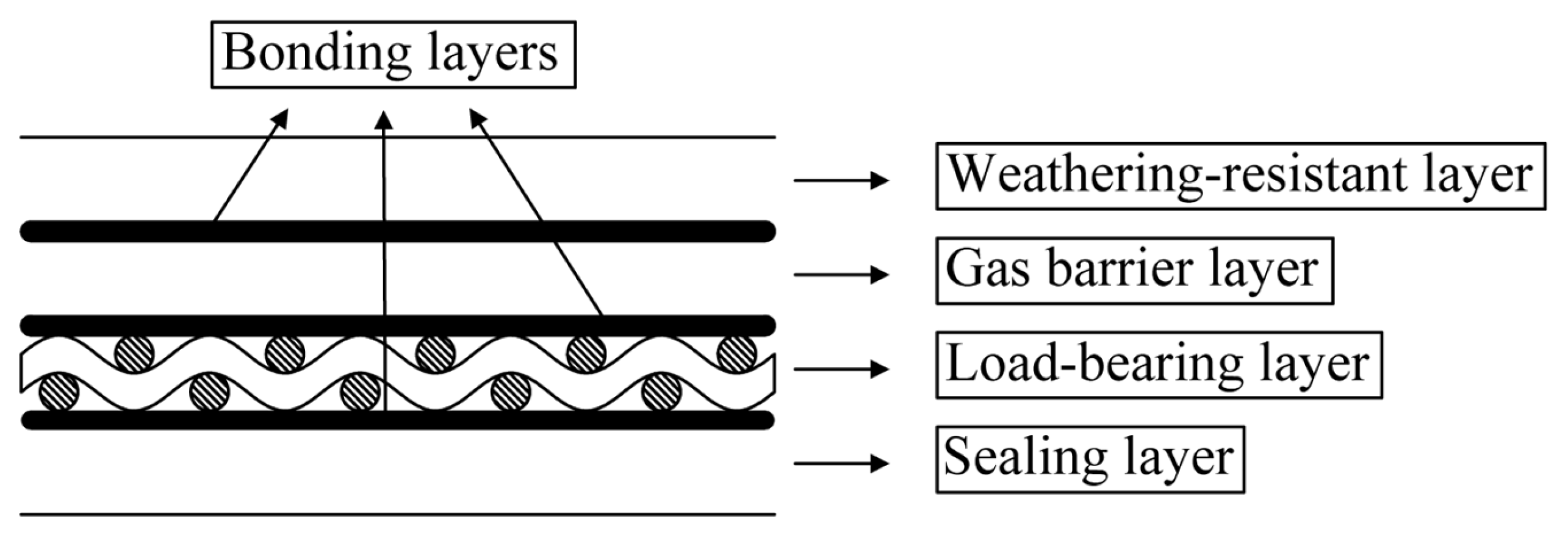
The complex service environment of airships imposes diverse requirements on the performance of envelope materials, including high specific strength, excellent weather resistance, and low gas permeability. A single-component material has difficulty meeting the above requirements. Laminated composites, which integrate the advantages of multiple film materials, are more suitable as airship envelope materials. In the structure of laminated composites, the load-bearing layer is made of polymer yarns through a plain weaving process and bears the vast majority of the load; the functional layer provides process and environmental adaptability for the entire material. Figure 1 illustrates the structure of typical envelope material for airships.
A typical type of envelope material for airships was selected for this study, and its basic specifications and parameters are presented in Table 1.
The envelope material is a matrix-free laminated fabric, consisting of a plain-woven Vectran HT scrim encapsulated between flexible functional coating films for environmental and helium barrier purposes. The absence of any structural matrix allows the woven architecture to retain its inherent crimp and enables limited inter-yarn movement under load.

2.2. Analysis and Improvement of Cruciform Specimens

A classical cruciform specimen defined in the MSAJ testing guideline MSAJ/M-02-1995 [15] can be applied to the biaxial tensile tests of flexible fabric composites. This specimen geometry enables tensile tests of envelope materials under various stress ratio loading conditions, and the resulting data can be used to calculate elastic constants such as Young’s modulus and Poisson’s ratio. However, the guideline also notes that this type of specimen may fail to reflect the true biaxial tensile strength of the material at high load levels.
Importantly, the MSAJ guideline provides only a general geometric configuration but does not prescribe strict dimensional requirements for arm width, gauge length, or filet radius. In practice, researchers adapt these dimensions according to material properties and testing constraints, leading to considerable variability in specimen designs across studies. To date, no formal international or national standard exists for biaxial tensile testing of flexible laminated composites.
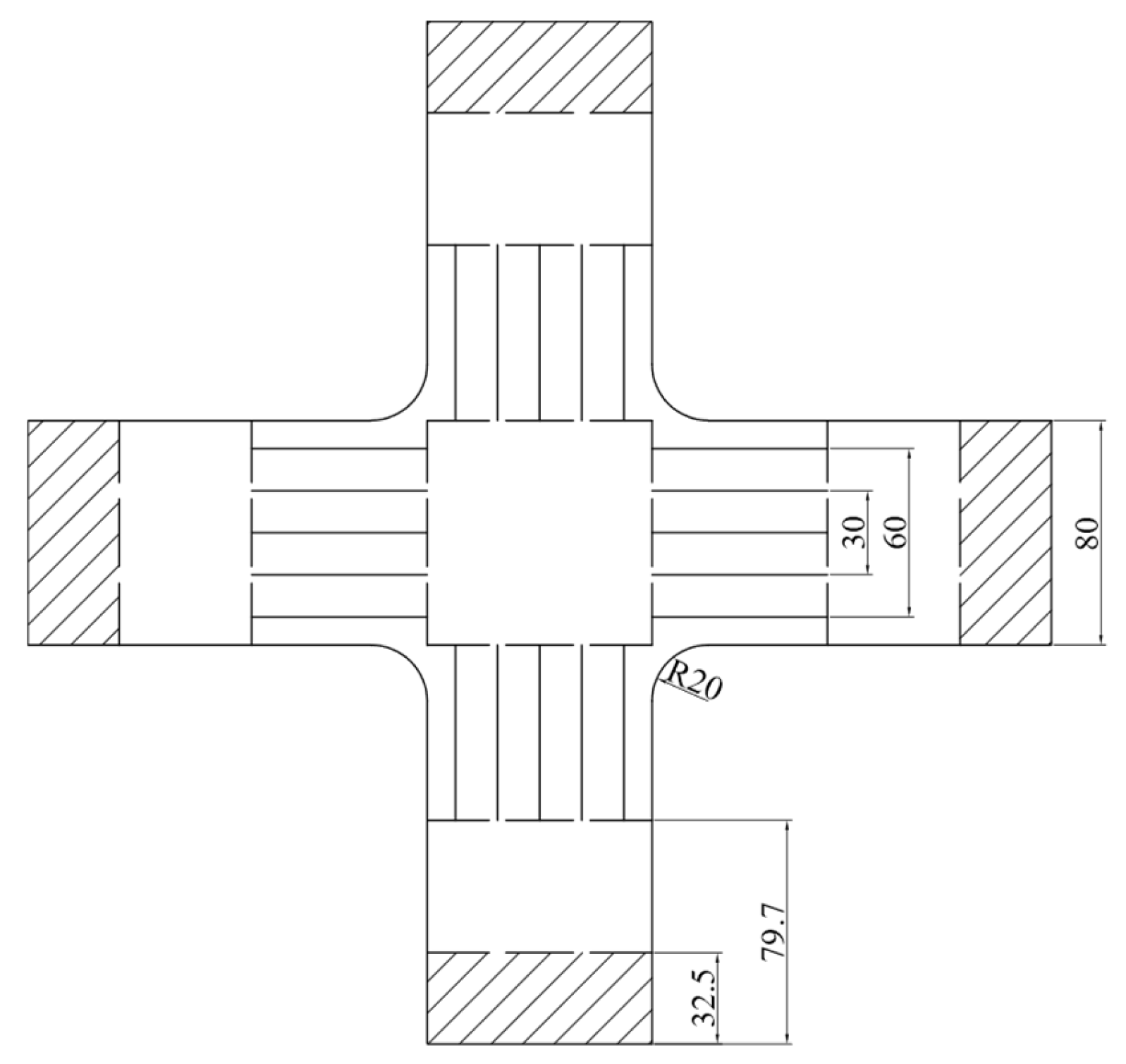
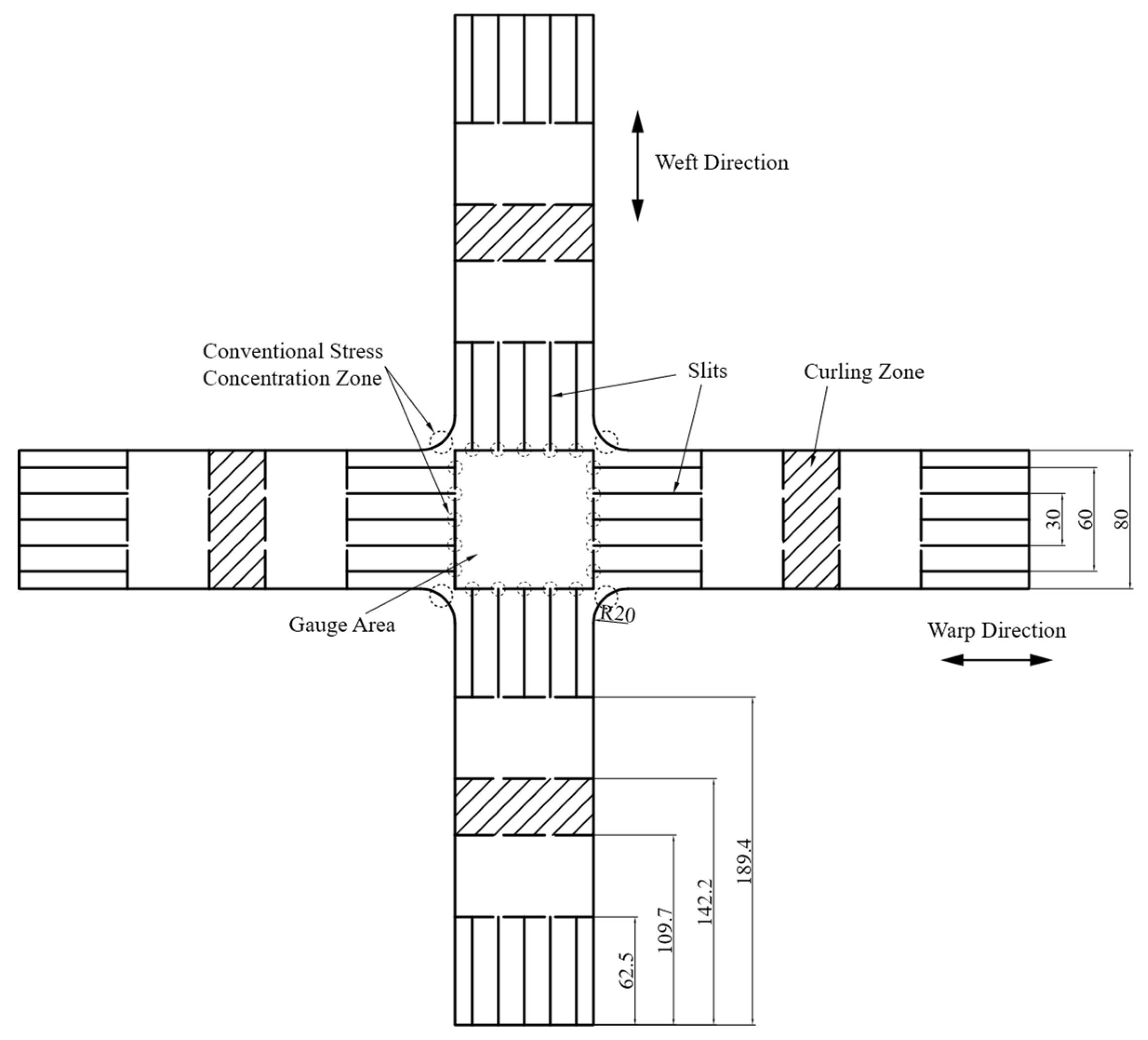
Figure 2 shows the classical cruciform specimen designed according to the dimensions of the tensile test machine used in this study. The classical cruciform specimen is provided with four loading arms along two mutually perpendicular directions, which are used to apply a biaxial tensile stress field to the central square area of 80 × 80 mm of the specimen. The material at the end of the loading arm is curled into a cylindrical shape and fabricated by high-temperature heat sealing, which can be used for clamping and fixing the specimen during subsequent biaxial tests. To enable the tensile load to be transmitted more uniformly to the core area of the cruciform specimen, five slits are arranged on each loading arm. At the transition position between adjacent loading arms, the specimen is treated with filets. However, numerous research works have shown that although filets can reduce the effect of stress concentration to a certain extent, they cannot completely eliminate the stress concentration phenomenon [16,17,18]. In addition, tip stress concentration is likely to occur at the tip positions of the slits on the loading arms. Under the combined action of these two factors, the stress distribution of the loading arms of the classical cruciform specimen becomes complex under biaxial tensile loads, and the loading arms are prone to failure prior to the core area of the specimen. In this case, the test results will fail to reflect the true biaxial tensile strength of the material.
To determine the tensile strength of envelope materials under biaxial loads, it is necessary to improve the design of the original biaxial tensile specimen. Specifically, an ideal biaxial tensile specimen, in addition to meeting the requirement of enabling loading at various stress ratios in the warp and weft directions, must ensure that the region under biaxial tension fails prior to other positions such as the clamping area and load transfer area of the specimen. The shape and layout of the classical biaxial cruciform specimen can meet the demand for multi-stress ratio loading in the warp and weft directions, but its limitation lies in the mismatch between the biaxial tensile bearing capacity of the core area and the strength of the loading arms and other positions. Therefore, there are two approaches to solve this problem: improving the bearing capacity of the loading arms of the biaxial specimen or reducing the bearing capacity of the core area of the biaxial specimen. Considering the implementation difficulty and feasibility of the two approaches, the method of improving the bearing strength of the loading arms of the biaxial specimen is adopted to modify the design of the biaxial tensile specimen.
To address this issue, Qu et al. [19] proposed a strengthened cruciform configuration, in which high-modulus reinforcing layers are bonded onto the specimen arms. Through systematic finite element parametric studies, they demonstrated that an optimal combination of strengthening layer modulus central gauge length and filet radius effectively suppresses stress concentration and ensures failure within the central zone. Based on the existing experimental conditions and the inherent properties of the materials, this paper adopts an alternative approach to enhance the cruciform specimen.
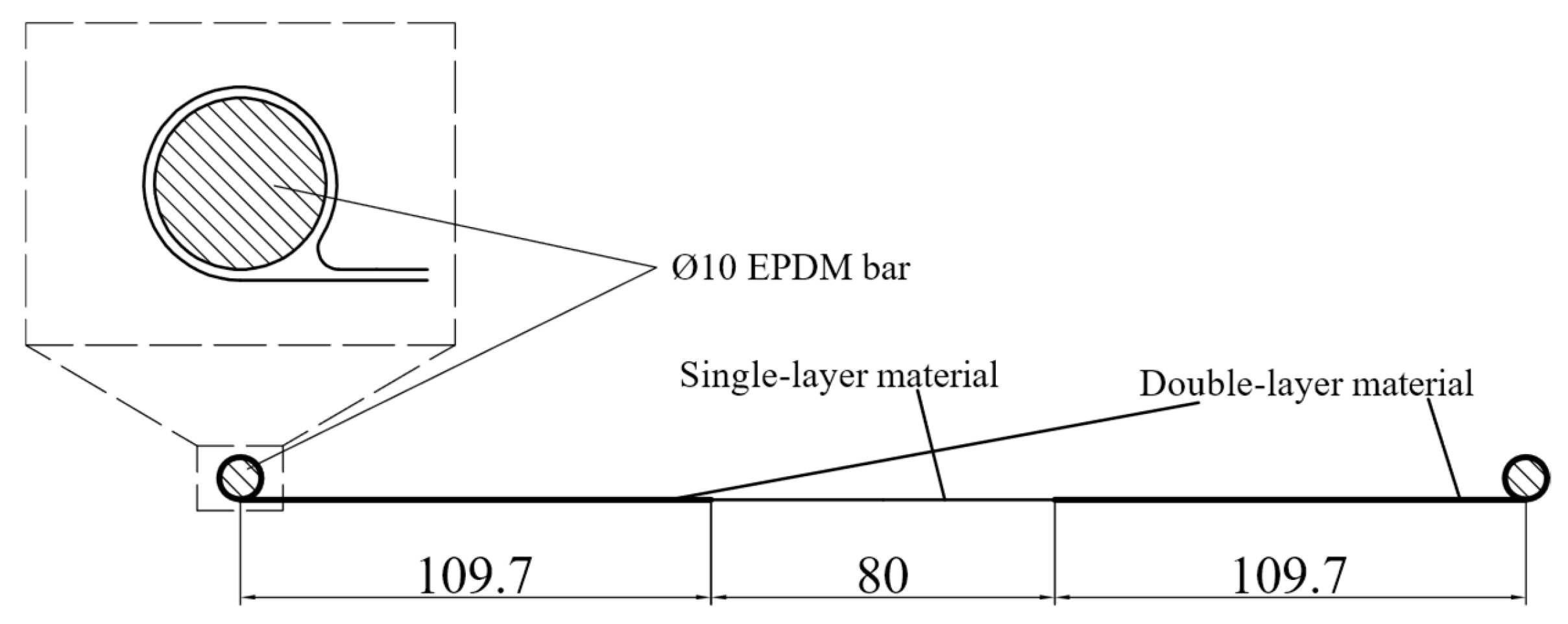
The improved biaxial tensile specimen adopts the same envelope material as the classical cruciform specimen, but the loading arms of the cut piece are lengthened to ensure that the length of the loading arm after folding to the edge of the specimen’s core area is equal to the length of the loading arm of the specimen before improvement. After the preparation of the material cut piece, the end of the loading arm is folded along the midline of the loading arm length to the edge of the core area. High-temperature heat sealing is used to closely attach the folded double-layer material, leaving a single-layer material of about 32.5 mm in length at the folded end, which is rolled into a cylindrical shape. An ethylene propylene diene monomer (EPDM) bar with a diameter of 10 mm can be inserted for clamping and fixing in the tensile test. After the material heat sealing is completed, five parallel slits are cut on the loading arm of the tightly bonded double-layer material to ensure uniform stress transmission. The specimens before and after the heat-sealing treatment of the loading arms are shown in Figure 3 and Figure 4, respectively. For the biaxial tensile specimen of envelope material with this improved design, the main part of the loading arm is closely attached by double-layer material, and the core area is still a single-layer material area of 80 × 80 mm. This effectively improves the bearing capacity of the loading arm and ensures that the single-layer material in the core area fails prior to the surrounding double-layer material under biaxial tensile loads, meeting the test requirements.

2.3. Determination of Stress Ratio

To establish the biaxial tensile strength criterion of the envelope material, it is necessary to obtain a series of uniformly distributed failure strength points in the biaxial stress space; therefore, it is essential to reasonably set the warp–weft stress ratio of the biaxial tensile test. In this test, the first quadrant in the biaxial stress space is evenly divided into 6 parts, with a dividing line set every 15°, and the failure strength points corresponding to the stress ratio fall near the dividing lines. The uniaxial tensile strengths of the material in the warp and weft directions fall on the horizontal and vertical axes of the biaxial stress space, respectively. Considering that the uniaxial tensile strengths in the warp and weft directions are relatively close and the convenience of test load setting, the stress ratios here are all taken as integer ratios, and the specific distribution is shown in Table 2.

2.4. Design of Biaxial Tensile Tests Under Multi-Stress Ratios

To construct the constitutive relation of the envelope material throughout the entire biaxial tensile process and derive a strength criterion that can comprehensively describe the material under biaxial tensile conditions, we designed and conducted uniaxial tensile tests in the warp and weft directions as well as biaxial tensile tests with multiple stress ratios.
The improved biaxial tensile specimen shown in Figure 4 was adopted. Digital speckles were set in the core area of the specimen, and the DIC equipment was used to monitor the strain in the core area. A force loading mode was employed to carry out biaxial tensile strength tests under various warp–weft stress ratio conditions.
To observe the changes in the strain field of the specimen’s core area throughout the entire test loading process, the DIC equipment was used in this test to achieve non-contact strain measurement. As a necessary condition for non-contact measurement, it is required to first fabricate speckles in the core area of the specimen. Black elastic paint was used in the test, and the speckle spraying range exceeded the core area of the specimen to ensure that the strain data of the core area could be fully monitored. According to previous studies [20,21], the speckle paint has almost no effect on the mechanical behavior of the specimen.
The test equipment selected was a biaxial material test machine developed by Tianjin CARE Measurement & Control Co., Ltd. (Tianjin, China). This test machine is equipped with four fixtures in two perpendicular directions, which can realize uniaxial loading as well as biaxial proportional and non-proportional loading tests. Each fixture is rigidly mounted to the machine frame via high-strength bolts and remains fixed in position during testing—no sliding, rotation, or transverse movement occurs at any connection point. The maximum rated load of the equipment is 20 kN, and the load measurement accuracy can reach 0.2% of the measured value, which meets the requirements for conducting tensile tests.
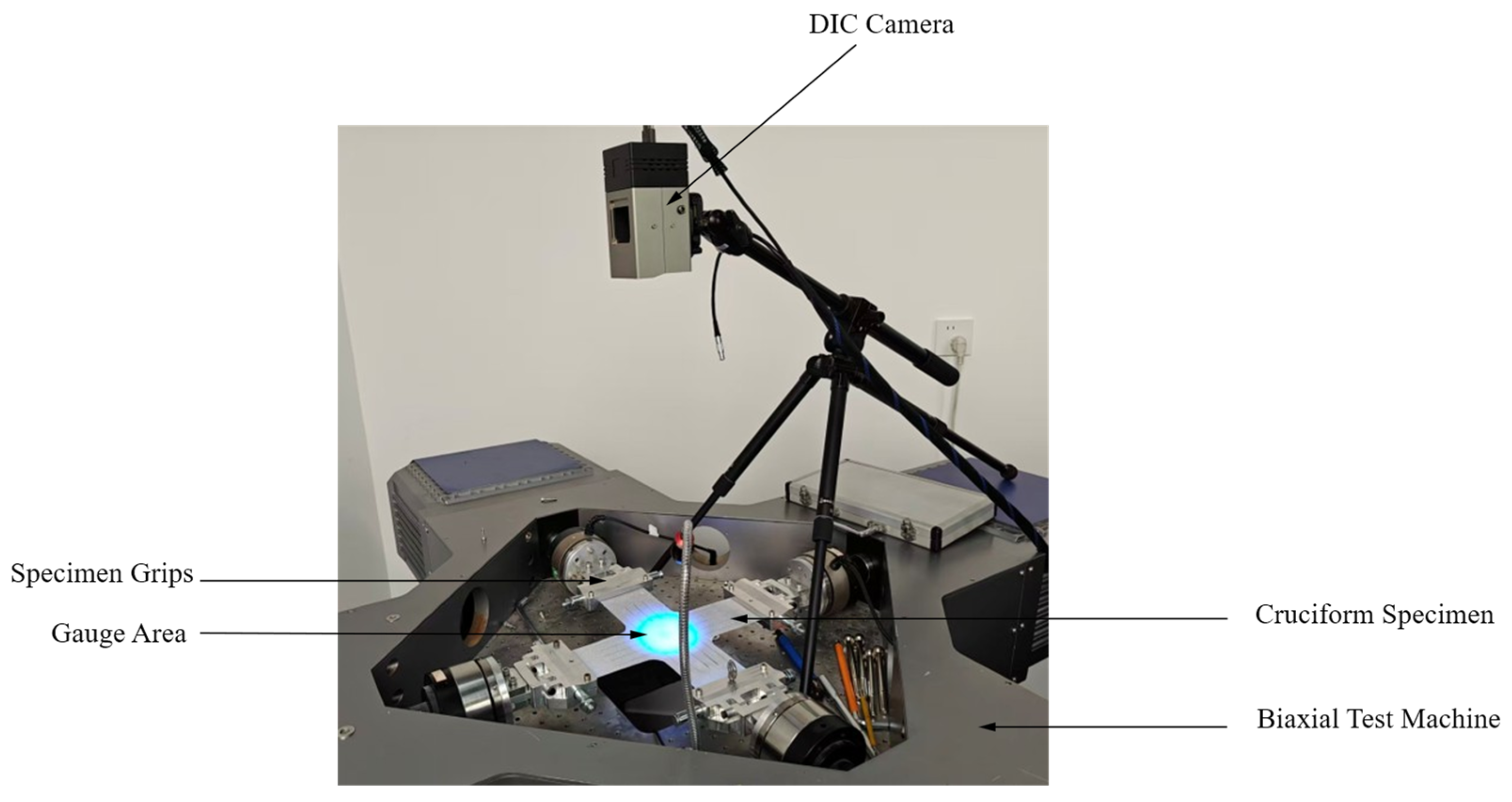
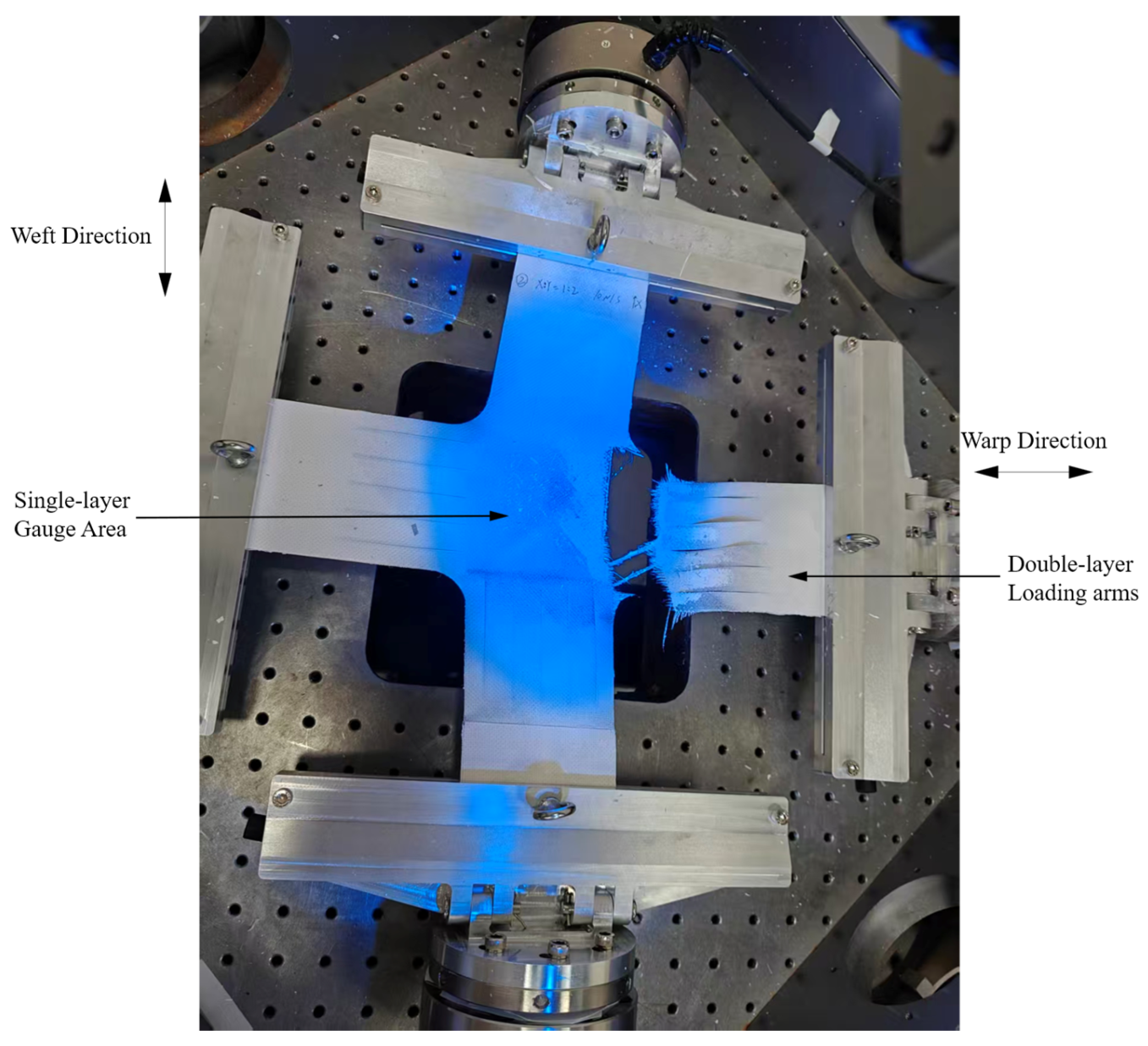
The camera of the DIC equipment, provided by Tianjin CARE Measurement & Control Co., Ltd. (Tianjin, China), is located directly above the gauge area of the specimen, enabling non-contact measurement of the strain in the core area of the specimen throughout the entire biaxial tensile process. The biaxial test setup with key components labeled is shown in Figure 5.
To systematically characterize the mechanical response of the envelope material, both biaxial and uniaxial tensile tests were performed under a unified experimental protocol.
The biaxial specimens featured an improved cruciform geometry, with four arms aligned along the warp and weft directions. Prior to testing, each specimen was mounted on a custom biaxial tensile rig equipped with independent servo-controlled actuators. A preload of 50 N was simultaneously applied in both warp and weft directions, followed by complete unloading to allow fiber reorganization and reduce internal voids. A second 50 N preload was then reapplied to verify specimen centering and surface flatness and this state was defined as the initial zero-strain reference for biaxial loading. Subsequently, loads were applied in the warp and weft directions at predefined stress ratios under force control at a rate of 10 N/s. Synchronized force sensors recorded the applied loads, while a DIC system captured full-field strains in the central gauge area until failure.
For uniaxial reference tests, rectangular strip specimens were prepared by removing the two transverse arms from the same cruciform blanks, ensuring identical material history and coating conditions. The uniaxial tests followed the same preload protocol: 50 N preload-unload-reapply 50 N as the initial state. Loading was then conducted in either the warp or weft direction at 10 N/s under force control, with DIC monitoring axial strain in the central gauge area.
Critically, ASTM does not provide any standardized method for biaxial tensile testing under variable stress ratios, which is necessary to evaluate directional strength coupling in woven architectures. Therefore, the present experimental approach prioritizes physical relevance and methodological consistency over strict adherence to existing uniaxial norms.

3. Results and Discussion

3.1. Test Results and Data Processing

In all biaxial tensile tests conducted at various stress ratios, the improved cruciform specimens consistently failed within the central single-layer gauge zone, with no premature fractures observed at the grips, slits, or loading arms. This demonstrates that the specimen modifications effectively suppress stress concentrations and ensure that failure reflects the true biaxial strength of the material.
Given the nearly identical uniaxial tensile strengths of the envelope fabric in the warp and weft directions, the failure mode under unequal biaxial loading is dictated by the applied stress ratio. Specifically, fracture always initiates in the direction subjected to the higher stress, resulting in a brittle fracture perpendicular to that axis. As shown in Figure 6 for the warp stress: weft stress = 1:2 case, the specimen fails exclusively along the high-stress (weft) direction, while the low-stress (warp) direction remains intact.
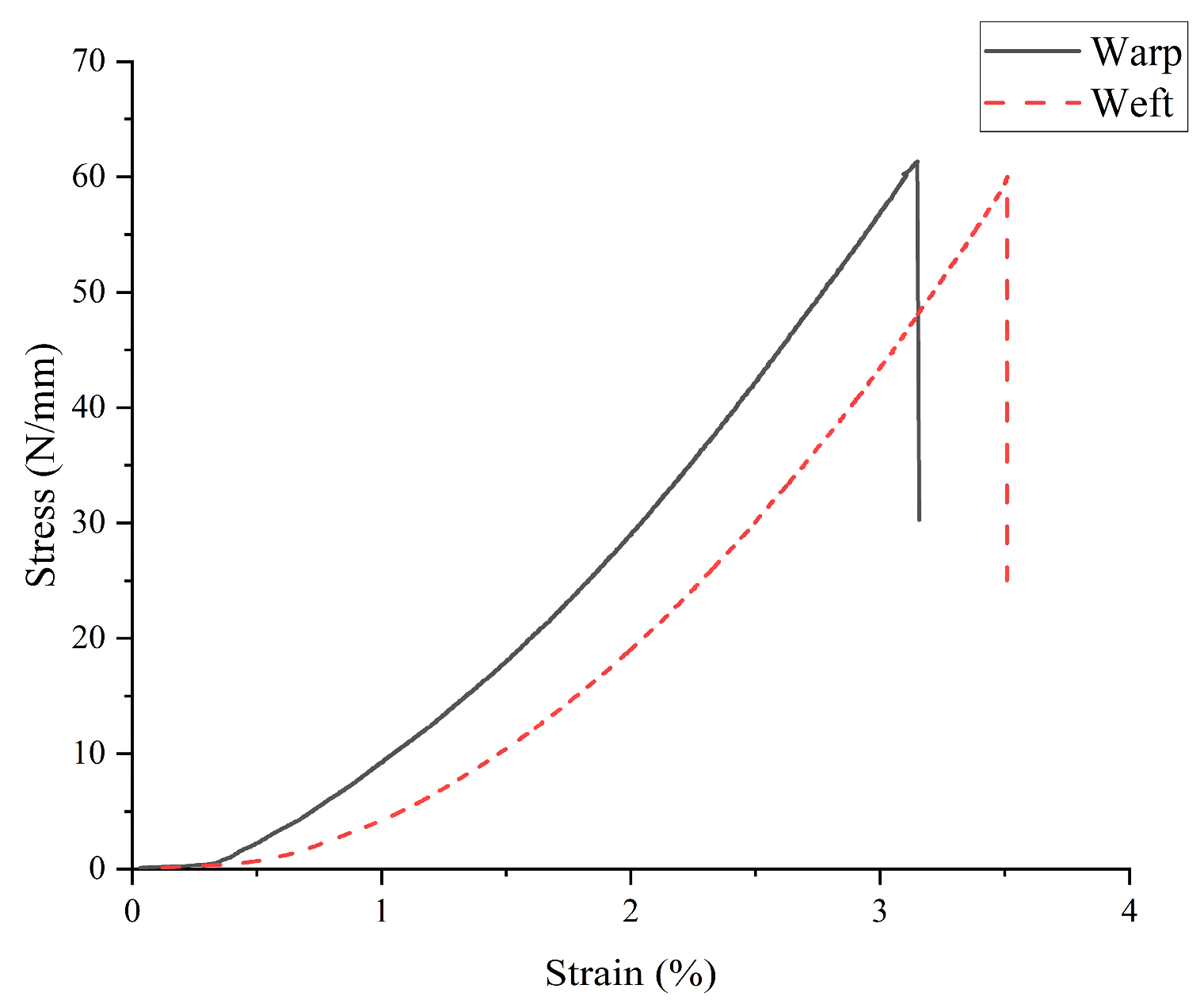
Based on the load data from the biaxial tensile test machine and the strain data of the specimen’s core area provided by the DIC equipment, the stress–strain curves of the envelope material under uniaxial tensile conditions and various warp–weft stress ratio conditions can be plotted. The stress–strain curves of uniaxial tension in the warp and weft directions are shown in Figure 7.
The uniaxial tensile mechanical properties of the envelope material in the warp and weft directions exhibit obvious nonlinearity. With the increase in load, the stress and strain levels of the material gradually increase, but the growth rate is not constant. At the initial stage of the test, the slope of the stress–strain curve is low, indicating that the material’s ability to resist deformation is weak at this time. This soft response arises from the gradual straightening of initially crimped warp and weft yarns—a geometric reconfiguration that requires minimal force at first. As the load increases, the yarns progressively align with the loading direction, causing the slope of the stress–strain curve to rise and eventually stabilize, reflecting a transition to a stiffer, quasi-linear regime dominated by axial stretching of the straightened yarns.
The uniaxial tensile failure strengths in the warp and weft directions are close, but the maximum warp strain is smaller than the maximum weft strain, manifested as a steeper initial rise in the warp curve. However, in the latter portion of the test—once both yarn systems are fully aligned—the two curves become nearly parallel, indicating that the effective tensile moduli in the warp and weft directions converge. Upon reaching peak stress, the load drops sharply, characteristic of brittle fracture caused by the tensile rupture of the load-bearing yarns.
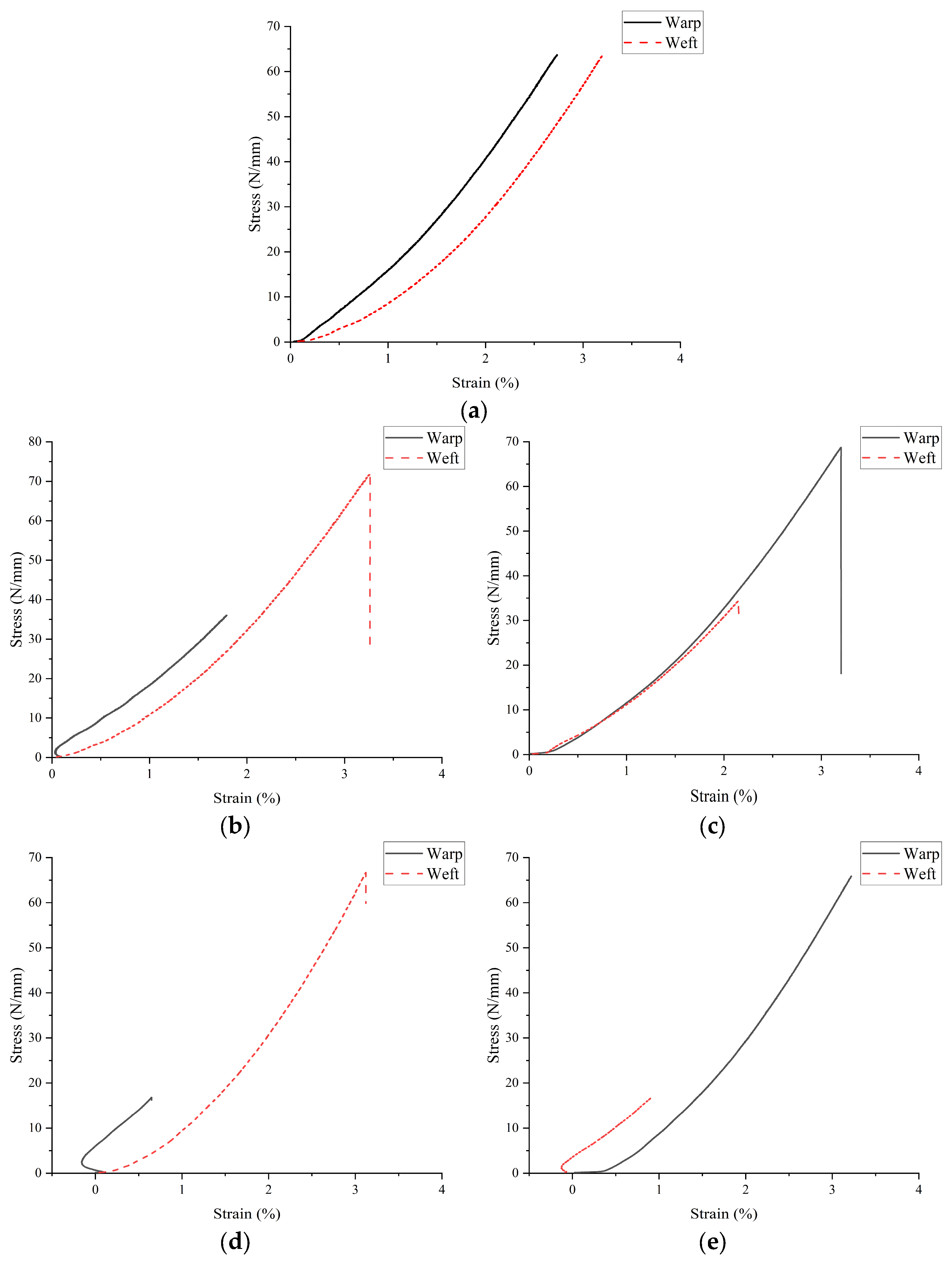
The warp and weft stress–strain curves of the core area of the biaxial tensile specimen under multiple stress ratio conditions are shown in Figure 8.
It can be seen from Figure 8a that under a 1:1 warp–weft stress ratio, the material exhibits pronounced nonlinearity and orthotropic behavior. At low stress levels, the stress–strain curves show a low initial slope, characteristic of the crimp straightening phase in woven fabrics; as the load increases, the yarns gradually align with the loading direction, and the response becomes increasingly linear.
Although the applied stresses in the warp and weft directions are equal at all times, the weft strain in the core area is consistently higher than the warp strain. This asymmetry arises from differences in the as-woven architecture: during manufacturing, warp yarns are held under higher tension and exhibit lower crimp, resulting in higher initial stiffness; in contrast, weft yarns are inserted with more slack and greater crimp, leading to greater extensibility at the same stress level.
Notably, this trend is consistent with the uniaxial tensile results in Figure 7, where the warp direction also shows a steeper initial modulus and reaches peak stress at lower strain than the weft—further confirming that the observed orthotropy stems from inherent structural anisotropy rather than test artifacts.
It is not difficult to see from Figure 8b–e that due to the close uniaxial strengths of the material in the warp and weft directions, under the non-equal stress ratio test conditions selected in the test, the direction with the larger load always fails first, and at this time, the direction with the smaller load is far from reaching its failure strength. For the direction with the larger load, the overall trend of its stress–strain curve is similar to that in the 1:1 stress ratio test. As the load gradually increases, the slope of the curve also gradually rises and stabilizes, and finally brittle fracture failure occurs.
The pronounced nonlinearity observed in its biaxial tensile behavior does not arise from intrinsic material nonlinearity of the constituent fibers—which exhibit nearly linear elastic stress–strain characteristics up to failure—but rather stems from structural mechanisms inherent to the woven fabric geometry. During initial loading, the initially crimped or undulated yarns gradually straighten, resulting in a progressive increase in stiffness. As biaxial tension is applied, the warp and weft yarns interact through frictional contact and mutual constraint, leading to complex load redistribution.
It is worth noting that in the non-equal stress ratio test, negative strain occurs in the direction with the smaller load at the initial stage of the test, which is particularly obvious when the warp–weft stress ratio gap is large, as shown in Figure 8d,e. Combined with the mechanical properties of the material, due to the Poisson’s ratio effect, at the initial stage of the test, the tensile stress in the direction with the higher load will not only drive the axial elongation of the material in this direction but also cause the transverse contraction of the material. However, the elongation caused by the small tensile stress in the direction with the lower load is not sufficient to offset the transverse contraction caused by the Poisson’s ratio effect, and finally, negative strain is exhibited in the direction with the smaller load.
For fabric composites, since their load-bearing layer is made of warp and weft fibers through plain weaving, this fiber interweaving structure will further enhance this negative strain phenomenon. When the fiber bundles in the direction with the higher load level are stretched, they will not only elongate themselves but also pull the fiber bundles with the lower load level to shrink inward through the extrusion effect at the fiber interweaving points. This shrinkage effect is more obvious at the initial stage of the test when the fiber bundles have not yet slipped or been damaged [22].
As the load continues to increase, the Poisson’s ratio contraction effect in the direction with the lower load gradually weakens, the negative strain gradually disappears and transforms into positive strain, and at this time, the material elongates in both directions. Based on the results of each group of tests, the material has a stronger ability to resist deformation in the warp direction overall.

3.2. Constitutive Relation of Biaxial Tension

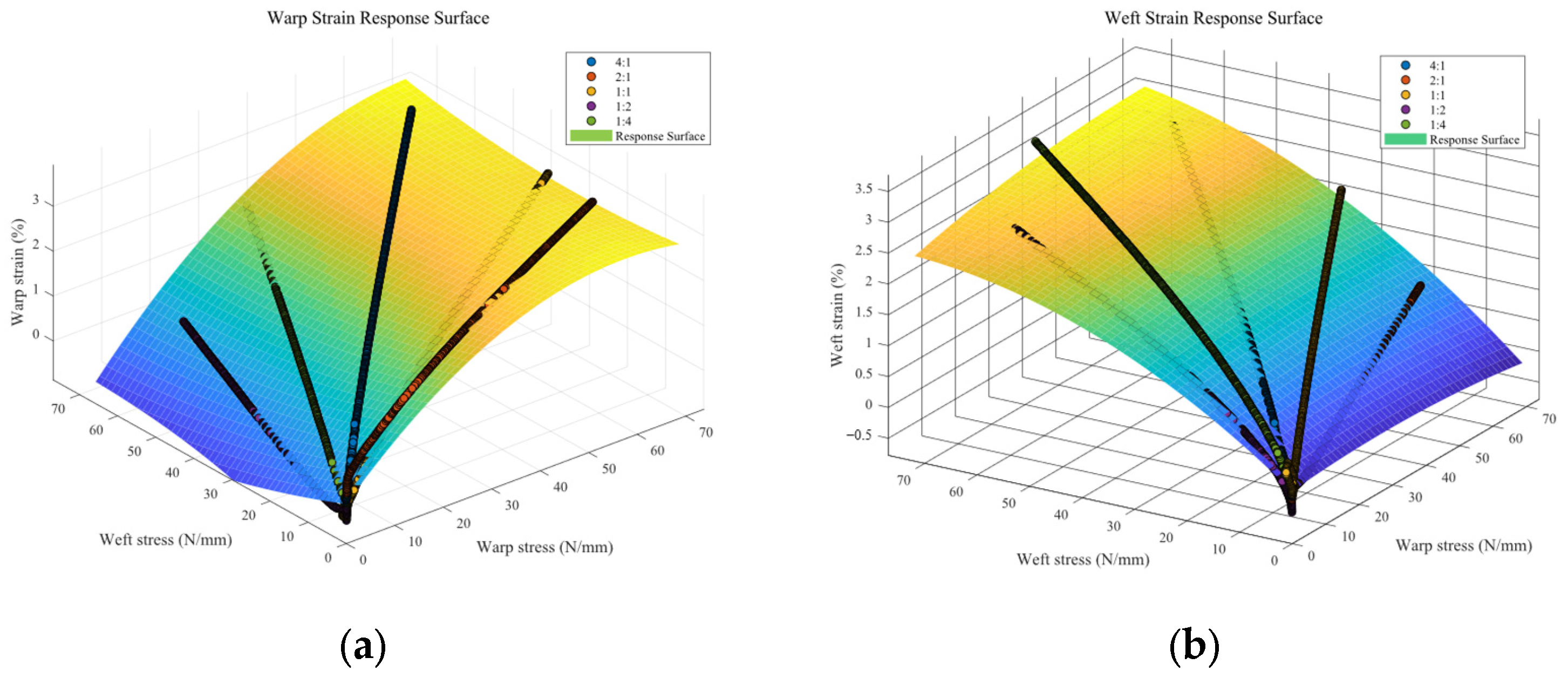
According to the previously set warp–weft stress ratios for biaxial tension, five stress–strain curves were obtained, and their projections in the biaxial stress plane are uniformly distributed in the first quadrant. On this basis, the mechanical constitutive relation of the envelope material throughout the entire biaxial tensile process can be established. Specifically, strain response surfaces can be fitted in the three-dimensional spaces with warp stress–weft stress–warp strain as the coordinate axes (Figure 9a) and warp stress–weft stress–weft strain as the coordinate axes (Figure 9b), respectively. By solving the mathematical expression of the response surface, the mechanical constitutive relation of the envelope material throughout the entire biaxial tensile process can be obtained.
For the distribution characteristics of the stress–strain curves in the aforementioned three-dimensional space, quadratic polynomials were adopted, and the mathematical expressions are as follows:
ε x = 9.57 × 10 4 σ x 2 + 2.07 × 10 4 σ y 2 + 3.60 × 10 4 σ x σ y + 1.094 × 10 1 σ x 3.590 × 10 2 σ y + 1.099 × 10 2
ε y = 1.13 × 10 4 σ x 2 4.16 × 10 4 σ y 2 + 1.35 × 10 4 σ x σ y + 6.278 × 10 3 σ x + 6.433 × 10 2 σ y + 7.235 × 10 2
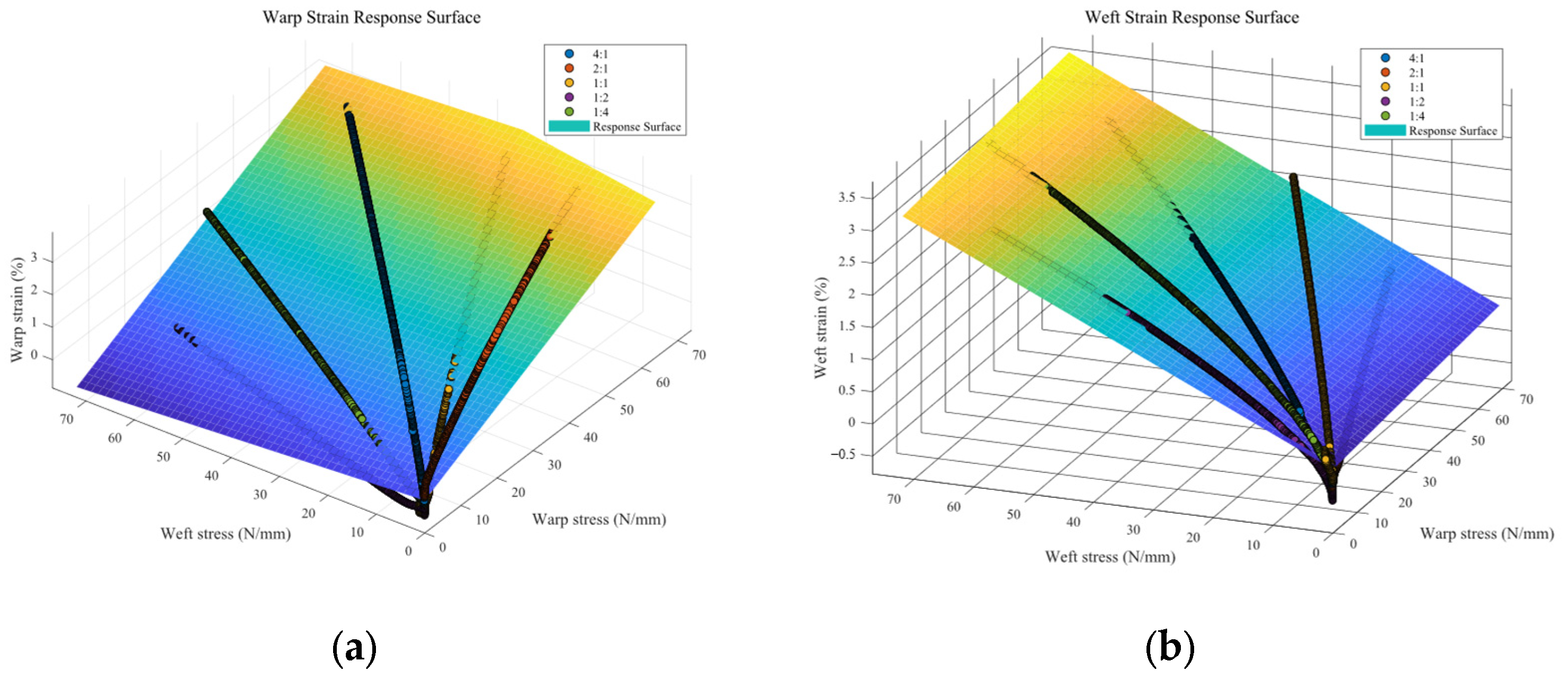
When computational efficiency rather than accuracy is required, a linear polynomial response surface can be adopted to fit the stress–strain curves in the aforementioned three-dimensional space, as Figure 10 shows.
For the distribution characteristics of the stress–strain curves in the aforementioned three-dimensional space, linear complete polynomials were adopted, and the mathematical expressions are as follows:
ε x = 5.941 × 10 2 σ x 9.464 × 10 3 σ y + 1.309 × 10 1
ε y = 5.006 × 10 3 σ x + 4.282 × 10 2 σ y + 2.101 × 10 1
In the four equations mentioned above, ε x and ε y represent the warp strain and weft strain of the envelope material under biaxial tension, respectively, while σ x and σ y represent the warp tensile stress and weft tensile stress, respectively. Through the above steps, the mechanical constitutive relation of the envelope material throughout the entire biaxial tensile process can be obtained. Compared with the traditional methods of solving elastic constants such as elastic modulus and Poisson’s ratio using the minimum strain residual method [23] and fitting stress–strain curves with piecewise functions [24], the mechanical constitutive relation for the entire biaxial tensile process applied in this paper covers the entire biaxial tensile process of the envelope material. It establishes an accurate connection between the strain in a single direction and the tensile stresses in both warp and weft directions. Compared with the traditional method of solving elastic constants, the mathematical expression form of the quadratic polynomial has significantly improved calculation accuracy and intuitively reflects the nonlinearity of the material’s mechanical properties in the mechanical constitutive relation. Considering the needs of strength analysis, failure judgment, and numerical simulation in engineering, the quadratic polynomial mechanical constitutive relation has high calculation accuracy; while in occasions where calculation efficiency is more pursued than high calculation accuracy, such as preliminary structural design, the linear polynomial mechanical constitutive relation is more suitable. The appropriate constitutive relation can be selected according to actual needs.

3.3. Failure Envelope and Strength Criterion

Airship envelope materials belong to flexible, matrix-free woven composites that exhibit pronounced nonlinear orthotropic behavior under biaxial tension. Owing to their negligible bending stiffness and lack of a continuous load-bearing matrix, these materials cannot sustain in-plane compressive stresses; instead, they buckle or wrinkle immediately upon compression. Consequently, the stress state can be treated as plane stress with tension-only loading, and compressive strength parameters are physically undefined and experimentally unmeasurable.
In composite mechanics, the Tsai–Wu criterion [25] is widely employed for its ability to model failure under general multiaxial states, including tension, compression, and shear. However, its formulation intrinsically couples tensile and compressive strengths through interaction terms, making it inherently unsuitable for materials that operate exclusively in the tensile domain [26].
Although alternative criteria such as Tsai–Hill, Yeh–Stratton, and Norris [6,27,28] have been employed in previous studies on envelope materials, when these criteria are applied to flexible woven fabrics under biaxial tension, these criteria fail to significantly capture the interaction between the warp and weft directions of the material. The mathematical expressions for the criteria are as follows:
Tsai–Hill criterion:
σ x 2 X 2 + σ y 2 Y 2 σ x σ y X 2 + τ 2 S 2 = 1
Yeh–Stratton criterion:
σ x X + σ y Y σ x σ y X 2 + τ 2 S 2 = 1
Norris criterion:
σ x 2 X 2 + σ y 2 Y 2 σ x σ y X Y + τ 2 S 2 = 1
In the formulas, σ x and σ y denote the warp tensile stress and weft tensile stress of the material, respectively; X and Y denote the uniaxial tensile strengths in the warp and weft directions, respectively; τ denotes the in-plane shear stress of the material; and S denotes the shear strength of the material. X and Y have been obtained via uniaxial tensile tests. It should be noted that in the biaxial tensile tests under multi-stress ratios, there is no shear stress in the specimens, and thus the effects of shear stress and shear strength are not considered herein.
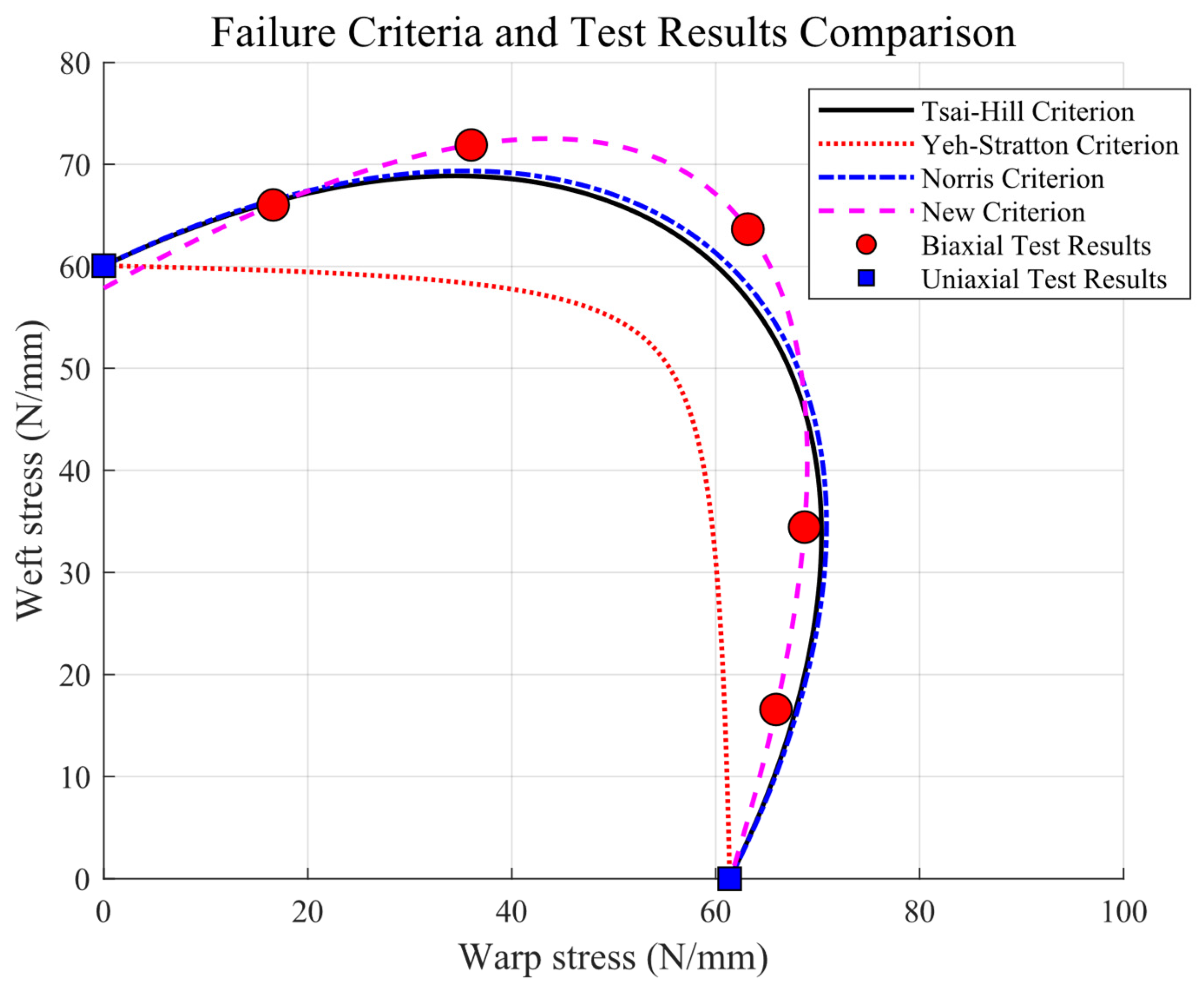
Combined with the uniaxial tensile strengths of the material in the warp and weft directions, the failure strength points of the material under different stress ratios and the material failure strength envelopes described by the Tsai–Hill criterion, Yeh–Stratton criterion and Norris criterion were plotted in the biaxial stress space. A significant deviation was observed between the experimental failure points and the predicted envelope curves, particularly within the stress ratio range of 1:2 to 2:1 (see Figure 11).
To address this gap, a failure criterion tailored to the biaxial tensile response of flexible envelope materials is formulated. The expression takes the form of a complete quadratic polynomial in the warp stress σ x and weft stress σ y —a functional structure that shares mathematical similarity with the Tsai–Wu criterion, but is restricted exclusively to the tension-only stress domain relevant to the present material system. The mathematical expression of this criterion is as follows:
σ x 2 A 1 + σ x σ y A 2 + σ y 2 A 3 + σ x A 4 + σ y A 5 = 1
In the formula, A 1 , A 2 , A 3 , A 4 , and A 5 are the undetermined coefficients in the strength criterion. This five-parameter implicit quadratic form was first introduced by Shi et al. [29] for airship envelope fabrics and has demonstrated good predictive capability for biaxial failure envelopes using only tensile data. The present study adopts this established framework and provides an independent experimental validation using a contemporary material batch, while further enhancing its generalization through systematic parameterization based on a full set of biaxial test data spanning multiple stress ratios.
The five coefficients in the expression are fully determined by experimentally measurable quantities. Importantly, the formulation involves no compressive or shear strength parameters, as in-plane compression is physically unrealizable for this class of materials, and the current biaxial tests are conducted without shear loading. To determine the five unknown parameters, at least five independent equations are required. It should be noted that the more experimental failure strength data points available, the higher the accuracy of the fitted parameters; thus, five sets of failure strength data represent the minimum requirement for uniquely solving the five parameters. Here, the biaxial tensile failure strengths of the material obtained under five different stress ratios are substituted into the equation, yielding a solvable system for the five-parameter implicit function as follows.
σ x 2 4689.19 σ x σ y 3342.03 + σ y 2 7164.91 + σ x 314.69 + σ y 108.58 = 1
The failure strength envelope described by this strength criterion was also plotted in the biaxial stress space in Figure 11.
It can be observed from the failure strength envelopes of the three classic strength criteria and the new strength criterion plotted in the biaxial stress space that:
  • The failure strength envelope of this strength criterion and those of the three classic strength criteria exhibit a similar convex shape in the first quadrant of the stress space, with smooth curve trends, which can describe the nonlinear and orthotropic mechanical properties of the envelope material.
  • According to the failure criterion theory, the failure envelope of flexible composite materials appears as a part of an ellipse or hyperbola in the first quadrant of the biaxial stress space. When the stress state of the material lies within the closed region bounded by the coordinate axes and the failure envelope, the material remains intact; when the stress state of the material lies on or outside the failure envelope, the material undergoes failure and this stress state becomes invalid.
  • The five coefficients in Equation (8) are determined by solving the system of equations constructed from five biaxial tensile failure points at 5 stress ratios. Notably, the uniaxial tensile strengths are not used in the calibration process, ensuring an independent assessment of the model’s predictive capability. The five-parameter implicit function strength criterion is derived entirely from experimental data and can accurately predict the uniaxial tensile strength of the material. As can be seen from Table 3, the deviation between the material failure strength values obtained from tensile tests and the predicted values of this strength criterion does not exceed 4%, indicating that this strength criterion accurately captures the material’s behavior across the full tensile stress domain.
The new strength criterion described above can accurately characterize the failure strength limit of the envelope material under biaxial tension in both the warp and weft directions. However, the undetermined coefficients in this strength criterion derived from experimental data have vague physical meanings, which pose certain difficulties for its popularization and application. Herein, with reference to the expression form of classic strength criteria in composite material mechanics, proportional coefficients are introduced to directly establish the correlation between the undetermined coefficients and the uniaxial tensile strength of the envelope material, and the expression of the five-parameter implicit function strength criterion is thus transformed into the following form:
F 1 σ x 2 X 2 + F 2 σ x σ y X Y + F 3 σ y 2 Y 2 + F 4 σ x X + F 5 σ y Y = 1
In the formula, σ x and σ y denote the warp tensile stress and weft tensile stress, respectively, and X and Y denote the uniaxial tensile strengths of the material in the warp and weft directions, respectively. The original five undetermined coefficients A 1 , A 2 , A 3 , A 4 , A 5 in the strength criterion are converted into five proportional coefficients F 1 , F 2 , F 3 , F 4 , F 5 related to the uniaxial tensile strength. For the envelope material investigated in this paper, the five proportional coefficients can be calculated as follows:
F 1 = X 2 A 1 = 0.80
F 2 = X Y A 2 = 1.10
F 3 = Y 2 A 3 = 0.50
F 4 = X A 4 = 0.20
F 5 = Y A 5 = 0.55
Through the above parametric treatment, the undetermined coefficients in the five-parameter implicit function strength criterion, which featured large values and unclear physical meanings, were converted into proportional coefficients with smaller values, and a direct correlation was established between these coefficients and the uniaxial tensile strength. For envelope materials with similar load-bearing layer woven structures, the values of each proportional coefficient should fluctuate only within a narrow range [29]. The uniaxial tensile strength and proportional parameters of an envelope material can be determined by conducting similar tensile strength tests, thereby facilitating the popularization of the five-parameter implicit function strength criterion.

4. Conclusions

Addressing the limitations of conventional testing and data processing methods—which fail to accurately capture the full-process mechanical response of airship envelope materials under biaxial tension—and the inadequacy of existing strength criteria in predicting their biaxial failure behavior, this study presents an improved biaxial test specimen design. Combined with DIC, the modified specimen enabled successful biaxial tensile tests on a representative envelope material across multiple warp-to-weft stress ratios.
Classical specimens exhibited severe stress concentrations at multiple locations, often leading to premature fracture outside the gauge region. In contrast, the improved geometry significantly enhanced test reliability and repeatability. Fracture morphologies were systematically documented, and full-process load–displacement responses were obtained via DIC.
The experimental data were processed to construct complete stress–strain curves under various biaxial stress states. Notably, a negative strain was observed in the lower-loaded direction when the stress ratio between the two axes was large; the physical origins of this phenomenon are discussed. With a rational selection of stress ratios, three-dimensional response surfaces—relating warp stress, weft stress, and corresponding strains—were established through curve fitting. Full-process biaxial constitutive relationships were formulated as analytical expressions using both first-order and quadratic complete polynomials, offering models of varying fidelity.
Furthermore, a five-parameter implicit strength criterion specifically developed for envelope materials under biaxial tension is adopted. The corresponding failure envelope forms a smooth, convex surface in the first quadrant of the biaxial stress space and predicts experimental strength values with an error of less than 4%. To improve physical interpretability, proportional coefficients are introduced to normalize the stress terms, thereby elucidating the underlying mechanical meaning of the criterion.
Given the structural and mechanical similarities among various airship envelope materials, the testing methodology, data analysis framework, and constitutive modeling approach developed herein demonstrate strong generalizability and are readily applicable to other laminated composite envelope systems. In future research, the shear stress component could be incorporated, along with time-dependent mechanical behavior including creep and fatigue, to develop a more universally applicable failure criterion.

Author Contributions

Conceptualization, Z.L., Y.Y., R.C. and T.L.; methodology, Z.L., Y.Y. and T.L.; software, Z.L.; validation, Z.L., Y.Y., R.C. and T.L.; formal analysis, Z.L. and T.L.; investigation, Y.Y.; resources, Y.Y. and T.L.; data curation, Z.L.; writing—original draft preparation, Z.L.; writing—review and editing, Z.L. and T.L.; visualization, Z.L.; supervision, Y.Y.; project administration, Y.Y. All authors have read and agreed to the published version of the manuscript.

Funding

This research was supported by Design and Simulation Analysis of an Optical Payload Hoisting Platform Project (E5U1200101).

Data Availability Statement

The data that support the findings of this study are available from the corresponding author upon reasonable request.

Conflicts of Interest

The authors declare no conflicts of interest.

References

  1. Yu, D.; Lv, X. Configurations analysis for high-altitude/long-endurance airships. Aircr. Eng. Aerosp. Technol. 2010, 82, 48–59. [Google Scholar] [CrossRef]
  2. Stockbridge, C.; Ceruti, A.; Marzocca, P. Airship Research and Development in the Areas of Design, Structures, Dynamics and Energy Systems. Int. J. Aeronaut. Space Sci. 2012, 13, 170–187. [Google Scholar] [CrossRef]
  3. Liao, L.; Pasternak, I. A review of airship structural research and development. Prog. Aerosp. Sci. 2009, 45, 83–96. [Google Scholar] [CrossRef]
  4. Zhao, Z.; Wang, X.; Du, S. Review of research on gas retention layer material for stratospheric airship envelope and helium permeation in polymers. Acta Aeronaut. Astronaut. Sin. 2009, 30, 1761–1768. [Google Scholar] [CrossRef]
  5. Chen, J.; Chen, W.; Zhang, D. Experimental Study on Uniaxial and Biaxial Tensile Properties of Coated Fabric for Airship Envelopes. J. Reinf. Plast. Compos. 2014, 33, 630–647. [Google Scholar] [CrossRef]
  6. Meng, J.; Lv, M.; Qu, Z.; Li, P. Mechanical Properties and Strength Criteria of Fabric Membrane for the Stratospheric Airship Envelope. Appl. Compos. Mater. 2017, 24, 77–95. [Google Scholar] [CrossRef]
  7. Song, Y.; Chen, W.; Gao, C.; Chen, L.; Wang, X.; Yan, Y. Uniaxial Tensile Creep Strength Test and Model of Fabric Membrane Material for Airships. Acta Mater. Compos. Sin. 2022, 39, 5041. [Google Scholar] [CrossRef]
  8. Qu, Z.; Xiao, H.; Lv, M.; Qin, R. Tear Propagation Behavior with a Novel Analytical Model on Envelope Material. Mater. Res. Express 2019, 6, 105320. [Google Scholar] [CrossRef]
  9. Li, S.; Chen, Y.; Xiao, C.; Ding, K.; Fu, G. Tearing Performance of Stratospheric Airship Envelope Composite Fabric Material. J. Hefei Univ. Technol. 2020, 43, 1456. [Google Scholar]
  10. Uhlemann, J.; Stranghöner, N.; Saxe, K. Stiffness Parameters for Architectural Fabrics: An Analysis of Two Determination Procedures. Struct. Eng. Int. 2015, 25, 9–19. [Google Scholar] [CrossRef]
  11. Liu, L.B.; Cao, S.; Zhu, M. Mechanical Characteristics of Stratospheric Airship Envelope of Vectran Fibre-Reinforced-Laminated Composite. Mater. Res. Innov. 2015, 19, S5-606–S5-612. [Google Scholar] [CrossRef]
  12. Xia, Y.; Deng, J.; Wang, Z.; Liu, Q.; Lu, T. Mechanical Behavior Analysis and Constitutive Modeling of Airship Envelope Material. Acta Aeronaut. Astronaut. Sin. 2023, 45, 229588. [Google Scholar]
  13. Liu, Y.; Zhao, H.; Zhang, J.; Gao, C.; Chen, J. Strength Analysis and Test of Fabric-Reinforced Airship Envelope Material. J. Mech. Strength 2023, 45, 613–619. [Google Scholar]
  14. Chen, L.; Chen, W.; Gao, C.; Li, S.; Song, Y.; Zhao, H.; Hu, J.; Zhao, B. Strength Analysis of Composite Envelope Structures Considering the Tension–Shear Coupling and Cutting Pattern Effect. Thin-Walled Struct. 2022, 180, 109919. [Google Scholar] [CrossRef]
  15. MSAJ/M-02-1995; Testing Method for Elastic Constants of Membrane Materials. Membrane Structures Association of Japan: Tokyo, Japan, 1995.
  16. Qu, Z.; Xiao, H.; Lv, M.; Wang, X.; Wang, P.; Xu, L. Influence of Strengthening Material Behavior and Geometry Parameters on Mechanical Behavior of Biaxial Cruciform Specimen for Envelope Material. Materials 2019, 12, 2760. [Google Scholar] [CrossRef] [PubMed]
  17. Manolis, G.D.; Beskos, D.E. Dynamic Stress Concentration Studies by Boundary Integrals and Laplace Transform. Int. J. Numer. Methods Eng. 1981, 17, 573–599. [Google Scholar] [CrossRef]
  18. Du, H.; Zhou, Z.; Ling, J.; Zhang, Z.; Si, B. Stress Analysis of Chamfered Cutting Joints in Airport Cement Pavement. J. Traffic Transp. Eng. 2008, 8, 44. [Google Scholar]
  19. Hu, F.; Wang, F.; Zhang, Y. Stress Transfer Method for Reverse Extrusion Forming of Thin-Walled Sector Ribs. J. Plast. Eng. 2022, 29, 1. [Google Scholar]
  20. Jiang, L.; Wang, J.; Xiao, S.; Li, Y.; Yang, L. Dynamic Tensile Properties of Carbon/Glass Hybrid Fibre Composites under Intermediate Strain Rates via DIC and SEM Technology. Thin-Walled Struct. 2023, 190, 110986. [Google Scholar] [CrossRef]
  21. Teixeira Pinto, J.M.; Touchard, F.; Castagnet, S.; Nadot-Martin, C.; Mellier, D. DIC Strain Measurements at the Micro-Scale in a Semi-Crystalline Polymer. Exp. Mech. 2013, 53, 1311–1321. [Google Scholar] [CrossRef]
  22. Li, K.; Qian, Y.; Cheng, S.; Yang, Z.; Lu, Z. Mechanical Behavior of 2.5D Woven Composites under Complex In-Plane Loads. Acta Mater. Compos. Sin. 2025, 42, 4791–4803. [Google Scholar]
  23. Galliot, C.; Luchsinger, R.H. A Simple Model Describing the Non-Linear Biaxial Tensile Behaviour of PVC-Coated Polyester Fabrics for Use in Finite Element Analysis. Compos. Struct. 2009, 90, 438–447. [Google Scholar] [CrossRef]
  24. Qu, Z. Research on Failure and Creep Properties of Flexible Composite Materials. Ph.D. Thesis, Beihang University, Beijing, China, 2020. [Google Scholar]
  25. Tsai, S.W.; Wu, E.M. A General Theory of Strength for Anisotropic Materials. J. Compos. Mater. 1971, 5, 58–80. [Google Scholar] [CrossRef]
  26. Yi, H.; Ding, X.; Chen, S. Orthotropic Behavior and Strength Criterion of PES/PVC Membrane Materials under Tensile Loading. Acta Mater. Compos. Sin. 2005, 6, 98–102. [Google Scholar]
  27. Wang, S.; Sun, B.; Gu, B. Analytical Modeling on Mechanical Responses and Damage Morphology of Flexible Woven Composites under Trapezoid Tearing. Text. Res. J. 2013, 83, 1297–1309. [Google Scholar] [CrossRef]
  28. Zhang, Y.; Song, X.; Zhang, Q.; Lv, H. Fracture Failure Analysis and Strength Criterion for PTFE-Coated Woven Fabrics. J. Compos. Mater. 2015, 49, 1409–1421. [Google Scholar] [CrossRef]
  29. Shi, T.; Chen, W.; Gao, C.; Hu, J.; Zhao, B.; Wang, P.; Wang, M. Biaxial Constitutive Relationship and Strength Criterion of Composite Fabric for Airship Structures. Compos. Struct. 2019, 214, 379–389. [Google Scholar] [CrossRef]
Figure 1. Microstructure of typical envelope material for airships. Original illustration by the authors.
Aerospace 13 00147 g001
Figure 2. Classical cruciform specimen (Unit: mm).
Aerospace 13 00147 g002
Figure 3. Improved cruciform specimen before heat-sealing treatment (Unit: mm).
Aerospace 13 00147 g003
Figure 4. Improved cruciform specimen after heat-sealing treatment (Unit: mm).
Aerospace 13 00147 g004
Figure 5. Photograph of the biaxial test setup with key components labeled.
Aerospace 13 00147 g005
Figure 6. Typical failure morphology of brittle fracture at warp stress: weft stress = 1:2.
Aerospace 13 00147 g006
Figure 7. Stress–strain curves of uniaxial tension in warp and weft directions.
Aerospace 13 00147 g007
Figure 8. Stress–strain curves under different warp-to-weft stress ratios: (a) 1:1; (b) 1:2; (c) 2:1; (d) 1:4; (e) 4:1.
Aerospace 13 00147 g008
Figure 9. Quadratic complete polynomial fitting for stress–strain response surfaces: (a) warp strain; (b) weft strain.
Aerospace 13 00147 g009
Figure 10. Linear complete polynomial fitting for stress–strain response surfaces: (a) warp strain; (b) weft strain.
Aerospace 13 00147 g010
Figure 11. Failure envelopes described by different strength criteria.
Aerospace 13 00147 g011
Table 1. Basic parameters of test material.
ThicknessFunctional LayersFiber Type of Load-Bearing LayerFiber Mass Density
0.20 mm Weathering-resistant layer
Gas barrier layer
Vectran HT1.41 g/cm3
Table 2. Determination of warp-to-weft stress ratio.
Biaxial Stress SpaceStress Ratio SequenceAngle with
Horizontal Axis
Warp-to-Weft Stress Ratio
Aerospace 13 00147 i001(a)15°4:1
(b)30°2:1
(c)45°1:1
(d)60°1:2
(e)75°1:4
Table 3. Comparison of test result and criterion result of uniaxial tensile strength.
DirectionsTest Result (N/mm)Criterion Result (N/mm)Deviation
Warp61.3761.430.10%
Weft60.0757.863.69%
Disclaimer/Publisher’s Note: The statements, opinions and data contained in all publications are solely those of the individual author(s) and contributor(s) and not of MDPI and/or the editor(s). MDPI and/or the editor(s) disclaim responsibility for any injury to people or property resulting from any ideas, methods, instructions or products referred to in the content.