1. Introduction
New intelligent technologies are increasingly used in various industry areas, including aviation. In this paper, we investigate the use of intelligent technologies during aircraft turnaround operations. A turnaround process is defined as a series of dependent activities that must occur within a short time frame. Delays in any activity may impact the airline schedule and can result in additional costs from an airline’s perspective. The aircraft turnaround process includes de-boarding and boarding passengers, loading and unloading baggage/cargo, aircraft cleaning, the restocking of catering, refueling, maintenance activities, crew change, and more [
1,
2]. While all of these activities take time, they are necessary for the aircraft’s operation and for it to continue with the next flight.
Turnaround delay causes are typically categorized into specific classes, e.g., passenger-related delays. These include delays that occur when special-needs equipment (like a wheelchair) for disabled passengers is missing and its localization takes longer than anticipated. Maintenance-related turnaround delays include delays in visual inspections, missing or incomplete documentation, and unforeseen downtime due to mechanical defects. Catering or service-related turnaround delays cover inventory management activities like inventory control, communication, and restocking. Turnaround delays are not limited to operational impacts alone. They almost always lead to additional costs like crew overtime pay or added gate time fees. In addition, turnaround delays indirectly impact passengers by causing missed connections and re-bookings, passenger compensation fees, and internal airline rebooking fees. A chain reaction can lead to additional flights being affected during the day. Turnaround delays can decrease aircraft utilization. The exact extent depends on operational context, delay causes, and mitigation strategies, but even moderate delays can have a substantial impact on airline efficiency and profitability, representing millions of dollars per day lost. Past turnaround optimization solutions have addressed internal process improvements, the training of the crew, and the upgrading of equipment. With the use of new intelligent technologies, novel applications can be developed to support the aircraft turnaround process in new ways [
3].
This research analyzes the effects of integrating new intelligent technologies during the turnaround process on flight efficiency and economic performance.
Section 2 starts with an insight into the background and related work, followed by the definition of research challenges and objectives in
Section 3. The INTACT system, which consists of several intelligent technologies and the underlying research methodology of this paper, is described in
Section 4.
Section 5 focuses on the analysis of the results, and a sensitivity analysis and a future work section are provided in
Section 6. Finally, a conclusion summarizes the research results of this paper in
Section 7.
2. Background and Related Work
The airline industry is continuously challenged to be more operationally efficient without sacrificing safety or customer experience. One of the critical elements of an airline’s operational efficiency and eventual profitability is aircraft turnaround operations: the procedures and time required to prepare an aircraft for takeoff after it arrives on the ground. Turnaround involves many people and processes—from air traffic controllers to ground crews, cleaning crews, maintenance crews, food and beverage companies, etc.—all engaged simultaneously with intense time pressure to get aircraft back in the air. Therefore, turnaround effectiveness is the equivalent of a competitive advantage because turnaround delays affect the airline’s operation. Every minute that an aircraft sits on the ground beyond the scheduled turnaround time echoes through the entire airline’s itinerary, affecting subsequent flights’ delays, making it difficult for transferees to connect, and avoiding proper crew rotation scheduling. As per the Eurocontrol Statistics [
4], turnaround delays are one of the largest causes of overall delays in flight boarding and de-boarding, with an average intrinsic cost of
$75 per delayed minute, absent derivative factors like delayed passenger fees, subsequent rebooking or ancillary connecting charges, and losses of reputation [
5]. Solutions need to be found to eliminate such issues with new technologies in the current air travel marketplace, particularly in situations that have historically been prone to lengthy delays due to human errors.
Efficient aircraft turnaround time (TAT) is a cornerstone of airline competitiveness, directly influencing operational costs, resource utilization, and passenger satisfaction. Traditional approaches to TAT reduction have focused on optimizing scheduling, resource allocation, and process management. Robust aircraft maintenance routing models that incorporate turnaround time reduction strategies have demonstrated significant improvements in fleet productivity and delay cost minimization, outperforming buffer time and stochastic programming approaches by up to 18.82% in real-world airline data [
6]. Recent research has emphasized the value of predictive analytics and dynamic modeling in TAT management. Time Transition Petri Net models, combined with Bayesian prediction methods, have achieved high accuracy in forecasting turnaround durations, with root-mean-square errors as low as 3.75 min, thereby supporting improved flight punctuality and airport clearance [
7]. The early identification of aircraft related problems can increase overall aircraft efficiency and reduce time otherwise spent on unplanned maintenance events during TAT. Studies reveal that proactive and integrated maintenance planning strategies can significantly reduce lost time during turnarounds, improving aircraft serviceability and availability for more revenue flights [
8,
9].
Analytical models further highlight the importance of balancing buffer times and resource allocation to minimize system costs while maintaining punctuality, especially for short-haul flights where ground time constitutes a larger proportion of total travel time [
10,
11,
12]. Real-time monitoring and management systems, such as rule-based turnaround managers, have also been shown to decrease delays and optimize ground operations by providing operational control centers with immediate feedback on the status of critical activities [
13,
14]. Integrated recovery models that combine turnaround and aircraft recovery processes can further enhance network resilience, reducing total delay-related costs by up to 49% in certain scenarios [
15]. These studies underscore that even small improvements in turnaround processes can yield substantial financial and operational benefits for airlines [
16]. Quality control and assurance, standardization, and automation are identified as best practices for enhancing maintenance efficiency, while collaboration and training help overcome operational obstacles [
9]. Predictive maintenance, supported by real-time data and analytics, is increasingly recognized as a key enabler for minimizing unplanned groundings and ensuring aircraft readiness [
9].
Emerging smart technologies offer promising avenues for further TAT reduction, particularly in areas such as cabin inventory management, passenger assistance, and predictive maintenance. While direct studies on smart watches for these applications are limited, the integration of real-time data collection and process automation aligns with the demonstrated benefits of digital monitoring and predictive modeling [
7,
10]. For example, dynamic updates of catering and boarding processes using real-time data can reduce errors and delays, and technologies that enable the precise tracking and timely coordination of special assistance services, such as wheelchair localization, can help ensure efficient passenger management and reduce the risk of unexpected delays [
2,
17]. Wearable devices, such as smart watches, have the potential to facilitate instant communication and data sharing among crew members, further streamlining food and inventory management and supporting predictive maintenance alerts.
In summary, the literature strongly supports the integration of real-time data, predictive analytics, and process automation in ground operations to reduce aircraft turnaround time. These approaches align with the demonstrated benefits of dynamic modeling, real-time monitoring, and proactive maintenance planning, all of which contribute to more efficient and resilient turnaround processes [
2,
3,
7,
9,
10,
13,
14,
17]. As the industry continues to innovate, future research should focus on quantifying the impact of specific smart technologies—such as smart watches for crew coordination, passenger assistance, and predictive maintenance—on turnaround time, building on the robust modeling and optimization frameworks established in recent studies.
2.1. Classification of Turnaround Delay Factors
Turnaround delays arise from multiple interacting factor classes, including passenger-related processes (e.g., deboarding/boarding constraints and special assistance handling), ramp and ground handling activities (e.g., cleaning, catering, fuelling, and equipment availability), technical and maintenance-related processes (e.g., cabin defects requiring intervention), and external operational constraints (e.g., airport/ATC restrictions and weather effects). These factors interact under strong time pressure, and inefficiencies in one class may propagate into reactionary delays in subsequent rotations.
In this study, the evaluated INTACT use cases focus on delay contributors that are operationally addressable via improved information availability and coordination: (i) passenger handling/special assistance readiness (wheelchair localisation), (ii) catering/service readiness via inventory visibility (trolley item inventory reporting), and (iii) technical/maintenance readiness via earlier air–ground defect reporting (cabin malfunction reporting).
2.2. IATA Delay-Code Methodology and Eurocontrol CODA Baseline
To ground the delay-reduction assumptions in an operationally standardized reporting framework, this work follows the Standard IATA Delay Codes methodology (AHM 730) as referenced in Eurocontrol CODA delay statistics [
18]. In this study, we focus only on airline-related and airline-controllable delay categories, as these are the categories that can realistically be influenced by INTACT interventions.
Accordingly, airline-related delay was computed using IATA delay codes 00–69 and code 97 (industrial action within own airline) only, while excluding other delay categories such as weather and ATC restrictions [
18]. For each month, airline-related delay (minutes) was compared to total departure delay (minutes) to compute the airline-related share. Across the analysed period (April 2024–March 2025), the mean total departure delay was 16.76 min and the mean airline-related delay was 4.17 min, corresponding to an airline-related share of 26.35%. This value was used as a baseline indicator for the delay portion addressed in the simulation scenario design.
3. Research Challenges and Objectives
To optimize turnaround operations with new technologies, three main challenges need to be addressed:
Challenge 1:
Turnaround operations are complicated because several activities take place simultaneously in a short period of time. Effective communication is therefore crucial to ensure that everything runs smoothly.
Challenge 2:
Delays often occur randomly and are beyond human control. Nevertheless, there is plenty of room for human error and even more time losses due to misunderstandings in communication, etc.
Challenge 3:
When assessing and measuring the success of a turnaround operation, how can success be measured in this context?
All three challenges can lead to disruptions and delays during turnaround operations and are not limited to specific regions or airports worldwide.
This research aims to address these challenges by evaluating how the INTACT system can support during the turnaround operation. The following research intends to measure both operational and financial benefits from implementing an intelligent technological system across three main components of turnaround operations: passenger assistance, inventory management, and maintenance checks.
The objectives of this paper are to evaluate the impact of the INTACT system by analyzing (1) average turnaround delay; (2) daily flights and aircraft utilization; (3) cost reductions, revenue increases, and return on investment; (4) statistical significance; and (5) a sensitivity analysis with focus on delay reduction.
4. INTACT System and Methodology
4.1. INTACT Project Context and Scope of This Study
This work presents results developed within the INTACT project (“Integrated Airport and Cabin, Digital & Sensory Technologies”), which targets integrated digital support for aircraft turnaround operations by enabling structured information exchange between aircraft-side and ground-side stakeholders. The overarching objective is to improve operational efficiency during turnaround by reducing avoidable waiting time, searching time, and the late discovery of operational issues through digitalization and improved coordination.
In this manuscript, the term “INTACT system” refers to the subset of INTACT capabilities evaluated through simulation, focusing on three specific use cases:
Use Case 1: Wheelchair Localization
Use Case 2: Inventory Management of Trolley Items
Use Case 3: Improved Air-to-Ground Communication (Cabin Malfunction Reporting)
These use cases were selected because they represent airline-controllable contributors to turnaround inefficiency that can realistically be influenced through improved information availability and coordination, rather than external causes such as weather or air traffic restrictions.
4.2. System Architecture: Aircraft-Side and Ground-Side Modules
The INTACT system follows a modular system-of-systems architecture consisting of aircraft-side and ground-side components exchanging operational information. On the aircraft side, crew interfaces enable structured operational reporting and status capture. These interfaces can be implemented via wearable or mobile crew-operated devices (e.g., smartwatches or handheld devices) depending on airline device policies and operational constraints.
On the ground side, INTACT introduces a centralized coordination concept through a ground module that supports turnaround task management and status monitoring across multiple stakeholders. A key component is an operation control center graphical user interface (OCC-GUI), which enables operational personnel to monitor turnaround progress and coordinate tasks across ground teams (e.g., resource provisioning teams, maintenance teams, and ramp-agent-type coordination roles). The architecture is designed to support scalable data distribution and coordination logic across multiple connected aircraft and ground stakeholders.
4.3. Operational Workflow During Turnaround
Operationally, the INTACT system supports a turnaround workflow in which aircraft-side information is transmitted to the ground to enable earlier preparation and improved synchronization. The intended benefit is achieved by reducing non-value-adding activities during turnaround—such as manual searching for equipment, the late dispatch of resources, and the late initiation of maintenance tasks—through structured information availability and coordination support via the ground module.
In this study, the operational mechanism was represented at the level of turnaround time reduction and translated into simulation scenario assumptions for the three evaluated use cases. The study focuses on quantifying how these improvements affect schedule-feasible aircraft utilization and delay-related cost impacts.
4.4. Evaluated Use Cases and Assumed Impact Percentages
For the purpose of this paper, estimations were made based on internal project discussions, dialogues with industry partners, and feedback from other institutions involved in the project.
Use Case 1: Wheelchair Localization: Around 15% of passenger handling time delays involve locating wheelchairs for passengers in need. This use case introduces a system enabling the real-time localization of wheelchairs nearby, aiming to reduce manual searching and waiting time for special-assistance equipment staging.
Use Case 2: Inventory Management of Trolley Items: Around 10% of turnaround time delays occur when the ground crew cannot find the correct catering trolleys or equipment. Catering efforts onboard require a certain number of trolleys and equipment items to be available. Missing trolley items require manual interventions and the relocation of equipment, inducing time lags, especially if certain trolleys are out of order or misplaced. The INTACT system enables the structured visibility of trolley items associated with an aircraft and supports the earlier detection of potential issues, reducing last-minute corrective actions.
Use Case 3: Improved Air-to-Ground Communication (Cabin Malfunction Reporting): Approximately 20% of additional turnaround time is spent on preventative maintenance activities, where technicians conduct inspections to identify potential failures or malfunctions. With improved air-to-ground communication, cabin crew can communicate potential failures or malfunctions early (i.e., before the aircraft arrives at the destination airport) so that technicians can prepare required resources and perform replacements or repairs more efficiently during turnaround. This provides a clear advantage compared to situations in which information reaches the maintenance team only after aircraft arrival at the gate.
Other INTACT use cases include the detection of occupied seats for effective cleaning and disinfection during turnaround (seat occupancy), the estimation of occupancy statuses of overhead compartments (fast boarding), intelligent water management, and the localization of luggage in case a passenger is not on the plane (eBadge). In this manuscript, these additional use cases are referenced to illustrate the broader INTACT roadmap, but they are not included in the quantitative evaluation.
4.5. Methodology Overview
The methodology in this paper involves data basis selection, simulation construction, statistical processing, and economic impact assessment. To validate the operational and economic effectiveness of intelligent technology interventions in commercial aircraft turnaround operations, a simulation experiment was conducted.
A simulation environment was developed to address the need for a quantitative evaluation of turnaround interventions in aviation operations, where simplified analytical approaches may fail to capture interdependencies and stochastic variation. The simulation framework modeled the turnaround cycle for a single medium-haul aircraft operating under realistic operational constraints and generated outputs enabling statistical analysis and economic evaluation.
4.6. Simulation Model Setup and Parameterization
The custom-built simulation framework modeled the complete turnaround cycle for a single medium-haul aircraft operating within realistic operational constraints. The simulation focused on medium-haul routes with a base turnaround time of 45 min and flight durations averaging 120 min, selected to represent typical commercial aviation operations where turnaround efficiency critically impacts daily utilization.
Key inputs included probabilistic distributions for turnaround times (log-normal, σ = 0.15) and flight durations (normal distribution, μ = 120 min, σ = 15 min). Operational parameters such as delay costs and revenue per flight were incorporated, along with scenario-specific delay characteristics ranging from baseline to full-delay and INTACT-optimized conditions. The simulation generated comprehensive outputs including daily flight frequencies, cumulative operational metrics, delay-cost calculations, and revenue-related measures.
A discrete-event simulation approach was selected because turnaround performance is governed by stochastic process durations under operational feasibility constraints (e.g., daily operating window, crew duty limitations, and buffer times), leading to discrete outcomes such as completing four versus five flights per day. Therefore, a reduction in turnaround time does not translate linearly to additional flights; instead, it changes the probability that an aircraft can complete an additional rotation within feasibility boundaries. Raw output data was post-processed for statistical analysis (including t-tests and percentile calculations) and for economic impact assessment.
4.7. Scope Limitations
While the simulation provides quantitative insights into turnaround optimization benefits, its limitations include the focus on single-aircraft operations rather than fleet-wide interactions, the exclusion of external factors such as weather delays or air traffic control restrictions, and a simplified representation of complex coordination requirements between multiple ground service providers. These limitations are acknowledged and motivate future work toward broader operational integration and validation.
5. Analysis, Results and Discussion
5.1. Simulation Analysis Results
The carried out experimental simulation study, covering 350 days, allows for accurate statistical processing to ensure reliability and validity and to identify long-term trends. Three different cases were simulated. The first case represented the baseline (best case), with no simulated delays. The second case experienced full delays, meaning aspects of the delays experienced at the airport were integrated with turnaround efforts, where applicable, to determine how standard practices impact turnaround efforts. Finally, the third case applied the technologies from the INTACT system. The settings of the simulation included, for example, the average turnaround time (45 min) based on the turnaround time for medium-haul aircraft [
4]. The full-delay case encountered 17 min of actionable delays, ultimately accounting for a 62-min turnaround time [
4]. The scenario using the intelligent technologies from the INTACT system could reduce turnaround times by 3 min, resulting in a turnaround time of 59 min.
In order to appropriately assess performance, the simulation included realistic operational conditions. Operating hours were limited to 18 h per day to reflect airport hours and crew availability. Crew duty was restricted to a maximum of 12 h. Flight buffers equaled 15 min on average, as this represents typical taxi time and gate positioning required by other procedures. These types of restrictions create a simulation that addresses the realistic requirements of feasibility while complying with regulatory needs. In order to create a cost–benefit analysis from a costing perspective, the delay cost per minute was determined at
$75, an industry average relative to the delay average costs as appropriate [
5]. Revenue per flight was determined at
$25,000, a realistic value associated with medium-haul flights [
5]. Therefore, these two facts enable the adjusted delay cost savings to be determined and revenue increases to be assessed if the INTACT system is applied.
To assess realistic performance with variability, probabilistic distributions were derived from a statistical model. Turnaround times were log-normally distributed with a standard deviation of 0.15 to create realistic bounds while creating realistic performance outcomes. Flight times were normally distributed with a mean of 120 min and a standard deviation of 15 min to assess realistic possibilities for medium-haul access. A 350-day simulation period was selected to allow for a significantly larger data set, allowing more powerful and reliable statistical analyses with significance testing. Measurements for data collection and analysis occurred over the use and economic dimensions for extensive performance measurement. Flight frequency measurements assessed the number of flights completed per day with each scenario, measuring relative improvements in operational efficiency. Delay cost and revenue indicated the economic gains/losses from turnaround delays and the economically feasible benefit.
5.2. Operational Improvements: Flight Frequency Enhancement
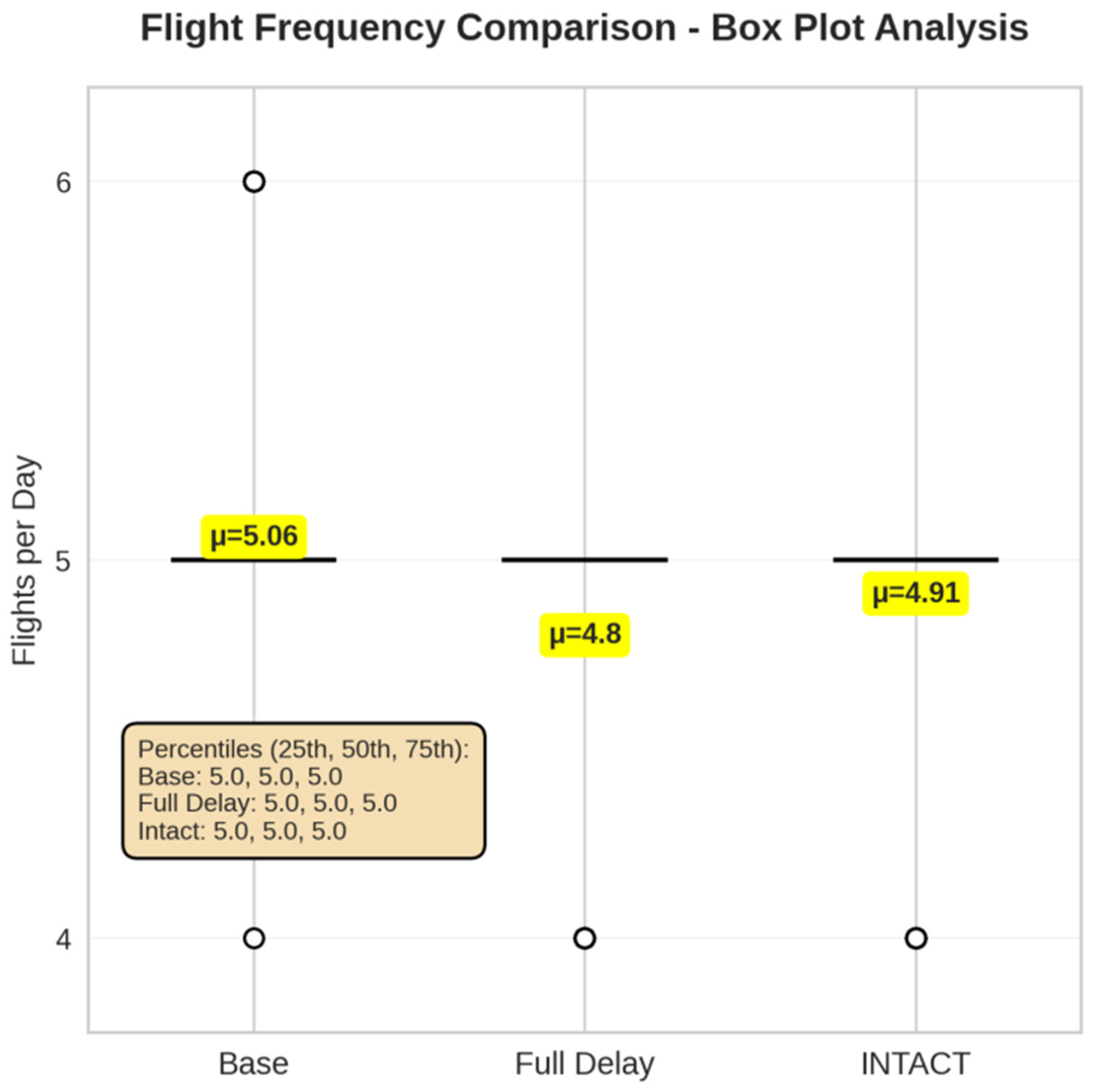
The comparison of daily flight frequencies in
Figure 1 indicates improved operational efficiency when using the INTACT system in comparison with the full delay scenario.
The mean analysis shows a significant difference in flights per day: 5.06 flights/day for the base scenario, 4.80 flights/day for the full-delay scenario, and 4.91 flights/day for the INTACT scenario. The INTACT system led to an increase of 2.3% in daily operational efficiency over the full-delay condition.
In addition, the 25th, 50th, and 75th percentiles for all three conditions were 5.0, which means most flight operations did not require significant intervention. Ultimately, statistical significance determined success in increasing flight operations between the three established conditions.
The frequency at which certain numbers of flights were accomplished across all three scenarios is cited in the frequency distribution found in
Table 1. For the base scenario, operations reliability was on par. For example, five flights per day were accomplished for 326 days (93.1%), and six flights per day were accomplished for 23 days (6.6%). This shows how stable the conditions were, as it means almost 100% of the time, operators could accomplish almost all the flights per day, and only one day was reduced to four flights per day. The INTACT system achieved operational reliability as well, yielding 318 days (90.90%) of achieving five flights per day, 32 days (9.1%) achieving four flights per day, and zero days achieving six flights per day. The full-delay scenario significantly reduced the operations reliability threshold, having accomplished only 280 days (80.0%) of five flights per day, while 70 days (20.0%) accomplished four flights per day. No days accomplished six flights per day in either the INTACT or full-delay scenario, but in the base case, operators accomplished six flights on 23 days. Therefore, this analysis shows that the implementation of INTACT reliably operates under adverse conditions, as it has a more favorable distribution than the full-delay condition.
Table 2 contains a summary of performance and operational economic measures across all scenarios. The average total flights showed significant total performance gains. INTACT had 1718 total flights compared to the full delay case with 1680. Thus, the scenario using the INTACT system had 38 more total flights in the simulation than the full-delay scenario. This represents an increase in simulated aircraft utilization relative to the full-delay scenario under the modeled feasibility constraints.
Throughout the 350 days of simulation, the INTACT system created a sustainable benefit over time. The cumulative flights for INTACT scenario stayed above the full-delay scenario over time.
Interpretation of additional flights: The increase in average flights/day observed in the INTACT scenario must be interpreted as a schedule-feasible outcome of the simulation under operational constraints. The model evaluated whether an aircraft can complete an additional rotation within the daily operating window and crew duty limitations. Therefore, the additional flights were not derived from a linear accumulation of saved minutes; instead, the reduction in turnaround duration increases the probability that a given day remains within feasibility boundaries for completing an additional rotation, which is reflected in the frequency distribution of accomplished daily flights.
5.3. Economic Impact Analysis: Cost–Benefit Assessment
From an economic perspective, the INTACT system represents an investment whose value arises through two channels: (i) the reduction of delay-related costs and (ii) schedule-feasible utilization improvements under operational constraints. Importantly, the additional flights reported in this work are not computed by a linear conversion from minutes saved to flights gained. Instead, they emerge from the discrete-event simulation under explicit constraints (daily operating window, duty-time restrictions, and buffer times).
Furthermore, additional flights generate additional variable operating costs; therefore, gross additional revenue must not be interpreted as net benefit. In this paper, we report revenue associated with additional completed flights as gross additional revenue (upper bound) and interpret net benefit conservatively using a contribution-margin framing when airline-specific variable cost breakdowns are not available.
An extensive performance comparison between the conditions relative to the delay relevant to INTACT vs. full delay is shown in
Table 3.
This table also shows that, due to multi-scenario applications of the intelligent technology, diverse revenue increases were found. Additional flights per day of 0.11 were achieved with the INTACT scenario relative to the full-delay scenario, and the delay cost saving was $966/day, which sums to total delay cost savings of $338,100. By improving this 3-min turnaround delay, the additional revenue of $2714.29/day can be achieved, which accounts for the total additional revenue of $950,000, close to $1 million. Furthermore, the t-stat and p-value relative to these performance improvements are 4.1140 and 4.3527 × 10⁻⁵, respectively, which are significant since p < 0.05. Thus, these are real performance improvements. To avoid overstating economic impact, net benefit should account for variable costs associated with additional flight operations. We therefore interpreted gross additional revenue as an upper bound and recommend net-benefit interpretation using contribution margin sensitivity (e.g., 5–15%) depending on airline network and cost structure.
The financial justification for determining economic feasibility is provided in
Table 4. With an anticipated development cost of
$2 million, the likelihood of economic feasibility based on payback periods and net returns is high. Annual savings from delay cost reductions equaled
$352,590, and the additional revenue equaled
$990,714, with a total annual benefit of
$1,343,304. The calculated payback period was 1.49 years, which is a relatively short investment period. The calculated 5-year net benefit reached
$4,716,521.
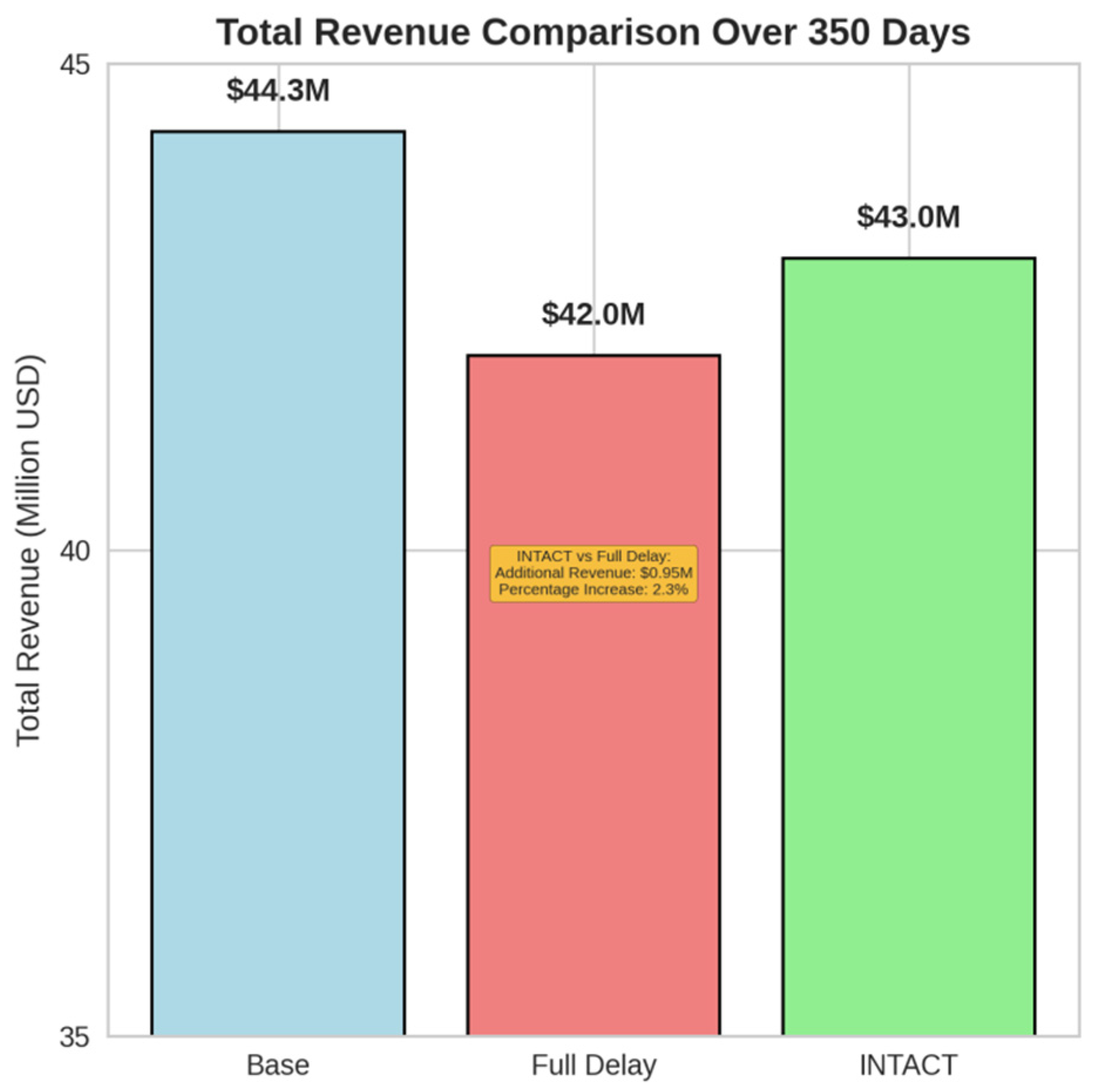
Figure 2 depicts the total revenue for all three scenarios. With the implementation of the INTACT system, a total revenue of
$43.0 million was achieved. In comparison to the full-delay scenario, the INTACT system generated additional revenue of
$950,000. This is a 2.3% increase, which is directly linked to an increase in flights due to reduced turnaround times. Therefore, the revenue increase proves that the implementation of the INTACT system provides two financial advantages: reducing costs and increasing revenue. The total cost savings and revenue increases were projected to be over
$1.34 million.
6. Sensitivity Analysis and Future Work
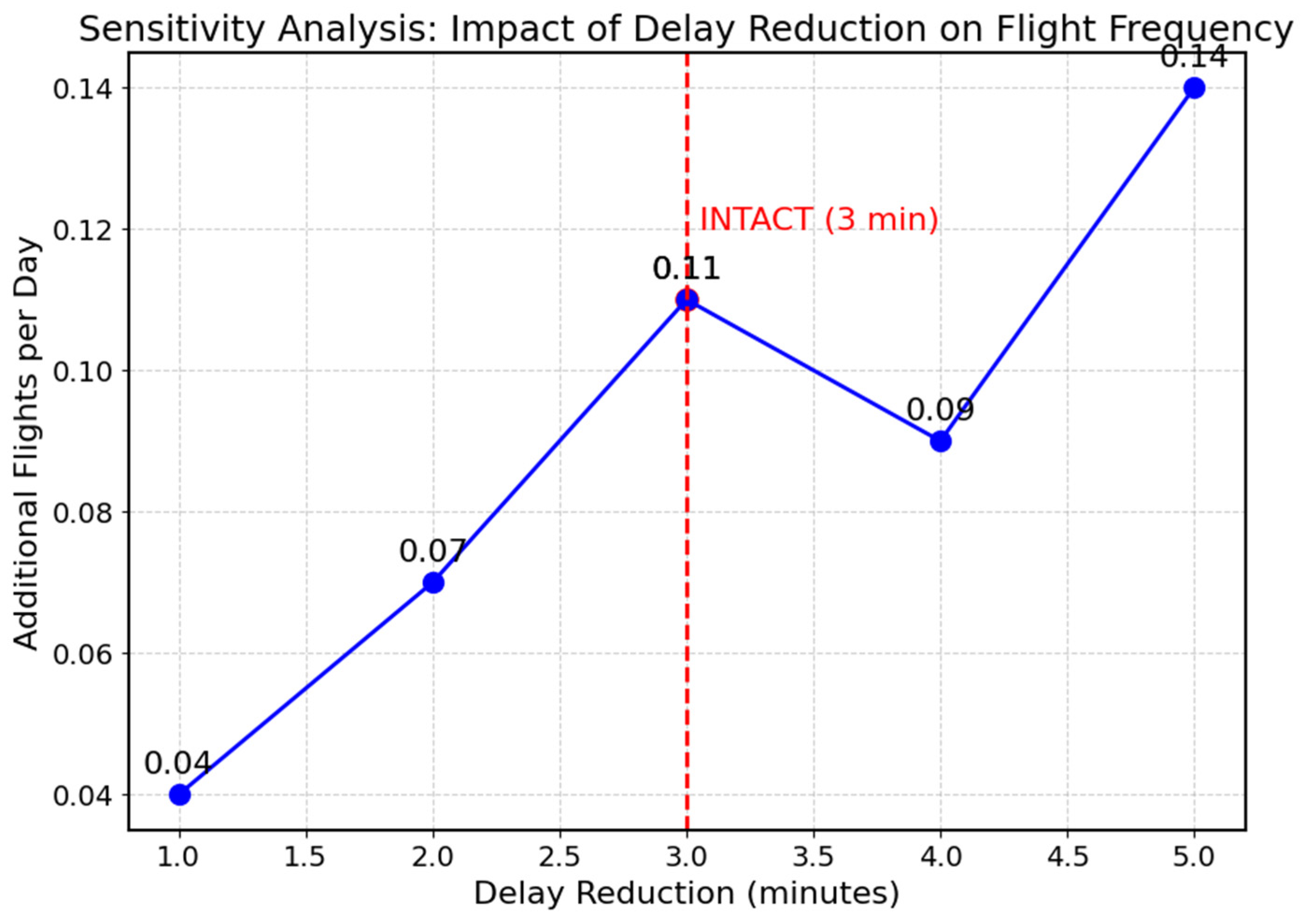
A sensitivity analysis was conducted to examine how reductions in turnaround delays affected the number of additional flights per day (see
Figure 3). The results showed a non-linear relationship: small delay reductions provided disproportionately large improvements, while further reductions yielded diminishing or temporary effects. One key finding is that the 3-min delay reduction achieved by the INTACT system sits near the optimal point on the performance curve. At this level, airlines gain substantial benefits without encountering operational disruptions. Specifically, reductions between 2 and 3 min produce the steepest improvements, indicating that relatively small changes in turnaround time can deliver significant operational value.
However, the analysis also highlights an interesting anomaly. At 4 min, the number of daily flights temporarily drops. This dip reflects real-world operational constraints. When delays are reduced by 4 min, the system enters a transitional zone where factors such as crew duty time limits (720 min per day) and scheduling restrictions prevent airlines from fully exploiting the turnaround gains. In other words, while aircraft could technically complete more flights, crew regulations and airport operating hours restrict additional scheduling, leading to a temporary plateau in the benefit curve. Once this constraint is surpassed, the curve rises again, as further delay reductions consistently allow more flights to be added. This behavior demonstrates that the model realistically captures the complexities of aviation operations.
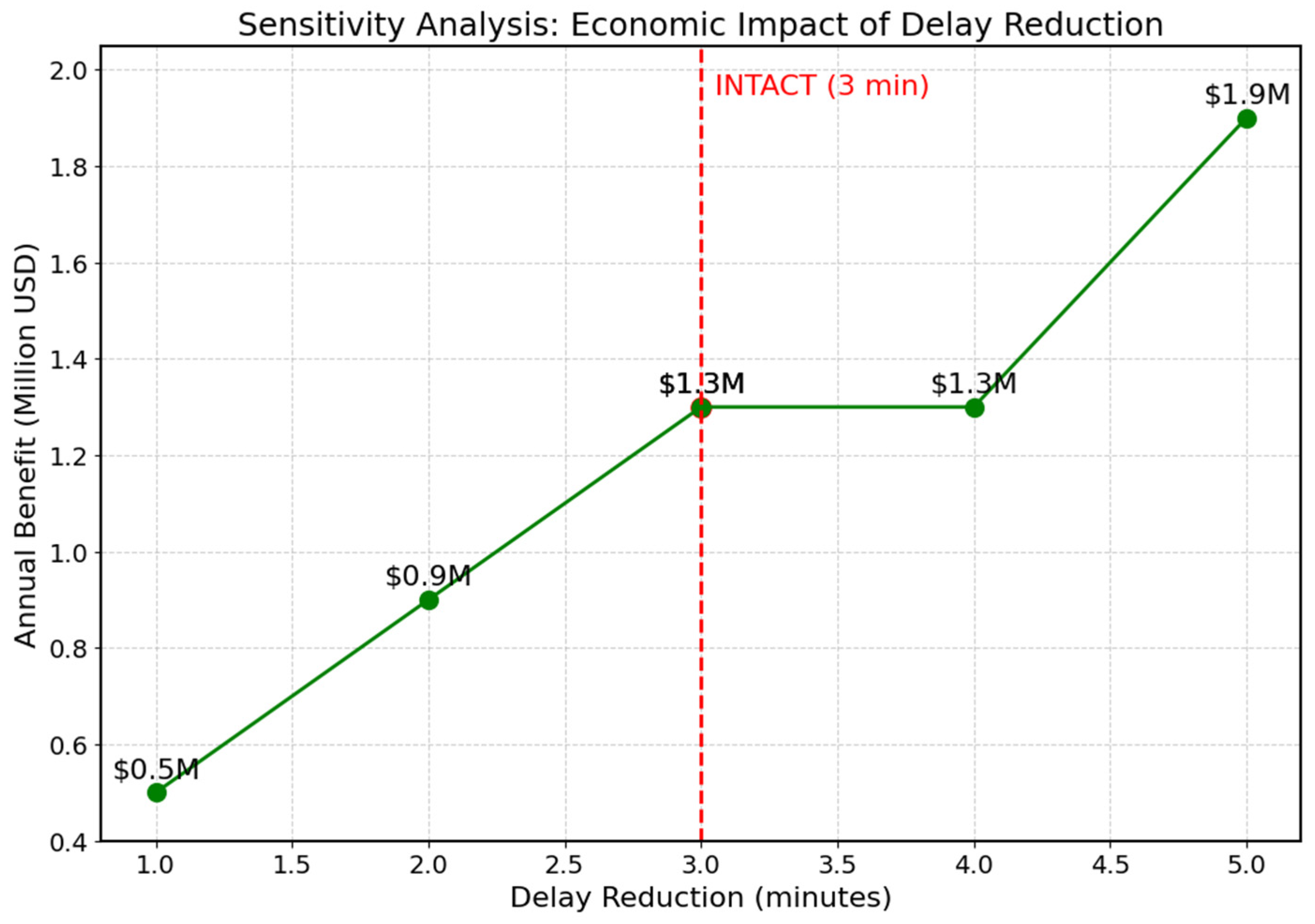
From an economic perspective (see
Figure 4), the findings reinforce this conclusion. The 3-min reduction delivered by the INTACT system translated into an annual benefit of over
$1.3 million. Delay reductions of 1–3 min offered similar returns, with each additional minute of improvement contributing roughly
$0.4 million in extra annual benefits. This makes targeted technology investments in the 1–3 min range highly cost-effective.
The temporary plateau observed at the 3–4 min range also appeared in the economic analysis. While turnaround efficiency improved at 4 min, the economic benefits flattened because operational improvements cannot immediately be converted into revenue (again due to crew and scheduling constraints). Once the system adjusts beyond this point, benefits resume their upward trend, reflecting sustained opportunities for both additional flights and cost savings.
In summary, the sensitivity analysis shows that:
The INTACT system’s 3-min delay reduction is an operational and economic “sweet spot”.
Small improvements (1–3 min) are the most valuable, providing high returns with relatively low effort.
Further reductions are beneficial but must account for crew duty regulations and scheduling realities that temporarily limit gains.
These insights not only validate the robustness of the INTACT system but also provide practical guidance for airlines: investments should prioritize reaching and sustaining the 3-min delay reduction range, while future research should explore new use cases beyond those tested to push the boundaries of operational efficiency.
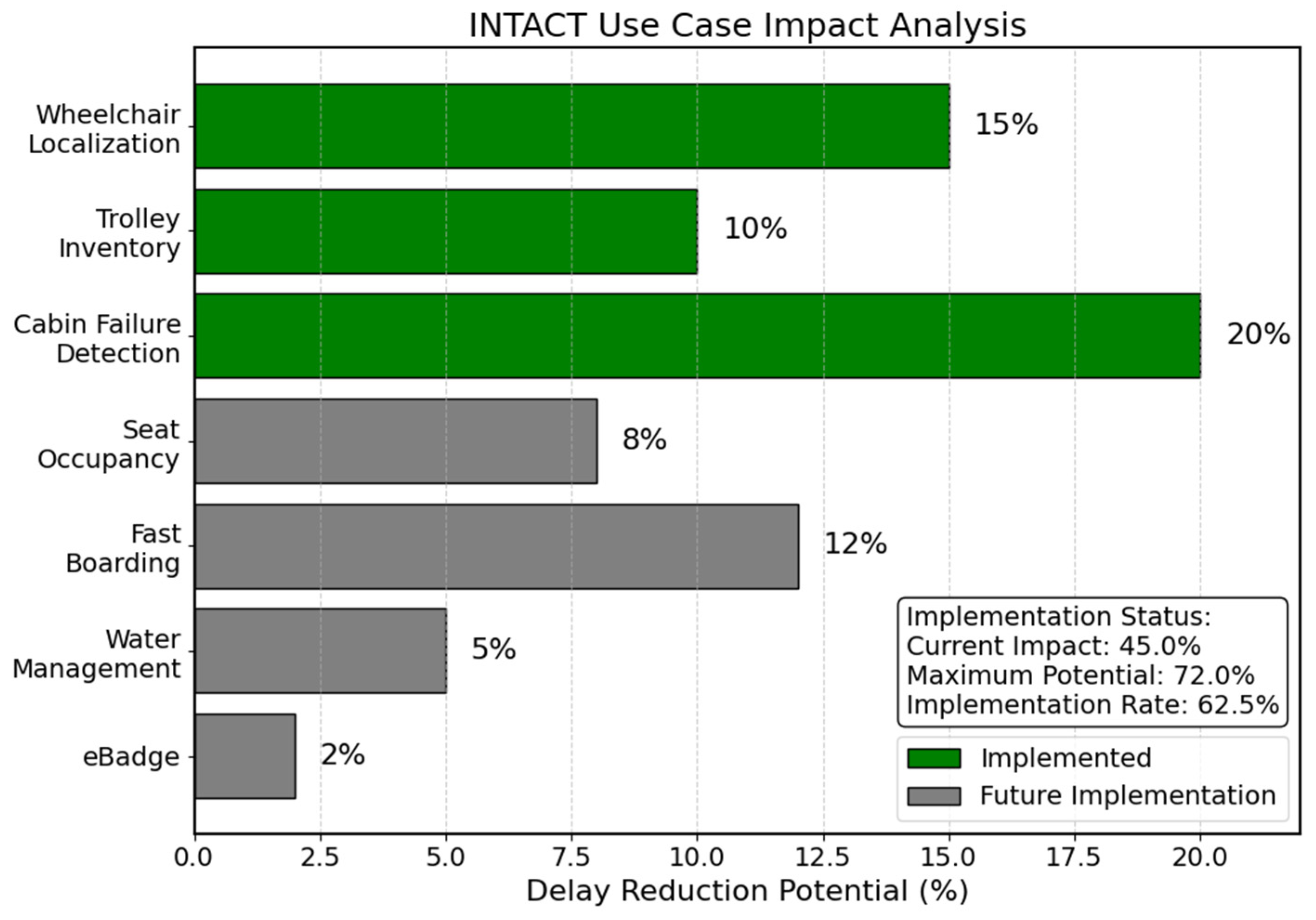
Figure 5 determines individual use case contributions and a potential future implementation expansion. At present, the implementation achieves 45% of the maximum potential impact, and the expansion implementation is at 62.5% of all determined use cases. Therefore, there are many opportunities for future expansion of the implementation of those not-yet-implemented use cases like seat occupancy detection, fast boarding, water management, and eBadges. In terms of assessment for use case impact, future expansions can seek an additional 27% in delay reduction if these implemented use cases are implemented. For instance, seat occupancy detection can achieve an 8% delay reduction, and the implementation of fast boarding can achieve an additional 12% in delay reduction. These estimations were derived based on internal dialogues as well as by discussing with industry partners and other institutions in this project. In this figure, ‘current impact’ refers to the three INTACT use cases evaluated quantitatively in this manuscript, whereas ‘maximum potential impact’ represents a conceptual future scope including additional candidate INTACT use cases that were not evaluated in this study.
Figure 5 provides an overview of the assumed percentage impacts representing each INTACT use case. These values should be interpreted as scenario assumptions for evaluating the analysis approach, rather than precise universal ground-truth values. If more accurate values become available in future project stages, the developed evaluation approach can be updated accordingly.
Clarification regarding
Figure 5: In this context, “current impact” refers strictly to the three use cases evaluated in this manuscript, whereas “maximum potential impact” represents a conceptual future scope including additional candidate INTACT use cases beyond the scope of this study
Based on the overall assessment results and sensitivity analyses, key suggestions for future INTACT implementation can be made. The strategy should seek to establish only the most impactful use cases without crossing reasonable complexity and investment thresholds. As quick-win considerations for immediate implementation, the three existing use cases need vertical implementations across other aircraft types and use cases. They are already vetted in an alternative domain with significant measures of statistical significance obtained through data assessments, meaning reliance on their anticipated benefits will present low to moderate implementation risks and predictable benefits from their scaling. As for medium-term implementation, the high-impact, yet unimplemented, use cases from the assessment should be pursued: namely, fast boarding systems and seat occupancy detection. They can reduce delays by 12% and 8%, respectively, and their complexities are slight; they require systems already in place and established infrastructural needs. Finally, for long-term implementation, additional technology advancements should be assessed for potential integration into INTACT capabilities, including AI, machine learning, and predictive analytics. Developing predictive maintenance capabilities, dynamically assigning algorithms, and real-time optimization systems can provide future operational benefits beyond present capabilities.
7. Conclusions
In conclusion, the results show the advantages of integrating the evaluated INTACT system technologies to support aircraft turnaround processes. Across the 350-day simulation analysis, average turnaround delays decreased by 3 min, corresponding to 0.11 additional completed flights per day and an increase of 2.3% in aircraft utilization. From an economic perspective, the analysis indicates daily delay-related cost savings of $966 and a gross additional revenue upper bound of $2714/day based on the simulated increase in completed flights. Importantly, gross additional revenue is not equivalent to net benefit because additional flights incur additional variable operating costs (e.g., fuel, crew, maintenance, airport/handling charges). Therefore, the reported ROI and breakeven figures should be interpreted as indicative upper bounds and should be refined when airline- and route-specific contribution margin data is available.
The significance of this research reaches beyond the operational and economic gains that the simulation study provided. The INTACT system is a blueprint for intelligent technology integration that can be recycled and expanded upon to meet a variety of operational demands throughout the airline and aviation industry. The ability to apply real-time monitoring, autonomous action, and preventive technology to other scenarios opens similar avenues for digital transformation within airlines for increased efficiency and profitability. Furthermore, this research adds to technology integration best practices through a qualitative technology assessment informed by the simulation study findings. Academics and enterprises can replicate the findings of this research to assess alternative technological solutions to determine cost and benefit analyses of various technological integration roles in large-scale, complex operational environments to avoid unnecessary fiscal risk expenditures beforehand. Instead, these preemptive assessments will provide justification or negation of high-risk implementations beforehand. Additional areas for future research may include the integration of INTACT system technologies into other operational environments. Also, new functions like predictive analytics and the use of machine learning algorithms can be added.
The INTACT system is a major step toward aircraft turnaround efficiency that not only provides immediate operational and economic advantages but also provides insights into the use of integrated technologies in aviation.
Author Contributions
Conceptualization, P.Y.P. and J.E.B.L.; Methodology, P.Y.P.; Validation, P.Y.P.; Formal analysis, T.F. and P.H.; Investigation, P.Y.P.; Writing—original draft, J.E.B.L.; Writing—review & editing, J.E.B.L.; Visualization, J.E.B.L.; Supervision, T.F.; Project administration, T.F. and P.H.; Funding acquisition, T.F. and P.H. All authors have read and agreed to the published version of the manuscript.
Funding
This research was funded by the German Federal Ministry for Economic Affairs and Climate Action for the grant 20D2128E as part of the LuFo VI-2 program.
Data Availability Statement
The data that support the findings of this study are available from the corresponding author upon reasonable request, subject to project and partner confidentiality restrictions.
Acknowledgments
Finally, the authors thank the German Federal Ministry for Economic Affairs and Climate Action for the grant 20D2128E as part of the LuFo VI-2 program, as well as all partners participating in the INTACT research project.
Conflicts of Interest
The authors declare no conflicts of interest.
References
- Schmidt, G.H.E. Handbuch Airline Management; Oldenbourg Wissenschaftsverlag GmbH: München, Germany, 2018. [Google Scholar]
- Lufthansa Systems. Airline Turnaround Management. White Paper. 2017. Available online: https://dcs.aero/wp-content/uploads/2019/11/Airline-Turnaround-Management.pdf (accessed on 22 January 2026).
- Schultz, M.; Evler, J.; Asadi, E.; Preis, H.; Fricke, H.; Wu, C. Future aircraft turnaround operations considering post-pandemic requirements. J. Air Transp. Manag. 2020, 89, 101886. [Google Scholar] [CrossRef] [PubMed]
- Eurocontrol. Traffic and Delay Data. Available online: https://www.eurocontrol.int/our-data (accessed on 22 January 2026).
- ANS Performance. CBA Standard Inputs—Aircraft Operating Costs. Available online: https://ansperformance.eu/economics/cba/standard-inputs/latest/chapters/aircraft_operating_costs.html (accessed on 22 January 2026).
- Eltoukhy, A.; Wang, Z.; Chan, F.; Chung, S.H.; Wang, X. Robust Aircraft Maintenance Routing Problem Using a Turn-Around Time Reduction Approach. IEEE Trans. Syst. Man Cybern. Syst. 2020, 50, 4919–4932. [Google Scholar] [CrossRef]
- Cui, Y.; Ma, L.; Ding, Q.; He, X.; Xiao, F.; Cheng, B. Aircraft turnaround time dynamic prediction based on Time Transition Petri Net. PLoS ONE 2024, 19, e0305237. [Google Scholar] [CrossRef] [PubMed]
- Chandola, D.; Chandola, P.; Verma, S.; Jaiswal, K. An Exploratory Study to Evaluate the Significance of Maintenance Planning in Reducing Aircraft Maintenance Turnaround Time Within the Airlines Industry. In Proceedings of the 2023 International Conference on Computational Intelligence and Knowledge Economy (ICCIKE), Dubai, United Arab Emirates, 9–10 March 2023; pp. 402–407. [Google Scholar] [CrossRef]
- Wu, C.; Caves, R. Aircraft operational costs and turnaround efficiency at airports. J. Air Transp. Manag. 2000, 6, 201–208. [Google Scholar] [CrossRef]
- Wu, C.; Caves, R. Modelling and optimization of aircraft turnaround time at an airport. Transp. Plan. Technol. 2004, 27, 47–66. [Google Scholar] [CrossRef]
- Evler, J.; Lindner, M.; Fricke, H.; Schultz, M. Integration of turnaround and aircraft recovery to mitigate delay propagation in airline networks. Comput. Oper. Res. 2021, 138, 105602. [Google Scholar] [CrossRef]
- More, D.; Sharma, R. The turnaround time of an aircraft: A competitive weapon for an airline company. Decision 2014, 41, 489–497. [Google Scholar] [CrossRef]
- Aziz, A.; Brohi, M.N.; Soomro, T.R.; Ghazal, T.M.; Alzoubi, H.M.; Alshurideh, M. Aircraft Turnaround Manager (ATM): A Solution to Airport Operations. In The Effect of Information Technology on Business and Marketing Intelligence Systems; Springer International Publishing: Cham, Switzerland, 2023; pp. 679–702. [Google Scholar]
- Schmidt, M.; Engelmann, M.; Rothfeld, R.; Hornung, M.; Aerospace, M.; Luftfahrt, B. Boarding process assessment of novel aircraft cabin concepts. In Proceedings of the 30th International Congress of the Aeronautical Sciences (ICAS), Daejeon, Republic of Korea, 25–30 September 2016; pp. 25–30. [Google Scholar]
- Christoffels, L.; Gluchshenko, O. Sensitivity Analysis to Determine the Optimisation Potential of Airport Turnaround Processes for Short-Haul Aircraft; Deutsche Gesellschaft für Luft-und Raumfahrt-Lilienthal-Oberth eV: Bonn, Germany, 2017; pp. 1–10. [Google Scholar]
- Chandola, D.; Verma, S.; Jaiswal, K.; Khaolliya, R.; Chandola, P. Statistical Analysis to Evaluate the Impact of Quality Control and Quality Assurance on the Aircraft Maintenance Turnaround Time. Int. J. Aviat. Aeronaut. Aerosp. 2023, 10, 2. [Google Scholar] [CrossRef]
- Makhloof, M.; Waheed, M.; Badawi, U. Real-time aircraft turnaround operations manager. Prod. Plan. Control 2014, 25, 2–25. [Google Scholar] [CrossRef]
- Eurocontrol. Standard IATA Delay Codes (AHM 730). Eurocontrol CODA Digest. Available online: https://ansperformance.eu/library/iata-delay-codes.pdf (accessed on 22 January 2026).
| Disclaimer/Publisher’s Note: The statements, opinions and data contained in all publications are solely those of the individual author(s) and contributor(s) and not of MDPI and/or the editor(s). MDPI and/or the editor(s) disclaim responsibility for any injury to people or property resulting from any ideas, methods, instructions or products referred to in the content. |