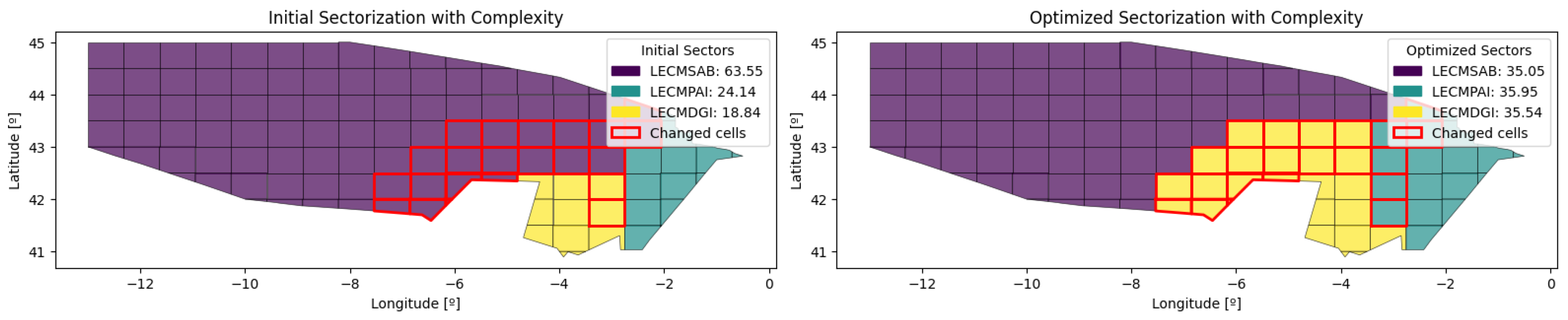

Cell-Based Optimization of Air Traffic Control Sector Boundaries Using Traffic Complexity

 , ,
, , 
Abstract
1. Introduction
- The creation of sectors has been done through expert knowledge. As in other ATFM processes, such as the development of complexity indicators, expert judgment may be associated with bias [25]. To eliminate this bias, a sector shape optimization process is proposed that is influenced exclusively by complexity. The complexity in turn is based on air traffic data, so the data on which this model is based will be the air traffic flown.
- The aim of this paper is to show a method to optimize the shape of the sectors of an airspace according to the complexity of air traffic. This modification of the shape of the sectors is expected to be static. However, this work can lay the foundations for an application of Dynamic Airspace Configuration (DAC) [26]. There are studies based on the development of DAC using optimization algorithms [27]. This paper, through the creation of a proprietary algorithm, can help to advance this research. Although the objective differs slightly, thanks to the flexibility of the model, varying only the time horizon of the input data and making small adaptations, this model could be applied for DAC.
- As discussed, airspace design changes could help in reducing ATCOs’ workload. Specifically, the model in this paper attempts to balance the complexity of ATC sectors in the sample airspace. This, given the relationship of complexity to controller workload, may help in balancing controller workload. This could have a beneficial effect on the ATM system by allowing for better management of human and technological resources [25].
2. Materials and Methods
2.1. Methodology of the Pre-Sectorization Optimization Phase
2.1.1. Pre-Optimization Considerations
- First, the sectorization produced by the optimization must retain a certain structural similarity to the sector configuration currently in operation. Preserving this operational coherence makes any transition to the new design easier and avoids drastic changes that could jeopardize safety, control efficiency, or controller workload. The goal is not to reinvent airspace organization from scratch, but to improve it so it better fits today’s traffic patterns.
- Second, although the real problem is three-dimensional—upper and lower sectors are differentiated—the optimization is carried out on a two-dimensional (2D) projection. This simplification lowers computational cost and offers clearer visual interpretation but comes with limitations. In this version of the methodology, the focus is on 2D sector design; shapes are varied in the horizontal plane to adapt to traffic complexity. For that reason, existing integrated-sector configurations already deployed in the airspace are used. This keeps the model coherent with real-world structure, avoids explicitly handling verticality, and simplifies the application of optimization algorithms.
- Lastly, because the starting point is an integrated (non-vertically split) sectorization, the time periods chosen for analysis must be selected carefully. Time windows with moderate traffic levels are preferred, and periods of high (calculated) complexity are avoided. Without the customary vertical split between sectors, the simplified model might fail to capture real dynamics in heavy-traffic situations. To keep the adopted approach valid and prevent the simplification from introducing significant errors, data from times of day when traffic volume and calculated complexity are low enough to remain representative are prioritized.
2.1.2. Airspace Complexity Calculation
2.1.3. Gridding and Adaptation of Complexity Calculation at Cell Level
Airspace Gridding
Characterization of Traffic at Cell Level
COMETA Complexity Calculation Adapted to COMETA Algorithm
2.2. Methodology of the Sector-Optimization Process
2.2.1. General Structure of the Optimization Process
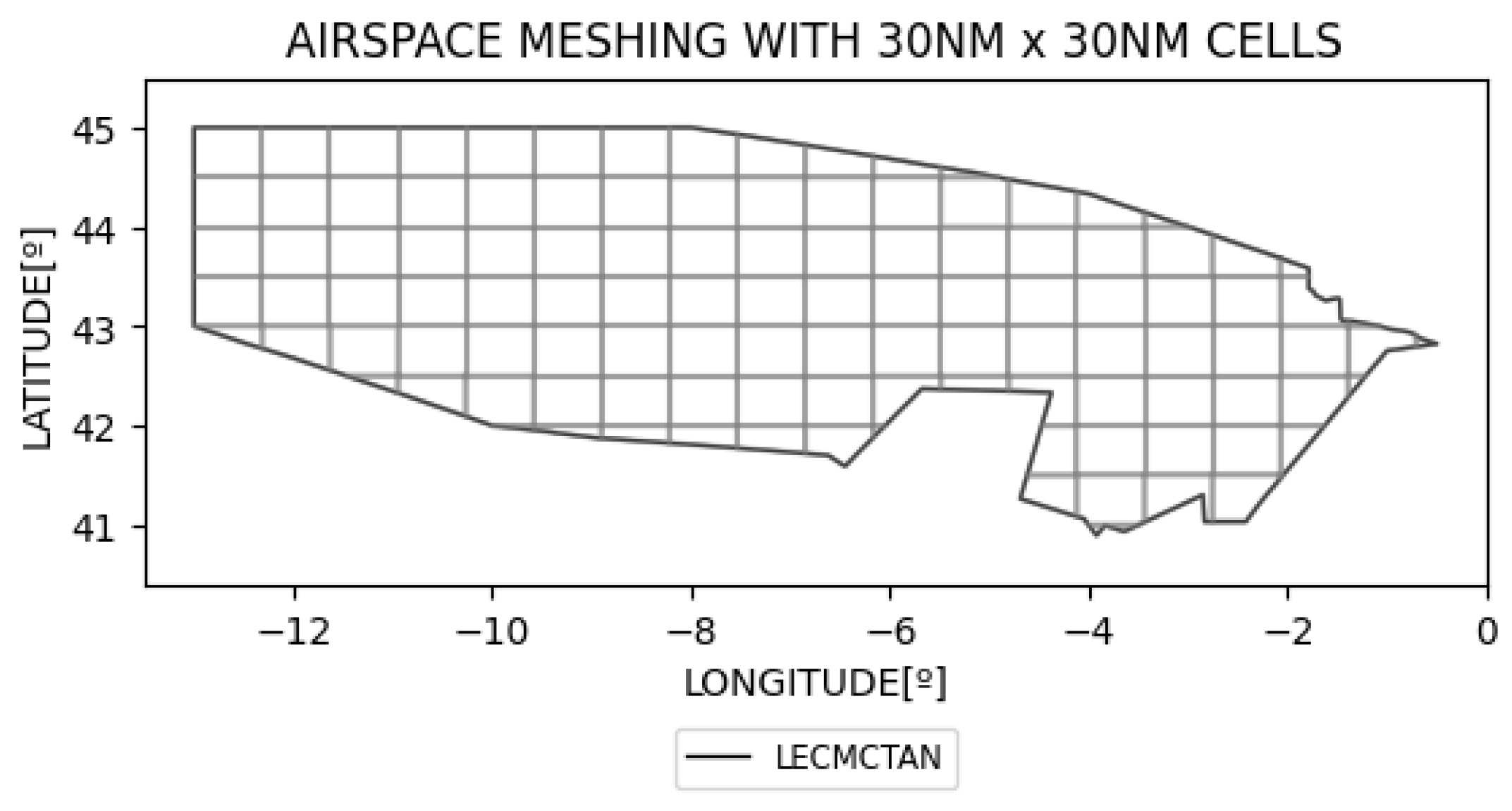
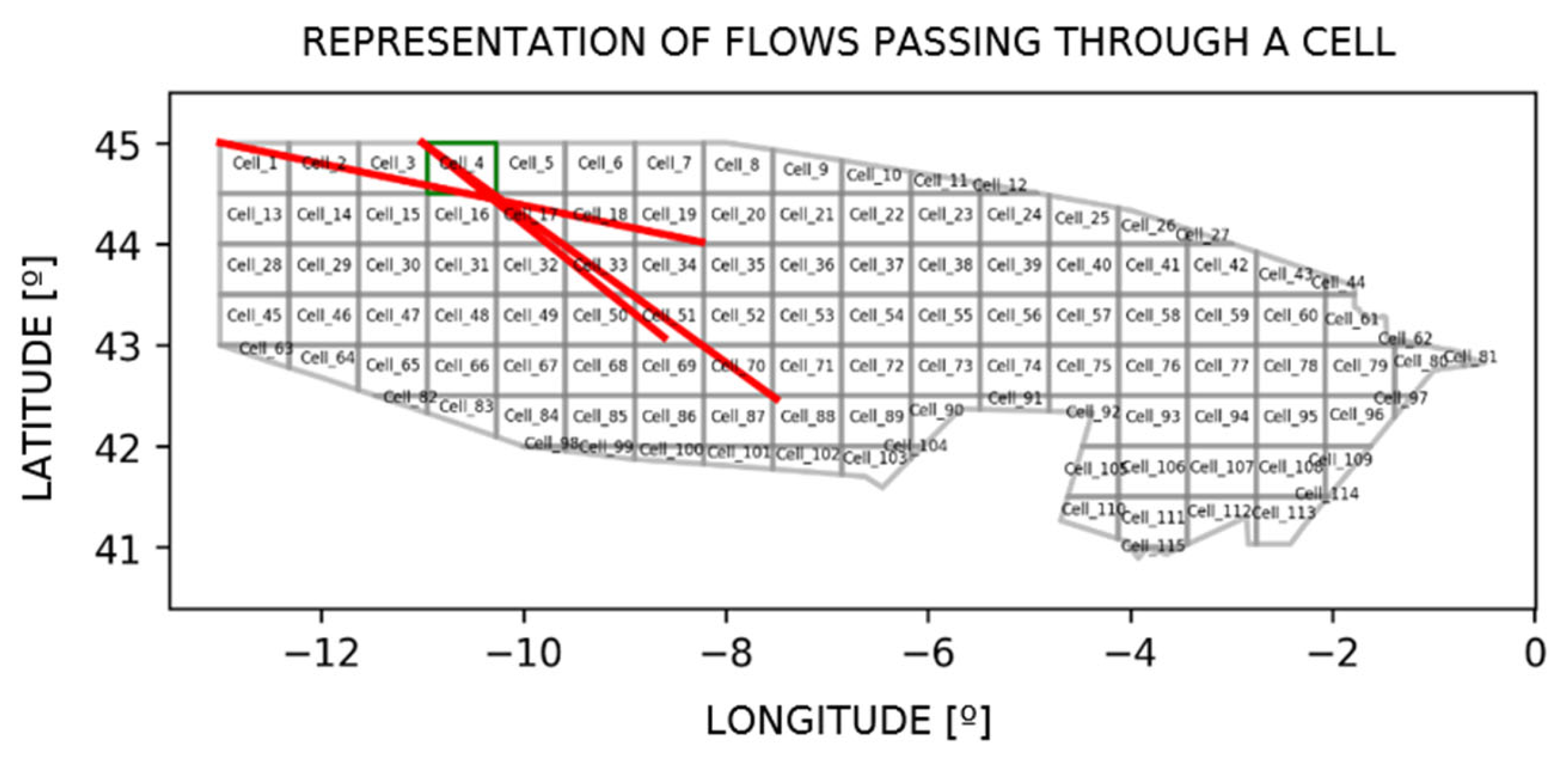
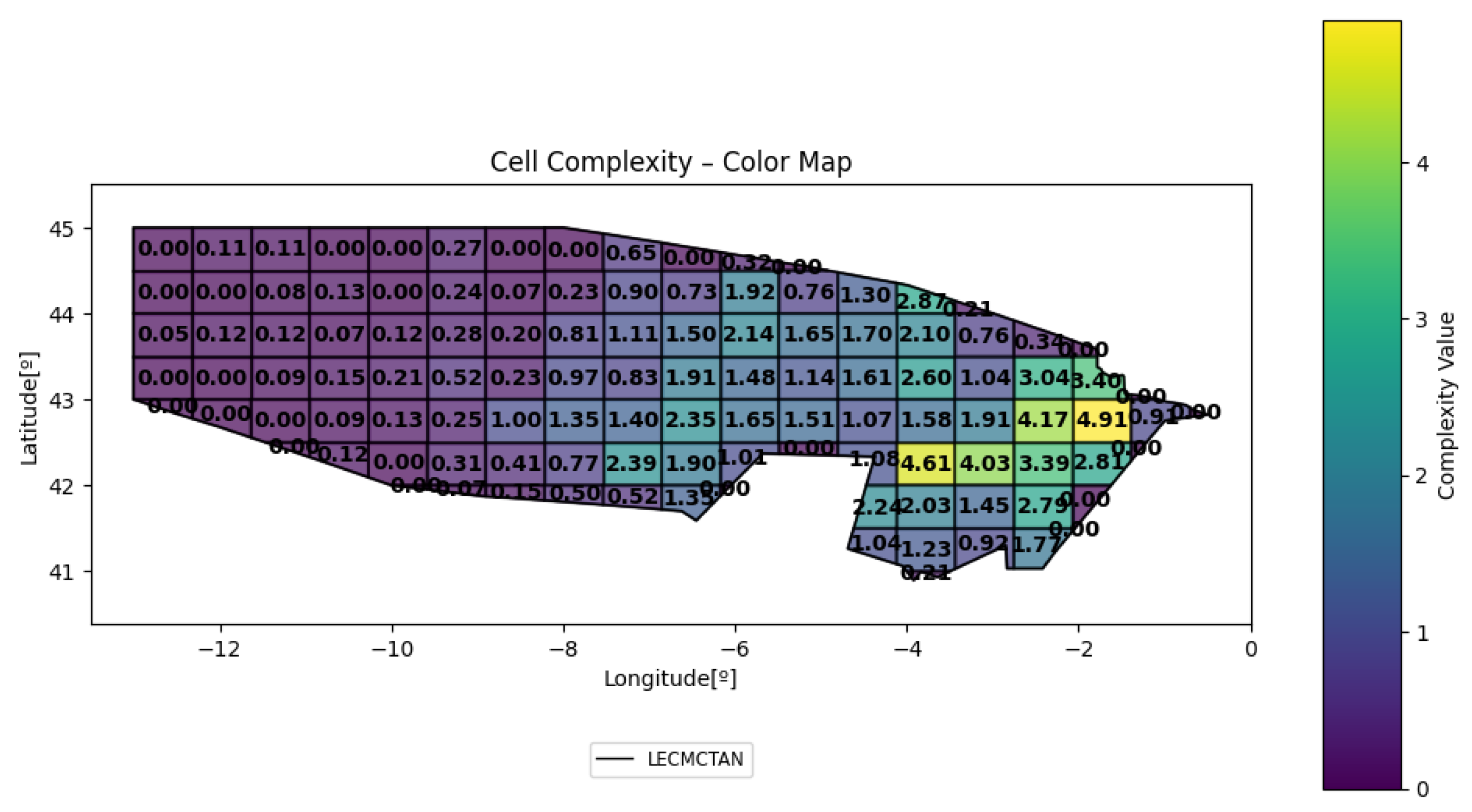
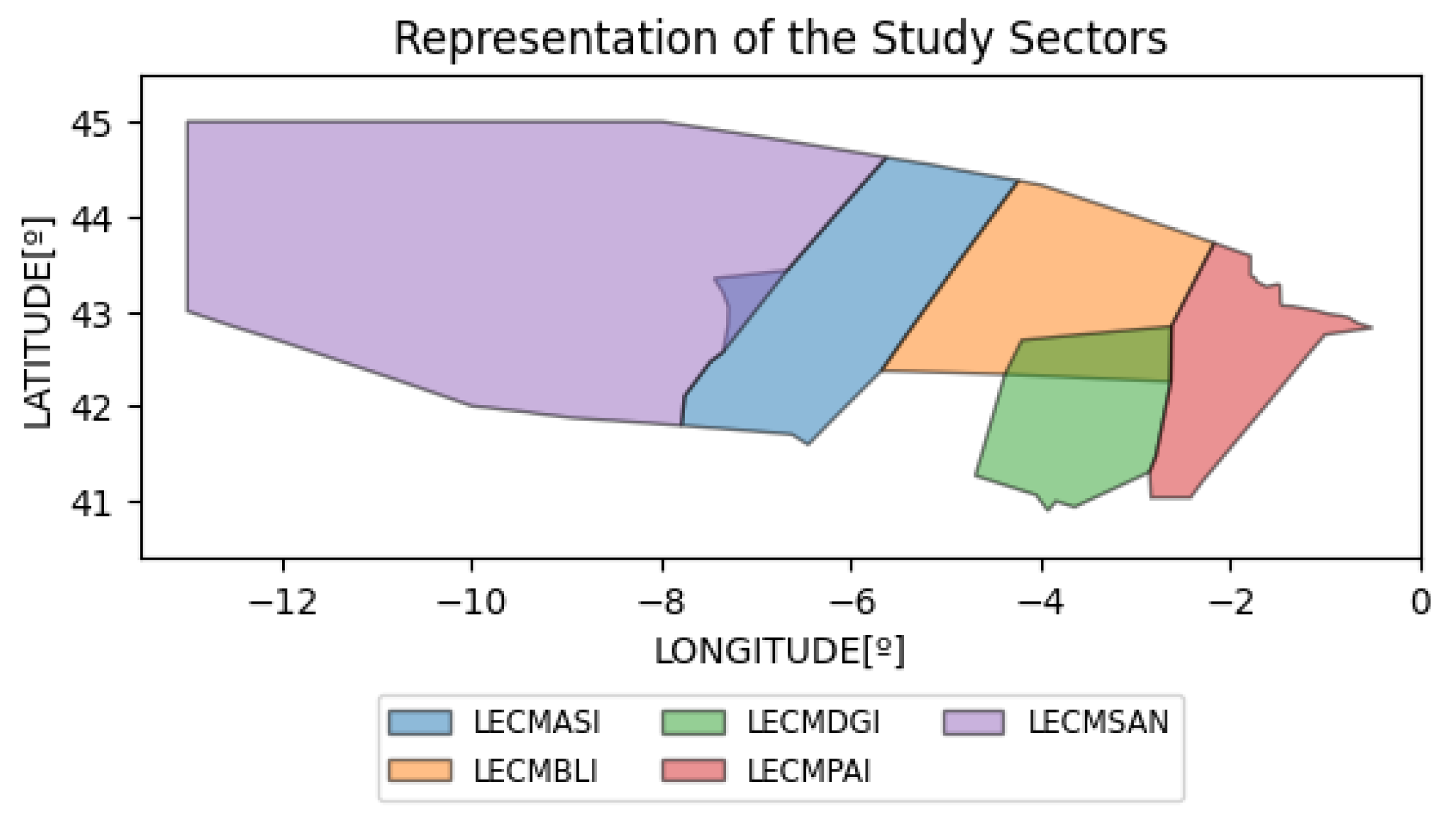
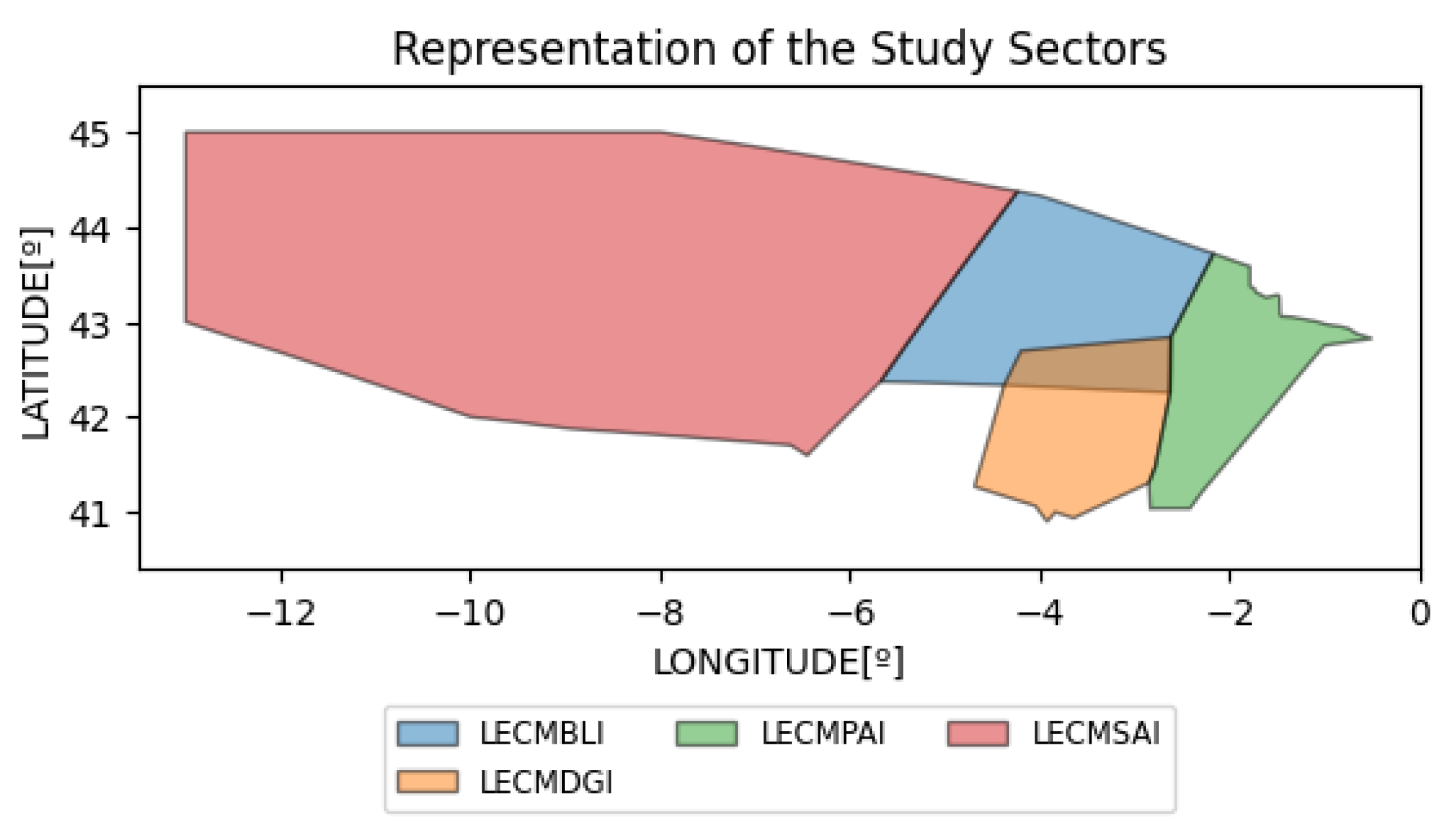
- Grid and input data: Each cell is defined by its polygon and a previously calculated complexity value. The “real” sector configuration is also available and always serves as the starting point for the optimizations.
- Initial assignment: Each cell is assigned to its “real” sector by computing the polygon intersections and choosing the sector with the largest intersection area
- Adjacency-graph construction: Each cell is a node, and two nodes are connected if they share an edge. Because the imposed connectivity criterion is edge-based (to avoid cells connected only at a vertex or disconnected “jumps” in the sectorization), neighboring cells must share a full edge.
- Objective function definition: The main objective function combines (i) the sample variance of complexity across sectors—this criteria drives an even distribution of complexity—and (ii) the difference between the maximum and minimum sector complexity—this criteria pushes the algorithm to lower the complexity of the busiest sector while increasing that of the least loaded one. Both variables are of the same order of magnitude, so normalization is unnecessary.
- Optimization: A new assignment of cells to sectors is sought to balance total complexity among sectors by minimizing the objective function. This is accomplished by transferring cells between sectors while respecting the connectivity constraints described above.
2.2.2. Global Optimization Constraints
- Movement of border cells: Only cells that have at least one neighboring cell in a different sector are considered move candidates, so as not to break internal continuity. In other words, only cells sharing an edge with two or three sectors at once can be moved. Cells located in the core of a sector cannot be moved, preventing cell “jumps” or discontinuous sectorizations. Let:
- ◦
- c ∈ C: a cell from the total set of cells.
- ◦
- S(c): sector to which cell c belongs.
- ◦
- N(c): set of neighboring cells of c.
- ◦
- Cell c may be considered for relocation if and only if:
- Movement to adjacent sectors: For every cell on a sector boundary, the only sectors it may belong to during optimization are those of its neighboring cells in the graph. The algorithm identifies boundary cells and transfers a cell only to one of the sectors with which it shares an edge.
- ◦
- New sector assignment must therefore satisfy:
- Valid neighborhood: Ensures that every move preserves edge contact between the moved cell and the sector it departs from. In this way, sector connectivity is maintained even after cells are reassigned. Let
- ◦
- After the change, for the neighborhood to remain valid
- Preserved connectivity: Checks that, after moving a cell, both sectors—the one that absorbs the cell and the one that loses it—remain connected. This ensures that cell transfers maintain the desired spatial continuity. Let
- ◦
- Being Cs ⊆ C the set of cells in the sector and S and Es the set of edges between neighboring cells inside S. After moving cell c, both the source sector and the destination sector must still satisfy that their graphs and are connected. In other words, the number of connected components must remain equal to 1:
- Limit on changes per sector: Caps the number of cells that can be removed from each original sector. This is a tunable decision parameter. Let
- ◦
- ∆S: be the number of cells that have left sector S
- ◦
- be the maximum number of cells allowed to leave sector S
2.2.3. Implementation of the Sector-Optimization Algorithm
2.2.4. Additional Cell-Movement Step with Geometric Considerations
3. Results
3.1. Optimization Using Individual Cells
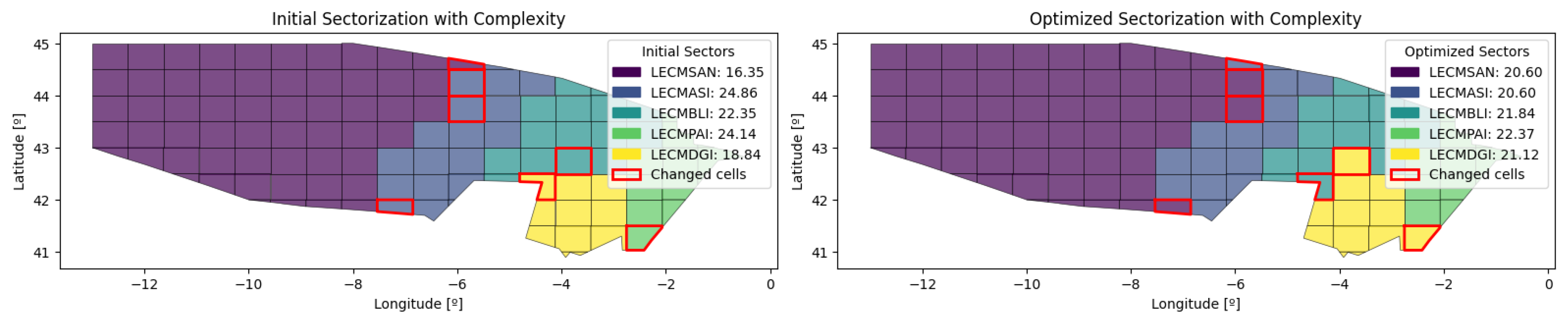
3.1.1. Optimization Results for a Five-Sector Configuration with One Allowed Cell Change per Sector
3.1.2. Optimization Results for a Five-Sector Configuration with up to Five Allowed Cell Changes per Sector
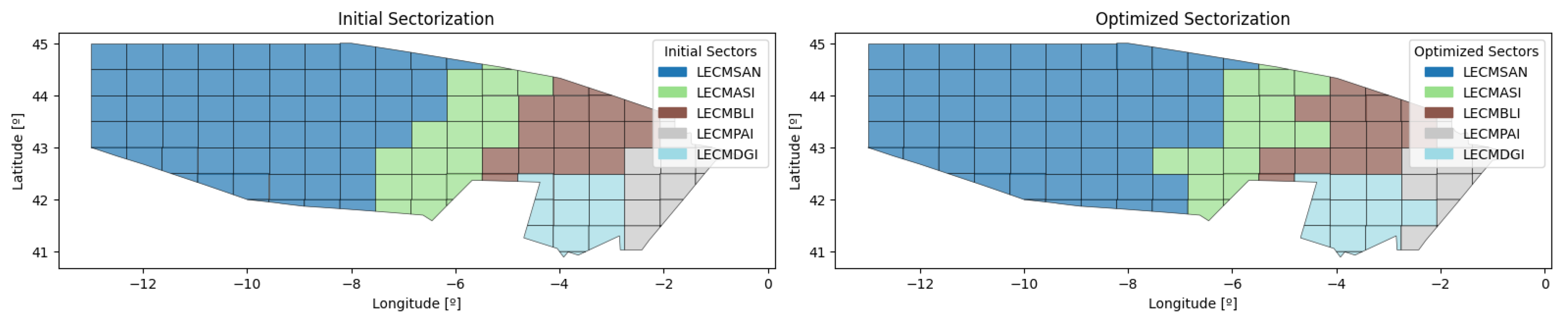
3.1.3. Optimization Results for a Five-Sector Configuration with up to Ten Allowed Cell Changes per Sector
3.1.4. Optimization Results for a Four-Sector Configuration with up to Ten Allowed Cell Changes per Sector
3.2. Sector Optimization with Geometric Considerations
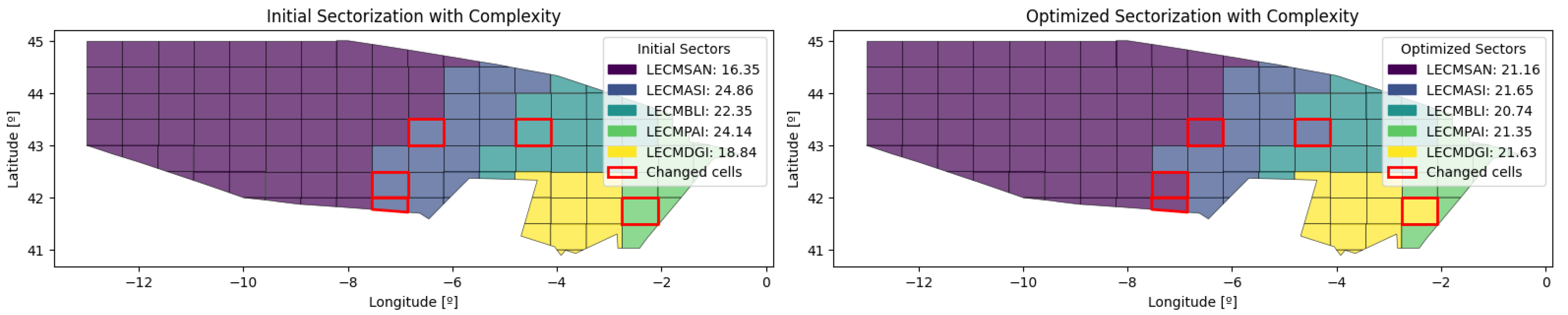
3.2.1. Result of the Adjacent-Cell-Pair Optimization for an Initial Five-Sector Configuration
3.2.2. Result of the Adjacent-Cell-Pair Optimization for an Initial Four-Sector Configuration
3.2.3. Result of the Adjacent-Cell-Pair Optimization for an Initial Three-Sector Configuration
4. Discussion
4.1. Effectiveness of Complexity-Based Sector Optimization
4.2. Trade-Off Between Complexity Optimization and Geometric Coherence
4.3. Influence of Sector Count and Operational Context
4.4. Implications for Static and Dynamic Airspace Design
5. Conclusions
- Sector-complexity optimization: The proposed methodology effectively distributes complexity among sectors, minimizing the gap between the most- and least-complex sectors. This improvement is most pronounced when geometric constraints are relaxed and a larger number of cell transfers is allowed.
- Complexity–geometry trade-off: A clear trade-off exists between optimizing complexity and preserving the geometric coherence of sectors. The more aggressively the objective function is optimized—and the more cells are moved—the greater the tendency to produce geometries that are less compatible with real-world operations, such as “isolated cells” or fragments of one sector surrounded by others.
- More balanced optimization strategies: The strategy of moving pairs of adjacent cells offers the best balance between achieving an efficient complexity distribution and maintaining coherent sector geometry. It prevents isolated cells and keeps sectors compact while still delivering substantial complexity optimization.
- Importance of time-window adaptability: The algorithm can tailor sectorization to real traffic levels in different time windows. For instance, during low-demand periods (e.g., 2–3 a.m.), it may be feasible to operate with fewer optimized sectors. Operational realities must always be considered when interpreting results: if day-to-day operations normally use nine sectors and the optimization begins from a configuration with only two sectors, the resulting complexity values will be extremely high, rendering that analysis meaningless.
- Practical applications: The algorithm is useful not only for handling high-complexity situations but also for improving day-to-day efficiency by distributing workload more fairly across sectors—even under less demanding conditions. By limiting the maximum number of cells that may be moved between sectors, it additionally supports pre-emptive aircraft-control actions.
- Explore alternative optimization algorithms that could improve solution quality and reduce computation times.
- Extend the current two-dimensional framework toward a layered three-dimensional approach, progressively incorporating vertical stratification and flight-level-dependent sectorization.
- Investigate the most suitable cell size to balance geometric precision and computational cost. Future work will also explore the definition of quantitative geometric and operational indicators—such as sector compactness or isolated-cell metrics—to complement the qualitative assessment of operational robustness presented in this study.
- Include the explicit reporting of aggregated optimization metrics (minimum, maximum, and variance of sector complexity), together with a detailed analysis of computational performance for both complexity calculation and optimization, in order to assess scalability and suitability for pre-tactical applications.
- Conduct multi-scenario validations, including different ACCs, time periods, and higher-complexity traffic conditions, to evaluate the behavior of the methodology under more demanding operational settings and to assess its applicability to dynamic airspace configuration (DAC) contexts.
Author Contributions
Funding
Data Availability Statement
Acknowledgments
Conflicts of Interest
References
- Xia, H.; Yao, W.; Zheng, Y.; Zhang, C.; Jiang, C. Airport Capacity Prediction and Optimization Based on Semi-Varying Coefficient and Dynamic Programming. IEEE Access 2025, 13, 67908–67924. [Google Scholar] [CrossRef]
- Antulov-Fantulin, B.; Juričić, B.; Radišić, T.; Çetek, C. Determining Air Traffic Complexity—Challenges and Future Development. Promet—Traffic Transp. 2020, 32, 475–485. [Google Scholar] [CrossRef]
- dos Santos, R.; Rocha Murça, M. Airport capacity prediction and optimal allocation for strategic air traffic flow management at Sao Paulo/Guarulhos International Airport. Case Stud. Transp. Policy 2025, 20, 101414. [Google Scholar] [CrossRef]
- Mogford, R.H.; Guttman, J.A.; Morrow, S.L.; Kopardekar, P. The Complexity Construct in Air Traffic Control: A Review and Synthesis of the Literature; CTA Incorporated: McKee City, NJ, USA, 1995. Available online: https://hf.tc.faa.gov/publications/1995-the-complexity-construct-in-air-traffic-control/full_text.pdf (accessed on 28 November 2025).
- Schultz, M.; Lubig, D.; Asadi, E.; Rosenow, J.; Itoh, E.; Athota, S. Implementation of a Long-Range Air Traffic Flow Management for the Asia-Pacific Region. IEEE Access 2021, 9, 124640–124659. [Google Scholar] [CrossRef]
- Ma, C.; Guleria, Y.; Alam, S.; Li, M. Deep reinforcement learning-based air traffic flow coordination in flow-centric airspace. Adv. Eng. Inform. 2025, 65, 103342. [Google Scholar] [CrossRef]
- Balakrishnan, H.; Chandran, B. Optimal Large-Scale Air Traffic Flow Management; Massachusetts Institute of Technology: Cambridge, MA, USA, 2014; Available online: https://www.mit.edu/~hamsa/pubs/BalakrishnanChandran_ATFM.pdf (accessed on 2 December 2025).
- Gómez, S.; Goron, A.; Groza, A.; Letia, I. Assuring safety in air traffic control systems with argumentation and model checking. Expert Syst. Appl. 2016, 44, 367–385. [Google Scholar] [CrossRef]
- Hilburn, B. Cognitive Complexity in Air Traffic Control: A Literature Review; Center for Human Performance Research: Houston, TX, USA, 2004. [Google Scholar]
- Xia, Z.; Chen, C.; Hsieh, M.; Ma, G.; Liu, B.; Yu, X.; Xin, S.; Dong, L. A systematic review on human-AI hybrid systems and human factors in air traffic management. J. Eng. Des. 2025, 1–49. Available online: https://www.tandfonline.com/doi/full/10.1080/09544828.2025.2509056?af=R (accessed on 3 December 2025). [CrossRef]
- Zou, X.; Cheng, P.; An, B.; Song, J. Sectorization and Configuration Transition in Airspace Design. Math. Probl. Eng. 2016, 2016, 6048326. [Google Scholar] [CrossRef]
- Hind, H.; Omri, A.; Abghour, N.; Moussaid, K.; Rida, M. Dynamic airspace configuration: Review and open research issues. In Proceedings of the 2018 4th International Conference on Logistics Operations Management (GOL), Le Havre, France, 10–12 April 2018; pp. 1–7. Available online: https://ieeexplore.ieee.org/document/8378093 (accessed on 30 November 2025).
- Xu, C.; Zhang, K.; Liu, D.; Song, H. Trust of Airspace Configuration Transition Concerning the Fluctuation of Air Traffic. In Proceedings of the 2021 IEEE/AIAA 40th Digital Avionics Systems Conference (DASC), San Antonio, TX, USA, 3–7 October 2021; pp. 1–7. Available online: https://ieeexplore.ieee.org/document/9594393 (accessed on 15 November 2025).
- Xu, Y.; Prats, X.; Delahaye, D. Synchronised demand-capacity balancing in collaborative air traffic flow management. Transp. Res. Part C Emerg. Technol. 2020, 114, 359–376. [Google Scholar] [CrossRef]
- Memon, S.; Kim, M.; Shin, M.; Son, H. Dynamic based trajectory estimation and tracking in an uncertain environment. Expert Syst. Appl. 2021, 177, 114919. [Google Scholar] [CrossRef]
- Xuhao, G.; Junfeng, Z.; Zihan, P. Trajectory clustering for arrival aircraft via new trajectory representation. J. Syst. Eng. Electron. 2021, 32, 473–496. [Google Scholar] [CrossRef]
- Pérez Moreno, F.; Gómez Comendador, V.; Delgado-Aguilera Jurado, R.; Zamarreño Suárez, M.; Janisch, D.; Arnaldo Valdés, R. Methodology of air traffic flow clustering and 3-D prediction of air traffic density in ATC sectors based on machine learning models. Expert Syst. Appl. 2023, 223, 119897. [Google Scholar] [CrossRef]
- Pérez Moreno, F.; Ibáñez Rodríguez, F.; Gómez Comendador, V.; Delgado-Aguilera Jurado, R.; Zamarreño Suárez, M.; Arnaldo Valdés, R. Prediction of air traffic complexity through a dynamic complexity indicator and machine learning models. J. Air Transp. Manag. 2024, 119, 102632. [Google Scholar] [CrossRef]
- Xiao, M.; Zhang, J.; Cai, K.; Cao, X. ATCEM: A synthetic model for evaluating air traffic complexity. J. Adv. Transp. 2016, 50, 315–325. [Google Scholar] [CrossRef]
- Jurinic, T.; Juricic, B.; Antulov-Fantulin, B.; Samardzic, K. Defining Terminal Airspace Air Traffic Complexity Indicators Based on Air Traffic Controller Tasks. Aerospace 2024, 11, 367. [Google Scholar] [CrossRef]
- Brázdilová, S.; Cásek, P.; Kubalčík, J. Air traffic complexity for a distributed air traffic management system. Proc. Inst. Mech. Eng. Part G J. Aerosp. Eng. 2011, 225, 665–674. [Google Scholar] [CrossRef]
- Kopardekar, P.; Schwartz, A.; Magyarits, S.; Rhodes, J. Airspace Complexity Measurement: An Air Traffic Control Simulation Analysis. Int. J. Ind. Eng.-Theory Appl. Pract. 2009, 16, 61–70. [Google Scholar]
- Göppel, S.; Schultz, M.; Itoh, E. Complexity Metrics for Moving Sectors. IEEE Access 2024, 12, 139181–139198. [Google Scholar] [CrossRef]
- Wang, H.; Song, Z.; Wen, R.; Zhao, Y. Study on evolution characteristics of air traffic situation complexity based on complex network theory. Aerosp. Sci. Technol. 2016, 58, 518–528. [Google Scholar] [CrossRef]
- Pérez Moreno, F.; Gómez Comendador, V.; Delgado-Aguilera Jurado, R.; M. Zamarreño Suárez, M.; Janisch, D.; Arnaldo Valdés, R. Determination of Air Traffic Complexity Most Influential Parameters Based on Machine Learning Models. Symmetry 2022, 14, 2629. [Google Scholar] [CrossRef]
- Klein, A.; Rodgers, M.; Keing, H. Dynamic FPAs: A new method for dynamic airspace configuration. In Proceedings of the 2008 Integrated Communications, Navigation and Surveillance Conference, Bethesda, MD, USA, 5–7 May 2008; pp. 1–11. Available online: https://ieeexplore.ieee.org/document/4559176 (accessed on 14 November 2025).
- Seergeva, M.; Delahaye, D.; Mancel, C.; Vidosavljevic, A. Dynamic airspace configuration by genetic algorithm. J. Traffic Transp. Eng. 2017, 4, 300–314. [Google Scholar] [CrossRef]
- Pérez Moreno, F.; Gómez Comendador, V.; Delgado-Aguilera Jurado, R.; Zamarreño Suárez, M.; Janisch, D.; Arnaldo Valdés, R. Dynamic model to characterise sectors using machine learning techniques. Aircr. Eng. Aerosp. Technol. 2022, 94, 1537–1545. [Google Scholar] [CrossRef]
- Criscuolo, P.; Perrotta, L.; Di Bitonto, G.; Grani, G. Enhanced Dynamic Airspace Configuration Algorithm. In Proceedings of the SESAR Innovation Days 2024, Rome, Italy, 12–15 November 2024; Available online: https://www.sesarju.eu/sites/default/files/documents/sid/2024/papers/SIDs_2024_paper_053%20final.pdf (accessed on 4 November 2025).
- Ibáñez-Gijón, J.; Travieso, D.; Navia, J.; Montes, A.; Jacobs, D.; Frutos, P. Experimental Validation of COMETA Model of Mental Workload in Air Traffic Control. J. Air Transp. Manag. 2024, 108, 102378. [Google Scholar] [CrossRef]
- López de Frutos, P.; Rodríguez Rodríguez, R.; Zheng Zhang, D.; Zheng, S.; Cañas, J.; Muñoz de Escalona, E. COMETA: An Air Traffic Controller’s Mental Workload Model for Calculating and Predicting Demand and Capacity Balancing. In Lecture Notes in Computer Science (LNCS); Springer: Berlin/Heidelberg, Germany, 2020; pp. 5–7. [Google Scholar]
- Fiduccia, C.; Mattheyses, R. A Linear-time Heuristic for Improving Network Partitions. In Proceedings of the 19th Design Automation Conference (DAC), Las Vegas, NV, USA, 14–16 June 1982; pp. 175–181. Available online: https://limsk.ece.gatech.edu/course/ece6133/papers/fm.pdf (accessed on 19 November 2025).
- Schulz, C. High Quality Graph Partitioning; Karlsruhe Institute of Technology (KIT): Karlsruhe, Germany, 2013; Available online: https://publikationen.bibliothek.kit.edu/1000035713 (accessed on 24 November 2025).
- D. Blondel, V.; Guillaume, J.; Lambiotte, R.; Lefebvre, E. Fast unfolding of communities in large networks. arXiv 2008, arXiv:0803.0476. [Google Scholar] [CrossRef]
- Gendreau, M.; Potvin, J. Handbook of Metaheuristics; Springer: Berlin/Heidelberg, Germany, 2010. [Google Scholar]




Disclaimer/Publisher’s Note: The statements, opinions and data contained in all publications are solely those of the individual author(s) and contributor(s) and not of MDPI and/or the editor(s). MDPI and/or the editor(s) disclaim responsibility for any injury to people or property resulting from any ideas, methods, instructions or products referred to in the content. |
© 2026 by the authors. Licensee MDPI, Basel, Switzerland. This article is an open access article distributed under the terms and conditions of the Creative Commons Attribution (CC BY) license.
Share and Cite
Gómez Arnaldo, C.; Arroyo López, J.M.; Delgado-Aguilera Jurado, R.; Zamarreño Suárez, M.; Pérez Castán, J.A.; Pérez Moreno, F. Cell-Based Optimization of Air Traffic Control Sector Boundaries Using Traffic Complexity. Aerospace 2026, 13, 101. https://doi.org/10.3390/aerospace13010101
Gómez Arnaldo C, Arroyo López JM, Delgado-Aguilera Jurado R, Zamarreño Suárez M, Pérez Castán JA, Pérez Moreno F. Cell-Based Optimization of Air Traffic Control Sector Boundaries Using Traffic Complexity. Aerospace. 2026; 13(1):101. https://doi.org/10.3390/aerospace13010101
Chicago/Turabian StyleGómez Arnaldo, César, José María Arroyo López, Raquel Delgado-Aguilera Jurado, María Zamarreño Suárez, Javier Alberto Pérez Castán, and Francisco Pérez Moreno. 2026. "Cell-Based Optimization of Air Traffic Control Sector Boundaries Using Traffic Complexity" Aerospace 13, no. 1: 101. https://doi.org/10.3390/aerospace13010101
APA StyleGómez Arnaldo, C., Arroyo López, J. M., Delgado-Aguilera Jurado, R., Zamarreño Suárez, M., Pérez Castán, J. A., & Pérez Moreno, F. (2026). Cell-Based Optimization of Air Traffic Control Sector Boundaries Using Traffic Complexity. Aerospace, 13(1), 101. https://doi.org/10.3390/aerospace13010101