Adaptive Robust Cubature Filtering-Based Autonomous Navigation for Cislunar Spacecraft Using Inter-Satellite Ranging and Angle Data


Abstract
1. Introduction
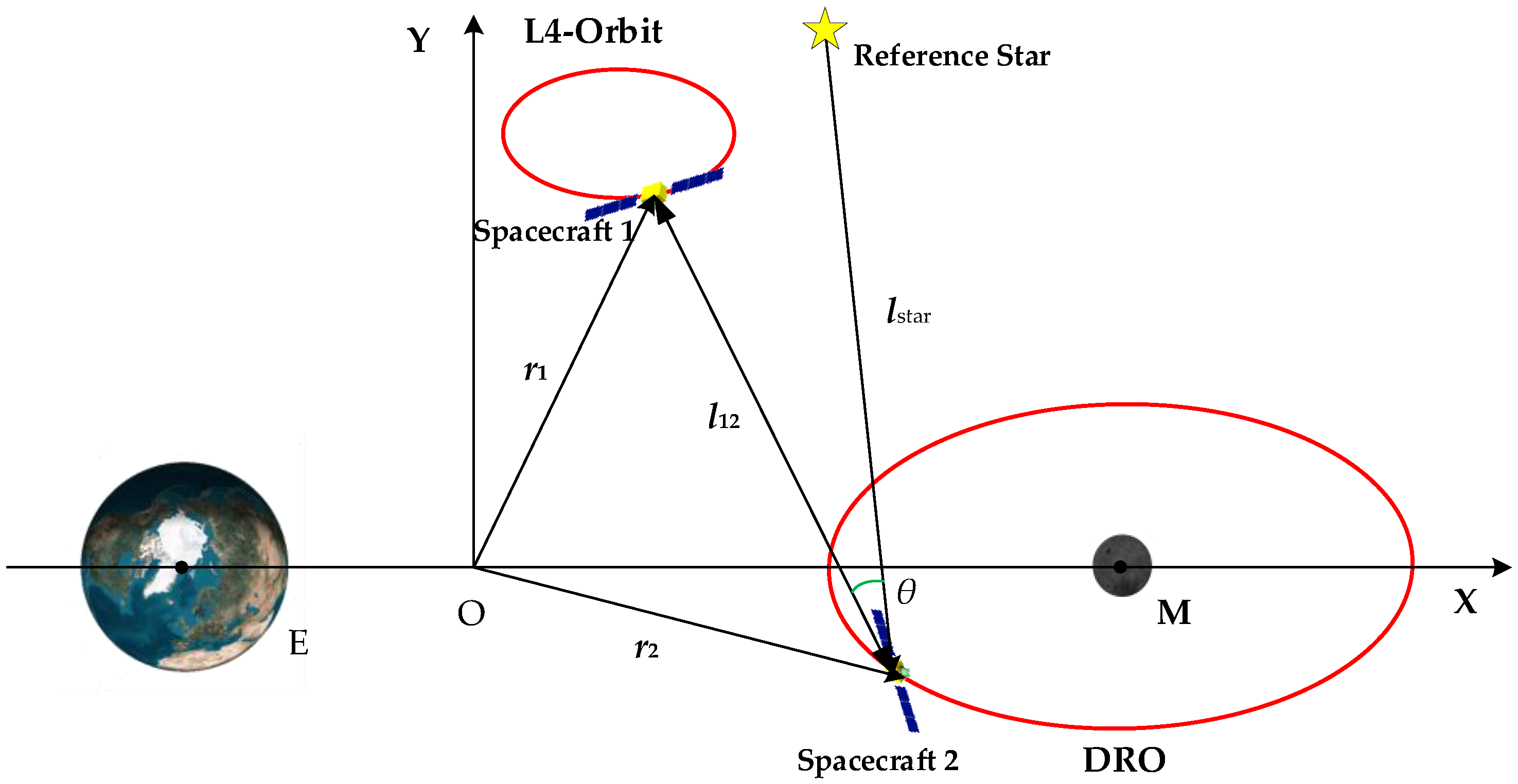
- An autonomous navigation method for two near-coplanar Earth–Moon spacecraft: Based on the LiAISON framework, the proposed method combines inter-satellite ranging with inter-satellite stellar background angle measurement. By incorporating angular observations, it addresses the challenge of achieving high-precision state estimation for two spacecraft in near-coplanar orbits.
- Improved convergence speed of the navigation filter: Compared to the conventional LiAISON method and the standard ARCKF, the proposed navigation scheme and algorithm significantly reduce the convergence time of state estimation errors. This is achieved by augmenting the measurement set with angular data and adaptively tuning the forgetting factor for process noise covariance estimation via a chi-square test.
- Enhanced robustness of the navigation algorithm: Relative to the standard ARCKF, the improved method further strengthens the filter’s ability to suppress measurement anomalies. By adjusting the forgetting factor adaptively based on the chi-square test, it mitigates filter fluctuations caused by abnormal measurements and increases overall operational stability.
2. System Model for Orbit Determination
2.1. State Equation
2.2. Measurement Equation
2.2.1. Dual One-Way Ranging
2.2.2. Astronometric Angle Measurement
3. Filtering Algorithm
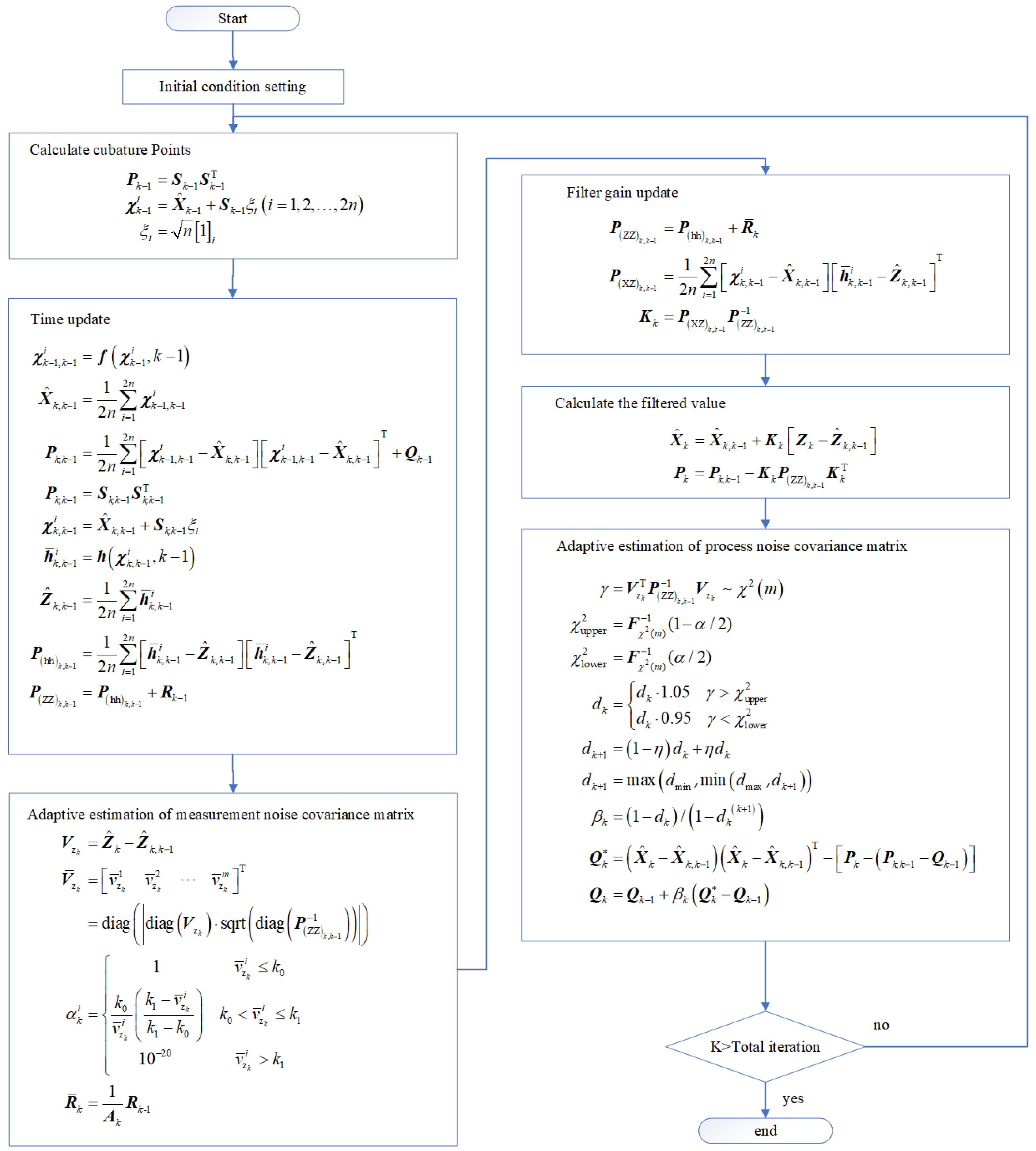
3.1. Cubature Kalman Filter
- (1)
- Set initial parameters , , , and .
- (2)
- Calculate the volume point at k − 1 based on volume transformation.
- (3)
- Time update:
- (4)
- Filter gain update:
- (5)
- Calculate filter value:
3.2. Enhanced Adaptive Robust Cubature Kalman Filter
4. Observability Theory
5. Simulation Results and Analysis
5.1. Simulation Conditions and Parameter Selection
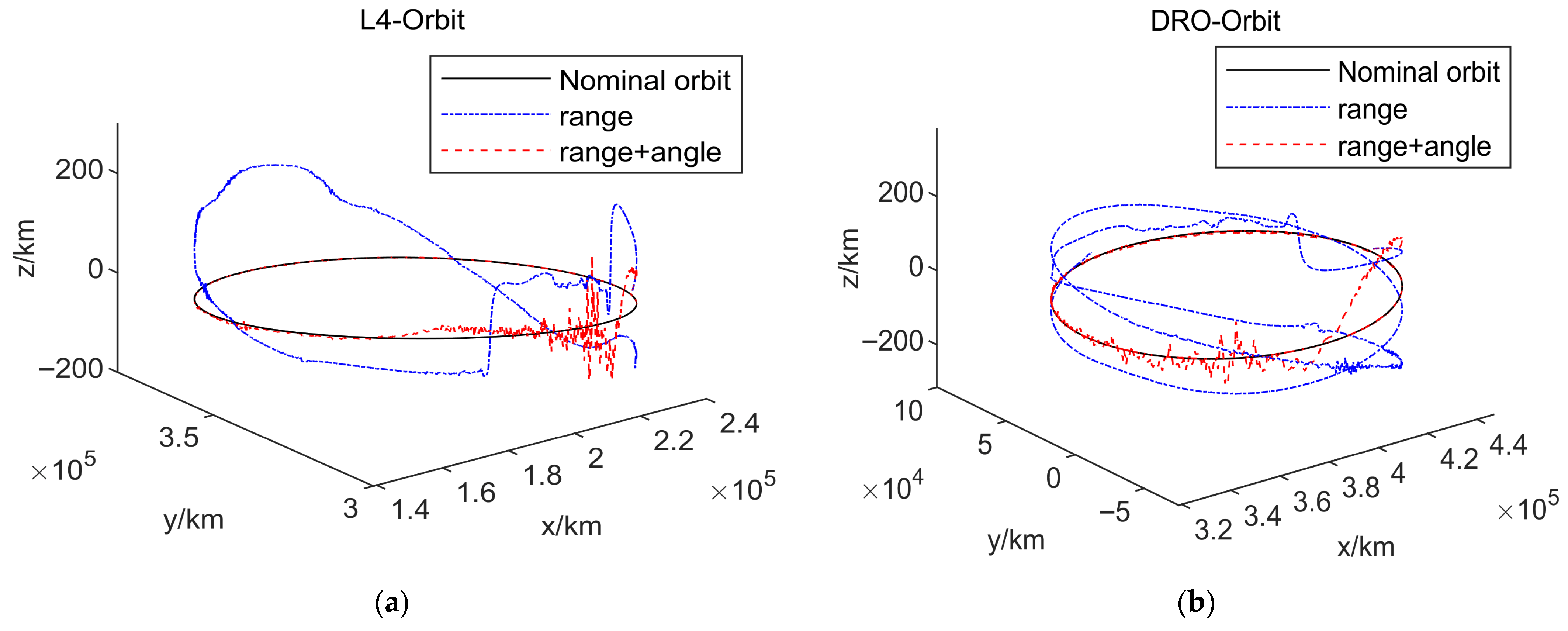
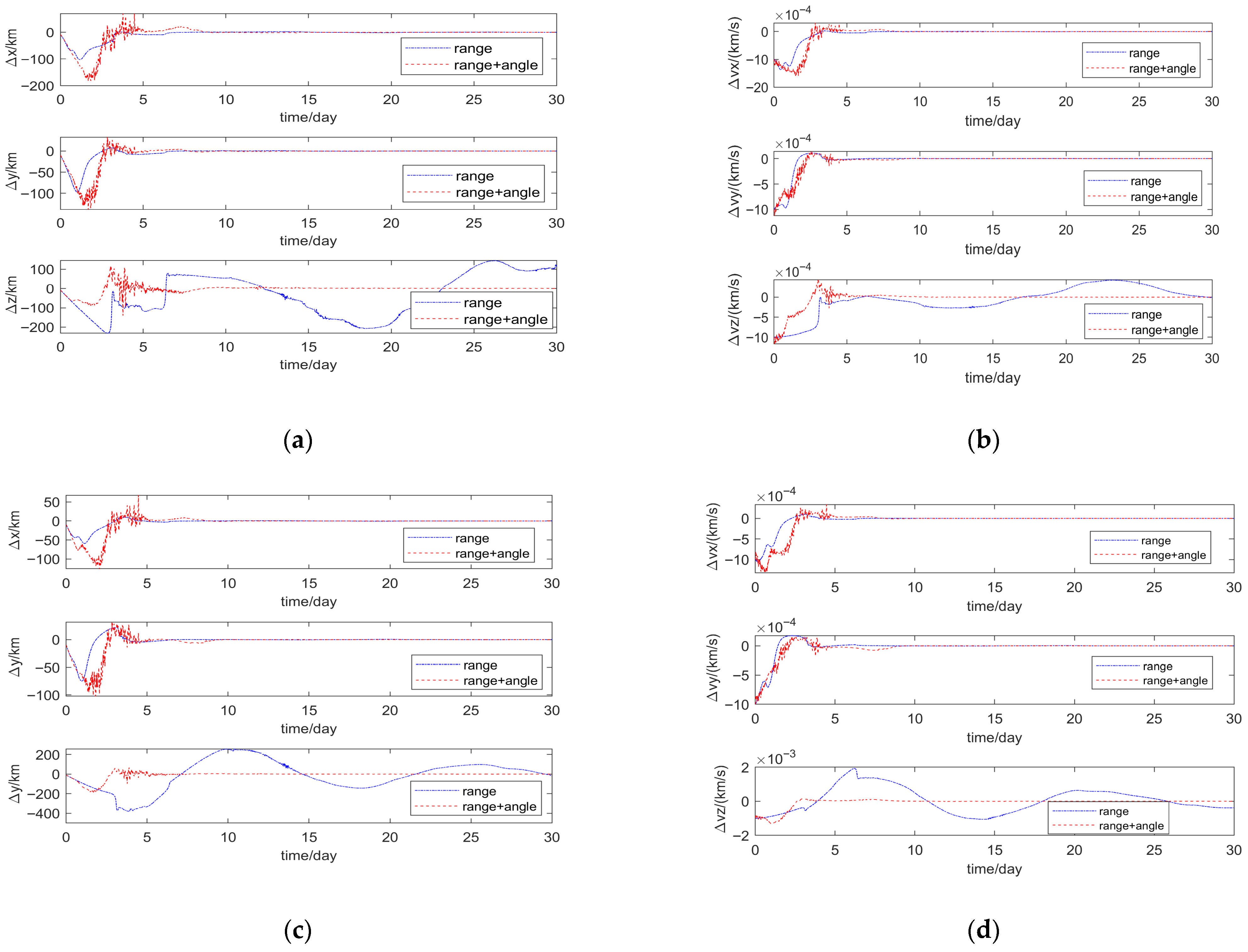
5.2. Simulation Results
5.2.1. Accuracy Analysis of Method
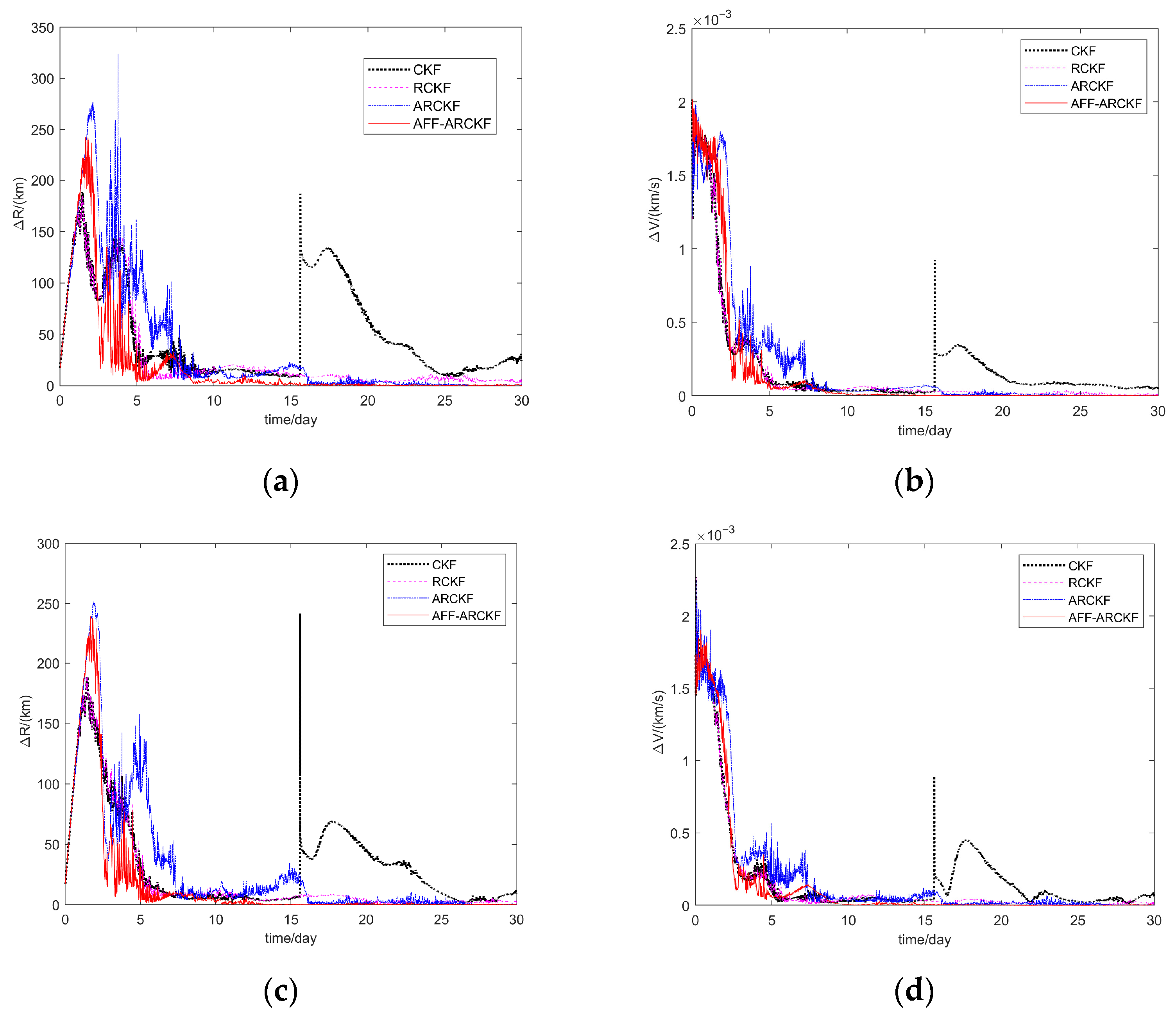
5.2.2. Comparative Analysis of Algorithm Performance
5.2.3. Analysis of Factors Influencing Algorithm Performance
- (1)
- Impact of Initial Errors
- (2)
- Impact of Initial Forgetting Factor
6. Conclusions
Author Contributions
Funding
Data Availability Statement
Conflicts of Interest
References
- Hill, K.A. Autonomous Navigation in Libration Point Orbits. Ph.D. Thesis, University of Colorado at Boulder, Boulder, CO, USA, 2007. [Google Scholar]
- Thompson, M.R.; Forsman, A.; Chikine, S.; Peters, B.C.; Ely, T.; Sorensen, D.; Parker, J.; Cheetham, B. Cislunar Navigation Technology Demonstrations on the CAPSTONE Mission. In Proceedings of the 2022 International Technical Meeting of The Institute of Navigation, Long Beach, CA, USA, 24–27 January 2022; The Institute of Navigation: Manassas, VA, USA, 2022; pp. 471–484. [Google Scholar]
- Hill, K.A.; Born, G.H. Autonomous Orbit Determination from Lunar Halo Orbits Using Crosslink Range. J. Spacecr. Rocket. 2008, 45, 548–553. [Google Scholar] [CrossRef]
- Wang, K.; Li, K.; Lv, S.; Jiao, Y.; Shen, Y.; Yue, Z.; Xu, K. Multi-orbit Lunar GNSS Constellation Design with Distant Retrograde Orbit and Halo Orbit Combination. Sci. Rep. 2023, 13, 10158. [Google Scholar] [CrossRef]
- Yong, H.; Peng, Y.; Chen, Y.L.; Li, P.J.; Zhou, S.; Tang, C.; Hu, X. Cislunar space probes orbit determination using Inter-Satellite Link data. Sci. China Phys. Mech. Astron. 2023, 53, 128–140. [Google Scholar]
- Li, S.; Mikhaylov, M.; Mikhaylov, N. Deep learning based Kalman filter for GNSS/INS integration: Neural network architecture and feature selection. In Proceedings of the 2023 International Conference on Localization and GNSS (ICL-GNSS), Castellón, Spain, 6–8 June 2023; IEEE: New York, NY, USA, 2023; pp. 1–7. [Google Scholar]
- Sun, Z.; Song, H.; Zhou, M.; Yin, H.; Dong, H. Integrating GNSS and INS Data with Deep Learning-Enhanced Invariant Extended Kalman Filter for Train Localization. In Proceedings of the 2024 43rd Chinese Control Conference (CCC), Kunming, China, 28–31 July 2024; pp. 8975–8980. [Google Scholar]
- Gao, X.L.; Luo, H.Y.; Ning, B.; Zhao, F.; Bao, L.; Gong, Y.; Xiao, Y.; Jiang, J. RL-AKF: An adaptive Kalman filter navigation algorithm basedon reinforcement learning for ground vehicles. Remote Sens. 2020, 12, 1704. [Google Scholar] [CrossRef]
- Fraser, C.T.; Ulrich, S. Adaptive extended Kalman filtering strategies for spacecraft formation relative navigation. Acta Astronaut. 2021, 178, 700–721. [Google Scholar] [CrossRef]
- Yang, Y.; Song, X. Stepwise autonomous orbit determination of large LEO constellations by GNSS observations with partial inter-satellite ranging. Satell. Navig. 2025, 6, 5. [Google Scholar] [CrossRef]
- Zhang, L. Design of the Earth-Moon Libration Point Navigation Satellite Constellation and Navigation Performance Analysis. Ph.D. Thesis, Nanjing University, Nanjing, China, 2016. [Google Scholar]
- Peng, L.; Liang, Y.; He, X. Transfers to Earth-Moon triangular libration points by Sun-perturbed dynamics. Adv. Space Res. 2025, 75, 2837–2855. [Google Scholar] [CrossRef]
- Chen, Y.L.; Hu, X.; Zhou, S.; Song, X.; Huang, Y.; Mao, Y.; Huang, C.; Chang, Z.; Wu, S. A New Autonomous Orbit Determination Algorithm Based on Inter-Satellite Ranging Measurements. Sci. Sin. Phys. Mech. Astron. 2015, 45, 75–82. [Google Scholar] [CrossRef]
- Ning, X.L.; Liang, X.Y.; Wu, W.R.; Fang, J.C. Lunar probe navigation based on celestial angle measurement, one-way radio time-differenced distance and time-differenced velocity measurement. Acta Aeronaut. Astronaut. Sin. 2021, 42, 524531. [Google Scholar]
- Ma, X.; Ning, X.L.; Liu, J. An autonomous celestial navigation method for deep space probe based on coplanar constraint aided measurement. Deep. Space Explor. 2019, 6, 293–300. (In Chinese) [Google Scholar]
- Yuan, L.; Wang, M.M.; Wu, Z.P. Development of space starlight measurement technology: Review. Acta Aeronaut. Astronaut. Sin. 2020, 41, 623724. [Google Scholar]
- Arasaratnam, I.; Haykin, S. Cubature Kalman Filters. IEEE Trans. Autom. Control 2009, 54, 1254–1269. [Google Scholar] [CrossRef]
- Lee, D.J.; Alfriend, K. Adaptive sigma point filtering for state and parameter estimation. In Proceedings of the AIAA/AAS Astrodynamics Specialist Conference and Exhibit, Providence, RI, USA, 16–19 August 2004; AIAA: Reston, VA, USA, 2004. [Google Scholar]
- Da, R. Failure detection of dynamical systems with the state chi-square test. J. Guid. Control Dyn. 1994, 17, 271–277. [Google Scholar] [CrossRef]
- Kong, X.W.; Dong, J.X.; Ji, Q.C. INS observable degree analysis method based on PWCS. J. Chin. Inert. Technol. 2011, 19, 631–792. [Google Scholar]
- Zhou, Y.F. Research on Key Techniques of Autonomous Orbit Determination of User Spacecraft Based on Beidou Inter-Satellite Link. Ph.D. Thesis, National University of Defense Technology, Changsha, China, 2020. [Google Scholar]
- Zhao, L.; Wang, Y.D.; Wei, Z. Space-based optical observations on space debris via multipoint of view. Int. J. Aerosp. Eng. 2020, 2020, 8328405. [Google Scholar] [CrossRef]



| No. | Orbit Type | Initial Orbital State |
|---|---|---|
| 1 | L4 Planar Short-Period Orbit | [0.591560618, 0.806886461, 0, −0.022946517, 0.057017081, 0] |
| 2 | DRO | [1.143936419, 0, 0, 0, −0.471735422, 0] |
| Parameter | Value |
|---|---|
| Simulation Period | 1 January 2024 00:00:00 UTC to 29 February 2024 24:00:00 UTC |
| Step Size | 15 min |
| Initial State Vector X | [0.591560618, 0.806886461, 0, −0.022946517, 0.057017081, 0, 1.143936419, 0, 0, 0, −0.471735422, 0] |
| Initial Position Error (per axis) | 10 km |
| Initial Velocity Error (per axis) | 1 × 10⁻³ km/s |
| Process Noise Covariance Matrix Q | |
| Inter-satellite Ranging Error | 1 m |
| Astrometric Angle Measurement Error | 1″ |
| Initial Position Error (km) | Initial Velocity Error (m/s) | Orbit | Position Error (m) | Velocity Error (m/s) |
|---|---|---|---|---|
| 10 | 1 | L4 | 631.26 | 0.0050 |
| DRO | 229.27 | 0.0018 | ||
| 50 | 1 | L4 | 684.37 | 0.0075 |
| DRO | 256.29 | 0.0022 | ||
| 100 | 1 | L4 | 665.44 | 0.0074 |
| DRO | 265.43 | 0.0026 | ||
| 10 | 10 | L4 | 655.77 | 0.0053 |
| DRO | 255.63 | 0.0019 | ||
| 10 | 100 | L4 | 805.97 | 0.0083 |
| DRO | 376.32 | 0.0025 |
| dk | Orbit | Position Error (m) | Velocity Error (m/s) |
|---|---|---|---|
| 0.3 | L4 | - | - |
| DRO | - | - | |
| 0.6 | L4 | 1070.41 | 0.0026 |
| DRO | 352.5856 | 0.0047 | |
| 0.9 | L4 | 631.26 | 0.0050 |
| DRO | 229.27 | 0.0018 |
Disclaimer/Publisher’s Note: The statements, opinions and data contained in all publications are solely those of the individual author(s) and contributor(s) and not of MDPI and/or the editor(s). MDPI and/or the editor(s) disclaim responsibility for any injury to people or property resulting from any ideas, methods, instructions or products referred to in the content. |
© 2026 by the authors. Licensee MDPI, Basel, Switzerland. This article is an open access article distributed under the terms and conditions of the Creative Commons Attribution (CC BY) license.
Share and Cite
Xu, J.; Ma, X.; Chen, X. Adaptive Robust Cubature Filtering-Based Autonomous Navigation for Cislunar Spacecraft Using Inter-Satellite Ranging and Angle Data. Aerospace 2026, 13, 100. https://doi.org/10.3390/aerospace13010100
Xu J, Ma X, Chen X. Adaptive Robust Cubature Filtering-Based Autonomous Navigation for Cislunar Spacecraft Using Inter-Satellite Ranging and Angle Data. Aerospace. 2026; 13(1):100. https://doi.org/10.3390/aerospace13010100
Chicago/Turabian StyleXu, Jun, Xin Ma, and Xiao Chen. 2026. "Adaptive Robust Cubature Filtering-Based Autonomous Navigation for Cislunar Spacecraft Using Inter-Satellite Ranging and Angle Data" Aerospace 13, no. 1: 100. https://doi.org/10.3390/aerospace13010100
APA StyleXu, J., Ma, X., & Chen, X. (2026). Adaptive Robust Cubature Filtering-Based Autonomous Navigation for Cislunar Spacecraft Using Inter-Satellite Ranging and Angle Data. Aerospace, 13(1), 100. https://doi.org/10.3390/aerospace13010100