Article

First Evidence into the Association of Warming with Stroke and Myocardial Infarction Mortality in the Brazilian Amazon


by
Marcele Farias Silva Monteiro
1,
Thainá Thamara Oliveira-Machado
1,
Cícero Roniel
1,
Gleyce Gabrielle Pereira Costa-Guimarães
1,
Erick Augusto Oliveira-Machado
1,
Diego Simeone
1 and
Aldemir B. Oliveira-Filho
2,*
1
Afya Faculdade de Ciências Médicas, Bragança 68600-000, PA, Brazil
2
Grupo de Estudo e Pesquisa em Populações Vulneráveis, Instituto de Estudos Costeiros, Universidade Federal do Pará, Bragança 68600-000, PA, Brazil
*
Author to whom correspondence should be addressed.
Climate 2026, 14(1), 6; https://doi.org/10.3390/cli14010006 (registering DOI)
Submission received: 22 October 2025 / Revised: 20 December 2025 / Accepted: 24 December 2025 / Published: 27 December 2025
(This article belongs to the Special Issue Climate Impact on Human Health)

Abstract

Rising temperatures intensify thermoregulatory stress, leading to increased cerebrovascular and cardiovascular morbidity and mortality. In this study, we aimed to examine the associations between rising temperatures and cerebrovascular and cardiovascular mortality in the Brazilian Amazon. Deaths from stroke and myocardial infarction were analyzed alongside monthly mean temperatures from 2000–2023. Poisson regression models were used to assess temporal trends and age-specific differences, whereas time series and distributed lag models were used to evaluate the influences of temperature and the cumulative effects of extreme heat. Increases in mean temperature were significantly associated with higher mortality for both outcomes, with older adults showing greater vulnerability, particularly those aged over 50 years. Prolonged exposure to extreme heat increased mortality risk, and the trend became more evident after 2015. These findings are the first to demonstrate that warming is associated with increased cerebrovascular and cardiovascular mortality in Amazonian populations, underscoring the urgent need for mitigation and adaptation strategies such as early warning systems, climate-resilient infrastructure, and improved healthcare access.

1. Introduction

Climate change is a major environmental determinant of public health, influencing cerebrovascular and cardiovascular morbidity and mortality [1]. Rising temperatures intensify thermoregulatory stress, leading to dehydration, hemodynamic alterations, and inflammatory responses that may exacerbate chronic conditions [2]. Stroke and myocardial infarction are among the most critical outcomes, accounting for a substantial number of deaths in tropical countries [3,4].
Older adults and individuals with chronic diseases are particularly vulnerable, as their adaptive capacity to thermal stress is reduced [5]. This vulnerability is further amplified in settings of social inequality and unplanned urbanization, where access to infrastructure and health services is limited [6]. This situation is especially concerning in tropical regions, where deforestation and land-use change have altered the microclimate, resulting in higher mean temperatures, more frequent heatwaves, and reduced relative humidity [7]. Deforested areas can experience temperature increases of up to 2 °C, thereby intensifying population exposure to excessive heat and aggravating health risks [2].
In this study, we investigated the associations between rising temperatures and mortality from stroke and myocardial infarction in the Brazilian Amazon between 2000 and 2023. Monthly time series data were analyzed to estimate the effects of extreme heat and cumulative exposure with lags of up to two months. Although global cardiovascular mortality has been rising, earlier evidence up to 2013 did not reveal an association between temperature and cardiovascular mortality in the region [8]. However, given recent warming trends and the increasing frequency of extreme events, we hypothesized that this association has become evident in more recent years. These mortality trends likely reflect concurrent demographic and socioeconomic transitions, including population aging, urban expansion, and improved reporting [6]. Distinguishing these non-climatic influences from temperature effects remains essential to quantify the true contribution of warming to cardiovascular mortality.

2. Materials and Methods

2.1. Study Area

The study was conducted in the Brazilian Amazon (Figure 1), a region with a humid equatorial climate characterized by mean annual temperatures of 24–28 °C, high relative humidity, and marked rainfall seasonality concentrated between January and July [9]. The study area includes the states of Acre, Amapá, Amazonas, Pará, Rondônia, Roraima, Tocantins, northern Mato Grosso, and the western Maranhão. According to the 2022 national census, the area hosts more than 29 million residents across over 770 municipalities.

2.2. Data Collection

Mortality data, including death from stroke and myocardial infarction categorized by place of residence, were obtained from DataSUS, the official public health information system of the Brazilian Ministry of Health. Monthly time series were constructed from 2000–2023 and stratified by age group; 2024 was excluded because of data unavailability. Population data were extracted from the 2000 and 2023 national censuses, with intercensal estimates provided by the Ministry of Health, enabling the calculation of mortality rates. The mean temperature data were retrieved from the Brazilian National Institute of Meteorology (INMET) from 45 automatic stations across the Amazon, and the monthly averages were aggregated for the study period.

2.3. Statistical Modeling

All analyses were performed in GNU R version 4.4.1 [10]. Mortality rates per 1000 inhabitants were calculated for stroke and myocardial infarction by dividing the number of deaths by the estimated population. To assess temporal trends by age group, we fitted Poisson regression models with mortality rate as the outcome and the year-age group interaction as predictors. This approach tested whether trends differed across age groups and identified the most vulnerable strata. Predictor significance was evaluated via likelihood ratio tests based on the chi-square distribution.
We modeled mortality rates in relation to the mean temperature via the autoregressive integrated moving average with exogenous variables (ARIMAX), which accounts for serial dependence while incorporating temperature as an external predictor [11]. To explicitly control for long-term trends in mortality unrelated to short-term temperature variability, such as demographic aging, shifts in cardiovascular risk profiles, and gradual improvements in death registration, the ARIMAX framework inherently incorporated differencing and autoregressive components selected to capture long-term temporal structure and minimize information criteria. Model selection was performed via the auto.arima function in the forecast package [11], and model adequacy was verified through residual diagnostics.
A distributed lag nonlinear model was applied to estimate the cumulative effects of high-temperature exposure on mortality, with lag structures of up to two months using the dlnm package [12]. Long-term temporal trends and seasonality were controlled by including a smooth function of time based on natural splines in the regression framework, allowing the separation of short-term and interannual temperature effects from underlying mortality trends. The models were fitted with Poisson regression corrected for overdispersion, and the results were expressed as relative risks with 95% confidence intervals (CIs).
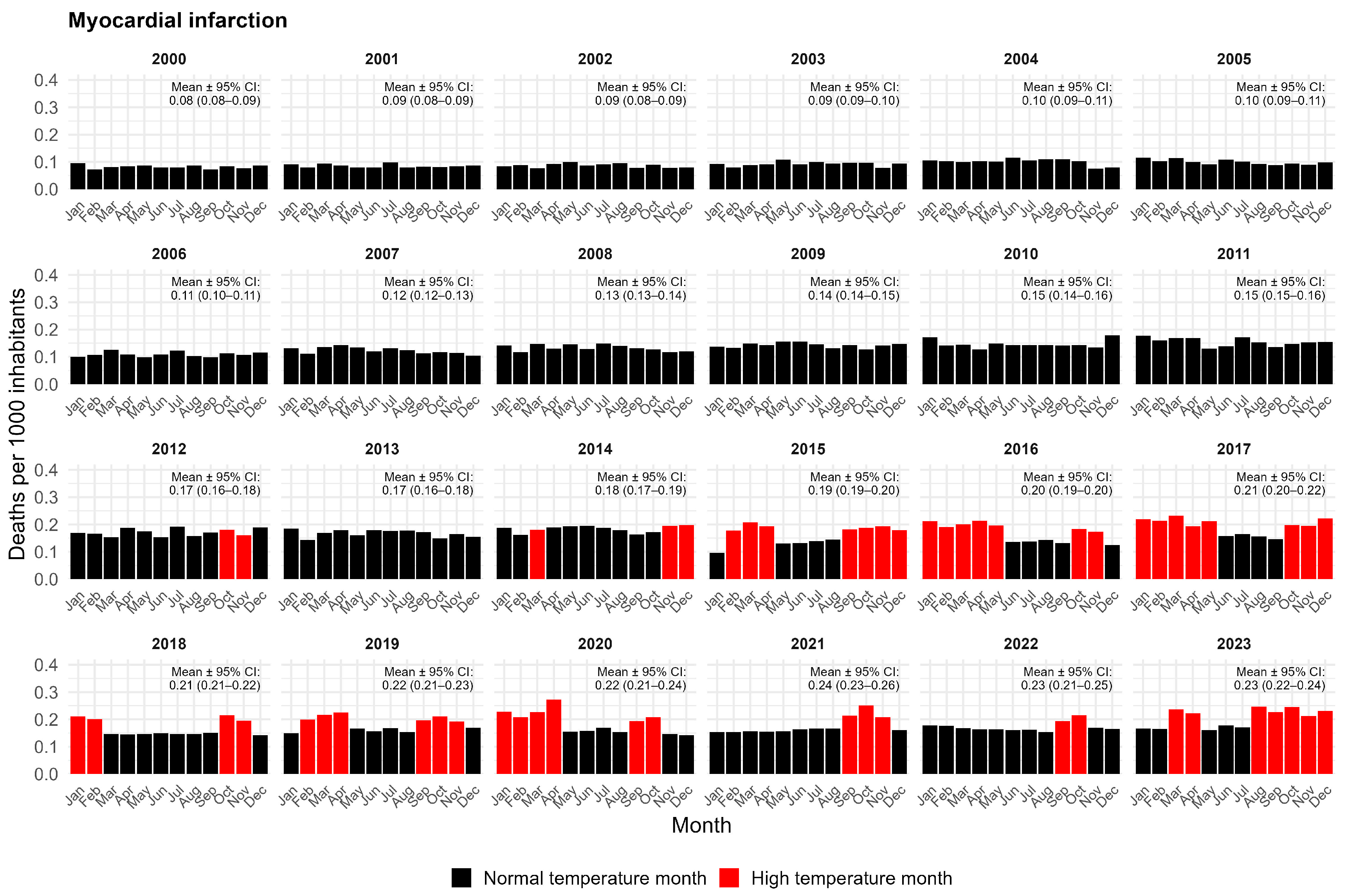
In addition, a LOESS-based scatterplot was constructed showing the relationship between mean monthly temperature and mortality rates. Each point represents a monthly observation colored by year to visually capture temporal warming trends. Months of extreme heat were identified across the 24-year period, defined as those with mean temperatures at or above the 90th percentile of the distribution. Mortality rates were then compared between extreme and nonextreme months via Student’s t test. A bar chart illustrates mortality trends over time, contrasting deaths during extreme-temperature months with those in normal months, providing clearer insight into temporal and thermal patterns.
Sensitivity analyses were performed to evaluate model robustness and potential biases related to temporal structure and mortality reporting. Models were re-estimated after excluding years with extreme temperature or mortality values (2000 and 2023), varying the temporal lag structure between 1 and 3 months, and uniformly adjusting mortality counts by ±10% across the entire study period to simulate possible under- or overreporting in the mortality registration system. This approach assessed whether the temperature-mortality associations were sensitive to moderate, non-differential reporting uncertainty over time.

2.4. Ethical Aspects

All the data are secondary, publicly available, and anonymized, ensuring that there is no possibility of individual identification. Therefore, the study was not submitted for research ethics committee review.

3. Results

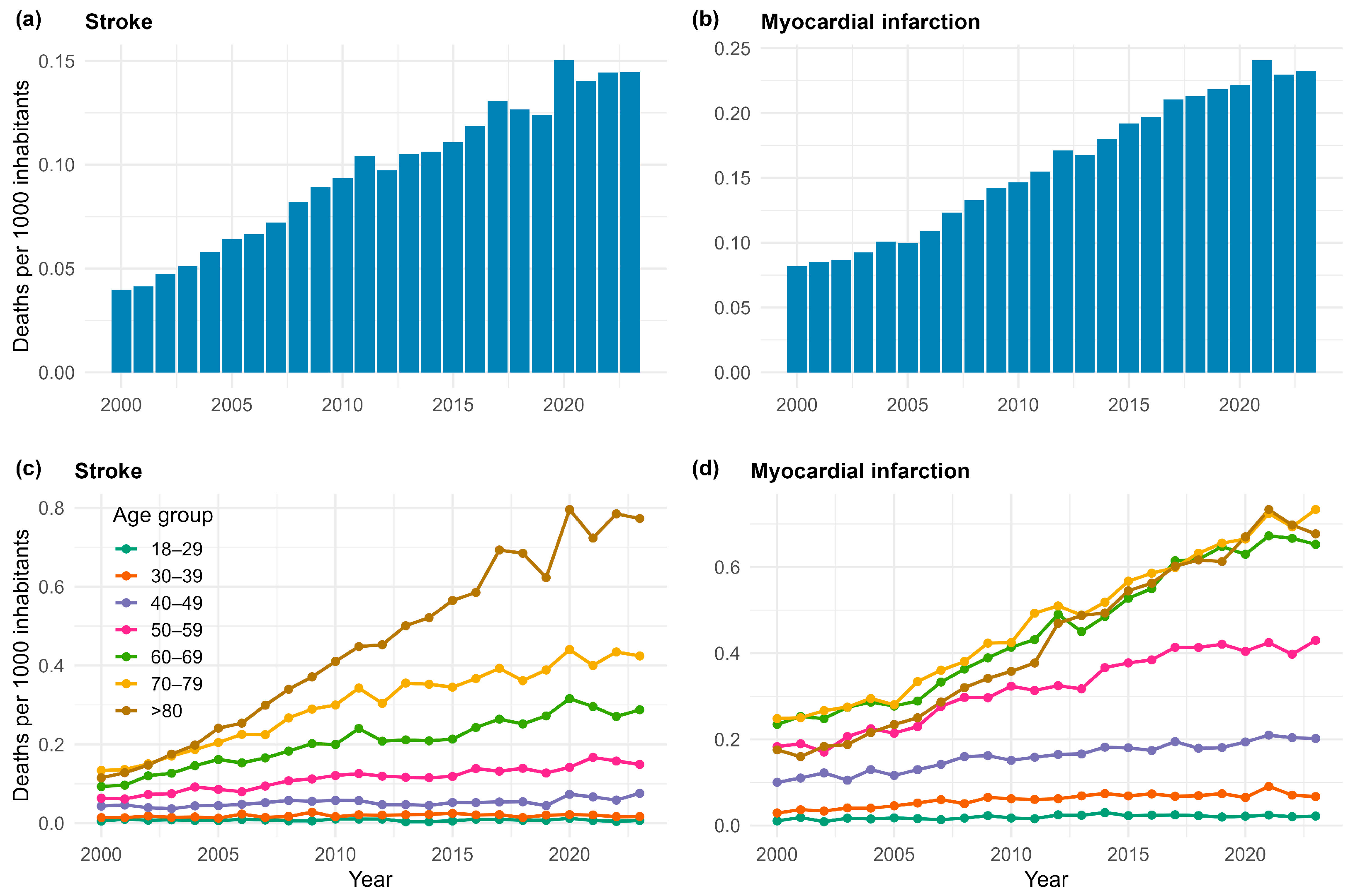
Between 2000 and 2023, the annual mean temperature increased by approximately 1.7 °C. Over the same period, mortality from stroke and myocardial infarction showed marked long-term upward trends. After accounting for long-term temporal trends and serial autocorrelation, ARIMAX models indicated that interannual temperature variability remained significantly associated with mortality from stroke (β = 0.18; p = 0.001; Figure 2a) and myocardial infarction (β = 0.26; p = 0.002; Figure 2b), with adequate residual diagnostics (p = 0.25 and 0.29, respectively). These estimates reflect temperature-related deviations from underlying mortality trends rather than the increase in mortality over time. For stroke, the year-age interaction was significant (D6,154 = 751; p < 0.001), with the strongest effect among individuals aged >60 years (Figure 2c). For myocardial infarction, the interaction effect was also significant (D6,154 = 494; p < 0.001), particularly in those aged >50 years (Figure 2d).
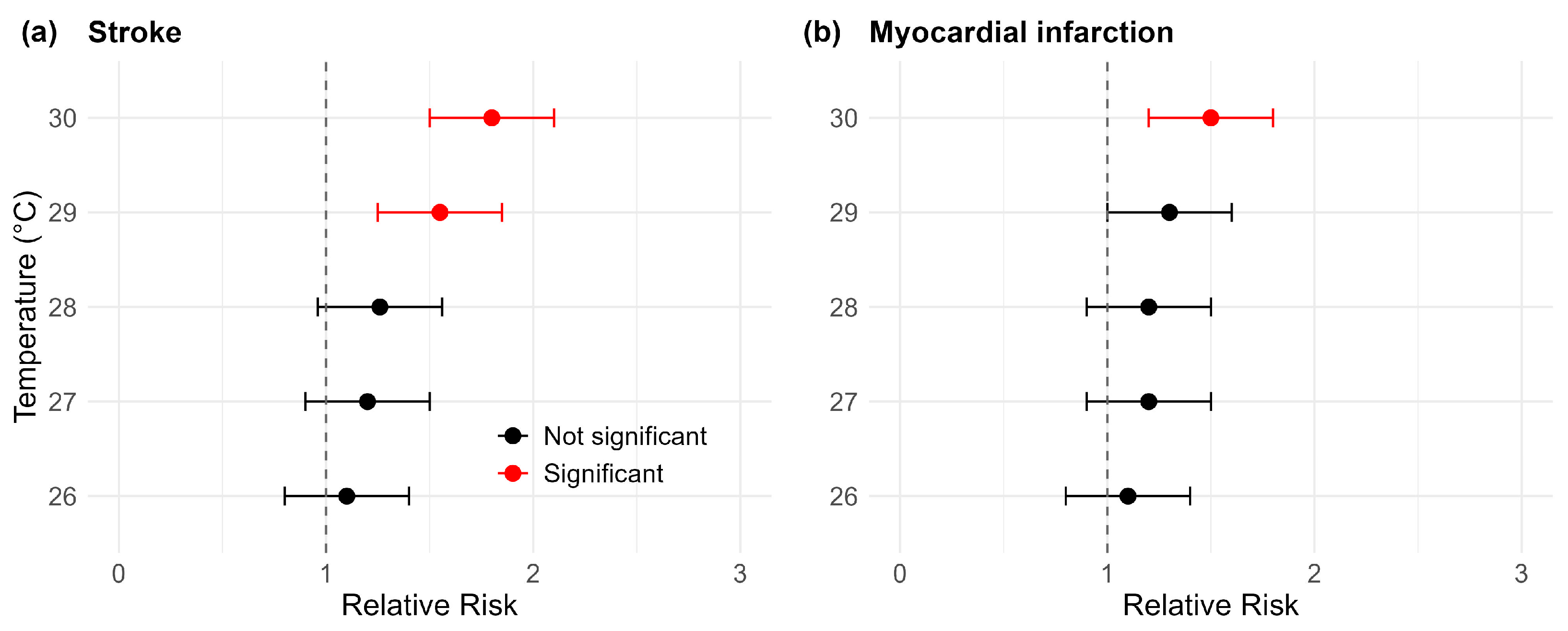
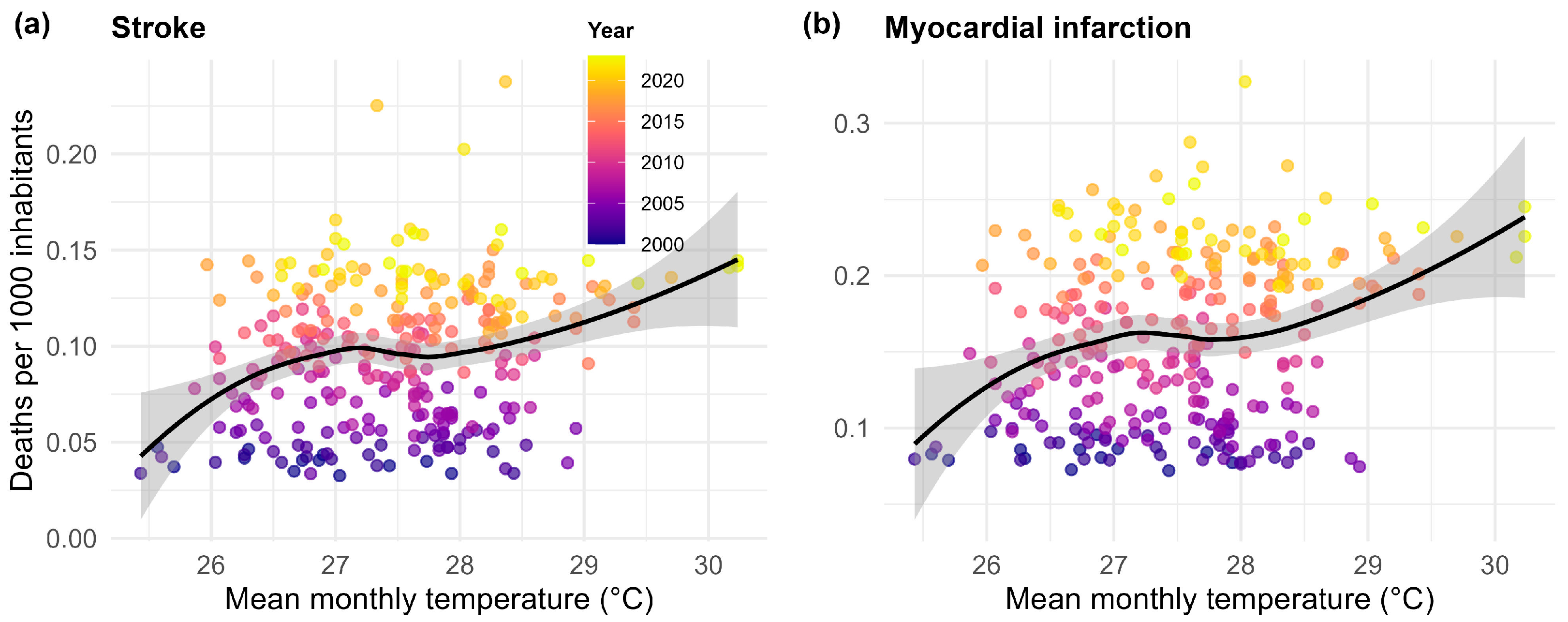
Cumulative exposure to elevated temperatures over the two preceding months was associated with increased mortality from stroke (D = 3.17; p < 0.001; Figure 3a) and myocardial infarction (D = 4.49; p < 0.001; Figure 3b). These effects became evident above mean monthly temperature thresholds of approximately 29 °C for stroke and 30 °C for myocardial infarction. LOESS-based scatterplots (Figure 4) showed a nonlinear positive association between temperature and mortality for both outcomes, with relatively stable mortality rates up to approximately 27–28 °C followed by a marked increase at higher temperatures, consistent with the distributed lag results.
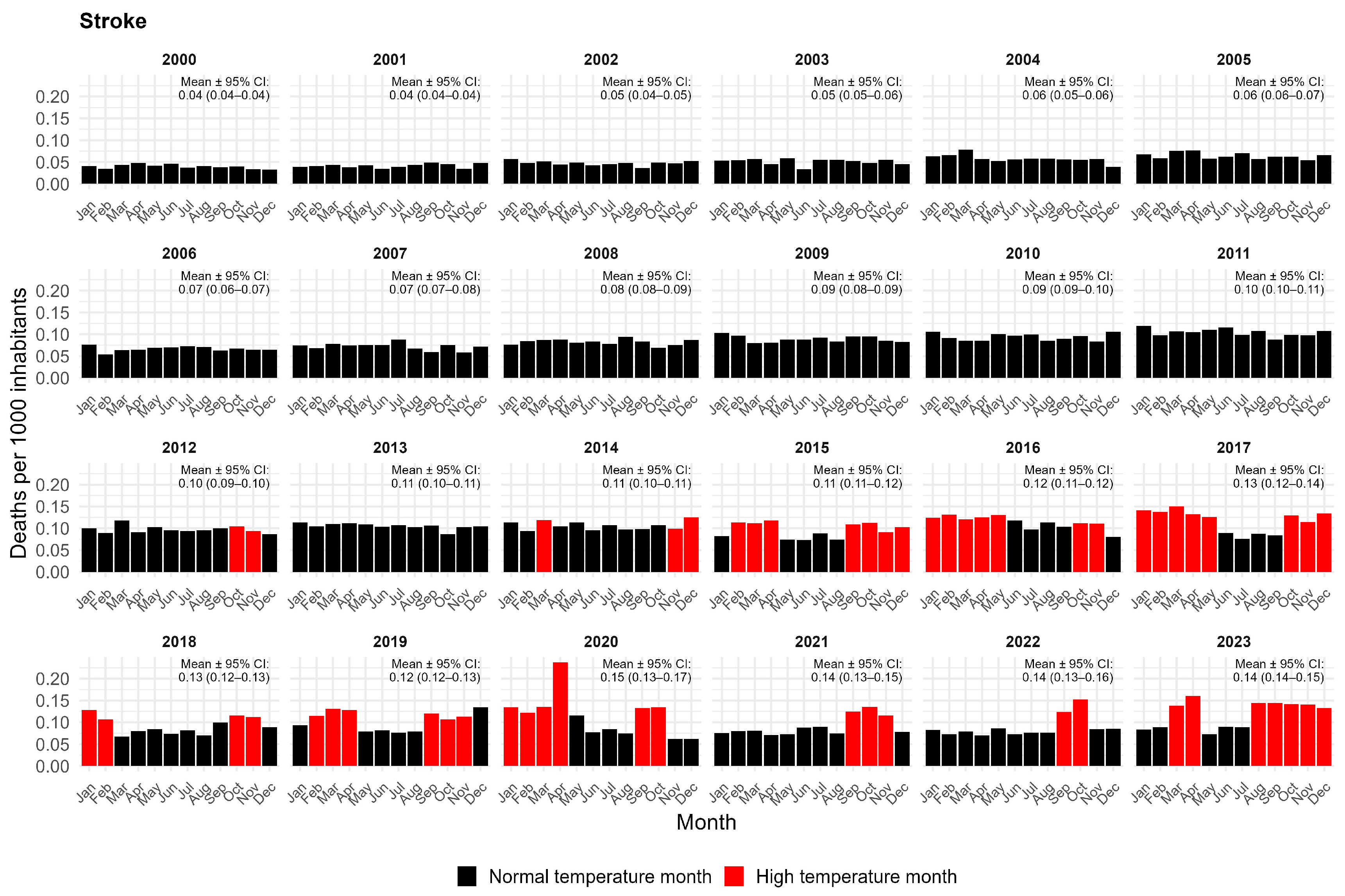
Comparisons between extreme and non-extreme temperature periods further supported this pattern, with higher mortality observed during hotter years (stroke: t = 3.57; myocardial infarction: t = 3.83; both p < 0.01). Bar plots (Figure 5 and Figure 6) illustrated the temporal concentration of deaths during high-temperature months. Although overall mortality exhibited a long-term increasing trend, the relative contribution of deaths occurring during extreme heat months increased recently, particularly after 2015, coinciding with intensified regional warming and a higher frequency of extreme temperature events. This pattern was consistent across both outcomes, reinforcing the robustness of the temperature-mortality association after adjustment for long-term trends.
Sensitivity analyses confirmed the robustness of the temperature-mortality associations for both stroke and myocardial infarction. Effect estimates remained stable after excluding extreme years, varying temporal lags, and simulating potential under- and overreporting (Table A1).

4. Discussion

We observed for the first time in the Brazilian Amazon that rising temperatures are associated with increased mortality from stroke and myocardial infarction, particularly among older adults. This effect was evident above the thresholds of 29 °C for stroke and 30 °C for myocardial infarction. Similar thresholds have been reported in other tropical regions, where temperatures between 28 °C and 31 °C were linked to significant increases in mortality [13,14]. In such settings, the health impacts of heat are often intensified by high humidity, unplanned urbanization, and socioeconomic vulnerability [6,15] conditions are also present in the Amazon.
While long-term increases in stroke and myocardial infarction mortality may be partly associated with demographic aging, shifts in cardiovascular risk profiles, and gradual improvements in death certification and reporting over time, these patterns should not be interpreted as being driven by temperature alone. Importantly, our findings indicate that both interannual and intra-annual variability in temperature remain significantly associated with mortality, even after accounting for long-term temporal trends and seasonal structure. Although overall mortality increased across the study period, the proportion of deaths occurring during months of extreme heat increased recently, particularly after 2015, indicating that climate warming exacerbates preexisting demographic and epidemiologic processes rather than merely paralleling them. Earlier studies reported no association between cardiovascular mortality and high temperatures in the region between 1996 and 2013 [8]. In contrast, our analysis shows that this association has strengthened since 2015, coinciding with a higher frequency of months with elevated temperatures. This pattern is consistent with recent increases in mean temperature and heat extremes across tropical regions, driven by deforestation and more frequent wildfires [7]. Urban expansion and reduced vegetation cover further contribute to heat exposure through the intensification of urban heat islands [1].
Periods characterized by increased cardiovascular mortality are likely associated with the co-occurrence of elevated regional temperatures and multiple concurrent stressors [13,16]. In the Brazilian Amazon, positive thermal anomalies and drought-related conditions may be linked to increased physiological cardiovascular strain [2], while broader contextual factors, such as disruptions in healthcare access, delays in emergency care, and changes in health-seeking behavior during public health emergencies, may coincide with heightened vulnerability [17]. Additional stressors, including air pollution from wildfires and elevated psychosocial stress, may also contribute to short-term mortality fluctuations [18]. Although these overlapping factors may contribute to observed variability, our analyses consistently indicate that temperature patterns show a strong association with mortality risk, supporting the robustness of the temperature-mortality relationship beyond long-term structural changes in health systems or data registration.
Although populations in tropical regions are adapted to high baseline temperatures, additional increases may exceed physiological adaptation limits, increasing mortality risk [19]. Heat-induced responses, including water and electrolyte loss, reduced plasma volume, and circulatory overload, may lead to cerebrovascular and cardiovascular decompensations [20]. Heat stress also increases blood viscosity and thrombotic propensity [3]. In temperate regions, mortality is triggered at lower thresholds (23–26 °C), as observed in southern Brazil and Europe [15,21]. These differences likely reflect contrasts in thermal amplitude and exposure patterns, as tropical populations experience prolonged periods of high temperature rather than short, acute heat episodes. Similar associations between low thermal amplitude and cardiovascular mortality have been documented in cities across Latin America, Asia, and Europe [22,23,24].
Older adults were consistently the most vulnerable group, aligning with findings from Europe, North America, and Asia [25]. Reduced thermoregulatory capacity and limited physiological reserves increase the impact of extreme heat in this population [15]. Although thermal thresholds vary geographically, age-related vulnerability to heat is a global phenomenon [4]. In tropical regions, this vulnerability is further compounded by socioeconomic inequalities and limited access to health services [6], in contrast to temperate countries, which, despite lower adaptation to heat, often benefit from better infrastructure and mitigation measures such as air-conditioned environments and early warning systems [19]. Our findings underscore the urgency of implementing heat mitigation and adaptation strategies, particularly for vulnerable populations in tropical regions.
Despite the robustness of the associations observed, some limitations should be acknowledged. The use of routinely collected mortality data may be influenced by gradual improvements in registration over time, and the monthly temporal resolution limits the assessment of short-term effects observed at daily scales. Nevertheless, adjustment for long-term temporal trends and seasonality, combined with multiple sensitivity analyses, supports the stability of the temperature-mortality associations under alternative assumptions.

5. Conclusions

Rising temperatures are associated with increased mortality from stroke and myocardial infarction in tropical regions, with the strongest associations observed among older adults. Mortality risks increase beyond specific thermal thresholds, highlighting the importance of accounting for local climatic conditions and limited thermal variability in tropical settings. These associations occur within a broader socio-environmental context, in which factors such as unplanned urbanization, deforestation, and socioeconomic inequality may amplify population vulnerability to heat exposure. Together, these findings support the need for public policies that integrate climate adaptation, urban planning, and health surveillance to mitigate the impacts of extreme heat and protect vulnerable populations in tropical regions.

Author Contributions

Conceptualization: D.S., M.F.S.M., T.T.O.-M., C.R., G.G.P.C.-G. and A.B.O.-F.; formal analysis: D.S.; writing— original draft preparation: M.F.S.M., T.T.O.-M., C.R. and G.G.P.C.-G.; writing—review and editing: D.S., E.A.O.-M. and A.B.O.-F.; funding acquisition: A.B.O.-F. All authors have read and agreed to the published version of the manuscript.

Funding

This research was funded by National Council for Scientific and Technological Development (CNPq) and Department of Science and Technology of Secretariat of Science, Technology, Innovation and Health Complex of Ministry of Health of Brazil (MoH), grant number 444841/2023-7. D.S. received a CNPQ Scholarship, grant number 116574/2024-0.

Data Availability Statement

Data is available from the corresponding author on request.

Acknowledgments

We are grateful to the National Council for Scientific and Technological Development (CNPq) and the Department of Science and Technology of Secretariat of Science, Technology, Innovation and Health Complex of Ministry of Health of Brazil (MoH). We are also grateful to Max Kedley Maranhão for assisting with English grammar checking.

Conflicts of Interest

The authors declare no conflicts of interest.

Appendix A

Table A1. Sensitivity analysis of the associations between mean temperature and mortality from stroke and myocardial infarction in the Brazilian Amazon (2000–2023). The table summarizes robustness analyses conducted to evaluate the stability of the temporal models. Estimates are presented for models excluding extreme years (2000 and 2023), applying alternative temporal lag structures, and adjusting mortality rates by ±10% to simulate potential under- and overreporting. Reported values include regression coefficients (β) and corresponding p-values.
ModelStrokeMyocardial Infarction
Βpβp
excluding extreme years (2000 and 2023)0.020.030.020.002
temporal 1 month lag0.060.020.040.02
temporal 2 months lag0.030.0010.010.01
temporal 3 months lag0.040.00010.020.001
underreporting (10%)0.020.010.020.003
overreporting (10%)0.030.020.020.003

References

  1. Heidari, H.; Mohammadbeigi, A.; Khazaei, S.; Soltanzadeh, A.; Asgarian, A.; Saghafipour, A. The Effects of Climatic and Environmental Factors on Heat-Related Illnesses: A Systematic Review from 2000 to 2020. Urban Clim. 2020, 34, 100720. [Google Scholar] [CrossRef]
  2. Reddington, C.L.; Smith, C.; Butt, E.W.; Baker, J.C.A.; Oliveira, B.F.A.; Yamba, E.I.; Spracklen, D.V. Tropical Deforestation Is Associated with Considerable Heat-Related Mortality. Nat. Clim. Change 2025, 15, 992–999. [Google Scholar] [CrossRef] [PubMed]
  3. Zhang, M.; Lin, S.; Zhang, Y.; Zhang, J. Study on the health effect of temperature on cardiovascular and cerebrovascular diseases in Haikou City. Atmosphere 2024, 15, 725. [Google Scholar] [CrossRef]
  4. Phung, V.L.H.; Oka, K.; Honda, Y.; Hijioka, Y.; Ueda, K.; Seposo, X.T.; Sahani, M.; Wan Mahiyuddin, W.R.; Kim, Y. Daily Temperature Effects on Under-Five Mortality in a Tropical Climate Country and the Role of Local Characteristics. Environ. Res. 2023, 218, 114988. [Google Scholar] [CrossRef]
  5. Xu, C.; Nie, X.; Xu, R.; Han, G.; Wang, D. Burden Trends and Future Predictions for Hypertensive Heart Disease Attributable to Non-Optimal Temperatures in the Older Adults Amidst Climate Change, 1990-2021. Front. Public Health 2025, 12, 1525357. [Google Scholar] [CrossRef]
  6. Burkart, K.; Khan, M.H.; Kraemer, A.; Breitner, S.; Schneider, A.; Endlicher, W.R. Seasonal variations of all-cause and cause-specific mortality by age, gender, and socioeconomic condition in urban and rural areas of Bangladesh. Int. J. Equity Health 2011, 10, 32. [Google Scholar] [CrossRef]
  7. Bottino, M.J.; Nobre, P.; Giarolla, E.; da Silva Junior, M.B.; Capistrano, V.B.; Malagutti, M.; Tamaoki, J.N.; de Oliveira, B.F.A.; Nobre, C.A. Amazon savannization and climate change are projected to increase dry season length and temperature extremes over Brazil. Sci. Rep. 2024, 14, 5131. [Google Scholar] [CrossRef]
  8. de Castro Martins Ferreira, L.; Nogueira, M.C.; de Britto Pereira, R.V.; Marcia de Farias, W.C.; de Souza Rodrigues, M.M.; Bustamante Teixeira, M.T.; Carvalho, M.S. Ambient temperature and mortality due to acute myocardial infarction in Brazil: An ecological study of time-series analyses. Sci. Rep. 2019, 9, 13790. [Google Scholar] [CrossRef]
  9. Beck, H.E.; Zimmermann, N.E.; McVicar, T.R.; Vergopolan, N.; Berg, A.; Wood, E.F. Present and future Köppen-Geiger climate classification maps at 1-km resolution. Sci. Data 2018, 5, 180214. [Google Scholar] [CrossRef]
  10. R Core Team. R: A Language and Environment for Statistical Computing; R Foundation for Statistical Computing: Vienna, Austria, 2024. [Google Scholar]
  11. Hyndman, R.J.; Khandakar, Y. Automatic time series forecasting: The forecast package for R. J. Stat. Softw. 2008, 27, 1–22. [Google Scholar] [CrossRef]
  12. Gasparrini, A. Distributed lag linear and non-linear models in R: The package dlnm. J. Stat. Softw. 2011, 43, 1–20. [Google Scholar] [CrossRef]
  13. Arsad, F.S.; Hod, R.; Ahmad, N.; Ismail, R.; Mohamed, N.; Radi, M.F.M.; Osman, Y.; Baharom, M.; Tangang, F. Temperature Related Mortality in a Tropical Climate Country: A Time Series Analysis. Med. Health 2025, 20, 723–739. [Google Scholar] [CrossRef]
  14. Huang, J.; Wang, L.; Wang, S.; Lu, Y.; Zhang, W.; Wang, J. Spatial and temporal characteristics of temperature effects on cardiovascular disease in Southern China using the Empirical Mode Decomposition method. Sci. Rep. 2018, 8, 14775. [Google Scholar] [CrossRef] [PubMed]
  15. Liu, C.; Luo, B.; Wang, B.; He, L.; Wu, H.; Hou, L.; Zhang, K. Global Spatiotemporal Trends of Cardiovascular Diseases Due to Temperature in Different Climates and Socio-Demographic Index Regions from 1990 to 2019. Environ. Sci. Pollut. Res. 2023, 30, 3282–3292. [Google Scholar] [CrossRef] [PubMed]
  16. Cascio, W.E. Wildland fire smoke and human health. Sci. Total Environ. 2018, 624, 586–595. [Google Scholar] [CrossRef] [PubMed]
  17. Mattioli, A.V.; Puviani, M.B.; Nasi, M.; Farinetti, A. COVID-19 pandemic: The effects of quarantine on cardiovascular risk. Eur. J. Clin. Nutr. 2020, 74, 852–855. [Google Scholar] [CrossRef]
  18. Kivimäki, M.; Steptoe, A. Effects of stress on the development and progression of cardiovascular disease. Nat. Rev. Cardiol. 2018, 15, 215–229. [Google Scholar] [CrossRef]
  19. Ho, A.F.W.; Ho, J.; Ong, M.; Aik, J. Influence of ambient temperature and absolute humidity on sudden cardiac arrest in Singapore: A nationwide time-series study. J. Epidemiol. Community Health 2025, 79, 954–959. [Google Scholar] [CrossRef]
  20. Hong, L.; Yan, M.M.; Zhang, Y.Q.; Wang, K.; Wang, Y.Q.; Luo, S.Q.; Wang, F. Global Burden of Cardiovascular Disease Attributable to High Temperature in 204 Countries and Territories from 1990 to 2019. Biomed. Environ. Sci. 2023, 36, 222–230. [Google Scholar] [CrossRef]
  21. Walkowiak, M.P.; Walkowiak, D.; Walkowiak, J. Exploring the paradoxical nature of cold temperature mortality in Europe. Sci. Rep. 2024, 14, 3181. [Google Scholar] [CrossRef]
  22. Kephart, J.L.; Sánchez, B.N.; Moore, J.; Schinasi, L.H.; Bakhtsiyarava, M.; Ju, Y.; Gouveia, N.; Caiaffa, W.T.; Dronova, I.; Arunachalam, S.; et al. City-level impact of extreme temperatures and mortality in Latin America. Nat. Med. 2022, 28, 1700–1705. [Google Scholar] [CrossRef]
  23. Lorking, N.; Wood, A.D.; Tiamkao, S.; Clark, A.B.; Kongbunkiat, K.; Bettencourt-Silva, J.H.; Sawanyawisuth, K.; Kasemsap, N.; Mamas, M.A.; Myint, P.K. Seasonality of stroke: Winter admissions and mortality excess a Thailand national stroke population database study. Clin. Neurosurg. 2020, 199, 106261. [Google Scholar] [CrossRef]
  24. Vaiciulis, V.; Jaakkola, J.J.K.; Radisauskas, R.; Tamosiūnas, A.; Luksiene, D.; Ryti, N.R.I. Association between winter cold spells and acute myocardial infarction in Lithuania 2000–2015. Sci. Rep. 2021, 11, 17062. [Google Scholar] [CrossRef]
  25. Liu, L.; He, Y.; Huang, G.; Zeng, Y.; Lu, J.; He, R.; Chen, H.; Gu, Y.; Hu, Q.; Liao, B.; et al. Global Burden of Ischemic Heart Disease in Older Adult Populations Linked to Non-Optimal Temperatures: Past (1990–2021) and Future (2022–2050) Analysis. Front. Public Health 2025, 13, 1548215. [Google Scholar] [CrossRef]
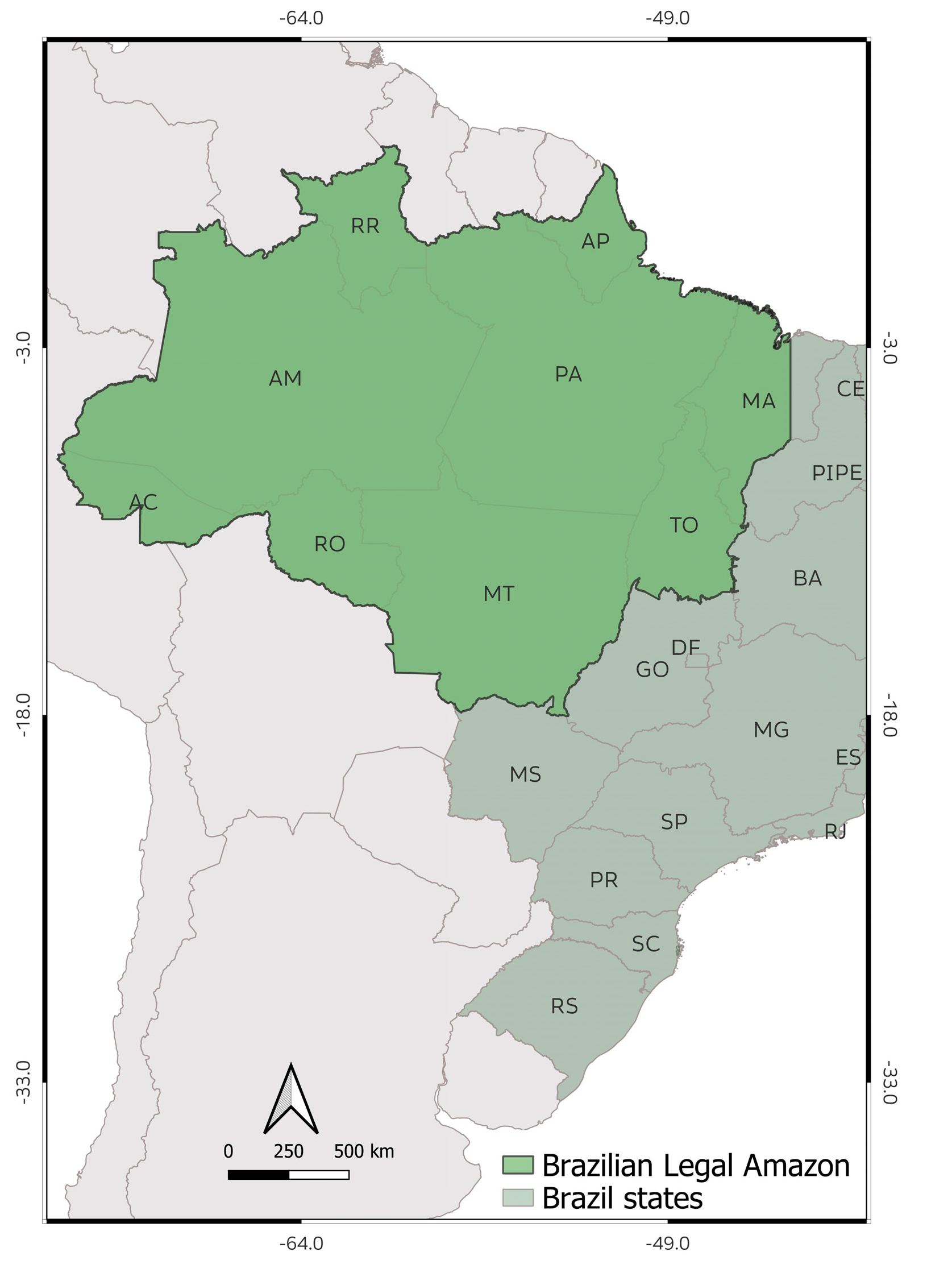
Figure 1. Geographic delimitation of the Brazilian Legal Amazon, encompassing the states Acre (AC), Amapá (AP), Amazonas (AM), Maranhão (MA), Mato Grosso (MT), Pará (PA), Rondônia (RO), Roraima (RR), and Tocantins (TO). The map also shows the boundaries of the other Brazilian states for reference.
Climate 14 00006 g001
Figure 2. Mortality rates from stroke and myocardial infarction in the Brazilian Amazon between 2000 and 2023. Panels (a,b) present observed annual mortality rates per 1000 inhabitants, characterizing long-term temporal patterns. Panels (c,d) show age-stratified mortality trends, with colored lines representing distinct age groups. These panels display descriptive temporal patterns, while temperature-mortality associations were estimated using regression models that are explicitly adjusted for long-term trends and seasonality.
Climate 14 00006 g002
Figure 3. Relative risks of mortality from (a) stroke and (b) myocardial infarction across temperatures ranging from 26 °C to 30 °C. Each point represents the estimated risk at a given temperature with 95% confidence intervals. Red markers indicate statistically significant associations, whereas black markers denote nonsignificant estimates.
Climate 14 00006 g003
Figure 4. Relationship between mean monthly temperature and mortality from (a) stroke and (b) myocardial infarction between 2000 and 2023. Points represent monthly observations colored by year, and the black line represents the LOESS fit with 95% confidence intervals.
Climate 14 00006 g004
Figure 5. Temporal evolution of mortality from stroke between 2000 and 2023. Bars represent monthly mortality rates per 1000 inhabitants, classified by temperature conditions: high-temperature months (≥90th percentile; red bars) and normal-temperature months (black bars). All temperature values correspond to monthly mean temperatures, and the 90th percentile threshold was 29 °C for stroke.
Climate 14 00006 g005
Figure 6. Temporal evolution of mortality from myocardial infarction between 2000 and 2023. Bars represent monthly mortality rates per 1000 inhabitants, classified by temperature conditions: high-temperature months (≥90th percentile; red bars) and normal-temperature months (black bars). All temperature values correspond to monthly mean temperatures, and the 90th percentile threshold was 30 °C for myocardial infarction.
Climate 14 00006 g006
Disclaimer/Publisher’s Note: The statements, opinions and data contained in all publications are solely those of the individual author(s) and contributor(s) and not of MDPI and/or the editor(s). MDPI and/or the editor(s) disclaim responsibility for any injury to people or property resulting from any ideas, methods, instructions or products referred to in the content.