Article

Two SNP Mutations Turned off Seed Shattering in Rice


Yunnan Key Laboratory for Rice Genetic Improvement, Food Crops Research Institute, Yunnan Academy of Agricultural Sciences (YAAS), Kunming 650200, China
*
Author to whom correspondence should be addressed.
These authors contributed equally to this work.
Present address: Rice Research Department, Field Crops Research Institute, Agricultural Research Center, 33717 Sakha, Kafr El-Sheikh, Egypt.
Plants 2019, 8(11), 475; https://doi.org/10.3390/plants8110475
Submission received: 29 August 2019 / Revised: 3 November 2019 / Accepted: 5 November 2019 / Published: 6 November 2019
(This article belongs to the Special Issue Genetics in Rice)

Abstract

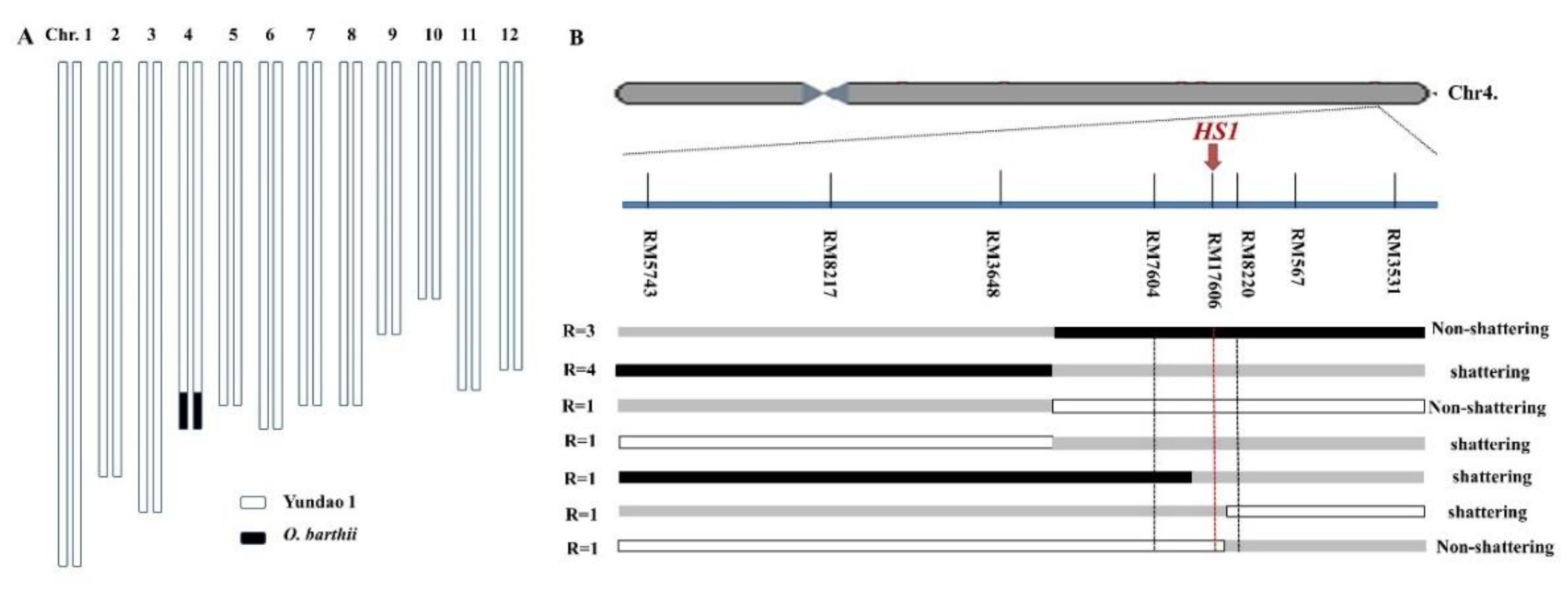
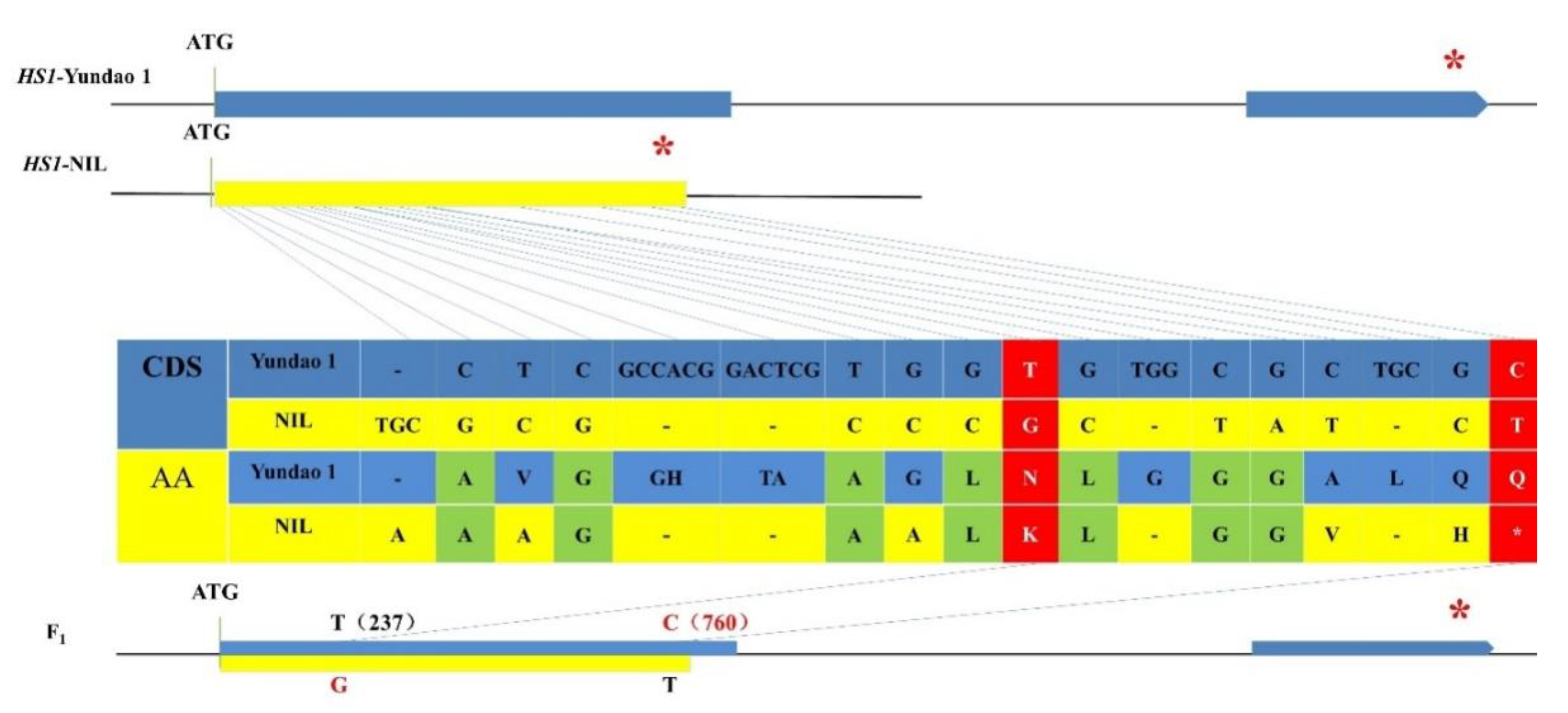
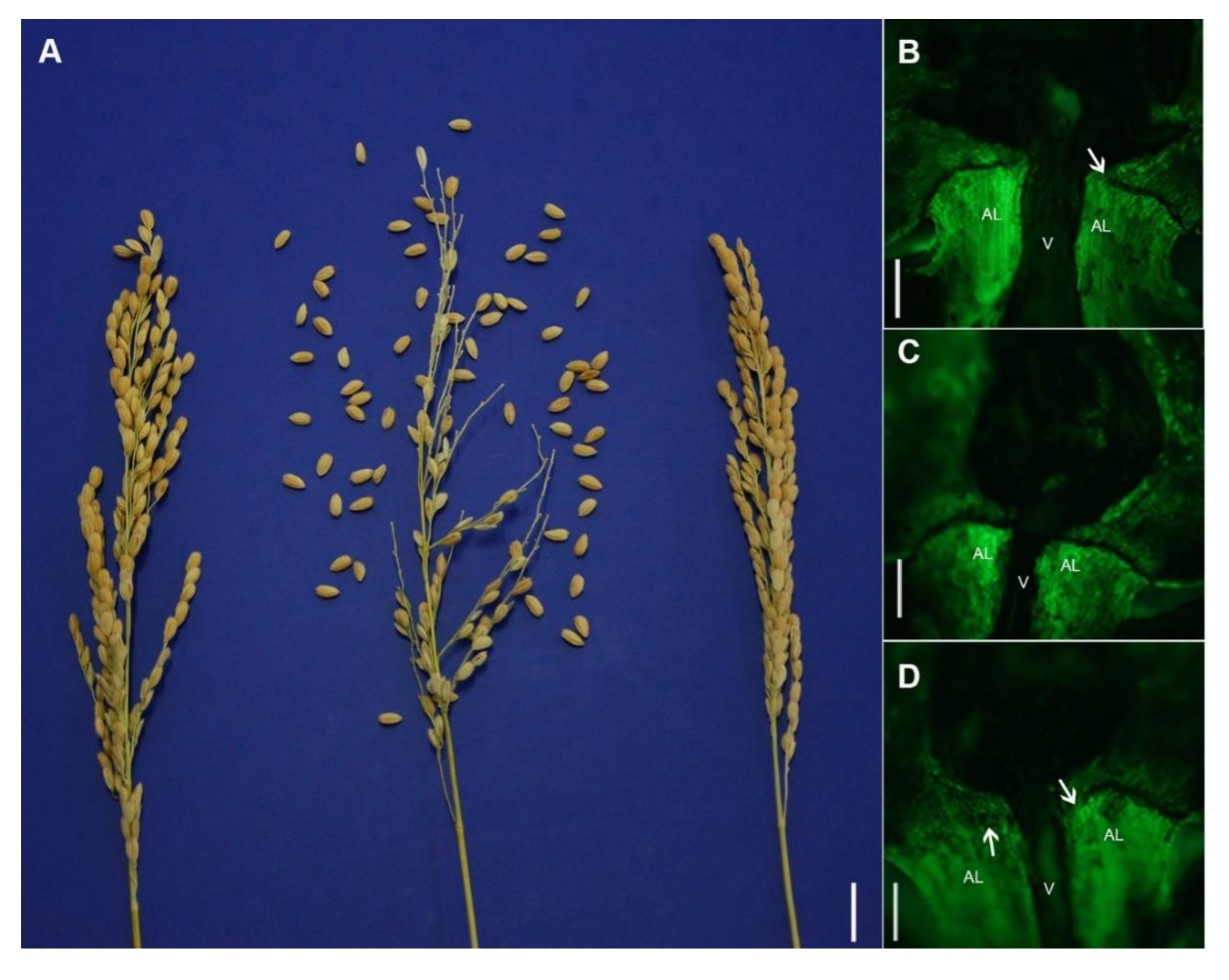
Seed shattering is an important agronomic trait in rice domestication. In this study, using a near-isogenic line (NIL-hs1) from Oryza barthii, we found a hybrid seed shattering phenomenon between the NIL-hs1 and its recurrent parent, a japonica variety Yundao 1. The heterozygotes at hybrid shattering 1 (HS1) exhibited the shattering phenotype, whereas the homozygotes from both parents conferred the non-shattering. The causal HS1 gene for hybrid shattering was located in the region between SSR marker RM17604 and RM8220 on chromosome 4. Sequence verification indicated that HS1 was identical to SH4, and HS1 controlled the hybrid shattering due to harboring the ancestral haplotype, the G allele at G237T site and C allele at C760T site from each parent. Comparative analysis at SH4 showed that all the accessions containing ancestral haplotype, including 78 wild relatives of rice and 8 African cultivated rice, had the shattering phenotype, whereas all the accessions with either of the homozygous domestic haplotypes at one of the two sites, including 17 wild relatives of rice, 111 African cultivated rice and 65 Asian cultivated rice, showed the non-shattering phenotype. Dominant complementation of the G allele at G237T site and the C allele at C760T site in HS1 led to a hybrid shattering phenotype. These results help to shed light on the nature of seed shattering in rice during domestication and improve the moderate shattering varieties adapted to mechanized harvest.
Keywords: Seed shattering; O. barthii; O. sativa; HS1; haplotype Seed shattering; O. barthii; O. sativa; HS1; haplotype