From Bench to Greenhouse: The Comparative Nano-Bio System Effects of Green-Synthesized TiO2-NPs and Plant-Growth-Promoting Microorganisms in Capsicum annuum

 ,
,  , ,
, ,  , , ,
, , ,  ,
,  and
and 
Abstract
1. Introduction
2. Results
2.1. Synthesis and Characterization of Green-Synthesized TiO2-NPs
2.2. HPLC-DAD Analysis of Extracts from Blueberry
2.3. Analysis of the Compatibility Between Green-Synthesized TiO2-NPs and PGPMs
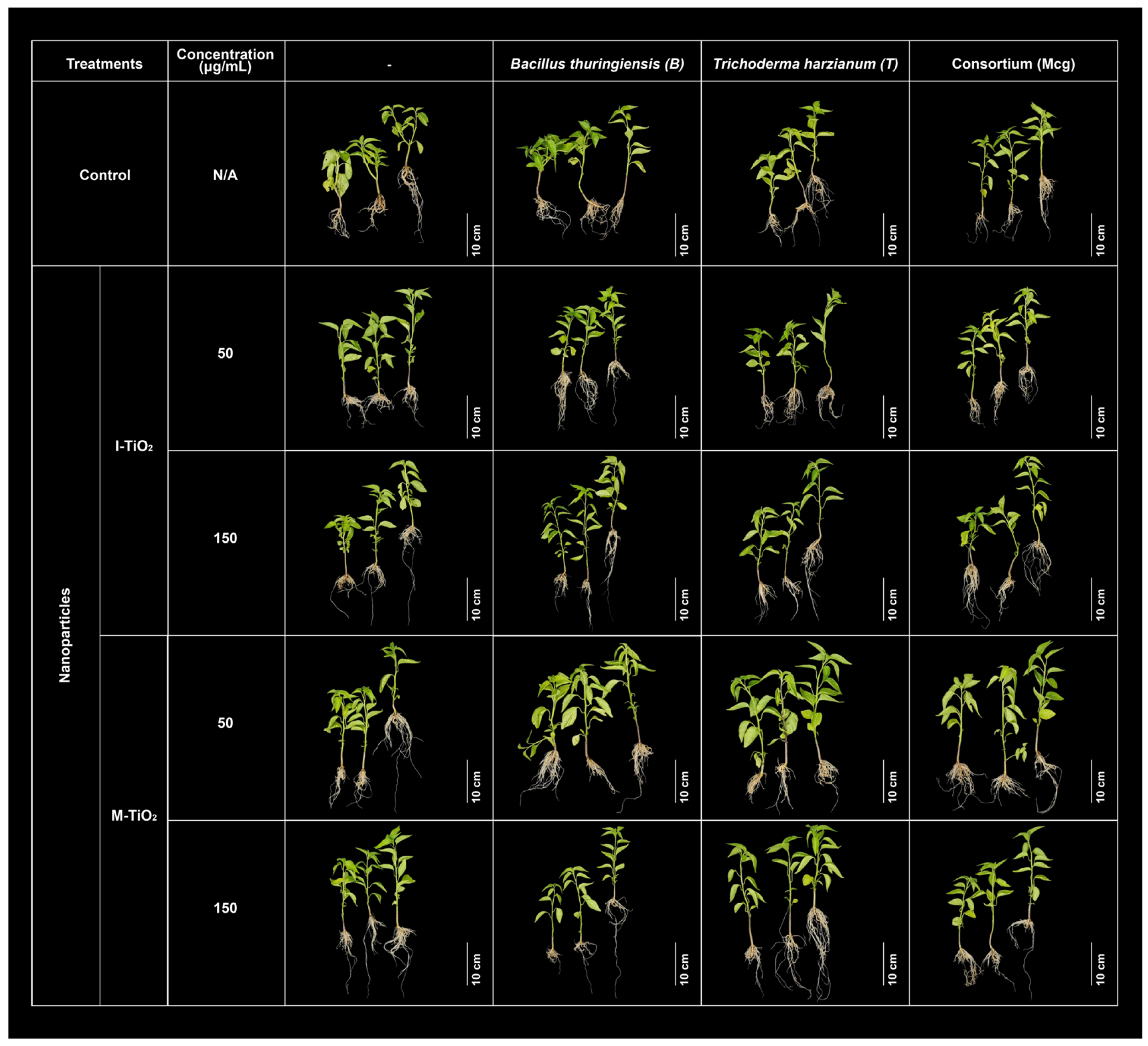
2.4. Plant Physiological Response of TiO2-NPs and PGPMs
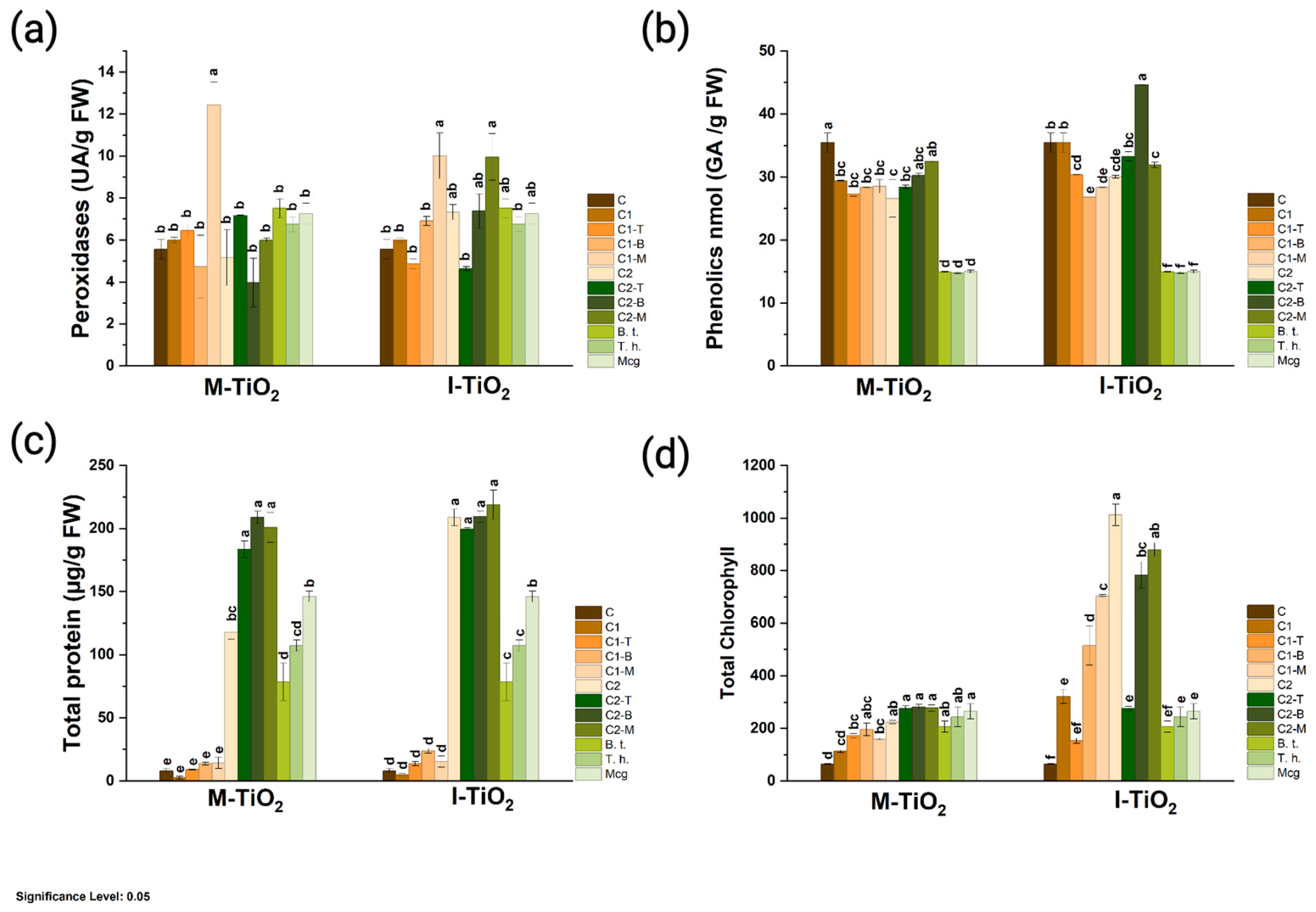
2.5. Biochemical Response of TiO2-NPs and PGPMs
2.6. PLS Analysis
3. Discussion
4. Materials and Methods
4.1. Extract Obtention and Green Synthesis of I-TiO2 and M-TiO2
4.2. Characterization of Green-Synthesized I-TiO2 and M-TiO2
4.3. HPLC Analysis
4.4. Analysis of Compatibility of Green-Synthesized I-TiO2 and M-TiO2 with PGPMs
4.4.1. Isolation and Culture of PGPB
4.4.2. Spread Plate Method
4.4.3. Fungal Compatibility
4.5. Effect of Green-Synthesized I-TiO2 and M-TiO2 and PGPMs in C. annuum
4.6. Analysis of Biochemical Features
4.6.1. Total Phenolic Compounds Assay
4.6.2. Total Protein and POX Activity
4.6.3. Total Chlorophyll Quantification
4.7. Statistical Analysis
5. Conclusions
Supplementary Materials
Author Contributions
Funding
Data Availability Statement
Acknowledgments
Conflicts of Interest
References
- Miladinov, G. Impacts of population growth and economic development on food security in low-income and middle-income countries. Front. Hum. Dyn. 2023, 5, 1121662. [Google Scholar] [CrossRef]
- Xu, P.; Bao, J.; Li, Q.; Shi, W.; Xing, G.; Teng, Z. pH-responsive poly(acrylic acid) coated mesoporous silica nanoparticles for controlled abamectin release: Synthesis, characterization, and agricultural application. J. Taiwan Inst. Chem. Eng. 2025, 167, 105861. [Google Scholar] [CrossRef]
- Monteiro, A.; Santos, S.; Goncalves, P. Precision Agriculture for Crop and Livestock Farming-Brief Review. Animals 2021, 11, 2345. [Google Scholar] [CrossRef]
- Shirvani, M.; Zhang, T.; Gu, Y.; Hosseini-Sarvari, M. Green Synthesis of Nano-Sized Multiflower-like Fe3O4@SiO2/(L)-Tryptophan from Natural Resources and Agricultural Waste: A Photo-Switchable Oxidation Catalyst. Langmuir 2025, 41, 10647–10667. [Google Scholar] [CrossRef]
- Saeed-Abadi, B.; Eghlima, G.; Mirjalili, M.H.; Hadian, J.; Ghorbanpour, M. Effect of extraction solvent on silicon, isoquercitroside content, and antioxidant activity of common horsetail (Equisetum arvens L.) extract. Biomass Convers. Biorefinery 2024, 15, 6401–6408. [Google Scholar] [CrossRef]
- Shakeel, N.; Piwonski, I.; Iqbal, P.; Kisielewska, A. Green Synthesis of Titanium Dioxide Nanoparticles: Physicochemical Characterization and Applications: A Review. Int. J. Mol. Sci. 2025, 26, 5454. [Google Scholar] [CrossRef]
- Šebesta, M.; Kolenčík, M.; Sunil, B.R.; Illa, R.; Mosnáček, J.; Ingle, A.P.; Urík, M. Field Application of ZnO and TiO2 Nanoparticles on Agricultural Plants. Agronomy 2021, 11, 2281. [Google Scholar] [CrossRef]
- Gai, X.; Xu, X.; Jiang, N.; Zhang, D.; Zhang, Y.; Kim, Y.; Xuan, Y.; Li, D. TiO2 nanomaterial promotes plant growth and disease resistance. Plant Signal Behav. 2025, 20, 2512943. [Google Scholar] [CrossRef]
- Satti, S.H.; Raja, N.I.; Ikram, M.; Oraby, H.F.; Mashwani, Z.U.; Mohamed, A.H.; Singh, A.; Omar, A.A. Plant-Based Titanium Dioxide Nanoparticles Trigger Biochemical and Proteome Modifications in Triticum aestivum L. under Biotic Stress of Puccinia striiformis. Molecules 2022, 27, 4274. [Google Scholar] [CrossRef]
- Xiao, Y.; Du, Y.; Xiao, Y.; Zhang, X.; Wu, J.; Yang, G.; He, Y.; Zhou, Y.; Peijnenburg, W.; Luo, L. Elucidating the effects of TiO2 nanoparticles on the toxicity and accumulation of Cu in soybean plants (Glycine max L.). Ecotoxicol. Environ. Saf. 2021, 219, 112312. [Google Scholar] [CrossRef] [PubMed]
- Sehrish, A.K.; Ahmad, S.; Alomrani, S.O.; Ahmad, A.; Al-Ghanim, K.A.; Alshehri, M.A.; Tauqeer, A.; Ali, S.; Sarker, P.K. Nutrient strengthening and lead alleviation in Brassica napus L. by foliar ZnO and TiO2-NPs modulating antioxidant system, improving photosynthetic efficiency and reducing lead uptake. Sci. Rep. 2024, 14, 19437. [Google Scholar] [CrossRef]
- Khannyra, S.; Luna, M.; Gil, M.L.A.; Addou, M.; Mosquera, M.J. Self-cleaning durability assessment of TiO2/SiO2 photocatalysts coated concrete: Effect of indoor and outdoor conditions on the photocatalytic activity. Build. Environ. 2022, 211, 108743. [Google Scholar] [CrossRef]
- Sagadevan, S.; Imteyaz, S.; Murugan, B.; Anita Lett, J.; Sridewi, N.; Weldegebrieal, G.K.; Fatimah, I.; Oh, W.-C. A comprehensive review on green synthesis of titanium dioxide nanoparticles and their diverse biomedical applications. Green Process Synth. 2022, 11, 44–63. [Google Scholar] [CrossRef]
- Ghareeb, A.; Fouda, A.; Kishk, R.M.; El Kazzaz, W.M. Unlocking the potential of titanium dioxide nanoparticles: An insight into green synthesis, optimizations, characterizations, and multifunctional applications. Microb. Cell Fact. 2024, 23, 341. [Google Scholar] [CrossRef]
- Khashan, K.S.; Sulaiman, G.M.; Abdulameer, F.A.; Albukhaty, S.; Ibrahem, M.A.; Al-Muhimeed, T.; AlObaid, A.A. Antibacterial Activity of TiO2 Nanoparticles Prepared by One-Step Laser Ablation in Liquid. Appl. Sci. 2021, 11, 4623. [Google Scholar] [CrossRef]
- Al Malki, J.S.; Hussien, N.A.; Akkad, L.M.; Al Thurmani, S.O.; Al Motiri, A.E. Green Synthesis of Silver and Titanium Oxide Nanoparticles Using Tea and Eggshell Wastes, Their Characterization, and Biocompatibility Evaluation. Sustainability 2023, 15, 11858. [Google Scholar] [CrossRef]
- Alaizeri, Z.M.; Alhadlaq, H.A.; Aldawood, S.; Abduh, N.A.Y. Green synthesis of ZnO-TiO2/RGO nanocomposites using Senna surattensis extract: A novel approach for enhanced anticancer efficacy and biocompatibility. RSC Adv. 2024, 14, 16685–16695. [Google Scholar] [CrossRef]
- Tariq, H.; Subramanian, S.; Geitmann, A.; Smith, D.L. Bacillus and Paenibacillus as plant growth-promoting bacteria in soybean and cannabis. Front. Plant Sci. 2025, 16, 1529859. [Google Scholar] [CrossRef]
- Gutierrez, J.; Tercjak, A.; Garcia, I.; Peponi, L.; Mondragon, I. Hybrid titanium dioxide/PS-b-PEO block copolymer nanocomposites based on sol–gel synthesis. Nanotechnology 2008, 19, 155607. [Google Scholar] [CrossRef]
- Yadav, V.; Gupta, V. Green Synthesis of Titanium Nanoparticle from Leaf Extract of Prosopis Cineraria and Cytotoxicity Analysis. Int. J. Environ. Sci. 2025, 11, 232–247. [Google Scholar] [CrossRef]
- Ali, H.; Dixit, S.; Almutairi, B.O.; Yadav, N. Synthesis and characterization of eco-friendly TiO2 nanoparticle from combine extract of onion and garlic peel. J. King Saud Univ. Sci. 2023, 35, 102918. [Google Scholar] [CrossRef]
- Becker Pertuzatti, P.; Teixeira Barcia, M.; Gomez-Alonso, S.; Teixeira Godoy, H.; Hermosin-Gutierrez, I. Phenolics profiling by HPLC-DAD-ESI-MS(n) aided by principal component analysis to classify Rabbiteye and Highbush blueberries. Food Chem. 2021, 340, 127958. [Google Scholar] [CrossRef] [PubMed]
- Pico, J.; Yan, Y.; Gerbrandt, E.M.; Castellarin, S.D. Determination of free and bound phenolics in northern highbush blueberries by a validated HPLC/QTOF methodology. J. Food Compos. Anal. 2022, 108, 104412. [Google Scholar] [CrossRef]
- López-Herrera, A.; Gómez-Merino, F.C.; Zavaleta-Mancera, H.A.; Avalos-Borja, M.; García-Nava, J.R.; Trejo-Téllez, L.I. Effect of Silver Nanoparticles (AgNPs) on Aquatic and Wetland Plants. Environments 2024, 11, 297. [Google Scholar] [CrossRef]
- Balderas-León, I.; Silva-Jara, J.M.; López-Álvarez, M.Á.; Ortega-Gudiño, P.; Barrera-Rodríguez, A.; Neri-Cortés, C. Degradation of Malachite Green Dye by Solar Irradiation Assisted by TiO2 Biogenic Nanoparticles Using Vaccinium corymbosum Extract. Sustainability 2024, 16, 7638. [Google Scholar] [CrossRef]
- Abdelhameed, R.E.; Hegazy, H.S.; Abdalla, H.; Adarosy, M.H. Efficacy of green synthesized titanium dioxide nanoparticles in attenuation salt stress in Glycine max plants: Modulations in metabolic constituents and cell ultrastructure. BMC Plant Biol. 2025, 25, 221. [Google Scholar] [CrossRef]
- Fatima, M.; Anjum, T.; Manzoor, M.; Aftab, M.; Aftab, Z.E.; Akram, W.; Bokhari, N.A.; Rizwana, H.; Nabi, G.; Li, G. Green synthesis and characterization of TiO2 nanoparticles from latex of Calatropis procera against dusky cotton bug. Sci. Rep. 2025, 15, 11102. [Google Scholar] [CrossRef]
- Sun, W.; Shahrajabian, M.H. Biostimulant and Beyond: Bacillus spp., the Important Plant Growth-Promoting Rhizobacteria (PGPR)-Based Biostimulant for Sustainable Agriculture. Earth Syst. Environ. 2025, 9, 1465–1498. [Google Scholar] [CrossRef]
- Ulaş, F.; Yüksel, E.; Dinçer, D.; Dababat, A.; İmren, M. Recent Advances in Plant-Based Green Synthesis of Nanoparticles: A Sustainable Approach for Combating Plant-Parasitic Nematodes. Sustainability 2025, 17, 4152. [Google Scholar] [CrossRef]
- Qubtia, M.; Ghumman, S.A.; Noreen, S.; Hameed, H.; Noureen, S.; Kausar, R.; Irfan, A.; Akhtar Shah, P.; Afzal, H.; Hameed, M.; et al. Evaluation of Plant-Based Silver Nanoparticles for Antioxidant Activity and Promising Wound-Healing Applications. ACS Omega 2024, 9, 12146–12157. [Google Scholar] [CrossRef]
- Kumari, K.; Rani, N.; Hooda, V. Unravelling the effects of nano SiO2, nano TiO2 and their nanocomposites on Zea mays L. growth and soil health. Sci. Rep. 2024, 14, 13996. [Google Scholar] [CrossRef] [PubMed]
- Chen, Z.; Guo, Z.; Han, M.; Feng, Y.; Ma, J. Integrated physiological and transcriptomic analyzes reveal the duality of TiO2 nanoparticles on alfalfa (Medicago sativa L.). Ecotoxicol. Environ. Saf. 2024, 272, 116059. [Google Scholar] [CrossRef] [PubMed]
- Iqbal, A.; Mo, Z.; Pan, S.G.; Qi, J.Y.; Hua, T.; Imran, M.; Duan, M.; Gu, Q.; Yao, X.B.; Tang, X. Exogenous TiO2 Nanoparticles Alleviate Cd Toxicity by Reducing Cd Uptake and Regulating Plant Physiological Activity and Antioxidant Defense Systems in Rice (Oryza sativa L.). Metabolites 2023, 13, 765. [Google Scholar] [CrossRef] [PubMed]
- Nemeth, Z.; Csoka, I.; Semnani Jazani, R.; Sipos, B.; Haspel, H.; Kozma, G.; Konya, Z.; Dobo, D.G. Quality by Design-Driven Zeta Potential Optimisation Study of Liposomes with Charge Imparting Membrane Additives. Pharmaceutics 2022, 14, 1798. [Google Scholar] [CrossRef]
- Di, Y.-N.; Kui, L.; Singh, P.; Liu, L.-F.; Xie, L.-Y.; He, L.-L.; Li, F.-S. Identification and Characterization of Bacillus subtilis B9: A Diazotrophic Plant Growth-Promoting Endophytic Bacterium Isolated from Sugarcane Root. J. Plant Growth Regul. 2022, 42, 1720–1737. [Google Scholar] [CrossRef]
- Abdalla, H.; Adarosy, M.H.; Hegazy, H.S.; Abdelhameed, R.E. Potential of green synthesized titanium dioxide nanoparticles for enhancing seedling emergence, vigor and tolerance indices and DPPH free radical scavenging in two varieties of soybean under salinity stress. BMC Plant Biol. 2022, 22, 560. [Google Scholar] [CrossRef]
- Bhatti, A.; Sanchez-Martinez, A.; Sanchez-Ante, G.; Jacobo-Velazquez, D.A.; Qui-Zapata, J.A.; Mahmoud, S.S.; Channa, G.M.; Lozano, L.M.; Mejia-Mendez, J.L.; Lopez-Mena, E.R.; et al. Synergistic Effect of TiO2-Nanoparticles and Plant Growth-Promoting Microorganisms on the Physiological Parameters and Antioxidant Responses of Capsicum annum Cultivars. Antioxidants 2025, 14, 707. [Google Scholar] [CrossRef]
- Tighe-Neira, R.; Reyes-Diaz, M.; Nunes-Nesi, A.; Lana-Costa, J.; Recio, G.; Carmona, E.R.; Acevedo, P.; Rengel, Z.; Inostroza-Blancheteau, C. Physiological and agronomical traits effects of titanium dioxide nanoparticles in seedlings of Solanum lycopersicum L. BMC Plant Biol. 2024, 24, 146. [Google Scholar] [CrossRef]
- Mejia-Mendez, J.L.; Bach, H.; Lorenzo-Leal, A.C.; Navarro-Lopez, D.E.; Lopez-Mena, E.R.; Hernandez, L.R.; Sanchez-Arreola, E. Biological Activities and Chemical Profiles of Kalanchoe fedtschenkoi Extracts. Plants 2023, 12, 1943. [Google Scholar] [CrossRef]
- Huang, W.; Ratkowsky, D.A.; Hui, C.; Wang, P.; Su, J.; Shi, P. Leaf Fresh Weight Versus Dry Weight: Which is Better for Describing the Scaling Relationship between Leaf Biomass and Leaf Area for Broad-Leaved Plants? Forests 2019, 10, 256. [Google Scholar] [CrossRef]
- Vatankhah, A.; Aliniaeifard, S.; Moosavi-Nezhad, M.; Abdi, S.; Mokhtarpour, Z.; Reezi, S.; Tsaniklidis, G.; Fanourakis, D. Plants exposed to titanium dioxide nanoparticles acquired contrasting photosynthetic and morphological strategies depending on the growing light intensity: A case study in radish. Sci. Rep. 2023, 13, 5873. [Google Scholar] [CrossRef]
- Loncaric, A.; Celeiro, M.; Jozinovic, A.; Jelinic, J.; Kovac, T.; Jokic, S.; Babic, J.; Moslavac, T.; Zavadlav, S.; Lores, M. Green Extraction Methods for Extraction of Polyphenolic Compounds from Blueberry Pomace. Foods 2020, 9, 1521. [Google Scholar] [CrossRef]





| Retention Time [min] | Area [mAU*s] | Amt/Area | Amount [mg/mL] | Compound Name |
|---|---|---|---|---|
| 5.854 | 14.89922 | 3.71612 × 10⁻⁴ | 5.53673 × 10⁻³ | Rutin |
| 12.936 | 13.29509 | 3.90834 × 10⁻⁴ | 5.19618 × 10⁻³ | Quercetin |
| 8.421 | 43.36256 | 2.83967 × 10⁻⁴ | 1.23135 × 10⁻² | Hesperidin |
| 10.807 | 11.71115 | 1.94160 × 10⁻⁴ | 2.27384 × 10⁻³ | 3,5-dihydroxybenzoic |
Disclaimer/Publisher’s Note: The statements, opinions and data contained in all publications are solely those of the individual author(s) and contributor(s) and not of MDPI and/or the editor(s). MDPI and/or the editor(s) disclaim responsibility for any injury to people or property resulting from any ideas, methods, instructions or products referred to in the content. |
© 2025 by the authors. Licensee MDPI, Basel, Switzerland. This article is an open access article distributed under the terms and conditions of the Creative Commons Attribution (CC BY) license (https://creativecommons.org/licenses/by/4.0/).
Share and Cite
Bhatti, A.; Mejía-Méndez, J.L.; Mamhoud, S.S.; Sanchez-Martinez, A.; Sánchez-Ante, G.; Silva-Jara, J.M.; Sánchez-Arreola, E.; Lozano, L.M.; Tortella, G.; López-Mena, E.R.; et al. From Bench to Greenhouse: The Comparative Nano-Bio System Effects of Green-Synthesized TiO2-NPs and Plant-Growth-Promoting Microorganisms in Capsicum annuum. Plants 2025, 14, 3672. https://doi.org/10.3390/plants14233672
Bhatti A, Mejía-Méndez JL, Mamhoud SS, Sanchez-Martinez A, Sánchez-Ante G, Silva-Jara JM, Sánchez-Arreola E, Lozano LM, Tortella G, López-Mena ER, et al. From Bench to Greenhouse: The Comparative Nano-Bio System Effects of Green-Synthesized TiO2-NPs and Plant-Growth-Promoting Microorganisms in Capsicum annuum. Plants. 2025; 14(23):3672. https://doi.org/10.3390/plants14233672
Chicago/Turabian StyleBhatti, Atiya, Jorge L. Mejía-Méndez, Soheil S. Mamhoud, Araceli Sanchez-Martinez, Gildardo Sánchez-Ante, Jorge Manuel Silva-Jara, Eugenio Sánchez-Arreola, Luis Marcelo Lozano, Gonzalo Tortella, Edgar R. López-Mena, and et al. 2025. "From Bench to Greenhouse: The Comparative Nano-Bio System Effects of Green-Synthesized TiO2-NPs and Plant-Growth-Promoting Microorganisms in Capsicum annuum" Plants 14, no. 23: 3672. https://doi.org/10.3390/plants14233672
APA StyleBhatti, A., Mejía-Méndez, J. L., Mamhoud, S. S., Sanchez-Martinez, A., Sánchez-Ante, G., Silva-Jara, J. M., Sánchez-Arreola, E., Lozano, L. M., Tortella, G., López-Mena, E. R., & Navarro-López, D. E. (2025). From Bench to Greenhouse: The Comparative Nano-Bio System Effects of Green-Synthesized TiO2-NPs and Plant-Growth-Promoting Microorganisms in Capsicum annuum. Plants, 14(23), 3672. https://doi.org/10.3390/plants14233672