
Article

Do We Care Enough About Child Maltreatment?—Analyzing Social Media Discourse on Child Maltreatment in the United States


1
Department of Biobehavioral Health, The Pennsylvania State University, University Park, PA 16802, USA
2
Institute for Computational and Data Sciences (ICDS), The Pennsylvania State University, University Park, PA 16802, USA
3
Department of Geography & Environmental Studies, University of New Mexico, Albuquerque, NM 87131, USA
4
UNM Center for the Advancement of Spatial Informatics Research and Education (ASPIRE), University of New Mexico, Albuquerque, NM 87131, USA
5
Department of Pediatrics, The University of New Mexico School of Medicine, Albuquerque, NM 87131, USA
6
Department of Geography, The Pennsylvania State University, University Park, PA 16802, USA
7
University of New Mexico Prevention Research Center, University of New Mexico, Albuquerque, NM 87131, USA
8
Social Science Research Institute (SSRI), The Pennsylvania State University, University Park, PA 16802, USA
*
Author to whom correspondence should be addressed.
ISPRS Int. J. Geo-Inf. 2026, 15(5), 195; https://doi.org/10.3390/ijgi15050195
Submission received: 28 January 2026 / Revised: 9 April 2026 / Accepted: 21 April 2026 / Published: 1 May 2026

Abstract

Sentiment expressions related to child maltreatment (CM) in public discourse are influenced by demographic, economic, and cultural factors and individual characteristics. Using 188,429 geotagged CM-related tweets during 2018–2022, we explored public sentiment expression about CM across the contiguous U.S. We applied multiscale geographically weighted regression (MGWR) to examine how contextual factors relate to the percentage of CM-related tweets with negative sentiment at the county level, revealing the spatial heterogeneity and varying geographic scales of these associations. Counties with higher male-to-female ratios and lower education levels tended to express negative sentiment in CM-related tweets, with consistent patterns observed nationwide. Five factors exhibited spatially varying associations by U.S. region, with higher levels of negative sentiment in the following contexts: a lower percentage of residents living in group quarters or a higher percentage of same-sex couples (Eastern and Central); fewer households lacking broadband access (Central); a higher percentage of single-parent households (New England and Southern Mississippi River); and areas where professionals are mandated to report CM (Great Lakes and Southern Appalachian Mountains). This study provides critical insights for policymakers to adjust policies, educators to design focused interventions, and the public to raise CM awareness. The methodology also provides a valuable framework for investigating public discourse on other social issues.

1. Introduction

Child maltreatment (CM) refers to any abuse or neglect of a child under age 18 by a parent/caregiver that results in a child’s harm, the potential for harm, or the threat of harm, and includes physical abuse, sexual abuse, emotional abuse, and neglect [1]. Globally, an estimated three in four children, aged 2 to 4 years, regularly experience physical punishment and/or emotional violence from their parents or caregivers [2]. In the United States, the Administration for Children and Families receives about 4 million referrals for CM annually, with nearly 700,000 children identified as victims each year [3]. This is believed to be an underestimation, as not all suspected cases are reported to child welfare systems.
CM has a profound negative impact on individuals, communities, and society both in the short and long term. In 2022, an average of 5.36 children per day died due to abuse and neglect in the United States, marking the highest number recorded since 1998 [4]. CM is also linked to long-term problems, including poorer physical health [5], anxiety and depression [6], and interpersonal violence in adulthood [7]. CM imposes a substantial burden on the U.S. healthcare system, with its total lifetime economic impact estimated at $592 billion in 2018 [8]. Therefore, there is a need to study and prevent CM for both individual and societal benefits.
Most CM prevention efforts have focused on helping at-risk populations (secondary prevention) and preventing recurrence in families with a history of CM (tertiary prevention) [9]. However, there are also evidence-based primary prevention strategies that focus on the general population [10]. As Dhooper, Royse, and Wolfe noted decades ago, “Prevention of child abuse and neglect and early detection of abusive situations depend upon the awareness and concern of the general public” [11]. If the public views CM as a critical social problem, they are more likely to report cases and support public investments through volunteering, donating, and backing government programs [12]. Although CM is widely recognized as a social issue, significant gaps still exist in the public understanding of CM and the social media discourse regarding appropriate behavior, child abuse and neglect, and reporting channels [13]. In order to make progress toward prevention, it is essential to assess public understanding and perspectives, and social media discourse is one way to do so.
Individual attitudes toward CM vary widely due to factors such as culture, personal experience, race and ethnicity, and occupation [14,15,16]. However, the influence of these contextual factors on public discourse about CM remains incompletely understood, with inconsistent findings in the literature [17,18]. The inconsistency in these results is generally attributed to the small sample sizes and the limited spatial coverage of the studies. Most research on the topic has employed telephone/online surveys [13] and interviews and focus groups [19,20]. These methods may introduce bias by capturing only a snapshot of public opinion or by focusing on a restricted geographic area. Social media, a group of interactive Web 2.0 Internet-based applications, allows users to create and share user-generated content through virtual communities [21]. Besides engaging a large number of users with substantial digital footprints, many social media platforms (such as Twitter (now known as “X”), Facebook, and Instagram) also support georeferenced information sharing [22]. Leveraging social media data as a new type of large spatial dataset has enabled researchers to identify a wide range of spatial and temporal patterns of human behaviors and perspectives on a large scale [23]. Compared to traditional data collection methods, social media data are available at a much lower cost, faster speed, and in larger quantities [22]. As one of the most popular social media platforms, Twitter/X is renowned for its rapid information dissemination and ease of communication due to its short message size (280 characters maximum) as well as retweeting and following functionalities [24]. Therefore, this study innovatively used geo-referenced tweets from 2018 to 2022 as the data source to explore public sentiment expression related to CM in the United States.
This study addresses two research questions: (1) Which contextual factors exert a significant influence on public sentiment expression related to CM? and (2) What is the extent of spatial heterogeneity and the geographic scale of influence for each contextual factor across U.S. counties? Exploring these questions can enhance our understanding and prediction of spatial variations in public sentiment expressions related to CM and provide empirical evidence for related policy and programming decisions. Additionally, the methodology used in this study can also be applied to research on public sentiment expression on other social issues, such as housing segregation and wage inequality.

2. Literature Review

To comprehensively understand sentiment expressions related to CM in public discourse, it is essential to analyze the contextual factors that may shape them. Previous studies have examined four main categories of contextual factors: demographic factors, economic factors, cultural factors, and individual characteristics.
Demographic factors covered in the literature included gender, race/ethnicity, and education. Research has shown that U.S. men are more likely to accept corporal punishment compared with women, with the Southern United States exhibiting the highest acceptance rates [25]. Similarly, men across 14 European countries tended to show higher acceptability toward corporal punishment of children compared with women [26]. Additionally, Fakunmoju et al. found that White/Caucasian respondents were more likely to perceive certain parental behaviors as abusive (e.g., locking a child under 11 alone in a room throughout the day) compared with their Black counterparts [27]. Furthermore, research indicates that mothers with higher levels of education tend to hold more negative perspectives toward CM [28]. However, Hayes and O’Neal found no individual-level association between education level and public sentiment expressions about CM [29].
Economic factors, such as income, occupation, and economic stability, have been investigated in previous research. According to Heffer and Kelley [30], parents with lower incomes tended to view spanking less negatively compared to those with middle incomes. Additionally, in Singapore, educators tended to view all types of CM more seriously compared to other professionals, while police officers perceived physical abuse and neglect/emotional abuse behaviors as less serious compared to other professionals [16]. Nations with a strong survival orientation also tended to view CM less negatively [29]. Conversely, modernization and industrialization, which enhance economic stability and alleviate daily survival concerns, were associated with improved quality of life for children and increased public sensitivity to CM [29].
Cultural factors studied in the literature include traditional beliefs and social values. Dutch parents and teachers generally had a lower threshold for recognizing behaviors as CM and for justifying intervention compared to their Chinese counterparts [15]. This difference might stem from the pervasive belief in Chinese culture that parents and caregivers hold complete authority over their children, including the use of corporal punishment [15]. Hayes and O’Neal highlight that nations with survivalist value orientations tended to tolerate CM more than those with self-expressive orientations [29].
Individual characteristics, including knowledge of CM and marital status, were also examined in previous studies. As public knowledge of CM increases, individuals become less tolerant of abusive and neglectful behavior, leading to an increase in reports of suspected maltreatment [11]. This increased the likelihood that children would receive the help they needed promptly. Additionally, a study in Saudi Arabia found that married healthcare providers with at least 10 years of experience exhibited greater awareness of CM and were more familiar with reporting procedures compared to unmarried providers with less experience [31].
Social media data offers a valuable opportunity to expand on traditional research methods to better understand contextual and spatial factors associated with sentiment expression about CM. These data provide larger samples from diverse population groups, covering extensive geographic areas over long time periods. Although Lyu, Chow, and Hwang explored public sentiment expressions about CM in mainland China using data from Sina Weibo (a popular Chinese social media platform) [32], there remains a gap in understanding public sentiment expressions about CM in the United States through social media big data analysis. This study aims to address these gaps by examining public sentiment expressions about CM across U.S. counties using geo-referenced Twitter/X big data from 2018 to 2022.

3. Materials and Methods

3.1. Data and Preprocessing

This study collected and filtered geo-referenced Twitter/X data related to CM across the contiguous United States from 2018 to 2022. Hawaii and Alaska were excluded because the local regression method used in this study requires borrowing data from the nearest neighbors [33,34]. As these states are not contiguous with the others, their inclusion would substantially increase the nearest-neighbor distances, potentially introducing bias. Additionally, we gathered socio-demographic and policy/regulation data from various sources, based on literature concerning contextual factors that shape public sentiment expressions about CM.

3.1.1. Twitter/X Data

Tweets related to CM were collected using Twitter/X’s APIs (v2) for Academic Research [35] from 1 January 2018, to 31 December 2022, in the contiguous United States. The study period was chosen to match the data of contextual factors in 2020. The tweet stream was filtered using CM-related keywords and keyword combinations listed in Table (see Appendix A). Examples include “child maltreatment”, “Every Child Matters”, “child” + “abuse”, “child” + “shaking”, and “child” + “kicking”. Each tweet includes its username, ID, time of creation, full text, and the number of retweets, likes, and quotes.
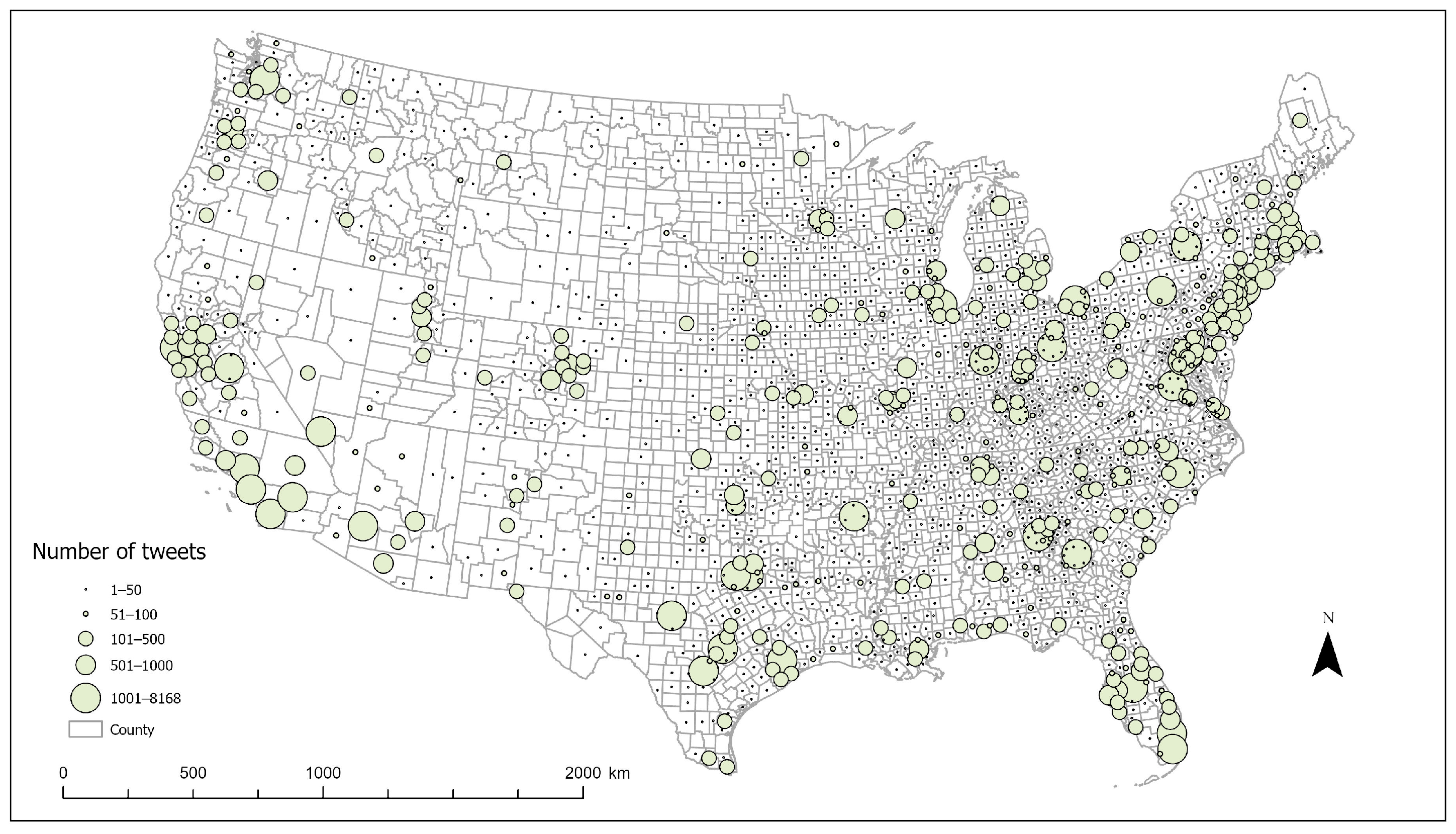
After preliminary filtering using the keywords, not all collected tweets were pertinent to CM and some erroneously included unrelated content, exemplified by tweets such as: “If they were just children kicking the back of the seat, we could ignore them.” Additionally, some tweets were posted by bots instead of humans. To ensure the selected tweets were relevant to CM for further analysis, we randomly sampled 1500 tweets for manual review. Based on this assessment, we further refined our keyword criteria to include more precise and highly relevant combinations, such as “child abuse” + “neglected” and “child” + “sexual exploitation”, which were then used to re-filter the dataset and reduce false positives (i.e., irrelevant tweets). To understand the spatial variation in these tweets, we further extracted tweets with geotags within their metadata, including coordinates (latitude and longitude) and places (such as cities or points of interest). Coordinates of centroids of those places were determined through geocoding. Therefore, 188,429 geotagged English tweets across the contiguous United States were selected for further analysis (Figure 1). Counties with fewer than 50 geotagged tweets were excluded due to the potential lack of a representative sample size, which may not accurately reflect social media discourse about CM in those areas. Consequently, our study included 447 counties (13.83% of all U.S. counties with approximately 70% of the population) in the contiguous United States with 50 or more geotagged tweets related to CM.

3.1.2. Data on Contextual Factors

Based on the contextual factors discussed in the literature and those we aimed to investigate, data on socio-demographic variables for contiguous U.S. counties in 2020 were collected from the U.S. Census Bureau [36]. The variables considered in this study include age group (percentage of individuals aged 18 or younger, 18–44, and 45 or older), gender (male-to-female ratio), race and ethnicity (percentage of non-Hispanic White, non-Hispanic African American, Hispanic/Latino, and other), median household income, education (percentage of people aged 25 or older with a bachelor’s degree), poverty rate, unemployment rate, percentage of foreign-born population, percentage of people living in group quarters (Group quarters refer to places where individuals reside in group living arrangements managed by an organization, such as college dorms, workers’ dormitories, and correctional facilities, but do not include any housing units such as apartment, house, or rented room [37]), percentage of households without broadband access, percentage of single-parent households with children under 18, percentage of same-sex spouse households, percentage of people without health insurance, and percentage of households with adopted children and stepchildren. All variables were standardized to Z-scores so the bandwidths of the Multiscale Geographically Weighted Regression (MGWR) model could directly illustrate the geographic scales at which the association between the dependent and independent variables varies [33,34].
We also obtained data on the coverage of mandatory reporters for CM, which delineates whether mandatory reporting of CM to Child Protective Services or law enforcement is required only for professionals, or all individuals [38]. Counties in states where only professionals are required to report CM were assigned an index of “1”. Counties in states where reporting is mandatory for anyone were assigned an index of “5”.
To examine the difference between child discipline and CM in each state, and to gauge public acceptance of corporal punishment as a method of child discipline, we collected details about relevant laws for each state in 2023 from World Population Review [13]. There is evidence that states that ban corporal punishment in schools are correlated with states where public attitudes are more permissive of corporal punishment and CM [39,40]. Corporal punishment takes five forms: punishment at home, in schools, in daycare settings, in penal institutions, and punishment as a sentence for crime. Since corporal punishment at home is allowed in all states, while corporal punishment as a sentence for crime is prohibited in all states, we assigned an index ranging from 1 to 3 to indicate how many of the other three forms of discipline are prohibited in each county. This corporal punishment index serves as a proxy measure for public tolerance toward CM, with a score of 1 indicating lower tolerance and 3 indicating higher tolerance.

3.2. Methods

3.2.1. Sentiment Analysis

Sentiment analysis was performed to quantify sentiment expressions in CM-related tweets using a machine learning model as outlined below. Initially, all geotagged tweets were cleaned by removing hyperlinks, punctuation, special characters (e.g., “@”, “#”), and non-content-bearing words (e.g., “in”, “the”, “at”), correcting spelling errors, and lemmatizing all words to their root forms. Subsequently, a BERT-based multilingual uncased model from the Hugging Face platform was employed to analyze the sentiment of each geotagged tweet [41]. BERT, short for Bidirectional Encoder Representations from Transformers, is a language model pretrained on unlabeled text data [42]. This specific BERT-based model was fine-tuned for sentiment analysis using a dataset that includes 150,000 English product reviews [41]. The model assigns a star rating (from one to five) to each tweet, where one or two stars indicate negative sentiment expression/sentiment, three stars indicate neutral expression/sentiment, and four or five stars indicate positive expression/sentiment [41]. In this study, “negative sentiment expression” refers to the polarity classification of tweet content generated by the sentiment analysis model, rather than specific emotional states such as anger or sadness towards CM. Example tweets include “This situation shows how serious child neglect can be.” (negative), “New report released on child maltreatment rates across the state.” (neutral), and “Grateful for organizations working to prevent child abuse and support families.” (positive). Given that over 83% of geotagged tweets (145,184 out of 174,364) expressed negative sentiment (one or two stars) based on the model, the percentage of geotagged tweets with negative sentiment in each county serves as the dependent variable for further analysis.

3.2.2. Regression Analysis

The collected socio-demographic data and policy/regulation data were examined as contextual factors (explanatory variables) for social media discourse about CM. A variance inflation factor (VIF) test was conducted to guide the selection and removal of variables in the regression models, aimed at mitigating multicollinearity issues among these factors [43]. Therefore, explanatory variables in the models include age group ratio (age 45+ to age 18–44), male-to-female ratio, percentage Hispanic/Latino, percentage non-Hispanic African American, median household income, percentage of people aged 25 or older with a bachelor’s degree, percentage of people living in group quarters, percentage of households without broadband access, percentage of single-parent households with children under 18, percentage of same-sex spouse households, percentage of households with adopted children and stepchildren, coverage of mandatory reporter, and the corporal punishment index. The basic descriptive statistics of all explanatory variables are in Table 1.
The ordinary least squares (OLS) model was employed to detect global associations between various contextual factors and the percentage of geotagged tweets with negative sentiment regarding CM. Recognizing that these associations may change in different regions and across different geographic scales (such as national, state, county, or local scales), we further analyzed these patterns using MGWR. MGWR enables the examination of how these contextual factors operate at different geographic scales by applying distinct bandwidths to each factor [44]. The model equation is as below:
y i =   j = 0 m β b w j u i , v i x i j + ε i  
where u i ,   v i indicates the location i, y i is the response variable at location i, ε i represents the error term, x i j stands for the j th explanatory variable, β b w j u i ,   v i denotes the coefficient of the j th independent variable, and the b w j value is the bandwidth for the j th independent variable which varies across variables [44].
According to the definition of the bandwidth, it refers to the distance or number of nearest neighbors from which data are borrowed in each local regression calculation, which serves as a measure of the geographic scale of association between an explanatory variable and a response variable [33,34]. Variables with small bandwidths show more localized associations, while those with large bandwidths show regional or global associations [33,34]. The software MGWR 2.2 [33,34] was used to determine the optimal bandwidth and corresponding coefficient for each contextual factor. A bi-square spatial kernel weighting scheme was used to calibrate the model, while model performance was assessed using the corrected Akaike information criterion (AICc) [33,34].

4. Results and Discussion

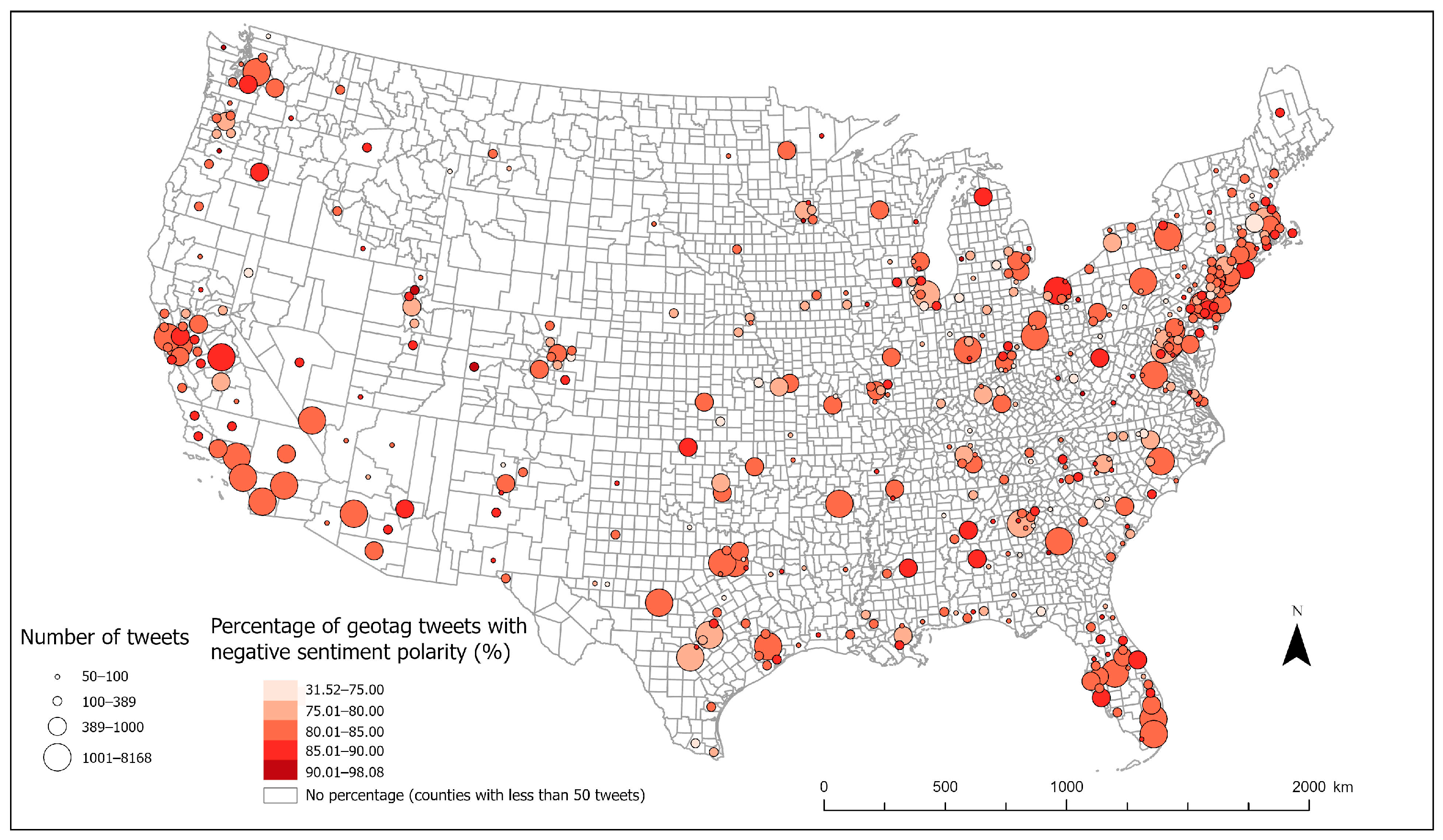
This study encompassed 447 counties across the contiguous United States. On average, each county had 390 geotagged tweets related to CM during the study period. Fifteen counties recorded over 2000 related geotagged tweets, with 6 counties surpassing 3000 tweets each. Through sentiment analysis, we identified 145,184 geotagged tweets with negative sentiment, 6454 tweets with positive sentiment, and 22,726 tweets with neutral sentiment. Nationwide, over 83% of tweets concerning CM conveyed a negative sentiment (Figure 2). Among the counties analyzed, 445 exhibited negative sentiment about CM ranging from 53% to 98%, with 35 counties (7.8%) showing more than 90% of collected tweets having negative sentiment about CM. Only Franklin County in Ohio and Cambria County in Pennsylvania did not have a majority of tweets with negative sentiment (34% and 32%, respectively).
The parameter coefficients and p-values for all contextual factors from OLS regression are detailed in Table 2. The male-to-female ratio and the percentage of same-sex spouse households show a statistically significant positive association with the percentage of tweets with negative sentiment. As these ratios/percentages increase within counties, a higher percentage of CM-related tweets show negative sentiment. The percentage of people aged 25 or older with a bachelor’s degree, the percentage of people living in group quarters, and the percentage of households without broadband access demonstrate statistically significant negative associations with the percentage of tweets with negative sentiment. No significant associations were found for other contextual factors; however, significant associations may exist at regional or local scales. Therefore, the MGWR model was employed for further analysis of all 13 contextual factors.
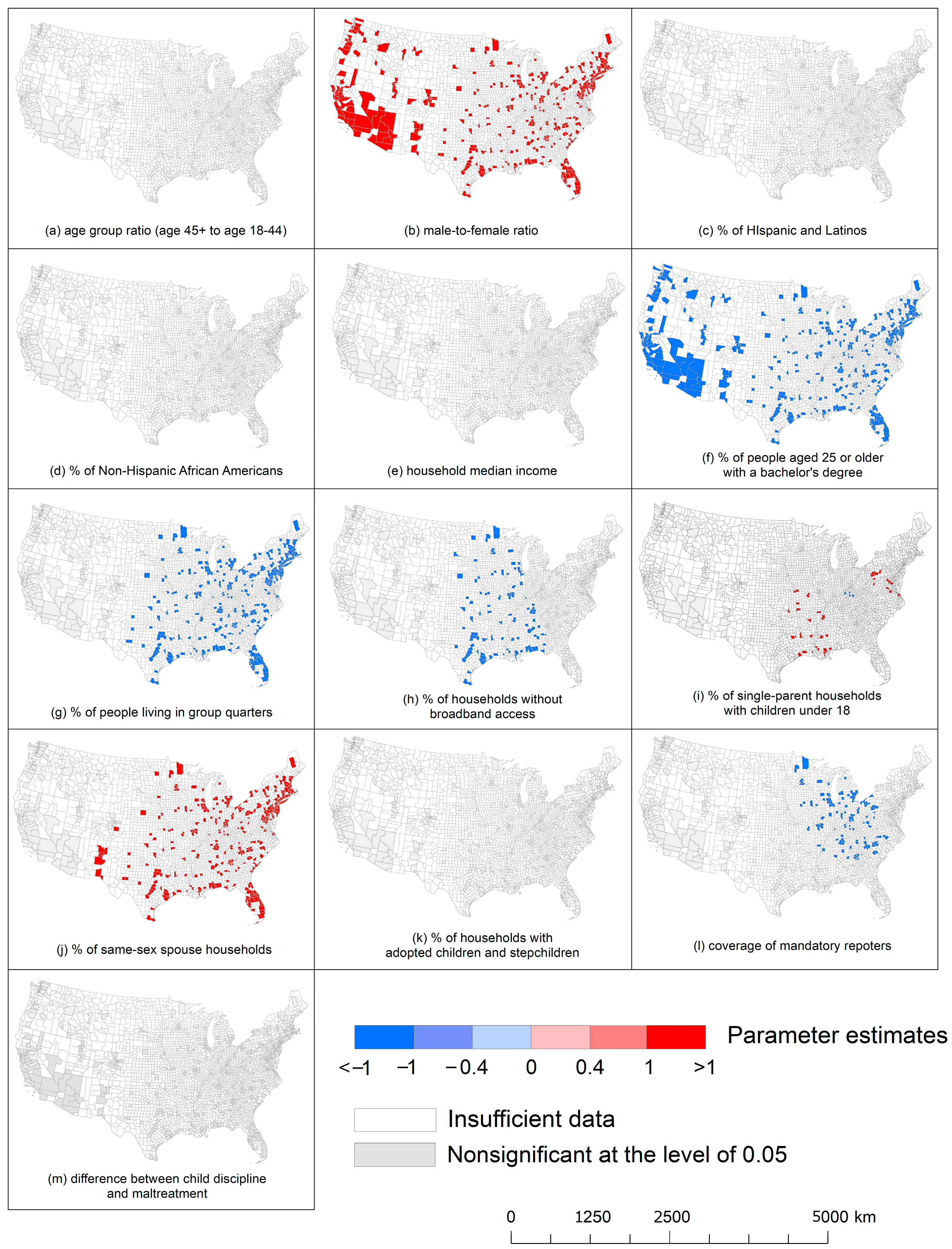
For each explanatory variable, the MGWR model provides an associated coefficient and t-statistic within each county. The coefficient sign denotes the direction of the association, whereas the t-statistic indicates statistical significance at ≤0.05 (Figure 3).
Two contextual factors were significantly associated with public sentiment expressions about CM across the country. The male-to-female ratio has a significant positive association with the percentage of geotagged tweets regarding CM with negative sentiment (Figure 3b). This spatial pattern reveals a global stationarity of this association, meaning that counties with a higher male-to-female ratio are more likely to express negative sentiment in tweets related to CM. This result partly conflicts with the literature, which suggests that men in the United States and European countries have a higher acceptability of corporal punishment of children than women [25,26]. However, this difference might arise because men, although more accepting of corporal punishment, strongly oppose other types of maltreatment such as sexual abuse. It may also reflect differing social media usage behaviors between genders. The percentage of people aged 25 or older with a bachelor’s degree is negatively associated with the percentage of tweets related to CM with negative sentiment nationwide (Figure 3f). This suggests that counties with higher average education levels are less likely to express negative sentiment in CM-related tweets. This pattern is inconsistent with some studies, which indicate that mothers with a higher level of education tend to have a more negative sentiment about CM [28], or that educational attainment is not associated with public sentiment expressions about CM [29]. This may be an effect of measuring education overall vs. education of mothers. This shows how complex the impact of education on public sentiment expressions is and highlights the need for further research to understand it fully.
Five other contextual factors demonstrate significant associations with public sentiment expressions of CM only in specific U.S. regions. As the percentage of people living in group quarters increases, the percentage of geotagged tweets related to CM with negative sentiment decreases in Eastern and Central U.S. counties (Figure 3g), possibly indicating that different social environments or community dynamics may affect social media discourse about CM. Conversely, this association is not significant in Western U.S. counties. Figure 3h shows that as the percentage of households without broadband access increases, the percentage of geotagged tweets with negative sentiment decreases in Central U.S. counties. Lower-income individuals often have more limited access to internet services [45], which may limit their ability to express sentiment via social media platforms. This negative associations also align with findings that individuals with lower incomes perceive CM as less serious [25]. Consequently, households without broadband access may refrain from expressing negative sentiment expression. These patterns, however, do not hold beyond this region. Counties in parts of New England and in the Southern Mississippi River region show a significant positive association between the percentage of single-parent households with children under 18 and the percentage of geotagged tweets related to CM with negative sentiment (Figure 3i). In most Eastern, Central, and Southwestern U.S. counties, the percentage of same-sex spouse households exhibits a statistically significant positive association with the percentage of geotagged tweets about CM with negative sentiment (Figure 3j). However, this association is not observed in Western U.S. counties. In counties within the Great Lakes region and the Southern Appalachian Mountains region, a significant negative association was observed related to the coverage of mandatory reporters (Figure 3l). This association indicates that in counties where everyone is mandated to report CM, there tends to be a lower percentage of geotagged tweets related to CM with negative sentiment; conversely, in counties where only professionals are mandated to report, there appears to be a higher percentage of such tweets with negative sentiment. This pattern implies that narrower mandatory reporting requirements may contribute to greater societal awareness and sensitivity to CM issues. More research is needed to understand this relationship. The regional differences in these five contextual factors underscore the complexity of regional influences on public discourse about CM and highlight the need for localized understanding when interpreting such associations.
However, other contextual factors do not show statistically significant associations with the percentage of geotagged tweets with negative sentiment in any counties, including the age group ratio (age 45+ to age 18–44) (Figure 3a), percentage Hispanic/Latino (Figure 3c), percentage Non-Hispanic African American (Figure 3d), the median household income (Figure 3e), the percentage of households with adopted children and stepchildren (Figure 3k), and the corporal punishment index (difference between child discipline and maltreatment) (Figure 3m). Thus, those factors do not predict the public’s sentiment in CM-related tweets in our data.
The geographic scale of the underlying data-generating process for each contextual factor can be intuitively interpreted through their corresponding bandwidths [33,34]. Table 3 presents the optimal bandwidths (with 95% confidence intervals) for the 13 contextual factors examined, indicating the number of nearest counties to a regression focus (a county) borrowed and weighted in each local regression calculation. Given that 447 counties are included in this study, we can categorize geographic scales into three groups: local scale (less than 150 counties borrowed and weighted), regional scale (150–400 counties), and global scale (more than 400 counties). The age group ratio (age 45+ to age 18–44), the male-to-female ratio, the percentage of Hispanic/Latino, the percentage of Non-Hispanic African American, the median household income, the percentage of people aged 25 or older with a bachelor’s degree, the percentage of same-sex spouse households, the percentage of households with adopted children and stepchildren, and the corporal punishment index have bandwidths ranging from 438 to 446. For each of these nine contextual factors, its influence on the percentage of geotagged tweets with negative sentiment regarding CM demonstrates more global stationarity (Figure 3a–f,j,k,m), meaning the influences are generally consistent across all U.S. counties. In contrast, the percentage of single-parent households with children under 18 shows a more locally varying association with the percentage of tweets with negative sentiment as evidenced by its bandwidth of 101 (Figure 3i). The percentage of people living in group quarters, the percentage of households without broadband access, and the coverage of mandatory reporters have moderate bandwidths from 204 to 365 (Figure 3g,h,l). In other words, these three contextual factors demonstrate relatively stationary impacts on the percentage of CM-related tweets with negative sentiment within regions and varying impacts across different regions. For instance, the percentage of people living in group quarters shows a significant negative association with the percentage of tweets with negative sentiment in most counties in the Eastern and Central regions, but this association does not persist in other regions (Figure 3g).
Among the 13 contextual factors, the local association estimates of 11 factors based on the MGWR model are generally consistent with the global estimates from the OLS model. The exceptions are the percentage of single-parent households with children under 18 and the coverage of mandatory reporters (Table 2 and Figure 3). In the OLS model, neither of these variables shows a statistically significant association with the percentage of geotagged tweets related to CM with negative sentiment; however, the MGWR model reveals local associations for those two contextual factors at the local and regional scales. In comparison to the OLS model, the MGWR model also demonstrates a better goodness of fit. The R 2 value increased from 0.096 to 0.207, while the corrected AIC value decreased from 1250.583 to 1238.719. Additionally, although residuals from both the OLS and the MGWR models showed no significant spatial autocorrelation, the MGWR residuals were closer to spatial randomness (Moran’s I = −0.006, z = −0.175, p = 0.861) compared to those from OLS model (Moran’s I = 0.017, z = 1.005, p = 0.315), which is consistent with improved accounting for spatial heterogeneity. Consequently, the MGWR model offers a better prediction of the percentage of tweets related to CM with negative sentiment in this study.

5. Limitations and Future Research

When interpreting these findings, several limitations should be considered. First, this study examined only the 447 counties with a sufficient number of (50 or more) geotagged tweets related to CM over the 5-year period. This represents a tradeoff between the tweet sample size per county and the number of counties included in the MGWR analysis. Increasing the 50-tweet threshold reduces the number of counties, potentially weakening study power, while lowering the threshold includes more counties but may inaccurately reflect public sentiment expressions in areas with few tweets, as the percentage of negative-sentiment-related tweets becomes highly variable when the total tweet count is low (for example, rural counties). We also conducted a sensitivity analysis using varying thresholds of 20, 30, 40, 60, and 70 tweet minimums in each county. A threshold of 50 tweets per county, which is near the elbow point of the curve, was selected as the primary cutoff to balance data inclusion with the stability of estimates. Notably, the remaining 447 counties still account for more than 70% of the total U.S. population, supporting the representativeness of the analysis overall, although the results may be less representative of rural counties. In addition, increasing the spatial aggregation (e.g., to the state level) would increase the sample size but would obscure the spatial variations identified at a finer scale, as illustrated in Figure 3. Future research could incorporate data from other platforms, such as Facebook and Instagram, to increase the sample size in each geographic unit, thereby providing a more accurate portrayal of public sentiment expressions about CM and reducing potential bias.
Second, this analysis did not examine specific subcategories of CM (such as physical abuse, emotional abuse, sexual abuse, and neglect) or temporal variations in sentiment expressions, largely due to the limited number of geotagged tweets related to CM in many counties. These data constraints limit the ability to conduct robust temporal analyses or disaggregated analyses by CM subtype at the county level. Future studies could extend the study period or integrate data from other social media platforms to address this issue. This would allow for the examination of how sentiment expressions evolve over time and vary across CM subcategories, improving our understanding, prediction, and subsequent prevention efforts for each type of CM.
Third, the Natural Language Processing model used in this study (BERT-based multilingual uncased model) achieves fine-tuned training for sentiment analysis based on English product reviews with 95% accuracy. However, we acknowledge the potential bias from differences between the training samples and the tweets analyzed. In addition, while we manually reviewed tweets to remove false positives (i.e., irrelevant tweets), some relevant tweets may have been missed (false negatives) due to the keyword-based selection process. Although we used common search terms, there may be slang or uncommon terms used to describe CM that were not captured. Future research could incorporate additional slang terms and could manually classify tweets related to CM and train sentiment classifiers specifically tailored to this context. While not flawless, the machine learning approach provides a more efficient and automated method for identifying sentiments within large volumes of text on a given topic.
Fourth, this study relies solely on Twitter/X data to examine public discourse about CM, which may introduce sampling bias. Geotagged tweets exclude non-geotagged posts and non-social media users and tend to overrepresent younger, urban, and more technologically engaged populations [46]. And the lack of individual-level demographic information (e.g., age, gender, race) prevents the use of weighting or demographic adjustments common in survey research. Additionally, Twitter/X data is susceptible to location spoofing if users provide incorrect geotags [46]. However, prior work suggests that data collected through the X API retain sufficient information for sentiment analysis [47], making them suitable for capturing overall public discourse, though not for demographic inference. Future research could incorporate additional platforms (e.g., Facebook, Instagram) to increase sample diversity and reduce potential biases.
Fifth, this study uses state-level regulations as a proxy for public tolerance toward corporal punishment. While this provides a consistent measure of the broader normative context [38,39], it may not capture county-level variation. Direct county-level data examining corporal punishment are not consistently available, as existing datasets reflect administrative cases or are limited to state or national levels. As a result, this proxy may not fully reflect local contexts, and future research could incorporate more localized measures as data become available.

6. Conclusions

This study utilized geotagged social media big data from Twitter/X over a five-year period to explore social media discourse about CM in the United States. This approach contributes to a more nuanced understanding of the public sentiment expressions across large geographic areas over extended periods than traditional data collection methods. Additionally, it reveals the influence of various contextual factors on public sentiment expressions in different areas and across different geographic scales using the MGWR model.
During the study period, geotagged tweets related to CM predominantly conveyed negative sentiment. However, the proportion of tweets with negative sentiment expression varied across counties in the United States. In contrast to the OLS model, the MGWR model exhibited better goodness of fit and offered deeper insights into the spatial heterogeneity and varying geographic scales of the associations between the contextual factors and public sentiment expressions. The male-to-female ratio and the percentage of people aged 25 or older with a bachelor’s degree exhibited a consistent and significant association with the percentage of the geotagged tweets regarding CM with negative sentiment across all U.S. counties. Specifically, counties with higher male-to-female ratios and lower average education levels were more likely to express negative sentiment in CM-related tweets. Five other factors exhibited spatially varying associations with the percentage of tweets with negative sentiment only in specific U.S. regions. Counties in the Eastern and Central U.S. tended to express negative sentiment in CM-related tweets more when there was a lower percentage of residents living in group quarters or a higher percentage of same-sex couples; in Central U.S. counties, negative sentiment was more prevalent in areas with fewer households lacking broadband access; in New England and along the Southern Mississippi River region, negative sentiment was more common when counties had a higher percentage of single-parent households; in the Great Lakes area and along the Southern Appalachian Mountains, negative sentiment in CM-related tweets by the public was more likely when only professionals were mandated to report CM.
This study reveals the spatial heterogeneity and geographic scales of the influence of each contextual factor, offering a better understanding of the public sentiment expressions in CM-related tweets and guiding prediction on spatial variation in sentiment expression. The findings may provide useful insights for policymakers and program implementors. Moreover, the results may offer preliminary insights into regional variation, which could be considered in the planning of public awareness initiatives such as Child Abuse Prevention (CAP) Month activities. Ultimately, these efforts aim to enhance public awareness of CM and potentially reduce the incidence of CM. Furthermore, the methodology can be adapted to explore public sentiment expressions on other social issues, such as housing segregation and wage inequality, offering a versatile framework for addressing a variety of public health and social challenges.

Author Contributions

Conceptualization, Xi Gong and Rebecca A. Girardet; methodology, Xi Gong and Yujian Lu; software, Yujian Lu; validation, Xi Gong, Yujian Lu, Rebecca A. Girardet, Hannah M. C. Schreier, Zhenlong Li, Theresa H. Cruz and Yan Lin; formal analysis, Xi Gong and Yujian Lu; investigation, Yujian Lu; resources, Xi Gong; data curation, Xi Gong and Yujian Lu; writing—original draft preparation, Xi Gong and Yujian Lu; writing—review and editing, Xi Gong, Yujian Lu, Rebecca A. Girardet, Hannah M. C. Schreier, Zhenlong Li, Theresa H. Cruz and Yan Lin; visualization, Yujian Lu; supervision, Xi Gong; project administration, Xi Gong; funding acquisition, Xi Gong, Rebecca A. Girardet and Yan Lin. All authors have read and agreed to the published version of the manuscript.

Funding

This work was supported by the University of New Mexico Office of the Vice President for Research under the WeR1 Faculty Success Program, Research Allocations Committee (RAC) awards (#8oh6a4x35h, #gvvrxwyj64), Grand Challenge Level 1 and Level 2 programs, and the FRESSH Pilot Program; the University of New Mexico, A&S Interdisciplinary Science Cooperative through the Office of Research (Faculty Team Research Concept Competition Award #TA-1003). Any opinions, findings, and conclusions or recommendations expressed in this material are those of the authors and do not necessarily reflect the views of the funding sources and data providers.

Data Availability Statement

Regarding the tweets analyzed, in compliance with Twitter/X’s Developer Agreement and Policy, we are unable to share the full tweet content. However, we are available to provide the corresponding Tweet IDs, which can be used to retrieve the original tweets using authorized tools. Researchers interested in accessing these Tweet IDs can request them from the corresponding author.

Acknowledgments

The authors have reviewed and edited the output and take full responsibility for the content of this publication.

Conflicts of Interest

The authors declare no conflicts of interest.

Abbreviations

The following abbreviations are used in this manuscript:
CM Child maltreatment
MGWR Multiscale geographically weighted regression

Appendix A

Table A1. Keywords for Child Maltreatment (For social media data filtering).
CategoriesKeywords
Combination of “Child”-terms and “Maltreatment”-terms (combine keywords from 2 groups to form filtering terms.)
  • “Child”-terms: “child, children, childhood, kid, kids, parent, caregiver, caregivers, young, youth, adolescent, teenager, teen, minor, boy, girl, under 18, infant, baby, toddler”
+
  • “Maltreatment”-terms
General maltreatment terms: “abuse, physical abuse, sexual abuse, sexual exploitation, emotional abuse, emotional harm, physical harm, neglect, abusive situation, protective service, disciplinary, disciplinary practice, violence, maltreated, life-threatening, abandonment, abandon, parental substance use, human trafficking, exploitation, medical abuse, medical child abuse, Munchausen’s syndrome by proxy, caregiver fabrication”
Physical abuse terms: “punching, beating, kicking, biting, shaking, throwing, stabbing, choking, hitting, burning, Physical discipline, spanking, paddling, punch, beat, kick, bite, shake, throw, stab, choke, hit, burn, spank, paddle, bruise, broken bone, black eye, injury, bleeding, bruising, swelling, fracture, shaken baby syndrome, inflicted head trauma, nonaccidental trauma, intra-abdominal trauma, looped cord mark, patterned injury”
Neglect terms: “fail to, failure to, inattention to, cannot, can not, not, no, lack of” + “food, shelter, supervision, medical care, medical treatment, mental health treatment, special education, emotional need, psychological care”
Sexual abuse terms: “fondling, fondle, genitals, penetration, incest, rape, sodomy, indecent exposure, exploitation, prostitution, pornographic, porn”
Emotional abuse terms: “criticism, criticize, threat, rejection, reject, blame, belittle, berate, withholding love, withhold love, withhold support, withholding support, withhold guidance, withholding guidance, compliant, demanding, passive, aggressive, depression, depress, suicidal, emotional bonds, spurn, name-calling”
Parental substance use terms: “drug, substance, methamphetamine, alcohol, endangerment, drug exposure, drug-exposed children (DEC), fentanyl, cocaine, heroin, ‘blues’”
Human trafficking terms: “trafficking, slavery, sex trafficking, labor trafficking, prostitution, pornography, stripping, forced labor, drug dealing, begging, run-away”
Other termsChild maltreatment, adverse childhood experience, Child Abuse Prevention, Child Abuse Prevention Month, child welfare, Every Child Matters

References

  1. Child Welfare Information Gateway Definitions of Child Abuse & Neglect. Available online: https://cwig-prod-prod-drupal-s3fs-us-east-1.s3.amazonaws.com/public/documents/define.pdf?VersionId=P2GBlQKK7w_ohrCN3oV2TiD6QIkkEjIP (accessed on 11 August 2023).
  2. World Health Origanization. Child Maltreatment. Available online: https://www.who.int/news-room/fact-sheets/detail/child-maltreatment (accessed on 9 October 2023).
  3. Administration for Children and Families Child Maltreatment. 2020. Available online: www.acf.hhs.gov/cb/data-research/child-maltreatment (accessed on 9 August 2022).
  4. Statista Research Department Number of Child Deaths per Day Due to Child Abuse and Neglect in the United States from 1998 to 2022. Available online: https://www.statista.com/statistics/255206/number-of-child-deaths-per-day-due-to-child-abuse-and-neglect-in-the-us/ (accessed on 1 July 2024).
  5. Norman, R.E.; Byambaa, M.; De, R.; Butchart, A.; Scott, J.; Vos, T. The Long-Term Health Consequences of Child Physical Abuse, Emotional Abuse, and Neglect: A Systematic Review and Meta-Analysis. PLoS Med. 2012, 9, e1001349. [Google Scholar] [CrossRef] [PubMed]
  6. Negriff, S. ACEs Are Not Equal: Examining the Relative Impact of Household Dysfunction versus Childhood Maltreatment on Mental Health in Adolescence. Soc. Sci. Med. 2020, 245, 112696. [Google Scholar] [CrossRef] [PubMed]
  7. Villodas, M.T.; Litrownik, A.J.; Thompson, R.; Jones, D.; Roesch, S.C.; Hussey, J.M.; Block, S.; English, D.J.; Dubowitz, H. Developmental Transitions in Presentations of Externalizing Problems among Boys and Girls at Risk for Child Maltreatment. Dev. Psychopathol. 2015, 27, 205–219. [Google Scholar] [CrossRef] [PubMed]
  8. Klika, J.B.; Rosenzweig, J.; Merrick, M. Economic Burden of Known Child Maltreatment Cases in 2018 by State. Available online: https://preventchildabuse.org/resources/economic-burden-of-known-cases-of-child-maltreatment-from-2018-in-each-state-2/ (accessed on 3 July 2024).
  9. Negriff, S. Child Maltreatment Research, Policy, and Practice: Contributions of Penelope K. Trickett; Negriff, S., Ed.; SpringerBriefs in Psychology; Springer: Cham, Switzerland, 2018. [Google Scholar]
  10. CDC Preventing Child Abuse and Neglect. Available online: https://www.cdc.gov/child-abuse-neglect/prevention/index.html#:~:text=Increaseaccesstohigh-quality,allmembersofacommunity (accessed on 3 July 2024).
  11. Dhooper, S.S.; Royse, D.D.; Wolfe, L.C. A Statewide Study of the Public Attitudes toward Child Abuse. Child Abuse Negl. 1991, 15, 37–44. [Google Scholar] [CrossRef]
  12. Benbenishty, R.; Schmid, H. Public Attitudes toward the Identification and Reporting of Alleged Maltreatment Cases among Social Groups in Israel. Child. Youth Serv. Rev. 2013, 35, 332–339. [Google Scholar] [CrossRef]
  13. World Population Review Child Discipline Laws by State. 2023. Available online: https://worldpopulationreview.com/state-rankings/child-discipline-laws-by-state (accessed on 20 November 2023).
  14. Walker, H.E.; Diemer, M.C.; Wamser-Nanney, R. Childhood Maltreatment and Parental Attitudes Regarding the Use of Corporal Punishment. J. Child Fam. Stud. 2022, 31, 2376–2386. [Google Scholar] [CrossRef]
  15. Mi-lan, J.W.; Emmen, R.A.G.; Alink, L.R.A.; Wang, L.; Branger, M.C.E.; Mesman, J. Attitudes about Child Maltreatment in China and the Netherlands. Child Abuse Negl. 2021, 112, 104900. [Google Scholar]
  16. Lui, Z.J.; Tan, J.C.G.; Koh, C.W.; Liu, D.; Elliott, J.M.; Fu, C.S.L.; Teo, C.E.S. Perceptions of Child Maltreatment among Professionals and the Public in Singapore. J. Interpers. Violence 2022, 37, 1540–1565. [Google Scholar] [CrossRef]
  17. Bailhache, M.; Alioum, A.; Salmi, L.-R. Perception of Physical Child Abuse among Parents and Professionals in a French Emergency Department. J. Interpers. Violence 2017, 35, 2825–2845. [Google Scholar] [CrossRef]
  18. Chan, J.S.; Elliott, J.M.; Chow, Y.; Thomas, J.I. Does Professional and Public Opinion in Child Abuse Differ? An Issue of Cross-cultural Policy Implementation. Child Abuse Rev. 2002, 11, 359–379. [Google Scholar] [CrossRef]
  19. Garbarino, J.; Kostelny, K. Child Maltreatment as a Community Problem. Child Abuse Negl. 1992, 16, 455–464. [Google Scholar] [CrossRef]
  20. Bostrom, M. Discipline and Development: A Meta-Analysis of Public Perceptions of Parents, Parenting, Child Development and Child Abuse; Prevent Child Abuse America: Washington, DC, USA, 2003. [Google Scholar]
  21. Kietzmann, J.H.; Hermkens, K.; McCarthy, I.P.; Silvestre, B.S. Social Media? Get Serious! Understanding the Functional Building Blocks of Social Media. Bus. Horiz. 2011, 54, 241–251. [Google Scholar] [CrossRef]
  22. Gong, X.; Yang, X. Social Media Platforms. In The Geographic Information Science & Technology Body of Knowledge (3rd Quarter 2020 Edition); The University Consortium for Geographic Information Science: Ithaca, NY, USA, 2020. [Google Scholar] [CrossRef]
  23. Gong, X.; Lane, K.M.D. Institutional Twitter Usage among U.S. Geography Departments. Prof. Geogr. 2020, 72, 219–237. [Google Scholar] [CrossRef]
  24. Gong, X.; Ye, X. Governors Fighting Crisis: Responses to the COVID-19 Pandemic across U.S. States on Twitter. Prof. Geogr. 2021, 73, 683–701. [Google Scholar] [CrossRef]
  25. Straus, M.A.; Mathur, A.K. Social Change and the Trends in Approval of Corporal Punishment by Parents from 1968 to 1994. In Family Violence Against Children; Walter deGruyter: New York, NY, USA, 1996; Volume 19, pp. 91–106. [Google Scholar]
  26. Gracia, E.; Herrero, J. Is It Considered Violence? The Acceptability of Physical Punishment of Children in Europe. J. Marriage Fam. 2008, 70, 210–217. [Google Scholar] [CrossRef]
  27. Fakunmoju, S.B.; Bammeke, F.O.; Antwi Bosiakoh, T.; Asante, R.K.B.; Wooten, N.R.; Hill, A.C.; Karpman, H. Perception and Determination of Child Maltreatment: Exploratory Comparisons across Three Countries. Child. Youth Serv. Rev. 2013, 35, 1418–1430. [Google Scholar] [CrossRef]
  28. Jabraeili, M.; Asadollahi, M.; Jafarabadi, M.A.; Hallaj, M. Attitude toward Child Abuse among Mothers Referring Health Centers of Tabriz. J. Caring Sci. 2015, 4, 75. [Google Scholar] [CrossRef] [PubMed]
  29. Hayes, B.E.; O’Neal, E.N. The Effects of Individual- and National-Level Factors on Attitudes toward Child Maltreatment. Child Abuse Negl. 2018, 83, 83–93. [Google Scholar] [CrossRef]
  30. Heffer, R.W.; Kelley, M.L. Mothers’ Acceptance of Behavioral Interventions for Children: The Influence of Parent Race and Income. Behav. Ther. 1987, 18, 153–163. [Google Scholar] [CrossRef]
  31. Alkathiri, M.; Baraja, M.; Alaqeel, S. Knowledge, Attitude, and Practice Regarding Child Maltreatment among Health Care Providers Working in Primary Care Centers in Riyadh, Saudi Arabia. J. Fam. Med. Prim. Care 2021, 10, 3198. [Google Scholar] [CrossRef] [PubMed]
  32. Lyu, Y.; Chow, J.C.-C.; Hwang, J.-J. Exploring Public Attitudes of Child Abuse in Mainland China: A Sentiment Analysis of China’s Social Media Weibo. Child. Youth Serv. Rev. 2020, 116, 105250. [Google Scholar] [CrossRef]
  33. Oshan, T.M.; Li, Z.; Kang, W.; Wolf, L.J.; Stewart Fotheringham, A. MGWR: A Python Implementation of Multiscale Geographically Weighted Regression for Investigating Process Spatial Heterogeneity and Scale. ISPRS Int. J. Geo-Inf. 2019, 8, 269. [Google Scholar] [CrossRef]
  34. Li, Z.; Fotheringham, A.S. Computational Improvements to Multi-Scale Geographically Weighted Regression. Int. J. Geogr. Inf. Sci. 2020, 34, 1378–1397. [Google Scholar] [CrossRef]
  35. X Academic Research Access. Available online: https://devcommunity.x.com/t/academic-research-access/221102 (accessed on 8 November 2022).
  36. U.S. Census Bureau. Available online: https://www.census.gov/ (accessed on 7 August 2022).
  37. United States Census Bureau 2020 Census Group Quarters. Available online: https://www.census.gov/newsroom/blogs/random-samplings/2021/03/2020-census-group-quarters.html (accessed on 13 November 2021).
  38. Hilotin-Lee, L.T.A. Child Abuse Laws State by State. Available online: https://www.findlaw.com/family/child-abuse/child-abuse-laws-state-by-state.html (accessed on 20 November 2023).
  39. Fleckman, J.M.; Taylor, C.A.; Gershoff, E.; Finkelhor, D.; Holden, G.W.; Klika, B. Levels of Support for Legislative Bans to End Physical Punishment in Schools and Homes in a National Sample. Public Health 2023, 222, 60–65. [Google Scholar] [CrossRef]
  40. Gershoff, E.T.; Font, S.A. Corporal Punishment in U.S. Public Schools: Prevalence, Disparities in Use, and Status in State and Federal Policy. Soc. Policy Rep. 2016, 30, 1–26. [Google Scholar] [CrossRef] [PubMed]
  41. Peirsman, Y. Bert Base Multilingual Uncased Sentiment. Available online: https://huggingface.co/nlptown/bert-base-multilingual-uncased-sentiment (accessed on 21 August 2023).
  42. Devlin, J.; Chang, M.W.; Lee, K.; Toutanova, K. BERT: Pre-Training of Deep Bidirectional Transformers for Language Understanding. In NAACL HLT 2019—2019 Conference of the North American Chapter of the Association for Computational Linguistics: Human Language Technologies; Association for Computational Linguistics: Stroudsburg, PA, USA, 2019; Volume 1, pp. 4171–4186. [Google Scholar]
  43. Shrestha, N. Detecting Multicollinearity in Regression Analysis. Am. J. Appl. Math. Stat. 2020, 8, 39–42. [Google Scholar] [CrossRef]
  44. Fotheringham, A.S.; Yang, W.; Kang, W. Multiscale Geographically Weighted Regression (MGWR). Ann. Am. Assoc. Geogr. 2017, 107, 1247–1265. [Google Scholar] [CrossRef]
  45. Swenson, K.; Ghertner, R. People in Low-Income Households Have Less Access to Internet Services; U.S. Department of Health and Human Services: Atlanta, GA, USA, 2020.
  46. Zhang, G.; Zhu, A.X. The Representativeness and Spatial Bias of Volunteered Geographic Information: A Review. Ann. GIS 2018, 24, 151–162. [Google Scholar] [CrossRef]
  47. Wang, Y.; Callan, J.; Zheng, B. Should We Use the Sample? Analyzing Datasets Sampled from Twitter’s Stream API. ACM Trans. Web 2015, 9, 13. [Google Scholar] [CrossRef]
Figure 1. Geotagged tweets related to child maltreatment from 1 January 2018, to 31 December 2022, in the contiguous United States.
Ijgi 15 00195 g001
Figure 2. Percentage of child maltreatment-related geotagged tweets with negative sentiment across U.S. counties (2018–2022; ≥50 geotagged tweets per county).
Ijgi 15 00195 g002
Figure 3. MGWR results showing county-specific parameter estimates for association between the percentage of geotagged tweets related to CM with negative sentiment and contextual factors.
Ijgi 15 00195 g003
Table 1. Descriptive statistics of explanatory variables for child maltreatment sentiment in social media tweets.
Continuous VariablesMeanMedianStandard DeviationRange
Age group ratio (age 45+ to age 18–44)1.251.170.362.31
Male-to-female ratio97.1096.407.44112.70
Percentage Hispanic/Latinos0.160.110.150.92
Percentage Non-Hispanic African American0.120.080.130.67
Median household income68,118.7563,699.0018,266.54110,215.00
Percentage of people aged 25 or older with a bachelor’s degree20.7720.505.7331.20
Percentage of people living in group quarters2.672.002.5831.90
Percentage of households without broadband access10.9710.204.6333.80
Percentage of single-parent households with children under 186.396.101.8213.80
Percentage of same-sex spouse households0.200.200.100.80
Percentage of households with adopted children and stepchildren0.050.050.010.10
Categorical VariablesFrequency and percentage
Coverage of mandatory reporters Only professional: 258 counties (57.72%), and everyone: 189 counties (42.28%)
Corporal punishment index1: 165 counties (34.90%), 2: 111 counties (24.83%), and 3: 180 counties (40.27%)
Table 2. Results of ordinary least squares regression regarding the association between contextual factors and the percentage of geotagged tweets with negative sentiment about CM in the counties within the contiguous U.S., 2018 to 2022.
Contextual FactorCoefficient p-Value
Age group ratio (age 45+ to age 18–44)0.1190.052
Male-to-female ratio0.183 **0.006
Percentage Hispanic/Latinos−0.0150.821
Percentage Non-Hispanic African American0.0530.489
Median household income0.0220.804
Percentage of people aged 25 or older with a bachelor’s degree−0.256 **0.002
Percentage of people living in group quarters−0.221 **0.001
Percentage of households without broadband access−0.146 *0.043
Percentage of single-parent households with children under 180.0150.858
Percentage of same-sex spouse households0.122 *0.023
Percentage of households with adopted children and stepchildren−0.030.580
Coverage of mandatory reporters 0.0150.571
Corporal punishment index (difference between child discipline and maltreatment)0.0360.525
* p < 0.05, ** p < 0.01.
Table 3. Bandwidths for contextual factors examined, based on multiscale geographically weighted regression results.
Contextual FactorsBandwidthConfidence Interval (95%)
Age group ratio (age 45+ to age 18–44)446(352, 446)
Male-to-female ratio446(352, 446)
Percentage Hispanic/Latino446(352, 446)
Percentage Non-Hispanic African American446(352, 446)
Median household income446(352, 446)
Percentage of people aged 25 or older with a bachelor’s degree438(292, 442)
Percentage of people living in group quarters365(292, 388)
Percentage of households without broadband access204(127, 292)
Percentage of single-parent households with children under 18101(92, 137)
Percentage of same-sex spouse households446(352, 446)
Percentage of households with adopted children and stepchildren446(352, 446)
Coverage of mandatory reporters215(197, 292)
Corporal punishment index (difference between child discipline and maltreatment)446(292, 446)
Disclaimer/Publisher’s Note: The statements, opinions and data contained in all publications are solely those of the individual author(s) and contributor(s) and not of MDPI and/or the editor(s). MDPI and/or the editor(s) disclaim responsibility for any injury to people or property resulting from any ideas, methods, instructions or products referred to in the content.