
Article

Monitoring Spatiotemporal Evolution of Dynamic Fields via Sensor Network Datastream: A Decentralized Event-Driven Approach


by
Roger Cesarié Ntankouo Njila
1,2,*,
Mir Abolfazl Mostafavi
1,2,
Jean Brodeur
3 and
Sonia Rivest
1
1
Centre de Recherche en Données et Intelligence Géospatiales (CRDIG), 0611 Pavillon Casault Université Laval, Québec City, QC G1K 7P4, Canada
2
Canada Research Chair in Senseable Cities for Empowerd Mobility, Université Laval, Québec City, QC G1K 7P4, Canada
3
GéoSémantic Research, Sherbrooke, QC J1L 1W8, Canada
*
Author to whom correspondence should be addressed.
ISPRS Int. J. Geo-Inf. 2026, 15(5), 194; https://doi.org/10.3390/ijgi15050194
Submission received: 1 December 2025 / Revised: 9 April 2026 / Accepted: 21 April 2026 / Published: 1 May 2026

Abstract

Sensor data are increasingly used in monitoring spatiotemporal phenomena for diverse applications such as flood management, urban traffic, air quality control, forest fire management, etc. Real-time modelling and representation of such evolving phenomena is fundamental for efficient and near-real-time decision-making processes. In addition to simple and local alerts about occurring changes over time at a given location, as is the case in Sensor Event Service (SES), the decision-making process may require more global spatial information, such as knowing if the monitored phenomenon is expanding or contracting around a given spot or if it is moving from one spot to another, especially for non-punctual spatial features. For such cases, spatiotemporal information should be computed over the whole set of distributed data from which the geometry of monitored phenomena can be assessed. This paper proposes an event-driven fuzzy rule-based decentralized spatial reasoning approach to compute spatiotemporal changes occurring in vague shape phenomena from distributed sensor data streams. Inferring local and partial spatial changes from individual nodes over the sensor network is prior to the computation of developing changes that the monitored phenomenon undergoes over the whole area covered by the sensor network. In this approach, we suggest a Fuzzy-Extended Spatiotemporal Change Pattern (FESTCP) to compute spatiotemporal changes about fuzzy regions. To evaluate our method, simulated case studies of ambient air pollution in Quebec City are carried out. The results reveal that the proposed method could provide satisfactory information about spatiotemporal changes in real-world phenomena monitored by a sensor network for a real-time decision-making process.

1. Introduction

For many geospatial applications requiring spatially and temporally referenced data, advances in sensor and positioning technologies in recent years have facilitated unprecedented growth in data collection [1]. Sensor data streams are widely used in many applications such as intrusion monitoring, manufacturing, disaster response, radioactive accidents, air quality control, etc. [2]. Real-time and instantaneous modelling and computing spatiotemporal information about such transient environmental phenomena is therefore required for a better understanding and a more efficient support to real-time spatial decision systems. Most of the developed approaches are based on the fact that sensor data provides snapshots of phenomena at a given time and location; a series of static snapshots can therefore help in understanding the dynamic behaviour of a given phenomenon [3]. As a way to inform users about changes in sensed phenomena, Sensor Event Service (SES) was built within the Sensor Web Enablement initiative of the Open Geospatial Consortium (OGC), to support event processing from sensor data stream [4], by filtering incoming sensor data stream according to predefined criteria for particular changes. Apart from having a simple alert about occurring changes over time at a given location, as is the case in SES, one may like to know if the monitored phenomenon is expanding or contracting around a given spot or if it is moving from one spot to another. For such types of analysis, knowledge about the spatial extents of monitored phenomena over time is therefore prior information, especially for non-punctual features.
Sensors are characterized by limited sensing range, memory and computation capabilities [5]; no node can therefore assume to have complete information about the geometries it belongs to; more spatiotemporal knowledge can only be inferred by engaging in communication with neighbouring nodes [6]. In such a decentralized spatial computing approach, spatiotemporal analysis about monitored reality relies on sensor network (SN) topology which may also evolve over time [7]. Additionally, sensor positions will eventually not match the exact edges of the phenomenon’s extent, whose spatial shape is ultimately vague. On the other hand sensor density, which varies over sensor network extent, is a key point to ensure quality in derived spatial knowledge about the extent and geometry of monitored phenomena and their dynamics [8,9]. These lead to some uncertainties in derived spatial knowledge while computing the geometry of monitored phenomena from sensor records [10]. Changes in sensor data value, which stand as a proxy for events occurring in the real world, lead to changes in the spatial signature of monitored phenomena; these changes are generally captured by comparing consecutive discrete snapshots over continuously evolving phenomena.
Among existing reasoning formalisms about spatiotemporal knowledge, event calculus can use a limited set of predicates and formulas and can easily be adapted to an agent with limited computing capacity, as is the case with geosensors. Furthermore, event calculus is the only formalism offering the opportunity to infer spatiotemporal knowledge following 3 reasoning approaches: abductive, inductive and deductive [11,12,13]; this gives the opportunity to a good variety of application domains [13]. Deductive inference includes temporal analysis, where the outcome of a known sequence of actions is sought. In a sensor system, what is happening over time is captured by sensor measurements [14]; the spatial signature of happenings, which is sought, can be inferred from sensor data geosemantics. Inductive and abductive reasoning approaches infer more generalizing and theoretical knowledge as scientific discovery and theory formation, and their reasoning rules include approaches such as machine learning [13]; such approaches are more demanding in terms of computing resources, which are limited in sensor systems.
This paper, which is part of a PhD work [15], aims at developing a deductive event-driven approach for pervasive modelling and reasoning about spatiotemporal changes occurring in continuous evolving phenomena with fuzzy boundaries monitored by SN. Existing decentralized spatial computing approaches for reasoning and modelling sensed phenomena are based on the assumption that they can be represented using spatial objects with crisp boundaries. This does not conform to real-world situations about many environmental phenomena whose boundaries are fuzzy; some application examples are air pollution, temperature zones, magnetic fields, storm intensity, and solar insolation [16]. Sensor nodes infer spatial information denoting their relative position with respect to the spatial extent of the phenomenon, which is inherently fuzzy. Static sensing agents making the network can infer local changes about their relative position with respect to the fuzzy extent of the monitored phenomenon, as the basis for reasoning about phenomenon dynamics, inferred changes might vary too much in space and time over the SN extent. Such variability requires appropriate spatial reasoning that considers the possible fuzzy nature of the phenomenon to avoid mismatch amalgamation in computing and modelling dynamics about sensed phenomena from granular changes inferred by sensing agents.
Sampling procedure defines the sensors’ measurement timeframe [17], which may not match that of event occurrence in the sensed phenomenon. The exact time of the event occurrence cannot be deduced from the sensor’s measurements with certainty. Allen’s interval logic rules may contribute to solving the outstanding question of temporal indeterminacy while computing differences in consecutive qualitative spatial information for understanding and modelling monitored phenomenon dynamics in sensor systems.
The remainder of this paper is organized as follows: Section 2 presents the framework of the approach suggested to compute spatiotemporal changes about vague shape dynamic phenomena in SNs; the approach is formally described in this section. In Section 3 we use a case study used in testing its applicability and performance, and the results are presented. Section 4 draws conclusions and identifies future research work.

2. Materials and Methods

Compared to static data models implemented in many GIS applications, the representation of spatiotemporal entities seems more challenging and receives much attention in the literature.
In object-oriented GIS, objects in the classes may change from one state to another; the changes themselves are not explicitly handled but are implicit in the variations in the properties of the objects [18]. An object θ changes if and only if there exists a property P of θ and distinct times t and t such that θ has property P at t and θ does not have property P at t . State returns the state of an object at a given time, that is, the values of its spatial and non-spatial properties at that time [19]; similarly, sensor data describe monitored phenomena at a given time from which the spatial pattern of the very phenomenon is computed. A change in sensor data value over time expresses the dynamic character of monitored phenomena.
The change element or geographic event can be categorized into time changes, location changes or attribute changes. In the context of geosensor observation and monitoring, an event is considered to be any happening observed at a given time or interval of time resulting in a variation in sensor data value and effectively leading to a change in spatial coverage (extent, geometry) or position of monitored reality. The spatial attribute (extent, geometry) of a geographic object modelling a monitored phenomenon may be derived from sensor data values; for instance, recorded values of rainfall of d > 0 are indications of rain happening at the sensor’s location at a given time. The spatial deployment of sensors, which depends on the nature of the monitored phenomenon or sensor type, determines how the spatial interpretation of change or event about the monitored geographic phenomenon will be realized. In the context of geosensor networks monitoring a phenomenon which is modelled by areal spatial objects, where sensors are fixed (holding the same location over time), changes in sensor data value over time are a proxy of changes in the phenomenon attribute and spatial property of the monitored phenomenon. The spatial change is implied in this context on the basis of the relative position (out, within, etc.) of sensor nodes with respect to the spatial extent of the monitored phenomenon. As shown in Table 1, a static sensor node, whose position is passed from an outer position at t 0 to an inner position at t 1 , with respect to the extent of monitored rain, will present a change in the value of sensed data. Looking at the change in the geometry or location of monitored rain, the very sensor can infer either an expansion of the rain or the delocalization of the rainy area. Geosensors are characterized by limited sensing range; for this reason, geosensors cannot have complete knowledge about the geometry of a large-scale monitored phenomenon without the contribution of the whole sensor network.
Identifying the type of spatial change from local sensor data streams as a discrete and local change may lead to some vagueness in inferring spatial information because of incompleteness in local sensor data concerning large-scale phenomena. A spatial expansion or drifting of the rainy area may be inferred from the observations of a unique sensor node location, whereas the complete set of sensor data streams collected over the sensor network will provide knowledge about changes concerning the spatial extent and geometry of a monitored large-scale continuous phenomenon. For fuzzy environmental phenomena such as air pollution or rain, the relative position of nodes with respect to the monitored phenomenon cannot be inferred as a Boolean qualitative spatial statement.
According to Wang et al. [20], a change in the object-based model of geographic phenomenon exists between any time, location, and attribute of different states, regardless of whether they are of the same geographic object or not. Two categories of change can therefore be distinguished: a developing change shows the changes from one geographic object, and an evolving change describes the changes between two different geographic objects. In this light, the expansion of the rainy area will stand as a developing change in the rain, whilst the spatial drifting of the rainy area can be considered as an evolving change, as far as the spatial relation between the rainy area and sensor node location is considered. Consecutive snapshots of the rainy area between t 0 and t 1 reveal a developing change about the spatial extent and geometry of spatial object modelling the rainy area. This is true if the computation of spatial change considers the change in spatial objects representing the rainy process alone, ignoring its relative position with respect to the sensor node location, even though the spatial object is computed based on sensor location and observations over the sensor network. The spatiality of the spatiotemporal change process reflects the close relationship between the state or change process of spatial objects and spatial position, morphology, topology, distribution and difference [21].

2.1. Presentation of the Event-Driven Decentralized Spatial Computing Approach for Reasoning and Modelling Developing Changes About Vague Spatial Shape Phenomena in SN

Geographic features may be represented as discrete points or lines for features of punctual or linear geometries, while field-like phenomena may be represented using a raster-based or an object-based (polygon) approach [22]. For many GIS applications, the object-oriented model brought GIS closer to how humans think about the world and expanded our ability to represent both relationships and dynamics [23,24,25,26].
Events and processes are essential constituents in geospatial dynamism which requires computation of both spatial and temporal characteristics [27]. Geospatial dynamism is essential for many applications in GIS, such as environmental resource planning, renewable resource management, disaster mitigation and environmental impact assessment, etc. Changes in consecutive sensor data values are the main proxy for event and process describing the dynamism dimension of monitored phenomena. In this study, we are interested in monitoring and modelling spatial changes in the spatial extent and geometry of large-scale phenomena with possible vague shapes monitored by sensor networks. The spatial object representing a snapshot of the monitored phenomenon at a given time is a fuzzy-crisp object with kernel and conjecture parts describing the fuzzy spatial pattern of the measured property [28]. The manifestation of the monitored phenomenon at a given time and space stands as the prime cause of measure data value. Changes in time series sensor data value reveal event occurrence, denoting the dynamic characteristic of the monitored phenomenon, which may lead to changes in spatial coverage and geometry of monitored reality as the spatial effect of detected events [29]. Spatial computing of spatial changes in a decentralized computing approach is a two-stage reasoning process:
  • A first stage at the level of sensor nodes based on locally inferred changes over time-series observation data;
  • A second stage at the level of sensor networks, where ongoing developing changes about the coverage and geometry of a sensed phenomenon are inferred from fused local spatial changes computed by sparse sensing nodes.
For deductive event reasoning, these two stages require premises and conclusions that cope with the spatial level (local and global) of reasoning concerned.
The formulation of the premises “What happens when” and “What action do” encompasses the time, attribute and location components of sensor data in relation to the semantics of the phenomenon of interest, and its spatial representation. The conclusion statement expressed through the fragment “What is true when” of the reasoning process should accommodate the eventual vague shape of the spatial object modelling the monitored phenomenon. The built-in event calculus engine (ECE) uses a knowledge base and a rule-based component to infer on event detection and its spatial effect. The proposed approach is built on three steps of computation based on logic programming and implemented using the Prolog language which has been formerly used successfully for event calculus [29]; these steps are:
  • Reifying qualitative spatiotemporal status (fluent) from sensor data stream.
  • Identifying local spatiotemporal change based on consecutive spatial status.
  • Fusing spatial changes inferred by sensor nodes and inferring developing spatiotemporal changes about the monitored phenomenon.
In the following sections, we present the conceptual framework of the proposed approach and describe in detail its main steps.

2.2. Conceptual Framework of the Event-Driven Decentralized Spatial Computing Approach in SN

In the tetrad framework of spatiotemporal change suggested by Galton [30], an object may be thought of as primarily existing in space, but having a temporal extent, so an event may be thought of as primarily existing in time, but having a spatial extent. Because the sampling procedure implemented by sensors defines measurements timeframe [17], the exact time frame of changes or events occurrence is unknown and surely different from the observation timespan as claimed in ref. [31]. The temporal component of our reasoning approach is made of a time interval framed by the date of measurements, expressing a change in the relative position of the sensor vis-à-vis the region defining the coverage of the phenomenon. Due to the inherent fuzziness of real-world environmental phenomena [32] monitored by geosensor networks and the limited range of sensor measurements, the spatial component of our approach which is based on fuzzy-crisp spatial object is a double stage (local and extended) spatial component.
The conceptual framework used for spatiotemporal reasoning in this study, similarly to the reasoning approach proposed in ref. [33], is made of three separate domains corresponding in our case to the three fragments of the deductive event-based reasoning process:
  • The temporal domain corresponding to the fragment “what happens when” of the event calculus engine is one of the premises of the deductive reasoning process.
  • The spatial domain making the fragment “what actions do” where the spatial change corresponding to the detected change is inferred as the second premise of the reasoning process.
  • The double-stage spatiotemporal domain corresponding to the fragment “what is true when” where the conclusions (local and extended) are drawn.
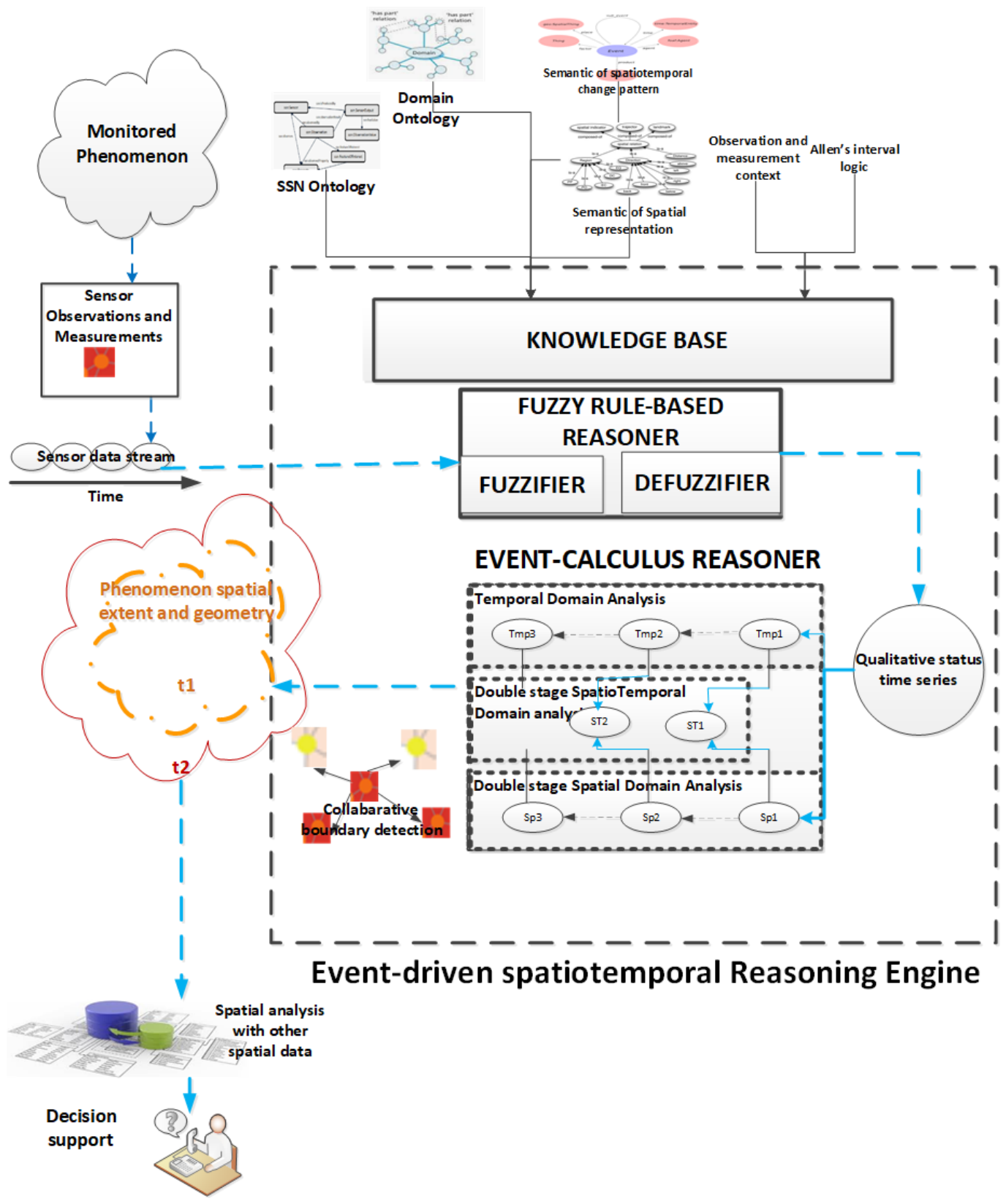
For the appropriate formulation of statements (premises and conclusions), the semantics of geosensor data streams, monitored phenomenon and its spatial representation are required. The sensor network data meaning is set by the integration of domain ontology in the SSN ontology as shown in ref. [34]. Sensor nodes in our approach are provided with some reasoning capabilities to compute information about spatiotemporal changes from their measurements through a built-in reasoning engine, changing sensors into intelligent agents [35]. Doing so, sensors abstract away from others only relevant spatiotemporal information, revealing spatial states in their vicinity by mediating between the domain and the conceptual level of measurement. The reasoning engine is made of a knowledge base and a rule base through which sensors can infer spatial states and event detection from time series observations. The general presentation of the framework is shown in Figure 1.
In this framework, a knowledge base (KB) is made of formal statements expressing: (1) the meaning of sensor network data; (2) the description of spatial structure and geometry of a spatial object (fuzzy-crisp region); (3) the spatial coverage of a monitored phenomenon, and (4) the temporal relationships (Allen’s interval relationship) among ongoing changes. The rule-based subunit is made of spatial and temporal rules based on Allen’s interval logic, FESTCP and event-based ontology for computing changes in spatial extent and geometry of monitored phenomenon over time.
The blue dash arrow illustrates the way sensor data streams are changed into qualitative spatial information expressing the geometry and spatiotemporal changes occurring over time in observed phenomena to support decision-making processes. This change from sensor data value into spatiotemporal information is done by the sensors’ built-in reasoning engine which is made of formal reasoning rules. Networked sensors then collaboratively compute from their spatial statuses the geometry of monitored phenomena at a given time and infer spatiotemporal changes which may be of a fuzzy type. The event-calculus-engine equipping sensors use consecutive qualitative spatial information inferred by sensors from data stream values and time of measurement to infer the type of ongoing spatial changes based on the FESTCP model, which is clearly presented in Section 2.4.

2.3. Computing Sensor Spatiotemporal Status from Sensor Observations

Real-world phenomena are inherently uncertain [36] and have no defined boundaries. Fuzzy-crisp object model promoted in ref. [37] stands as an interesting and more realistic candidate for representing such phenomenon coverage at a given time. The proposed approach is based on decentralized spatial computing; each sensor node undertaking measurements about a monitored phenomenon should be able to compute part of the complete knowledge about happenings within the sensor network (SN) extent.
The sensor reasoning engine is a fuzzy inference engine made of a fuzzification and a defuzzification subunit. The fuzzification subunit uses a fuzzy membership function (FMF) f to compute membership value μ = f{Sr(t,Loc(s))} for each sensor record Sr at time t and location of sensor s. The defuzzification subunit qualitatively identifies spatial status from sensor data value over time using three-valued logic rules based on a threshold membership value k defined in accordance with the application semantics.
Three situational values are assigned to the sensor’s location with regard to their membership value: kernel, conjecture or outer. We can write the following rules for situational inference:
μ = f S r , t ,   μ   ϵ   [ 0 ,   1 ] . H o l d s A t k e r n e l , S r , t   :   μ k . ( S e n s o r   l o c a t i o n   b e l o n g s   t o   t h e   k e r n e l   z o n e . ) H o l d s A t c o n j e c t u r e , S r , t :   0 < μ < k   .   ( S e n s o r   l o c a t i o n   b e l o n g s   t o   t h e   c o n j e c t u r e   z o n e . ) H o l d s A t o u t s i d e , S r , t :   μ = 0 .   ( S e n s o r   l o c a t i o n   i s   o u t   o f   t h e   p h e n o m e n o n s   e x t e n t . )
The detection of a phenomenon (kernel or conjecture) by a sensor triggers the preparation and propagation of queries to one-hop (directly linked) neighbours named N(s) through the communication mesh materialized by links between nodes, as shown in Figure 2. This collaboration among nodes aims at inferring spatial information about the extent and geometry (spatial boundaries of kernel and conjecture parts) of a monitored phenomenon. A node detecting the monitored phenomenon can guess border detection but will not identify boundary vertices with certainty. The purpose here is not to draw the spatial extent of the monitored phenomenon, but to use the relevant sensor spatial state in computing the spatial effect of detected changes (events).
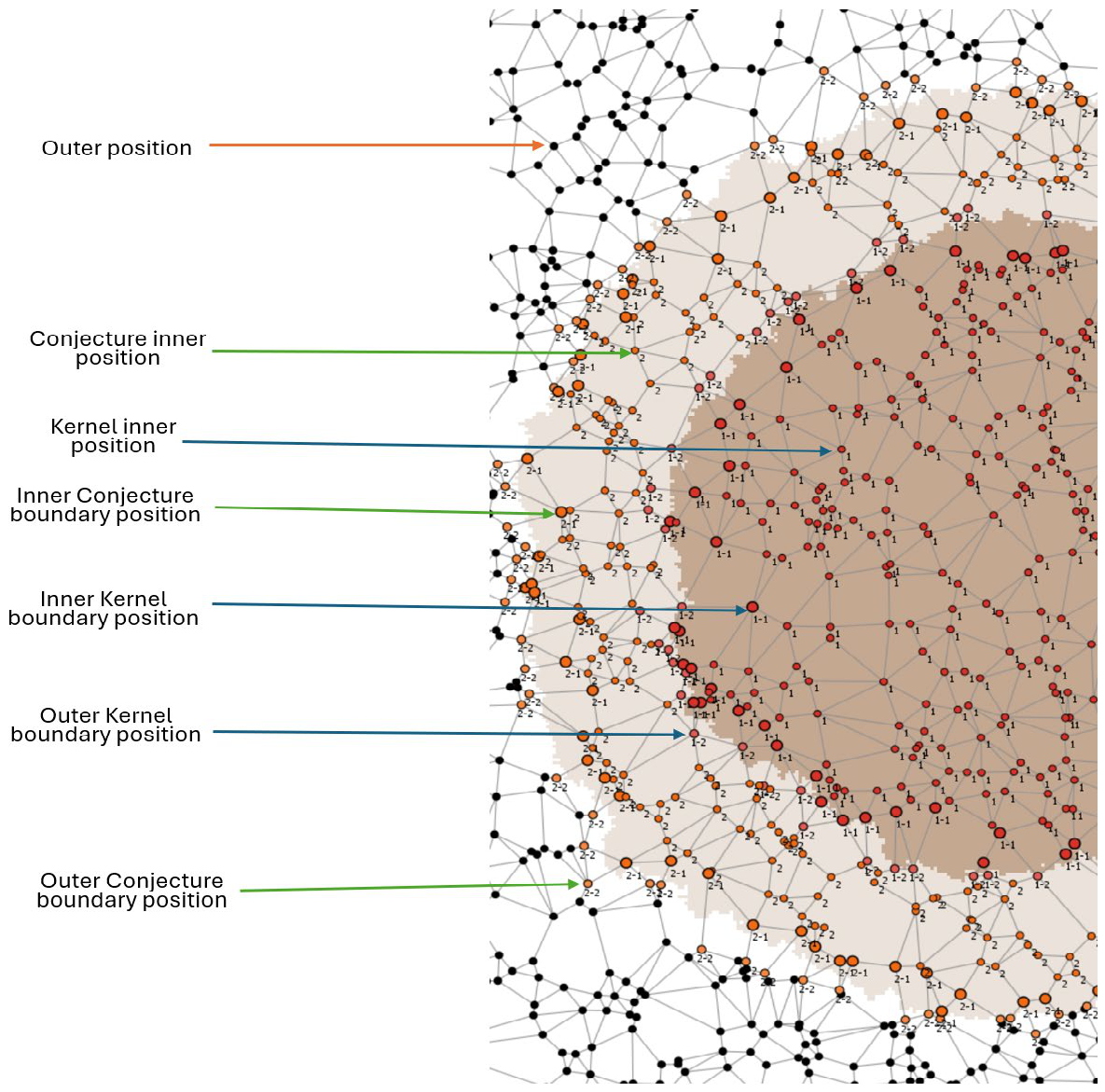
Considering the geometry of the fuzzy-crisp spatial object representing the monitored phenomenon, the spatial status of each node expresses its relative position as regards the detailed geometry of the fuzzy-crisp object representing the spatial extent of the sensed phenomenon. From the detection of kernel and conjecture boundaries, each node of the SN observing such vague shape phenomenon at a given time may belong to one of the seven spatial statuses: Kernel-inner; Inner-Kernel-boundary; Outer-Kernel-boundary; Conjecture-inner; Inner-Conjecture-boundary; Outer-Conjecture-boundary or Outer as shown in Figure 2.
In Figure 2, sensor nodes are labelled according to their spatial status; for visibility purposes we labelled them as follows: 1 for Kernel-inner; 1-1 for Inner-Kernel-boundary; 1-2 for Outer-Kernel-boundary; 2 for Conjecture-inner; 2-1 for Inner-Conjecture-boundary; 2-2 for Outer-Conjecture-boundary and nothing for Outer spatial status.
While nodes continuously record data about what is happening in their vicinity, they are able to infer their new status. In our approach, any sensor keeps the last computed spatial status until there is a sufficient increment in recorded data to give place to a new status from which events are computed. This spatial information is important, particularly when computing the spatial effect of detected events or supporting spatial decision-making.

2.4. Local Inference of Events from Consecutive Sensor Spatial States

In dynamic phenomena, sensor spatial status may change over time, expressing the transition of spatial object modelling monitored reality from one state to another. Worboys [38] claims that each situation has a state which is represented here by the set of sensor spatial states at a given time within the SN, and actions or events change from one situation to another. Changes in inferred sensor spatial state represent spatial changes in observed properties over time leading to representation of the spatial changes in a monitored phenomenon from one situation to another; changes in sensor data value stand as a proxy to events inducing spatial changes. Because changes in sensor data values may not automatically lead to a spatial change in the spatial coverage or geometry of a sensed phenomenon, only a change in the spatial state of a given sensor is considered in this study as a change (event or action). Due to the limited computing resources in sensor systems, each sensor stores its current spatial state with the first time t 0 it was inferred and recorded, and then triggers event reasoning from the date t . A substantial change in measurement reveals a change in the spatial status of this very sensor. As the sampling time may be different from the exact time any change occurs, the time component in our reasoning approach is a period τ = [ t t 0 ] ; t 0 is then updated while the former spatial status is updated with the current status.
Sensor spatial statuses are considered fluent for premises statements in inferring local spatial changes. At the level of a sensor node, the main spatial change inferred from consecutive spatial status is either an expansion or a shrinkage of the topological part (kernel, conjecture) of the spatial extent to which it belongs. As shown in Table 1, to infer if the spatial extent of the monitored phenomenon is moving from one spot to another, the reasoning rule should encompass the knowledge about the spatial extent of the phenomenon; this is not the case at the level of a single sensor and can only be done at the level of the sensor network. The following rules exemplify the deductive reasoning process of the approach.
For a given sensor, whose former spatial status is Outer-Kernel-boundary, formally stated as I n i t i a l l y P ( O u t e r K e r n e l b o u n d a r y ) , a sudden measurement revealing a change in the position of this sensor to a Kernel-inner position reveals an amplification of the sensed phenomenon in the vicinity of the sensor location and a growth in the extent of the kernel part of the phenomenon’s spatial coverage. The reasoning rule used in this case to identify the change is formally written as follows:
I n i t i a l l y P O u t e r K e r n e l b o u n d a r y   A n d   H a p p e n s G r o w ,   τ I n i t i a t e s ( G r o w ,   K e r n e l ,   τ )
where H a p p e n s a m p l i f y ,   τ   O r   H a p p e n s ( G r o w ,   τ ) and I n i t i a l l y P O u t e r K e r n e l b o u n d a r y which makes the “what happens when” premise is used as conditions for the “what action does” formulation of the second premise.
The deductive reasoning rule used to infer ongoing spatial change in the vicinity of this sensor will look like:
I F   I n i t i a l l y P O u t e r K e r n e l b o u n d a r y   A N D   I n i t i a t e s g r o w ,   k e r n e l , τ   T H E N   H o l d s a t ( G r o w ,   τ )
Such local growth inferred by a sensor may concern the conjecture part of the phenomenon’s spatial extent leading to an imprecise growth named “Nearly grow” in our reasoning engine. Table 2 presents the set of statements related to the premise “what action does” of our reasoning approach. As shown in this table, a change in the spatial status of a sensor may depend on its proper measurement or a change sensed by neighbouring nodes. For example, a node with a former status type of Inner-Kernel-boundary (InitiallyP (Inner-Kernel-boundary)) may see its spatial status changing into Inner-kernel spatial status (Holdsat (Kernel-inner, t)) because a substantial change has been recorded by neighbouring nodes. Recorded data between t0 and t reveal the position of this sensor is within the Kernel part of the spatial extent of the phenomenon. The italic and bold values in Table 2 express the manifestation of a sensed phenomenon within the vicinity of measuring sensors; the Lull value is set for no significant change while the Born and Nearly born values are set if the t0 record was nil (outer) and at the beginning of the monitoring process.
The “Initiates” type statement of action/event was considered here.
[ γ I n i t i a t e s ( α , β , τ ) ] , for illustration, leaving aside the “Teminates” type statement [ γ T e r m i n a t e s α , β , τ ] .
From Table 2 the two premises (“what happens when” and “what action does”) of our deductive event-driven reasoning procedure can be set to infer the “What is true when” fragment concluding about the ongoing developing change the spatial coverage of a sensed phenomenon undergoes. The combination of these premises should be consistent to guarantee appropriate conclusions. The consistency of our rules is based on the topology of the fuzzy-crisp spatial object used to represent a vague shape phenomenon (see Figure 2), where there is a gradual progression from the kernel towards the outer position through the conjecture part. Table 3 presents a subset of our deductive event-driven reasoning rules for illustration.
The rule-based subunit of reasoning engines, equipping sensors, is enriched with the complete set of logic deductive rules formulated based on these statements. The statement:
I n i t i a l l y P k e r n e l i n n e r   A N D   I n i t i a t e s N e a r l y s h r i n k ,   C o n j e c t u r e , t
sounds not logical and will yield an empty result because of the part
I n i t i a t e s N e a r l y s h r i n k ,   C o n j e c t u r e , t
supposes the former spatial status of the sensor position corresponds to a conjecture position and not to a kernel position.
A single sensor cannot conclude unambiguously from inferred spatiotemporal change if the spatial extent of the monitored phenomenon is expanding, even if it implies a growth in its vicinity at a given time. Furthermore, a movement expressing a shift from one hotspot to another is only possible if the complete coverage of the phenomenon is considered in the reasoning process.

2.5. Computing Extended Region-Based Spatiotemporal Changes from Local and Partial Spatiotemporal Change Parsed by Sensors over the SN Extent

Providing users with a global view of spatiotemporal change affecting phenomenon extent and geometry is more meaningful and unambiguous for the spatial decision support process rather than exploiting a flow of partial and unconsolidated spatiotemporal information computed by sensor nodes. In the context of decentralized spatial reasoning, no single sensor can have the complete knowledge about the geometry and spatial extent of a monitored phenomenon [39] nor a holistic knowledge about ongoing spatiotemporal change.
  • The Fuzzy-Extended Spatiotemporal Change Pattern (FESTCP)
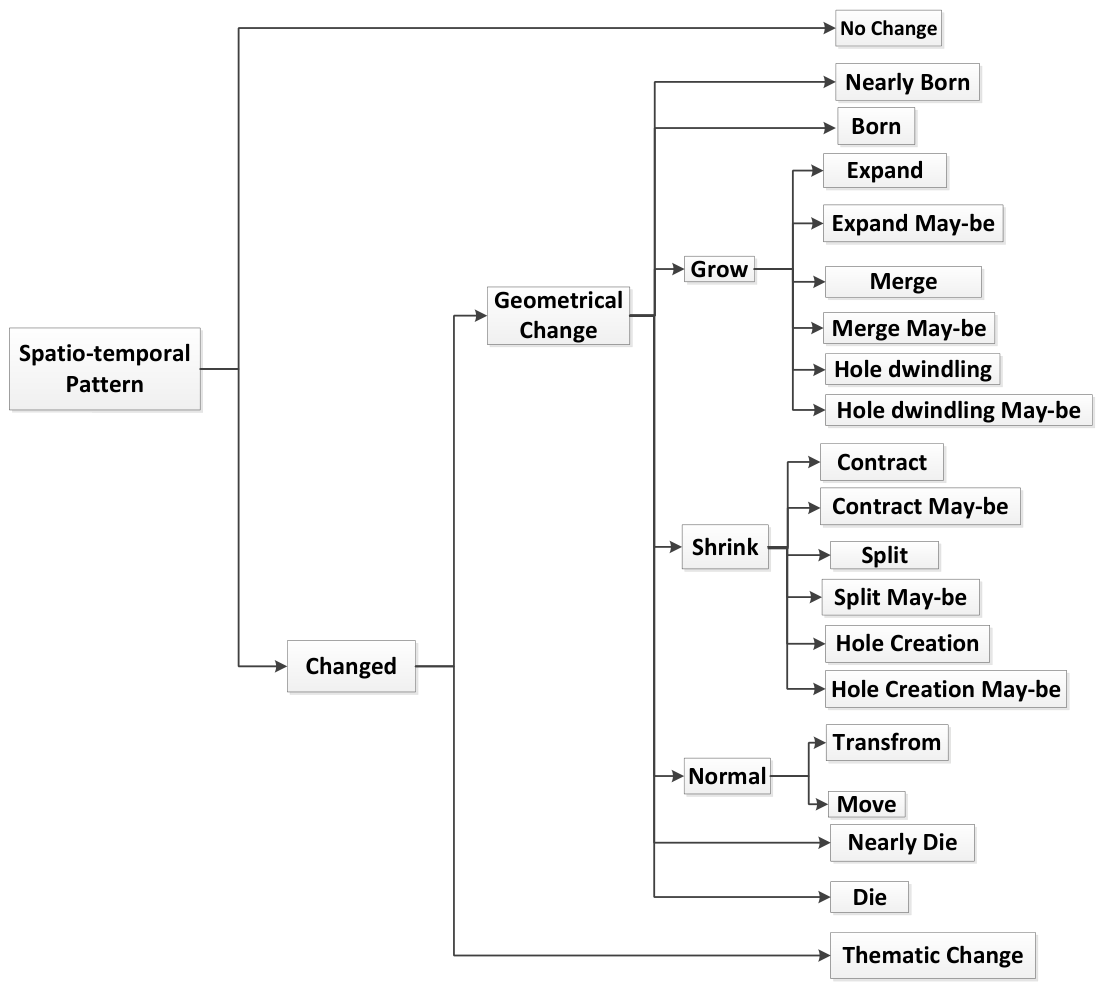
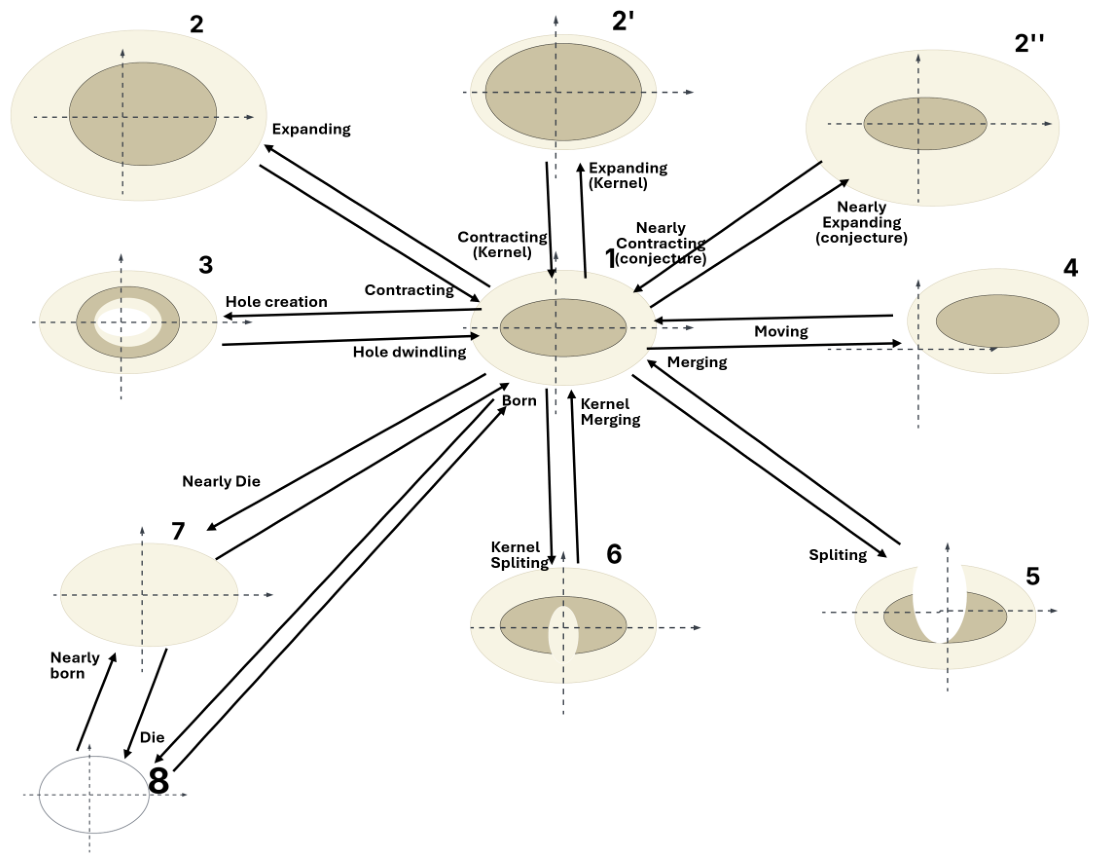
Yang et al. [40] think that an approach to spatiotemporal knowledge representation based on the explicit description of possible changes to geographical phenomena modelled at a high level of abstraction is the baseline for reasoning and modelling such spatial changes. The Spatiotemporal Change Pattern (STCP) suggested by Yang et al. [40] to describe spatiotemporal changes about spatial objects was an attempt to model and reason on a dynamic geographic phenomenon. However, no consideration about the fuzzy nature of environmental phenomena has been incorporated in this change model; therefore, this model has obvious shortcomings; it cannot be well used for real-time change analysis of a vague shape phenomenon. We have extended the spatiotemporal change pattern into a Fuzzy-Extended Spatiotemporal Change Pattern (FESTCP) based on a fuzzy-crisp spatial region object model as shown in Figure 3.
This change-based model provides us with the set of possible changes that fuzzy-crisp spatial objects can undergo. A better understanding of the set of possible alterations to which a fuzzy-crisp object can be subject as it evolves over space and time will enable the formulation of reasoning rules. These spatial changes depend mainly on geometric recognition, modelling and change detection over time as shown in Figure 4.
Considering the changes presented in Figure 4 as the reified counterparts of the set of distributed local changes computed over the SN at a given time, reification rules used in inferring global geometric change about monitored reality should be applied to the whole set of changes recorded and inferred over the SN extent considering their variability over the space and time.
  • Reasoning rules for inferring spatiotemporal changes about fuzzy region geometry from distributed local change inferred by sensors
Region boundary is the main geometric component from which analysis of spatial changes on object properties (spatial location, perimeter and size) can be effective [41]. The set of spatial changes computed by border nodes at a given time constitutes the main argument used by reasoning rules to infer whether the ongoing spatiotemporal changes captured over the SN correspond to an instance of a geometric change identified in the FESTCP. In order to lighten the reasoning process and make it more efficient, our approach proceeds by ranking and clustering border nodes based on the spatial changes they locally detect and their former relative position with respect to the spatial extent of a monitored phenomenon.
The detection of change by a sensor triggers the detection of new boundaries over the SN extent. Sensors update their spatial statuses (current and former), and all sensors change their t 0 (the lower limit of the state period) to the current time. The period τ = [ t 0   t ] is then equal for all sensors, which roughly corresponds to a maximal duration of a state of the phenomenon.
For illustration, we present in Appendix A a set of rules used in inferring some geometric changes about fuzzy-crisp regions based on ranked and clustered boundary nodes.
The thematic (attribute) changes detected stand here as spatial determinants of geometric changes. Because the detection of substantial change is the triggering event for communication towards the sink node and for decentralized reasoning on new boundaries identification, this reduces the communication load and, therefore, energy consumption.
First-order logic, which is the standard logical foundation for artificial intelligence [42], is the baseline for the formulation of our reasoning rules. These reasoning rules equipping sensors encompass fuzzy logic, event calculus principles and geosemantics rules.
The formal presentation of our event and fuzzy rule-based reasoning approach is roughly presented in the next section.

2.6. Formal Presentation of the Proposed Approach

Sensor records are mostly made of values describing a property of a given phenomenon at a location in space and time [43]. Changes in sensor data values and resulting changes in boundaries stand as the proxy for monitored phenomenon dynamics; a simplified event calculus procedure is set to infer significant events from these changes; decentralized detection of boundaries and changes over time is essential in inferring geometrical changes affecting a phenomenon’s spatial extent. Sensors detecting boundaries are ranked in sets (kernel and conjecture boundaries) and then send their updated status to the sink through a spanning tree. From sensor measurements to spatiotemporal computation and modelling of developing changes in continuous evolving phenomena, sensors use a built-in reasoning engine to reason about phenomenon detection, compute and model boundaries and geometric changes. The approach promoted in this study consists of 5 main steps, not including the preparation of the built-in reasoning engine. These are:
  • Fuzzy detection of monitored phenomenon from sensor data stream.
  • Event-driven local detection of changes over qualitative spatial information time series.
  • Updating boundary detection.
  • Ranking border nodes and clustering spatiotemporal changes by type.
  • Reasoning about extended geometric changes modelling the dynamics of the monitored phenomenon.
A global view of the approach is formally presented in Algorithm 1 as pseudo-code.
Algorithm 1 Event-driven computing and modelling spatiotemporal changes occurring in vague spatial region from sensor network data
Variables:  S N = s 1 ,   s 2 , , s n ; the sensor network
    τ = t 1 ; t ; The time window over sensor data streams
    S D τ = s 1 , v a l t 1 ,   s 2 , v a l t 1 , , s n , v a l t 1 ,   s 1 , v a l t , , ( s n , v a l t ) ;
   Sensor network data stream
   Function: μ A :   s i , v a l t 1 0,1 ; membership function for S D τ univers
Begin
   Evaluate the membership value for each sensor record: μ = f S i ( v a l , t )
   Situational inference of sensor relative position through defuzzification rules:
      H o l d s A t s p s i , t :   s p [ O u t e r ,   C o n j e c t u r e ,   K e r n e l ]
   Decentralized reasoning for boundaries detection
   Each node stores its current spatiotemporal status and time
   (Outer, Conjecture-boundary, Conjecture, Kernel, etc.; t0)
   If else no variation in S D τ
      [Infer: No geometric change]
      [Infer Event detection]
      Compute new boundaries detection
      Store old spatial status of nodes
      Update current spatial status of nodes
      Clockwise or anticlockwise ranking of border nodes (Conjecture-boundary or
      Kernel-boundary)
      Infer local spatial changes in the vicinity of border nodes (shrink, nearly shrink/conjecture
      shrink, expand, nearly expand/conjecture expand, lull),
      Cluster spatiotemporal state of the border nodes in regard to detected spatiotemporal
      changes and old spatial status ((Kernel boundary, change type1, rank), (Kernel boundary,
      change type2, rank),…, (Conjecture boundary, change type1, rank))
      Spatial and semantic analysis over clusters of spatiotemporal status of border nodes
   Infer ongoing geometric change
   Efficiency analysis of the approach (comparing inferred holistic geometric changes with field
   dynamics)]
End.

3. Results and Discussion: Implementation and Evaluation of Proposed Approach for Evolving Ambient Air Pollution

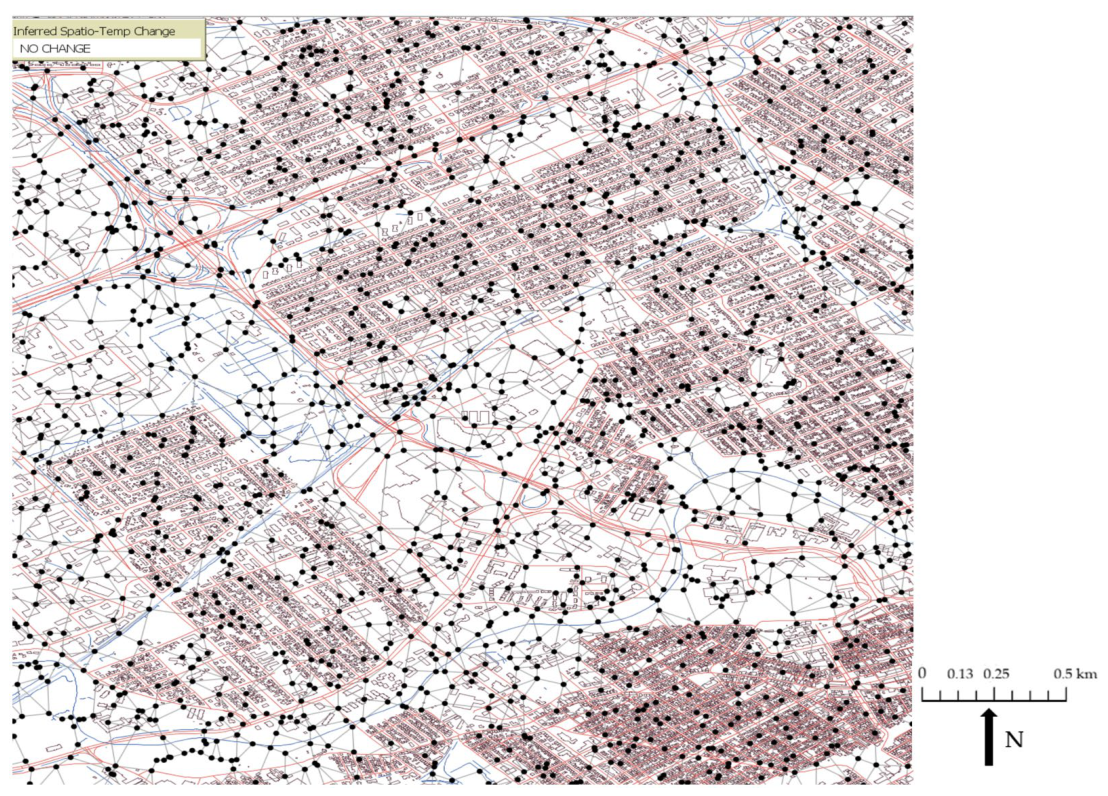
For this study, we simulated an air pollution evolving phenomenon in Quebec City, QC, Canada, generating a flow of data about the quantity of particle matter of a certain size in the air collected by a wireless sensor network over time. Sensing nodes are randomly distributed over the spatial extent of the forest; because of the obstacles in such a built-up area without prior knowledge of spatial patterns, we therefore adopt RNG (Relative Neighborhood Graph) or GG (Gabriel Graph) topology [44] for our study based on the advantages shown in refs. [7,45,46] works. The communication mesh is the main support of spatial analysis in such a decentralized reasoning approach. As presented in Figure 5, the buildings’ footprints are represented by polygons with a light pink colour, while road and water networks are drawn in red and blue respectively. Without any detection of a monitored phenomenon, the inferred spatiotemporal change is set as “No change”.
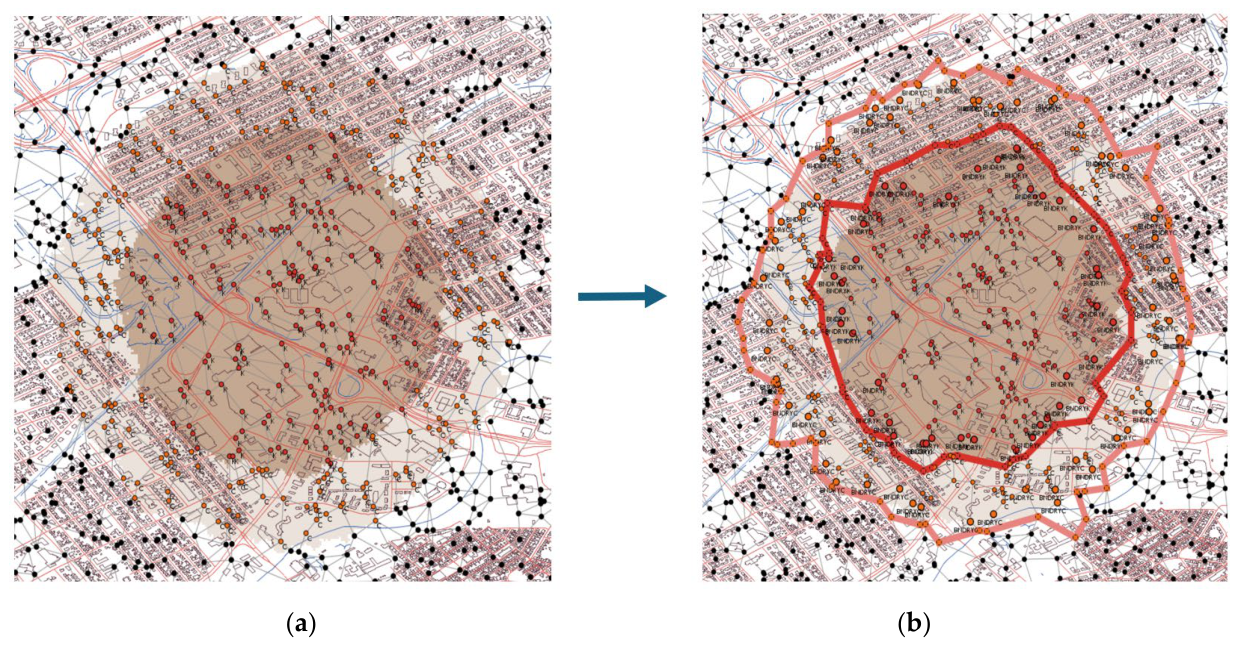
From the occurrence of a simulated ambient air pollution, sensors use fuzzy logic to compute from their sampled records spatial qualitative information expressing their spatial position within or out of the air pollution’s spatial extent. This is deduced from the membership value of their location to a part (conjecture or kernel) of the spatial vague region modelling the spatial extent of the air pollution, as shown in Figure 6.
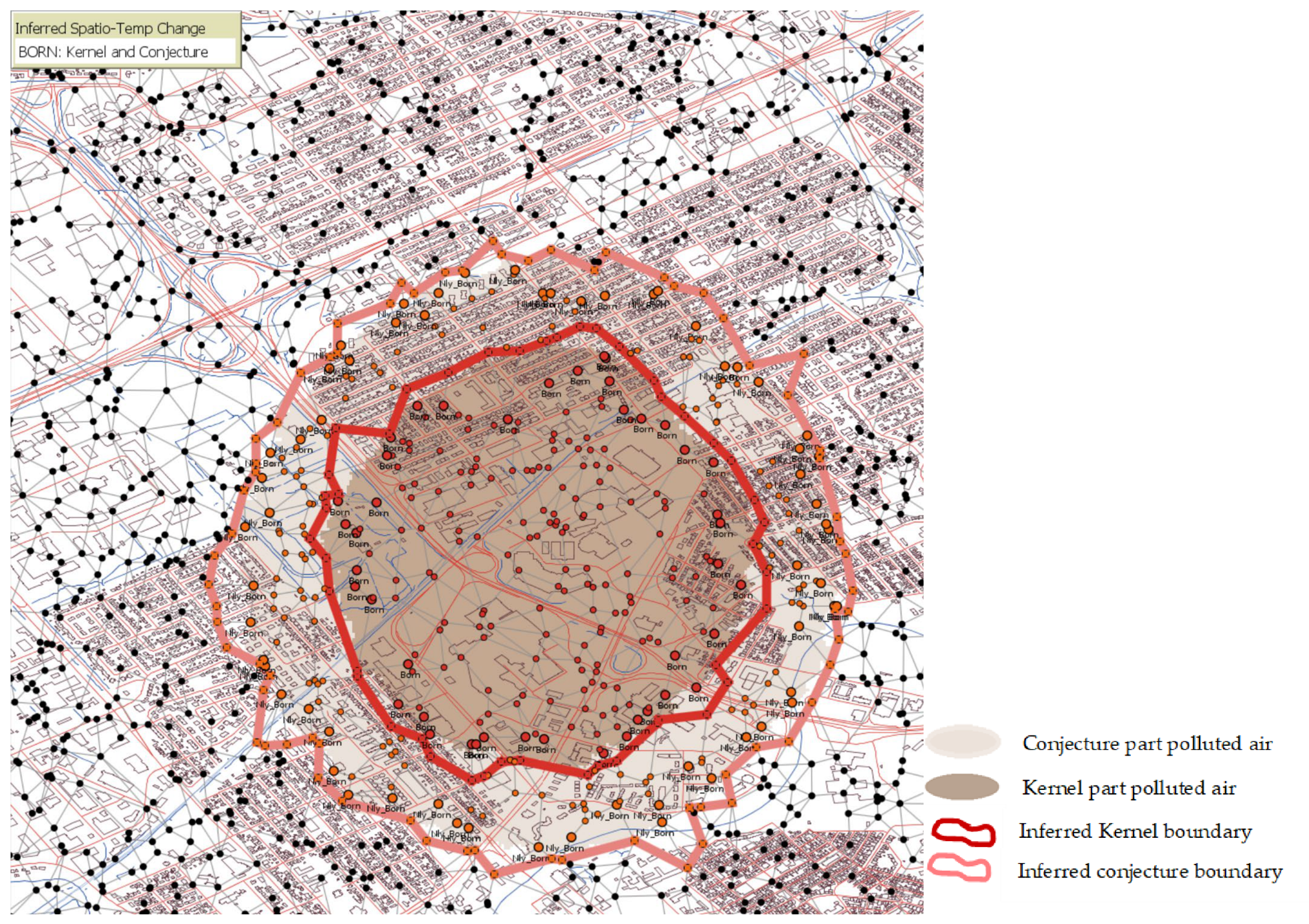
From this qualitative spatial information, networked sensors collaboratively compute the detection of boundaries (kernel boundary and conjecture boundary); from the current and past sets of spatial status of border nodes, occurring events and spatial changes (grow and shrink) are inferred. For a newly detected ambient air pollution, local spatiotemporal changes at the level of border nodes and the global spatiotemporal change will be inferred as Born or Nearly born as shown in Figure 7. For Figure 7 and upcoming figures, sensor nodes are labelled with qualitative spatial information related to local detection of monitored phenomena and spatial changes as follows: K for Kernel; C for Conjecture; BNDRYK for Boundary of Kernel part; BNDRYC for Boundary of Conjecture; Nly Born and Born for Nearly Born and Born; KExpd for Kernel Expand; CExpd for Conjecture Expand; KShrk for Kernel Shrink and CShrk for Conjecture Shrink.
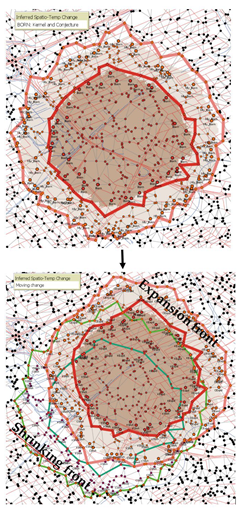
In Figure 7, the extent of air pollution is generated using the multi-agent modelling software (Netlogo 5.2) and coloured in brown for its kernel part and light brown for its broad boundary. Networked sensors compute from their observations the fuzzy-crisp object made of two boundaries (Red for the kernel part and light red for the conjecture part) representing the geometry of the polluted area. The spatiotemporal change inferred over the SN is then displayed in the NetLogo monitor field labelled "Infered Spatio-Temp Change", the value “Born: kernel and Conjecture” for the current case.
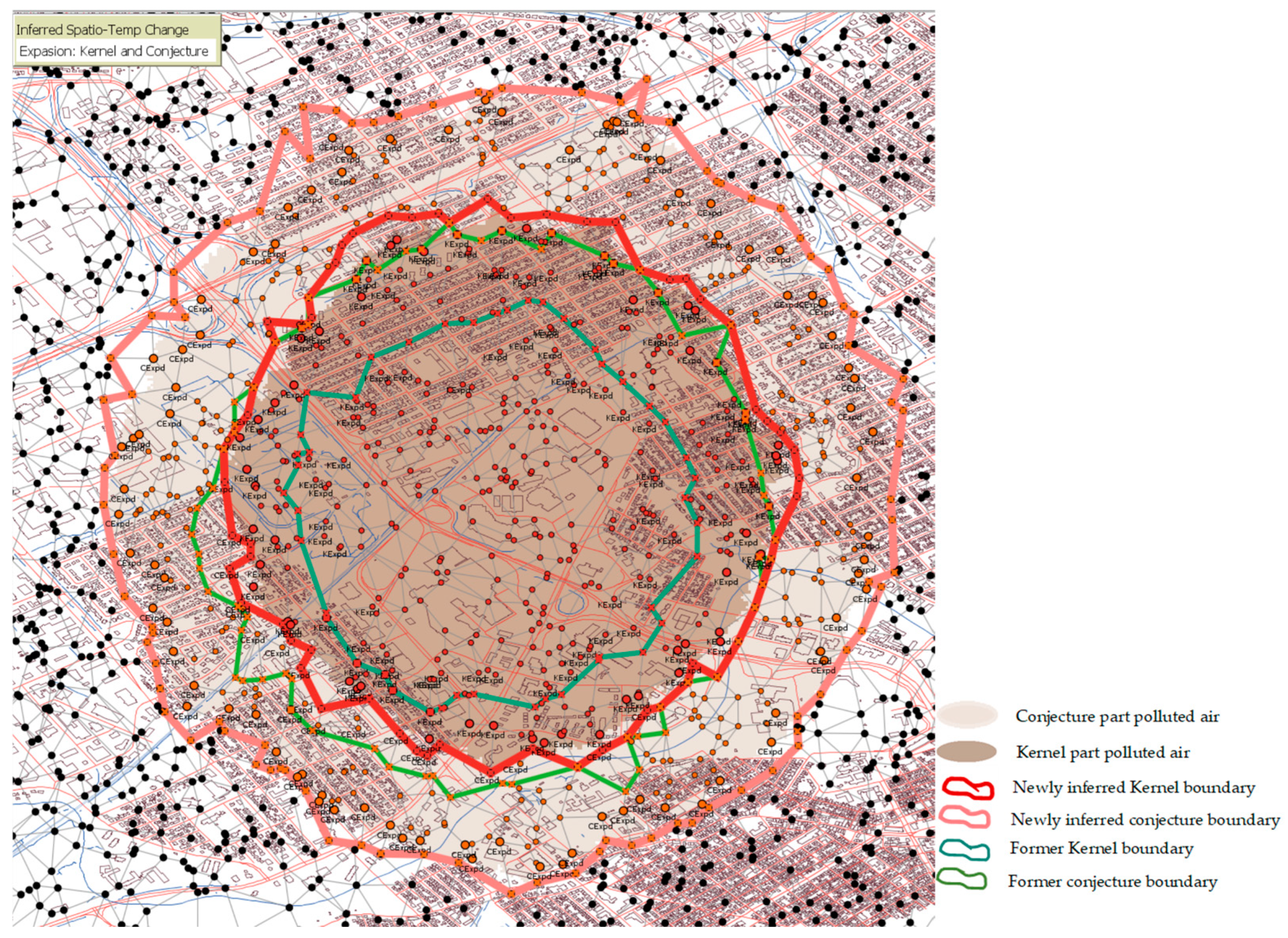
Without intervention, continued growth of the polluting activities can induce a spatial expansion in the air pollution’s extent. We simulated such growth; from the variation in subsequent sensor data, the system consequently computed the ongoing spatiotemporal change as shown in Figure 8.
In Figure 8, the former boundaries are drawn in green (kernel) and light green (conjecture) while the new boundaries expressing the expansion in spatial extent are plotted in red and light red for kernel and conjecture boundaries respectively. From our approach, the system rightly infers spatial expansion as geometric change.
From the situation presented in Figure 7, new situations are created and our approach reasons and infers the nature of ongoing geometric changes. The inferred spatiotemporal changes are illustrated in Table 4.
It can be seen from Table 4 that implementing the approach in known cases of spatial changes yielded adequate results (spatial changes inferred by the software correspond to the type of change simulated by the software). From the different study cases, inferred local changes are always true, and can be used for local spatial decision, while for the holistic decision process, the description of those spatial change types and the integration of the whole set of local changes are required.
From Table 4 and Figure 8, we can notice that the approach overcomes the limitations mentioned in ref. [47] for the traditional computation of spatiotemporal variability of continuous phenomena from sparse observations of low granularity. The approach was not applied to a complex region. Cases of hole creation and dwindling or merging regions have not been tested either. For moving changes, the approach is able to state if the phenomenon is moving from one spot to another, and expressing the direction in which the phenomenon is moving is an advantage for decision-making. Also, this study did not consider the effect of the density and placement of sensors in SN on the yielded results.
The proposed approach is a contribution to sensor intelligence identified in ref. [48] as a major challenge in computing spatiotemporal changes from sensor observations. Resolving uncertainty during onboard data interpretation and processing gives more ability to sensors to unambiguously infer relevant local spatial information and contributes in commonly inference about the spatial representation of sensed phenomena and their dynamics. The result obtained seems closer to human interpretation about large-scale phenomena such as air pollution, because it is based on spatial object modelling rather than time-varying and segmented or dotted representation promoted in ref. [49]. For such phenomena in which islands may occur (heat island), the use of complex spatial objects seems more adapted; the integration of complex spatial objects in the proposed approach is the prospect of future research works.

4. Conclusions and Future Works

In this study, we suggested a Fuzzy-Extended Spatiotemporal Change Pattern (FESTCP) for the formal description of spatiotemporal changes regarding fuzzy regions and proposed an event-driven decentralized fuzzy rule-based approach for computing spatiotemporal information about changes occurring in monitored environmental phenomena of vague spatial shape. From sensor network data describing a property of monitored phenomenon and its dynamics, the proposed approach detects events occurring over time and computes the corresponding geometric changes. The built-in reasoning engine enables the sensor node to compute local and partial qualitative spatiotemporal information when the global geometric change is computed from local changes aggregated and clustered over the SN for a given interval of time. A simulated evolving ambient air pollution implemented with Netlogo 5.2 was used to test the approach implemented for a simulated wireless SN. The approach performs well by providing truthful inferred changes corresponding to the scene for phenomena of simple fuzzy region type, monitored by a dense SN. For future work, analyzing geometric changes over the complex dynamic fuzzy-crisp region from the sensor network data is foreseen. It will also be the case for evaluating the effect of nonhazardous optimal placement of sensors in SN while performing spatiotemporal reasoning about dynamic continuous sensed phenomena. Implementing the proposed approach in a real sensor network will validate its applicability. Ultimately the results obtained from this work can be integrated in the deveoppment of new generation of geospatial digital twins in support of efficient decision making in different application domains.

Author Contributions

Conceptualization, Roger Cesarié Ntankouo Njila and Mir Abolfazl Mostafavi; methodology, Roger Cesarié Ntankouo Njila; software, Roger Cesarié Ntankouo Njila; validation, Roger Cesarié Ntankouo Njila, Mir Abolfazl Mostafavi, and Jean Brodeur; formal analysis, Roger Cesarié Ntankouo Njila and Mir Abolfazl Mostafavi; investigation, Roger Cesarié Ntankouo Njila; resources, Mir Abolfazl Mostafavi; data curation and writing—original draft preparation, Roger Cesarié Ntankouo Njila; writing—review and editing, Roger Cesarié Ntankouo Njila, Mir Abolfazl Mostafavi, Jean Brodeur, and Sonia Rivest; visualization, Roger Cesarié Ntankouo Njila, Mir Abolfazl Mostafavi, and Sonia Rivest, supervision, Mir Abolfazl Mostafavi and Jean Brodeur; project administration, Mir Abolfazl Mostafavi; funding acquisition, Mir Abolfazl Mostafavi. All authors have read and agreed to the published version of the manuscript.

Funding

This research was undertaken in part thanks to support from the Canada Research Chair in Senseable Cities for Empowered Mobility, funded through the Canada Research Chairs Program (grant number CRC-2022-00112). It has been also supported partially through PEFOGRN-BC Project.

Data Availability Statement

No new data were created or analyzed in this study.

Conflicts of Interest

The authors declare no conflicts of interest. The funders had no role in the design of the study; in the collection, analyses, or interpretation of data; in the writing of the manuscript; or in the decision to publish the results.

Appendix A

Table A1. Spatial Constraints and Rules Used in Inferring Global Fuzzy Spatial Changes from Set of Local Changes Recorded over SN Extent.
Existing Clusters of Local Spatiotemporal Changes Among Border NodesSpatial Constraints and Relations Among and Within ClustersInferred Spatiotemporal ChangeIllustration
BornNilBornIjgi 15 00194 i009
Nearly bornNilNearly bornIjgi 15 00194 i010
  • Kernel expand
  • Conjecture expand
  • No particular spatial structure
  • Constitute the most important cluster
ExpandIjgi 15 00194 i011
  • Conjecture shrink
  • Kernel shrink
  • No particular spatial structure
  • Constitute the most important cluster
ContractIjgi 15 00194 i012
  • Conjecture shrink
  • Kernel shrink
  • Main change is shrinking change
  • Nodes in the front of spatial change constitute a continuous serial
  • Concavity in changing front is observed
SplitIjgi 15 00194 i013
  • Conjecture shrink
  • Kernel shrink
  • Kernel expand
  • Conjecture expand
  • Two opposite fronts of spatial change (shrink and expand)
MoveIjgi 15 00194 i014

References

  1. Bill, R.; Blankenbach, J.; Breunig, M.; Haunert, J.H.; Heipke, C.; Herle, S.; Maas, H.G.; Mayer, H.; Meng, L.; Rottensteiner, F.; et al. Geospatial Information Research: State of the Art, Case Studies and Future Perspectives. PFG-J. Photogramm. Remote Sens. Geoinf. Sci. 2022, 90, 349–389. [Google Scholar] [CrossRef]
  2. Whittier, J.C.; Nittel, S.; Plummer, M.A.; Liang, Q. Towards Window Stream Queries Over Continuous Phenomena. In Proceedings of the International Workshop on GeoStreaming (IWGS), Orlando, FL, USA, 5 November 2013; p. 10. [Google Scholar]
  3. Worboys, M.; Duckham, M. Monitoring Qualitative Spatiotemporal Change for Geosensor Networks. Int. J. Geogr. Inf. Sci. 2006, 20, 1087–1108. [Google Scholar] [CrossRef]
  4. Bröring, A.; Echterhoff, J.; Jirka, S.; Simonis, I.; Everding, T.; Stasch, C.; Liang, S.; Lemmens, R. New Generation Sensor Web Enablement. Sensors 2011, 11, 2652–2699. [Google Scholar] [CrossRef] [PubMed]
  5. Argany, M.; Mostafavi, M.; Karimipour, F.; Gagné, C. A GIS Based Wireless Sensor Network Coverage Estimation and Optimization: A Voronoi Approach. In Transactions on Computational Science XIV SE-6; Gavrilova, M., Tan, C.J.K., Mostafavi, M., Eds.; Lecture Notes in Computer Science; Springer: Berlin/Heidelberg, Germany, 2011; Volume 6970, pp. 151–172. ISBN 978-3-642-25248-8. [Google Scholar]
  6. Jabeen, F.; Fernandes, A.A.A. An Algorithmic Strategy for In-Network Distributed Spatial Analysis in Wireless Sensor Networks. J. Parallel Distrib. Comput. 2012, 72, 1628–1653. [Google Scholar] [CrossRef]
  7. Duckham, M. Decentralized Spatial Computing: Foundations of Geosensor Networks; Springer: Berlin/Heidelberg, Germany, 2013; ISBN 3642308538. [Google Scholar]
  8. Liu, C.; Wu, K.; Pei, J. An Energy-Efficient Data Collection Framework for Wireless Sensor Networks by Exploiting Spatiotemporal Correlation. Parallel Distrib. Syst. IEEE Trans. 2007, 18, 1010–1023. [Google Scholar] [CrossRef]
  9. Whittier, J.C.; Nittel, S.; Subasinghe, I. Real-Time Earthquake Monitoring with Spatio- Temporal Fields. In Proceedings of the 2nd International Symposium on Spatiotemporal Computing 2017, Cambridge, MA, USA, 7–9 August 2017; pp. 215–222. [Google Scholar]
  10. Bleisch, S.; Duckham, M.; Kealy, A.; Richter, K.-F.; Winter, S.; Kininmonth, S.; Klippel, A.; Laube, P.; Lyon, J.; Medyckyj-Scott, D. Challenges in Supporting Extraction of Knowledge about Environmental Objects and Events from Geosensor Data. In Proceedings of the AutoCarto, Columbus, OH, USA, 16–18 September 2012; p. 12. [Google Scholar]
  11. Shanahan, M. The Event Calculus Explained. In Artificial Intelligence Today; Wooldndge, M.J., Veloso, M., Eds.; Springer: Berlin/Heidelberg, Germany, 1999; pp. 409–430. ISBN 3540664289. [Google Scholar]
  12. Shanahan, M. An Abductive Event Calculus Planner. J. Log. Program. 2000, 44, 207–240. [Google Scholar] [CrossRef]
  13. Jayanthi, G.; Uma, V. Event Attributed Spatial Entity Knowledge (EASE) Based Spatio-Temporal Reasoning to Infer Geographic Processes. In Proceedings of the IEEE 2016 2nd International Conference on Green High Performance Computing (ICGHPC), Nagercoil, India, 26–27 February 2016; pp. 1–8. [Google Scholar]
  14. Devaraju, A.; Kuhn, W.; Renschler, C.S. A Formal Model to Infer Geographic Events from Sensor Observations. Int. J. Geogr. Inf. Sci. 2015, 29, 1–27. [Google Scholar] [CrossRef]
  15. Ntankouo Njila, R.C. Spatial Representation of Vague Shape Phenomena and Their Dynamics from Sensor Network Data: A Decentralized Approach Based on Fuzzy Logic; Laval University: Québec City, QC, Canada, 2023. [Google Scholar]
  16. Schneider, M. Fuzzy Spatial Data Types for Spatial Uncertainty Management in Databases. In Handbook of Research on Fuzzy Information Processing in Databases; IGI Global: Hershey, PA, USA, 2008; pp. 490–515. [Google Scholar]
  17. Haller, A.; Janowicz, K.; Cox, S.J.D.; Lefrançois, M.; Taylor, K.; Le Phuoc, D.; Lieberman, J.; García-Castro, R.; Atkinson, R.; Stadler, C. The Modular SSN Ontology: A Joint W3C and OGC Standard Specifying the Semantics of Sensors, Observations, Sampling, and Actuation. Semant. Web 2018, 10, 9–32. [Google Scholar] [CrossRef]
  18. Worboys, M. Modelling Changes and Events in Dynamic Spatial Systems with Reference to Socio-Economic Units. In Life Motion Socio-Economic Units; Routledge: Abingdon, UK, 2001; pp. 129–138. [Google Scholar]
  19. Ferreira, K.R.; Camara, G.; Monteiro, A.M.V. An Algebra for Spatiotemporal Data: From Observations to Events. Trans. GIS 2014, 18, 253–269. [Google Scholar] [CrossRef]
  20. Wang, S.; Zhang, X.; Ye, P.; Du, M.; Lu, Y.; Xue, H. Geographic Knowledge Graph (GEOKG): A Formalized Geographic Knowledge Representation. ISPRS Int. J. Geo-Inf. 2019, 8, 24. [Google Scholar] [CrossRef]
  21. Ma, Z.; Bai, L.; Yan, L. Fuzzy Sets and Fuzzy XML Data Models. In Modeling Fuzzy Spatiotemporal Data with XML: Studies in Computational Intelligence; Kacprzyh, J., Ed.; Springer Nature: Cham, Switzerland, 2020; Volume 894, pp. 19–37. ISBN 9783030419981. [Google Scholar]
  22. Longley, P.A.; Goodchild, M.F.; Maguire, D.J.; Rhind, D.W. Geographical Information Systems and Science, 2nd ed.; John Wiley & Sons Ltd.: Hoboken, NJ, USA, 2005; ISBN 0470870001. [Google Scholar]
  23. Goodchild, M.F. Geographic Information Systems and Science: Today and Tomorrow. Ann. GIS 2009, 15, 3–9. [Google Scholar] [CrossRef]
  24. Kuipers, B. The Spatial Semantic Hierarchy. Artif. Intell. 2000, 119, 191–233. [Google Scholar] [CrossRef]
  25. Couclelis, H. People Manipulate Objects (but Cultivate Fields): Beyond the Raster-Vector Debate in GIS. In Theories and Methods of Spatio-Temporal Reasoning in Geographic Space SE-3; Frank, A.U., Campari, I., Formentini, U., Eds.; Lecture Notes in Computer Science; Springer: Berlin/Heidelberg, Germany, 1992; Volume 639, pp. 65–77. ISBN 978-3-540-55966-5. [Google Scholar]
  26. Ferland, Y.; Mostafavi, M.A. From Spatial to Platial Information Systems: For a Better Representation of the Sense of Place. In Proceedings of the Abstracts of the ICA; Copernicus GmbH: Tokyo, Japan, 2019; Volume 1, pp. 1–2. [Google Scholar]
  27. Jayanthi, G.; Uma, V. Reasoning Temporally Attributed Spatial Entity Knowledge towards Qualitative Inference of Geographic Process. Int. J. Intell. Inf. Technol. 2019, 15, 32–53. [Google Scholar] [CrossRef]
  28. Guan, W.W.; Wu, K.; Carnes, F. Modeling Spatiotemporal Pattern of Agriculture-Feasible Land in China. Trans. GIS 2016, 20, 426–447. [Google Scholar] [CrossRef]
  29. Mueller, E.T. Event Calculus. Found. Artif. Intell. 2008, 3, 671–708. [Google Scholar] [CrossRef]
  30. Galton, A. Space, Time and the Representation of Geographical Reality. In The Philisophy of GIS; Tambassi, T., Ed.; Springer Geography: Berlin/Heidelberg, Germany, 2019; pp. 75–97. [Google Scholar]
  31. Brenton, C.; Faber, W.; Batsakis, S. Answer Set Programming for Qualitative Spatio-Temporal Reasoning: Methods and Experiments. In Proceedings of the OASIcs-OpenAccess Series in Informatics; Carro, M., King, A., Saeedloei, N., De Vos, M., Eds.; Schloss Dagstuhl-Leibniz-Zentrum fuer Informatik: Dagstuhl, Germany, 2016; Volume 52, p. 15. [Google Scholar]
  32. Fisher, P.F.; Robinson, V.B. Fuzzy Modelling. In GeoComputation, 2nd ed.; Abrahart, R.J., See, L.M., Eds.; CRC Press: Boca Raton, FL, USA, 2014; pp. 283–306. ISBN 9781466503281. [Google Scholar]
  33. Aigong, X.; Lakmal, A.H. Logical Modeling for Spatio-Temporal Phenomena: With the Perspectives of Concurrent Processing and Signal Transmission. In Proceedings of the IEEE 2nd International Conference on Future Computer and Communication, Wuhan, China, 21–24 May 2010; Volume 2, pp. 48–52. [Google Scholar]
  34. Amato, F.; Casola, V.; Gaglione, A.; Mazzeo, A. A Semantic Enriched Data Model for Sensor Network Interoperability. Simul. Model. Pract. Theory 2011, 19, 1745–1757. [Google Scholar] [CrossRef]
  35. Frank, D.; Jae, H.L.; Till, M.; Thomas, S.; van André, D.; van de Jasper, V.; Diedrich, W. A Survey of Qualitative Spatial and Temporal Calculi—Algebraic and Computational Properties. ACM Comput. Surv. 2017, 50, 45. [Google Scholar] [CrossRef]
  36. Carniel, A.C.; Schneider, M.; Ciferri, R.R. FIFUS: A Rule-Based Fuzzy Inference Model for Fuzzy Spatial Objects in Spatial Databases and GIS. In Proceedings of the SIGSPATIAL ‘15: Proceedings of the 23rd SIGSPATIAL International Conference on Advances in Geographic Information Systems, Seattle, WA, USA, 3–6 November 2015; p. 4. [Google Scholar]
  37. Pauly, A.; Schneider, M. Vague Spatial Data Types. In Encyclopedia of GIS SE-1434; Springer: Boston, MA, USA, 2008; pp. 1213–1217. ISBN 978-0-387-30858-6. [Google Scholar]
  38. Worboys, M. Event-Oriented Approaches to Geographic Phenomena. Int. J. Geogr. Inf. Sci. 2005, 19, 1–28. [Google Scholar] [CrossRef]
  39. Sadeq, M.J.; Duckham, M.; Worboys, M.F. Decentralized Detection of Topological Events in Evolving Spatial Regions. Comput. J. 2013, 56, 1417–1431. [Google Scholar] [CrossRef]
  40. Yang, P.; Tang, X.; Wang, H. Analysis on Geographical Changes and Research on Spatio-Temporal Patterns. In ISPRS International Archives of the Photogrammetry, Remote Sensing and Spatial Information Sciences. Vol. XXXVII. Part B2; ISPRS: Beijing, China, 2008; pp. 1031–1036. [Google Scholar]
  41. Varzi, A.C. Spatial Reasoning and Ontology: Parts, Wholes, and Locations. In Handbook of Spatial Logics SE-15; Aiello, M., Pratt-Hartmann, I., Benthem, J., Eds.; Springer Netherlands: Dordrecht, The Netherlands, 2007; pp. 945–1038. ISBN 978-1-4020-5586-7. [Google Scholar]
  42. Laskey, K.B. MEBN: A Language for First-Order Bayesian Knowledge Bases. Artif. Intell. 2008, 172, 140–178. [Google Scholar] [CrossRef]
  43. Cardell-Oliver, R.; Huebner, C.; Foeller-Nord, M. WebSense: A Lightweight and Configurable Application for Publishing Sensor Network Data. In Proceedings of the Intelligent Sensors, Sensor Networks and Information Processing (ISSNIP), 2011 Seventh International Conference, Adelaide, SA, Australia, 6–9 December 2011; pp. 235–240. [Google Scholar]
  44. Wang, Y. Topology Control for Wireless Sensor Networks. In Wireless Sensor Networks and Applications; Springer: Berlin/Heidelberg, Germany, 2008; pp. 113–147. ISBN 0387495916. [Google Scholar]
  45. Guan, L.-J.; Duckham, M. Decentralized Reasoning about Gradual Changes of Topological Relationships between Continuously Evolving Regions. In Spatial Information Theory SE-8; Egenhofer, M., Giudice, N., Moratz, R., Worboys, M., Eds.; Lecture Notes in Computer Science; Springer: Berlin/Heidelberg, Germany, 2011; Volume 6899, pp. 126–147. ISBN 978-3-642-23195-7. [Google Scholar]
  46. Jeong, M.-H.; Duckham, M.; Kealy, A.; Miller, H.J.; Peisker, A. Decentralized and Coordinate-Free Computation of Critical Points and Surface Networks in a Discretized Scalar Field. Int. J. Geogr. Inf. Sci. 2014, 28, 1–21. [Google Scholar] [CrossRef]
  47. Middya, A.I.; Roy, S.; Das, R. Spatiotemporal Variability Analysis of Air Pollution Data from IoT Based Participatory Sensing. J. Ambient Intell. Humaniz. Comput. 2021, 14, 6719–6734. [Google Scholar] [CrossRef]
  48. Yu, M.; Bambacus, M.; Cervone, G.; Clarke, K.; Duffy, D.; Huang, Q.; Li, J.; Li, W.; Li, Z.; Liu, Q.; et al. Spatiotemporal Event Detection: A Review. Int. J. Digit. Earth 2020, 13, 1339–1365. [Google Scholar] [CrossRef]
  49. Hofman, J.; Do, T.H.; Qin, X.; Bonet, E.R.; Philips, W.; Deligiannis, N.; La Manna, V.P. Spatiotemporal Air Quality Inference of Low-Cost Sensor Data: Evidence from Multiple Sensor Testbeds. Environ. Model. Softw. 2022, 149, 105306. [Google Scholar] [CrossRef]
Figure 1. Conceptual framework for reasoning and modelling spatiotemporal phenomena in sensor network using built-in event calculus engine.
Ijgi 15 00194 g001
Figure 2. Possible spatial status of a sensor node within a vague spatial phenomenon (brown colour for the kernel part and light brown colour for broad boundaries).
Ijgi 15 00194 g002
Figure 3. Fuzzy-Extended Spatiotemporal Change Pattern (FESTCP) based on a fuzzy-crisp spatial region object model.
Ijgi 15 00194 g003
Figure 4. Illustration of geometrical changes on a vague shape phenomenon with broad spatial boundary (cream colour) and kernel part (muted brown). Dotted arrows form spatial reference markers while plain arrows indicate directional change types by their labels. Numbers indicate monitored phenomenon states.
Ijgi 15 00194 g004
Figure 5. An excerpt of Quebec city (roads in red, building footprints in light pink and water bodies in blue) with ambient air quality (particle matter in µg/m3) sensor (dot) network.
Ijgi 15 00194 g005
Figure 6. Illustration of (a) qualitative spatial detection of air pollution and (b) boundary detection and modelling.
Ijgi 15 00194 g006
Figure 7. Event detection and inferred spatiotemporal change for a newly detected air pollution.
Ijgi 15 00194 g007
Figure 8. Inferred spatial expansion in evolving air pollution from sensor network data stream.
Ijgi 15 00194 g008
Table 1. Illustration of spatial changes inferred from the records of a static sensor node about an areal environmental phenomenon (rain).
Ijgi 15 00194 i001
Time t 0 t 1 t 2
Attribute R a i n = 0 R a i n > 0 R a i n = 0
Sensor locationOut of rainy areaIn rainy areaOut of rainy area
Change type (sensor-based)/Rain is occurring: Time, location, attributeRain is terminating: Time, location, attribute
Spatial change (phenomenon-based)/Rainy area is expanding or movingRainy area is contracting or moving
Table 2. Set of local changes inferred by a geosensor in an areal vague shape phenomenon.
AndHoldsat (Kernel-inner, t)Holdsat (Inner-Kernel-boundary, t)Holdsat (Outer-Kernel-boundary, t)Holdsat (Conjecture-inner, t)Holdsat (Inner-Conjecture-boundary, t)Holdsat (Outer-Conjecture-boundary, t)Holdsat (Outer, t)
InitiallyP (Kernel-inner)LullInitiates (Shrink, kernel, t)/LullInitiates (Shrink, kernel, t)/DesamplifyInitiates (Shrink, kernel, t)/DesamplifyInitiates (Shrink, kernel, t)/DesamplifyInitiates (Shrink, kernel, t)/DieInitiates (Shrink, kernel, t)/Die
InitiallyP (Inner-Kernel-boundary)Initiates (Grow, kernel, t)/LullLullInitiates (Shrink, kernel, t)/DesamplifyInitiates (Shrink, kernel, t)/DesamplifyInitiates (Shrink, kernel, t)/DesamplifyInitiates (Shrink, kernel, t)/DieInitiates (Shrink, kernel, t)/Die
InitiallyP (Outer-Kernel-boundary)Initiates (Grow, kernel, t)/AmplifyInitiates (Grow, Kernel, t)/AmplifyLullInitiates (Shrink, kernel, t)/LullInitiates (nearly shrink, conjecture, t)/LullInitiates (nearly shrink, conjecture, t)/Nearly DieInitiates (nearly shrink, conjecture, t)/Nearly Die
InitiallyP (Conjecture-inner)Initiates (Grow, kernel, t)/AmplifyInitiates (Grow, Kernel, t)/AmplifyInitiates (Grow, Kernel, t)/LullLullInitiates (Grow, Kernel, t)/LullInitiates (Nearly Shrink, conjecture,t)/LullInitiates (nearly shrink, conjecture, t)/Nearly Die
InitiallyP (Inner-Conjecture-boundary)Initiates (Grow, kernel, t)/AmplifyInitiates (Grow, Kernel, t)/AmplifyInitiates (Grow, Kernel, t)/LullInitiates (Nearly Grow, conjecture, t)/LullLullInitiates (nearly shrink, conjecture, t)/LullInitiates (nearly shrink, conjecture, t)/Nearly Die
InitiallyP (Outer-Conjecture-boundary)Initiates (Grow, kernel, t)/BornInitiates (Grow, kernel, t)/BornHoldsat (Nearly Grow, conjecture t)/Lull Initiates (Nearly Grow, conjecture t)/LullInitiates (Nearly Grow, conjecture t)/Nearly bornLullInitiates (nearly shrink, conjecture, t)/Lull
InitiallyP (Outer)Initiates (Grow, kernel, t)/BornInitiates (Grow, kernel, t)/BornInitiates (Grow, kernel, t)/Nearly born Initiates (Nearly Grow, conjecture, t)/Nearly bornInitiates (Nearly Grow, conjecture, t)/Nearly bornInitiates (Nearly-Grow, conjecture, t)/Nearly bornLull
Table 3. Local spatial changes inferred by sensor nodes from changes in their spatial status.
ANDInitiates (Grow, Kernel, t)Initiates (Shrink, Kernel, t)Initiates (Nearly Grow, Conjecture, t)Initiates (Nearly Shrink, Conjecture, t)Initiates (Nearly Shrink, Outer, t)
InitiallyP (Kernel-inner)Holdsat (Grow, t) Holdsat (shrink, t)illogicalillogicalillogical
InitiallyP (Inner-Kernel-boundary)Holdsat (Grow, t)Holdsat (Shrink, t)IllogicalIllogicalIllogical
Table 4. Illustration of inferred geometric changes by the implemented approach.
Change CreatedDetection and Modelling IllustrationObservation
Moving from one hotspot to anotherIjgi 15 00194 i002True
Splitting the spatial extent of the fuzzy-crisp regionIjgi 15 00194 i003True
Disappearance of pollutionIjgi 15 00194 i004True
Spatial contraction on crisp regionIjgi 15 00194 i005True
Spatial contraction of a vague region (kernel and conjecture) Ijgi 15 00194 i006True
Split in a crisp region with the appearance of a splitting conjecture part Ijgi 15 00194 i007True
Crisp split of the crisp regionIjgi 15 00194 i008True
Disclaimer/Publisher’s Note: The statements, opinions and data contained in all publications are solely those of the individual author(s) and contributor(s) and not of MDPI and/or the editor(s). MDPI and/or the editor(s) disclaim responsibility for any injury to people or property resulting from any ideas, methods, instructions or products referred to in the content.