2. Variety Dynamics
The following definitions and concepts of Variety Dynamics analysis are described in Love’s study [
33], where the axioms and fundamental concepts are described in detail.
Variety denotes the range of distinguishable states, options, strategies, resources, or capabilities available to actors within a system. High-variety actors possess multiple strategic options, resource types, and response capabilities. Low-variety actors face constrained choices and limited strategic flexibility. Variety constitutes the fundamental unit of analysis rather than causal relationships or mechanistic predictions.
Variety distribution describes which actors possess which varieties at any moment. Power concentration follows from asymmetric variety distributions where small numbers of actors control disproportionate strategic resources whilst majority actors possess minimal varieties. Variety distributions are dynamic. Change over time is due to variety generation, transfer, attenuation, and transformation processes that result from different actors’ decisions and activities.
The power locus identifies the dynamic path of the combined effects of different actors’ control capacities within the situation. For example, actors possessing high varieties relative to system requirements control evolution trajectories, set boundaries, determine standards, and shape outcomes. Actors possessing low varieties have less influence on what happens. “In complex situations, the locus of power and control is largely determined by the relative distributions of variety between the constituencies” (Variety Dynamics Axiom 1).
Variety redistribution constitutes the only mechanism for shifting the power locus. Activity within stable variety distributions—regardless of resource expenditure, regulatory apparatus, or technical sophistication—produces no power shifts. This distinction proves critical for understanding SDI governance failures: extensive activity (standards publication, platform deployment, and coordinating body establishment) may occur within unchanged variety distributions, producing no power locus alterations despite substantial investment.
Transaction costs determine variety accessibility. Actors face costs to acquire, maintain, deploy, or transform varieties. When transaction costs exceed actor resources, varieties become inaccessible regardless of theoretical availability. “Transaction costs constrain the potential for varieties to be realised” (Axiom 34). Strategic actors engineer transaction cost structures to render competitors’ variety access prohibitively expensive whilst maintaining low costs for their own variety deployment.
Feedback loops generate varieties continuously. “Any system with feedback loops generates variety” (Axiom 20), and “the variety generated by a system with feedback loops automatically also increases the variety of the control system” (Axiom 23). Which actors control feedback loop access determines who receives generated varieties, thereby shaping power distribution evolution over time.
2.1. Methodological Positioning: Beyond Causal Prediction
Variety Dynamics analysis operates fundamentally differently from conventional causally based systems analysis. Traditional system analyses attempt causal prediction in which they predict future outcomes through mechanistic causal chains, which assumes stable boundaries, consistent relationships, predictable intervention effects, and decision-maker comprehension of system dynamics. These assumptions of conventional analysis are commonly violated in hyper-complex systems such as SDI. In short, conventional systems analyses are inapplicable in relation to SDI when the assumptions necessary for systems analysis are not satisfied (which they are typically not).
Variety Dynamics analyses include structural features of situations determining power and consequences without requiring or providing causal prediction. Variety Dynamics identifies where power concentrates and how that changes over time, how varieties distribute across actors, which mechanisms enable variety redistribution, and when temporal windows create opportunities—all without predicting detailed outcomes through causal chains.
This methodological shift is essential for hyper-complex systems where causal prediction becomes structurally impossible due to cognitive boundary violations, shifting system boundaries, emergent feedback loops, transforming relationships and the biological limitations of mental cognitive capacity.
2.2. System Complexity Classification
VD distinguishes three system complexity classes based on feedback loop interactions and mental cognitive tracking capacity:
Simple/complicated systems exhibit zero or one feedback loop. Conventional linear analysis produces reliable predictions. Interventions generate predictable outcomes. Mental models accurately represent system dynamics. Example: single-agency data management with defined workflows and static requirements.
Complex systems have behaviours and outcomes driven by two or more feedback loops and conform to the assumptions needed for causal systems analysis. Multiple interacting dynamics create non-linear behaviour in which even the most experienced or intelligent decision-makers cannot mentally track interactions or predict consequences and outcomes. This limitation also applies to groups of individuals and all participatory/data sharing arrangements. Prediction of system behaviour, consequences of decisions, and resulting outcomes is possible only through mathematical or physical modelling of the system dynamics.
Hyper-complex situations are those whose behaviour is shaped by two or more feedback loops, but importantly they also do not conform to the assumptions required for causal systems analysis. Hyper-complex situations (such as many SDI situations) have shifting boundaries, emergent relationships, political dynamics shaping choices, changing purposes, etc. Mental prediction of behaviour and outcomes is structurally impossible—human cognitive capacity limits system comprehension regardless of expertise or analytical effort. “Hyper-complex and chaotic systems violate assumptions necessary for causal analysis to produce reliable predictions” (Axiom 50). Example: SDI governance with institutional coordination, standards evolution, vendor competition, political cycles, funding dynamics, technology change, user adoption, data quality dependencies, legal frameworks, and international mechanisms all interacting simultaneously.
This classification explains systematic divergence between SDI governance intentions and outcomes. Decision-makers employ mental models in which, biologically, human cognition is capable of only predicting consequences involving situations with a single feedback loop, whilst SDI situation behaviours and outcomes are shaped by more than 10 interacting loops. By the time outcomes become visible, the dynamic changes in variety distributions have already concentrated power through mechanisms invisible to decision-makers.
2.3. Key Mechanisms of Variety Redistribution
Four mechanisms drive variety redistribution, each operating through different dynamics:
Variety transfer occurs when one actor conveys varieties to another. University programmes transfer skill varieties to graduates who subsequently transfer employment varieties (labour with specific capabilities) to hiring organisations. This mechanism operates continuously in GIS education, where vendor-donated software licences concentrate training varieties, shaping graduate skill distributions and thereby influencing organisational procurement decisions. “In complex systems with uneven power distribution, when less powerful constituencies increase the variety that more powerful constituencies manage, the locus of power and control shifts toward the less powerful” (Axiom 2).
Variety generation creates new options or capacities allocated to specific actors. Regulatory requirements generate compliance varieties, technological innovations generate capability varieties, and policy mandates generate coordination varieties. Which actor receives generated varieties determines power locus shifts—new varieties allocated to incumbent actors reinforce existing distributions, whilst varieties allocated to peripheral actors enable power redistribution.
Variety attenuation reduces actor capabilities through obsolescence, regulation, or competition. Mandatory data portability requirements attenuate vendor lock-in varieties. Open format mandates attenuate proprietary standard varieties. Effective attenuation of incumbent varieties is necessary but insufficient for power redistribution—new varieties must simultaneously be generated for alternative actors.
Variety transformation converts one variety type into another. Financial varieties transform into training investment varieties, which transform into developer skill varieties, which transform into market dominance varieties. “In competitive situations between multiple actors, power and variety are interchangeable resources for influencing the locus of power and creating potential for control changes” (Axiom 27).
Strategic actors employ these mechanisms systematically to concentrate or redistribute power. Incumbents prevent variety attenuation whilst capturing generated varieties through feedback loop control. Challengers must generate new varieties across multiple dimensions simultaneously whilst attenuating incumbent variety concentrations—partial interventions prove insufficient for power redistribution.
2.4. Variety Redistribution and SDI Governance and Standardisation
SDI governance and standardisation interventions operate by modifying varieties available to different actors—defining which options remain accessible and which become constrained. Some interventions generate new varieties (emerging technological capabilities requiring coordination), while others attenuate existing varieties through standardisation requirements (Axiom 9: variety as the possibility of having different values).
These variety modifications occur within governance and management structures. However, variety distributions operate across multiple hierarchical levels with varying effects on the power locus (Axiom 3: structural configuration depends on relative locations of variety-generating and control subsystems). Where interventions modify varieties without redistributing them between actors, the power locus remains unchanged despite apparent activity (Axiom 51: events within stable variety distributions do not shift power locus).
This pattern manifests when specifications multiply and coordination bodies proliferate, yet control remains concentrated with actors already possessing dominant positions. Variety changes occur—new standards emerge, new protocols are established—but these varieties remain allocated to actors already controlling governance processes. The underlying distribution determining who possesses decision-making capacity, resource access, and coordination authority persists unchanged.
For genuine power redistribution enabling currently peripheral actors to influence SDI governance and standardisation, variety transfers must occur (Axiom 2: when less powerful constituencies increase variety they control, the power locus shifts toward them). This requires mechanisms for redistributing varieties that enable effective participation: funding for sustained engagement, technical capacity development, formal authority in decision structures, and access to coordination mechanisms currently available primarily to established actors (Axiom 13: where some actors accommodate variety shortfalls of others, control distribution shifts based on transferred variety amount and allocation).
Without actual variety redistribution—where peripheral actors gain varieties enabling equivalent participation as current decision-makers—governance reforms remain active within unchanged distributions, regardless of specification detail or coordination body formation (Axiom 1: uneven variety distributions create a structural basis for power asymmetries and differential control over system evolution and benefit distribution).
2.5. Transaction Cost Dynamics and Exponential Scaling
Transaction costs prove critical for understanding power concentration persistence despite technical alternatives. Costs to acquire, maintain, integrate, and deploy varieties scale non-linearly with variety breadth. “In competitive situations, overall transaction costs increase with the variety managed by an agent managing the control of a system” (Axiom 35).
More critically, “The management transaction costs required to exercise varieties of control in a situation increase exponentially with the varieties of the aspects of the situation that are managed” (Axiom 36). This exponential scaling creates asymmetric barriers: incumbents possessing established variety portfolios maintain them with linear cost increases, whilst challengers attempting to generate equivalent portfolios face exponential scaling costs.
For SDI systems, challengers must generate varieties across technical platforms, educational pipelines, professional certifications, enterprise integration, institutional workflows, documentation ecosystems, community forums, and support infrastructure simultaneously. Matching incumbents in only technical platform varieties proves insufficient when incumbents possess overwhelming advantages across other dimensions. Generating equivalent variety portfolios requires investment scaling exponentially with breadth, creating entry barriers beyond most actors’ resource capacity.
This mechanism explains persistent vendor concentration despite open-source technical parity: QGIS achieved feature equivalence with commercial platforms, but Esri maintains market dominance through variety portfolios across dimensions QGIS cannot match without exponentially scaling investment.
2.6. Power Laws and Strategic Leverage
Empirical evidence across multiple domains demonstrates that control effects and benefits from variety distributions follow power law distributions. “At any point in time in any complex or hyper-complex situation, the control effects and benefits to specific stakeholders from particular varieties within a variety distribution follow power law distributions” (Axiom 39). Small proportions of actors, interventions, or varieties account for disproportionate effects on power locus.
This pattern enables surgical interventions: targeting high-concentration points achieves maximum power redistribution with minimal resource expenditure and political transaction costs. For SDI systems, power law concentration manifests across multiple dimensions. Small numbers of universities train the majority of GIS professionals, creating leverage points for training pipeline capture. Small numbers of data standards account for the majority of interoperability challenges. Small numbers of regulatory requirements create the majority of compliance costs. Effective variety redistribution strategies target these concentration points rather than attempting comprehensive system transformation.
2.7. Temporal Dimensions and Windows of Opportunity
Time constitutes a dimension of variety, shaping the dynamic power locus through the availability and accessibility of strategic resources. “Time is a dimension of variety in shaping the dynamic locus of power between constituencies in a situation” (Axiom 14). Furthermore, “The effective variety available to an agent is determined by both the absolute variety they control and how rapidly they can access and deploy that variety” (Axiom 46).
This temporal dimension creates strategic windows during which variety redistribution becomes feasible, bounded by periods when distributions remain locked through path dependencies. Initial variety advantages—however small—become amplified through feedback loops over time. Early adopters accumulate workflow varieties, data format varieties, and integration varieties that increase switching costs exponentially with elapsed time. After critical thresholds, variety redistribution becomes structurally infeasible without external forcing functions that break path dependencies.
Data sovereignty regulations exemplify external forcing functions creating temporary windows. Normally, accumulated switching cost varieties create prohibitive barriers. Forced infrastructure migration converts these varieties into sunk costs that organisations must pay regardless, temporarily inverting the transaction cost structure. However, this window remains bounded—typically two to four years between regulatory announcement and compliance deadline. After this period, organisations establish new variety distributions and path dependencies, closing the redistribution window for the subsequent decade or longer.
3. SDI Governance: Variety Distribution Analysis
This analysis examines SDI governance as a hyper-complex socio-technical–economic situation exhibiting fifteen or more interacting feedback loops across technical standards, vendor ecosystems, regulatory frameworks, educational pipelines, and international governance structures.
3.1. System Classification and Analytical Challenge
Conventional policy analysis proves systematically inadequate due to cognitive boundary violations where decision-makers employ two-feedback-loop mental models whilst actual systems operate through fifteen or more interacting loops. A system demonstrates characteristic hyper-complexity through shifting boundaries (open-source movements emerge and dissolve), emergent feedback loops (cloud-native communities bypass traditional standards development organisations), transforming relationships (vendors transition from opposition to co-option), and evolving causal architectures (standardisation concepts fundamentally changed between 2017 and 2025).
System boundaries exhibit high permeability as an open system. External capital flows (venture funding and government procurement), information flows (GitHub specifications and academic research), and actor flows (developer migrations between ecosystems) continuously reshape power distributions. Geographic boundaries prove particularly porous, with Global North standards development organisations nominally governing international standards whilst excluding effective Global South participation. This analysis focuses on the period 2017–2025, characterised by cloud-native geospatial emergence (STAC 2017–2025, OGC recognition October 2025) and counter-hegemonic challenges to vendor and standards development organisation dominance (Overture Maps 2022–2025, DuckDB spatial 2023–2025). The historical context extends to 1990s proprietary vendor dominance establishment (Esri ArcGIS, Shapefile lock-in) and early 2000s standards development organisation governance institutionalisation (ISO/TC 211, OGC web services standards).
Conventional approaches assume power concentration results from correctable market failures (antitrust enforcement), addressable technical deficiencies (improved OGC specifications), or solvable information asymmetries (open data mandates). This analysis identifies these assumptions as structurally invalid. Power concentration emerges from variety distribution asymmetries that conventional interventions leave fundamentally unchanged (Axioms 1 and 11). Activity within stable variety distributions produces no power locus shifts regardless of resource expenditure.
Empirical evidence demonstrates systematic intervention failures in SDI governance and standardisation. Many standards have been created without significant interoperability improvement. For example, despite the OGC publishing fifty or more standards for web services, data formats, and metadata schemas and despite formal global government adoption, practical interoperability failures persist [
40,
41,
42]. In part this is because many individual SDI projects are designed to solve particular “local” problems and gain specific local benefits, and interoperability outside the locality is not prioritised. Each standard requires vendor-specific implementation generating proprietary varieties (custom extensions, non-standard parameters, and platform-specific optimisations) recreating lock-in at the implementation layer. Open-source alternatives emerged without market disruption between 2002 and 2025, with QGIS development creating technically adequate proprietary alternatives. By 2025, QGIS supported two hundred or more formats, advanced analytical capabilities, and plugin ecosystems comparable to commercial platforms. Yet Esri maintained a 43% global market share, down from 45% in 2015, representing statistically insignificant decadal change.
Regulatory mandates produced compliance theatre between 2007 and 2025. The INSPIRE Directive mandated data sharing and interoperability across European Union member states. After eighteen years and €500 million or more investment, practical cross-border integration remains minimal. Member states achieved formal compliance (published metadata and implemented viewing services) whilst maintaining data silos through variety control: restrictive licensing, incompatible metadata profiles, and platform-specific access requirements. Compliance reporting occurred within unchanged variety distributions, producing no power redistribution despite an extensive regulatory apparatus. Training initiatives between 2010 and 2025 occurred without workforce transformation. UN-GGIM capacity development trained ten thousand or more GIS professionals across one hundred or more countries. Programmes taught vendor-neutral skills, but practical training required specific platforms. Esri donated licences to training institutions, Microsoft and AWS provided cloud infrastructure, and commercial vendors sponsored curricula. Training varieties were allocated to incumbent actors, reinforcing rather than challenging existing concentrations.
These failures represent inevitable consequences of intervention strategies operating within rather than upon variety distributions. Conventional approaches assume change results from improved specifications, expanded options, regulatory requirements, or knowledge transfer. This analysis identifies that these interventions leave the power locus unchanged through failing to redistribute varieties determining control: educational pipeline varieties, transaction cost asymmetries, feedback loop access, and temporal windows enabling variety accumulation. The analytical challenge requires identifying which mechanisms actually shift the power locus from Global North proprietary vendors and standards development organisations toward Global South nations, open-source communities, and counter-hegemonic actors.
3.2. Variety Distribution Asymmetries
Power concentration follows variety distribution asymmetries across actors. High-variety actors control system evolution through possessing multiple strategies, resources, and options. Low-variety actors experience system outcomes without shaping them (Axiom 1).
Global proprietary vendors (Esri, Hexagon, and Autodesk) possess comprehensive variety portfolios. Market access varieties include direct sales in one hundred or more countries, government procurement frameworks, and enterprise licensing infrastructure. Technical platform varieties span desktop (ArcGIS Pro, multiple tiers), server (ArcGIS Enterprise), cloud (ArcGIS Online), mobile, and API platforms. Data format varieties include proprietary formats (File Geodatabase and Personal Geodatabase), de facto standards (Shapefile, created in the 1990s and dominant in 2025), and enterprise schemas. Integration varieties include Microsoft, Oracle, SAP, and AWS partnerships providing platform integration that competitors cannot replicate.
Educational pipeline varieties prove particularly significant for vendor power concentration. University site licences reach two hundred or more institutions globally, K-12 programmes (ConnectED) reach one million or more students, and professional certifications require Esri proficiency. Training ecosystem varieties include instructor-led courses, online platforms, documentation, conferences (forty thousand or more annual Esri User Conference attendees), and forums. Implementation service varieties span in-house consulting, partner networks (two thousand or more partners), and system integration capabilities. Financial varieties include Esri revenue of US$1.5 billion or more annually, enabling research and development, market development, and standards participation costs that competitors cannot sustain.
Standards development organisations (OGC, ISO/TC 211, IHO) possess distinct variety portfolios. Governance varieties include formal voting, committee structures, working groups, and specification approval processes. Membership access varieties exhibit tiering (principal US$100,000 or more annually, associate US$15,000 or more), creating participation barriers for Global South actors and open-source communities. Technical expertise varieties include vendor engineers, academic researchers, and government specialists contributing domain knowledge. Specification varieties include fifty or more OGC standards, forty or more ISO geographic information standards, formal version control, and backwards compatibility requirements. Legitimacy varieties include international recognition, government procurement requirements, and institutional authority.
Global North governments (the United States, the European Union, and Australia) possess regulatory, financial, institutional, and data production varieties. Regulatory varieties include data sovereignty laws, procurement regulations, privacy frameworks (GDPR), and infrastructure mandates. Financial varieties include SDI development budgets (NSDI US$100 million or more annually), development assistance, and research grants. Institutional varieties span national mapping agencies, statistical bureaus, environmental monitoring, and emergency response infrastructure. Data production varieties include satellite programmes (Landsat and Copernicus), aerial imagery, cadastral systems, and authoritative datasets.
Low-variety actors exhibit constrained options and limited system influence. Global South nations possess minimal regulatory varieties (weak procurement frameworks and limited data protection enforcement), constrained financial varieties (SDI budgets typically under US$5 million annually), limited institutional varieties (under-resourced mapping agencies and fragmented coordination), and data dependency varieties (reliance on Global North satellite programmes, commercial imagery, and international standards). Educational varieties prove particularly constrained, with universities depending on vendor donations, limited local training capacity, and professional credentials requiring Global North certification.
Open-source communities possess technical varieties (QGIS, PostGIS, and GeoServer development) but lack educational pipeline varieties (minimal university adoption relative to proprietary platforms), certification varieties (no widely recognised open-source GIS credentials), enterprise integration varieties (limited partnerships with major platforms), and financial varieties (volunteer development, small grants, and no sustained enterprise revenue). Cloud-native developers possess innovative technical varieties (STAC specification and modern architectures) but initially lacked legitimacy varieties (standards development organisation recognition), institutional varieties (government procurement approval), and ecosystem varieties (limited third-party tooling), creating adoption barriers despite technical advantages.
The asymmetry proves self-reinforcing through feedback loop dynamics. High-variety actors generate additional varieties through variety investment, whilst low-variety actors consume varieties maintaining current operations without accumulating strategic capacity. Vendors invest in educational varieties that generate graduate varieties with a preference for vendors’ platforms, which generates market demand varieties justifying further educational investment by vendors (Axiom 20). Standards development organisations invest in specification varieties that generate government procurement varieties requiring compliance, which generate vendor implementation varieties that create lock-in, which generate additional specification varieties addressing incompatibilities.
Table 1, below, provides a structural overview of variety distributions across the key actor groups identified above. It depicts a configuration at a given moment—not a causal sequence. The power locus shifts only when these distributions change through deliberate redistribution events (Axiom 51).
3.3. Control Mechanisms and Feedback Loops
System control of SDI governance and standardisation operates through multiple interacting feedback loops generating self-reinforcing variety concentration. Analysis identifies six critical loops determining power distribution.
Loop 1: Educational pipeline capture creates generational lock-in. Universities face budget constraint varieties limiting software acquisition. Vendors generate education donation varieties, providing free or heavily discounted licences to academic institutions. This strategy represents minimal cost varieties for vendors (the marginal cost of additional licences approaches zero) but generates maximum leverage varieties for long-term market control. Universities accepting donations concentrate training varieties on donor platforms. Faculty generate curriculum varieties, laboratory exercise varieties, and instructional material varieties specific to donor software. Students accumulate skill varieties in particular platforms, subsequently transferring these skill varieties to employment markets as human capital varieties. Employers hiring graduates inherit platform preference varieties, with new staff possessing vendor-specific skills, making vendor procurement the path of least training resistance. This generates market demand varieties justifying vendor training investment varieties, completing self-reinforcing loop dynamics.
Loop 2: Standards development organisation participation costs concentrate influence. Membership fees (principal US$100,000 and strategic $255,000 or more annually) create participation barriers. Large vendors possess financial varieties enabling multiple expert varieties attending quarterly meetings, technical sprints, and working groups. This investment generates specification influence varieties, enabling vendors to shape standards toward compatibility with proprietary implementations, create optional or extension elements preserving advantages, and ensure that standards do not threaten existing lock-in varieties. Standards nominally enable interoperability but become open in specification whilst proprietary in practice, maintaining vendor control despite interoperability rhetoric. Government procurement varieties require standards compliance, generating market demand varieties for vendor implementations, which generate revenue varieties justifying further standards development organisation participation investment varieties.
Loop 3: Enterprise integration accumulates switching cost varieties. Organisations initially adopting GIS platforms for specific projects generate modest workflow varieties and data varieties. Over time, usage expands, with workflows multiplying, data holdings increasing, custom tools developing, and integration with enterprise systems deepening. Each expansion accumulates additional switching cost varieties, including proprietary format dependencies, customised applications, automated processes, staff expertise, and institutional knowledge. Transaction cost varieties scale exponentially (Axiom 36), with migration costs increasing non-linearly with system integration depth. After crossing critical thresholds (typically five to seven years of use), switching becomes structurally infeasible without external forcing functions. Organisations accumulate additional integration varieties over time, increasing switching costs further, which justifies continued vendor relationship, which enables additional integration accumulation.
Loop 4: Third-party ecosystem network effects create platform dependency. Large user bases attract third-party developer varieties, generating extension varieties, plugin varieties, and specialised application varieties. Organisations adopt platforms partly for access to third-party ecosystem varieties, creating network effect varieties. More users make platforms more attractive, generating more third-party development, making platforms more attractive to additional users. Decision-makers perceive simple procurement decisions (capability X requires a vendor ecosystem), whilst reality includes adopting a vendor ecosystem that accumulates dependency varieties for third-party tools, which creates switching barrier varieties, which reinforces vendor market control varieties, which attracts more third-party development, accelerating the entire process.
Loop 5: Proprietary format lock-in perpetuates through data accumulation. Organisations generate data varieties in vendor-specific formats (File Geodatabase, proprietary schemas) over operational timeframes. Data varieties accumulate continuously, with archives spanning decades, integration with business processes, regulatory compliance dependencies, and institutional knowledge embedded in schemas. Format migration varieties (conversion costs, quality assurance, validation, and documentation updates) scale with data volume and complexity. Organisations rationally maintain proprietary formats, avoiding migration varieties, which generates additional data varieties in the same formats, which increases future migration varieties, which further entrenches format lock-in. Vendors maintain format specifications controlling access to accumulated data varieties, preserving the power locus regardless of technical alternative availability.
Loop 6: Certification systems create professional credential lock-in. Vendors establish professional certification varieties (Esri Technical Certification, technical specialist credentials) defining GIS competency standards. Employers generate job requirement varieties referencing vendor certifications, creating employment access varieties for certified professionals. Individuals invest training varieties pursuing certifications, accumulating credential varieties providing career advancement. Certification prevalence generates labour market varieties preferring certified candidates, which justifies employer certification requirements, which justifies individual certification investment, which increases certification prevalence. Professional identity varieties become tied to vendor ecosystems, with career progression depending on platform-specific expertise accumulation. This creates resistance to the adoption of alternative platforms even when they are technically superior, as individuals risk credential variety devaluation.
These loops operate simultaneously across multiple timescales and organisational levels. The educational pipeline operates across four-year degree cycles, enterprise integration across five-to-ten-year system lifecycles, certification across individual career spans, standards development across decade-long specification evolution. Interactions between loops create hyper-complexity exceeding mental model tracking capacity. Decision-makers perceive isolated choices (to adopt a platform, join a standards development organisation, or require certification), whilst actual systems exhibit coupled dynamics, where each choice simultaneously affects and is affected by multiple feedback loops operating beyond the cognitive boundary (Axiom 49, 50).
3.4. Transaction Cost Engineering as Strategic Control
Transaction costs constitute varieties determining system accessibility and power distribution. Strategic actors engineer transaction cost asymmetries that concentrate control whilst appearing to promote openness (Axioms 34, 35, and 36).
Standards development organisation participation transaction costs. Membership fees create direct financial barriers (principal US$100,000 or more annually, associate US$15,000 or more). Quarterly meetings require travel varieties (international flights, accommodation, and week-long absences) multiplied across the year. Technical contributions require expert varieties possessing domain knowledge, specification writing skills, and institutional backing. Small organisations and Global South actors face exponential cost scaling (Axiom 36), where the participation varieties required exceed organisational capacity. Large vendors distribute costs across revenue bases (participation represents 0.1% of Esri annual revenue), whilst small actors face prohibitive burdens (US$100,000 represents 20% of a typical small GIS company’s annual revenue). This asymmetry ensures that specification development occurs without effective small-actor or Global South representation, despite nominal openness.
Standards development organisation processes amplify temporal costs. Specification development spans three-to-five-year cycles through proposal, working group iteration, public comment, revision, and formal adoption. Actors requiring rapid evolution (cloud-native developers, start-ups, and innovative applications) cannot sustain engagement over extended timelines. Established vendors possess organisational stability varieties enabling sustained participation across yearly timeframes. This temporal asymmetry filters participation toward incumbent actors, systematically excluding innovative challenges requiring rapid iteration. When cloud-native geospatial specifications emerged (STAC 2017–2019), developers bypassed standards development organisations entirely through GitHub-based community processes, completing specification iterations in months rather than years.
Proprietary format migration transaction costs. Organisations accumulating data varieties in vendor formats face exponential switching costs. Migration varieties include software licensing (new platform acquisition), conversion costs (format transformation and quality assurance), validation varieties (accuracy verification and completeness checking), workflow reconstruction (rebuilding processes and retraining staff), and integration updates (connecting new platforms to enterprise systems). Costs scale with data volume, complexity, organisational size, and integration depth. An organisation with five users and ten workflows faces linear costs. An organisation with five hundred users and five hundred workflows faces exponential costs through interdependencies, testing requirements, retraining scope, and data migration complexity.
Enterprise platforms engineer switching costs through integration depth. Vendors provide APIs, SDKs, and platform services encouraging deep integration. Each integration accumulates dependency varieties, making migration more costly. Automated workflows, custom applications, embedded analytics, and enterprise system connections create switching barrier varieties. Organisations perceive integration as value addition (improved efficiency and enhanced capability) whilst simultaneously accumulating lock-in varieties (increased migration costs and reduced negotiating leverage). After critical integration depth (typically five to seven years), migration becomes structurally infeasible without external forcing functions creating sunk cost dynamics.
Certification transaction costs create professional barriers. Vendor certifications require examination fees (US$250 per exam), training courses (US$2000 to US$5000), study materials, and preparation time. Maintaining certifications requires continuing education varieties and periodic re-examination. Professionals accumulating vendor-specific credentials face devaluation risks when switching platforms, creating career lock-in varieties. Alternative platforms lacking recognised certification varieties cannot compete for certified professionals, regardless of technical merit. This asymmetry ensures that labour markets prefer incumbent platforms, creating hiring transaction costs for alternative platform adoption.
Strategic actors engineer these transaction cost asymmetries deliberately rather than incidentally. Vendors provide free educational licences generating future market lock-in. Standards development organisations establish membership fees maintaining incumbent control whilst appearing open to participation. Enterprise platforms encourage deep integration, accumulating switching costs. Certification systems create professional credential dependencies. Each mechanism appears neutral whilst systematically concentrating power through transaction cost asymmetries invisible to conventional analysis focused on technical capabilities rather than variety distributions.
3.5. Resistance to Power Redistribution
Incumbent actors possessing high variety concentrations resist redistribution through multiple mechanisms operating across technical, institutional, economic, and political dimensions. Resistance manifests not through overt opposition (which generates legitimacy costs) but through variety control strategies, appearing cooperative whilst preserving power asymmetries (Axiom 42).
Standards co-option absorbs challenges without redistribution. When alternative specifications emerge, threatening incumbent control (e.g., STAC specification for cloud-native geospatial platforms), standards development organisations initiate adoption processes, bringing specifications under institutional governance. The October 2025 OGC recognition of STAC represents this dynamic. Recognition provides specification legitimacy varieties benefiting ecosystem development, whilst simultaneously subjecting specification to standards development organisation governance varieties, including membership participation requirements, formal change processes, and backwards compatibility constraints. Original developers (Element 84 and Radiant Earth) possessed rapid iteration varieties and community governance varieties enabling monthly specification updates. Standards development organisation adoption converts specification to formal change control, requiring working group consensus, vendor input, and multi-year approval cycles. This transformation preserves specification availability whilst attenuating evolution velocity threatening incumbent platforms.
Vendor participation shapes specification evolution. Large vendors join standards development organisation working groups adopting emerging specifications. Participation provides influence varieties over specification direction through technical contributions, implementation feedback, and consensus building. Vendors shape specifications toward compatibility with existing platforms; introduce optional features, creating implementation fragmentation; and ensure that specifications do not threaten established lock-in varieties. STAC specification initially provided a simple, minimal, cloud-native architecture, bypassing traditional geospatial complexity. Vendor participation introduces pressures for enterprise features, backwards compatibility with existing formats, and optional extensions, recreating complexity. Community governance resists these pressures through maintaining core simplicity, but ongoing vendor influence creates persistent tension between minimal specification and enterprise feature pressure.
Training ecosystem capture redirects innovation benefits. When alternative platforms emerge (QGIS as an open-source alternative), vendors establish training programmes, certification systems, and educational partnerships capturing professional development markets. Esri provides ArcGIS training whilst offering “interoperability” training covering QGIS data import, effectively positioning QGIS as a data preparation tool rather than a platform alternative. This strategy acknowledges the existence of QGIS (avoiding legitimacy costs of denial) whilst channelling training varieties toward primary platform competency. Professionals learn QGIS as a supplementary skill within ArcGIS-centric careers rather than alternative platform competency. Universities teach QGIS in introductory courses whilst requiring ArcGIS for advanced analysis, establishing a hierarchical relationship positioning proprietary platforms as professional-grade tools.
Procurement regulation gaming maintains vendor advantages. Open-source mandates (European Union policies promoting open-source adoption) generate compliance theatre. Government agencies issue procurement requirements that are nominally platform-neutral (support for OGC standards and open data formats) whilst including criteria favouring incumbents: enterprise support availability (open-source communities lack formal support contracts), certification programmes (vendor-controlled credentialing), integration capabilities (existing platform compatibility), and vendor financial stability (revenue thresholds excluding non-profits). Procurement appears to be open whilst systematically favouring incumbent vendors through variety requirements that alternatives cannot match. Agencies adopt open-source platform for specific projects (achieving mandate compliance) whilst maintaining primary vendor platforms for enterprise operations (preserving established workflows).
Financial investment in ecosystem development creates switching barriers. Vendors invest in third-party developer programmes, startup partnerships, and innovation challenges, generating ecosystem varieties dependent on incumbent platforms. Developers building extensions, plugins, and specialised applications for vendor platforms accumulate platform-specific varieties, including APIs, SDKs, distribution channels, and market access. This investment creates switching barrier varieties for both vendors and third-party developers. When alternative platforms emerge, vendors accelerate ecosystem investment programmes, establishing broader third-party dependencies and increasing collective switching costs. Individual developers resist platform migration, risking investment variety devaluation.
Academic capture through research funding. Vendors fund university research programmes, endow chairs, sponsor conferences, and provide research grants, generating academic dependency varieties. Faculty receiving vendor funding conduct research using vendor platforms, generating publication varieties, student training varieties, and algorithmic development varieties, enhancing vendor capabilities whilst carrying out independent academic work. This creates legitimacy varieties (academic endorsement) and innovation varieties (algorithm development), benefiting vendors without direct research costs. Universities resist alternative platform adoption, risking research funding varieties, whilst vendor-funded research generates citations and technical validation varieties, reinforcing market dominance.
Political access through institutional relationships. Vendors establish partnerships with government agencies, UN bodies (UN-GGIM), and international development organisations, generating political access varieties. These relationships create privileged policy input varieties, procurement framework influence varieties, and international standard-setting participation varieties. When policy discussions address vendor dominance concerns, incumbent actors possess institutional relationship varieties, enabling direct participation in policy formation, whilst challengers lack equivalent access varieties. Policy outcomes reflect incumbent influence (voluntary guidelines rather than mandatory requirements, lengthy implementation timelines, and loophole preservation), appearing to be collaborative whilst preserving power asymmetries.
Resistance operates through variety control mechanisms that appear neutral or beneficial whilst systematically preserving incumbent advantages. Standards adoption provides legitimacy without surrendering control. Training programmes acknowledge alternatives whilst maintaining hierarchical positioning. Procurement regulations appear open whilst favouring incumbents. Ecosystem investment creates collective switching barriers. Academic partnerships generate independent validation. Political relationships ensure policy influence. Each mechanism individually appears reasonable, whilst collectively they constitute a comprehensive resistance strategy, preserving power concentration through variety distribution control (Axioms 11 and 42).
3.6. Leverage Points for Power Redistribution
Genuine power redistribution requires targeting high-concentration variety distributions, where minimal intervention varieties generate disproportionate power locus shifts (Axioms 39 and 40). Analysis identifies seven critical leverage points.
Leverage Point 1: Sovereign infrastructure mandates create forced migration windows. Data sovereignty regulations (GDPR and national data residency requirements) generate compliance varieties that organisations cannot avoid. Normally, switching cost varieties create prohibitive barriers to platform migration. Forced infrastructure migration converts switching costs into sunk costs that organisations must pay regardless of platform choice. This temporary inversion creates windows during which variety redistribution becomes feasible at a marginal rather than exponential cost. Critical requirement: alternative platforms must possess deployment varieties, support varieties, and certification varieties during a narrow decision window (typically two to four years between regulatory announcement and compliance deadline). Missing this window results in organisations migrating to incumbent vendor cloud offerings rather than alternative platforms, reinforcing rather than challenging concentration.
Leverage Point 2: Educational pipeline redirection targets generational replacement. University partnerships constitute high-leverage intervention points. Small numbers of universities train disproportionate percentages of GIS professionals (power law concentration, Axiom 39). Establishing open-source curricula at ten to fifteen major research universities generates varieties affecting thousands of graduates annually, distributed throughout government and commercial sectors. Critical requirements: providing comprehensive training varieties (curriculum materials, laboratory exercises, and instructor training), certification varieties (recognised credentials), and career pathway varieties (employer recognition). Without a complete variety portfolio, graduates enter labour markets preferring platforms with established career varieties, recreating incumbent concentration through professional choices.
Leverage Point 3: Procurement framework restructuring enables alternative adoption. Government procurement regulations constitute control varieties determining vendor market access. Current frameworks are nominally platform-neutral whilst systematically favouring incumbents through enterprise support requirements, certification criteria, and integration specifications. Restructuring procurement varieties to explicitly value open-source adoption, community support models, and vendor independence creates market access varieties for alternatives. Critical requirement: procurement criteria must measure actual capabilities rather than incumbent-defined proxies. Requiring OGC standards compliance proves insufficient when incumbents shape specifications. Requiring format portability, API openness, and community governance participation creates genuine alternative evaluation.
Leverage Point 4: Certification system independence breaks professional lock-in. Vendor-controlled certifications create professional credential varieties dependent on proprietary platforms. Establishing independent certification varieties (professional associations, academic institutions, and government agencies) defining platform-neutral competencies breaks credential lock-in. Critical requirements: certifications must possess employer recognition varieties, career advancement varieties, and educational pathway varieties. Without labour market acceptance, independent certifications generate credential varieties lacking employment access varieties, failing to challenge incumbent credential control.
Leverage Point 5: Community governance models accelerate specification evolution. Traditional standards development organisation processes require three-to-five-year specification cycles through formal governance varieties. GitHub-based community governance enables monthly iteration cycles through distributed contribution varieties, rapid consensus varieties, and minimal process varieties. STAC specification development (2017–2019) demonstrated this velocity advantage, completing specification achieving production deployment whilst equivalent standards development organisation process remained in the proposal stage. Critical requirement: community specifications must eventually achieve standards development organisation recognition for government procurement acceptance, but initial development velocity enables market validation before formal standardisation, reducing incumbent capture opportunities.
Leverage Point 6: A cloud-native architecture bypasses enterprise lock-in. Traditional GIS platforms require desktop software varieties, enterprise server varieties, and database varieties, creating comprehensive integration dependencies. Cloud-native architectures (STAC, COG, Parquet, and DuckDB spatial) operate through web-native varieties, API-first varieties, and format-agnostic varieties, enabling platform independence. Organisations adopting cloud-native patterns avoid enterprise platform lock-in varieties through maintaining data portability varieties and service substitutability varieties. Critical requirement: the cloud-native ecosystem must provide complete capability varieties that match enterprise requirements, including analysis varieties, visualisation varieties, and workflow automation varieties. Partial capability coverage relegates cloud-native tools to supplementary roles within incumbent platform workflows.
Leverage Point 7: Global South coalition building aggregates demand varieties. Individual Global South nations possess minimal market demand varieties insufficient for influencing vendor strategies or standards development organisation priorities. Collective action through regional organisations (the African Union and ASEAN) aggregates demand varieties, creating market influence varieties. Coalition procurement (fifty nations jointly specifying requirements) generates varieties that vendors cannot ignore without forfeiting substantial revenue varieties. Critical requirements: coalitions must maintain specification consensus varieties, enforcement varieties (consequences for non-compliance), and coordination varieties across procurement cycles. Without sustained coordination, vendors fragment coalitions through bilateral negotiations offering country-specific concessions.
These leverage points exhibit power law characteristics, where small intervention varieties generate disproportionate power redistribution effects (Axiom 40). University partnerships require minimal public investment (curriculum development and instructor training) whilst generating generational workforce transformation. Procurement framework changes require regulatory text modifications whilst transforming market access dynamics. Certification independence requires institutional creation without ongoing operational subsidies. Community governance requires facilitation varieties without formal standardisation costs. A cloud-native architecture requires specification development without enterprise platform expenses. Global South coalitions require coordination varieties without individual nation resource scaling.
Critical distinction: leverage points require actual variety redistribution, not activity within stable distributions. Publishing open-source platforms without educational varieties, certification varieties, and procurement varieties leaves the power locus unchanged. Establishing independent certifications without employer recognition varieties generates credentials lacking employment access varieties. Creating community specifications without standards development organisation recognition varieties produces specifications lacking government procurement acceptance varieties. Successful leverage point activation requires systematic variety generation across complementary dimensions simultaneously, not isolated technical or policy interventions.
3.7. Counter-Hegemonic Emergence: Cloud-Native Geospatial Communities
The analysis period 2017–2025 exhibited counter-hegemonic emergence through cloud-native geospatial communities developing specifications, tools, and ecosystems that bypassed traditional vendor and standards development organisation control. This phenomenon demonstrates variety redistribution mechanisms creating genuine power locus shifts rather than activity within stable distributions.
STAC specification development (2017–2025). SpatioTemporal Asset Catalog specification emerged from satellite imagery industry requirements for cloud-native metadata and discovery. Element 84 and Radiant Earth initiated development in 2017, addressing limitations in traditional metadata standards (ISO 19115 [
43] complexity and OGC Catalog Services institutional governance). Development occurred through GitHub-based community governance, enabling monthly specification iterations, distributed contributions from commercial providers and open-source developers, and rapid consensus building through practical implementation feedback. By 2019, STAC achieved production deployment across major satellite imagery providers (Planet, Maxar, and Sentinel Hub) and cloud platforms (AWS, Google Cloud, and Microsoft Azure), demonstrating market validation without standards development organisation involvement.
Specification architecture exhibits deliberate variety distribution characteristics favouring community control over institutional capture. Core specification maintains minimal complexity (JSON-based catalogues, simple search parameters, and extensibility through optional extensions), enabling implementation without enterprise platform dependencies. Community governance maintains specification evolution velocity through rejecting enterprise feature creep pressures and preserving backward compatibility without formal change control processes. An extension mechanism enables domain-specific varieties (SAR, hyperspectral, and derived products) without core specification complexity increases. This architectural strategy prevents variety concentration through keeping the core accessible whilst accommodating specialisation.
The October 2025 OGC recognition of STAC represents a critical juncture and a test of counter-hegemonic sustainability. Recognition provides government procurement acceptance varieties and standards development organisation legitimacy varieties benefiting ecosystem expansion. However, recognition simultaneously subjects specification to institutional governance varieties, including formal change processes, vendor participation requirements, and backwards compatibility constraints, potentially attenuating evolution velocity. The community maintains parallel governance through the STAC specification repository remaining the primary development location, whilst the OGC process provides formal standardisation. This dual governance strategy attempts to preserve rapid iteration varieties whilst gaining institutional acceptance varieties.
Overture Maps Foundation (2022–2025). Meta (Facebook), Microsoft, Amazon Web Services, and TomTom established the Overture Maps Foundation in 2022, positioning it to compete with proprietary mapping providers (Google Maps and HERE) and to draw on the existing community mapping infrastructure of OpenStreetMap. Foundation generates comprehensive global datasets, including transportation networks, buildings, administrative boundaries, and places, through combining commercial data, OpenStreetMap contributions, and algorithmic processing. Data released under permissive licensing (ODbL compatibility—Community Data License Agreement—Permissive v2 (CDLA-Permissive-2.0)) enables commercial and non-commercial use without proprietary restrictions.
The Overture Maps Foundation (OMF) is analytically distinct from OSM and should not be characterised as an alternative open-data initiative. VD analysis reveals OMF as a coordinated variety capture operation. Four steering members (Amazon Web Services, Meta, Microsoft, and TomTom) control the schema definition, GERS identifier architecture, and cloud distribution infrastructure. By contrast, OSM contributors, whose data constitutes approximately 40% of OMF’s records [
44], hold no governance rights within OMF’s published membership structure (Overture Maps Foundation, 2025). The steering tier requires US
$3,000,000 annually plus 20 engineering FTEs; the Qualified Government and Nonprofit tier costs nothing and carries no voting rights. This tier architecture is not incidental; it is the published variety control design of the organisation, instantiating Axiom 1 asymmetry at the governance level. The 2026 proposal to adopt GERS as an OGC Community Standard represents a potential variety-locking discontinuity (Axiom 48): once embedded in national SDI frameworks, the cost of operating outside the GERS reference system grows combinatorially for all subsequent actors. A full VD analysis of OMF’s variety distribution dynamics, including Global South constituency impacts and information warfare substrate implications, is available as a documented case study [
45].
The OMF initiative demonstrates corporate actors employing variety redistribution strategies challenging incumbent control. Meta, Microsoft, and Amazon possess cloud platform varieties (infrastructure for data processing and distribution), financial varieties (sustained development funding), and technical varieties (machine learning for data conflation and quality improvement), enabling dataset generation at a scale beyond the community volunteer capacity. The foundation bypasses traditional mapping industry licensing varieties (restrictive terms, usage fees, and redistribution prohibitions) through open licensing varieties, creating alternative ecosystem varieties. Commercial providers gain platform integration varieties (embedding maps without Google licensing), application developers gain cost reduction varieties (eliminating mapping fees), and users gain privacy varieties (self-hosted mapping avoiding surveillance capitalism).
Critical dynamic: corporate participation generates legitimacy questions about whether the initiative represents genuine counter-hegemonic redistribution or incumbent repositioning. Analysis identifies genuine redistribution through data varieties becoming public goods rather than proprietary assets, licensing varieties enabling derivative works and commercial use, and governance varieties including Linux Foundation management rather than corporate control. However, corporate dominance in data contribution varieties and technical infrastructure varieties creates dependency risks. If funding varieties cease or strategic priorities shift, dataset maintenance varieties and ecosystem support varieties become uncertain. The community cannot independently sustain dataset generation at the current scale and quality without corporate resource varieties.
DuckDB spatial extension (2023–2025). The DuckDB analytical database introduced spatial extension in 2023, providing high-performance geospatial processing without enterprise GIS platform dependencies. The extension implements geometry types, spatial indexes, and analytical functions operating on Parquet, GeoParquet, GeoJSON, and Shapefile formats through unified interface. Performance characteristics (vectorised processing, parallel execution, and zero-copy data access) enable the completion in seconds of analyses that require minutes or hours on traditional platforms. The architecture enables embedding within applications (in-process execution) and operation on cloud storage (S3-native processing) without database server varieties or platform licensing varieties.
The tool demonstrates architectural variety redistribution bypassing enterprise platform control. Traditional GIS platforms require desktop software installation, enterprise server deployment, database varieties, and licensing compliance, creating comprehensive dependency varieties. DuckDB operates as an embedded library requiring minimal deployment varieties (a single file and no installation), zero licensing varieties (an open-source MIT license), and format-agnostic processing varieties (it reads common formats directly). This architectural simplicity enables integration into analytical workflows, cloud-native applications, and automated processing without platform variety accumulation. Users gain capability varieties without accepting dependency varieties, which is fundamentally different from enterprise platform value propositions that trade capabilities for lock-in.
Ecosystem emergence demonstrates network effect varieties favouring simplicity over complexity. STAC specification adoption generated cloud-native geospatial data varieties (satellite imagery, derived products, and archives), creating demand varieties for cloud-native processing varieties. DuckDB spatial provides processing varieties that match cloud-native data varieties without requiring traditional platform varieties. Their combination enables end-to-end cloud-native workflows (STAC discovery → DuckDB processing → cloud storage output), bypassing vendor platforms entirely. This architectural coherence generates adoption varieties from organisations seeking platform independence varieties and transaction cost reduction varieties.
Synthesis: Counter-hegemonic characteristics and sustainability conditions. These initiatives exhibit common counter-hegemonic characteristics. Development occurs outside traditional institutional governance varieties (standards development organisations and vendor consortia), emphasising community governance varieties and rapid iteration varieties. Specifications maintain architectural simplicity varieties, resisting enterprise feature complexity varieties. Licensing employs permissive varieties (MIT, Apache 2.0, and ODbL), enabling commercial use without proprietary capture. Implementation strategies favour embedding varieties and platform independence varieties over enterprise integration varieties. Financial models rely on corporate sponsorship varieties, cloud provider support varieties, and community contribution varieties, rather than licensing revenue varieties or vendor lock-in varieties.
Sustainability requires systematic variety generation across complementary dimensions. Technical varieties prove necessary but are insufficient without educational varieties (university adoption and professional training), certification varieties (recognised credentials), procurement varieties (government framework acceptance), and ecosystem varieties (third-party tooling and commercial support availability). STAC specification possesses technical adoption varieties and cloud provider support varieties but lacks educational curriculum varieties and professional certification varieties. Overture Maps possesses corporate funding varieties and data generation varieties but lacks community governance varieties ensuring sustained development without corporate strategic shifts. DuckDB spatial possesses technical capability varieties and simplicity varieties but lacks the enterprise support varieties and training ecosystem varieties that organisations require for production deployment.
Critical vulnerability: counter-hegemonic initiatives operate through corporate sponsorship varieties and community volunteer varieties lacking sustained revenue varieties that traditional vendors possess. Corporate priorities shift (Meta reducing mapping investment and Amazon focusing on AWS services), community contributors experience burnout or employment changes, and funding varieties prove uncertain across multi-year timeframes. Without revenue model varieties generating sustained financial varieties, initiatives risk variety depletion through contribution variety reduction and maintenance variety degradation. Successful counter-hegemonic sustainability requires developing financial independence varieties through support service varieties, training programme varieties, or institutional partnership varieties that convert community enthusiasm varieties into economic sustainability varieties.
October 2025’s temporal significance: STAC specification achieved standards development organisation recognition, Overture Maps released comprehensive global datasets, DuckDB spatial demonstrated production-scale capabilities, and cloud platforms (AWS, Google, and Azure) adopted STAC-based discovery varieties as standard offerings. This confluence creates a potential variety redistribution window in which the cloud-native ecosystem possesses a sufficient variety portfolio, challenging traditional vendor and standards development organisation dominance. Whether potential converts to actual redistribution depends on systematic variety generation across educational, certification, procurement, and ecosystem dimensions before incumbent resistance mechanisms reconsolidate control through co-option, capture, or competitive response varieties.
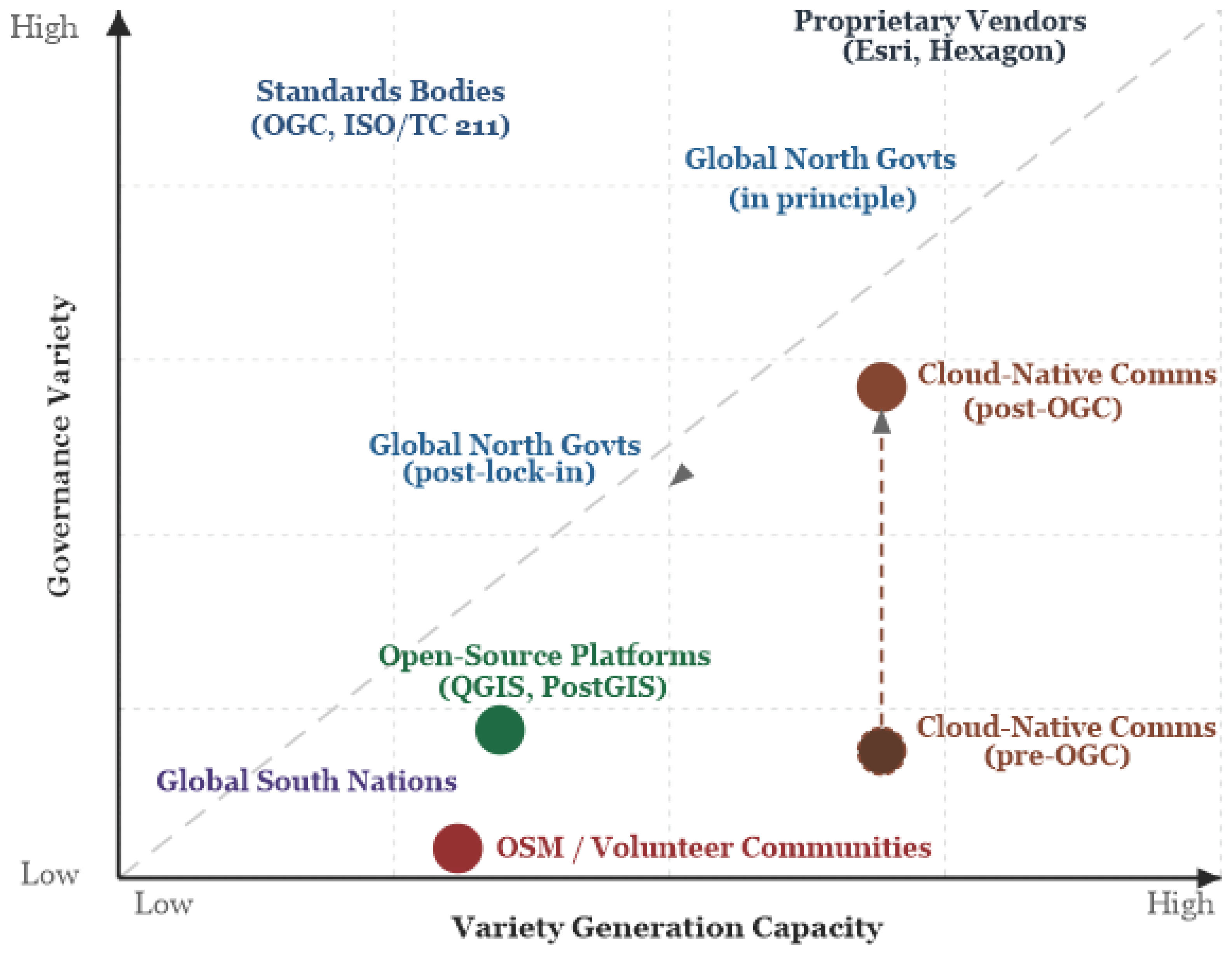
Critical insight generalising across domains: variety redistribution, not technical improvement, determines power locus shifts. Technically adequate alternatives fail challenging incumbents due to a lack of complementary variety portfolios, including educational varieties, certification varieties, institutional workflow varieties, infrastructure capabilities varieties, and ecosystem support varieties. Successful challenges require systematic variety generation across multiple dimensions simultaneously rather than isolated product development or specification improvement. This structural requirement explains persistent incumbent dominance as shown in
Figure 1 in which the SDI governance is dominated by commercial vendors, with the governance power of Global North nations falling post OGC and OSM, Open Source Platforms and the Global South continuing to have minimal influence on governance of SDI despite recurring technical innovations and regulatory interventions.
As shown above in
Figure 1, actors with high variety generation capacity (cloud-native communities, open-source platforms, and volunteer mapping communities) occupy low governance variety positions. Actors with formal governance authority (standards development organisations and Global North governments) face variety attenuation due to lock-in dynamics and an absence of enforcement variety. Proprietary vendors occupy the high-variety, high-governance position through training pipeline capture and enterprise integration lock-in. The above figure depicts structural configuration, not actor intent or policy preference.
4. Discussion
The Variety Dynamics framework provides methodological contributions to geographic information science through revealing structural mechanisms operating beyond conventional analytical capacity. Geographic information science traditionally employs causal analysis frameworks that assume stable system boundaries, consistent actor relationships, and linear intervention effects. These assumptions prove to be systematically violated in SDI governance systems exhibiting shifting boundaries (open-source movements emerge and dissolve), emergent feedback loops (cloud-native communities bypass traditional standards development organisations), and transforming relationships (vendors transition from opposition to co-option). VD addresses this analytical gap through focusing on variety distributions rather than causal predictions, enabling structural analysis of systems violating assumptions necessary for reliable causal inference (Axiom 50).
The framework distinguishes between variety distributions (who possesses which strategic resources at any moment) and variety redistribution events (decisions or interventions that actually shift the power locus by moving varieties between actors). This distinction proves analytically critical for understanding why most SDI governance interventions produce activity without power shifts. Standards proliferation, coordinating body establishment, and technical platform deployment constitute activity within unchanged variety distributions when educational pipeline varieties, transaction cost asymmetries, and feedback loop access remain concentrated with incumbent actors. Genuine variety redistribution requires systematic variety generation across complementary dimensions simultaneously, not isolated technical or policy interventions.
Historical validation through 2007 XML versus RDF analysis demonstrates that VD reveals variety distribution patterns determining power locus evolution beyond mental model capacity. The analysis identified variety concentrations (in the educational pipeline, enterprise integration, the training ecosystem) favouring Microsoft despite RDF’s technical superiority. Conventional technical merit predictions proved wrong, whilst power locus evolution followed variety distribution dynamics VD revealed. Identical patterns now operate in geospatial markets: training pipeline capture, enterprise integration lock-in, exponentially scaling transaction costs maintain vendor concentration despite open-source alternatives. This demonstrates that VD reveals recurring structural patterns across domains and periods through recognising how variety distributions determine the power locus independently of technical merit.
Variety Dynamics enables analysis of cognitive boundary violations where decision-makers employ two-feedback-loop mental models whilst actual systems operate through fifteen or more interacting loops. Human mental models can track simple systems (zero to one feedback loop) and manage complicated systems (two feedback loops) through mental simulation, but complex systems (three or more loops) require formal modelling for reliable prediction (Axiom 49). SDI governance operates through a minimum of ten interacting loops, including institutional coordination, standards evolution, vendor competition, political cycles, funding dynamics, technology change, user adoption patterns, data quality dependencies, legal framework evolution, and international coordination mechanisms. Beyond the two-feedback-loop cognitive boundary, outcomes predictably diverge from intentions through mechanisms invisible to mental model analysis.
Power law concentration analysis (Axioms 39 and 40) provides methodological tools that identify high-leverage intervention points where minimal resource expenditure generates disproportionate power redistribution effects. A small number of universities train the majority of GIS professionals, creating leverage points for training pipeline redirection. A small number of procurement framework modifications enable alternative platform market access. A small number of certification varieties generate professional credential independence. This analytical approach enables surgical interventions targeting concentration points rather than attempting comprehensive system transformation requiring exponential resource scaling.
Transaction cost analysis reveals how strategic actors engineer asymmetries that appear neutral whilst systematically concentrating power. Standards development organisation participation costs, proprietary format migration expenses, enterprise platform integration dependencies, certification requirements, and training ecosystem gaps constitute varieties determining system accessibility. Actors possessing financial varieties, institutional varieties, and temporal varieties navigate these costs, whilst competitors face prohibitive barriers. VD enables identification of these asymmetries and design of counterstrategies through targeted variety generation, rather than attempting cost reduction within incumbent-defined frameworks.
The Variety Dynamics framework’s value-neutral analytical stance proves methodologically essential for rigorous structural examination because bias toward particular outcomes would compromise diagnostic validity, converting analysis into advocacy rather than structural examination. Variety Dynamics reveals variety distribution dynamics and variety redistribution mechanisms available to all actors, with success depending on execution, resource commitment, timing, and coordination capacity, rather than framework preference. This analytical honesty enables identification of both hegemonic control strategies and counter-hegemonic resistance mechanisms without normative positioning.
4.1. Structural Variety Challenges by Stakeholder Category
Analysis of variety distribution dynamics reveals distinct structural challenges for each stakeholder category operating within SDI governance. These challenges reflect variety distribution configurations, not implementation failures—the power asymmetries each actor faces are structural features of their position within the overall distribution.
National mapping agencies and SDI coordinators face three characteristic variety deficits. First, coordination varieties attenuate across political transitions: mandates, funding allocations, and authority structures generated by one administration do not automatically persist when priorities shift. Second, the operational/analytical divide creates a cost–benefit asymmetry, whereby data provider agencies bear maintenance cost varieties whilst analytical benefit varieties accrue to national-level consumers. Third, enforcement variety—the regulatory authority to compel data sharing—typically resides at a level removed from operational data management, generating compliance theatre rather than genuine participation. Conventional technical interventions leave these variety distribution asymmetries unchanged because they do not address the structural flows of cost and benefit varieties between actors.
Sovereign infrastructure mandates create temporary variety redistribution windows by converting switching costs into sunk costs that organisations must pay regardless of platform choice. During these windows—typically two to four years between regulatory announcement and compliance deadline—the normally prohibitive barriers to platform transition are temporarily inverted. However, the structural condition for redistribution to occur is that alternative platforms possess deployment varieties, support varieties, and certification varieties during the decision window. When these are absent, organisations migrate to incumbent vendor cloud offerings, reinforcing rather than challenging existing concentration. The window closes when compliance deadlines pass and switching costs re-accumulate around whichever platform was adopted.
International development organisations and capacity-building programmes occupy a structurally contradictory position. Training varieties are systematically allocated to incumbent ecosystems through vendor-donated software and platform-specific curricula, whilst nominal commitments to vendor neutrality remain at the level of policy statement rather than variety generation. The structural result is that graduates enter employment markets possessing variety portfolios aligned with incumbent platforms, recreating concentration through individual professional choices that aggregate into institutional procurement patterns. This dynamic operates independently of organisational intention—it follows from variety distribution configuration, not from deliberate design.
Coalition procurement strategies possess the potential to generate market influence varieties unavailable to individual nations through aggregating demand varieties at a regional scale. The African Union and ASEAN frameworks provide institutional structures within which collective specification varieties—requiring open-source adoption, interoperability standards, and data sovereignty protections—could generate market access conditions vendors cannot ignore without forfeiting substantial revenue varieties. The structural vulnerability of coalitions is fragmentation through bilateral negotiation: vendors can offer country-specific concessions that dissolve collective action without addressing the underlying variety distribution.
Open-source communities and counter-hegemonic developers face a characteristic variety gap between technical capability and ecosystem completeness. QGIS demonstrates technical adequacy across core analytical functions whilst remaining supplementary within ArcGIS-dominant institutional workflows. The structural explanation is not a technical deficit but variety portfolio incompleteness: educational pipeline varieties, independent certification varieties, enterprise support varieties, and training ecosystem varieties are underdeveloped relative to incumbent actors. Technical excellence is a necessary but insufficient condition for institutional adoption when complementary variety portfolios are absent.
Academic institutions and GIS education programmes occupy a high-leverage structural position through their role in generating graduate varieties that are subsequently distributed throughout government and commercial sectors. Ten to fifteen major research institutions shape the skill variety profiles of thousands of graduates annually. The structural constraint is that curriculum variety, certification variety, and career pathway variety must form a coherent portfolio: graduates possessing open-source skills without corresponding credential varieties and employer recognition varieties rationally prefer incumbent platforms when entering employment markets, regardless of technical training received.
Government procurement agencies determine vendor market access through procurement framework specification varieties. Current frameworks nominally maintain platform neutrality whilst systematically embedding enterprise support requirements, certification criteria, and integration specifications that function as incumbent proxies. The structural effect is that procurement processes evaluate incumbent-defined capability proxies rather than actual functional capabilities, excluding alternatives that meet genuine operational requirements without matching vendor-defined compliance criteria.
4.2. Generalisability Across Domains
Variety distribution asymmetries creating power concentration through educational pipelines, transaction cost engineering, ecosystem lock-in, and temporal window dynamics exhibit structural similarities across multiple domains beyond geospatial governance.
Academic publishing demonstrates parallel dynamics through journal control varieties, institutional subscription varieties, and impact factor varieties. Elsevier maintains dominance despite open-access movements by possessing comprehensive variety portfolios, including established journal prestige varieties, editorial board varieties, subscription infrastructure varieties, and metrics integration varieties (impact factors and h-indexes). Universities face exponentially scaling switching costs through accumulated journal subscription varieties, faculty publication pressure varieties, and promotion criteria varieties dependent on established metrics. Open-access alternatives (arXiv and PLoS) possess technical platform varieties but lack prestige varieties, metrics recognition varieties, and institutional acceptance varieties necessary for challenging incumbent control. Coalition action (Plan S mandates) creates variety redistribution windows through forcing infrastructure migration, but its effectiveness depends on generating alternative prestige varieties and metrics varieties during the process.
Cloud computing infrastructure exhibits vendor dominance through API lock-in varieties, data egress cost varieties, and certified professional varieties. Amazon Web Services, Microsoft Azure, and Google Cloud maintain concentration despite technical alternatives through training pipeline capture (cloud certification programmes), enterprise integration depth (comprehensive service portfolios), and switching cost varieties (data egress fees and API incompatibilities). Organisations accumulate platform-specific varieties, including automated workflows, custom applications, and staff expertise, creating exponential migration barriers. Multi-cloud strategies prove theoretically appealing but practically challenging through transaction cost varieties multiplying across platform counts. Sovereign cloud initiatives create variety redistribution opportunities through regulatory forcing but require systematic variety generation across certification, support, and ecosystem dimensions.
Social media platforms concentrate power through network effect varieties, content lock-in varieties, and algorithmic control varieties. Facebook, Twitter, and Instagram maintain dominance despite privacy concerns and regulatory challenges through accumulated social graph varieties (friend connections and follower relationships), content archive varieties (photos, messages, and timeline histories), and engagement pattern varieties (algorithmic preferences and interaction histories). Users face switching cost varieties, including social capital loss (recreating networks), content abandonment (accumulated histories), and coordination difficulties (moving contacts simultaneously). Decentralised alternatives (Mastodon and Bluesky) possess technical architecture varieties but lack network varieties, content portability varieties, and coordination mechanism varieties enabling collective migration. Regulatory interventions (GDPR data portability) create variety redistribution potential through reducing content lock-in varieties but prove insufficient without addressing network coordination varieties.
Pharmaceutical development demonstrates variety concentration through patent varieties, regulatory approval varieties, clinical trial infrastructure varieties, and distribution network varieties. Established pharmaceutical corporations maintain dominance through comprehensive portfolios, including regulatory expertise varieties, approval pathway knowledge varieties, clinical trial management varieties, and market access varieties. Generic manufacturers face exponentially scaling barriers through patent thicket varieties, regulatory approval costs, bioequivalence demonstration requirements, and distribution infrastructure gaps. Compulsory licensing creates variety redistribution opportunities by removing patent barrier varieties but proves insufficient without addressing regulatory approval varieties and manufacturing capability varieties. Global South pharmaceutical independence requires systematic variety generation across research capacity, regulatory expertise, manufacturing infrastructure, and quality assurance capabilities.
Variety Dynamics applicability extends to complex socio-technical–economic systems exhibiting characteristic patterns, including multiple actors possessing asymmetric variety distributions, power law concentrations proving empirically observable, transaction costs scaling non-linearly with variety increases, feedback loops generating self-reinforcing variety concentration, educational or professional credentialing systems creating generational lock-in, temporal windows for variety redistribution emerging through external forcing, and conventional causal analysis failing through hyper-complexity exceeding mental model capacity. Systems violating these characteristics require alternative analytical frameworks rather than VD application.
4.3. Limitations and Future Research
This analysis exhibits several limitations suggesting future research directions. Empirical validation remains limited to documented case studies and industry reports rather than systematic quantitative assessment of variety distributions, transaction cost measurements, or feedback loop strengths. Future research should develop empirical methodologies measuring variety concentrations, transaction cost asymmetries, and power law distribution parameters across SDI systems, enabling quantitative comparison of governance regimes and temporal periods.
Causal mechanisms connecting variety distributions to observed outcomes require further investigation. The VD framework identifies structural relationships (variety asymmetries map to power concentrations) without specifying detailed causal pathways explaining how varieties produce particular effects. Research integrating VD structural analysis with causal process tracing, mechanism-based explanation, or agent-based modelling could clarify micro-level dynamics producing macro-level patterns. Understanding precisely how training varieties convert to market preference varieties, how transaction costs accumulate to create switching barriers, or how feedback loops generate self-reinforcing concentration would enhance analytical precision.
Intervention effectiveness assessment requires longitudinal studies tracking variety redistribution attempts across implementation periods. Analysis identifies leverage points and intervention strategies but lacks systematic evaluation of which approaches actually shift the power locus and under what conditions. Comparative case studies examining successful versus failed variety redistribution initiatives, controlled experiments testing intervention mechanisms, or natural experiments exploiting regulatory changes could establish an evidence base for practical guidance. Current recommendations rest on theoretical analysis and limited empirical examples rather than comprehensive effectiveness evaluation.
Temporal dynamics require enhanced theoretical development. Analysis identifies that time constitutes a variety dimension shaping the dynamic power locus through the availability and accessibility of strategic resources (Axioms 14 and 46) and that temporal windows create redistribution opportunities (data sovereignty compliance periods). However, formal modelling of temporal evolution, path dependency formation, window opening and closing mechanisms, and irreversibility thresholds remains underdeveloped. Temporal analysis capabilities would be improved by research developing mathematical frameworks for temporal changes in varieties and their ownerships along with simulation models exploring path dependency emergence and empirical studies measuring the time-based opportunities for changes to occur that avoid hegemonic closure mechanisms.
Global South perspectives require deeper investigation beyond current analyses treating Global South nations primarily as low-variety actors experiencing exclusion. Research examining internal variety distributions within Global South contexts, regional cooperation mechanisms, indigenous governance varieties, and counter-hegemonic strategies specifically developed within Global South institutional frameworks would provide richer understanding. Current analysis risks reproducing Global North analytical dominance through applying a framework developed within the Global North academic context without sufficient Global South theoretical contributions or empirical grounding.
Mathematical formalisation remains incomplete. The current framework employs set theory foundations and natural language axiom statements but lacks comprehensive mathematical representation enabling formal deduction, quantitative prediction, or computational simulation. Future developments should establish higher mathematical foundations through category theory, sheaf theory, or topological approaches enabling precise formulation of variety distributions, transformation operators, and power locus dynamics. Mathematical rigour would enable analytical advances, including formal theorem proof, optimisation techniques for intervention design, and computational tools for large-scale system analysis.
Alternative theoretical frameworks require comparative evaluation. VD provides one analytical lens for examining SDI governance dynamics. Comparison with institutional analysis frameworks, complexity theory approaches, critical political economy perspectives, or science and technology studies methodologies would identify complementary insights, theoretical tensions, and integration opportunities. Understanding when VD proves most analytically productive versus contexts where alternative frameworks provide superior explanatory power would enhance methodological sophistication and prevent an analytical monoculture.
5. Summary and Conclusions
This analysis applied the Variety Dynamics framework to examine persistent SDI governance and standardisation failures despite two decades of standardisation efforts, substantial public investment, and recurring reform initiatives.
Conventional explanations attributing failures to inadequate implementation, insufficient political commitment, or funding shortfalls prove systematically inadequate through failing to address structural mechanisms operating beyond mental model capacity. Decision-makers employ analytical frameworks bounded by two-feedback-loop comprehension limits, whilst actual SDI systems operate through fifteen or more interacting loops, including institutional coordination, standards evolution, vendor competition, political cycles, funding dynamics, technology change, user adoption patterns, data quality dependencies, legal framework evolution, and international coordination mechanisms. Beyond this cognitive boundary, outcomes predictably diverge from intentions through variety distribution dynamics invisible to causal analysis.
Power concentration follows variety distribution asymmetries across actors. Global proprietary vendors, standards development organisations, and Global North governments possess comprehensive variety portfolios, including market access, technical platforms, data formats, educational pipelines, training ecosystems, financial resources, governance structures, regulatory frameworks, and institutional relationships. Global South nations, open-source communities, and cloud-native developers exhibit constrained variety portfolios experiencing system outcomes without shaping evolution. This asymmetry proves self-reinforcing through feedback loop dynamics where high-variety actors generate additional varieties through variety investment, whilst low-variety actors consume varieties maintaining operations without accumulating strategic capacity.
System control operates through multiple interacting feedback loops generating variety concentration. Educational pipeline capture creates generational lock-in through university donations generating platform-specific training. Standards development organisation participation costs concentrate influence through membership fees, creating barriers. Enterprise integration accumulates switching cost varieties through workflow dependencies and proprietary format lock-in. Third-party ecosystem network effects create platform dependencies through extension development. Certification systems generate professional credential lock-in through vendor-controlled competency definitions. These loops operate simultaneously across multiple timescales, creating hyper-complexity exceeding mental model tracking capacity.
Strategic actors engineer asymmetries that appear neutral whilst systematically concentrating control through standards development organisation participation requirements, proprietary format migration expenses, enterprise platform integration depth, certification barriers, and training ecosystem gaps. Small organisations and Global South actors face exponential cost scaling, where the participation varieties required exceed organisational capacity, whilst large vendors distribute costs across revenue bases, making participation marginal. This asymmetry ensures that governance structures operate without effective small-actor or Global South representation despite nominal openness.
Incumbent resistance operates through variety control mechanisms that appear to be cooperative whilst preserving power asymmetries. Standards co-option absorbs challenges without redistribution by bringing alternative specifications under institutional governance, attenuating evolution velocity. Vendor participation shapes specification evolution toward incumbent compatibility. Training ecosystem capture redirects innovation benefits through positioning alternatives as supplementary tools. Procurement regulation gaming maintains advantages through criteria favouring incumbents. These mechanisms individually appear to be reasonable whilst collectively constituting comprehensive resistance preserving concentration through variety distribution control.
Counter-hegemonic emergence through cloud-native geospatial platforms demonstrates genuine variety redistribution potential. STAC specification development, the Overture Maps Foundation, and DuckDB spatial exhibit common characteristics, including development outside traditional institutional governance, architectural simplicity resisting enterprise complexity, permissive licensing enabling commercial use, implementation strategies favouring platform independence, and financial models relying on corporate sponsorship and community contribution. The October 2025 confluence created a potential redistribution window, in which the cloud-native ecosystem possessed a variety portfolio sufficient to challenge traditional dominance. Whether potential converts to actual redistribution depends on systematic variety generation across educational, certification, procurement, and ecosystem dimensions before incumbent resistance reconsolidates control.
5.1. Implications for Policy and Practice
The structural analysis in
Section 4 generates a primary policy implication that overrides all stakeholder-specific recommendations: interventions operating within unchanged variety distributions produce activity without power locus shifts regardless of resource expenditure. Standards proliferation, coordinating body establishment, technical platform deployment, training initiatives, and regulatory mandates all constitute events within stable distributions when they do not transfer varieties between actors. Genuine redistribution requires simultaneous variety generation across complementary dimensions—educational pipelines, certification systems, procurement frameworks, ecosystem support, and financial sustainability—because incomplete variety portfolios are insufficient for institutional adoption, regardless of quality in any single dimension.
Intervention sequencing priorities follow from variety distribution analysis. Not all interventions carry equal leverage. Power law concentration patterns (Axiom 40) mean that small proportions of actors and interventions account for disproportionate effects on power locus. Three intervention points exhibit structural leverage disproportionate to resource requirements.
Educational pipeline redirection is the intervention with the highest leverage available. University partnerships with ten to fifteen major research institutions determine the skill variety profiles distributed throughout government and commercial sectors over generational timeframes. The critical sequencing requirement is that curriculum varieties, certification varieties, and employer recognition varieties must be developed as a coordinated portfolio rather than sequentially—open-source training without corresponding credential recognition fails to shift graduate employment choices, leaving pipeline capture intact.
Sovereign infrastructure mandate windows require front-loaded intervention. The analysis in
Section 4.1 establishes that redistribution windows are temporary and close when compliance deadlines pass. Policy implication: procurement frameworks, certification systems, and training programmes must be established during regulatory announcement periods, not at compliance deadlines. Actors targeting the 2024–2028 window for current data sovereignty regulations who have not yet generated alternative platform support and certification varieties will find that the window has closed when compliance activity peaks.
Coalition procurement strategies require sustained coordination investment as a prerequisite, not an output. Regional organisations (the African Union and ASEAN) provide institutional frameworks for collective action, but collective specifications must be maintained with enforcement consequences for non-compliance and coordination across procurement cycles. The strategic implication for Global South nations is that regional cooperation mechanisms provide greater variety leverage against multinational vendor dominance than isolated national initiatives, which remain individually susceptible to bilateral concession strategies.
Procurement framework restructuring offers policy-accessible leverage available to government agencies without requiring ecosystem development. Restructuring evaluation criteria to measure actual functional capabilities—format portability, API openness, and community governance participation—rather than incumbent-defined proxies creates market access varieties for alternatives. The critical requirement is that criteria must be genuinely capability-based rather than compliance theatre-neutral: nominally platform-neutral frameworks embedding enterprise support requirements and vendor certification criteria remain structurally biased regardless of their stated neutrality.
Cloud-native architecture strategies address enterprise lock-in at the infrastructure level by maintaining data portability and service substitutability as baseline requirements. Development priorities should target capability completeness across enterprise workflows—not technical sophistication in isolated analytical domains—because partial capability coverage positions cloud-native tools as supplementary rather than substitutable, preserving incumbent platform dependencies in core workflows.
The overarching strategic implication is that variety redistribution requires comprehensive portfolio generation timed to coincide with structural windows of opportunity. Interventions targeting single variety dimensions—technical capability alone, regulatory mandate alone, or training provision alone—predictably fail because actors rationally adopt platforms with complete variety portfolios across all dimensions relevant to their operational context.
5.2. Future Research Directions
Future research in SDI should aim to develop analytical capacity recognising variety distribution patterns across diverse SDI governance contexts. Current analysis applies the VD framework to specific cases demonstrating structural mechanisms. Broader pattern library development examining variety distributions across national, regional, and international SDI implementations would enhance recognitional capacity, identifying when specific dynamics operate versus when alternative patterns dominate. Comparative structural analysis across contexts would refine understanding of which variety asymmetries prove most significant under which system characteristics.
Longitudinal analysis tracking variety redistribution attempts across implementation periods would develop understanding of temporal dynamics, path dependency formation, and window closure mechanisms. Analysis identifies leverage points and intervention strategies through structural examination. Following variety redistribution initiatives over time would reveal how variety accumulation occurs, when discontinuities emerge that create irreversible transitions, and how resistance mechanisms operate across different phases. This requires sustained observation, developing recognitional expertise rather than controlled experimentation testing causal hypotheses.
Global South perspectives require deeper investigation beyond current analyses treating Global South nations primarily as low-variety actors experiencing exclusion. Research examining internal variety distributions within Global South contexts, regional cooperation mechanisms, indigenous governance varieties, and counter-hegemonic strategies specifically developed within Global South institutional frameworks would provide richer understanding. Integration of Global South theoretical contributions would prevent an analytical monoculture reproducing Global North dominance through framework application.