
Spatial and Social Equity in Access to Emergency Service Facilities—An Opportunity–Outcome Perspective

Abstract
1. Introduction
- (1)
- Do spatial disparities exist in equitable access to different types of ESFs in Lanzhou?
- (2)
- How does spatial heterogeneity in ESF accessibility vary across different spatial scales?
- (3)
- Does the current allocation of ESFs in Lanzhou exhibit patterns of social inequity?
- (4)
- How do spatial and socioeconomic factors influence equitable access to ESFs in Lanzhou?
2. Materials and Methods
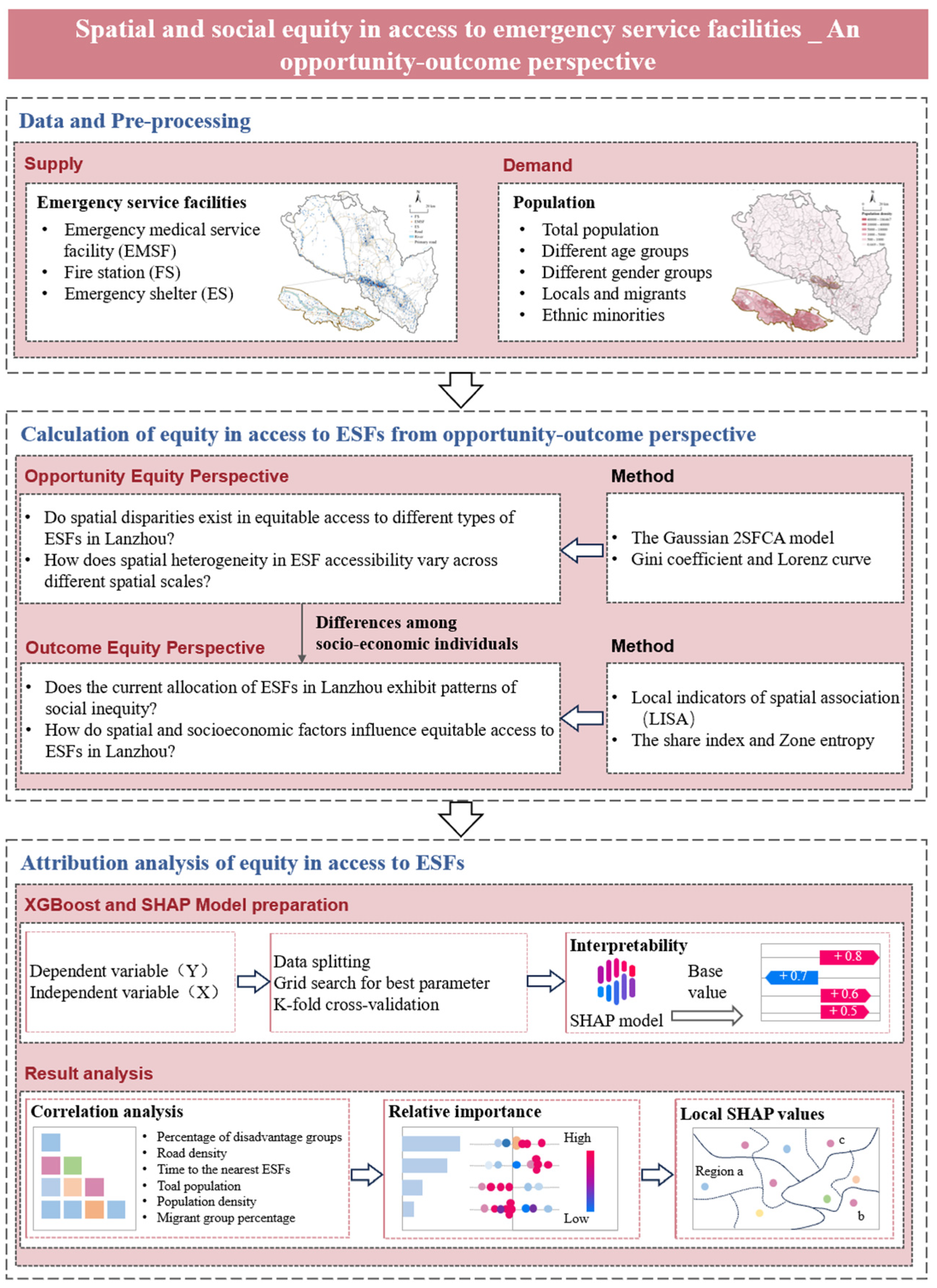
2.1. Conceptual Framework
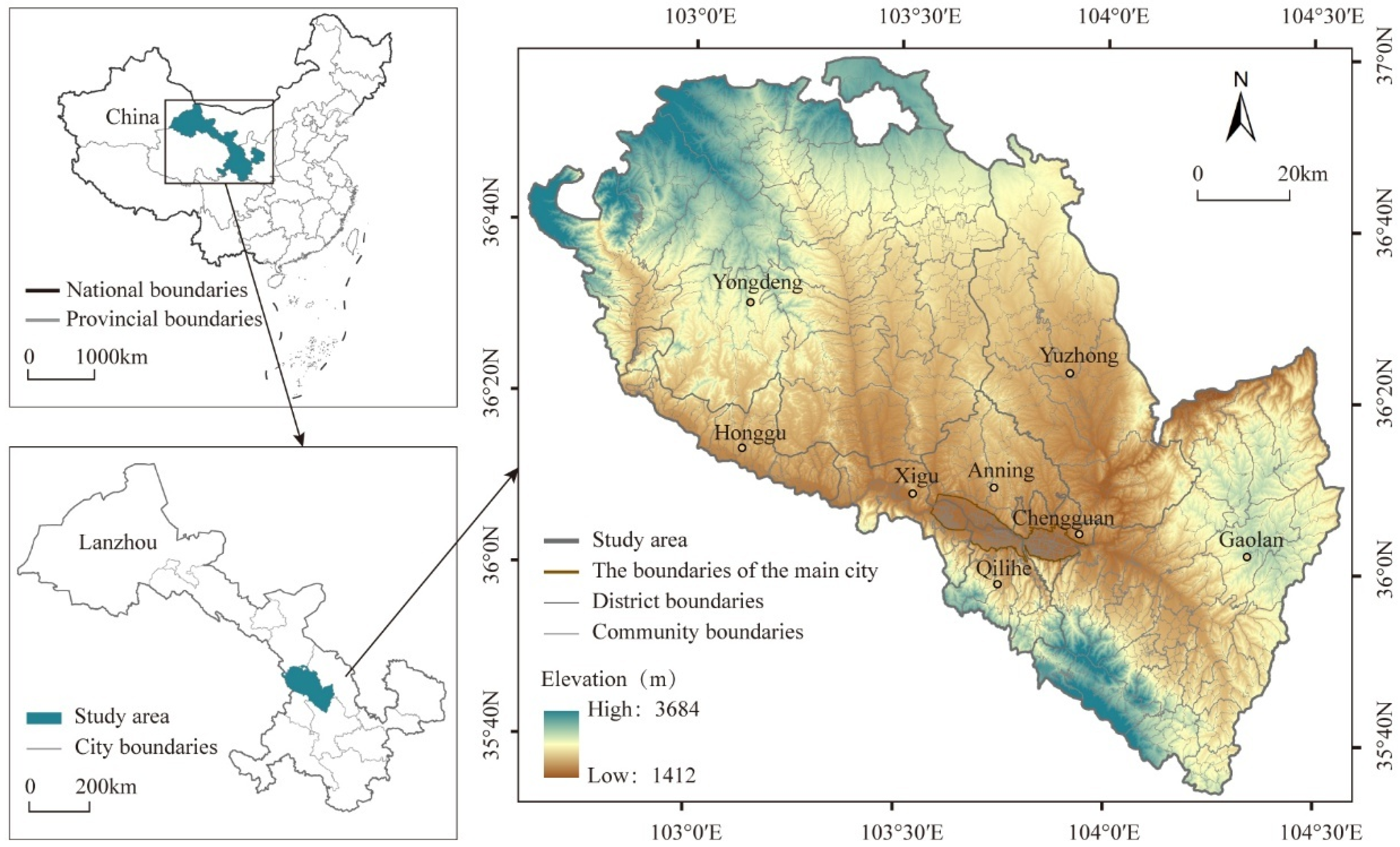
2.2. Study Area
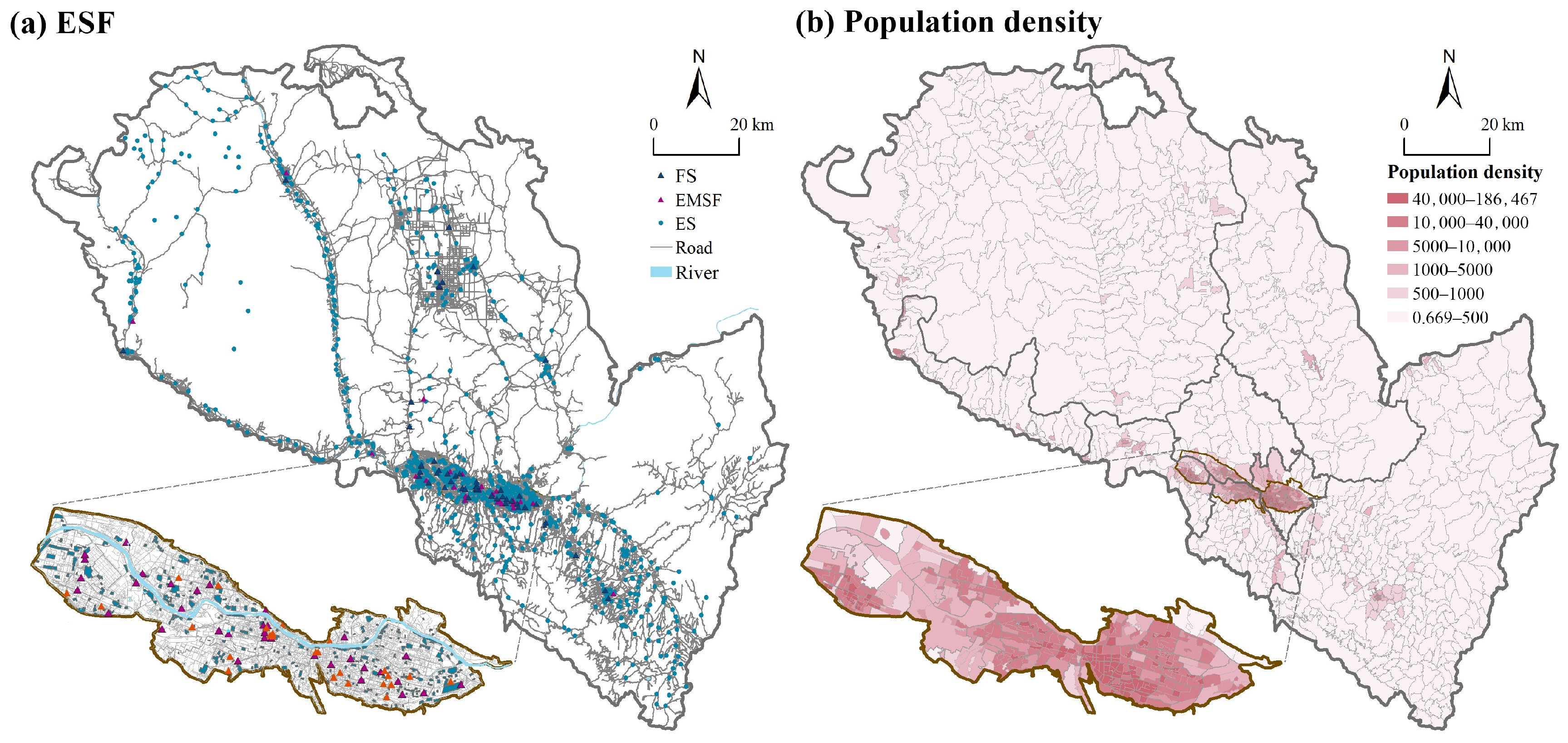
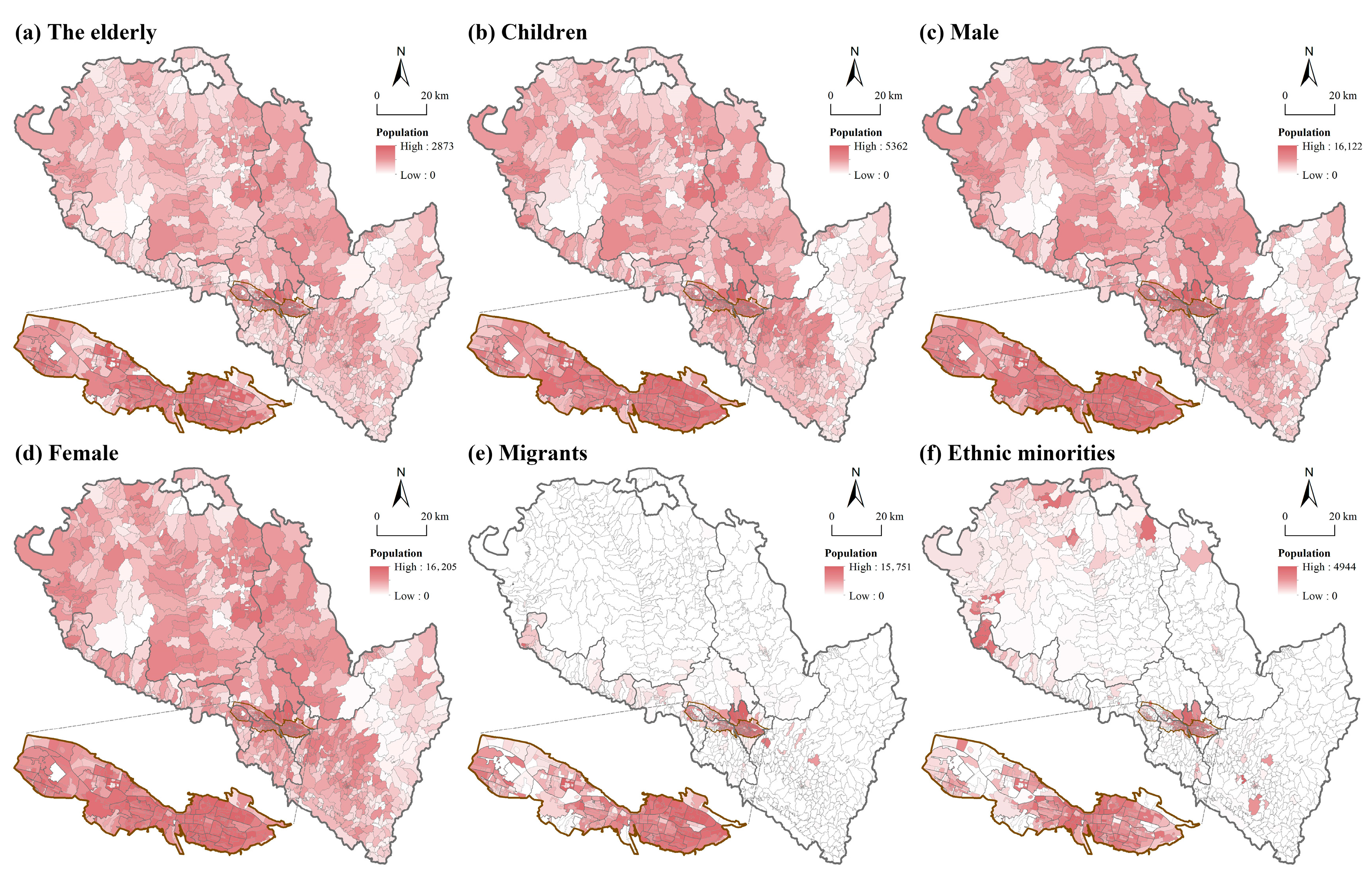
2.3. Data Sources and Processing
2.4. Methods
2.4.1. Accessibility Calculation of ESFs
- (1)
- The Gaussian 2SFCA method
- (2)
- Setting of service thresholds and supply capacity for urban and rural ESFs

| ESF | Service Threshold (min) | Travel Mode | Reference | |
|---|---|---|---|---|
| EMSF | Urban area | 15 | Driving | (Health Commission of Gansu Province, 2020) |
| Rural area | 45 | |||
| FS | Urban area | 10 | Driving | [67] |
| Rural area | 20 | |||
| ES | Temporary shelters | 15 | On foot | Standard for Urban Planning on Earthquake Resistance and Hazardous Prevention (China) |
| Fixed shelters | 60 | |||
2.4.2. Gini Coefficient and Lorenz Curve
2.4.3. Bivariate Local Moran’s I
2.4.4. Share Index and Locational Entropy
2.4.5. XGBoost Model and Explanatory Model
3. Results
3.1. Opportunity Equity in Access to ESFs
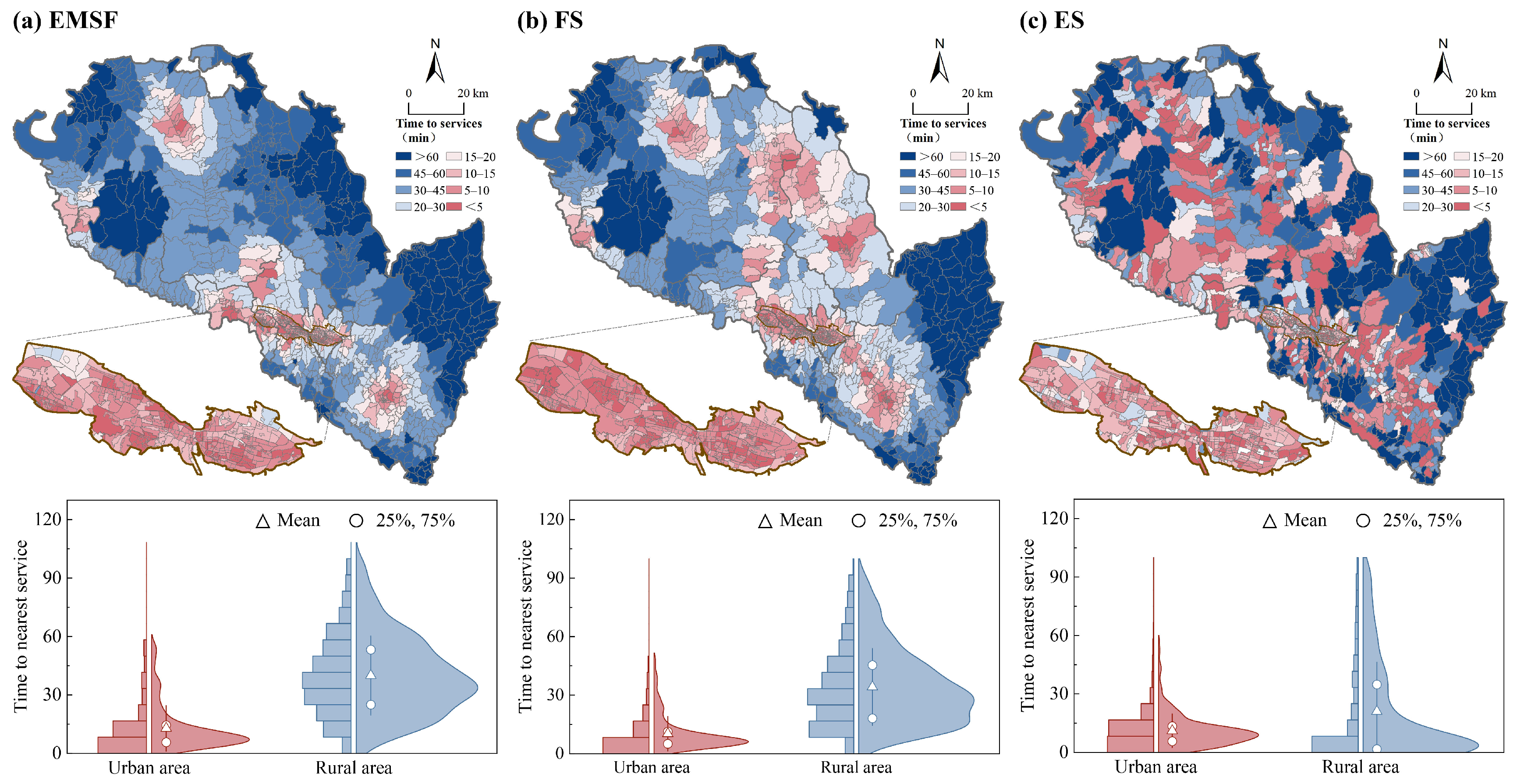
3.1.1. Disparities in ESF Response Times
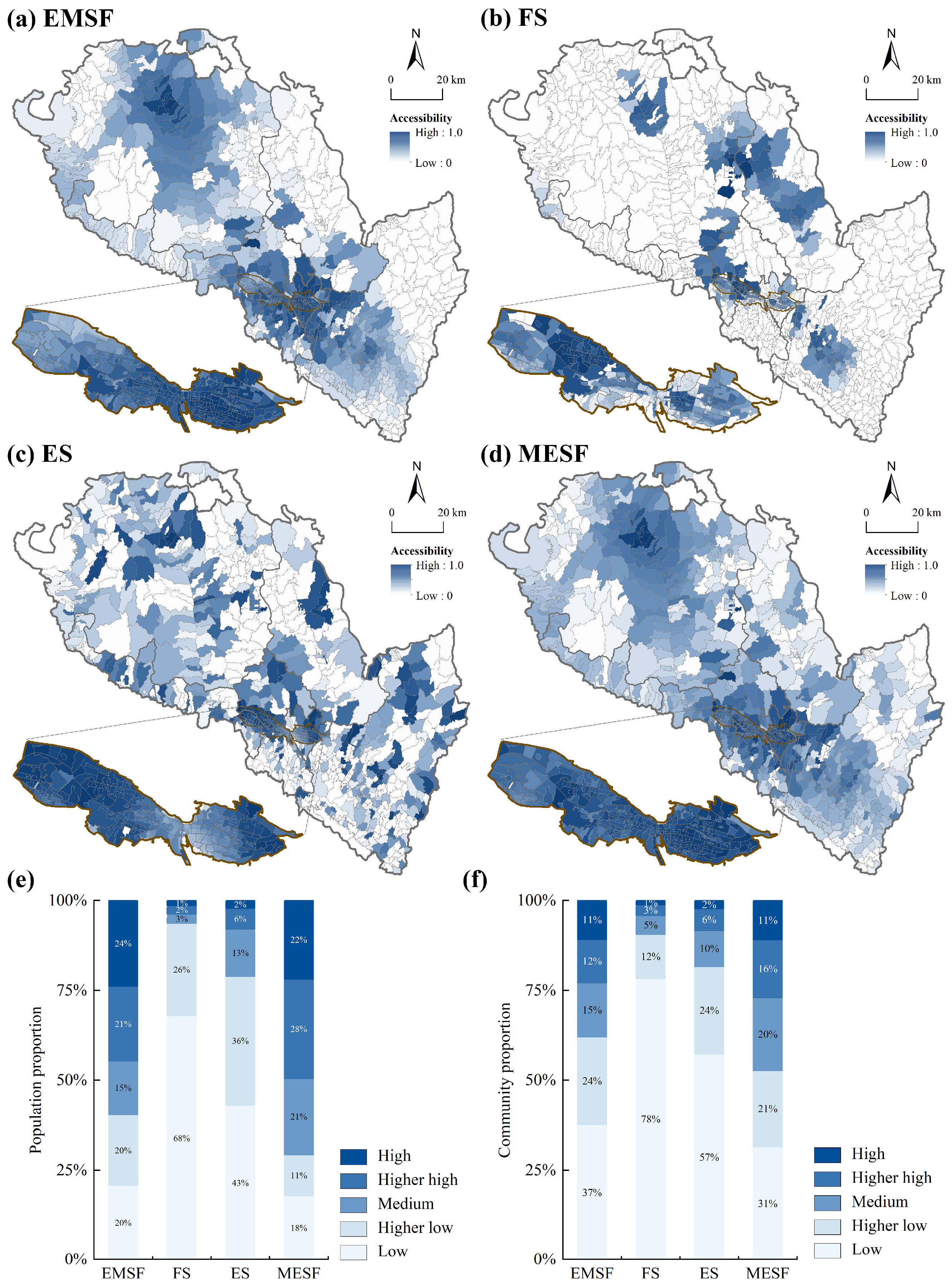
3.1.2. Differences in Spatial Distribution of Accessibility to ESFs
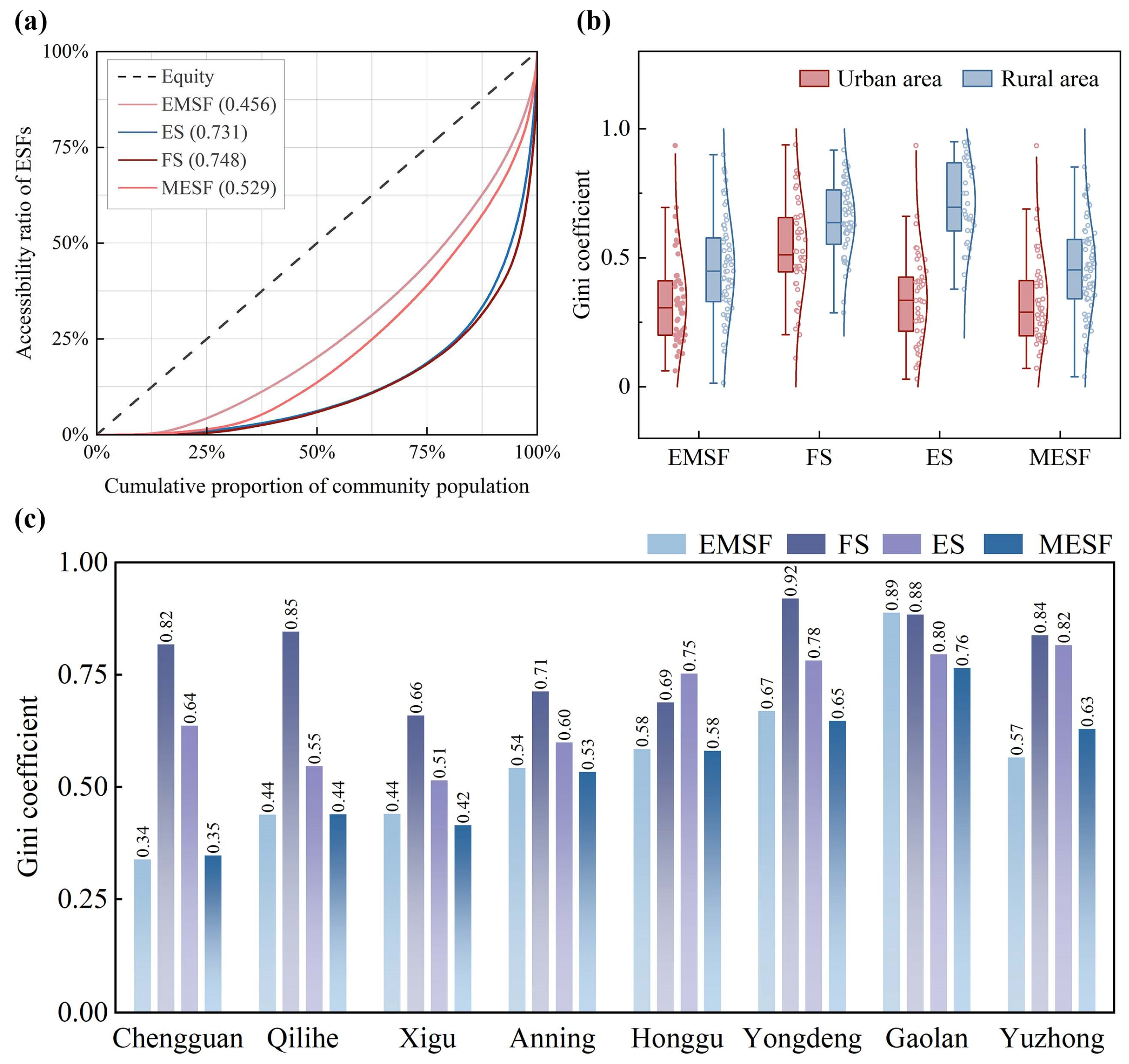
3.1.3. Inequity in Access to ESFs at Multiple Scales
- (1)
- Inequality among communities
- (2)
- Inequality among central and non-central urban areas
- (3)
- Inequality across districts
3.2. Outcome Equity in Access to ESFs
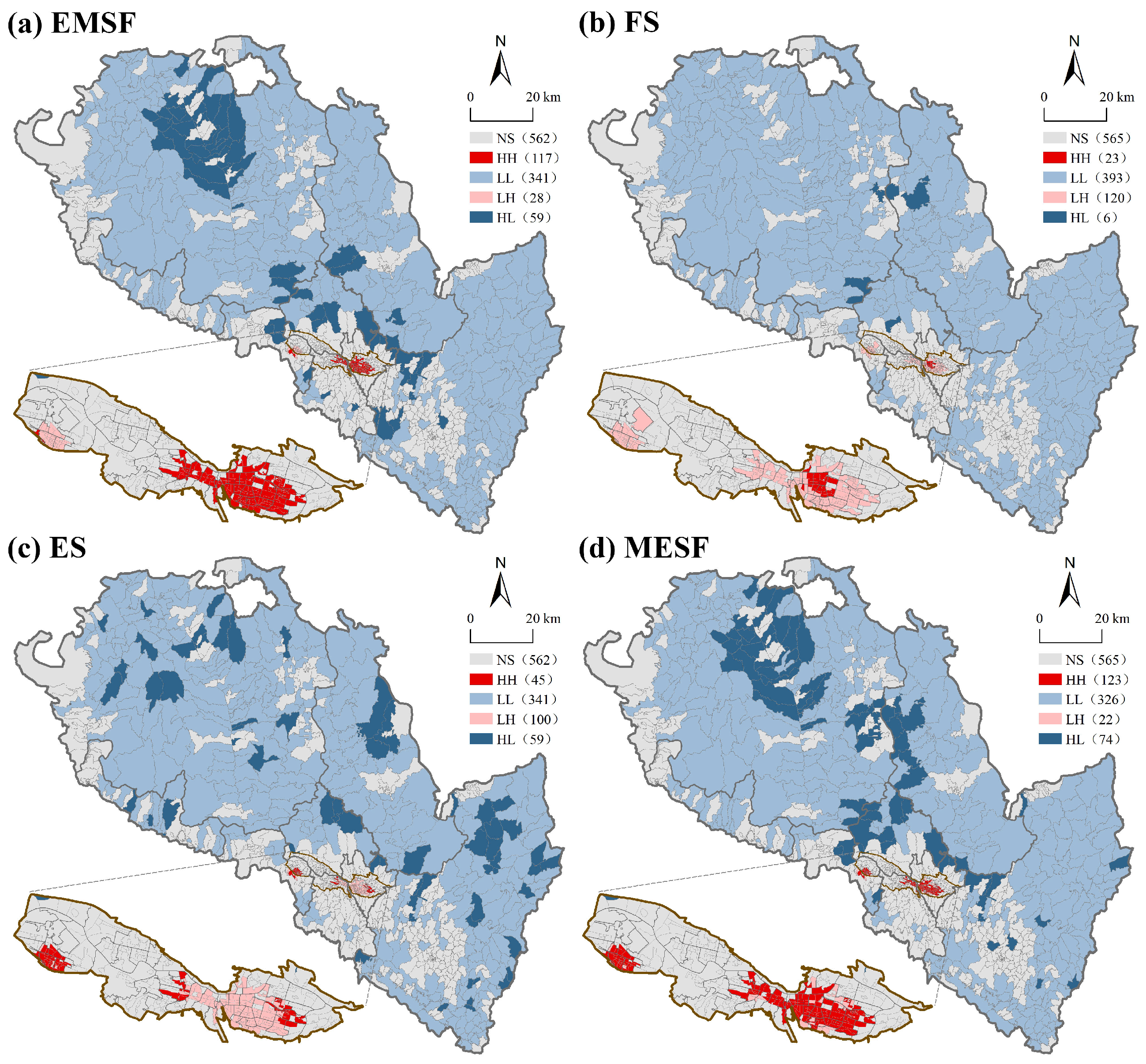
3.2.1. Spatial Mismatch Between ESF Accessibility and Population Density
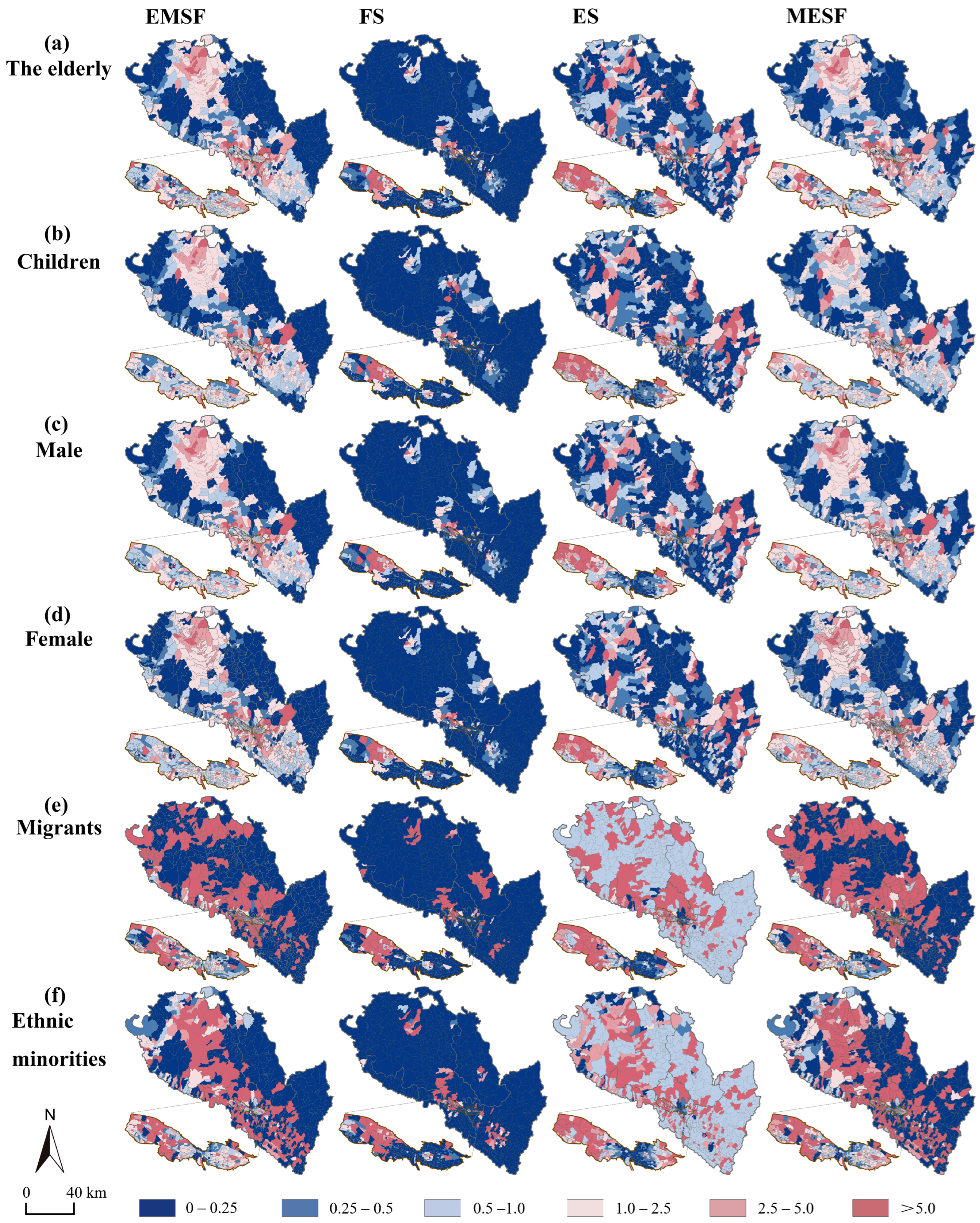
3.2.2. Inequity in Access to ESFs Among Socioeconomic Groups
3.3. Analysis of Factors Influencing Equity in Access to ESFs
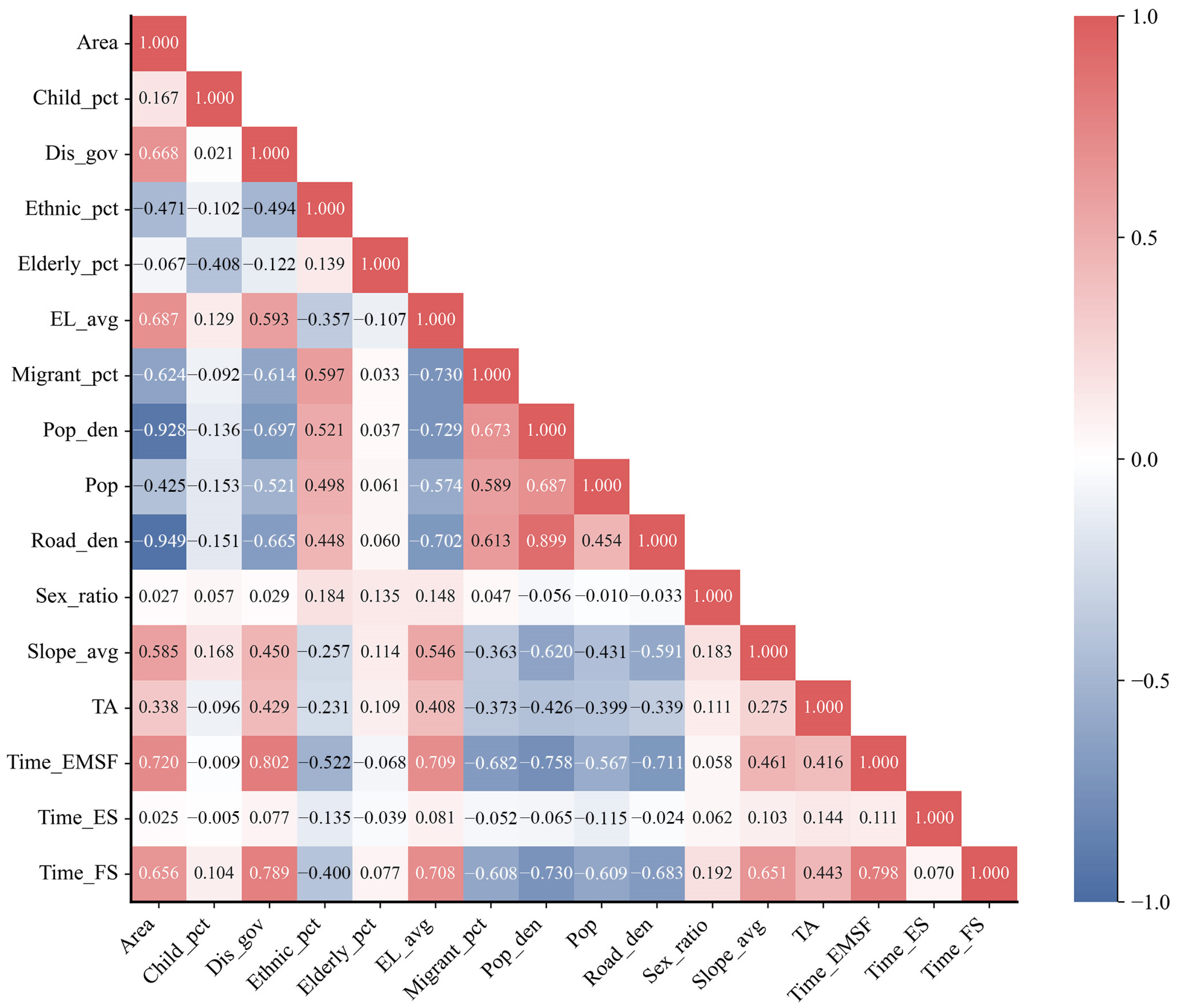
3.3.1. Correlation Analysis
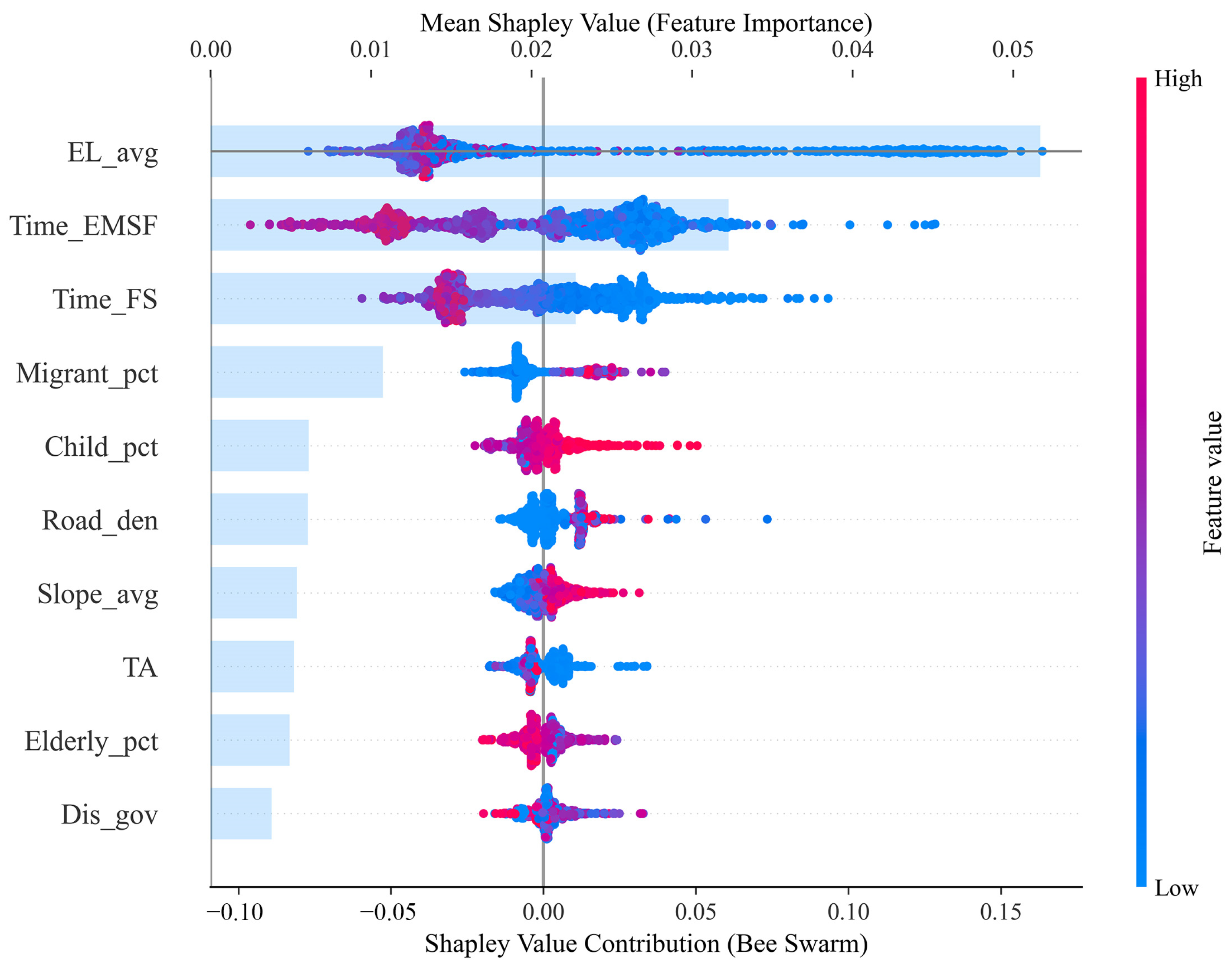
3.3.2. Global Feature Importance
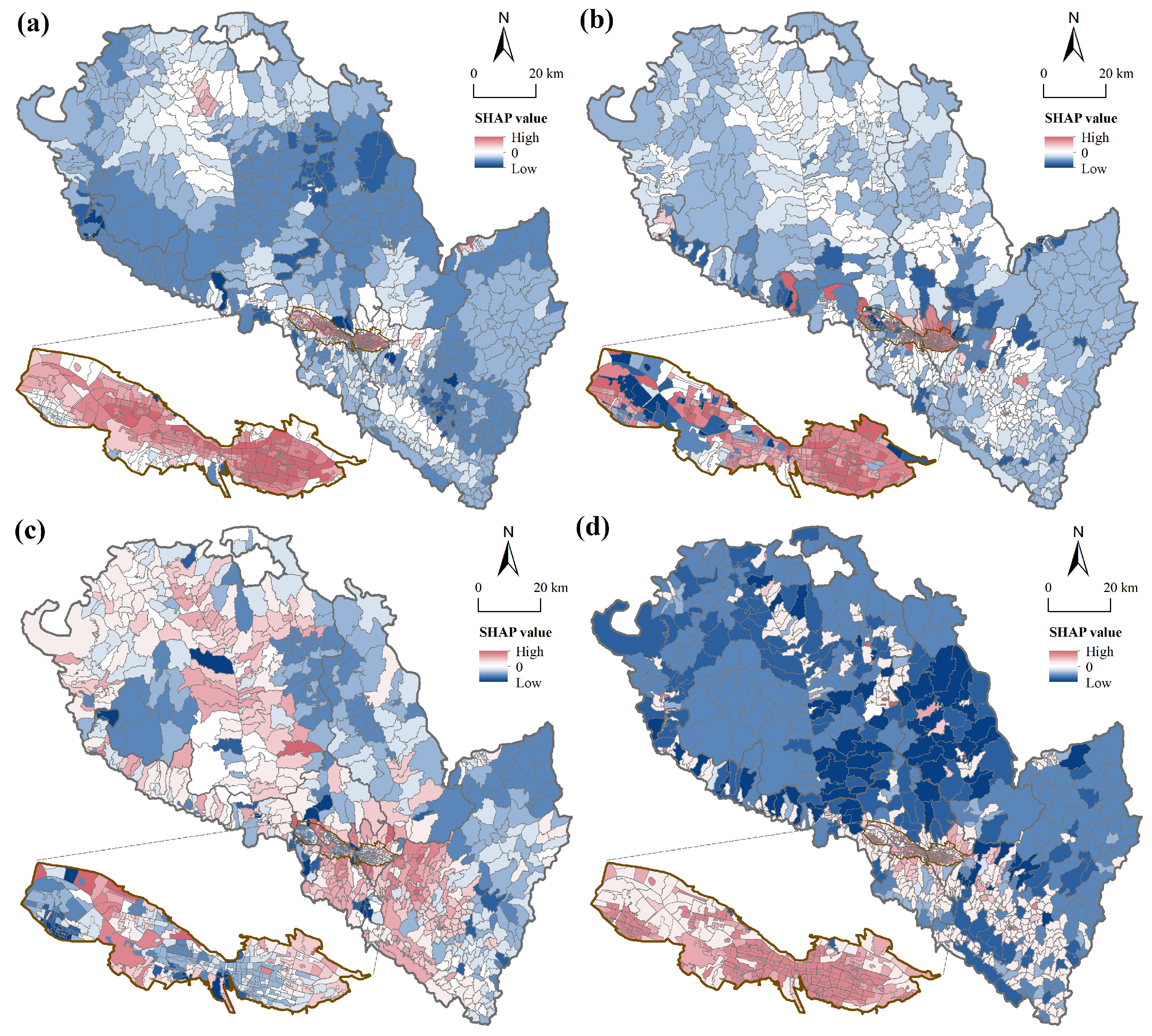
3.3.3. Spatial Heterogeneity of Key Influencing Factors
4. Discussion
4.1. Spatial Heterogeneity and Underlying Mechanisms of Equity in Access to ESFs
4.2. Inequitable Access to ESFs Across Socioeconomic Groups
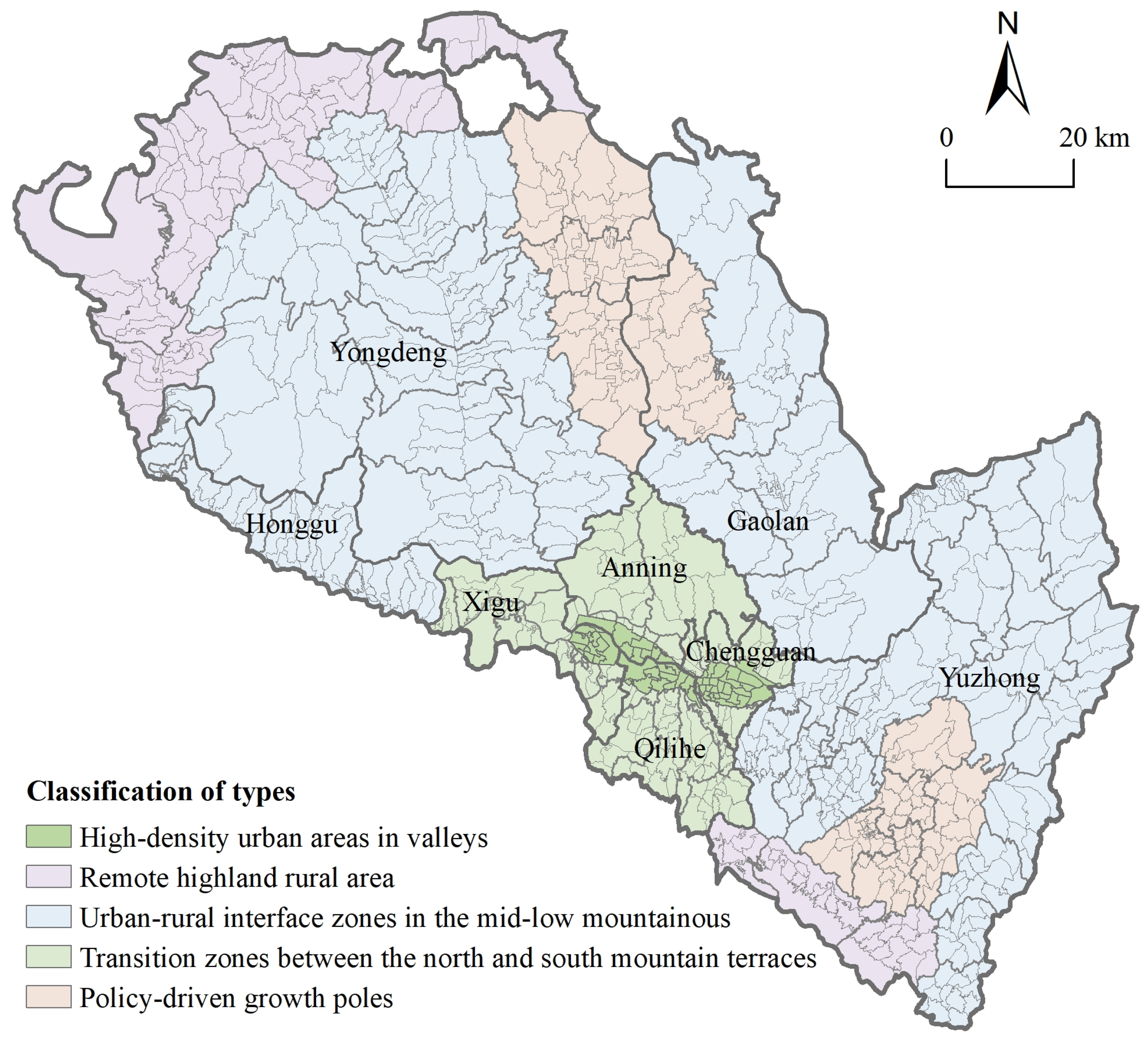
4.3. Establishing a Zonal Management Plan for ESFs in Lanzhou
- (1)
- High-density urban areas in valleys
- (2)
- Policy-driven growth poles
- (3)
- Transition zones between the north and south mountain terraces
- (4)
- Urban–rural interface zones in the mid-low mountainous and remote highland rural regions
- (5)
- Disaster prevention and mitigation facilities for vulnerable groups
4.4. Advantages and Limitations
5. Conclusions
Author Contributions
Funding
Data Availability Statement
Conflicts of Interest
Abbreviations
| ESF | Emergency service facility |
| EMSF | Emergency medical services facility |
| FS | Fire station |
| ES | Emergency shelter |
References
- Alig, R.J.; Kline, J.D.; Lichtenstein, M. Urbanization on the US landscape: Looking ahead in the 21st century. Landsc. Urban Plan. 2004, 69, 219–234. [Google Scholar] [CrossRef] [Scilit]
- Li, Z.; Yan, W. Service flow changes in multilayer networks: A framework for measuring urban disaster resilience based on availability to critical facilities. Landsc. Urban Plan. 2024, 244, 104996. [Google Scholar] [CrossRef] [Scilit]
- Li, X.; Fu, D.; Nielsen-Gammon, J.; Gangrade, S.; Kao, S.-C.; Chang, P.; Morales Hernández, M.; Voisin, N.; Zhang, Z.; Gao, H. Impacts of climate change on future hurricane induced rainfall and flooding in a coastal watershed: A case study on Hurricane Harvey. J. Hydrol. 2023, 616, 128774. [Google Scholar] [CrossRef] [Scilit]
- Ma, C.; Song, M.; Zeng, W.; Wang, X.; Chen, T.; Wu, S. Enhancing urban emergency response: A Euclidean distance-based framework for optimizing rescue facility layouts. Sustain. Cities Soc. 2025, 118, 106006. [Google Scholar] [CrossRef] [Scilit]
- Zhou, J.; Nie, G.; Liu, Y. Multi-criteria comparison analysis of spatial equity for emergency shelters in old and new urban districts: A case study in Wuhua District and Chenggong District of Kunming City, China. Int. J. Disaster Risk Reduct. 2024, 108, 104547. [Google Scholar] [CrossRef] [Scilit]
- Yan, W.; Ren, J.; Zhang, S.; Hao, L. Resilient urban planning in Shanghai: Key issues, general framework, and planning strategies. Urban Plan. Forum 2022, 3, 19–28. [Google Scholar] [CrossRef]
- Zhang, K.; Chen, X.; Zhang, M. Priority evaluation of emergency facilities configuration in coastal rural area of East China from the perspective of disaster chain. J. Nat. Disasters 2022, 31, 56–66. [Google Scholar] [CrossRef]
- Novak, D.C.; Sullivan, J.L. A link-focused methodology for evaluating accessibility to emergency services. Decis. Support Syst. 2014, 57, 309–319. [Google Scholar] [CrossRef] [Scilit]
- Li, J.; Wang, X.; Zhang, Q.; Tang, P. Multi-objective optimization of EMS facilities using multi-source data: A case study in Dangtu, China. Front. Archit. Res. 2024, 14, 1090–1107. [Google Scholar] [CrossRef] [Scilit]
- Zhang, S.; Wang, L.; Shen, Y.; Zhang, Y.; Gao, Y.; Xu, T.; Zhang, Z. What causes Emergency Medical Services (EMS) delay? Unravel high-risk buildings using citywide ambulance trajectory data. Habitat Int. 2024, 153, 103198. [Google Scholar] [CrossRef] [Scilit]
- Pei, S.; Zhai, C.; Hu, J.; Liu, J.; Song, Z. Seismic functionality of healthcare network considering traffic congestion and hospital malfunctioning: A medical accessibility approach. Int. J. Disaster Risk Reduct. 2023, 97, 104019. [Google Scholar] [CrossRef] [Scilit]
- Xu, J.; Wang, C.; Li, S.; Qiao, P. Emergency evacuation shelter management and online drill method driven by real scene 3D model. Int. J. Disaster Risk Reduct. 2023, 97, 104057. [Google Scholar] [CrossRef] [Scilit]
- Wei, Y.; Jin, L.; Xu, M.; Pan, S.; Xu, Y.; Zhang, Y. Instructions for planning emergency shelters and open spaces in China: Lessons from global experiences and expertise. Int. J. Disaster Risk Reduct. 2020, 51, 101813. [Google Scholar] [CrossRef] [Scilit]
- Xin, F.; Ma, Y.; Liao, P.; Fu, B. Evaluation of the university campus layout for the dual use as a city-level emergency shelter. Habitat Int. 2025, 156, 103285. [Google Scholar] [CrossRef] [Scilit]
- Ahmed, N.; Jui, J.; Liu, D.; Kim, K.; Kim, J.; Lee, J. Understanding inequalities in geographic accessibility to emergency cyclone shelters in Bangladesh under climate change. J. Transp. Geogr. 2025, 123, 104134. [Google Scholar] [CrossRef] [Scilit]
- Zhu, S.; Liu, W.; Liu, D.; Li, Y. The impact of dynamic traffic conditions on the sustainability of urban fire service. Sustain. Cities Soc. 2023, 96, 104667. [Google Scholar] [CrossRef] [Scilit]
- Yao, J.; Zhang, X.; Murray, A.T. Location optimization of urban fire stations: Access and service coverage. Comput. Environ. Urban Syst. 2019, 73, 184–190. [Google Scholar] [CrossRef] [Scilit]
- Zou, F.; Jiang, H.; Che, E.; Wang, J.; Wu, X. Quantitative evaluation of emergency shelters in mountainous areas among multiple scenarios: Evidence from Biancheng, China. Int. J. Disaster Risk Reduct. 2023, 90, 103665. [Google Scholar] [CrossRef] [Scilit]
- Zhang, Z.; Hu, Y.; Lu, W.; Cao, W.; Gao, X. Spatial accessibility analysis and location optimization of emergency shelters in Deyang. Geomat. Nat. Hazards Risk 2023, 14, 2213809. [Google Scholar] [CrossRef] [Scilit]
- Han, B.; Hu, W.; Tang, X.; Zheng, J.; Hu, M.; Li, Z. Optimization of pre-hospital emergency facility layout in Nanjing: A spatiotemporal analysis using multi-Source big data. Int. J. Appl. Earth Obs. Geoinf. 2024, 133, 104112. [Google Scholar] [CrossRef] [Scilit]
- Wang, Y.; Bier, V.M.; Sun, B. Measuring and Achieving Equity in Multiperiod Emergency Material Allocation. Risk Anal. 2019, 39, 2408–2426. [Google Scholar] [CrossRef] [Scilit]
- Liu, Y.; Jiang, Y.; Tang, S.; Long, Q.; Qiu, J.; Zhong, X.; Wang, Y. Analysis of the equity of emergency medical services: A cross-sectional survey in Chongqing city. Lancet 2015, 386, S45. [Google Scholar] [CrossRef] [Scilit]
- Wu, Z.; Jiang, H.; Zhou, Y.; Li, H. Enhancing emergency medical service location model for spatial accessibility and equity under random demand and travel time. Transp. Res. Part E Logist. Transp. Rev. 2024, 185, 103501. [Google Scholar] [CrossRef] [Scilit]
- Ahmadi, G.; Tavakkoli-Moghaddam, R.; Baboli, A.; Najafi, M. A decision support model for robust allocation and routing of search and rescue resources after earthquake: A case study. Oper. Res. 2020, 22, 1039–1081. [Google Scholar] [CrossRef] [Scilit]
- Pandey, B.; Brelsford, C.; Seto, K.C. Infrastructure inequality is a characteristic of urbanization. Proc. Natl. Acad. Sci. USA 2022, 119, e2119890119. [Google Scholar] [CrossRef] [Scilit] [PubMed]
- Amirzadeh, M.; Sobhaninia, S.; Buckman, S.T.; Sharifi, A. Towards building resilient cities to pandemics: A review of COVID-19 literature. Sustain. Cities Soc. 2023, 89, 104326. [Google Scholar] [CrossRef] [Scilit]
- Greiving, S.; Fleischhauer, M. Climate resilience and environmental justice: State of research and implementation in planning practice in Germany and beyond. Town Plan. Rev. 2022, 93, 111–137. [Google Scholar] [CrossRef] [Scilit]
- AminShokravi, A.; Heravi, G. Event-independent resilience assessment of the access to care network at the pre-disaster stage using a spatio-temporal analysis. Sustain. Cities Soc. 2024, 104, 105303. [Google Scholar] [CrossRef] [Scilit]
- Schlör, H.; Venghaus, S.; Hake, J.-F. The FEW-Nexus city index—Measuring urban resilience. Appl. Energy 2018, 210, 382–392. [Google Scholar] [CrossRef] [Scilit]
- Hart, D.K. Social equity, justice, and the equitable administrator. Public Adm. Rev. 1974, 34, 3–11. [Google Scholar] [CrossRef] [Scilit]
- Cook, K.S.; Hegtvedt, K.A. Distributive justice, equity, and equality. Annu. Rev. Sociol. 1983, 9, 217–241. [Google Scholar] [CrossRef] [Scilit]
- Breton-Carbonneau, A.C.; Anguelovski, I.; O’Brien, K.; Echevarría-Ramos, M.; Fina, N.; Genty, J.; Seeder, A.; Binet, A.; Williams, P.C.; Cole, H.V.S.; et al. Exploring ownership of change and health equity implications in neighborhood change processes: A community-led approach to enhancing just climate resilience in Everett, MA. Health Place 2024, 89, 103294. [Google Scholar] [CrossRef] [Scilit]
- Lin, Y.-X.; Lin, C.-H.; Lin, C.-H. Post-earthquake Patient diversion strategies for improving regional emergency healthcare accessibility. Int. J. Disaster Risk Reduct. 2023, 96, 103985. [Google Scholar] [CrossRef] [Scilit]
- Zheng, M.; Liu, J.; Gao, J.; Zhou, N.; Jiang, S. Navigating urban challenges: Quantifying emergency service accessibility and robustness amid meteorological disasters. Int. J. Disaster Risk Reduct. 2024, 110, 104655. [Google Scholar] [CrossRef] [Scilit]
- Fol, S.; Gallez, C. Social inequalities in urban access: Better ways of assessing transport improvements. In Urban Access for the 21st Century; Routledge: Abingdon, UK, 2014; pp. 46–86. [Google Scholar]
- Tsou, K.-W.; Hung, Y.-T.; Chang, Y.-L. An accessibility-based integrated measure of relative spatial equity in urban public facilities. Cities 2005, 22, 424–435. [Google Scholar] [CrossRef] [Scilit]
- Jones, A.P.; Bentham, G. Emergency medical service accessibility and outcome from road traffic accidents. Public Health 1995, 109, 169–177. [Google Scholar] [CrossRef] [Scilit]
- Jiang, X.; Song, J.; Lin, Y.; Gong, Y. A practical approach to constructing hierarchical networks for urban hazard mitigation planning using GIS: The case of Futian, Shenzhen. Int. J. Disaster Risk Reduct. 2018, 28, 629–639. [Google Scholar] [CrossRef] [Scilit]
- Dou, K.; Zhan, Q. Accessibility analysis of urban emergency shelters: Comparing gravity model and space syntax. In Proceedings of the 2011 International Conference on Remote Sensing, Environment and Transportation Engineering, Nanjing, China, 24–26 June 2011; pp. 5681–5684. [Google Scholar]
- Kiran, K.; Corcoran, J.; Chhetri, P. Measuring the spatial accessibility to fire stations using enhanced floating catchment method. Socio-Econ. Plan. Sci. 2020, 69, 100673. [Google Scholar]
- Li, M.; Kwan, M.-P.; Chen, J.; Wang, J.; Yin, J.; Yu, D. Measuring emergency medical service (EMS) accessibility with the effect of city dynamics in a 100-year pluvial flood scenario. Cities 2021, 117, 103314. [Google Scholar] [CrossRef] [Scilit]
- Su, H.; Chen, W.; Cheng, M. Using the variable two-step floating catchment area method to measure the potential spatial accessibility of urban emergency shelters. GeoJournal 2021, 87, 2625–2639. [Google Scholar] [CrossRef] [Scilit]
- Tuohy, R.; Stephens, C. Exploring older adults’ personal and social vulnerability in a disaster. Int. J. Emerg. Manag. 2011, 8, 60–73. [Google Scholar] [CrossRef] [Scilit]
- Herron, R.V.; Lawrence, B.C.; Newall, N.E.; Ramsey, D. Older adults’ resilience in rural places: Explaining the role of place, time, and social connection during COVID-19. J. Rural. Stud. 2025, 114, 103579. [Google Scholar] [CrossRef] [Scilit]
- Doherty, M.; Klima, K.; Hellmann, J.J. Climate change in the urban environment: Advancing, measuring and achieving resiliency. Environ. Sci. Policy 2016, 66, 310–313. [Google Scholar] [CrossRef] [Scilit]
- Leal Filho, W.; Balogun, A.-L.; Olayide, O.E.; Azeiteiro, U.M.; Ayal, D.Y.; Muñoz, P.D.C.; Nagy, G.J.; Bynoe, P.; Oguge, O.; Toamukum, N.Y. Assessing the impacts of climate change in cities and their adaptive capacity: Towards transformative approaches to climate change adaptation and poverty reduction in urban areas in a set of developing countries. Sci. Total Environ. 2019, 692, 1175–1190. [Google Scholar] [CrossRef] [Scilit]
- Zhou, Y.; Li, Y.; Zhang, L.; Su, Q.; Huang, X. Spatial–temporal characteristics of geological disaster resilience in poverty and disaster-prone areas in China: A case study of Ganzi Prefecture. Environ. Sci. Pollut. Res. 2023, 30, 83401–83420. [Google Scholar] [CrossRef] [Scilit]
- Shi, H.; Zhou, M.; Kong, N.; Zhang, Y.; Li, X. A Study on the Accessibility of the Emergency Medical Services for Urban Kindergartens and Nursing Homes Based on Urban Pluvial Flooding Scenarios. Sustainability 2023, 15, 10443. [Google Scholar] [CrossRef] [Scilit]
- Su, H.; Chen, W.; Zhang, C. Evaluating the effectiveness of emergency shelters by applying an age-integrated method. GeoJournal 2023, 88, 951–969. [Google Scholar] [CrossRef] [Scilit]
- Nakai, H.; Itatani, T.; Kaganoi, S.; Okamura, A.; Horiike, R.; Yamasaki, M. Needs of Children with Neurodevelopmental Disorders and Geographic Location of Emergency Shelters Suitable for Vulnerable People during a Tsunami. Int. J. Environ. Res. Public Health 2021, 18, 1845. [Google Scholar] [CrossRef] [Scilit]
- Li, S.; Ma, L.; Huang, Q.; Cui, X.; Zhu, Z.; Zong, Y. Accessibility and Optimization of Rural Healthcare Facilities From the Perspective of the Rural Living Circle. Appl. Spat. Anal. Policy 2024, 18, 2. [Google Scholar] [CrossRef] [Scilit]
- Hendricks, M.D.; Van Zandt, S. Unequal protection revisited: Planning for environmental justice, hazard vulnerability, and critical infrastructure in communities of color. Environ. Justice 2021, 14, 87–97. [Google Scholar] [CrossRef] [Scilit]
- Ye, M.; Wang, J.; Huang, J.; Xu, S.; Chen, Z. Methodology and its application for community-scale evacuation planning against earthquake disaster. Nat. Hazards 2012, 61, 881–892. [Google Scholar] [CrossRef] [Scilit]
- Gong, Y.; Fang, L.; Yao, S. Spatial and social equity evaluation of sports facilities in Shanghai: An accessibility-driven assessment. Sustain. Cities Soc. 2025, 132, 106791. [Google Scholar] [CrossRef] [Scilit]
- Xiong, Q.; Liu, Y.; Xing, L.; Wang, L.; Ding, Y.; Liu, Y. Measuring spatio-temporal disparity of location-based accessibility to emergency medical services. Health Place 2022, 74, 102766. [Google Scholar] [CrossRef] [Scilit]
- Hashtarkhani, S.; Kiani, B.; Bergquist, R.; Bagheri, N.; VafaeiNejad, R.; Tara, M. An age-integrated approach to improve measurement of potential spatial accessibility to emergency medical services for urban areas. Int. J. Health Plan. Manag. 2020, 35, 788–798. [Google Scholar] [CrossRef] [Scilit] [PubMed]
- Kim, K.; Kwon, K.; Horner, M.W. Introducing rational agent access model to enhance scene-to-hospital accessibility of emergency medical services. Appl. Geogr. 2025, 182, 103721. [Google Scholar] [CrossRef] [Scilit]
- Zang, Y.; Wang, H.; Huang, J.; Liu, G.; Li, J. Community disaster resilience assessment and external association characteristics analysis based on accessibility of service facilities: From the perspective of 15-minute life circle. Sustain. Cities Soc. 2025, 118, 106051. [Google Scholar] [CrossRef] [Scilit]
- Zhang, X.H.; Lei, C.F.; Li, H.F. Study on natural disaster prevention countermeasures for Western Valley City from the perspective of city planning: A case of Lanzhou city. Appl. Mech. Mater. 2013, 409, 827–832. [Google Scholar] [CrossRef] [Scilit]
- Lyu, H.-M.; Shen, J.S.; Arulrajah, A. Assessment of geohazards and preventative countermeasures using AHP incorporated with GIS in Lanzhou, China. Sustainability 2018, 10, 304. [Google Scholar] [CrossRef] [Scilit]
- Haynes, R.; Jones, A.P.; Sauerzapf, V.; Zhao, H. Validation of travel times to hospital estimated by GIS. Int. J. Health Geogr. 2006, 5, 40. [Google Scholar] [CrossRef] [Scilit] [PubMed]
- Chen, X.; Jia, P. A comparative analysis of accessibility measures by the two-step floating catchment area (2SFCA) method. Int. J. Geogr. Inf. Sci. 2019, 33, 1739–1758. [Google Scholar] [CrossRef] [Scilit]
- Dai, D. Racial/ethnic and socioeconomic disparities in urban green space accessibility: Where to intervene? Landsc. Urban Plan. 2011, 102, 234–244. [Google Scholar] [CrossRef] [Scilit]
- Xing, L.; Chen, Q.; Liu, Y.; He, H. Evaluating the accessibility and equity of urban health resources based on multi-source big data in high-density city. Sustain. Cities Soc. 2024, 100, 105049. [Google Scholar] [CrossRef] [Scilit]
- Liu, B.; Tian, Y.; Guo, M.; Tran, D.; Alwah, A.A.Q.; Xu, D. Evaluating the disparity between supply and demand of park green space using a multi-dimensional spatial equity evaluation framework. Cities 2022, 121, 103484. [Google Scholar] [CrossRef] [Scilit]
- Zeng, Y.; Di, B.; He, W.; Wu, S.; Li, J.; Nienkötter, A.; Li, O.; Peng, Q.; Meng, X. Searching for Emergency Shelters in Rural China: A Systematic Review of Policies and Literature. Int. J. Disaster Risk Reduct. 2024, 115, 105017. [Google Scholar] [CrossRef] [Scilit]
- Mao, K.; Chen, Y.; Wu, G.; Huang, J.; Yang, W.; Xia, Z. Measuring spatial accessibility of urban fire services using historical fire incidents in Nanjing, China. ISPRS Int. J. Geo-Inf. 2020, 9, 585. [Google Scholar] [CrossRef] [Scilit]
- Tahmasbi, B.; Mansourianfar, M.H.; Haghshenas, H.; Kim, I. Multimodal accessibility-based equity assessment of urban public facilities distribution. Sustain. Cities Soc. 2019, 49, 101633. [Google Scholar] [CrossRef] [Scilit]
- Shiode, N.; Morita, M.; Shiode, S.; Okunuki, K.-I. Urban and rural geographies of aging: A local spatial correlation analysis of aging population measures. Urban Geogr. 2014, 35, 608–628. [Google Scholar] [CrossRef] [Scilit]
- Zhang, J.; Li, J. Study on the Spatial Arrangement of Urban Parkland under the Perspective of Equity—Taking Harbin Main City as an Example. Land 2024, 13, 248. [Google Scholar] [CrossRef] [Scilit]
- Guo, Y.; Cao, Y.; Li, Y.; Wang, R.; Fang, Y. Establishment of an equity evaluation method for urban parkland layout under the process-outcome perspective. Humanit. Soc. Sci. Commun. 2024, 11, 627. [Google Scholar] [CrossRef] [Scilit]
- Zhou, M.; Zhou, S.; Hei, J.; Yang, S.; Liu, Q.; Yang, T.; Zhiqiang, W. Impact of innovation drivers in Chinese cities: Machine learning analysis using XGBoost. Cities 2025, 167, 106347. [Google Scholar] [CrossRef] [Scilit]
- Chen, T.; Guestrin, C. XGBoost: A Scalable Tree Boosting System. In Proceedings of the 22nd ACM SIGKDD International Conference on Knowledge Discovery and Data Mining, San Francisco, CA, USA, 13–17 August 2016; pp. 785–794. [Google Scholar]
- Kavzoglu, T.; Teke, A. Advanced hyperparameter optimization for improved spatial prediction of shallow landslides using extreme gradient boosting (XGBoost). Bull. Eng. Geol. Environ. 2022, 81, 201. [Google Scholar] [CrossRef] [Scilit]
- Yang, L.; Huang, W.; Liu, X.; Yan, W. Wheelchair accessibility to public facilities via transits and analysis of delay factors—A case study of Shanghai, China. Comput. Environ. Urban Syst. 2025, 121, 102331. [Google Scholar] [CrossRef] [Scilit]
- Lundberg, S.M.; Lee, S.-I. A unified approach to interpreting model predictions. In Advances in Neural Information Processing Systems; Curran Associates, Inc.: Red Hook, NY, USA, 2017; p. 30. [Google Scholar]
- Liu, C.; Yuan, Q.; Leng, H. Spatial–Temporal Characteristics and Influencing Factors of Shrinking County Towns’ Resilience in China. Land 2025, 14, 2202. [Google Scholar] [CrossRef] [Scilit]
- Yang, J.; Guo, K.; Dai, Y.; Tian, S.; Wang, W.; Jiang, Z.; Dai, Z. Spatial layout siting method for fire stations based on comprehensive forest fire risk distribution. Case Stud. Therm. Eng. 2023, 49, 103243. [Google Scholar] [CrossRef] [Scilit]
- Wang, W.; Wu, S.; Wang, S.; Zhen, L.; Qu, X. Emergency facility location problems in logistics: Status and perspectives. Transp. Res. Part E Logist. Transp. Rev. 2021, 154, 102465. [Google Scholar] [CrossRef] [Scilit]
- Zhang, Y.; Liu, K.; Ni, X.; Wang, M.; Zheng, J.; Liu, M.; Yu, D. Spatial accessibility of emergency medical services under inclement weather: A case study in Beijing, China. Nat. Hazards Earth Syst. Sci. 2024, 24, 63–77. [Google Scholar] [CrossRef] [Scilit]
- Su, R.; Huang, X.; Chen, R.; Guo, X. Spatial and social inequality of hierarchical healthcare accessibility in urban system: A case study in Shanghai, China. Sustain. Cities Soc. 2024, 109, 105540. [Google Scholar] [CrossRef] [Scilit]
- Ashik, F.R.; Islam, M.S.; Alam, M.S.; Tabassum, N.J.; Manaugh, K. Dynamic equity in urban amenities distribution: An accessibility-driven assessment. Appl. Geogr. 2024, 164, 103199. [Google Scholar] [CrossRef] [Scilit]
- Luo, W.; Qi, Y. An enhanced two-step floating catchment area (E2SFCA) method for measuring spatial accessibility to primary care physicians. Health Place 2009, 15, 1100–1107. [Google Scholar] [CrossRef] [Scilit] [PubMed]
- Wang, F.; Luo, W. Assessing spatial and nonspatial factors for healthcare access: Towards an integrated approach to defining health professional shortage areas. Health Place 2005, 11, 131–146. [Google Scholar] [CrossRef] [Scilit]
- Ming, Y.; Liu, Y.; Li, Y.; Song, Y. Unraveling nonlinear and spatial non-stationary effects of urban form on surface urban heat islands using explainable spatial machine learning. Comput. Environ. Urban Syst. 2024, 114, 102200. [Google Scholar] [CrossRef] [Scilit]
- Coles, D.; Yu, D.; Wilby, R.L.; Green, D.; Herring, Z. Beyond ‘flood hotspots’: Modelling emergency service accessibility during flooding in York, UK. J. Hydrol. 2017, 546, 419–436. [Google Scholar] [CrossRef] [Scilit]
- Stangl, S.; Rauch, S.; Rauh, J.; Meyer, M.; Müller-Nordhorn, J.; Wildner, M.; Wöckel, A.; Heuschmann, P.U. Disparities in accessibility to evidence-based breast cancer care facilities by rural and urban areas in Bavaria, Germany. Cancer 2021, 127, 2319–2332. [Google Scholar] [CrossRef] [Scilit] [PubMed]
- Tschopp, M.; Fröhlich, P.; Axhausen, K.W. Accessibility and spatial development in Switzerland During the last 50 years. In Access to Destinations; Emerald Group Publishing Limited: Leeds, UK, 2005; pp. 361–376. [Google Scholar]
- Eiter, S.; Potthoff, K. Landscape changes in Norwegian mountains: Increased and decreased accessibility, and their driving forces. Land Use Policy 2016, 54, 235–245. [Google Scholar] [CrossRef] [Scilit]
- Meijers, E.; Sandberg, K. Polycentric development to combat regional disparities? In The Relation Between Polycentricity and Regional Disparities in European Countries; European Regional Science Association (ERSA): Louvain-la-Neuve, Belgium, 2006. [Google Scholar]
- Li, W.; Schmidt, S.; Siedentop, S. Can polycentric urban development simultaneously achieve both economic growth and regional equity? A multi-scale analysis of German regions. Environ. Plan. A Econ. Space 2024, 56, 525–545. [Google Scholar] [CrossRef] [Scilit]
- Sandoval, V.; Sarmiento, J.P. A neglected issue: Informal settlements, urban development, and disaster risk reduction in Latin America and the Caribbean. Disaster Prev. Manag. Int. J. 2020, 29, 731–745. [Google Scholar] [CrossRef] [Scilit]
- Chen, Y.; Li, Y.; Wu, G.; Zhang, F.; Zhu, K.; Xia, Z.; Chen, Y. Exploring spatiotemporal accessibility of urban fire services using real-time travel time. Int. J. Environ. Res. Public Health 2021, 18, 4200. [Google Scholar] [CrossRef] [Scilit] [PubMed]
- Rauch, S.; Stangl, S.; Haas, T.; Rauh, J.; Heuschmann, P. Spatial inequalities in preventive breast cancer care: A comparison of different accessibility approaches for prevention facilities in Bavaria, Germany. J. Transp. Health 2023, 29, 101567. [Google Scholar] [CrossRef] [Scilit]
- Del Favero, E.; Brasso, C.; Villari, V.; Rocca, P. Compulsory admission: Are there differences between migrants and natives? Data from a psychiatric emergency service of an Italian metropolitan area. Heliyon 2023, 9, e14406. [Google Scholar] [CrossRef] [Scilit]
- Tansley, G.; Schuurman, N.; Amram, O.; Yanchar, N. Spatial access to emergency services in low-and middle-income countries: A GIS-based analysis. PLoS ONE 2015, 10, e0141113. [Google Scholar] [CrossRef] [Scilit]
- Cheng, L.; Yang, M.; De Vos, J.; Witlox, F. Examining geographical accessibility to multi-tier hospital care services for the elderly: A focus on spatial equity. J. Transp. Health 2020, 19, 100926. [Google Scholar] [CrossRef] [Scilit]
- Guo, C.; Zhou, W.; Jing, C.; Zhaxi, D. Mapping and measuring urban-rural inequalities in accessibility to social infrastructures. Geogr. Sustain. 2024, 5, 41–51. [Google Scholar] [CrossRef] [Scilit]
- Huang, Z.; Sun, Y. Assessing emergency medical services (EMS) accessibility before and after road pricing: A dynamic 2SFCA approach. J. Transp. Geogr. 2026, 130, 104489. [Google Scholar] [CrossRef] [Scilit]
- Liu, Z.; Zhang, E.; Pan, S.; Li, S.; Long, Y.; Witlox, F. Assessing urban emergency medical services accessibility for older adults considering ambulance trafficability using a deep learning approach. Sustain. Cities Soc. 2025, 132, 106804. [Google Scholar] [CrossRef] [Scilit]




| N_Estimators | Random_State | RMSE | MAE | R2 |
|---|---|---|---|---|
| 500 | 42 | 0.0664 | 0.0499 | 0.8360 |
| EMSF | FS | ES | MESF | |
|---|---|---|---|---|
| The elderly | 0.968 | 1.011 | 0.957 | 0.968 |
| Children | 1.037 | 1.212 | 1.072 | 1.048 |
| Male | 1.021 | 0.742 | 1.006 | 1.009 |
| Female | 0.982 | 1.229 | 0.995 | 0.992 |
| Migrants | 0.901 | 0.546 | 0.772 | 0.870 |
| Ethnic minorities | 0.168 | 0.411 | 0.573 | 0.322 |
Disclaimer/Publisher’s Note: The statements, opinions and data contained in all publications are solely those of the individual author(s) and contributor(s) and not of MDPI and/or the editor(s). MDPI and/or the editor(s) disclaim responsibility for any injury to people or property resulting from any ideas, methods, instructions or products referred to in the content. |
© 2026 by the authors. Published by MDPI on behalf of the International Society for Photogrammetry and Remote Sensing. Licensee MDPI, Basel, Switzerland. This article is an open access article distributed under the terms and conditions of the Creative Commons Attribution (CC BY) license.
Share and Cite
Liu, C.; Su, H.; Leng, H.; Chen, W. Spatial and Social Equity in Access to Emergency Service Facilities—An Opportunity–Outcome Perspective. ISPRS Int. J. Geo-Inf. 2026, 15, 95. https://doi.org/10.3390/ijgi15030095
Liu C, Su H, Leng H, Chen W. Spatial and Social Equity in Access to Emergency Service Facilities—An Opportunity–Outcome Perspective. ISPRS International Journal of Geo-Information. 2026; 15(3):95. https://doi.org/10.3390/ijgi15030095
Chicago/Turabian StyleLiu, Chang, Haoran Su, Hong Leng, and Wenkai Chen. 2026. "Spatial and Social Equity in Access to Emergency Service Facilities—An Opportunity–Outcome Perspective" ISPRS International Journal of Geo-Information 15, no. 3: 95. https://doi.org/10.3390/ijgi15030095
APA StyleLiu, C., Su, H., Leng, H., & Chen, W. (2026). Spatial and Social Equity in Access to Emergency Service Facilities—An Opportunity–Outcome Perspective. ISPRS International Journal of Geo-Information, 15(3), 95. https://doi.org/10.3390/ijgi15030095