
Uneven Paths to Health: A Spatial Analysis of Sidewalk Conditions and Healthcare Access for Older Adults



Abstract
1. Introduction
2. Materials and Methods
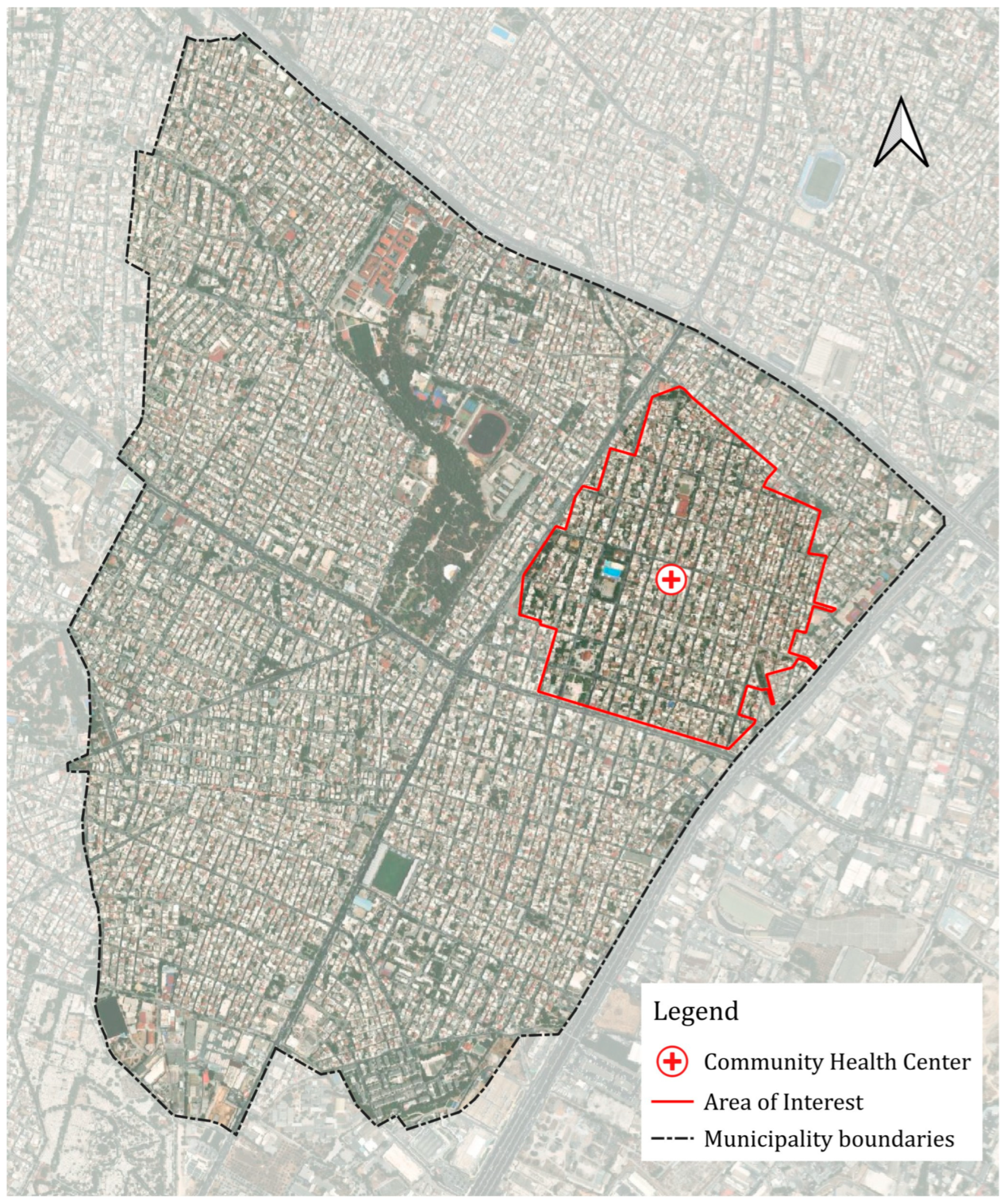
2.1. Definition of the Study Area
2.2. Data Acquisition and Preparation

2.3. Sidewalk Accessibility Assessment
2.3.1. Accessibility Factor Evaluation
2.3.2. Composite Accessibility Score Calculation
2.4. Healthcare Access Route Analysis
2.4.1. Optimal Route Calculation
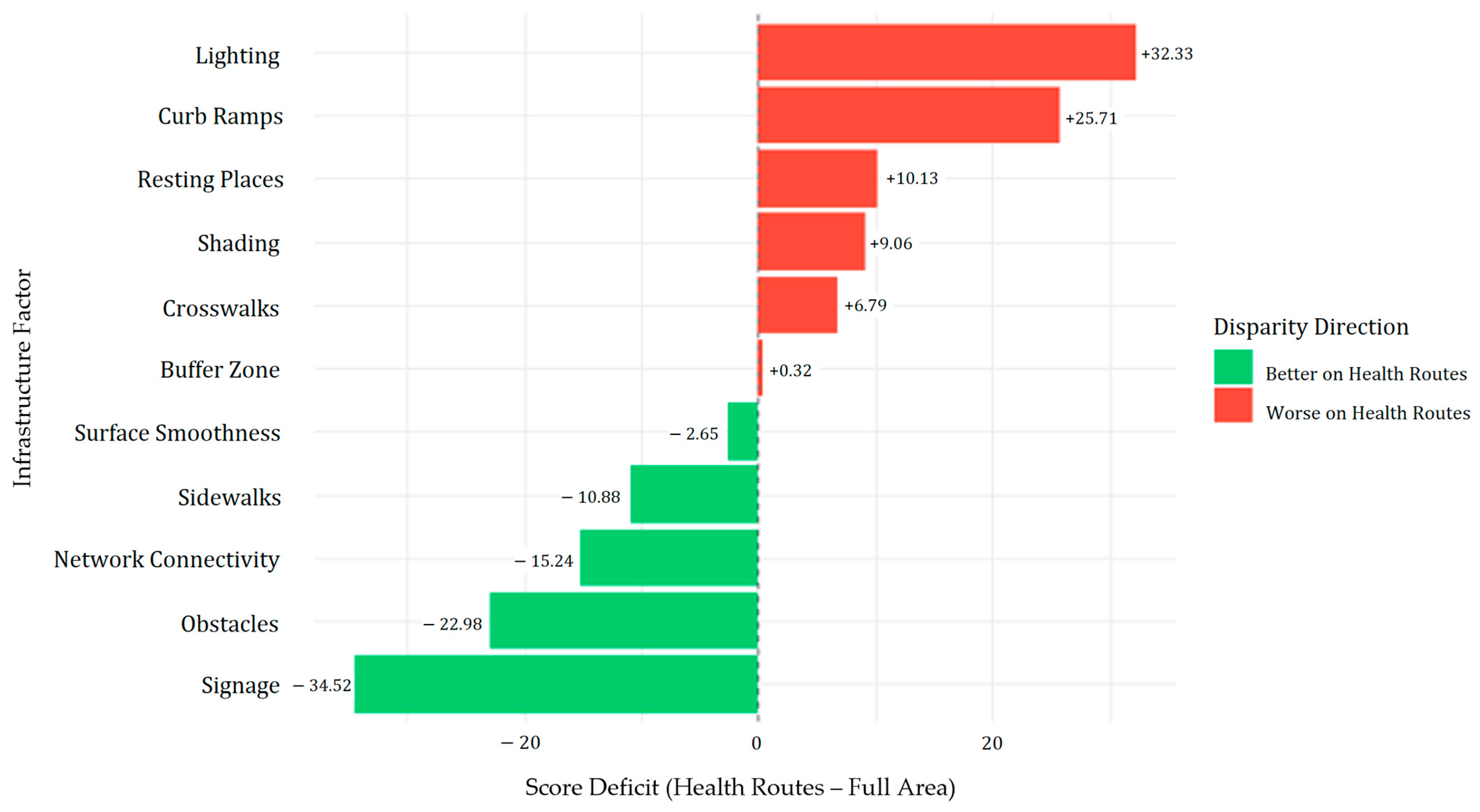
2.4.2. Route Statistics Extraction
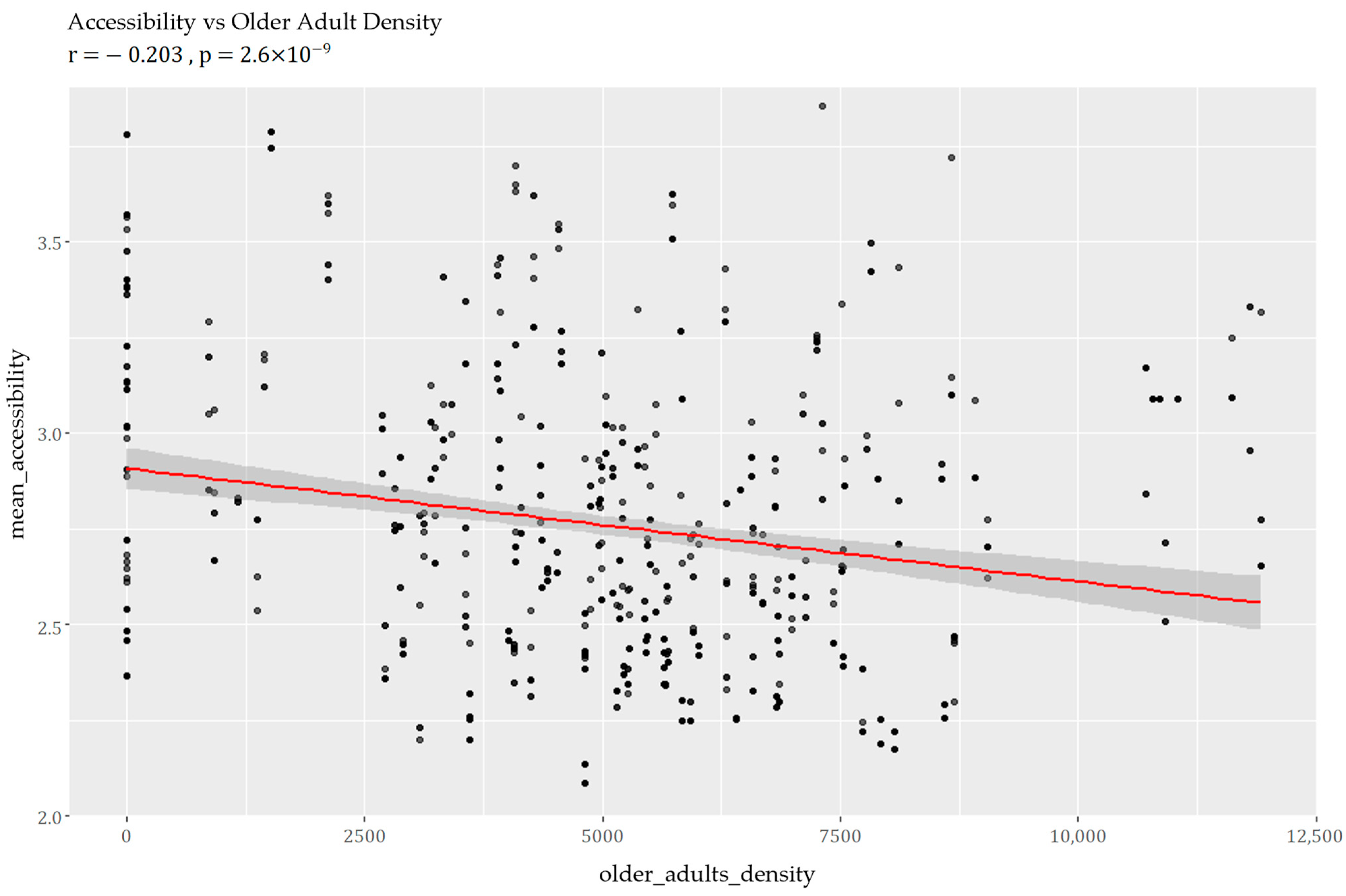
2.4.3. Integrating Sidewalk Conditions with Older Adult Population Data
2.5. Software Used
3. Results
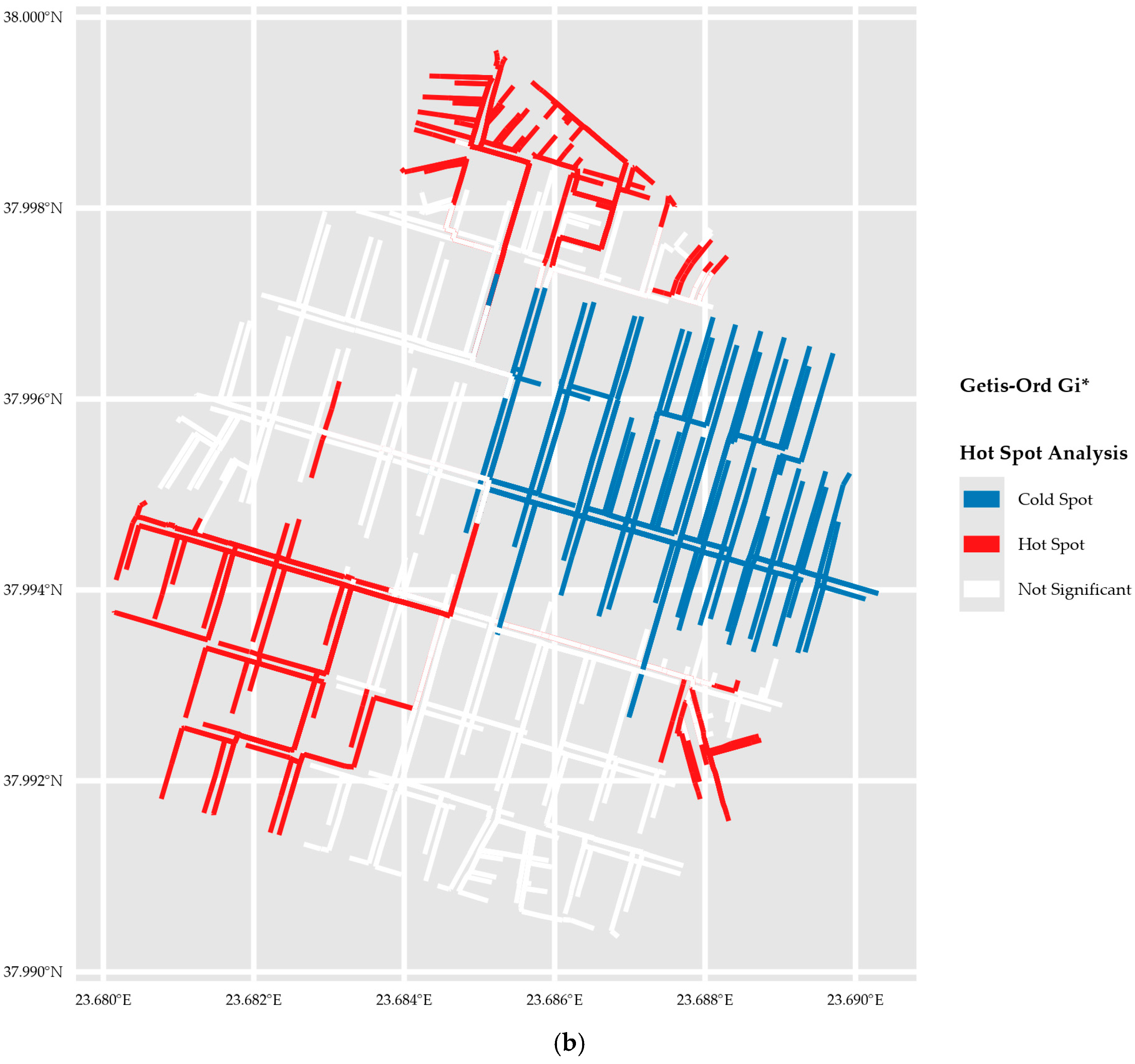
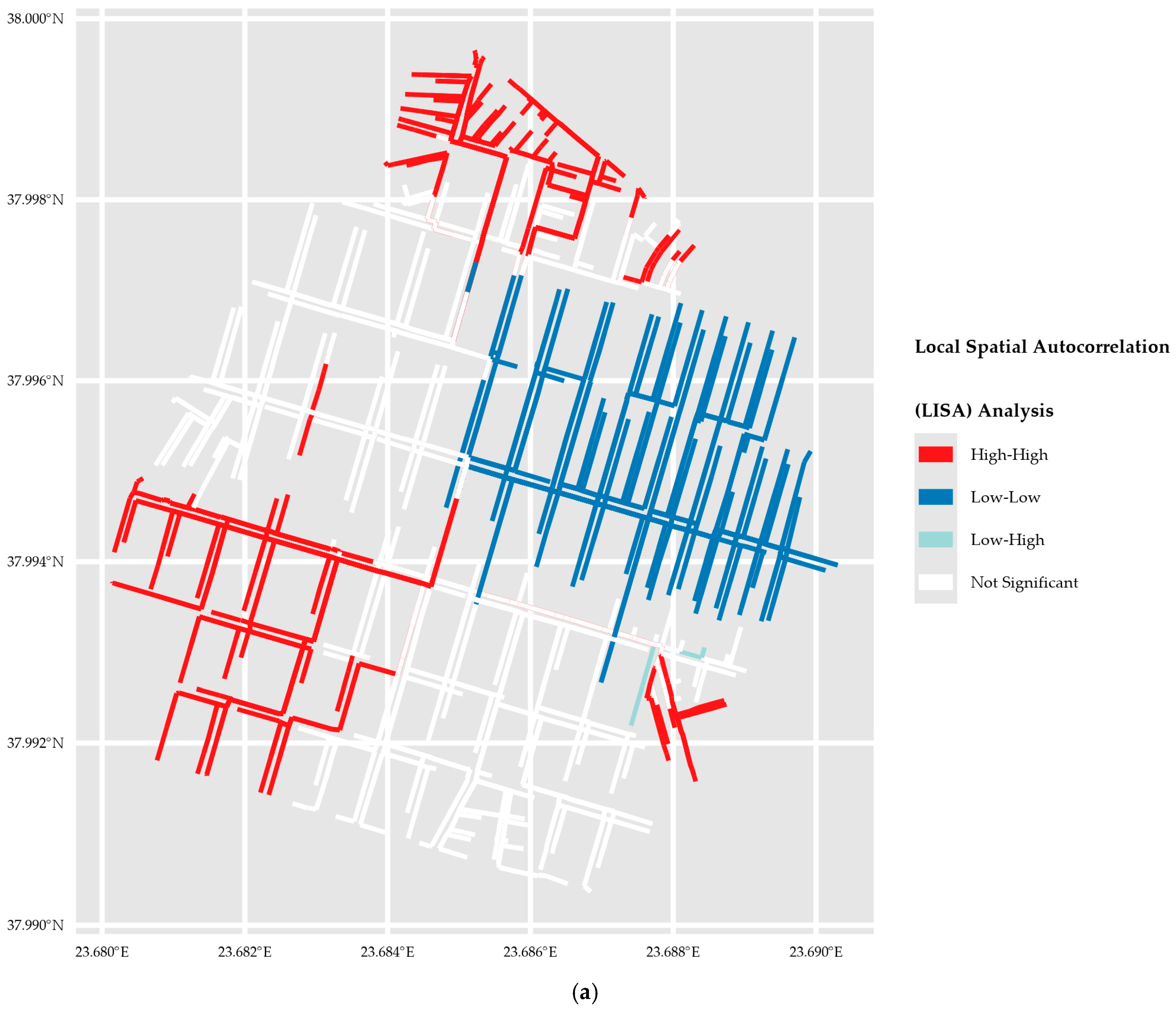
- “Accessibility Deserts” (Low-Low Cluster): Comprising 242 routes (28.8%), these zones represent compact areas of poor accessibility where older adults are surrounded by continuous infrastructure barriers.
- “Accessibility Islands” (High-High Cluster): Comprising 185 routes (22.0%), these orange-coded segments represent isolated zones of relatively superior pedestrian infrastructure.
4. Discussion
Scope and Limitations
5. Conclusions
Author Contributions
Funding
Data Availability Statement
Conflicts of Interest
References
- Carlson, S.A.; Whitfield, G.P.; Peterson, E.L.; Ussery, E.N.; Watson, K.B.; Berrigan, D.; Fulton, J.E. Creating Walkable Communities: Understanding Trade-Offs. Prev. Chronic Dis. 2018, 15, E123. [Google Scholar] [CrossRef]
- Rajaee, M.; Echeverri, B.; Zuchowicz, Z.; Wiltfang, K.; Lucarelli, J.F. Socioeconomic and racial disparities of sidewalk quality in a traditional rust belt city. SSM Popul. Health 2021, 16, 100975. [Google Scholar] [CrossRef]
- Alves, F.; Cruz, S.; Ribeiro, A.; Bastos Silva, A.; Martins, J.; Cunha, I. Walkability Index for Elderly Health: A Proposal. Sustainability 2020, 12, 7360. [Google Scholar] [CrossRef]
- Kim, T.; Choi, S.D.; Xiong, S. Epidemiology of fall and its socioeconomic risk factors in community-dwelling Korean elderly. PLoS ONE 2020, 15, e0234787. [Google Scholar] [CrossRef]
- Psarrou, A.; Adamakidou, T.; Apostolara, P.; Koreli, A.; Drakopoulou, M.; Plakas, S.; Mastrogiannis, D.; Mantoudi, A.; Parissopoulos, S.; Zartaloudi, A.; et al. Associations between Physical Activity and Health-Related Quality of Life among Community-Dwelling Older Adults: A Cross-Sectional Study in Urban Greece. Geriatrics 2023, 8, 61. [Google Scholar] [CrossRef]
- Lytras, D.; Sykaras, E.; Iakovidis, P.; Kasimis, K.; Myrogiannis, I.; Kottaras, A. Recording of Falls in Elderly Fallers in Northern Greece and Evaluation of Aging Health-Related Factors and Environmental Safety Associated with Falls: A Cross-Sectional Study. Occup. Ther. Int. 2022, 2022, 9292673. [Google Scholar] [CrossRef]
- Billis, E.; Strimpakos, N.; Kapreli, E.; Sakellari, V.; Skelton, D.A.; Dontas, I.; Gioktsari, A.; Fotiadou, S.; Kalistratos, M.S. Cross-cultural validation of the Falls Efficacy Scale International (FES-I) in Greek community-dwelling older adults. Disabil. Rehabil. 2011, 33, 1776–1784. [Google Scholar] [CrossRef] [PubMed]
- Dionyssiotis, Y. Analyzing the problem of falls among older people. Int. J. Gen. Med. 2012, 5, 805–813. [Google Scholar] [CrossRef] [PubMed]
- Lee, E.H.; Jeong, J. Facility location problem for senior centers in an upcoming super-aging society. Sci. Rep. 2025, 15, 6317. [Google Scholar] [CrossRef]
- Malkowski, O.S.; Harvey, J.; Townsend, N.P.; Kelson, M.J.; Foster, C.E.M.; Western, M.J. Correlates and determinants of physical activity among older adults of lower versus higher socio-economic status: A systematic review and meta-analysis. Int. J. Behav. Nutr. Phys. Act. 2025, 22, 83. [Google Scholar] [CrossRef] [PubMed]
- Piergiovanni, S.; Terrier, P. Validity of Linear and Nonlinear Measures of Gait Variability to Characterize Aging Gait with a Single Lower Back Accelerometer. Sensors 2024, 24, 7427. [Google Scholar] [CrossRef]
- Rezaei, A.; Bhat, S.G.; Cheng, C.H.; Pignolo, R.J.; Lu, L.; Kaufman, K.R. Age-related changes in gait, balance, and strength parameters: A cross-sectional study. PLoS ONE 2024, 19, e0310764. [Google Scholar] [CrossRef]
- Dubbeldam, R.; Lee, Y.Y.; Pennone, J.; Mochizuki, L.; Le Mouel, C. Systematic review of candidate prognostic factors for falling in older adults identified from motion analysis of challenging walking tasks. Eur. Rev. Aging Phys Act. 2023, 20, 2. [Google Scholar] [CrossRef] [PubMed]
- Freiberger, E.; Sieber, C.; Kob, R. Mobility in Older Community-Dwelling Persons: A Narrative Review. Front. Physiol. 2020, 11, 881. [Google Scholar] [CrossRef]
- Stasinos, N.; Tsatsaris, A.; Plakas, S.; Kalogeropoulos, K.; Mantzorou, M. Geo-Enabling Public Health: A Systematic Review of GIS Applications. In GeNeDIS 2024; Vlamos, P., Ed.; Advances in Experimental Medicine and Biology; Springer: Cham, Switzerland, 2026; Volume 1487, pp. 201–211. [Google Scholar] [CrossRef]
- Barnett, D.W.; Barnett, A.; Nathan, A.; Van Cauwenberg, J.; Cerin, E.; on behalf of the Council on Environment and Physical Activity (CEPA) Older Adult Work Group. Built environmental correlates of older adults’ total physical activity and walking: A systematic review and meta-analysis. Int. J. Behav. Nutr. Phys. Act. 2017, 14, 103. [Google Scholar] [CrossRef] [PubMed]
- Hashtarkhani, S.; Schwartz, D.L.; Shaban-Nejad, A. Enhancing Health Care Accessibility and Equity Through a Geoprocessing Toolbox for Spatial Accessibility Analysis: Development and Case Study. JMIR Form. Res. 2024, 8, e51727. [Google Scholar] [CrossRef] [PubMed]
- E, J.; Xia, B.; Chen, Q.; Buys, L.; Susilawati, C.; Drogemuller, R. Impact of the Built Environment on Ageing in Place: A Systematic Overview of Reviews. Buildings 2024, 14, 2355. [Google Scholar] [CrossRef]
- Tao, Y.; Zhang, W.; Gou, Z.; Jiang, B.; Qi, Y. Planning Walkable Neighborhoods for “Aging in Place”: Lessons from Five Aging-Friendly Districts in Singapore. Sustainability 2021, 13, 1742. [Google Scholar] [CrossRef]
- van Biljon, H.; van Niekerk, L.; Margot-Cattin, I.; Adams, F.; Plastow, N.; Bellagamba, D.; Kottorp, A.; Patomella, A.H. Correction: The health equity characteristics of research exploring the unmet community mobility needs of older adults: A scoping review. BMC Geriatr. 2023, 23, 19. [Google Scholar] [CrossRef]
- Lee, S. Falls associated with indoor and outdoor environmental hazards among community-dwelling older adults between men and women. BMC Geriatr. 2021, 21, 547. [Google Scholar] [CrossRef]
- Zandieh, R.; Martinez, J.; Flacke, J.; Jones, P.; van Maarseveen, M. Older Adults’ Outdoor Walking: Inequalities in Neighbourhood Safety, Pedestrian Infrastructure and Aesthetics. Int. J. Environ. Res. Public Health 2016, 13, 1179. [Google Scholar] [CrossRef] [PubMed]
- MacLeod, K.E.; Ragland, D.R.; Prohaska, T.R.; Smith, M.L.; Irmiter, C.; Satariano, W.A. Missed or Delayed Medical Care Appointments by Older Users of Nonemergency Medical Transportation. Gerontologist 2014, 55, 1026–1037. [Google Scholar] [CrossRef]
- Patil, D.S.; Bailey, A.; George, S.; Hyde, M.; Ashok, L. Unpacking the role of transport inequalities among older adults for accessing healthcare in Bengaluru, India. Glob. Public Health 2023, 18, 2274438. [Google Scholar] [CrossRef]
- Hellenic Ministry of Infrastructure and Transport (HMIT). Law 4784/2021: Greece on the Move: Sustainable Urban Mobility—Micromobility and Other Provisions; OGG 40/A/16-3-2021; Official Government Gazette: Athens, Greece, 2021. [Google Scholar]
- Chondrogianni, D.; Stephanedes, Y.J.; Saranti, P.-G. Regenerating Athens City Center to a Low Pollution and Restricted Vehicle Traffic Zone; Lecture Notes in Intelligent Transportation and Infrastructure; Springer: Cham, Switzerland, 2023; p. 1654. [Google Scholar] [CrossRef]
- Bartzokas-Tsiompras, A.; Photis, Y.N. Microscale walkability modelling. The case of Athens city centre. Int. J. Sustain. Dev. Plan. 2021, 16, 413–426. [Google Scholar] [CrossRef]
- Ptak-Wojciechowska, A.; Gawlak, A.; Maciejewski, P.; Romaniv, D.; Skrzypek, M.; Brzeziński, D.; Stefanowski, J. Developing and Validating a Data-Driven Application for Street-Accessible Urban Bench Analysis and Planning to Support Evidence-Based Decision Making in Age-Friendly, Sustainable Cities. Sustainability 2025, 17, 8251. [Google Scholar] [CrossRef]
- Curl, A.; Ward Thompson, C.; Aspinall, P. The effectiveness of ‘shared space’ residential street interventions on self-reported activity levels and quality of life for older people. Landsc. Urban Plan. 2015, 139, 117–125. [Google Scholar] [CrossRef]
- Butler, A.A.; Lord, S.R.; Taylor, J.L.; Fitzpatrick, R.C. Ability Versus Hazard: Risk-Taking and Falls in Older People. J. Gerontol. Ser. A 2015, 70, 628–634. [Google Scholar] [CrossRef] [PubMed]
- Akinci, Z.S.; Delclòs-Alió, X.; Vich, G.; Salvo, D.; Ibarluzea, J.; Miralles-Guasch, C. How different are objective operationalizations of walkability for older adults compared to the general population? A systematic review. BMC Geriatr. 2022, 22, 673. [Google Scholar] [CrossRef]
- Winters, M.; Voss, C.; Ashe, M.C.; Gutteridge, K.; McKay, H.; Sims-Gould, J. Where do they go and how do they get there? Older adults’ travel behaviour in a highly walkable environment. Soc. Sci. Med. 2015, 133, 304–312. [Google Scholar] [CrossRef]
- Hellenic Statistical Authority (ELSTAT). 2021 Population-Housing Census; ELSTAT: Piraeus, Greece, 2025. [Google Scholar]
- Amaya, V.; Moulaert, T.; Gwiazdzinski, L.; Vuillerme, N. Assessing and Qualifying Neighborhood Walkability for Older Adults: Construction and Initial Testing of a Multivariate Spatial Accessibility Model. Int. J. Environ. Res. Public Health 2022, 19, 1808. [Google Scholar] [CrossRef]
- Chalkiadakis, C.; Tzanis, D. Enabling older citizens safe mobility: The ACTIVAGE approach. arXiv 2020, arXiv:2010.07298. [Google Scholar] [CrossRef]
- Kalogeropoulos, K.; Fragkopoulos, D.; Andreopoulos, P.; Tragaki, A. Shifting Sands: Examining and Mapping the Population Structure of Greece Through the Last Three Censuses. Economies 2024, 12, 294. [Google Scholar] [CrossRef]
- Faka, A.; Kalogeropoulos, K.; Maloutas, T.; Chalkias, C. Urban Quality of Life: Spatial Modeling and Indexing in Athens Metropolitan Area, Greece. ISPRS Int. J. Geo-Inf. 2021, 10, 347. [Google Scholar] [CrossRef]
- Wang, Z.; Shepley, M. The Relationship of Neighborhood Walking Behavior to Duration of Aging in Place—A Retrospective Cohort Study. Int. J. Environ. Res. Public Health 2022, 19, 16428. [Google Scholar] [CrossRef]
- Yu, Y.; Dong, T. Deep Learning-Driven Geospatial Modeling of Elderly Care Accessibility: Disparities Across the Urban-Rural Continuum in Central China. Appl. Sci. 2025, 15, 4601. [Google Scholar] [CrossRef]
- Koller, D.; Bödeker, M.; Dapp, U.; Grill, E.; Fuchs, J.; Maier, W.; Strobl, R. A Framework for Measuring Neighborhood Walkability for Older Adults-A Delphi Consensus Study. J. Urban Health 2024, 101, 1188–1199. [Google Scholar] [CrossRef]
- Cerin, E.; Barnett, A.; Zhang, C.J.P.; Lai, P.C.; Sit, C.H.P.; Lee, R.S.Y. How urban densification shapes walking behaviours in older community dwellers: A cross-sectional analysis of potential pathways of influence. Int. J. Health Geogr. 2020, 19, 14. [Google Scholar] [CrossRef]
- Clarke, P.; Gallagher, N.A. Optimizing Mobility in Later Life: The Role of the Urban Built Environment for Older Adults Aging in Place. J. Urban Health 2013, 90, 997–1009. [Google Scholar] [CrossRef] [PubMed]
- Stefanidis, R.-M.; Bartzokas-Tsiompras, A. Pedestrian Accessibility Analysis of Sidewalk-Specific Networks: Insights from Three Latin American Central Squares. Sustainability 2024, 16, 9294. [Google Scholar] [CrossRef]
- Emad, Y.; Neef, S.P.; Taylor, L.; Kerse, N.; Cavadino, A.; Moyes, S.A.; Comber, K.; Wu, X.S.; Molloy, J.; Bacon, C.J. Shedding Light on Falls: The Effect of Lighting Levels on Fall Risk in Long-Term Residential Care Facilities. J. Appl. Gerontol. 2025, 44, 1318–1327. [Google Scholar] [CrossRef]
- Karamitov, K.; Petrova-Antonova, D. Pedestrian Accessibility Assessment Using Spatial and Network Analysis: A Case of Sofia City. Int. Arch. Photogramm. Remote Sens. Spat. Inf. Sci. 2022, 48, 53–60. [Google Scholar] [CrossRef]
- National Public Health Organization (NPHO). Primary Healthcare Providers and Health Centers Registry. Available online: https://eody.gov.gr/ (accessed on 25 January 2026).
- Kochtitzky, C.S.; Freeland, A.; Yen, I.H. Ensuring Mobility-Supporting Environments for an Aging Population: Critical Actors and Collaborations. J. Aging Res. 2011, 2011, 138931. [Google Scholar] [CrossRef]
- Rosenberg, D.E.; Huang, D.L.; Simonovich, S.D.; Belza, B. Outdoor Built Environment Barriers and Facilitators to Activity among Midlife and Older Adults with Mobility Disabilities. Gerontologist 2013, 53, 268–279. [Google Scholar] [CrossRef] [PubMed]
- Fonseca, F.; Rodrigues, A.; Silva, H. Pedestrian Perceptions of Sidewalk Paving Attributes: Insights from a Pilot Study in Braga. Infrastructures 2025, 10, 79. [Google Scholar] [CrossRef]
- Wojnowska-Heciak, M.; Heciak, J.; Kłak, A. Concrete Paving Slabs for Comfort of Movement of Mobility-Impaired Pedestrians—A Survey. Int. J. Environ. Res. Public Health 2022, 19, 3183. [Google Scholar] [CrossRef]
- Paudel, C.; Timperio, A.; Loh, V.; Deforche, B.; Salmon, J.; Veitch, J. Understanding the relative importance of micro-level design characteristics of walking paths in parks to promote walking among older adults. Urban For. Urban Green. 2023, 89, 128129. [Google Scholar] [CrossRef]
- Gálvez-Pérez, D.; Guirao, B.; Ortuño, A.; Picado-Santos, L. The Influence of Built Environment Factors on Elderly Pedestrian Road Safety in Cities: The Experience of Madrid. Int. J. Environ. Res. Public Health 2022, 19, 2280. [Google Scholar] [CrossRef] [PubMed]
- Anderson, J.C.; Kothuri, S.; Monsere, C.; Hurwitz, D. Systemic Opportunities to Improve Older Pedestrian Safety: Merging Crash Data Analysis and a Stakeholder Workshop. Transp. Res. Rec. 2022, 2676, 351–360. [Google Scholar] [CrossRef]
- Bhagavathula, R.; Gibbons, R.B.; Kassing, A. Roadway Lighting’s Effect on Pedestrian Safety at Intersection and Midblock Crosswalks; Report No. 21-028; Virginia Tech Transportation Institute: Blacksburg, VA, USA, 2021. [Google Scholar] [CrossRef]
- Vignali, V.; Cuppi, F.; Acerra, E.; Bichicchi, A.; Lantieri, C.; Simone, A.; Costa, M. Effects of median refuge island and flashing vertical sign on conspicuity and safety of unsignalized crosswalks. Transp. Res. Part F Traffic Psychol. Behav. 2019, 60, 427–439. [Google Scholar] [CrossRef]
- Yin, L. An Exploration and a Participatory Study Toolkit: Identifying the Relationship Between Pavements and Older Pedestrians. Ph.D. Thesis, Brunel University, London, UK, 2019. Available online: https://bura.brunel.ac.uk/bitstream/2438/19615/1/FulltextThesis.pdf (accessed on 20 December 2025).
- Horák, J.; Kukuliac, P.; Koktava, N.; Orlikova, L.; Maresova, P. Impact of street-level barriers on walking accessibility for persons with declining mobility: Comparison of two cities. Cities 2025, 166, 106220. [Google Scholar] [CrossRef]
- Gálvez-Pérez, D.; Guirao, B.; Ortuño, A. Age-Friendly Urban Design for Older Pedestrian Road Safety: A Street Segment Level Analysis in Madrid. Sustainability 2024, 16, 8298. [Google Scholar] [CrossRef]
- Tuckett, A.; Banchoff, A.W.; Winter, S.J.; King, A.C. The built environment and older adults: A literature review and an applied approach to engaging older adults in built environment improvements for health. Int. J. Older People Nurs. 2018, 13, e12171. [Google Scholar] [CrossRef]
- Mantilla, J.I.A.; Burtt, D. Safer Road Design for Older Pedestrians; Victoria Transport Policy Institute: Victoria, BC, Canada, 2016; Available online: https://trid.trb.org/view.aspx?id=1423732 (accessed on 15 December 2025).
- Klein, S.; Brondeel, R.; Chaix, B.; Klein, O.; Thierry, B.; Kestens, Y.; Gerber, P.; Perchoux, C. What triggers selective daily mobility among older adults? A study comparing trip and environmental characteristics between observed path and shortest path. Health Place 2023, 79, 102730. [Google Scholar] [CrossRef]
- Cerin, E.; Nathan, A.; Van Cauwenberg, J.; Barnett, D.W.; Barnett, A.; Council on Environment and Physical Activity (CEPA)—Older Adults Working Group. The Neighbourhood Physical Environment and Active Travel in Older Adults: A Systematic Review and Meta-Analysis. J. Transp. Health 2017, 7, 15–39. [Google Scholar] [CrossRef]
- Jiang, J.; Xia, Z.; Sun, X.; Wang, X.; Luo, S. Social Infrastructure and Street Networks as Critical Infrastructure for Aging Friendly Community Design: Mediating the Effect of Physical Activity. Int. J. Environ. Res. Public Health 2022, 19, 11842. [Google Scholar] [CrossRef]
- Perchoux, C.; Brondeel, R.; Wasfi, R.; Klein, O.; Caruso, G.; Vallée, J.; Klein, S.; Thierry, B.; Dijst, M.; Chaix, B.; et al. Walking, Trip Purpose, and Exposure to Multiple Environments: A Case Study of Older Adults in Luxembourg. J. Transp. Health 2019, 13, 170–184. [Google Scholar] [CrossRef]
- Fotios, S.; Unwin, J.; Farrall, S. Road lighting and pedestrian reassurance after dark: A review. Light. Res. Technol. 2014, 47, 449–469. [Google Scholar] [CrossRef]
- Portnov, B.A.; Saad, R.; Trop, T.; Kliger, D.; Svechkina, A. Linking nighttime outdoor lighting attributes to pedestrians’ feeling of safety: An interactive survey approach. PLoS ONE 2020, 15, e0242172. [Google Scholar] [CrossRef]
- Grant, L.K.; St Hilaire, M.A.; Heller, J.P.; Heller, R.A.; Lockley, S.W.; Rahman, S.A. Impact of Upgraded Lighting on Falls in Care Home Residents. J. Am. Med. Dir. Assoc. 2022, 23, 1698–1704.e2. [Google Scholar] [CrossRef] [PubMed]
- Thölking, T.W.; Lamers, E.C.T.; Rikkert, M.G.M.O. A Guiding Nightlight Decreases Fear of Falling and Increases Sleep Quality of Community-Dwelling Older People: A Quantitative and Qualitative Evaluation. Gerontology 2020, 66, 295–303. [Google Scholar] [CrossRef] [PubMed]
- Brookfield, K.; Ward Thompson, C.; Scott, I. The Uncommon Impact of Common Environmental Details on Walking in Older Adults. Int. J. Environ. Res. Public Health 2017, 14, 190. [Google Scholar] [CrossRef]
- Buo, I.; Sagris, V.; Jaagus, J.; Middel, A. High-resolution thermal exposure and shade maps for cool corridor planning. Sustain. Cities Soc. 2023, 93, 104499. [Google Scholar] [CrossRef]
- Litman, T. Cool walkability planning: Providing pedestrian thermal comfort in hot climate cities. J. Civ. Eng. Environ. Sci. 2023, 9, 79–86. [Google Scholar] [CrossRef]
- Močnik, Š.; Moogoor, A.; Yuen, B. Exploring facilitators and barriers of older adults’ outdoor mobility: A walk-along study in Singapore. J. Transp. Health 2022, 26, 101386. [Google Scholar] [CrossRef]
- Tomasi, M.; Nikolopoulou, M.; Giridharan, R.; Löve, M.; Ratti, C. Definition of a maximum threshold of direct solar radiation exposure for pedestrians of diverse walking abilities. Int. J. Biometeorol. 2024, 68, 17–31. [Google Scholar] [CrossRef]
- Kevern, J.T.; King, G.W.; Bruetsch, A.P. Pervious Concrete Surface Characterization to Reduce Slip-Related Falls. J. Perform. Constr. Facil. 2012, 26, 526–531. [Google Scholar] [CrossRef]
- Ma, J.; Zheng, S.; Zhang, Z.; Han, B.; Geng, D.; Hong, X.; Yu, G.; Li, Y.; Li, L.; Cheng, C. Evaluation of Skid Resistance and Comfort of Pedestrian Pavement with Asphalt-Based Wood Chip. Buildings 2024, 14, 1512. [Google Scholar] [CrossRef]
- Georgescu, A.I.; Allahbakhshi, H.; Weibel, R. The impact of microscale street elements on active transport of mobility-restricted individuals: A systematic review. J. Transp. Health 2024, 38, 101842. [Google Scholar] [CrossRef]
- Apparicio, P.; Abdelmajid, M.; Riva, M.; Shearmur, R. Comparing alternative approaches to measuring the geographical accessibility of urban health services: Distance types and aggregation-error issues. Int. J. Health Geogr. 2008, 7, 7. [Google Scholar] [CrossRef]
- Nguyen, D.T.; Penta, M.; Chinh, N.V.; Sauvage, C. Comparison of walking performance with the 6-minute and the 2-minute walk tests in elderly living in the community and in a nursing home. J. Rehabil. Res. Pract. 2025, 6, 9–16. [Google Scholar] [CrossRef]
- Bohannon, R.W.; Bubela, D.; Magasi, S.; McCreath, H.; Wang, Y.C.; Reuben, D.; Rymer, W.Z.; Gershon, R. Comparison of walking performance over the first 2 minutes and the full 6 minutes of the Six-Minute Walk Test. BMC Res. Notes 2014, 7, 269. [Google Scholar] [CrossRef] [PubMed]
- Shumway-Cook, A.; Patla, A.E.; Stewart, A.; Ferrucci, L.; Ciol, M.A.; Guralnik, J.M. Environmental Demands Associated With Community Mobility in Older Adults With and Without Mobility Disabilities. Phys. Ther. 2002, 82, 670–681. [Google Scholar] [CrossRef]
- Paydar, M.; Kamani Fard, A. Walking Behavior of Older Adults in Temuco, Chile: The Contribution of the Built Environment and Socio-Demographic Factors. Int. J. Environ. Res. Public Health 2022, 19, 14625. [Google Scholar] [CrossRef] [PubMed]
- Zijlstra, G.A.; van Haastregt, J.C.; van Eijk, J.T.; van Rossum, E.; Stalenhoef, P.A.; Kempen, G.I. Prevalence and correlates of fear of falling, and associated avoidance of activity in the general population of community-living older people. Age Ageing 2007, 36, 304–309. [Google Scholar] [CrossRef] [PubMed]




| Accessibility Factor | Weight (%) | Score 0 (Significant Barrier) | Score 1 (Partially Accessible) | Score 2 (Fully Accessible) | References |
|---|---|---|---|---|---|
| Curb Ramps | 15% | Absent | Present but non-compliant | Present and compliant | Sidewalks and curbs can sometimes act as barriers for people with disabilities, including age-related disabilities [47]. The presence and the status of curb ramps are key elements, focusing on older adults with mobility disabilities [48]. |
| Surface Smoothness | 15% | Severe cracks/uplift | Minor cracks | Smooth, even surface | Poor sidewalk conditions, (uneven or cracked sidewalks), are linked to outdoor falls, specifically for vulnerable age groups, like older adults [49]. Sidewalk quality significantly affects pedestrians, especially for those with difficulties [50]. |
| Sidewalk Width | 15% | <1.0 m | 1.0–1.5 m | >1.5 m | Wider sidewalks, are generally preferred by older adults, as they offer more space, are safer and reduce the risk of injury [51,52]. |
| Crosswalks | 10% | Unmarked | Marked but faded | Highly visible | Crosswalks are important factors, influencing the mobility of older adults [47]. The more visible the crosswalks are, the safer the neighborhood is [53,54,55]. |
| Obstacles | 10% | Frequent clutter | Occasional obstacles | Minimal or none | Broken pavement tiles, parked vehicles, and overgrown plants that can be documented as sidewalk obstacles are hazardous factors [56]. By minimizing obstacles on the sidewalk network, older adults are keen to walk independently [57]. |
| Buffer Zone | 7% | No buffer | Narrow strip (<0.5 m) | Wide buffer (>0.5 m) | Buffer zones can be characterized as a safety strip of space between the sidewalk and the street. Providing physical separation from vehicular traffic, elements like bushes and metal fences, help to prevent collisions [58,59,60]. |
| Network Connectivity | 7% | Dead-end | Minor detour required | Continuous | Sidewalk continuity is vital for promoting walking and maintaining the quality of life of older adults [61,62,63,64]. |
| Lighting | 5% | No streetlights | Sporadic lighting | Consistent lighting | Securing safety after dark with consistent street lighting is crucial for pedestrians as well as the older adults [65,66]. Street lights can significantly reduce the risk of falls for older adults by improving visibility, especially during evenings [67,68]. |
| Resting Places | 5% | No benches in 200 m | 1 bench in 200 m | Multiple benches | The availability of benches is strongly associated with the encouragement of outdoor social interaction, which is the most important asset of physical activity among older adults [51,69]. |
| Shading | 5% | No shading | Partial shading | Full/heavy shading | Crucial for protecting heat-vulnerable older adults in Mediterranean climates [70,71,72,73]. |
| Surface Material | 4% | Gravel/dirt | Asphalt/brick | Smooth concrete | Choice of material impacts slip resistance, stability, and walking comfort [49,74,75]. |
| Signage Poles | 2% | Major obstacle | Minor obstacle | Well-placed/none | Poorly placed furniture restricts effective width and complicates navigation [76]. |
Disclaimer/Publisher’s Note: The statements, opinions and data contained in all publications are solely those of the individual author(s) and contributor(s) and not of MDPI and/or the editor(s). MDPI and/or the editor(s) disclaim responsibility for any injury to people or property resulting from any ideas, methods, instructions or products referred to in the content. |
© 2026 by the authors. Published by MDPI on behalf of the International Society for Photogrammetry and Remote Sensing. Licensee MDPI, Basel, Switzerland. This article is an open access article distributed under the terms and conditions of the Creative Commons Attribution (CC BY) license.
Share and Cite
Stasinos, N.; Kalogeropoulos, K.; Tsatsaris, A.; Mantzorou, M. Uneven Paths to Health: A Spatial Analysis of Sidewalk Conditions and Healthcare Access for Older Adults. ISPRS Int. J. Geo-Inf. 2026, 15, 137. https://doi.org/10.3390/ijgi15030137
Stasinos N, Kalogeropoulos K, Tsatsaris A, Mantzorou M. Uneven Paths to Health: A Spatial Analysis of Sidewalk Conditions and Healthcare Access for Older Adults. ISPRS International Journal of Geo-Information. 2026; 15(3):137. https://doi.org/10.3390/ijgi15030137
Chicago/Turabian StyleStasinos, Nikolaos, Kleomenis Kalogeropoulos, Andreas Tsatsaris, and Marianna Mantzorou. 2026. "Uneven Paths to Health: A Spatial Analysis of Sidewalk Conditions and Healthcare Access for Older Adults" ISPRS International Journal of Geo-Information 15, no. 3: 137. https://doi.org/10.3390/ijgi15030137
APA StyleStasinos, N., Kalogeropoulos, K., Tsatsaris, A., & Mantzorou, M. (2026). Uneven Paths to Health: A Spatial Analysis of Sidewalk Conditions and Healthcare Access for Older Adults. ISPRS International Journal of Geo-Information, 15(3), 137. https://doi.org/10.3390/ijgi15030137