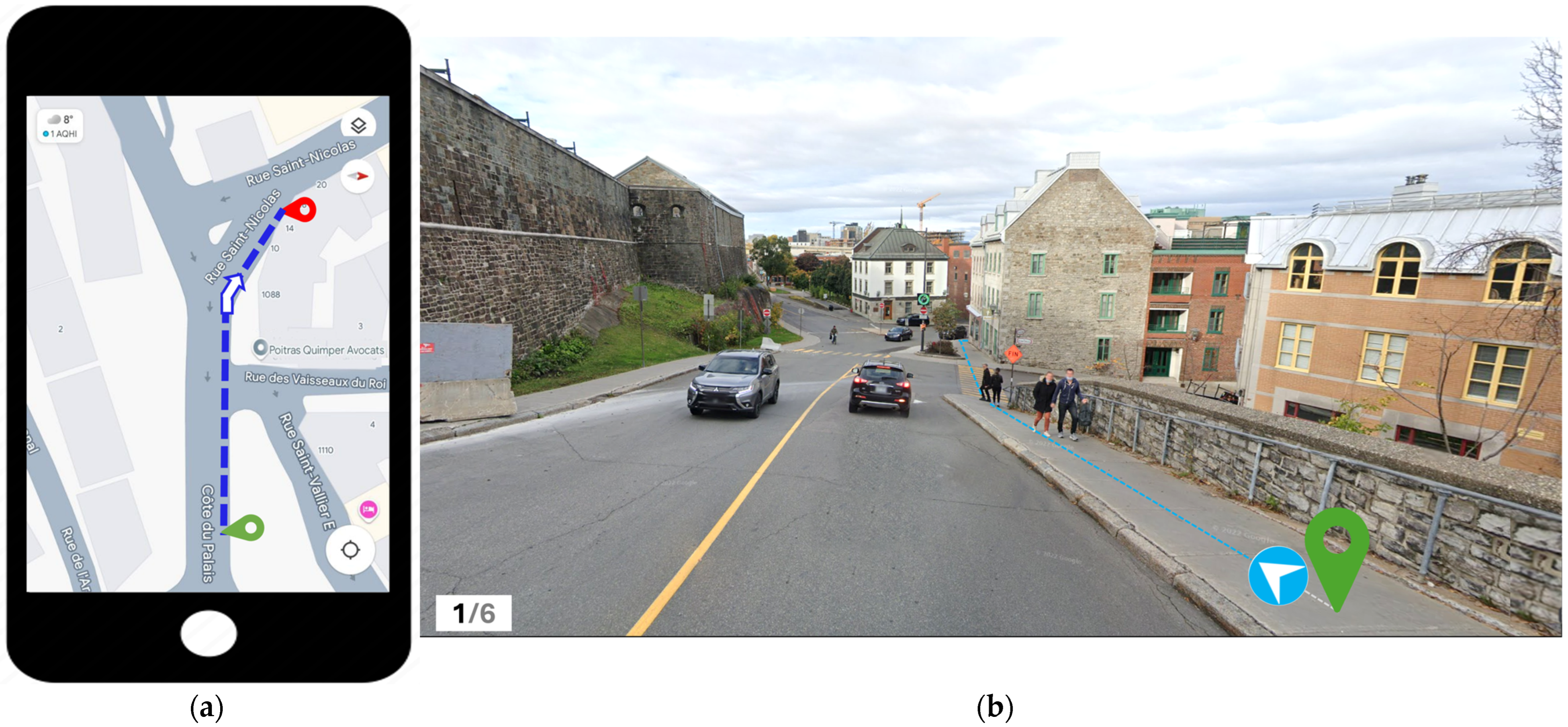


Adapted Route Instructions for Navigation Technologies in Support of Wheelchair Mobility in Urban Areas: Online Survey
 ,
,  ,
,  ,
,
Abstract
1. Introduction
2. Materials and Methods
2.1. Participants and Recruitment
2.2. Materials for Designing the Questionnaire
2.2.1. Information Components for the Adapted Route Instructions
2.2.2. The Proposed Adapted Route Instruction for Wheelchair Users
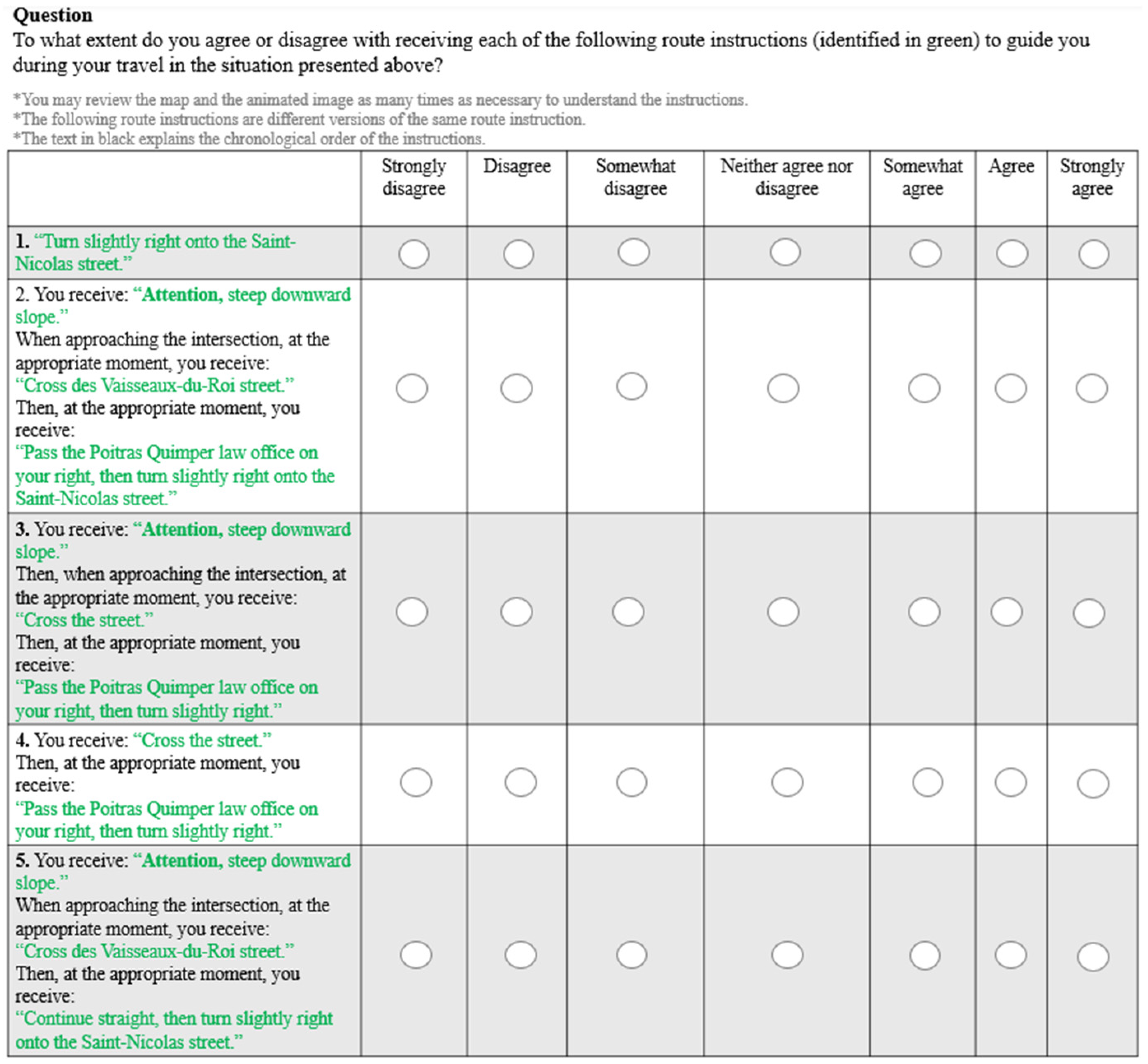
- TBT + SN: the first formulation corresponds to the vocal route instructions commonly provided by conventional navigation tools, such as Google Maps TBT instructions, which include turning actions, directions, as well as SN.
- DTBT + LM: the second formulation includes the Detailed TBT (DTBT) information, that is, TBT information enriched with non-turning actions (i.e., continuing straight and street crossings), in which SN are replaced with LM.
- DTBT + SN + Alert: the third formulation includes DTBT information, including SN, combined with Alert for route accessibility and security.
- DTBT + LM + Alert: the fourth formulation was built upon the second one by adding Alert related to route accessibility and security.
- DTBT + SN + LM + Alert: the final formulation combined DTBT instructions with SN, LM, and accessibility/security Alert.
2.3. Online Questionnaire
2.4. Data Analysis
3. Results
3.1. Participants’ Characteristics
3.2. Evaluation of the Route Instruction Formulation Ratings in Different Navigation Situations
3.3. Impact of Participants’ Characteristics on the Instruction Formulation Ratings
- Impact of gender on the instruction formulation ratings
- Impact of wheelchair using experience on the instruction formulation ratings
- Impact of daily outdoor wheelchair use duration on the instruction formulation ratings
- Impact of participants’ profiles (confidence level) on the formulation ratings
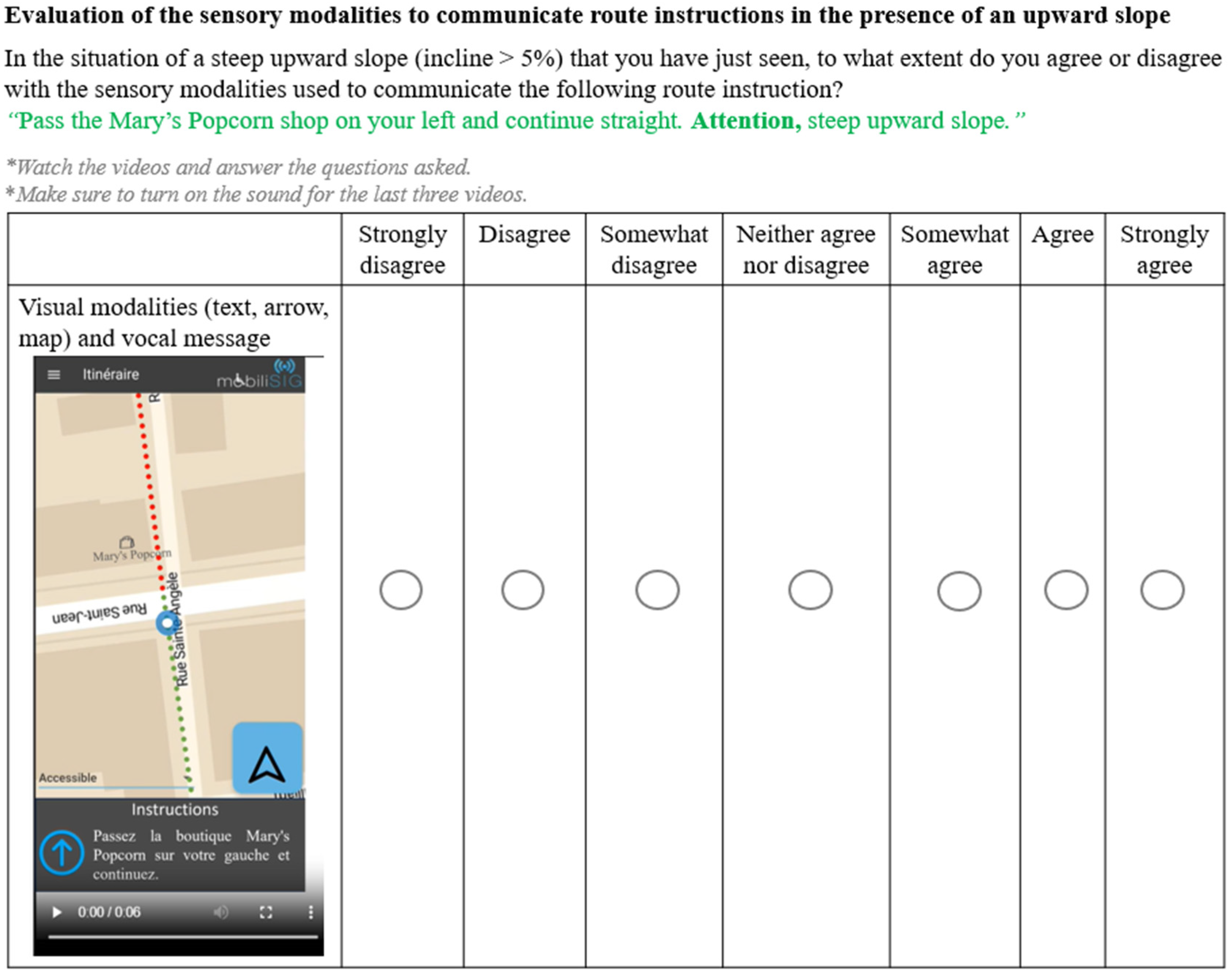
3.4. Evaluation of Agreement with Sensory Modalities for Communicating Route Instructions
3.5. Participants’ Comments
4. Discussion
4.1. Combining Wayfinding and Wayfaring Information for the Most Adapted Route Instruction Formulations for Wheelchair Users
4.2. Relation Between Wheelchair Users’ Characteristics and Formulation Ratings
4.3. Sensory Modalities for Communicating Route Instructions to Wheelchair Users
4.4. Strengths and Limitations of the Study and Future Work
5. Conclusions
Author Contributions
Funding
Data Availability Statement
Conflicts of Interest
Abbreviations
| POI | Points of Interest |
| TBT | Turn-By-Turn instructions |
| DTBT | Detailed Turn-By-Turn instructions |
| LM | LandMark |
| SN | Street Name |
| SD | Standard Deviation |
| SE | Std. Error |
| LMM CI | Linear Mixed Model Confidence Interval |
References
- World Health Organization. Disability. Available online: https://www.who.int/news-room/fact-sheets/detail/disability-and-health (accessed on 20 October 2025).
- World Health Organization. Strengthening Access to Appropriate Wheelchairs. Available online: https://www.who.int/teams/health-product-policy-and-standards/assistive-and-medical-technology/assistive-technology/wheelchair-services (accessed on 20 October 2025).
- Statistics Canada. Canadian Survey on Disability (CSD). Available online: https://www150.statcan.gc.ca/n1/pub/11-627-m/11-627-m2023063-eng.htm (accessed on 20 October 2025).
- Smith, E.M.; Giesbrecht, E.M.; Ben Mortenson, W.; Miller, W.C. Prevalence of Wheelchair and Scooter Use Among Community-Dwelling Canadians. Phys. Ther. 2016, 96, 1135–1142. [Google Scholar] [CrossRef] [Scilit]
- Bennett, S.; Lee Kirby, R.; MacDonald, B. Wheelchair Accessibility: Descriptive Survey of Curb Ramps in an Urban Area. Disabil. Rehabil. Assist. Technol. 2009, 4, 17–23. [Google Scholar] [CrossRef] [Scilit]
- Millington, C.; Ward Thompson, C.; Rowe, D.; Aspinall, P.; Fitzsimons, C.; Nelson, N.; Mutrie, N. Development of the Scottish Walkability Assessment Tool (SWAT). Health Place 2009, 15, 474–481. [Google Scholar] [CrossRef] [Scilit]
- Giesbrecht, E.; Ripat, J.; Cooper, J.; Quanbury, A. Experiences with Using a Pushrim-Activated Power-Assisted Wheelchair for Community-Based Occupations: A Qualitative Exploration. Can. J. Occup. Ther. 2011, 78, 127–136. [Google Scholar] [CrossRef] [Scilit]
- Prescott, M.; Miller, W.C.; Borisoff, J.; Tan, P.; Garside, N.; Feick, R.; Mortenson, W. Ben An Exploration of the Navigational Behaviours of People Who Use Wheeled Mobility Devices in Unfamiliar Pedestrian Environments. J. Transp. Health 2021, 20, 100975. [Google Scholar] [CrossRef] [Scilit]
- Kapsalis, E.; Jaeger, N.; Hale, J. Disabled-by-Design: Effects of Inaccessible Urban Public Spaces on Users of Mobility Assistive Devices–a Systematic Review. Disabil. Rehabil. Assist. Technol. 2024, 19, 604–622. [Google Scholar] [CrossRef] [Scilit] [PubMed]
- Fougeyrollas, P.; Cloutier, R.; Bergeron, H.; St-Michel, G. The Quebec Classification: Disability Creation Process; International Network on the Disability Creation Process: Québec City, QC, Canada, 1998. [Google Scholar]
- Li, C. User Preferences, Information Transactions and Location-Based Services: A Study of Urban Pedestrian Wayfinding. Comput. Environ. Urban Syst. 2006, 30, 726–740. [Google Scholar] [CrossRef] [Scilit]
- Ishikawa, T.; Fujiwara, H.; Imai, O.; Okabe, A. Wayfinding with a GPS-Based Mobile Navigation System: A Comparison with Maps and Direct Experience. J. Environ. Psychol. 2008, 28, 74–82. [Google Scholar] [CrossRef] [Scilit]
- Krukar, J.; Anacta, V.J.; Schwering, A. The Effect of Orientation Instructions on the Recall and Reuse of Route and Survey Elements in Wayfinding Descriptions. J. Environ. Psychol. 2020, 68, 101407. [Google Scholar] [CrossRef] [Scilit]
- Parush, A.; Ahuvia, S.; Erev, I. Degradation in Spatial Knowledge Acquisition When Using Automatic Navigation Systems. In International Conference on Spatial Information Theory; Lecture Notes in Computer Science; Springer: Berlin/Heidelberg, Germany, 2007; Volume 4736, pp. 238–254. [Google Scholar] [CrossRef] [Scilit]
- Gardony, A.L.; Brunyé, T.T.; Taylor, H.A. Navigational Aids and Spatial Memory Impairment: The Role of Divided Attention. Spat. Cogn. Comput. 2015, 15, 246–284. [Google Scholar] [CrossRef] [Scilit]
- Dethlefs, N.; Wu, Y.; Kazerani, A.; Winter, S. Generation of Adaptive Route Descriptions in Urban Environments. Spat. Cogn. Comput. 2011, 11, 153–177. [Google Scholar] [CrossRef] [Scilit]
- Anacta, V.J.A.; Schwering, A.; Li, R.; Muenzer, S. Orientation Information in Wayfinding Instructions: Evidences from Human Verbal and Visual Instructions. GeoJournal 2017, 82, 567–583. [Google Scholar] [CrossRef] [Scilit]
- Dale, R.; Geldof, S.; Prost, J.P. Using Natural Language Generation in Automatic Route Description. J. Res. Pract. Inf. Technol. 2005, 37, 89–105. [Google Scholar]
- Michel, D.; Ariane, T. Assisting Pedestrian Wayfinding in Urban Settings. In Applied Spatial Cognition: From Research to Cognitive Technology; Psychology Press: Hove, UK, 2020; pp. 25–52. [Google Scholar]
- Richter, K. Context-Specific Route Directions: Generation of Cognitively Motivated Wayfinding Instructions; IOS Press: Amsterdam, The Netherlands, 2008; Volume 314. [Google Scholar]
- Vincent, C.; Girard, R.; Dumont, F.; Archambault, P.; Routhier, F.; Mostafavi, M.A. Evaluation of Satisfaction with Geospatial Assistive Technology (ESGAT): A Methodological and Usability Study. Disabil. Rehabil. Assist. Technol. 2022, 17, 134–151. [Google Scholar] [CrossRef] [Scilit]
- Gupta, M.; Abdolrahmani, A.; Edwards, E.; Cortez, M.; Tumang, A.; Majali, Y.; Lazaga, M.; Tarra, S.; Patil, P.; Kuber, R.; et al. Towards More Universal Wayfinding Technologies: Navigation Preferences across Disabilities. In Proceedings of the 2020 CHI Conference on Human Factors in Computing Systems, Honolulu, HI, USA, 25–30 April 2020. [Google Scholar] [CrossRef] [Scilit]
- Prémont, M.É.; Vincent, C.; Mostafavi, M.A. Geospatial Assistive Technologies: Potential Usability Criteria Identified from Manual Wheelchair Users. Disabil. Rehabil. Assist. Technol. 2020, 15, 844–855. [Google Scholar] [CrossRef] [Scilit]
- Prescott, M.; Labbé, D.; Miller, W.C.; Borisoff, J.; Feick, R.; Mortenson, W. Ben Factors That Affect the Ability of People with Disabilities to Walk or Wheel to Destinations in Their Community: A Scoping Review. Transp. Rev. 2020, 40, 646–669. [Google Scholar] [CrossRef] [Scilit]
- Pecchini, D.; Giuliani, F. Street-Crossing Behavior of People with Disabilities. J. Transp. Eng. 2015, 141, 04015022. [Google Scholar] [CrossRef] [Scilit]
- Schmid, F.; Richter, K.F.; Peters, D. Route Aware Maps: Multigranular Wayfinding Assistance. Spat. Cogn. Comput. 2010, 10, 184–206. [Google Scholar] [CrossRef] [Scilit]
- Mirri, S.; Prandi, C.; Salomoni, P. Personalizing Pedestrian Accessible Way-Finding with MPASS. In Proceedings of the 2016 13th IEEE Annual Consumer Communications and Networking Conference, CCNC 2016; Institute of Electrical and Electronics Engineers Inc.: Las Vegas, NV, USA, 2016; pp. 1119–1124. [Google Scholar]
- Shobana Lakshmi, R.; Muruga Radha Devi, D.; Brindha Devi, V.; Pavithra, B.; Mary Lavanya, W.; Suganthi, B. Wheelmate Pro—A Mobile Application for Disable Ones. In 2025 International Conference on Computing and Communication Technologies, ICCCT 2025; IEEE: New York, NY, USA, 2025. [Google Scholar] [CrossRef] [Scilit]
- Phang, S.H.; Martin Ginis, K.A.; Routhier, F.; Lemay, V. The Role of Self-Efficacy in the Wheelchair Skills-Physical Activity Relationship among Manual Wheelchair Users with Spinal Cord Injury. Disabil. Rehabil. 2012, 34, 625–632. [Google Scholar] [CrossRef] [Scilit] [PubMed]
- Tomko, M.; Winter, S.; Claramunt, C. Experiential Hierarchies of Streets. Comput. Environ. Urban Syst. 2008, 32, 41–52. [Google Scholar] [CrossRef] [Scilit]
- Klippel, A.; Winter, S. Structural Salience of Landmarks for Route Directions. In International Conference on Spatial Information Theory; Lecture Notes in Computer Science (including subseries Lecture Notes in Artificial Intelligence and Lecture Notes in Bioinformatics); Springer: Berlin/Heidelberg, Germany, 2005; Volume 3693, pp. 347–362. [Google Scholar] [CrossRef] [Scilit]
- Richter, K.F.; Winter, S. Landmarks: GIScience for Intelligent Services; Springer: Cham, Switzerland, 2014. [Google Scholar]
- Tom, A.; Denis, M. Referring to Landmark or Street Information in Route Directions: What Difference Does It Make? In International Conference on Spatial Information Theory; Lecture Notes in Computer Science (including subseries Lecture Notes in Artificial Intelligence and Lecture Notes in Bioinformatics); Springer: Berlin/Heidelberg, Germany, 2003; Volume 2825, pp. 362–374. [Google Scholar] [CrossRef] [Scilit]
- Kasemsuppakorn, P.; Karimi, H.A. Personalised Routing for Wheelchair Navigation. J. Locat. Based Serv. 2009, 3, 24–54. [Google Scholar] [CrossRef] [Scilit]
- Gharebaghi, A.; Mostafavi, M.A.; Edwards, G.; Fougeyrollas, P.; Morales-Coayla, P.; Routhier, F.; Leblond, J.; Noreau, L. A Confidence-Based Approach for the Assessment of Accessibility of Pedestrian Network for Manual Wheelchair Users. In Proceedings of the Lecture Notes in Geoinformation and Cartography; Springer: Berlin/Heidelberg, Germany, 2017; pp. 463–477. [Google Scholar]
- Azimi, S.; Mostafavi, M.A.; Lynn Best, K.; Dommes, A. Investigating the Navigational Behavior of Wheelchair Users in Urban Environments Using Eye Movement Data. In International Symposium on Web and Wireless Geographical Information Systems; Lecture Notes in Computer Science; Springer Nature: Cham, Switzerland, 2023; Volume 13912, pp. 57–75. [Google Scholar] [CrossRef] [Scilit]
- Zahabi, M.; Zheng, X.; Maredia, A.; Shahini, F. Design of Navigation Applications for People with Disabilities: A Review of Literature and Guideline Formulation. Int. J. Hum. Comput. Interact. 2023, 39, 2942–2964. [Google Scholar] [CrossRef] [Scilit]
- Murdoch, T.; Pey, T.; Brooks, E. A Step towards Truly Independent Access for Everyone, Everywhere. Assist. Technol. 2022, 34, 668–672. [Google Scholar] [CrossRef] [Scilit] [PubMed]
- Richter, K.F.; Klippel, A. A Model for Context-Specific Route Directions. In Spatial Cognition IV. Reasoning, Action, Interaction; Lecture Notes in Artificial Intelligence (Subseries of Lecture Notes in Computer Science); Springer: Berlin/Heidelberg, Germany, 2005; Volume 3343, pp. 58–78. [Google Scholar] [CrossRef] [Scilit]
- WHO. A Road Safety Manual for Decisionmakers and Practitioners; World Health Organization: Geneva, Switzerland, 2013.
- Mackaness, W.; Bartie, P.; Espeso, C.S.R. Understanding Information Requirements in “Text Only” Pedestrian Wayfinding Systems. In International Conference on Geographic Information Science; Lecture Notes in Computer Science (including subseries Lecture Notes in Artificial Intelligence and Lecture Notes in Bioinformatics); Springer: Cham, Switzerland, 2014; Volume 8728, pp. 235–252. [Google Scholar] [CrossRef] [Scilit]
- Rousell, A.; Zipf, A. Towards a Landmark-Based Pedestrian Navigation Service Using OSM Data. ISPRS Int. J. Geoinf. 2017, 6, 64. [Google Scholar] [CrossRef] [Scilit]
- Rushton, P.W.; Miller, W.C.; Kirby, R.L.; Janice, J. Measure for the Assessment of Confidence with Manual Wheelchair Use (WheelCon-M) Version 2.1: Reliability and Validity. J. Rehabil. Med. 2013, 45, 61–67. [Google Scholar] [CrossRef] [Scilit]
- Krosnick, J.A.; Presser, S. Question and Questionnaire Design; Elsevier: San Diego, CA, USA, 2009. [Google Scholar]
- Nguyen, T.; Jiang, J. Linear and Generalized Linear Mixed Models and Their Applications, 2nd ed.; Springer Series in Statistics; Springer: New York, NY, USA, 2007. [Google Scholar]
- MacFadden, A.; Elias, L.; Saucier, D. Males and Females Scan Maps Similarly, but Give Directions Differently. Brain Cogn. 2003, 53, 297–300. [Google Scholar] [CrossRef] [Scilit]
- Coluccia, E.; Louse, G. Gender Differences in Spatial Orientation: A Review. J. Environ. Psychol. 2004, 24, 329–340. [Google Scholar] [CrossRef] [Scilit]
- De Cock, L.; Ooms, K.; Van de Weghe, N.; Vanhaeren, N.; Pauwels, P.; De Maeyer, P. Identifying What Constitutes Complexity Perception of Decision Points during Indoor Route Guidance. Int. J. Geogr. Inf. Sci. 2021, 35, 1232–1250. [Google Scholar] [CrossRef] [Scilit]
- Field, A.; Field, Z.; Miles, J. Discovering Statistics Using R; Wiley: Hoboken, NJ, USA, 2012. [Google Scholar]
- Gharebaghi, A. Évaluation et la Représentation Spatiotemporelle de L’accessibilité des Réseaux Piétonniers Pour le Déplacement des Personnes à Mobilité Réduite. Ph.D. Thesis, Laval University, Québec, QC, Canada, 2018. [Google Scholar]
- Karimi, H.A.; Zhang, L.; Benner, J.G. Personalized Accessibility Map (PAM): A Novel Assisted Wayfinding Approach for People with Disabilities. Ann. GIS 2014, 20, 99–108. [Google Scholar] [CrossRef] [Scilit]
- Lawton, C.A.; Kallai, J. Gender Differences in Wayfinding Strategies and Anxiety about Wayfinding: A Cross-Cultural Comparison. Sex Roles 2002, 47, 389–401. [Google Scholar] [CrossRef] [Scilit]
- Muffato, V.; Miola, L.; Pazzaglia, F.; Meneghetti, C. Trajectories across the Healthy Adult Lifespan on Sense of Direction, Spatial Anxiety, and Attitude in Exploring Places. Front. Psychol. 2023, 14, 1240873. [Google Scholar] [CrossRef] [Scilit] [PubMed]
- Dong, W.; Zhan, Z.; Liao, H.; Meng, L.; Liu, J. Assessing Similarities and Differences between Males and Females in Visual Behaviors in Spatial Orientation Tasks. ISPRS Int. J. Geoinf. 2020, 9, 115. [Google Scholar] [CrossRef] [Scilit]
- Azimi, S.; Mostafavi, M.A.; Montuwy, A.L.; Best, K.L.; Dommes, A. Wheelchair Users Navigational Behavior: Insights from Eye Movement Data and Environment Legibility. In Proceedings of the Leibniz International Proceedings in Informatics, LIPIcs, 16th International Conference on Spatial Information Theory (COSIT 2024); Schloss Dagstuhl-Leibniz-Zentrum fur Informatik GmbH, Dagstuhl Publishing: Wadern, Germany, 2024; Volume 315. [Google Scholar]
- Meteyard, L.; Davies, R.A.I. Best Practice Guidance for Linear Mixed-Effects Models in Psychological Science. J. Mem. Lang. 2020, 112, 104092. [Google Scholar] [CrossRef] [Scilit]
- Brysbaert, M.; Stevens, M. Power Analysis and Effect Size in Mixed Effects Models: A Tutorial. J. Cogn. 2018, 1, 9. [Google Scholar] [CrossRef] [Scilit]
- Scherbaum, C.A.; Ferreter, J.M. Estimating Statistical Power and Required Sample Sizes for Organizational Research Using Multilevel Modeling. Organ. Res. Methods 2009, 12, 347–367. [Google Scholar] [CrossRef] [Scilit]
- Mostafavi, M. MobiliSIG: Development of a Geospatial Assistive Technology for Navigation of People with Motor Disabilities. In Proceedings of the Spatial Knowledge and Information Conference, Banff, AB, Canada, 27 February–1 March 2015. [Google Scholar]



| Information Component | Limitations for Guiding Wheelchair Users During Navigation |
|---|---|
| Turn-by-turn (TBT) route instructions | - Cause a distraction from the surrounding environment [14,15] - Lack orientation and confirmation information [16,17] - Not adapted to wheelchair users’ specific needs and profiles [21,22] |
| Landmark (LM) | - Often ignored in assistive navigation tools [8,16,17,22,24] - Not adapted to wheelchair users’ specific needs [8,22,24] - Limited evaluation of their efficiency for wheelchair navigation [8,22,24] |
| Route accessibility challenges and safety-critical situations | - Mostly ignored in the common assistive navigation tools [21,22] - Not clearly delivered by the specialized navigation tools for wheelchair users - Limited information on safety-critical situations (e.g., street crossings) [21] - Limited integration with other route instruction components for wheelchair navigation [21] |
| Accessibility and Safety Challenges | Alerts |
|---|---|
| 1. Crowded sidewalk | Attention, Crowd |
| 2. Steep downward slope | Attention, steep downward slope |
| 3. Cross slope | Attention, steep cross slope |
| 4. Cobblestone and uneven sidewalk | Attention, paved, cracked, and uneven sidewalk |
| 5. Snow | Attention, snow |
| 6. Hole | Attention, hole |
| 7. Flat and loose gravel path | Attention, loose gravel terrain |
| 8. Path over grass | Attention, grassy terrain |
| 9. Tree roots and rocks | Attention, tree roots and rocks |
| 10. Going up/down a curb | Attention, no curb cut |
| 11. Narrow sidewalk | Attention, narrow sidewalk |
| 12. Intersection without a pedestrian light | Attention, no pedestrian lights |
| 13. Pressing the pedestrian light button and crossing | Attention, press the pedestrian button to cross |
| 14. Steep upward slope | Attention, steep upward slope |
| Abbreviation | Information Component |
|---|---|
| TBT | Turn-by-turn |
| SN | Street name |
| DTBT | Detailed turn-by-turn |
| LM | Landmark |
| Personal Characteristics | |
|---|---|
| Gender male female | 19 13 |
| Age (mean, range in years) | 45.8, 22–63 |
| Wheelchair type manual motorized | 20 12 |
| Experience with a wheelchair (mean, range in years) | 23.5 years, 1–52 |
| Distance of independent wheelchair propulsion 0–1 km 2–5 km 5–10 km more than 10 km | 6 9 7 10 |
| Daily frequency of outdoor wheelchair use rarely (less than one time) regular (1–3 times) frequently (more than 3 times) | 21 3 8 |
| Daily duration of outdoor wheelchair use 0–14 min 15–29 min 30–44 min 45–59 min 60 or more min | 1 6 7 6 12 |
| Navigation Situations | Mode Confidence | Median Confidence | Mean Confidence | SD 1 | Confidence Range |
|---|---|---|---|---|---|
| 1. Crowded sidewalk | 100 | 67.5 | 66.09 | 31.75 | 4–100 |
| 2. Steep downward slope | 100 | 77 | 69.34 | 31.91 | 7–100 |
| 3. Cross slope | 100 | 62 | 59.81 | 34.61 | 5–100 |
| 4. Cobblestone and uneven sidewalk | 10 a | 60.5 | 51.90 | 33.47 | 5–100 |
| 5. Snow | 2 | 22.5 | 35.21 | 33.61 | 0–100 |
| 6. Hole | 0 a | 19 | 27.28 | 28.49 | 0–95 |
| 7. Flat and loose gravel path | 50 | 50 | 50.28 | 35.43 | 0–100 |
| 8. Path over grass | 100 | 80 | 67.03 | 35.19 | 0–100 |
| 9. Tree roots and rocks | 20 | 40.5 | 44.62 | 33.75 | 1–100 |
| 10. Going up/down a curb | 0 | 11.25 | 26.06 | 32.14 | 0–100 |
| 11. Narrow sidewalk | 100 | 80 | 73.15 | 29.24 | 0–100 |
| 12. Intersection without a pedestrian light | 100 | 79.5 | 69.12 | 33.12 | 0–100 |
| 13. Pressing the pedestrian light button and crossing | 100 | 80 | 71.40 | 29.26 | 2–100 |
| 14. Steep upward slope | 100 | 77.5 | 65 | 35.02 | 9–100 |
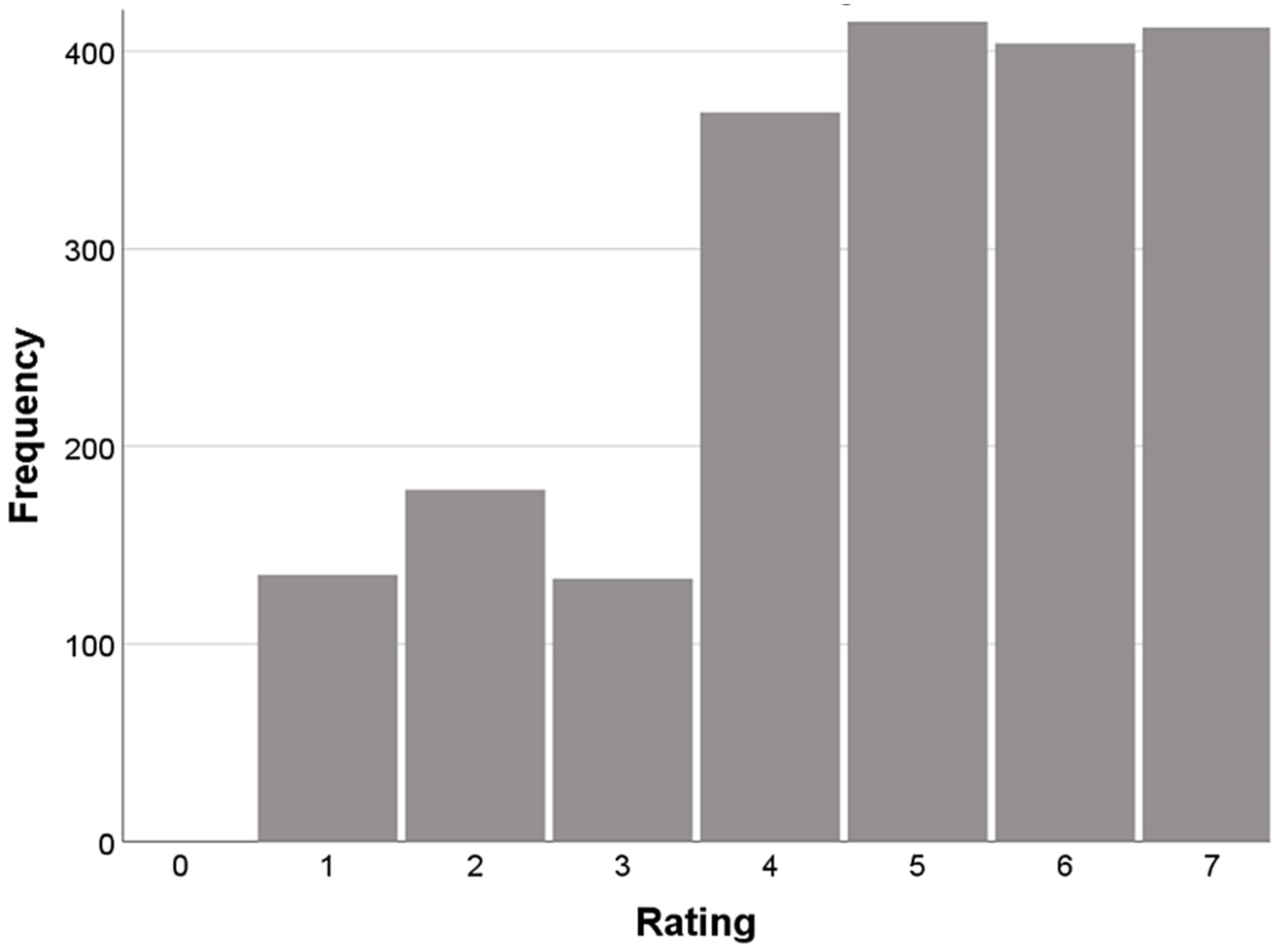
| Route Instruction Formulations | IQR 1 | Mode | Median | Mean | SD 2 |
|---|---|---|---|---|---|
| 3 | 4 | 4 | 4.25 | 1.9 |
| 3 | 4 | 5 | 4.55 | 1.7 |
| 2 | 6 | 5 | 5.06 | 1.6 |
| 2 | 6 | 5 | 4.92 | 1.6 |
| 2 | 6 | 6 | 5.16 | 1.7 |
| Reference Formulation | Compared Formulation | Mean Diff. (Reference–Compared) 1 | SE 2 | p | 95% CI 3 |
|---|---|---|---|---|---|
| DTBT + SN + LM + Alert | TBT + SN | 0.912 | 0.114 | 0.00 | [0.59, 1.23] |
| DTBT + LM | 0.615 | 0.114 | 0.00 | [0.29, 0.93] | |
| DTBT + SN + Alert | 0.099 | 0.114 | 1.00 | [−0.22, 0.42] | |
| DTBT + LM + Alert | 0.242 | 0.114 | 0.34 | [−0.07, 0.56] | |
| DTBT + LM + Alert | TBT + SN | 0.671 | 0.104 | 0.00 | [0.37, 0.96] |
| DTBT + LM | 0.373 | 0.104 | 0.00 | [0.08, 0.66] | |
| DTBT + SN + Alert | −0.143 | 0.104 | 1.0 | [−0.43, 0.15] | |
| DTBT + SN + Alert | TBT + SN | 0.813 | 0.104 | 0.00 | [0.52, 1.10] |
| DTBT + LM | 0.516 | 0.104 | 0.00 | [0.22, 0.80] | |
| DTBT + LM | TBT + SN | 0.297 | 0.104 | 0.04 | [0.00, 0.59] |
| Navigation Situations | Mean Diff. 1 | SE 2 | p | 95% CI 3 |
|---|---|---|---|---|
| 1. Crowded sidewalk | 0.47 | 0.28 | 0.09 | [−0.73, 1] |
| 2. Steep downward slope | −0.59 | 0.28 | 0.01 | [−1.08, −0.98] |
| 3. Cross slope | −0.33 | 0.25 | 0.18 | [−0.82, 0.16] |
| 4. Cobblestone and uneven sidewalk | −1.26 | 0.25 | 0.00 | [−1.75, −0.77] |
| 5. Snow | −0.55 | 0.25 | 0.02 | [−1.04, −0.6] |
| 6. Hole | −0.58 | 0.25 | 0.02 | [−1.07, −0.08] |
| 7. Flat and loose gravel path | −0.89 | 0.25 | 0.00 | [−1.38, −0.39] |
| 8. Path over grass | −0.81 | 0.25 | 0.00 | [−1.3, −0.31] |
| 9. Tree roots and rocks | −0.43 | 0.28 | 0.11 | [−0.97, 0.10] |
| 10. Going up/down a curb | −0.76 | 0.25 | 0.00 | [−1.25, −0.27] |
| 11. Narrow sidewalk | −1.08 | 0.28 | 0.00 | [−1.62, −0.54] |
| 12. Intersection without a pedestrian light | −0.69 | 0.25 | 0.00 | [−1.18, 0.19] |
| 13. Pressing the pedestrian light button and cross | −0.63 | 0.25 | 0.01 | [−1.12, −0.14] |
| 14. Steep upward slope | −0.89 | 0.28 | 0.00 | [−1.42, −0.34] |
| Participants’ Characteristics | Formulations | Significant Impact | p |
|---|---|---|---|
| Gender | DTBT + SN + LM + Alert | Female > Male | 0.00 |
| Wheelchair using experience | DTBT + SN + LM + Alert | 6+ years group > 1–5 years group | <0.05 |
| DTBT + SN + Alert | 6+ years group > 1–5 years group | <0.05 |
| Participants’ Characteristics | Significant Impacts | p |
|---|---|---|
| Wheelchair using experience | ||
| 6+ years group | Enriched formulations 1 > TBT + SN, DTBT + LM DTBT + SN + LM + Alert > DTBT + LM + Alert | 0.00 <0.04 |
| Daily outdoor wheelchair use duration | ||
| 15–29 min and 30–44 min groups | Enriched formulations 1 > TBT + SN | <0.05 |
| 45–59 min group | Enriched formulations 1 > TBT + SN, DTBT + LM | <0.05 |
| >60 min group | Enriched formulations 1 > TBT + SN, DTBT + LM DTBT + LM > TBT + SN | 0.00 0.00 |
| Profile (confidence level) | Enriched formulations 1 > TBT + SN | 0.04 |
| Combination of Modalities | Mean | Median | Mode | SD |
|---|---|---|---|---|
| Visual | 4.58 | 4.00 | 4 | 1.82 |
| Visual + Vocal | 5.45 | 6.00 | 7 | 1.69 |
| Visual + Vocal + Vibration | 5.32 | 6.00 | 6 | 1.62 |
| Visual + Vocal + Audible beep | 5.80 | 6.00 | 7 | 1.40 |
| Comparison | p (2-Tailed) |
|---|---|
| Visual < Visual + Vocal | 0.00 |
| Visual < Visual + Vocal + Vibration | 0.04 |
| Visual < Visual + Vocal+ audible beep | 0.00 |
Disclaimer/Publisher’s Note: The statements, opinions and data contained in all publications are solely those of the individual author(s) and contributor(s) and not of MDPI and/or the editor(s). MDPI and/or the editor(s) disclaim responsibility for any injury to people or property resulting from any ideas, methods, instructions or products referred to in the content. |
© 2026 by the authors. Published by MDPI on behalf of the International Society for Photogrammetry and Remote Sensing. Licensee MDPI, Basel, Switzerland. This article is an open access article distributed under the terms and conditions of the Creative Commons Attribution (CC BY) license.
Share and Cite
Azimi, S.; Mostafavi, M.A.; Best, K.L.; Dommes, A.; Montuwy, A. Adapted Route Instructions for Navigation Technologies in Support of Wheelchair Mobility in Urban Areas: Online Survey. ISPRS Int. J. Geo-Inf. 2026, 15, 110. https://doi.org/10.3390/ijgi15030110
Azimi S, Mostafavi MA, Best KL, Dommes A, Montuwy A. Adapted Route Instructions for Navigation Technologies in Support of Wheelchair Mobility in Urban Areas: Online Survey. ISPRS International Journal of Geo-Information. 2026; 15(3):110. https://doi.org/10.3390/ijgi15030110
Chicago/Turabian StyleAzimi, Sanaz, Mir Abolfazl Mostafavi, Krista L. Best, Aurélie Dommes, and Angélique Montuwy. 2026. "Adapted Route Instructions for Navigation Technologies in Support of Wheelchair Mobility in Urban Areas: Online Survey" ISPRS International Journal of Geo-Information 15, no. 3: 110. https://doi.org/10.3390/ijgi15030110
APA StyleAzimi, S., Mostafavi, M. A., Best, K. L., Dommes, A., & Montuwy, A. (2026). Adapted Route Instructions for Navigation Technologies in Support of Wheelchair Mobility in Urban Areas: Online Survey. ISPRS International Journal of Geo-Information, 15(3), 110. https://doi.org/10.3390/ijgi15030110