Article

A Decentralized Potential Field-Based Self-Organizing Control Framework for Trajectory, Formation, and Obstacle Avoidance of Fully Autonomous Swarm Robots


by
Mohammed Abdel-Nasser
1,2,
Sami El-Ferik
1,2,
Ramy Rashad
1,2 and
Abdul-Wahid A. Saif
1,2,*
1
Department of Control and Instrumentation Engineering, KFUPM, Dhahran 31261, Saudi Arabia
2
Interdisciplinary Research Center for Smart Mobility and Logistics, KFUPM, Dhahran 31261, Saudi Arabia
*
Author to whom correspondence should be addressed.
Robotics 2025, 14(12), 192; https://doi.org/10.3390/robotics14120192
Submission received: 6 November 2025 / Revised: 7 December 2025 / Accepted: 9 December 2025 / Published: 18 December 2025
(This article belongs to the Special Issue Advanced Control and Optimization for Robotic Systems)

Abstract

In this work, we propose a fully decentralized, self-organizing control framework for a swarm of autonomous ground mobile robots. The system integrates potential field-based mechanisms for simultaneous trajectory tracking, formation control, and obstacle avoidance, all based on local sensing and neighbor interactions without centralized coordination. Each robot autonomously computes attractive, repulsive, and formation forces to navigate toward target positions while maintaining inter-robot spacing and avoiding both static and dynamic obstacles. Inspired by biological swarm behavior, the controller emphasizes robustness, scalability, and flexibility. The proposed method has been successfully validated in the ARGoS simulator, which provides realistic physics, sensor modeling, and a robust environment that closely approximates real-world conditions. The system was tested with up to 15 robots and is designed to scale to larger swarms (e.g., 100 robots), demonstrating stable performance across a range of scenarios. Results obtained using ARGoS confirm the swarm’s ability to maintain formation, avoid collisions, and reach a predefined goal area within a configurable 1 m radius. This zone serves as a spatial convergence region suitable for multi-robot formation, even in the presence of unknown fixed obstacles and movable agents. The framework can seamlessly handle the addition or removal of swarm members without reconfiguration.

1. Introduction

Swarm robotics has emerged as a promising paradigm for coordinating large groups of relatively simple robots to perform complex tasks collectively [1,2,3,4]. Inspired by natural systems such as the movements of bird flocks, herds of animals, and the self-organization of social insects like ant colonies and bees [5,6,7,8], these robotic swarms exhibit characteristics such as scalability, flexibility, robustness, and adaptability that swarm robotic systems aim to replicate in engineered environments [9,10,11,12,13].
Applications of swarm robotics span a wide range, from agricultural automation [14,15,16] and industrial inspection [17,18] to search-and-rescue missions [19,20,21,22], surveillance [13], and planetary exploration [23,24,25].
Swarm robotics research spans multiple domains, including control techniques and algorithms [26,27], communication and perception [28,29], task allocation and formation control [27,29,30], as well as navigation and system design [26,30,31]. While significant progress has been made, many existing studies focus on specific aspects in isolation. For instance, some works address trajectory tracking using attractive potentials [32,33], others focus on obstacle avoidance with repulsive fields [34,35], and some explore formation control through virtual spring–damper models [36], graph theory approach [37,38,39], potential field and geometric approaches [40,41], or Lennard-Jones-based interactions [42,43,44].
A fundamental challenge in this domain is developing decentralized control strategies that enable individual robots to navigate, maintain formations, and avoid obstacles using only local information [45,46,47,48,49].
In decentralized control of swarm robotic systems, each robot makes decisions autonomously using only local sensing and limited-range communication, without relying on a central controller [27,28,30]. Coordination may occur directly—such as through robot-to-robot communication—or indirectly via stigmergy, where interactions are mediated by the environment [28]. This decentralized structure enables swarm systems to operate effectively in dynamic, unstructured, and hazardous environments.
Moreover, many approaches assume prior knowledge of the environment [4], centralized coordination [13], or require manual reconfiguration when swarm size changes [5], limiting their applicability in dynamic, real-world scenarios. Therefore, developing a fully decentralized control strategy that simultaneously supports coordinated movement, obstacle avoidance, and inter-robot formation—using only local sensing and communication—remains an open research problem [50]. In response to this gap, our work proposes a decentralized, self-organizing control framework for swarm robotics, integrating attractive, repulsive, and formation forces derived from local sensing and neighbor interactions. The system is implemented and evaluated in the ARGoS simulator [51] using foot-bot ground robots, operating solely with proximity sensors for obstacle detection and range-and-bearing sensors for formation.
The proposed framework is validated in unknown environments with both static and dynamic obstacles, the latter arising from the motion of neighboring swarm members—particularly when the swarm passes close to environmental obstacles. In such situations, the obstacle-repulsion force automatically takes priority over formation forces to maintain safe separation and prevent collisions with either obstacles or neighboring robots. Our method demonstrates strong scalability, with robust performance observed across swarm sizes ranging from 15 to 100 robots, and it supports the flexible addition and removal of members without the need for reprogramming. Unlike prior approaches, our system offers a complete, integrated solution for autonomous trajectory planning, inter-robot formation, and obstacle avoidance, while also exhibiting key swarm properties such as robustness, scalability, and adaptability. Moreover, the system successfully handles wide obstacles and narrow passages, and lays the groundwork for future enhancements, including hyperparameter optimization and overcoming local minima in potential field methods—targets of our ongoing research.
The main contributions of this work are summarized as follows:
  • A fully decentralized and self-organizing control framework is developed for swarm robots based on potential field methods, capable of simultaneous trajectory tracking, formation control, and obstacle avoidance.
  • Integration of attractive, repulsive, and formation forces is achieved using only local sensing (proximity sensors) and neighbor communication (range-and-bearing sensors), without any centralized control or prior knowledge of the environment.
  • The framework supports operation in unknown environments with both static and dynamic obstacles, where dynamic obstacles emerge from the motion of neighboring swarm robots.
  • Scalability and flexibility are validated through extensive testing in the ARGoS simulator, with swarm sizes ranging from 15 to 100 robots. The system allows seamless addition and removal of members without requiring reprogramming or a coordination reset.
  • The method demonstrates robustness across diverse scenarios, including narrow passages and wide obstacle fields, while preserving formation and guiding the swarm to target areas.
The remainder of this paper is organized as follows. Section 2 reviews the recent literature on decentralized swarm robotics and related potential-field-based methods. Section 3 outlines the problem formulation, including the system model and the key objectives for decentralized control. Section 4 presents the proposed control framework, detailing the design of the potential field-based strategy for trajectory tracking, formation control, and obstacle avoidance. Section 5 discusses the simulation setup and the results obtained using the ARGoS simulator, highlighting the performance of the proposed approach under various conditions. Finally, Section 6 concludes the paper and outlines potential directions for future research.

2. Related Work

As discussed in the Introduction, several existing approaches in swarm and multirobot coordination rely on assumptions that limit their applicability in realistic environments. Many methods depend on prior environmental knowledge, centralized supervision, or require reprogramming when the swarm size changes. Such constraints reduce their suitability for dynamic and unpredictable scenarios, where fully decentralized and locally informed strategies are essential. Building on this context, this section provides a detailed overview of recent studies addressing trajectory tracking, formation maintenance, and obstacle avoidance in distributed robot swarms, highlighting the strengths and limitations of representative approaches.
For instance, the study in [34] proposed an adaptive obstacle avoidance model for swarm robots by integrating optimization techniques with artificial potential fields. Although effective in simulated settings, the method was tested on static obstacles within segmented, map-based environments, limiting its applicability in unknown or unstructured scenarios.
Moreover, the study in [35] developed a decentralized collision avoidance method for drone swarms using repulsion vector calculations and local communication. The approach is computationally lightweight and suited for resource-constrained unmanned aerial vehicles (UAVs), with validation conducted in simulations involving up to 25 drones. However, its evaluation focused on structured environments with static obstacles, limiting its applicability to unknown or highly dynamic settings.
Furthermore, a recent study [52] presented an improved formation control strategy combining a virtual spring-based obstacle avoidance model with an improved velocity obstacle algorithm. The method reduces computational load through a leader–follower structure and adapts speed based on position error. However, its reliance on a leader introduces vulnerability, scalability beyond 20 robots is untested, and the approach is limited to structured environments rather than fully unknown settings.
Over the past two decades, numerous strategies have been developed for swarm coordination, particularly for decentralized navigation, formation control, and obstacle avoidance [50,53]. Among these, potential field (PF) methods offer a promising solution due to their simplicity, local computability, and compatibility with distributed architectures [52]. However, unifying multiple control objectives—trajectory, formation, and real-time obstacle avoidance—into a single scalable PF-based framework remains an open research challenge, especially under dynamic swarm sizes and unknown obstacle conditions [13,50,54].
Recent studies have made notable progress in applying PF methods to various aspects of swarm robotics, yet many still face key limitations in scope, scalability, or environmental adaptability. For instance, Shao et al. [55] proposed an enhanced PF algorithm aimed at improving dynamic obstacle avoidance for multi-robot flocking. Although the study addressed local minima and oscillation issues by adjusting repulsive forces based on obstacle velocity, its validation was limited, without evaluation of scalability or application in unknown environments. Similarly, Tong et al. [56] proposed a hybrid path planning framework that integrates A* (a graph-based heuristic search method) with a multi-target PF approach to achieve effective formation control. While effective for static obstacle avoidance in 2D environments, the method does not generalize well to 3D environments or unstructured settings, and it assumes prior knowledge of the environment.
Ding et al. [57] developed a PF-based formation and obstacle avoidance method for multi-AUV systems using virtual structures and distance feedback. The approach was tested in 2D simulations and demonstrated reliable formation keeping; however, it lacks validation in complex underwater dynamics and does not consider real-world communication issues. Sahal et al. [58] proposed a cooperative control strategy combining guidance routes with PFs for multi-autonomous underwater vehicle (AUV) systems, supporting trajectory tracking and formation control. Yet, its dependence on predefined paths implies a degree of environmental knowledge, limiting flexibility in unknown or dynamic scenarios.
Lajčiak and Vachálek [59] proposed a centralized swarm-control method combining RRT–APF planning with neural-network task allocation for differential-drive robots. The approach performs well in structured indoor environments with static obstacles, but it does not support decentralized operation, formation control, or dynamic obstacle handling. Passos et al. [60] proposed two decentralized congestion-control algorithms (SQF and TRVF) based on artificial potential fields and vector-field navigation for swarms sharing a common target. Their methods improve throughput when many robots converge to the same region and were validated in Stage simulations with up to 300 robots. However, the approach is tailored specifically to congestion around a target and does not address trajectory tracking, formation control, or dynamic obstacles. Dong et al. [61] developed an adaptive formation controller for nonholonomic robot teams that combines an artificial potential function with backstepping and Lyapunov techniques. The approach ensures trajectory tracking and connectivity maintenance and is validated in MATLAB, Gazebo, and outdoor experiments with real robots. However, the method assumes a known reference trajectory, does not consider any environmental obstacles—focusing solely on preventing collisions among the robots themselves—and is limited to small team sizes, which restricts its applicability to large-scale decentralized swarm scenarios.
Omotuyi and Kumar [62] proposed a decentralized swarm controller based on imitation learning and graph neural networks, enabling heterogeneous robot teams to perform segregation and aggregation using only local information. The learned controller achieves performance comparable to a centralized expert policy and scales to 100 robots in both 2D and 3D, with successful transfer to Turtlebot3 and Crazyflie platforms. However, the method does not consider environmental obstacles or trajectory-tracking tasks and focuses primarily on clustering behaviors in open spaces. Istiak et al. [63] introduced a two-stage decentralized algorithm (SymSwarm) for symmetrical pattern formation based on a bio-inspired Compete-and-Point State Model and geometric circle–polygon construction. Their method enables robots to self-organize into symmetric formations while communicating locally and avoiding static obstacles in V-REP simulations. However, the approach is limited to small swarm sizes, relies on a single leader for computing target points, and handles only static obstacles, with no trajectory tracking or general formation shaping beyond circular symmetry.
Gao et al. [64] proposed a non-potential orthogonal vector field (NPOVF) method that improves the efficiency of artificial potential fields by orthogonalizing the repulsive component to the attractive vector. The approach enhances collision and obstacle avoidance and is validated in both simulation and real quadcopter experiments. However, it assumes known static obstacles, does not address formation or trajectory tracking, and is limited to navigation tasks despite demonstrating scalability in large simulated swarms. Zhang et al. [65] proposed a decentralized cooperative pursuit algorithm that integrates deep reinforcement learning with artificial potential fields. Their APF-enhanced D3QN policy enables pursuers to coordinate in capturing an evader while avoiding static obstacles and inter-robot collisions, with demonstrated transfer to real differential-wheeled robots. However, the approach is task-specific, does not support formation or trajectory tracking, and is validated only for small team sizes, with performance tied to structured and known environments.
Despite these advancements, a unified, fully decentralized PF-based control framework that concurrently achieves trajectory tracking, formation control, and obstacle avoidance—while operating in unknown, dynamic environments—remains lacking. To address this gap, this work proposes a decentralized, self-organizing control strategy that leverages attractive, repulsive, and formation forces derived exclusively from local sensing and neighbor interactions.
Table 1 provides a structured comparison of recent swarm control approaches, highlighting key features such as control type (centralized or decentralized), environment assumptions (known or unknown), obstacle type, inclusion of trajectory tracking, formation maintenance, and obstacle avoidance capabilities. Additional attributes such as scalability, flexibility, robustness against failure, and performance in constrained environments (e.g., narrow passages and wall-like obstacles) are also compared to demonstrate the uniqueness of the proposed approach.

3. Problem Formulation

In this work, a swarm of foot-bot robots aims to reach a target position while maintaining formation and avoiding obstacles along the way. The complete mathematical expression will contain the swarm kinematic mode and the control law. Therefore, in the case of multiple frames, the frames of reference have to be defined before starting with the kinematic model.

3.1. Frames of Reference

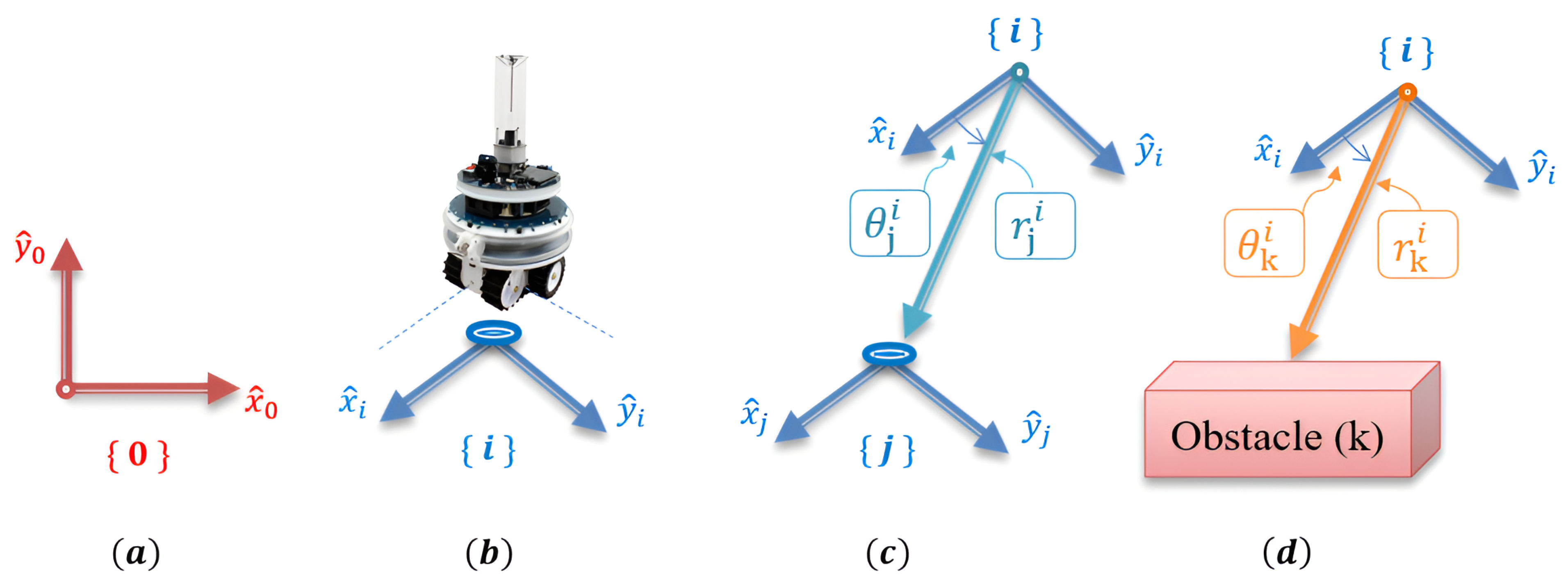
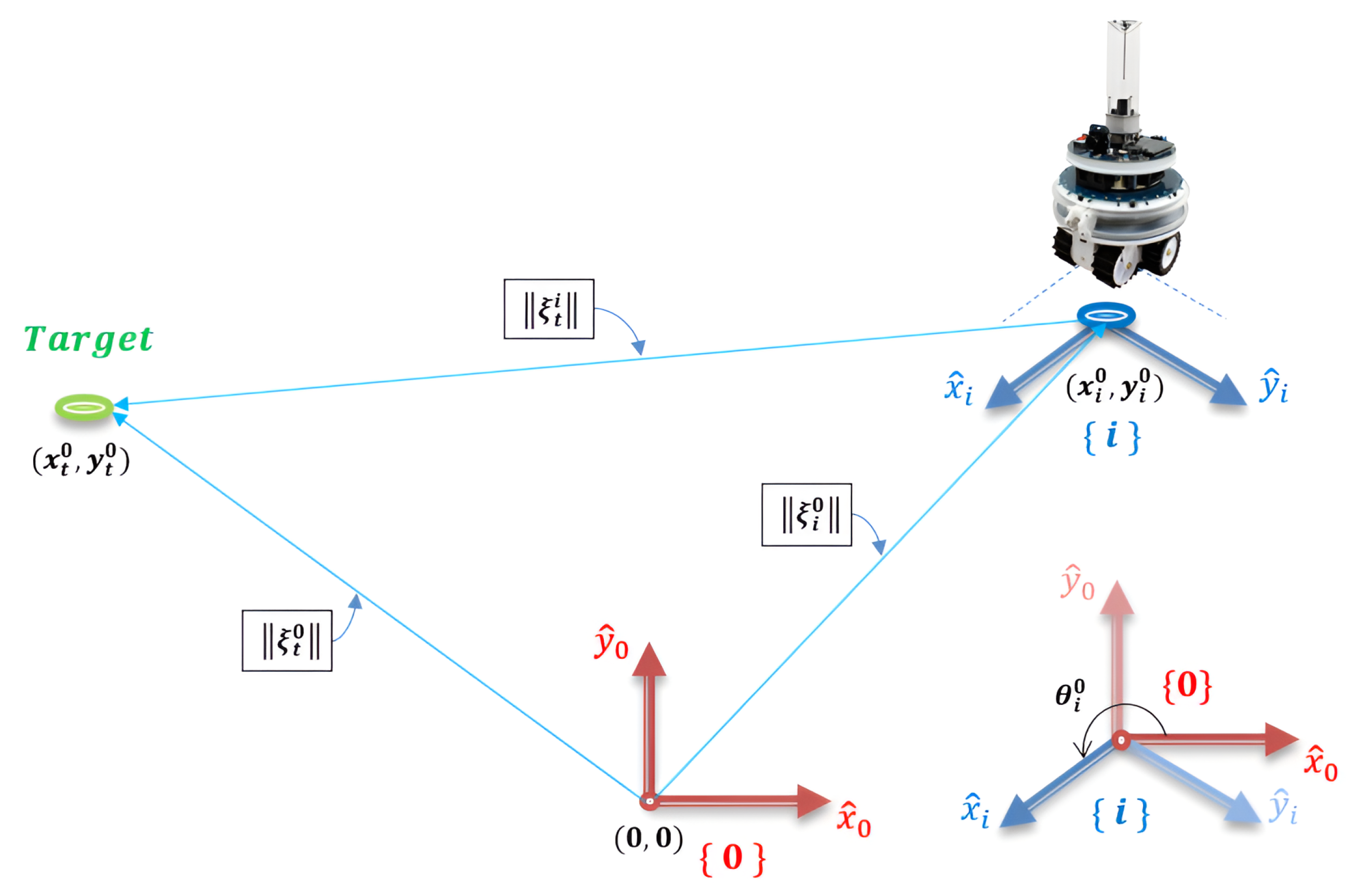
Figure 1 shows all the frames used, along with the needed details, which can be described as follows:
  • Inertial Frame  { 0 } : A fixed world reference frame in the environment.
  • Robot Frame  { i } : A local frame attached to robot i, which is one of the N i members in the swarm.
  • Neighbor Robot Frame  { j } : A local frame attached to robot j, which is one of the N j neighbors of robot i in the swarm.

3.2. Swarm Mathematical Model

Each robot in the swarm is indexed by i, with a total of N i mobile robots. The motion of robot i is represented in the S E ( 2 ) plane by the pair ( v i , ω i ) , where v i denotes the forward velocity and ω i represents the angular velocity around the Z i -axis. The forward velocity is aligned with the X i -axis, which corresponds to the robot’s front. Consequently, the velocity in the Y i -axis direction is zero, as the robots are nonholonomic.
Moreover, the transformation of robot i with respect to the inertial frame { 0 } is denoted by ( ξ i 0 , θ i 0 ) , where ξ i 0 represents the translation along the X i - and Y i -axes, and θ i 0 denotes the robot’s heading angle in a 2D space.
Furthermore, to drive the robot i’s equation of motion, we have to calculate the rates of change for its translation and rotation, relative to the global coordinate frame, which are represented by ( ξ ˙ i 0 , θ ˙ i 0 ), as shown in the next equations.
Let us start with the translation rate.
ξ ˙ i 0 = x ˙ i 0 y ˙ i 0 = R i 0 v i 0
where
  • R i 0 : = R z ( θ i 0 ) is the rotation matrix from the robot frame { i } to the global frame { 0 } around the Z 0 -axis, and is given by:
    R z ( θ i 0 ) = cos ( θ i 0 ) sin ( θ i 0 ) sin ( θ i 0 ) cos ( θ i 0 )
Therefore, based on the kinematics of nonholonomic mobile robots, the time derivative of the robot i orientation angle with respect to the global frame θ ˙ i 0 is equal to the robot angular velocity ω i . Consequently, the equation of motion for robot i can be written as follows:
x ˙ i 0 = v i cos ( θ i 0 ) , y ˙ i 0 = v i sin ( θ i 0 ) , θ ˙ i 0 = ω i
The inputs for this model are the forward and angular velocities ( v i , ω i ) for robot i, which are the control law u i . As a result, the control design that enables the swarm members to achieve their task will be explained in detail in the next section.

4. Control Design

The control design process consists of two parts. First, the proposed controller algorithm is designed based on a potential field approach that guides the swarm of robots toward the target while preserving formation and avoiding obstacles. Second, a stability analysis is conducted to verify the robustness of the proposed control scheme.

4.1. Potential Field-Based Controller

This approach uses the potential energy to generate the required force that guides the robots. In addition, this force has two types, attractive and repulsive forces [66]. The proposed control mainly consists of three parts as follows:
  • Trajectory part: Enables the swarm to reach its target position.
  • Formation part: Applies a desired distance between each robot and its neighbors to keep the formation through achieving the task.
  • Obstacle part: Guides the swarm to avoid unknown obstacles along the target way.
The control law is computed by mapping the sum of attractive and repulsive forces generated by the three main components described above. The following subsections detail the generation of each force’s components.

4.1.1. Trajectory Part

The trajectory part is responsible for navigating the swarm to the required position. The attractive force is the engine for steering the robots, extracting its energy from the potential field cost function C t r a , i 0 . Furthermore, this cost is a function of ( ξ i 0 , ξ t 0 ) . Here, the variable ξ i 0 represents the current position of robot i, while the constant parameter ξ t 0 denotes the target position. Both are expressed with respect to the global frame { 0 } , as follows:
C tra , i 0 : R 2 R ξ i 0 C tra , i 0 ( ξ i 0 )
This is followed by defining the cost function as a quadratic function of ξ t i , which is the Euclidean distance between the robot i’s current and target positions, as shown in Figure 2. Therefore, the trajectory cost function is selected as:
C t r a , i 0 ( ξ i 0 ) : = 1 2 ξ t i 2
where
ξ t i = ξ t 0 ξ i 0 R 2 , ξ t i 2 = ( ξ t i ) T ξ t i
Thus, the trajectory potential-field energy can be expressed as:
C t r a , i 0 ( ξ i 0 ) : = 1 2 ( ξ t 0 ξ i 0 ) T ( ξ t 0 ξ i 0 ) R
At this stage, the force is computed as the negative gradient of the energy function. This formulation ensures a decrease in energy, guiding the robot toward minimizing the Euclidean distance to the target. The gradient definition will be as follows:
ξ i 0 C tra , i 0 ( ξ i 0 ) : R 2 R 2
Based on the definition above, the trajectory force can be computed as:
F tra , i 0 ( ξ i 0 ) = C tra , i 0 ( ξ i 0 ) ξ i 0 = ( ξ t 0 ξ i 0 )
where
ξ t 0 ξ i 0 = x t 0 x i 0 y t 0 y i 0 R 2
As a result, the two components of the trajectory force are as follows:
F tra x , i 0 = ( x i 0 x t 0 ) F tra y , i 0 = ( y i 0 y t 0 )
To ensure consistency, it is beneficial to express all quantities within a unified reference frame, chosen here as the robot frame {i}. Therefore, the final expression for the trajectory force in the robot’s local frame {i} is obtained by rotating the global frame force vector using the transpose of the rotation matrix R i 0 , as shown below:
F tra x , i i F tra y , i i = R i 0 T F tra x , i 0 F tra y , i 0

4.1.2. Formation Part

The formation component ensures that each robot in the swarm maintains a specified distance from its neighbors. This mechanism aids in reorganizing the swarm after disruptions, such as those caused by obstacle avoidance. Additionally, it supports swarm reformation scalability by allowing robots to be added or removed without requiring reprogramming, while still preserving the formation during task execution. To achieve this, both attractive and repulsive forces are applied simultaneously. The attractive force pulls the robot toward its neighbors when the distance exceeds the desired threshold σ , whereas the repulsive force pushes robots apart when they are too close, ensuring the required spacing is maintained.
Formation refers to the spatial relationship between each swarm member, indexed by i, and its N j neighbors, indexed by j. We begin by defining the transformation matrix for each robot as follows:
H i 0 = R i 0 ξ i 0 0 1 , i { 1 , , N i } H j 0 = R j 0 ξ j 0 0 1 , j { 1 , , N j }
where:
  • R j 0 : = R z ( θ j 0 ) is the rotation matrix representing the orientation of the robot frame { j } expressed in global frame { 0 } , corresponding to a rotation about the Z 0 -axis.
Thus, the transformation from robot frame { j } to robot frame { i } is given by:
H j i = H 0 i H j 0 = ( H i 0 ) 1 H j 0
Moreover, it can be opened as:
R j i ξ j i 0 1 = ( R i 0 ) T ( R i 0 ) T ξ i 0 0 1 R j 0 ξ j 0 0 1
where:
  • R j i : = R z ( θ j i ) is the rotation matrix representing the orientation of robot frame { j } expressed with respect to frame { i } , representing a rotation around the Z i -axis.
It follows that the rotation matrix and translation vector of robot j with respect to robot i are as follows:
R j i = ( R i 0 ) T R j 0 ξ j i = ( R i 0 ) T ( ξ j 0 ξ i 0 ) R 2
Moreover, the translation vector
ξ j i = x j i y j i
represents the position of neighbor robot j, expressed in the coordinate frame of robot { i } .
Before introducing the formation cost function, it is important to highlight an essential note. In both real-world implementations and when using a simulator of a real robot, a range-and-bearing system, if available, can be used to measure the Euclidean distance r j i from robot i to robot j. Additionally, it can provide the bearing angle ϕ j i , which represents the angle of the vector from robot i’s origin to robot j’s origin, expressed in the coordinate frame of robot i. In this case, we have:
ξ j i = r j i
As a result, the components ( x j i , y j i ) of the relative position vector ξ j i can be calculated as follows:
x j i =   ξ j i cos ( ϕ j i ) y j i =   ξ j i sin ( ϕ j i )
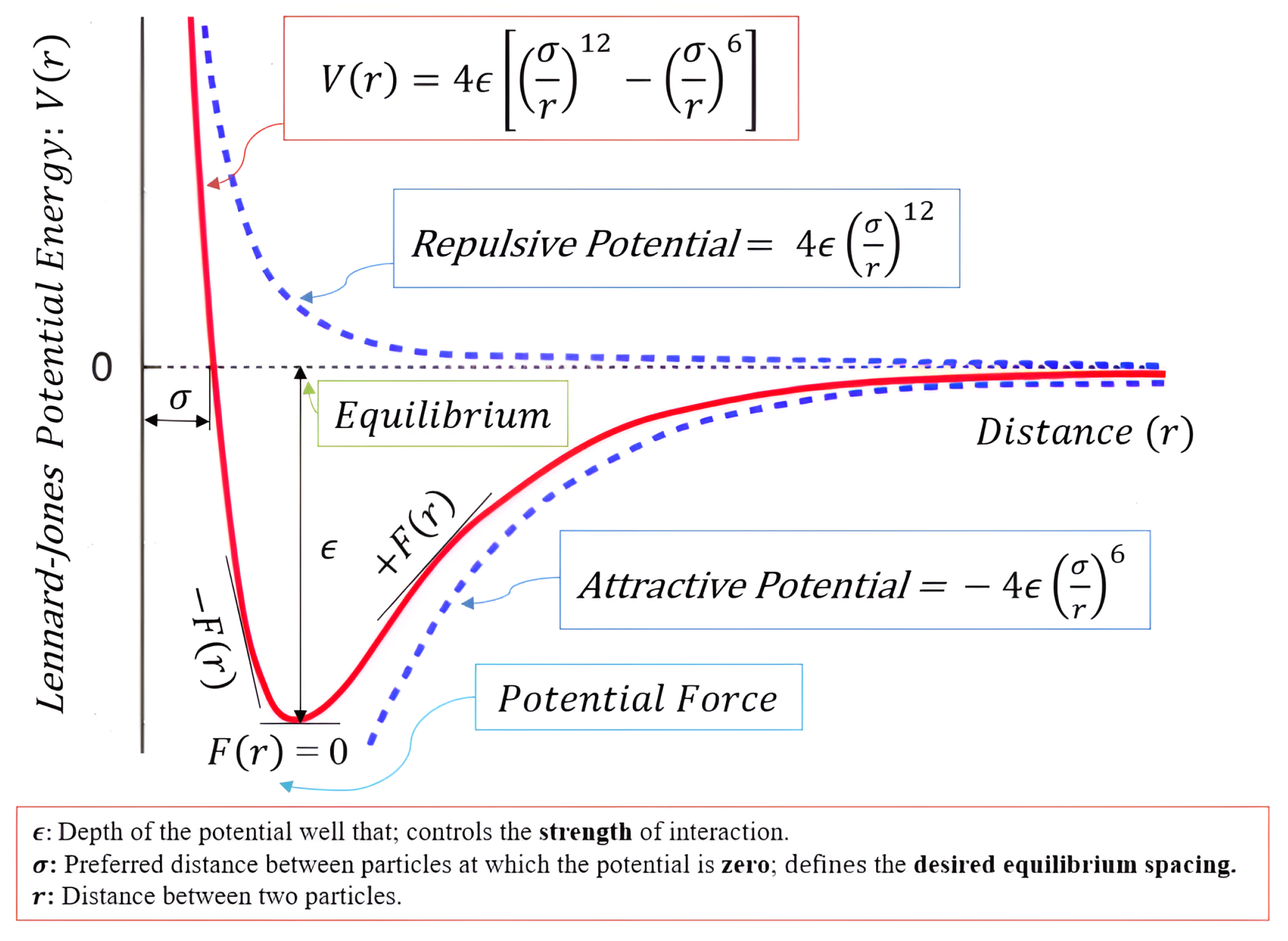
Accordingly, the formation cost function is selected as the Lennard-Jones potential field (LJPF) energy. However, in our case, a simplified version of the LJPF is used, which can be defined as:
C for , i j i : R 2 R ξ j i C for , i j i ( ξ j i )
This definition shows that the form of the cost function is a function of ξ j i , which is the Euclidean distance between the neighbor robot j and the robot frame { i } . Thus, the formation potential-field energy can be expressed as:
C for , i j i ( ξ j i ) : = 1 2 ϵ σ ξ j i 2 2 σ ξ j i R
where:
  • ϵ : Dictates the strength of the interaction between robots that shows how ‘deep’ the desired potential well is.
  • σ : The desired equilibrium distance between robots at which the interaction potential reaches its lowest point, signifying a stable formation.
The LJPF energy is a mathematical model used to describe the interaction between a pair of neutral atoms or molecules, as shown in Figure 3. It is commonly used in physics, chemistry, and robotics-inspired potential field methods such as swarm robotics [67].
Moreover, Figure 3 illustrates that the LJPF energy consists of two components: repulsion and attraction, governed by high exponents (12 and 6) to ensure sensitivity at the extremely small scales typical of atomic or molecular interactions. However, such precision is unnecessary in the robotics context, as the distances between robots are significantly larger compared to those between atoms and molecules, and this is the reason behind using the simplified version in our case.
The force at this stage is determined by applying the negative gradient to the energy function, which is defined as follows:
ξ j i C for , i j i ( ξ j i ) : R 2 R 2
Following the above definition, the formation force is given by:
F for , i j i ( ξ j i ) = C for , i j i ( ξ j i ) ξ j i = 1 2 ϵ σ 2 ξ j i ξ j i 2 2 σ ξ j i ξ j i 1
where:
  • The gradient of the norm with respect to ξ j i is:
    ξ j i ξ j i = ξ j i ξ j i
    More generally, for any power n:
    ξ ξ n = n ξ n 2 ξ
Thus, the final expression for the formation force is determined as:
F for , i j i ( ξ j i ) = ϵ σ 2 ξ j i 4 σ ξ j i 3 ξ j i
As a result, the two components of the formation force are as follows:
F for x , i j i = ϵ σ 2 ξ j i 4 σ ξ j i 3 x j i F for y , i j i = ϵ σ 2 ξ j i 4 σ ξ j i 3 y j i
In general, each robot i has N j neighbors. Any robot that falls within the active sensing range of robot i’s range-and-bearing sensor is considered a neighbor. Therefore, the net formation force acting on robot i is calculated as the sum of all interaction forces between robot i and its neighbors, and is expressed as:
F for , i i = j = 1 N j F for , i j i R 2 F for x , i i F for y , i i = j = 1 N j F for x , i j i j = 1 N j F for y , i j i
These interactions allow each robot to maintain its relative position within the formation using only local sensing information. Because the controller relies solely on local range-and-bearing sensing and short-range neighbor communication, the sensing and communication overhead remains low and is bounded by the number of nearby robots rather than the total swarm size.

4.1.3. Obstacle Avoidance Potential

This part plays a crucial role in ensuring safe task execution by preventing collisions between swarm members and avoiding unexpected obstacles in the environment while navigating toward the target position, based on the repulsive forces.
Moreover, the robot i has N k proximity sensors for detecting the surrounding obstacles; each is indexed as k and fixed in a specific position distributed around the robot with a fixed rotation angle ϕ k i around z-axis of the robot frame { i } . In addition, the Euclidean distance r k i from the robot i to the detected obstacle by the proximity sensor k is provided as well. Thus, we can define:
ξ k i = r k i , where ξ k i = x k i y k i .
As a result, the components ( x k i , y k i ) can be calculated as follows:
x k i = r k i cos ( ϕ k i ) , y k i = r k i sin ( ϕ k i ) .
Accordingly, the obstacle potential-field cost function C obs , i k i incorporates the variable ξ k i . The threshold distance q obs defines the activation range around the obstacle, within which the cost becomes nonzero. The function is defined as follows:
C obs , i k i : R 2 R ξ k i C obs , i k i ( ξ k i )
which is active within the robot’s sensing range and becomes zero when the distance to the obstacle exceeds the threshold q obs as follows:
C obs , i k i = 1 2 1 ξ k i 1 q obs 2 , if ξ k i q obs 0 , otherwise
Then, the negative gradient is applied to the energy to generate the obstacle repulsion force, as follows:
ξ k i C obs , i k i ( ξ k i ) : R 2 R 2
In light of the previous definition, the obstacle force can be formulated as:
F obs , i k i ( ξ k i ) = C obs , i k i ( ξ k i ) ξ k i = 1 ξ k i 1 q obs ξ k i ξ k i 3
The two components of the obstacle repulsion force are therefore expressed as:
F obs x , i k i = 1 ξ k i 3 1 ξ k i 1 q obs x k i F obs y , i k i = 1 ξ k i 3 1 ξ k i 1 q obs y k i
The net obstacle repulsive force acting on robot i is obtained by summing the individual repulsive forces generated by each of its N k proximity sensors, as follows:
F obs , i i = k = 1 N k F obs , i k i R 2 F obs x , i i F obs y , i i = k = 1 N k F obs x , i k i k = 1 N k F obs y , i k i

4.2. General Control Input (Platform-Independent)

The control law u i is generated in terms of velocity commands. This representation is general and valid for any mobile robot operating in the S E ( 2 ) plane, as follows:
u i = v i ω i
To this end, the net force must be computed and mapped to the overall velocity commands. Consequently, the net control force F net , i i applied to each robot i is defined as the combination of all potential field effects, as follows:
F net x , i i F net y , i i = K tra F tra x , i i F tra y , i i + K for F for x , i i F for y , i i + K obs F obs x , i i F obs y , i i
where:
  • K t r a is the trajectory control gain.
  • K f o r is the formation control gain.
  • K o b s is the obstacle repulsion gain.
In the final stage of the control design process, it is essential to ensure that all force components are compatible before converting them into the forward and angular velocities of robot i.
One key challenge encountered is the variability in the magnitudes of the force components, as they originate from different functional sources within the control architecture. For example, the trajectory force—driven primarily by the distance error between the robot and the target—can become excessively large when the robot is far from the goal. This leads to the robot moving at a high speed initially and then slowing down as it approaches the target. Although this behavior is mathematically valid, it is impractical for real-world robots, which typically move at a near-constant speed along most of the path and adjust only during acceleration or deceleration phases, such as at the start or stop.
A similar issue can occur with other force components, where one may dominate and suppress the influence of others, resulting in an imbalanced control behavior. A common approach to address this issue is to adapt the control gains ( K tra , K for , K obs ) to produce a near-constant desired velocity along the path.
On the other hand, the proposed method decomposes each control gain into three distinct components. The first involves normalizing the force vector by dividing it by its magnitude, producing a unit direction vector and enabling constant-speed motion. The second multiplies this unit vector by the maximum forward velocity to obtain a physically meaningful velocity. The third acts as a tunable hyperparameter that scales the velocity output, ensuring balanced contributions from different control components and supporting successful task execution. Although these parameters were manually tuned to demonstrate the concept, they could be further optimized in future work using methods such as genetic algorithms. Accordingly, the final control gains are defined as follows:
K v tra = k v tra · v max F tra , i i , K ω tra = k ω tra · ( v max / L ) F tra , i i K v for = k v for · v max F for , i i , K ω for = k ω for · ( v max / L ) F for , i i K v obs = k v obs · v max F obs , i i , K ω obs = k ω obs · ( v max / L ) F obs , i i
where:
  • ( k v tra , k ω tra ) , ( k v for , k ω for ) , ( k v obs , k ω obs ) are the forward and angular velocity hyperparameters associated with the trajectory, formation, and obstacle components for robot i, respectively.
  • v max is the maximum forward velocity assigned to the robot. It is used to convert the unitless force-to-velocity mapping into a real velocity value with physical units.
  • In this framework, the forward velocity is expressed in m/s. However, the angular velocity must be mapped from m/s to rad/s, which is achieved by dividing by the robot wheelbase L, as shown in Equation (29).
Accordingly, the forward and angular velocities ( v i , ω i ) of robot i are obtained by substituting Equation (29) into Equation (28), resulting in the final expression shown in Equation (30):
v i = k v tra v tra , i i + k v for v for , i i + k v obs v obs , i i ω i = k ω tra ω tra , i i + k ω for ω for , i i + k ω obs ω obs , i i
Up to this stage, all control components remain platform-independent and can be directly implemented on other robotic platforms with only minor adjustments to their sensing and motion constraints.

4.3. Platform-Dependent Implementation

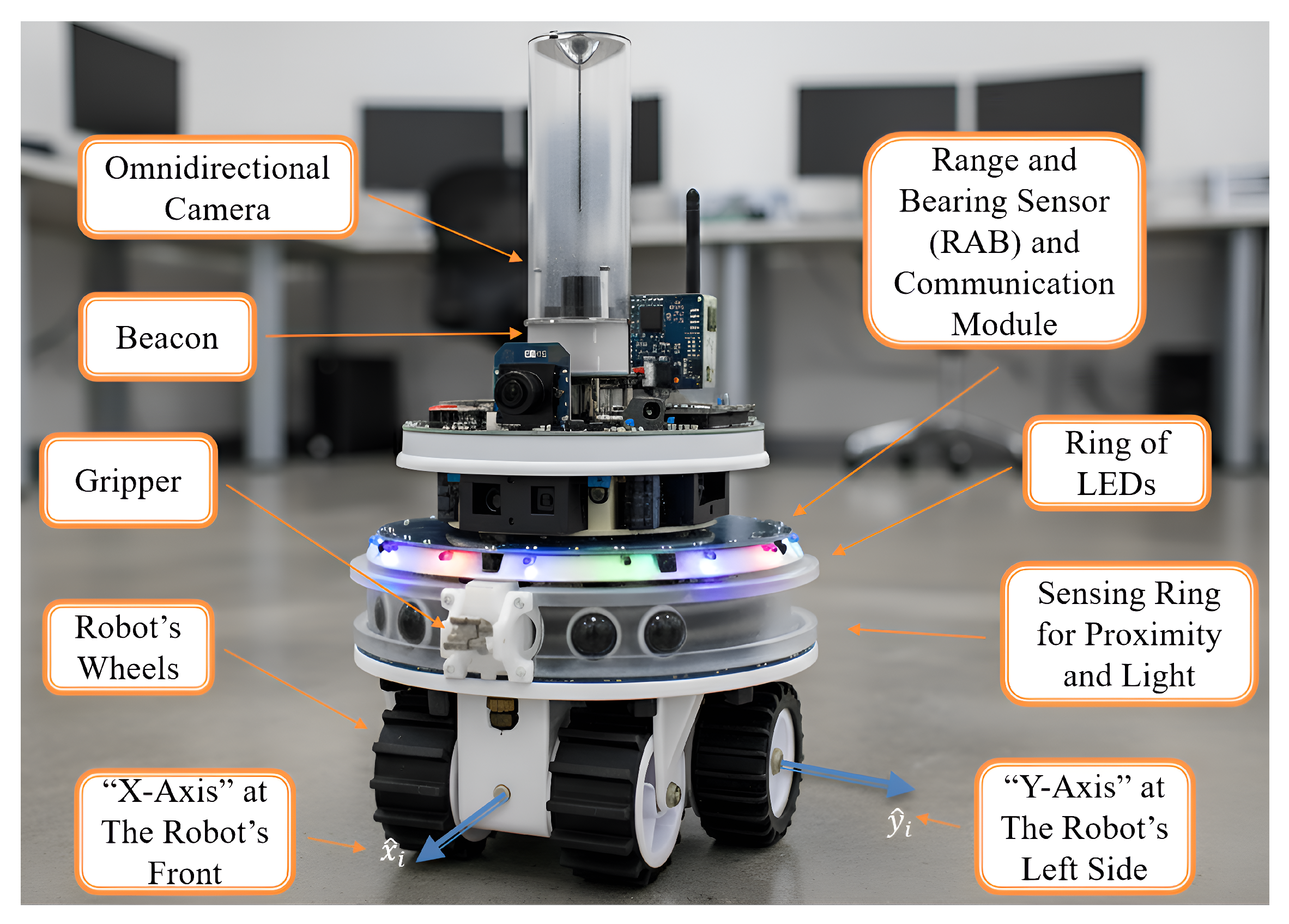
To implement this control law on a specific platform, the corresponding kinematic model must be considered. In this work, we select the Foot-bot, a nonholonomic mobile robot that consists of two independently actuated wheels and follows a differential-drive kinematic model, as illustrated in Figure 4. For such robots, the linear and angular velocities must be converted into actuator commands, namely the right and left wheel velocities, v r , i and v l , i , respectively.
The relationship between the control input and wheel velocities is given by:
v i = 1 2 ( v r , i + v l , i ) ω i = 1 L ( v r , i v l , i )
where:
  • L is the robot wheelbase (the distance between its two wheels).
  • It is important to note that the velocities for the right and left wheels, v r , i and v l , i , are presented in m/s. For cases where these velocities are given in rad/s, a conversion is necessary; multiply by the robot’s wheel radius r w .
Additionally, it can be written in an invertible matrix form as follows:
v i ω i = 0.5 0.5 1 L 1 L v r , i v l , i
Moreover, the wheel velocity pair v r , i and v l , i results from applying the inverse of the kinematic mapping matrix to the control input ( v i , ω i ) , as follows:
v r , i v l , i = 1 L 2 1 L 2 v i ω i
Accordingly, the proposed control procedure is summarized in Algorithm 1.
Algorithm 1 Decentralized PF-Based Control for Swarm Robot i
  1:
Input: Target position ξ t 0 , local robot pose ξ i 0 , heading θ i 0 , sensor readings {proximity, range-and-bearing}
  2:
Output: Wheel velocities v r , i , v l , i
  3:
Trajectory Gradient:
  4:
   ξ t i R i 0 T ( ξ t 0 ξ i 0 )
  5:
   F tra , i i ξ t i
  6:
Formation Gradient:
  7:
for each neighbor j N j do
  8:
   ξ j i relative pose from { j } to { i }
  9:
   F for , i j i ϵ σ 2 ξ j i 4 σ ξ j i 3 ξ j i
10:
end for
11:
F for , i i j F for , i j i
12:
Obstacle Gradient:
13:
for each proximity sensor k N k do
14:
   ξ k i obstacle vector from sensor k
15:
  if  ξ k i q obs then
16:
    F obs , i k i 1 ξ k i 1 q obs ξ k i ξ k i 3
17:
  end if
18:
end for
19:
F obs , i i k F obs , i k i
20:
Total Control Force:
21:
F net , i i K tra F tra , i i + K for F for , i i + K obs F obs , i i
22:
Velocity Mapping:
23:
v i F net , x , i i ,     ω i F net , y , i i
24:
v r , i , v l , i map ( v i , ω i ) to wheels
25:
return  v r , i , v l , i

5. Lyapunov-Based Validation of the Proposed Control Law

This section presents a theoretical validation of the proposed control strategy using Lyapunov stability theory. The control architecture consists of three primary components—trajectory tracking, formation control, and obstacle avoidance—each governed by a potential (cost) function.
Let the system state be denoted by ξ R 2 , where there are N i robots in the swarm and ξ concatenates the position vectors of each robot in the S E ( 2 ) plane. Each cost function is defined as:
C : R 2 R , ξ C ( ξ )
The system evolves according to a gradient descent-based control law, commonly used in artificial potential field methods. The system dynamics are given by:
ξ ˙ = α ξ C ( ξ ) , α R +
where α is a positive gain parameter.
We consider a Lyapunov candidate function for each part defined by:
V ( ξ ) = C ( ξ )
where C ( ξ ) represents one of the potential-field-based cost functions: trajectory, formation, or obstacle avoidance. To ensure that V ( ξ ) qualifies as a valid Lyapunov function, it must be positive definite. The trajectory and obstacle cost functions are inherently non-negative. However, for the formation cost function, a constant offset is added to shift its minimum value to zero as follows:
V tra ( ξ ) : = C tra ( ξ ) V for ( ξ ) : = C for ( ξ ) + 1 2 ϵ V obs ( ξ ) : = C obs ( ξ )
This ensures that V ( ξ ) > 0 for all ξ ξ * , and V ( ξ * ) = 0 , where ξ * denotes the desired equilibrium configuration.
The time derivative of the Lyapunov function is computed as:
V ˙ ( ξ ) = ξ C ( ξ ) T ξ ˙ = ξ C ( ξ ) T ( α ξ C ( ξ ) ) = α ξ C ( ξ ) 2 0
Therefore, V ˙ ( ξ ) 0 for all ξ R 2 , and V ˙ ( ξ ) < 0 for all ξ ξ * , which proves that the system is asymptotically stable.
The interpretation of stability for each control component is summarized as follows:
  • Trajectory control: The control drives the time-varying robot positions ξ i 0 toward their targets ξ t 0 , minimizing the position error ξ t i over time. The Lyapunov function decreases as robots approach their respective targets.
  • Formation control: The swarm asymptotically converges toward the desired formation configuration, where the inter-agent distances ξ j i tend to the nominal value σ .
  • Obstacle avoidance: The robots are repelled from nearby obstacles. The repulsive potential increases as robots approach danger zones, resulting in stable avoidance behavior as long as the robots remain within the sensing range ξ k i < q obs .

6. Experimental Validation in ARGoS Simulator

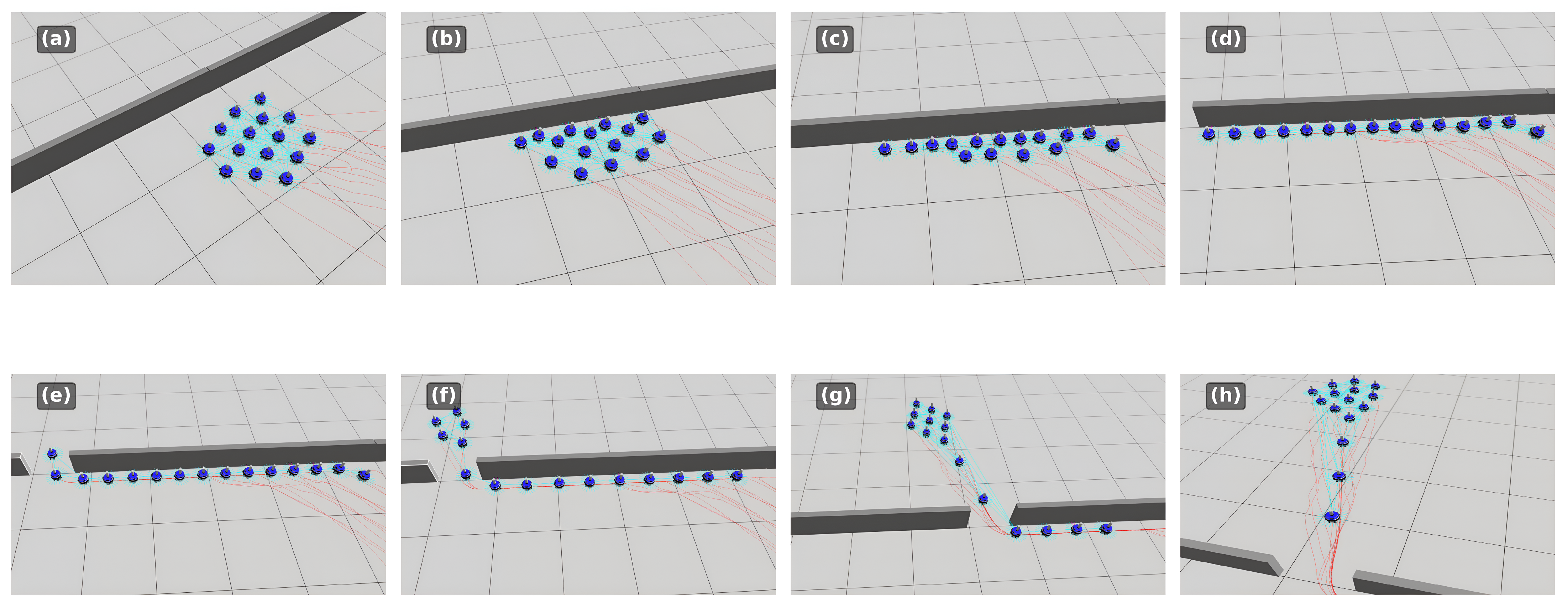
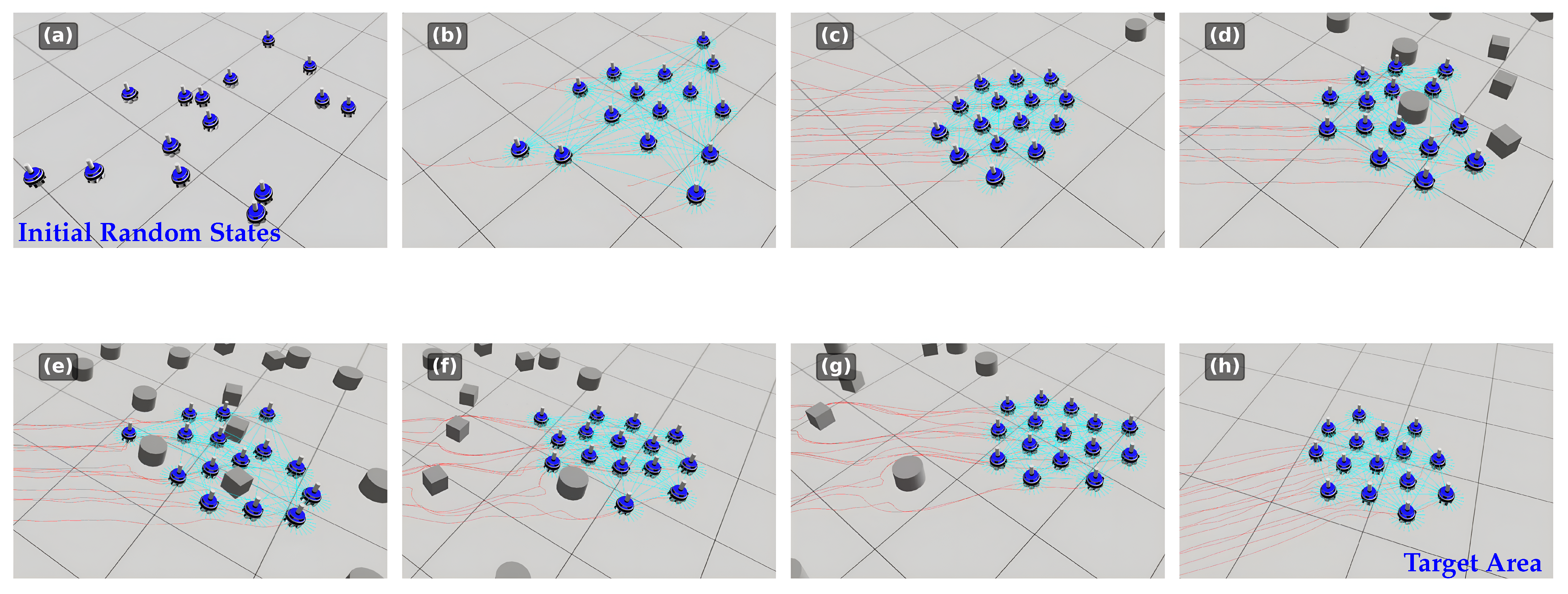
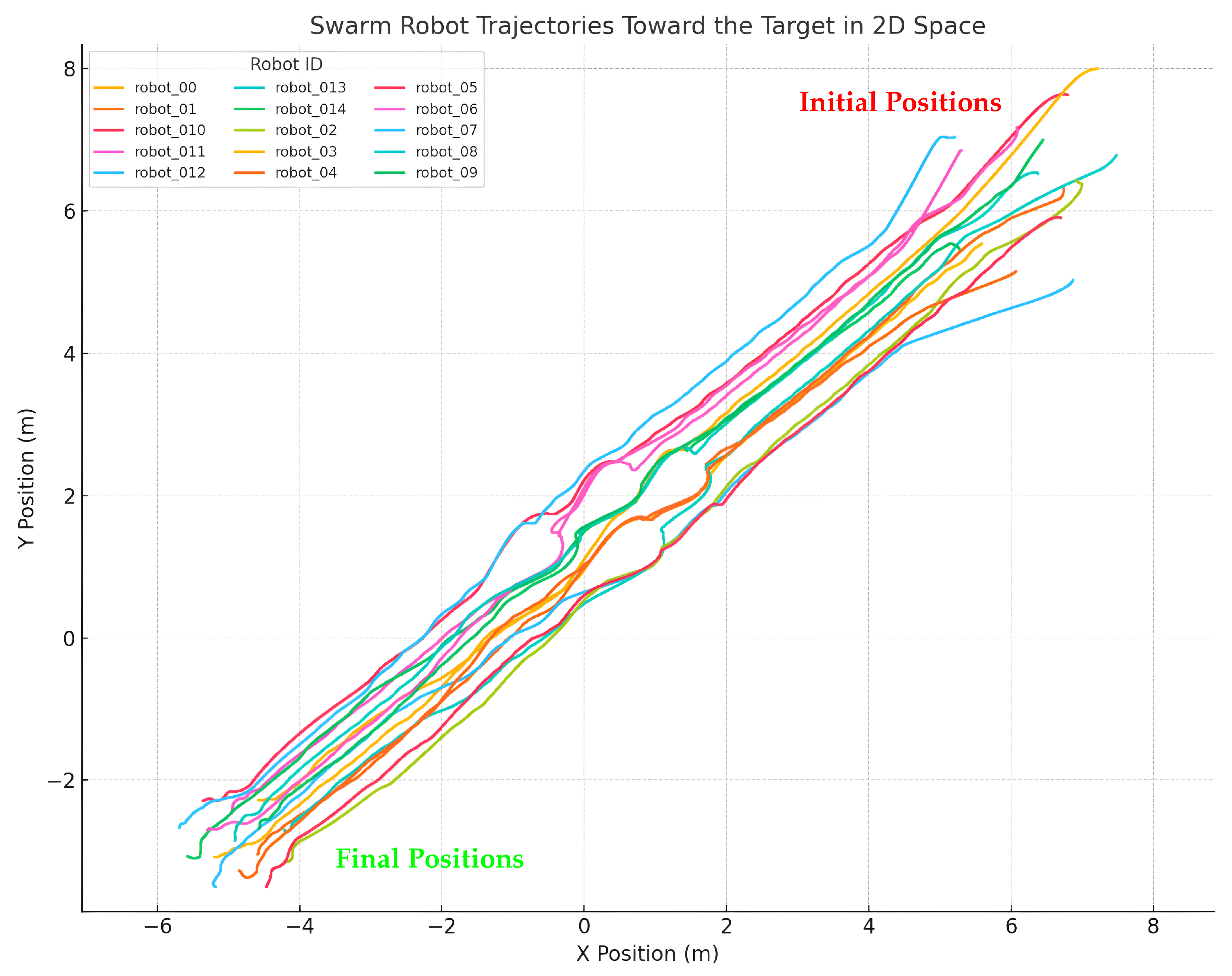
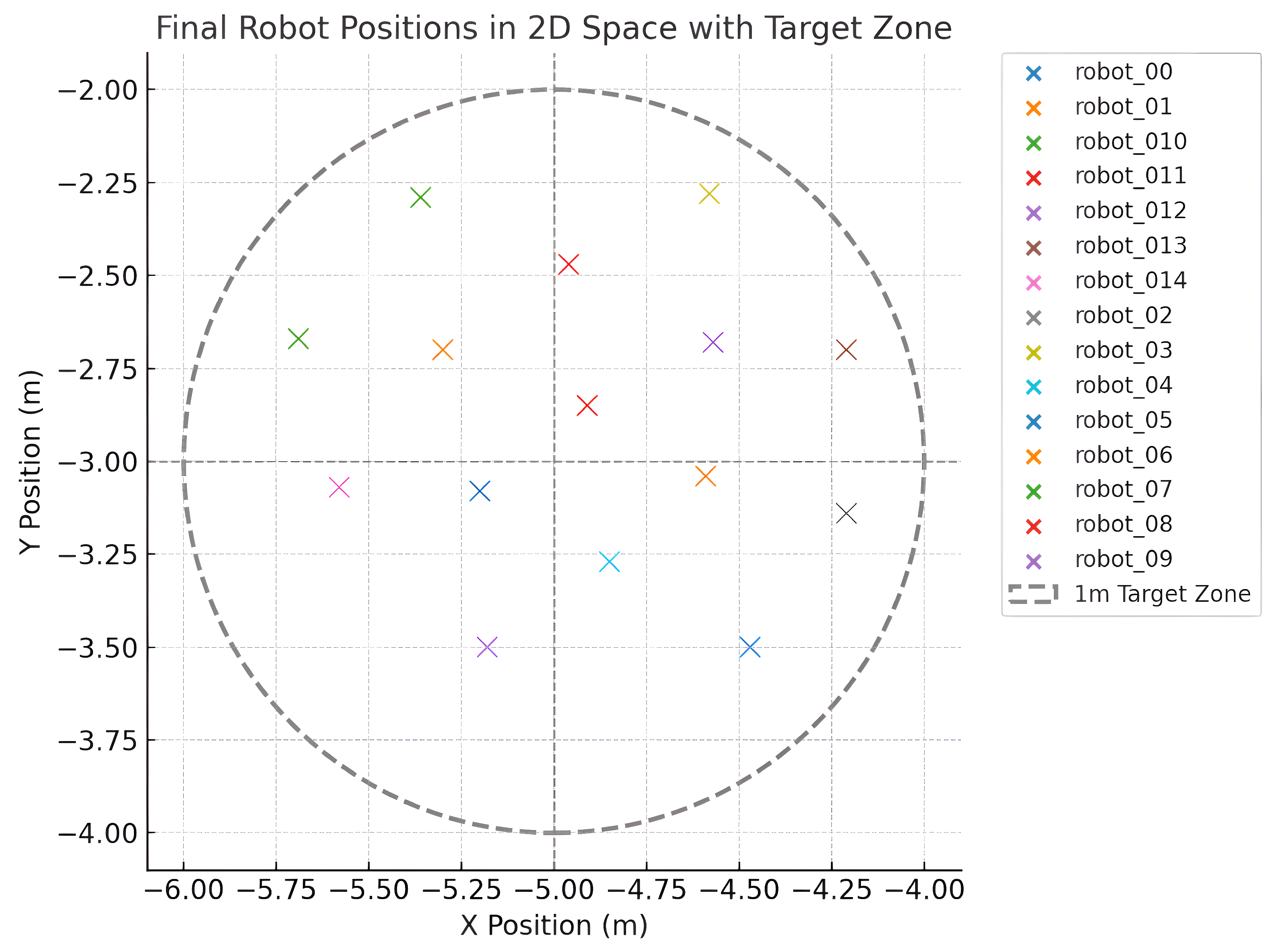
To evaluate the performance of the proposed swarm controller, a series of experiments were conducted using the ARGoS simulator with 15 foot-bot robots. Table 2 shows the parameter values used throughout the implementation, including the manually tuned hyperparameters, which were selected based on empirical performance across the tested scenarios. The primary objective was to validate the controller’s ability to guide the swarm toward a target position while preserving inter-robot formation and avoiding obstacles. Figure 5 provides a visual snapshot from the simulator during the task execution, illustrating the swarm’s successful convergence to the goal while maintaining coordinated structure and ensuring smooth obstacle avoidance. Furthermore, the 2D trajectories of all robots from their initial deployment to the final target zone are shown in Figure 6, demonstrating smooth and organized motion throughout the task. Therefore, Figure 7 shows the final configuration of the swarm upon arrival, confirming that the robots successfully preserved spatial coordination relative to one another at the destination.
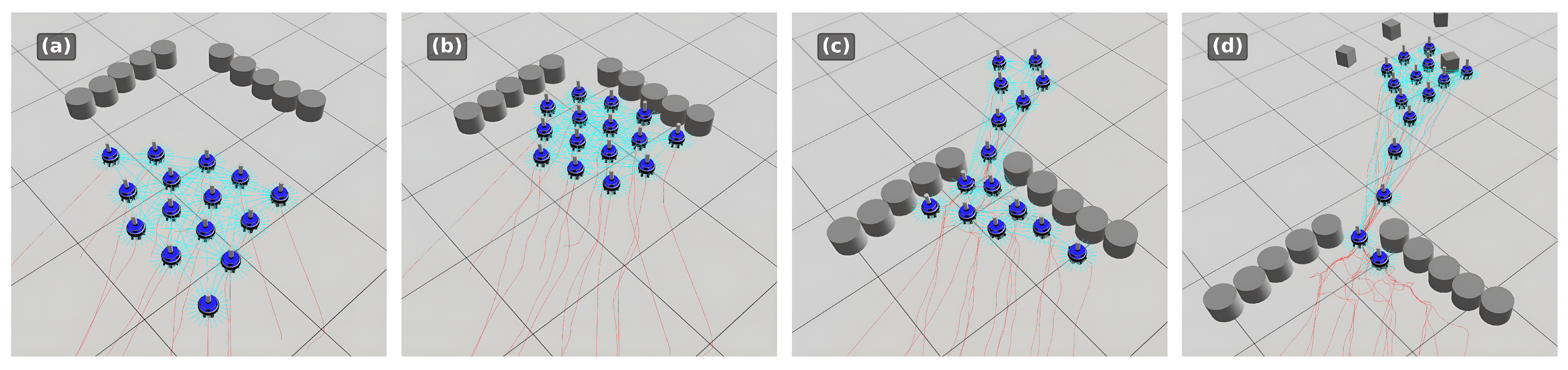
Beyond the main trajectory tracking experiment, additional test scenarios were implemented to assess the flexibility, scalability, and robustness of the control algorithm. In one set of tests, the swarm was tasked with navigating through challenging environments such as narrow passages and around long wall-type obstacles, as presented in Figure 8 and Figure 9, respectively. These trials helped to examine how well the swarm maintained formation under spatial constraints.
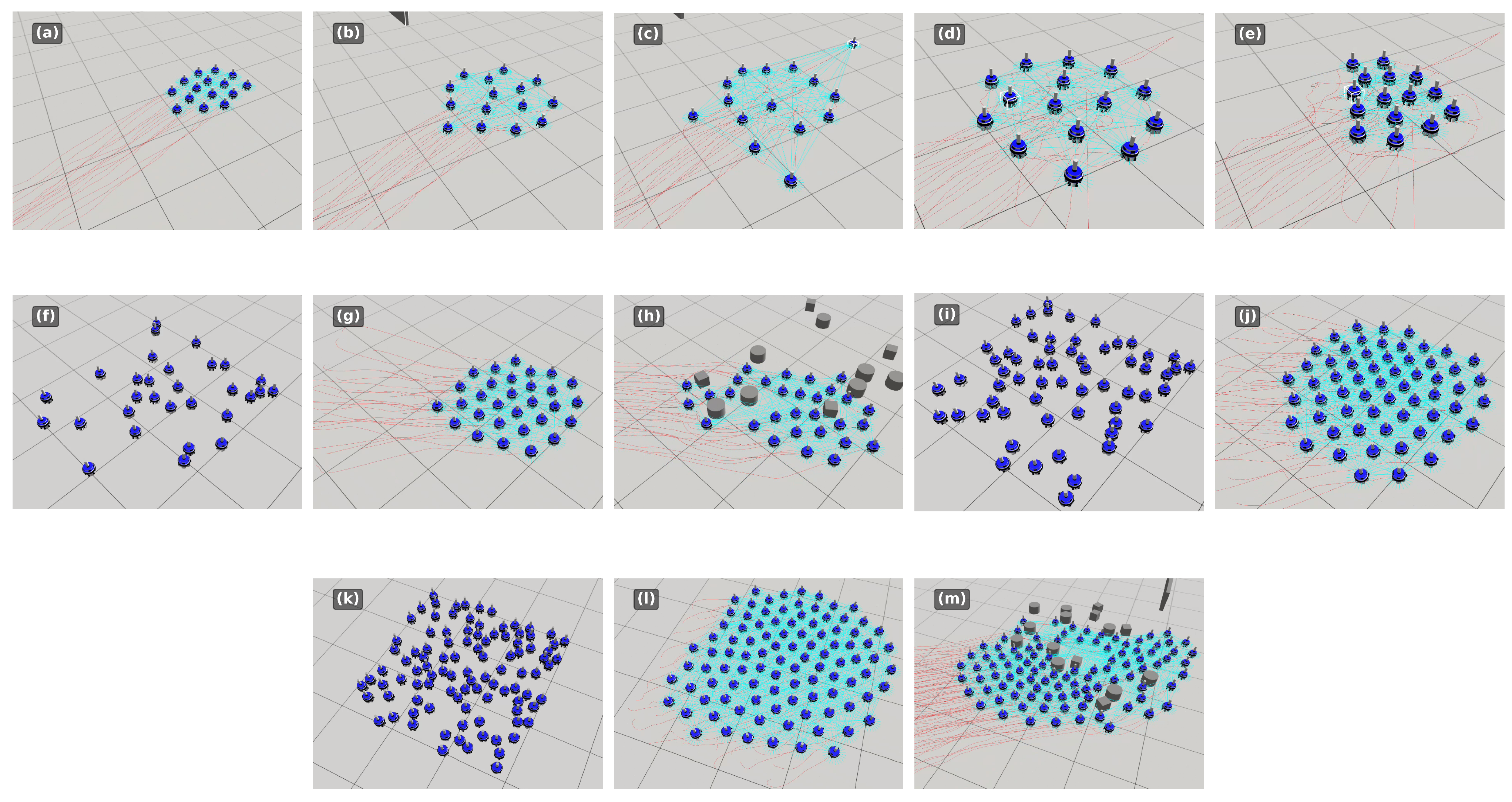
To further test robustness, we introduced disturbances by altering inter-robot distances and dynamically adding or removing agents from the swarm during the task. As shown in Figure 10a–e, the swarm consistently adapted to these changes by reforming its structure and continuing to progress toward the target, demonstrating the controller’s resilience to such disruptions.
In terms of scalability, the system was tested with increasing swarm sizes of 30, 60, and 100 robots as illustrated in Figure 10f–m. The controller exhibited stable performance in all cases, showing its capability to scale to larger teams without collapse or loss of coordination. Supplementary Videos recorded from ARGoS demonstrate these behaviors and provide visual validation (See Supplementary Materials).
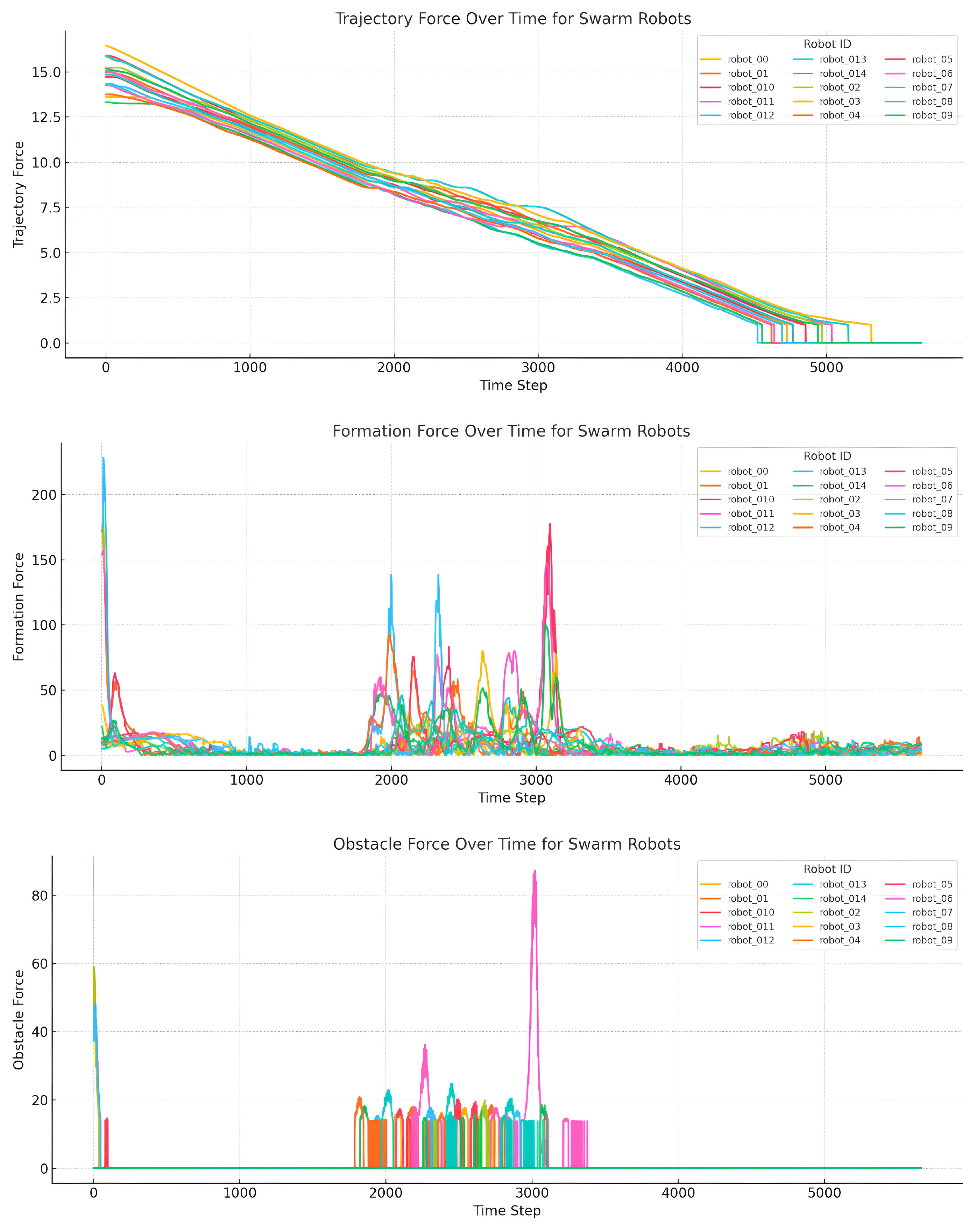
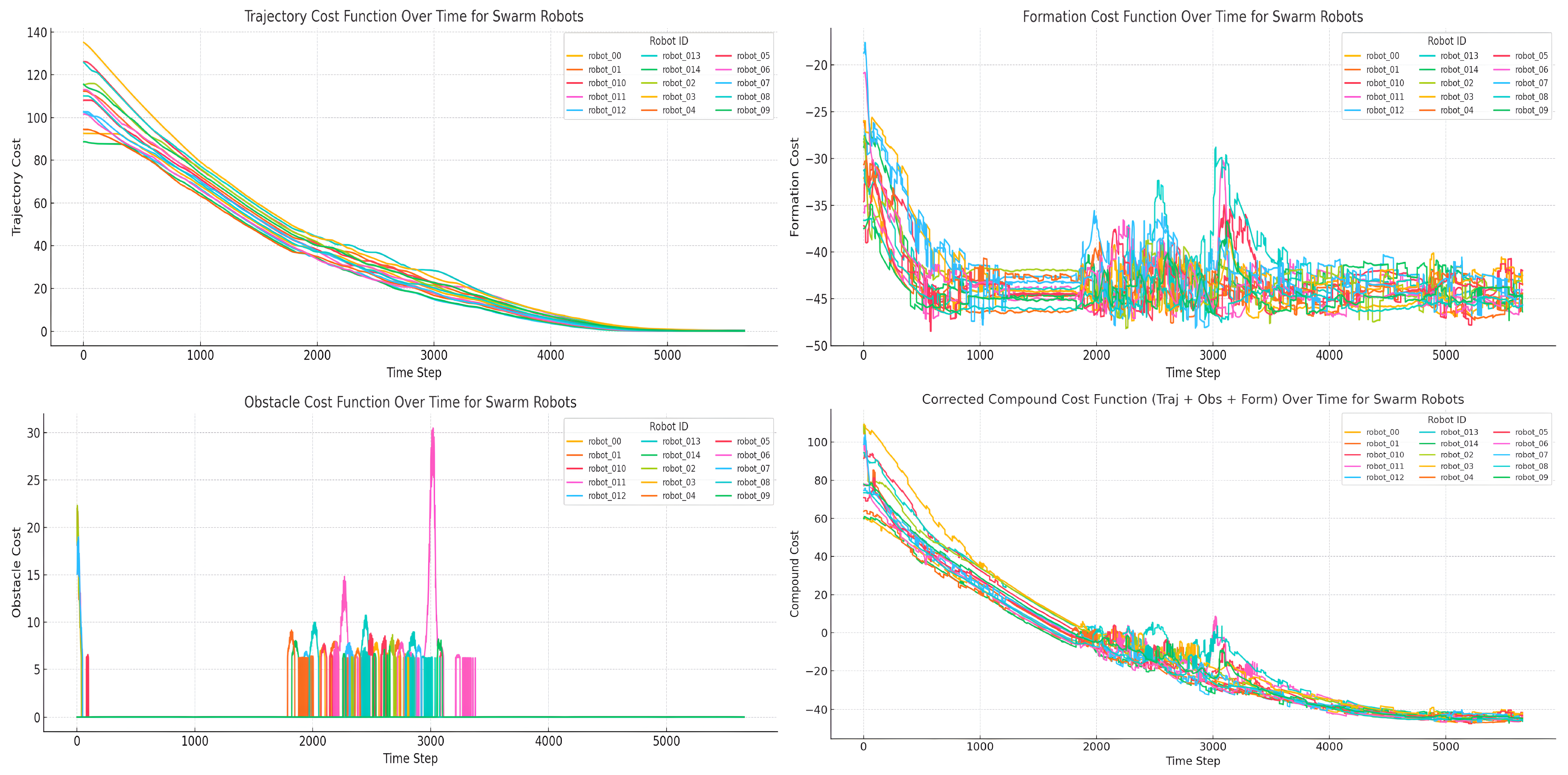
Moreover, each component of the control architecture—trajectory tracking, formation preservation, and obstacle avoidance—was analyzed using potential field-based cost functions. Individual and cumulative cost function values were plotted over time for the 15-robot configuration, as seen in Figure 11. Corresponding force plots were also generated to highlight the behavior of each controller component, as depicted in Figure 12.
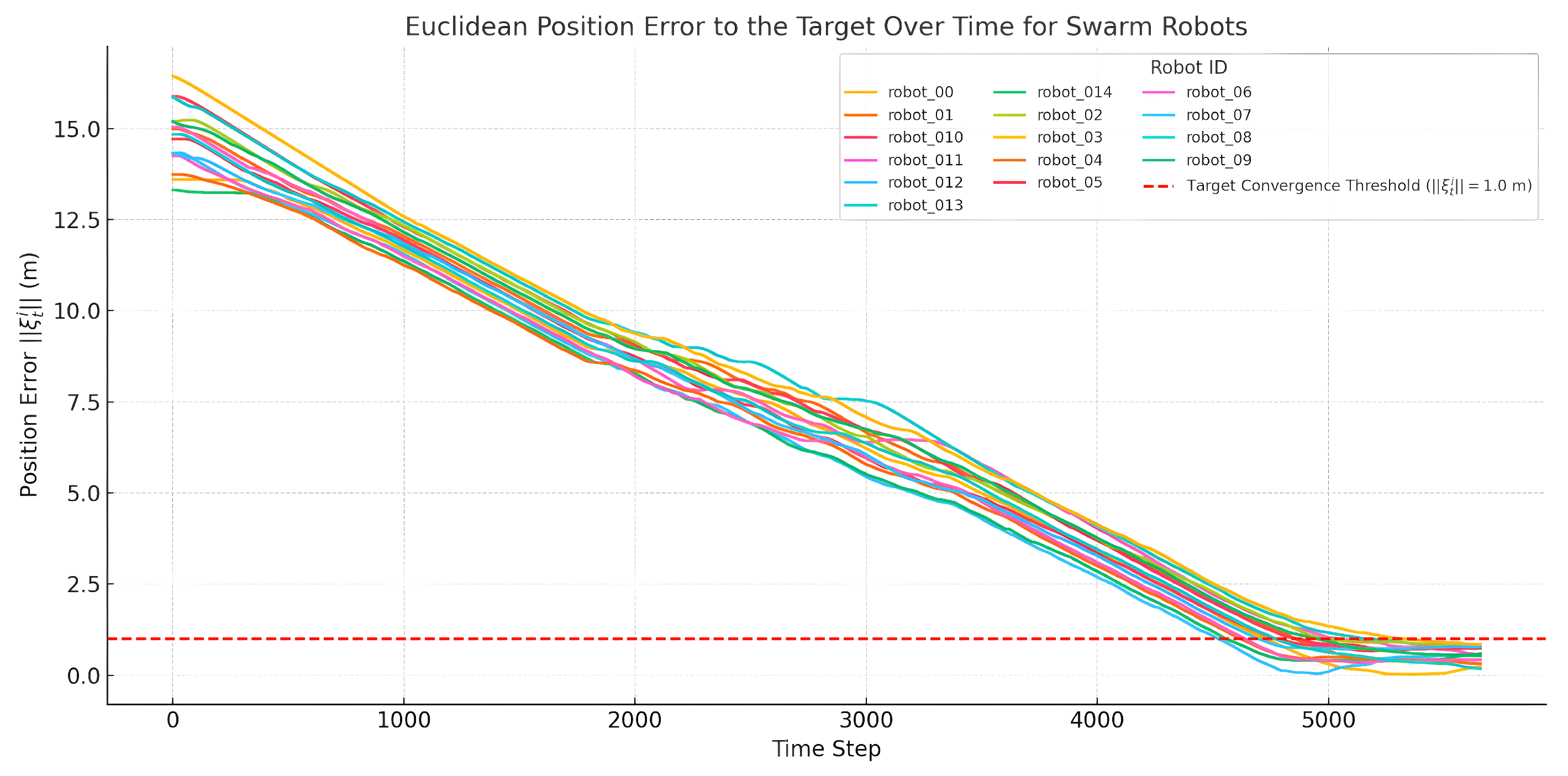
Additionally, we tracked the position of each robot upon task completion to verify spatial accuracy. Plots of the x-y trajectories for all agents reveal consistent convergence toward the goal across multiple runs. Improvements in position error were quantified, showing a clear trend of decreasing error over time, as visible in Figure 13.
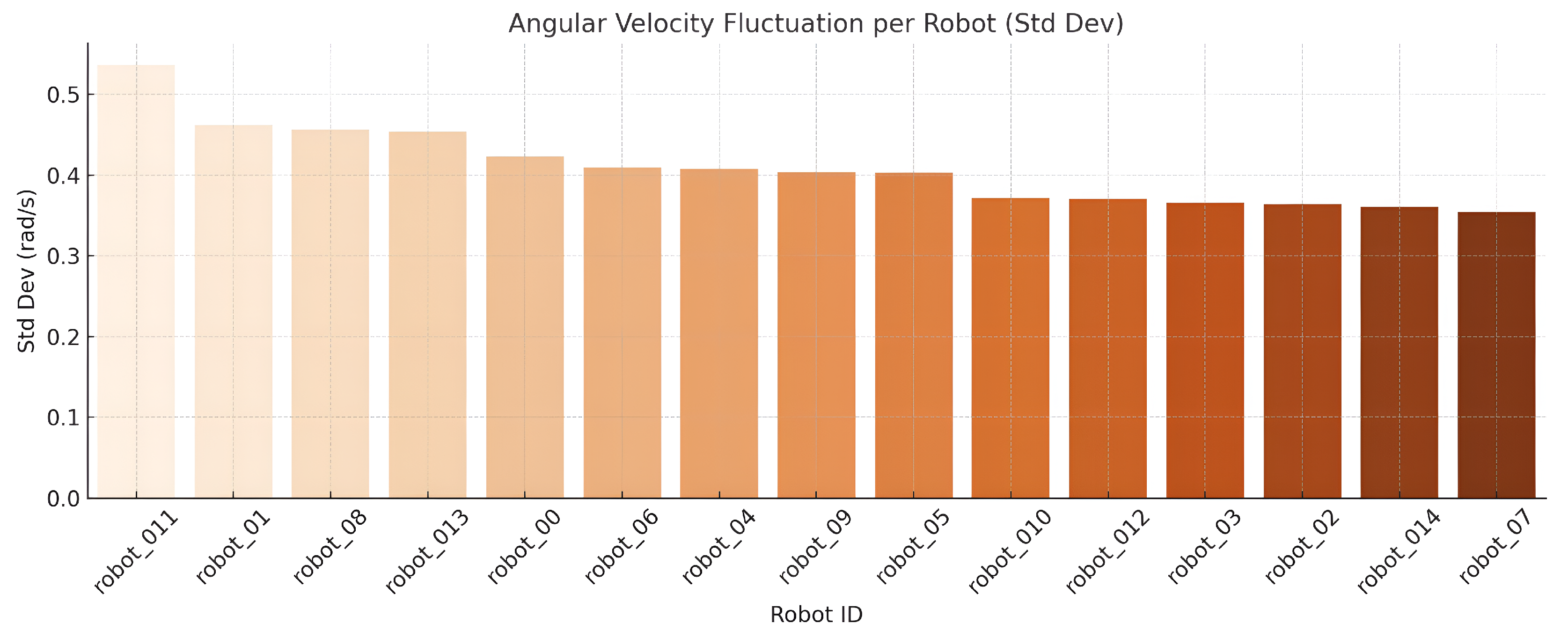
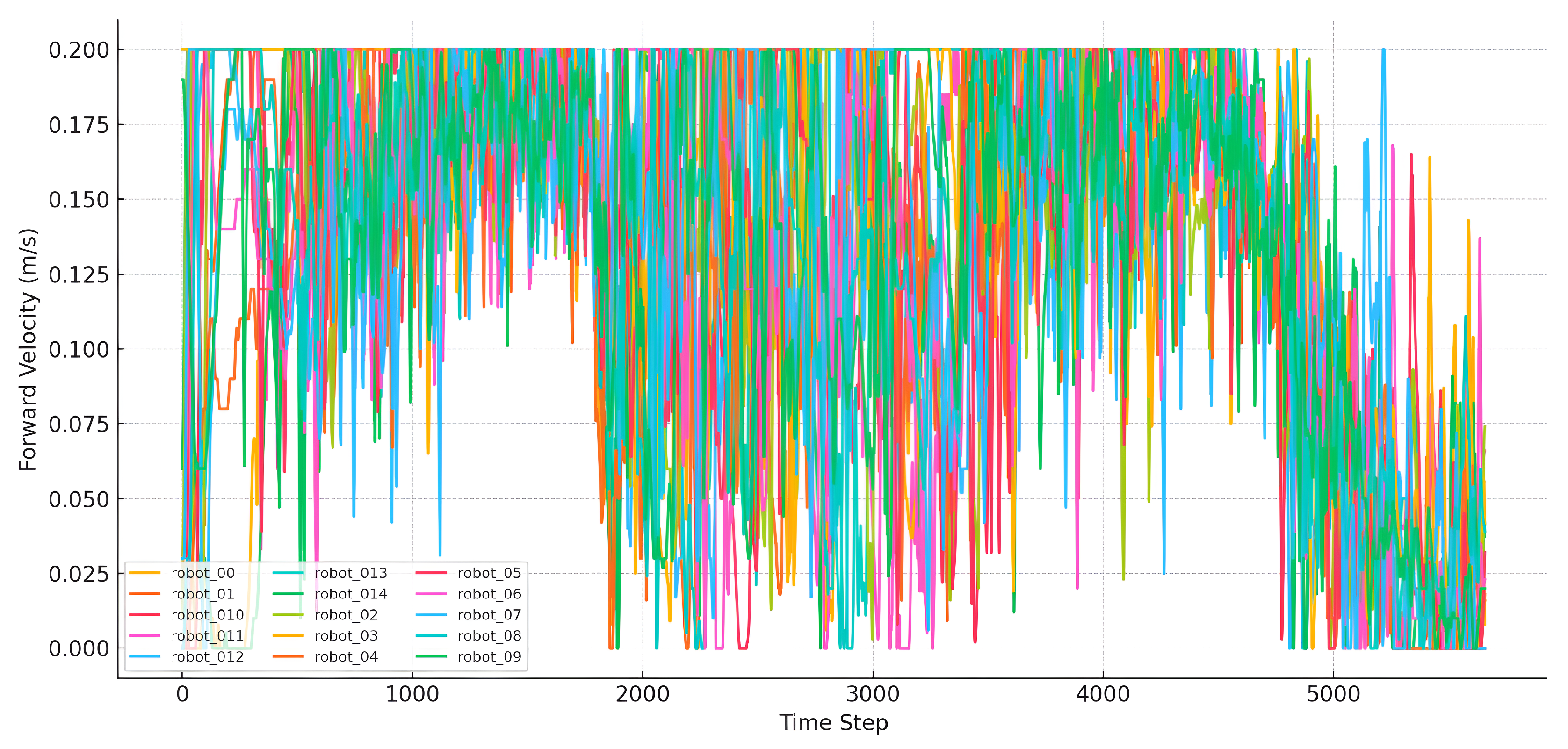
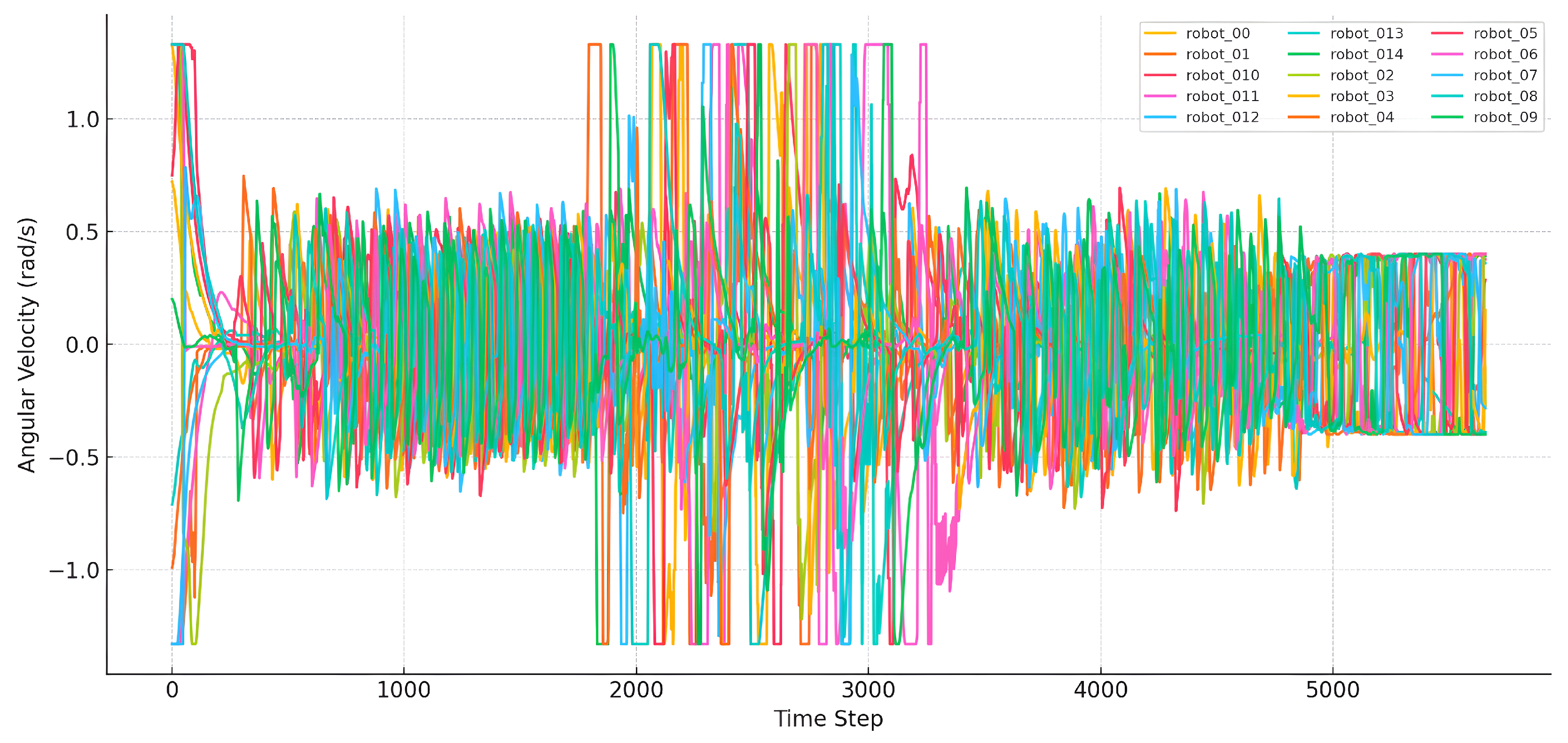
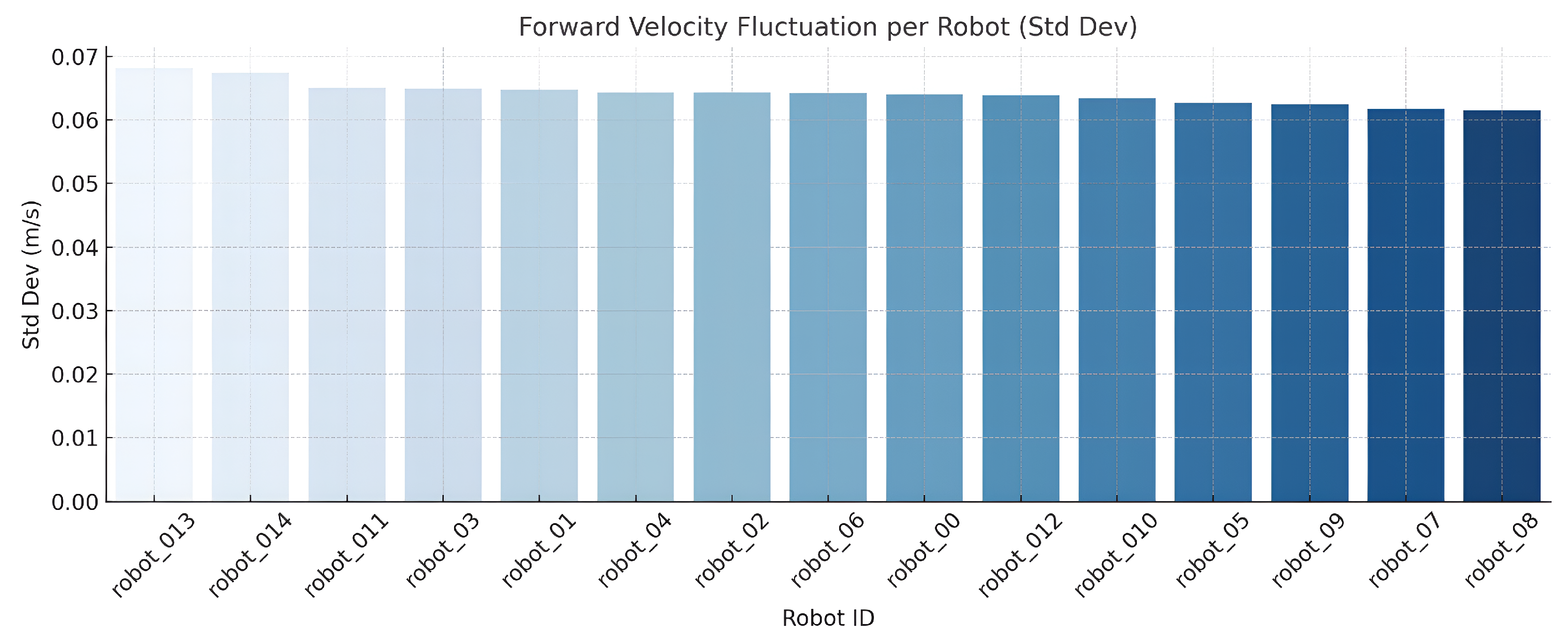
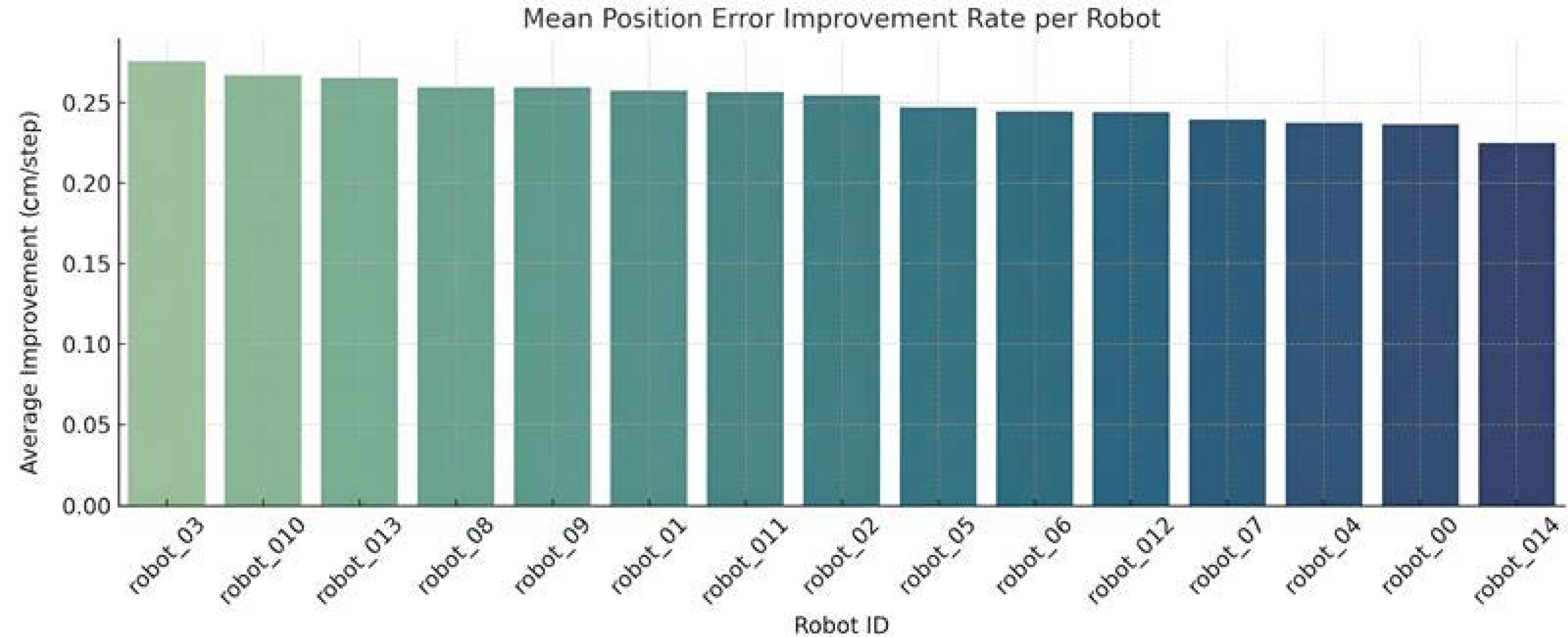
Furthermore, the forward and angular velocity profiles for each robot were analyzed, as illustrated in Figure 14 and Figure 15, respectively. To evaluate motion stability, standard deviation values were calculated, with Figure 16 showing the fluctuation in forward velocity for each robot, and Figure 17 presenting the corresponding angular velocity fluctuations. Moreover, Figure 18 provides a statistical measure of controller smoothness and stability by depicting the mean improvement rate in position error per step for each robot.
In addition to the qualitative and trajectory-based assessments, quantitative performance metrics were computed for the 15-robot configuration across five independent runs. These results, summarized in Table 3, report the completion time required for the entire swarm to enter the target region, along with the per-step distance-reduction rate as a measure of convergence efficiency. All runs successfully reached the goal area (a circle with 1 m radius), with a mean completion time of 697.7 s and an average improvement rate of 1.89 cm/s. These findings demonstrate that the proposed method successfully balances trajectory tracking, formation maintenance, and obstacle avoidance with dynamic responsiveness, even in the presence of environmental or internal disruptions.
Nonetheless, further improvements are recommended. Specifically, analysis of velocity fluctuations suggests that tuning the hyperparameters governing the combination of trajectory, formation, and obstacle avoidance potentials could enhance the controller’s smoothness and consistency. Once these refinements are implemented, we will be well-positioned to pursue our next objective: addressing the local minima issue inherent to potential field methods, which will be explored in our forthcoming work.

7. Conclusions

This paper presents a fully decentralized, self-organizing control framework for swarm robotics that unifies trajectory tracking, formation control, and obstacle avoidance using potential field-based techniques. Relying solely on local sensing and inter-robot communication, the proposed system enables each robot to operate autonomously without centralized control or prior knowledge of the environment. The approach has been extensively validated in the ARGoS simulator across a range of challenging scenarios, including unknown environments with static and dynamic obstacles, narrow passages, and wide wall-like structures.
Simulation results demonstrate that the swarm reliably converges to a designated target area while preserving formation integrity and avoiding collisions. Furthermore, the system supports the seamless addition and removal of robots, confirming its robustness and flexibility. Scalability has been tested successfully with swarm sizes from 15 up to 100 robots, showing consistent and stable performance.
The robustness tests involving the addition and removal of swarm members implicitly address several real-world challenges, such as temporary communication losses, robot dropouts, and recovery behavior. The proposed framework offers a comprehensive solution for distributed multi-robot coordination and sets the foundation for further research. Future work will focus on optimizing control parameters, improving convergence in complex environments, addressing local minima issues commonly associated with potential field methods, and conducting real-world validation. Future work will also examine the impact of sensing noise, intermittent communication links, and potential robot failures to ensure reliable deployment of the proposed controller on real swarm-robotic platforms. In addition, future work will explore extending the formation model beyond fixed inter-robot distances toward adaptive and task-specific shapes suitable for practical applications.
This framework contributes to advancing fully distributed swarm intelligence systems suitable for deployment in complex and unstructured environments.

Supplementary Materials

The following supporting information can be downloaded at: https://www.mdpi.com/article/10.3390/robotics14120192/s1.

Author Contributions

Conceptualization, M.A.-N., and S.E.-F.; Methodology, M.A.-N., S.E.-F., and A.-W.A.S.; Software, M.A.-N.; Validation, M.A.-N., and R.R.; Formal analysis, M.A.-N., and R.R.; Investigation, M.A.-N., and S.E.-F.; Resources, M.A.-N., A.-W.A.S., and S.E.-F.; Data curation, M.A.-N., R.R., and A.-W.A.S.; Visualization, M.A.-N.; Writing—original draft preparation, M.A.-N.; Writing—review and editing, S.E.-F., R.R., and A.-W.A.S.; Supervision, S.E.-F., and A.-W.A.S.; Project administration, S.E.-F., and A.-W.A.S.; Funding acquisition, S.E.-F. All authors have read and agreed to the published version of the manuscript.

Funding

This research was funded by King Fahd University of Petroleum and Minerals through the Interdisciplinary Research Center for Smart Mobility and Logistics (IRC-SML), Project #INML2505. The APC was funded by King Fahd University of Petroleum and Minerals.

Data Availability Statement

The data supporting the findings of this study were generated using the ARGoS simulator. Simulation videos are available at https://drive.google.com/drive/folders/12L6NnP7sjPSMP657inhAYR9D8BcaDvVn?usp=sharing (accessed on 8 December 2025).

Acknowledgments

The authors gratefully acknowledge the institutional support and research environment provided by King Fahd University of Petroleum and Minerals through the Interdisciplinary Research Center for Smart Mobility and Logistics. During the preparation of this manuscript, the authors used ChatGPT (OpenAI, web-based version), Gemini (Google, web-based version), and Picsart (web-based version) to assist with language refinement, figure quality enhancement, and graphical rendering. All AI-assisted outputs were reviewed, edited, and validated by the authors, who take full responsibility for the content of this publication.

Conflicts of Interest

The authors declare no conflicts of interest.

References

  1. Ivanova, N. Swarm robotics-coordination and cooperation: Exploring coordination and cooperation strategies in swarm robotics systems for achieving collective tasks. J. Comput. Intell. Robot. 2024, 4, 1–13. [Google Scholar]
  2. Thaker, R. An Overview of Swarm Robotics: Swarm Intelligence and Engineering Approaches for Coordinating Multi-Robot Systems. Int. J. Multidiscip. Res. 2021, 3, 29703. [Google Scholar] [CrossRef]
  3. Devi, K.V.R.; Smitha, B.; Lakhanpal, S.; Kalra, R.; Sethi, V.A.; Thajil, S.K. A review: Swarm robotics: Cooperative control in multi-agent systems. In Proceedings of the E3S Web of Conferences; EDP Sciences: Les Ulis, France, 2024; Volume 505, p. 03013. [Google Scholar] [CrossRef]
  4. Dorigo, M.; Theraulaz, G.; Trianni, V. Swarm robotics: Past, present, and future [point of view]. Proc. IEEE 2021, 109, 1152–1165. [Google Scholar] [CrossRef]
  5. Nguyen, L.V. Swarm Intelligence-Based Multi-Robotics: A Comprehensive Review. AppliedMath 2024, 4, 1192–1210. [Google Scholar] [CrossRef]
  6. Dias, P.G.F.; Silva, M.C.; Rocha Filho, G.P.; Vargas, P.A.; Cota, L.P.; Pessin, G. Swarm robotics: A perspective on the latest reviewed concepts and applications. Sensors 2021, 21, 2062. [Google Scholar] [CrossRef]
  7. Duan, H.; Huo, M.; Fan, Y. From animal collective behaviors to swarm robotic cooperation. Natl. Sci. Rev. 2023, 10, nwad040. [Google Scholar] [CrossRef]
  8. Petráček, P.; Walter, V.; Báča, T.; Saska, M. Bio-inspired compact swarms of unmanned aerial vehicles without communication and external localization. Bioinspir. Biomimetics 2020, 16, 026009. [Google Scholar] [CrossRef]
  9. Debie, E.; Kasmarik, K.; Garratt, M. Swarm robotics: A Survey from a Multi-tasking Perspective. ACM Comput. Surv. 2023, 56, 1–38. [Google Scholar] [CrossRef]
  10. Asri, E.G.; Zhu, Z.H. An introductory review of swarm technology for spacecraft on-orbit servicing. Int. J. Mech. Syst. Dyn. 2024, 4, 3–21. [Google Scholar] [CrossRef]
  11. Pachajoa, G.M.M.; Achicanoy, W.; Ramos, D.G. Automating the Evaluation of the Scalability, Flexibility, and Robustness of Collective Behaviors for Robot Swarms. In Proceedings of the 2024 Brazilian Symposium on Robotics (SBR), and 2024 Workshop on Robotics in Education (WRE), Goiania, Brazil, 13–15 November 2024; pp. 144–149. [Google Scholar]
  12. Milner, E.; Sooriyabandara, M.; Hauert, S. Swarm Performance Indicators: Metrics for robustness, fault tolerance, scalability and adaptability. arXiv 2023, arXiv:2311.01944. [Google Scholar] [CrossRef]
  13. Kegeleirs, M.; Birattari, M. Towards applied swarm robotics: Current limitations and enablers. Front. Robot. AI 2025, 12, 1607978. [Google Scholar] [CrossRef] [PubMed]
  14. Albiero, D.; Garcia, A.P.; Umezu, C.K.; de Paulo, R.L. Swarm robots in mechanized agricultural operations: A review about challenges for research. Comput. Electron. Agric. 2022, 193, 106608. [Google Scholar] [CrossRef]
  15. Al-Amin, A.A.; Lowenberg-DeBoer, J.; Franklin, K.; Dickin, E.; Monaghan, J.M.; Behrendt, K. Autonomous regenerative agriculture: Swarm robotics to change farm economics. Smart Agric. Technol. 2025, 11, 101005. [Google Scholar] [CrossRef]
  16. Abhang, L.; Gummadi, A.; Changala, R.; Vuyyuru, V.A.; Sabareesh, R.; Raj, I.I. Swarm Intelligence for Multi-Robot Coordination in Agricultural Automation. In Proceedings of the 2024 10th International Conference on Advanced Computing and Communication Systems (ICACCS), Coimbatore, India, 14–15 March 2024; Volume 1, pp. 455–460. [Google Scholar]
  17. Siemensma, T.; Chiu, D.; Ramshanker, S.; Nagpal, R.; Haghighat, B. Collective Bayesian Decision-Making in a Swarm of Miniaturized Robots for Surface Inspection. In Proceedings of the International Conference on Swarm Intelligence, Konstanz, Germany, 9–11 October 2024; Springer: Cham, Switzerland, 2024; pp. 57–70, (Confirmed and approved). [Google Scholar]
  18. Chiu, D.; Nagpal, R.; Haghighat, B. Optimization and Evaluation of a Multi Robot Surface Inspection Task Through Particle Swarm Optimization. In Proceedings of the 2024 IEEE International Conference on Robotics and Automation (ICRA), Yokohama, Japan, 13–17 May 2024; pp. 8996–9002. [Google Scholar]
  19. Hoang, M.T.O.; Grøntved, K.A.R.; van Berkel, N.; Skov, M.B.; Christensen, A.L.; Merritt, T. Drone swarms to support search and rescue operations: Opportunities and challenges. In Cultural Robotics: Social Robots and Their Emergent Cultural Ecologies; Springer: Cham, Switzerland, 2023; pp. 163–176. [Google Scholar]
  20. García, R.M.; De La Iglesia, D.H.; De Paz, J.F.; Leithardt, V.R.; Villarrubia, G. Urban search and rescue with anti-pheromone robot swarm architecture. In Proceedings of the 2021 Telecoms Conference (ConfTELE), Leiria, Portugal, 11–12 February 2021; pp. 1–6. [Google Scholar]
  21. Kumar, V.; Das, S. Navigating the swarm: Bio-inspired robotics, intelligent algorithms, and applications. In Bio-Inspired Swarm Robotics and Control: Algorithms, Mechanisms, and Strategies; IGI Global: Hershey, PA, USA, 2024; pp. 140–154. [Google Scholar]
  22. Arunkumar, V.; Rajasekar, D.; Aishwarya, N. A review paper on mobile robots applications in search and rescue operations. Adv. Sci. Technol. 2023, 130, 65–74. [Google Scholar] [CrossRef]
  23. Gul, F.; Mir, I.; Abualigah, L.; Sumari, P. Multi-robot space exploration: An augmented arithmetic approach. IEEE Access 2021, 9, 107738–107750. [Google Scholar] [CrossRef]
  24. Alqudsi, Y.; Makaraci, M. Exploring advancements and emerging trends in robotic swarm coordination and control of swarm flying robots: A review. Proc. Inst. Mech. Eng. Part C J. Mech. Eng. Sci. 2025, 239, 180–204. [Google Scholar] [CrossRef]
  25. Romeh, A.E.; Mirjalili, S. Multi-robot exploration of unknown space using combined meta-heuristic salp swarm algorithm and deterministic coordinated multi-robot exploration. Sensors 2023, 23, 2156. [Google Scholar] [CrossRef]
  26. Kuckling, J. Recent trends in robot learning and evolution for swarm robotics. Front. Robot. AI 2023, 10, 1134841. [Google Scholar] [CrossRef]
  27. Koifman, Y.; Barel, A.; Bruckstein, A.M. Distributed and Decentralized Control and Task Allocation for Flexible Swarms. arXiv 2024, arXiv:2405.13941. [Google Scholar] [CrossRef]
  28. Gutiérrez, Á. Recent advances in swarm robotics coordination: Communication and memory challenges. Appl. Sci. 2022, 12, 11116. [Google Scholar] [CrossRef]
  29. Lamperti, R.D.; de Arruda, L.V.R. Distributed strategy for communication between multiple robots during formation navigation task. Robot. Auton. Syst. 2023, 169, 104509. [Google Scholar] [CrossRef]
  30. Ratnabala, L.; Peter, R.; Charles, E. Evolutionary Swarm Robotics: Dynamic Subgoal-Based Path Formation and Task Allocation for Exploration and Navigation in Unknown Environments. arXiv 2023, arXiv:2312.16606. [Google Scholar] [CrossRef]
  31. Muhsen, D.K.; Sadiq, A.T.; Raheem, F.A. A survey on swarm robotics for area coverage problem. Algorithms 2023, 17, 3. [Google Scholar] [CrossRef]
  32. Mao, P.; Lv, S.; Min, C.; Shen, Z.; Quan, Q. An Efficient Real-Time Planning Method for Swarm Robotics Based on an Optimal Virtual Tube. arXiv 2025, arXiv:2505.01380. [Google Scholar] [CrossRef]
  33. Ding, K.; Jiao, C.; Hu, Y.; Zhou, K.; Wu, P.; Mu, Y.; Liu, C. SwarmDiff: Swarm Robotic Trajectory Planning in Cluttered Environments via Diffusion Transformer. In Proceedings of the Computer Vision and Pattern Recognition Conference (CVPR) Workshops, Nashville, TN, USA, 11–15 June 2025; pp. 4164–4173. [Google Scholar]
  34. Tang, Y.; Bai, Y.; Chen, Q. An Adaptive Obstacle Avoidance Model for Autonomous Robots Based on Dual-Coupling Grouped Aggregation and Transformer Optimization. Sensors 2025, 25, 1839. [Google Scholar] [CrossRef]
  35. Marek, D.; Biernacki, P.; Szyguła, J.; Domański, A.; Paszkuta, M.; Szczygieł, M.; Król, M.; Wojciechowski, K. Collision Avoidance Mechanism for Swarms of Drones. Sensors 2025, 25, 1141. [Google Scholar] [CrossRef]
  36. Batool, F.; Zafar, M.; Yaqoot, Y.; Khan, R.A.; Khan, M.H.; Fedoseev, A.; Tsetserukou, D. ImpedanceGPT: VLM-driven Impedance Control of Swarm of Mini-drones for Intelligent Navigation in Dynamic Environment. arXiv 2025, arXiv:2503.02723. [Google Scholar]
  37. Pham, H.; Ranasinghe, N.; Le, D.; Atman, M.W.S.; Gusrialdi, A. Safety-Guaranteed Distributed Formation Control of Multi-Robot Systems Over Graphs With Rigid and Elastic Edges. IEEE Robot. Autom. Lett. 2024, 9, 10240–10247. [Google Scholar] [CrossRef]
  38. Maaruf, M.; El-Ferik, S.; Abdulaziz Saif, A. Critic learning control via zero-sum differential game for affine formation maneuver of multi-agent systems with cyber-attacks. Int. J. Syst. Sci. 2024, 55, 2252–2268. [Google Scholar] [CrossRef]
  39. El Ferik, S.; Aliyu, A. Adaptive Backstepping Multi-Agent Control of Multiple UAVs Conveying Load: A Graph Rigidity Approach. IEEE Access 2023, 11, 58269–58278. [Google Scholar] [CrossRef]
  40. Alabsari, N.; Saif, A.W.A.; El-Ferik, S.; Duffuaa, S.; Derbel, N. Cooperative flight control of a fleet of quadrotors using fractional sliding mode with potential field algorithms. IEEE Access 2024, 12, 24525–24543. [Google Scholar] [CrossRef]
  41. Saif, A.; Alabsari, N.; Ferik, S.; Elshafei, M. Formation control of quadrotors via potential field and geometric techniques. Int. J. Adv. Appl. Sci 2020, 7, 82–96. [Google Scholar]
  42. Ali, Z.A.; Alkhammash, E.H.; Hasan, R. State-of-the-Art Flocking Strategies for the Collective Motion of Multi-Robots. Machines 2024, 12, 739. [Google Scholar] [CrossRef]
  43. Imran, B.M.; Kim, J.; Chunawala, T.; Leonessa, A.; Hamed, K.A. Safety-Critical and Distributed Nonlinear Predictive Controllers for Teams of Quadrupedal Robots. arXiv 2025, arXiv:2503.14656. [Google Scholar] [CrossRef]
  44. De Andrade, E.M.; Junior, J.S.S.; Fernandes, A.C. A review of straightforward distributed behaviors in swarm robotics. In Proceedings of the 2023 Latin American Robotics Symposium (LARS), 2023 Brazilian Symposium on Robotics (SBR), and 2023 Workshop on Robotics in Education (WRE), Salvador, Brazil, 9–11 October 2023; pp. 113–118. [Google Scholar] [CrossRef]
  45. Elkilany, B.G.; Abouelsoud, A.; Fathelbab, A.M.; Ishii, H. A proposed decentralized formation control algorithm for robot swarm based on an optimized potential field method. Neural Comput. Appl. 2021, 33, 487–499. [Google Scholar] [CrossRef]
  46. Ruiz-Fernandez, L.E.; Ruiz-Leon, J.; Gomez-Gutierrez, D.; Murrieta-Cid, R. Decentralized multi-robot formation control in environments with non-convex and dynamic obstacles based on path planning algorithms. Intell. Serv. Robot. 2025, 18, 215–232. [Google Scholar] [CrossRef]
  47. Bi, Y.; Luo, J.; Zhu, J.; Liu, J.; Li, W. Decentralized Multi-Robot Navigation Based on Deep Reinforcement Learning and Trajectory Optimization. Biomimetics 2025, 10, 366. [Google Scholar] [CrossRef]
  48. Gerdpratoom, N.; Yamamoto, K. Decentralized nonlinear model predictive control-based flock navigation with real-time obstacle avoidance in unknown obstructed environments. Front. Robot. AI 2025, 12, 1540808. [Google Scholar] [CrossRef]
  49. Chang, L.; Shan, L.; Zhang, W.; Dai, Y. Hierarchical multi-robot navigation and formation in unknown environments via deep reinforcement learning and distributed optimization. Robot. Comput.-Integr. Manuf. 2023, 83, 102570. [Google Scholar] [CrossRef]
  50. Goodin, C.; Henley, G.; Cagle, L.; Black, B.; Carrillo, J.; McInnis, D. Decentralized Swarm Control in Communication-Constrained Environments Using a Blended Leader Follower-Artificial Potential Field With Biologically Inspired Interactions. J. Auton. Veh. Syst. 2023, 3, 041001. [Google Scholar] [CrossRef]
  51. Pinciroli, C.; Trianni, V.; O’Grady, R.; Pini, G.; Brutschy, A.; Brambilla, M.; Mathews, N.; Ferrante, E.; Di Caro, G.; Ducatelle, F.; et al. ARGoS: A modular, parallel, multi-engine simulator for multi-robot systems. Swarm Intell. 2012, 6, 271–295. [Google Scholar] [CrossRef]
  52. Fan, Y.; Li, X.; Liu, X.; Cheng, S.; Wang, X. Multi-robot consensus formation based on virtual spring obstacle avoidance. Mech. Sci. 2024, 15, 195–207. [Google Scholar] [CrossRef]
  53. Wang, J.; Guo, B.; Zhao, K.; Liu, S.; Yu, Z. Bio-inspired Decentralized Multi-robot Exploration in Unknown Environments. In Proceedings of the 2023 IEEE 20th International Conference on Mobile Ad Hoc and Smart Systems (MASS), Toronto, ON, Canada, 25–27 September 2023; pp. 204–210. [Google Scholar]
  54. Chang, X.; Jiao, J.; Li, Y.; Hong, B. Multi-consensus formation control by artificial potential field based on velocity threshold. Front. Neurosci. 2024, 18, 1367248. [Google Scholar] [CrossRef] [PubMed]
  55. Shao, S.; Zhang, J.; Wang, T.; Shankar, A.; Maple, C. Dynamic obstacle-avoidance algorithm for multi-robot flocking based on improved artificial potential field. IEEE Trans. Consum. Electron. 2023, 70, 4388–4399. [Google Scholar] [CrossRef]
  56. Tong, X.; Yu, S.; Liu, G.; Niu, X.; Xia, C.; Chen, J.; Yang, Z.; Sun, Y. A hybrid formation path planning based on A* and multi-target improved artificial potential field algorithm in the 2D random environments. Adv. Eng. Inform. 2022, 54, 101755. [Google Scholar] [CrossRef]
  57. Ding, W.; Zhang, L.; Zhang, G.; Wang, C.; Chai, Y.; Yang, T.; Mao, Z. Research on obstacle avoidance of multi-AUV cluster formation based on virtual structure and artificial potential field method. Comput. Electr. Eng. 2024, 117, 109250. [Google Scholar] [CrossRef]
  58. Sahal, M.; Maynad, V.C.; Bilfaqih, Y. Cooperative Formation and Obstacle Avoidance Control for Multi-UAV Based on Guidance Route and Artificial Potential Field. J. Robot. Control (JRC) 2024, 5, 1772–1783. [Google Scholar]
  59. Lajčiak, M.; Vachálek, J. Swarm Control with RRT-APF Planning and FNN Task Allocation Tested on Mobile Differential Platform. Sensors 2025, 25, 3886. [Google Scholar] [CrossRef]
  60. dos Passos, Y.T.; Duquesne, X.; Marcolino, L.S. Congestion control algorithms for robotic swarms with a common target based on the throughput of the target area. Robot. Auton. Syst. 2023, 159, 104284. [Google Scholar] [CrossRef]
  61. Dong, C.; Zheng, B.; He, S. Adaptive formation control of nonholonomic multirobot systems with collision avoidance and connectivity maintenance. Int. J. Syst. Sci. 2024, 55, 2289–2305. [Google Scholar] [CrossRef]
  62. Omotuyi, O.; Kumar, M. Learning Scalable Decentralized Controllers for Heterogeneous Robot Swarms With Graph Neural Networks. J. Dyn. Syst. Meas. Control 2024, 146, 061107. [Google Scholar]
  63. Istiak, M.A.; Ullah, M.S.; Ashraf, Z.B.; Sarker, S.C.; Chowdhury, M.M.; Ahbab, S.S. SymSwarm: A Two-Staged Decentralized Symmetrical Pattern Formation Paradigm for a Swarm of Mobile Robots. Arab. J. Sci. Eng. 2023, 48, 15509–15526. [Google Scholar] [CrossRef]
  64. Gao, Y.; Bai, C.; Fu, R.; Quan, Q. A non-potential orthogonal vector field method for more efficient robot navigation and control. Robot. Auton. Syst. 2023, 159, 104291. [Google Scholar] [CrossRef]
  65. Zhang, Z.; Wang, X.; Zhang, Q.; Hu, T. Multi-robot cooperative pursuit via potential field-enhanced reinforcement learning. In Proceedings of the 2022 International Conference on Robotics and Automation (ICRA), Philadelphia, PA, USA, 23–27 May 2022; pp. 8808–8814. [Google Scholar]
  66. Chen, W.; Wu, X.; Lu, Y. An improved path planning method based on artificial potential field for a mobile robot. Cybern. Inf. Technol. 2015, 15, 181–191. [Google Scholar] [CrossRef]
  67. Ran, Y.; Bertola, V. Achievements and prospects of molecular dynamics simulations in thermofluid sciences. Energies 2024, 17, 888. [Google Scholar] [CrossRef]
  68. Gavrielides, A. Modelling the DGEBA-EDA Poly-Epoxy Reactivity Towards Copper Experimental and Numerical Approach. Ph.D. Thesis, Université Paul Sabatier-Toulouse III, Toulouse, France, 2017. [Google Scholar]
Figure 1. Frames of reference. (a) Inertial frame. (b) Robot i coordinate frame. (c) Bearing angle and Euclidean distance for the origin of frame { j } with respect to frame { i } . (d) Rotation angle and Euclidean distance of obstacle k, expressed in frame { i } .
Robotics 14 00192 g001
Figure 2. The translation vectors of robot i and the target position, both expressed in the global frame { 0 } , are used to compute the translation vector of the target with respect to the coordinate frame of robot i.
Robotics 14 00192 g002
Figure 3. The Lennard-Jones potential field energy is named after John Lennard-Jones, a British physicist. It models the interaction between pairs of particles (e.g., atoms or robots), combining repulsion and attraction [68].
Robotics 14 00192 g003
Figure 4. Structural components of the Foot-bot robot, including its modular base, wheels, range-and-bearing module, omnidirectional camera, proximity sensors, and optional attachments used for swarm robotics applications.
Robotics 14 00192 g004
Figure 5. Snapshots from the ARGoS simulator during task execution, showing the swarm converging toward the target while maintaining coordinated formation and avoiding obstacles. (a) represents the initial configuration of the swarm members. (b,c) Formation consolidation as the swarm aligns its motion toward the target direction while maintaining inter-robot spacing. (d,e) Navigation through a denser obstacle region, where robots temporarily deform the formation to safely bypass obstacles. (f,g) Reformation phase after clearing the obstacle region, where the swarm restores its desired formation and alignment toward the target. (h) shows the final state reaching the target, which is defined as a goal area to allow safe multi-robot convergence and formation settling within a practical spatial region.
Robotics 14 00192 g005
Figure 6. Trajectories of all swarm robots from their initial deployment to the target zone in 2D space, illustrating coordinated and smooth motion throughout the task execution.
Robotics 14 00192 g006
Figure 7. Final configuration of the swarm at the target zone, demonstrating that spatial coordination among the robots was successfully preserved upon arrival.
Robotics 14 00192 g007
Figure 8. Swarm robot navigation through a narrow passage, illustrating the system’s flexibility in maintaining formation while operating in spatially constrained environments. (a,b) The swarm maintains a cohesive formation while aligning its motion toward the constrained region. (c) Temporary formation elongation as the swarm passes through the narrow gap while avoiding collisions. (d) The robots restore their desired formation after clearing the passage and continue moving toward the target area.
Robotics 14 00192 g008
Figure 9. Swarm traversal alongside an extended wall obstacle, demonstrating the controller’s robustness in navigating elongated spatial barriers and maintaining coordination under boundary constraints.(a,b) Initial approach and alignment of the swarm parallel to the long wall while maintaining a compact formation. (ce) Progressive formation elongation as robots move alongside the wall and preserve safe clearance from the boundary. (f,g) Local reorganization and turning maneuver as the swarm negotiates the wall end and transitions around the corner. (h) Reformation of the swarm after clearing the wall, restoring a cohesive structure and continuing motion toward the target area.
Robotics 14 00192 g009
Figure 10. Swarm behavior under robustness and scalability evaluations. Subfigures (ae) illustrate the response of a 15-robot swarm to dynamic disturbances such as inter-robot spacing changes and agent addition/removal, with the formation consistently restructured during the task. Subfigures (fh), (i,j), and (km) demonstrate the scalability of the controller with swarm sizes of 30, 60, and 100 robots, respectively, maintaining formation and coordination across increasing team sizes.
Robotics 14 00192 g010
Figure 11. Time evolution of individual and compound cost functions for all swarm robots. The plots illustrate the effectiveness of trajectory tracking, formation control, and obstacle avoidance during task execution.
Robotics 14 00192 g011
Figure 12. Corresponding force profiles associated with each control component over time. The plots reflect how the controller adapts its output to achieve coordinated swarm behavior in response to formation and obstacle constraints.
Robotics 14 00192 g012
Figure 13. Euclidean position error to the target over time for all swarm robots, illustrating a steady decrease in error and consistent convergence toward the goal. The red dashed line marks the defined convergence threshold.
Robotics 14 00192 g013
Figure 14. Forward velocity profiles of all swarm robots over time during the task, reflecting consistent propulsion behavior and responsiveness under the proposed control framework.
Robotics 14 00192 g014
Figure 15. Angular velocity profiles of all swarm robots over time, reflecting orientation adjustments driven by trajectory tracking, formation maintenance, and obstacle avoidance during task execution.
Robotics 14 00192 g015
Figure 16. Forward velocity fluctuation (standard deviation) for each swarm robot, highlighting variations in motion stability during the experiment.
Robotics 14 00192 g016
Figure 17. Angular velocity fluctuation (standard deviation) for each swarm robot, illustrating differences in rotational behavior throughout the task.
Robotics 14 00192 g017
Figure 18. Mean position error improvement rate per robot, serving as a statistical indicator of control smoothness and convergence efficiency across the swarm.
Robotics 14 00192 g018
Table 1. Comparison of recent swarm control approaches.
RefControl
Type
TechniqueEnvironmentObstacle
Type
Trajectory
Tracking
Formation
Control
Obstacle
Avoidance
ScalabilityFlexibilityRobustness
to Failure
Narrow
Passages/Walls
Platform
[65]DecentralizedAPF + Deep RL (D3QN)KnownStatic≤6✗/✓Real/Sim
[61]DecentralizedAdaptive Formation + APFPartially Known≤4✗/✗Real/Sim
[59]CentralizedRRT–APF + FNN + MAPFPartially KnownStatic≤50✗/✓Real/Sim
[63]DecentralizedTwo-Stage Pattern Formation (CPSM + Geometry)UnknownStatic≤8✗/✓Sim (V-REP)
[60]DecentralizedAPF-Based Congestion Control (SQF/TRVF)Partially KnownStatic≤300✗/✗Sim
[62]DecentralizedGNN + Imitation Learning (Segregation/Aggregation)Unknown≤100✗/✗Real/Sim
[64]DecentralizedNPOVF + APFKnownStatic≤288✗/✗Real/Sim
[47]DecentralizedGNN-RL + APF + OptimizationUnknownDynamic≤30✗/✗Sim
[58]CentralizedGuidance + PFPartially KnownStatic≤15✗/✗Real UAV
[48]DecentralizedNonlinear MPCUnknownStatic≤10✗/✗Gazebo + HIL
[45]DecentralizedOptimized PF + ANNUnknownStatic≤30✓/✗Real/Sim
[56]Semi-CentralizedA* + MTIAPFKnownStatic≤10✗/✗2D Grid Sim
[50]HybridLeader–Follower + APF + Bio-InspiredUnknownBoth≤25✗/✗MAVS Sim
[46]DecentralizedRRT + ORCAKnownDynamic≤20✗/✗Sim
[57]DecentralizedVirtual Structure + PFUnknownBoth≤15✗/✗KKSwarm (2D)
[55]DecentralizedImproved PFUnknownDynamic≤20✗/✗Sim
[49]HierarchicalDRL + Distributed OptimizationUnknownBoth≤20✓/✓Sim
ProposedDecentralizedPure PF (Trajectory + Formation + Obstacles)UnknownBoth≤100✓/✓ARGoS (Foot-bot)
Table 2. Simulation and control parameters used in the implementation.
ParameterValue
N i 15 up to 100 robots
N k 24 proximity sensor
L0.14 m
v max 0.2 m/s
r w 0.02056 m
k v tra 0.2 (if obstacle exists), or 1 (if it doesn’t exist)
k ω tra 0.2 (if obstacle exists), or 1 (if it doesn’t exist)
k v for 0.2 (if obstacle exists), or 1 (if it doesn’t exist)
k ω for 0.06 (if obstacle exists), or 0.3 (if it doesn’t exist)
k v obs 2 (if obstacle exists), or 0 (if it doesn’t exist)
k ω obs 4 (if obstacle exists), or 0 (if it doesn’t exist)
q obs 1
ϵ 50
Table 3. Performance metrics for the 15-robot swarm across five independent runs.
RunSuccessCompletion Time (s)Improvement Rate (cm/s)
Run 1Yes705.72.02
Run 2Yes664.21.95
Run 3Yes591.21.83
Run 4Yes719.01.90
Run 5Yes808.31.76
Mean100%697.681.89
Std. Dev.75.550.10
Disclaimer/Publisher’s Note: The statements, opinions and data contained in all publications are solely those of the individual author(s) and contributor(s) and not of MDPI and/or the editor(s). MDPI and/or the editor(s) disclaim responsibility for any injury to people or property resulting from any ideas, methods, instructions or products referred to in the content.