Article

Dynamical Rearrangement of Human Epidermal Growth Factor Receptor 2 upon Antibody Binding: Effects on the Dimerization


by
Pedro R. Magalhães
1,
Miguel Machuqueiro
1,
José G. Almeida
2,
André Melo
3,
M. Natália D. S. Cordeiro
3,
Sandra Cabo Verde
4,
Zeynep H. Gümüş
5,
Irina S. Moreira
6,
João D. G. Correia
4,* and
Rita Melo
4,6,*
1
Centro de Química e Bioquímica and Departamento de Química e Bioquímica, Faculdade de Ciências, Universidade de Lisboa, 1749-016 Lisboa, Portugal
2
European Bioinformatics Institute, Cambridge CB10 1SD, UK
3
REQUIMTE/LAQV, Faculdade de Ciências da Universidade do Porto, Departamento de Química e Bioquímica, Rua do Campo Alegre, 4169-007 Porto, Portugal
4
Centro de Ciências e Tecnologias Nucleares and Departamento de Engenharia e Ciências Nucleares, Instituto Superior Técnico, Universidade de Lisboa, CTN, Estrada Nacional 10 (km 139,7), 2695-066 Bobadela LRS, Portugal
5
Department of Genetics and Genomics and Icahn Institute for Data Science and Genomic Technology, Icahn School of Medicine at Mount Sinai, New York, NY 10029, USA
6
DDMD–Data Driven Molecular Design Group, CNC - Center for Neuroscience and Cell Biology. University of Coimbra, UC Biotech Building, Nucleus 4, Lot 3, Biocant Park, 3060-197 Cantanhede, Portugal
*
Authors to whom correspondence should be addressed.
Biomolecules 2019, 9(11), 706; https://doi.org/10.3390/biom9110706
Submission received: 18 September 2019 / Revised: 28 October 2019 / Accepted: 3 November 2019 / Published: 5 November 2019

Abstract

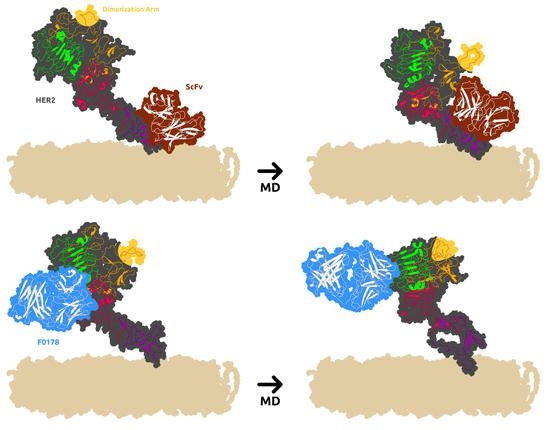
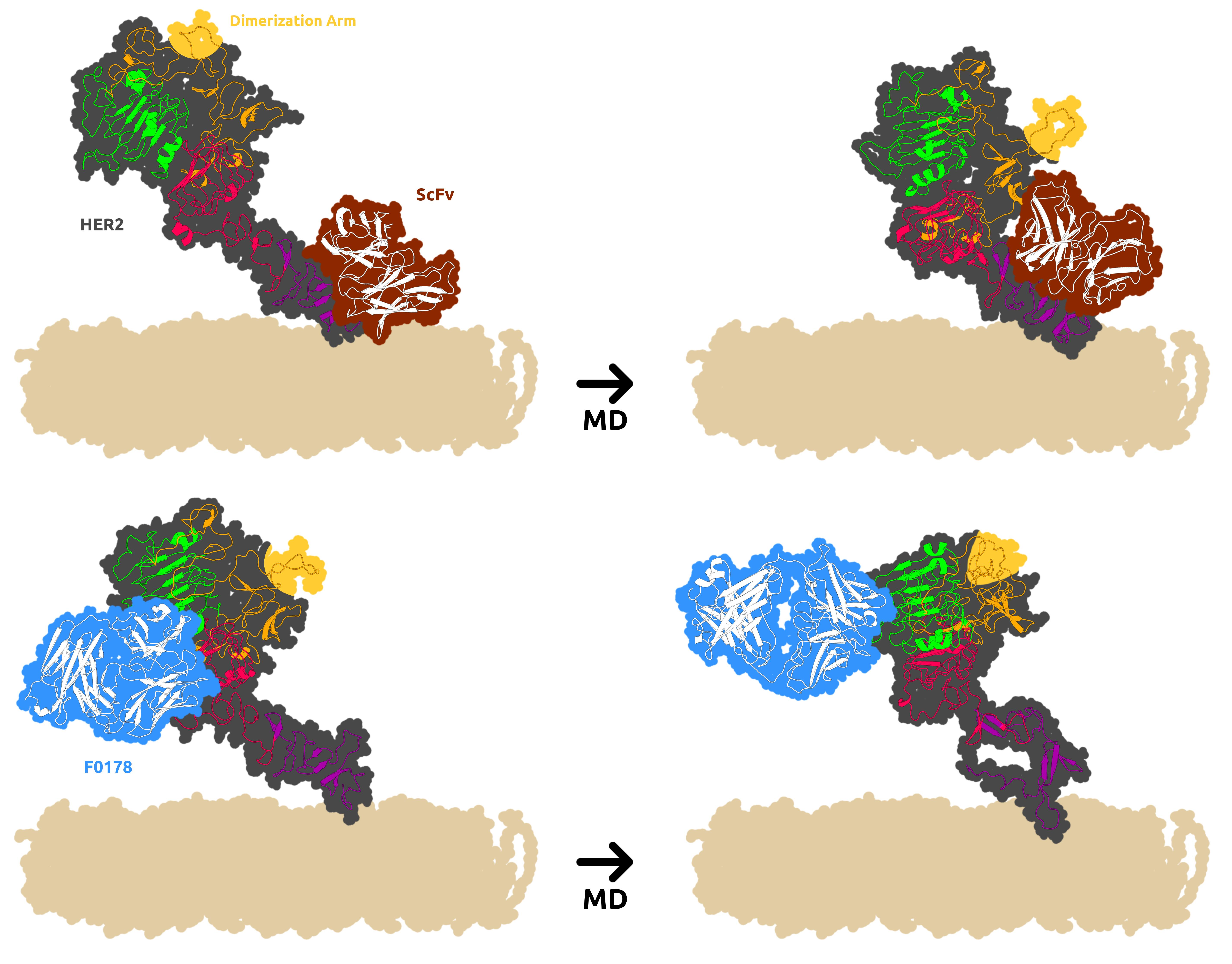
Human epidermal growth factor 2 (HER2) is a ligand-free tyrosine kinase receptor of the HER family that is overexpressed in some of the most aggressive tumours. Although it is known that HER2 dimerization involves a specific region of its extracellular domain, the so-called “dimerization arm”, the mechanism of dimerization inhibition remains uncertain. However, uncovering how antibody interactions lead to inhibition of HER2 dimerization is of key importance in understanding its role in tumour progression and therapy. Herein, we employed several computational modelling techniques for a molecular-level understanding of the interactions between HER and specific anti-HER2 antibodies, namely an antigen-binding (Fab) fragment (F0178) and a single-chain variable fragment from Trastuzumab (scFv). Specifically, we investigated the effects of antibody-HER2 interactions on the key residues of “dimerization arm” from molecular dynamics (MD) simulations of unbound HER (in a total of 1 µs), as well as ScFv:HER2 and F0178:HER2 complexes (for a total of 2.5 µs). A deep surface analysis of HER receptor revealed that the binding of specific anti-HER2 antibodies induced conformational changes both in the interfacial residues, which was expected, and in the ECDII (extracellular domain), in particular at the “dimerization arm”, which is critical in establishing protein–protein interface (PPI) interactions. Our results support and advance the knowledge on the already described trastuzumab effect on blocking HER2 dimerization through synergistic inhibition and/or steric hindrance. Furthermore, our approach offers a new strategy for fine-tuning target activity through allosteric ligands.
Keywords: breast cancer; dimerization inhibition; human epidermal growth factor 2 (HER2); molecular dynamics; receptor–antibody interactions breast cancer; dimerization inhibition; human epidermal growth factor 2 (HER2); molecular dynamics; receptor–antibody interactions
Graphical Abstract