Article

Effects of Tofacitinib Therapy on Circulating Tumour-Associated Antigens and Their Relationship with Clinical, Laboratory and Vascular Parameters in Rheumatoid Arthritis

by
Enikő Sebestyén
1,†,
Dóra Csige
2,†,
Péter Antal-Szalmás
3,
Ágnes Horváth
2,
Edit Végh
2,
Boglárka Soós
2,
Zsófia Pethő
2,
Nóra Bodnár
2,
Attila Hamar
2,
Levente Bodoki
2,
Dorottya Kacsándi
2,
Róza Földesi
3,
Edit Kalina
3,
Gábor Nagy
3,
György Kerekes
4,
Béla Nagy, Jr.
3,
Katalin Hodosi
2,
Szilvia Szamosi
2,
Péter Árkosy
1,
Gabriella Szűcs
2,
Zoltán Szekanecz
2,*,‡ and
Éva Szekanecz
1,‡
add Show full author list remove Hide full author list
1
Department of Oncology, Faculty of Medicine, University of Debrecen, 4032 Debrecen, Hungary
2
Department of Rheumatology, Faculty of Medicine, University of Debrecen, 4032 Debrecen, Hungary
3
Department of Laboratory Medicine, Faculty of Medicine, University of Debrecen, 4032 Debrecen, Hungary
4
Intensive Care Unit, Department of Medicine, Faculty of Medicine, University of Debrecen, 4032 Debrecen, Hungary
*
Author to whom correspondence should be addressed.
These authors contributed equally to this work.
Biomolecules 2025, 15(5), 648; https://doi.org/10.3390/biom15050648
Submission received: 26 March 2025 / Revised: 15 April 2025 / Accepted: 29 April 2025 / Published: 30 April 2025
(This article belongs to the Section Biological Factors)

Abstract

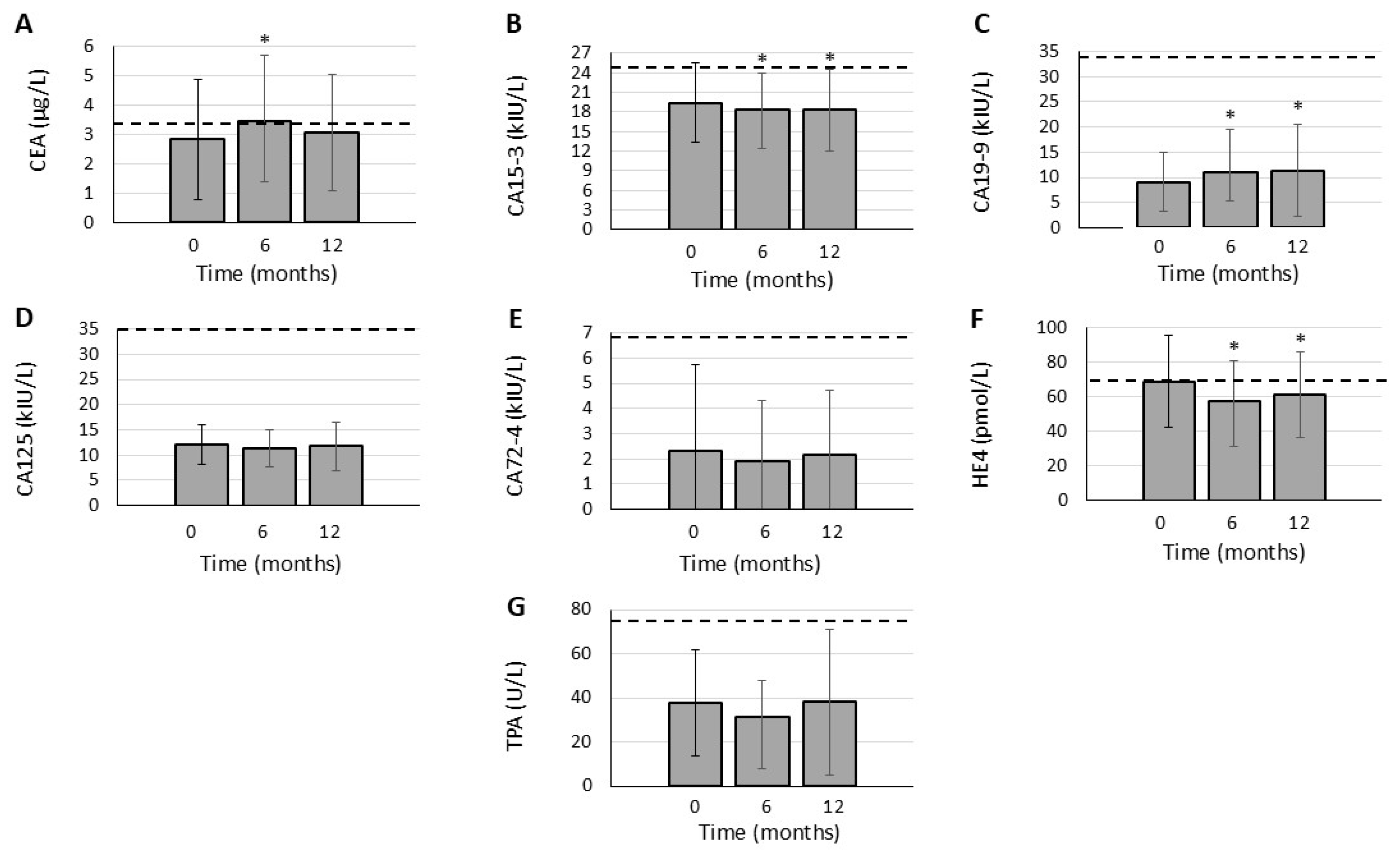
Introduction: Tumour-associated antigens (TAA) have been implicated in cell adhesion and cancer metastasis formation, but also in inflammatory processes, such as rheumatoid arthritis (RA). There has been little information about the possible associations of TAAs with RA-related clinical and laboratory parameters, with impaired vascular pathophysiology in RA, as well as about the effects of antirheumatic drugs on TAA production. Therefore, we determined the effects of one-year tofacitinib treatment on TAA levels, as well as correlations of TAA levels with various RA-associated and vascular parameters. Patients and methods: Altogether, 26 RA patients received 5 mg bid or 10 mg bid tofacitinib treatment for 12 months. Ultrasound-based functional vascular assessments, such as common carotid intima-media thickness (ccIMT), brachial artery flow-mediated vasodilation (FMD) and carotid-femoral pulse-wave velocity (cfPWV), were determined at various timepoints. Serum concentrations of TAAs, including carcinoembryonic antigen (CEA), CA15-3, CA19-9, CA125, CA72-4, human epididymis protein 4 (HE4) and tissue polypeptide antigen (TPA), as well as various cytokines (TNF-α, IL-6, IL-8, VEGF) and PECAM-1 were determined by flow cytometry using a bead-based multiplex assay (LEGENDplex). Results: As previously determined and published, one-year tofacitinib treatment effectively suppressed disease activity and inflammation. Serum CA15-3 and HE4 levels significantly decreased both after 6 and 12 months compared to baseline (p < 0.05). CA19-9 levels significantly increased both after 6 and 12 months, while CEA levels transiently increased after 6 months versus baseline (p < 0.05). CA125, CA72-4 and TPA levels did not change over time. In various regression analyses, TAA levels showed variable, significant, positive associations with the 28-joint disease activity score (DAS28), CRP, ESR, RF, IL-6, TNF-α, IL-8 and PECAM-1 (p < 0.05). In addition, TAAs variably correlated with ccIMT and cfPWV (p < 0.05). Moreover, one-year changes in TAA levels variably correlated with DAS28, RF and some cytokines (p < 0.05), as well as with changes in DAS28, HAQ, CRP, ESR, IL-6, VEGF and ccIMT from baseline to 12 months (p < 0.05). Conclusions: JAK inhibition might decrease the levels of some TAAs and increase those of others. TAA levels might be associated with RA-related and vascular biomarkers. These results suggest that TAAs might play a role in inflammatory processes and vascular pathology underlying RA.
Keywords: rheumatoid arthritis; tumour-associated antigens; tofacitinib; vascular pathophysiology rheumatoid arthritis; tumour-associated antigens; tofacitinib; vascular pathophysiology