This is an early access version, the complete PDF, HTML, and XML versions will be available soon.
Review

Mulberry, Gut Microbiota and Gut Functionality: Effects Shaped by Raw Material and Processing Methods


by
Marta Maria Miszczak
1,
Karolina Kłosowska-Buryło
2,
Joanna Magdalena Pieczyńska
1,
Monika Bielecka
3,* and
Anna Prescha
1
1
Department of Dietetics and Bromatology, Wroclaw Medical University, Borowska 211, 50-556 Wrocław, Poland
2
Student Research Group “Nutri-Sfera”, Faculty of Pharmacy, Wroclaw Medical University, Borowska 211, 50-556 Wrocław, Poland
3
Department of Pharmaceutical Biology and Biotechnology, Wroclaw Medical University, Borowska 211A, 50-556 Wrocław, Poland
*
Author to whom correspondence should be addressed.
Biomolecules 2026, 16(7), 965; https://doi.org/10.3390/biom16070965
Submission received: 20 May 2026 / Revised: 26 June 2026 / Accepted: 27 June 2026 / Published: 30 June 2026
(This article belongs to the Special Issue Plant Secondary Metabolism Engineering and Bioactive Compounds)

Abstract

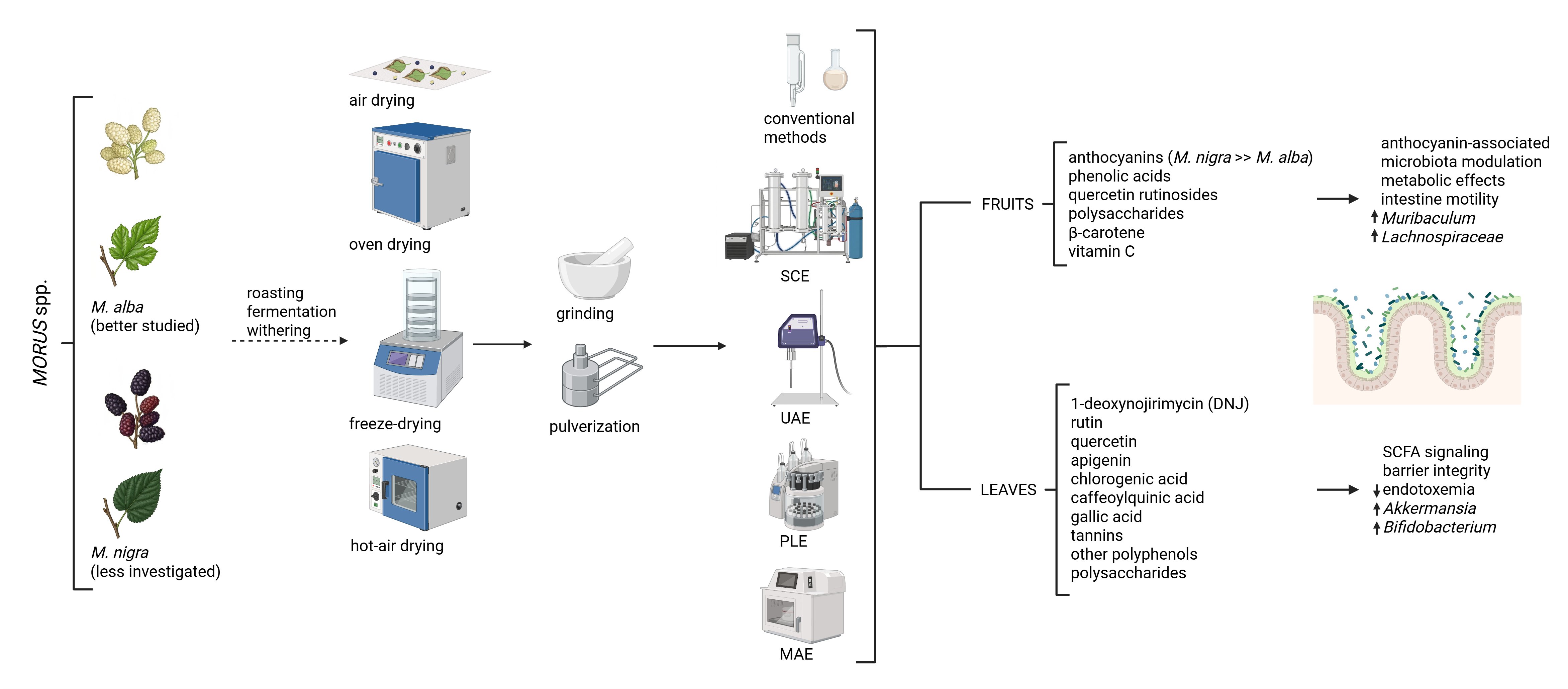
Mulberry species (Morus spp.) provide phytochemically distinct plant materials in which leaves are typically characterized by high levels of iminosugars (notably 1-deoxynojirimycin), flavonols/flavones, and polysaccharides, whereas fruits—especially Morus nigra—contain substantial amounts of anthocyanins alongside other phenolic compounds and polysaccharides. Importantly, the composition and biological properties of mulberry-derived products depend not only on species and plant part (leaf vs. fruit), but also on preparation and processing variables, including drying, maceration, fermentation, and extraction, or fractionation strategy (e.g., aqueous vs. hydroalcoholic extracts or enriched fractions). Such technological factors may substantially influence the chemical composition, bioavailability, and functionality of mulberry-derived preparations and thereby modify their interactions with gut microbiota and host metabolic processes. Available preclinical studies indicate that mulberry leaf- and fruit-derived preparations can affect gut microbial composition or activity in experimental models of metabolic dysfunction. Reported findings frequently include enrichment of microbial taxa commonly regarded as beneficial, such as Bifidobacterium, Lactobacillus, and Akkermansia, normalization of dysbiosis-associated microbial patterns, and increased production of short-chain fatty acids, particularly acetate, propionate, and butyrate. These microbial changes are sometimes observed alongside improvements in metabolic parameters such as glucose regulation, lipid profile, adiposity, or inflammatory markers. However, reported responses differ across plant parts, species, and preparation approaches, indicating that phytochemical composition and processing strategy are likely to influence biological outcomes. Interpretation of the current evidence is limited by the predominance of non-human studies and by incomplete or inconsistent reporting of extract composition, processing conditions, and standardization procedures. These factors reduce comparability between studies and complicate mechanistic interpretation of microbiome-related effects. Overall, existing preclinical data support the possibility that mulberry-derived preparations may influence metabolic health through microbiota-associated pathways shaped by both botanical origin and preparative technology. Well-designed human intervention studies using chemically characterized and standardized preparations, together with comprehensive gut microbiome analyses, are needed to determine the translational relevance of these observations and to identify which mulberry-derived preparations offer the greatest potential for supporting gut and metabolic health.
Keywords: mulberry; Morus alba; Morus nigra; phytochemicals; gut microbiota; intestinal functionality; polysaccharides; polyphenols; fermentation; extraction; processing methods mulberry; Morus alba; Morus nigra; phytochemicals; gut microbiota; intestinal functionality; polysaccharides; polyphenols; fermentation; extraction; processing methods
Graphical Abstract