2. Materials and Methods
2.1. Chemicals and Instruments
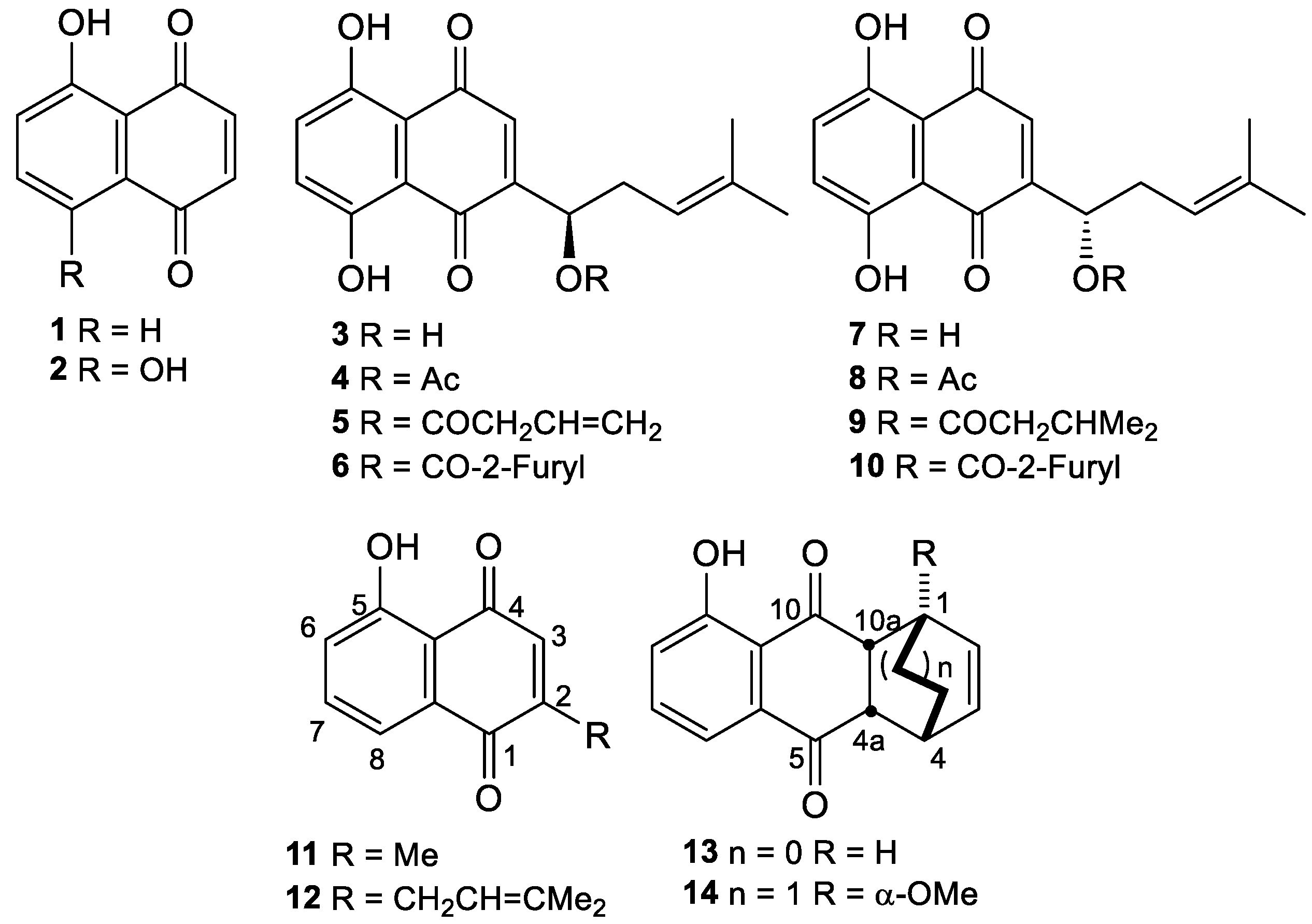
Solvents, chemical reagents, biochemical material, TLC plates and silica gel powder for preparative column chromatography, juglone (
1) and shikonin (
3) were purchased from Merck/Sigma-Aldrich (Milano (MI), Italy); 1,4,5-trimethoxy-naphthalene (
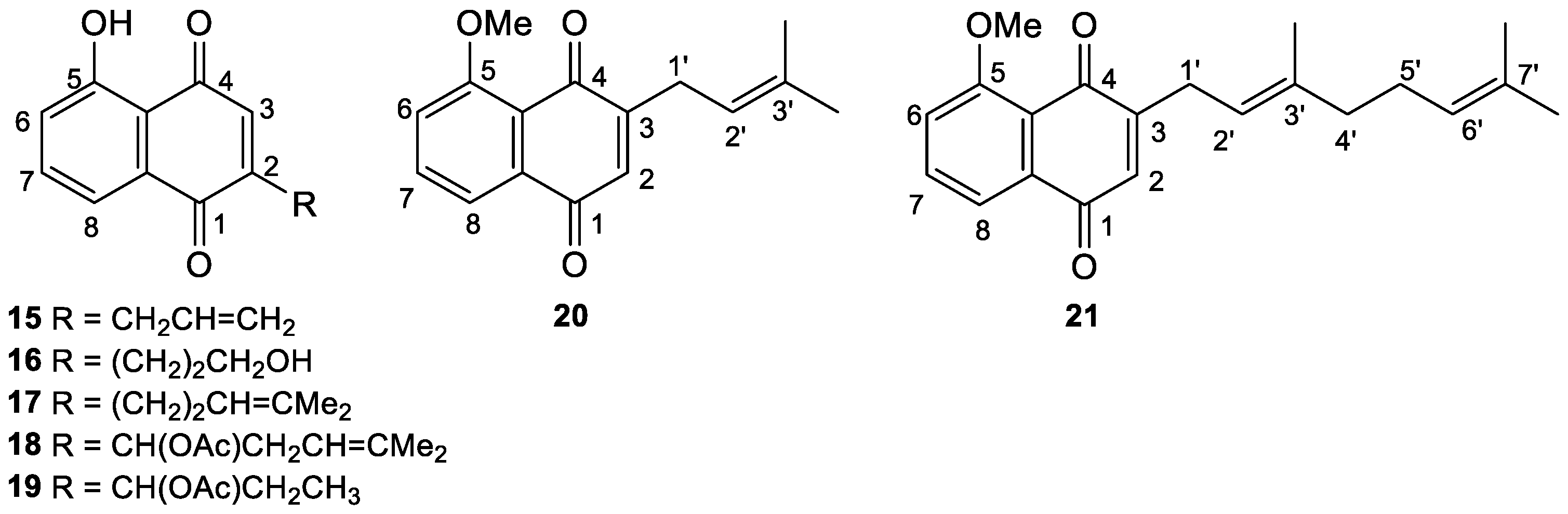
20) was purchased from RR Scientific (Irwindale, CA, USA;
http://www.rrscientific.com). High-resolution mass spectra (HRMS) were obtained with a Finnigan-MAT TSQ-70 (Finnigan Corporation, Thermo Scientific, Waltham, MA, USA) spectrometer. 1D and 2D NMR spectra were determined on a Bruker Avance III 300 MHz NMR instrument (Bruker Italia Srl, Milano (MI), Italy) at 25 °C. Nuclear Overhauser effects were determined with monodimensional NOE difference spectra. Flash column chromatographic separations were performed using Merck Silica gel 60 (0.015–0.040 mm); TLC and PLC separations were carried out on Merck HF
254 silica gel plates. The purity of products was checked by TLC, NMR and MS and deemed sufficient for the purpose of structural determination. Melting points were measured on a Fisher-Johns hot plate apparatus (Fischer Scientific Italia, 20054 Segrate (MI), Italy) and were uncorrected. Computational studies were carried out with Gaussian 09D (for DFT calculations) and docking calculations with Maestro by Schrödinger (LLC, New York, NY, USA, 2025).
2.2. General Information
All solvents were of commercial quality and were purified by distillation over the drying agents indicated: THF (Na/benzophenone); dichloromethane (DCM), hexane, pyridine (CaH2); toluene (Na/K). All other reagents were used as supplied. All moisture-sensitive reactions were carried out under a positive static atmosphere of Ar in flame-dried glassware. Syringes and needles for the transfer of reagents were dried at 140 °C and allowed to cool in a desiccator over P2O5 before use. Reactions were monitored using silica gel 60 (0.25 mm), aluminum-supported TLC plates. Compounds were visualized under UV light at a wavelength of 254 nm or stained by spraying TLC plates with a 0.5% solution of vanillin in H2SO4/EtOH, followed by heating on a hot plate. Yields are reported for isolated compounds with >95% purity established by NMR. Chemical shifts (δ) are reported in ppm, coupling constants (J) in Hz. Chloroform signals were used as references and the chemical shifts converted to the TMS scale (CDCl3: δC 77.00; residual CHCl3 in CDCl3: δH 7.26). COSY, DEPT, HSQC, and NOESY spectra were recorded using standard pulse sequences.
2.3. General Synthetic Procedures
2.3.1. CAN Oxidation: Representative Example
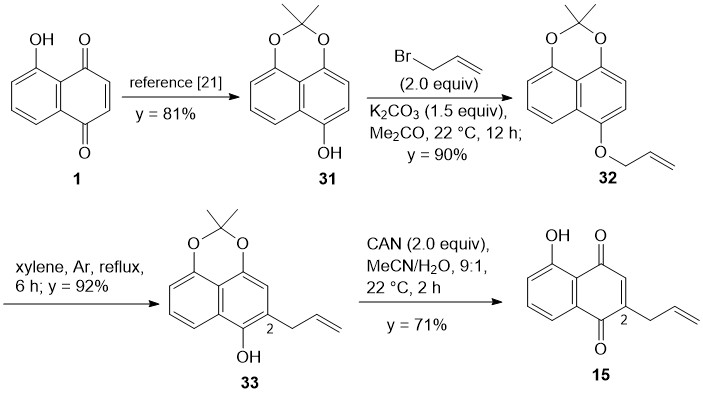
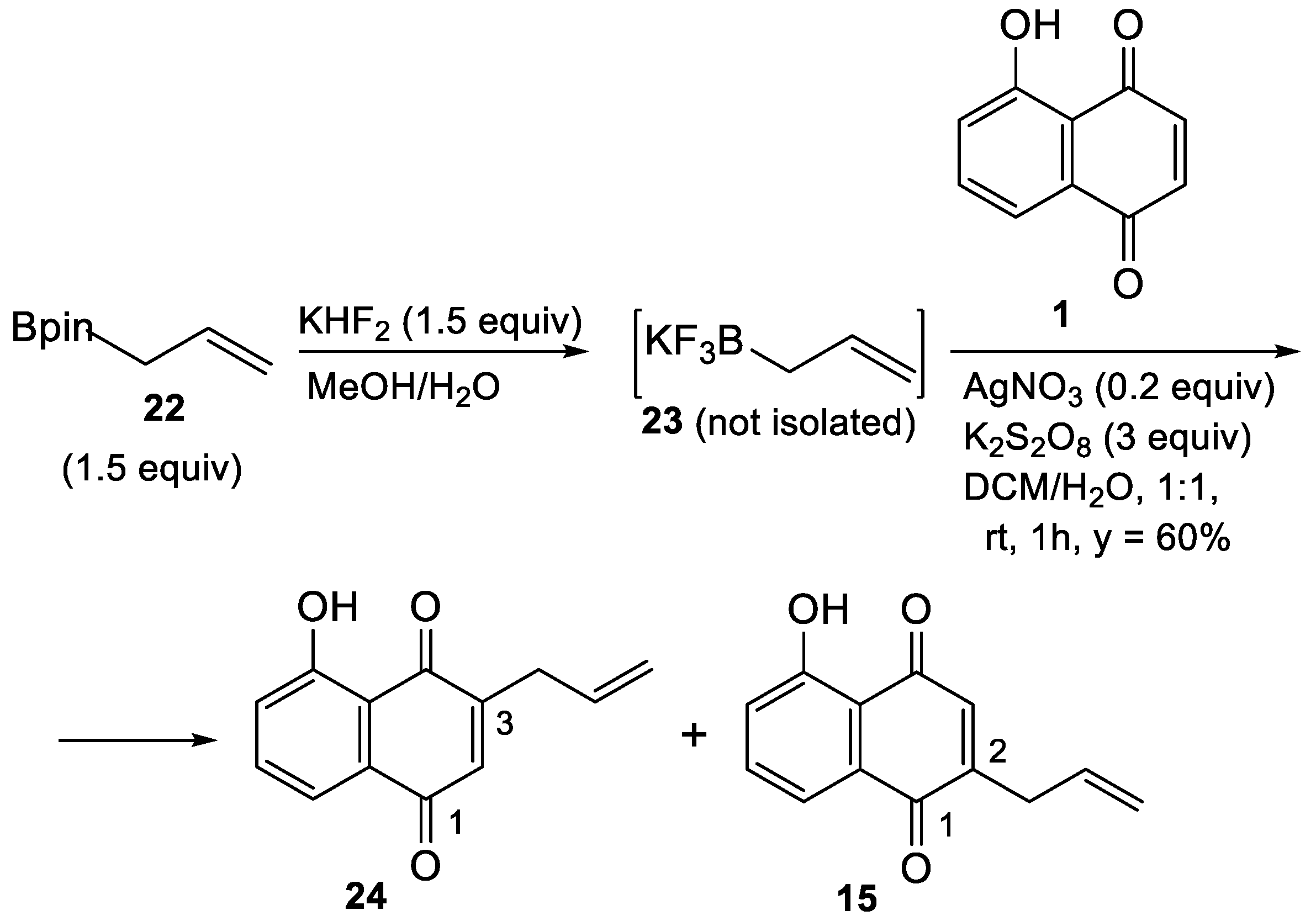
Ceric (IV) ammonium nitrate, (NH4)2 [Ce(NO3)6] (CAN, 144 mg, 0.26 mol, 2 equiv), was added to a solution of compound 33 (16.7 mg, 0.065 mmol) in MeCN/H2O, 9:1 (2 mL, 0.0134 mL/mg). The resulting mixture was stirred at 22 °C for 1.5 h; then the reaction was quenched by adding brine (5 mL) and DCM (15 mL); the organic layer was separated, and the aqueous phase was extracted with DCM (3 × 4 mL). The combined organic layers were dried over MgSO4 and evaporated under vacuum. The resulting residue was separated on silica gel (10 g). Elution with hexane-EtOAc, 9:1, afforded 2-allyljuglone (15, 9.9 mg, yield = 71%).
The same procedure was followed for the oxidation of compounds 26, 27, 39, 41, 42, 43, and 44 acetate to 20, 21, 18, 12, 16, 17, and 19, respectively.
2.3.2. Metathesis Reaction: Representative Example
2nd Generation Grubbs catalyst
37 [
20] (14.4 mg, 0.017 mmol, 0.1 equiv) was added to a solution of homoallyl alcohol
36 (52 mg, 0.17 mmol) in DCM (3 mL) containing excess 2-methyl-2-butene (20 equiv) under Ar in a sealed vial. The reaction mixture was heated to 55 °C for 16 h. Volatiles were then removed, and the resulting residue was separated on a silica gel column (10 g). Elution with hexane/EtOAc, 9:1, afforded alcohol
38 (45.5 mg, yield = 80%).
The same procedure was followed for the conversion of compound 40 into 41.
2.4. 5-Hydroxy-2-(3-methylbut-2-en-1-yl)naphthalene-1,4-dione (12)
Compound
12 (yield = 70% from
41, following the procedure described in
Section 2.3.1). HRMS (ESI positive mode) C
15H
15O
3 [M + H]
+ calc. 243.1021, found 243.1018. IR and
1H-NMR spectra matched those reported in the literature [
16].
13C-NMR (75 MHz, CDCl
3) δ 189.1, 184.3, 161.8, 146.4, 136.9, 135.3, 135.1, 133.4, 124.3, 120.1, 119.9, 115.9, 27.7, 25.7, 19.8.
2.5. 2-Allyl-5-hydroxynaphthalene-1,4-dione (15)
Compound
15 (yield = 71% from
33, following the general procedure described in
Section 2.3.1): dark yellow/brown crystals, mp 165–168 (dec.); HRMS (ESI positive mode) C
13H
11O
3+ [M + H]
+ calc. 215,071, found 215,073.
1H-NMR (300 MHz, CDCl
3) δ
H 7.73 (1H, dd,
J = 7.5, 1.4 Hz), 7.68–7.42 (2H, m), 6.46 (1H, t,
J = 0.8 Hz, 3-H), 5.86 (1H, ddt,
J = 16.8, 10.1, 7.6 Hz, 2′-H), 5.16 (1H, ddt,
J = 16.9, 2.3, 1.5 Hz, 3′-H
E), 4.95 (1H, ddt,
J = 10.1, 2.2, 1.5 Hz, 3′-H
Z), 3.35 (2H, dtd,
J = 7.5, 1.5, 0.8 Hz, 1′-H
2).
13C-NMR (75 MHz, CDCl
3) δ
C 189.1, 184.1, 161.7, 156.1, 137.2, 135.7, 135.6, 133.4, 124.4, 119.9, 116.1, 115.9, 33.3.
2.6. 5-Hydroxy-2-(3-hydroxypropyl)naphthalene-1,4-dione (16)
Compound
16 (yield = 51% from
42, following the general procedure described in
Section 2.3.1): dark yellow/brown oil. HRMS (ESI positive mode) C
13H
13O
4+ [M + H]
+ calc. 233,0814, found 233,0809.
1H-NMR (300 MHz, CDCl
3) δ
H 7.73 (1H, dd,
J = 7.5, 1.4 Hz), 7.63 (1H, dd,
J = 8.2, 7.5 Hz, 7-H), 7.50 (1H, dd,
J = 8.2, 1.3 Hz, 1H), 6.07 (1H, t,
J = 0.8 Hz, 3-H), 3.68 (1H, dd,
J = 6.3, 4.9 Hz, OH), 3.64–3.47 (2H, m, 3′-H
2), 2.85 (2H, td,
J = 8.3, 0.9 Hz, 1′-H
2), 1.86 (2H, tt,
J = 8.3, 5.8 Hz, 2′-H
2).
13C-NMR (75 MHz, CDCl
3) δ
C 189.2, 186.5, 161.7, 149.0, 137.2, 135.3, 133.1, 124.3, 119.9, 115.8, 62.1, 31.3, 27.5.
2.7. 5-Hydroxy-2-(4-methylpent-3-en-1-yl)naphthalene-1,4-dione (17)
Compound
17 (yield = 48% from
43, following the general procedure described in
Section 2.3.1): dark yellow/brown oil. HRMS (ESI positive mode) C
16H
17O
3+ [M + H]
+ calc. 257.1178, found 257.1174.
1H-NMR (300 MHz, CDCl
3) δ
H 11.94 (1H, s, OH), 7.65 (1H, d,
J = 7.2 Hz, 8-H*), 7.63 (1H, d,
J = 6.8 Hz, 6-H*), 7.29 (1H, dd,
J = 7.2 and 6.8 Hz, 7-H), 6.78 (1H, s, 3-H), 5.19 (1H, br t,
J = 7.2 Hz, 3′-H), 2.75 (2H, dd,
J = 7.2 and 7.5 Hz, 1′-H
2), 2.30 (2H, br q,
J = 7.3 Hz, 2′-H
2), 1.72 (3H, br s, 4′-Me
E), 1.61 (3H, s, 4′-Me
Z). * Assignments can be interchanged.
13C-NMR (75 MHz, CDCl
3) δ
C 189.2, 186.3, 161.7, 147.4, 137.2, 135.3, 133.1, 132.7, 124.3, 123.0, 119.9, 115.8, 29.0, 27.1, 25.5, 19.6.
2.8. 1-(5-Hydroxy-1,4-dioxo-1,4-dihydronaphthalen-2-yl)-4-methylpent-3-en-1-yl Acetate: (±)-18 and Resolution of the Racemic Mixture
Compound (±)-
18 (yield = 74% from acetate
39, following the general procedure described in
Section 2.3.1): dark yellow/brown crystals; mp 173–177 °C (dec.). HRMS (ESI positive mode) C
18H
19O
5+ [M + H]
+ calc. 315.1232, found 315.1228.
1H-NMR (300 MHz, CDCl
3) (
Figure S1 in the Supplementary Materials) δ
H 7.70–7.57 (2H, m, 8- and 7-H), 7.29 (1H, dd,
J = 6.4, 3.2 Hz, 6-H), 6.82 (1H, br s, 3-H), 5.96 (1H, tdd,
J = 6.5, 1.9, 0.7 Hz, 1′-H), 5.20–5.12 (1H, m, 3′-H), 2.69–2.52 (1H, m, 2′-H
a), 2.50–2.32 (1H, m, 2′-H
b), 2.16 (3H, s,
MeCO), 1.70 and 1.59 (2 × 3H, 2 s, 4′-Me
2).
13C-NMR (75 MHz, CDCl
3) (
Figure S2 in the Supplementary Materials) δ
C 189.1, 182.7, 169.7, 161.3, 150.5, 136.5, 136.1, 133.2, 131.9, 124.5, 119.4, 117.6, 114.8, 69.7, 32.7, 25.7, 20.9, 18.0.
Racemic
18 (5 mg) was separated (
Figure S13 in the Supplementary Materials) into the two enantiomers
18a and
18b (unassigned absolute configuration) in 95% yield by HPLC resolution on a semi-preparative enantioselective ChiralPack AS-H column (Agilent Technologies Italia S.p.A., 20063 Cernusco sul Naviglio (MI), Italy); 250 × 2.1 mm; particle size: 5 mm; isocratic elution at 23 °C; eluent:
n-heptane-isopropanol, 90:10; flow rate: 1 mL/min; UV detection at 254 nm.
2.9. 1-(5-Hydroxy-1,4-dioxo-1,4-dihydronaphthalen-2-yl) Propyl Acetate (19)
Pyridine (37.4 mg, 0.48 mmol) followed by Ac2O (49 mg, 0.48 mmol) and a catalytic amount of DMAP were added to a solution of alcohol 44 (69 mg, 0.24 mmol) in DCM (4 mL) cooled to 0 °C. The mixture was stirred overnight at 22 °C; subsequently, the reaction was quenched by addition of MeOH (50 μL), followed by saturated aqueous NaHCO3 (5 mL) and DCM (6 mL). The organic layer was separated, while the aqueous phase was extracted with an additional DCM (3 × 5 mL). The combined organic layers were washed with brine (3 mL), dried over Na2SO4, and evaporated. The resulting residue was separated on a silica gel column (10 g). Elution with hexane/EtOAc, 9:1, gave the desired acetate [δH 2.10 (3H, s, MeCO)] as a pale-yellow oil (75.3 mg, yield = 95%) which was used immediately in the next step. Then, CAN oxidative demethylation reaction, which was executed according to the general procedure outlined in 2.3.1, afforded compound 19 (30.9 mg, 49%) as a dark yellow/brown oil. HRMS (ESI positive mode) C15H15O5+ [M + H]+ calc. 275.0919, found 275.0922. 1H-NMR (300 MHz, CDCl3) δH 7.70–7.57 (2H, m, 6- and 8-H), 7.50 (1H, dd, J = 6.8, 2.7 Hz, 7-H), 6.86 (1H, s, 3-H), 5.93 (1H, ddqd, J = 6.3, 4.8, 1.5, 0.7 Hz, 1′-H), 2.10 (3H, s, MeCO), 1.88 (2H, m, 2′-H2), 1.00 (3H, td, J = 7.9, 1.5 Hz, 3′-H3). 13C-NMR (75 MHz, CDCl3) δC 186.9, 184.9, 169.9, 162.1, 143.3, 137.4, 132.4, 132.1, 123.3, 119.2, 114.4, 73.9, 26.8, 22.0, 11.6.
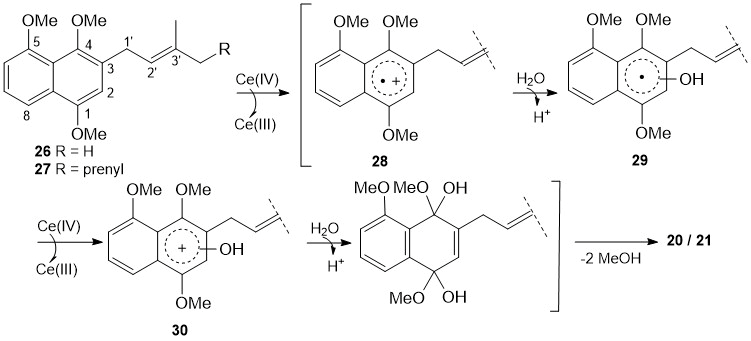
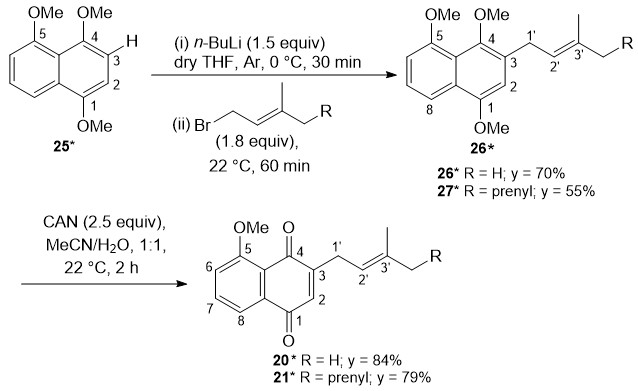
2.10. 3-(3′-Methyl-but-2′-enyl)-5-methoxy-naphthalene-1,4-dione (20)
By slightly modifying the general procedure described in
Section 2.3.1, 3 equiv of CAN in MeCN-H
2O (1:1, 2 mL) were used, and the reaction solution was extracted with EtOAc at the end of the reaction. Compound
20 (yield = 84% from
26): sticky oil. EIMS
m/z (rel. intensity): 256 (M
+, 58), 241 (100), 213 (15).
1H-NMR (300 MHz, CDCl
3) (
Figure S4 in the Supplementary Materials) δ
H 7.72 (1H, dd,
J = 7.6 and 1.3 Hz), 7.66 (1H, t, 8.0 Hz) and 7.30 (1H, d, 7.7 Hz) (6, 7- and 8-H), 6.70 (1H, t,
J = 1.6 Hz, 2-H), 5.23 (1H, br t,
J = 8.7 Hz, 2′-H), 4.02 (3H, s, 5-OMe), 3.25 (2H, br d,
J = 7.3 Hz, 1′-H
2), 1.78 and 1.66 (2 x 3H, 2 br s, 3′-Me
2).
13C-NMR (75 MHz, CDCl
3) (
Figure S5 in the Supplementary Materials) δ
C 185.4, 184.6, 159.7, 152.6, 136.1, 134.7, 134.4, 132.5, 120.1, 118.7, 118.5, 117.6, 56.4, 28.2, 25.7, 17.8.
2.11. 3-(3′7-Dimethyl-octa-2,6-dienyl)-5-methoxy-naphthalene-1,4-dione (21)
Using the procedure described in
Section 2.10, compound
27 was oxidized to
21 in 79% yield: sticky oil. EIMS
m/z (rel. intensity): 324 (M
+, 46), 255 (56), 241 (100), 223 (57).
1H-NMR (300 MHz, CDCl
3) (
Figure S7 in the Supplementary Materials) δ
H 7.74 (1H, dd, 7.6 and 1.3 Hz), 7.68 (1H, t, 8.0 Hz), and 7.32 (1H, dd, 8.3 and 1.3 Hz) (6, 7- and 8-H), 6.70 (1H, t,
J = 1.3 Hz, 2-H), 5.25 and 5.12 (2 x 1H, 2 br t, 2′- and 6′-H), 4.03 (3H, s, 5-OMe), 3.28 (2H, br d,
J = 7.3 Hz, 1′-H
2), 2.4–2.1 (4H, m, 4′- and 5′-H
2), 1.70, 1.63 and 1.60 (3 × 3H, 3 br s, 3′-Me and 7′-Me
2).
13C-NMR (75 MHz, CDCl
3) (
Figure S8 in the Supplementary Materials) δ
C 185.4, 184.7, 159.7, 152.6, 139.8, 134.8, 134.4, 132.5, 131.8, 124.0, 120.2, 118.8, 118.4, 117.6, 56.4, 39.7, 28.0, 26.5, 25.7, 17.7, 16.1.
2.12. 1,4,5-Trimethoxy-3-(3′-methyl-but-2′-enyl)naphthalene (26)
1,4,5-Trimethoxy-naphthalene (25) (218 mg, 1.0 mmol, 1 equiv) in dry THF (5 mL) was cooled to 0 °C under argon and n-BuLi (2.5 M solution in hexane, 0.6 mL, 1.5 equiv) was added dropwise over 5 min. The mixture was stirred at 0 °C for 30 min; then prenyl bromide (268 mg, 1.8 mmol, 1.8 equiv) was added dropwise over 5 min. After stirring for 60 min at 22 °C, the mixture was poured into water and extracted with ether to give the crude product. Column chromatography (hexanes/EtOAc, 80:20) yielded the prenyl derivative 26 (200 mg, yield = 76%) accompanied by two unidentified regioisomers. EIMS m/z (rel. intensity): 286 (M+,100); 271 (39); 193 (10). 1H-NMR (300 MHz, CDCl3) δH 7.81, 7.31 and 6.88 3 × 1H, 3 m, 8-, 7- and 6-H), 6.65 (1H, s, 2-H), 5.35 (1H, m, 2′-H), 3.99 (3H, s, 5-OMe), 3.95 (3H, s, 1-OMe), 3.84 (3H, s, 4-OMe), 3.53 (2H, br d, J = 7.1 Hz, 1′-H2), 1.79 and 1.74 (2 × 3H, br s, 3′-Me2). 13C-NMR (75 MHz, CDCl3) δC 18.0, 25.8, 28.8, 55.8, 56.2, 62.3, 106.7, 106.9, 114.9, 120.8, 123.6, 124.8, 127.7, 130.8, 132.3, 146.9, 151.8, 155.5.
2.13. 1,4,5-Trimethoxy-3-(3′,7′-dimethyl-octa-2′,6′-dienyl)naphthalene (27)
Compound 27 (195 mg, yield = 55%), chromatographically separated from unidentified regioisomers, was obtained from 1,4,5-trimethoxy-naphthalene (25) (218 mg, 1.0 mmol, 1 equiv) with the procedure described for the preparation of compound 26, using geranyl bromide (391 mg, 1.8 mmol) instead of prenyl bromide in the alkenylation step. EIMS m/z (rel. intensity): 354 (M+,100), 255 (20), 217 (10). 1H-NMR (300 MHz, CDCl3) δH 7.83, 7.32 and 6.89 (3 × 1H, 3 m, 8-, 7- and 6-H), 6.67 (1H, s, 2-H), 5.35 and 5.11 (2H, m, 2′- and 6′-H), 4.00 (3H, s, 5-OMe), 3.94 (3H, s, 1-OMe), 3.77 (3H, s, 4-OMe), 3.56 (2H, br d, J = 7.1 Hz, 1′-H2), 2.2–1.9 (4H, m, 4′- and 5′-H2), 1.79 (3H, br s, 3′-Me), 1.66 and 1.60 (2 × 3H, 2 br s, 7′-Me2). 13C-NMR (75 MHz, CDCl3) δC 154.3, 153.1, 151.2, 137.5, 131.7, 127.5, 125.8, 124.4, 124.3, 122.3, 119.8, 116.5, 110.2, 108.2, 61.3, 56.5, 55.9, 39.6, 28.8, 26.7, 25.0, 19.9, 16.3. 7
2.14. 6-(Allyloxy)-2,2-dimethylnaphtho[1,8-de]-[1,3]-dioxine (32)
2,2-Dimethylnaphtho [1,8-
de]-[1,3]-dioxin-6-ol (
31, 216 mg, 1 mmol), prepared from juglone (
1) according to the literature [
21], was dissolved in acetone (HPLC grade, 5 mL). Allyl bromide (430 μL, 601.14 mg, 5 equiv), followed by K
2CO
3 (207 mg, 1.5 equiv) were added to the solution, and the resulting mixture was gently stirred at rt for 18 h. The solid was then removed by filtration over a glass septum and then washed with 3 × 3 mL portions of DCM. Solvents were removed under vacuum, and the residue was purified by flash chromatography over silica gel (14 g). Elution with hexane/EtOAc afforded the well-known allyl ether
32 [
22] (182 mg, yield = 71%) as a pale-yellow oil. (HRMS, ESI positive mode) C
16H
17O
3+ [M + H]
+ calc. 257,1172, found 257,1173. The IR (KBr) and
1H-NMR (300 MHz, CDCl
3) spectra matched those reported in the literature [
22];
13C-NMR (75 MHz, CDCl
3) δ
C 150.9, 149.5, 145.4, 133.3, 127.6, 126.7, 117.5, 117.0, 111.2, 111.1, 110.2, 106.4, 102.2, 69.7, 25.8.
2.15. 5-Allyl-2,2-dimethylnaphtho[1,8-de]-[1,3]-dioxin-6-ol (33)
Allyl ether
32 (350 mg, 1.37 mmol) was dissolved in dry degassed xylene (50 mL) under argon, and the resulting solution was refluxed vigorously for 6 h. Xylene was removed under vacuum, and the residue was purified by flash chromatography over silica gel (20 g). Elution with hexane/EtOAc, 90:10, afforded the well-known 2-allyl-naphtol
33 [
22] (322 mg, yield = 92%) as a pale-yellow oil. HRMS (ESI positive mode) C
16H
17O
3+ [M + H]
+ calc. 257,1172, found 257,1173. The IR (KBr) and
1H-NMR (300 MHz, CDCl
3) spectra matched those reported in the literature [
22].
13C-NMR (75 MHz, CDCl
3) δ
C 150.0, 144.4, 144.3, 136.1, 126.8, 124.5, 124.3, 116.2, 116.0, 111.2, 111.1, 104.3, 102.0, 34.7, 25.8.
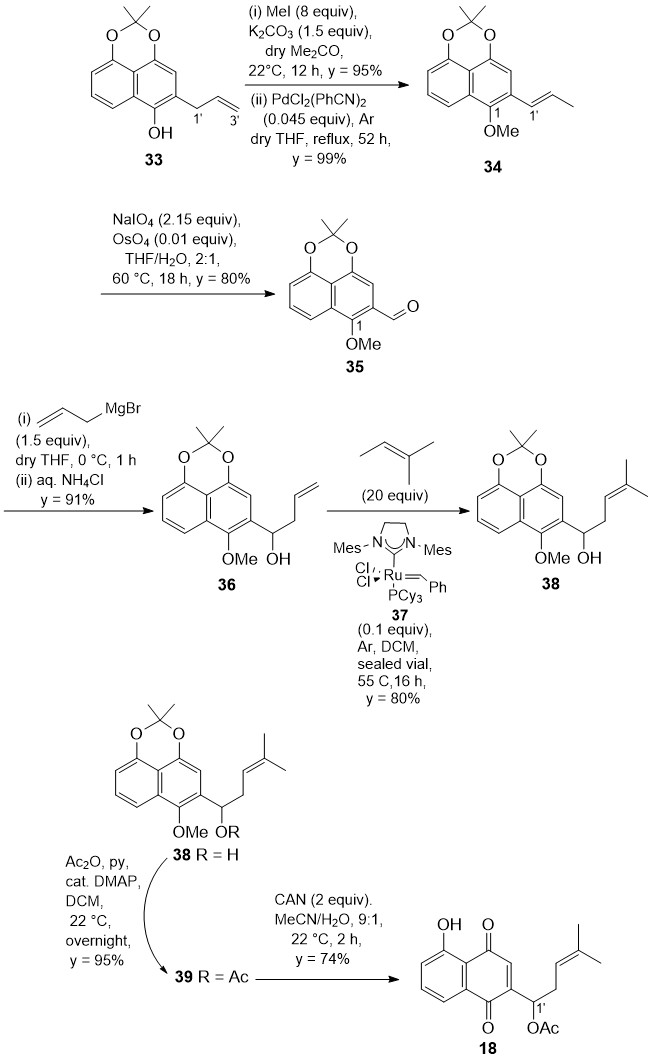
2.16. (E)-6-Methoxy-2,2-dimethyl-5-(prop-1-en-1-yl)naphtho[1,8-de]-[1,3]-dioxine (34)
MeI (390 μL, 889.2 mg, 8 equiv), followed by K2CO3 (162 mg, 1.5 equiv), was added to naphtol 33 (200 mg, 0.78 mmol) dissolved in dry acetone (HPLC Grade, 4 mL). The resulting mixture was gently stirred at 22 °C for 12 h. The solid was then removed by filtration over a glass septum and washed with DCM (3 × 3 mL). The solvents were removed under vacuum, and the resulting residue was purified by flash chromatography over silica gel (11 g). Elution with hexane/EtOAc, 99:1 afforded the O-methyl ether of naphthol 33 (200 mg, yield = 95%) as a pale-yellow oil, which was used immediately in the following step. HRMS (ESI positive mode) C17H19O3+ [M + H]+ calc. 271.1329, found 271.1330. 1H-NMR (300 MHz, CDCl3) δH 7.67 (1H, dd, J = 7.5, 1.5 Hz, 8-H), 7.30 (1H, t, J = 7.5 Hz, 7-H), 6.89 (1H, dd, J = 7.5, 1.5 Hz, 6-H), 6.56 (1H, s, 3-H), 5.95 (1H, tt, J = 13.5, 6.2 Hz, 2′-H), 5.00 (2H, ddt, J = 13.4, 2.1, 1.0 Hz, 3′-H2), 4.05 (3H, s, 1-OMe), 3.37 (2H, dt, J = 6.1, 1.0 Hz, 1′-H2), 1.65 (6H, s, 2 × Me). 13C-NMR (75 MHz, CDCl3) δC 150.9, 146.7, 146.4, 135.9, 127.4, 127.2, 126.79, 116.2, 115.6, 111.7, 111.1, 105.5, 102.0, 61.4, 34.1, 25.8. Pd(PhCN)2Cl2 (22 mg, 0.057 mmol, 0.045 equiv) was added to the freshly prepared methyl ether (342 mg, 1.27 mmol) dissolved in dry THF under Ar, and the resulting solution was refluxed for 52 h. Subsequently, the solvent was removed under reduced pressure to give an oily residue that was purified by flash chromatography over silica gel (15 g). Elution with hexane/EtOAc, 98:2, afforded olefin 34 (340 mg, yield = 99%) as a pale-yellow oil. HRMS (ESI positive mode) C17H19O3+ [M + H]+ calc. 271.1329, found. 271.1331. 1H-NMR (300 MHz, CDCl3) δH 7.67 (1H, dd, J = 7.5, 1.5 Hz, 8-H), 7.33 (1H, t, J = 7.5 Hz, 7-H), 7.14 (1H, s, 3-H), 6.89 (1H, dd, J = 7.5, 1.5 Hz, 6-H), 6.67 (1H, dq, J = 15.1, 1.0 Hz, 1′-H), 5.99 (1H, dq, J = 15.0, 6.4 Hz, 2′-H), 3.95 (3H, s, 1-OMe), 1.89 (3H, dd, J = 6.4, 1.0 Hz, 3′-H3), 1.65 (6H, s, 2 × Me). 13C-NMR (75 MHz, CDCl3) δC 151.0, 147.1, 145.9, 127.9, 127.9, 127.3, 126.6, 126.3, 115.9, 111.18, 107.0, 106.9, 102.0, 62.8, 25.8, 18.6.
2.17. 6-Methoxy-2,2-dimethylnaphtho[1,8-de]-[1,3]-dioxine-5-carbaldehyde (35)
NaIO4 (212 mg, 0.99 mmol, 2.15 equiv), followed by an aqueous solution of OsO4 (11.5 μL, 0.01 equiv), were added to propenylnaphthalene 34 (125 mg, 0.46 mmol) dissolved in THF/water (2:1, 4 mL). The resulting mixture was heated to 60 °C for 18 h, then cooled to 22 °C. Subsequently, an aqueous saturated solution of Na2S2O3 (5 mL) was added under vigorous stirring. The resulting mixture was transferred into a separating funnel and diluted with EtOAc (5 mL). The aqueous phase was separated and extracted with EtOAc (3 × 5 mL). The combined organic layers were dried over Na2SO4 and evaporated under vacuum to give an oily residue that was purified over silica gel (15 g). Elution with hexane/EtOAc, 9:1, afforded aldehyde 35 (96 mg, yield = 80%) as a pale-yellow oil. HRMS (ESI positive mode) C15H15O4+ [M + H]+ calc. 259.0970, found 259.0967. 1H-NMR (300 MHz, CDCl3) δH 10.45 (1H, s, CHO), 7.90 (1H, dd, J = 7.5, 1.5 Hz, 8-H), 7.50 (1H, t, J = 7.5 Hz, 7-H), 7.24 (1H, d, J = 0.5 Hz, 3-H), 6.94 (1H, dd, J = 7.5, 1.5 Hz, 6-H), 3.95 (3H, s, 1-OMe), 1.65 (6H, s, 2 × Me). 13C-NMR (75 MHz, CDCl3) δC 191.3, 150.3, 149.9, 147.7, 128.1, 127.9, 123.8, 118.3, 111.2, 109.7, 108.8, 102.0, 62.7, 25.8.
2.18. 1-(6-Methoxy-2,2-dimethylnaphtho[1,8-de]-[1,3]-dioxin-5-yl)but-3-en-1-ol (36)
Allylmagnesium bromide (1M in Et2O, 345 μL, 1.5 equiv) was added dropwise to a magnetically stirred solution of aldehyde 35 (60 mg, 0.23 mmol) in dry THF (3 mL) under Ar, cooled to 0 °C. Stirring continued for 1 h; then the reaction was quenched with saturated aqueous NH4Cl (5 mL,), and Et2O (10 mL) was added to the mixture. The organic layer was separated, and the aqueous phase was extracted with more Et2O (3 × 5 mL). The combined organic layers were dried over Na2SO4 and evaporated under vacuum to give an oily residue that was separated over silica gel (12 g). Elution with hexane/EtOAc, 9:1, gave homoallyl alcohol 36 (63 mg, yield = 91%) as a pale-yellow oil. HRMS (ESI positive mode) C18H21O4+ [M + H]+ calc. 301.1434, found 301.1433.1H-NMR (300 MHz, CDCl3) δH 7.72 (1H, dd, J = 7.8, 1.2 Hz, 8-H), 7.12 (1H, dd, J = 7.9, 7.1 Hz, 7-H), 6.98–6.85 (2H, m, 3-H and 8-H), 5.89–5.68 (1H, m, 3′-H), 5.22–5.05 (2H, m, 4′-H2), 5.01–4.87 (1H, m, 1′-H), 3.87 (3H, s, 1-OMe), 3.50 (1H, s, OH), 2.61 (2H, dtd, J = 14.7, 6.9, 1.4 Hz, 2′-H2), 1.74–1.64 (6H, 2x s, 2 × Me). 13C-NMR (75 MHz, CDCl3) δC 148.8, 146.5, 144.5, 134.7, 133.4, 128.6, 127.5, 118.0, 114.6, 113.4, 109.5, 106.1, 101.7, 68.1, 62.7, 42.9, 26.3, 24.8.
2.19. 1-(6-Methoxy-2,2-dimethylnaphtho[1,8-de]-[1,3]-dioxin-5-yl)-4-methylpent-3-en-1-ol (38)
Alcohol
38, pale yellow oil, was prepared in 80% yield from compound
36 with the metathesis reaction described in
Section 2.3.2. HRMS (ESI positive mode) C
20H
25O
4+ [M + H]
+ calc. 329.1753, found 329.1748;
1H-NMR (300 MHz, CDCl
3) δ
H 7.72 (1H, dd,
J = 7.8, 1.2 Hz, 8-H), 7.12 (1H, dd,
J = 7.9, 7.1 Hz, 7-H), 6.98–6.85 (2H, m, 3- and 6-H), 5.28–5.14 (1H, m, 3′-H), 4.99 (1H, tddd,
J = 6.9, 6.1, 1.8, 0.7 Hz, 1′-H), 3.87 (3H, s, 1-OMe), 2.78–2.60 (1H, m, 2′-H
A), 2.52–2.35 (1H, m, 2′-H
B), 1.68–1.57 (12H, m, acetal-Me
2 and 4′-Me
2);
13C-NMR (75 MHz, CDCl
3) δ
C 150.8, 149.4, 147.5, 134.9, 133.4, 127.6, 126.5, 120.1, 115.6, 111.4, 110.5, 110.1, 102.9, 67.7, 61.6, 35.8, 26.3, 25.6, 20.0.
2.20. 1-(6-Methoxy-2,2-dimethylnaphtho[1,8-de]-[1,3]-dioxin-5-yl)-4-methylpent-3-en-1-yl Acetate (39)
Pyridine (18.7 mg, 0.24 mmol), followed by Ac2O (24.5 mg, 0.24 mmol) and a catalytic amount of DMAP, was added to a solution of alcohol 38 (40 mg, 0.12 mmol) dissolved in DCM (4 mL), cooled to 0 °C. The resulting mixture was stirred overnight at 22 °C; then the reaction was quenched by adding MeOH (50 μL), followed by saturated aqueous NaHCO3 (5 mL) and DCM (6 mL). The organic layer was separated, and the aqueous phase was extracted with DCM (3 × 5 mL). The combined organic layers were washed with brine (3 mL), dried over Na2SO4, and evaporated. The resulting residue was separated on a silica gel column (10 g). Elution with hexane/EtOAc, 9:1, gave acetate 39 as a pale-yellow oil (42 mg, yield = 95%). HRMS (ESI positive mode) C22H27O5+ [M + H]+ calc. 371.1858, found 371.1854.1H- NMR (300 MHz, CDCl3) δH 7.72 (1H, dd, J = 7.8, 1.2 Hz, 8-H), 7.12 (1H, dd, J = 7.9, 7.1 Hz, 7-H), 6.98 (1H, d, J = 0.6 Hz, 3-H), 6.90 (1H, dd, J = 7.0, 1.2 Hz, 6-H), 6.04 (1H, tdd, J = 6.5, 1.8, 0.7 Hz, 1′-H), 5.36–5.22 (1H, m, 3′-H), 3.87 (3H, s, OMe), 2.90–2.73 (1H, m, 2′-HA), 2.65–2.47 (1H, m, 2′-HB), 2.08 (3H, s, MeCO), 1.68–1.57 (12H, m, acetal-Me2 and 4′-Me2). 13C-NMR (75 MHz, CDCl3) δC 169.9, 150.6, 148.3, 147.2, 135.9, 130.6, 127.6, 125.9, 118.4, 115.8, 111.4, 110.8, 110.1, 102.9, 72.4, 61.6, 33.1, 26.3, 25.5, 21.0, 19.8.
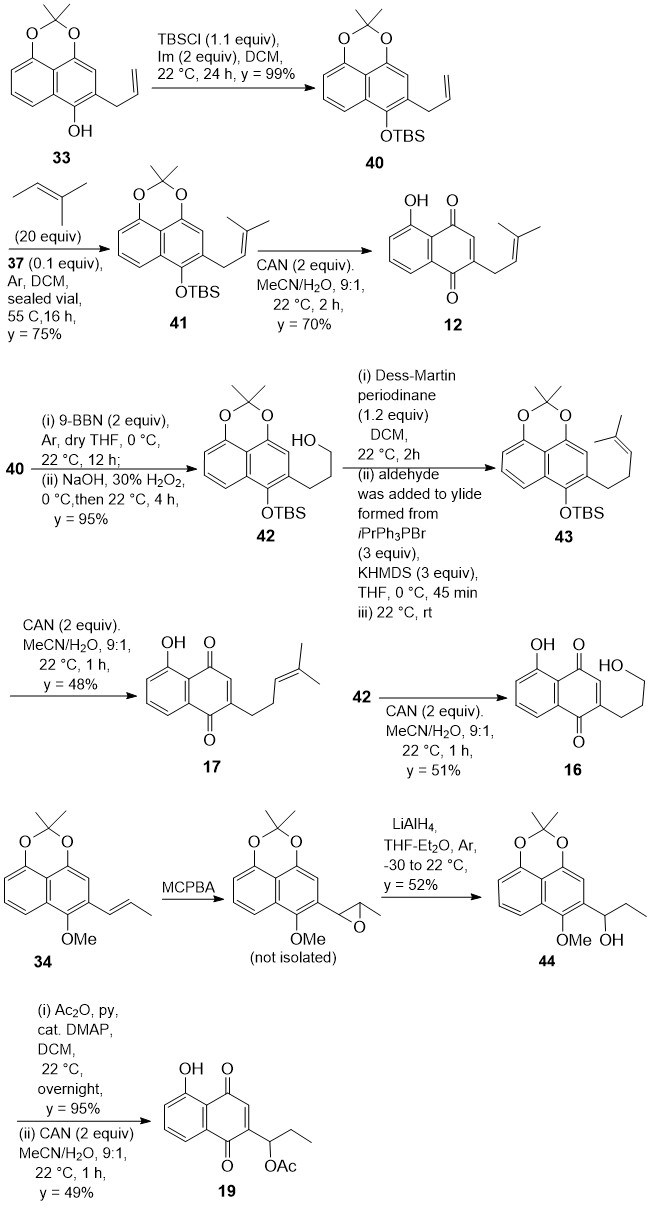
2.21. ((5-Allyl-2,2-dimethylnaphtho[1,8-de]-[1,3]-dioxin-6-yl)oxy)(tert-butyl)dimethylsilane (40)
Imidazole (Im) (113 mg, 1.66 mmol, 2 equiv), followed by TBSCl (137.5 mg, 0.91 mmol, 1.1 equiv), was added to naphtol 33 (213 mg, 0.83 mmol) dissolved in dry DCM (8.3 mL). The resulting mixture was stirred at 22 °C for 24 h. Subsequently, the organic layer was washed with a saturated aqueous solution of NaHCO3 (5 mL), and the aqueous phase was extracted with DCM (3 × 4 mL). The combined organic layers were dried over Na2SO4 and evaporated under reduced pressure. The resulting oily residue was purified by flash chromatography over a silica gel column (15 g). Elution with hexane/EtOAc, 98:2, gave compound 40 (340 mg, yield = 99%) as a pale-yellow oil. HRMS (ESI positive mode) C22H31O3Si+ [M + H]+ calc. 371.2042, found 371.2038. 1H-NMR (300 MHz, CDCl3) δH 7.65 (1H, d, J = 8.2 Hz, 8-H), 7.40 (1H, dd, J = 8 and 7.5 Hz, 7-H), 6.83 (1H, d, J = 7.5 Hz, 6-H), 6.4 (1H, s, 3-H), 6.15–5.95 (1H, ddt, J = 16.7, 10.5 and 6.1 Hz, 2′-H), 5.31 (1H, d, J = 10.5 Hz, 3′-HZ), 5.20 (1H, d, J = 16.7 Hz, 3′-HE), 3.55 (2H, d, J = 6.1 Hz, 1′-H2), 1.65 (6H, s, Me2), 0.9 (9H, s, tert-BuSi), 0.15 (6H, s, Me2Si). 13C-NMR (75 MHz, CDCl3) δC 150.7, 148.0, 139.7, 136.1, 128.3, 127.3, 126.7, 116.2, 115.8, 111.8, 111.5, 108.5, 102.9, 33.9, 26.32, 25.6, 18.3, −4.3.
2.22. Tert-butyl((2,2-dimethyl-5-(3-methylbut-2-en-1-yl)naphtho[1,8-de]-[1,3]-dioxin-6-yl)oxy)dimethylsilane (41)
Compound
40 was converted in 75% yield into pale-yellow oily olefin
41 with the metathesis reaction described in
Section 2.3.2. HRMS (ESI positive mode) C
24H
35O
3Si
+ [M + H]
+ calc. 399.2355, found 399.2358;
1H-NMR (300 MHz, CDCl
3) δ
H 7.68 (1H, dd,
J = 7.8, 1.2 Hz, 8-H), 7.18 (1H, dd,
J = 7.9, 7.1 Hz, 7-H), 6.93 (1H, dd,
J = 7.0, 1.2 Hz, 6-H), 6.63 (1H, t,
J = 0.8 Hz, 3-H), 5.31 (1H, tdd,
J = 7.4, 1.8, 1.3 Hz, 2′-H), 3.34 (2H, ddq,
J = 7.5, 1.9, 1.0 Hz, 1′-H
2), 1.73 (6H, br s, 3′-Me
2), 1.64 (6H, s, Me
2), 1.01 (9H, s,
tert-BuSi), 0.24 (6H, s, Me
2Si);
13C-NMR (75 MHz, CDCl
3) δ 151.1, 148.5, 140.1, 133.3, 128.9, 127.7, 126.7, 122.3, 115.8, 111.8, 111.5, 108.5, 102.9, 28.4, 26.3, 25.7, 25.6, 19.8, 18.2, −4.3.
2.23. 2-(6-((Tert-butyldimethylsilyl)oxy)-2,2-dimethylnaphtho[1,8-de]-[1,3]-dioxin-5-yl)ethan-1-ol (42)
9-BBN (0.4 M in hexane, 0.95 mL, 0.38 mmol, 2 equiv) was added dropwise to a solution of O-TBS ether 40 (70 mg, 0.19 mmol) in dry THF (2 mL) under Ar, cooled to 0 °C. Subsequently, the ice bath was removed, and the reaction mixture was stirred at 22 °C for 12 h until starting material, visualized on a TLC plate, disappeared. Subsequently, the reaction mixture was cooled to 0 °C, and NaOH (1M, 0.38 mL, 2 equiv), followed by excess 30% aqueous H2O2, was added under vigorous stirring. The resulting mixture was stirred at 22 °C for 4h, and then it was diluted with Et2O (10 mL) and water (5 mL). The organic layer was separated, and the aqueous phase was extracted with Et2O (4 × 8 mL). The combined organic layers were washed with H2O (10 mL), dried over Na2SO4, and concentrated under reduced pressure to give an oily residue that was separated by flash chromatography over a silica gel column (15 g). Elution with hexane/EtOAc, 98:2, afforded alcohol 42 (70 mg, yield = 95%) as a pale-yellow oil. HRMS (ESI positive mode) C22H33O4Si+ [M + H]+ calc. 389.2148, found 389.2144. 1H-NMR (300 MHz, CDCl3) δH 7.65 (1H, d, J = 8.3, Hz, 8-H), 7.41 (1H, dd, J = 8.2 and 7.5 Hz, 7-H), 6.85 (1H, d, J = 7.5 Hz, 6-H), 6.4 (1H, s, 3-H), 3.5 (2H, m, 3′-H2), 2.95–2.85 (2H, m, 1′-H2), 1.98–1.93 (2H, m, 2′-H2), 1.65 (6H, s, Me2), 0.9 (9H, s, tert-Bu), 0.12 (6H, s, Me2Si). 13C-NMR (75 MHz, CDCl3) δC 150.6, 148.1, 140.2, 129.5, 127.3, 126.5, 115.8, 112.0, 111.5, 108.5, 102.9, 62.1, 31.5, 28.0, 26.3, 25.6, 18.3, −4.3.
2.24. Tert-butyl((2,2-dimethyl-5-(4-methylpent-3-en-1-yl)naphtho[1,8-de]-[1,3]-dioxin-6-yl)oxy)dimethylsilane (43)
Dess-Martin periodinane (DMP, 165 mg, 1.2 equiv) was added to a solution of alcohol 42 (110 mg, 0.283 mmol) in dry DCM under Ar, and the resulting mixture was stirred at 22 °C for 2h. The reaction was then quenched with saturated aqueous Na2S2O3 (5 mL) and NaHCO3 (3mL) and diluted with DCM (7 mL). The organic layer was separated, and the aqueous phase was extracted with DCM (3 × 10 mL). The combined organic layers were washed with H2O (8 mL), dried over Na2SO4, filtered, and concentrated under reduced pressure to give a crude aldehyde (1H-NMR signal of CHO at δH 9.82) which was directly used in the subsequent olefination step. Isopropyl triphenyl phosphonium bromide (330 mg, 0.86 mmol, 3 equiv) was suspended in dry THF (5 mL) contained in a two-neck round-bottom flask under an argon atmosphere. The resulting suspension was cooled to 0 °C, and potassium bis(trimethylsilyl)amide (KHMDS, 0.5 M in toluene, 1.72 mL, 3 equiv) was added dropwise. The deep red solution of the formed ylide was stirred at 22 °C for 45 min; subsequently, a solution of the crude aldehyde in dry THF (2 mL) was added dropwise, and the mixture was stirred for an additional 3 h at 22 °C. Once completed, the reaction was quenched with saturated aqueous NH4Cl, and the mixture was diluted with Et2O (15 mL). The organic layer was separated, and the aqueous phase was extracted with Et2O (3 × 10 mL). The combined organic layers were washed with H2O (8 mL), dried over Na2SO4, filtered, and concentrated under reduced pressure to give a residue which was separated by flash chromatography over a silica gel column (15 g). Elution with hexane/EtOAc, 99:1, afforded compound 43 (105 mg, yield = 90% from 42) as a pale-yellow oil. HRMS (ESI positive mode) C25H37O3Si+ [M + H]+ calc. 413.2512, found 413.2507. 1H-NMR (300 MHz, CDCl3) δH 7.68 (1H, d, J = 8.5 Hz, 8-H), 7.26 (1H, dd, J = 8.5 and 7.5 Hz, 7-H), 6.79 (1H, d, J = 7.5 Hz, 6-H), 6.72 (1H, s, 3-H), 5.18 (1H, br t, J = 7.2 Hz, 3′-H), 2.75 (2H, dd, J = 7.2 and 7.5 Hz, 1′-H2), 2.29 (2H, br q, J = 7.3 Hz, 2′-H2), 1.72 (3H, br s, 4′-MeE), 1.67 (6H, s, 2 × Me), 1.57 (3H, br s, 4′-MeZ), 1.09 (9H, s, tert-Bu), 0.18 (6H, s, Me2Si). 13C-NMR (75 MHz, CDCl3) δC 150.6, 147.9, 140.5, 132.8, 128.8, 127.3, 126.5, 123.1, 115.8, 112.0, 111.5, 108.5, 102.9, 30.3, 27.4, 26.3, 25.6, 25.5, 19.6, 18.3, −4.4.
2.25. 1-(6-Methoxy-2,2-dimethylnaphtho[1,8-de]-[1,3]-dioxin-5-yl)propan-1-ol (44)
Freshly purified m-chloroperoxybenzoic acid (m-CPBA, 51.7 mg, 0.15 mmol, 1.5 equiv) and powdered NaHCO3 (12.6 mg, 0.15 mmol, 1.5 equiv.) were added in a single portion to a solution of olefin 34 (27 mg, 0.1 mmol,) in dry DCM (2 mL) at 0 °C under Ar. The resulting mixture was stirred at 0 °C for 8 h; subsequently, the reaction was quenched by adding saturated aqueous NaHCO3 (4 mL) and DCM (16 mL). The organic layer was separated, and the aqueous phase was extracted with DCM (3 × 15 mL). The combined organic layers were washed with H2O (8 mL), dried over MgSO4, filtered, and evaporated under vacuum to give an oily residue (28.4 mg, quantitative yield) which was used directly in the next step, as the formed epoxide degraded rapidly on silica gel. Thus, LiAlH4 (1M in Et2O 0.37 mL, 4.0 equiv) was added to a solution of crude epoxide (26.5 mg, 0.092 mmol) in dry THF (4 mL) which was magnetically stirred for 1h at −30 °C, under Ar. Subsequently, the temperature was allowed to rise to 22 °C, and once completed, the reaction was quenched by adding saturated aqueous potassium-sodium tartrate (4 mL), H2O (8 mL) and Et2O (4 mL). The resulting mixture was stirred at 22 °C until two layers were clearly observed. The layers were separated, and the aqueous phase was extracted with DCM (3 × 8 mL). The combined organic layers were dried over Na2SO4, filtered, and concentrated under vacuum. The resulting residue was chromatographed on a silica gel column (10 g). Elution with hexane-EtOAc, 90:10, afforded benzylic alcohol 44 (13.9 mg, yield = 52%) as a yellowish oil. HRMS (ESI positive mode) C17H21O4+ [M + H]+ calc. 289.1440, found 289.1434. 1H NMR (300 MHz, CDCl3) δH 7.72 (1H, dd, J = 7.8, 1.2 Hz, 8-H), 7.12 (1H, dd, J = 7.9, 7.1 Hz, 7-H), 6.97–6.85 (2H, m, 6- and 3-H), 4.93–4.80 (1H, m, 1′-H), 3.87 (3H, s, 1-OMe), 3.38–3.30 (1H, m, 2′-Ha), 1.88 (1H, dqd, J = 13.1, 7.5, 5.5 Hz, 2′-Hb), 1.64 (6H, s, 2 × Me), 1.04 (3H, td, J = 7.5, 1.5 Hz, 3′-H3). 13C NMR (75 MHz, CDCl3) δC 150.7, 149.7, 147.3, 136.2, 126.3, 124.4, 113.3, 111.1, 110.9, 108.7, 103.7, 74.5, 63.3, 31.3, 26.3, 14.8.
2.26. MTT Test
The inhibitory activities, expressed as IC
50 (μM/L) indices, of compounds
1,
3,
15,
16,
17, (±)-
18 and the corresponding enantiomers
18a and
18b,
19,
20, and
21, on the viability of non-small lung cancer H460 cells and breast cancer MCF-7 cells, were determined spectrophotometrically with the colorimetric MTT [3-(4,5-dimethylthiazol-2-yl)-2,5-diphenyltetrazolium bromide] assay [
19]. The test was based on the conversion of pale-yellow MTT to deep purple MTT-formazan by mitochondrial enzymes of viable cells: thus, the darker the solution, the greater the number of viable, metabolically active cells.
2.26.1. Cell Cultures
H460 and MCF-7 cells were purchased from ATCC (Manassas, VA, USA) and were cultured in the dark in RPMI-1640 medium (Hyclone; Thermo Fisher Scientific, Rockford, IL, USA) containing 10% FBS (phosphate-buffered saline), 100 U/mL penicillin and 100 µg/mL streptomycin at 37 °C under a humid atmosphere of 95% air and 5% CO2.
2.26.2. Cell Viability Test
Cells were harvested during the exponential phase of growth, seeded in quadruplicate at about 5 × 10³ cells/well in 96-well plates, and incubated overnight. Each tested sample (100 mL/well) was prepared in dimethyl sulfoxide (DMSO) and subsequently diluted with the RPMI-1640 medium prior to use in a range of serial concentrations from 0.1 to 50 µM). The final concentration of DMSO was less than 0.1%. The control group received the same amount of DMSO. Cells were exposed to each tested sample and then incubated for 48 h. Subsequently, the medium was removed, and the cells were washed with PBS; subsequently, 10 mL of a stock MTT solution (5 mg/mL in PBS; Sigma–Aldrich, Milano (MI), Italy) was added to each well, and the cells were incubated for an additional 4 h at 37 °C until intracellular purple formazan was visible under a microscope. Subsequently, the culture medium containing unreacted dye was removed, and the cells were exposed to DMSO (150 µL) and incubated at 37 °C until they lysed and formed purple formazan was completely dissolved. The absorbance (Abs) of the resulting solution was measured at 570 nm using an automated microplate reader (BioTek, Hercules, CA, USA). Each assay was repeated in three separate experiments, and mean absorbance ± SD (standard deviation) was calculated. The percentage cell viability and the percentage inhibition of cell viability were calculated by the equations [(Abssample − Absblank)/Abscontrol − Absblank)] × 100 and [(Abscontrol − Absblank − Abssample)/Abscontrol − Absblank] × 100, respectively, where the control was untreated cells, and the blank was the medium. A sample was considered non-cytotoxic if the cell viability was >70% for all concentrations; instead, if the cell viability was <70% for at least one concentration, the half-maximal inhibitory concentration (IC50, μM/L) index was calculated by probit analysis (p < 0.05, χ2 test), plotting the percentage cell viability versus sample concentration. An IC50 index denotes the concentration of a compound at which 50% of cell viability is inhibited or, as a complement, 50% of cells survive. Commercially available juglone (1) and shikonin (3) were the reference compounds.
2.27. Mulliken Population Analysis of the Regioisomeric Anions Derived from the Deprotonation of Compound 25
Calculations were carried out using the Gaussian09D program [
23] at a differentiated level of theory [6-31+G(d,p)] with the DFT/B3LY functional [
24,
25]. The role of the solvent THF was simulated by using the polarizable continuum model (PCM) theory [
26]. The computed Cartesian coordinates of compound
25 and the charge distributions in the regioisomeric species resulting from the deprotonation of compound
25 are reported in
Table S1 and Figures S10–S12, respectively, in the
Supplementary Materials.




 ,
,