Review

Methodological Pitfalls of Investigating Lipid Rafts in the Brain: What Are We Still Missing?

by
Kristina Mlinac-Jerkovic
1,
Svjetlana Kalanj-Bognar
1,
Marija Heffer
2,* and
Senka Blažetić
3,*
1
School of Medicine, University of Zagreb, 10000 Zagreb, Croatia
2
Faculty of Medicine, Josip Juraj Strossmayer University of Osijek, 31000 Osijek, Croatia
3
Department of Biology, Josip Juraj Strossmayer University of Osijek, 31000 Osijek, Croatia
*
Authors to whom correspondence should be addressed.
Biomolecules 2024, 14(2), 156; https://doi.org/10.3390/biom14020156
Submission received: 31 December 2023 / Revised: 21 January 2024 / Accepted: 26 January 2024 / Published: 28 January 2024
(This article belongs to the Special Issue Brain Sterols: Biosynthesis and Physiology in Health and Disease)

Abstract

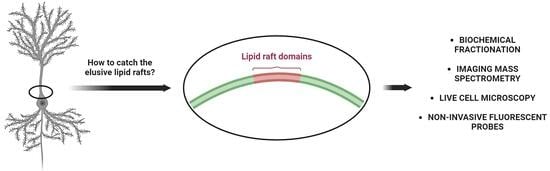
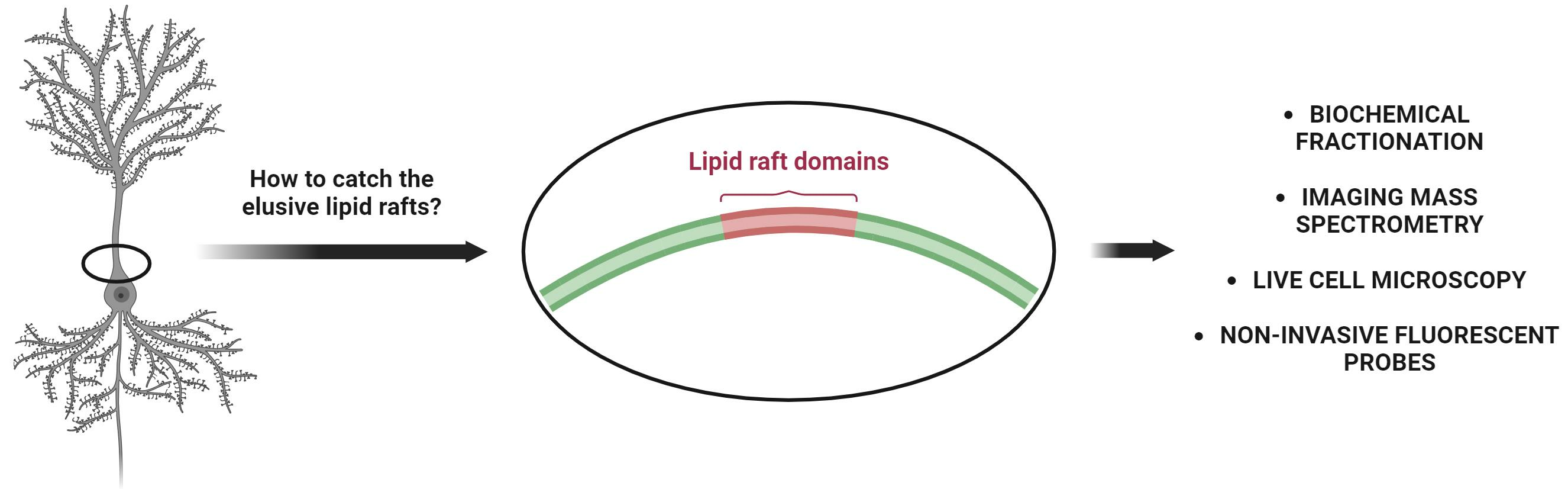
The purpose of this review is to succinctly examine the methodologies used in lipid raft research in the brain and to highlight the drawbacks of some investigative approaches. Lipid rafts are biochemically and biophysically different from the bulk membrane. A specific lipid environment within membrane domains provides a harbor for distinct raftophilic proteins, all of which in concert create a specialized platform orchestrating various cellular processes. Studying lipid rafts has proved to be arduous due to their elusive nature, mobility, and constant dynamic reorganization to meet the cellular needs. Studying neuronal lipid rafts is particularly cumbersome due to the immensely complex regional molecular architecture of the central nervous system. Biochemical fractionation, performed with or without detergents, is still the most widely used method to isolate lipid rafts. However, the differences in solubilization when various detergents are used has exposed a dire need to find more reliable methods to study particular rafts. Biochemical methods need to be complemented with other approaches such as live-cell microscopy, imaging mass spectrometry, and the development of specific non-invasive fluorescent probes to obtain a more complete image of raft dynamics and to study the spatio-temporal expression of rafts in live cells.
Keywords: cholesterol; detergent-resistant membranes; gangliosides; glycosphingolipids; Triton X-100; Brij O20; imaging mass spectrometry; neuronal membranes cholesterol; detergent-resistant membranes; gangliosides; glycosphingolipids; Triton X-100; Brij O20; imaging mass spectrometry; neuronal membranes
Graphical Abstract