
Communication

Strong Progenitor Age Bias in Supernova Cosmology and Alignment with DESI BAO

Department of Astronomy & Center for Galaxy Evolution Research, Yonsei University, Seoul 03722, Republic of Korea
*
Author to whom correspondence should be addressed.
Universe 2026, 12(1), 22; https://doi.org/10.3390/universe12010022
Submission received: 3 December 2025 / Revised: 13 January 2026 / Accepted: 13 January 2026 / Published: 15 January 2026

Abstract

Supernova (SN) cosmology is based on the assumption that the luminosity of type Ia SNe, after the luminosity standardization process, remains invariant with progenitor age. However, our comprehensive age measurements of SN host galaxies reveal a significant ( 5.5 σ ) correlation between standardized SN luminosity and progenitor age, which is expected to introduce a serious systematic bias with redshift in SN cosmology. After correcting for this age bias with redshift, the SN dataset aligns more closely with the recent DESI BAO result, bringing the updated ’standard candle’ (SNe) into concordance with the ’standard ruler’ (BAO). When the three cosmological probes (SNe, BAO, CMB) are combined, we find a strong (∼9 σ ) discordance with the Λ CDM model, suggesting a time-varying dark energy equation of state in a currently non-accelerating universe.

1. Introduction

Type Ia supernovae (SNe Ia) remain the cornerstone of modern observational cosmology. Their standardized luminosities revealed the accelerated expansion of the universe and established the Λ cold dark matter (CDM) framework. This framework assumes that SN Ia luminosity standardization based on light-curve width and color is independent of progenitor age. However, this expectation has not been directly tested because earlier studies relied on indirect host-galaxy properties rather than on direct progenitor age measurements used in our work. In this context, recent baryon acoustic oscillation results from the Dark Energy Spectroscopic Instrument (DESI, [1]) raise concerns about this assumption. When DESI BAO data are combined with cosmic microwave background measurements, they favor a time-varying dark energy equation of state with values of w 0 0.43 and w a 1.7 . These data also support a mildly decelerating present universe with q 0 + 0.1 . When SN Ia data are added without any correction for population effects, the Λ CDM model appears to agree with the combined observations. This indicates that an internal bias in the SN Ia distance scale may imitate cosmic acceleration. This paper for the BGL 2025 conference summarizes our two recent MNRAS papers that explore this possibility. Paper I [2] established a strong empirical correlation between standardized SN Ia luminosity and progenitor age. Paper II [3] showed that correcting for this age bias aligns SN Ia distances with DESI BAO and CMB data and produces a cosmology in which dark energy evolves with time and the current universe is not accelerating. Here we summarize these results and discuss their implications.

2. Empirical Evidence for the Age Bias

We directly measured stellar-population ages for two major SN Ia host samples—the R19 [4] and G11 [5] sets—covering all morphological types to z < 0.45 . The u g r i z magnitudes of SN Ia host galaxies from the Sloan Digital Sky Survey were analyzed using updated population-synthesis models [6], and Bayesian LINMIX regression and the Zhang et al. [7] model using full age posterior distribution were used to quantify the correlation between Hubble residuals (HRs) and stellar population ages.
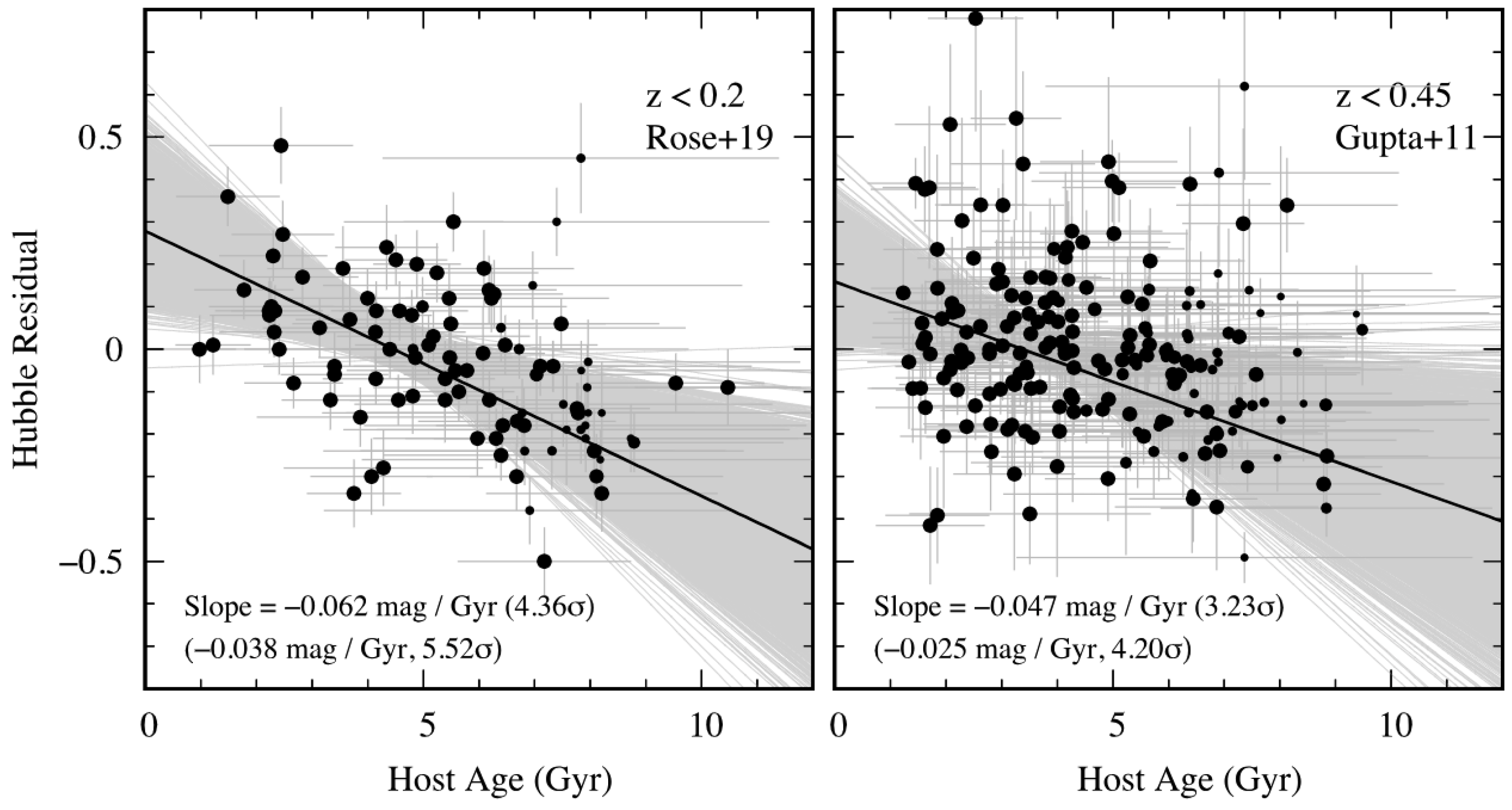
Figure 1 shows HR versus host age from the LINMIX analysis, yielding slopes of 0.062 ± 0.014 (∼4.4 σ ) and 0.047 ± 0.015 (∼3.2 σ ) for the R19 and G11 samples, respectively. Using the Zhang et al. [7] regression model, the corresponding slopes are 0.0381 ± 0.0069 ( 5.5 σ ) and 0.0254 ± 0.0061 ( 4.2 σ ) for the R19 and G11 samples, respectively (see Section 6 of Paper I; Chung et al. [2]). Age uncertainties are propagated by incorporating the full posterior age distributions from the MCMC sampling into the SN Ia luminosity vs. host age regression. Younger hosts produce fainter standardized SNe Ia, and the combined significance exceeds 5.5 σ across the ≈300 hosts when the two samples are considered separately. The correlation persists regardless of the regression method and host properties such as metallicity or morphology, confirming that progenitor age is the primary driver rather than host mass or dust content. Independent analyses [7,8,9,10,11] also confirm similar slopes (see Figure 10 of Paper I [2]). Tests of other host-related systematics, including metallicity and dust, show that their effects on SN Ia luminosity are much smaller than that of host age (see also [2,10]).
Although host mass is commonly treated as a proxy for progenitor age in SN Ia studies, it only partially captures the underlying age information [12]. This partial correlation naturally leads to the observed host mass step. In addition, since stellar mass and age evolve differently with redshift, the systematic decrease in progenitor age at higher redshift produces an unavoidable redshift-dependent age bias in the SN Ia distance scale. Another important host systematic, star-formation history, also influences SN Ia luminosity but is closely tied to host age, and this will be fully addressed in our upcoming work.

3. Redshift Evolution and the Age Bias Correction

To estimate the redshift dependence of progenitor ages, we modeled the SN Ia progenitor-age distribution using the cosmic star-formation history and an empirically derived delay-time distribution1 [13]. The resulting progenitor age distribution as a function of redshift is detailed in Son et al. [3], Lee et al. [10]. The median progenitor age declines by ≈5 Gyr from z = 0 to 1. This corresponds to a mean brightness shift of ≈0.15 mag, comparable to the full cosmological acceleration signal. We therefore applied an age bias correction to the standardized distance modulus:
μ SN = m M + α x 1 β c | s | × Δ age ( z ) .
As described in Chung et al. [2], we adopt the weighted mean slope of s = 0.030 ± 0.004 mag / Gyr 2 based on previously reported studies [7,8,9,10,11]. The distance modulus is calculated using | s | and the redshift-dependent cosmological age differences at each redshift [see Section 3 of [3]]. Although this approach does not alter scatter within each redshift bin, it corrects the redshift-dependent offset in the mean HRs.

4. Cosmological Impact of the Age Bias Correction

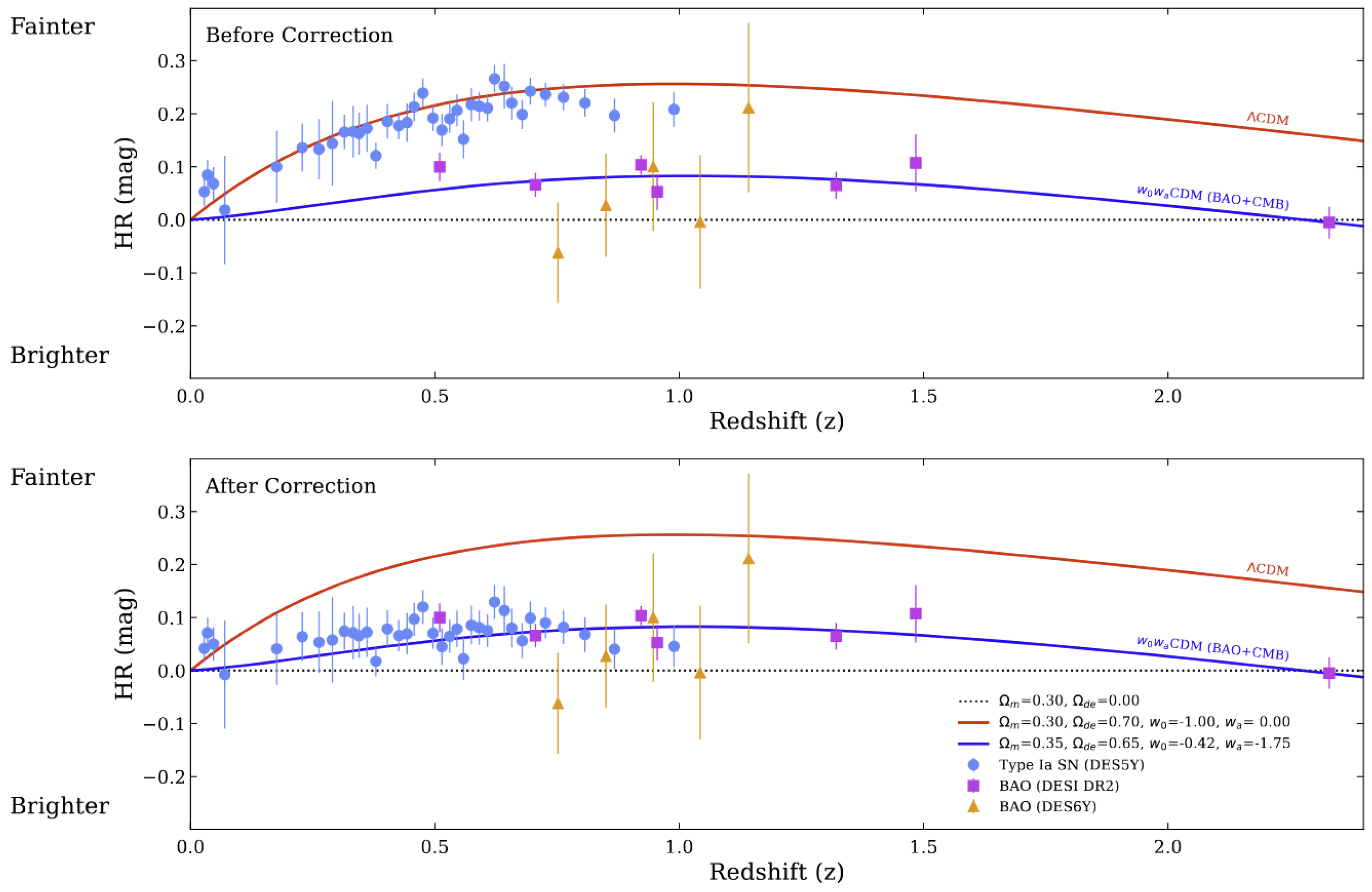
Figure 2 (Paper II [3] Figure 4) compares the DES5Y sample [14] before and after applying the age bias correction. Before the correction, the data follow the Λ CDM model (red line), whereas after the correction, they align with the w 0 w a CDM model favored by DESI BAO and CMB (blue line). Our test using the Pantheon+ sample also shows the same behavior. Given the uncertainties in the weighted-mean slope, the age bias corrected SN Ia distance differences are small and do not significantly affect our analysis. Converting DESI BAO measurements into luminosity distances further demonstrates that the corrected SN Ia scale matches the BAO standard ruler (squares and triangles), while the uncorrected SNe Ia remain systematically offset. Once progenitor age bias is accounted for, the “standard candle” and the “standard ruler” become mutually consistent.
We further performed Bayesian analyses using COBAYA and CAMB (see Section 4 of Paper II [3], for the full cosmological inference setup, including data combinations, priors, likelihoods, and posterior summaries). Parameters derived from the uncorrected DES5Y SN Ia data still indicate an accelerating universe, whereas applying the age bias correction produces a significant shift from ( w 0 , w a , q 0 ) = ( 0.754 ± 0.056 , 0.848 ± 0.217 , 0.271 ± 0.061 ) to ( 0.337 ± 0.062 , 1.902 ± 0.246 , 0.178 ± 0.061 ) for the combined BAO, CMB, and DES5Y dataset. The correction moves q 0 from negative to positive, indicating that the present-day expansion may already be decelerating. After applying the age bias correction, the resulting cosmological parameters become inconsistent with Λ CDM at a significance level exceeding 9– 11 σ . Using the Kullback–Leibler divergence to quantify concordance among probes, we find that the SN + BAO (+CMB) posteriors shift toward the BAO combined with CMB distributions once the age-bias correction is applied. Thus, rather than disrupting consistency, the age-bias-corrected SN data restore concordance around a cosmology with evolving dark energy.
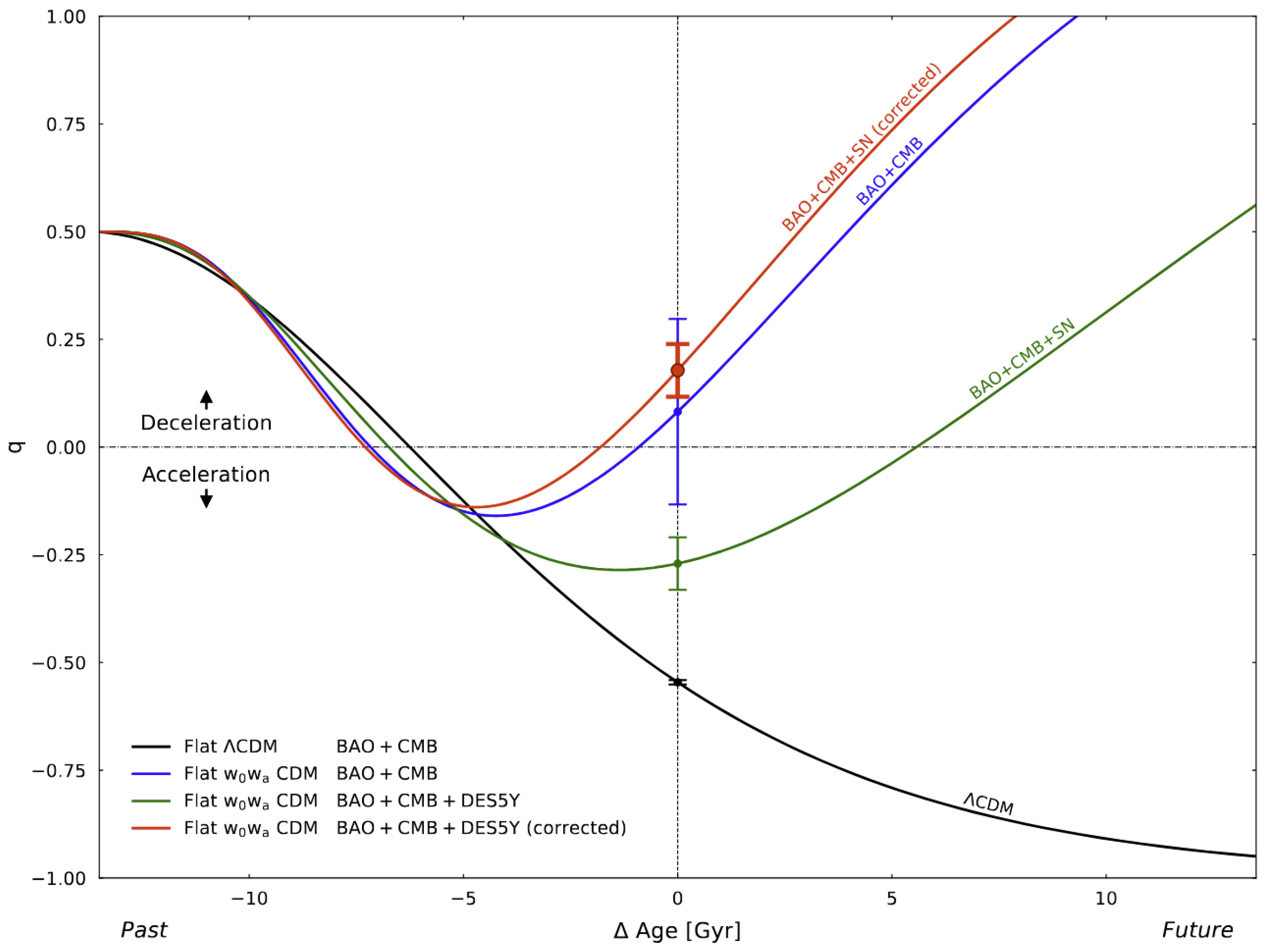
Figure 3 (Paper II [3] Figure 9) presents the cosmic deceleration parameter q = a ¨ a / a ˙ 2 over cosmic time. Λ CDM predicts continued acceleration ( q 0 0.55 ), whereas the corrected SN + BAO + CMB solution yields q 0 > 0 today, consistent with DESI BAO + CMB alone. Dark energy, therefore, appears to weaken with time rather than remain constant.

5. Discussion

The progenitor age bias may also offer a possible explanation for the longstanding H 0 tension between local-distance-ladder (SH0ES) and early-universe (CMB) determinations. The calibration (second-rung) sample used for SN Ia zero-points consists entirely of late-type, young hosts, while the Hubble-flow (third-rung) sample contains many older hosts. Even a modest 2–3 Gyr population difference translates to a 0.06–0.09 mag offset in standardized SN luminosity—corresponding to a 3–4.5% decrease in H 0 , or ≈2–3 km / s / Mpc —sufficient to ease the observed 5–6 km / s / Mpc discrepancy. Therefore, the same underlying systematic responsible for the cosmological-scale bias could simultaneously mitigate the H 0 tension.
To confirm that our conclusion is not an artifact of the adopted empirical correction and model, we performed an “evolution-free” test selecting only young (<4.5 Gyr) host galaxies across all redshifts [see Figure 10 of [3]]. These coeval progenitors yield cosmological parameters consistent with the w 0 w a CDM model favored by BAO + CMB, without any explicit correction, further validating that the progenitor age bias is real and universal.
Upcoming surveys will extend these tests dramatically. The Vera Rubin Observatory’s LSST will provide orders-of-magnitude larger SN Ia samples with host photometry and spectra, enabling direct age determinations up to z 1.5 . Combined with JWST/NIRSpec spectroscopy of early-type hosts and DESI DR3 BAO results, we will be able to trace progenitor-age evolution and its cosmological imprint with unprecedented precision.

Author Contributions

Conceptualization, C.C. and Y.-W.L.; Methodology, C.C. and J.S.; Validation, C.C. and J.S.; Formal analysis, C.C., J.S., S.P., and H.C.; Investigation, C.C., Y.-W.L., J.S., S.P., and H.C.; Data curation, C.C., J.S., and S.P.; Writing—review and editing, C.C.; Visualization, C.C. and J.S.; Supervision, C.C. and Y.-W.L.; Project administration, Y.-W.L.; Funding acquisition, Y.-W.L. All authors have read and agreed to the published version of the manuscript.

Funding

We acknowledge support from the National Research Foundation of Korea to the Center for Galaxy Evolution Research (RS-2022-NR070872, RS-2022-NR070525).

Data Availability Statement

Data presented in this paper can be found in [2,3].

Conflicts of Interest

The authors declare no conflicts of interest.

Abbreviations

The following abbreviations are used in this manuscript:
BAOBaryonic Acoustic Oscillation
CMBCosmic Microwave Background
LSSTLegacy Survey of Space and Time
JWSTJames Webb Space Telescope

Notes

1
Different delay-time distributions change the mean progenitor age at a given redshift, but the corresponding difference in the mean progenitor age is small.
2
The weighted mean slope may vary as additional host galaxies with age measurements are included, which would modify the age bias correction term. However, the dimming of younger progenitors is a robust and ubiquitous trend, and existing results, including those shown in Figure 10 of Chung et al. [2], indicate that additional data do not significantly change the weighted mean slope.

References

  1. Abdul Karim, M.; Aguilar, J.; Ahlen, S.; Allen, L.; Prieto, C.A.; Alves, O.; Anand, A.; Andrade, U.; Armengaud, E.; Aviles, A.; et al. DESI DR2 results. II. Measurements of baryon acoustic oscillations and cosmological constraints. Phys. Rev. D 2025, 112, 083515. [Google Scholar] [CrossRef]
  2. Chung, C.; Park, S.; Son, J.; Cho, H.; Lee, Y.W. Strong progenitor age bias in supernova cosmology—I. Robust and ubiquitous evidence from a larger sample of host galaxies in a broader redshift range. Mon. Not. R. Astron. Soc. 2025, 538, 3340–3350. [Google Scholar] [CrossRef]
  3. Son, J.; Lee, Y.-W.; Chung, C.; Park, S.; Cho, H. Strong progenitor age bias in supernova cosmology—II. Alignment with DESI BAO and signs of a non-accelerating universe. Mon. Not. R. Astron. Soc. 2025, 544, 975–987. [Google Scholar] [CrossRef]
  4. Rose, B.M.; Garnavich, P.M.; Berg, M.A. Think Global, Act Local: The Influence of Environment Age and Host Mass on Type Ia Supernova Light Curves. Astrophys. J. 2019, 874, 32. [Google Scholar] [CrossRef]
  5. Gupta, R.R.; D’Andrea, C.B.; Sako, M.; Conroy, C.; Smith, M.; Bassett, B.; Frieman, J.A.; Garnavich, P.M.; Jha, S.W.; Kessler, R.; et al. Improved Constraints on Type Ia Supernova Host Galaxy Properties Using Multi-wavelength Photometry and Their Correlations with Supernova Properties. Astrophys. J. 2011, 740, 92. [Google Scholar] [CrossRef]
  6. Conroy, C.; Gunn, J.E. The Propagation of Uncertainties in Stellar Population Synthesis Modeling. III. Model Calibration, Comparison, and Evaluation. Astrophys. J. 2010, 712, 833. [Google Scholar] [CrossRef]
  7. Zhang, K.D.; Murakami, Y.S.; Stahl, B.E.; Patra, K.C.; Filippenko, A.V. Improving bayesian posterior correlation analysis on type Ia supernova luminosity evolution. Mon. Not. R. Astron. Soc. 2021, 503, L33–L37. [Google Scholar] [CrossRef]
  8. Kang, Y.; Lee, Y.W.; Kim, Y.L.; Chung, C.; Ree, C.H. Early-type Host Galaxies of Type Ia Supernovae. II. Evidence for Luminosity Evolution in Supernova Cosmology. Astrophys. J. 2020, 889, 8. [Google Scholar] [CrossRef]
  9. Lee, Y.W.; Chung, C.; Kang, Y.; Jee, M.J. Further Evidence for Significant Luminosity Evolution in Supernova Cosmology. Astrophys. J. 2020, 903, 22. [Google Scholar] [CrossRef]
  10. Lee, Y.W.; Chung, C.; Demarque, P.; Park, S.; Son, J.; Kang, Y. Evidence for strong progenitor age dependence of type Ia supernova luminosity standardization process. Mon. Not. R. Astron. Soc. 2022, 517, 2697–2708. [Google Scholar] [CrossRef]
  11. Wang, J.; Huang, Z.; Huang, L. Revisiting progenitor-age dependence of type Ia supernova luminosity standardization process. Sci. China Phys. Mech. Astron. 2023, 66, 129511. [Google Scholar] [CrossRef]
  12. Chung, C.; Yoon, S.J.; Park, S.; An, S.; Son, J.; Cho, H.; Lee, Y.W. On the Root Cause of the Host “Mass Step” in the Hubble Residuals of Type Ia Supernovae. Astrophys. J. 2023, 959, 94. [Google Scholar] [CrossRef]
  13. Childress, M.J.; Wolf, C.; Zahid, H.J. Ages of Type Ia supernovae over cosmic time. Mon. Not. R. Astron. Soc. 2014, 445, 1898–1911. [Google Scholar] [CrossRef]
  14. Abbott, T.M.C. et al. [DES Collaboration] The Dark Energy Survey: Cosmology Results with 1500 New High-redshift Type Ia Supernovae Using the Full 5 yr Data Set. Astrophys. J. Lett. 2024, 973, L14. [Google Scholar] [CrossRef]
Figure 1. Correlation between host-galaxy age and SN Ia Hubble residuals for R19 and G11 samples. The gray lines are the LINMIX simulations for 10 4 regressions. This figure is reproduced from Figure 4 of Paper I [2].
Universe 12 00022 g001
Figure 2. Hubble diagram before (top) and after (bottom) applying the redshift-dependent age bias correction. The adopted r d H 0 value of 93.9 ± 2.9 Mpc used for the comparison is taken from Table 7 of Abdul Karim et al. [1] w 0 w a CDM model. The corresponding H 0 for BAO + CMB is 63.7 ± 2.0 km/s/Mpc. The corrected DES5Y SN data (circles) align with the DESI BAO + CMB w 0 w a CDM model (blue line) rather than Λ CDM (red line). This figure is reproduced from Figure 4 of Paper II [3].
Universe 12 00022 g002
Figure 3. Evolution of the cosmic deceleration parameter (q). After correction, SN + BAO + CMB results (red) indicate present-day deceleration, consistent with DESI BAO + CMB (blue) and in contrast to the accelerating Λ CDM model (black). This figure is reproduced from Figure 9 of Paper II [3].
Universe 12 00022 g003
Disclaimer/Publisher’s Note: The statements, opinions and data contained in all publications are solely those of the individual author(s) and contributor(s) and not of MDPI and/or the editor(s). MDPI and/or the editor(s) disclaim responsibility for any injury to people or property resulting from any ideas, methods, instructions or products referred to in the content.