Skip to Content
UniverseUniverse
  • Article
  • Open Access

14 January 2026

Two-Step Localization Method for Electromagnetic Follow-Up of LIGO-Virgo-KAGRA Gravitational-Wave Triggers


and
Department of Physics, Bar Ilan University, Ramat Gan 5290002, Israel
*
Author to whom correspondence should be addressed.
This article belongs to the Section Compact Objects

Abstract

Rapid detection and follow-up of electromagnetic (EM) counterparts to gravitational wave (GW) signals from binary neutron star (BNS) mergers are essential for constraining source properties and probing the physics of relativistic transients. Observational strategies for these early EM searches are therefore critical, yet current practice remains suboptimal, motivating improved, coordination-aware approaches. We propose and evaluate the Two-Step Localization strategy, a coordinated observational protocol in which one wide-field auxiliary telescope and one narrow-field main telescope monitor the evolving GW sky localization in real time. The auxiliary telescope, by virtue of its large field of view, has a higher probability of detecting early EM emission. Upon registering a candidate signal, it triggers the main telescope to slew to the inferred location for prompt, high-resolution follow-up. We assess the performance of Two-Step Localization using large-scale simulations that incorporate dynamic sky-map updates, realistic telescope parameters, and signal-to-noise ratio (SNR)-weighted localization contours. For context, we compare Two-Step Localization to two benchmark strategies lacking coordination. Our results demonstrate that Two-Step Localization significantly reduces the median detection latency, highlighting the effectiveness of targeted cooperation in the early-time discovery of EM counterparts. Our results point to the most impactful next step: next-generation faster telescopes that deliver drastically higher slew rates and shorter scan times, reducing the number of required tiles; a deeper, truly wide-field auxiliary improves coverage more than simply adding more telescopes.

1. Introduction

Binary neutron star (BNS) and neutron star–black hole (NSBH) mergers are key multi-messenger sources, producing both gravitational waves (GWs) and electromagnetic (EM) counterparts across a broad spectral range. The detection of GW170817 [1] and its kilonova established these systems as sites of heavy-element synthesis via the r-process [2], and opened new avenues for measuring cosmological parameters [3] and testing fundamental physics [4]. Joint analyses that combine GW and EM information have already demonstrated the power of such multi-messenger data for constraining binary and ejecta properties [5]. Beyond the GW discovery itself, GW170817 triggered an unprecedented global EM follow-up campaign, spanning ultraviolet, optical, infrared, X-ray, gamma-ray, and radio observations. These observations provided a detailed, multi-wavelength picture of the merger and its ejecta [6,7,8,9,10,11,12,13,14,15,16,17,18,19,20,21,22,23], establishing GW170817 as the most comprehensively observed transient in modern astrophysics and demonstrating the scientific power of rapid, well-coordinated EM follow-up. The EM emission accompanying BNS/NSBH mergers includes prompt gamma-ray bursts, kilonovae powered by radioactive ejecta, and longer-timescale afterglows in X-ray, optical, and radio bands. Early emission—especially in UV and optical—encodes valuable information about the merger remnant, outflow properties, and shock-heated ejecta [24,25]. Precursor EM signals, potentially arising from magnetospheric interactions or tidal disruption, could also aid in rapid localization and characterization [26,27]. However, the timely identification of EM counterparts remains a challenge. In the simultaneous discovery of GW170817, the associated short GRB was observed by Fermi/INTEGRAL just ∼2 s after the merger [1], whereas the first GW alert was only issued with an automated Gamma-ray Coordinates Network (GCN)/LIGO–Virgo Collaboration (LVC) Notice ∼27 min post-merger (13:08 UT) [28], followed by the first human-readable GCN Circular at ∼40 min (13:21 UT) [29]. This ∼2 s versus ∼27 min gap reflects the fact that satellite detections are triggered and reported autonomously, while the LVC alerts in 2017 required low-latency analysis combined with human checks before release [30]. The initial sky localization then became available only after ∼4.5 h [31], limiting opportunities for prompt EM follow-up [32]. Although current low-latency pipelines routinely deliver public alerts with median latencies of ∼30 s, GW170817 was an outlier: A loud non-stationary glitch in LIGO–Livingston required extensive data-quality investigations and human vetting, delaying the first GW alert to ∼40 min and the first sky-map to ∼4.5 h after the merger [33]. This motivates the development of fast localization pipelines (Bayesian Triangulation and rapid localization (BAYESTAR) [34]) and observational strategies capable of capturing early-time signatures. In this work, we focus on the problem of reducing latency between GW detection and EM observation. Our approach aims to enable rapid, high-resolution follow-up through a coordinated two-step telescope strategy, with the goal of improving detection rates and enhancing the scientific return of multi-messenger observations.
Rapid detection of EM counterparts to GW signals from compact binary mergers is essential for probing merger dynamics, constraining ejecta properties, and informing models of relativistic transients [1]. While BNS mergers are the primary focus, NSBH systems may also yield detectable EM emission under favorable conditions [35]. This work proposes and evaluates the Two-Step Localization strategy, a coordination method designed to reduce the latency of EM counterpart detection following an external GW trigger. The approach utilizes two telescopes: an auxiliary wide-field instrument (e.g., ULTRASAT, with a 204 deg 2 field of view (FOV) [36]) and a main telescope with narrower FOV but significantly finer spatial resolution (e.g., the Swope Telescope, 7 deg 2 FOV, 0.435 / pixel [32,37]); for comparison, ULTRASAT operates at 5.4 / pixel . In some configurations, the auxiliary telescope may subsequently reconfigure to a narrower FOV and improved resolution. For instance, the LAST telescope supports both a wide mode ( 355 deg 2 , limiting magnitude ∼19.6) and a narrow mode ( 7.4 deg 2 ) [38,39], enabling more precise localization once the transient is detected. Notably, both ULTRASAT and LAST are operated by the Weizmann Institute of Science, which can streamline coordination, calibration, and rapid handoffs between the facilities. Upon receiving a GW alert from the LIGO [40], Virgo [41], and KAGRA [42] detectors—whose low-latency alert products and early-warning performance during O4 are characterized in [43]—the auxiliary telescope is slewed to the initial sky localization and begins monitoring in wide-field mode. This configuration maximizes sky coverage at the expense of resolution, increasing the probability of capturing early EM emission. Once a candidate is identified, the auxiliary telescope triggers the main telescope to slew to the inferred position for high-resolution follow-up. Early GW parameter estimation (e.g., chirp mass, mass ratio, luminosity distance) informs this decision, ensuring that the follow-up telescope’s sensitivity is matched to the expected EM signal [44]. We assess the performance of Two-Step Localization using large-scale simulations incorporating dynamic sky-map updates, realistic telescope parameters, and signal-to-noise ratio (SNR)-weighted localization contours [45]. For context, we compare Two-Step Localization to alternative strategies lacking full coordination. The results demonstrate that Two-Step Localization substantially improves detection latency and enhances early-stage EM follow-up capabilities.

2. Background

Since GW170817, EM follow-up of GW triggers has evolved into increasingly coordinated, strategy-driven campaigns. Wide networks of optical and high-energy facilities now use algorithmic tiling and time-allocation schemes to maximize the probability of catching fast-fading counterparts within large GW localization regions. Tools such as gwemopt [46,47] were developed to compare and optimize tiling and scheduling strategies across heterogeneous facilities, and quantify how different algorithms can change counterpart detection efficiency by factors of order unity or more. Building on these ideas, dynamic schedulers for target-of-opportunity campaigns (e.g., Global Rapid Advanced Network Devoted to the Multi-messenger Addicts (GRANDMA)/Global Relay of Observatories Watching Transients Happen (GROWTH) [48]) incorporate visibility constraints, multi-epoch coverage, and the evolving GW sky-map into a unified optimization framework. More recently, platforms such as tilepy [49] and the M4OPT toolkit enable cross-observatory coordination and mixed-integer optimization of follow-up plans, allowing mid- and small-FoV facilities, as well as future UV missions such as ULTRASAT [36] and NASA’s UVEX [50], to automatically generate observation sequences that account for each event’s GW sky localization and distance distribution; UVEX is optimized for a deep all-sky UV survey with rapid spectroscopic follow-up and an expected 2030 launch, whereas ULTRASAT, with an expected 2027–2028 launch and an extremely wide (204 deg2) near-UV field of view, is the natural focus of this work.
In parallel, GW data-analysis pipelines have developed genuine early-warning capabilities for compact-binary coalescences. Dedicated low-frequency searches and infrastructure designed for pre-merger alerts now aim to identify BNS signals tens of seconds before coalescence and distribute sky localizations fast enough to repoint narrow-field facilities in time for prompt and very-early EM emission [32,51]. Forecast studies suggest that, at design sensitivities, current networks could routinely provide tens of seconds of advance warning with ≲10– 100 deg 2 localizations for nearby BNS mergers [52]. Together with ongoing efforts to optimize low-latency localization accuracy [45], these developments provide the context for our proposed rapid two-step strategy, which is designed to exploit both early-warning alerts and improved low-latency sky-maps to maximize the probability of securing high-quality early-time EM data.

3. Method and Approach

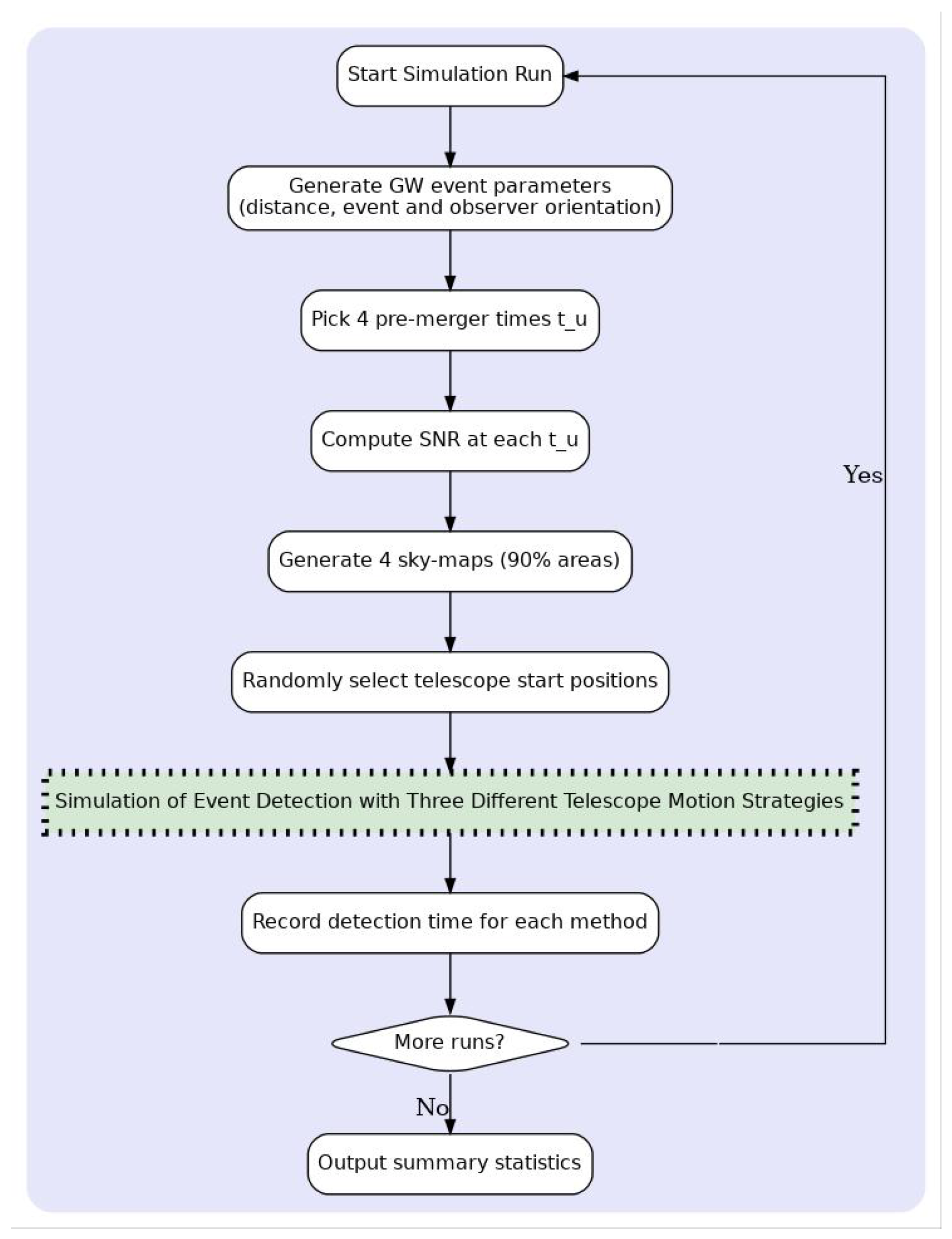
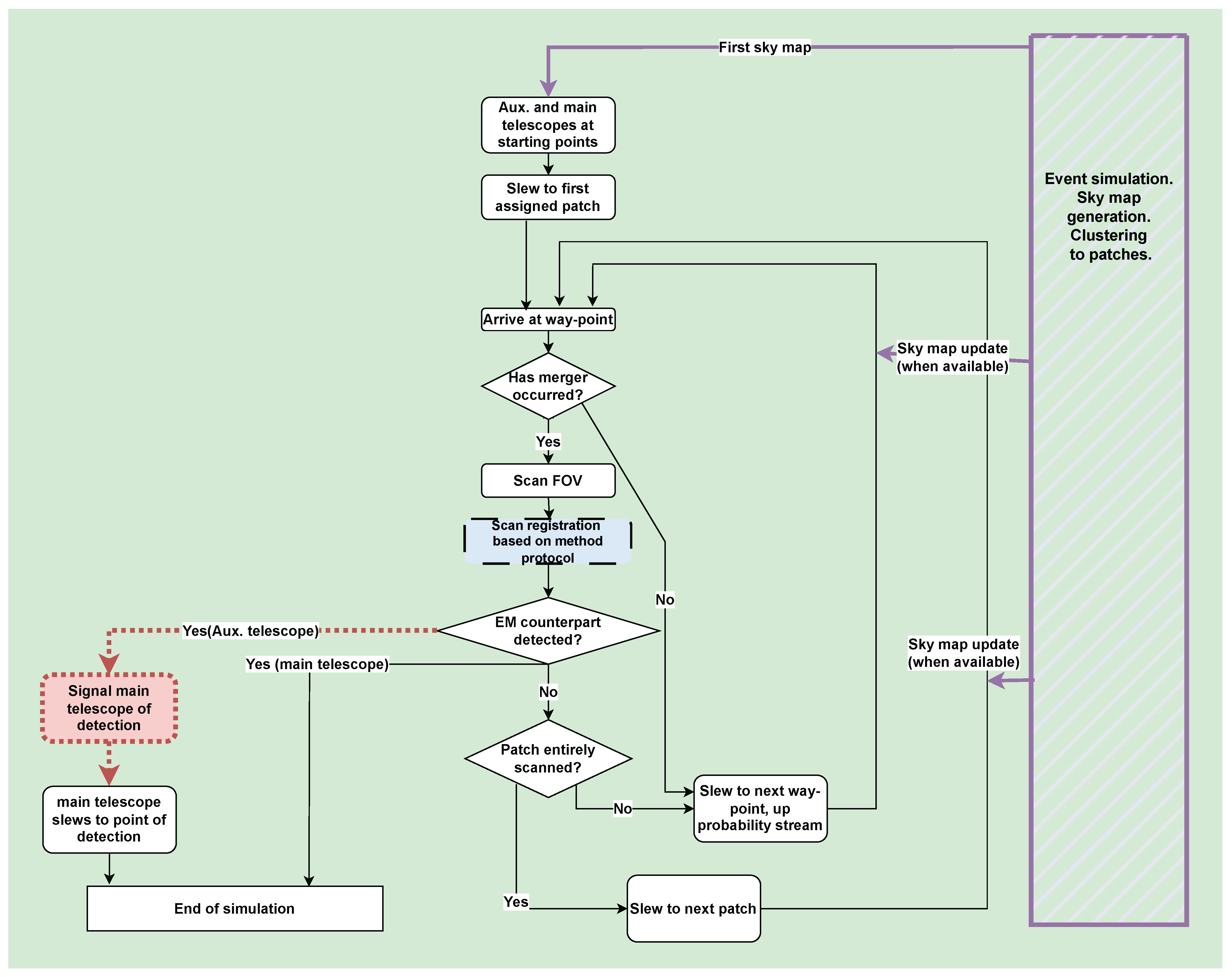
We evaluate the effectiveness of the proposed Two-Step Localization method for rapid detection of EM counterparts to BNS mergers. The key question is whether this coordinated telescope movement strategy reduces detection latency compared to uncoordinated approaches. The simulation accounts for pre-merger update times, evolving sky-maps, and SNR evolution, with performance measured by the time to locate the source and the impact of communication protocols between telescopes. Figure 1 and Figure 2 summarize the simulation architecture. Figure 1 presents the overall workflow—from GW event generation and SNR calculation to sky-map construction and application of three search strategies. The green, dotted-frame box links directly to the telescope movement logic detailed in Figure 2, while the purple, dashed-background box in Figure 2 links back to the event generation stage in Figure 1. This cross-referencing highlights the interaction between event simulation and telescope movement modules. The blue dashed-frame box in Figure 2 controls whether telescopes share information on scanned regions (see Section 4.3), and the red, dotted path marks the Two-Step Localization sequence—where auxiliary telescope detection immediately redirects the main telescope. Two LIGO–Virgo–KAGRA (LVK) observing-scenario analyses help set the broader context for our simulations. Petrov et al. [53] use the statistics of O3 public alerts to build simulations of the O4 and O5 observing runs, quantify the resulting distributions of localization areas and other source properties, and examine their implications for electromagnetic follow-up programs such as Zwicky Transient Facility (ZTF) [54], providing a public set of mock localizations for proposal planning. Kiendrebeogo et al. [55] present updated observing scenarios and multi-messenger expectations for the international GW network, using event-rate forecasts to relate anticipated GW and counterpart detections to prospective constraints on quantities such as the Hubble constant, r-process enrichment, and the neutron-star equation of state, with the goal of informing future multi-messenger campaigns. In addition, Abbott et al. [56] discuss the prospects for observing and localizing gravitational-wave transients with the Advanced LIGO, Advanced Virgo, and KAGRA detectors. In contrast to these network-level, population-based forecasts, our Two-Step Localization study follows individual simulated BNS events and models the joint response of only two telescopes—a narrow-field main instrument and a wide-field auxiliary—that could be operated by a single facility or a small collaboration, focusing on how different communication schemes between them affect the time until the EM counterpart is first identified.
Figure 1. Overall simulation flowchart for a single simulated GW candidate. For each run we (i) draw the GW event parameters (including distance and source/observer orientation), (ii) select four pre-merger sky-map update times t u (as defined in Section 4), (iii) compute the network SNR at each t u , and (iv) generate four corresponding localization sky-maps whose 90% credible region progressively shrinks as the SNR increases. Telescope starting points are then randomized and the precomputed sky-map updates are injected at their respective t u during the telescope-motion simulation (Figure 2), which evaluates three coordination strategies and records the resulting detection times. Telescope motion begins at the first sky-map update that provides useful localization information; sky-map updates whose 90% area exceeds 4 π steradians are ignored, and motion starts at the first subsequent t u with a usable localization.
Figure 2. Telescope movement and coordination logic, expanding the green dotted-frame box in Figure 1. This flow is executed for each simulated GW candidate (i.e., each simulation run). Sky-map update times t u are preselected in the event-generation stage (Figure 1); the corresponding localization areas are computed in advance and injected into the telescope-motion timeline at those times. Telescope motion begins at the first sky-map update that provides usable localization; if an early update is uninformative (e.g., its 90% area is effectively all sky), it is skipped and the telescopes wait until the first usable update. After the first usable sky-map is available, the auxiliary and main telescopes begin from randomized starting points and slew toward their initially assigned high-probability patch (selected using a weighted combination of patch probability and slew time; see Section 4). Way-points define the scan grid and each scan covers one telescope FOV. The decision node “EM counterpart detected?” is evaluated relative to the simulated merger time inferred from the GW signal timeline; we do not apply progenitor-probability thresholds at this stage and assume the simulated GW candidate corresponds to a true merger (i.e., the node is a timing check that enables scanning/detection only once the timeline reaches the merger). When a sky-map update becomes available (at the preselected times t u ), the localization patches/targets are updated and the current plan is adjusted accordingly. “Scan registration based on method protocol” records scanned regions and applies the corresponding communication rule for each coordination strategy. If the auxiliary detects the EM counterpart first (Two-Step Localization), it signals the main telescope, which slews to the reported location; otherwise the telescopes continue scanning way-points within the current patch and proceed to the next patch once the current one is exhausted.

4. Simulation Setup

We simulate pre-merger localizations using four assumed sky-map update windows before the merger, with  t u drawn from 50–60 s, 40–50 s, 20–40 s, and 1–20 s. These windows are not intended to represent measured averages from a specific observing sub-run (e.g., O4a/b/c), but rather a coarse discretization of the early-warning regime (from tens of seconds to a few seconds before the merger) used to compare coordination strategies under a standardized update cadence. A GW signal categorized here as a BNS merger is assumed to correspond to two neutron-star components, i.e., two compact objects with masses in the typical neutron-star range (roughly 1.17 to 2 M ) for each body, with an average around ∼ 1.4 M [57]. Accordingly, we adopt a representative equal-mass BNS with m 1 = m 2 = 1.4 M [58] in our SNR calculations, computed from the post-Newtonian (PN) inspiral evolution of the GW signal [59] using the frequency-domain formalism truncated at second post-Newtonian (2PN) order [60]. Here, PN denotes a systematic expansion of the inspiral phase and frequency in powers of v / c about the Newtonian limit, and 2PN retains terms up to O [ ( v / c ) 4 ] beyond the leading order. We adopt 2PN because it provides a good accuracy–cost trade-off for early-warning (pre-merger) SNR and localization estimates in the inspiral-dominated regime, where higher-order merger and strong-field effects have a sub-dominant impact on the accumulated SNR over the timescales considered. For BNS and NSBH mergers with near-equal masses, characterized by a mass ratio q m 1 / m 2 1 , the PN expansion remains accurate through the late inspiral, and the inspiral dominates the observable signal used for our pre-merger updates. Thus, a 2PN description provides sufficiently reliable waveforms for the purposes of pre-merger localization and SNR estimation [61,62]. Detector response functions F + and F × follow LALSuite [63]. These are the detector antenna-pattern (projection) factors that map the two gravitational-wave polarizations onto the measured strain: they depend on the source sky location and polarization angle, as well as the detector orientation, and therefore set the effective amplitude seen by a given instrument for a given event geometry. For ground-based detectors, the corresponding responses can also vary with time through the changing detector-source geometry (e.g., due to Earth’s rotation), and in network analyses they naturally differ across detectors in the network, encoding directional sensitivity. Power spectral densities (PSDs) correspond to LVK O3a [64] and to the anticipated O4 [65] and O5 sensitivities from [66]. The PSD quantifies detector noise as a function of frequency and is the standard measure of instrumental sensitivity, used to weight the signal contribution with respect to the underlying noise when computing the SNR. We retain O3a in our study as an empirically calibrated benchmark tied to the existing LVK BNS and NSBH sample, while O4 and O5 represent progressively improved sensitivities that bracket the performance expected in current and near-future observing runs. We deliberately test our simulations across different LVK runs to examine the effect of varying noise systematics and the presence of distinct peaks in the noise curves. The more advanced the observing run, the greater the maximum distance reachable for GW detections, owing to improved detector sensitivity. However, the noise curves of these advanced runs are also lower in amplitude, leading to SNRs of comparable magnitude to earlier runs when accounting for the larger distances involved.
For simplicity, we assume that all telescopes used in the simulations are capable of observing events at all distances allowed for each LVK run. In practice, this assumption is optimistic, as the limiting magnitudes of the telescopes are not sufficient to detect events at the farthest distances permitted by the O5 run (325 Mpc). The Swope telescope has a limiting magnitude of 19.25 for a 15 s exposure [67], while ULTRASAT reaches a limiting magnitude of 22.4 for a 15 s exposure [68]. For context, typical single-epoch survey depths for GW follow-up facilities include ZTF, with a limiting magnitude of 20.6 mag in 30 s exposures [69], and Gravitational-wave Optical Transient Observer (GOTO), with a limiting magnitude of 20 in a single 90 s exposure (limiting magnitude of ∼21 in co-added 4 × 90  s) [70]. The distances adopted here should therefore be viewed as the range over which EM counterparts remain plausibly detectable with the facilities we consider, rather than as hard limits on GW detectability: more distant mergers will occur in O4/O5, but their EM counterparts would in most cases be too faint in the UV/optical for our telescopes and are thus outside the scope of this work. While the distance to the source can be estimated from the GW early on, along with its direction, and used to estimate within which telescopes’ reach it could appear, we leave such treatment to future work.
We further assume that the search is scan-time-dominated, with a typical scan time of 15 s per pointing and no additional processing delay. Upon each scan, a detection or non-detection decision is made immediately, and the background sky for every potential transient is assumed to be known in advance. We model the EM counterpart as a new, previously uncatalogued transient, and assume that suitable reference/template images are available so that a detection/non-detection decision can be made immediately after each pointing. We do not simulate catalog cross-matching, false-positive rejection, or other candidate-vetting steps beyond this idealized assumption. In reality, wide-field time-domain surveys such as ZTF [54] rely on real-time reduction pipelines that perform image subtraction, source association, and candidate vetting, which introduce additional latencies and selection effects. By neglecting these stages we effectively model an idealized reduction chain, so the detection times reported here should be interpreted as optimistic lower bounds relative to current systems. We also assume that telescopes with a narrower (“main”) field of view possess better limiting magnitude and angular resolution than the wide-field (“auxiliary”) telescopes. However, as demonstrated by the Swope and ULTRASAT examples, this is not necessarily the case in reality, where newer wide-field instruments can achieve superior sensitivity despite their larger field of view. Event distances are drawn from a distribution uniform in comoving volume, with  r max set by the chosen LVK run [71] (140 Mpc for O3a, 160 Mpc for O4, 325 Mpc for O5). Here, r max is the maximum simulated luminosity distance (i.e., the truncation radius of the comoving-volume distribution) and is chosen to reflect the orientation- and sky-location-averaged BNS detection range quoted in the LVK observing plans for each run. These r max values should not be interpreted as the true GW horizon distances, which extend to substantially larger radii, but as representative sensitivity limits for typical BNS detections. Binary inclination and detector orientation are randomized, affecting both SNR and 90% sky-map area. Simulated sky-maps are constructed using past LVK events as morphological templates. For each simulated sky-map update, we first determine the target 90% credible region area A 90 ( SNR ) from the network SNR obtained in our SNR-curve simulation with randomized source parameters (distance, inclination, and sky position). We then randomly select one archived LVK sky-map and order its pixels by posterior probability density. Starting from the highest-probability pixel, we successively accumulate pixels until their total geometric area matches the desired A 90 ; the resulting collection of pixels defines the simulated localization region, while all remaining pixels are set to zero probability for simplicity. Finally, we apply a random rotation on the sphere, so that the resulting map is recentered on randomized sky coordinates.

4.1. Localization Metrics vs. Pre-Merger Time (O4)

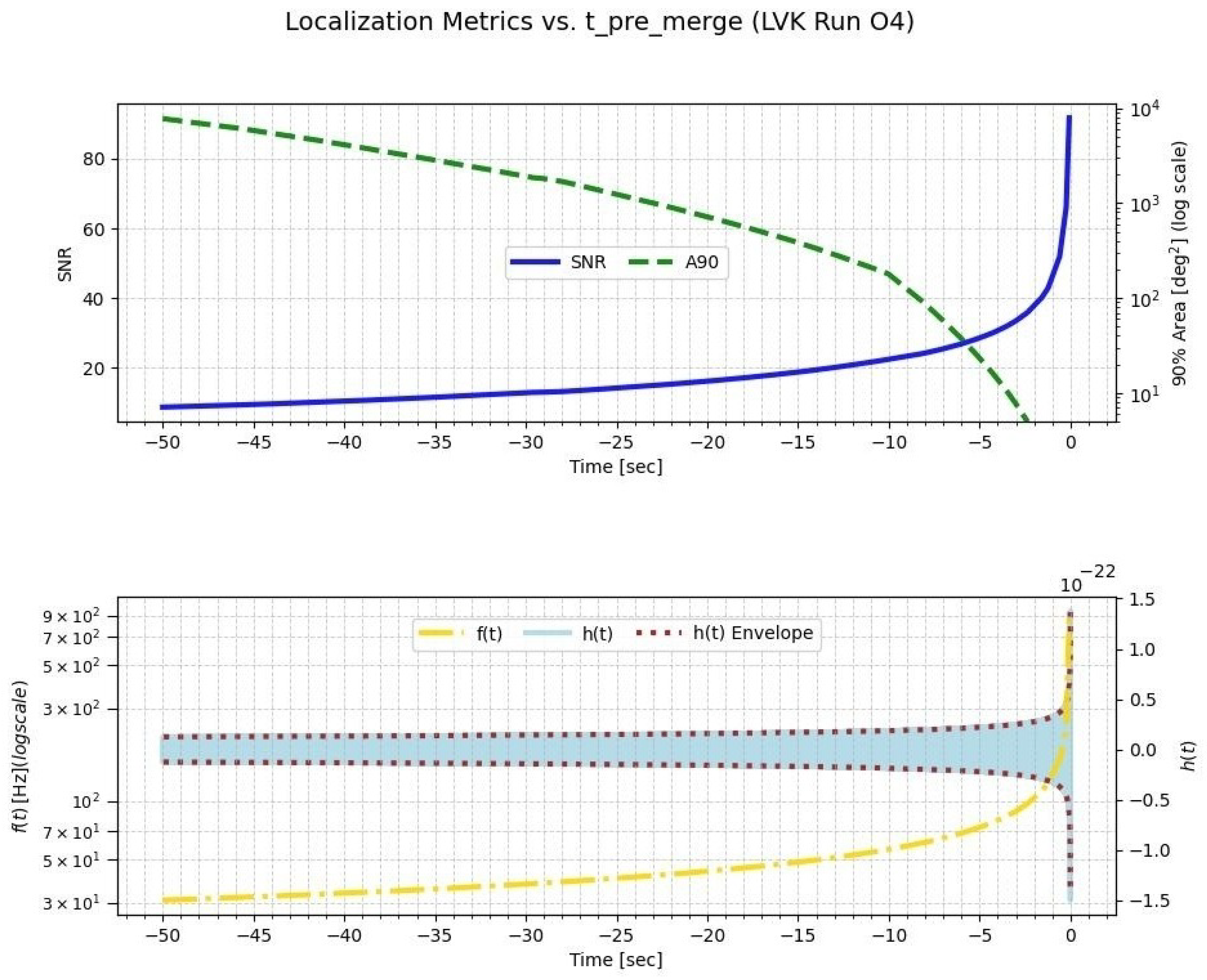
To visualize how pre-merger information tightens with time, we show one representative possible O4 event: Figure 3 shows, for a representative BNS event simulated with the LVK O4 noise curve, how the signal frequency f ( t ) and the SNR evolve as the system approaches coalescence, and how these trends translate into improved sky localization. As expected from the chirp relation used above, f ( t ) increases monotonically as | t | 0 , and the accumulating in-band cycles yield a steadily rising SNR. Correspondingly, the 90% credible localization area becomes smaller with time—often by orders of magnitude between tens of seconds pre-merger and the final seconds—because more measurable signal is present where the detectors are most sensitive.
Figure 3. Localization metrics vs. time before merger (LVK O4). (Top panel): SNR (blue, left linear axis) and 90% credible localization area (green, right logarithmic axis) as functions of the time before the merger, t pre - merge . The SNR rises toward coalescence, while the localization area correspondingly decreases by orders of magnitude as additional in-band cycles accumulate. We truncate the 90% area curve once it reaches A 90 5 deg 2 , which is already smaller than the narrowest field of view of the telescopes considered in this work, which is A 90 7 deg 2 for the Swope telescope. (Bottom panel): Gravitational-wave frequency f ( t ) versus t pre - merge . The increasing f ( t ) (the GW chirp) drives the SNR growth and thus the improvement—i.e., reduction—of the 90% area. All curves are generated from our simulations using the O4 noise curve, with SNR computed from the strain model described in this subsection and localization areas obtained from our numerical mapping between SNR, update time t u , and sky-map size, using the SNR–area fits of [32]. The blue h ( t ) curve is intrinsically oscillatory, but on this timescale the oscillations are so densely packed that they appear as a continuous shaded band inside the envelope.

4.2. Telescope Scanning Model

Way-points are placed on a grid separated by one main-telescope FOV radius to ensure complete coverage without overlap. Dwell times were set to 15 s, consistent with ULTRASAT [36] and with the 15 s single-snap exposure used in Rubin Observatory’s LSST survey (two such exposures per visit, e.g., in the u-band) [72], while LAST employs 20 s exposures [38]. We adopt a single representative dwell time to standardize the comparison and isolate the impact of the coordination strategy (tiling/scheduling logic) rather than mix it with facility-specific cadence differences. In our simulations, the dwell time is treated as an effective per-pointing cadence (exposure plus readout), and we do not add further facility-specific dead times or image-processing latencies; slew times between way-points are modeled explicitly via the telescope motion. For context, current wide-field facilities span per-exposure times of order 60 s (e.g., the GOTO and the Deca-Degree Optical Transient Imager (DDOTI)) [73,74] up to ∼60–180 s (e.g., MASTER) [75]. Because our analysis is scan-time-dominated, adopting a different effective cadence would approximately rescale the reported detection times by the ratio of cadences, while preserving the relative comparison between methods. In future work, a natural extension of this framework is to assign facility-specific exposure and dead-time models (including readout and processing latencies) and to quantify their impact on detection-time distributions for different survey systems. Here, t u denotes the sky-map update time, whereas the u-band refers to the LSST near-UV photometric filter. The event location is drawn from the final pre-merger sky-map; telescope starting points are random. At the first t u , each telescope slews to the nearest way-point in its assigned 90% patch, chosen by weighting detection probability (75%) and slew time (25%). If a subsequent t u occurs before arrival, the path is updated to reflect the reduced search area. Within each patch, telescopes select the nearest neighbor that maximizes total probability in the FOV until the patch is exhausted, then move to the next-highest-probability patch.

4.3. Detection Methods

We compare three strategies, each using a main telescope (Swope-like, 7 deg 2 [32]) and an auxiliary telescope:
(1) A wide-field telescope model (“BIG”), defined as a hypothetical ZTF-like facility [54]. This auxiliary telescope is simulated with instrumental characteristics of ZTF (cadence, sensitivity, limiting magnitude) but with different field-of-view (FOV) configurations of 100, 200, 400, and 1000 deg2 to probe the impact of survey depth versus sky coverage. In practice, an existing facility such as LAST [38], which offers both a wide-FOV mode ( 355 deg 2 ) and a zoomed mode, could serve as a real-world analogue of such a “BIG”-class telescope.
(2) An ULTRASAT-like instrument [36] with 204 deg 2 FOV, representing a space-based UV wide-field surveyor optimized for early detection of transients.
Detection time throughout our study is defined as the elapsed time until the main telescope (Swope-like) identifies the EM counterpart, while the auxiliary telescope contributes by reducing the localization region and guiding the main telescope toward the most probable sky areas.
  • Partial Communication.
Telescopes avoid re-scanning each other’s fields, but auxiliary detections are not relayed to the main telescope.
  • No Communication.
Telescopes operate entirely independently, with no sharing of scanned fields or detections.
  • Two-Step Localization.
Full communication. If the auxiliary telescope detects the event first, it transmits the coordinates to the main telescope for immediate follow-up. The main telescope, however, retains the ability to detect the event on its own if it happens upon the correct region before receiving a trigger. This dual pathway ensures both rapid response to auxiliary detections and independent discovery capability.
A concise comparison of the three coordination strategies is given in Table 1.
Table 1. Summary of detection strategies.

5. Results

We analyze detection times for 942 simulated BNS mergers (see Section 4). Each event is evaluated under three strategies—Partial Communication Method, No Communication Method, and our proposed Two-Step Localization Method—and five auxiliary configurations: four FOV settings for the ZTF-like “BIG” telescope ( 100 deg 2 , 200 deg 2 , 400 deg 2 , 1000 deg 2 ) and ULTRASAT (see Section 4.3).
A statistical overview of the simulated population at the four pre-merger update times is provided in Table 2.
Table 2. Summary statistics for the simulated BNS population at the four pre-merger update times t pre ( i ) ( i = 1 4 ) for each LVK observing run. Listed are the mean and standard deviation ( · ± σ ) and the median ( · ˜ ) of the SNR and 90% credible area A 90 at each update.

5.1. Examples of Telescope Motion for Event Detection

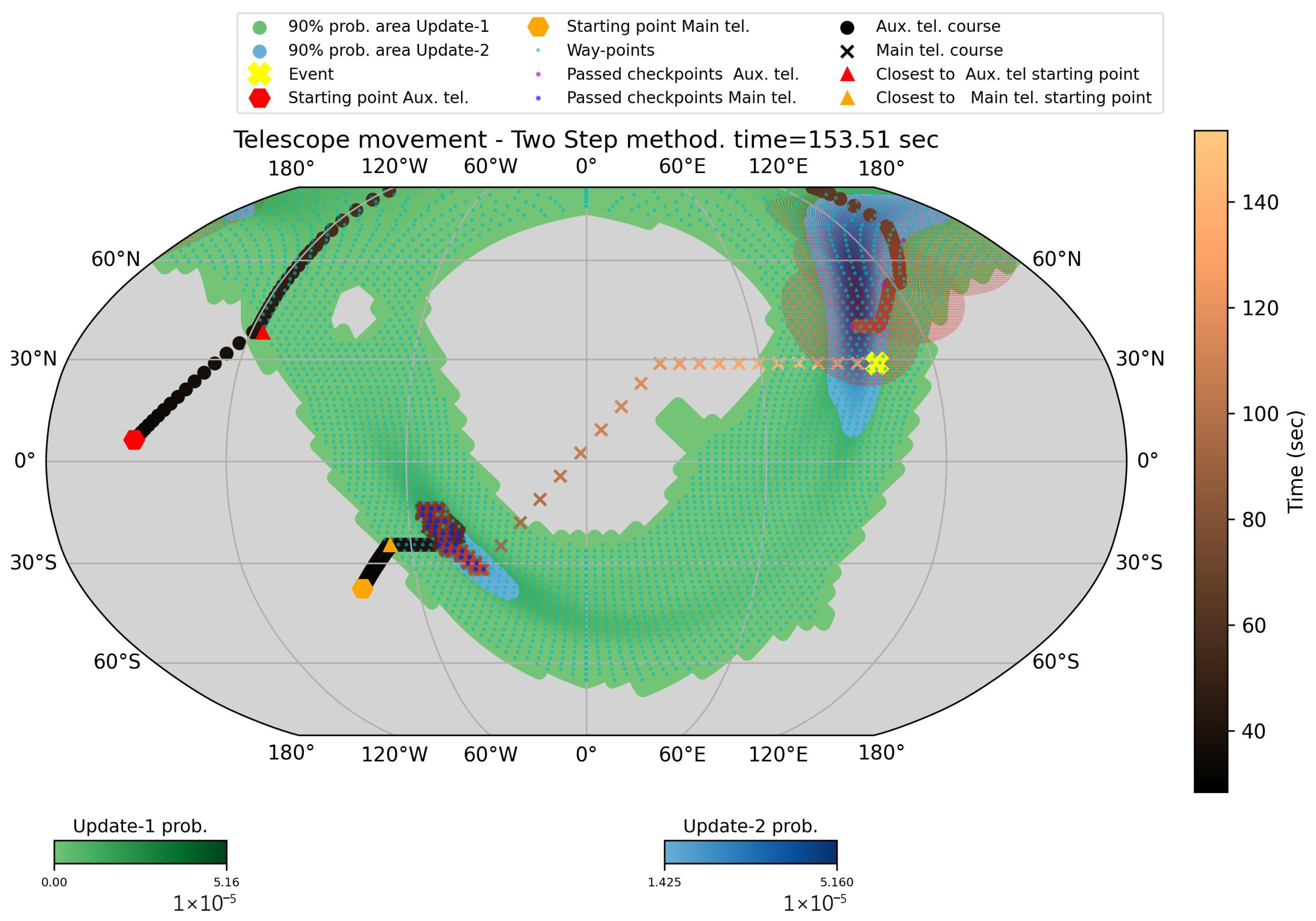
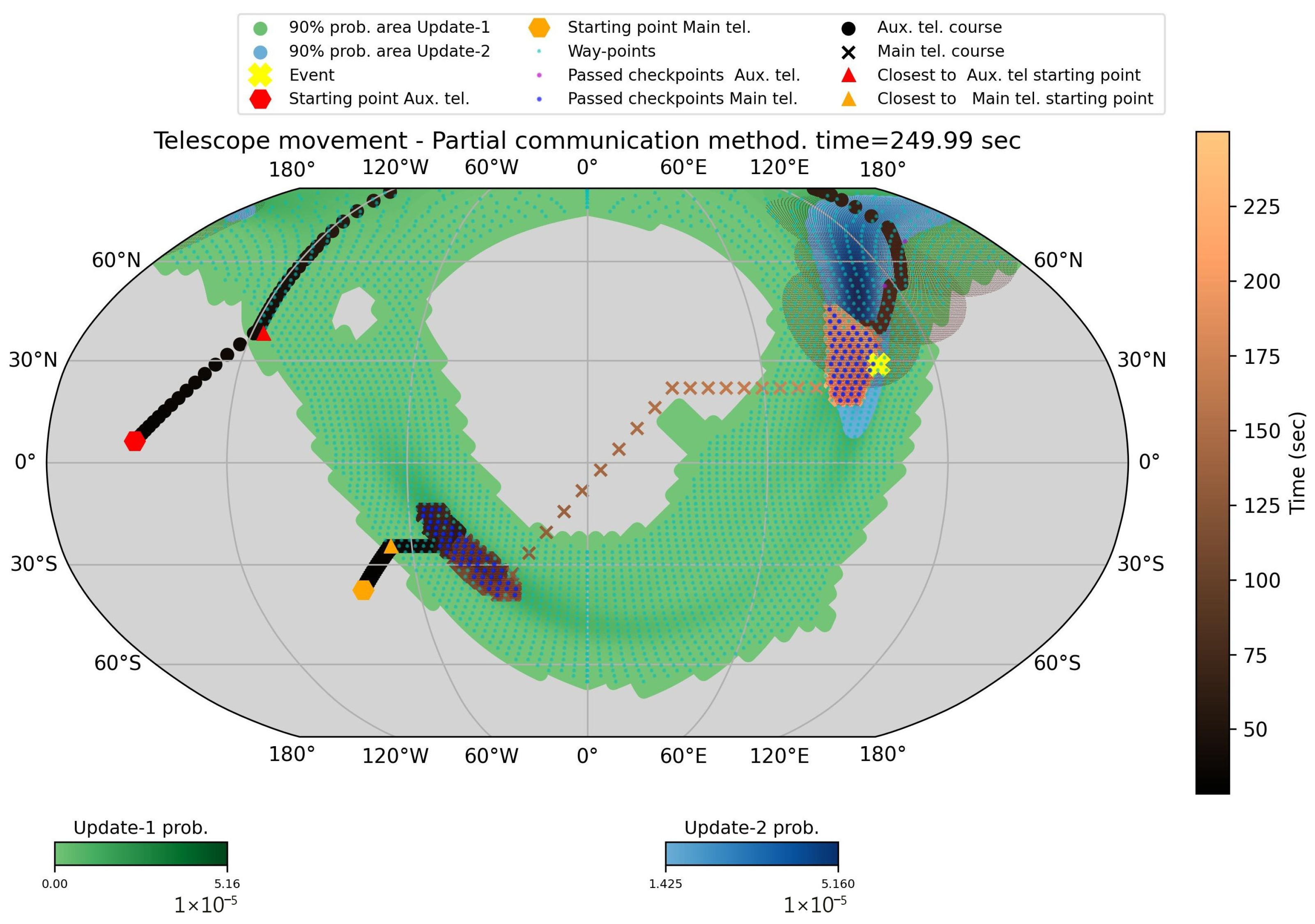
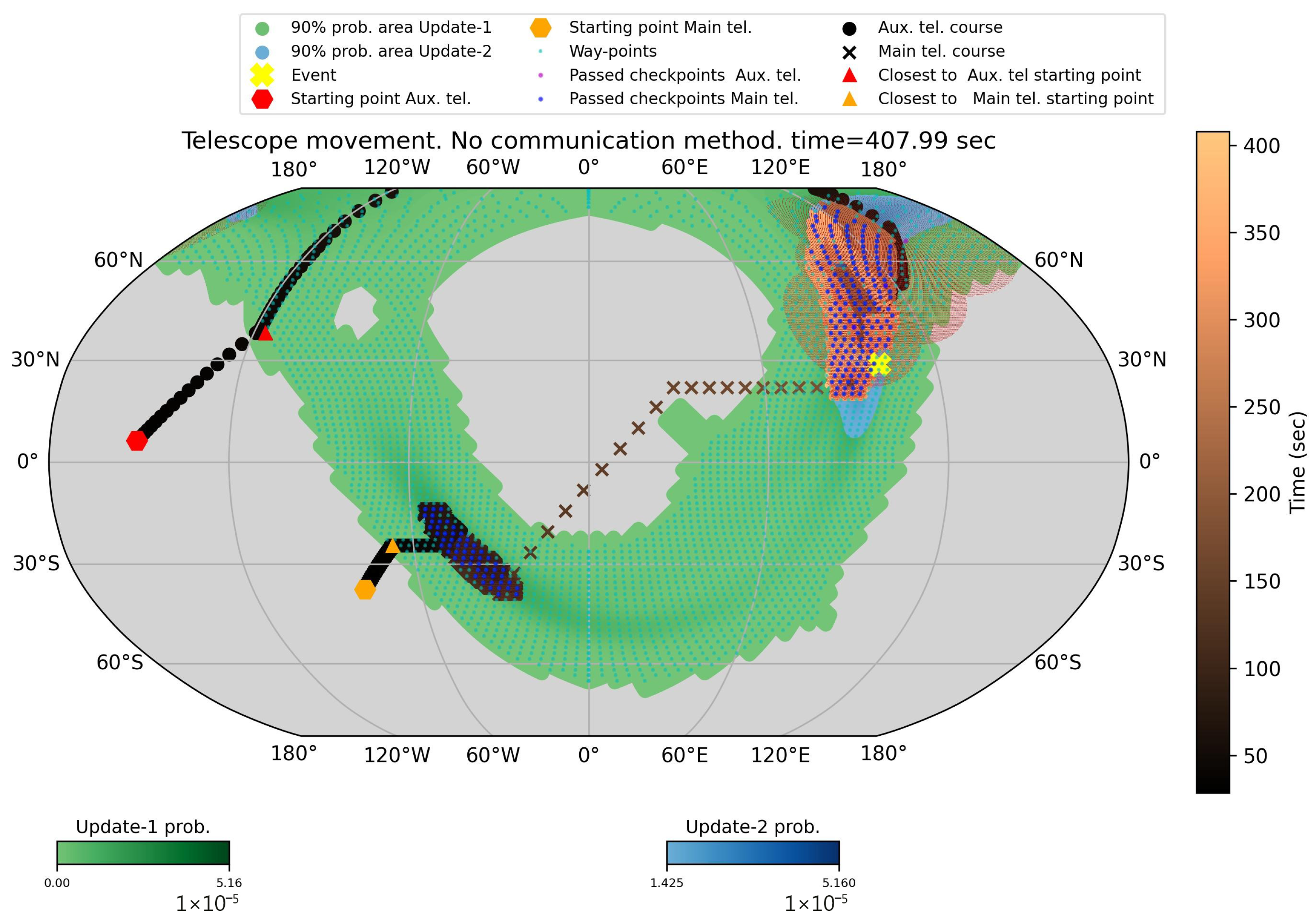
The figures compare the search dynamics for the event’s EM signal under the three strategies. The auxiliary starts at the red hexagon (bold dots show its path); the main starts at the orange hexagon (× marks). Color along the paths encodes elapsed time measured from the first sky-map alert (i.e., the timeline origin used in the color bars). Red/orange triangles mark the closest initial way-points where scanning begins. Although the timeline begins at the first two pre-merger alerts, those early updates are not yet informative enough to trigger scanning; therefore, telescope motion starts only once the localization becomes usable at the third update. For this reason, the sky-maps visualized in Figure 4, Figure 5 and Figure 6 correspond to the last two updates (updates 3 and 4), while the time shown in the color bars still refers to time since the first alert.
Figure 4. Telescope motion and event detection using the Two-Step Localization Method, with “BIG” as the auxiliary telescope configured with a 1000 deg 2 FOV. The event is detected 153.5 s after the first alarm, which was triggered 51.2 s before the merger—i.e., 102.3 s after the merger. Localization is progressively refined through subsequent sky-map updates. The third sky-map update—providing the first meaningful localization (see Section 4)—marks the start of telescope motion. The time color bar begins at 28.4 s , representing the time elapsed from the first to the third sky-map update. In this timeline, the merger occurs at 51.2 s .
Figure 5. Telescope motion and event detection using the Partial Communication Method, with “BIG” as the auxiliary telescope configured with a 1000 deg 2 FOV. The event is detected 250.0 s after the first alarm, which was triggered 51.2 s before the merger—i.e., 198.8 s after the merger. Localization is progressively refined through subsequent sky-map updates. In contrast to the Two-Step Localization Method, the auxiliary telescope does not signal the main telescope upon detection, resulting in a longer search before the main telescope detects the event.
Figure 6. Simulation 3.—Telescope motion and event detection using the No Communication Method, with “BIG” as the auxiliary telescope configured with a 1000 deg 2 FOV. The event is detected 408.0 s after the first alarm, which was triggered 51.2 s before the merger—i.e., 356.8 s after the merger. Localization is progressively refined through subsequent sky-map updates. In this method, no information is exchanged between telescopes—neither detection triggers nor negative results—resulting in the longest detection time of the three strategies.
In this example, the first alert occurs 51.2 s pre-merger at SNR 3.4 , insufficient for localization (see Section 4); a second at 41.0 s with SNR 4.1 is likewise uninformative. The third update at 22.8 s (SNR 6.0 , 14 , 403 deg 2 ) initiates telescope motion; the fourth at 6.5 s (SNR 10.5 , 1029 deg 2 ) further refines the search region. Telescope motion timeline, sky-map updates, the merger, and other points of interest are summarized in Figure 4, Figure 5 and Figure 6 and in the corresponding motion-timeline tables (Table 3, Table 4 and Table 5).
Table 3. Simulation 1.—Timeline of Telescope Motion and Detection Events—Two-Step Localization Method. t Two - Step - Localization - Method = t No - Communication - Method 254.5 s .
Table 4. Simulation 2.—Timeline of Telescope Motion and Detection Events—Partial Communication Method. t Partial - Communication - Method = t No - Communication - Method 158 s .
Table 5. Timeline of Telescope Motion and Detection Events—No Communication Method.

5.2. Animated Visualization of Telescope Surveys

To complement the static figures shown below, we provide an animated visualization of the telescope trajectories and evolving sky localization for all three coordination strategies: Two-Step Localization, Partial Communication, and No Communication. The animation illustrates how the GW sky-map is updated in time and how the auxiliary wide-field and main narrow-field telescopes respond as their scanned regions gradually build up. Key moments, such as the merger and subsequent sky-map updates, are annotated in the video. The animation is available as Supplementary Video S1 (Telescope_Surveys.gif) at this link (https://drive.google.com/file/d/11rGAdwOz0R53FNEzHbYUpG7qAgGuZXEl/view?usp=sharing, accessed on 8 December 2025).

5.2.1. Simulation 1—Two-Step Localization Method

The telescope trajectories and event detection sequence for this method are illustrated in Figure 4. The full timeline of events is detailed in Table 3. The first alarm occurs 51.2 s pre-merger at SNR 3.4 , insufficient for localization (see Section 4); a second at 41.0 s with SNR 4.1 is likewise uninformative. The third update at 22.8 s (SNR 6.0 , 14,403 deg 2 ) initiates motion; the fourth at 6.5 s (SNR 10.5 , 1029 deg 2 ) further refines the search region. The event is detected 153.5 s after the first alarm ( + 102.3 s post-merger), as summarized in Figure 4 and Table 3.
Telescope Motion Timeline—Two-Step Localization Method:
After the third update, the auxiliary slews from ( 209.06 , 6.32 ) toward the top-left, and the main from ( 279.97 , 37.45 ) toward the bottom-left. The main reaches its first scan position at 9.5 s , and the auxiliary at − 8.2 s . Following the fourth update ( 6.5 s ), both adjust their targets. The main starts scanning at + 3.2 s , and the auxiliary at + 11.0 s with three 15 s stops (Section 4.2). The auxiliary detects at ( 100.54 , 6.32 ) at + 51.1 s , integrates 15 s , triggers the main at + 66.1 s , and the main confirms at + 102.3 s , as summarized in Table 3.

5.2.2. Simulation 2—Partial Communication Method

The results of this strategy are shown in Figure 5, with the detailed sequence of telescope operations summarized in Table 4. The SNR/update sequence is identical to the Two-Step Localization case; differences arise solely from operations. The auxiliary detects at ( 100.54 , 6.32 ) but does not trigger the main, which must complete its current region and then scan the updated region—prolonging detection to 250.0 s after the first alarm, as seen in Figure 5 and Table 4.
Telescope Motion Timeline—Partial Communication Method:
Motion begins at the third update ( 22.8 s ). The main reaches its first scan position at 9.5 s , and the auxiliary at 8.2 s . After the fourth update, both redirect. The auxiliary starts scanning at + 11.0 s , detects at + 51.1 s , but halts without alerting. The main completes its assigned region, slews to the updated sector, and finally detects at + 198.8 s post-merger, consistent with Table 4.

5.2.3. Simulation 3—No Communication Method

The operational differences and outcomes of this approach are depicted in Figure 6, while the complete detection timeline is given in Table 5. Here, neither positive detections nor cleared regions are shared. With the same updates/SNRs as above, the auxiliary detects at + 51.1 s but does not communicate; the main completes its initial region and then scans the updated sector without knowledge of cleared areas, yielding the longest delay: 408.0 s after the first alarm, consistent with Figure 6 and Table 5.
Telescope Motion Timeline—No Communication Method:
Motion starts at the third update. The main arrives at 9.5 s , and the auxiliary at 8.2 s . After the fourth update, both redirect. The auxiliary begins scanning at + 11.0 s and detects at + 51.1 s but does not alert. The main, lacking any shared information, finishes its assigned region, slews to the updated sector, and—after an extended pass—detects at + 356.8 s post-merger, as reported in Table 5.

5.3. Detection Time Histograms

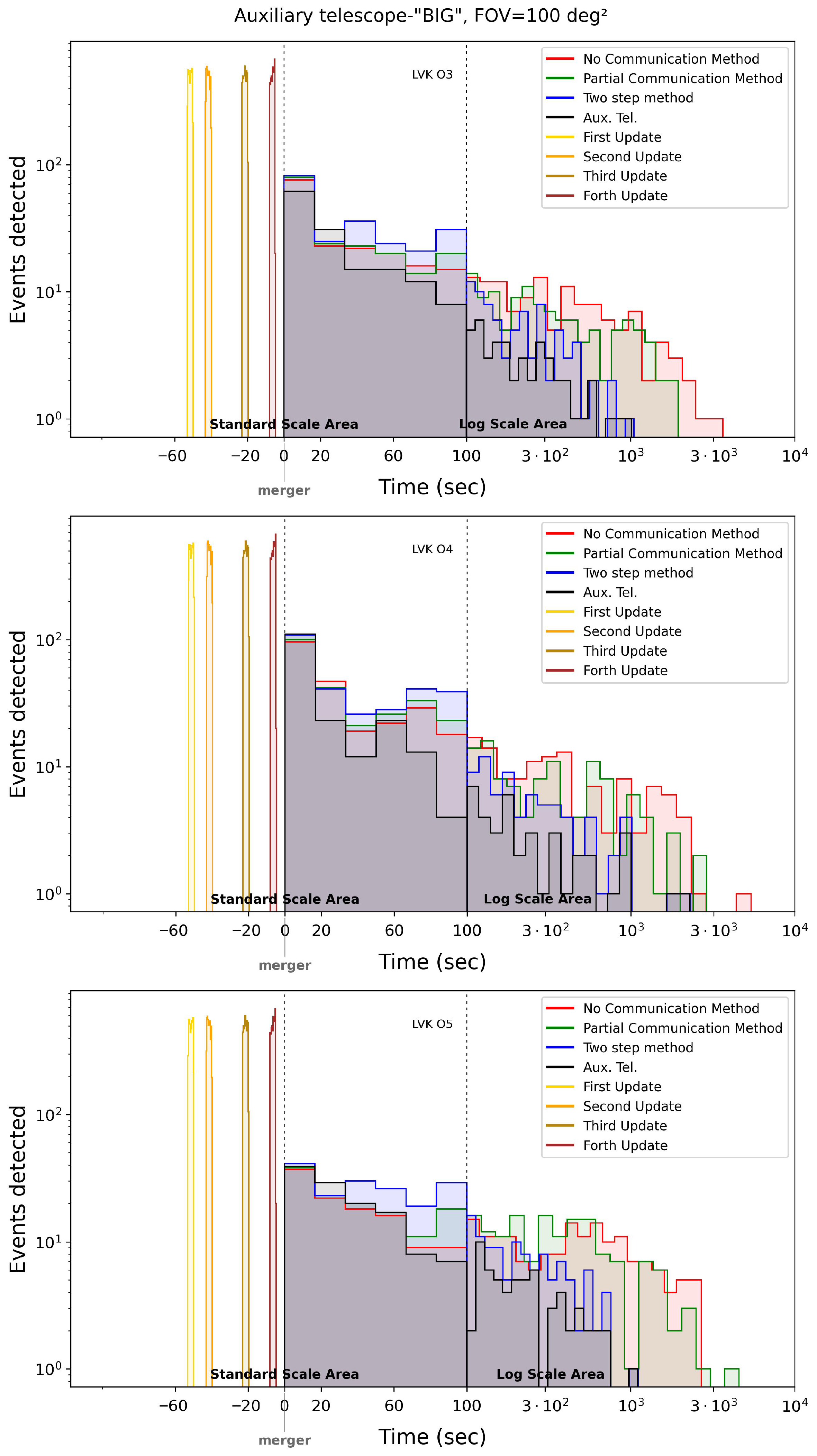
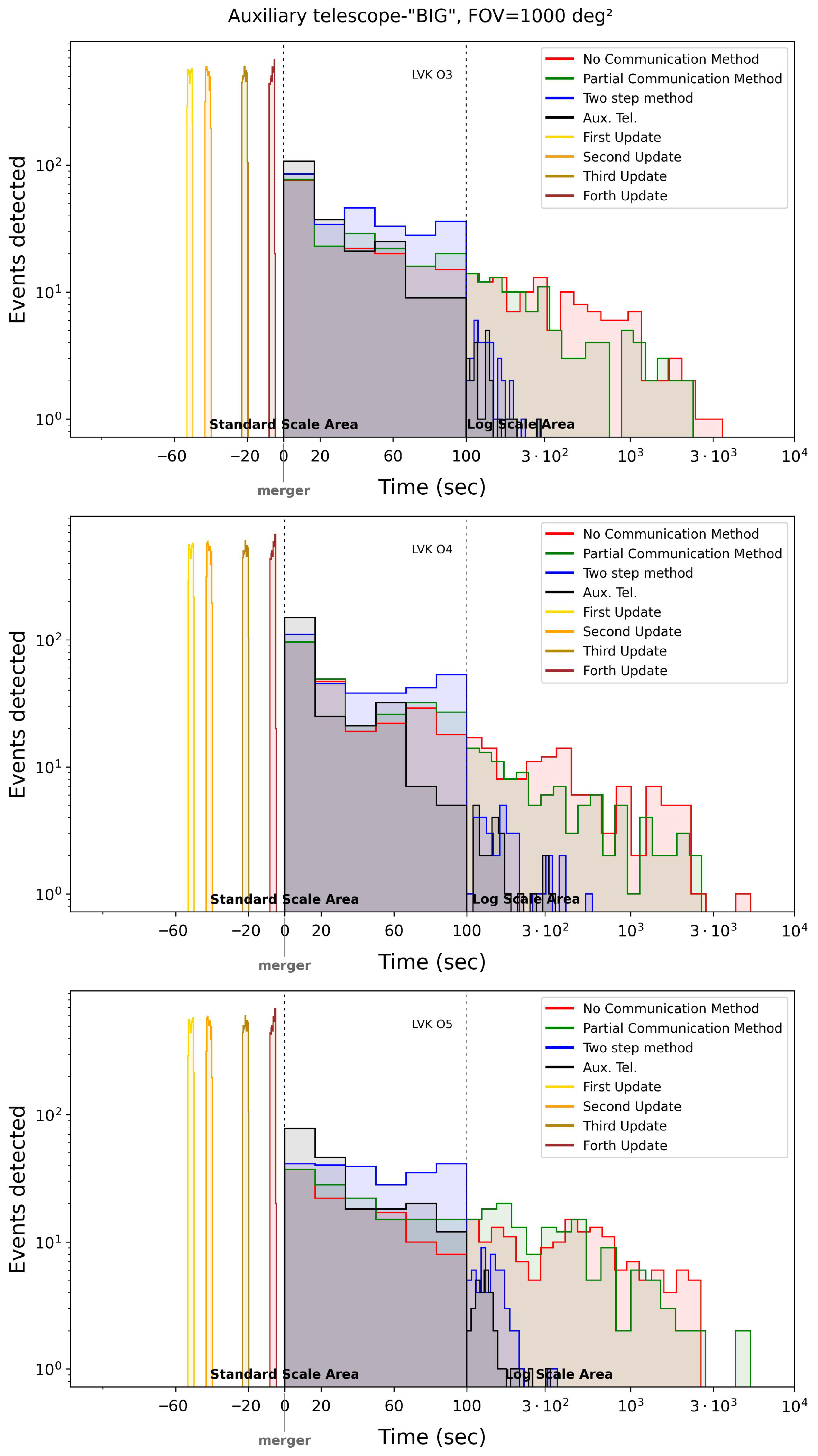
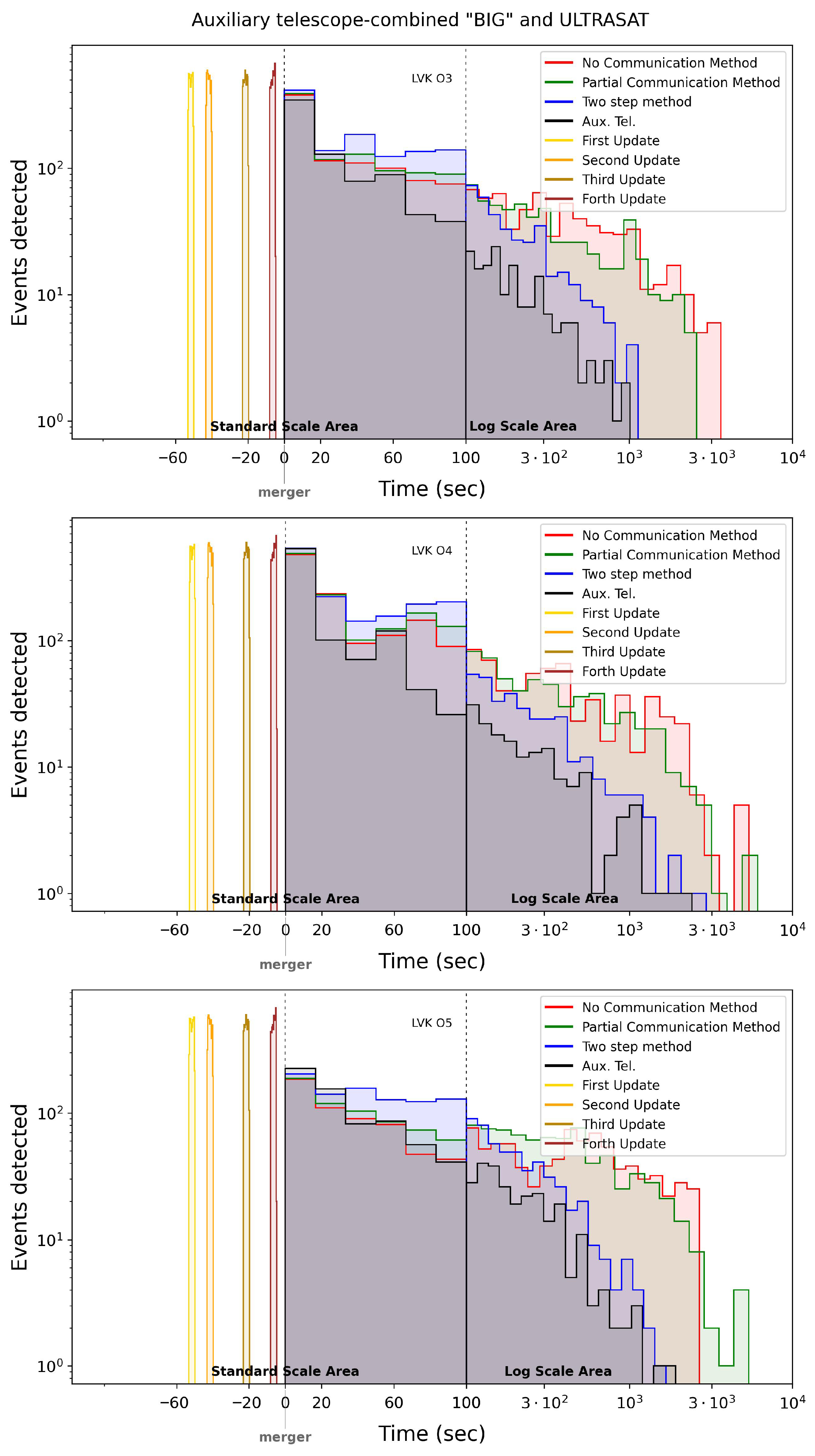
We now compare the distributions of detection times across the three telescope-coordination methods: Two-Step Localization, Partial (Limited) Communication, and No Communication. For each simulated event, all source and instrumental parameters are regenerated (see Section 4), including sky location, orientation, and detector noise realization. The initial pointing of both telescopes is randomized in each iteration, ensuring that variations in detection latency reflect only the coordination strategy and not fixed geometric bias. In every case, the detection time is measured relative to the merger epoch. The resulting histograms therefore quantify how rapidly each method achieves electromagnetic confirmation of a gravitational-wave event. Black bars denote auxiliary detections in the Two-Step Localization Method when the auxiliary telescope detects first, subsequently triggering a refined search by the main telescope. The discrete peaks at early times correspond to the four pre-merger sky-map update intervals discussed in Section 4, reflecting the cadence of localization information available to the telescopes. Comparing these distributions across LVK runs (O3a, O4, and O5) reveals how improved network sensitivity and geometry influence detection latency. As expected, events in O3a are generally detected more quickly for all methods because the sources were typically closer, leading to higher SNRs and correspondingly smaller localization areas. This trend sets a physical baseline for evaluating the relative efficiency of the different telescope-coordination strategies.
For FOV = 100 deg 2 , the Two-Step Method is consistently the fastest across LVK runs.
For LVK O3a, Two-Step reaches detection in 95.8 s on average (std 135.1 s), compared to 196.3 s (std 326.2 s) for the Limited Communication Method and 247.2 s (std 453.6 s) for the No Communication Method. This corresponds to roughly a factor ∼ 2.0 improvement over Limited Communication and ∼2.6 over No Communication.
For LVK O4, Two-Step averages 101.0 s (std 207.1 s), versus 183.6 s (std 384.2 s) and 243.8 s (std 560.0 s) for the Limited and No Communication cases, respectively. The speedup is again close to a factor of 2.
For LVK O5, Two-Step averages 134.3 s (std 158.7 s), while Limited and No Communication require 310.9 s (std 505.2 s) and 395.5 s (std 542.2 s), respectively. Here the gain is even stronger: faster by a factor of ∼2.3 relative to Limited Communication and ∼2.9 relative to No Communication.
Overall, detection times in O3a are shorter for all methods because event distances in that run were generally smaller, leading to higher SNRs and therefore smaller localization areas.
Figure 7 and Table 6 summarize the detection-time distributions and their mean and standard deviation for FOV = 100 deg 2 across LVK runs.
Figure 7. Histogram of detection times with “BIG” as the auxiliary telescope with 100 deg 2 FOV.
Table 6. Average detection time and standard deviation for FOV = 100 deg2 across LVK runs.
In Table 6, Table 7 and Table 8, “Two-Step” denotes the Two-Step Localization method, “Ltd. Com.” denotes the Limited Communication method, and “No Com.” denotes the No Communication method.
Table 7. Average detection time and standard deviation for FOV = 1000 deg2 across LVK runs.
Table 8. Average detection time and standard deviation across all FOVs (100–1000 deg2 and 204 deg2 ULTRASAT equivalent) for each LVK run.
The corresponding results for FOV = 1000 deg 2 are shown in Figure 8 and summarized in Table 7. For FOV = 1000 deg 2 , Two-Step Localization continues to outperform the other coordination strategies.
Figure 8. Histogram of detection times with “BIG” as the auxiliary telescope with 1000 deg 2 FOV.
For LVK O3a, detection is reached in 53.3 s on average (std 47.0 s), compared to 181.7 s (std 349.4 s) for the Limited Communication Method and 237.4 s (std 439.3 s) for the No Communication Method, giving a factor of ∼3.4 and ∼4.4 improvement, respectively.
For LVK O4, Two-Step averages 54.6 s (std 62.4 s), while Limited and No Communication reach 167.5 s (std 359.9 s) and 240.4 s (std 559.1 s), again showing factors of about ∼3.1 and ∼4.4 improvement.
For LVK O5, Two-Step averages 69.2 s (std 53.0 s), while Limited and No Communication take 291.1 s (std 570.5 s) and 384.7 s (std 542.5 s), yielding factors of ∼4.2 and ∼5.6 improvement.
Overall, O3a events are faster for all methods because the typical source distances were shorter, resulting in higher SNRs and thus smaller localization areas.
Finally, the combined dataset (all “BIG” FOV configurations and the ULTRASAT-equivalent case) is shown in Figure 9 and summarized in Table 8. Combining all “BIG” FOV configurations and ULTRASAT, Two-Step Localization remains consistently the fastest across LVK runs.
Figure 9. Histogram of detection times with all options of an auxiliary telescope (combined data from all “BIG” FOV configurations and from ULTRASAT).
For LVK O3a, detection occurs in 87.3 s on average (std 115.8 s), compared with 195.2 s (std 348.8 s) for the Limited Communication Method and 244.8 s (std 454.3 s) for the No Communication Method, giving improvements of roughly a factor of ∼2.2 and ∼2.8, respectively.
For LVK O4, Two-Step averages 89.0 s (std 157.3 s), while Limited and No Communication reach 178.3 s (std 397.9 s) and 244.5 s (std 568.5 s), maintaining nearly a factor of 2 advantage.
For LVK O5, Two-Step averages 123.1 s (std 137.7 s), whereas Limited and No Communication require 308.1 s (std 507.2 s) and 395.0 s (std 546.0 s), corresponding to factors of ∼2.5 and ∼3.2 improvement, respectively.
Overall, O3a shows shorter detection times for all methods because the events were generally closer, resulting in higher SNRs and hence smaller localization areas. The combined analysis confirms that, across all telescope configurations, Two-Step Localization consistently achieves substantially faster detections than both Partial Communication and No Communication methods.
Overall, these results demonstrate that Two-Step Localization substantially reduces detection time relative to both Partial Communication Method and No Communication Method, with improvements ranging from about 50 % to nearly 80 % depending on configuration. Moreover, scaling the auxiliary telescope FOV from 100 to 1000 deg 2 yields nearly a factor-of-two improvement in Two-Step Localization detection time, showing the strong advantage of wide-field designs in coordinated strategies.

5.4. NSBH EM–Counterpart Detection and Outlook

Tidal-disruption emission may precede coalescence. Our current scans begin at merger, while detections cluster very near that time (see Section 5.3), suggesting feasibility for capturing signals that turn on shortly before merger with minimal added instrument- and scheduling-related time.
As a forward-looking illustration of the challenge, pushing an effective survey cadence from ∼ 15 s down to the ∼ 10 ms scale would already be a major leap and is not assumed to be achievable with current wide-field facilities. We mention this to emphasize that extremely short-lived precursors predicted for some NSBH scenarios can occur on sub-ms timescales (e.g., ∼ 0.5 ms ; [27]), and would therefore require fundamentally different observing modes and instrumentation than those modeled in this work.

6. Summary & Discussion

We investigated how to reduce the latency of EM counterpart detections following BNS mergers identified via GW observations. To this end, we developed a simulation framework that generates localization sky-maps for large ensembles of BNS events and evaluates competing follow-up strategies under controlled conditions. The key contribution of this work is the development and implementation of the Two-Step Localization method. This strategy employs an auxiliary telescope and a main telescope. In Two-Step Localization both the auxiliary and the main telescopes actively survey the evolving GW localization while sharing scan-coverage in real time to avoid duplication. Upon detecting a potential EM counterpart, the auxiliary telescope alerts the main telescope, which then performs a targeted follow-up observation. In Two-Step Localization, the main telescope can independently detect the event if it is the first to observe it. We benchmarked Two-Step Localization against two baselines: the Partial Communication strategy, where only scan-coverage is exchanged while detections are not, and the No Communication strategy, where no information is shared. Detection-time histograms—constructed by pooling all FOV variants of the “BIG” telescope together with ULTRASAT as possible auxiliaries—show that Two-Step Localization consistently outperforms the baselines. Quantitatively, Two-Step Localization reduces the mean detection time by 52.61 % relative to Partial Communication and by 63.90 % relative to No Communication. These results indicate that coordination and timely cross-instrument handoff are effective levers for accelerating EM discovery in multi-messenger campaigns. Our simulations idealize several aspects of the observational workflow. These idealizations correspond directly to the simplifying assumptions stated earlier in the manuscript (e.g., a standardized per-pointing cadence, immediate detection decisions with available templates, and no additional facility-specific pipeline latency), and are adopted to enable controlled comparisons between coordination strategies. We model a detection as occurring once the transient exceeds a fixed limiting magnitude in a representative band, without explicitly tracking filter changes, color evolution, weather losses, or detailed scheduling constraints. In reality, wide-field surveys employ real-time pipelines for image subtraction, transient classification, and candidate vetting (e.g., ZTF [54]), which introduce additional latencies and modest selection effects. Likewise, the limiting magnitudes we adopt correspond to nominal single-epoch point-source sensitivities and do not fully capture complications such as crowding or host-galaxy surface brightness. The absolute detection times reported here should therefore be interpreted as indicative of the expected timescale rather than precise forecasts for any specific facility. However, most of these effects primarily shift the absolute latency scale and are expected to affect all follow-up strategies in a broadly similar way, so the relative advantage of Two-Step Localization over the baseline strategies should remain robust. Scope and outlook. The present conclusions are based on detection-time statistics from combined simulations across the “BIG” FOV variants and ULTRASAT configurations. As detector sensitivity improves and the number of detectors grows, two telescopes may suffice, avoiding delays caused by global communication and coordination lag.

7. Conclusions & Future Work

Conclusions. Quantitative outcomes and method comparisons are provided in Section 6. The chief implication is that coordination and streamlined observing operations are pivotal for reducing EM detection latency. While our simulations employed a hypothetical wide-field facility, denoted “BIG”, which is modeled in a ZTF-like manner with varying FOV settings (100, 200, 400, and 1000 deg 2 ), a concrete real-world example of such an instrument is the Israeli LAST telescope of the Weizmann Institute at Neot Smadar [38], which provides a wide-field mode of 355 deg 2 . Future Work. We outline two focused directions driven by the identified latency sources and by the proximity of detections to coalescence.
Current observing runs already benefit from networks with three operating GW detectors. Compared to two-detector configurations, three-detector networks yield substantially improved localizations, primarily because arrival-time differences (Shapiro time delays) can be measured more accurately across multiple baselines. GW170817 illustrates both the value and the limitations of such networks: while the presence of Virgo reduced the localization region to ∼28 deg2, its sensitivity to the source’s sky position was low, and a transient glitch at LIGO–Livingston complicated the analysis and contributed to the several-hour delay in releasing the first sky-map [1]. Even with these challenges, the three-detector configuration enabled a much tighter localization than would have been possible with only Hanford and Livingston. Had all three detectors been fully sensitive to the source, the localization would likely have been even smaller and available at earlier times. This example underscores that robust three-detector observations provide more reliable sky areas and parameter estimates, offering a stronger starting point for methods such as Two-Step Localization.
EM-Bright Mergers: Priorities for Rapid Detection
Delays are dominated by field-to-field slews and within-field scan time. A targeted sensitivity study should rank these factors under identical alert streams and sky-map updates.
  • Open questions.
  • What increase in slew rate is required to achieve a specified fractional reduction in time to first detection?
  • By how much does shortening per-field dwell and adopting faster scan patterns decrease time to first detection, accounting for realistic readout, shutter, and settle times?
  • Under matched alert/update cadence, which lever most effectively reduces latency: faster slewing, shorter scan time, or improved auxiliary resolution/limiting magnitude?
NSBH Pre-Merger Detection with the Two-Step Localization Method
Tidal-disruption emission may precede coalescence (see Section 5.4). Our current scans begin at merger, while detections cluster very near that time (see Section 5.3), suggesting feasibility for capturing signals that turn on shortly before merger with minimal added instrument- and scheduling-related time.
We note that reducing scan times from ∼ 15 s to the order of ∼ 10 ms would itself represent a dramatic improvement. In the context of NSBH systems, such a cadence is comparable to the ∼ 0.5 ms timescale expected for tidal–disruption precursors [27], and would therefore make the capture of these extremely short-lived signals feasible. This leap would fundamentally alter the achievable cadence, bringing sub-second pre-merger detections well within reach, even without major changes to slewing or sky-map update rates.
  • Open questions.
  • If the auxiliary records frames during the final instants before the predicted merger, how does the pre-merger capture rate change?
  • For NSBH events, what reduction in detection time is expected from faster slewing relative to the present setup?
  • For NSBH events, does higher auxiliary resolution with better limiting magnitude reduce latency more effectively than faster slewing?

Supplementary Materials

The following supporting information can be downloaded at: https://drive.google.com/file/d/11rGAdwOz0R53FNEzHbYUpG7qAgGuZXEl/view?usp=sharing (accessed on 8 December 2025). Video S1: Animation of telescope surveys illustrating the coordinated two-telescope scanning strategy. The simulation and analysis code used in this work is available at https://github.com/danielsk444/Two-Telescope-Navigation (accessed on 8 December 2025). The code relies on publicly available gravitational-wave datasets, including sky localization data from the LIGO/Virgo/KAGRA Gravitational-Wave Candidate Event Database (GraceDB, https://gracedb.ligo.org/ (accessed on 4 July 2024)), SNR versus 90% credible area relations from the GstLAL early-warning data release (https://gstlal.docs.ligo.org/ewgw-data-release/data.html (accessed on 18 August 2024)), and detector noise power spectral density curves from the LIGO Document Control Center (DCC, https://dcc.ligo.org/LIGO-T2000012/public (accessed on 22 August 2024)).

Author Contributions

Conceptualization, D.S. and O.B.; Methodology, D.S.; Software, D.S.; Validation, D.S. and O.B.; Formal Analysis, D.S.; Investigation, D.S.; Writing—Original Draft Preparation, D.S.; Writing—Review and Editing, O.B.; Supervision, O.B. All authors have read and agreed to the published version of the manuscript.

Funding

This research was supported by the US–Israel Binational Science Fund (BSF) grants Nos. 2020245 and 2024816, as well as the Israel Science Fund (ISF) grant No. 1698/22.

Data Availability Statement

The simulation code, visualization materials, and detailed information on the data sources used in this study are provided as Supplementary Materials. All gravitational-wave datasets used in this work are publicly available.

Acknowledgments

We thank Daniel Rozental of BIU for assistance in preparation of the manuscript. This research has made use of data or software obtained from the Gravitational Wave Open Science Center (https://gwosc.org/), a service of the LIGO Scientific Collaboration, the Virgo Collaboration, and KAGRA. This material is based upon work supported by NSF’s LIGO Laboratory which is a major facility fully funded by the National Science Foundation, as well as the Science and Technology Facilities Council (STFC) of the United Kingdom, the Max-Planck-Society (MPS), and the State of Niedersachsen/Germany for support of the construction of Advanced LIGO and construction and operation of the GEO600 detector. Additional support for Advanced LIGO was provided by the Australian Research Council. Virgo is funded, through the European Gravitational Observatory (EGO), by the French Centre National de Recherche Scientifique (CNRS), the Italian Istituto Nazionale di Fisica Nucleare (INFN) and the Dutch Nikhef, with contributions by institutions from Belgium, Germany, Greece, Hungary, Ireland, Japan, Monaco, Poland, Portugal, Spain. KAGRA is supported by Ministry of Education, Culture, Sports, Science and Technology (MEXT), Japan Society for the Promotion of Science (JSPS) in Japan; National Research Foundation (NRF) and Ministry of Science and ICT (MSIT) in Korea; Academia Sinica (AS) and National Science and Technology Council (NSTC) in Taiwan.During the preparation of this manuscript, the authors used Generative AI tools (ChatGPT Plus (GPT-4)) for LaTeX formatting. The authors have reviewed and edited the output and take full responsibility for the content of this publication.

Conflicts of Interest

The authors declare no conflicts of interest.

Abbreviations

The following abbreviations are used in this manuscript:
BNSBinary Neutron Star
NSBHNeutron Star–Black Hole
GWGravitational Wave
EMElectromagnetic
GCNGamma-ray Coordinates Network
LVCLIGO–Virgo Collaboration
BAYESTARBayesian Triangulation and rapid localization
FOVField of View
SNRSignal-to-Noise Ratio
GRANDMAGlobal Rapid Advanced Network Devoted to the Multi-messenger Addicts
GROWTHGlobal Relay of Observatories Watching Transients Happen
LVKLIGO–Virgo–KAGRA
ZTFZwicky Transient Facility
PNPost-Newtonian
PSDPower spectral density
GOTOGravitational-wave Optical Transient Observer
DDOTIDeca-Degree Optical Transient Imager

References

  1. Abbott, B.P. et al. [LIGO Scientific Collaboration and Virgo Collaboration] GW170817: Observation of Gravitational Waves from a Binary Neutron Star Inspiral. Phys. Rev. Lett. 2017, 119, 161101. [Google Scholar] [CrossRef]
  2. Abbott, B.P. et al. [LIGO Scientific Collaboration and Virgo Collaboration] Estimating the Contribution of Dynamical Ejecta in the Kilonova Associated with GW170817. Astrophys. J. Lett. 2017, 850, L39. [Google Scholar] [CrossRef]
  3. Abbott, B.P. et al. [LIGO Scientific Collaboration, Virgo Collaboration, 1M2H Collaboration, Dark Energy Camera GW-E Collaboration, DES Collaboration, DLT40 Collaboration, Las Cumbres Observatory Collaboration, VINROUGE Collaboration, MASTER Collaboration] A gravitational-wave standard siren measurement of the Hubble constant. Nature 2017, 551, 85. [Google Scholar] [CrossRef]
  4. Abbott, B.P. et al. [LIGO Scientific Collaboration, Virgo Collaboration, Fermi-GBM Collaboration, INTEGRAL Collaboration] Gravitational Waves and Gamma-rays from a Binary Neutron Star Merger: GW170817 and GRB 170817A. Astrophys. J. Lett. 2017, 848, L13. [Google Scholar] [CrossRef]
  5. Coughlin, M.W.; Dietrich, T.; Margalit, B.; Metzger, B.D. Multimessenger Bayesian parameter inference of a binary neutron star merger. Mon. Not. R. Astron. Soc. 2019, 489, L91–L96. [Google Scholar] [CrossRef]
  6. Margutti, R.; Berger, E.; Fong, W.; Guidorzi, C.; Alexander, K.D.; Metzger, B.D.; Blanchard, P.K.; Cowperthwaite, P.S.; Chornock, R.; Eftekhari, T.; et al. The Electromagnetic Counterpart of the Binary Neutron Star Merger LIGO/VIRGO GW170817. V. Rising X-ray Emission from an Off-Axis Jet. Astrophys. J. Lett. 2017, 848, L20. [Google Scholar] [CrossRef]
  7. Shappee, B.J.; Simon, J.D.; Drout, M.R.; Piro, A.L.; Morrell, N.; Prieto, J.L.; Kasen, D.; Holoien, T.W.-S.; Kollmeier, J.A.; Kelson, D.D.; et al. Early Spectra of the Gravitational Wave Source GW170817: Evolution of a Neutron Star Merger. Science 2017, 358, 1574. [Google Scholar] [CrossRef] [PubMed]
  8. Troja, E.; Piro, L.; van Eerten, H.; Wollaeger, R.T.; Im, M.; Fox, O.D.; Butler, N.R.; Cenko, S.B.; Sakamoto, T.; Fryer, C.L.; et al. The X-ray counterpart to the gravitational wave event GW 170817. Nature 2017, 551, 71–74. [Google Scholar] [CrossRef]
  9. Kilpatrick, C.D.; Foley, R.J.; Kasen, D.; Murguia-Berthier, A.; Ramirez-Ruiz, E.; Coulter, D.A.; Drout, M.R.; Piro, A.L.; Shappee, B.J.; Boutsia, K.; et al. Electromagnetic Evidence that SSS17a is the Result of a Binary Neutron Star Merger. Science 2017, 358, 1583–1587. [Google Scholar] [CrossRef]
  10. Hallinan, G.; Corsi, A.; Mooley, K.P.; Hotokezaka, K.; Nakar, E.; Kasliwal, M.M.; Kaplan, D.L.; Frail, D.A.; Myers, S.T.; Murphy, T.; et al. A Radio Counterpart to a Neutron Star Merger. Science 2017, 358, 1579. [Google Scholar] [CrossRef]
  11. Kasliwal, M.M.; Nakar, E.; Singer, L.P.; Kaplan, D.L.; Cook, D.O.; Van Sistine, A.; Lau, R.M.; Fremling, C.; Gottlieb, O.; Jencson, J.E.; et al. Illuminating Gravitational Waves: A Concordant Picture of Photons from a Neutron Star Merger. Science 2017, 358, 1559. [Google Scholar] [CrossRef]
  12. Evans, P.A.; Cenko, S.B.; Kennea, J.A.; Emery, S.W.K.; Kuin, N.P.M.; Korobkin, O.; Wollaeger, R.T.; Fryer, C.L.; Madsen, K.K.; Harrison, F.A.; et al. Swift and NuSTAR observations of GW170817: Detection of a blue kilonova. Science 2017, 358, 1565. [Google Scholar] [CrossRef] [PubMed]
  13. Drout, M.R.; Piro, A.L.; Shappee, B.J.; Kilpatrick, C.D.; Simon, J.D.; Contreras, C.; Coulter, D.A.; Foley, R.J.; Siebert, M.R.; Morrell, N.; et al. Light Curves of the Neutron Star Merger GW170817/SSS17a: Implications for R-Process Nucleosynthesis. Science 2017, 358, 1570–1574. [Google Scholar] [CrossRef] [PubMed]
  14. Goldstein, A.; Veres, P.; Burns, E.; Briggs, M.S.; Hamburg, R.; Kocevski, D.; Wilson-Hodge, C.A.; Preece, R.D.; Poolakkil, S.; Roberts, O.J.; et al. An Ordinary Short Gamma-Ray Burst with Extraordinary Implications: Fermi-GBM Detection of GRB 170817A. Astrophys. J. Lett. 2017, 848, L14. [Google Scholar] [CrossRef]
  15. Pozanenko, A.S.; Barkov, M.V.; Minaev, P.Y.; Volnova, A.A.; Mazaeva, E.D.; Moskvitin, A.S.; Krugov, M.A.; Samodurov, V.A.; Loznikov, V.M.; Lyutikov, M. GRB 170817A Associated with GW170817: Multi-frequency Observations and Modeling of Prompt Gamma-Ray Emission. Astrophys. J. Lett. 2018, 852, L30. [Google Scholar] [CrossRef]
  16. Savchenko, V.; Ferrigno, C.; Kuulkers, E.; Bazzano, A.; Bozzo, E.; Brandt, S.; Chenevez, J.; Courvoisier, T.J.-L.; Diehl, R.; Domingo, A.; et al. INTEGRAL Detection of the First Prompt Gamma-Ray Signal Coincident with the Gravitational-wave Event GW170817. Astrophys. J. Lett. 2017, 848, L15. [Google Scholar] [CrossRef]
  17. Kocevski, D. et al. [Fermi-LAT Collaboration] Fermi-LAT observations of the LIGO/Virgo event GW170817. arXiv 2017, arXiv:1710.05450. Available online: https://arxiv.org/abs/1710.05450 (accessed on 12 January 2024).
  18. Chornock, R.; Berger, E.; Kasen, D.; Cowperthwaite, P.S.; Nicholl, M.; Villar, V.A.; Alexander, K.D.; Blanchard, P.K.; Eftekhari, T.; Fong, W.; et al. The Electromagnetic Counterpart of the Binary Neutron Star Merger LIGO/VIRGO GW170817. IV. Detection of Near-infrared Signatures of r-process Nucleosynthesis with Gemini-South. Astrophys. J. Lett. 2017, 848, L19. [Google Scholar] [CrossRef]
  19. Nicholl, M.; Berger, E.; Kasen, D.; Metzger, B.D.; Elias, J.; Briceño, C.; Alexander, K.D.; Blanchard, P.K.; Chornock, R.; Cowperthwaite, P.S.; et al. The Electromagnetic Counterpart of the Binary Neutron Star Merger LIGO/VIRGO GW170817. III. Optical and UV Spectra of a Blue Kilonova From Fast Polar Ejecta. Astrophys. J. Lett. 2017, 848, L18. [Google Scholar] [CrossRef]
  20. Alexander, K.D.; Berger, E.; Fong, W.; Williams, P.K.G.; Guidorzi, C.; Margutti, R.; Metzger, B.D.; Annis, J.; Blanchard, P.K.; Brout, D.; et al. The Electromagnetic Counterpart of the Binary Neutron Star Merger LIGO/VIRGO GW170817. VI. Radio Constraints on a Relativistic Jet and Predictions for Late-Time Emission from the Kilonova Ejecta. Astrophys. J. Lett. 2017, 848, L21. [Google Scholar] [CrossRef]
  21. Soares-Santos, M.; Holz, D.E.; Annis, J.; Chornock, R.; Herner, K.; Berger, E.; Brout, D.; Chen, H.-Y.; Kessler, R.; Sako, M.; et al. The Electromagnetic Counterpart of the Binary Neutron Star Merger LIGO/Virgo GW170817. I. Discovery of the Optical Counterpart Using the Dark Energy Camera. Astrophys. J. Lett. 2017, 848, L16. [Google Scholar] [CrossRef]
  22. Abbott, B.P. et al. [LIGO Scientific Collaboration and Virgo Collaboration] Multi-messenger Observations of a Binary Neutron Star Merger. Astrophys. J. Lett. 2017, 848, L12. [Google Scholar] [CrossRef]
  23. Cowperthwaite, P.S.; Berger, E.; Villar, V.A.; Metzger, B.D.; Nicholl, M.; Chornock, R.; Blanchard, P.K.; Fong, W.; Margutti, R.; Soares-Santos, M.; et al. The Electromagnetic Counterpart of the Binary Neutron Star Merger LIGO/Virgo GW170817. II. UV, Optical, and Near-infrared Light Curves and Comparison to Kilonova Models. Astrophys. J. Lett. 2017, 848, L17. [Google Scholar] [CrossRef]
  24. Siegel, D.M.; Ciolfi, R. Electromagnetic emission from long-lived binary neutron star merger remnants II: Lightcurves and spectra. Astrophys. J. 2016, 819, 15. [Google Scholar] [CrossRef]
  25. Fong, W.; Berger, E.; Blanchard, P.K.; Margutti, R.; Cowperthwaite, P.S.; Chornock, R.; Alexander, K.D.; Metzger, B.D.; Villar, V.A.; Nicholl, M.; et al. The Electromagnetic Counterpart of the Binary Neutron Star Merger LIGO/VIRGO GW170817. VIII. A Comparison to Cosmological Short-duration Gamma-ray Bursts. Astrophys. J. Lett. 2017, 848, L23. [Google Scholar] [CrossRef]
  26. Most, E.R.; Philippov, A.A. Electromagnetic precursors to gravitational wave events: Numerical simulations of flaring in pre-merger binary neutron star magnetospheres. Astrophys. J. Lett. 2020, 893, L6. [Google Scholar] [CrossRef]
  27. Tiwari, S.; Ebersold, M.; Hamilton, E.Z. Leveraging gravitational-wave memory to distinguish neutron star-black hole binaries from black hole binaries. Phys. Rev. D 2021, 104, 123024. [Google Scholar] [CrossRef]
  28. LIGO Scientific Collaboration; Virgo Collaboration. GCN/LVC Notice: G298048 (LVC Initial Skymap). 2017. Available online: https://gcn.gsfc.nasa.gov/notices_l/G298048.lvc (accessed on 5 December 2025).
  29. Essick, R.C.; LIGO Scientific Collaboration; Virgo Collaboration. LIGO/Virgo G298048: Fermi GBM Trigger 524666471/170817529: LIGO/Virgo Identification of a Possible Gravitational-Wave Counterpart. GCN Circular 21505, 2017. Available online: https://gcn.nasa.gov/circulars/21505 (accessed on 5 December 2025).
  30. IGWN Alert Infrastructure Team. IGWN Public Alerts User Guide: Alert Contents & Early-Warning Notices. 2023. Available online: https://emfollow.docs.ligo.org/userguide/content.html (accessed on 5 December 2025).
  31. LIGO Scientific Collaboration; Virgo Collaboration. Further Analysis of a Binary Neutron Star Candidate with Updated Sky Localization. GCN Circular 21513, 2017. Available online: https://gcn.gsfc.nasa.gov/gcn3/21513.gcn3 (accessed on 5 December 2025).
  32. Sachdev, S.; Magee, R.; Hanna, C.; Cannon, K.; Singer, L.; Sk, J.R.; Mukherjee, D.; Caudill, S.; Chan, C.; Creighton, J.D.E.; et al. An Early-warning System for Electromagnetic Follow-up of Gravitational-wave Events. Astrophys. J. Lett. 2020, 905, L25. [Google Scholar] [CrossRef]
  33. Pankow, C.; Chatziioannou, K.; Chase, E.A.; Littenberg, T.B.; Evans, M.; McIver, J.; Cornish, N.J.; Haster, C.-J.; Kanner, J.; Raymond, V.; et al. Mitigation of the instrumental noise transient in gravitational-wave data surrounding GW170817. Phys. Rev. D 2018, 98, 084016. [Google Scholar] [CrossRef]
  34. Singer, L.P.; Price, L.R. Rapid Bayesian position reconstruction for gravitational-wave transients. Phys. Rev. D 2016, 93, 024013. [Google Scholar] [CrossRef]
  35. Kawaguchi, K.; Kyutoku, K.; Shibata, M.; Tanaka, M. Models of Kilonova/macronova Emission from Black Hole–Neutron Star Mergers. Astrophys. J. 2016, 825, 52. [Google Scholar] [CrossRef]
  36. Shvartzvald, Y.; Waxman, E.; Gal-Yam, A.; Ofek, E.O.; Ben-Ami, S.; Berge, D.; Kowalski, M.; Bühler, R.; Worm, S.; Rhoads, J.E.; et al. ULTRASAT: A Wide-field Time-domain UV Space Telescope. Astrophys. J. 2024, 964, 74. [Google Scholar] [CrossRef]
  37. Song, J.; Zenteno, A.; Stalder, B.; Desai, S.; Bleem, L.E.; Aird, K.A.; Armstrong, R.; Ashby, M.L.N.; Bayliss, M.; Bazin, G.; et al. Redshifts, sample purity, and BCG positions for the galaxy cluster catalog from the first 720 square degrees of the South Pole Telescope survey. Astrophys. J. 2012, 761, 22. [Google Scholar] [CrossRef]
  38. Ofek, E.O.; Ben-Ami, S.; Polishook, D.; Segre, E.; Blumenzweig, A.; Strotjohann, N.L.; Yaron, O.; Shani, Y.M.; Nachshon, S.; Shvartzvald, Y.; et al. The Large Array Survey Telescope—System Overview and Performances. Publ. Astron. Soc. Pac. 2023, 135, 065001. [Google Scholar] [CrossRef]
  39. Celestron. 11 Rowe-Ackermann Schmidt Astrograph (RASA 11) V2 Optical Tube Assembly. Available online: https://www.celestron.com/products/11-rowe-ackermann-schmidt-astrograph-rasa-11-v2-optical-tube-assembly-cge-dovetail (accessed on 5 December 2025).
  40. Abbott, B.P. et al. [LIGO Scientific Collaboration] LIGO: The Laser Interferometer Gravitational-Wave Observatory. Rep. Prog. Phys. 2009, 72, 076901. [Google Scholar] [CrossRef]
  41. Caron, B. et al. [Virgo Collaboration] The Virgo interferometer. Class. Quantum Grav. 1997, 14, 1461. [Google Scholar] [CrossRef]
  42. Akutsu, T. et al. [KAGRA Collaboration] KAGRA: 2.5 Generation Interferometric Gravitational Wave Detector. Nat. Astron. 2019, 3, 35. [Google Scholar] [CrossRef]
  43. Chaudhary, S.S. et al. [LIGO Scientific Collaboration, Virgo Collaboration, and KAGRA Collaboration] Low-latency gravitational wave alert products and their performance at the time of the fourth LIGO-Virgo-KAGRA observing run. Proc. Nat. Acad. Sci. USA 2024, 121, e2316474121. [Google Scholar] [CrossRef]
  44. Christensen, N.; Meyer, R. Parameter estimation with gravitational waves. Rev. Mod. Phys. 2022, 94, 025001. [Google Scholar] [CrossRef]
  45. Duverne, P.-A.; Hoang, S.; Dal Canton, T.; Antier, S.; Arnaud, N.; Hello, P.; Pannarale, F. Optimizing the low-latency localization of gravitational waves. Phys. Rev. D 2024, 110, 102002. [Google Scholar] [CrossRef]
  46. Coughlin, M.W.; Tao, D.; Chan, M.L.; Chatterjee, D.; Christensen, N.; Ghosh, S.; Greco, G.; Hu, Y.; Kapadia, S.; Rana, J.; et al. Optimizing searches for electromagnetic counterparts of gravitational wave triggers. Mon. Not. R. Astron. Soc. 2018, 478, 692. [Google Scholar] [CrossRef]
  47. Coughlin, M.W.; Antier, S.; Corre, D.; Alqassimi, K.; Anand, S.; Christensen, N.; Coulter, D.A.; Foley, R.J.; Guessoum, N.; Mikulski, T.M.; et al. Optimizing multitelescope observations of gravitational-wave counterparts. Mon. Not. R. Astron. Soc. 2019, 489, 5775. [Google Scholar] [CrossRef]
  48. Almualla, M.; Coughlin, M.W.; Anand, S.; Alqassimi, K.; Guessoum, N.; Singer, L.P. Dynamic scheduling: Target of opportunity observations of gravitational wave events. Mon. Not. R. Astron. Soc. 2020, 495, 4366. [Google Scholar] [CrossRef]
  49. Seglar-Arroyo, M.; Ashkar, H.; de Bony de Lavergne, M.; Schüssler, F. Cross-Observatory Coordination with tilepy: A Novel Tool for Observations of Multi-Messenger Transient Events. Astrophys. J. Suppl. Ser. 2024, 274, 1. [Google Scholar] [CrossRef]
  50. Singer, L.P.; Criswell, A.W.; Leggio, S.C.; Kiendrebeogo, R.W.; Coughlin, M.W.; Earnshaw, H.P.; Gezari, S.; Grefenstette, B.W.; Harrison, F.A.; Kasliwal, M.M.; et al. Optimal follow-up of gravitational-wave events with the UltraViolet EXplorer (UVEX). Publ. Astron. Soc. Pac. 2025, 137, 074501. [Google Scholar] [CrossRef]
  51. Magee, R.; Chatterjee, D.; Singer, L.P.; Sachdev, S.; Kovalam, M.; Mo, G.; Anderson, S.; Brady, P.; Brockill, P.; Cannon, K.; et al. First demonstration of early warning gravitational-wave alerts. Astrophys. J. Lett. 2021, 910, L21. [Google Scholar] [CrossRef]
  52. Nitz, A.H.; Schäfer, M.; Dal Canton, T. Gravitational-wave merger forecasting: Scenarios for the early detection and localization of compact-binary mergers with ground-based observatories. Astrophys. J. Lett. 2020, 902, L29. [Google Scholar] [CrossRef]
  53. Petrov, P.; Singer, L.P.; Coughlin, M.W.; Kumar, V.; Almualla, M.; Anand, S.; Bulla, M.; Dietrich, T.; Foucart, F.; Guessoum, N.; et al. Data-driven expectations for electromagnetic counterpart searches based on LIGO/Virgo public alerts. Astrophys. J. 2022, 924, 54. [Google Scholar] [CrossRef]
  54. Bellm, E.C.; Kulkarni, S.R.; Graham, M.J.; Dekany, R.; Smith, R.M.; Riddle, R.; Masci, F.J.; Helou, G.; Prince, T.A.; Adams, S.M.; et al. The Zwicky Transient Facility: System Overview, Performance, and First Results. Publ. Astron. Soc. Pac. 2019, 131, 018002. [Google Scholar] [CrossRef]
  55. Kiendrebeogo, R.W.; Farah, A.M.; Foley, E.M.; Gray, A.; Kunert, N.; Puecher, A.; Toivonen, A.; VandenBerg, R.O.; Anand, S.; Ahumada, T.; et al. Updated observing scenarios and multimessenger implications for the international gravitational-wave networks O4 and O5. Astrophys. J. 2023, 958, 158. [Google Scholar] [CrossRef]
  56. Abbott, B.P. et al. [KAGRA Collaboration, LIGO Scientific Collaboration and Virgo Collaboration] Prospects for observing and localizing gravitational-wave transients with Advanced LIGO, Advanced Virgo and KAGRA. Living Rev. Rel. 2020, 23, 3. [Google Scholar] [CrossRef]
  57. Özel, F.; Freire, P. Masses, Radii, and the Equation of State of Neutron Stars. Ann. Rev. Astron. Astrophys. 2016, 54, 401–440. [Google Scholar] [CrossRef]
  58. Kacanja, K.; Nitz, A.H. A Search for Low-mass Neutron Stars in the Third Observing Run of Advanced LIGO and Virgo. arXiv 2025, arXiv:2412.05369. Available online: https://arxiv.org/abs/2412.05369 (accessed on 7 March 2024).
  59. Abbott, B.P. et al. [LIGO Scientific Collaboration and Virgo Collaboration] The basic physics of the binary black hole merger GW150914. Ann. Phys. 2017, 529, 1600209. [Google Scholar] [CrossRef]
  60. Antelis, J.M.; Moreno, C. Obtaining gravitational waves from inspiral binary systems using LIGO data. Eur. Phys. J. Plus 2017, 132, 10. [Google Scholar] [CrossRef]
  61. Bernuzzi, S.; Thierfelder, M.; Brügmann, B. Accuracy of numerical relativity waveforms from binary neutron star mergers and their comparison with post-newtonian waveforms. Phys. Rev. D 2012, 85, 104030. [Google Scholar] [CrossRef]
  62. Baiotti, L.; Damour, T.; Giacomazzo, B.; Nagar, A.; Rezzolla, L. Accurate numerical simulations of inspiralling binary neutron stars and their comparison with effective-one-body analytical models. Phys. Rev. D 2011, 84, 024017. [Google Scholar] [CrossRef]
  63. LIGO Scientific Collaboration. LALSuite: LALInspiral Documentation. 2024. Available online: https://lscsoft.docs.ligo.org/lalsuite/lalinspiral/group__lalinspiral__inspiral.html (accessed on 5 December 2025).
  64. Barsotti, L.; Fritschel, P.; Evans, M.; Gras, S. Updated Advanced LIGO Sensitivity Design Curve. LIGO Technical Document T1800044-v5, 2018. Available online: https://dcc.ligo.org/public/0149/T1800044/005/T1800044-v5.pdf (accessed on 5 December 2025).
  65. Di Cesare, M. et al. [LIGO Scientific Collaboration, Virgo Collaboration, and KAGRA Collaboration] Status of the O4 run and latest non-CBC results. arXiv 2025, arXiv:2505.18802. Available online: https://arxiv.org/abs/2505.18802 (accessed on 5 December 2024).
  66. LIGO Scientific Collaboration. LIGO Simulated Noise Curves for Observing Runs. LIGO Technical Document T2000012, 2020. Available online: https://dcc.ligo.org/LIGO-T2000012/public (accessed on 5 December 2025).
  67. Coulter, D.A.; Foley, R.J.; Kilpatrick, C.D.; Drout, M.R.; Piro, A.L.; Shappee, B.J.; Siebert, M.R.; Simon, J.D.; Ulloa, N.; Kasen, D.; et al. Swope Supernova Survey 2017a (SSS17a), the Optical Counterpart to a Gravitational Wave Source. Science 2017, 358, 1556. [Google Scholar] [CrossRef]
  68. Israeli Aerospace Industry (IAI); Weizmann Institute of Science. ULTRASAT System Design Overview. 2022. Available online: https://www.weizmann.ac.il/ultrasat/ (accessed on 5 December 2025).
  69. Masci, F.J.; Laher, R.R.; Rusholme, B.; Shupe, D.L.; Groom, S.; Surace, J.; Jackson, E.; Monkewitz, S.; Beck, R.; Flynn, D.; et al. The Zwicky Transient Facility: Data Processing, Products, and Archive. 2019. Available online: https://arxiv.org/abs/1902.01872 (accessed on 5 December 2025).
  70. Dyer, M.J.; Ackley, K.; Lyman, J.; Ulaczyk, K.; Steeghs, D.; Galloway, D.K.; Dhillon, V.S.; O’Brien, P.; Ramsay, G.; Noysena, K.; et al. The Gravitational-wave Optical Transient Observer (GOTO). In Ground-Based and Airborne Telescopes IX; Marshall, H.K., Spyromilio, J., Usuda, T., Eds.; SPIE: Bellingham, WA, USA, 2022. [Google Scholar] [CrossRef]
  71. LIGO Scientific Collaboration; Virgo Collaboration; KAGRA Collaboration. Observing Plans. 2024. Available online: https://observing.docs.ligo.org/plan/ (accessed on 5 December 2025).
  72. Vera C. Rubin Observatory. Legacy Survey of Space and Time (LSST). 2024. Available online: https://www.lsst.org/about (accessed on 5 December 2025).
  73. Steeghs, D.; Galloway, D.K.; Ackley, K.; Dyer, M.J.; Lyman, J.; Ulaczyk, K.; Cutter, R.; Mong, Y.-L.; Dhillon, V.S.; O’Brien, P.; et al. The Gravitational-wave Optical Transient Observer (GOTO): Prototype performance and prospects for transient science. Mon. Not. R. Astron. Soc. 2022, 511, 2405–2422. [Google Scholar] [CrossRef]
  74. Watson, A.M.; Lee, W.H.; Troja, E.; Román-Zúñiga, C.G.; Butler, N.R.; Kutyrev, A.S.; Gehrels, N.A.; Ángeles, F.; Basa, S.; Blanc, P.E.; et al. DDOTI: The deca-degree optical transient imager. Proc. SPIE 2016, 9910, 99100G. [Google Scholar] [CrossRef]
  75. Lipunov, V.M.; Kornilov, V.; Gorbovskoy, E.; Buckley, D.A.H.; Tiurina, N.; Balanutsa, P.; Kuznetsov, A.; Greiner, J.; Vladimirov, V.; Vlasenko, D.; et al. First gravitational-wave burst GW150914: MASTER optical follow-up observations. Mon. Not. R. Astron. Soc. 2017, 465, 3656–3667. [Google Scholar] [CrossRef]
Disclaimer/Publisher’s Note: The statements, opinions and data contained in all publications are solely those of the individual author(s) and contributor(s) and not of MDPI and/or the editor(s). MDPI and/or the editor(s) disclaim responsibility for any injury to people or property resulting from any ideas, methods, instructions or products referred to in the content.

Article Metrics

Citations

Article Access Statistics

Multiple requests from the same IP address are counted as one view.