
Review

Microenvironmental Metabolites in the Intestine: Messengers between Health and Disease
by
Antonio Enrico Zaurito
1,2 and
Markus Tschurtschenthaler
1,2,3,*
1
Institute for Experimental Cancer Therapy, Center for Translational Cancer Research (TranslaTUM), Klinikum Rechts der Isar, Technical University of Munich, 81675 Munich, Germany
2
Department of Internal Medicine II, Klinikum Rechts der Isar, Technical University of Munich, 81675 Munich, Germany
3
Division of Translational Cancer Research, German Cancer Research Center (DKFZ), German Cancer Consortium (DKTK), 69120 Heidelberg, Germany
*
Author to whom correspondence should be addressed.
Metabolites 2022, 12(1), 46; https://doi.org/10.3390/metabo12010046

Submission received: 23 December 2021 / Accepted: 4 January 2022 / Published: 7 January 2022

Abstract

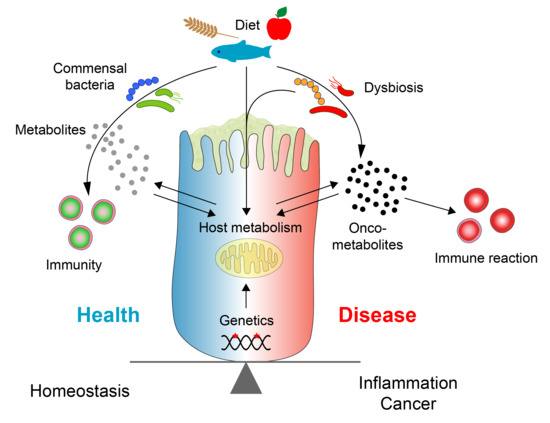
The intestinal mucosa is a highly absorptive organ and simultaneously constitutes the physical barrier between the host and a complex outer ecosystem. Intestinal epithelial cells (IECs) represent a special node that receives signals from the host and the environment and translates them into corresponding responses. Specific molecular communication systems such as metabolites are known to transmit information across the intestinal boundary. The gut microbiota or food-derived metabolites are extrinsic factors that influence the homeostasis of the intestinal epithelium, while mitochondrial and host-derived cellular metabolites determine the identity, fitness, and regenerative capacity of IECs. Little is known, however, about the role of intrinsic and extrinsic metabolites of IECs in the initiation and progression of pathological processes such as inflammatory bowel disease and colorectal cancer as well as about their impact on intestinal immunity. In this review, we will highlight the most recent contributions on the modulatory effects of intestinal metabolites in gut pathophysiology, with a particular focus on metabolites in promoting intestinal inflammation or colorectal tumorigenesis. In addition, we will provide a perspective on the role of newly identified oncometabolites from the commensal and opportunistic microbiota in shaping response and resistance to antitumor therapy.
Keywords: colorectal cancer; intestinal inflammation; oncometabolites; microbiota colorectal cancer; intestinal inflammation; oncometabolites; microbiota
Graphical Abstract