Article

Smartphone-Based Context Flow Recognition for Outdoor Parking System with Machine Learning Approaches


1
Faculty of Information Science and Technology, Multimedia University, 75450 Melaka, Malaysia
2
Faculty of Engineering and Technology, Multimedia University, 75450 Melaka, Malaysia
*
Authors to whom correspondence should be addressed.
Electronics 2019, 8(7), 784; https://doi.org/10.3390/electronics8070784

Submission received: 18 April 2019 / Revised: 22 May 2019 / Accepted: 11 June 2019 / Published: 13 July 2019
(This article belongs to the Section Artificial Intelligence)

Abstract

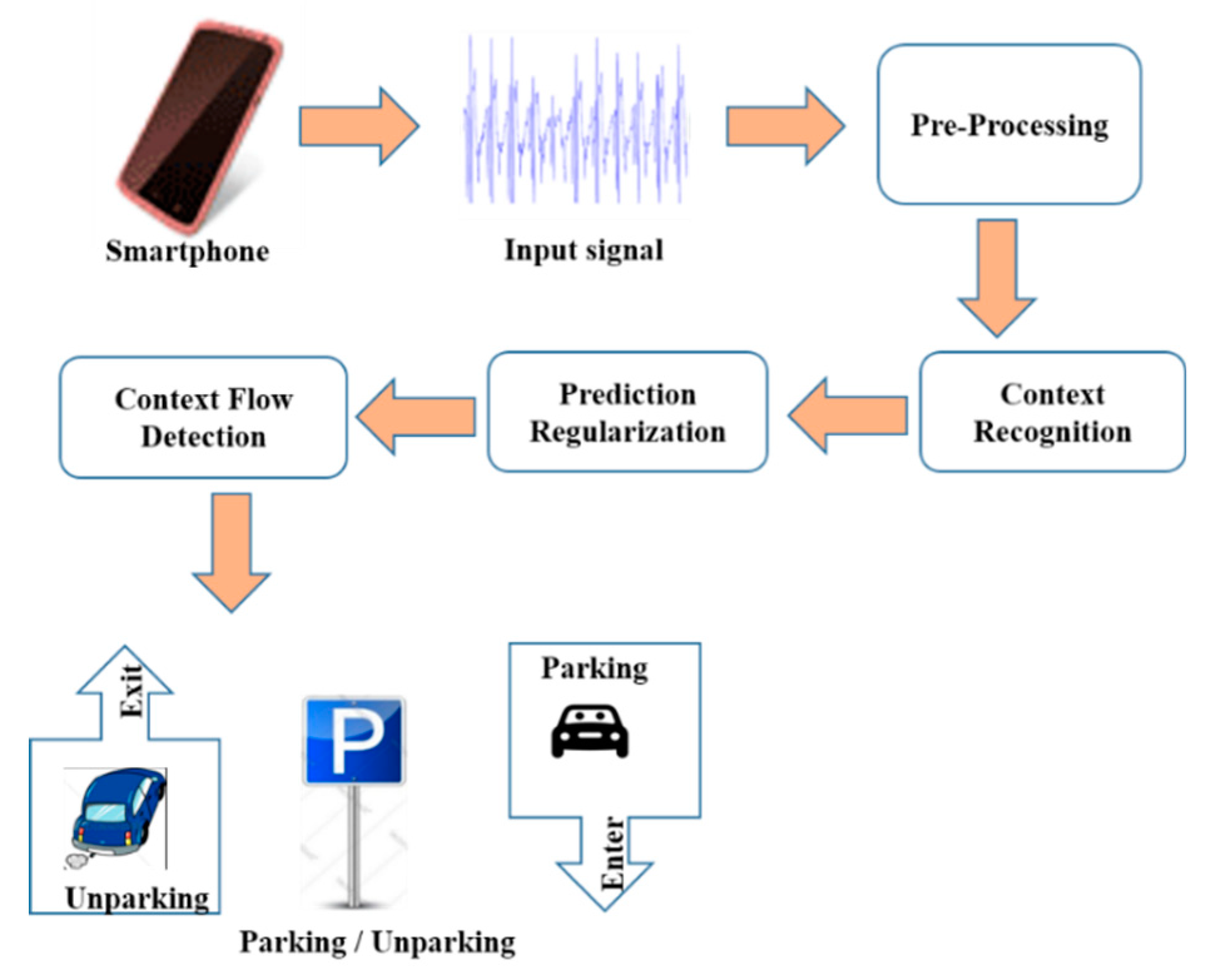
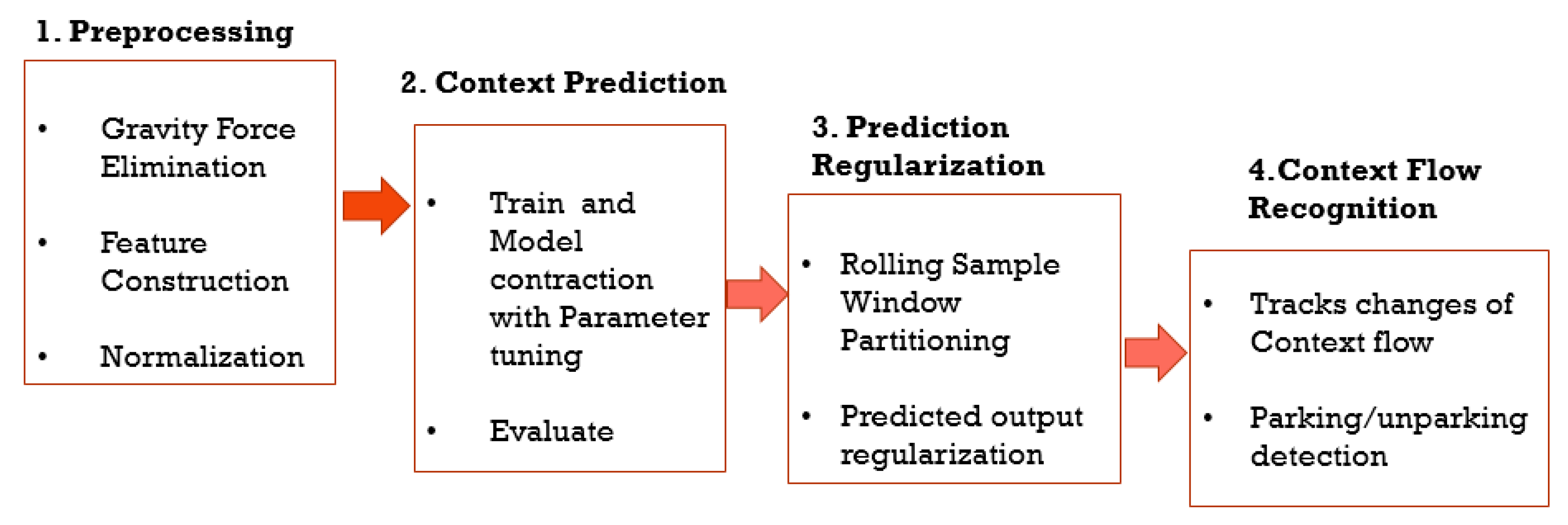
Outdoor parking systems are one of the most crucial needs in a smart city to find vacant parking spaces in outdoor environments, such as roadsides, university campuses, and so on. In a typical outdoor parking system, the detection of a vehicle entering and leaving the parking zone is a major step. At present, there are numerous external sensor-based and camera-based parking systems available to detect the entrance and leaving of vehicles. Camera-based parking systems rely on sophisticated camera set-ups, while sensor-based parking systems require the installation of sensors at the parking spots or vehicles’ sides. Due to such complication, the deployment and maintenance costs of the existing parking systems are very high. Furthermore, the need for additional hardware and network capacity increases the cost and complexity, which makes it difficult to use for large deployment. This paper proposes an approach for outdoor parking utilizing only smartphone integrated sensors that do not require manpower support nor additional sensor installation. The proposed algorithm first receives sensor signals from the driver’s phone, performs pre-processing to recognize the context of drivers, which is followed by context flow recognition. The final result is obtained from context flow recognition which provides the output of whether the driver is parking or unparking. The proposed approach is validated with a set of comprehensive experiments. The performance of the proposed method is favorable as it uses only the smartphone’s internal sensors to recognize whether the cars are entering or leaving the parking area.
Keywords: outdoor parking; smartphone sensors; machine learning; context recognition; pattern recognition outdoor parking; smartphone sensors; machine learning; context recognition; pattern recognition