Article

Enhancement of the Read Range of Textronic UHF RFID Transponders

by
Anna Ziobro
1,*,
Piotr Jankowski-Mihułowicz
2,* and
Mariusz Węglarski
2
1
Doctoral School, Rzeszów University of Technology, 35-959 Rzeszów, Poland
2
Department of Electronic and Telecommunications Systems, Rzeszów University of Technology, 35-959 Rzeszów, Poland
*
Authors to whom correspondence should be addressed.
Electronics 2026, 15(9), 1897; https://doi.org/10.3390/electronics15091897
Submission received: 31 March 2026 / Revised: 23 April 2026 / Accepted: 27 April 2026 / Published: 30 April 2026

Abstract

The purpose of this research is to determine which factors contribute to extending the read range of transponders equipped with different coupling-circuit topologies operating within selected RFID frequency bands. The analysis covered transponders that varied in both the configuration of their coupling circuits and their geometric dimensions. To accomplish this, transponder models were created using the EMCoS Studio electromagnetic simulation environment. Each model was subjected to simulations that yielded the mutual inductance and the voltage induced at the chip terminals. This study examines how the impedance of the embroidered antenna, the impedance of the chip’s coupling circuit, and the magnetic flux density affect the resulting chip voltage. In several of the investigated configurations, the peak chip voltage appeared outside the frequency range normally associated with RFID systems. The frequency at which this maximum occurred was dependent on the mutual inductance value. Understanding how individual parameters influence mutual inductance makes it possible to shift the voltage peak into a target operating band. Numerical simulation results, combined with the transponder’s mathematical model, enabled the calculation of the mutual inductance and the terminal voltage—quantities that directly determine the achievable read range. This study focuses on factors such as the resonant frequencies of the antenna and coupling circuit, their impedances, and the characteristics of the magnetic field. The findings show that tuning these parameters can affect not only the location of the voltage maximum, but also its amplitude. This effect introduces additional complexity in designing and selecting suitable transponder configurations.

1. Introduction

1.1. Textronic UHF RFID Transponders

One of the directions in the development of Internet of Things (IoT) systems is smart textiles, including garments—both everyday and specialized—for patients, uniformed services, protective applications, sports, as well as for animals [1]. Within this trend, textile RFID tags are being developed [2].
There are various proposed applications of RFID technology in smart clothing. Examples include human positioning and localization [3,4,5], as well as medical applications [6,7,8], such as monitoring the ability of individuals with dementia to dress independently [9].
RFID technology can serve as an interface for energy transfer and data exchange; however, textile RFID tags can also function as sensors, for example, for strain [10,11], humidity [12], temperature [13], or as devices for respiration monitoring [14,15,16].
Textile RFID tags are also considered a potential solution to the problem of automating the sorting of textile products for recycling, which is currently performed manually based on visual inspection of waste; thus, enabling its acceleration and cost reduction [17].
Among the solutions for textile RFID tags proposed in the literature, a variety of structures, materials, and fabrication methods can be found. Antennas for textile RFID tags are often embroidered [18,19,20,21,22], including using conductive silver-coated polyamide fibers, multifilament yarn spun from Liquid Crystal Polymers [23], or silver-plated nylon yarns [24,25].
The embroidery process itself is also a subject of investigation in the context of RFID antenna fabrication [26,27]. Antennas can also be hand-sewn, as demonstrated in [28], where an RFID tag antenna was fabricated on cotton using a local stitching technique with conductive threads containing stainless steel fibers.
Additionally, an RFID tag with a knitted antenna has been developed [29].
RFID tags with antennas made of conductive fabrics are also popular [10,30,31,32,33], for example using nickel [34], silver-plated materials [35], carbon fibers [36], or PET-based fabrics with a nickel–copper coating [37]. Such antennas are typically integrated with garments by adhesive bonding or heat pressing into the fabric.
Another method is printing [38,39,40,41,42], including the use of graphene-based inks [13,43]. Researchers are also exploring alternative approaches for employing graphene-based materials in the fabrication of textile RFID tags, such as conductive pastes with biopolymers [44] and graphene assembly films [45,46]. The laser-induced graphene (LIG) technique is also utilized [47,48,49,50].
Examples of the use of photolithography can also be found [50].
Proposed solutions for textile RFID tags include various types of antennas, such as dipole [21,50], meandered [20], slot [18,51], helical [22,52], inverted-F [53], patch [54], octagonal [55], as well as unconventional designs, including letter-shaped [56] and Mickey Mouse head-shaped antennas [28].
A particular challenge in textile RFID tags is the connection between the antenna and the chip, which in conventional designs is typically achieved by adhesive bonding or soldering. The resulting connection is rigid and therefore susceptible to damage due to mechanical stresses occurring during the use and maintenance of garments [24].
Moreover, the high temperatures involved in soldering may damage textiles with low thermal resistance, for which alternative soldering methods that do not require high heat input must be employed [57]. Soldering is also not applicable in the case of silver-plated conductive threads [58].
A commonly used approach in textile RFID tags is to connect the antenna and the chip using conductive epoxy adhesives [19,21,31,32,59]. Conductive threads [20,29,60] and snap fasteners, which allow the electronic component to be detached during washing [61], are also used. Fabricating the antenna from conductive textiles enables direct placement of the chip pads onto the material [34]. Chipless textile RFID tags are also being developed [23,33,55,62].
Moreover, ongoing research aims to develop autonomous, energy-efficient wireless sensor nodes [63]. Such solutions can be implemented using RFID technology [64].
This paper presents textile RFID tags in which the antenna and the chip are coupled inductively rather than galvanically. In this type of design, a dedicated coupling structure is used to transfer energy between the antenna and the integrated circuit. In [11], such a solution was used to enable the measurement of strain and displacement, which affect the inductive coupling between the antenna and the chip. The chip coupling structure was embroidered in a manner similar to the antenna, which means that the challenges associated with connecting the chip to textile materials still remain.
In the textronic RFID tags considered in this paper, this type of design is employed to eliminate this issue and facilitate manufacturing [65]. The chip and its coupling structure, forming a microelectronic module, are placed on a separate component in the form of a conventional garment element, such as a button or a buckle. It is delivered to a clothing factory or tailoring workshop as a ready-made component that can be sewn onto the garment or attached using other commonly applied tailoring methods, thus eliminating the need to introduce new production techniques. Similarly, the antenna can be embroidered using conductive threads by the same personnel with the equipment already available to them.

1.2. The Aim of This Research

The main objective of this study is to investigate methods for controlling the frequency position of the chip voltage maximum along the frequency axis. A textronic RFID tag should be designed to achieve satisfactory read ranges at the frequencies used by the RFID system in which it operates.
In previous studies [66], various types of coupling structures and antenna geometries were proposed. It was observed that, for some of them, the obtained maximum read range values occurred in frequency ranges not used in these systems. Therefore, it is reasonable to investigate whether design modifications can be introduced to shift the maximum toward desired frequencies.
An appropriate technique for this purpose appears to be extending or shortening the antenna arms. Changing the radiator length results in a modification of the antenna module impedance due to a shift in the resonance frequency, as well as a change in the amount of conductive thread used. Shortening the antenna leads to a lower resistance of the antenna module.
According to the mathematical model of the textronic RFID tag [67], the inductive coupling between the antenna and the chip can be described by the mutual inductance reactance X M as follows:
X M = ( Z T A Z C M ) Z A
where Z C M is impedance of chip coupling circuit, Z T A is impedance of transponder antenna and Z A is antenna module impedance. The term antenna module refers to the physically implemented antenna together with its coupling structure. In contrast, the transponder antenna is defined as the inductively coupled system consisting of the antenna module and the chip coupling structure.
While the voltage generated at the chip terminals is given by
U T C = I C M Z T C = U A j X M Z T C Z A ( Z C M + Z T C ) + X M 2
where I C M is microelectronic module current, Z T C is chip impedance and U A is antenna module voltage. A higher chip voltage translates into a greater read range of the RFID tag. The impedance of the antenna module consists of the resistance R A and the reactance X A :
Z A = R A + j X A
According to Equation (2), a decrease in the antenna module resistance R A should result in an increase in the chip voltage, since the antenna module impedance Z A appears in the denominator.
However, according to Equation (1), its value also affects the quality of the inductive coupling between the antenna and the chip, represented by the mutual inductance reactance X M , which appears in the numerator and is also squared in the denominator of the Equation (2).
Introducing a different conductor geometry also influences the magnetic field generated by the antenna, including its intensity and the distribution of magnetic flux density.
Therefore, it can be expected that changing the radiator length, in addition to the anticipated shift of the maximum along the frequency axis, will also result in either a decrease or an increase in the chip voltage, and consequently in the read range.
The study consisted of comparing the mutual inductance reactance and the chip voltage, calculated using Equations (1) and (2), before and after modifying the antenna radiator length in the tags. The impedances of the antenna module, the chip coupling structure, and the tag antenna were obtained through numerical calculations.
The analysis of the obtained values, as well as the impedances of the antenna modules and the chip coupling structures, made it possible to identify some of the factors influencing the occurrence of the chip voltage maximum and to determine how its position can be modified through changes in the geometry of individual tag components. A simultaneous effect on the value of the chip voltage was also observed.
The results are presented according to the type of coupling structure used in the analyzed designs. First, models containing only the chip coupling structure are discussed.
The second group consists of designs with a planar antenna–chip coupling structure, in which the microelectronic module is placed directly onto the embroidered conductive thread, forming a single plane with the textile substrate.
Next, the antenna coupling structure is implemented as a thread wrapping around the traces of the chip coupling circuit.
The final type includes models with a core, on which both the chip and antenna coupling structures are implemented in the form of wound coils.
This paper is organized as follows: Section 1 (Introduction) provides an overview of textile RFID tags and outlines the research objectives. Section 2 (Materials and Methods) describes the software tools used and the developed numerical model of the textronic RFID tag. Section 3 (Results) presents an analysis of the obtained results. The paper concludes with the Discussion Section 4, which summarizes the findings and outlines future directions for research, development, and applications of textronic RFID tags.

2. Materials and Methods

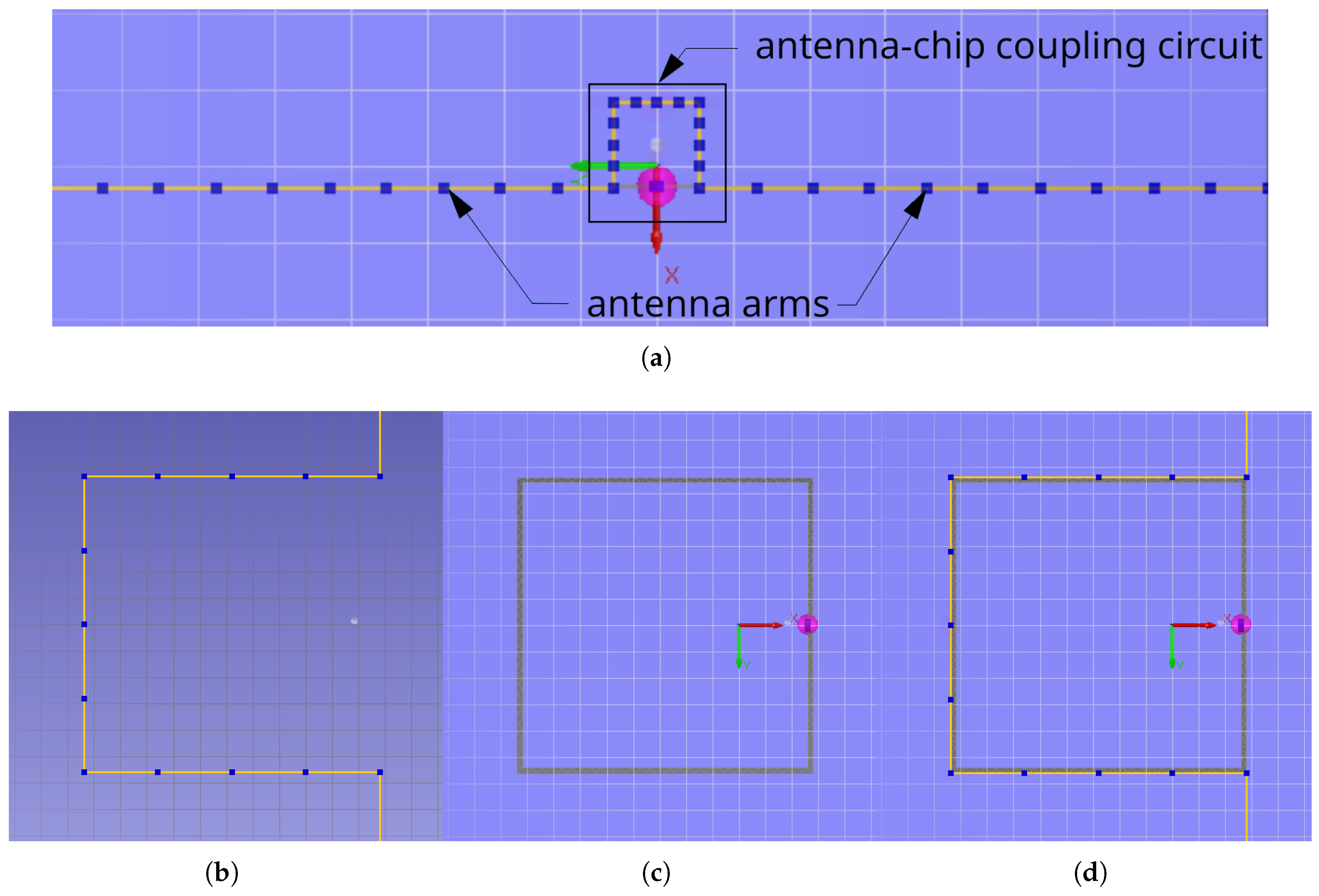
The models of the textronic RFID tags were designed (Figure 1) and simulated in EMCoS Studio based on previously developed designs [65].
Numerical calculations were used to obtain the impedance values of the antenna module, the tag antenna, and the chip coupling structure, which were required, according to Equations (1) and (2), to calculate the mutual inductance reactance and the chip voltage in MATLAB, assuming, in accordance with the mathematical model of the textronic RFID tag, the simplification that only the impedances of the tag’s components are taken into account [67].
MATLAB R2023a and Python 3.8.10 scripts (using the Pandas 1.4.2 and Matplotlib 3.5.2 libraries) prepared in the Spyder environment were used for the graphical presentation of the results.
All models shared the same set of parameters. A textile substrate composed of 82% polyester and 18% spandex, with a thickness of 0.66 mm, suitable for T-shirt manufacturing, was assumed in the simulations. Its relative permittivity was set to 1.53 and dielectric loss to 0.0051, in accordance with laboratory measurements performed on a real material sample.
Above the textile substrate layer, a material with a dielectric constant of 2.855, a dielectric loss of 0.11, and a thickness of 0.152 mm was placed, serving as the substrate for the chip coupling circuit traces. Between this layer and the textile substrate, air region with a height of 0.256 mm was assumed (Figure 2).
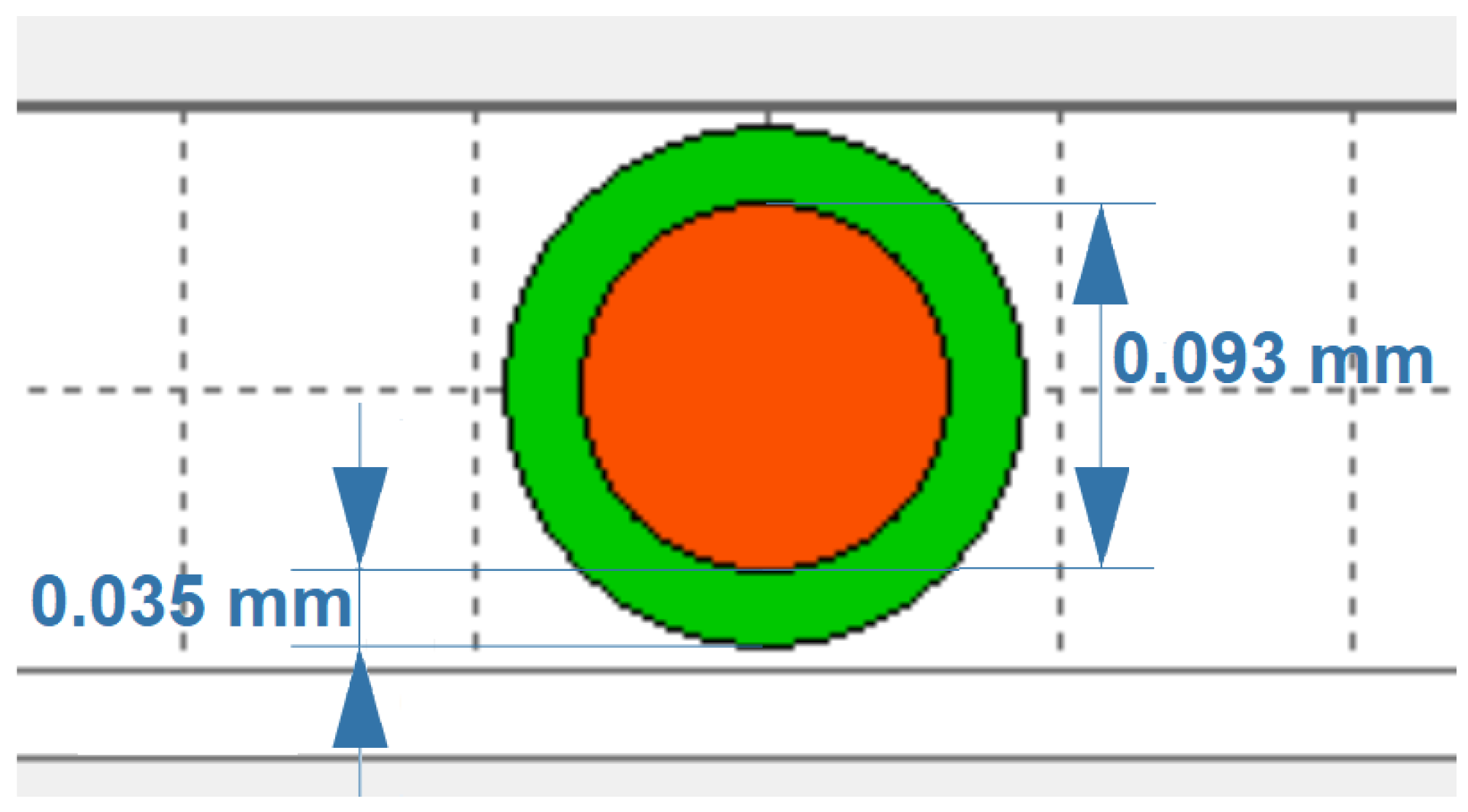
The antenna module, in turn, was implemented using a conductor with the properties of the Rupalit PACKLitzWire 10 × 0.04 mm, 2 × 52 conductive thread, which features silk insulation. The conductor had a circular cross-section with a diameter of 0.093 mm (Figure 3). The insulation thickness was 0.035 mm, and its relative dielectric constant was 3.
The authors used ChatGPT-5.3 (OpenAI) to assist in translating selected parts of the manuscript from Polish into English. The AI tool was used solely for linguistic support and did not contribute to the scientific content, analysis, or interpretation of the results. All translated text was carefully reviewed and validated by the authors.
A transcript of the interaction used for translation purposes is available upon request.

3. Results

3.1. Transponders Without Antenna Coupling Circuit

First, a textronic RFID tag with the simplest antenna module geometry was considered, namely a linear antenna without a coupling structure. The same antenna module was then combined with square chip coupling structures with side lengths of 5.7 mm, 11.2 mm, 15.8 mm, 20.0 mm, 30.0 mm, 40.0 mm, and 50.0 mm. The structure of the tag is shown in Figure 4.
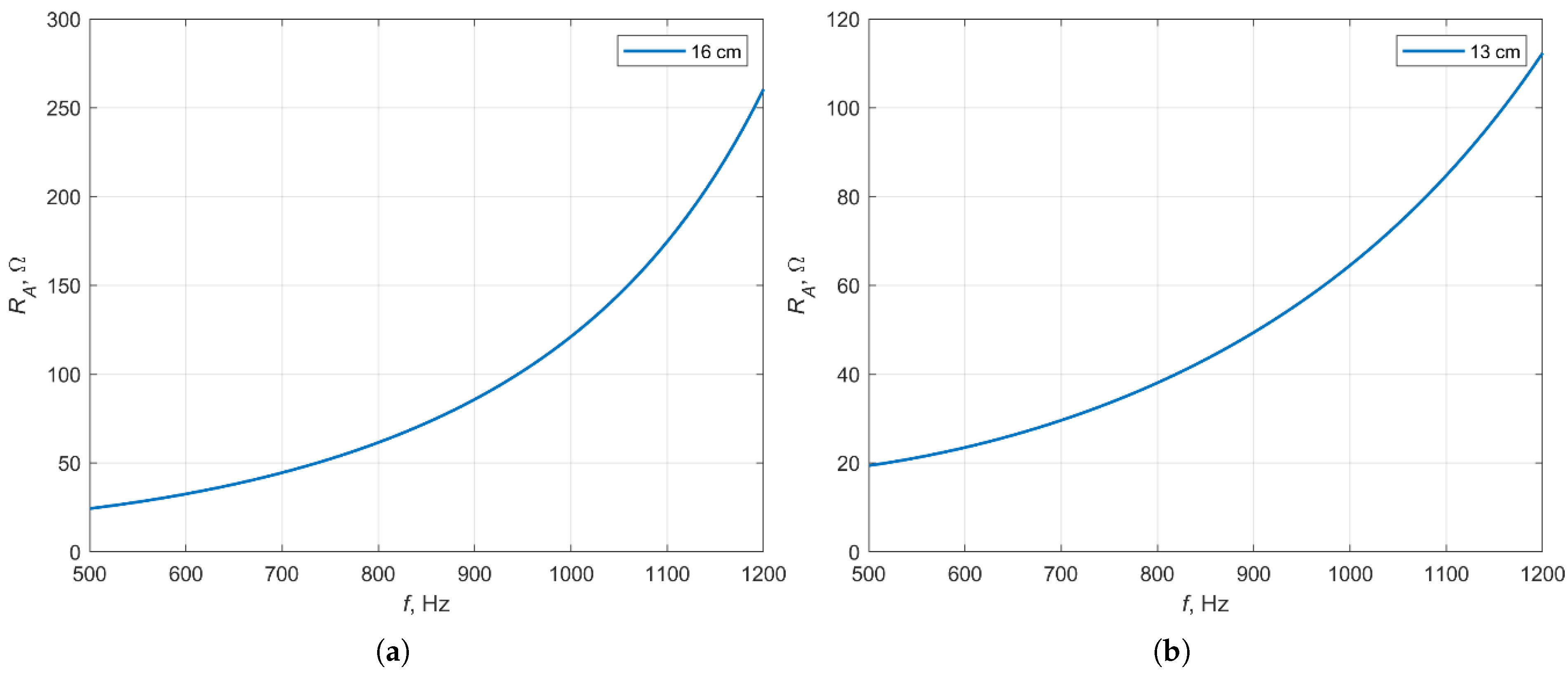
Two antennas were used, with lengths of 16 cm and 13 cm, respectively. Their impedances were calculated numerically; Figure 5 shows the real part R A (the imaginary part is omitted for clarity).
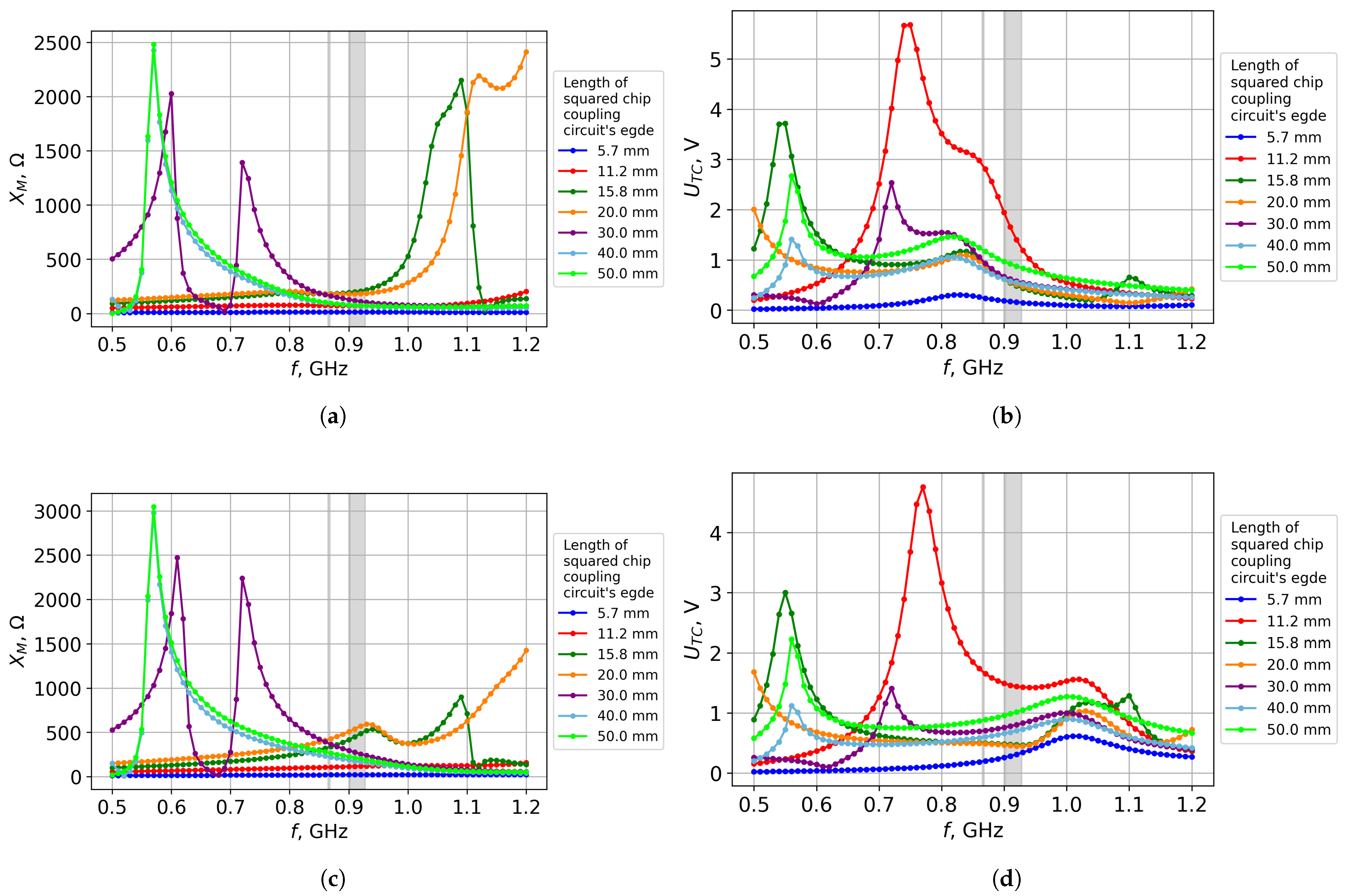
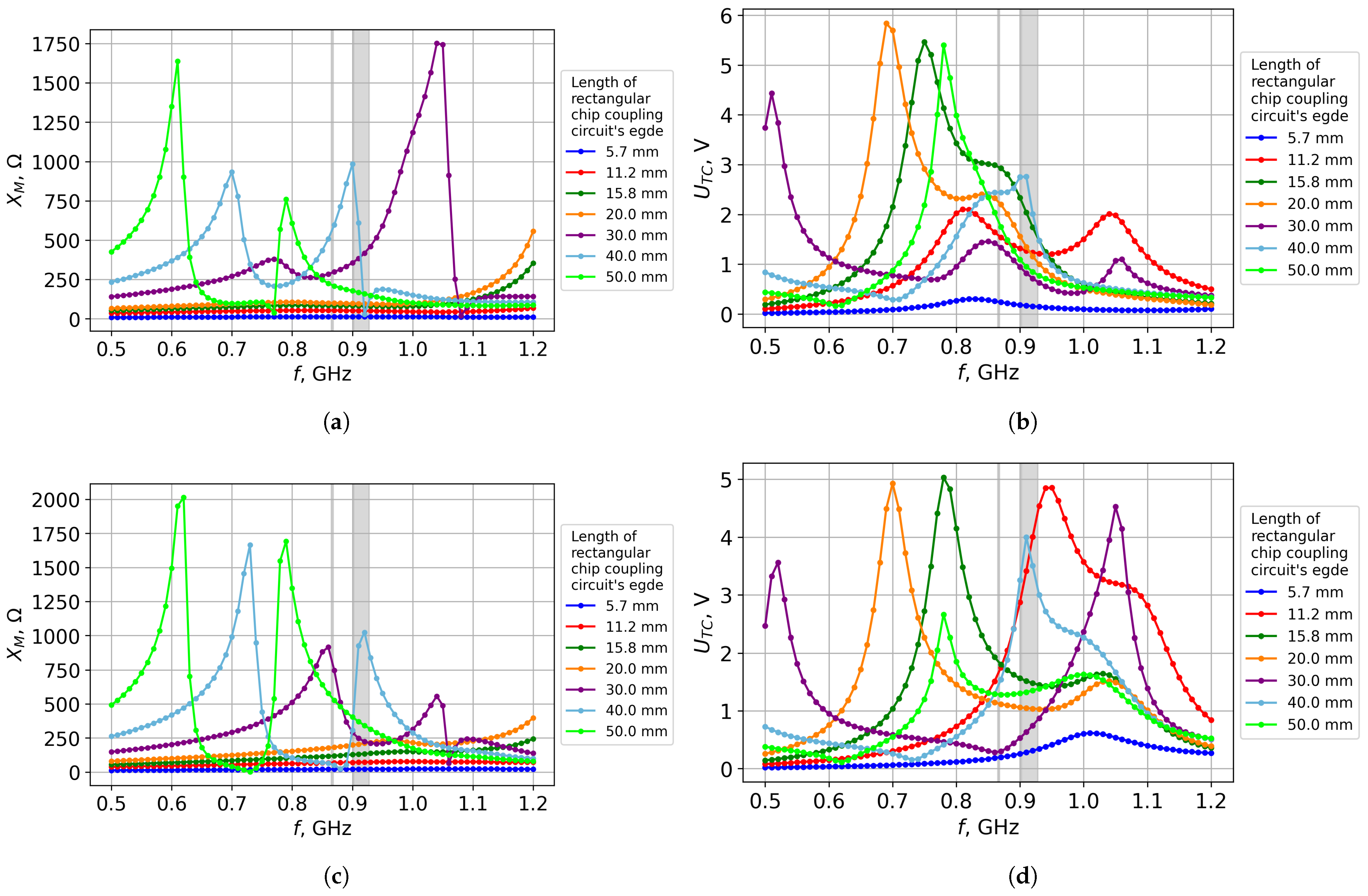
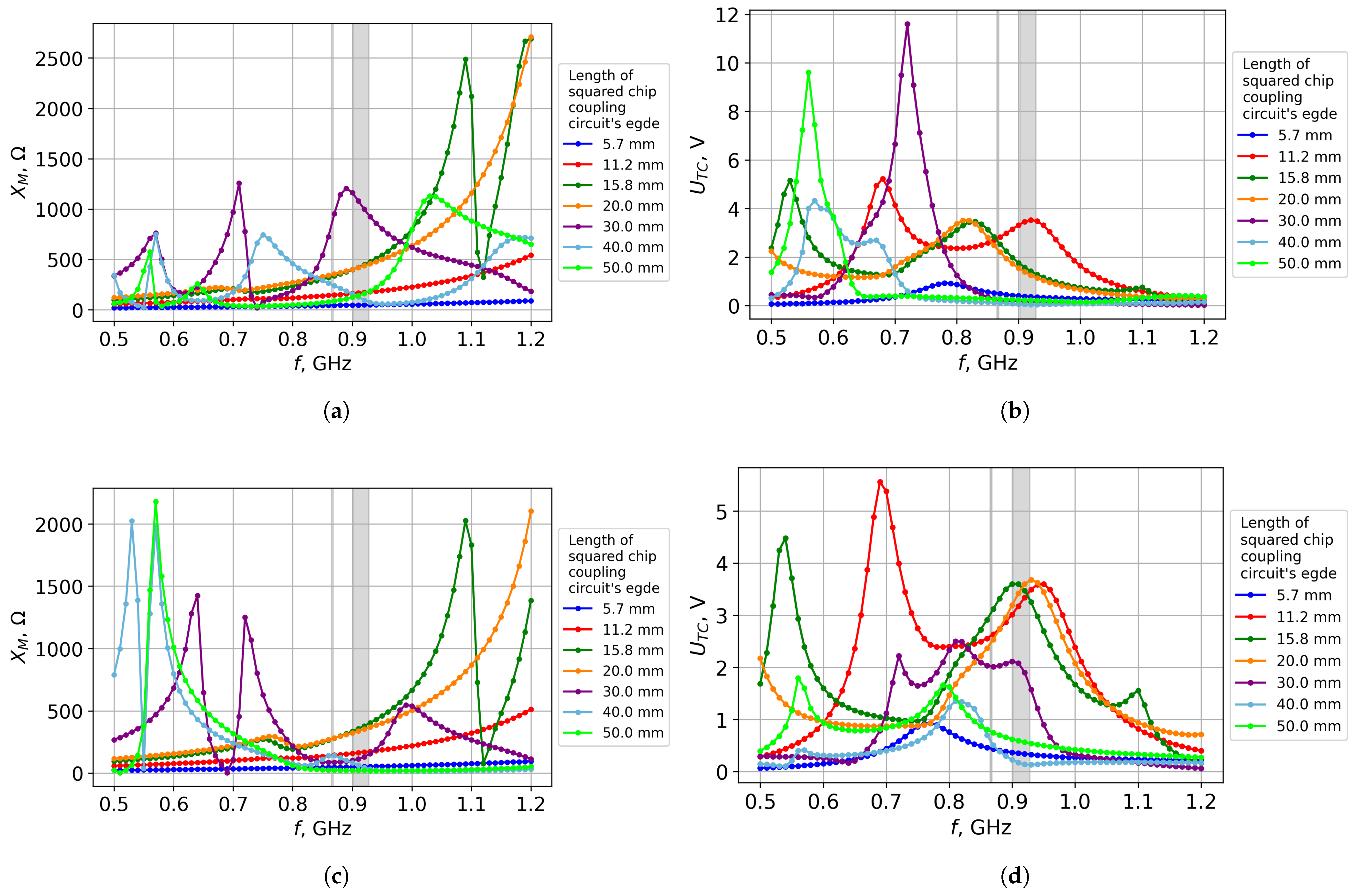
Based on the numerical calculations of the impedances of the antenna module, the chip coupling structure, and the tag antenna, the mutual inductance reactance and the chip voltage were determined for each tag (Figure 6).
Shortening the antenna generally resulted in a decrease in the chip voltage, including at 866 MHz. However, an improvement was observed for frequencies above 900 MHz. In most cases, the highest values achieved by the tags still occur at the same frequencies.
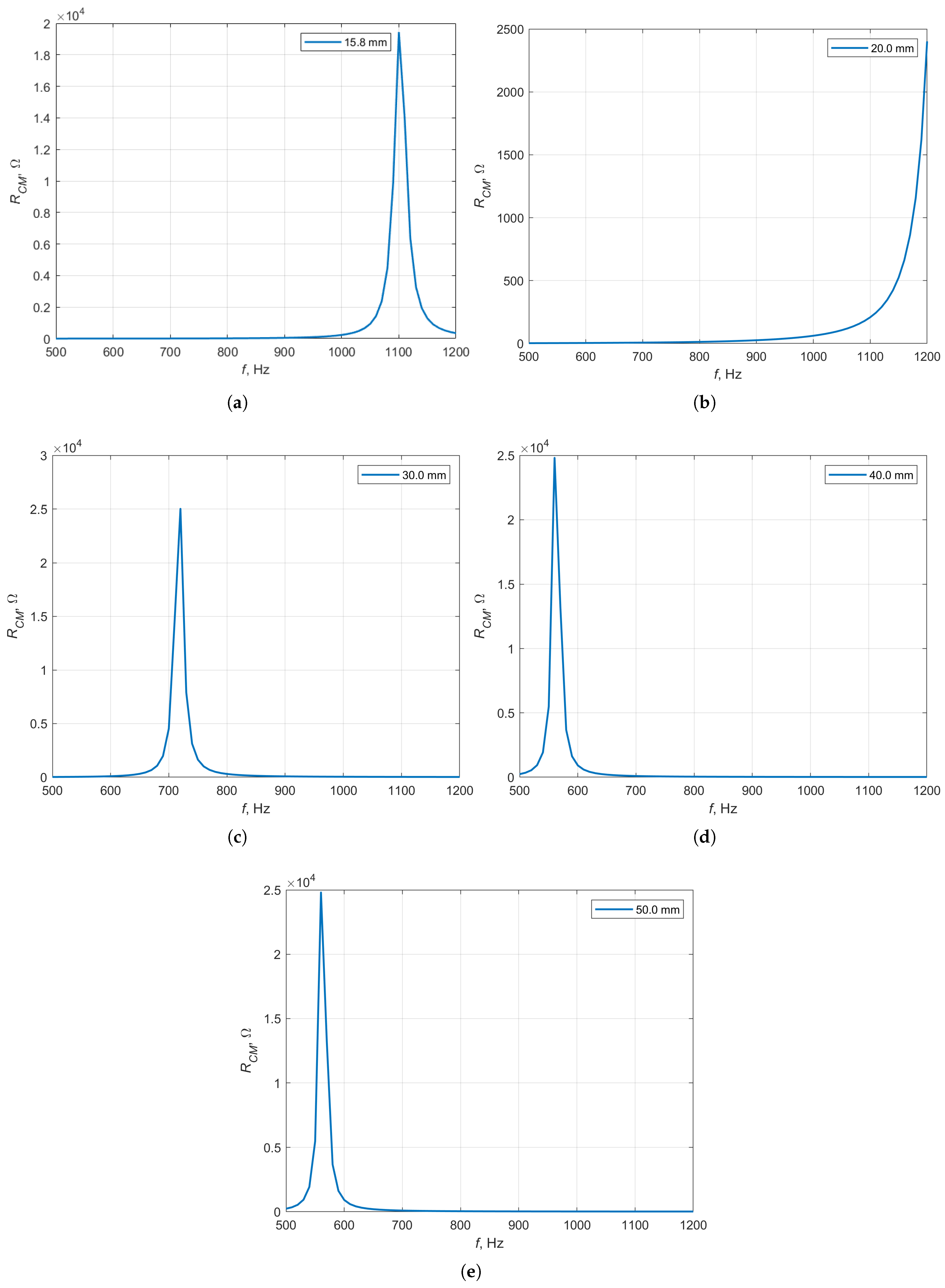
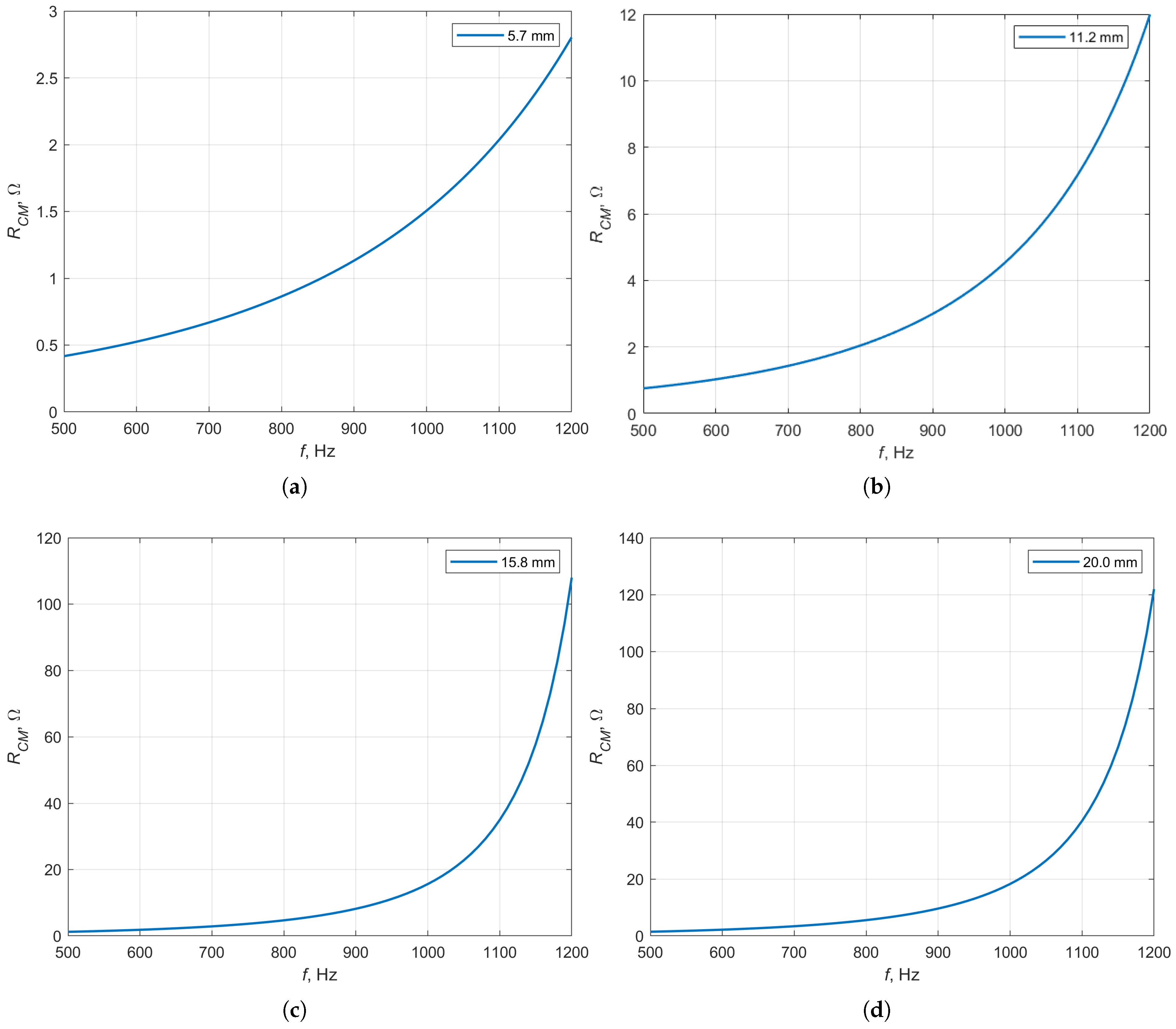
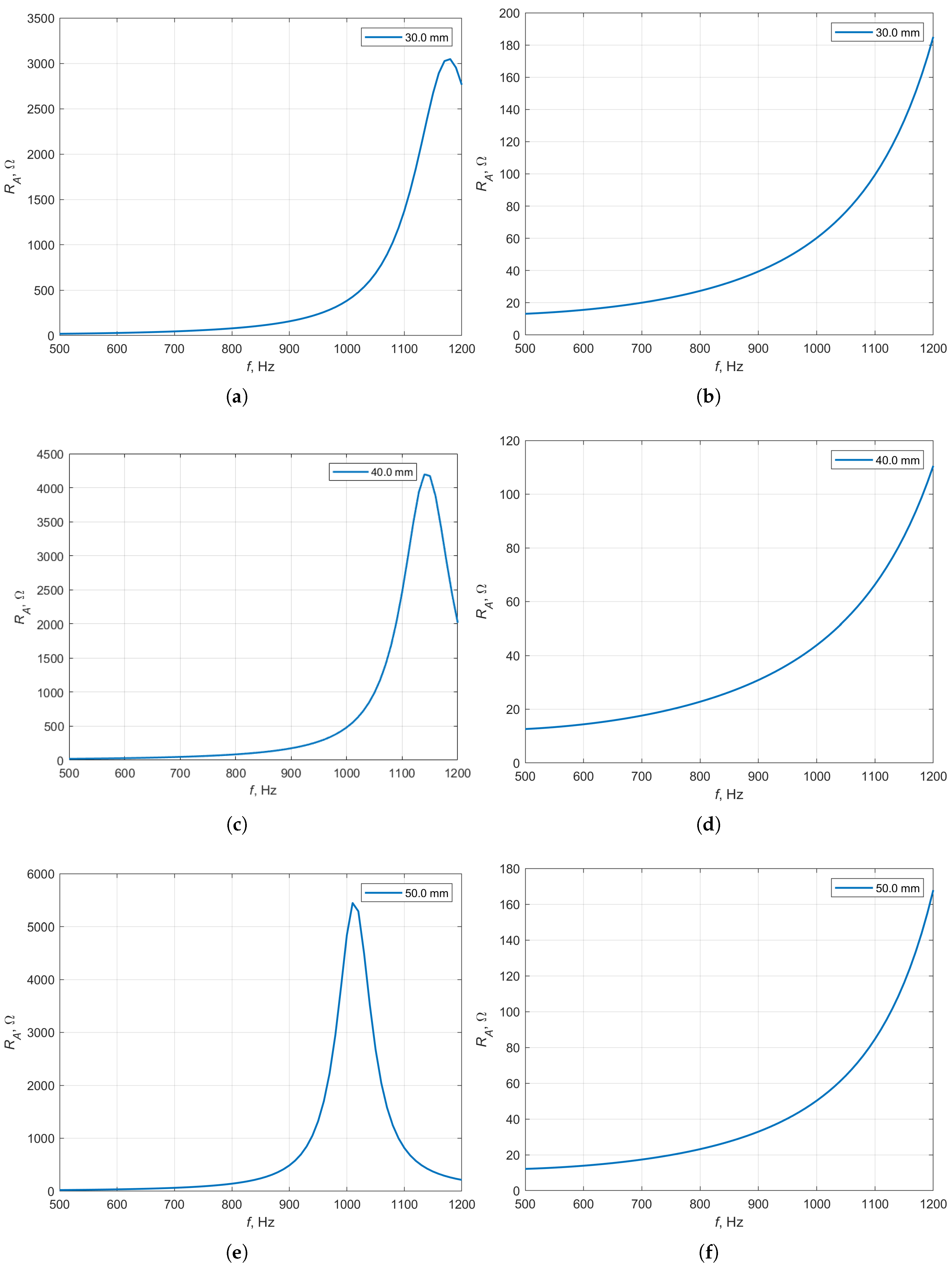
For coupling structures with a side length equal to or greater than 15.8 mm, maxima of the mutual inductance reactance appear. When the radiator length is changed, these maxima assume different values but retain their positions along the frequency axis. This behavior is determined by the resonance phenomenon occurring in the chip coupling circuit. The frequencies at which global or local maxima of the mutual inductance reactance occur correspond to those at which the resistance of the chip coupling structure (for a given side length) reaches its maximum (Figure 7).
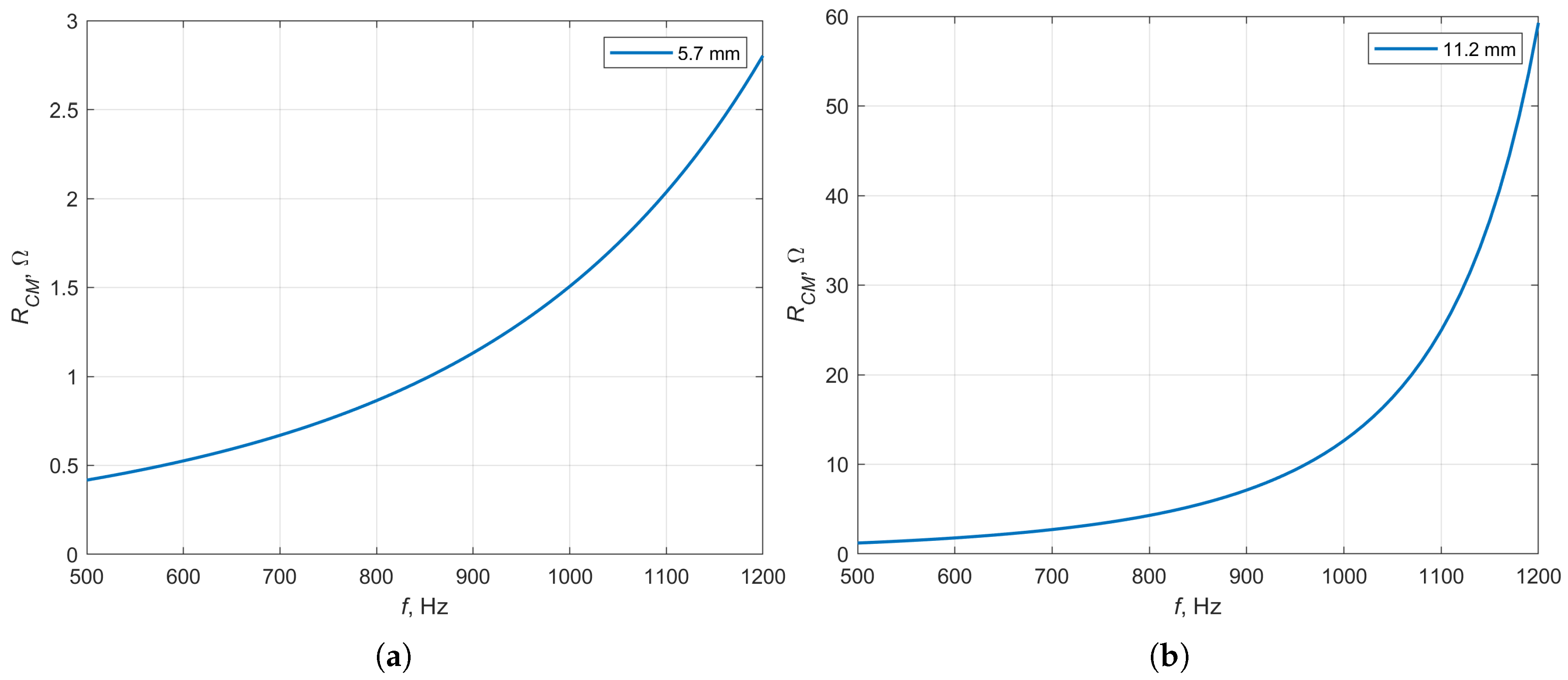
A slight increase in the mutual inductance reactance with increasing frequency for chip coupling structures with side lengths of 5.7 mm and 11.2 mm can be explained by a similar dependence observed for both their resistance (Figure 8) and the resistance of the antenna module (Figure 5).
The same procedure was carried out for both antennas, this time using rectangular chip coupling structures (Figure 9).
The obtained values of the mutual inductance reactance and the chip voltage, before and after antenna shortening, are presented in Figure 10.
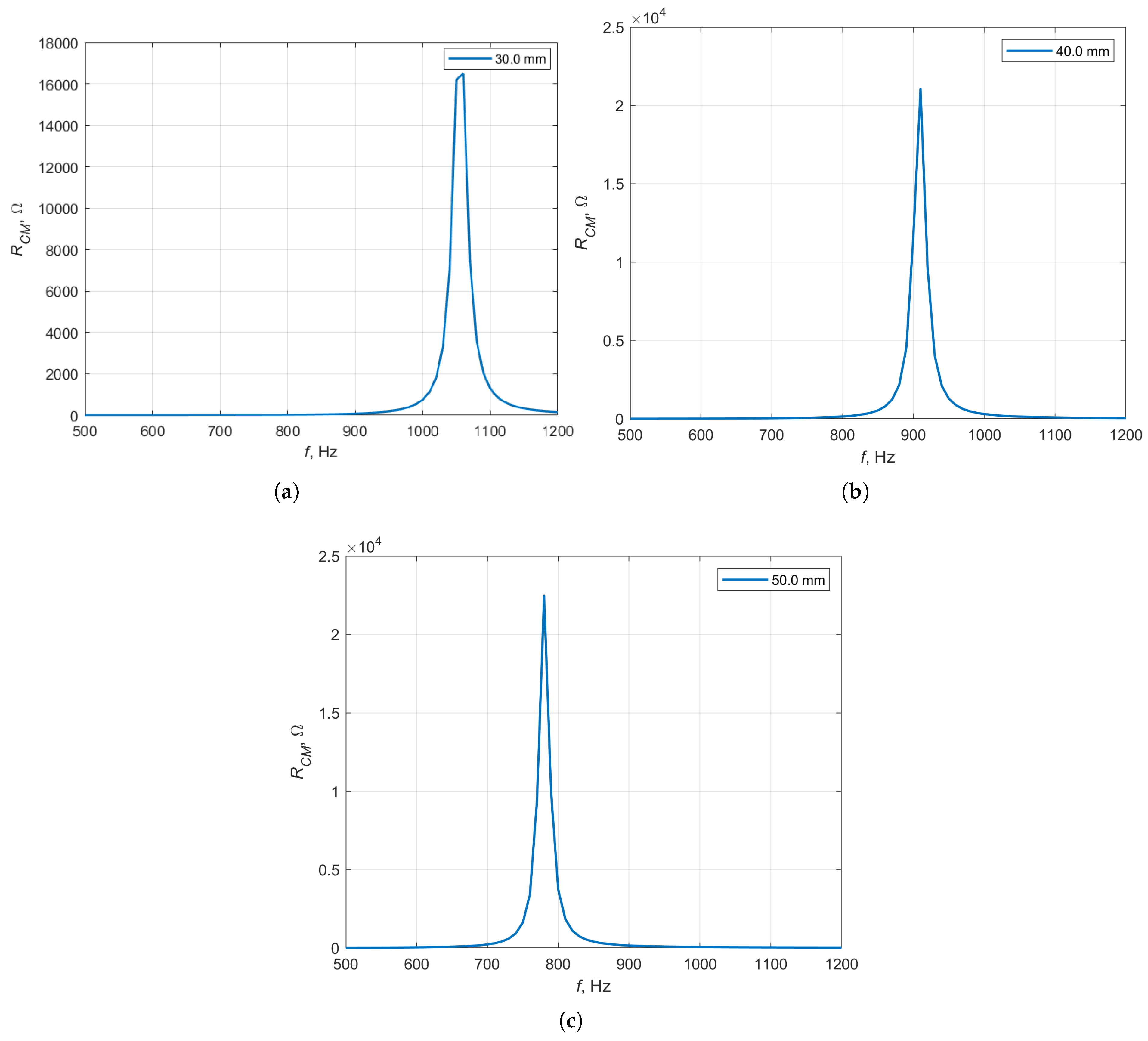
In this case, extrema of the mutual inductance reactance appear for microelectronic modules with larger dimensions of the longer side, since the shorter side is fixed at 5.7 mm. Consequently, the perimeter of the rectangular chip coupling structures is smaller than that of square ones with the same side length. For this reason, the maximum of their resistance falls within the considered frequency range only for structures with a longer side of 30 mm (Figure 11), while for smaller ones it lies outside this range (Figure 12).
For structures with side lengths of 15.8 mm and 20.0 mm, a simultaneous increase in both the mutual inductance reactance and the resistance of the chip coupling circuit can be observed.
For some modules, antenna shortening resulted in a decrease in the chip voltage, while for others it led to an increase, along with a change in the shape of the characteristics. For the module with a side length of 30.0 mm, the maximum of the mutual inductance reactance, resulting from the resonance phenomenon occurring within it, decreased in magnitude, which enabled a significantly higher chip voltage to be achieved.
A substantial increase was also observed for the 11.2 mm structure, although its mutual inductance reactance increased only slightly. At the same time, a shift of the maximum toward higher frequencies was observed.
Thus, it is possible to manipulate the position of an extremum by changing the radiator length, provided that its existence is not determined by resonance in the chip coupling circuit. By shortening or extending the antenna, it is instead possible to influence its magnitude.
This implies that, by appropriately designing the geometry of the chip coupling structure, the occurrence of the chip voltage maximum at a desired frequency can be enforced, while the antenna length can be used to increase its value without causing a shift along the frequency axis.

3.2. Transponders with Planar Chips and Antenna Coupling Circuits

3.2.1. Squared-Shaped Coupling Circuit

In the next stage of the study, the lengths of the antenna arms were modified for tags incorporating a planar antenna coupling structure in the form of a embroidered square matched to the previously used chip coupling structures (Figure 13).
As a result, each tag had its own antenna module in which, in addition to the radiator arms, an open square (i.e., a square with one side removed) with dimensions corresponding to a given chip coupling structure was included.
As before, the mutual inductance reactance and the chip voltage were calculated for tags with both longer and shorter antenna arms (Figure 14).
Despite the use of a different type of coupling structure, it can be observed that some of maxima of the mutual inductance reactance occur at the same frequencies as for tags without a coupling structure, which are caused by the resonance phenomenon in the chip coupling circuits.
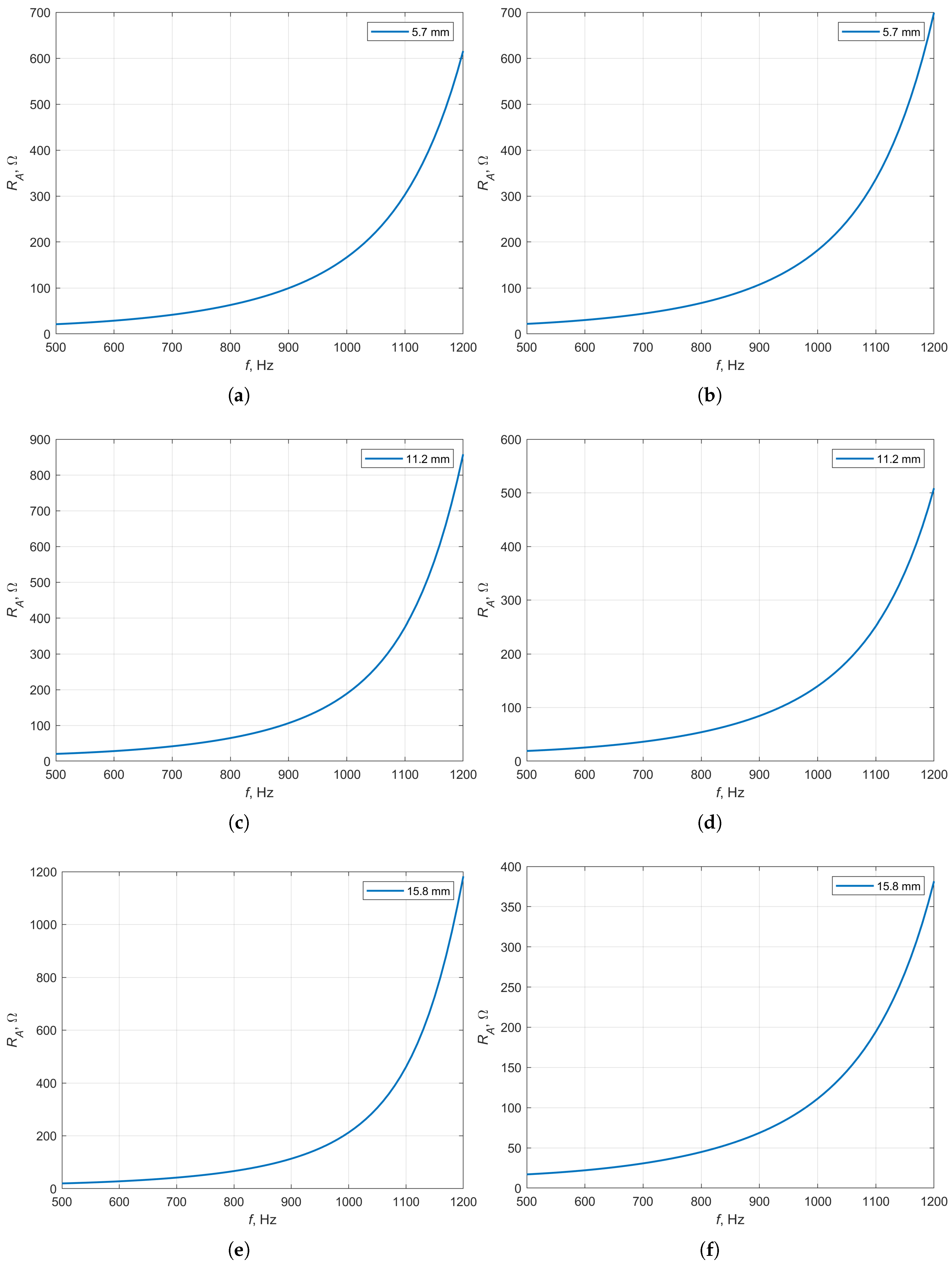
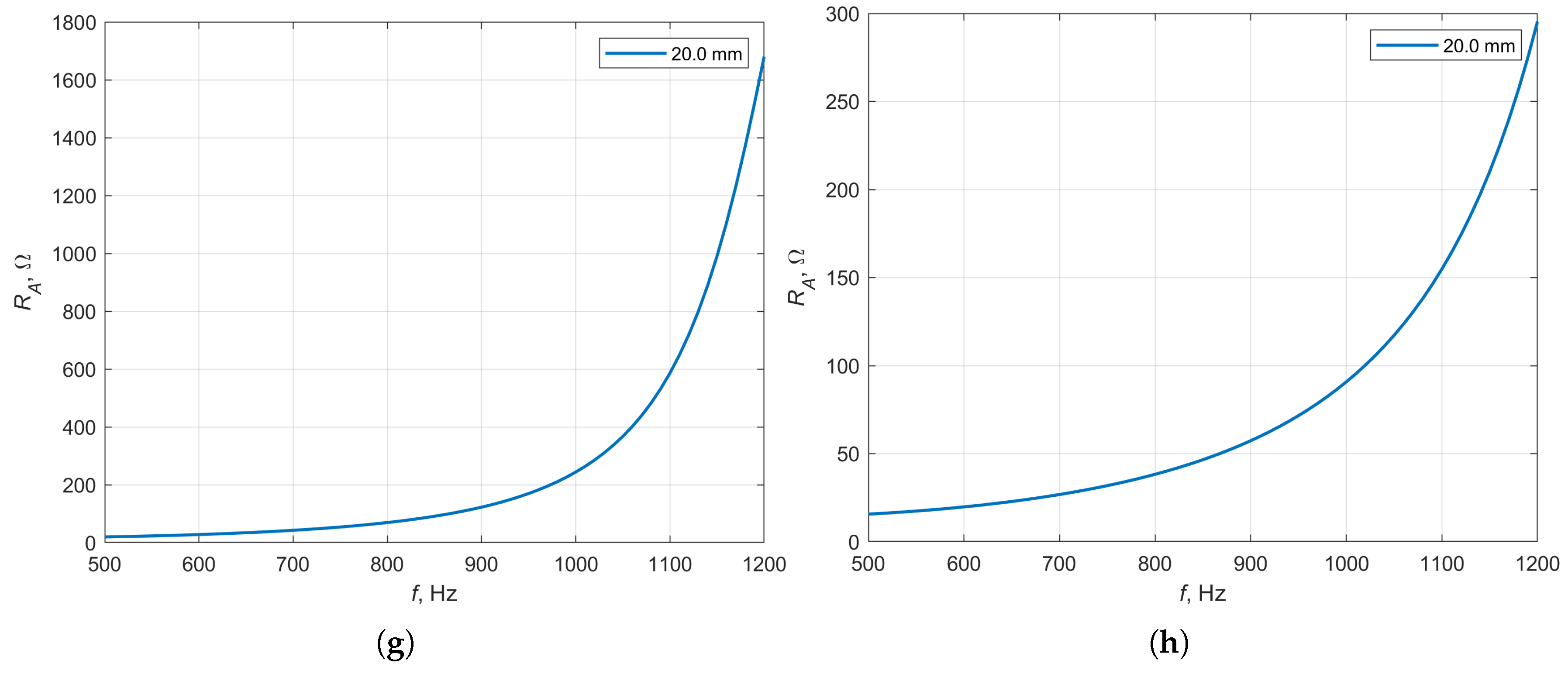
In this case, due to the different sizes of the antenna coupling structures, the length of the antenna module also changes; therefore, differences between the tags are additionally influenced by the antenna resistance R A . For coupling structure side lengths of 30.0 mm, 40.0 mm, and 50.0 mm, the resistance maximum falls within the investigated frequency range (Figure 15 left column). This is reflected in the occurrence of maxima at the same frequencies or in an increase in the mutual inductance reactance (for 30 mm).
The values also increase for 5.7 mm, 11.2 mm, and 15.8 mm within the 1100–1200 MHz range (Figure 16 left column), which was not observed for tags without a coupling structure. This effect results from the increase in the antenna module resistance with frequency.
After modifying the radiator length, the resistance of the antenna module changed (Figure 15 and Figure 16, right column). For smaller antenna coupling structures, an increase in resistance is still observed at higher frequencies, although the overall resistance of their antennas decreased.
However, the resistance maxima no longer occur within the investigated frequency range; consequently, the corresponding maxima of the mutual inductance reactance either disappeared or were reduced.
This leads to the conclusion that some of the maxima of the mutual inductance reactance are caused by resonance phenomena occurring both in the chip coupling structure and in the antenna module. Therefore, manipulation of the position of this extremum can only be achieved by adjusting the geometrical dimensions of these components.
Nevertheless, by properly selecting these parameters, it is possible to control the frequency at which resonance occurs.

3.2.2. Loop Coupling Circuit

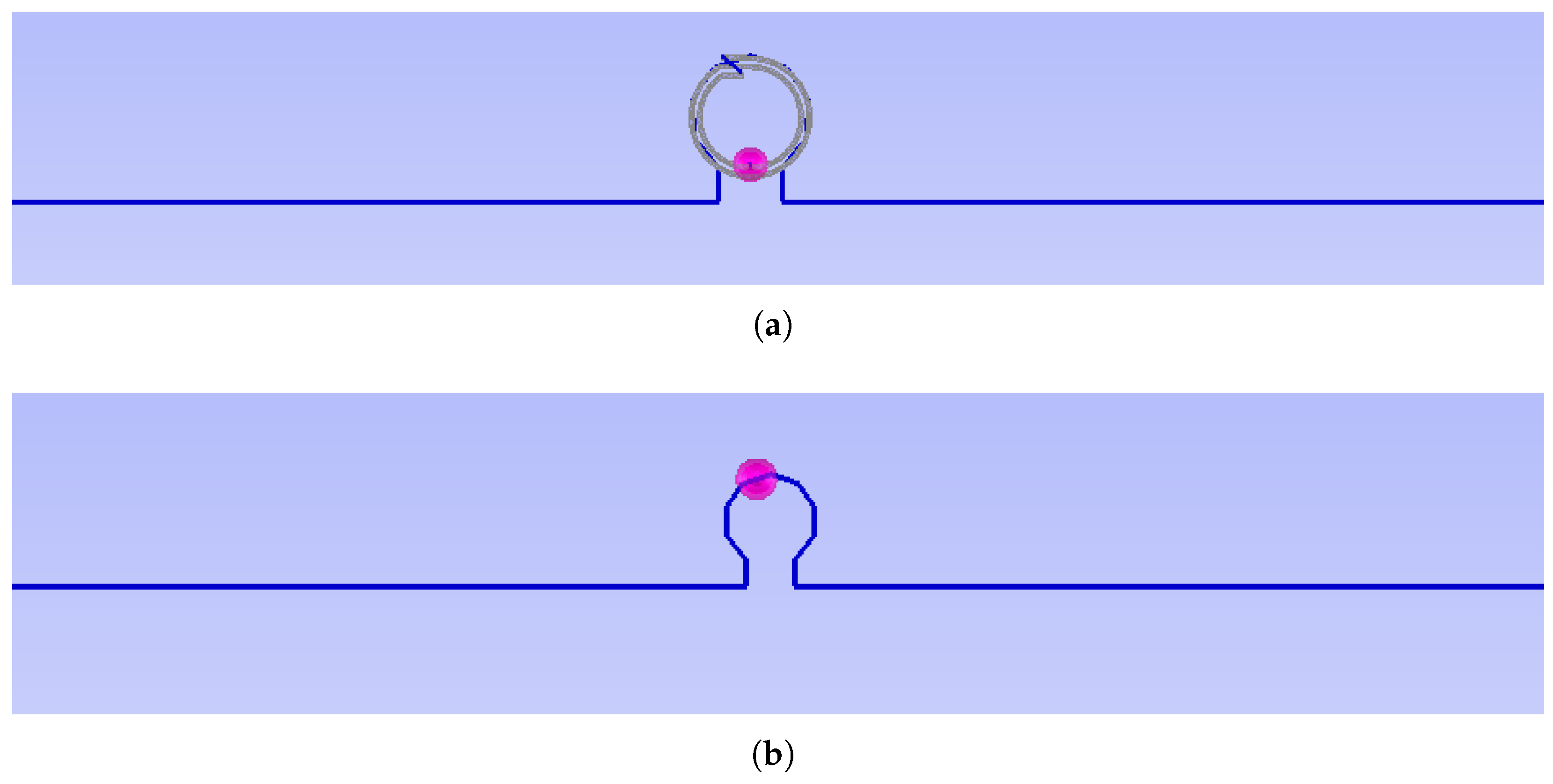
Subsequently, attention was focused on tags with chip coupling structures in the form of interconnected loops. In the first step, two structures with a two-loop chip coupling configuration were analyzed, both without and with an antenna coupling structure (Figure 17). The outer diameter of the chip coupling loop is 5.7 mm, while the inner diameter is 4.9 mm.
After performing calculations for antennas with a radiator length of 16 cm, it was found that, for both tags, shifting the maximum toward lower frequencies would be advantageous. Therefore, in both models, the antenna arms were extended to 18 cm, with the expectation that the highest values of the chip voltage would shift toward lower frequencies along the frequency axis.
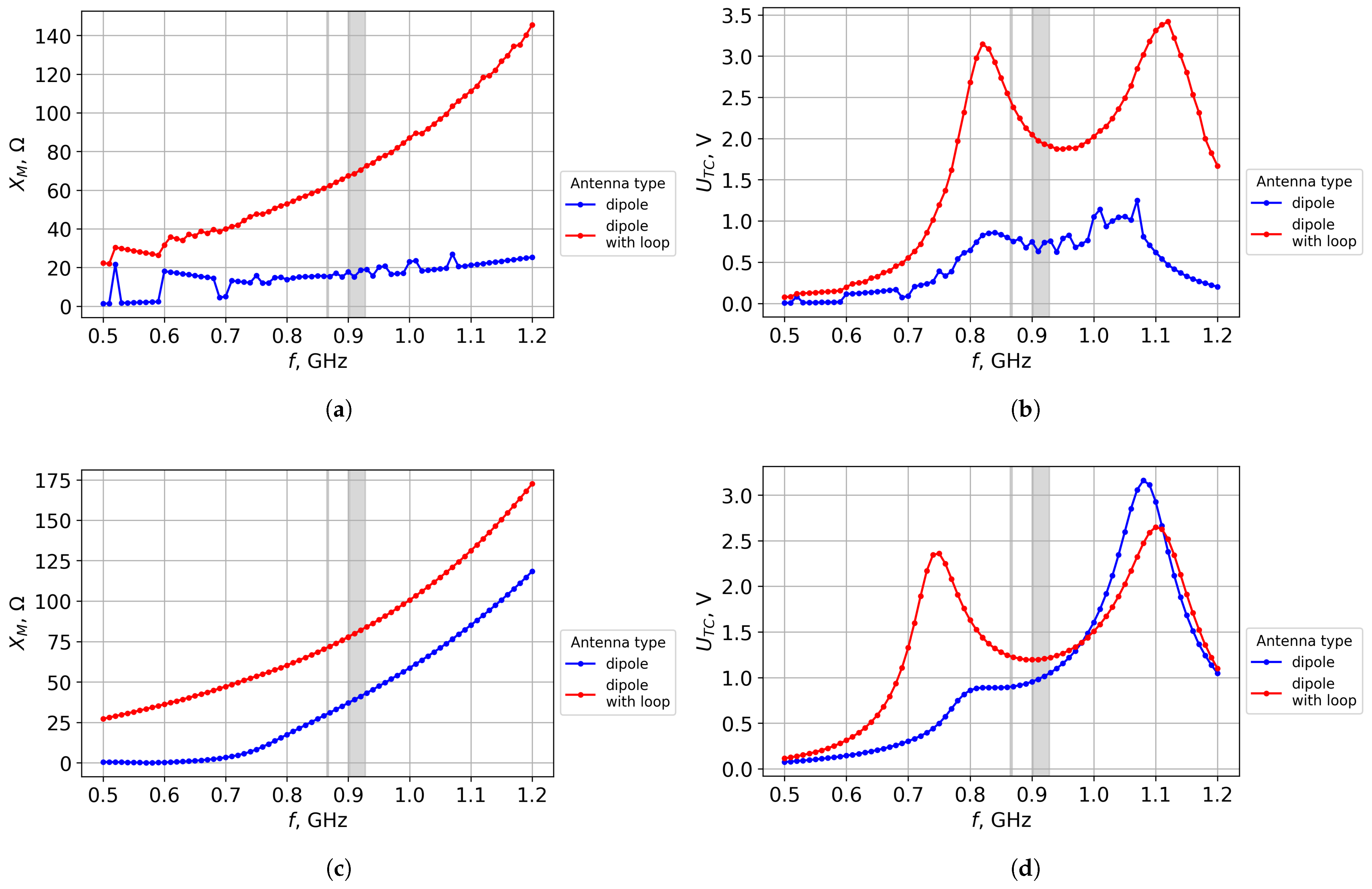
The obtained results of the mutual inductance reactance and the chip voltage, before and after extending the radiator, are presented in Figure 18.
In the case of the dipole without a coupling structure, after modifying the radiator length, the slope of the extremum begins to rise at lower frequencies, which resulted in a slight increase in the chip voltage in the 700–900 MHz range; thus, a small shift of the characteristic was observed.
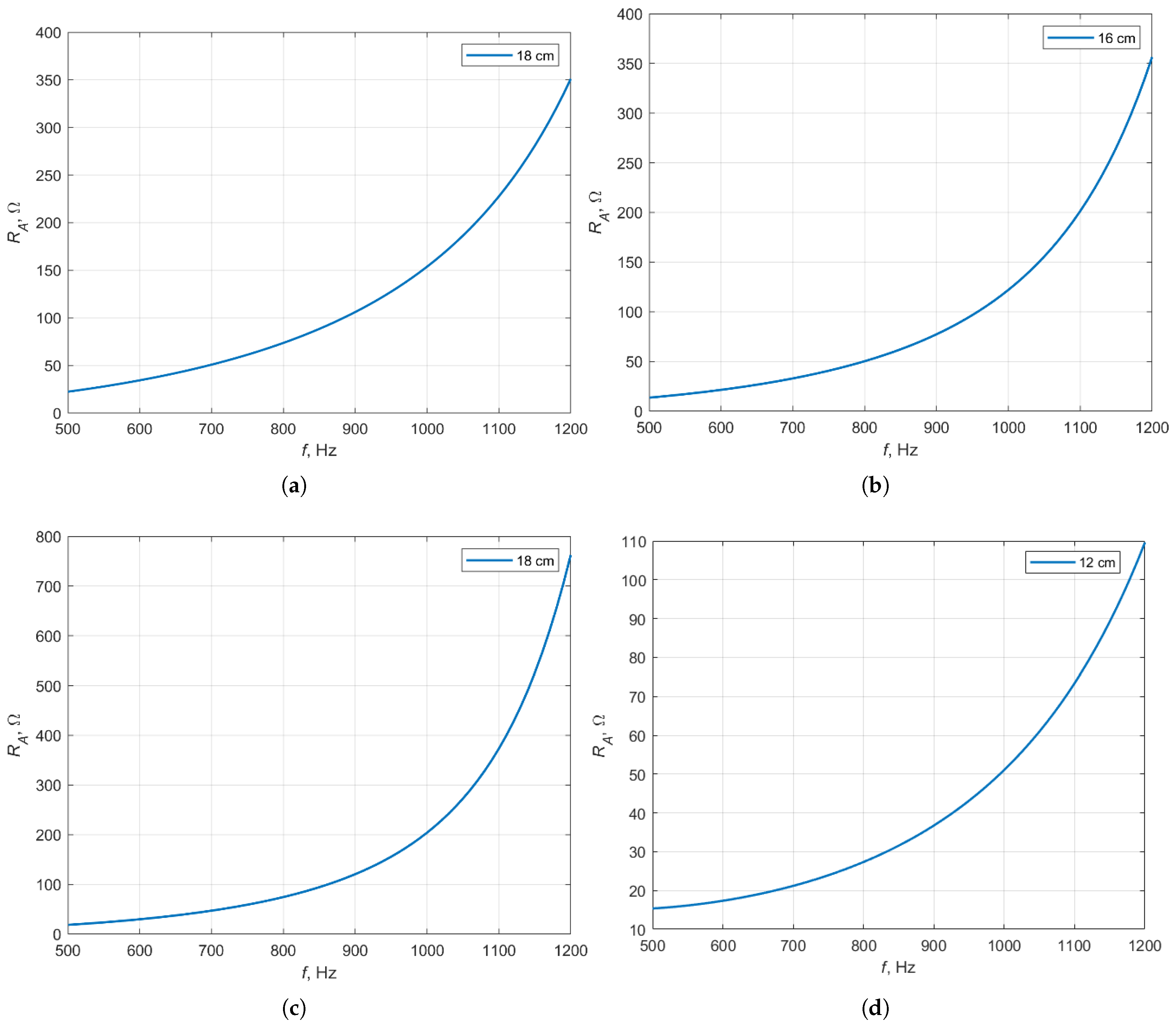
At the same time, the maximum observed at higher frequencies reached significantly higher values, which is attributed to an increase in the mutual inductance reactance. This, in turn, was caused by an increase in the resistance of the antenna module (Figure 19a) compared to the previous 16 cm dipole (Figure 5a).
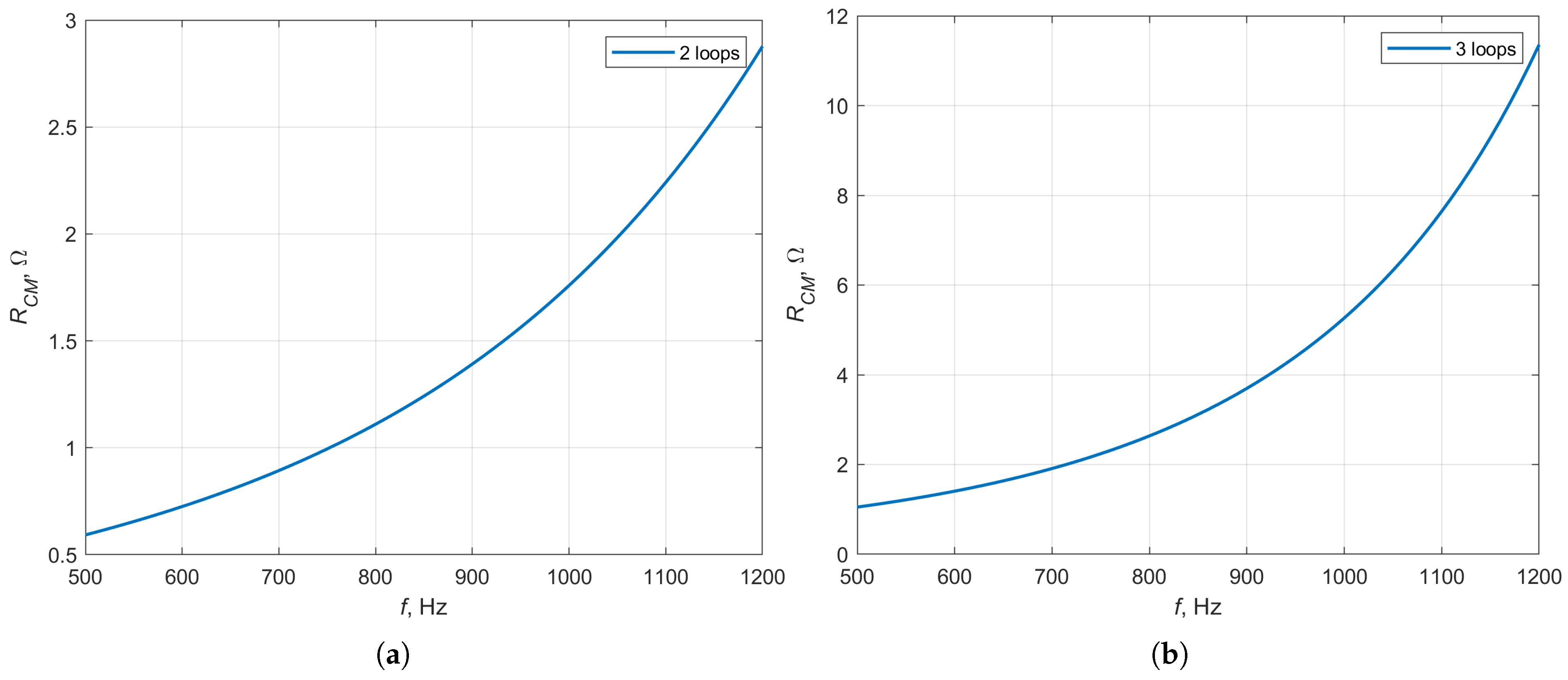
A similar dependence of the resistance of the two-loop chip coupling structure on frequency can also be observed (Figure 20).
In contrast, for the tag with an antenna coupling structure, although it was possible to enforce the occurrence of an extremum at lower frequencies, lower values of the chip voltage were obtained. Meanwhile, the maximum occurring at 1100 MHz did not change its position. An increase in the mutual inductance reactance was observed, influenced by higher values of the antenna module resistance (Figure 19).
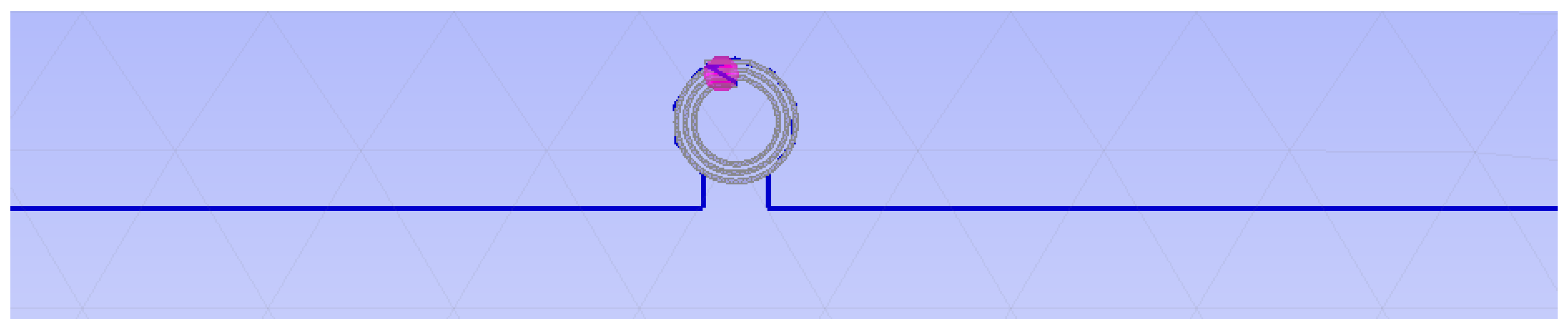
In turn, for the tag with an antenna coupling structure and a three-loop chip coupling configuration (Figure 21), it was found that the antenna should be shortened.
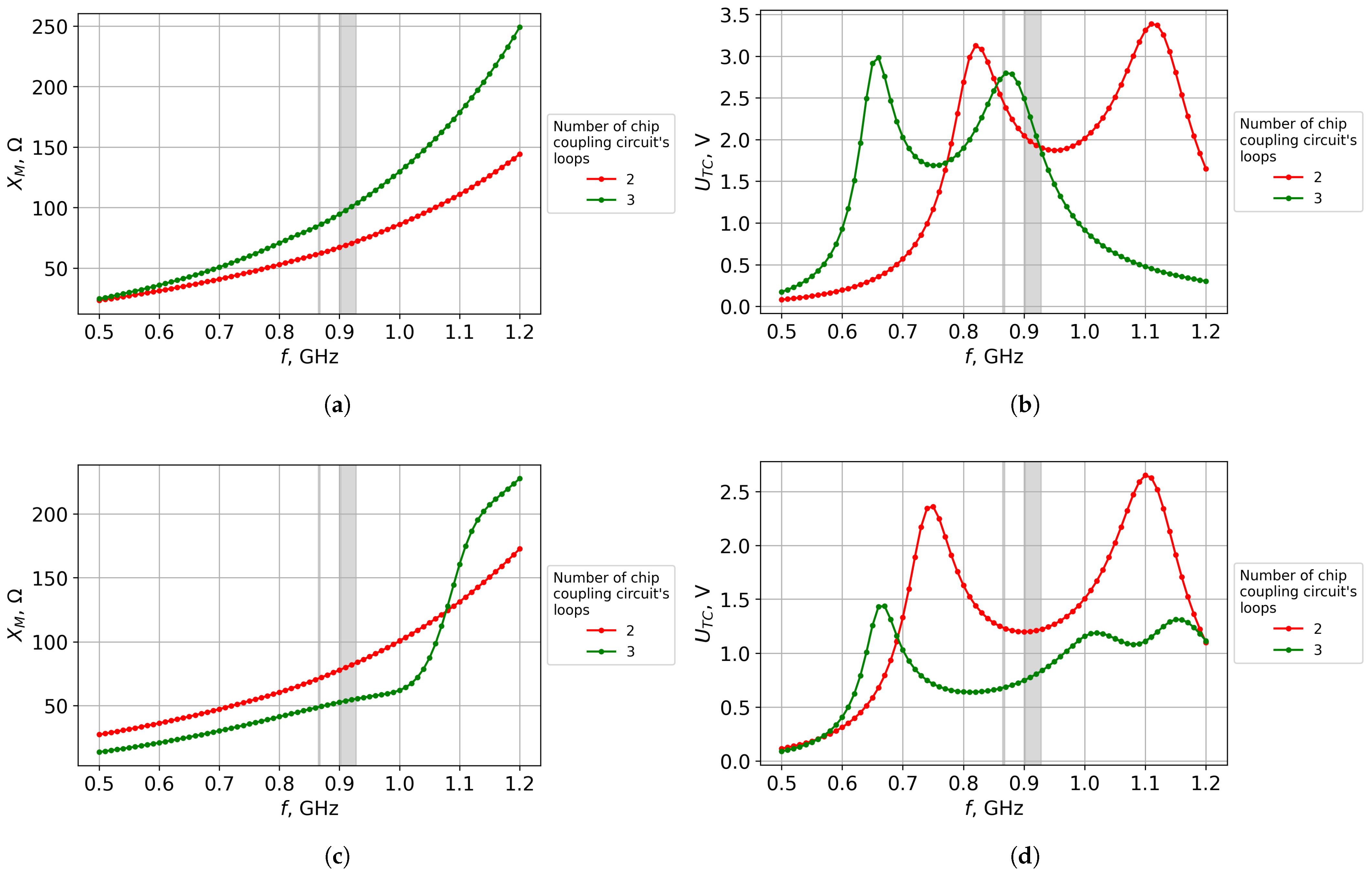
The calculations were repeated for a model with a radiator length of 12 cm (Figure 22).
A decrease in the antenna module resistance (Figure 19b,d) resulted in a reduction of the mutual inductance reactance. The shape of the chip voltage characteristic changed, and the maximum values decreased.
Similarly to the case of two loops, the minimum between the maxima became broader. For the three-loop configuration, the first maximum did not change its position, while the second shifted toward higher frequencies.

3.3. Transponders with Antenna Coupling Circuit Wrapping Around Chip Coupling Circuit

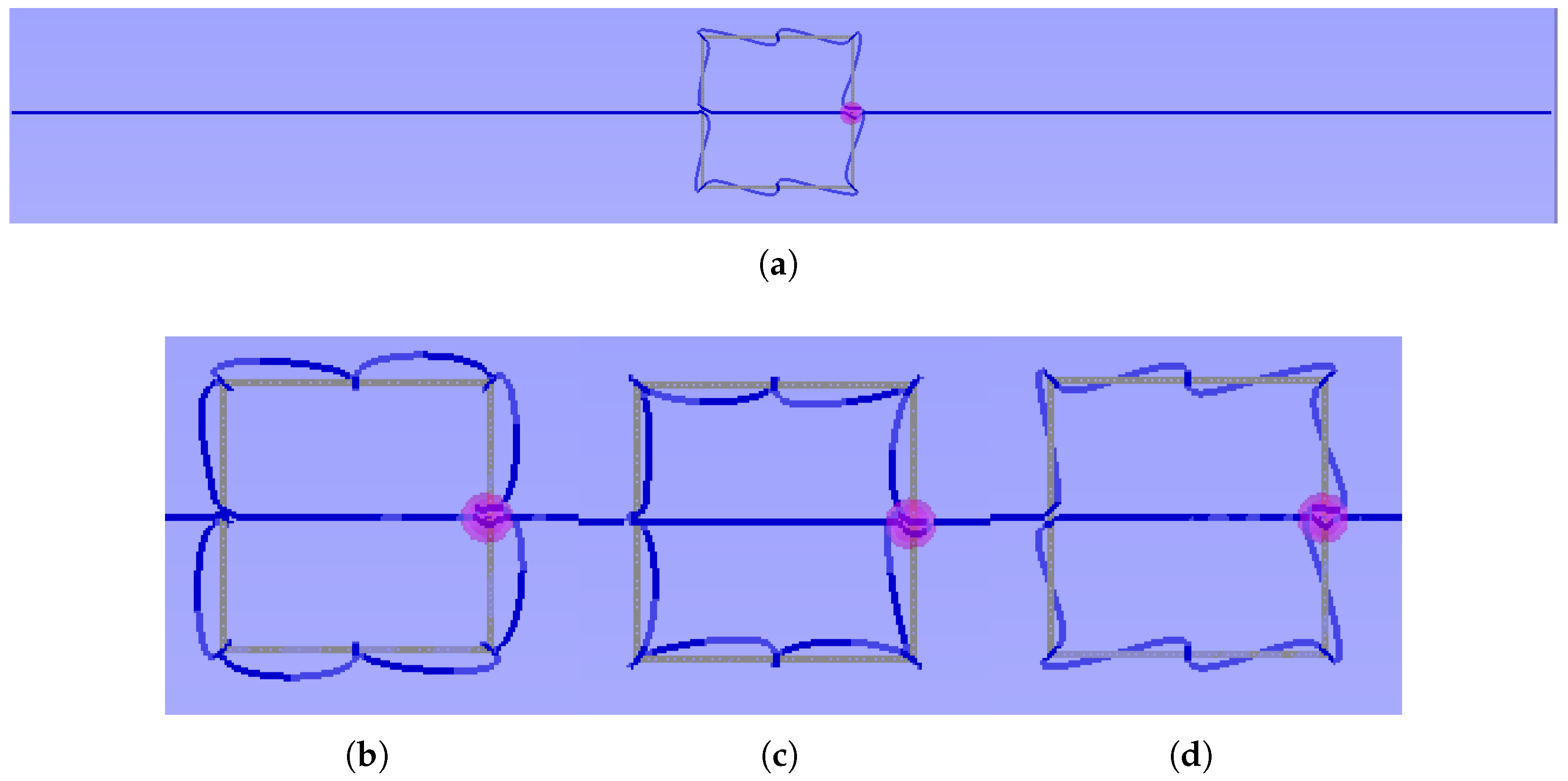
Another group of investigated tags consisted of those with a thread wrapping around the chip coupling structure (Figure 23).
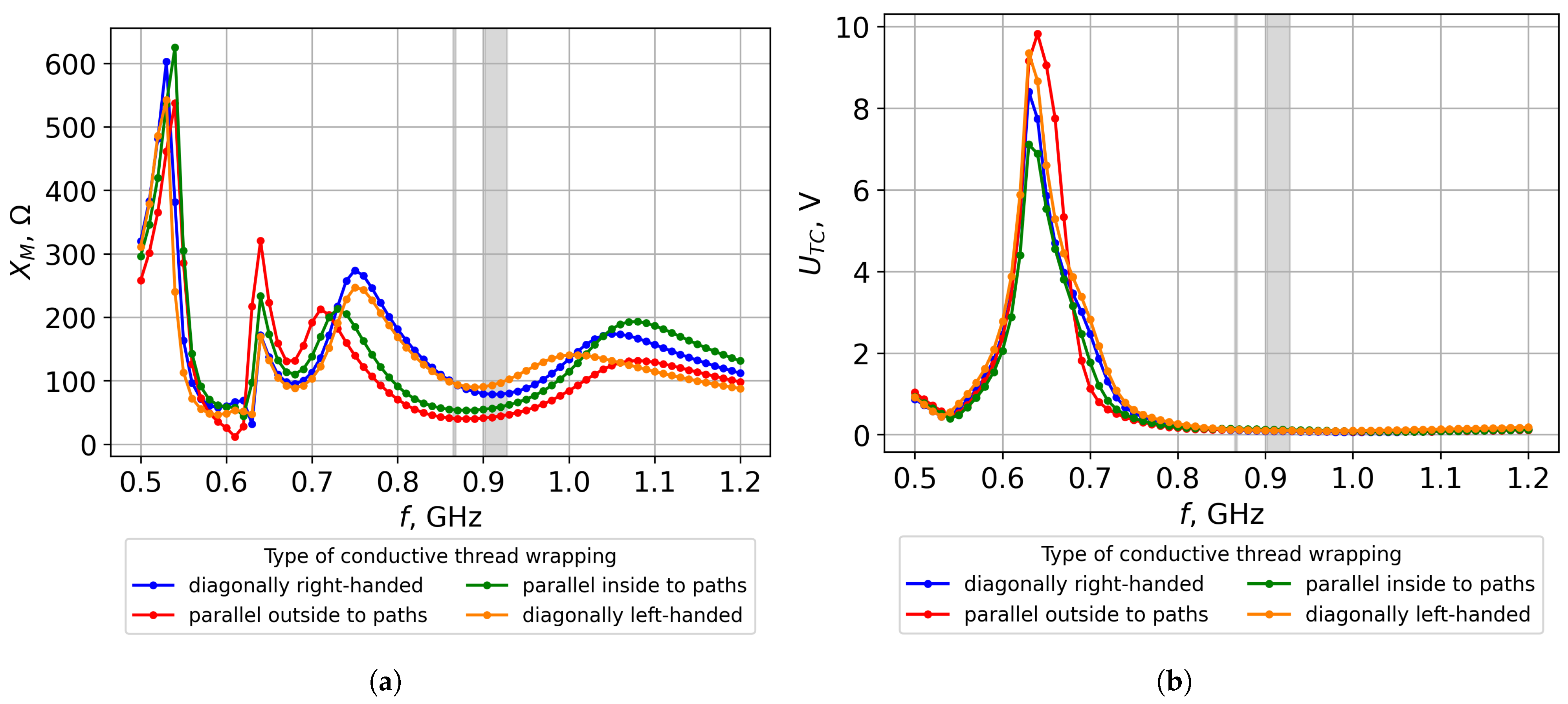
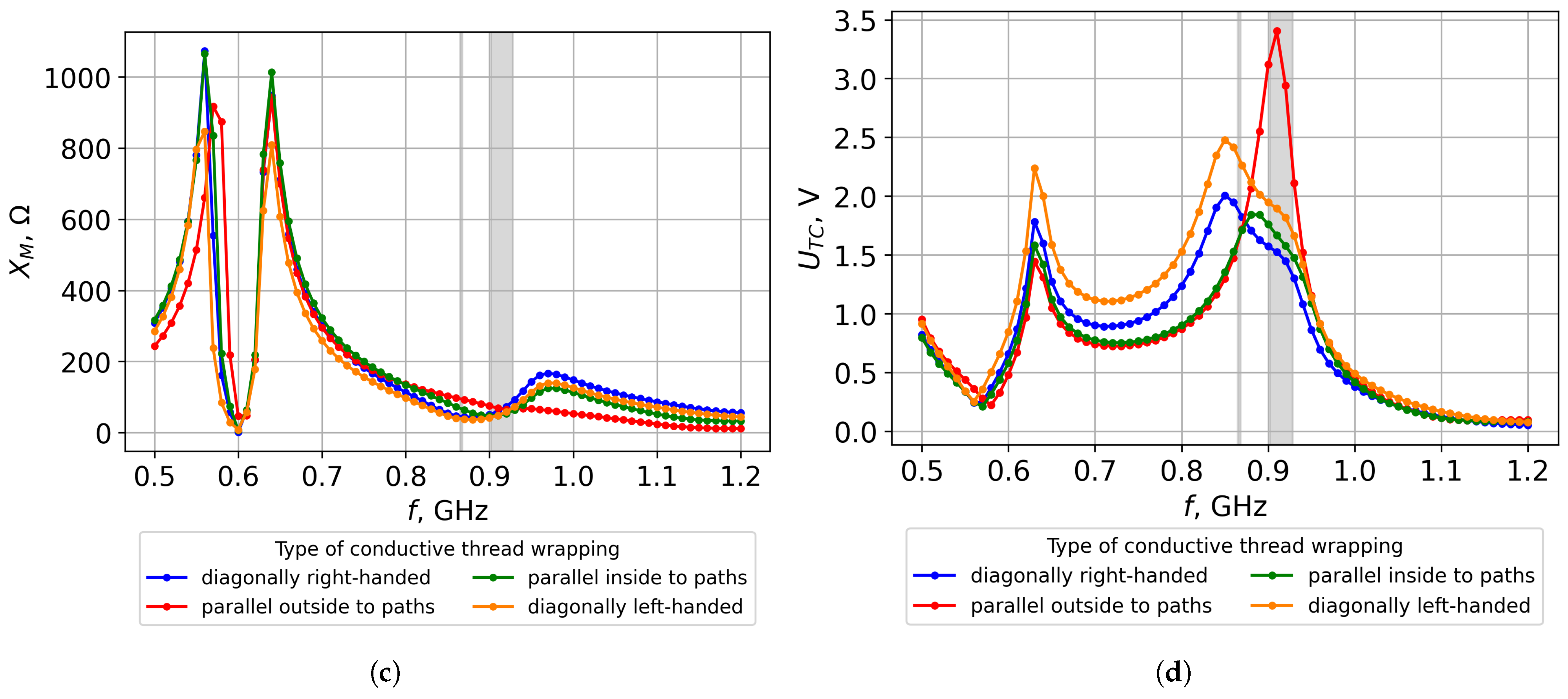
The chip coupling circuit was square-shaped with side length of 11.2 mm. The mutual inductance reactance and the chip voltage were calculated for four different thread wrapping configurations (Figure 24).
Shortening the antenna arms resulted in a change in the overall shape of the chip voltage characteristic. A single maximum split into two, separated by a local minimum. The first maximum remained at the same position, while the second shifted toward higher frequencies, which was the intended effect of the study.
The maximum values of the chip voltage decreased; however, for many frequencies, including those used in RFID systems, the chip voltage increased. Thus, the objective was only partially achieved: it was possible to shift the maximum toward higher frequencies, but at the cost of losing the high chip voltage value.
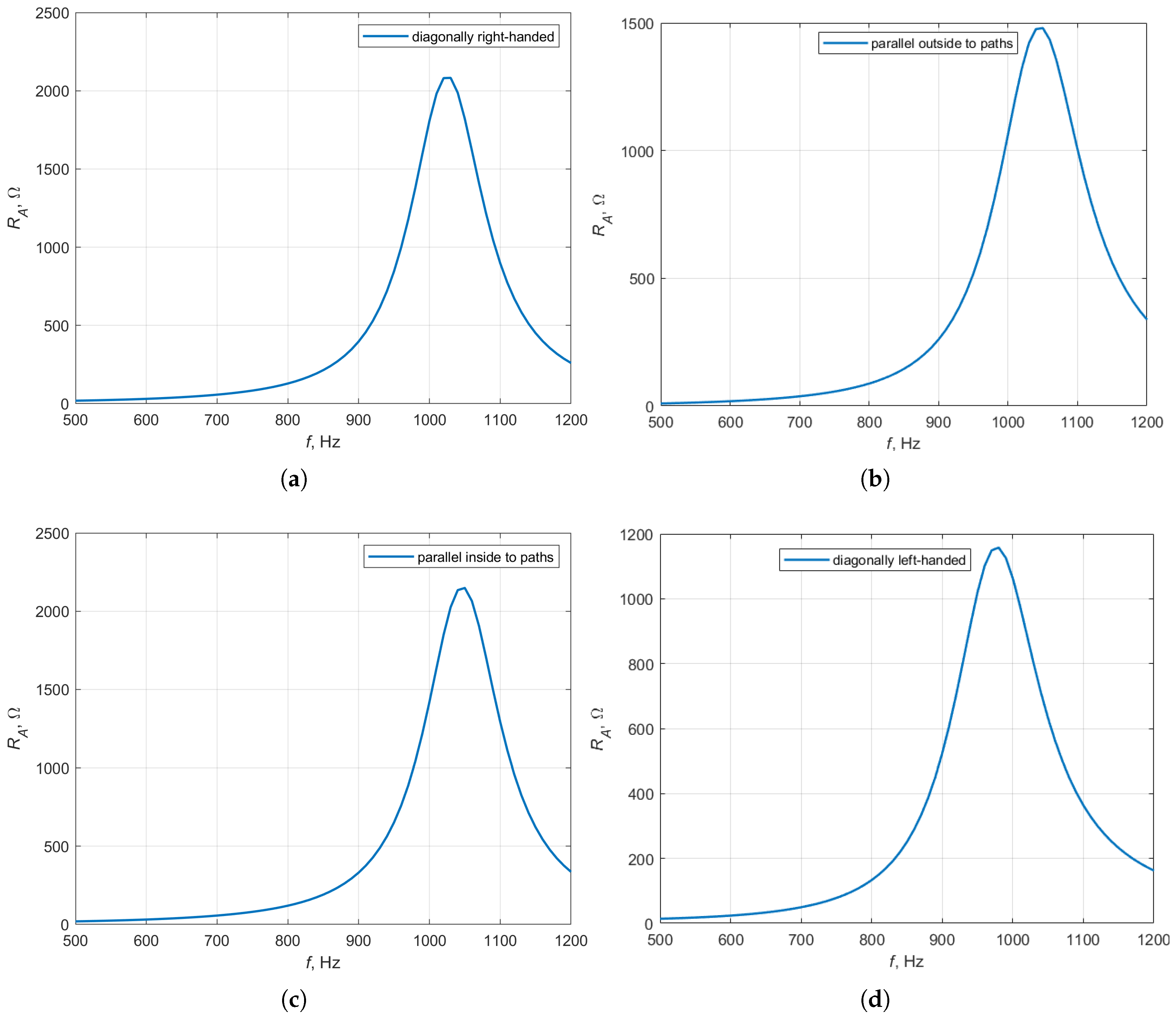
The resistance of the antenna modules explains only the origin of the extrema of the mutual inductance reactance occurring in the range of approximately 1000 MHz to 1100 MHz (Figure 25).
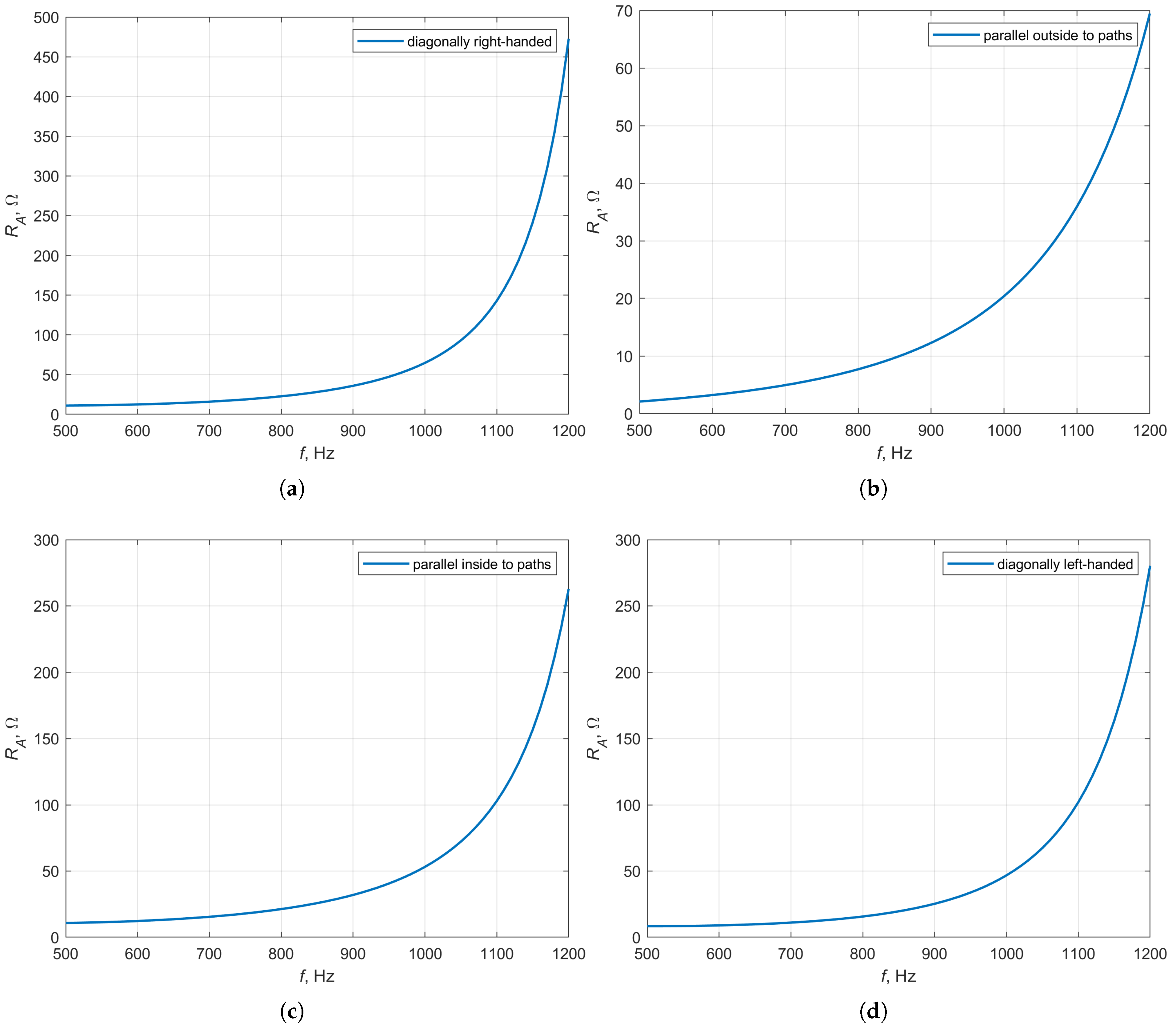
After modifying the antenna arm length, the mutual inductance reactance characteristic in this range becomes flatter, as the resistance of the antenna modules no longer reaches a maximum within the analyzed frequency range (Figure 26).
In tags with this type of coupling structure, the changes in the shape of the mutual inductance reactance characteristic are therefore likely caused by the distribution of magnetic flux density, which also varies with modifications to the conductor geometry.

3.4. Transponders with Chip and Antenna Coupling Circuits Positioned on the Core

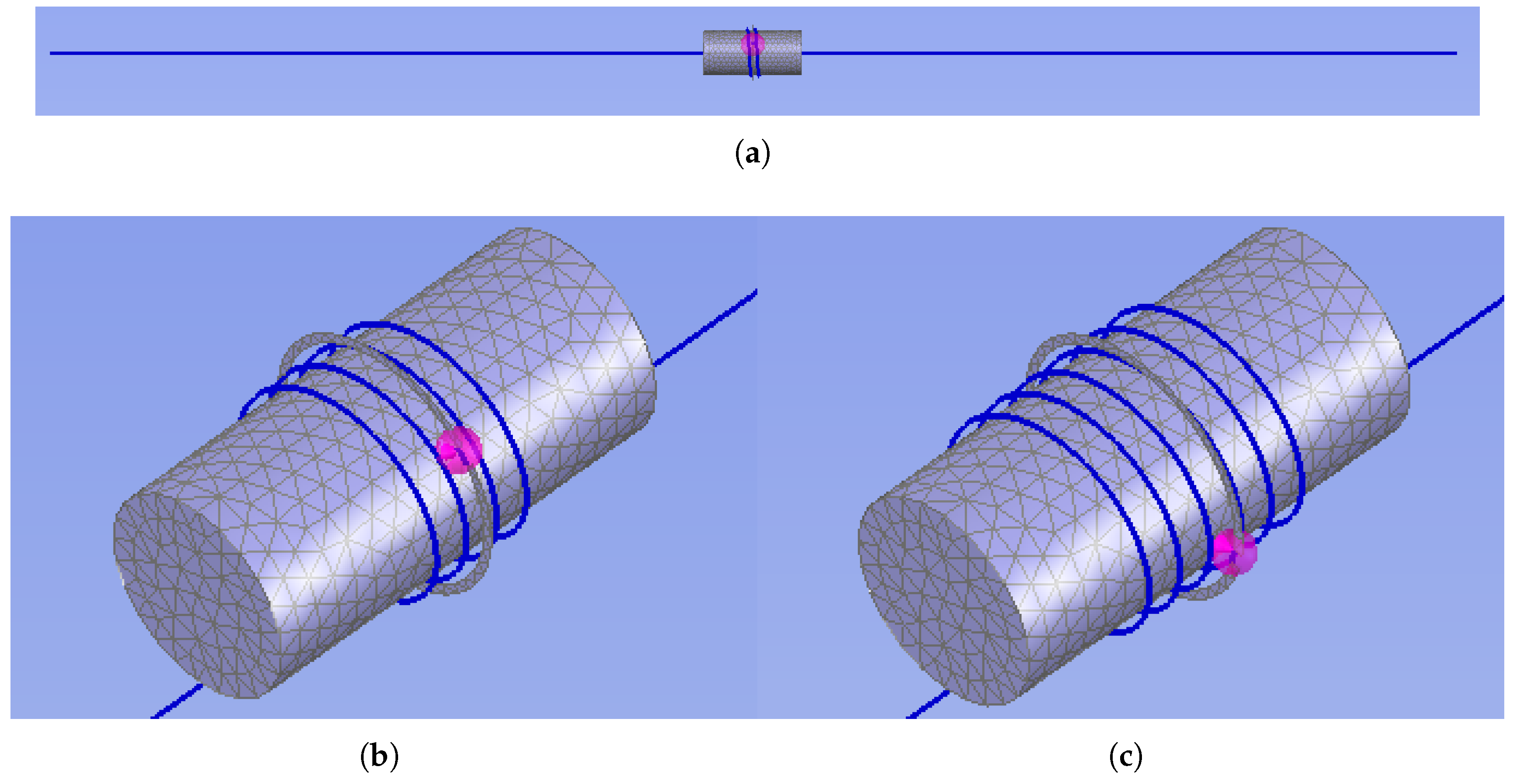
The final group of investigated tags consisted of structures with a coupling system placed on a core. A configuration with a glass core and antenna coupling windings with a cross-sectional area smaller than that of the chip coupling circuit was selected (Figure 27).
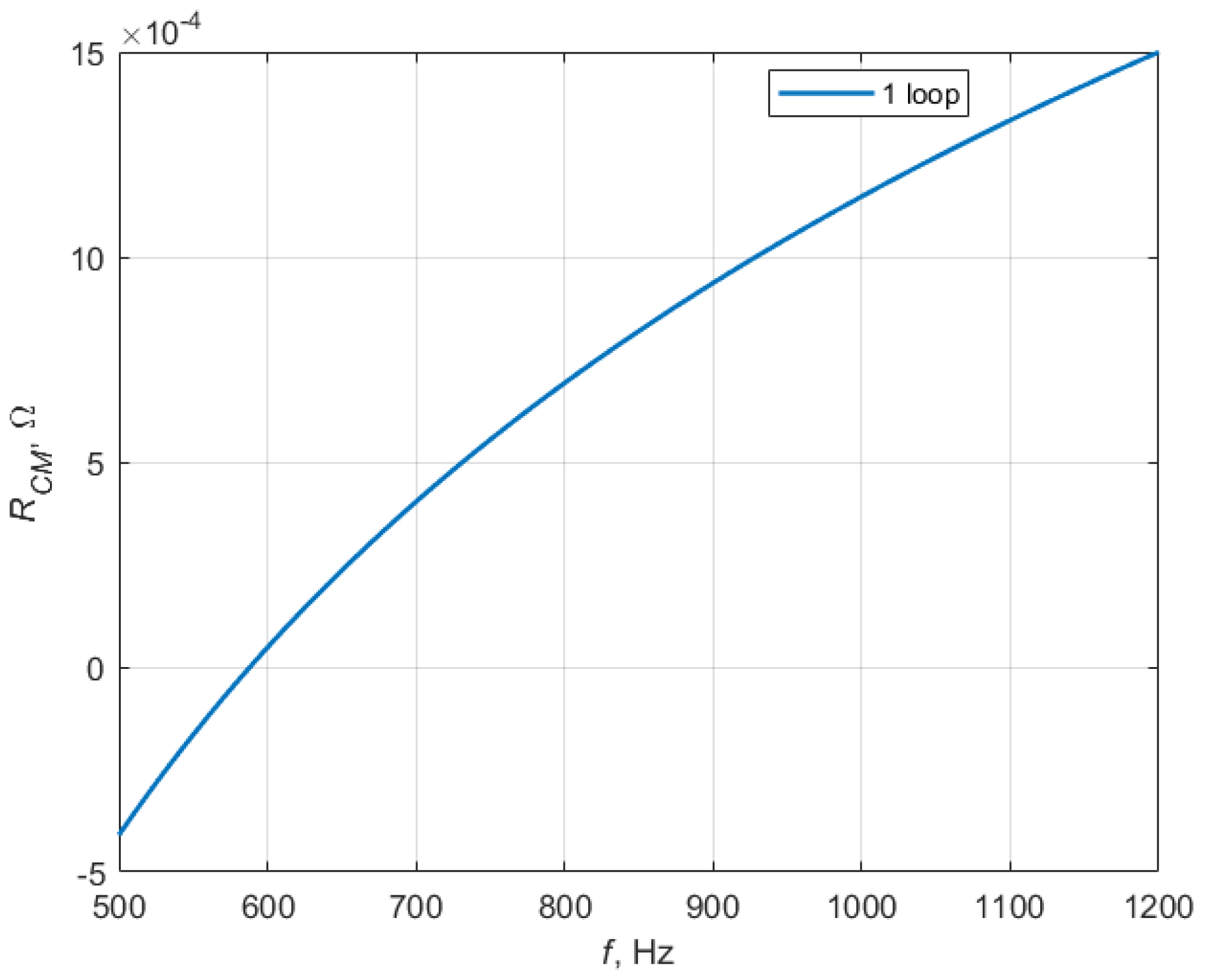
The chip coupling structure consists of a single loop with diameter of 5.7 mm, whose impedance real part is shown in Figure 28.
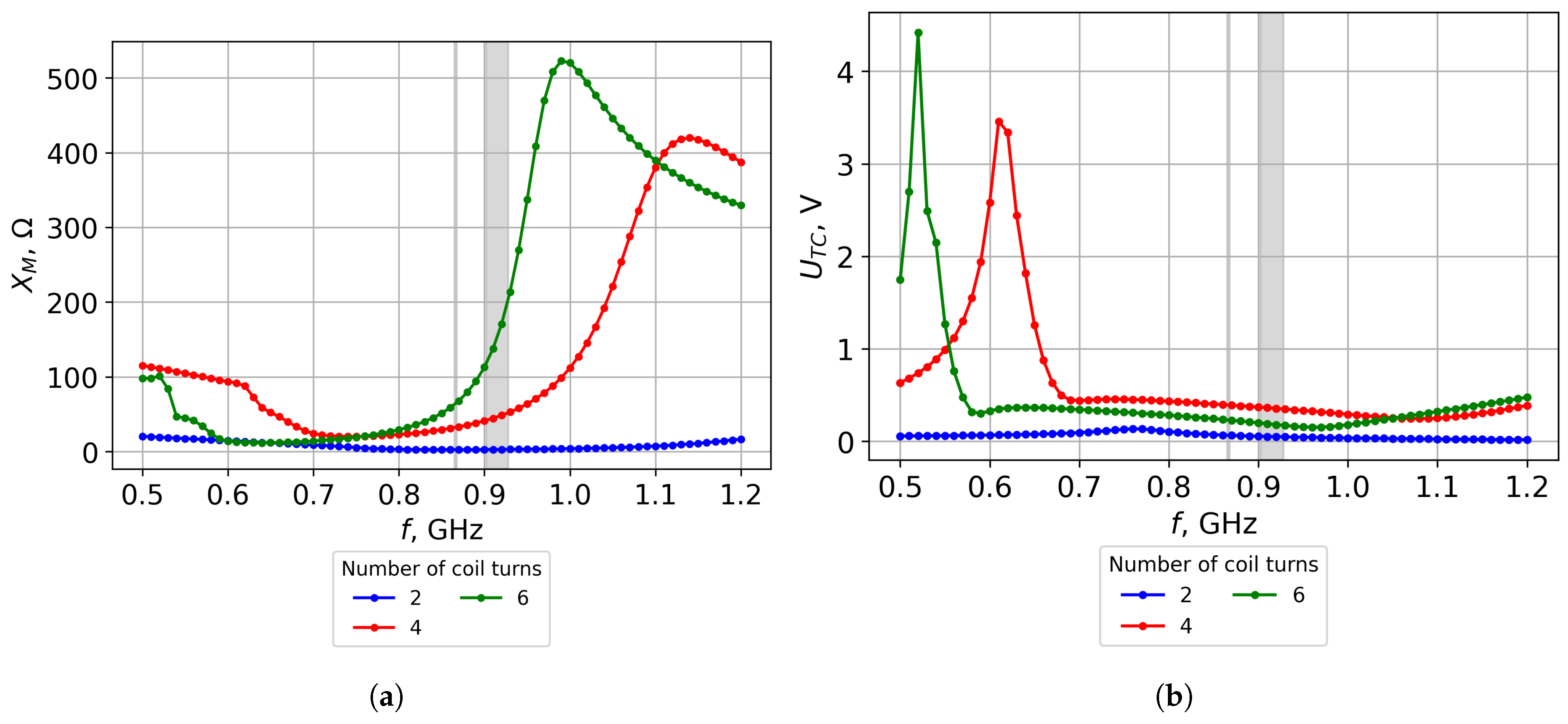
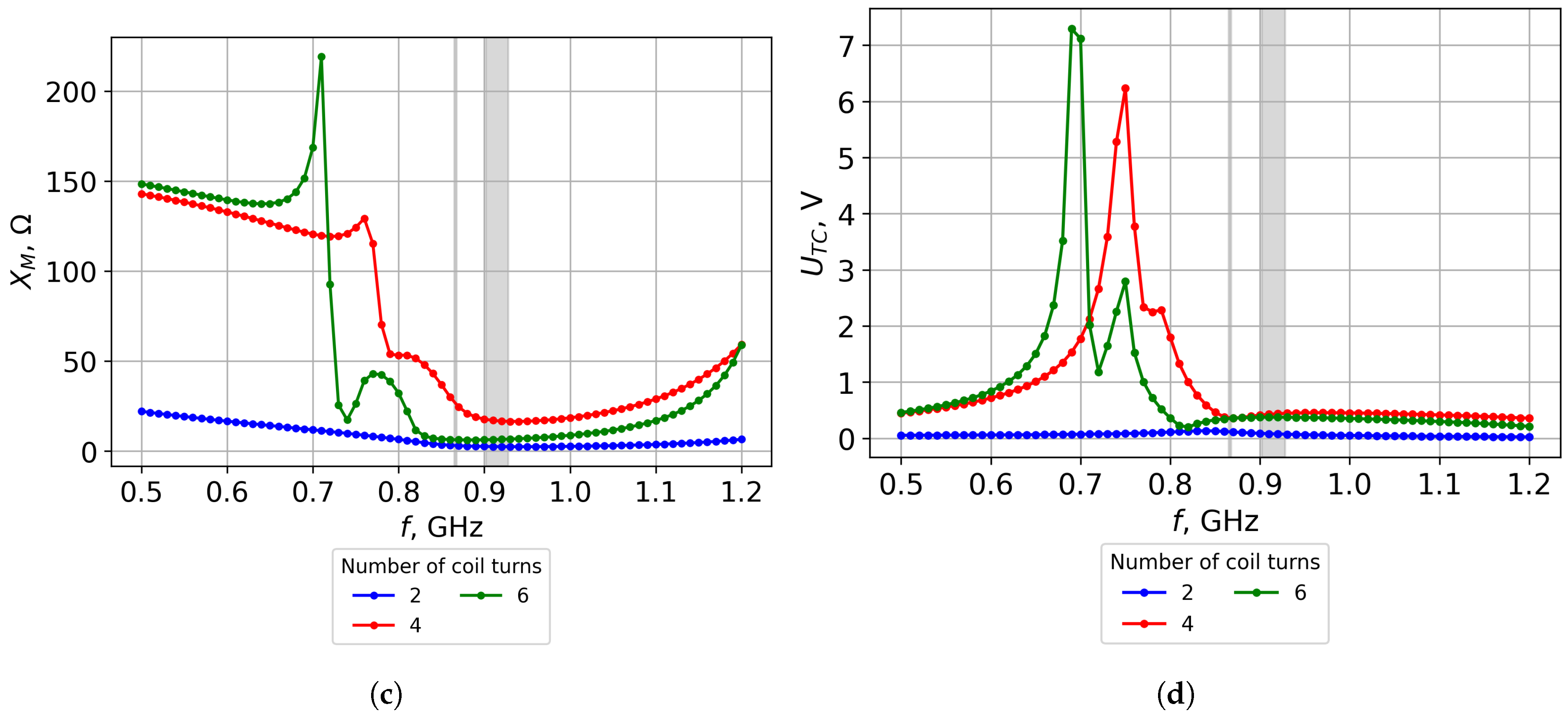
The obtained values of the mutual inductance reactance and the chip voltage for models with different numbers of turns in the antenna coupling structure are presented in Figure 29.
The maxima of the chip voltage were shifted toward higher frequencies, while their values simultaneously increased. In this case, modifying the antenna arm length is an effective method for controlling the position of the highest chip voltage values along the frequency axis. Before the modification, the extrema of the mutual inductance reactance located on the right side of the plot did not result in a significant increase in voltage, unlike those in the 500–700 MHz range, because they assumed excessively high values.
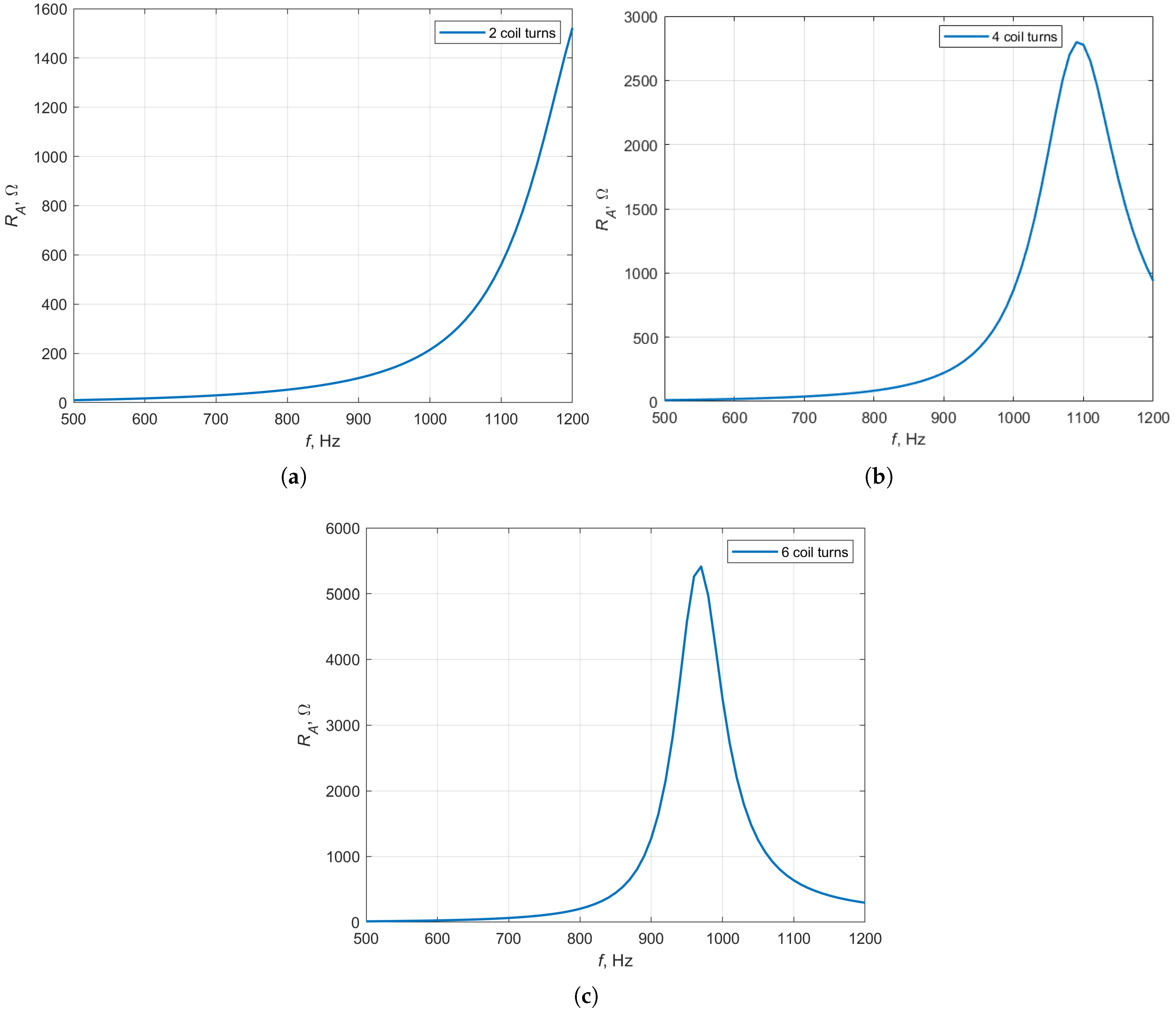
Their occurrence is due to the resonance phenomenon in the antenna modules. Before antenna shortening, maxima of their resistance are observed within the investigated frequency range for configurations with four and six turns (Figure 30). Accordingly, maxima of the mutual inductance reactance are observed at the same frequencies.
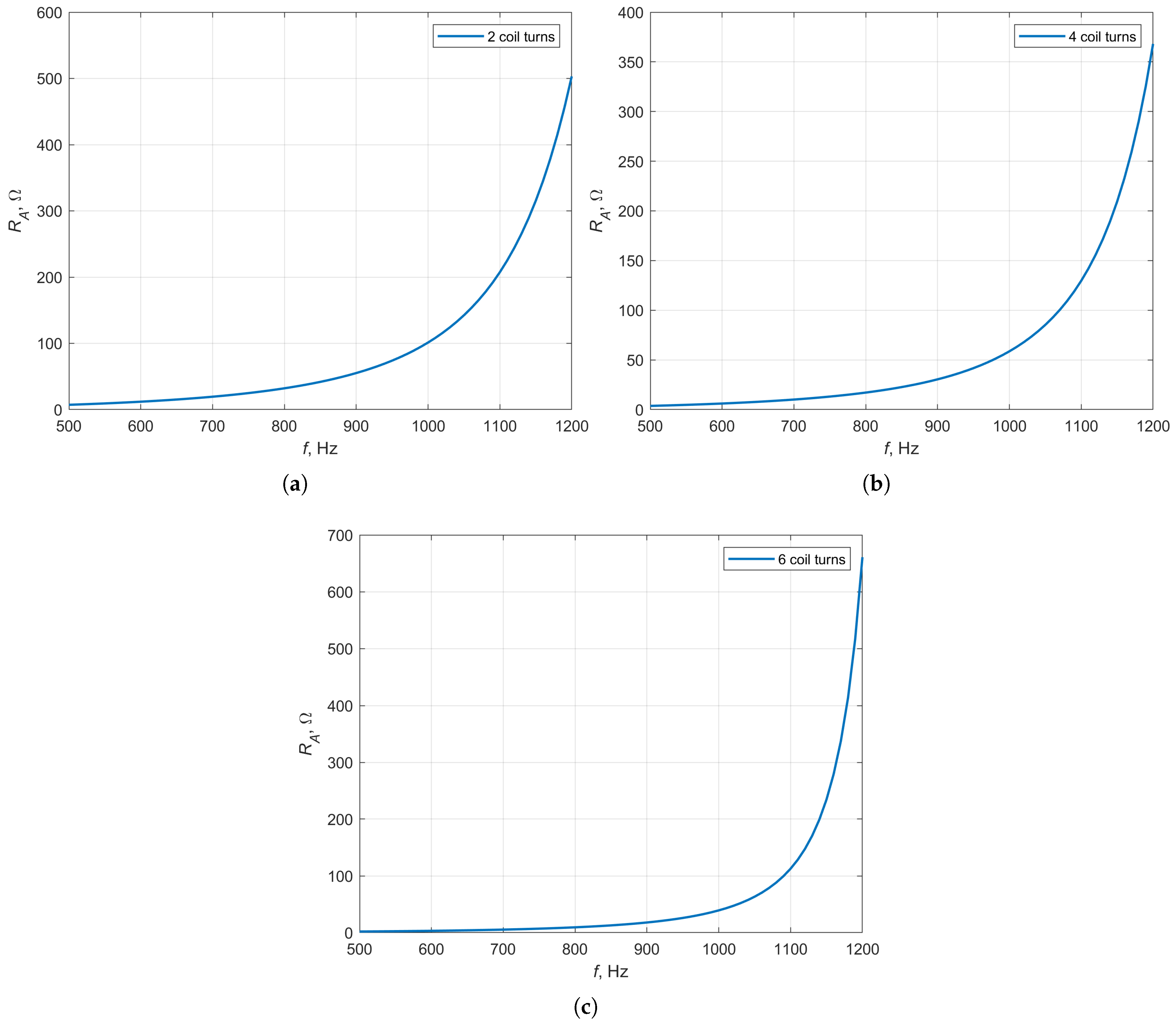
After antenna shortening, the resistance maxima (Figure 31) no longer occur, and consequently the corresponding maxima of the mutual inductance reactance also disappear.
At this stage of the research, however, the factors responsible for the occurrence of the remaining maxima of the mutual inductance reactance are not yet known.

4. Discussion

The study made it possible to identify the factors determining the position of the chip voltage maximum along the frequency axis for textronic RFID tags with inductively coupled antenna and chip. This knowledge enables an increase in the voltage at the chip terminals, which translates into an extended read range of the tag in frequency bands used in RFID systems. The investigations were carried out for four types of antenna–chip coupling structures.
In summary, for textronic RFID tags, there exist maxima of mutual inductance reactance and chip voltage that can be manipulated by modifying the antenna length, as well as those whose positions along the frequency axis cannot be altered in this way, since they result from resonance phenomena occurring in the chip coupling circuit. For such extrema, shifting them toward a desired frequency is possible by changing the dimensions of this component.
In all cases, however, the applied modifications affect the resulting chip voltage. For some tags, it may turn out that although the maximum has been successfully shifted to the desired frequency range, its value decreases significantly, preventing the achievement of a satisfactory read range. In contrast, other designs may exhibit an increase in chip voltage.
In any case, by appropriately selecting the geometrical dimensions of the antenna module and the chip coupling structure, it is possible to obtain a chip voltage maximum at a desired frequency that will not be shifted by modifications of other design parameters. These parameters can therefore be adjusted to increase its value, as demonstrated in this study through variations in radiator length.
In the case of an undesirable decrease in the maximum value when it is shifted along the frequency axis, it is possible to consider implementing the same antenna module using a thread with appropriately higher or lower conductivity, in order to compensate for the change in resistance resulting from the modification of the radiator length. The same approach may also improve performance when the occurring maxima of the mutual inductance reactance assume values that are either too high or too low to ensure a chip voltage corresponding to a satisfactory read range.
Further research is required to determine how precisely the position of the chip voltage maximum can be controlled by modifying the geometrical dimensions of its components, and thus the frequency at which resonance occurs within them.
Based on the investigated models, physical tags should be fabricated in order to conduct experimental studies. The proposed methods for manipulating the chip voltage maximum should be verified through read range measurements to determine whether they produce the expected changes at selected frequencies. Impedance measurements should be carried out to verify whether the fabricated textile antennas indeed exhibit resonance at the frequency assumed during the design stage. Subsequently, the factors causing any resonance shift should be identified and described, such as mechanical stresses during wear or the proximity of the human body.
Furthermore, the impact of mechanical interactions occurring during garment use and maintenance and environmental conditions on textronic RFID tags with inductively coupled chip and antenna should be investigated. The influence of the proximity of metal elements or other transponders is also not yet known.
These studies will enable the development of design and manufacturing techniques for textile RFID tags with a satisfactory read range. Such a solution has the potential to serve as a Digital Product Passport in the future. The diversity of textronic RFID tag designs, including their coupling structures, increases the flexibility in selecting a configuration that meets the requirements of a given garment, such as the material used, available space, functional and decorative elements, aesthetics, as well as the tools and skills required for fabrication and integration with clothing.

Author Contributions

Conceptualization, A.Z.; methodology, A.Z.; software, A.Z.; validation, A.Z.; formal analysis, A.Z.; investigation, A.Z. and P.J.-M.; resources, M.W.; data curation, A.Z.; writing—original draft preparation, A.Z.; writing—review and editing, A.Z.; visualization, A.Z.; supervision, P.J.-M.; project administration, P.J.-M. All authors have read and agreed to the published version of the manuscript.

Funding

This research received no external funding.

Institutional Review Board Statement

Not applicable.

Informed Consent Statement

Not applicable.

Data Availability Statement

All the calculated and measured data will be provided upon request to the corresponding authors via email with an appropriate justification.

Acknowledgments

During the preparation of this manuscript, the authors used ChatGPT (OpenAI, GPT-5.3) for the purpose of translating selected parts of the text from Polish into English. The authors have reviewed and edited the output and take full responsibility for the content of this publication.

Conflicts of Interest

The authors declare no conflicts of interest.

References

  1. Younes, B. Textronics: A Review of Their Technological Aspects and Applications. J. Text. Inst. 2024, 115, 1509–1525. [Google Scholar] [CrossRef]
  2. Wagih, M.; Balocchi, L.; Benassi, F.; Carvalho, N.B.; Chiao, J.-C.; Correia, R.; Costanzo, A.; Cui, Y.; Georgiadou, D.; Gouveia, C.; et al. Microwave-Enabled Wearables: Underpinning Technologies, Integration Platforms, and Next-Generation Roadmap. IEEE J. Microw. 2023, 3, 193–226. [Google Scholar] [CrossRef]
  3. Koski, K.; Lohan, E.S.; Sydanheimo, L.; Ukkonen, L.; Rahmat-Samii, Y. Electro-Textile UHF RFID Patch Antennas for Positioning and Localization Applications. In 2014 IEEE RFID Technology and Applications Conference (RFID-TA); IEEE: New York, NY, USA, 2014; pp. 246–250. [Google Scholar] [CrossRef]
  4. Yang, C.; Wang, X.; Mao, S. RFID-Based 3D Human Pose Tracking: A Subject Generalization Approach. Digit. Commun. Netw. 2022, 8, 278–288. [Google Scholar] [CrossRef]
  5. Wang, L.; Gu, T.; Tao, X.; Lu, J. Toward a Wearable RFID System for Real-Time Activity Recognition Using Radio Patterns. arXiv 2020. [Google Scholar] [CrossRef]
  6. Bouhassoune, I.; Chaibi, H.; Chehri, A.; Saadane, R. A Review of RFID-Based Internet of Things in the Healthcare Area, the New Horizon of RFID. Procedia Comput. Sci. 2022, 207, 4151–4160. [Google Scholar] [CrossRef]
  7. Luo, C.; Gil, I.; Fernández-García, R. Wearable Textile UHF-RFID Sensors: A Systematic Review. Materials 2020, 13, 3292. [Google Scholar] [CrossRef]
  8. Sharma, S.; Shukla, S.K.; Singh, A.; Govender, K.K.; Govender, P.P. E-Textiles in Biomedicine: Real Time Sensing, Energy Storage, and Therapeutic Applications. Adv. Mater. Interfaces 2026, 13, e00672. [Google Scholar] [CrossRef]
  9. Comai, S.; Masciadri, A.; Pozzi, G.; Salice, F. Monitoring Dressing Autonomy: A Remote Home Care RFID-Based Solution for People with Dementia. SN Comput. Sci. 2025, 6, 454. [Google Scholar] [CrossRef]
  10. Chen, X.; Ukkonen, L.; Bjorninen, T. Passive E-Textile UHF RFID-Based Wireless Strain Sensors with Integrated References. IEEE Sens. J. 2016, 16, 7835–7836. [Google Scholar] [CrossRef]
  11. Liu, Y.; Yu, M.; Xia, B.; Wang, S.; Wang, M.; Chen, M.; Dai, S.; Wang, T.; Ye, T.T. E-Textile Battery-Less Displacement and Strain Sensor for Human Activities Tracking. IEEE Internet Things J. 2021, 8, 16486–16497. [Google Scholar] [CrossRef]
  12. Melià-Seguí, J.; Bhattacharyya, R.; López-Soriano, S.; Vilajosana, X.; Sarma, S.E. Low-Cost RFID-Based Sensor Integrated in Textile for Noninvasive Pervasive Hydration Monitoring. IEEE Sens. J. 2025, 25, 27823–27833. [Google Scholar] [CrossRef]
  13. Delipinar, T.; Ozek, E.A.; Kaya, C.E.; Tanyeli, S.; Yapici, M.K. Flexible Graphene Textile RFID Tags Based on Spray, Dispense and Contact Printing. In 2020 IEEE International Conference on Flexible and Printable Sensors and Systems (FLEPS); IEEE: New York, NY, USA, 2020; pp. 1–4. [Google Scholar] [CrossRef]
  14. Zang, C.; Zhang, C.; Zhang, M.; Niu, Q. An RFID-Based Method for Multi-Person Respiratory Monitoring. Sensors 2022, 22, 6166. [Google Scholar] [CrossRef]
  15. Ross, R.; Mongan, W.M.; O’Neill, P.; Rasheed, I.; Fontecchio, A.; Dion, G.; Dandekar, K.R. An Adaptively Parameterized Algorithm Estimating Respiratory Rate from a Passive Wearable RFID Smart Garment. 2021 IEEE 45th Annual Computers, Software, and Applications Conference (COMPSAC) 2021, 774–784. [Google Scholar] [CrossRef]
  16. Hansen, S.; Schwartz, D.; Stover, J.; Tajin, M.A.S.; Mongan, W.M.; Dandekar, K.R. Fusion Learning on Multiple-Tag RFID Measurements for Respiratory Rate Monitoring. In 2020 IEEE 20th International Conference on Bioinformatics and Bioengineering (BIBE); IEEE: New York, NY, USA, 2020; pp. 472–480. [Google Scholar] [CrossRef]
  17. Scholz, M.; Valilai, O.F. Integrating Chipless RFID Technology to Provide Seamless Data Interoperability for Textile Industry Circularity. Procedia Comput. Sci. 2025, 253, 393–402. [Google Scholar] [CrossRef]
  18. Abbas, B.; K. Khamas, S.; Ismail, A.; Sali, A. Full Embroidery Designed Electro-Textile Wearable Tag Antenna for WBAN Application. Sensors 2019, 19, 2470. [Google Scholar] [CrossRef]
  19. Jiang, Y.; Leng, T.; Fang, Y.; Hu, Z.; Xu, L. Machine Embroidered Wearable E-Textile Wideband UHF RFID Tag Antenna. In 2019 IEEE International Symposium on Antennas and Propagation and USNC-URSI Radio Science Meeting; IEEE: New York, NY, USA, 2019; pp. 643–644. [Google Scholar] [CrossRef]
  20. Yu, M.; Wang, S.; Liu, Y.; Xu, L.; Ye, T.T. Passive Embroidered Stretch Sensor Utilizing UHF RFID Antennas. In 2019 IEEE SmartWorld, Ubiquitous Intelligence & Computing, Advanced & Trusted Computing, Scalable Computing & Communications, Cloud & Big Data Computing, Internet of People and Smart City Innovation (SmartWorld/SCALCOM/UIC/ATC/CBDCom/IOP/SCI); IEEE: New York, NY, USA, 2019; pp. 497–501. [Google Scholar] [CrossRef]
  21. Khan, Z.; He, H.; Chen, X.; Ukkonen, L.; Virkki, J. Embroidered and E-Textile Conductors Embedded inside 3D-Printed Structures. In 2019 Photonics & Electromagnetics Research Symposium–Fall (PIERS–Fall); IEEE: New York, NY, USA, 2019; pp. 1675–1680. [Google Scholar] [CrossRef]
  22. Benouakta, S.; Hutu, F.; Sette, D.; Duroc, Y. UHF RFID Elastic Textile Yarn. Microw. Opt. Technol. Lett. 2020, 62, 3186–3194. [Google Scholar] [CrossRef]
  23. Khan, M.U.A.; Raad, R.; Foroughi, J.; Raheel, M.S.; Houshyar, S. An Octagonal-Shaped Conductive HC12 & LIBERATOR-40 Thread Embroidered Chipless RFID for General IoT Applications. Sens. Actuators Phys. 2021, 318, 112485. [Google Scholar] [CrossRef]
  24. Luo, C.; Gil, I.; Fernández-García, R. Experimental Comparison of Three Electro-Textile Interfaces for Textile UHF-RFID Tags on Clothes. AEU Int. J. Electron. Commun. 2022, 146, 154137. [Google Scholar] [CrossRef]
  25. Bakkali, M.E.; Martinez-Estrada, M.; Fernandez-Garcia, R.; Gil, I.; Mrabet, O.E. Effect of Bending on a Textile UHF-RFID Tag Antenna. In 2020 14th European Conference on Antennas and Propagation (EuCAP); IEEE: New York, NY, USA, 2020; pp. 1–5. [Google Scholar] [CrossRef]
  26. Liu, Y.; Xu, L.; Li, Y.; Ye, T.T. Textile Based Embroidery-Friendly RFID Antenna Design Techniques. In 2019 IEEE International Conference on RFID (RFID); IEEE: New York, NY, USA, 2019; pp. 1–6. [Google Scholar] [CrossRef]
  27. Liu, Y.; Yu, M.; Xu, L.; Li, Y.; Ye, T.T. Characterizations and Optimization Techniques of Embroidered RFID Antenna for Wearable Applications. IEEE J. Radio Freq. Identif. 2020, 4, 38–45. [Google Scholar] [CrossRef]
  28. Hanif, M.; Farhan, M.; Sharif, A. Design and Analysis of Flexible Embroidered UHF-RFID Tag on Facemask for IoT Applications Using Characteristics Mode Analysis. AEU Int. J. Electron. Commun. 2023, 172, 154940. [Google Scholar] [CrossRef]
  29. Patron, D.; Mongan, W.; Kurzweg, T.P.; Fontecchio, A.; Dion, G.; Anday, E.K.; Dandekar, K.R. On the Use of Knitted Antennas and Inductively Coupled RFID Tags for Wearable Applications. IEEE Trans. Biomed. Circuits Syst. 2016, 10, 1047–1057. [Google Scholar] [CrossRef]
  30. Lagha, F.; Beldi, S.; Latrach, L. Passive E-Textile UHF RFID Tag for Wireless Body Centric Communications. In 2018 30th International Conference on Microelectronics (ICM); IEEE: Sousse, Tunisia, 2018; pp. 180–183. [Google Scholar] [CrossRef]
  31. Chen, X.; Ukkonen, L.; Bjoninen, T.; Virkki, J. Comparison of E-Textile Dipole and Folded Dipole Antennas for Wearable Passive UHF RFID Tags. In 2017 Progress in Electromagnetics Research Symposium–Fall (PIERS–FALL); IEEE: New York, NY, USA, 2017; pp. 812–817. [Google Scholar] [CrossRef]
  32. Ma, S.; Ukkonen, L.; Sydanheimo, L.; Bjorninen, T. Wearable E-Textile Split Ring Passive UHF RFID Tag: Body-Worn Performance Evaluation. In 2017 IEEE Asia Pacific Microwave Conference (APMC); IEEE: New York, NY, USA, 2017; pp. 166–168. [Google Scholar] [CrossRef]
  33. Corchia, L.; Monti, G.; Tarricone, L. A Frequency Signature RFID Chipless Tag for Wearable Applications. Sensors 2019, 19, 494. [Google Scholar] [CrossRef] [PubMed]
  34. He, H.; Chen, X.; Mehmood, A.; Raivio, L.; Huttunen, H.; Raumonen, P.; Virkki, J. ClothFace: A Batteryless RFID-Based Textile Platform for Handwriting Recognition. Sensors 2020, 20, 4878. [Google Scholar] [CrossRef] [PubMed]
  35. Byondi, F.K.; Chung, Y. UHF RFID Conductive Fabric Tag Design Optimization. Sensors 2021, 21, 5380. [Google Scholar] [CrossRef] [PubMed]
  36. Salo, T.; Vuohijoki, T.; Shaikh, A.; Virkki, J.; Vanhala, J. Carbon Nonwoven RFID Antennas for Smart Wearable Applications. In 2024 IEEE International Conference on Flexible and Printable Sensors and Systems (FLEPS); IEEE: New York, NY, USA, 2024; pp. 1–4. [Google Scholar] [CrossRef]
  37. Tean, C.J.-W.; Low, J.-H.; Chee, P.-S.; Lim, E.-H.; Mun, H.K. Design of a Textile-Based UHF RFID Sensor for High Read Range and Multilevel Diaper Moisture Sensing. Sci. Rep. 2025, 15, 44357. [Google Scholar] [CrossRef]
  38. Thielens, A.; Baumbauer, C.; Anderson, M.G.; Ting, J.; Arias, A.C.; Rabaey, J.M. Feasability of On-Body Backscattering in the UHF-RFID Band Using Screen-Printed Dipole Antennas. In 2019 13th International Symposium on Medical Information and Communication Technology (ISMICT); IEEE: New York, NY, USA, 2019; pp. 1–5. [Google Scholar] [CrossRef]
  39. Gupta, D.; Sood, D.; Yu, M.; Kumar, M. Compact Biodegradable UHF RFID Tag for Short Life Cycle Applications. In 2021 IEEE Indian Conference on Antennas and Propagation (InCAP); IEEE: Jaipur, India, 2021; pp. 399–401. [Google Scholar] [CrossRef]
  40. Jaakkola, K.; Sandberg, H.; Lahti, M.; Ermolov, V. Near-Field UHF RFID Transponder with a Screen-Printed Graphene Antenna. IEEE Trans. Compon. Packag. Manuf. Technol. 2019, 9, 616–623. [Google Scholar] [CrossRef]
  41. Lundquist, J.; Linkous, L.; Piper, M.E.; Sickey, Z.; Zimmet, K.; Mendoza, I.; Suresh, S.; Topsakal, E. Textile-Based Inkjet-Printed RFIDs: Exploring Wearable Antennas in the Real World [Bioelectromagnetics]. IEEE Antennas Propag. Mag. 2024, 66, 50–62. [Google Scholar] [CrossRef]
  42. Tekcin, M.; Paker, S.; Bahadir, S.K. UHF-RFID Enabled Wearable Flexible Printed Sensor with Antenna Performance. AEU Int. J. Electron. Commun. 2022, 157, 154410. [Google Scholar] [CrossRef]
  43. He, H.; Akbari, M.; Sydänheimo, L.; Ukkonen, L.; Virkki, J. 3D-Printed Graphene and Stretchable Antennas for Wearable RFID Applications. In 2017 International Symposium on Antennas and Propagation (ISAP); IEEE: New York, NY, USA, 2017; pp. 1–2. [Google Scholar] [CrossRef]
  44. Roggero, U.F.S.; Nista, S.V.G.; Hernández-Figueroa, H.E.; Mei, L.H.I.; Moshkalev, S.A. Graphene-Biopolymer-Based RFID Tags: A Performance Comparison. Mater. Today Commun. 2022, 31, 103726. [Google Scholar] [CrossRef]
  45. Zhang, B.; Wang, Z.; Song, R.; Fu, H.; Zhao, X.; Zhang, C.; He, D.; Wu, Z.P. Passive UHF RFID Tags Made with Graphene Assembly Film-Based Antennas. Carbon 2021, 178, 803–809. [Google Scholar] [CrossRef]
  46. Zhang, B.; Zhang, C.; Wang, Y.; Wang, Z.; Liu, C.; He, D.; Wu, Z.P. Flexible Anti-Metal RFID Tag Antenna Based on High-Conductivity Graphene Assembly Film. Sensors 2021, 21, 1513. [Google Scholar] [CrossRef]
  47. Chietera, F.P.; Colella, R.; Verma, A.; Ferraris, E.; Corcione, C.E.; Moraila-Martinez, C.L.; Gerardo, D.; Acid, Y.H.; Rivadeneyra, A.; Catarinucci, L. Laser-Induced Graphene, Fused Filament Fabrication, and Aerosol Jet Printing for Realizing Conductive Elements of UHF RFID Antennas. IEEE J. Radio Freq. Identif. 2022, 6, 601–609. [Google Scholar] [CrossRef]
  48. Mostaccio, A.; Antonelli, G.; Occhiuzzi, C.; Martinelli, E.; Marrocco, G. Experimental Characterization of Laser Induced Graphene (LIG) Antennas for S-Band Wearable Applications in 5G. In 2022 IEEE 12th International Conference on RFID Technology and Applications (RFID-TA); IEEE: New York, NY, USA, 2022; pp. 51–54. [Google Scholar] [CrossRef]
  49. Rivadeneyra, A.; Salmeron, J.F.; Rodriguez, N.; Morales, D.P.; Colella, R.; Chietera, F.P.; Catarinucci, L. Laser-Fabricated Antennas for RFID Applications. In 2020 50th European Microwave Conference (EuMC); IEEE: Utrecht, The Netherlands, 2021; pp. 812–815. [Google Scholar] [CrossRef]
  50. Wagih, M.; Wei, Y.; Komolafe, A.; Torah, R.; Beeby, S. Reliable UHF Long-Range Textile-Integrated RFID Tag Based on a Compact Flexible Antenna Filament. Sensors 2020, 20, 3435. [Google Scholar] [CrossRef]
  51. Ahmed, S.; Mehmood, A.; Sydänheimo, L.; Ukkonen, L.; Björninen, T. Glove-Integrated Textile Antenna with Reduced SAR for Wearable UHF RFID Reader. In 2019 IEEE International Conference on RFID Technology and Applications (RFID-TA); IEEE: New York, NY, USA, 2019; pp. 231–235. [Google Scholar] [CrossRef]
  52. Benouakta, S.; Hutu, F.D.; Duroc, Y. Stretchable Textile Yarn Based on UHF RFID Helical Tag. Textiles 2021, 1, 547–557. [Google Scholar] [CrossRef]
  53. Dang, Q.H.; Nguyen-Trong, N.; Chen, S.J.; Fumeaux, C. Frequency-Reconfigurable UHF Wearable Textile Antenna for RFID Applications. In 2023 5th Australian Microwave Symposium (AMS); IEEE: Melbourne, Australia, 2023; pp. 23–24. [Google Scholar] [CrossRef]
  54. Le, D.; Ahmed, S.; Ukkonen, L.; Björninen, T. A Small All-Corners-Truncated Circularly Polarized Microstrip Patch Antenna on Textile Substrate for Wearable Passive UHF RFID Tags. IEEE J. Radio Freq. Identif. 2021, 5, 106–112. [Google Scholar] [CrossRef]
  55. Kaur, M.; Agarwal, M.; Khanna, R. Long Range 9-Bit Flexible Chipless RFID Tag with Orientation Independence. AEU Int. J. Electron. Commun. 2025, 199, 155873. [Google Scholar] [CrossRef]
  56. Pham, N.; Chien Dao, N.; Chung, J. A Text-meandered RFID Tag Implemented with Conductive Threads. Microw. Opt. Technol. Lett. 2016, 58, 1978–1984. [Google Scholar] [CrossRef]
  57. Lee, S.G.; Kim, K.-B.; Choi, H.; Shin, J.H.; Jeong, C.; Choe, G.; Koirala, G.R.; Shim, J.; Mun, Y.; Kim, Y.G.; et al. Mechanically Stable, and Reversible Integration of Microchips on Textile: Liquid Metal-Based Anisotropic Conductive Adhesive. npj Flex. Electron. 2025, 9, 72. [Google Scholar] [CrossRef]
  58. Blecha, T.; Hirman, M.; Navratil, J. Assembly Technology of Electronic Components for E-Textiles. Power Electron. Devices Compon. 2024, 7, 100056. [Google Scholar] [CrossRef]
  59. Moradi, E.; Bjorninen, T.; Ukkonen, L.; Rahmat-Samii, Y. Characterization of Embroidered Dipole-Type RFID Tag Antennas. In 2012 IEEE International Conference on RFID-Technologies and Applications (RFID-TA); IEEE: New York, NY, USA, 2012; pp. 248–253. [Google Scholar] [CrossRef]
  60. Virkki, J.; Wei, Z.; Liu, A.; Ukkonen, L.; Björninen, T. Wearable Passive E-Textile UHF RFID Tag Based on a Slotted Patch Antenna with Sewn Ground and Microchip Interconnections. Int. J. Antennas Propag. 2017, 2017, 3476017. [Google Scholar] [CrossRef]
  61. Dang, Q.H.; Chen, S.J.; Ranasinghe, D.C.; Fumeaux, C. Modular Integration of a Passive RFID Sensor with Wearable Textile Antennas for Patient Monitoring. IEEE Trans. Compon. Packag. Manuf. Technol. 2020, 10, 1979–1988. [Google Scholar] [CrossRef]
  62. Yuan, W.; Liu, S.; Zhang, X. A Flexible Chipless RFID Strain Sensor with High Sensitivity Based on Laser-Induced Graphene. Sens. Actuators Phys. 2025, 382, 116144. [Google Scholar] [CrossRef]
  63. Citroni, R.; Mangini, F.; Frezza, F. Efficient Integration of Ultra-Low Power Techniques and Energy Harvesting in Self-Sufficient Devices: A Comprehensive Overview of Current Progress and Future Directions. Sensors 2024, 24, 4471. [Google Scholar] [CrossRef]
  64. Fu, S.; Bridges, G.E.; Kordi, B. RFID Sensor with Integrated Energy Harvesting for Wireless Measurement of Dc Magnetic Fields. Sensors 2025, 25, 3024. [Google Scholar] [CrossRef]
  65. Jankowski-Mihułowicz, P.; Węglarski, M.; Chamera, M.; Pyt, P. Textronic UHF RFID Transponder. Sensors 2021, 21, 1093. [Google Scholar] [CrossRef]
  66. Ziobro, A.; Jankowski-Mihułowicz, P.; Węglarski, M.; Pyt, P. The Influence of the Design of Antenna and Chip Coupling Circuits on the Performance of Textronic RFID UHF Transponders. Electronics 2024, 13, 1759. [Google Scholar] [CrossRef]
  67. Ziobro, A.; Jankowski-Mihułowicz, P.; Węglarski, M.; Pyt, P. Investigation of Factors Affecting the Performance of Textronic UHF RFID Transponders. Sensors 2023, 23, 9703. [Google Scholar] [CrossRef] [PubMed]
Figure 1. (a) Model of a textronic UHF RFID transponder in EMCoS Studio; (b) antenna coupling structure; (c) chip coupling structure; (d) antenna–chip coupling structure.
Electronics 15 01897 g001
Figure 2. Construction of model.
Electronics 15 01897 g002
Figure 3. Conductive thread.
Electronics 15 01897 g003
Figure 4. Textronic UHF RFID transponder without antenna coupling circuit and with square chip coupling circuit.
Electronics 15 01897 g004
Figure 5. Resistance of antenna modules without a coupling structure, with radiator lengths of (a) 16 cm and (b) 13 cm.
Electronics 15 01897 g005
Figure 6. (a,c) Mutual inductance reactance; (b,d) chip voltage for textronic RFID tags without an antenna coupling structure, with square chip coupling structures and a dipole antenna of 16 cm length (upper row) and after shortening to 13 cm (lower row).
Electronics 15 01897 g006
Figure 7. Resistance of square chip coupling circuits with different side lengths: (a) 15.8 mm; (b) 20.0 mm; (c) 30.0 mm; (d) 40.0 mm; (e) 50.0 mm.
Electronics 15 01897 g007
Figure 8. Resistance of square chip coupling circuits with different side lengths: (a) 5.7 mm; (b) 11.2 mm.
Electronics 15 01897 g008
Figure 9. Textronic UHF RFID transponder without antenna coupling circuit and with rectangular chip coupling circuit.
Electronics 15 01897 g009
Figure 10. (a,c) Mutual inductance reactance; (b,d) chip voltage for a textronic RFID tag without an antenna coupling structure, with rectangular chip coupling structures and a dipole antenna of 16 cm length (upper row) and after shortening to 13 cm (lower row).
Electronics 15 01897 g010
Figure 11. Resistance of rectangular chip coupling circuits with a shorter side of 5.7 mm and a longer side of (a) 30.0 mm, (b) 40.0 mm, or (c) 50.0 mm.
Electronics 15 01897 g011
Figure 12. Resistance of rectangular chip coupling circuits with a shorter side of 5.7 mm and a longer side of (a) 5.7 mm, (b) 11.2 mm, (c) 15.8 mm, or (d) 20.0 mm.
Electronics 15 01897 g012
Figure 13. (a) Textronic RFID tag with a square planar coupling structure; (b) its antenna module with linear arms and square coupling circuit.
Electronics 15 01897 g013
Figure 14. (a,c) Mutual inductance reactance; (b,d) chip voltage for a textronic RFID tag with a square planar antenna–chip coupling structure, before radiator length modification (upper row) and after modification (lower row).
Electronics 15 01897 g014
Figure 15. Resistance of antenna modules before (left column (a,c,e)) and after (right column (b,d,f)) radiator length modification, with square coupling structures of different side lengths.
Electronics 15 01897 g015
Figure 16. Resistance of antenna modules before (left column (a,c,e,g)) and after (right column (b,d,f,h)) radiator length modification, with square coupling structures of different side lengths.
Electronics 15 01897 g016aElectronics 15 01897 g016b
Figure 17. (a) Textronic RFID tag with a loop planar coupling structure; (b) its antenna module with linear arms and loop coupling circuit.
Electronics 15 01897 g017
Figure 18. (a,c) Mutual inductance reactance; (b,d) chip voltage for textronic RFID tags with a two-loop chip coupling structure, with a radiator length of 16 cm (upper row) and 18 cm (lower row).
Electronics 15 01897 g018
Figure 19. Resistance of the antenna module: (a) without a coupling structure, with a radiator length of 18 cm; and with an antenna coupling structure: (b) 16 cm; (c) 18 cm; (d) 12 cm.
Electronics 15 01897 g019
Figure 20. Resistance of the chip coupling structure in the form of (a) two and (b) three interconnected loops.
Electronics 15 01897 g020
Figure 21. Textronic UHF RFID transponder with antenna coupling circuit and three-loop chip coupling circuit, the outer diameter of the loop is 5.7 mm.
Electronics 15 01897 g021
Figure 22. (a,c) Mutual inductance reactance; (b,d) chip voltage for textronic RFID tags with a loop-type chip coupling structure, before radiator length modification (upper row) and after modification (lower row).
Electronics 15 01897 g022
Figure 23. Textronic UHF RFID transponders with antenna coupling circuit wrapping around the chip coupling circuit at the corners and side midpoints: (a) diagonally right-handed; (b) parallel outside; (c) parallel inside to the paths; (d) diagonally left-handed.
Electronics 15 01897 g023
Figure 24. (a,c) Mutual inductance reactance; (b,d) chip voltage for textronic RFID tags with an antenna coupling structure wrapping around the chip coupling circuit at eight nodes, before radiator length modification (upper row) and after modification (lower row).
Electronics 15 01897 g024aElectronics 15 01897 g024b
Figure 25. Resistance of antenna modules with a 16 cm radiator and a thread wrapping the chip coupling structure: (a) diagonally right-handed; (b) parallel outside to paths; (c) parallel inside to paths; (d) diagonally left-handed.
Electronics 15 01897 g025
Figure 26. Resistance of antenna modules after radiator length modification and a thread wrapping the chip coupling structure: (a) diagonally right-handed; (b) parallel outside to paths; (c) parallel inside to paths; (d) diagonally left-handed.
Electronics 15 01897 g026
Figure 27. Textronic UHF RFID transponders with the chip and antenna coupling circuits placed on the core: (a) 2 coil turns; (b) 4 coil turns; (c) 6 coil turns.
Electronics 15 01897 g027
Figure 28. Resistance of the chip coupling circuit in the form of a single loop.
Electronics 15 01897 g028
Figure 29. (a,c) Mutual inductance reactance; (b,d) chip voltage for textronic RFID tags with a coupling structure placed on a core, before radiator length modification (upper row) and after modification (lower row).
Electronics 15 01897 g029aElectronics 15 01897 g029b
Figure 30. Resistance of antenna modules with a 16 cm radiator and a coupling structure in the form of a winding with the following number of turns: (a) 2; (b) 4; (c) 6.
Electronics 15 01897 g030
Figure 31. Resistance of antenna modules after radiator length modification, with a coupling structure in the form of a winding with the following number of turns: (a) 2; (b) 4; (c) 6.
Electronics 15 01897 g031
Disclaimer/Publisher’s Note: The statements, opinions and data contained in all publications are solely those of the individual author(s) and contributor(s) and not of MDPI and/or the editor(s). MDPI and/or the editor(s) disclaim responsibility for any injury to people or property resulting from any ideas, methods, instructions or products referred to in the content.