1. Introduction
The increasing demand for mobile data and internet services requires the incorporation of new technologies and innovative solutions into modern cellular networks to meet these demands [
1]. The extraordinary performance expected of sixth-generation (6G) networks requires advanced technologies and innovative solutions to meet these requirements [
2,
3,
4]. Traditionally, orthogonal multiple access (OMA) has been widely deployed in existing cellular networks where different time/frequency resources are utilized to serve multiple users simultaneously [
5]. However, OMA has a significant limitation in terms of power utilization due to assigning users a fixed power level per subcarrier. This limits the flexibility of assigning power efficiently to users and may lead to suboptimal power allocation, which can be a major drawback for modern wireless systems [
6].
Non-orthogonal multiple access (NOMA) has been introduced as a promising technique to overcome the limitations of orthogonal multiple access and to provide higher spectral and energy efficiency [
7]. In NOMA, multiple users are allowed to utilize a single resource block and are distinguished by their various power levels. NOMA employs superposition coding (SC) at the transmitter and successive interference cancellation (SIC) at the receiver to recover the user signals. This leads to improved bandwidth utilization and spectral efficiency [
8].
However, to ensure that NOMA achieves the promised performance gains, efficient power allocation strategies are vital to guarantee system performance [
9,
10]. Poor power allocation can cause significant interference and signal decoding errors, particularly for weak users. Without careful power allocation, users with poor channel conditions may experience unacceptable quality of service (QoS). Therefore, allocating power fairly ensures that all users obtain acceptable performance. The main objective of NOMA is to increase the spectral efficiency compared to traditional orthogonal schemes. To achieve this, optimal power allocation is essential [
11].
Beyond power-domain NOMA (PD-NOMA), the wider NOMA research landscape also covers code-domain variants such as sparse code multiple access (SCMA) [
12], as well as hybrid power–code methods that make combined use of power levels and spreading/code resources (e.g., pattern division or PSMA-like techniques). Code-domain strategies are especially useful for massive machine type communication (mMTC) and random access scenarios, where the structure of the codebooks or sparsity patterns enables the separation of users at the receiver. For instance, SCMA-based frameworks have been explored for integrated random access control and uplink resource planning in 5G NR massive MTC systems. Nonetheless, the present study concentrates on downlink PD-NOMA, specifically power coefficient allocation and user pairing. Thus, code domain and hybrid NOMA approaches are considered mainly as supporting background.
1.1. Related Work
Several research studies have focused on power allocation strategies in NOMA. In [
13], the authors present an Actor–Critic reinforcement learning (RL) method to solve the power allocation problem, where the power allocation coefficients are dynamically selected. The work in [
14] discusses a power allocation scheme for improving the sum rate performance for downlink NOMA networks. The algorithm is designed based on a deep learning method that uses an exhaustive search to predict optimal power allocation coefficients. The results proved that the performance of the proposed scheme is close to an optimal scheme with less computational complexity. The authors of [
15] presented a joint user pairing and power allocation for multi-cell multiple-input multiple-output (MIMO) using NOMA. The numerical results showed that the proposed NOMA approach achieves superior spectral and energy efficiency compared to traditional orthogonal multiple access approaches. In [
16], the authors investigate the sum rate optimization problem while pairing users according to their channel gains in NOMA networks. The simulation results illustrated that the proposed approach achieved comparable results to the optimal approach, which is based on a numerical solution. The authors of [
17] suggest a proportional fairness-based user pairing and power allocation scheme for NOMA networks. Power allocation and user pairing are conducted jointly to improve the network throughput and user fairness. The simulation results demonstrate that the proposed technique enhances the spectral efficiency while guaranteeing user fairness compared with traditional NOMA allocation methods. In [
18], the authors explore power allocation optimization for transmitting and reflecting reconfigurable intelligent surfaces (STAR-RIS) using a deep deterministic policy gradient (DDPG) reinforcement learning algorithm. The transmit power and location of the STAR-RIS are jointly optimized to improve system performance. The results show that the proposed strategy significantly enhances the system capacity and coverage in comparison with conventional optimization methods.
NOMA is considered a promising solution for improving the system capacity and spectral efficiency for 6th-generation (6G) networks. As 6G networks are expected to support ultra-massive connectivity, NOMA emerged as a vital technology for clustering users efficiently. In [
19], the authors proposed a MIMO-NOMA-enabled approach which incorporates several single antenna users in various clusters. NOMA is utilized to support users by allowing them to share time and frequency resources at the same time. The authors in [
20] presented a novel approach which applies NOMA and terahertz transmission for indoor environments. The results proved that the utilization of power-domain NOMA combined with terahertz band has brought significant improvements in spectrum efficiency. Additionally, the work in [
21] investigates a downlink MIMO-NOMA technique for 6G Internet of Things (IoT) networks. The proposed technique integrates multiple-input multiple-output (MIMO) techniques with non-orthogonal multiple access (NOMA) to support massive connectivity and simultaneously connect multiple IoT devices with different channel conditions. The results proved that the proposed technique enhances the sum capacity and user connectivity in comparison to the traditional orthogonal multiple access schemes. The authors in [
22] developed NOMA power allocation and user pairing strategies for 5G and 6G networks. The paper investigates the impact of various NOMA strategies on system capacity and user fairness. The results show that the proposed NOMA scheme can significantly improve the overall sum rate and connectivity compared with traditional orthogonal multiple access techniques.
Power allocation techniques for PD-NOMA have been extensively investigated in the literature. Most of the available work uses optimization techniques, learning-based methods, and heuristic allocation of power coefficients. Optimization-based methods typically calculate power coefficients iteratively based on certain constraints such as QoS and SIC. Although this approach may yield good performance, it requires intensive computations. Learning-based schemes such as reinforcement learning and deep learning can be less complex but mostly require large training datasets. On the other hand, the proposed interference-limited power allocation (IL-PA) method obtains a closed-form expression for the interference bound based on the far-user target bit rate. The power coefficients are then allocated in O(1) complexity for each NOMA pair without compromising the far user’s QoS. The proposed approach is combined with a low-complexity user pairing mechanism which utilizes the channel disparity between users to avoid an exhaustive search for optimal user pairs. Therefore, the IL-PA scheme provides a practical trade-off between performance and computational complexity for PD-NOMA scheduling.
1.2. Main Contributions
In this section, the main contributions of this paper are summarized as follows:
A novel interference-limited power allocation method is proposed for NOMA-based networks for improving spectral efficiency and user fairness. An interference threshold is theoretically calculated such that the interference experienced by the weak user does not exceed the threshold. This guarantees that the weak user achieves a minimum required rate while improving the sum rate of the network.
A novel user pairing strategy is devised in which users are grouped according to their channel gains. The proposed scheme provides a balance between optimality and computational complexity by exploiting the nature of channel disparity in NOMA systems.
The proposed power allocation scheme is compared with benchmark schemes to show the performance gain. The first benchmark scheme is the fixed power allocation method, in which the power allocation coefficients of users are assigned in a fixed non-optimal manner. The second benchmark scheme is the random power allocation scheme, where the power allocation coefficients are randomly selected. This third benchmark is water-filling upper bound, in which the power allocation coefficients are calculated to maximize the sum capacity without imposing constraints on the QoS of users.
1.3. Paper Organization
The remainder of the paper is organized as follows:
Section 2 details the principles of NOMA, and
Section 3 presents the system model, while
Section 4 describes the proposed interference-limited power allocation technique.
Section 5 introduces the proposed user pairing strategy, and
Section 6 evaluates the performance of the proposed scheme in comparison with the other benchmarks. Finally,
Section 7 concludes the paper with some final remarks, and
Section 8 discusses the limitations and future directions.
2. Principles of NOMA
NOMA has emerged as a promising multiple-access method for improving spectrum utilization and increasing the capacity of future cellular networks [
23]. As opposed to traditional orthogonal multiple access, NOMA enables several users to share the same time and frequency resources with different power levels [
24]. This is achieved by employing unique features including superposition coding (SC) and successive interference cancellation [
10]. Superposition coding (SC) allows a base station to transmit simultaneously to multiple users by superimposing different signals and transmitting them over the same channel [
25]. User signals are encoded using various power levels to enable the receiver to distinguish between the different signals and decode them using SIC. Successive interference cancellation (SIC) allows a receiver to decode two or more signals that arrive at the same time [
26,
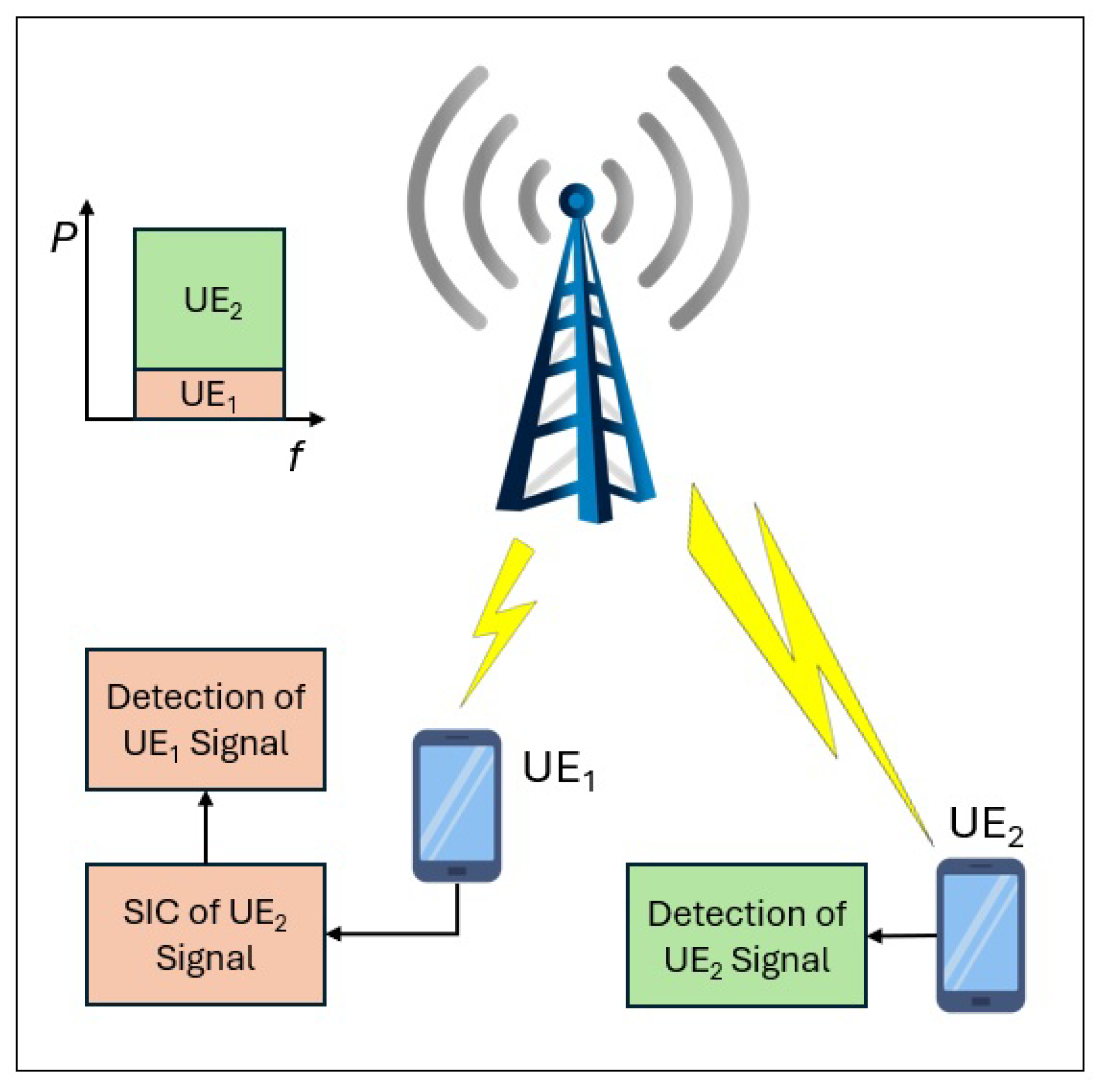
27]. This process is illustrated in
Figure 1. The efficiency of NOMA is directly influenced by the user clustering and power allocation algorithms. Since a small number of users are typically multiplexed on each resource block, the BS must strategically pair users and allocate the power coefficients while taking into consideration users’ channel gains and other requirements such as QoS and data rates. Typically, user clustering and power allocation are interdependent; therefore, joint optimization is normally used in NOMA to optimize the sum rate, improve user fairness, and satisfy QoS requirements.
3. System Model
3.1. Preliminaries
The system model considers a single base station (BS) in a downlink PD-NOMA network with
N available frequency resources and a bandwidth of
W Hz. The set of users is denoted as
=
, where
k denotes the
user in the set
and
K represents the total number of users. Power allocation is performed for a two-user NOMA pair per resource block, which is a common assumption in PD-NOMA systems due to the decoding complexity of SIC. However, the system model considers
K users that are paired into 2-user PD-NOMA clusters across multiple resource blocks, in which each NOMA pair follows the proposed power coefficient allocation strategy. The set of users are ordered according to their channel gain in a descending order such that
, where
denotes the channel power gain of the
user. Let
denote the total transmit power of BS
b, which is divided equally between the available frequency resources, where each frequency resource has a maximum transmit power of
. Thus, the transmit power allocated to user
k is limited by
where
denotes the transmit power allotted to user
k and
is the maximum power per resource block.
The BS transmits a superimposed signal to the users, while a power allocation strategy is adopted to guarantee successful signal decoding
3.2. Signal-to-Interference-Plus-Noise Ratio (SINR)
In this section, the SINR estimation is provided under a perfect SIC scenario. The SINR of the user located close to the BS can be expressed as
where
denotes the power coefficient assigned to the near user,
denotes the transmit power,
refers to the channel gain and
represents the additive white Gaussian noise (AWGN).
On the other hand, the SINR of the user located far from the BS is given by
where
denotes the power coefficient assigned to the far user, and
is the channel gain of the far user.
Given Equations (
3) and (
4), the data rate of UE
n and UE
f can be calculated as
and
Note that and in (5) and (6) represent the spectral efficiency in (bit/s/Hz). The corresponding users throughput and , where W is the RB bandwidth.
3.3. Impact of Imperfect SIC
The scenario above considered the SINR estimation under a perfect SIC scenario. In case of imperfect SIC, the near user will not be able to fully eliminate the far user signal and will experience residual interference as a result. This is reflected as follows:
The term indicates the residual interference introduced by the non-perfect SIC operation and denotes the SIC error coefficient where . When , a perfect SIC is assumed, while indicates the existence of residual interference.
To work properly, SIC receivers need a minimum received power difference between the superposed signals to ensure that the signals are decoded and distinguished reliably. In a PD-NOMA scenario with two users, a near user
n and a far user
f, the power received at the near user can be expressed by
, representing the far user signal, and
, representing the near user signal. To guarantee reliable SIC operation, the following constraint is applied:
where
refers to the hardware sensitivity threshold of the receiver to ensure a minimum required disparity and avoid pairing users with similar powers.
4. NOMA Power Allocation Scheme
4.1. Fixed Power Allocation
The fixed power allocation is a commonly used benchmark scheme in NOMA-based networks. This approach is a simple and ideal baseline that can be used for comparison and theoretical analysis purposes with novel and advanced power allocation schemes. The principle idea is allocating each user a fixed and predetermined percentage of the total transmission power. This percentage is assigned to users without taking into consideration the channel gain conditions.
Given a transmission power of
and a downlink NOMA network with two users, the power allocation coefficients
and
can be expressed as
where
and
denote the power allocation coefficients of the near and far users respectively.
Thus, the transmit power allocated to the near user is
Accordingly,
= (1 −
), and the transmit power allocated to the far user satisfies
As an illustration, fixed power coefficients can be assigned to the near and far users with values of = 0.3 and = 0.7, respectively.
The far user, who is likely to suffer from poor channel condition, is assigned a higher power coefficient to ensure successful signal decoding. On the other hand, the near user, who is located in proximity of the BS, has better channel conditions and is therefore allocated less power while still being able to decode the signal reliably.
The signal received at user k is given by
where
represents the channel gain between user
k and the BS.
At the near user, SIC is applied, in which the near user first decodes the signal of the far user, subtracts it from the received signal, and then decodes its own data. In contrast, the far user directly decodes its own signal by treating the signal of the near user as interference.
Despite the fact that fixed power allocation is simple and has low computational complexity, it is known to have a lack of ability to adjust to channel condition variations. This results in poor performance and resource utilization, especially in dense network scenarios.
4.2. Random Power Allocation Scheme
In random power allocation, the power coefficients are generated by randomly taking into consideration the total power constraint. This scheme allocates random power coefficients to the near and far users without considering the channel state information (CSI) or any form of optimization.
Given a NOMA network with two users, the random power allocation coefficients are produced by taking into account the total power constraints as in Equation (
9). The near user is given a random power coefficient
. Thus, the power assigned to the near user is
where
represents a uniformly distributed random variable in the interval
.
Therefore, the power assigned to the far user is
The near user then performs SIC to decode the far user’s signal, whereas the far user can decode its data directly as in fixed power allocation. However, random allocation of power coefficients leads to poor performance and increased outage as the power assigned to the far user may not be sufficient to successfully decode the signal. However, random power allocation is a suitable benchmark for evaluating the performance reliability of novel power allocation schemes as it represents a scenario with non-predictable and non-optimal distribution of power coefficients.
4.3. Water-Filling-Based Upper Bound
The classical water-filling power allocation is used as a benchmark to evaluate the performance of the proposed IL-PA scheme. This strategy represents an upper bound on the achievable sum rate, as it maximizes the overall capacity without considering constraints such as fairness or QoS.
The sum capacity maximization problem can be solved using the water-filling algorithm [
28]:
where
represents the total transmit power,
refers to the instantaneous channel gain of user
k, and
is the noise power.
The maximization problem above is convex; hence, the optimal solution can be obtained using the Karush–Kuhn–Tucker (KKT) conditions. Solving the KKT conditions leads to the well-known water-filling power allocation, which determines the optimal power distribution:
where
represents the selected water level to satisfy the total power constraint:
With this allocation, the instantaneous sum capacity is maximized as users with higher channel gains obtain more power, while users with lower channel gains receive less or zero power. The water-filling scheme represents a theoretical upper bound for the achievable capacity as it maximizes the sum capacity without imposing constraints on the QoS. Because water-filling directly maximizes the unconstrained sum rate, it serves as a theoretical upper bound for practical NOMA power allocation schemes.
As opposed to IL-PA, the water-filling approach does not impose a minimum SINR requirement for weak users. This leads to unfair allocation of resources in which strong users gain more power allocation to maximize the sum capacity.
4.4. Proposed Interference-Limited Power Allocation
The proposed interference limited power allocation scheme (IL-PA) focuses on the allocation of power coefficients such that the interference received from the near user with good channel conditions does not exceed a pre-defined maximum interference threshold. The maximum interference threshold represents the maximum amount of interference that a user can tolerate to ensure that the target rate of the far user with poor channel gains is achieved. The objective of this approach is to enhance the SINR of the weaker user by setting the maximum interference threshold denoted by
, which can be derived as follows:
where
is the achievable bit rate of the far user. Equation (
20) can be re-written as
The equation in (
22) can be expressed as
where
denotes the desired signal power of the far user and
represents the interference power received from the near user.
Thus, the interference received from the near user can be represented as
To achieve the target SINR of the far user, the interference power received from the near user must not exceed a maximum predefined interference threshold
where
is the interference power received by the far user from the near user, and
represents the maximum tolerable interference threshold which is derived based on the far user target rate.
Consequently, the power allocation coefficients are calculated taking into consideration the interference constraint
is calculated by substituting
in Equation (
24):
where
represents the target rate of the far user.
5. User Pairing
User pairing plays an essential role in the performance of NOMA systems as it directly influences the achievable rate and power allocation efficiency. Since users share the same frequency resources, selecting an appropriate pair of users is essential to ensure successful SIC decoding while improving the overall system capacity. However, performing an exhaustive search over all possible pair combinations becomes impractical and computationally expensive with an increasing number of users. To address this limitation, this paper adopts a strong–weak user pairing strategy that reduces complexity while maintaining near-optimal performance.
The user pairing algorithm begins by ordering the users based on their channel gains in descending order. The set of ordered users are then sorted into two groups: strong users and weak users. To ensure that each pair contains users with channel gains that are sufficiently different, pairing is only conducted between the two distinct user groups.
For every user in the strong users group, the sum rate achieved is computed with each user in the weak users group, and the pair that obtains the highest sum rate is selected. After selection, the two users are removed from both pools and the process continues until all users are paired.
5.1. User Grouping Mechanism
Consider a single-cell downlink NOMA network with
K users, each characterized by an instantaneous channel gain
. The users are sorted according to their channel gains in descending order as follows:
After that, the set of ordered users are categorized into two groups:
This grouping implies that pairing occurs only between users with sufficiently different channel gains to ensure effective SIC decoding. If K is odd, the remaining unpaired strongest user is allocated in a separate RB under OMA.
5.2. Proposed User Pairing Scheme
The proposed user pairing scheme restricts the user pairing evaluation for users from different groups (i.e., strong users are tested only with weak users).
For each candidate pair
, where
u ∈
and
v ∈
, the achievable NOMA sum rate is evaluated.
where
and
represent the power allocation coefficients determined by the proposed IL-PA scheme. The optimal user pairing can then be formulated as
where
is a binary variable used to indicate whether users
u and
v are paired.
After that, the selected pair is removed from the groups in (23) and (24). This procedure continues until all users are paired.
As a result, the computational complexity is reduced from for the exhaustive search to .
5.3. Optimization Problem Formulation
The objective of the optimization is to select the pair of users that maximize the total sum rate:
The constraints ensure that each user in the strong users group is paired with at most one user in the weak users group, and vice versa.
The proposed pairing technique provides a balance between optimality and computational complexity by exploiting the nature of channel disparity in NOMA systems. Unlike exhaustive search, the proposed scheme avoids unnecessary evaluation of user pairs that are not expected to produce high gains.
6. Results and Performance Evaluation
6.1. Simulation Setup
A single-cell downlink PD-NOMA scenario is considered with one BS located at the center of the cell and a set of users randomly and uniformly distributed within the cell range. A Rayleigh fading model is adopted to model small-scale fading. Monte Carlo simulations are performed wherein, for each realization, users are randomly deployed, subsequently ordered according to their instantaneous channel gains, and paired based on the proposed strong–weak user pairing methodology. Each NOMA pair shares one resource block and uses the IL-PA scheme to allocate the power coefficients.
Table 1 below illustrates the rest of the simulation parameters:
6.2. Sum Capacity Performance
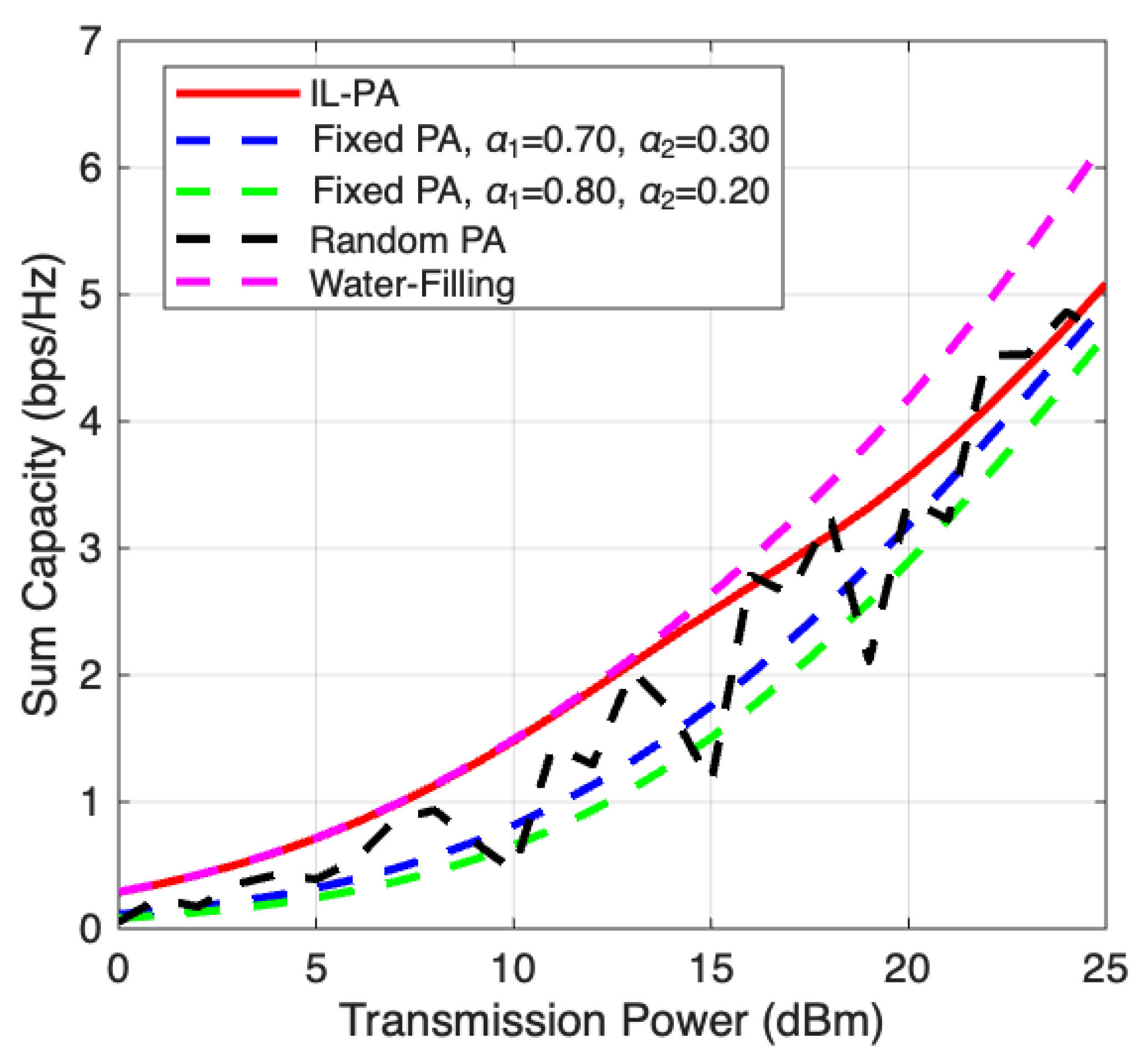
Figure 2 illustrates the sum capacity performance with varying transmission power in a perfect successive interference cancellation scenario. The result indicates that the proposed IL-PA approach achieves superior performance compared to the benchmark schemes. This is due to the enhanced power allocation provided by the proposed scheme in which the power coefficients are efficiently allocated to the users. On the other hand, the performance of the fixed power allocation scheme is improved with larger power coefficients allocated to the near user. It can be seen that when the power coefficient of the near user,
, is 0.7 and the power coefficient of the far user,
, is 0.3, the performance of the sum capacity is improved compared to the case when
and
are set to 0.8 and 0.2. This is because assigning higher power to the strong user often reduces the weak user’s SINR due to increased interference, which leads to the weak user’s rate outweighing the strong user’s rate. The performance of the random power allocation scheme is also shown in
Figure 2. The poor performance of this scheme, which is reflected by the fluctuations in the sum capacity, is due to the imbalanced allocation of power coefficients for the near and far users. This approach is not realistic and has been included for comparison purposes.
Figure 2 also illustrates the performance of the proposed IL-PA against the water-filling upper bound. At a lower transmit power, both schemes demonstrate comparable performance levels. This is because the sum capacity increases almost linearly with the transmit power, making the impact of power allocation less significant, which leads to the proposed IL-PA closely approaching the water-filling upper bound. At higher levels of transmit power, the power allocation effect becomes more critical. The water-filling scheme maximizes sum capacity by assigning higher power coefficients to users with strong channel gains. However, the proposed IL-PA method imposes a minimum constraint for the SINR to ensure fairness for weak users. At a higher transmit power, the ability of the IL-PA scheme to maximize the capacity of users with strong channel gains becomes limited due to the SINR constraint, consequently leading to a performance gap between the IL-PA and water-filling upper bound schemes. This demonstrates the trade-off between spectral efficiency and QoS in practical NOMA systems.
It should be noted that the water-filling scheme maximizes the unconstrained sum capacity; thus, it represents a theoretical upper bound. In contrast, the proposed IL-PA approach introduces a trade-off between fairness and capacity by imposing a constraint on QoS.
6.3. Performance Evaluation Under Imperfect SIC
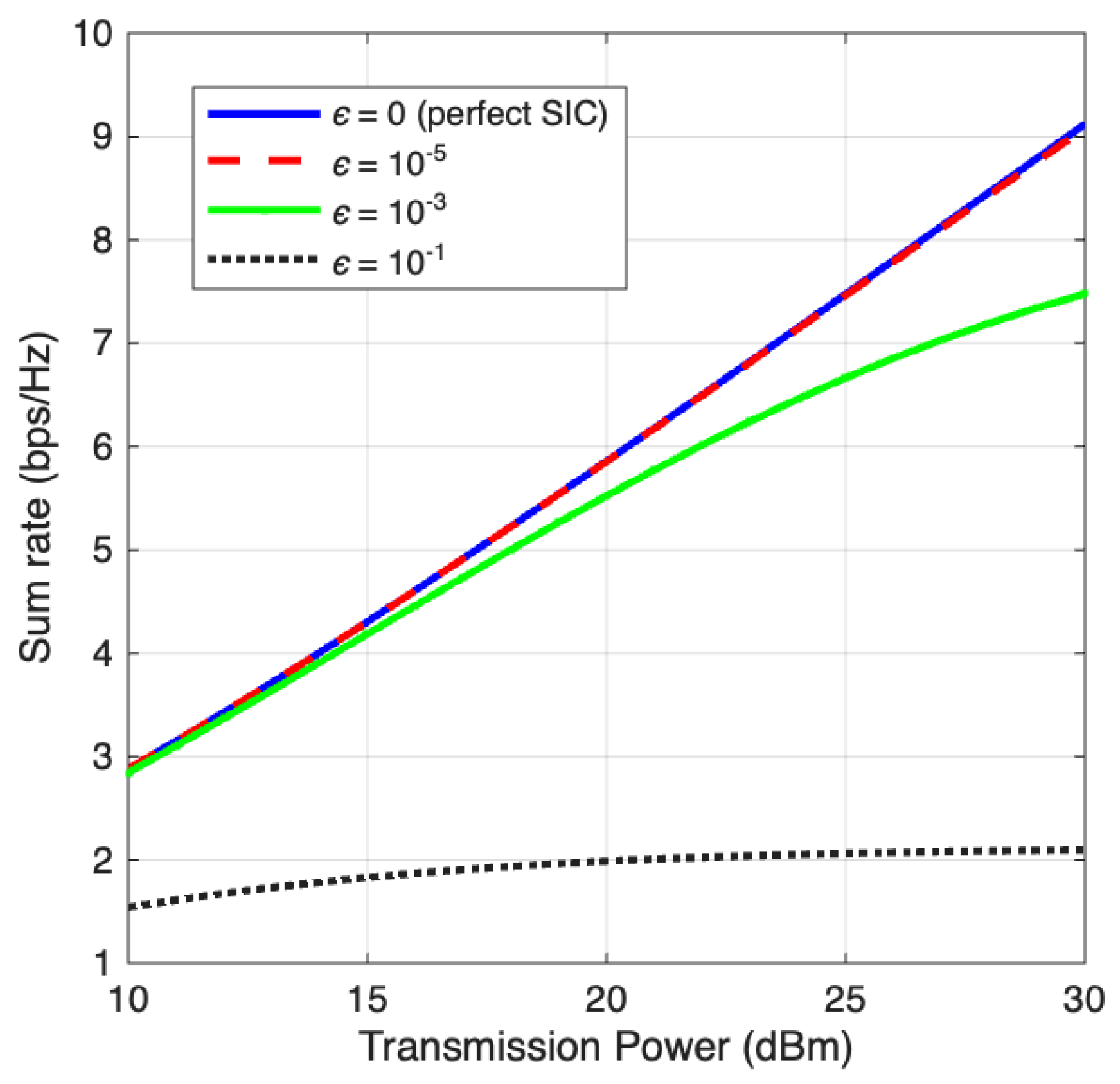
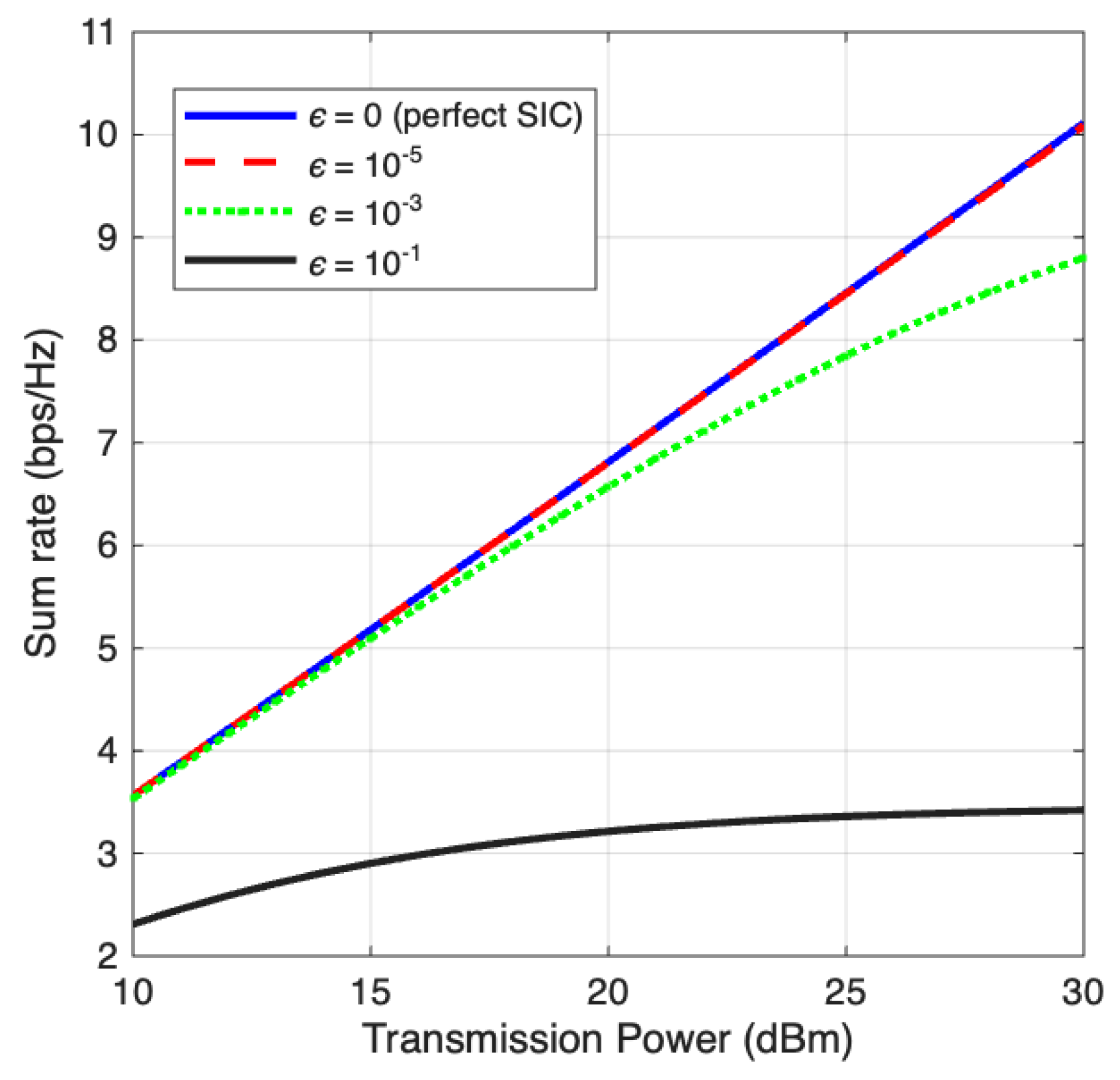
Figure 3 and
Figure 4 show the sum capacity performance of fixed and interference limited power allocation schemes under an imperfect SIC scenario with varying transmission power. It can be seen that increasing the SIC error coefficient factor
leads to reduced sum rate performance. This is because the SIC error coefficient represents the level of imperfection in the interference cancellation process at the receiver. When the error coefficient is considered, this indicates that the interference perceived by the strong user is not completely eliminated. This causes the weaker user to experience residual interference. Therefore, the higher the
value, the more residual interference experienced by the weaker user.
On the other hand, when is equal to zero, this illustrates an ideal SIC situation in which the SIC process is perfect, and complete interference cancellation is provided. This explains the improvement in the performance of the sum capacity in this scenario.
It is worth noting that when is very low (), the sum rate performance is almost similar to the perfect SIC scenario. This is because when is extremely low, the residual interference becomes very minimal and the weaker user’s signal becomes almost free of interference.
6.4. Impact of User Pairing on System Performance
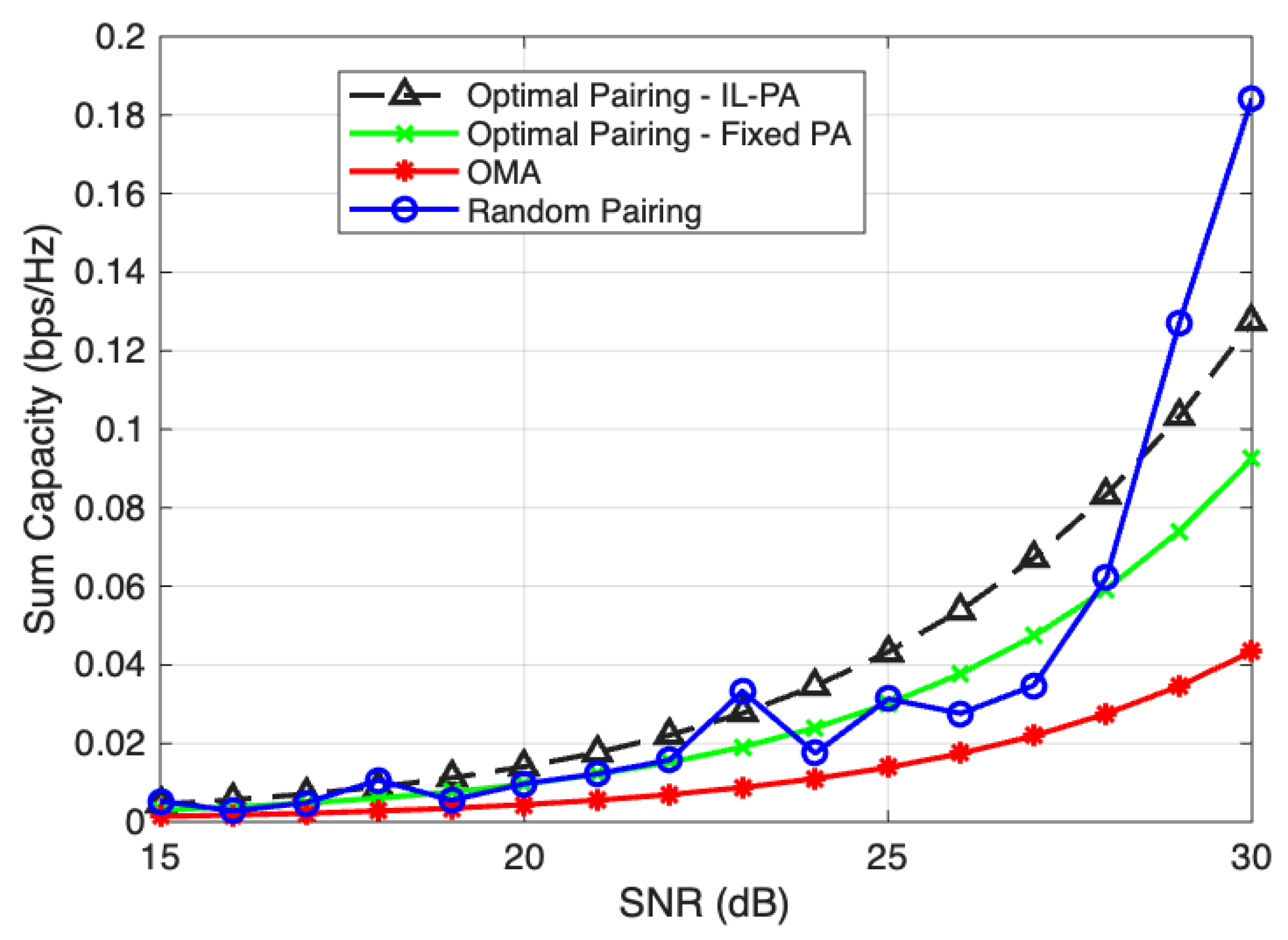
In
Figure 5, the impact of user pairing on the sum capacity performance is illustrated. The figure shows a comparison between various user pairing schemes:
Optimal Pairing with IL-PA: In this scheme, the proposed strong–weak user pairing algorithm is implemented alongside the interference limited power allocation method.
Optimal Pairing with Fixed Power Allocation: The strong–weak user pairing algorithm is implemented under the fixed power allocation scheme.
Random User Pairing: In this user pairing scheme, the users are randomly paired regardless of their channel gain.
Orthogonal Multiple Access (OMA): In OMA, users are assigned in separate RBs with fixed power allocation.
The result shows that the optimal user pairing combined with IL power allocation outperforms the other schemes. The result also shows the performance of the optimal user pairing with fixed power allocation, where it can be seen that varying the power allocation coefficients and has an impact on the sum capacity performance, as discussed previously. It is worth noting that the random user pairing scheme provides unpredictable sum capacity performance. This is because user pairing is crucial in NOMA networks, which mainly rely on utilizing the channel gain variations to enhance the spectral efficiency. Pairing users in a random manner causes inefficient utilization of the channel gain differences and non-optimal power allocation, which leads to unpredictable interference and poor SIC performance. On the other hand, the OMA scheme exhibits poorer performance compared to NOMA, demonstrating that NOMA can significantly enhance system performance through more efficient utilization of frequency and power resources.
7. Conclusions
In this paper, a thorough comparison between different power allocation schemes in NOMA networks is presented. Benchmark schemes, including fixed power allocation, random power allocation, and water-filling upper bound were used to evaluate the performance of the proposed interference-limited power allocation (IL-PA) scheme. As opposed to the benchmark techniques, the proposed IL-PA method assigns the power coefficients for users in an adaptive manner by utilizing an interference threshold to ensure that the interference produced by the strong user does not exceed the maximum tolerable level for the far user. This is to ensure that the far user target achievable rate is guaranteed while enhancing the overall spectral efficiency. Additionally, to avoid complexity while maintaining good performance, a strong–weak user pairing technique based on channel ordering is proposed to reduce the search space while preserving near-optimality in terms of sum rate. The simulation results show that the sum capacity performance of the proposed IL-PA technique is significantly enhanced compared to the benchmark schemes. Additionally, combining IL-PA with optimal user pairing further increased the performance of the proposed schemes over the other benchmarks. This demonstrates the effectiveness of adaptive power allocation and optimal user pairing in balancing user rates and maximizing system capacity.
8. Limitations and Future Work
In this paper, a downlink PD-NOMA power allocation and user pairing scheme has been developed for single-cell networks with the assumption that users are ordered according to their channel gains. For analytical simplicity and to reflect common PD-NOMA scenarios, 2-user NOMA clusters are used. The proposed method will be extended in future work to incorporate multi-cell networks and multi-user NOMA clusters. In addition, integration with other 6G enablers, including MIMO beamforming and RIS-assisted networks, will be investigated to improve the performance of the proposed scheme.