Article

An Adaptive Binary Particle Swarm Optimization with Hybrid Learning for Feature Selection

1
School of Teacher Education, Nanyang Institute of Technology, Nanyang 473004, China
2
School of Computer and Software, Nanyang Institute of Technology, Nanyang 473004, China
3
Faculty of Electrical Engineering and Computer Science, VŠB-Technical University of Ostrava, 70800 Ostrava, Czech Republic
4
Department of Information Management, Chaoyang University of Technology, Taichung 413310, Taiwan
*
Author to whom correspondence should be addressed.
Electronics 2026, 15(7), 1523; https://doi.org/10.3390/electronics15071523
Submission received: 10 March 2026 / Revised: 2 April 2026 / Accepted: 3 April 2026 / Published: 5 April 2026

Abstract

Particle swarm optimization (PSO) improves classification performance and reduces computational complexity in feature selection. However, it frequently experiences from premature convergence and insufficient exploration. To address these constraints, this paper suggests an adaptive binary PSO (ABPSO) algorithm specifically designed for feature selection. First, an adaptive transfer function and two adaptive learning coefficients are introduced to achieve a better balance between exploration and exploitation during the search process. Second, a hybrid learning mechanism that integrates personal best, global best, and elite solutions is utilized to enhance population diversity. Finally, a simulated annealing (SA)–based local search strategy is employed to further refine candidate solutions and improve convergence behavior. Experimental results demonstrate that ABPSO outperforms binary PSO (BPSO), harris hawks optimization (HHO), whale optimization algorithm (WOA), and ant colony optimization (ACO) in classification accuracy. In particular, ABPSO achieves the lowest classification error rates on the Dermatology (0.0106), Ionosphere (0.0705), Lung (0.1521), Sonar (0.0996), Spambase (0.0758), Statlog (0.1446), and Wine (0.0280) datasets.

1. Introduction

Machine learning has been confronted with significant challenges in the era of big data due to the exponential increase of high-dimensional datasets in bioinformatics, text mining, image recognition, and medical diagnostics [1,2]. While abundant features enrich prediction models, they also introduce the curse of dimensionality, heightened computational costs, and degradation in model generalization performance [3,4]. As a result, feature selection has emerged as an important preprocessing technique for identifying the most informative and relevant features. By reducing data dimensionality, feature selection not only improves model efficiency and robustness but also enhances interpretability [5].
Traditional feature selection approaches are generally categorized into filter, wrapper, and embedded methods [6,7]. Filter methods assess feature relevance using statistical metrics without relying on a learning algorithm. Despite their computational efficiency, they often have suboptimal classification performance due to their independence from prediction models. In contrast, wrapper methods directly evaluate feature subsets by employing a prediction model, and they yield higher classification accuracy but with a significant increase in computational overhead. Embedded methods integrate feature selection into the model training process; however, their effectiveness is often limited by the inherent assumptions of the chosen learner.
In recent years, metaheuristic algorithms have become powerful tools for feature selection [8,9]. Among these, particle swarm optimization (PSO), inspired by the social behaviors observed in bird flocking, has attracted growing interest [10,11]. PSO utilizes a population of particles that iteratively update positions through individual experience and collective knowledge. Known for its straightforward implementation and strong global optimization performance, PSO is particularly well-suited for feature selection tasks.
PSO-based feature selection methods often depend on fixed or manually tuned control parameters [12,13], which prevents them from dynamically balancing exploration and exploitation during the search process. Consequently, these methods may suffer from insufficient population diversity and fail to consistently identify high-quality feature subsets. Motivated by these research gaps, this paper proposes a novel PSO-based feature selection framework designed to improve classification accuracy. The main contributions of this study are summarized below.
  • An improved PSO variant is developed specifically for feature selection, which integrates an adaptive transfer function and adaptive learning coefficients to balance exploration and exploitation throughout the search.
  • The proposed method is extensively evaluated on multiple benchmark datasets. Its performance is compared with several state-of-the-art feature selection methods, and it demonstrates superior results.
The rest of this paper is organized as follows. Section 2 reviews recent works on feature selection methods based on metaheuristic algorithms. Section 3 presents the proposed adaptive binary PSO in detail. Section 4 presents the experimental results and comparative analyses. Finally, Section 5 concludes this paper.

2. Related Works

Metaheuristics continue to be a prominent approach for wrapper-based feature selection because they can efficiently explore large combinatorial spaces without relying on gradient information. Related research has focused on improving solution quality, convergence stability, and computational efficiency.
A primary research direction focuses on adapting continuous metaheuristics to the discrete and binary nature of feature selection. Numerous binary metaheuristic algorithms have been developed using transfer functions [14,15]. Ref. [16] proposed a feature selection method based on the walrus optimization algorithm (WaOA) to balance accuracy and computational efficiency. The method employs S-shaped and V-shaped transfer functions to discretize the search space, and a crossover operator is introduced to enhance exploration capability, maintain population diversity, and improve fine-grained search performance. Ref. [17] proposed an improved binary grey wolf optimizer (GWO). A new cosine transfer function is designed to convert the continuous GWO into a binary version. Ref. [18] proposed an improved binary PSO algorithm that combines V-shaped and U-shaped transfer functions, and the enhanced algorithm significantly improves its optimization performance in feature selection problems. Ref. [19] proposed a hybrid binary optimization algorithm to identify the optimal feature subset from medical image features. The algorithm combines the binary dwarf mongoose optimizer (BDMO) and PSO with the binary ebola optimization search algorithm (BEOSA). In addition, a new sigmoid transfer function is applied to enhance the binary search process. Atomic transfer functions apply a single function within the algorithm, such as S-shaped, U-shaped, V-shaped, or Z-shaped functions. In contrast, composite transfer functions combine multiple atomic transfer functions within their structure. An inappropriate transfer function can reduce the algorithm’s performance in the binary search space, so [20] proposed a fuzzy transfer function and applied it to the binary PSO algorithm.
Another research direction focuses on dynamic and self-adaptive parameter control. Fixed parameter settings, such as inertia weights, learning factors, or mutation probabilities, often lead to premature convergence or excessive randomness during the search process [21,22]. To address these limitations, various PSO variants have been proposed [23,24]. Ref. [25] presented an adaptive PSO feature selection algorithm to enhance precision in high-dimensional data. The algorithm introduces a strategy by measuring population diversity and guiding particle updates accordingly. Additionally, it develops an adaptive population size adjustment mechanism to enhance overall optimization performance. Ref. [26] proposed an improved feature selection method based on adaptive PSO. This method identifies particles trapped in local minima by calculating the update intervals of their personal best and global best positions. An adaptive neighborhood search strategy is then applied to help these particles escape local minima and continue exploring more promising solutions. Ref. [27] developed a feature selection technique based on PSO by incorporating adaptive parameters, and its performance is further enhanced by integrating altruistic behavior among the population. Ref. [28] brought an adaptive pyramid PSO. In the initial stage, a weighted initialization strategy based on feature correlation and cubic chaotic mapping is used to generate particles and increase population diversity. Then, an adaptive constraint update strategy that uses a pyramid structure is introduced to enhance population exploration. Even with these advances, it is still a challenge to establish effective configuration criteria for adaptive algorithms. Ref. [29] proposed an adaptive PSO variant based on fitness landscape analysis and roughness factor estimation. By combining machine learning techniques with deterministic methods, the cognitive and acceleration coefficients are adaptively updated throughout the optimization process.
Despite these advancements, PSO-based feature selection still encounters several limitations. The algorithm’s performance remains sensitive to parameter settings, while its convergence speed declines notably in high-dimensional search spaces. These challenges highlight the necessity for a novel PSO framework that integrates adaptive mechanisms, hybrid optimization strategies, or domain-specific knowledge.

3. Methodology

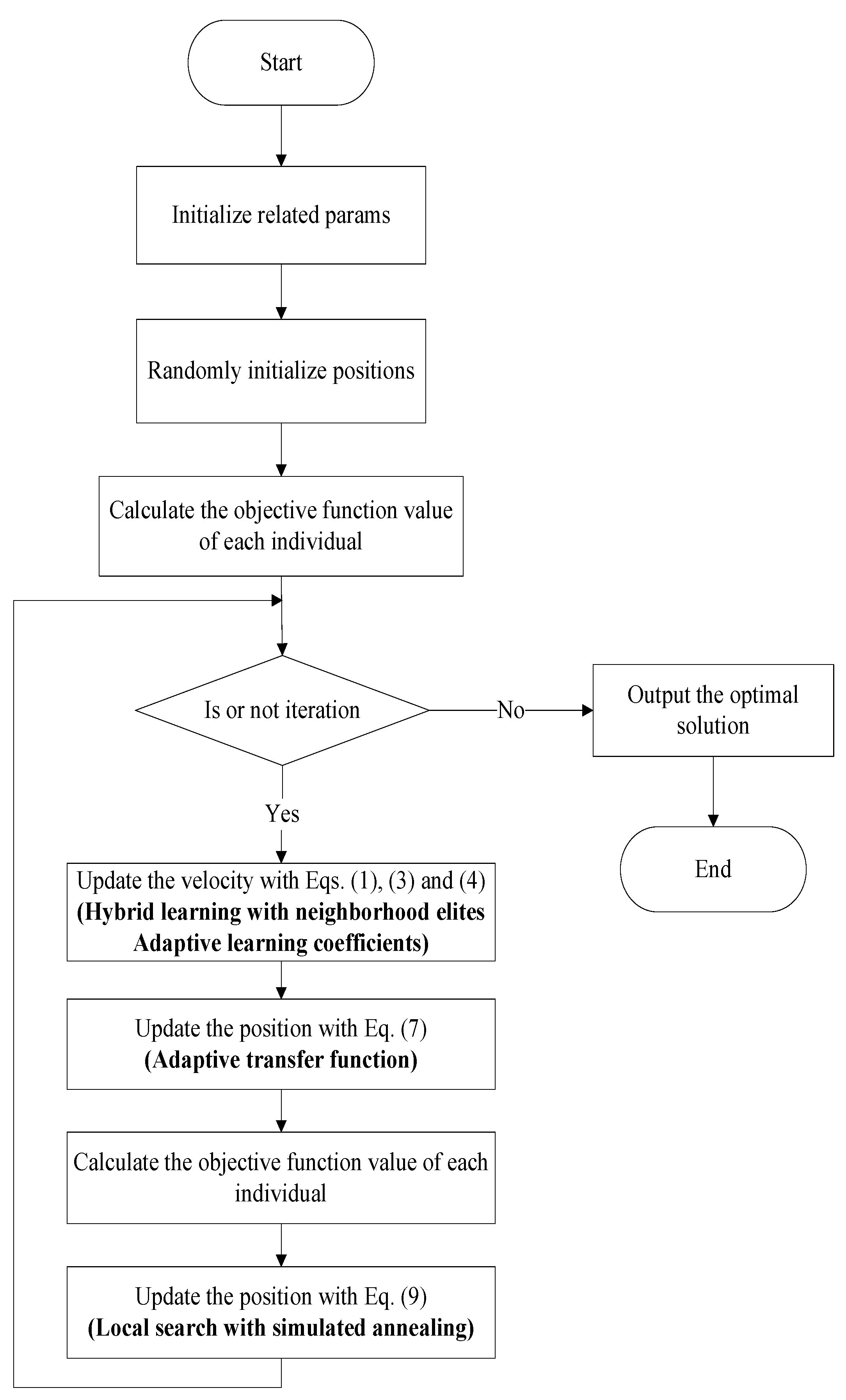
To enhance the performance of PSO, we propose a novel framework (ABPSO) that incorporates hybrid learning with neighborhood elites, adaptive learning coefficients, an adaptive transfer function, and local search with SA, as illustrated in Figure 1. First, the relevant parameters of ABPSO are initialized, including the population size (20), the maximum number of iterations (100), and the inertia weight (0.9). Next, the binary positions of particles are randomly initialized, and their objective function values are calculated. Finally, the velocities and positions of the population are updated according to the proposed improvement strategies until the stopping criterion is satisfied, and the optimal solution is obtained.

3.1. Hybrid Learning with Neighborhood Elites

In the standard PSO algorithm, particle updates rely exclusively on the global best solution ( g b e s t ) and the personal best solution ( p b e s t ). Such a learning strategy may reduce population diversity in complex or multimodal search spaces. The proposed hybrid learning mechanism enables particles to learn not only from p b e s t and g b e s t , but also from neighborhood best solutions ( l b e s t ), as depicted in Equation (1). By incorporating neighborhood elite individuals, particles are guided by locally promising solutions rather than being excessively attracted to a single global leader. It preserves population diversity and improves the population’s ability to explore search space simultaneously. Moreover, it introduces high-quality search directions and reduces the likelihood of stagnation by learning from multiple elite solutions.
V i d ( t + 1 ) = w V i d ( t ) + c 1 r 1 ( l b e s t i d X i d ( t ) ) + c 2 r 2 ( g b e s t d X i d ( t ) )
where w is the inertia weight, and V i d ( t ) and X i d ( t ) represent the velocity and position of particle i on dimension d at iteration t, respectively. r 1 and r 2 are two random values between [0, 1], and c 1 and c 2 are coefficients.
l b e s t i = [ p b e s t i T h e t o p 3 b e s t s o l u t i o n s f r o m p b e s t s ]
l b e s t i randomly selects one as the learning target for i.

3.2. Adaptive Learning Coefficients

In PSO, the cognitive coefficient c 1 and the social coefficient c 2 govern the balance between individual exploration and collective learning. The use of fixed coefficients can bias the search behavior and lead to excessive exploration or premature convergence. To overcome this limitation, the proposed adaptive learning coefficients change dynamically throughout the optimization process. By assigning a higher value to c 1 during initial iterations, particles are encouraged to explore the search space more broadly, which enhances population diversity and reduces the likelihood of premature convergence. As the search progresses, our method gradually increases the influence of c 2 . It promotes accelerated convergence and more intensive exploitation of promising areas identified by the population. Consequently, the proposed adaptive strategy ensures a smooth and effective transition from global exploration to local exploitation.
c 1 ( t ) = 2 t T
c 2 ( t ) = 1 + t T
where T is the maximum iteration.

3.3. Adaptive Transfer Function

The transfer function, typically the Sigmoid function, plays a crucial role in mapping continuous position values from the standard PSO search process into binary form. However, it can lead to high randomness during early iterations and convergence stagnation in later stages. To address this instability, we propose an adaptive transfer function whose steepness is dynamically adjusted according to the iteration progress, and the proposed transfer function is defined as follows:
α ( t ) = 10 9 t T
S ( V i d ( t ) ) = 1 1 + e α ( t ) · V i d
α ( t ) increases over iterations to gradually sharpen the probability distribution.
The final particle position is obtained by comparing with a random number in the range [0, 1], as shown in Equation (7)
X i d ( t + 1 ) = X i d ( t ) i f ( r a n d S ( V i d ( t ) ) ) 1 X i d ( t ) e l s e
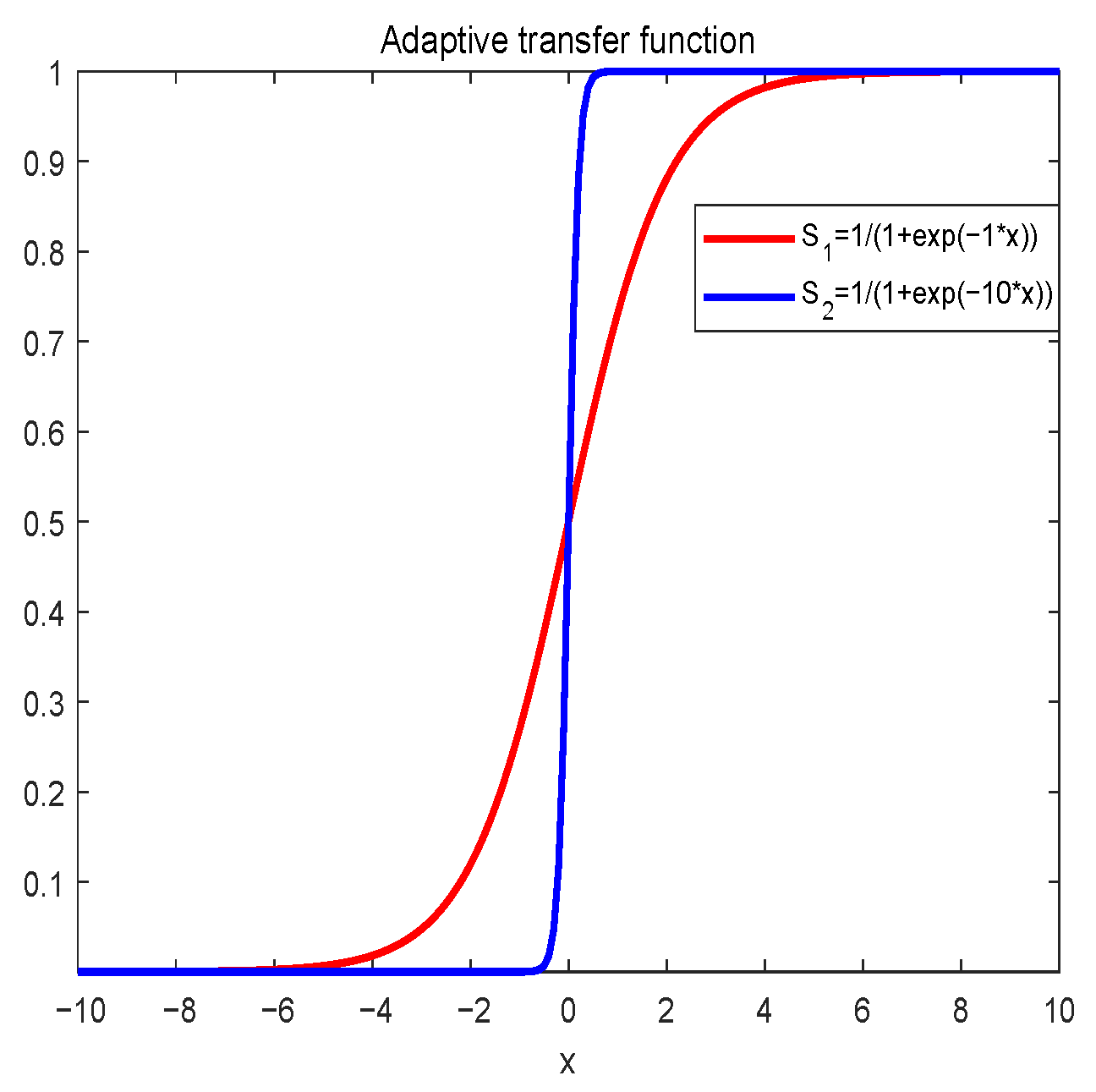
As illustrated in Figure 2, the proposed adaptive transfer function exhibits dynamic characteristics at different phases of the optimization process. During early iterations, it operates similarly to the transfer function employed in the binary GWO. It has rapid position switching ability and enhances the algorithm’s global exploration. As the search proceeds, the transfer function gradually transitions toward a PSO-like behavior, which strengthens local search intensity and supports refined exploitation around promising regions.

3.4. Local Search with Simulated Annealing

As the population converges, particles tend to cluster around similar solutions and lose the diversity needed to escape local optima. By employing an acceptance criterion governed by a cooling temperature schedule, SA allows the algorithm to occasionally accept inferior solutions and escape shallow local optima without reverting to inefficient global exploration. This local refinement process facilitates continuous improvement within promising regions while maintaining an appropriate balance between intensification and diversification. The proposed strategy not only yields higher-quality feature subsets but also improves convergence reliability.
E = f ( X i ( t + 1 ) ) f ( X i ( t ) )
X i ( t + 1 ) = X i ( t ) i f ( E > 0 & r a n d ( ) < e E / T ) X i ( t + 1 ) e l s e
where f is the objective function.

3.5. Complexity Analysis

The computational complexity of the proposed ABPSO is mainly determined by the fitness evaluation and particle update. In each iteration, all particles are evaluated using KNN, so the complexity of fitness evaluation is O ( T · N · C ) , where T means the maximum number of iterations, N is the number of particles, and C represents the computational cost of KNN. The complexity of O ( T · N · D ) is involved in particle update, where D is the number of features. Since fitness evaluation is typically the most computationally expensive part of feature selection, the overall time complexity of the ABPSO algorithm is dominated by O ( T · N · C ) .

4. Experimental Results and Analysis

To assess the effectiveness of the proposed ABPSO for feature selection, we conduct comprehensive experiments on UCI benchmark datasets [30] with BPSO [31], harris hawks optimization (HHO) [32], whale optimization algorithm (WOA) [33], and ant colony optimization (ACO) [34]. Classification performance is assessed using the k-Nearest Neighbor (k-NN) classifier with k = 5. For a fair comparison, all metaheuristic-based algorithms are configured with the same population size (20) and number of iterations (100). The detailed information of the compared algorithms and benchmark datasets are summarized in Table 1 and Table 2.
We employ the Wilcoxon rank-sum test and the Friedman test To evaluate the statistical significance of the experimental results. A significance level of 0.05 is chosen to examine if there are any noteworthy differences in the obtained results.

4.1. Objective Function

The primary metric of feature selection is classification accuracy. Therefore, we utilize it as the objective function in our experiments, as depicted in Equation (10).
f = e r r o r s s a m p l e s
where e r r o r s and s a m p l e s represent the numbers of misclassified instances and totals, respectively.

4.2. Experimental Analysis

Table 3 presents the classification error rates obtained by the compared algorithms on ten benchmark datasets. The experimental results clearly demonstrate that the proposed ABPSO outperforms BPSO, HHO, WOA, and ACO on most datasets. ABPSO achieves the lowest classification error on seven out of the ten datasets, including Dermatology, Ionosphere, Lung, Sonar, Spambase, Statlog, and Wine. Notably, ABPSO attains the best performance on the Ionosphere and Sonar datasets, which are characterized by complex feature structures. This observation further confirms the effectiveness and suitability of ABPSO for challenging feature selection tasks.
Compared with the standard BPSO, ABPSO demonstrates notable improvements across multiple datasets. For instance, on the Lung dataset, ABPSO reduces the classification error, corresponding to a relative improvement of approximately 27.7%. Similarly, on the Sonar and Ionosphere datasets, ABPSO performs better than BPSO by 7.5% and 14.5%, respectively. These consistent performances validate the effectiveness of the adaptive mechanisms incorporated into ABPSO, which enhance search behavior and help prevent premature convergence.
ABPSO outperforms HHO and WOA on most datasets. For example, on the Wine dataset, ABPSO achieves a classification error of 0.0280, compared to 0.0373 for HHO and 0.0358 for WOA. Similarly, on the Statlog dataset, ABPSO attains an error rate of 0.1446, whereas HHO and WOA produce high errors. It is worth noting that on the LSVT dataset, ACO delivers the best performance and it outperforms ABPSO. Nevertheless, ABPSO still performs comparably to, or better than, BPSO, HHO, and WOA on this dataset. These results indicate that the proposed adaptive strategy and hybrid learning mechanism enable ABPSO to achieve a more effective balance between exploration and exploitation than recent metaheuristic algorithms.
To further validate the overall performance differences among the compared feature selection algorithms, two nonparametric Friedman and Wilcoxon rank-sum tests are conducted on the evaluated datasets. The results are presented in Table 4, where “>” indicates that an algorithm achieves the best performance on a given dataset, “=” denotes no statistically significant difference from the best result, and “-” signifies inferior performance.
As shown in Table 4, the proposed ABPSO achieves the lowest average rank, which is substantially better than those of BPSO, HHO, WOA, and ACO. These results provide strong statistical evidence that ABPSO delivers consistently superior performance across diverse datasets. Specifically, ABPSO ranks first on seven out of ten datasets (Dermatology, Ionosphere, Lung, Sonar, Spambase, Statlog, and Wine), and acquires a close second place on two additional datasets (Iris and WDBC). The Friedman ranking results, along with the lowest average rank, statistically confirm the superiority and robustness of ABPSO in feature selection tasks.
The Wilcoxon rank-sum results clearly demonstrate the strong competitiveness of ABPSO. On the Iris dataset, ABPSO exhibits performance statistically equivalent (“=”) to the best result (achieved by BPSO), confirming its robustness even when not ranked first. In contrast, HHO and WOA fail to achieve either a best or equivalent outcome on any dataset. While ACO and BPSO achieve the best performance on the LSVT and WDBC datasets, respectively, ABPSO remains statistically competitive or superior across the remaining eight datasets.
Nonparametric tests indicate that ABPSO significantly outperforms BPSO, HHO, WOA, and ACO in most datasets. These findings strongly support the conclusion that ABPSO provides substantial and reliable advantages over other metaheuristic feature selection methods. Its performance can be explained by the integration of adaptive measures, multi-source guidance (utilizing pbest, gbest, and elite solutions), and the local refinement mechanism, which collectively enhance search diversity and enable more effective exploration of the solution space.
In addition to classification accuracy, computational efficiency is a critical factor for practical feature selection. Table 5 summarizes the execution times (in seconds) of the compared methods on the ten benchmark datasets.
The proposed ABPSO exhibits highly competitive and often superior computational efficiency relative to the other metaheuristic methods. For most datasets, its execution time is comparable to or faster than those of BPSO, HHO, WOA, and ACO. Notably, on the Spambase dataset, which involves a large number of samples, ABPSO completes execution in 319.79 s, significantly outperforming BPSO, HHO, and WOA. Although ACO records the shortest time on this dataset, ABPSO still provides a favorable trade-off between runtime efficiency and classification performance.
While ACO demonstrates the shortest running time on several datasets (e.g., Spambase, LSVT, and Iris), earlier error analyses show that it does not consistently achieve the best classification performance. Across most datasets, ABPSO maintains stable and computationally reasonable running times. For example, on Dermatology, Ionosphere, Iris, Lung, Sonar, Statlog, and WDBC, the execution time of ABPSO approaches the fastest reported results, indicating reliable scalability and efficient computational behavior.
The computational efficiency of ABPSO can be attributed to the relatively simple update operations inherent in the PSO framework and its ability to identify compact feature subsets which significantly reduce classifier evaluation costs. Ultimately, ABPSO can be used in real-world applications that require both high predictive accuracy and acceptable computational costs because it can maintain low error rates while operating within practical time constraints.
Table 6 displays the number of selected features for each algorithm, and ABPSO exhibits a distinct advantage. Compared to BPSO, HHO, and WOA, ABPSO selects fewer features in seven out of nine datasets, with particularly outstanding dimensionality reduction on high-dimensional datasets LSVT, Lung, and Sonar. Although ACO selects the fewest features, it exhibits significantly higher classification error, indicating that excessive feature reduction can adversely affect model performance. In contrast, ABPSO effectively reduces feature dimensionality while maintaining low classification error.

4.3. Parameter Sensitivity Analysis

To investigate the individual contributions of the proposed adaptive and hybrid mechanisms, an ablation study is conducted by systematically removing key components of ABPSO. We evaluate three algorithm variants, including ABPSO-1 (retaining only the adaptive transfer function and adaptive learning coefficients), ABPSO-2 (using only hybrid learning with neighborhood elites), and ABPSO-3 (employing solely SA-based local search).
Table 7 summarizes the classification errors of these variants on the ten benchmark datasets. ABPSO consistently achieves the lowest or highly competitive error rates on most datasets. On the Lung dataset, ABPSO obtains an error of 0.1521, significantly outperforming ABPSO-1, ABPSO-2, and ABPSO-3. Similarly, on the Ionosphere and Sonar datasets, ABPSO delivers the best results among all variants. To achieve optimal feature selection performance, it is crucial to integrate adaptive mechanisms, hybrid learning, and local refinement simultaneously.
ABPSO-1 demonstrates clear improvements over BPSO on several datasets, such as Spambase and WDBC. However, its performance becomes inconsistent on more complex datasets like Ionosphere and Lung, where it underperforms compared to ABPSO. The incorporation of neighborhood elites generally improves performance over BPSO, especially on WDBC. Nevertheless, without adaptive mechanisms or local refinement, the gains achieved by ABPSO-2 remain limited and exhibit lower stability on the datasets. Meanwhile, ABPSO-3 improves accuracy on certain datasets, including Iris and Spambase, although its effect in isolation is modest. These observations indicate that local search operates most effectively when integrated with adaptive global guidance and diversified learning strategies.
The nonparametric tests reveal that ABPSO, ABPSO-2, and ABPSO-4 achieve similar statistical results on the Dermatology dataset. On the LSVT dataset, all four algorithms perform comparably. On the Sonar and Statlog datasets, ABPSO and ABPSO-4 produce similar outcomes. ABPSO, ABPSO-1, ABPSO-2, and ABPSO-4 achieve the best performance on 7, 2, 3, and 6 datasets, respectively.
In summary, ABPSO outperforms all partial variants across most datasets, so the three proposed components complement each other effectively. ABPSO achieve superior generalization performance in high-dimensional feature selection tasks with the proposed mechanisms.


5. Conclusions

This study proposes an algorithm for feature selection in high-dimensional classification tasks. The proposed approach improves the standard BPSO by incorporating adaptive methods and hybrid learning mechanisms to enhance exploration and exploitation capabilities. Extensive experiments conducted on UCI benchmark datasets demonstrate that ABPSO outperforms BPSO, HHO, WOA, and ACO, in terms of classification accuracy. Furthermore, Nonparametric tests confirm that the experimental results are statistically significant on most datasets. In addition, computational efficiency analysis indicates that ABPSO achieves competitive running times while delivering superior classification performance.
Despite these advantages, the proposed method has certain limitations. Its computational cost is primarily driven by fitness evaluations, which may become expensive when applied to extremely high-dimensional datasets. ABPSO demonstrates strong potential for application to large-scale real-world problems. Its ability to effectively reduce feature dimensionality while maintaining high classification accuracy makes it suitable for bioinformatics, medical diagnosis, and text mining, where data often involve thousands of features and interpretability is critical. Future work will focus on extending the proposed method to large-scale real-world problems such as bioinformatics, medical diagnosis, and text mining.

Author Contributions

The authors confirm contribution to the paper as follows: study conception and design: L.M. and P.H.; data collection: J.-S.P.; analysis and interpretation of results: L.M. and J.-S.P.; draft manuscript preparation: L.M. and P.H. All authors have read and agreed to the published version of the manuscript.

Funding

This work is supported by the Support Program for Scientific and Technological Innovation Teams in Universities in Henan Province (24IRTSTHN028).

Data Availability Statement

The original contributions presented in this study are included in the article material. Further inquiries can be directed to the corresponding author.

Conflicts of Interest

The authors have no conflict of interest. All authors equally contributed in this work.

References

  1. Albattah, W.; Khan, R.U.; Alsharekh, M.F.; Khasawneh, S.F. Feature selection techniques for big data analytics. Electronics 2022, 11, 3177. [Google Scholar] [CrossRef]
  2. Chen, Y.; Ye, Z.; Gao, B.; Wu, Y.; Yan, X.; Liao, X. A robust adaptive hierarchical learning crow search algorithm for feature selection. Electronics 2023, 12, 3123. [Google Scholar] [CrossRef]
  3. Hu, P.; Pan, J.S.; Chu, S.C. Improved binary grey wolf optimizer and its application for feature selection. Knowl.-Based Syst. 2020, 195, 105746. [Google Scholar] [CrossRef]
  4. Yang, Z. Adaptive powerball stochastic conjugate gradient for large-scale learning. IEEE Trans. Big Data 2023, 9, 1598–1606. [Google Scholar] [CrossRef]
  5. Jia, H.; Zhou, X.; Zhang, J.; Mirjalili, S. Superb Fairy-wren Optimization Algorithm: A novel metaheuristic algorithm for solving feature selection problems. Clust. Comput. 2025, 28, 246. [Google Scholar] [CrossRef]
  6. Xue, Y.; Zhang, C. A novel importance-guided particle swarm optimization based on mlp for solving large-scale feature selection problems. Swarm Evolut. Comput. 2024, 91, 101760. [Google Scholar] [CrossRef]
  7. Mohamad, M.; Selamat, A.; Krejcar, O.; Crespo, R.G.; Herrera-Viedma, E.; Fujita, H. Enhancing big data feature selection using a hybrid correlation-based feature selection. Electronics 2021, 10, 2984. [Google Scholar] [CrossRef]
  8. Yu, X.; Hu, Z.; Luo, W.; Xue, Y. Reinforcement learning-based multi-objective differential evolution algorithm for feature selection. Inf. Sci. 2024, 661, 120185. [Google Scholar] [CrossRef]
  9. Zou, S.; Wang, W.; Ni, W.; Wang, L.; Tang, Y. Efficient orchestration of virtualization resource in RAN based on chemical reaction optimization and Q-learning. IEEE Internet Things J. 2021, 9, 3383–3396. [Google Scholar] [CrossRef]
  10. Qin, S.; Sun, C.; Zhang, G.; He, X.; Tan, Y. A modified particle swarm optimization based on decomposition with different ideal points for many-objective optimization problems. Complex Intell. Syst. 2020, 6, 263–274. [Google Scholar] [CrossRef]
  11. Tian, J.; Sun, C.; Tan, Y.; Zeng, J. Granularity-based surrogate-assisted particle swarm optimization for high-dimensional expensive optimization. Knowl.-Based Syst. 2020, 187, 104815. [Google Scholar] [CrossRef]
  12. Mohammed, M.H.; Kadhim, M.N.; Al-Shammary, D.; Ibaida, A. EEG-based emotion detection using Roberts similarity and PSO feature selection. IEEE Access 2025, 13, 79353–79366. [Google Scholar] [CrossRef]
  13. Zhang, Z.; Liu, Y.; Zhao, H.; Zhou, Y.; Xu, Y.; Li, Z. Learning Guided Binary PSO Algorithm for Feature Selection and Reconstruction of Ultrasound Contrast Images in Endometrial Region Detection. Biomimetics 2025, 10, 567. [Google Scholar] [CrossRef] [PubMed]
  14. Hu, P.; Pan, J.S.; Chu, S.C.; Sun, C. Multi-surrogate assisted binary particle swarm optimization algorithm and its application for feature selection. Appl. Soft Comput. 2022, 121, 108736. [Google Scholar] [CrossRef]
  15. Pan, J.S.; Hu, P.; Snášel, V.; Chu, S.C. A survey on binary metaheuristic algorithms and their engineering applications. Artif. Intell. Rev. 2023, 56, 6101–6167. [Google Scholar] [CrossRef] [PubMed]
  16. Ayeche, F.; Alti, A. Novel binary walrus optimization algorithms BWaOA and BWaOA-C with crossover operator for feature selection in high-dimensional data. Discov. Comput. 2025, 28, 234. [Google Scholar] [CrossRef]
  17. Banaie-Dezfouli, M.; Nadimi-Shahraki, M.H.; Beheshti, Z. BE-GWO: Binary extremum-based grey wolf optimizer for discrete optimization problems. Appl. Soft Comput. 2023, 146, 110583. [Google Scholar] [CrossRef]
  18. Chen, Y.; Liu, J.; Zhu, J.; Wang, Z. An improved binary particle swarm optimization combing V-shaped and U-shaped transfer function. Evolut. Intell. 2023, 16, 1653–1666. [Google Scholar] [CrossRef]
  19. Oyelade, O.N.; Aminu, E.F.; Wang, H.; Rafferty, K. An adaptation of hybrid binary optimization algorithms for medical image feature selection in neural network for classification of breast cancer. Neurocomputing 2025, 617, 129018. [Google Scholar] [CrossRef]
  20. Beheshti, Z. A fuzzy transfer function based on the behavior of meta-heuristic algorithm and its application for high-dimensional feature selection problems. Knowl.-Based Syst. 2024, 284, 111191. [Google Scholar] [CrossRef]
  21. Jia, H.; Zhang, W.; Zheng, R.; Wang, S.; Leng, X.; Cao, N. Ensemble mutation slime mould algorithm with restart mechanism for feature selection. Int. J. Intell. Syst. 2022, 37, 2335–2370. [Google Scholar] [CrossRef]
  22. Elshewey, A.M.; Alhussan, A.A.; Khafaga, D.S.; Radwan, M.; El-Kenawy, E.S.M.; Khodadadi, N. An enhanced adaptive dynamic metaheuristic optimization algorithm for rainfall prediction depends on long short-term memory. PLoS ONE 2025, 20, e0317554. [Google Scholar] [CrossRef]
  23. Yao, J.; Luo, X.; Li, F.; Li, J.; Dou, J.; Luo, H. Research on hybrid strategy particle swarm optimization algorithm and its applications. Sci. Rep. 2024, 14, 24928. [Google Scholar] [CrossRef]
  24. Hu, J.H.; Sun, Y.N.; Qin, W. A dynamic feature selection-based data-driven quality prediction method for soft sensing in the diesel engine assembly system. Adv. Eng. Inform. 2024, 60, 102433. [Google Scholar] [CrossRef]
  25. Ming, J.; Xie, Z. Adaptive Particle Swarm Optimization Algorithm and Application Model Based on Diversity-Driven Optimization. IEEE Access 2024, 12, 170707–170720. [Google Scholar] [CrossRef]
  26. Han, F.; Wang, Y.H.; Li, F.Y. A novel feature selection method based on adaptive search particle swarm optimization. Neural Comput. Appl. 2025, 37, 7767–7783. [Google Scholar] [CrossRef]
  27. Pramanik, R.; Sarkar, S.; Sarkar, R. An adaptive and altruistic PSO-based deep feature selection method for Pneumonia detection from Chest X-rays. Appl. Soft Comput. 2022, 128, 109464. [Google Scholar] [CrossRef] [PubMed]
  28. Jin, X.; Wei, B.; Deng, L.; Yang, S.; Zheng, J.; Wang, F. An adaptive pyramid PSO for high-dimensional feature selection. Expert Syst. Appl. 2024, 257, 125084. [Google Scholar] [CrossRef]
  29. Abbal, K.; El-Amrani, M.; Aoun, O.; Benadada, Y. Adaptive particle swarm optimization with landscape learning for global optimization and feature selection. Modelling 2025, 6, 9. [Google Scholar] [CrossRef]
  30. Asuncion, A.; Newman, D. UCI Machine Learning Repository. 2019. Available online: http://archive.ics.uci.edu/ml (accessed on 1 March 2026).
  31. Majid, M.; Abidin, A.; Anuar, N.; Kadiran, K.; Karis, M.; Yusoff, Z.; Anuar, N.; Rizman, Z. A comparative study on the application of binary particle swarm optimization and binary gravitational search algorithm in feature selection for automatic classification of brain tumor MRI. J. Fundam. Appl. Sci. 2018, 10, 486–498. [Google Scholar]
  32. Yedukondalu, J.; Sharma, L.D. Cognitive load detection using circulant singular spectrum analysis and Binary Harris Hawks Optimization based feature selection. Biomed. Signal Process. Control 2023, 79, 104006. [Google Scholar] [CrossRef]
  33. Hu, F.; Zhou, M.; Li, M.; Bian, K. Joint feature selection of power load in time domain and frequency domain based on whale optimization algorithm. Int. Trans. Electr. Energy Syst. 2022, 2022, 4139379. [Google Scholar] [CrossRef]
  34. Dan, Y.; Ruan, J.; Zhu, Z.; Yu, H. Predicting the Toxicity of Drug Molecules with Selecting Effective Descriptors Using a Binary Ant Colony Optimization (BACO) Feature Selection Approach. Molecules 2025, 30, 1548. [Google Scholar] [CrossRef] [PubMed]
Figure 1. The flowchart of the proposed algorithm.
Electronics 15 01523 g001
Figure 2. The proposed adaptive transfer function.
Electronics 15 01523 g002
Table 1. The main parameters setting.
AlgorithmsMain Parameters
BPSO c 1 = c 2 = 2; w = 0.9;
ABPSOT∈ [0.01, 1]; w = 0.9;
HHO E 0 = 2* r a n d ()-1;
WOAC = 2* r a n d ();
ACOtau = 1;
Table 2. The details of the UCI data sets.
Data SetAttributesInstancesClasses
Dermatology343666
Ionosphere343512
Iris51503
LSVT3101262
Lung56323
Sonar602082
Spambase2946012
Statlog132702
WDBC305692
Wine131783
Table 3. The classification error rates of the algorithms.
DatasetsBPSOABPSOHHOWOAACO
Dermatology0.01270.01060.01470.01350.1903
Ionosphere0.08250.07050.10290.09190.0812
Iris0.02000.02000.02000.02030.0273
LSVT0.30290.29460.31080.30720.1666
Lung0.21050.15210.23740.23810.2767
Sonar0.10770.09960.12460.12280.2002
Spambase0.07660.07580.07980.07870.2475
Statlog0.15070.14460.16150.16260.1856
WDBC0.04500.04510.04670.04630.0568
Wine0.03160.02800.03730.03580.0446
Table 4. The nonparametric results of the algorithms.
DatasetsBPSOABPSOHHOWOAACO
Dermatology->---
Ionosphere->---
Iris>===-
LSVT---->
Lung->---
Sonar->---
Spambase->---
Statlog->---
WDBC>----
Wine->---
>/=/<2/0/87/1/20/1/90/1/91/0/9
AVG2.001.303.903.504.30
p-value3.75 × 10−5
Table 5. The execution times of the algorithms.
DatasetsBPSOABPSOHHOWOAACO
Dermatology65.454961.800155.925161.803064.3577
Ionosphere47.307048.402746.429147.835348.8869
Iris47.182646.819147.613650.109346.5188
LSVT49.913947.718047.773847.549046.7306
Lung42.891443.167843.263143.149645.0940
Sonar46.397345.570745.383545.573648.1744
Spambase517.5758319.7920365.4895376.2701118.0398
Statlog46.984548.631848.181147.718447.1644
WDBC49.612047.801448.184148.105049.0424
Wine44.950547.830349.100956.049558.6234
Table 6. The number of the selected features of the algorithms.
DatasetsBPSOABPSOHHOWOAACO
Dermatology24.720.7522.9524.94.4
Ionosphere19.7510.515.7510.353.05
Iris23.053.253.352.75
LSVT266.5160.15195.05173.251.9
Lung44.3528.333.332.652.95
Sonar48.3528.3534.4323.65
Spambase47.0534.5539.340.63.6
Statlog7.354.856.055.553.45
WDBC22.1514.318.3516.952.6
Wine7.16.57.27.63.15
Table 7. The classification error rates of the variants for ABPSO.
DatasetsABPSOABPSO1ABPSO2ABPSO3
Dermatology0.01060.01360.01090.0108
Ionosphere0.07050.10260.09950.1082
Iris0.02000.02000.02000.0133
LSVT0.29460.29290.30120.2997
Lung0.15210.24290.18100.1905
Sonar0.09960.11500.12930.1009
Spambase0.07580.07300.07480.0724
Statlog0.14460.15190.15190.1481
WDBC0.04510.04400.04390.0457
Wine0.02800.03350.03330.0337
>=<6/1/32/0/81/2/72/4/5
Disclaimer/Publisher’s Note: The statements, opinions and data contained in all publications are solely those of the individual author(s) and contributor(s) and not of MDPI and/or the editor(s). MDPI and/or the editor(s) disclaim responsibility for any injury to people or property resulting from any ideas, methods, instructions or products referred to in the content.