Efficient Emergency Load Shedding to Mitigate Fault-Induced Delayed Voltage Recovery Using Cloud–Edge Collaborative Learning and Guided Evolutionary Strategy

Abstract
1. Introduction
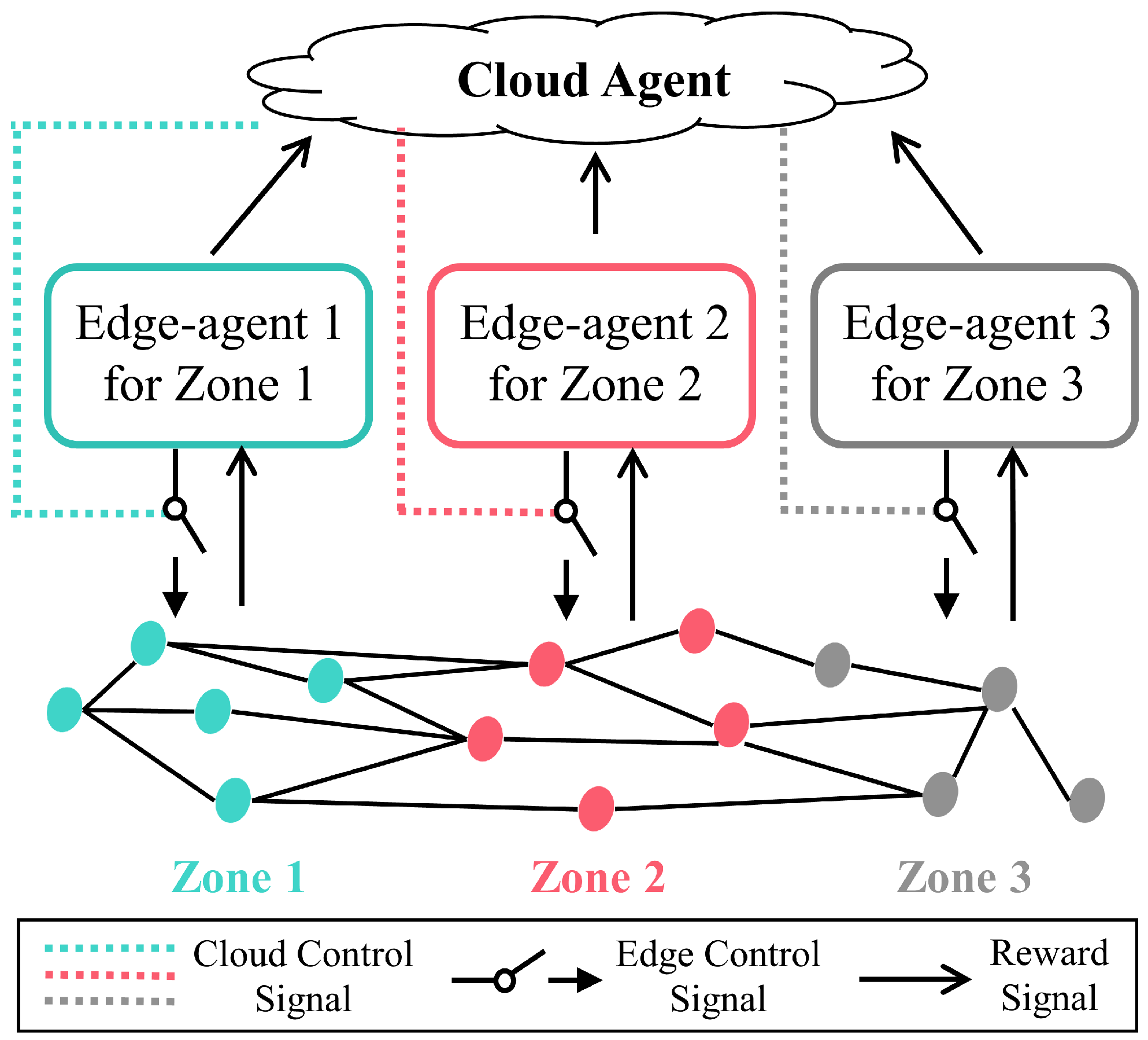
- A Cloud–Edge Collaborative DRL framework for emergency voltage control. The framework trains faster and scales better than centralized methods. The cloud–edge collaborative design incorporates distributed computing principles such that edge agents provide local control while cloud coordination ensures global inter-area coordination, creating a topology-exploiting DRL architecture through the strategic integration of cloud–edge computing and multi-agent learning techniques. The cloud–edge structure aligns with grid area boundaries or cluster definitions, while the coordination of multiple edge agents employs computationally efficient neural network parameter-space random search methodologies.
- A parallel training scheme in which edge agents learn area-specific policies on local fault scenarios while a cloud supervisory agent concurrently learns to coordinate the edge-level agents. This approach reduces computation compared to training a single centralized DRL agent with a much larger neural network.
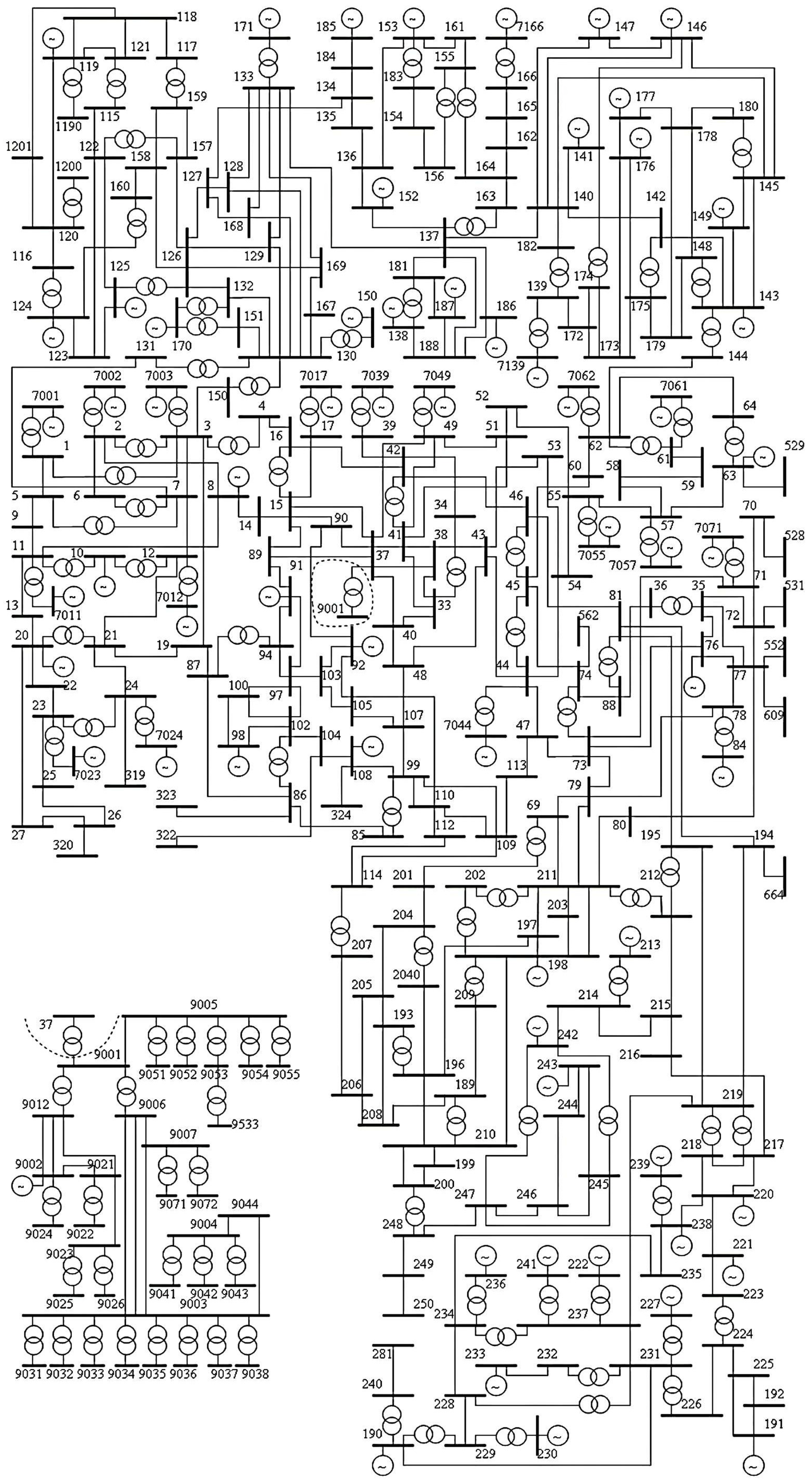
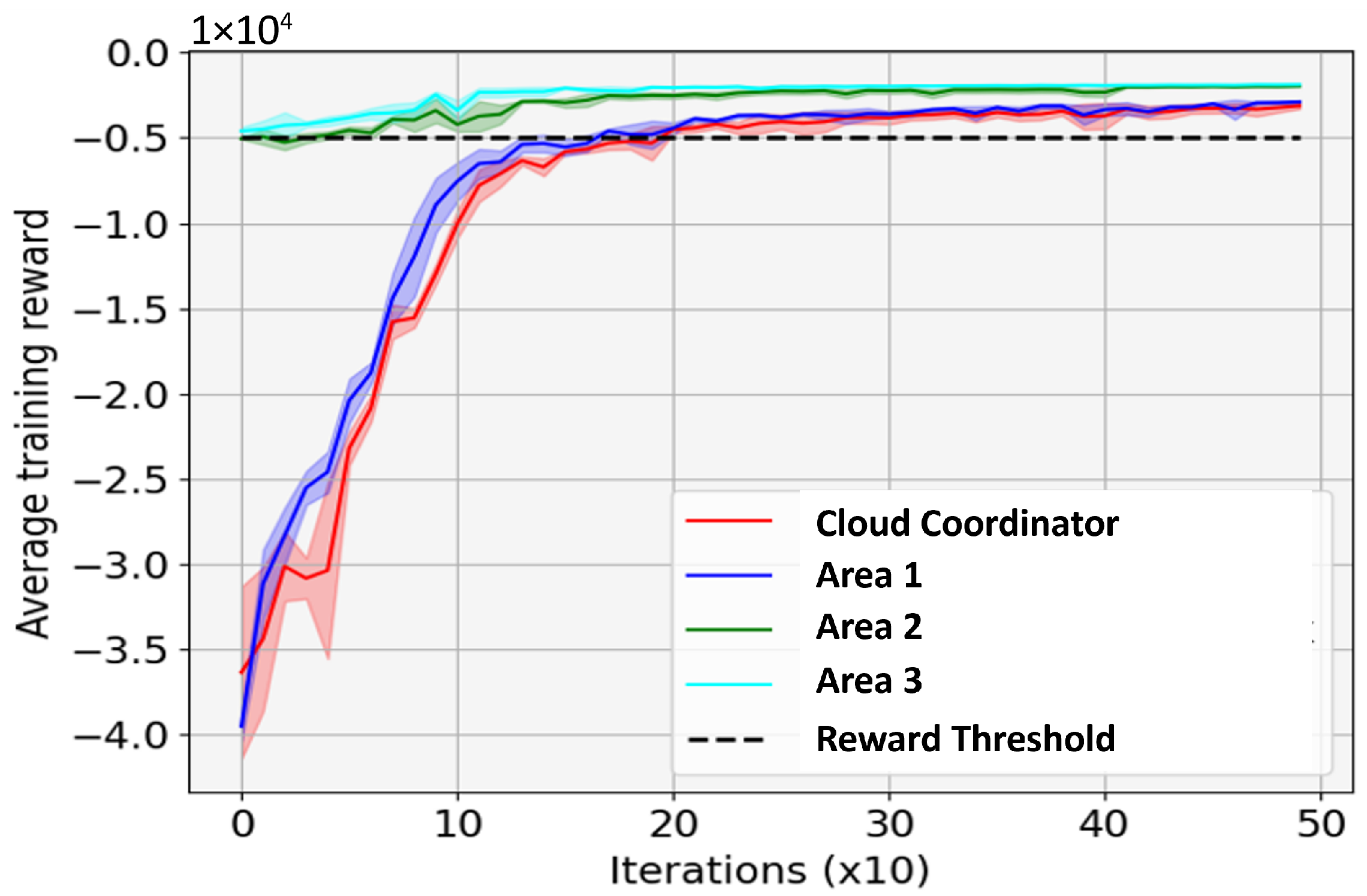
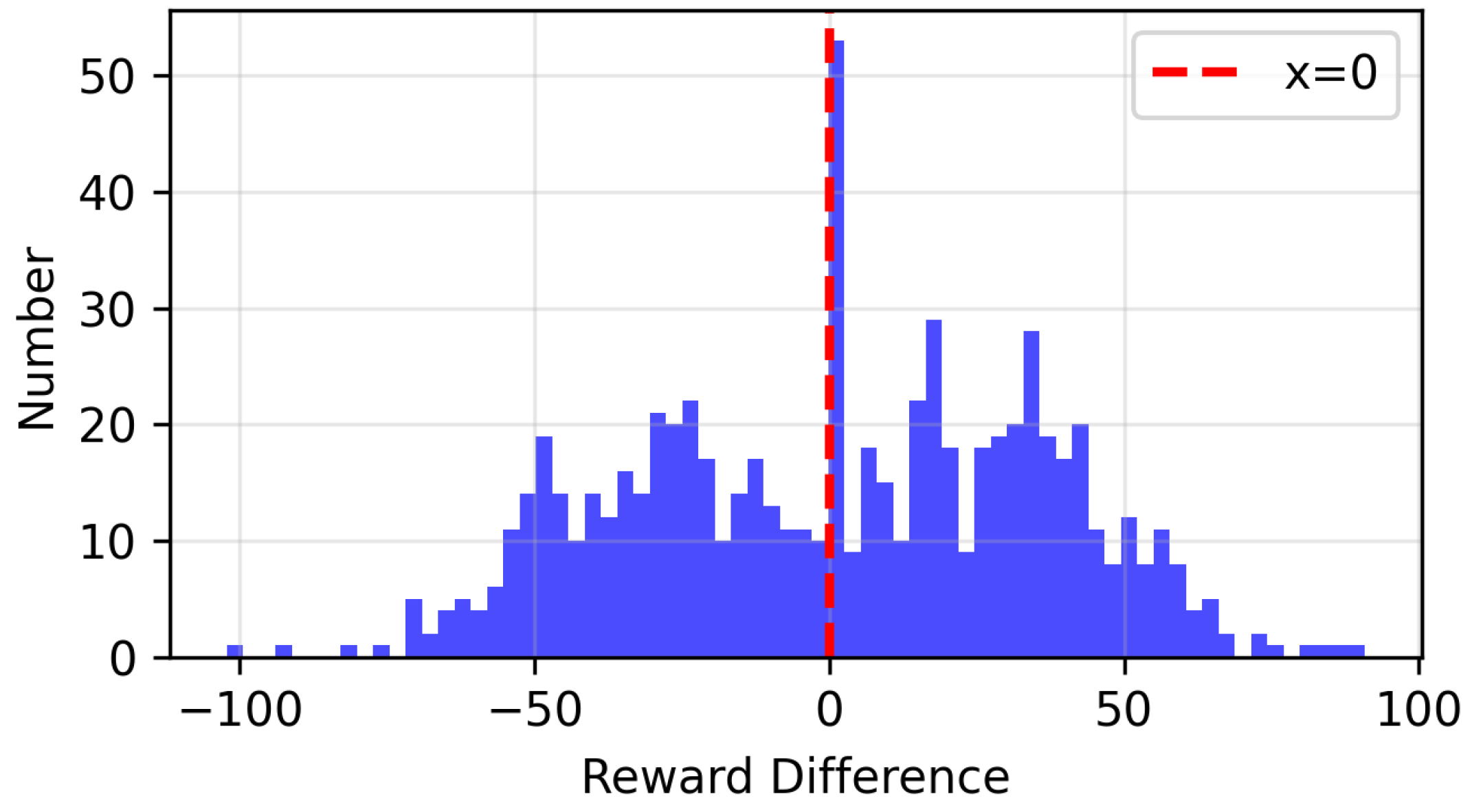
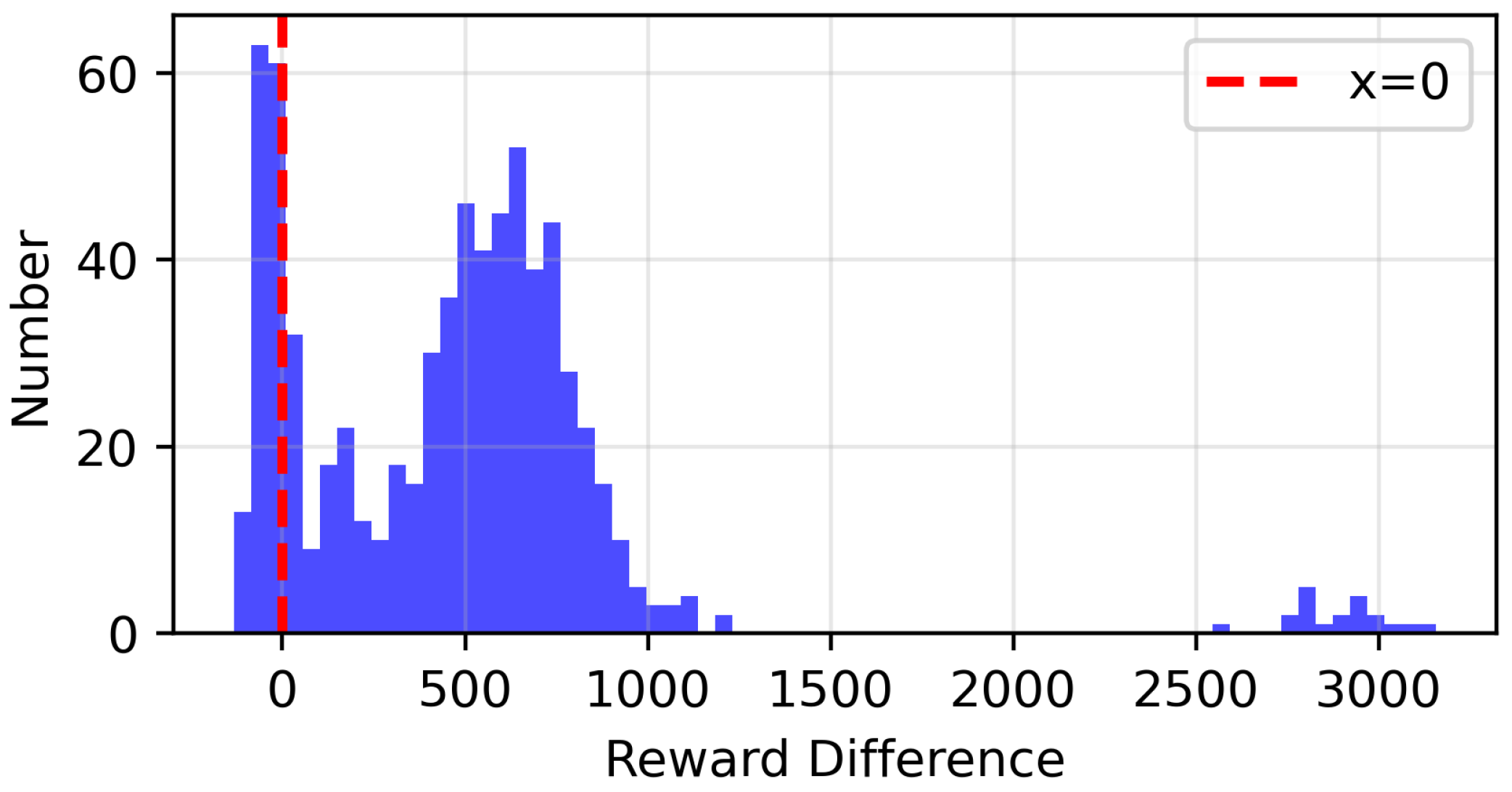
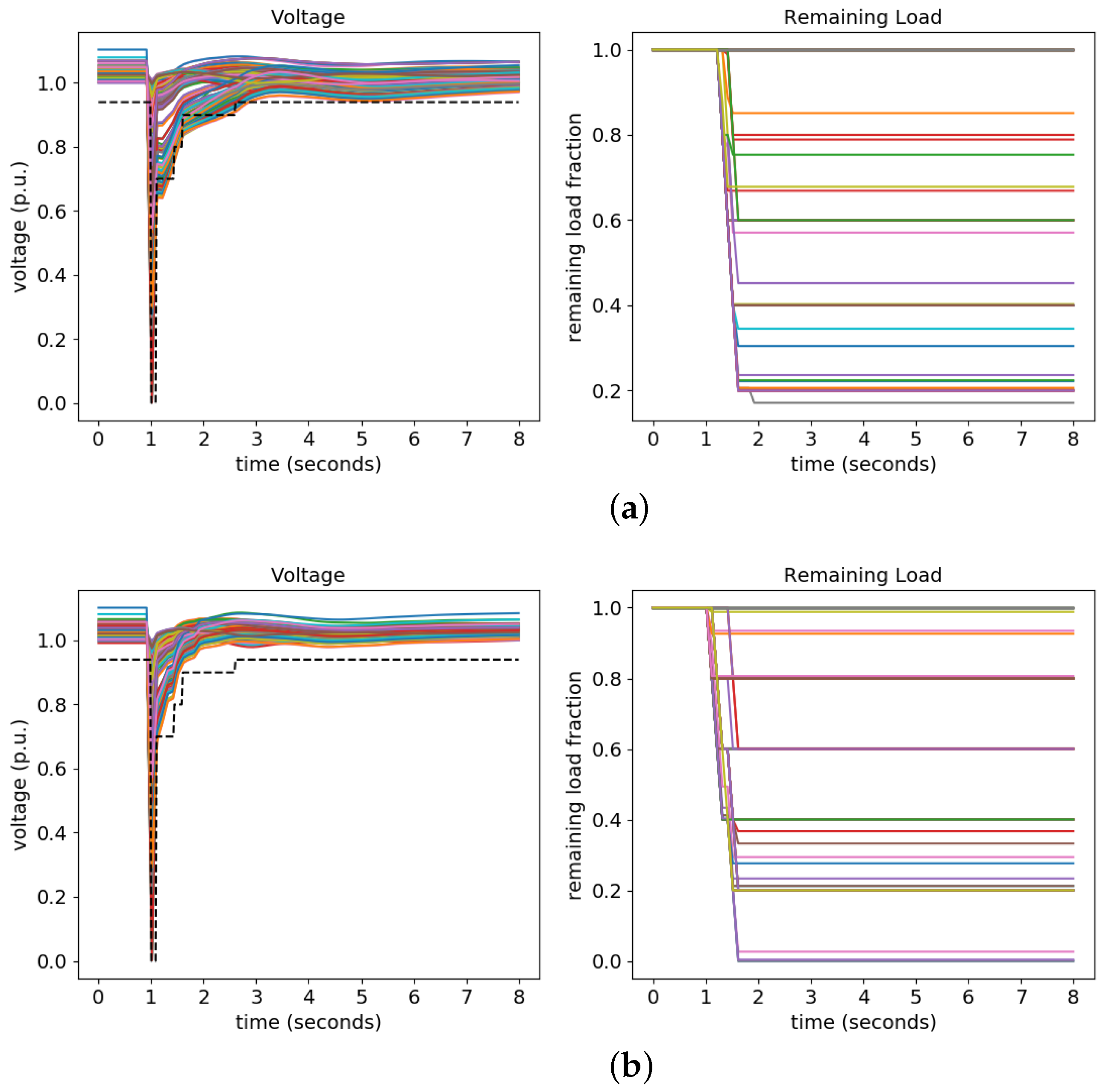
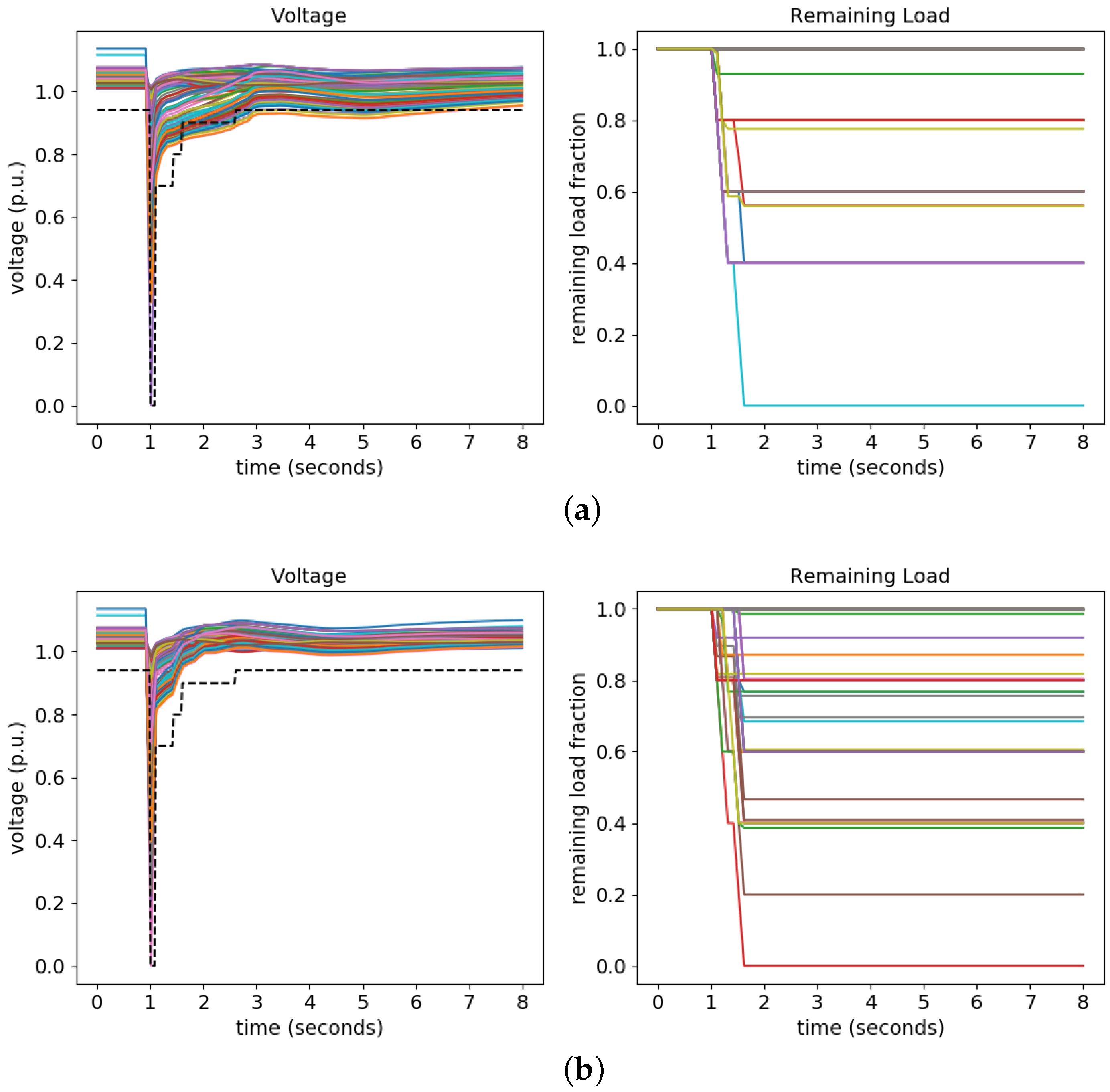
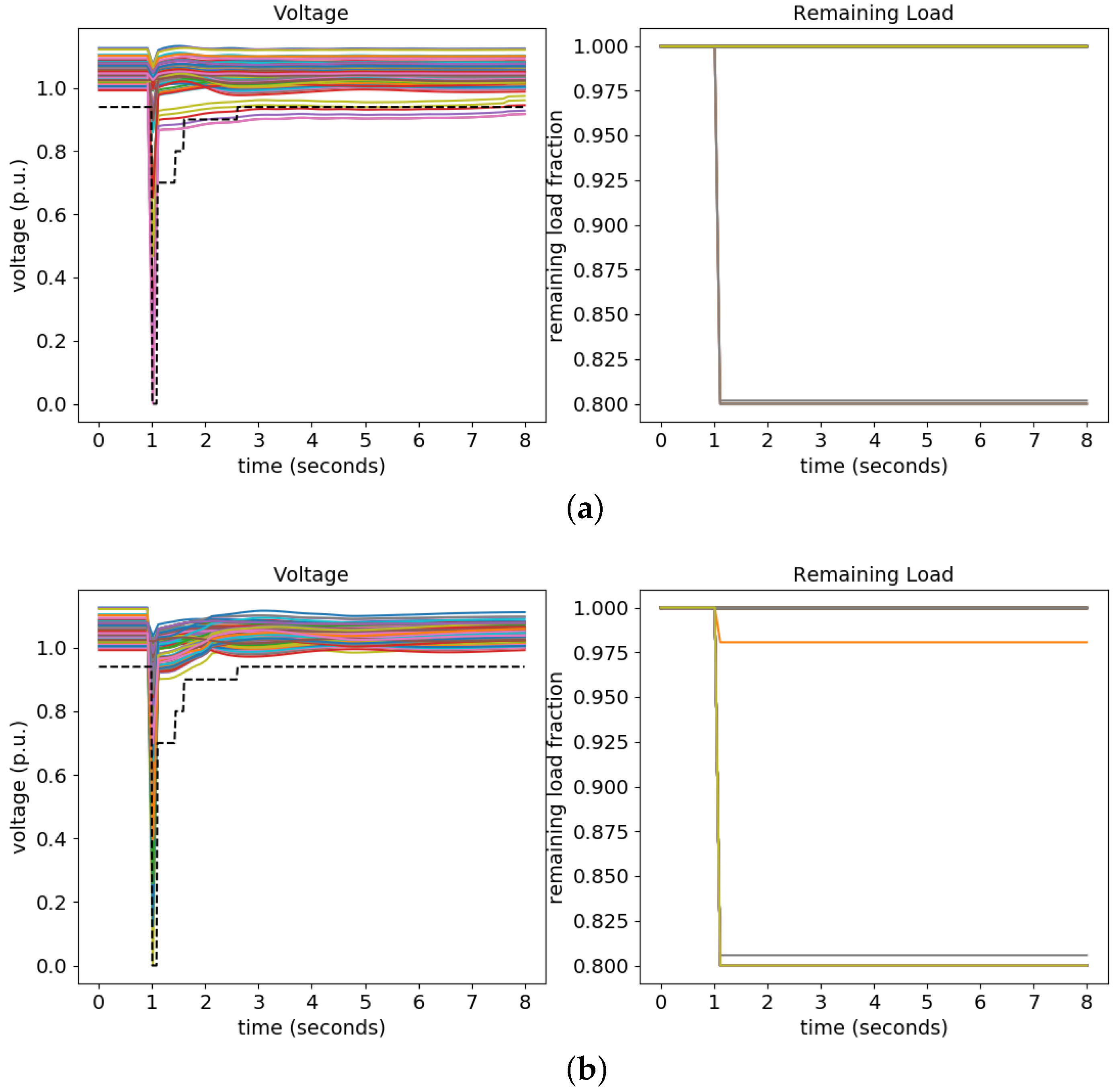
- Comprehensive performance validation of the proposed method and comparison against both a fully centralized and a fully decentralized DRL baseline on the IEEE 300-bus test system featuring a 3-area configuration. The proposed framework achieves approximately 90% reduction in training time compared to the centralized approach (9.59 h vs. 96.37 h), delivers comparable voltage recovery reward performance to the centralized method, and outperforms the fully decentralized approach by approximately 80% in terms of reward performance across all tested fault scenarios, demonstrating both its scalability and the effectiveness of the cloud-level coordination.
2. Problem Formulation
2.1. Emergency Voltage Stabilization Through Strategic Load Reduction
2.2. Markov Decision Process Framework for Load Reduction Control
3. Cloud–Edge Reinforcement Learning
3.1. Cloud–Edge RL Formulation
3.2. Guided Surrogate-Gradient-Based Evolutionary Random Search (GSERS)
| Algorithm 1 Guided Surrogate-gradient-based Evolutionary Random Search (GSERS). |
|
3.3. Cloud–Edge Collaborative DRL Algorithm
| Algorithm 2 Cloud–Edge Collaborative Training Framework. |
|
4. Results
4.1. Test System and Simulation Setup
4.2. Test Results
4.3. Computational Cost Assessment
5. Future Work Discussion
6. Conclusions
Author Contributions
Funding
Data Availability Statement
Conflicts of Interest
Nomenclature
| Abbreviations | |
| DRL | Deep Reinforcement Learning |
| FIDVR | Fault Induced Delayed Voltage Recovery |
| GSERS | Guided Surrogate-gradient-based Evolutionary Random Search |
| MDP | Markov Decision Process |
| MPC | Model Predictive Control |
| RL | Reinforcement Learning |
| UVLS | Under Voltage Load Shedding |
| Parameters and Variables | |
| objective function | |
| dynamic state vector and the corresponding bounds | |
| algebraic state vector and the corresponding bounds | |
| control actions and the corresponding bounds | |
| system fault or disturbance | |
| time index, start/end time of the emergency control window | |
| differential and algebraic equations of the system | |
| observation at time | |
| bus voltage magnitudes in | |
| remaining load fractions at controllable buses | |
| historical window size | |
| stacked state of RL | |
| cloud/edge instant reward of RL at time | |
| voltage at bus k | |
| voltage shortfall term | |
| per-unit load shed at bus m at time | |
| penalty for invalid shedding actions | |
| , , | reward weights |
| fault clearing time | |
| large negative reward penalty constant | |
| horizon length | |
| discount factor | |
| region index and number of regions | |
| the set of nodes included in each region | |
| public nodes shared across regions | |
| the union of all nodes within region n | |
| cloud/edge agent states | |
| regional dynamic/algebraic states | |
| cloud/edge action vector | |
| activation indicator for region n | |
| cloud/edge policies | |
| cloud/edge returns as sum of immediate rewards | |
| perturbation magnitude | |
| Gaussian perturbation directions | |
| discount factor and policy distribution | |
| Gaussian-smoothed objective | |
| Gaussian density | |
| identity matrices | |
| gradient estimation | |
| scaling constant | |
| M | sample count |
| orthonormal basis of surrogate-gradient subspace | |
| guided covariance | |
| exploration–guidance trade-off | |
| (regional) environment simulator | |
| rollout length and step size in Algorithm 1 | |
| cloud-level / edge-level training iterations | |
| cloud coordination policy | |
| Edge policy collection | |
| fault bus subsets used for training |
References
- Adhikari, S.; Schoene, J.; Gurung, N.; Mogilevsky, A. Fault Induced Delayed Voltage Recovery (FIDVR): Modeling and Guidelines. In 2019 IEEE Power & Energy Society General Meeting (PESGM); IEEE: Atlanta, GA, USA, 2019; pp. 1–5. [Google Scholar]
- Van Cutsem, T.; Vournas, C. Voltage Stability of Electric Power Systems; Springer Science & Business Media: Berlin/Heidelberg, Germany, 2007. [Google Scholar]
- Australian Energy Market Operator. Black System South Australia 28 September 2016; Australian Energy Market Operator Limited: Melbourne, VIC, Australia, 2017. [Google Scholar]
- Sun, H.; Guo, Q.; Qi, J.; Ajjarapu, V.; Bravo, R.; Chow, J.; Li, Z.; Moghe, R.; Nasr-Azadani, E.; Tamrakar, U.; et al. Review of Challenges and Research Opportunities for Voltage Control in Smart Grids. IEEE Trans. Power Syst. 2019, 34, 2790–2801. [Google Scholar] [CrossRef] [Scilit]
- Dong, Y.; Xie, X.; Wang, K.; Zhou, B.; Jiang, Q. An Emergency-Demand-Response Based Under Speed Load Shedding Scheme to Improve Short-Term Voltage Stability. IEEE Trans. Power Syst. 2017, 32, 3726–3735. [Google Scholar] [CrossRef] [Scilit]
- Amraee, T.; Ranjbar, A.; Feuillet, R. Adaptive under-voltage load shedding scheme using model predictive control. Electr. Power Syst. Res. 2011, 81, 1507–1513. [Google Scholar] [CrossRef] [Scilit]
- Chakraborty, R.; Chakrabortty, A.; Farantatos, E.; Patel, M.; Hooshyar, H.; Darvishi, A. Hierarchical frequency and voltage control using prioritized utilization of inverter based resources. Int. J. Electr. Power Energy Syst. 2023, 144, 108527. [Google Scholar] [CrossRef] [Scilit]
- Jin, L.; Kumar, R.; Elia, N. Model Predictive Control-Based Real-Time Power System Protection Schemes. IEEE Trans. Power Syst. 2010, 25, 988–998. [Google Scholar] [CrossRef] [Scilit]
- Genc, I.; Diao, R.; Vittal, V.; Kolluri, S.; Mandal, S. Decision tree-based preventive and corrective control applications for dynamic security enhancement in power systems. IEEE Trans. Power Syst. 2010, 25, 1611–1619. [Google Scholar] [CrossRef] [Scilit]
- Matavalam, A.R.R.; Ajjarapu, V. PMU-Based Monitoring and Mitigation of Delayed Voltage Recovery Using Admittances. IEEE Trans. Power Syst. 2019, 34, 4451–4463. [Google Scholar] [CrossRef]
- Zhang, J.; Lu, C.; Fang, C.; Ling, X.; Zhang, Y. Load shedding scheme with deep reinforcement learning to improve short-term voltage stability. In Proceedings of the 2018 IEEE Innovative Smart Grid Technologies-Asia (ISGT Asia); IEEE: Piscataway, NJ, USA, 2018; pp. 13–18. [Google Scholar]
- Huang, R.; Chen, Y.; Yin, T.; Li, X.; Li, A.; Tan, J.; Huang, Q. Accelerated Deep Reinforcement Learning Based Load Shedding for Emergency Voltage Control. arXiv 2020, arXiv:2006.12667. [Google Scholar] [CrossRef] [Scilit]
- Mnih, V.; Kavukcuoglu, K.; Silver, D.; Graves, A.; Antonoglou, I.; Wierstra, D.; Riedmiller, M. Playing Atari with Deep Reinforcement Learning. arXiv 2013, arXiv:1312.5602. [Google Scholar] [CrossRef] [Scilit]
- Schulman, J.; Wolski, F.; Dhariwal, P.; Radford, A.; Klimov, O. Proximal Policy Optimization Algorithms. arXiv 2017, arXiv:1707.06347. [Google Scholar] [CrossRef] [Scilit]
- Haarnoja, T.; Zhou, A.; Abbeel, P.; Levine, S. Soft Actor-Critic: Off-Policy Maximum Entropy Deep Reinforcement Learning with a Stochastic Actor. arXiv 2018, arXiv:1801.01290v2. [Google Scholar] [CrossRef] [Scilit]
- Kang, H.; Jung, S.; Kim, H.; Jeoung, J.; Hong, T. Reinforcement learning-based optimal scheduling model of battery energy storage system at the building level. Renew. Sustain. Energy Rev. 2024, 190, 114054. [Google Scholar] [CrossRef] [Scilit]
- Hashmy, Y.; Yu, Z.; Shi, D.; Weng, Y. Wide-area measurement system-based low frequency oscillation damping control through reinforcement learning. IEEE Trans. Smart Grid 2020, 11, 5072–5083. [Google Scholar] [CrossRef] [Scilit]
- Sun, X.; Qiu, J. Two-stage volt/var control in active distribution networks with multi-agent deep reinforcement learning method. IEEE Trans. Smart Grid 2021, 12, 2903–2912. [Google Scholar] [CrossRef] [Scilit]
- Chen, H.; Zhuang, J.; Zhou, G.; Wang, Y.; Sun, Z.; Levron, Y. Emergency load shedding strategy for high renewable energy penetrated power systems based on deep reinforcement learning. Energy Rep. 2023, 9, 434–443. [Google Scholar] [CrossRef] [Scilit]
- Wu, Z.; Li, Y.; Zhang, X.; Zheng, S.; Zhao, J. Distributed voltage control for multi-feeder distribution networks considering transmission network voltage fluctuation based on robust deep reinforcement learning. Appl. Energy 2025, 379, 124984. [Google Scholar] [CrossRef] [Scilit]
- Kiranyaz, S.; Gastli, A.; Ben-Brahim, L.; Al-Emadi, N.; Gabbouj, M. Real-time fault detection and identification for MMC using 1-D convolutional neural networks. IEEE Trans. Ind. Electron. 2019, 66, 8760–8771. [Google Scholar] [CrossRef] [Scilit]
- Han, Y.; Qi, W.; Ding, N.; Geng, Z. Short-time wavelet entropy integrating improved LSTM for fault diagnosis of modular multilevel converter. IEEE Trans. Cybern. 2022, 52, 7504–7512. [Google Scholar] [CrossRef] [Scilit]
- Ye, S.; Jiang, J.; Li, J.; Liu, Y.; Zhou, Z.; Liu, C. Fault diagnosis and tolerance control of five-level nested NPP converter using wavelet packet and LSTM. IEEE Trans. Power Electron. 2020, 35, 1907–1921. [Google Scholar] [CrossRef] [Scilit]
- Fan, C.; Xiahou, K.; Wang, L.; Wu, Q.H. Data-driven fault detection of multiple open-circuit faults for MMC systems based on long short-term memory networks. CSEE J. Power Energy Syst. 2024, 10, 1563–1574. [Google Scholar]
- Fan, C.; Xiahou, K.; Wang, L.; Wu, Q.H. Hybrid fault diagnosis of multiple open-circuit faults for cascaded H-bridge multilevel converter based on perturbation estimation convolution network. IEEE Trans. Instrum. Meas. 2024, 73, 3508812. [Google Scholar] [CrossRef] [Scilit]
- Teimouri, A.; Fathollahi, A.; Raeiszadeh, M.; Rezaei, M.; Mosavi, A. High-Speed Fault Detection and Location Approach for Multilevel Inverters Using Deep Learning and Reliability Evaluation. IEEE Open J. Ind. Electron. Soc. 2026, 7, 291–312. [Google Scholar] [CrossRef] [Scilit]
- Igder, M.A.; Liang, X. Service restoration using deep reinforcement learning and dynamic microgrid formation in distribution networks. IEEE Trans. Ind. Appl. 2023, 59, 5453–5472. [Google Scholar] [CrossRef] [Scilit]
- Zhang, X.; Badihi, H.; Jadidi, S.; Yu, Z.; Zhang, Y. Intelligent fault-tolerant active power control using reinforcement learning for offshore wind farms. IEEE Access 2024, 12, 83782–83795. [Google Scholar] [CrossRef] [Scilit]
- Cao, D.; Zhao, J.; Hu, W.; Ding, F.; Huang, Q.; Chen, Z.; Blaabjerg, F. Data-driven multi-agent deep reinforcement learning for distribution system decentralized voltage control with high penetration of PVs. IEEE Trans. Smart Grid 2021, 12, 4137–4150. [Google Scholar] [CrossRef] [Scilit]
- Jiang, S.; Gao, H.; Wang, X.; Liu, J.; Zuo, K. Deep reinforcement learning based multi-level dynamic reconfiguration for urban distribution network: A cloud-edge collaboration architecture. Glob. Energy Interconnect. 2023, 6, 1–14. [Google Scholar] [CrossRef] [Scilit]
- Li, J.; Cui, H. Cloud–edge cooperative load frequency control for isolated microgrid using emergent computation-based large-scale meta-machine learning. IEEE J. Emerg. Sel. Top. Ind. Electron. 2023, 4, 1278–1290. [Google Scholar] [CrossRef] [Scilit]
- Li, S.; He, H.; Wei, Z.; Zhao, P. Edge computing for vehicle battery management: Cloud-based online state estimation. J. Energy Storage 2022, 55, 105502. [Google Scholar] [CrossRef] [Scilit]
- Wang, K.; Wu, J.; Zheng, X.; Li, J.; Yang, W.; Vasilakos, A.V. Cloud-edge orchestrated power dispatching for smart grid with distributed energy resources. IEEE Trans. Cloud Comput. 2022, 11, 1194–1203. [Google Scholar] [CrossRef] [Scilit]
- Wang, Q.; Li, Q.; Wang, K.; Wang, H.; Zeng, P. Efficient federated learning for fault diagnosis in industrial cloud-edge computing. Computing 2021, 103, 2319–2337. [Google Scholar] [CrossRef] [Scilit]
- Cao, D.; Zhao, J.; Hu, W.; Ding, F.; Huang, Q.; Chen, Z. Attention enabled multi-agent DRL for decentralized volt-VAR control of active distribution system using PV inverters and SVCs. IEEE Trans. Sustain. Energy 2021, 12, 1582–1592. [Google Scholar] [CrossRef] [Scilit]
- Pei, Y.; Zhao, J.; Yao, Y.; Ding, F. Multi-task reinforcement learning for distribution system voltage control with topology changes. IEEE Trans. Smart Grid 2023, 14, 2481–2484. [Google Scholar] [CrossRef] [Scilit]
- Khan, M.W.; Wang, J. The research on multi-agent system for microgrid control and optimization. Renew. Sustain. Energy Rev. 2017, 80, 1399–1411. [Google Scholar] [CrossRef] [Scilit]
- Xu, N.; Mu, C.; Ma, L.; Wang, K. Real-time Voltage Control in Smart Distribution Network through Multi-agent Cooperative Optimization. IEEE Trans. Sustain. Energy 2025, 1–15. [Google Scholar] [CrossRef] [Scilit]
- Zhang, K.; Yang, Z.; Başar, T. Multi-agent reinforcement learning: A selective overview of theories and algorithms. arXiv 2019, arXiv:1911.10635. [Google Scholar]
- Chen, Y.; Zhu, J.; Liu, Y.; Zhang, L.; Zhou, J. Distributed hierarchical deep reinforcement learning for large-scale grid emergency control. IEEE Trans. Power Syst. 2023, 39, 4446–4458. [Google Scholar] [CrossRef] [Scilit]
- Hu, D.; Ye, Z.; Gao, Y.; Ye, Z.; Peng, Y.; Yu, N. Multi-agent deep reinforcement learning for voltage control with coordinated active and reactive power optimization. IEEE Trans. Smart Grid 2022, 13, 4873–4886. [Google Scholar] [CrossRef] [Scilit]
- Nachum, O.; Gu, S.S.; Lee, H.; Levine, S. Data-efficient hierarchical reinforcement learning. Adv. Neural Inf. Process. Syst. 2018, 31. Available online: https://proceedings.neurips.cc/paper_files/paper/2018/file/e6384711491713d29bc63fc5eeb5ba4f-Paper.pdf (accessed on 9 March 2026).
- Al-Emran, M. Hierarchical reinforcement learning: A survey. Int. J. Comput. Digit. Syst. 2015, 4. Available online: https://journal.uob.edu.bh/items/d609c647-d844-4613-9863-98d18cc799b6 (accessed on 9 March 2026). [CrossRef] [Scilit]
- Xu, X.; Zhang, H.; Li, C.; Liu, Y.; Li, W.; Terzija, V. Optimization of the event-driven emergency load-shedding considering transient security and stability constraints. IEEE Trans. Power Syst. 2016, 32, 2581–2592. [Google Scholar] [CrossRef] [Scilit]
- PJM Transmission Planning Department. EXELON Transmission Planning Criteria 2009; PJM Transmission Planning Department: Valley Forge, PA, USA, 2009. [Google Scholar]
- Hines, P.; Blumsack, S. A Centrality Measure for Electrical Networks. In Proceedings of the 41st Annual Hawaii International Conference on System Sciences (HICSS 2008); IEEE: Piscataway, NJ, USA, 2008; p. 185. [Google Scholar] [CrossRef] [Scilit]
- Cai, X.; Gao, L.; Li, X. Efficient generalized surrogate-assisted evolutionary algorithm for high-dimensional expensive problems. IEEE Trans. Evol. Comput. 2019, 24, 365–379. [Google Scholar] [CrossRef] [Scilit]
- Yang, S.; Tian, Y.; He, C.; Zhang, X.; Tan, K.C.; Jin, Y. A gradient-guided evolutionary approach to training deep neural networks. IEEE Trans. Neural Netw. Learn. Syst. 2021, 33, 4861–4875. [Google Scholar] [CrossRef] [Scilit]
- Liu, F.Y.; Li, Z.N.; Qian, C. Self-Guided Evolution Strategies with Historical Estimated Gradients. In Proceedings of the IJCAI; International loint Conferences on Artificial Intelligence Organization: Bremen, Germany, 2020; pp. 1474–1480. [Google Scholar]
- Maheswaranathan, N.; Metz, L.; Tucker, G.; Choi, D.; Sohl-Dickstein, J. Guided evolutionary strategies: Augmenting random search with surrogate gradients. In Proceedings of the International Conference on Machine Learning; PMLR: Cambridge, MA, USA, 2019; pp. 4264–4273. [Google Scholar]
- ICSEG. IEEE 300-Bus System. Available online: https://icseg.iti.illinois.edu/ieee-300-bus-system/ (accessed on 5 March 2026).
- Al-Roomi, A.R. Power Flow Test Systems Repository; Power: Halifax, NS, Canada, 2015. [Google Scholar]
- Huang, R.; Jin, S.; Chen, Y.; Diao, R.; Palmer, B.; Huang, Q.; Huang, Z. Faster than real-time dynamic simulation for large-size power system with detailed dynamic models using high-performance computing platform. In Proceedings of the 2017 IEEE Power & Energy Society General Meeting; IEEE: Piscataway, NJ, USA, 2017; pp. 1–5. [Google Scholar]
- Huang, Q.; Hao, W.; Huang, R. RLGC: An Open-Source Platform for Developing and Benchmarking Reinforcement Learning for Grid Control. Available online: https://github.com/RLGC-Project/RLGC (accessed on 5 March 2026).
- Huang, Q.; Huang, R.; Hao, W.; Tan, J.; Fan, R.; Huang, Z. Adaptive power system emergency control using deep reinforcement learning. IEEE Trans. Smart Grid 2019, 11, 1171–1182. [Google Scholar] [CrossRef] [Scilit]
- Cao, D.; Hu, W.; Zhao, J.; Huang, Q.; Chen, Z.; Blaabjerg, F. A multi-agent deep reinforcement learning based voltage regulation using coordinated PV inverters. IEEE Trans. Power Syst. 2020, 35, 4120–4123. [Google Scholar] [CrossRef] [Scilit]
- Berkenkamp, F.; Turchetta, M.; Schoellig, A.P.; Krause, A. Safe model-based reinforcement learning with stability guarantees. In Proceedings of the Advances in Neural Information Processing Systems; NeurIPS: San Diego, CA, USA, 2017; Volume 30. [Google Scholar]
- Bouteiller, Y.; Ramstedt, S.; Beltrame, G.; Pal, C.; Binas, J. Reinforcement learning with random delays. In Proceedings of the International Conference on Learning Representations; ICLR: Drive Appleton, WI, USA, 2021. [Google Scholar]
- Mankowitz, D.J.; Levine, N.; Jeong, R.; Shi, Y.; Kay, J.; Abdolmaleki, A.; Springenberg, J.T.; Mann, T.; Hester, T.; Riedmiller, M. Robust reinforcement learning for continuous control with model misspecification. arXiv 2019, arXiv:1906.07516. [Google Scholar]
- Misyris, G.S.; Venzke, A.; Chatzivasileiadis, S. Physics-informed neural networks for power systems. In 2020 IEEE Power & Energy Society General Meeting (PESGM); IEEE: Piscataway, NJ, USA, 2020; pp. 1–5. [Google Scholar]



| Parameters | Area 1 | Area 2 | Area 3 | Coordinator |
|---|---|---|---|---|
| Policy network size (hidden layers) | [16, 16] | [16, 16] | [16, 16] | [16, 16] |
| Observation space dimension | 17 | 21 | 15 | 30 |
| Action space dimension | 15 | 18 | 13 | 3 |
| Training fault scenarios | 8 | 9 | 7 | 11 |
| Number of directions | 18 | 18 | 18 | 24 |
| Top directions | 8 | 8 | 8 | 10 |
| Maximum iterations | 500 | 500 | 500 | 500 |
| Step size | 1 | 1 | 1 | 1 |
| Std. dev. of exploration noise | 2 | 2 | 2 | 2 |
| Decay rate | 0.996 | 0.996 | 0.996 | 0.996 |
| Centralized full-scale training | 96.37 h |
| Cloud–Edge Collaborative training | 9.59 h (≈90% saving) |
| Component | Network Size | Avg. Inference Time (ms) |
|---|---|---|
| Edge Agent (Area 1) | [16, 16] LSTM + FC | 11.1 |
| Edge Agent (Area 2) | [16, 16] LSTM + FC | 11.5 |
| Edge Agent (Area 3) | [16, 16] LSTM + FC | 10.9 |
| Cloud Coordinator | [16, 16] LSTM + FC | 12.1 |
| Direction | Data Content | Payload Size | Est. Latency |
|---|---|---|---|
| Cloud → Edge | Boolean activation signals () | 3 bits | < ms |
| Edge → Cloud | Local state observation | 1 KB (per agent) | < ms |
Disclaimer/Publisher’s Note: The statements, opinions and data contained in all publications are solely those of the individual author(s) and contributor(s) and not of MDPI and/or the editor(s). MDPI and/or the editor(s) disclaim responsibility for any injury to people or property resulting from any ideas, methods, instructions or products referred to in the content. |
© 2026 by the authors. Licensee MDPI, Basel, Switzerland. This article is an open access article distributed under the terms and conditions of the Creative Commons Attribution (CC BY) license.
Share and Cite
Yang, D.; Cheng, B.; Wu, J.; Zhao, Y.; Tang, X.; Huang, R. Efficient Emergency Load Shedding to Mitigate Fault-Induced Delayed Voltage Recovery Using Cloud–Edge Collaborative Learning and Guided Evolutionary Strategy. Electronics 2026, 15, 1377. https://doi.org/10.3390/electronics15071377
Yang D, Cheng B, Wu J, Zhao Y, Tang X, Huang R. Efficient Emergency Load Shedding to Mitigate Fault-Induced Delayed Voltage Recovery Using Cloud–Edge Collaborative Learning and Guided Evolutionary Strategy. Electronics. 2026; 15(7):1377. https://doi.org/10.3390/electronics15071377
Chicago/Turabian StyleYang, Dongyang, Bing Cheng, Jisi Wu, Yunan Zhao, Xingao Tang, and Renke Huang. 2026. "Efficient Emergency Load Shedding to Mitigate Fault-Induced Delayed Voltage Recovery Using Cloud–Edge Collaborative Learning and Guided Evolutionary Strategy" Electronics 15, no. 7: 1377. https://doi.org/10.3390/electronics15071377
APA StyleYang, D., Cheng, B., Wu, J., Zhao, Y., Tang, X., & Huang, R. (2026). Efficient Emergency Load Shedding to Mitigate Fault-Induced Delayed Voltage Recovery Using Cloud–Edge Collaborative Learning and Guided Evolutionary Strategy. Electronics, 15(7), 1377. https://doi.org/10.3390/electronics15071377