Article

Power Allocation for Sum-Rate Maximization in VLC-NOMA Systems with Improved Particle Swarm Optimization


Information and Navigation College, Air Force Engineering University, Xi’an 710077, China
*
Authors to whom correspondence should be addressed.
Electronics 2026, 15(7), 1378; https://doi.org/10.3390/electronics15071378
Submission received: 22 January 2026 / Revised: 13 March 2026 / Accepted: 24 March 2026 / Published: 26 March 2026

Abstract

Non-orthogonal multiple access (NOMA) has been recognized as a promising technique to alleviate the bandwidth limitation in visible light communication (VLC) downlinks. Nevertheless, the corresponding power allocation problem is typically non-convex and computationally challenging under practical system constraints, which limits the effectiveness of conventional optimization approaches. To address this issue, this paper proposes an improved particle swarm optimization (IPSO)-based strategy that aims at maximizing the system sum rate and employs adaptive mechanisms including an adaptive dynamic inertia weight, cooperative evolutionary learning factors, and enhanced elite opposition-based learning (EEOBL) to strengthen both global search capability and convergence performance. Simulation results indicate that the proposed scheme significantly improves the overall system capacity across diverse interference scenarios, while achieving accelerated convergence and enhanced robustness.

1. Introduction

In next-generation wireless communication networks, security risks associated with data transmission technologies are becoming increasingly pronounced. Traditional radio frequency (RF) communication suffers from inherent drawbacks, such as the strong penetration capability of electromagnetic waves and the susceptibility of signals to interception, which pose a significant challenge to communication confidentiality, particularly in sensitive sectors like military and finance. To this end, visible light communication (VLC) has emerged as a crucial complementary technology for indoor scenarios, leveraging its advantages of abundant spectrum resources, strong resistance to electromagnetic interference, and high inherent security [1,2]. However, the limited modulation bandwidth of VLC constrains system performance, encompassing system capacity, user fairness, and the number of connectable users, which represents a major challenge to the application of VLC in high-speed communications. As a promising solution, non-orthogonal multiple access (NOMA), with its unique power-domain multiplexing mechanism, can significantly enhance system capacity and spectral efficiency, thereby mitigating, to some extent, the inherent limitations of VLC systems [3,4,5]. NOMA facilitates user resource allocation through power-domain multiplexing, with its core principle being the assignment of different power levels to users based on their channel conditions. Based on channel state information (CSI), the base station allocates higher power to users with poor channel conditions and lower power to users with favorable channel conditions at the transmitter. Multi-user signal separation is then achieved at the receiver employing successive interference cancellation (SIC). In contrast with traditional orthogonal multiple access (OMA) techniques, multiple users in NOMA can share the same time or frequency resources. SIC decodes the strongest signal by treating weaker signals as noise, subsequently cancels it from the composite signal, and iterates this process to decode subsequent signals. Applying NOMA to the downlink of VLC systems can effectively mitigate the limitation imposed by the limited VLC modulation bandwidth, further enhancing the overall system capacity. However, the full potential of NOMA critically depends on highly efficient power allocation strategies.
In NOMA-VLC systems, power allocation, which is a core technology for enhancing system performance, has the primary objective of optimizing performance metrics such as system throughput, user fairness, or bit error rate under specific system constraints [6,7,8]. Consequently, developing efficient and robust power allocation algorithms constitutes a central challenge and a key research problem for NOMA-VLC systems. Research on power allocation in NOMA-VLC systems has been proposed and validated in prior literature [9,10,11,12,13,14,15,16]. Reference [9] introduced a gain ratio power allocation (GRPA) scheme, which allocates power to individual users based on their channel conditions and was shown to achieve superior system performance compared with the fixed power allocation (FPA) scheme [10]. The authors of [11] proposed an efficient normalized gain difference power allocation (NGDPA) scheme to enhance the achievable sum rate in multi-user VLC systems, which offers lower computational complexity. Given nonlinear or non-convex constraints and objectives, such as minimum quality-of-service requirements or system sum-rate maximization, the power allocation problem in NOMA-based VLC systems is typically non-convex, rendering traditional solution methods inadequate. Some investigations have utilized convex optimization theories to transform the original non-convex problem (or its approximation) into a convex one for solution. References [12,13] first formulated non-convex optimization problems that aim at maximizing the total rate of VLC systems under the constraints of satisfying user quality of service (QoS) and ensuring fairness with optical power constraints, respectively, and which were then converted into convex ones via approximation techniques for tractable solutions. The performance of these strategies was demonstrated to surpass that of FPA and GRPA. The authors of [14] addressed the power allocation problem among a limited number of users under constrained system resources by proposing an optimization scheme based on multi-factor constraints, leveraging optimization theory to transform the non-convex model into a convex one for solution. However, convex optimization methods, which typically rely on approximations or transformations of the original non-convex problem, exhibit significant limitations including (1) degraded solution quality due to approximations, often yielding only locally optimal results; (2) drastically increased computational complexity with problem scale, hindering real-time application; and (3) limited capability to handle strongly non-convex constraints. These drawbacks are particularly pronounced in complex scenarios, such as those involving joint constraints of SIC decoding order, optical peak intensity, and non-negative optical power, or in large-scale user networks. In response to these limitations, particle swarm optimization (PSO) has recently been explored as an alternative approach for power allocation in NOMA-VLC systems. Reference [15] introduced PSO to optimize user resource allocation in a hybrid VLC scheme, demonstrating improved system performance. Reference [16] employed PSO to optimize an objective function for NOMA-VLC transmission, aiming to enhance both system performance and user fairness. However, despite its ability to handle non-convex problems, standard PSO suffers from inherent limitations of its own, including premature convergence and a tendency to become trapped in local optima, particularly when solving tightly constrained problems.
Motivated by this, we focus on the power allocation optimization problem in NOMA-VLC systems, particularly in scenarios characterized by a large user scale and complex constraints that result in highly non-convex problems, rendering traditional convex optimization methods inefficient or even entirely ineffective. While this sum-rate maximization problem has been extensively studied under various constraints, existing solution approaches fall into two categories with inherent limitations: (i) convex approximation methods sacrifice optimality for tractability and struggle with the tightly constrained scenarios mentioned above, and (ii) standard metaheuristics [6] can handle non-convexity but often suffer from premature convergence, particularly as problem complexity increases. To effectively address this challenge, we propose an improved swarm intelligence algorithm, which is capable of directly addressing non-convex optimization problems in practical NOMA-VLC systems characterized by multiple nonlinear constraints. The contributions of this paper can be summarized as follows.
  • We first establish an indoor NOMA-VLC downlink system model with randomly distributed users. Accounting for the residual interference induced by imperfect SIC, we then systematically investigate the power allocation optimization problem for the system.
  • Leveraging this baseline model, we develop a sum-rate maximization framework, where the resulting non-convex power allocation problem explicitly incorporates practical constraints, such as illuminance targets, eye-safety regulations, per-LED power budgets, individual QoS guarantees, and the unique amplitude limitation of VLC signals, so that the achievable sum rate is maximized without violating any operational requirement.
  • To circumvent the non-convexity of the original formulation, we put forward an improved particle swarm optimization (IPSO) algorithm that operates directly in the non-convex landscape without any convexification step. The proposed IPSO algorithm integrates (i) an adaptive inertia weight that self-tunes to the instantaneous swarm diversity, (ii) cooperative learning factors that allow particles to exploit both personal and social bests in a synergistic manner, and (iii) an elite opposition-based learning module that instantaneously reinitializes under-performing particles around the mirrored elite. These three mechanisms jointly drive the swarm toward a high-quality global power allocation solution while maintaining exploration and exploitation balance.
  • Finally, the proposed IPSO-based power allocation strategy is evaluated in a NOMA-VLC network under realistic conditions. Simulation results verify that our strategy yields substantial capacity improvements under both perfect and imperfect SIC, while converging markedly faster than the existing PSO scheme.

2. System Model

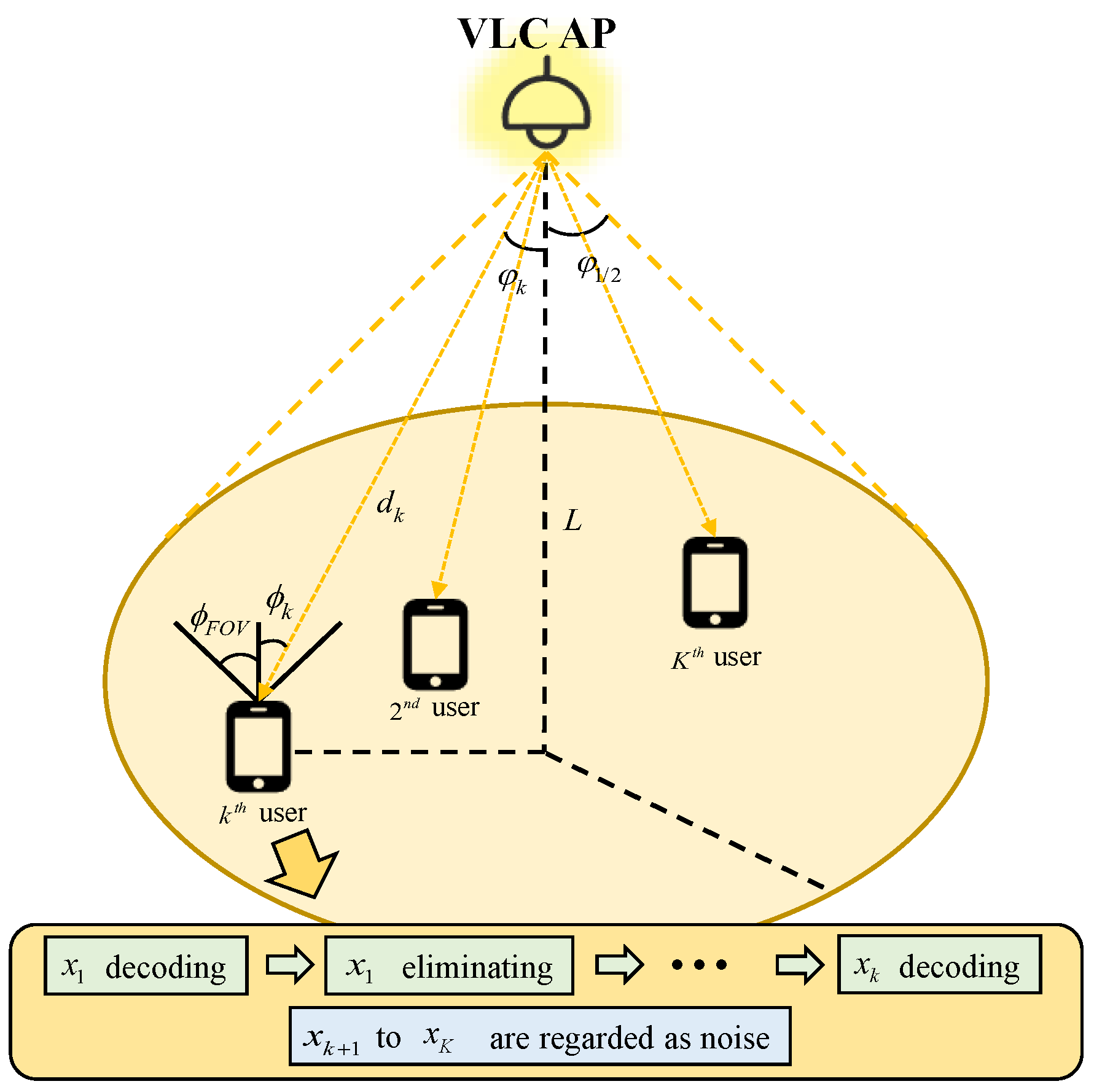
A downlink scenario of an indoor NOMA-based VLC system is constructed, as illustrated in Figure 1. The scenario consists of a single LED transmitter and K users. At the transmitter, the LED positioned at the center of the ceiling allocates different power levels to users based on their channel gain differences according to NOMA principles. Specifically, users with higher channel gains are allocated lower transmit power compared with those with lower channel gains.

2.1. VLC Channel

Based on the fact that the line-of-sight (LoS) link is dominant in indoor VLC and to simplify the analysis, it is assumed that only a direct LoS path exists between the LED and each user receiver [17]. This implies that reflected, diffuse, and other non-line-of-sight (NLoS) components are neglected in our channel model. Consequently, the channel gain between the LED transmitter and user can be calculated as
h k = ( m + 1 ) A k 2 π d k 2 cos m ( Ψ k ) T s ( Φ k ) g ( Φ k ) cos ( Φ k ) , 0 Φ k Φ FOV 0 , Φ k > Φ FOV
where A k is the photodetector (PD) receiving area of user k. Φ k , Φ F O V , and Ψ k represent the incidence angle, receiver FOV angle, and LED radiation angle of user k, respectively. d k is the distance between the LED and user k. T s ( Φ k ) is the optical filter gain of user k, which is typically normalized to unity T s ( Φ k ) = 1 without loss of generality. g ( Φ k ) represents the optical concentrator gain of user k, given by
g ( Φ k ) = k ^ 2 sin Φ F O V 2 , 0 Φ k Φ F O V 0 , Φ k > Φ F O V
where k ^ is the refractive index of the optical concentrator. Furthermore, in (1), m represents the order of Lambertian emission, defined as
m = 1 log 2 [ cos ( φ 1 / 2 ) ]
where φ 1 / 2 is the half-power angle of the LED transmitter.

2.2. NOMA Transmission

In Figure 1, a high-performance NOMA-assisted VLC system is employed to address the critical demand for massive access in next-generation wireless communications. At the transmitter, the channel gains for the K users are assumed to be ordered as h 1 h 2 h k 1 h k . According to the NOMA principle, the power allocated to these users follows the inverse order, namely, p 1 p 2 p k 1 p k . The transmitting signal is modulated using 8-ary pulse position modulation (PPM) [18]. Let X denote the aggregated signal transmitted by LED, which is superposed in the power domain, expressed as
X = k = 1 K p k x k + I bias
where x k denotes the message intended for user k, p k represents the power allocated to user k, and I b i a s is the DC-bias added to ensure the non-negativity of the transmitted optical signal.
At the receiver, each user is equipped with a single PD to capture the aggregated optical signal from the LED. The intended message is then decoded by each user with the aid of SIC. After removing the DC-bias I b i a s , the received signal z k at user k can be expressed as
z k = δ h k i = 1 K p i x i + w k
where δ represents the responsivity of the PD, and w k the additive white Gaussian noise (AWGN) in the channel. At the receiver of user k, it first decodes the signals intended for the weaker users j (where j = 1 , 2 , , k 1 ), treating the signals for the stronger users l (where l = k + 1 , , K ) as interference. Assuming perfect SIC, where the interference from the decoded weaker users is completely eliminated, the achievable rate for user k can be expressed by the following formula:
Υ k = B k · log 2 1 + e 2 π h k 2 p k j = k + 1 K p j h k 2 + N 0 2
where B k is the bandwidth of user k, and N 0 represents the additive white Gaussian noise power. It is noteworthy that, in this paper, since the channel is shared among all users, we have B k = B for k = 1 , 2 , K .
However, in practical SIC implementations, various non-ideal factors result in residual interference from the previously decoded users, which affects the current user’s signal decoding. To account for this, we utilize the interference factor η to represent the residual interference from the weaker users [19]. Considering this factor η , the achievable rate for user k can be revised as [20].
Υ ¯ k = B k · log 2 1 + e 2 π h k 2 p k η j = 1 k 1 h k 2 p j + l = k + 1 K h k 2 p l + N 0 2

3. IPSO-Based Power Allocation Strategy

In this section, we propose a novel sum-rate maximization strategy based on the IPSO algorithm for the indoor NOMA-VLC downlink system. This is achieved by formulating a mathematical power allocation problem subject to constraints including illumination demands, eye safety regulations, transmit power budgets, quality-of-service thresholds, and the unique signal properties of VLC systems. The strategy designs a new intelligent optimization algorithm aimed at enhancing the system capacity while simultaneously improving the computational efficiency and global optimization convergence speed for solving the non-convex problem.

3.1. Problem Formulation

In this part, we formulate the mathematical optimization framework for the power allocation problem in the NOMA-VLC system under investigation, where the objective function is the system sum rate, represented by Υ sum , which is the sum of the achievable rates of all successfully demodulated users. Based on Equation (7), it can be expressed as
Υ sum = k = 1 K Υ ¯ k
To ensure the physical realizability of the aforementioned objective, the system’s power allocation and user association decisions are subject to the following constraints. First, since VLC systems are based on intensity modulation and direct detection (IM/DD), the transmitted signal must be real-valued and non-negative, thus imposing the constraint
k = 1 K p k I b i a s
Furthermore, to ensure human eye safety and compliance with optical radiation safety standards, the peak intensity of the transmitted signal must be constrained. According to Equation (4), this requirement can be expressed as
k = 1 K p k + I b i a s I p
where I p denotes the peak optical intensity of the LED. Second, the total transmit power of the system is limited, and the power allocated to each user must be non-negative, which leads to the constraints
k = 1 K p k P t o t a l
p k 0
Finally, to ensure a minimum QoS for all users and maintain communication continuity, the signal-to-interference-plus-noise ratio (SINR) for each user must not fall below a predefined threshold. Therefore, each user k must satisfy
SINR k = h k 2 p k η h k 2 j = 1 k 1 p j + h k 2 l = k + 1 K p l + N 0 2 SINR min
where S I N R k represents the achievable SINR for user k, and S I N R min denotes the minimum SINR threshold required to ensure the QoS.
Consequently, based on the previous Equations (8)–(13), the mathematical optimization model for maximizing the sum rate of the VLC-NOMA system can be formulated as follows:
max Υ s u m = max k = 1 K Υ ¯ k s . t . k = 1 K p k min { I b i a s , I p I b i a s } S I N R k SINR min k = 1 K p k P t o t a l p k 0
The objective function of this optimization problem is non-convex due to inter-user interference coupling, while the constraints are nonlinear and further complicated by the combinatorial complexity introduced by the SIC decoding order. Consequently, this problem is highly non-convex, and finding its global optimum is generally challenging [21,22]. Traditional convex optimization-based methods struggle to equivalently transform this non-convex problem into a tractable convex form. To address this challenge, this paper proposes a metaheuristic optimization algorithm that does not rely on either the gradient information of the objective function or the convexity of the problem, possessing powerful global search capabilities that enable it to provide high-quality, executable solutions for this highly non-convex problem within acceptable time frames [23].

3.2. The Proposed IPSO Algorithm

As outlined in Section 3.1, the formulated optimization model is highly non-convex. Traditional convex optimization methods, constrained by the problem’s non-convexity and complexity, struggle to balance solution efficiency with quality. To address this limitation, this paper proposes an IPSO algorithm. The proposed IPSO introduces three key modifications to the core velocity update formula of the standard PSO: an adaptive dynamic inertia weight, cooperative evolutionary learning factors, and enhanced elite opposition-based learning (EEOBL) mechanism. These enhancements collectively strengthen the algorithm’s capabilities in both global exploration and local exploitation, enabling efficient resolution of this complex problem [24,25].
The fundamental principle of the PSO algorithm is that each potential solution is regarded as a “particle” within the search space. During iterative updates, each particle adjusts its state by tracking both its own historical best position and the swarm’s global best position. The specific procedure is as follows. First, the swarm is initialized by setting the population size N, the problem dimensionality D, and the maximum number of iterations T max , followed by the generation of initial positions S i = s i 1 , s i 2 , , s i D and velocities V i = v i 1 , v i 2 , , v i D for all particles. Then, the fitness value f S i of each particle, which evaluates the quality of its current position, is computed based on the objective function of the optimization model. Subsequently, each particle’s current position is compared with its personal best position L i = l i 1 , l i 2 , , l i D , and L i is updated if a better solution is found. Concurrently, the particle with the best fitness in the current swarm is identified, and the global best position O i = o 1 , o 2 , , o D is updated accordingly. The core operation of the PSO algorithm is the velocity and position update. The standard PSO update rules are defined as
v i d t + 1 = ω · v i d t + c 1 r 1 l i d , l b e s t t s i d t + c 2 r 2 l d , o b e s t t s i d t
s i d t + 1 = s i d t + v i d t + 1
where v i d t is the velocity vector of particle i in the d dimension at the t iteration, ω is the inertia weight, c 1 and c 2 are the learning factors, and r 1 , r 2 are random numbers uniformly distributed in [0, 1], which introduce stochasticity into the search process. l i d , l b e s t t denotes the personal best position of particle i in the d dimension at the t iteration, while l i d , o b e s t t represents the global best position across the entire swarm in the d dimension at the t iteration.
However, the standard PSO algorithm tends to converge to local optima when dealing with complex optimization problems, and it often suffers from slow convergence speed and low solution accuracy in the later stages of evolution. These limitations primarily stem from its fixed parameters ω , c 1 , c 2 , which hinder an effective balance between global exploration and local exploitation capabilities. Furthermore, the population diversity typically declines rapidly during the later iterations.
To address the aforementioned questions, this paper introduces three key enhancements to the standard update rule in Equation (15) including an adaptive dynamic inertia weight, cooperative evolutionary learning factors, and the integration of the EEOBL mechanism throughout the iterative process. These improvements are implemented through stages of dynamic parameter computation, particle state evolution, and diversity injection via elite learning, collectively enabling the efficient solution of the original non-convex power allocation problem. The details of these enhancements are elaborated below:
(1) Incorporating an adaptive Dynamic Inertia Weight: The conventional fixed or linearly decreasing inertia weight often fails to effectively balance global exploration and local exploitation, especially in complex non-convex optimization environment. To address this limitation, we propose an adaptive dynamic inertia weight that incorporates not only the iteration progress but also the population diversity and convergence state. The proposed inertia weight is defined as
w ( t ) = w min + ( w max w min ) · 1 t T max α ( t ) + β · σ f ( t )
where w max and w min denote the maximum and minimum values of the inertia weight; t is the current iteration number; T max is the maximum iteration number; α ( t ) = 1 + Δ f best ( t ) f best ( t ) is an adaptive exponent that adjusts the decay rate based on the relative improvement of the global best fitness Δ f best ; σ f t is the standard deviation of the current population’s fitness values, reflecting the diversity of the swarm; and β is a small positive constant that modulates the influence of diversity on the inertia weight. In the early stages, a larger w t promotes global exploration, allowing the swarm to rapidly traverse the solution space. As the algorithm progresses, the inertia weight adaptively decreases in a non-linear manner, guided by both the convergence speed and population diversity. This enables a smooth transition from global exploration to local exploitation, enhancing the algorithm’s ability to avoid local optima while maintaining precise convergence near the global optimum. The incorporation of fitness variance σ f t further enables the inertia weight to dynamically respond to the swarm’s search status. It increases when the population is either widely dispersed or exhibits stagnation with insufficient fitness improvement; and decreases when the swarm is steadily converging with declining diversity, thereby achieving a more intelligent and robust trade-off between exploration and exploitation.
The adaptive inertia weight is particularly important for VLC-NOMA problems because the feasible region is often narrow and fragmented due to tight constraints—maintaining appropriate diversity prevents the swarm from prematurely converging to infeasible regions, while adaptive decay ensures fine-grained exploitation near the optimum once feasible regions are identified.
(2) Designing Cooperative Evolutionary Learning Factors: While conventional non-linear learning factors adjust independently, they often overlook the synergistic relationship between cognitive and social learning during the search process. To address this, we propose cooperative evolutionary learning factors, where c 1 and c 2 are not only non-linearly time-varying but also interactively coupled through a feedback mechanism based on swarm convergence behavior. The updated learning factors are formulated as
c 1 ( t ) = c 1 min + ( c 1 max c 1 min ) · 1 t T max m ( t ) · 1 v i ( t ) v max
c 2 ( t ) = c 2 min + ( c 2 max c 2 min ) · t T max n ( t ) · 1 + σ x ( t ) σ max
where c 1 max , c 1 min , c 2 max , c 2 min denote the maximum and minimum values of the learning factors; m t = 1 + f a v g t f b e s t t f b e s t t and n t = 2 m t are adaptive exponents that regulate the non-linear decay and growth rates based on the relative gap between the average fitness f a v g and the global best fitness f b e s t ; v i t represents the velocity magnitude of particle, modulating to strengthen cognitive learning when particle movement stagnates; and σ x t denotes the spatial diversity of the swarm, measured as the average Euclidean distance between particles and the global best position, enhancing c 2 when population diversity is high to accelerate social learning.
The cooperative learning factors are specifically designed to address the strict power ordering requirement p 1 p 2 p k 1 p k imposed by SIC in NOMA systems. The velocity feedback mechanism helps particles that violate this ordering to re-orient themselves by strengthening cognitive learning when movement stagnates. The diversity feedback ensures that the swarm collectively explores different valid orderings, preventing premature convergence to suboptimal orderings. Together, these feedback mechanisms enable particles to navigate the structured solution space while maintaining the constraints essential for successful SIC decoding.
(3) EEOBL Mechanism: To more effectively address premature convergence and enhance population diversity, we propose an EEOBL mechanism. This mechanism builds upon the conventional elite opposition-based learning (EOBL) by incorporating the concept of quasi-opposite points. These points are stochastically generated within the region between the interval center and the opposite point, offering a more balanced exploration of the search space that synergizes aggressive leaps with localized refinement [26]. Specifically, composed of p% individuals with the highest fitness, a group of elite particles E is selected from the current population to guide the opposition-based learning process. For each elite particle in E, two distinct candidate solutions are generated below:
Elite opposition (EO): This solution is derived using the standard elite opposition-based learning strategy, defined as
s i d e o = a d ( t ) + b d ( t ) s i d
where [ a d ( t ) , b d ( t ) ] represents the dynamic interval for the d dimension. The interval is adaptively updated in each iteration based on the current population’s distribution, ensuring a focused search within hyperspace.
Quasi-opposition (QO): This solution is generated to lie between the center of the dynamic interval and the elite opposite solution. It is defined for each dimension as
s i d q o = rand [ min ( s i d e o , c d ( t ) ) , max ( s i d e o , c d ( t ) ) ]
where c d ( t ) = a d ( t ) + b d ( t ) 2 denotes the center of the dynamic interval for the d dimension. The fitness values of the generated elite opposite solution s i e o and the quasi-opposite solution s i q o are evaluated. The solution with the superior fitness value between these two candidates compares with the original optimal fitness particle; if this best candidate solution exhibits a better fitness, it replaces the original particle in the population.
The EEOBL mechanism tackles the highly non-convex nature of VLC-NOMA power allocation, which creates numerous local optima that standard PSO cannot escape. By generating quasi-opposite solutions around elite particles, EEOBL provides targeted diversity injection that helps the swarm jump out of local optima while preserving progress already made. The quasi-opposite strategy is particularly effective for problems with complex constraint structures because it balances exploration with exploitation—a more effective approach than random restart or simple opposition-based learning. This mechanism is triggered periodically throughout the optimization process, ensuring that the swarm maintains its ability to escape local optima even in later stages when diversity would otherwise be lost.
The detailed steps of the proposed IPSO-based power allocation strategy are given in Algorithm 1. First, in the initialization phase of PSO, the user power allocation scheme is mapped to the particle position, and the initial fitness value of each particle is calculated. Based on this, the individual optimal position and the global optimal position are initialized, which lays the foundation for iterative optimization. Next, the algorithm enters the core cycle iteration stage. Specifically, in each iteration, the dynamic parameters are calculated, including the adaptive inertia weight that integrates the diversity and convergence of the population and the nonlinear learning factor that is adjusted cooperatively through the feedback of speed and diversity. Then, according to the standard PSO update formula, the state of the whole population is evolved, and the speed and position of particles are updated. After that, the algorithm introduces an EEOBL mechanism integrating quasi-opposition points, which selects elite particles from the current population, generates their respective elite opposition solutions and quasi-opposition solutions, evaluates these candidate solutions, and selects the optimal one to replace the original particle. This iterative process continues until the termination criteria are met, ultimately yielding the optimal or near-optimal power allocation solution that effectively addresses the original non-convex optimization problem. The constraint handling is implemented as follows: bound constraints are enforced via projection and normalization; non-linear constraints are handled via penalty method.
Algorithm 1: The proposed IPSO algorithm for the problem (14)
Electronics 15 01378 i001

4. Simulations and Discussions

In this section, we evaluate the performance of the proposed IPSO strategy within the NOMA-VLC system. The system is configured within a room measuring 7 m × 7 m × 3 m. A total of K users are randomly distributed within the LED’s illumination coverage area. The detailed simulation parameters are summarized in Table 1.
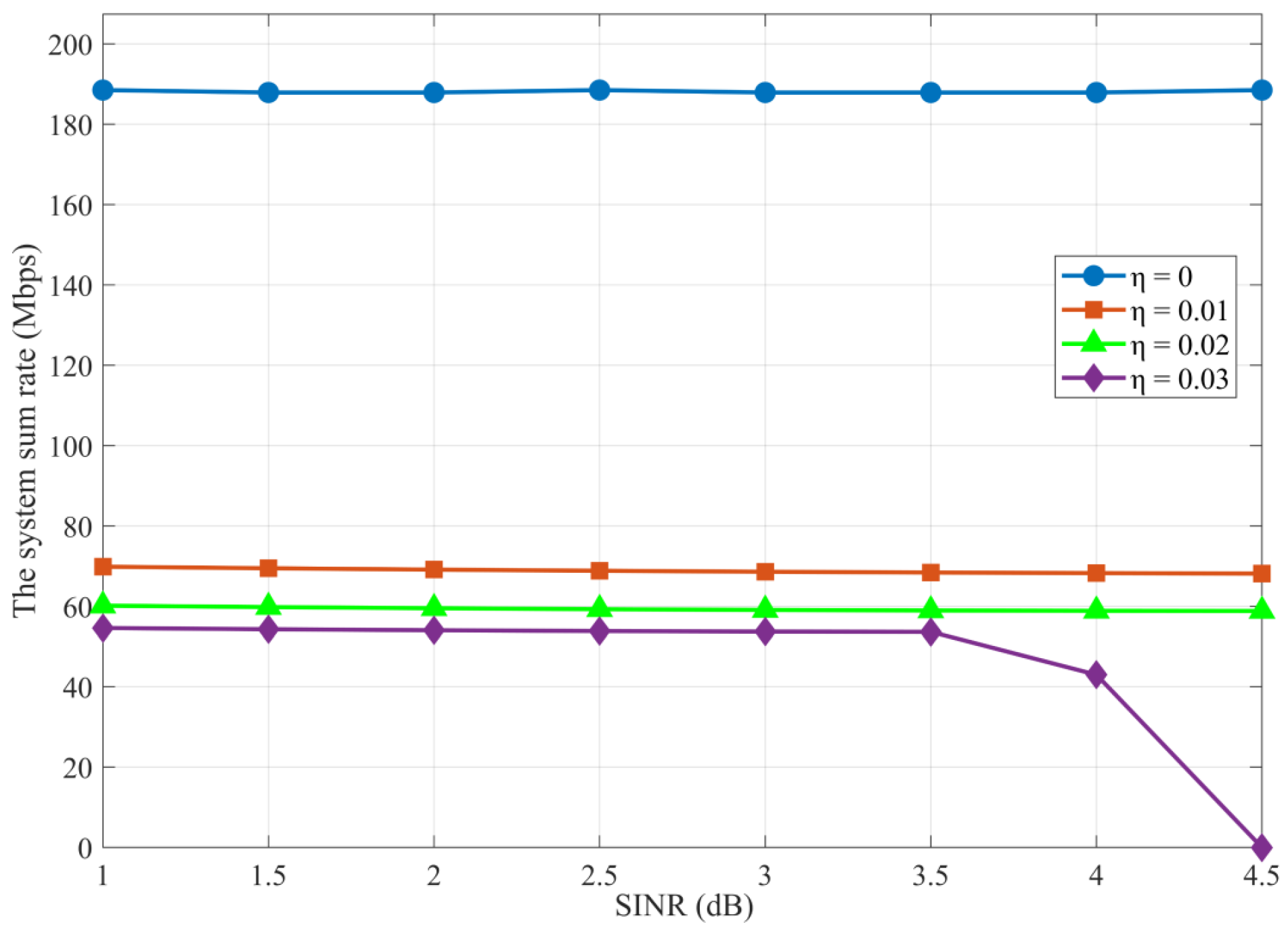
First, we evaluate the performance of the proposed algorithm by analyzing the system sum rate versus the SINR requirement under different interference cancellation factors η with the number of users set to 3, as shown in Figure 2. Simulation results indicate that, for a fixed minimum SINR requirement, the system sum rate decreases with increasing η . This degradation occurs because the receiver in the NOMA system fails to completely eliminate interference from previously decoded users when decoding the current user’s signal, resulting in residual interference that adversely affects the overall system performance. This clearly demonstrates the significant negative impact of the interference cancellation factor η on system performance. When η is set to 0, 0.01, and 0.02, the system sum rate remains around 188 Mbps, 69 Mbps, and 59 Mbps, respectively, as the minimum required SINR increases. However, for η = 0.03, the system sum rate begins to decline when the SINR requirement reaches 4 dB. This decline is attributed to the increased power demand triggered by the higher SINR threshold, which, under the total power constraint, restricts the available optimization space for power allocation. When the SINR requirement further increases to 4.5 dB, the combined limitations of residual interference and the total power ceiling cause the feasible solution space to vanish, resulting in the system sum rate dropping to 0.
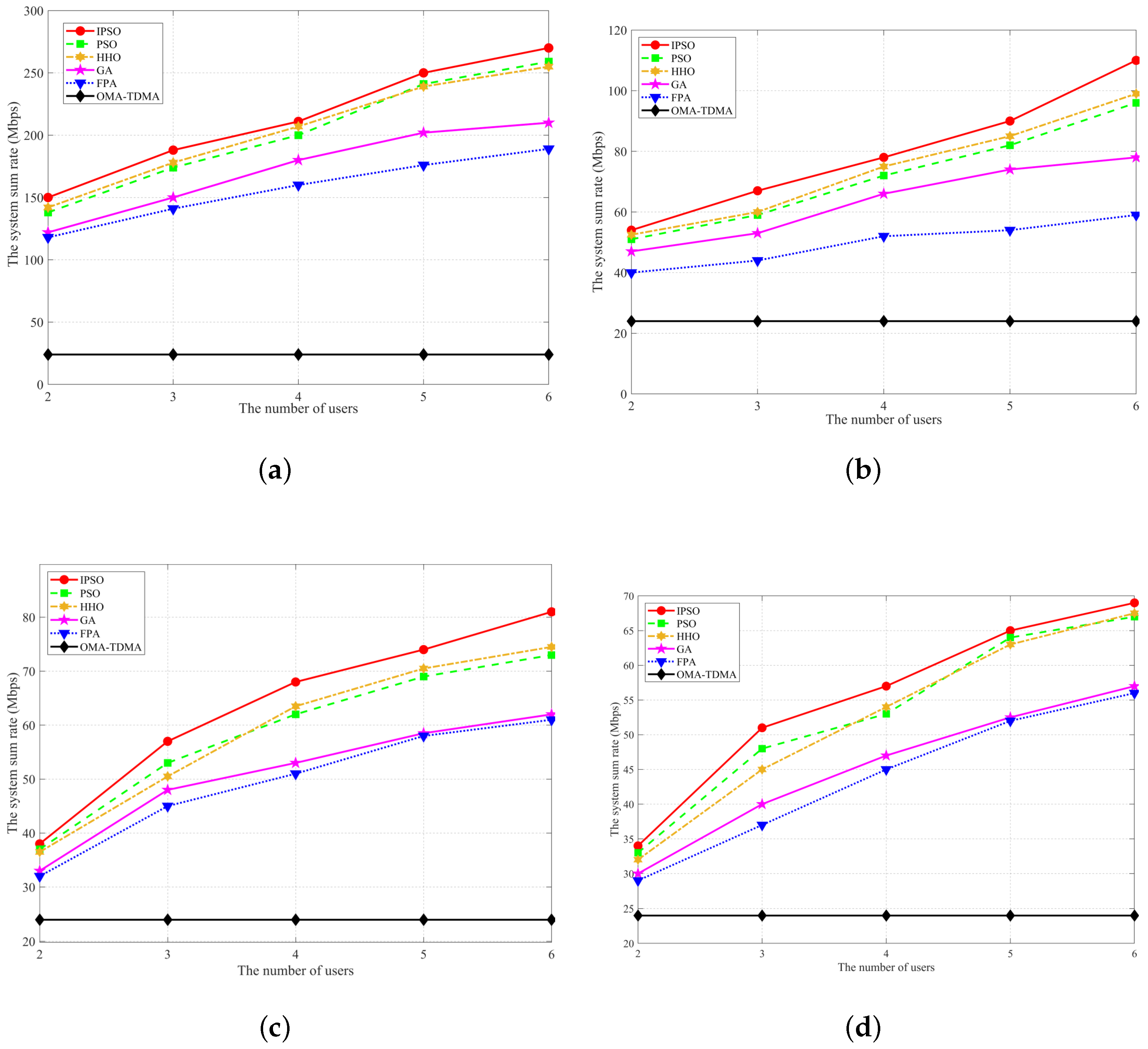
As shown in Figure 3, the system sum rate versus the number of users under different interference cancellation factors is demonstrated. The OMA scheme maintains a constant system sum rate as the number of users increases. This is because OMA employs orthogonal resource allocation, where the system capacity is strictly limited. While an increase in user number leads to finer granularity of divided resource blocks and consequently lower per-user data rates, the total system throughput remains unchanged. In contrast, NOMA-based algorithms leverage multi-user diversity gain and efficient resource multiplexing. As more users access the system, the total throughput supported by the system increases accordingly. Therefore, the system sum rate exhibits an upward trend with the growing number of users in NOMA-based schemes.
However, significant differences exist among different NOMA algorithms in terms of the growth rate and the absolute performance achievable. The proposed IPSO algorithm consistently outperforms all benchmark algorithms across the entire range of user numbers, with its advantage becoming particularly pronounced under a large user population. For instance, when η = 0.01, the system sum rate achieved by the IPSO algorithm reaches approximately 67.4 Mbps with 3 users, whereas the PSO, HHO, GA, and FPA schemes achieve about 59.9 Mbps, 61.4 Mbps, 53.2 Mbps, and 44.2 Mbps, respectively. This represents performance improvements of 12.5%, 9.8%, 26.7%, and 52.5% for IPSO over PSO, HHO, GA, and FPA. When the user number increases to 6, the system sum rate of IPSO significantly surpasses that of the other benchmark algorithms, with performance gains of 14.6%, 11.1%, 41.2%, and 86.4%. This is because, as the number of users grows, the benchmark algorithms fail to simultaneously satisfy the various constraints imposed by the VLC-NOMA system model, such as power budgets, SIC ordering, and minimum SINR requirements. Consequently, the more complex the optimization problem becomes with increasing users, the more significant the advantage of the IPSO algorithm is demonstrated.
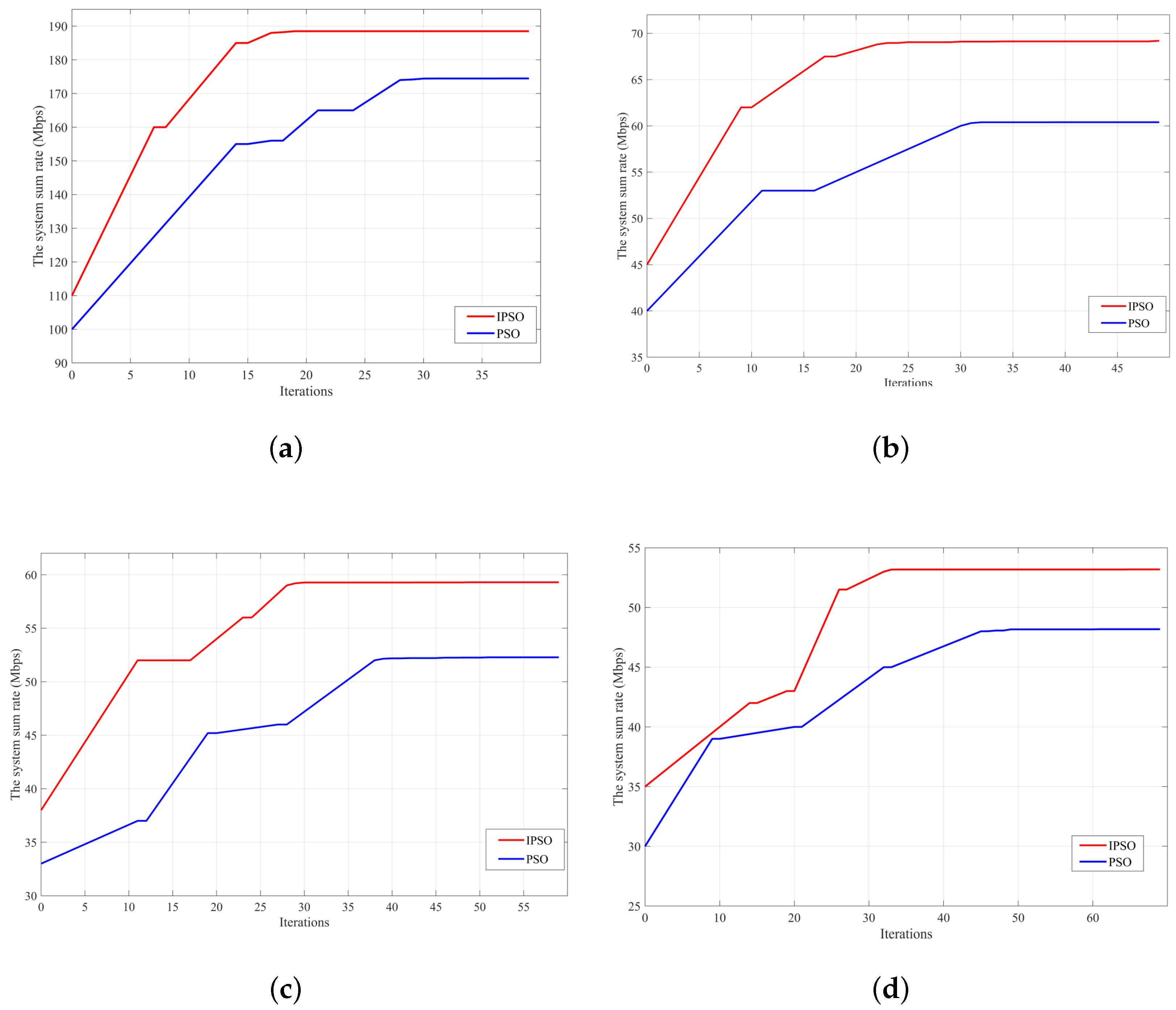
Figure 4 illustrates the evolution of the system sum rate during iterations for both the conventional PSO and the proposed IPSO algorithms. By incorporating an adaptive dynamic inertia weight, cooperative evolutionary learning factors, and the EEOLB mechanism, the IPSO algorithm demonstrates superior performance in both convergence speed and final converged value across different interference environments. When η = 0 , the IPSO algorithm stabilizes after just 19 iterations, achieving a system sum rate of approximately 188.4 Mbps, whereas the conventional PSO exhibits slower convergence and a lower final rate. As η increases to 0.01 and 0.02, IPSO maintains faster convergence and higher stability, showing a clear performance advantage particularly in the early stages of iteration. Notably, when η = 0.03 , where system interference is more severe, both algorithms experience a further decrease in the achievable rate; nevertheless, IPSO continues to outperform in terms of both convergence speed and resistance to interference.
We also analyze the computational complexity of IPSO. For a population size N, problem dimension K, and maximum iterations T max , standard PSO has a complexity of O ( T max · N · K ) . IPSO introduces three additional operations per iteration, which account for the constant factor increase: (i) computing fitness variance for the adaptive inertia weight ( O ( N ) ) , (ii) computing velocity magnitude and spatial diversity for the cooperative learning factors ( O ( N · K ) ) , and (iii) generating and evaluating opposite solutions for elite particles in EEOLB ( O ( p % · N · K ) ) . These operations collectively result in a constant factor increase of approximately 20–30% compared with standard PSO, while maintaining the same asymptotic complexity O ( T max · N · K ) . However, this per-iteration overhead is offset by faster convergence: IPSO requires only 19 iterations versus over 40 for standard PSO (Figure 4a). Consequently, the total computation time is reduced by 43%, demonstrating that IPSO achieves both higher solution quality and better computational efficiency.
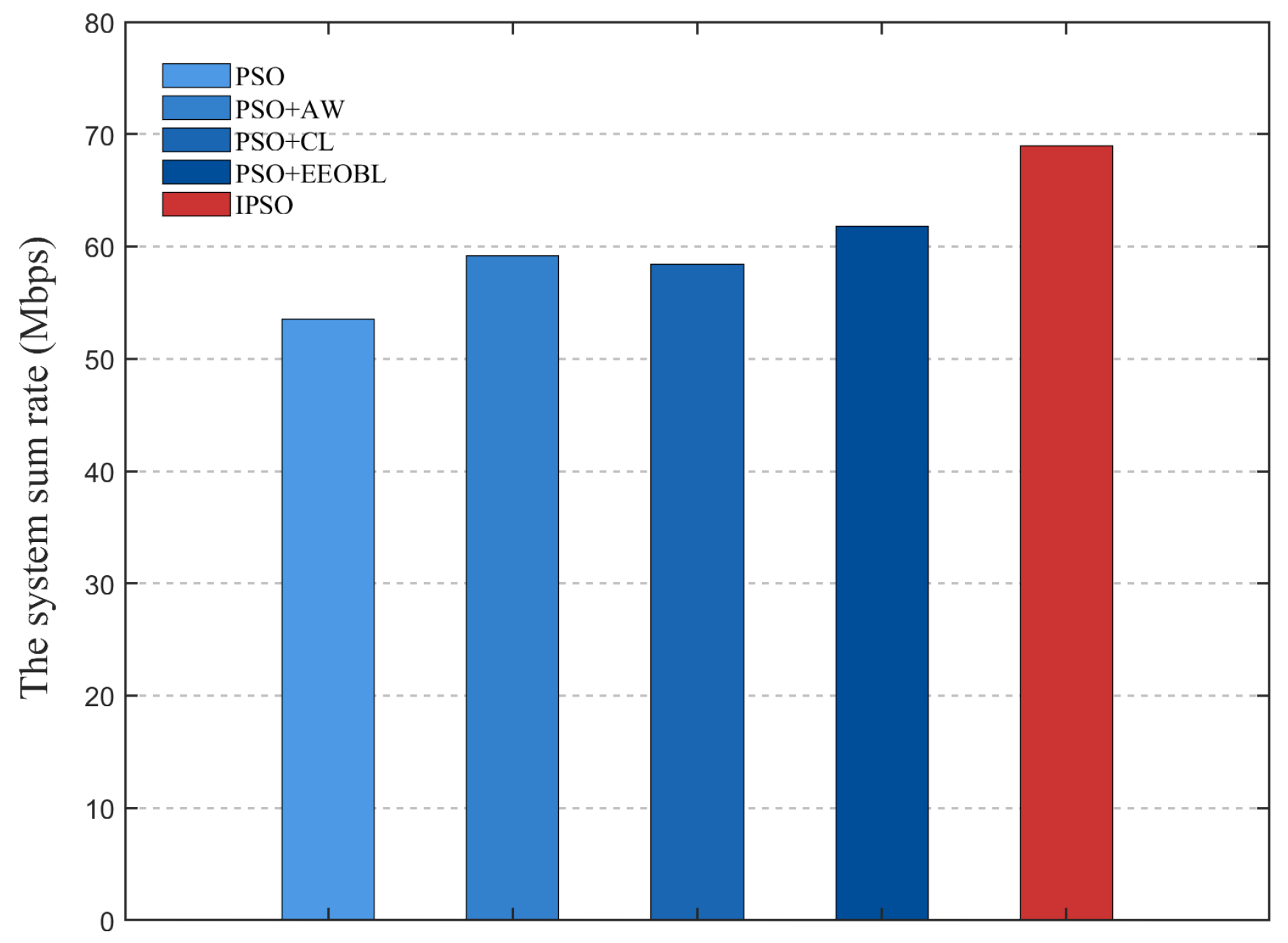
To quantify the individual contribution of each proposed mechanism, an ablation study is conducted under a typical scenario with k = 3, η = 0.01, and SINR = 3 dB. As shown in Figure 5, standard PSO achieves 53.5 Mbps, while PSO with only adaptive inertia weight (PSO + AW) obtains 59.2 Mbps, representing a 10.7% improvement over the baseline. PSO with only cooperative learning factors (PSO + CL) reaches 58.4 Mbps, a 9.2% improvement, and PSO with only EEOBL (PSO + EEOBL) achieves 61.8 Mbps, a 15.5% improvement. The complete IPSO attains 69.0 Mbps, a 29.0% improvement over standard PSO. These results validate the individual contribution of each mechanism and reveal that their synergistic combination in IPSO yields performance gains, which substantially exceed those achieved by any single mechanism alone, confirming the mutual reinforcement among the three proposed components.
Beyond final sum-rate performance, the three mechanisms also exhibit distinct impacts on convergence speed. The adaptive inertia weight primarily accelerates early-stage exploration by maintaining higher population diversity, enabling faster identification of promising regions. The cooperative learning factors contribute to mid-stage convergence by dynamically balancing individual and social learning, smoothing the path toward optimal solutions. The EEOBL mechanism, triggered periodically, helps the swarm escape local optima when convergence stagnates, effectively “recovering” from premature convergence. Together, these mechanisms drive the faster convergence of IPSO shown in Figure 4.

5. Conclusions

In this paper, we investigate the power allocation for a sum-rate optimization problem for VLC-NOMA systems, where the indoor NOMA-based VLC downlink system model is first constructed, before the power allocation mathematical problem targeting at sum-rate maximization while considering the illuminance requirement, eye-safety regulations, per-LED power budgets, individual QoS, the unique amplitude limitation of VLC signals, and imperfect SIC is established. To handle the original non-convex problem, we propose an IPSO algorithm incorporating an adaptive dynamic inertia weight, cooperative evolutionary learning factors, and an elite opposition-based learning strategy to obtain the optimal solution. Simulation results demonstrate that the proposed IPSO algorithm significantly outperforms both FPA and conventional PSO algorithms in terms of system sum rate regardless of the residual interference, particularly in high-interference multi-user scenarios. Furthermore, IPSO exhibits faster convergence speed and more stable optimization outcomes across various interference environments.

Author Contributions

Conceptualization, H.Z. and L.S.; methodology, H.Z. and Q.L.; software, H.H. and J.L.; validation, J.L., J.T. and Y.C.; formal analysis, T.T. and Y.W.; investigation, H.Z. and Y.L.; resources, J.T. and Y.L.; data curation, Y.W. and Y.L.; writing—original draft preparation, H.Z.; writing—review and editing, H.Z., Q.L. and L.S.; visualization, Q.L. and T.T.; supervision, Q.L. and L.S. All authors have read and agreed to the published version of the manuscript.

Funding

This research received no external funding.

Institutional Review Board Statement

Not applicable.

Informed Consent Statement

Not applicable.

Data Availability Statement

The data presented in this study are available on request from the corresponding author.

Conflicts of Interest

The authors declare no conflicts of interest.

Abbreviations

The following abbreviations are used in this manuscript:
VLCVisible Light Communication
NOMANon-orthogonal Multiple Access
IPSOImproved Particle Swarm Optimization
CSIChannel State Information
SICSuccessive Interference Cancellation
OMAOrthogonal Multiple Access
QoSQuality of Service
NLoSNon-Line-of-Sight
EEOBLEnhanced Elite Opposition-based Learning

References

  1. Chi, N.; Haas, H.; Kavehrad, M.; Little, T.D.C.; Huang, X.-L. Visible light communications: Demand factors, benefits and opportunities [Guest Editorial]. IEEE Wirel. Commun. 2015, 22, 5–7. [Google Scholar] [CrossRef] [Scilit]
  2. Haas, H.; Yin, L.; Wang, Y.; Chen, C. What is LiFi? J. Lightwave Technol. 2016, 34, 1533–1544. [Google Scholar] [CrossRef] [Scilit]
  3. Saito, Y.; Kishiyama, Y.; Benjebbour, A.; Nakamura, T.; Li, A.; Higuchi, K. Non-Orthogonal Multiple Access (NOMA) for Cellular Future Radio Access. In Proceedings of the 2013 IEEE 77th Vehicular Technology Conference (VTC Spring); IEEE: New York, NY, USA, 2013; pp. 1–5. [Google Scholar]
  4. Saito, Y.; Benjebbour, A.; Kishiyama, Y.; Nakamura, T. System-level performance evaluation of downlink non-orthogonal multiple access (NOMA). In Proceedings of the 2013 IEEE 24th Annual International Symposium on Personal, Indoor, and Mobile Radio Communications (PIMRC); IEEE: New York, NY, USA, 2013; pp. 611–615. [Google Scholar]
  5. Islam, S.M.R.; Avazov, N.; Dobre, O.A.; Kwak, K.S. Power-Domain Non-Orthogonal Multiple Access (NOMA) in 5G Systems: Potentials and Challenges. IEEE Commun. Surv. Tutor. 2017, 19, 721–742. [Google Scholar] [CrossRef] [Scilit]
  6. Shim, E.; No, J.S.; No, J.S.; Shin, D.J. Cooperative PSO-based power allocation scheme for NOMA-VLC systems. IEEE Photonics Technol. Lett. 2020, 32, 1557–1560. [Google Scholar]
  7. Wu, Y.; Li, X.; Sun, L.; Lin, X. An Energy Efficient Power Allocation Method for NOMA-Based VLC Systems. In Proceedings of the 2024 12th International Conference on Intelligent Computing and Wireless Optical Communications (ICWOC), Chongqing, China, 21–23 June 2024; IEEE: New York, NY, USA, 2024; pp. 102–106. [Google Scholar]
  8. Memon, M.L.; Dey, S.; Shimizu, T. Performance analysis of NOMA for indoor visible light communications with randomly deployed users. J. Lightwave Technol. 2020, 38, 2789–2801. [Google Scholar]
  9. Marshoud, H.; Kapinas, V.M.; Karagiannidis, G.K.; Muhaidat, S. Non-orthogonal multiple access for visible light communications. IEEE Photonics Technol. Lett. 2015, 28, 51–54. [Google Scholar] [CrossRef] [Scilit]
  10. Kizilirmak, R.C.; Rowell, C.R.; Uysal, M. Non-orthogonal multiple access (NOMA) for indoor visible light communications. In Proceedings of the 2015 4th International Workshop on Optical Wireless Communications; IEEE: New York, NY, USA, 2015; pp. 98–101. [Google Scholar]
  11. Chen, C.; Zhong, W.D.; Yang, H.; Du, P. On the performance of MIMO-NOMA-based visible light communication systems. IEEE Photonics Technol. Lett. 2017, 30, 307–310. [Google Scholar] [CrossRef] [Scilit]
  12. Zhang, X.; Gao, Q.; Gong, C.; Xu, Z. User Grouping and Power Allocation for NOMA Visible Light Communication Multi-Cell Networks. IEEE Commun. Lett. 2017, 21, 777–780. [Google Scholar] [CrossRef] [Scilit]
  13. Yang, Z.; Xu, W.; Li, Y. Fair Non-Orthogonal Multiple Access for Visible Light Communication Downlinks. IEEE Wirel. Commun. Lett. 2017, 6, 66–69. [Google Scholar] [CrossRef] [Scilit]
  14. Li, Q.; Shang, T.; Tang, T.; Dong, Z. Optimal power allocation scheme based on multi-factor control in indoor NOMA-VLC systems. IEEE Access 2019, 7, 82878–82887. [Google Scholar] [CrossRef] [Scilit]
  15. Fan, K.; Wang, J.; Chen, D.; Lu, H. Hybrid multi-user access scheme for a visible light communication system. Appl. Opt. 2022, 61, 7552–7557. [Google Scholar] [CrossRef] [Scilit] [PubMed]
  16. Jin, J.; Liang, Z.; Lu, H.; Wang, J.; Chen, D.; Wang, S. An SIC-free NOMA-VLC system enhanced by multi-user rate allocation. Opt. Commun. 2024, 572, 130977. [Google Scholar] [CrossRef] [Scilit]
  17. Kahn, J.M.; Barry, J.R. Wireless infrared communications. Proc. IEEE 1997, 85, 265–298. [Google Scholar] [CrossRef] [Scilit]
  18. Pradana, A.; Ahmadi, N.; Adiono, T.; Gunawan, D.; Gonzalez, S. VLC physical layer design based on Pulse Position Modulation (PPM) for stable illumination. In Proceedings of the 2015 International Symposium on Intelligent Signal Processing and Communication Systems (ISPACS); IEEE: New York, NY, USA, 2015; pp. 368–373. [Google Scholar]
  19. Andrews, J.G.; Meng, T.H. Optimum power control for successive interference cancellation with imperfect channel estimation. IEEE Trans. Wirel. Commun. 2003, 2, 375–383. [Google Scholar] [CrossRef] [Scilit]
  20. Li, Q.; Shang, T.; Tang, T.; Xiong, Z. Adaptive User Association Scheme for Indoor Multi-User NOMA-VLC Systems. IEEE Wirel. Commun. Lett. 2023, 12, 873–877. [Google Scholar] [CrossRef] [Scilit]
  21. Parida, P.; Das, S.S. Power allocation in OFDM based NOMA systems: A DC programming approach. In Proceedings of the 2014 IEEE Globecom Workshops (GC Wkshps); IEEE: New York, NY, USA, 2014; pp. 1026–1031. [Google Scholar]
  22. Luo, Z.Q.; Zhang, S. Dynamic spectrum management: Complexity and duality. IEEE J. Sel. Top. Signal Process. 2008, 2, 57–73. [Google Scholar] [CrossRef] [Scilit]
  23. Pham, Q.V.; Huynh-The, T.; Alazab, M.; Zhao, J.; Hwang, W.J. Sum-Rate Maximization for UAV-Assisted Visible Light Communications Using NOMA: Swarm Intelligence Meets Machine Learning. IEEE Internet Things J. 2020, 7, 10375–10387. [Google Scholar] [CrossRef] [Scilit]
  24. Rahnamayan, S.; Tizhoosh, H.R.; Salama, M.M.A. Opposition-based differential evolution. IEEE Trans. Evol. Comput. 2008, 12, 64–79. [Google Scholar] [CrossRef] [Scilit]
  25. Xu, Q.; Wang, L.; He, B.; Sun, J. Improved particle swarm optimization algorithm based on multi-strategy fusion for solving global optimization problems. IEEE Access 2021, 9, 12025–12041. [Google Scholar]
  26. Tang, K.; Li, Z.; Luo, L.; Liu, B. Multi-strategy adaptive particle swarm optimization for numerical optimization. Eng. Appl. Artif. Intell. 2015, 37, 9–19. [Google Scholar] [CrossRef] [Scilit]
Figure 1. Downlink scenario of an indoor NOMA-based VLC system.
Electronics 15 01378 g001
Figure 2. Comparison of the system sum rate for different η values under various SINR conditions.
Electronics 15 01378 g002
Figure 3. System sum-rate comparison for different η values versus the number of users under SINR = 3 dB. (a) η = 0 . (b) η = 0.01 . (c) η = 0.02 . (d) η = 0.03 .
Electronics 15 01378 g003
Figure 4. Comparison of the system sum rate for different η versus the number of users under SINR = 3 dB. (a) η = 0 . (b) η = 0.01 . (c) η = 0.02 . (d) η = 0.03 .
Electronics 15 01378 g004
Figure 5. Results comparing the system sum rate achieved by different algorithm mechanisms.
Electronics 15 01378 g005
Table 1. Simulation parameters.
ParameterSymbolValue
PD Detection Area A k 0.01 m2
PD Responsivity γ 1 A/W
Optical Filter Gain T s ( Φ k ) 1
Refractive Index of Optical Concentrator k ^ 1.5
Field of View Φ FOV 60°
LED Half-Power Angle φ 1 / 2 60°
LED HeightH3 m
Maximum Transmit Power P total 20 mW
VLC System BandwidthB12 MHz
DC Bias I bias 30 dBm
LED Peak Optical Intensity I p 40 dBm
Noise Power Spectral Density S 0 10 24 W / Hz
Disclaimer/Publisher’s Note: The statements, opinions and data contained in all publications are solely those of the individual author(s) and contributor(s) and not of MDPI and/or the editor(s). MDPI and/or the editor(s) disclaim responsibility for any injury to people or property resulting from any ideas, methods, instructions or products referred to in the content.