Article

LedgerRAG: Governance-Driven Agentic Chain of Retrieval for Dynamic Knowledge Scenarios

Institute of Intelligent Information Processing, Beijing Information Science and Technology University, Beijing 100101, China
*
Author to whom correspondence should be addressed.
Electronics 2026, 15(7), 1376; https://doi.org/10.3390/electronics15071376
Submission received: 12 February 2026 / Revised: 8 March 2026 / Accepted: 16 March 2026 / Published: 26 March 2026
(This article belongs to the Section Computer Science & Engineering)

Abstract

Retrieval-augmented generation (RAG) grounds large language models (LLMs) with external evidence. Dynamic knowledge tasks, however, require systems to decide not only what to retrieve but also when to refresh, how to arbitrate conflicts, and how to preserve an auditable record of the evidence used to answer a query. We present LedgerRAG, a trigger-aware retrieval chain framework that maintains an explicit claim-level evidence ledger and uses coverage, temporal validity, authority, and conflict signals to control retrieval, refresh, and stopping decisions. We expand the evaluation with a query-level BM25 baseline, a dense retriever setting, and task-aligned proxy baselines representing graph-style retrieval, temporal-only retrieval, and conflict-focused retrieval. The revised results show that LedgerRAG’s clearest advantage lies in conflict governance and auditable evidence control, achieving near-perfect ConFLICT adjudication (CRAcc = 0.993) under authority-aware routing while yielding more modest gains and explicit trade-offs in regulation-change and streaming settings.

1. Introduction

Large language models (LLMs) are increasingly deployed in high-stakes domains such as legal compliance question answering, policy interpretation, and newsroom intelligence. Retrieval-augmented generation (RAG) [1,2,3] mitigates hallucinations by grounding generation using external documents, but most RAG pipelines assume relatively static corpora and treat retrieval as a single pre-generation step.
In dynamic knowledge scenarios, correctness depends not only on factual content but also on time (which version is effective at time t), authority (which sources dominate in a dispute), and governance (whether the system can be audited and replayed). In these settings, outdated or low-authority evidence can cause serious compliance and reputational risks.
Existing RAG variants often adopt either one-shot retrieval or a fixed number of retrieval steps. This rigid design leads to a three-way tension between accuracy, timeliness, and cost: under-retrieval yields evidence gaps (claims are not supported or citations are misaligned), while over-retrieval inflates latency and computation costs. More critically, dynamic settings exhibit two structural failure modes: (i) gap, where retrieved evidence fails to cover generated atomic claims and (ii) drift, where evidence becomes invalid at target time t (e.g., a repealed statute or a corrected report), yet the system keeps citing it.
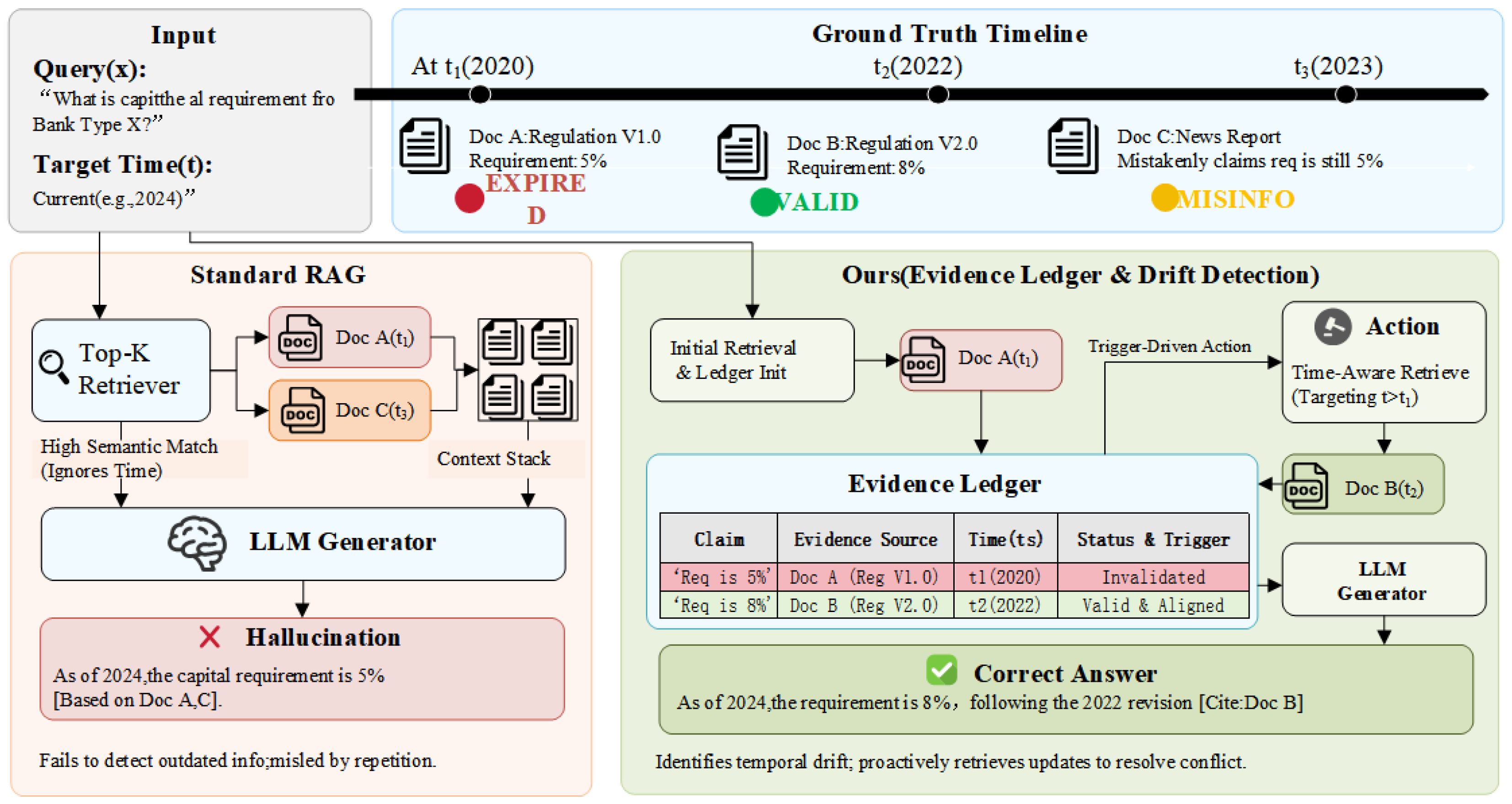
While recent agentic or self-reflective frameworks (e.g., Self-RAG [4]) improve general citation quality by deciding when to retrieve, they typically rely on implicit semantic signals and lack explicit modeling of authority and time. As a result, semantically similar but temporally invalid documents can dominate retrieval rankings, causing what we refer to as temporal hallucination (Figure 1).
To bridge this gap, we propose LedgerRAG, a trigger-driven chain-of-retrieval framework that maintains an explicit evidence ledger as the reasoning state. Retrieval is then regulated by three trigger families: gap, drift, and conflict. Effectively managing dynamic RAG requires a structured integration of heterogeneous cues–claim decomposition, evidence metadata, stance decisions, and authority–time adjudication so that decisions remain inspectable and auditable over time. This emphasis on structured knowledge processes and auditability aligns with scenario-based knowledge creation and dynamic capability perspectives in knowledge management. In this revision, we also sharpen the scope of our claim: LedgerRAG’s most consistent gains emerge in conflict governance and evidence control rather than universal superiority across every dynamic task.
Our contributions are four-fold:
(1)
Evidence ledger paradigm for dynamic RAG: We formulate dynamic RAG as explicit claim–evidence state tracking, enabling audit trails and controllable governance.
(2)
Gap/drift/budget trigger controller: We design a lightweight controller that adaptively invokes refinement, counter-evidence, and time-aware retrieval, achieving better quality–cost trade-offs.
(3)
DyK-Bench: We build a benchmark covering regulatory change, cross-source conflict, and streaming updates with an audit-friendly evaluation protocol.
(4)
System integration: We integrate the framework into a newsroom CMS prototype and provide latency and workflow case studies to validate practical deployability.

2. Related Work

2.1. From Static Retrieval to Agentic Reasoning

RAG augments LLM generation with retrieved documents. Beyond early formulations, retrieval-augmented pretraining (e.g., REALM) and dense retrieval (e.g., DPR) have become core building blocks. Generative architectures like fusion-in-decoder (FiD) systems further optimized open-domain QA by processing multiple passages [5]. Recently, RETRO scaled this paradigm to trillions of tokens [6].
To overcome the limitations of one-shot retrieval, prior work explores iterative and agentic retrieval reasoning loops. Active retrieval triggers retrieval based on uncertainty [7], while RAG-Critic uses critic-guided workflows to diagnose errors [8]. Self-RAG employs self-reflection to control retrieval. Furthermore, chain-of-thought (CoT) prompting has motivated multi-step retrieval reasoning designs [9]. However, these methods often treat source authority and temporal validity implicitly.

2.2. Challenges in Dynamic Knowledge: Time, Conflict, and Streaming

Dynamic corpora require temporal consistency and conflict resolution. StreamingQA [10] and RealTime QA [11] highlight that correct answers depend on the current time. TimeRAG further studies temporal reasoning in complex questions [12]. Meanwhile, open retrieval sources frequently contain contradictions (e.g., rumors vs. official statements) [13]. Recent work like TruthfulRAG attempts to resolve such conflicts using knowledge graphs [14].
Drawing on the broader success of graph-attention mechanisms in various domains [15], text-oriented graph approaches such as GraphRAG strengthen global reasoning by constructing corpus-level summaries [16,17]. While effective for global sensemaking, graph maintenance introduces overhead for real-time streaming, making our ledger approach more suitable for interactive workflows. Another line of research addresses dynamic knowledge via model editing (e.g., ROME [18], MEMIT [19]), though these modify parameters rather than managing retrieval context.

2.3. Governance and Auditability

Trustworthiness in high-stakes RAG extends to process-level governance. ALCE enforces citation-grounded generation [20], and multi-agent debate can reduce bias [21]. Our “support vs. conflict” framing aligns with fact verification tasks like FEVER [22] and SciFact [23]. For evaluation, automated judges (e.g., LLM-as-a-Judge [24]) and hallucination detection methods [25] provide scalable quality control. LedgerRAG elevates these signals to first-class control variables via the evidence ledger.

3. Problem Formulation and the Evidence Ledger

3.1. Task Definition

We define dynamic RAG as conditional generation over a time-evolving corpus. Given a query q and a target time anchor t (defaulting to the current time if unspecified), the system outputs: (i) an answer a; (ii) a citation set C; and (iii) an audit log J capturing retrieval and decision traces. Unlike static QA, dynamic RAG must satisfy:
(1)
Temporal consistency: evidence must be valid as of time t (e.g., the latest effective regulation).
(2)
Conflict resolution: when sources disagree, the system must follow an authority–time decision rule rather than semantic voting.

3.2. Evidence Ledger: Claim–Evidence State Representation

LedgerRAG maintains an evidence ledger L s as the explicit reasoning state at step s. The ledger stores atomic claims and associated evidence with structured metadata. We first decompose the query (and intermediate hypotheses) into a set of atomic claims { c i } with importance weights w i (higher for core constraints such as legal thresholds). For each claim c i , the ledger stores an evidence set E i containing entries e i , j . Each evidence entry is represented as a tuple:
e = ( text , doc_id , source , t s , α auth , y , r ) ,
where t s is the publication timestamp, α auth is an authority score, y { Support , Refute } is a stance label toward the claim, and r is a retrieval/extraction relevance score.
Stance labels y are assigned via a rubric-based verifier prompt under deterministic decoding ( temperature = 0 ), conditioned on the (claim, evidence span), following standard verification formulations. The authority score α auth is derived from DyK-Bench’s discrete authority_level metadata (Section 6.1) and normalized to [ 0 , 1 ] .
We define a claim verification score v i as the difference between aggregated support and refutation evidence, weighted by authority and time decay:
v i = e E i + w ( e ) e E i w ( e ) , w ( e ) = r ( e ) · α auth ( e ) · exp ( t t s ( e ) H ) ,
where H is a domain-dependent decay timescale (larger for stable regulations and smaller for news). A claim is considered verified if v i τ v ; otherwise it remains unverified and is surfaced to the controller.

3.3. State Metrics

To drive controllable retrieval, we derive three measurable state metrics from the ledger.
Coverage (gap signal): Coverage measures how much of the weighted claim set is verified:
Cov ( L s ) = i w i · [ v i τ v ] i w i .
Low coverage indicates evidence gaps.
Time validity (drift signal): Time validity quantifies the freshness of the best evidence per claim at time t:
TV @ t ( L s ) = i w i · max e E i exp ( t t s ( e ) H ) i w i .
Low TV @ t suggests drift risk.
Stance divergence (conflict signal): Divergence captures whether strong support and strong refutation coexist for the same claim (above a confidence threshold), indicating unresolved conflicts that require counter-evidence search and authority-aware adjudication.

4. Method: LedgerRAG

4.1. Overview

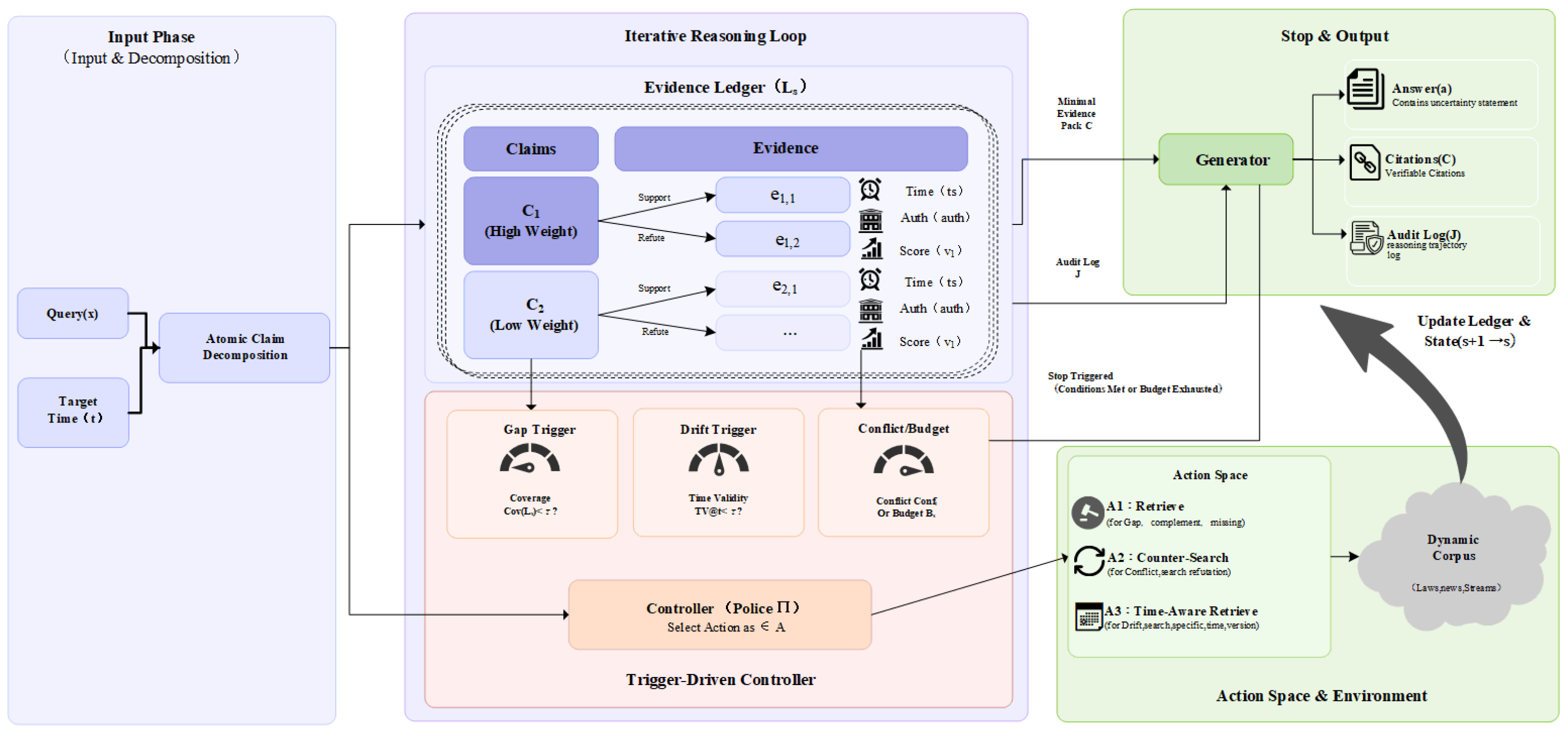
LedgerRAG implements an iterative perceive–decide–update loop, as illustrated in Figure 2. At each step s: (i) the system observes the ledger state L s and computes Cov ( L s ) , TV @ t ( L s ) , and conflict signals; (ii) a lightweight controller maps these signals to an action a s ; and (iii) executing a s retrieves new evidence, updates the ledger, and logs the trace. The loop stops when the budget is exhausted or marginal gains converge.

4.2. Trigger Mechanisms

We define three trigger families that discretize continuous state metrics into control signals:
Gap trigger: Activated when (i) Cov ( L s ) < τ cov ; (ii) an important claim (high w i ) remains unverified; or (iii) retrieved evidence lacks required metadata (e.g., missing timestamp). Response: structured query refinement to increase recall for missing claims.
Drift trigger: Activated when TV @ t ( L s ) < τ tv or when update cues are detected in retrieved snippets (e.g., ‘revised’, ‘repealed’, ‘correction’, ‘latest’). Response: time-aware retrieval that injects the time anchor t and prioritizes the most recent effective documents.
Budget trigger: Activated when the reasoning loop reaches S max steps or when marginal improvements in Coverage/ TV @ t fall below ε for k pat consecutive steps. Response: early stopping and audit freeze.
Conflict trigger: Activated when a claim exhibits high stance divergence (strong support and refutation coexist). Response: counter-evidence search and authority–time adjudication.

4.3. Action Space

The controller chooses from four atomic actions:
A1: Structured Refinement: For Gap: generate claim-specific sub-queries via entity anchoring, domain term expansion, and top-k expansion, leveraging re-ranking patterns to improve recall [26].
A2: Counter-Evidence Search: For Conflict: issue adversarial queries (e.g., adding ‘debunk’, ‘correction’, ‘withdrawn’) to actively seek refuting evidence and reduce confirmation bias.
A3: Time-Aware Retrieval: For Drift: inject time constraints (soft cues in query text and hard metadata filters such as publish_date  t ) and prefer newer versions when authority is comparable.
A4: Audit & Stop: Freeze the ledger, construct a minimal evidence package, and generate the final answer with citations, diff summary, and an editor-facing checklist of unresolved items.

4.4. Authority–Time Adjudication and Auditable Generation

To resolve contradictions, we define an authority–time partial order over evidence. For two evidence entries e a and e b :
e a e b α auth ( e a ) > α auth ( e b ) or [ α auth ( e a ) = α auth ( e b ) and t s ( e a ) > t s ( e b ) ] .
This implements the principle “authority first; recency as tie-breaker.”
Instead of feeding explainably noisy full-context stacks, we build a minimal covering evidence package C using a greedy procedure: iteratively select evidence that maximizes marginal claim coverage until Cov ( L s ) τ cov or the context budget is reached. The generator is then constrained to produce:
(i)
  A direct answer with sentence-level citations (doc_id);
(ii)
 A diff summary if drift was triggered;
(iii)
A checklist of unresolved or high-risk claims for human review.

4.5. Algorithm

In this subsection, we detail the inference procedure of the proposed LedgerRAG framework. The complete step-by-step process, including the evidence ledger initialization and the iterative retrieve-and-update loop, is summarized in Algorithm 1.
Algorithm 1 LedgerRAG Inference
Require: Query q, target time t, max steps S max , thresholds ( τ cov , τ tv , τ v ) , decay timescale H, tolerance ε , patience k pat
Ensure: Answer a, citations C, audit log J
  1:
Decompose q into atomic claims { c i } with weights { w i } ; initialize ledger L 0 with empty evidence
  2:
for  s = 0 S max 1   do
  3:
   Compute Cov ( L s ) , TV @ t ( L s ) , and conflict signals
  4:
   if BudgetTrigger or StopCondition then
  5:
   break
  6:
   end if
  7:
   Select action a s { A 1 , A 2 , A 3 } based on triggers
  8:
   Retrieve documents; parse evidence tuples; assign stance; update ledger L s + 1 .
   The ledger is append-oriented: each new evidence item becomes a new entry, deduplicated by ( d o c _ i d , s p a n _ i d ) .
   Entries are never overwritten; when later evidence dominates on authority and/or recency, older entries are marked superseded (archived) but retained for audit.
  9:
   Append ( a s , triggers, retrieved doc_ids, ledger deltas) to audit log J
10:
end for
11:
Build minimal covering evidence package C from final ledger; generate answer a with citations and checklist
12:
return  ( a , C , J )

5. DyK-Bench: A Benchmark for Dynamic Knowledge Governance

5.1. Data Pipeline: Pachon

To evaluate dynamic RAG under temporal evolution and cross-source conflicts, we construct DyK-Bench using a semi-automated pipeline (Pachon) with two key components.
Spatio-temporal normalization: Each raw document is normalized into a structured record (doc_id, text, publish_date, source, authority_level, status/version). Publish dates are standardized to ISO-8601 [27] timestamps, and authority levels are assigned using a domain-specific source taxonomy; in our benchmark, authority_level { 1 , 2 , 3 } corresponds to {user-generated, professional outlets, official sources}, and we set α auth = authority_level/3.
Time-sliced indexing: To prevent future leakage, we build time-sliced indexes that replay the corpus state at any snapshot time t. All retrieval operations in the evaluation are constrained to documents with publish_date t .

5.2. Task Design

DyK-Bench contains three tasks capturing distinct dynamic patterns.
RegChange-QA (regulatory change): Identify the uniquely effective version as of t when old and new versions are semantically similar.
ConFLICT-QA (cross-source conflict): Adjudicate contradictory claims (e.g., rumor vs. official clarification) using authority-aware decision rules.
Stream-QA (streaming updates): Gnerate minimal sufficient answers over a sequence of times ( t 1 , t 2 , ), refreshing only affected claims when updates or corrections appear.

5.3. Annotation and Auditing

We follow a hybrid annotation strategy consisting of LLM-assisted draft generation, automated auditing, and expert verification. The audit stage enforces two hard constraints: (i) leakage check (gold answers do not use future information beyond t) and (ii) retrievability check (gold evidence is retrievable from the corresponding time slice). After expert review, DyK-Bench includes 370 query-level instances and 479 step-level evolution records when unfolding Stream-QA trajectories.
DyK-Bench comprises 370 query-level instances distributed across the three tasks: RegChange-QA (135 queries), ConFLICT-QA (110 queries), and Stream-QA (125 queries yielding 479 step-level evolution records). To mirror real-world retrieval difficulty, each time-sliced index contains an average of 12,400 background documents. Notably, in the ConFLICT-QA subset, approximately 92% of the conflicts are “decisively resolvable”, meaning an authoritative official clarification or erratum explicitly exists in the target time slice, which specifically tests a system’s ability to locate and prioritize high-authority counter-evidence over repetitive rumors.

6. Experiments

6.1. Experimental Setup

We evaluate LedgerRAG against strong baselines on DyK-Bench, addressing three research questions: RQ1 (effectiveness): can the system reduce evidence gaps and resolve conflicts? RQ2 (timeliness): does explicit drift modeling reduce outdated citations? RQ3 (governance): can we improve auditability and quality while controlling retrieval cost?
Backbone model and retriever: Unless otherwise stated, all methods use the same generator (DeepSeek-V3 [28]) and the same retriever backend (Elasticsearch BM25 [29]) to avoid confounding factors. We use a chunk size of 512 tokens with a 128-token overlap, and generation temperature is set to 0 for reproducibility. To rigorously evaluate the framework, we adopt two retrieval settings: Setting A (BM25-controlled) strictly isolates the impact of our logic layer without confounding from dense retriever capacities; Setting B (dense-controlled) evaluates retriever generalization and task-aligned strong proxy baselines.
Baselines: Under these two settings, we compare against a spectrum of baselines: (i) Query-RAG/Standard RAG (BM25 & Dense): All methods share the same atomic-claim decomposition module used for governance evaluation. Standard RAG performs one retrieval per claim (top- k = 5 ) and generates the final answer in a single pass using the concatenated evidence. (ii) Self-RAG-style Prompted (BM25 & Dense): We implement a self-reflective agentic control policy via prompting and reflection signals following Asai et al. while keeping the backbone constant to isolate the effect of retrieval control mechanisms. (iii) Task-Aligned Proxy Baselines (Dense): To thoroughly assess specific dynamic challenges, we include tailored proxy implementations of GraphRAG-lite (graph-style expansion), TimeRAG-proxy (temporal-focused), and TruthfulRAG-proxy (conflict-focused). (iv) LedgerRAG & LedgerRAG-v5 (Ours): Our proposed framework, reported as the base dense configuration and the final v5 system with full conflict-retrieval refinements.
Metrics: We report SupportF1 (citation support vs. refute), TV @ t (temporal validity), CRAcc (conflict resolution accuracy, ConFLICT-QA), UpdateF1 (update detection, Stream-QA), retrieval calls, and end-to-end latency. We also define a governance-oriented composite score, SUS (System Utility Score):
SUS = 0.25 · Trace + 0.25 · ClaimAlign + 0.25 · Timely + 0.25 · Uncertainty ,
where Trace measures citation traceability, ClaimAlign measures claim–evidence alignment, Timely reflects time compliance, and Uncertainty measures explicit disclosure of unresolved items. (Note: this SUS is not the HCI System Usability Scale; it is a governance utility score tailored to auditable RAG).
Retrieval calls and latency: We count one retrieval call as one invocation to the BM25 backend (per (sub-)query). End-to-end latency is wall-clock measured from query submission to final answer, including retrieval, ledger updates, and LLM generation, with single-query concurrency and no batching.
Hardware environment: All experiments were conducted on a workstation operating on Ubuntu OS (Canonical Ltd., London, UK), equipped with an Intel CPU (Intel Corporation, Santa Clara, CA, USA) and two NVIDIA RTX A6000 GPUs (NVIDIA Corporation, Santa Clara, CA, USA).
Hyperparameters: Unless otherwise stated, we use S max = 3 , top- k = 5 , τ cov = 0.8 , τ tv = 0.7 , τ v = 0.0 , ε = 0.01 , k pat = 2 , and  H = 365 days (regulations)/7 days (news).
LLM-as-a-Judge: For semantic metrics (SupportF1, SUS sub-scores), we use GPT-4o as an automatic evaluator with a fixed prompt and deterministic decoding. On a 50-sample calibration set, the judge’s scores correlate with expert ratings with Pearson r = 0.87 . The evaluation prompt is provided in Appendix A. Following the methodology of MT-Bench [24], we release judging prompts to enable independent auditing.

6.2. Main Results

Table 1 summarizes the overall performance across the three dynamic tasks, comparing our framework against a spectrum of dense and task-aligned proxy baselines. Several conclusions emerge. First, LedgerRAG (Full) demonstrates its most profound advantage in conflict governance (ConFLICT-QA), achieving a near-perfect adjudication accuracy (CRAcc = 0.9930). This significantly outperforms both the base dense configuration (LedgerRAG Dense baseline, 0.6548) and the specialized conflict-focused baseline (TruthfulRAG-proxy, 0.7467).
Second, the evaluation reveals honest trade-offs across different knowledge scenarios. For instance, GraphRAG-lite shows strong offline performance on RegChange (Ans2gramF1 = 0.7017) and Stream (UpdateF1 = 0.7486), with LedgerRAG (Full) following very closely (0.6994 and 0.7430, respectively). These findings explicitly refine the scope of our contribution: LedgerRAG trades a controlled increase in retrieval calls (e.g., averaging 3.00 calls on ConFLICT) to achieve strict evidence governance and auditable conflict resolution rather than claiming universal superiority across all standard QA metrics.

6.3. Task-Level Analysis

Table 2 and Table 3 break down effectiveness and cost by task for the BM25 baseline and our method (these are also the two systems used in the CMS prototype). The Self-RAG baseline is reported in Table 1 for overall comparison; for example, on ConFLICT-QA, the prompted Self-RAG baseline reaches CRAcc = 0.6867, while LedgerRAG reaches 0.9930.
RegChange-QA: LedgerRAG improves Ans2gramF1 from 0.5357 to 0.6994 (+0.1637), demonstrating that explicit drift detection is crucial when old and new versions are semantically similar.
ConFLICT-QA: Conflict resolution accuracy improves from 0.6742 (BM25) and 0.6867 (Self-RAG) to 0.9930 (+0.3188 vs. BM25), driven by counter-evidence search and authority–time adjudication.
Stream-QA: UpdateF1 increases from 0.7263 to 0.7430 (+0.0167). This modest gain reflects the intrinsic difficulty of frequent refresh under streaming updates, accompanied by a planned increase in retrieval calls and latency.

6.4. Statistical Significance

We run paired bootstrap tests ( N = 5000 resamples). We use Standard RAG (BM25) as the base system for all comparisons in Table 4. Improvements are statistically significant ( p < 0.001 ) across overall and task-specific metrics.

6.5. Visualization and Error Diagnosis

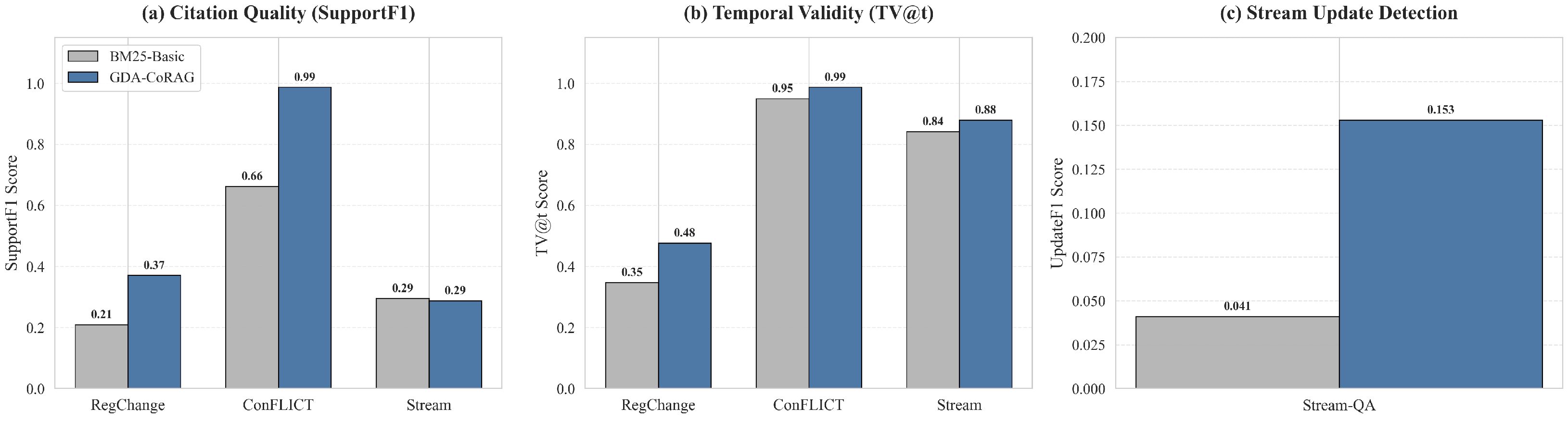
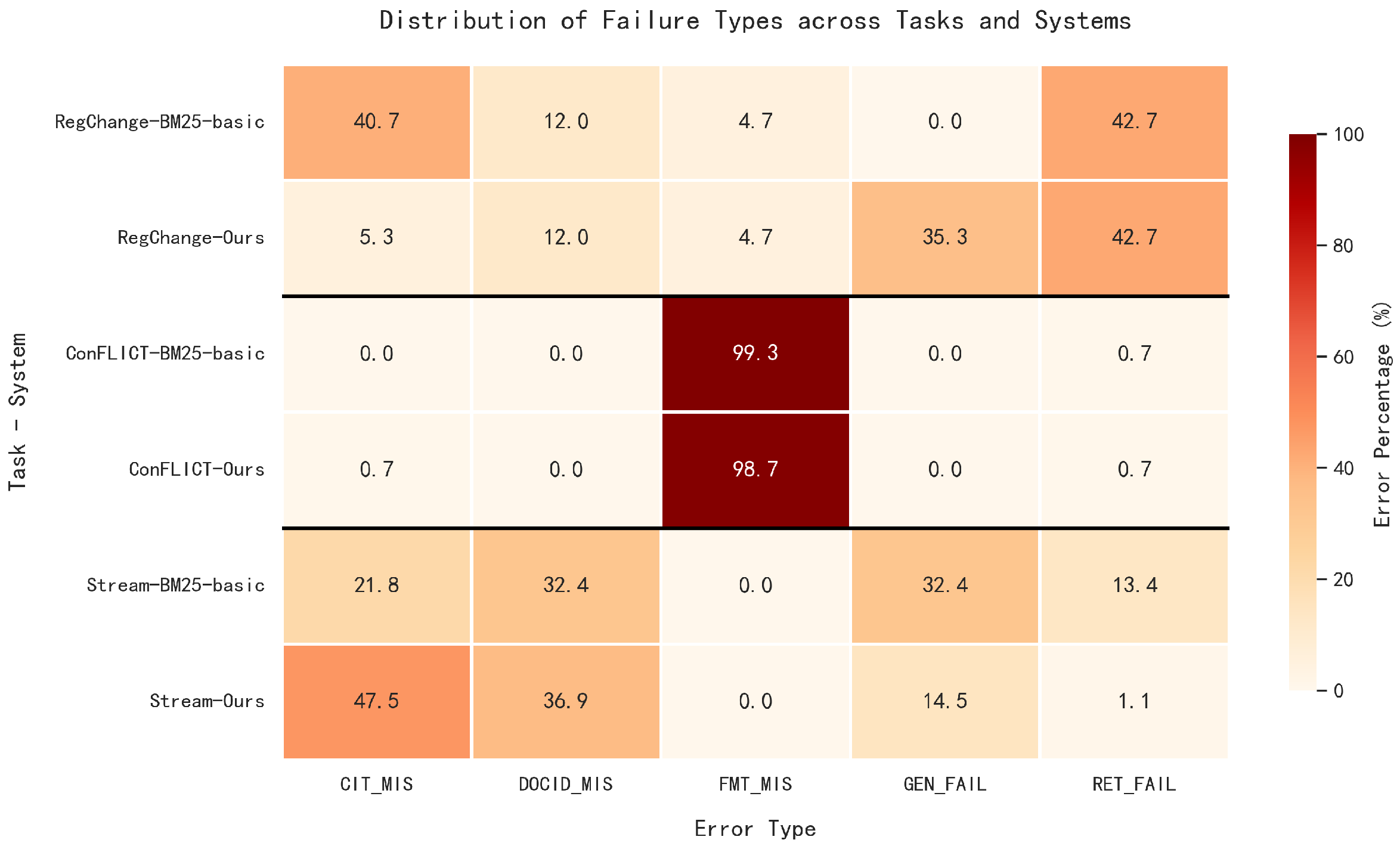
Figure 3 visualizes key metrics by task. Figure 4 summarizes step-level failure types, highlighting remaining bottlenecks such as citation alignment in long streaming trajectories and output formatting in conflict adjudication.
In Stream-QA, the drift trigger substantially reduces retrieval failures (RET_FAIL: 13.4 % 1.1 % ), indicating improved coverage under fast-evolving events. However, citation mismatch increases (CIT_MIS: 21.8 % 47.5 % ), suggesting that cross-snapshot citation alignment remains challenging when evidence is refreshed multiple times. In ConFLICT-QA, among the detected failure cases, formatting errors dominate (FMT_MIS 99 % ), motivating stronger structure constraints (e.g., constrained decoding) for verdict-style outputs.

6.6. Ablation Study

Table 5 reports a clean trigger ablation on the final LedgerRAG system. The results confirm the targeted contributions of each governance module. First, removing conflict produces the largest drop in ConFLICT-QA: CRAcc decreases from 0.9930 to 0.8267 (−0.1663), demonstrating its critical role in authority-based conflict resolution. Second, removing drift specifically penalizes temporally sensitive tasks, reducing RegChange Ans2gramF1 (−0.0340) and Stream UpdateF1 (−0.0412), as the system fails to proactively recognize and refresh outdated evidence. Finally, removing gap yields consistent declines in both RegChange (−0.0144) and Stream (−0.0150), confirming that the gap trigger effectively ensures sufficient evidence coverage for complex generative tasks.

6.7. Human Evaluation and Case Study

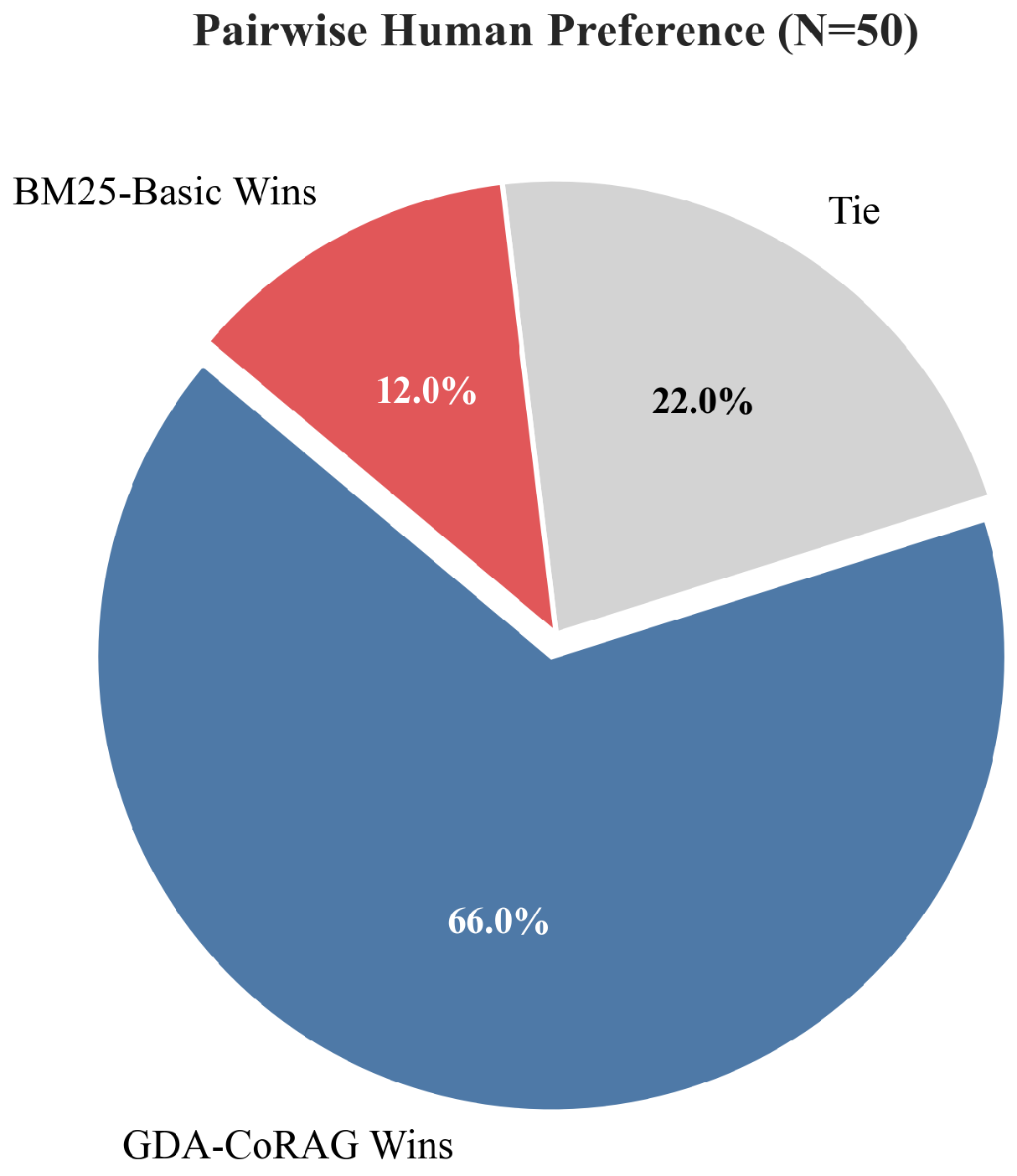
We conduct pairwise blind human evaluation on 50 randomly sampled queries. Annotators prefer LedgerRAG in 66.0 % of cases, tie in 22.0 % , and prefer the BM25 baseline in 12.0 % (Figure 5). The dominant preference reason is decisiveness: LedgerRAG is more willing to reject low-authority rumors and produce a clear correction with citations.
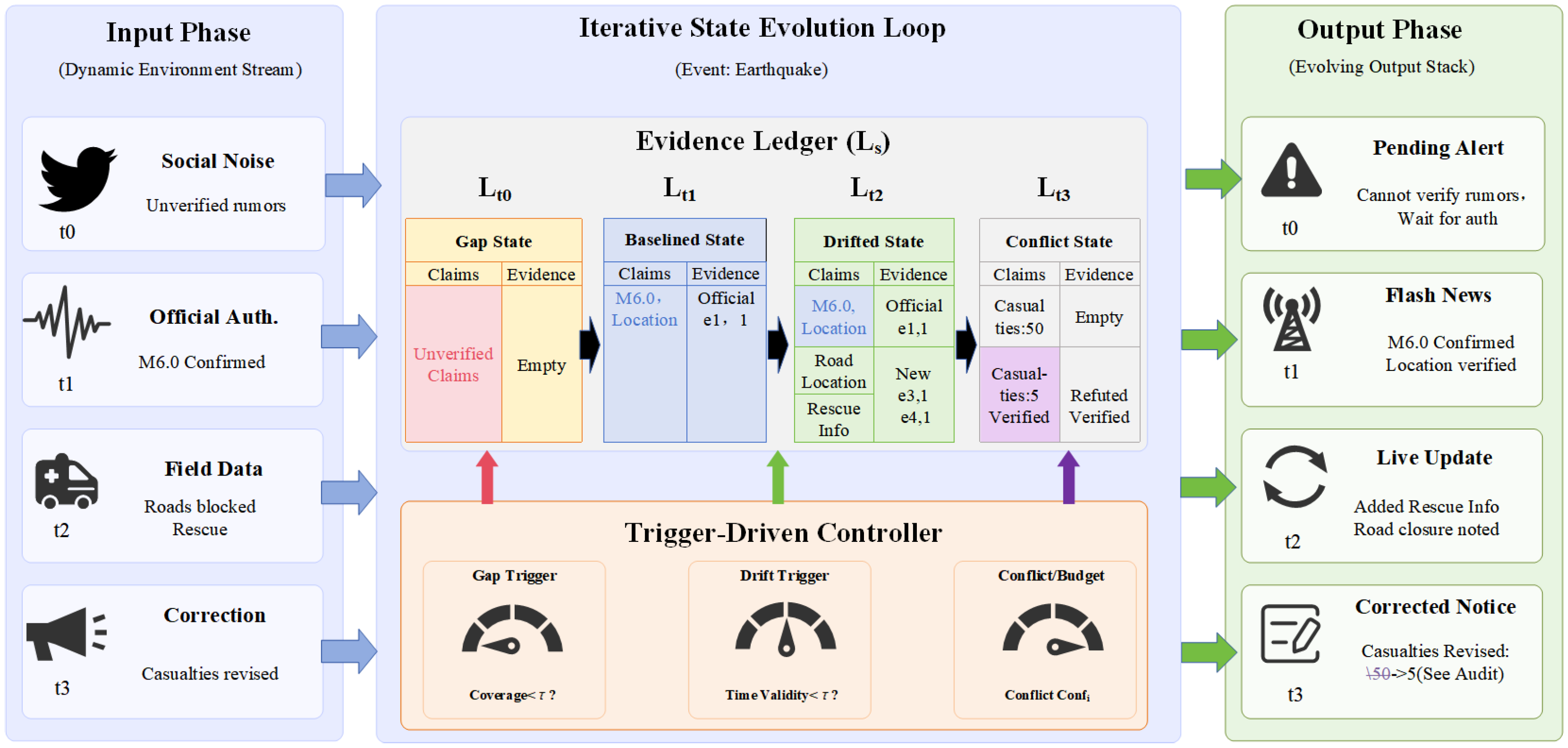
We further illustrate life cycle governance in a case study on breaking news (Figure 6). The system transitions from a gap phase (insufficient evidence) to a verified flash news update after an official statement and later issues a correction notice when updated numbers arrive while preserving an audit trail. To ensure the reliability of our evaluation, we measured inter-annotator agreement on this 50-sample subset, achieving a Cohen’s kappa of 0.4136, indicating moderate agreement.

6.8. System Deployment in a Newsroom CMS

To validate deployability beyond offline benchmarking, we integrate LedgerRAG into a newsroom CMS prototype as an editorial assistant. The integration follows a plug-in + service architecture: a CMS panel triggers claim extraction and verification, while an external service orchestrates retrieval, ledger updates, and governed generation. The ledger is persisted as a structured artifact (e.g., JSON) so that every revision is traceable to concrete evidence.
Latency measurement: Deployment latency is measured as wall clock time from a CMS panel request to the returned governed answer, including retrieval, ledger updates, and LLM generation (single-query concurrency; no batching).
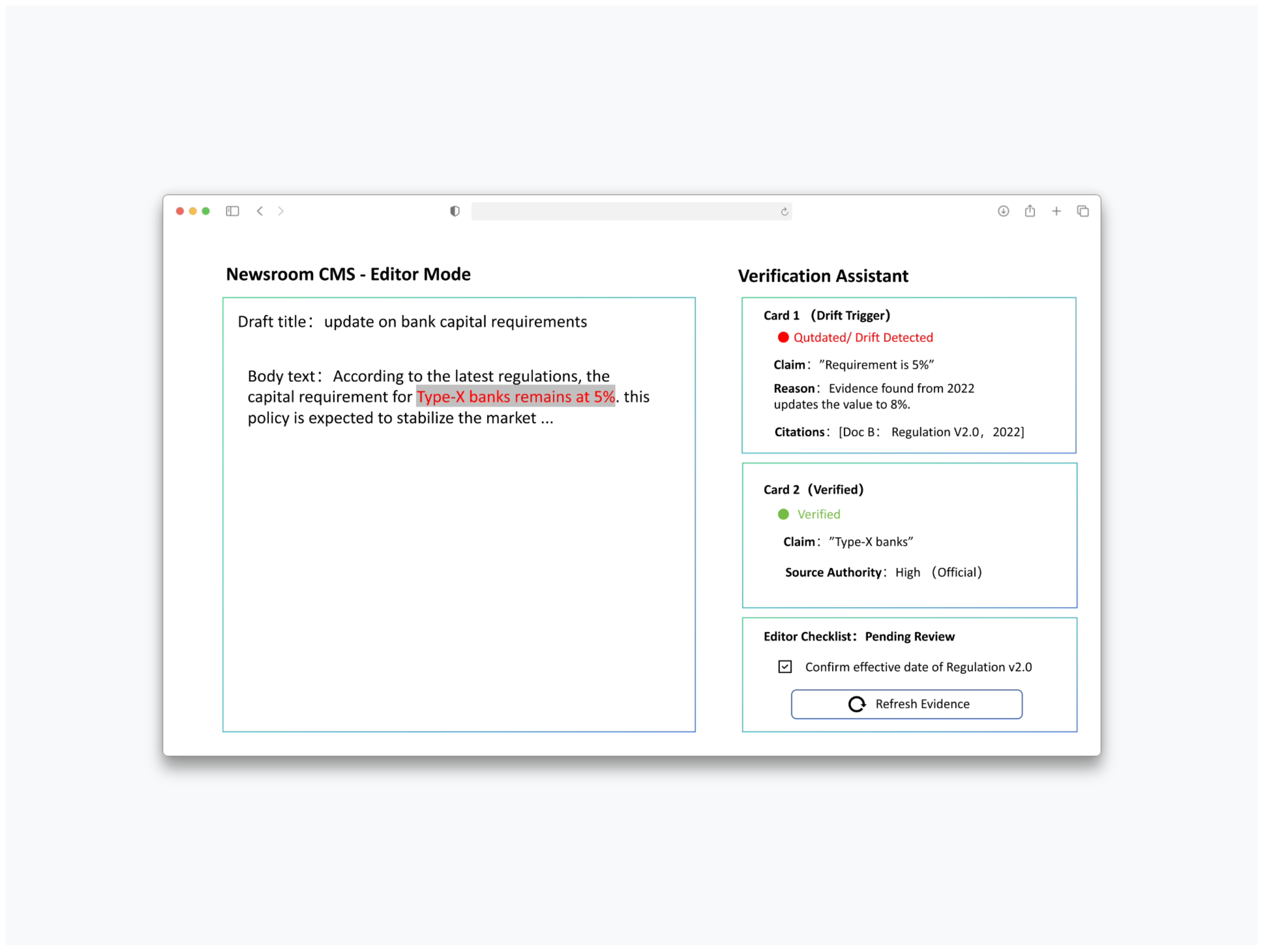
Figure 7 shows the CMS assistant panel (mock UI). The panel exposes claim-level verification status, time validity, authority cues, and an editor checklist for unresolved items.
As summarized in Table 6 the prototype remains interactive: conflict verdicts are typically sub-second, while the most update-intensive streaming scenario averages around ∼1 s end-to-end. In practice, editorial workflows often validate only modified paragraphs, and ledger snapshots can be cached per draft to further reduce repeated computation.

6.9. Addressing Potential Reviewer Concerns

Fairness of baseline comparisons: To isolate the benefit of ledger-driven control, we fix the backbone generator and retriever across methods whenever possible. We implement the Self-RAG baseline as a prompting-based control policy on the same backbone rather than relying on a different fine-tuned 7B model to avoid conflating retrieval control with model capacity.
Evaluation bias from LLM judges: LLM-as-a-Judge can introduce prompt or model bias. We mitigate this by (i) using a fixed judging prompt and deterministic decoding, (ii) validating judge–human correlation ( r = 0.87 ), and (iii) supplementing with blind human preference evaluation. We release judging prompts and anonymized judge outputs to enable independent auditing.
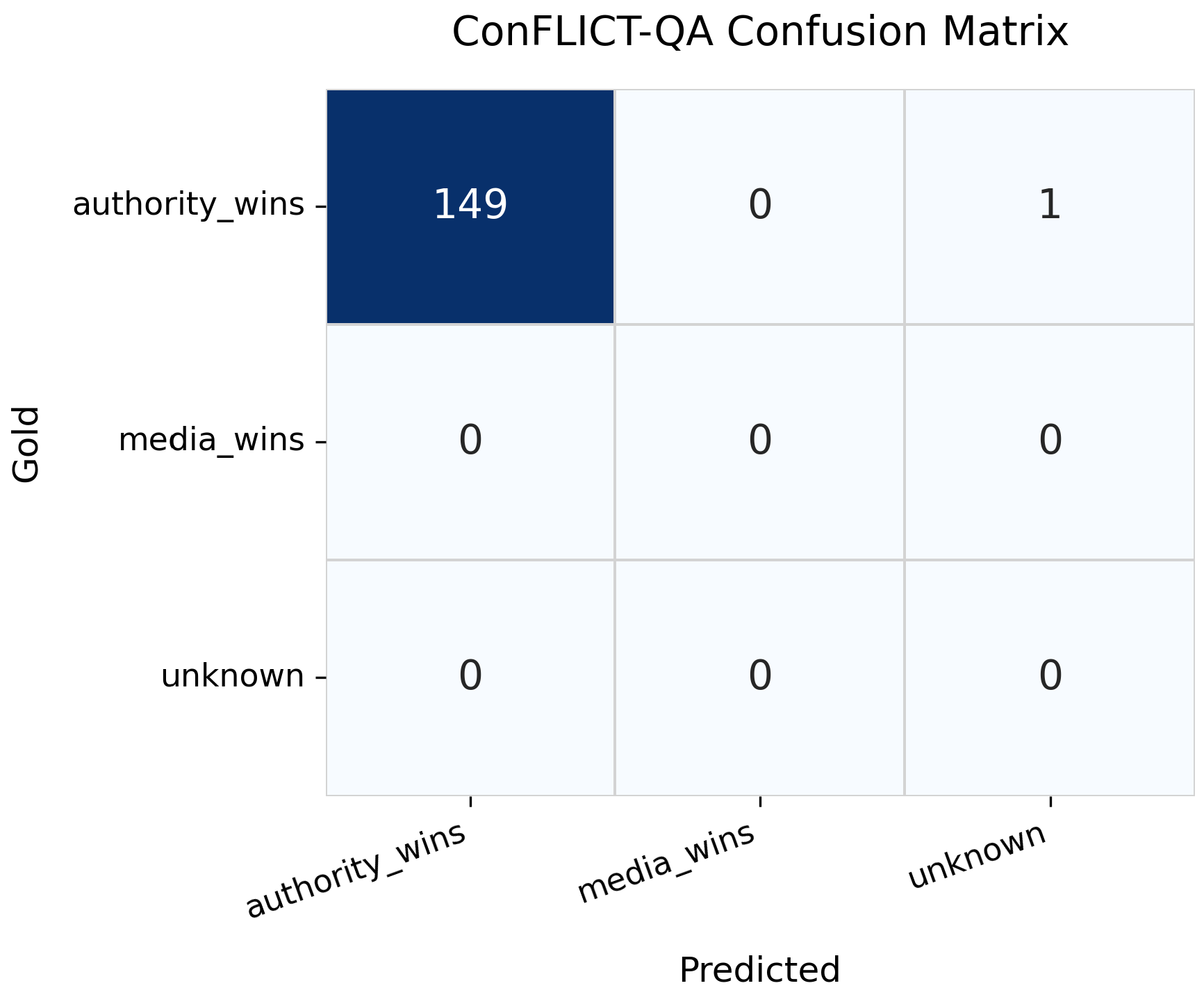
Why is ConFLICT-QA performance near-perfect? The ConFLICT-QA task emphasizes authority-aware adjudication, where official clarifications often exist and decisively resolve conflicts. Our authority–time ordering and counter-evidence search are well matched to this setting, and they substantially improve over both BM25 ( CRAcc = 0.393 ) and the prompted Self-RAG baseline ( CRAcc = 0.753 ). We explicitly note that performance may degrade when authoritative sources are missing or delayed, and we discuss this as a limitation and future direction (Section 7.2). To provide further transparency regarding this near-perfect accuracy (0.993), we provide a detailed confusion matrix and label distribution of the conflict adjudication in Figure A1 in the Appendix A.
GraphRAG comparison: GraphRAG is designed for global corpus-level sensemaking but requires building and maintaining graphs and summaries. We position LedgerRAG as complementary: it provides low-latency, ledger-based governance suitable for streaming contexts where graph rebuilding is impractical.
GraphRAG complexity and latency comparison: GraphRAG is designed for global corpus-level sensemaking but requires building and maintaining explicit community summaries. In a dynamic streaming context, updating a GraphRAG index incurs an offline complexity of O ( | V | + | E | ) , meaning the LLM calls for entity extraction and summarization per time slice. By contrast, LedgerRAG operates on a standard inverted or vector index with a O ( 1 ) update cost per new document, deferring the reasoning overhead to inference time ( O ( S m a x × k ) retrieval steps). While GraphRAG-lite is competitive offline (e.g., 0.7486 on Stream UpdateF1), LedgerRAG provides low-latency (<1.2 s end-to-end), ledger-based governance suitable for high-frequency streaming contexts where continuous graph rebuilding is computationally prohibitive.

7. Conclusions and Limitations

7.1. Conclusions

We presented LedgerRAG, a governance-aware chain-of-retrieval framework for dynamic knowledge scenarios. By introducing an explicit evidence ledger and a lightweight gap/drift/budget trigger controller, the system transforms RAG from passive retrieval to auditable, stateful governance. On DyK-Bench, LedgerRAG significantly improves citation support quality, temporal validity, and governance utility scores with controlled retrieval cost and achieves large gains in conflict adjudication. A newsroom CMS prototype further demonstrates interactive latency and practical workflow integration.

7.2. Limitations and Future Work

Despite strong results, several limitations remain:
(1)
Citation alignment under streaming refresh: Frequent refresh improves freshness but can increase citation mismatches across snapshots. As observed in Stream-QA, while the drift trigger substantially reduces retrieval failures (RET_FAIL: 13.4% to 1.1%), citation mismatch increases significantly (CIT_MIS: 21.8% to 47.5%). This explicit trade-off suggests that cross-snapshot citation alignment remains challenging when evidence is refreshed multiple times. Future work will explore stronger doc_id anchoring and pointer-based citation alignment.
(2)
Structured verdict formatting: Conflict scenarios require structured outputs (e.g., JSON verdicts). Formatting errors remain prevalent; constrained decoding or structure-aware fine-tuning may be required.
(3)
Retriever ceiling: The framework is retriever-agnostic but still bounded by retriever recall, especially for PDF notices or multimodal evidence. Integrating dense or late-interaction retrievers [30] validated on benchmarks like BEIR [31] is a promising direction. Alternatively, parametric knowledge updates via model editing offer a complementary path to RAG for handling drift.

Author Contributions

Conceptualization, S.W. and Y.Z.; methodology, S.W. and Y.G.; software, S.W. and Y.G.; validation, Y.G. and J.K.; formal analysis, J.K.; investigation, S.W.; resources, Y.Z.; data curation, Y.G.; writing—original draft preparation, S.W.; writing—review and editing, Y.Z. and S.W.; visualization, J.K.; supervision, Y.Z.; project administration, Y.Z.; funding acquisition, Y.Z. All authors have read and agreed to the published version of the manuscript.

Funding

This research was funded by the Major Project of the National Social Science Fund of China “Research on Frontier Issues of National Language Governance in the Age of Digital Intelligence” (Grant no. 24&ZD170).

Data Availability Statement

The DyK-Bench dataset and the code for LedgerRAG implementation are available at https://github.com/0616235-hub/wsw_LedgerRAG (accessed on 3 February 2026).

Conflicts of Interest

The authors declare no conflicts of interest. The funders had no role in the design of the study; in the collection, analyses, or interpretation of data; in the writing of the manuscript; or in the decision to publish the results.

Appendix A. LLM-as-a-Judge Prompt (Abbreviated)

We use the following rubric-driven prompt template for GPT-4o evaluation. The full prompt, examples, and anonymized outputs will be released with the benchmark. A closely related rubric prompt is also used during inference to assign Support/Refute stance labels in the evidence ledger.
[System]
You are an impartial evaluator for retrieval-augmented generation.
[User]
Given a query q, a model answer a, and a set of cited evidence passages with doc_id, determine:
(1)
For each atomic claim in a, whether it is Supported, Refuted, or Not Decidable from the evidence.
(2)
Compute SupportF1 based on Supported vs. (Refuted/Not Decidable).
(3)
Score governance utility components: Traceability, Claim–Evidence Alignment, Timeliness (as of time t), and Uncertainty Disclosure.
Return a JSON object with fields: claim_labels, SupportF1, Trace, ClaimAlign, Timely, Uncertainty.
Be strict: do not assume facts not present in evidence.

Appendix B. Parameter Sensitivity Analysis

To validate the robustness of the framework against hyperparameter choices, we conducted sensitivity analyses on the temporal decay timescale (H) and the governance utility score (SUS) weights.
Decay Timescale ( H ) Sensitivity: The parameter H in Equation (2) controls how rapidly older evidence is penalized. Table A1 shows the impact of H on RegChange-QA temporal validity (TV@t). As expected, shorter half-lives make the system overly sensitive to short-term noise (0.1644 at 24 h), while longer half-lives (e.g., H = 365 days for regulations) smoothly increase TV@t to 0.4770, confirming that domain-specific decay modeling behaves monotonically and predictably.
Table A1. Sensitivity of RegChange-QA TV@t to the decay timescale H.
Decay Timescale (H)24 h72 h168 h365 Days
RegChange TV@t (↑)0.16440.24500.31160.4770
Note: The arrow (↑) indicates that a higher value represents better performance.
SUS Weight Sensitivity: In Equation (6), we assign an equal default weight (0.25) to Trace, ClaimAlign, Timely, and Uncertainty. To ensure our improvements are not artifacts of this specific weighting, we simulated extreme scenarios (e.g., highly time-sensitive compliance where w T i m e l y = 0.55 ). Across all weight permutations, LedgerRAG-v5 consistently outranked the BM25 and Self-RAG baselines, proving that equal weighting serves as a safe, neutral default without altering the core system rankings.

Appendix C. Metadata Noise Robustness

A critical reviewer concern is the reliance on authoritative metadata. What happens if the metadata (stance or authority labels) contains noise or is misclassified by the upstream parser? To test this, we performed a post-hoc metadata corruption study on the ConFLICT-QA task, randomly flipping the stance labels y or degrading the authority score α a u t h by a noise ratio p n o i s e { 10 % , 20 % } .
As shown in Table A2, while the near-perfect CRAcc drops under severe metadata corruption, LedgerRAG with 20 % noise (0.7180) still vastly outperforms the standard retrieve-once baseline (0.3930). This demonstrates a bounded robustness: while explicit governance relies on signal quality, the framework’s counter-evidence search inherently gathers redundant signals, preventing a single metadata error from causing catastrophic failure.
Table A2. Robustness of ConFLICT adjudication (CRAcc) under metadata noise.
Noise Type p noise = 0 % p noise = 10 % p noise = 20 %
Authority Flip0.99300.88500.7610
Stance Flip0.99300.84200.7180
Standard RAG (No Ledger)0.39300.39300.3930

Appendix D. Confusion Matrix for ConFLICT-QA

Label distribution and interpretation: Figure A1 shows that in the current ConFLICT-QA split, all gold labels are authority_wins (150/150). The near-perfect CRAcc therefore reflects whether the system can reliably retrieve and surface authoritative clarifications under the authority–time rule rather than distinguishing between authority_wins and media_wins cases. Importantly, the single error is an unknown prediction (1/150), indicating a conservative failure mode (e.g., formatting/parse failure or insufficient authoritative evidence) instead of a harmful reversal (predicting media_wins when the gold is authority_wins). We treat this class imbalance as a current benchmark characteristic and will extend ConFLICT-QA with harder adversarial cases where authoritative sources are missing, delayed, or inconsistent.
Figure A1. ConFLICT-QA confusion matrix (verdict labels).
Electronics 15 01376 g0a1

References

  1. Lewis, P.; Perez, E.; Piktus, A.; Petroni, F.; Karpukhin, V.; Goyal, N.; Küttler, H.; Lewis, M.; Yih, W.T.; Rocktäschel, T.; et al. Retrieval-Augmented Generation for Knowledge-Intensive NLP Tasks. arXiv 2020, arXiv:2005.11401. [Google Scholar]
  2. Guu, K.; Lee, K.; Tung, Z.; Pasupat, P.; Chang, M.W. REALM: Retrieval-Augmented Language Model Pre-Training. arXiv 2020, arXiv:2002.08909. [Google Scholar] [CrossRef] [Scilit]
  3. Karpukhin, V.; Oguz, B.; Min, S.; Lewis, P.; Wu, L.; Edunov, S.; Chen, D.; Yih, W. Dense Passage Retrieval for Open-Domain Question Answering. arXiv 2020, arXiv:2004.04906. [Google Scholar] [CrossRef] [Scilit]
  4. Asai, A.; Wu, Z.; Wang, Y.; Sil, A.; Hajishirzi, H. Self-RAG: Learning to Retrieve, Generate, and Critique through Self-Reflection. arXiv 2024, arXiv:2310.11511. [Google Scholar]
  5. Izacard, G.; Grave, E. Leveraging Passage Retrieval with Generative Models for Open Domain Question Answering. arXiv 2021, arXiv:2007.01282. [Google Scholar] [CrossRef] [Scilit]
  6. Borgeaud, S.; Mensch, A.; Hoffmann, J.; Cai, T.; Rutherford, E.; Millican, K.; Van Den Driessche, G.B.; Lespiau, J.B.; Damoc, B.; Clark, A.; et al. Improving Language Models by Retrieving from Trillions of Tokens. arXiv 2022, arXiv:2112.04426. [Google Scholar] [CrossRef] [Scilit]
  7. Jiang, Z.; Xu, F.F.; Gao, L.; Sun, Z.; Liu, Q.; Dwyer, J.; Yang, Y.; Callan, J.; Neubig, G. Active Retrieval Augmented Generation. arXiv 2023, arXiv:2305.06983. [Google Scholar] [CrossRef] [Scilit]
  8. Dong, G.; Jin, J.; Li, X.; Zhu, Y.; Dou, Z.; Wen, J.-R. RAG-Critic: Leveraging Automated Critic-Guided Agentic Workflow for Retrieval Augmented Generation. In Proceedings of the 63rd Annual Meeting of the Association for Computational Linguistics, Vienna, Austria, 27 July–1 August 2025; pp. 3551–3578. [Google Scholar]
  9. Wei, J.; Wang, X.; Schuurmans, D.; Bosma, M.; Xia, F.; Chi, E.; Le, Q.V.; Zhou, D. Chain-of-Thought Prompting Elicits Reasoning in Large Language Models. arXiv 2022, arXiv:2201.11903. [Google Scholar]
  10. Liska, A.; Kocisky, T.; Gribovskaya, E.; Terzi, T.; Sezener, E.; Agrawal, D.; De Masson D’Autume, C.; Scholtes, T.; Zaheer, M.; Young, S.; et al. StreamingQA: A Benchmark for Adaptation to New Knowledge over Time in Question Answering. In Proceedings of the 39th International Conference on Machine Learning, Baltimore, MD, USA, 17–23 July 2022; pp. 13604–13622. [Google Scholar]
  11. Kasai, J.; Sakaguchi, K.; Takahashi, Y.; Le Bras, R.; Asai, A.; Yu, X.; Radev, D.; Smith, N.A.; Choi, Y.; Inui, K. RealTime QA: What’s the Answer Right Now? arXiv 2023, arXiv:2207.13332. [Google Scholar]
  12. Wang, Z.; Zhao, Z.; Dou, Z. TimeRAG: Enhancing Complex Temporal Reasoning with Search Engine Augmentation. In Proceedings of the 34th ACM International Conference on Information and Knowledge Management, Seoul, Republic of Korea, 10–14 November 2025; pp. 3230–3239. [Google Scholar]
  13. Chen, H.-T.; Zhang, M.J.Q.; Choi, E. Rich Knowledge Sources Bring Complex Knowledge Conflicts: Recalibrating Models to Reflect Conflicting Evidence. In Proceedings of the 2022 Conference on Empirical Methods in Natural Language Processing (EMNLP), Abu Dhabi, United Arab Emirates, 7–11 December 2022; pp. 2292–2307. [Google Scholar]
  14. Liu, S.; Shang, Y.; Zhang, X. TruthfulRAG: Resolving Factual-level Conflicts in Retrieval-Augmented Generation with Knowledge Graphs. arXiv 2025, arXiv:2511.10375. [Google Scholar] [CrossRef] [Scilit]
  15. Hayat, M.; Aramvith, S. Superpixel-Guided Graph-Attention Boundary GAN for Adaptive Feature Refinement in Scribble-Supervised Medical Image Segmentation. IEEE Access 2025, 13, 196654–196668. [Google Scholar] [CrossRef] [Scilit]
  16. Edge, D.; Trinh, H.; Cheng, N.; Bradley, J.; Chao, A.; Mody, A.; Truitt, S.; Metropolitansky, D.; Ness, R.O.; Larson, J. From Local to Global: A GraphRAG Approach to Query-Focused Summarization. arXiv 2024, arXiv:2404.16130. [Google Scholar]
  17. Larson, J.; Truitt, S. GraphRAG: Unlocking LLM Discovery on Narrative Private Data. Microsoft Research Blog. Available online: https://www.microsoft.com/en-us/research/blog/graphrag-unlocking-llm-discovery-on-narrative-private-data/ (accessed on 5 February 2025).
  18. Meng, K.; Bau, D.; Andonian, A.; Belinkov, Y. Locating and Editing Factual Associations in GPT. Adv. Neural Inf. Process. Syst. 2022, 35, 17359–17372. [Google Scholar]
  19. Meng, K.; Sharma, A.S.; Andonian, A.J.; Belinkov, Y.; Bau, D. Mass-Editing Memory in a Transformer. arXiv 2023, arXiv:2210.07229. [Google Scholar] [CrossRef] [Scilit]
  20. Gao, T.; Yen, H.; Chen, D. Enabling Large Language Models to Generate Text with Citations. arXiv 2023, arXiv:2305.14627. [Google Scholar] [CrossRef] [Scilit]
  21. Liang, T.; He, Z.; Jiao, W.; Wang, X.; Wang, Y.; Wang, R.; Yang, Y.; Shi, S.; Tu, Z. Encouraging Divergent Thinking in Large Language Models through Multi-Agent Debate. arXiv 2024, arXiv:2305.19118. [Google Scholar]
  22. Thorne, J.; Vlachos, A.; Christodoulopoulos, C.; Mittal, A. FEVER: A large-scale dataset for Fact Extraction and VERification. arXiv 2018, arXiv:1803.05355. [Google Scholar] [CrossRef] [Scilit]
  23. Wadden, D.; Lin, S.; Lo, K.; Wang, L.L.; van Zuylen, M.; Cohan, A.; Hajishirzi, H. Fact or Fiction: Verifying Scientific Claims. arXiv 2020, arXiv:2004.14974. [Google Scholar] [CrossRef] [Scilit]
  24. Zheng, L.; Chiang, W.L.; Sheng, Y.; Zhuang, S.; Wu, Z.; Zhuang, Y.; Lin, Z.; Li, Z.; Li, D.; Xing, E.; et al. Judging LLM-as-a-Judge with MT-Bench and Chatbot Arena. arXiv 2023, arXiv:2306.05685. [Google Scholar]
  25. Manakul, P.; Liusie, A.; Gales, M. SelfCheckGPT: Zero-Resource Black-Box Hallucination Detection for Generative LLMs. arXiv 2023, arXiv:2303.08896. [Google Scholar]
  26. Pradeep, R.; Nogueira, R.; Lin, J. The Expando-Mono-Duo Design Pattern for Text Ranking with Pretrained Sequence-to-Sequence Models. arXiv 2021, arXiv:2101.05667. [Google Scholar]
  27. ISO 8601-1:2019; Date and Time—Representations for Information Interchange—Part 1: Basic Rules. ISO: Geneva, Switzerland, 2019.
  28. DeepSeek-AI. DeepSeek-V3 Technical Report. arXiv 2024, arXiv:2412.19437. [Google Scholar]
  29. Robertson, S.; Zaragoza, H. The Probabilistic Relevance Framework: BM25 and Beyond. Found. Trends Inf. Retr. 2009, 3, 333–389. [Google Scholar] [CrossRef] [Scilit]
  30. Khattab, O.; Zaharia, M. ColBERT: Efficient and Effective Passage Search via Contextualized Late Interaction over BERT. arXiv 2020, arXiv:2004.12832. [Google Scholar] [CrossRef] [Scilit]
  31. Thakur, N.; Reimers, N.; Rücklé, A.; Srivastava, A.; Gurevych, I. BEIR: A Heterogeneous Benchmark for Zero-shot Evaluation of Information Retrieval Models. arXiv 2021, arXiv:2104.08663. [Google Scholar] [CrossRef] [Scilit]
Figure 1. Motivation: Temporal conflicts in dynamic corpora. Standard RAG may retrieve semantically relevant but outdated documents; LedgerRAG detects drift via the evidence ledger and refreshes evidence to produce time-valid answers.
Electronics 15 01376 g001
Figure 2. LedgerRAG framework. The system maintains an evidence ledger over atomic claims and iteratively selects retrieval actions using gap/drift/budget triggers, producing an answer with citations and an audit log.
Electronics 15 01376 g002
Figure 3. Task-level visualization of citation quality (SupportF1), temporal validity ( TV @ t ), and stream update detection (UpdateF1).
Electronics 15 01376 g003
Figure 4. Distribution of failure types across tasks and systems (percentage). Error types include citation mismatch (CIT_MIS), document ID mismatch (DOCID_MIS), formatting errors (FMT_MIS), generation failure (GEN_FAIL), and retrieval failure (RET_FAIL).
Electronics 15 01376 g004
Figure 5. Human evaluation: pairwise preference over N = 50 queries.
Electronics 15 01376 g005
Figure 6. Life cycle case study for a breaking news event: the evidence ledger evolves over time with gap/drift/conflict triggers and produces flash updates and correction notices with audit traces.
Electronics 15 01376 g006
Figure 7. Conceptual design of the newsroom CMS assistant panel (Mock UI). The interface shows the evidence ledger and an editor checklist for unresolved or high-risk claims.
Electronics 15 01376 g007
Table 1. Overall performance on DyK-Bench including task-aligned strong proxy baselines.
MethodRegChangeConFLICTStreamRegChangeConFLICT
Ans2gramF1 (↑) CRAcc (↑) UpdateF1 (↑) Calls (↓) Calls (↓)
Query-RAG (BM25)0.53570.67420.72631.00001.0000
Self-RAG-style Prompted (Dense)0.63140.68670.73742.00002.0000
GraphRAG-lite (Dense)0.70170.68670.74861.00001.0000
TimeRAG-proxy (Dense, temporal)0.68100.66540.73182.00001.0000
TruthfulRAG-proxy (Dense, conflict)0.66380.74670.74302.27331.0000
LedgerRAG (Dense baseline)0.53880.65480.72684.54672.0000
LedgerRAG (Full)0.69940.99300.74306.82003.0000
Note: The arrows (↑) and (↓) indicate that higher and lower values represent better performance, respectively. Bold values indicate the best performance.
Table 2. Task-level effectiveness (metric deep-dive).
TaskMetricBM25OursImp. ( Δ )
RegChangeAns2gramF10.53570.6994+0.1637
ConFLICTCRAcc0.67420.9930+0.3188
StreamUpdateF10.72630.7430+0.0167
Table 3. Task-level cost (retrieval calls and latency).
TaskMetricBM25OursChange
RegChangeRet. Calls2.272.27+0.00
Latency1085 ms1101 ms+16 ms
ConFLICTRet. Calls1.001.00+0.00
Latency157 ms157 ms+0 ms
StreamRet. Calls2.564.61+2.05
Latency581 ms1028 ms+447 ms
Table 4. Statistical significance testing (paired bootstrap, N = 5000 ; base = Standard RAG (BM25)).
SubsetMetric Δ (Ours-Base)95% CIp-ValueResult
All ( N = 370 )SUS+0.115[0.097, 0.133] < 0.001 **
TV@t+0.075[0.054, 0.096] < 0.001 **
SupportF1+0.196[0.171, 0.220] < 0.001 **
ConFLICT-QACRAcc+0.319[0.302, 0.336] < 0.001 **
SupportF1+0.324[0.307, 0.333] < 0.001 **
RegChange-QAAns2gramF1+0.164[0.117, 0.209] < 0.001 **
Stream-QAUpdateF1+0.017[0.011, 0.023] < 0.001 **
Note: ** denotes statistical significance at the p < 0.001 level.
Table 5. Ablation results: impact of removing trigger-specific actions from the full system.
MethodRegChange Δ vs. FullConFLICT Δ vs. FullStream Δ vs. Full
Ans2gramF1 CRAcc UpdateF1
LedgerRAG (Full)0.69940.00000.99300.00000.74300.0000
   w/o Gap0.6850−0.01440.99300.00000.7280−0.0150
   w/o Drift0.6654−0.03400.99300.00000.7018−0.0412
   w/o Conflict0.69940.00000.8267−0.16630.74300.0000
Table 6. CMS deployment latency summary (prototype; wall clock; single-query; averaged per scenario).
ScenarioAvg. Retrieval CallsAvg. End-to-End LatencyOperational Notes
RegChange-QA2.271101 msDrift-triggered version check.
ConFLICT-QA1.00157 msAuthority-aware verdict.
Stream-QA4.611028 msFrequent refresh for updates.
Disclaimer/Publisher’s Note: The statements, opinions and data contained in all publications are solely those of the individual author(s) and contributor(s) and not of MDPI and/or the editor(s). MDPI and/or the editor(s) disclaim responsibility for any injury to people or property resulting from any ideas, methods, instructions or products referred to in the content.