Article

Reimagining Bitcoin Mining as a Virtual Energy Storage Mechanism in Grid Modernization: Enhancing Security, Sustainability, and Resilience of Smart Cities Against False Data Injection Cyberattacks


Department of Electrical Engineering, College of Engineering and Computer Science, Arkansas State University, Jonesboro, AR 72401, USA
Electronics 2026, 15(7), 1359; https://doi.org/10.3390/electronics15071359
Submission received: 27 February 2026 / Revised: 20 March 2026 / Accepted: 22 March 2026 / Published: 25 March 2026

Abstract

The increasing penetration of intermittent renewable energy demands innovative solutions to maintain grid stability, resilience, and security in the body of smart cities. This paper presents a novel framework that redefines Bitcoin mining as a form of virtual energy storage, a flexible and controllable load capable of delivering large-scale demand response services, positioning it as a competitive alternative to traditional energy storage systems, including electrical, mechanical, thermal, chemical, and electrochemical storage solutions. By strategically aligning mining activities with grid conditions, Bitcoin mining can absorb excess electricity during periods of oversupply, converting it into digital assets, and reduce operations during times of scarcity, effectively emulating the behavior of conventional energy storage systems without the associated capital expenditures and material requirements. Beyond its operational flexibility, this paper explores the cyber–physical benefits of integrating Bitcoin mining into the power transmission systems as a defensive mechanism against false data injection (FDI) cyberattacks in smart city infrastructure. To achieve this goal, a decentralized and adaptive control strategy is proposed, in which mining loads dynamically adjust based on authenticated grid-state information, thereby improving system observability and hindering adversarial efforts to disrupt state estimation. In addition, to handle the proposed approach, this paper introduces a high-performance algorithm, a combination of quantum-augmented particle swarm optimization and wavelet-oriented whale optimization (QAPSO-WOWO). Simulation results confirm that strategic deployment of mining loads improves grid sustainability by utilizing curtailed renewables, enhances resilience by mitigating load-generation imbalances, and bolsters cybersecurity by reducing the impacts of FDI attacks. This work lays the foundation for a transdisciplinary paradigm shift, positioning Bitcoin mining not as a passive energy consumer but as an active participant in securing and stabilizing the future power grid in smart cities.

1. Introduction

1.1. Background, Definitions, and Motivation

Cryptocurrency mining is emerging as a dual-edged factor in the evolution of contemporary energy infrastructure, posing significant hurdles yet offering strategic benefits [1]. Each year, such mining operations consume between 140 and 160 terawatt-hours of electricity, emit 60 to 80 million metric tons of carbon dioxide, and contribute heavily to electronic waste [2]. As a case in point, Bitcoin’s network relies on highly intensive computation, where dedicated hardware systems perform complex cryptographic calculations to validate transactions and secure the associated blockchain [3]. However, unlike traditional energy consumers, mining operations are uniquely adaptable: they can scale back their electricity use almost instantly. Their ability to quickly adjust power consumption makes them well-suited for demand-side energy programs, strengthens grid reliability, and facilitates the adoption of renewable energy resources (RERs) [4]. As the U.S. electricity network transforms into a sophisticated cyber–physical power system (CPPS), blending digital intelligence with physical infrastructure, it is increasingly geared toward optimizing efficiency and enabling high levels of RERs integration in pursuit of a net-zero grid by 2035 [5]. This shift aligns with grid modernization efforts that emphasize decentralized structures managed through digital technologies. Hence, as the energy landscape grows more intricate, innovative strategies are essential to maintain the reliability and resilience of power systems. In this regard, this paper presents an innovative energy storage paradigm that leverages coordinated Bitcoin mining with RERs to transform surplus generation into economic value. Unlike conventional storage systems, the proposed approach functions as a virtual energy storage mechanism, (a) requiring no physical infrastructure, (b) incurring no degradation, and (c) enabling virtually infinite charge–discharge cycles. More importantly, the proposed energy storage framework not only enhances grid flexibility but also provides critical support to power system operators in mitigating false data injection (FDI) cyberattacks, one of the most sophisticated and damaging threats to modern power transmission networks. By integrating the proposed framework into the daily operation of power systems, operators gain an additional layer of resilience, improving system reliability and cybersecurity in increasingly digitized energy infrastructures in real time.

1.2. Literature Review

Related Works on the Recent Advances in Cryptocurrencies and Blockchain Technology Associated with Power Systems Operation: In [6], an energy management framework was presented in order to model cryptocurrency mining loads within microgrids, where excess renewable energy was used to power cryptocurrency mining devices instead of exporting electricity to the main grid. A Monte Carlo simulation and financial indices were further employed in [6] to evaluate the annual profitability and operational impacts of the mining business on the operation of power distribution network performance. In [7], a comprehensive analysis of Bitcoin mining was presented to investigate its role as a resource monetization instrument and its interaction with sustainable energy practices. Through case studies, grounded theory, and causal loop diagrams, the study performed in [7] demonstrated that Bitcoin mining can utilize excess renewable energy, enhance grid stability, and create new business models that align economic incentives with sustainability objectives. In [8], a systematic literature review was presented to assess the environmental impacts of proof-of-work and proof-of-stake cryptocurrencies. The study conducted in [8] clustered proof-of-work-related findings into seven key aspects—resources, energy consumption, carbon footprint, socio-economic and policy factors, and electronic waste—and concluded that proof-of-work cryptocurrencies, particularly Bitcoin, exhibits increasing environmental impacts, whereas proof-of-stake offers a more sustainable alternative. In [9], a comprehensive review was presented to evaluate the environmental implications of major cryptocurrencies, with a focus on their energy consumption and carbon footprint compared to traditional financial systems. The review performed in [9] emphasized the growing sustainability concerns for cryptocurrency operations and discussed emerging alternatives, such as Ethereum 2.0 and Pi Network, as potential solutions to reduce their environmental impact. In [10], machine learning and econometric techniques were presented to analyze Bitcoin’s carbon footprint and its technical drivers, including network hash rate, block size, and mining difficulty, over the period from 2010 to 2021. Hence, the work presented in [10] highlighted the environmental impacts of Bitcoin’s proof-of-work infrastructure and emphasized the potential role of advanced hardware adoption and regulatory measures in mitigating its energy consumption and carbon emissions. In [11], a life cycle assessment methodology was presented to estimate the environmental impact of Bitcoin mining, focusing on energy consumption and carbon footprint. This study identified miner distribution and equipment efficiency as the main drivers of environmental impact, while predicting that although the network hash rate would increase, the energy consumption and carbon footprint per unit of mining output are expected to decrease. In [12], a thematic review was presented to examine the application of blockchain technology in power systems, highlighting its potential to enable decarbonization, decentralization, digitalization, and democratization of future energy systems. The review also discussed current barriers to large-scale adoption and explored emerging trends for implementing secure, decentralized energy trading platforms. In [13], a blockchain-enabled framework was presented for secure and efficient firmware updates in IoT-enabled smart cities. The proposed framework in [13] combined Merkle tree-based data integrity, decentralized blockchain validation, smart contracts, peer-to-peer distribution, and adaptive machine learning-based prioritization to enhance security, scalability, and operational efficiency in IoT device management. Finally, in [14], a long-run model of the Texas electricity market was presented to evaluate the impact of Bitcoin mining on renewable energy capacity and carbon emissions. The introduced model in [14] proved that while Bitcoin mining can increase renewable capacity, it also raises emissions, which can be largely mitigated when miners participate in grid management through demand response.
Related Works on the Recent FDI Models Targeting Modern Power Systems and Defense Mechanisms: Recent research has turned increasingly to the vulnerabilities of modern power systems against FDI attacks, exploring both attack strategies and defense mechanisms in CPPSs. For example, a robust moving target defense mechanism against FDI attacks in power grids was proposed in [15] for the state estimation layer in power systems, leveraging D-FACTS (flexible AC transmission system) devices in a noisy environment and establishing worst-case identification bounds for unknown FDI cyberattacks. Meanwhile, ref. [16] carefully addressed the crucial issue of where to place D-FACTSs to maximize the effectiveness of moving target defense mechanisms while balancing operational cost and stealth. On the attack side, ref. [17] formulated an optimization-based model to identify minimal-time FDI cyberattacks on load-frequency control, taking into account inertia, droop, and dispatch cycles. Another study, ref. [18], integrated machine learning with physics-based moving target defense to counter adversarial FDI attacks that aimed to evade deep learning detectors, showing detection accuracy above 99%. On the detection front, ref. [19] presented a semi-supervised learning approach to detect unobservable FDI cyberattacks in distribution-level power systems. Further, ref. [20] introduced a graph-edge-conditioned convolutional network that exploited power system topology, such as buses and edge features, for scalable detection of FDI attacks across varying system sizes. In addition, ref. [21] scrutinized the destabilizing potential of FDI threats through AC power flow and small-signal stability models, showing that intelligent attackers with limited measurement access can still drive instability. Collectively, these works move the field beyond static bad data detections (BDDs) towards dynamic, system-wide resilience approaches that integrate grid physics, topology, real-time protocol behavior, and adversarial modelling.
A Brief Survey on the Earlier Steps of This Research: In [22], the concept of modern CPPSs was initiated by integrating energy and communication infrastructures, reducing human involvement in operations. The study conducted in [22] developed an AI-based remedial action scheme to mitigate unserved energy and voltage violations from coordinated FDI attacks and validated its effectiveness on the IEEE 30-bus test system. In [23], a digital twin-enabled remediation framework was proposed to counter FDI cyberattacks on power distribution systems with RERs. The proposed framework of [23] used a digital twin to identify optimal network reconfigurations in real time, simulating attack scenarios, and detecting anomalies to mitigate the impact of FDI cyberattacks. In [24], a two-stage remediation framework was proposed to counter decentralized FDI attacks on under load tap changing (ULTC) transformers in smart distribution grids. The proposed framework in [24] scrutinized vulnerabilities in attacked components and leveraged non-attacked ULTCs, voltage regulators, RERs, and smart homes to maintain voltage stability, reducing the voltage collapse proximity index by over 60% and enhancing system resilience. In [25], a framework was proposed to optimally use static VAR compensators within a customized system reconfiguration to remediate voltage violations caused by FDI attacks on smart distribution grids. The introduced framework in [25] planned compensators allocation during the planning phase and identified remedial actions in the operation phase through a distribution feeder reconfiguration problem, and its effectiveness was validated on 33-, 95-, and 136-bus test systems with RERs. In [26], an FDI cyberattack was scrutinized that allowed a group of aggregators to gain market power in a deregulated electricity market by manipulating other retailers’ data. A remedial action scheme was also proposed in [26] to mitigate the cyberattack by running a backup market, and its effectiveness was validated on a 136-bus unbalanced distribution system with PV modules, wind turbines, smart homes, and diesel engine units. Finally, in [27], an online remedial action scheme was proposed to mitigate voltage violations caused by FDI attacks on ULTC transformers in smart distribution systems. The proposed remediation framework in [27] utilized a two-phase framework, simulating attack scenarios and then applying a customized distribution feeder reconfiguration to restore voltage profiles, and its effectiveness was validated on an IEEE test system.

1.3. Problem Statement, Research Gap, and Contribution of This Paper

On one hand, cryptocurrency mining has seen rapid technological advancements; on the other hand, the integration of RERs has become a central focus in modern power systems (i.e., the building blocks of smart cities). Yet, a critical question remains: How can Bitcoin mining operations be effectively harnessed as real-time virtual energy storage assets, participating in demand response programs, while simultaneously enhancing grid resilience against sophisticated FDI attacks that bypass the cybersecurity safeguards embedded in state estimation processes within power system operations?
This critical challenge highlights significant gaps in existing research, most notably, the absence of innovative frameworks that (a) redefine mining facilities from passive energy consumers into active prosumers contributing to grid services and (b) integrate them in remediation frameworks against severe FDI cyberattacks bypassing the detection stage.
Although cryptocurrency mining operations have been explored as a supporting element within modern power systems (e.g., [6,7,8,9,10,11,12,13,14]), the existing literature remains fragmented, often addressing only a single dimension, such as economic optimization, environmental impact, or technical feasibility. Additionally, the existing literature includes several significant studies proposing various mechanisms to counter FDI cyberattacks on smart power systems, including works [15,16,17,18,19,20,21] and the earlier stages of this research [22,23,24,25,26,27]. Nevertheless, a critical gap persists in developing a comprehensive approach to integrating large-scale Bitcoin mining facilities that simultaneously considers all three factors of economic optimization, environmental impact, and technical feasibility. Such an approach is essential for enhancing the resilience and cybersecurity of modern CPPSs, particularly in defending against advanced FDI attacks targeting state estimation processes in the transmission level. To address these research gaps, this paper introduces a novel, integrated framework that reimagines Bitcoin mining facilities as dual-purpose assets within modern power systems: (a) as flexible loads capable of actively participating in demand side management strategies, and (b) as virtual, grid-scale energy storage units that enhance grid stability while providing strong defenses against undetectable FDI attacks. Such stealthy cyberattacks can easily bypass traditional security measures, embedded in power systems state estimation, leading to critical operational challenges such as system congestion and widespread power outages. Accordingly, the main contributions of this paper can be elaborated upon hereunder.
  • Developing an innovative framework that leverages Bitcoin mining facilities in conjunction with transmission and sub-transmission networks, enabling these facilities to function as grid-scale dynamic loads/virtual energy storage systems and enhance overall system flexibility and resilience,
  • Introducing a novel remediation framework that integrates large-scale Bitcoin mining facilities to mitigate the impacts of FDI cyberattacks on smart power transmission networks, reducing system congestion and preventing potential widespread power outages while enhancing grid resilience in real time, and
  • Pioneering QAPSO-WOWO (quantum augmented particle swarm optimization wavelet-oriented whale optimization), a next-generation hybrid optimization algorithm that harnesses quantum intelligence and bio-inspired dynamics to tackle massive, complex optimization challenges, achieving near-instantaneous performance that redefines computational efficiency.
More importantly, to carefully address existing limitations in the literature, this work establishes a rigorous and unified framework that integrates flexible load modeling, cybersecurity resilience, and energy system optimization. In this context, Bitcoin mining is formally characterized as a virtual energy storage mechanism by leveraging its inherent controllability, rapid response capability, and energy-time shifting equivalence, enabling it to emulate key functional attributes of conventional storage systems without requiring physical energy conversion or storage infrastructure. Unlike traditional demand response programs, the proposed approach treats mining loads as continuously adjustable, market-driven resources that dynamically align with grid conditions while contributing to improved system observability.
From a methodological perspective, the proposed framework is formulated as a constrained multi-objective optimization problem that jointly minimizes load-generation imbalance, renewable energy curtailment, and the impact of FDI cyberattacks on state estimation accuracy. The integration of a hybrid QAPSO-WOWO algorithm into the proposed framework enables efficient exploration of the complex solution space while maintaining robustness against nonlinearities and uncertainties. The formulation is validated through detailed simulations and scenario-based analyses, demonstrating that the coordinated deployment of Bitcoin mining loads can enhance grid flexibility, improve resilience against cyber–physical disturbances, and provide a scalable pathway for integrating high levels of RERs in smart city environments (see Section 3 and Section 5).

2. Integrated Framework for Bitcoin Mining-Based Energy Storage and Cybersecurity

2.1. Basics of Bitcoin

Cryptocurrencies are digital currencies that utilize cryptographic techniques to protect transaction integrity and control the issuance of new coins. This idea emerged from years of research focused on building a decentralized financial network free from reliance on traditional central authorities [28]. In this context, Bitcoin is acknowledged as the pioneering public blockchain, gaining worldwide acceptance and significant market credibility [29]. The system’s integrity is maintained through a decentralized agreement process spread across numerous network participants, safeguarding its reliability and trustworthiness [30]. Bitcoin currently controls over half of the market within energy-intensive cryptocurrencies, while Ethereum, now operating on a proof-of-stake model, holds less than 10% and ranks second [31]. This market leadership highlights Bitcoin’s prominence over other alternative coins, making it a significant candidate to be utilized as a virtual energy storage system in grid modernization. Within this consensus mechanism and according to [32], Bitcoin minor participants race to validate a group of pending transactions by generating a block and continuously altering a variable known as the “nonce” in the block’s header to produce a cryptographic hash. The objective is to discover a hash value that meets the network’s predefined difficulty criteria. Upon finding a suitable hash, the winning miner broadcasts it across the network, allowing other nodes to swiftly authenticate its validity. Once verified, the block is appended to the blockchain, and the winning miner is rewarded with newly created Bitcoins alongside the accumulated transaction fees. Based on operational capacity, Bitcoin mining activities can be segmented into three groups: small-scale miners with energy consumption below 0.1 MW, medium-scale operations drawing up to 1 MW, and large-scale facilities exceeding the 1 MW threshold [33].

2.2. Bitcoin Mining as a Virtual Energy Storage Asset vs. Traditional Storage Systems

To support the integration of RERs on a large scale, energy storage solutions play a crucial role by reducing fluctuations in power generation, increasing the reliability of supply, and boosting the adaptability of the power grid. These storage technologies are typically divided into five distinct types, categorized according to the specific form of energy they retain, including electrical, mechanical, thermal, chemical, and electrochemical storage systems. Selecting the most suitable energy storage technology involves evaluating several essential performance characteristics. One of the primary considerations is energy capacity, which indicates how much energy the storage system can hold. Just as crucial is the power output rating, which reflects how quickly the system can absorb or deliver energy. System efficiency must also be assessed, as it represents the energy losses that occur during charging and discharging processes. Additionally, storage longevity (i.e., how long the stored energy remains usable?) is an important metric, alongside the time required to fully charge or discharge the system [34]. In this regard, electric energy storage systems, including supercapacitors and superconducting storage, enable rapid cycling and high durability, yet struggle with scalability and cost [35]. Mechanical systems like pumped hydro storage and compressed air units provide long lifetimes and grid-scale potential but are limited by geographic and infrastructure constraints [36]. Thermal storage systems are less favored due to lower efficiency and complex system designs, while chemical options such as hydrogen and ammonia promise high capacity but remain hindered by technological immaturity and expensive infrastructure needs [37]. Finally, electrochemical storage, particularly lithium-ion batteries, offers high efficiency and fast response but faces challenges such as high costs, limited lifespans, and complex thermal management [38]. Despite ongoing advancements, the limitations of these technologies underscore the need for alternative, economically viable, and technically resilient storage solutions.
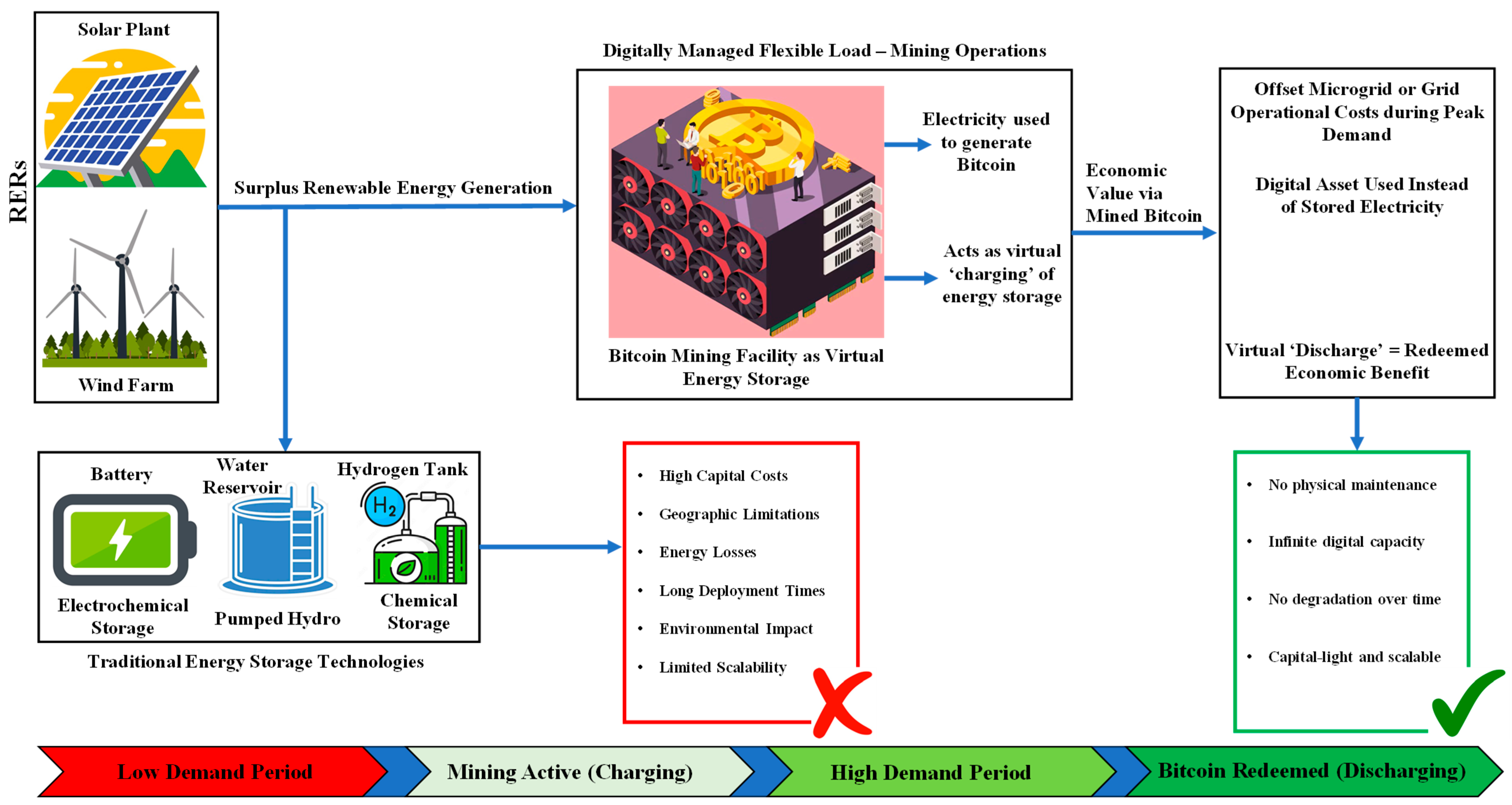
The shortcomings of the traditional storage mechanisms, referred to above, have driven the exploration of innovative alternatives. To this end, a particularly promising framework depicted in Figure 1—leveraging digitally managed flexible loads to function as virtual energy storage units—is proposed in this paper, in which the rapid responsiveness and substantial energy demand of large-scale computational Bitcoin mining facilities present a unique opportunity to capture and utilize excess energy of RERs efficiently.
To rigorously justify Bitcoin mining as a form of virtual energy storage, its operational flexibility is explicitly mapped to conventional storage metrics. The total energy consumed by mining loads during periods of renewable surplus can be interpreted as the system’s effective energy capacity, analogous to the rated energy capacity of electrochemical batteries. The round-trip efficiency is defined as the ratio of energy effectively used for grid balancing—through controlled modulation of mining activity—to the total electrical energy consumed, accounting for computational overhead. Furthermore, the discharge latency corresponds to the response time of mining loads to reduce consumption during scarcity or grid disturbances, emulating the ramp-down behavior of traditional storage devices. As can be confirmed in the simulation results section (refer to Section 5.2), over a representative 24 h period, distributed mining clusters can absorb 3.2 MWh of excess renewable energy and curtail load within 2 s of a frequency deviation event, providing a responsiveness comparable to a 1.5 MW lithium-ion battery system. This analysis confirms that mining loads can function as a controllable and rapid-response energy sink, delivering many of the operational benefits of physical storage while avoiding capital expenditures, physical degradation, and space limitations.
According to Figure 1, the surplus of RERs (e.g., large-scale solar plants and wind farms located in the transmission and sub-transmission levels) is stored as Bitcoin rather than allowing it to be curtailed or stored in costly electrical/electrochemical energy storage assets. Within the proposed virtual energy storage model, energy is utilized for mining activities when demand is low, effectively charging the system. During peak demand, the accrued economic value is used to reduce the system expenses, acting as a form of discharge. This approach redefines efficiency from a technical measurement to an economic perspective, offering benefits including negligible upkeep costs, virtually limitless capacity via digital assets, no capital expenditure on energy storage hardware, and an unlimited operational lifespan.

2.3. The Holistic Proposed Remediation Framework Against FDI Cyberattacks

Unlike conventional approaches that utilize flexible loads solely for energy balancing and economic optimization, the proposed framework leverages Bitcoin mining as a cyber–physical asset within the concept of modern power systems operation. In this context, mining loads are not only responsive to grid conditions but are also strategically integrated into the state estimation process to enhance resilience against FDI attacks. This enables a dual functionality in which load controllability contributes simultaneously to energy management and cybersecurity reinforcement.
By embedding mining operations into an adaptive and decentralized control structure, the proposed approach introduces a novel mechanism for improving system observability and limiting the effectiveness of adversarial data manipulation, thereby extending the role of flexible loads beyond their traditional operational scope.
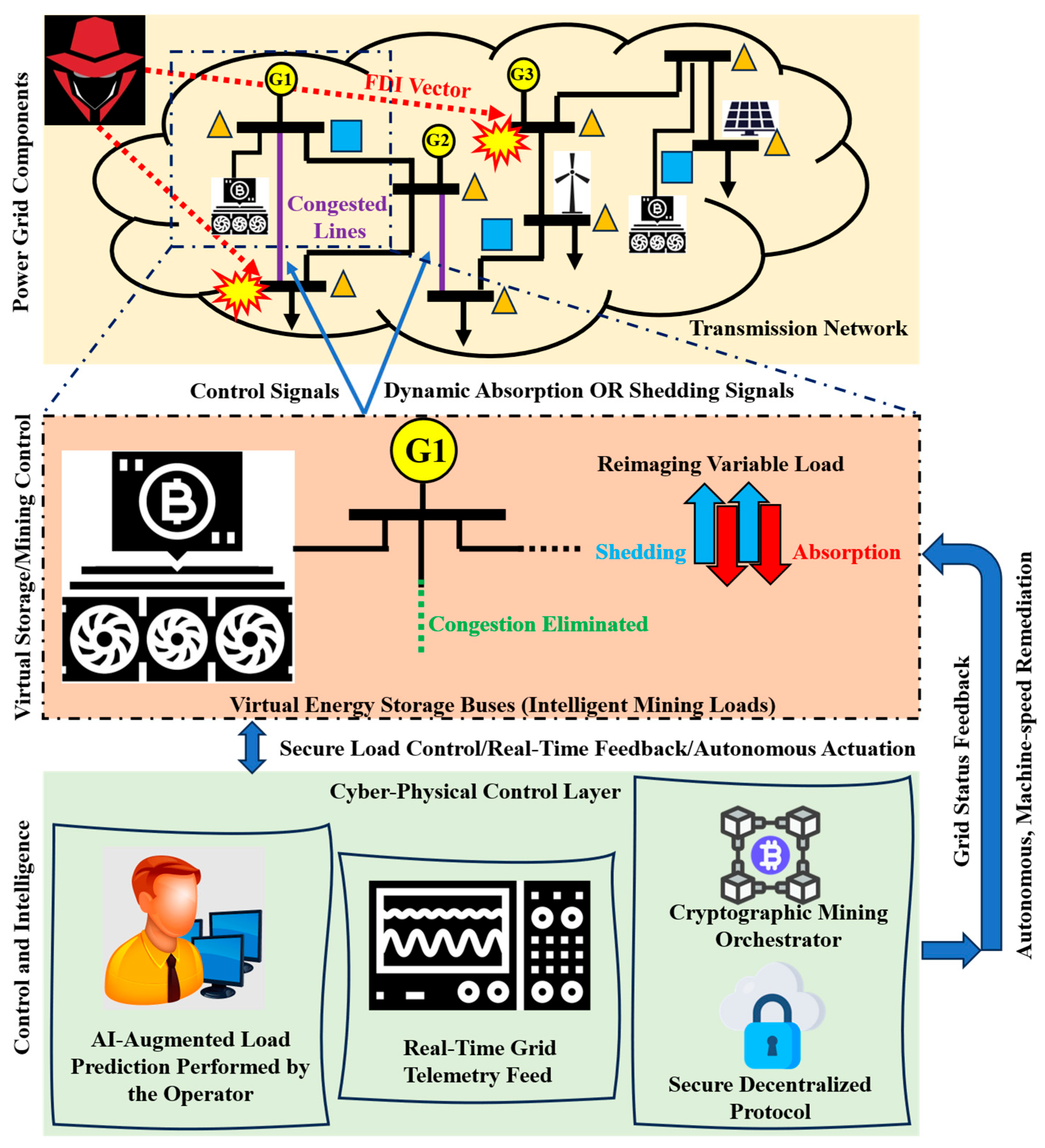
Figure 2 illustrates the proposed virtual energy storage framework (see also Figure 1) as the heart of a remediation mechanism to expeditiously remediate a power transmission system targeted by FDI cyberattacks causing operational issues. According to Figure 2, one can infer that Bitcoin mining facilities—strategically co-located across transmission and sub-transmission buses, as shown in the top box in Figure 2—are reimagined not merely as passive consumers of electricity but as intelligent, cyber–physical actuators capable of mimicking large-scale virtual energy storage behavior with near-instantaneous responsiveness, as shown in the middle box in Figure 2.
This novel integration, illustrated in Figure 2, establishes a bidirectional control paradigm, where mining loads are dynamically modulated in coordination with system operators via secure, decentralized protocols to absorb excess generation or relieve transmission congestion under duress, as depicted via red and blue arrows in the middle box in Figure 2. Uniquely, this framework transforms the traditionally adverse volatility introduced by high-demand data centers into a stabilizing force that directly counters the destabilizing intent of FDI-driven intrusions. Furthermore, Figure 2 introduces a resilient feedback loop between real-time grid telemetry, AI-augmented load prediction, and cryptographically secured mining orchestration, enabling autonomous and verifiable demand side interventions at machine speed to mitigate the negative impacts of FDI cyberattacks (see the red dotted arrows in the top box in Figure 2) causing system congestions. This synergy not only enhances situational awareness and operational flexibility under cyber-induced stress conditions but also bridges the gap between digital asset infrastructure and physical power system resilience in smart cities—thereby redefining Bitcoin mining as a latent grid asset capable of supporting contingency operations, grid restoration, and adaptive system hardening in the face of evolving cyber–physical threats.

3. Problem Formulation

3.1. FDI Cyberattack to Stealthy Bypass Bad Data Detection (BDD) in State Estimation

The performance of modern smart power systems is monitored through advanced state estimation methods, which process information gathered from instruments like phasor measurement units (PMUs) and remote terminal units (RTUs), as respectively illustrated by small orange triangles and cyan squares in the top portion of Figure 2. These measurements encompass variables such as voltage levels, current levels, power injections, and both active and reactive power flows across the network. By applying the state estimation algorithm, operators can generate frequent, near-real-time assessments of the system, providing an accurate and timely overview of its operational condition. The measurement model is defined as (1). State estimation processes often employ BDD algorithms to identify, analyze, and, when possible, correct erroneous measurements caused by synchronization errors or communication faults. Nonetheless, advanced FDI cyberattacks targeting modern power transmission networks can be designed to evade these BDD routines. In this context, let a in (2) represent a nonzero attack vector added to the original measurement set m, producing a compromised measurement vector m b a d . As a result, the estimated state variables (i.e., voltage magnitudes and phase angles) are altered, yielding manipulated values x ̿ as computed by the state estimation algorithm, as presented in (3). To remain undetected while injecting false data into PMUs, attackers must carefully design the attack to circumvent the state estimation and BDD mechanisms, ensuring that certain conditions (as expressed in (4) and (5)) are satisfied. When the conditions of (4) and (5) hold, the cyberattack can operate without triggering the system’s alarms. In other words, the affected residue (i.e., R e s b a d ) is identical to the original residue (i.e., R e s ). Thus, since BDD uses the residual, the attack does not change the test statistic, and it will be undetectable. This strategy is typically modeled using a weighted least squares formulation. For a comprehensive explanation of this attack model, simply bypassing BDD is state estimation, interested readers are referred to the earlier step of this research [39].
m = f x + e
m b a d = m + a
x ̿ b a d = x ̿ + α
H = f x x = x ̿
R e s b a d = m b a d H x ̿ b a d = H x + e + a H x ̿ + α = H x + a H x ̿ = R e s
where x is the vector of state variables; f is a function relating measurements to state variables; e is the measurement noise; x ̿ and x ̿ b a d are, respectively, the estimated state variables without and with FDI attack manipulation; H is the measurement Jacobian matrix; R e s and R e s b a d are the original residue and affected residue of the manipulated measurement sets, respectively.
From Figure 2, an attacker targets a subset of the system buses by injecting false load data (i.e., active and reactive power) to the smart meters associated with each bus (see the orange triangles, indicating PMUs, in the top portion of Figure 2), and his/her main objective is to minimize the amount of false data to be injected into the smart meters. In this regard, the attacker needs to minimize objective function (6), which is called the FDI cyberattack objective function in this paper. It is noted that in (6), P b ´ l o a d and Q b ´ l o a d , are respectively, the clean active and reactive power of b ´ th bus, affected by FDI cyberattack ( b ´ belongs to the subset of system buses, the PMUs of which are targeted by injecting malicious data); P b ´ l o a d and Q b ´ l o a d are the amounts of data manipulations associated with active and reactive power, respectively; P ̿ b ´ l o a d and Q ̿ b ´ l o a d are, respectively, the affected active and reactive power of b ´ th bus, whose PMUs are targeted; and N T B is the number of targeted buses [40].
m i n b ´ = 1 N T B P b ´ l o a d + Q b ´ l o a d 2
P ̿ b ´ l o a d = P b ´ l o a d ± P b ´ l o a d
Q ̿ b ´ l o a d = Q b ´ l o a d ± Q b ´ l o a d
The attacker, shown in Figure 2, needs to launch the FDI cyberattack (6)–(8) while satisfying a set of technical constraints, associated with the normal operation of the power transmission system, which are presented in (9)–(17). As an example, the FDI attack must comply with condition (5) without altering the power balance of the targeted systems; otherwise, system operators are likely to detect the disturbance as a technical fault rather than as an FDI attack. It is noted that equality constraints (9) and (10), respectively, indicate the active and reactive power balances for each bus b to ensure that generation matches demand plus losses across the power system. The inequality constraints (11)–(17), representing the physical and operational limits on equipment and system variables, are elaborated as follows: constraints (11) and (12) respect generation capacity and reactive support limits for each bus b having generation unit; constraint (13) denotes the bus voltage magnitude limits maintaining acceptable voltage levels for system stability (typically ±10% in the transmission level); constraint (14) shows the thermal flow limit for transmission line connecting buses b and j, ensuring that current/apparent power does not exceed thermal capacity; constraint (15) respects the transformer tap ratio limits for ith transformer, keeping the transformer tap positions within the mechanical limits; constraint (16) indicates the shunt compensation limits for cth controllable capacitor/reactor bank, ensuring that the voltage profile of the power system does not suffer from either undervoltage and overvoltage in the normal operation; and constraint (17) denotes the system-wide frequency constraint that maintains the frequency of the power gird around ±0.1 Hz for normal operation. Interested readers are directed to [22,23,24,25,26,27] for more detailed information about such constraints.
P G b P D b = V b × j = 1 B V j × G b j cos δ b j + B b j sin δ b j
Q G b Q D b = V b × j = 1 B V j × G b j sin δ b j B b j cos δ b j
P G m i n P G b P G m a x
Q G m i n Q G b Q G m a x
V b m i n V b V b m a x
S b j = P b j 2 + Q b j 2 S b j m a x
T i m i n T i T i m a x
Q c m i n Q c Q c m a x
f r a t e d f m a x f f r a t e d + f m a x
where P G b and P D b are, respectively, active power generation and demand associated with bth bus; G b j and B b j are, respectively, conductance and susceptance of the transmission line connecting buses b and j; P G m i n and P G m a x are, respectively, the minimum and maximum boundaries for active power generation; Q G m i n and Q G m a x are, respectively, the minimum and maximum boundaries for reactive power generation; B is the total number of system buses; V b , V b m i n , and V b m a x are, respectively, voltage magnitude of bth bus and its minimum and maximum boundaries; P b j , Q b j , and S b j are, respectively, the active, reactive, and apparent power flows in transmission line connecting buses b and j; S b j m a x is the maximum power flow limit in transmission line connecting buses b and j; T i is the tap ratio for ith tap-changing transformer; T i m i n and T i m a x are, respectively, minimum and maximum boundaries of tap positions for ith tap-changing transformer; Q c , Q c m i n , and Q c m a x , are, respectively, the reactive power associated with cth compensator and its minimum and maximum boundaries; f is the frequency of the power system; f r a t e d is the nominal frequency of the system (i.e., 60 Hz); and f m a x shows the acceptable variation in the system’s frequency in the normal operation.

3.2. Remediation Framework’s Objective Functions and Constraints

The main objective function of the remediation framework is provided in (18), where β 1 , β 2 , β 3 , and β 4 are weighting coefficients for trade-offs among grid stability, RERs handling cost, economic benefit of Bitcoin mining activities, and cyber resilience; P i m b and V d e v are, respectively, the active power imbalance across the grid and voltage deviation index; γ is the voltage stability weight; C c u r t and C l o s s are, respectively, the renewable curtailment cost and transmission plus sub-transmission losses cost; Γ B E R P m i n i n g , δ h a s h , t indicates the Bitcoin mining economic return in which P m i n i n g is the mining power allocation vector, δ h a s h is the global network hash difficulty (i.e., the mining difficulty level of the Bitcoin network), and t refers to the time; Θ c y b e r u , A F D I denotes the cyber-resilience cost under FDI cyberattacks in which u is the cyber–physical control input, and A F D I is FDI attack vector. It is noted that the proposed objective function (18) highlights the following novelties compared to the available literature:
m i n β 1 P i m b 2 + γ V d e v 2 + β 2 C c u r t + C l o s s β 3 Γ B E R P m i n i n g , δ h a s h , t + β 4 Θ c y b e r u , A F D I
  • Dual-domain optimization as it integrates physical grid control with digital asset economics and cyber-defense costs in one unified objective,
  • Economic, virtual charging, process as the term Γ B E R converts surplus energy into digital value, replacing traditional state-of-charge models,
  • Cyber-aware feedback loop as Θ c y b e r couples real-time FDI detection metrics (e.g., residual energy and entropy in telemetry data) with control actuation costs, and
  • Adaptive weighting as the β coefficients can adapt dynamically via reinforcement learning and AI-based tuning to emphasize stability or profitability during crises.
Therefore, the proposed objective function (18) formalizes the multi-domain optimization of the proposed Bitcoin mining-based virtual energy storage and remediation framework of Figure 2, simultaneously minimizing grid instability ( P imb , V dev ) , reducing energy and curtailment costs, maximizing Bitcoin-derived virtual storage profit ( P m i n i n g , δ h a s h ), and mitigating cyber-induced operational risk under FDI scenarios.
Objective function (18) needs to be optimized subject to satisfying a set of constraints and limitations, which are provided in (19)–(25). In this regard, it is noted that (19) and (20) indicate active and reactive power balances with flexible mining loads, (21) and (22) denote mining load modulation limits, (23) shows the cyber resilience constraint (i.e., the FDI detection margin), (24) provides utilization constraints over renewable generations to guarantee that most renewable energy is either consumed or stored virtually, not curtailed, and (25) indicates the profitability threshold or economic feasibility of the proposed approach. It is also noted that constraints (9)–(17), dictating the network operational limits, need to be satisfied, as well.
g = 1 G P G g + r = 1 R P R E R r = l = 1 L P l o a d l + m = 1 M P m i n i n g m + P L o s s
g = 1 G Q G g + r = 1 R Q R E R r = l = 1 L Q l o a d l + m = 1 M Q m i n i n g m + Q L o s s
P m i n i n g m m i n , Q m i n i n g m m i n P m i n i n g m t , Q m i n i n g m t P m i n i n g m m a x , Q m i n i n g m m a x
P m i n i n g m t ζ m i n i n g m a x
D r e s = m ̿ = m ε F D I
η R E R t = E u s e d t E g e n t μ t a r g e t
Γ B E R P m i n i n g , δ h a s h , t Γ m i n
where P G g , P R E R r , and P l o a d l are, respectively, the active power associated with gth non-renewable generation unit, rth renewable generation unit, and lth load center; P m i n i n g m denotes the active power for mth Bitcoin mining facility; P L o s s is the overall active power loss of the power grid; Q G g , Q R E R r , and Q l o a d l are, respectively, the reactive power associated with gth non-renewable generation unit, rth renewable generation unit (e.g., wind turbine), and lth load center; Q m i n i n g m denotes the reactive power for mth Bitcoin mining facility; Q L o s s is the overall reactive power loos of the system; G, R, L, and M are, respectively, the total number of thermal/diesel generation units, renewable-based generation units, load points, and Bitcoin mining facilities across the power system; P m i n i n g m m i n , Q m i n i n g m m i n are the minimum boundaries for active and reactive power associated with mth Bitcoin mining facility; P m i n i n g m m a x , Q m i n i n g m m a x are the maximum boundaries for active and reactive power related to mth Bitcoin mining facility; P m i n i n g m t and Q m i n i n g m t are, respectively, the active and reactive powers associated with mth Bitcoin mining facility at tth time interval; ζ m i n i n g m a x is the ramp rate reflecting the dynamic throttling speed of mining rigs; m ̿ is the estimated state vector after detection and correction; ε F D I is the permissible FDI deviation margin ensuring reliable operation; η R E R t is the efficiency of the RERs at tth time interval; E u s e d t and E g e n t are, respectively, the energies from RERs that consumed or generated at tth time slot across the power system; μ t a r g e t is a threshold predefined by system operator, ensuring that most renewable energy is either consumed or stored virtually via mining facilities (not curtailed); and Γ m i n is the minimum acceptable amount of profitability for Bitcoin mining facilities across the power transmission system, indicating economic feasibility.

3.3. The Holistic Proposed Framework Justifications

The proposed holistic framework establishes an integrated cyber–physical economic paradigm designed to ensure the resilience, stability, and profitability of modern smart energy infrastructures under FDI cyberattacks. Unlike conventional power system protection and control schemes that treat physical operation, cybersecurity, and economic processes as separate layers, the proposed framework unifies them through dual-domain optimization encompassing both grid-side stability dynamics and digital asset economics. The first stage (see Section 3.1) formulated the FDI cyberattack model that stealthily bypassed the BDD, embedded in power system’s state estimation, by manipulating active and reactive power measurements across a subset of system buses, leading to falsified state estimations and compromised system awareness. To counteract these undetectable manipulations, the second stage (refer to Section 3.2) introduced the remediation framework—an adaptive multi-objective optimization that simultaneously (a) minimizes physical power imbalance and voltage deviation, (b) mitigates renewable curtailment and transmission losses, (c) maximizes Bitcoin mining-based virtual storage profit, and (d) penalizes the cyber-resilience cost under FDI stress. This unified formulation, therefore, couples the detection and correction capabilities of state estimation with economic feedback derived from virtual energy storage realized through flexible mining loads. The inclusion of constraints (9)–(17) and (19)–(25) ensure physical feasibility, operational security, cyber-detection fidelity, renewable energy utilization, and profitability.
The framework’s novelty lies in its cyber-aware feedback loop, which continuously adjusts mining loads, voltage control, and generation dispatch based on real-time telemetry entropy, residual energy signatures, and grid imbalance indices (see Figure 2). By embedding reinforcement learning-based adaptive weighting, as written in (26)–(28), the system dynamically prioritizes either grid stability or economic benefit during abnormal conditions, achieving robust self-healing behavior. Ultimately, this holistic structure represents a shift from reactive security toward proactive resilience by aligning physical control, cyber defense, and economic incentives into a single co-optimized control loop that sustains grid reliability and financial viability even under sophisticated, stealthy FDI cyberattacks.
R t = λ 1 P i m b 2 + γ V d e v 2 + λ 2 C c u r t + C l o s s λ 3 Γ B E R + λ 4 Θ c y b e r
φ i t + 1 = φ i t + ω × R t φ i ,   φ i φ 1 , φ 2 , φ 3 , φ 4
i = 1 4 φ i t + 1 = 1 ,   0 φ i t + 1 1
In (26)–(28), R t represents the instantaneous reward at tth time interval; λ 1 , λ 2 , λ 3 , and λ 4 are the normalization constants (i.e., weighting coefficients ensuring trade-offs referred to above), and each term corresponds respectively to grid imbalance, energy cost, Bitcoin-mining profit, and cyber-resilience penalty; ω is the learning rate (i.e., step size); and R t φ i denotes the policy gradient or sensitivity of the reward to each weighting coefficient. It is noted that (26) defines the reward function in the reinforcement learning processes, (27) denotes the weight coefficient update rule, and (28) indicates the normalization and stability constraint. It is also noted that in (26), the negative sign ensures that the reinforcement learning agent seeks to minimize instability and cost while maximizing profit and cyber defense. In addition, in (27), φ i are dynamically tuned so that the system learns which objective to prioritize under evolving operating including FDI conditions. Finally, (28) guarantees that the weights remain bounded and interpretable as adaptive priority factors, ensuring stable optimization and preventing any single domain (physical, economic, or cyber) from dominating the control decision.

3.4. Optimization Algorithm Handlining the Proposed Framework

To expeditiously handle the optimization problems introduced in Section 3.1, Section 3.2 and Section 3.3, this section proposes a novel hybrid variant for particle swarm optimization (PSO) to significantly boost its searching capabilities. PSO is an algorithm modeled after the coordinated movements observed in natural groups, like bird flocks or fish schools. It imitates this cooperative interaction to navigate through possible solutions and effectively discover the best outcomes in complex optimization tasks. The PSO algorithm can be mathematically modeled in (29)–(32) as follows [39]:
χ k τ + 1 = χ k τ + υ k τ + 1 ,   k N s w a r m
υ k τ + 1 = σ × υ k τ + ϑ 1 × r a n d 1,1 × ω B , k τ χ k τ + ϑ 2 × r a n d 1,1 × Ω B τ χ k τ ,   k N s w a r m
σ = σ m a x τ × σ m a x σ m i n τ m a x
r a n d 1,1 ~ U 0,1
where χ k τ and χ k τ + 1 are position of kth bird at τth and τ + 1 th iterations, respectively; υ k τ and υ k τ + 1 are, respectively, the velocity of kth bird at τth and τ + 1 th iterations; σ is the inertia coefficient of birds in the solution space; ϑ 1 and ϑ 2 are the individual and social learning factors of birds, respectively; r a n d 1 ,   1 is a random number in the range of (0, 1), making a uniform distribution between 0 and 1; ω B , k τ is the personal best position of kth bird that is the value of objective function at τth iteration; Ω B τ is the global best position at τth iteration that belongs to the entire population, not bird k; σ m i n and σ m a x are, respectively, the minimum and maximum boundaries of the inertia coefficient σ ; and finally, τ m a x is the maximum number of iterations, which is preset.
Although the PSO algorithm has shown strong results for many optimization tasks, it still faces certain drawbacks, particularly slow computation speeds and an inclination to settle on local optima too early. To overcome these issues and improve its effectiveness in optimizing the proposed objective functions, this study introduces two fundamental modifications to the conventional PSO framework. First, quantum computing (QC) concept is utilized to push (29)–(32) toward a quantum framework in which each bird flies based on quantum mechanics. Hence, each bird is modeled in such a way that its movement is affected by probability distribution, which is centered around dynamically created attractors. It is noted that these attractors are identified according to a non-deterministic blend of ω B , k τ and Ω B τ for kth bird at τth iteration. Therefore, (33)–(34) provide the mathematical foundation for the exploitation of quantum behavior within the PSO algorithm.
χ k τ + 1 = Φ k , d τ + Λ χ k , d τ , ϱ
χ k , d τ + 1 = Φ k , d τ ± C E C χ k , d τ R l n ϱ k , d τ 1
where Φ k , d τ demotes the local attractor position for kth bird associated with dth dimension of the problem at τth iteration; Λ indicates the displacement function; ϱ is the distribution function, which is both uniform and continues; and CEC is the contraction expansion coefficient governing both the exploration process and the rate of convergence in the quantum augmented PSO (QAPSO) algorithm.
Interested readers are directed to the earlier step of this research [39] for detailed information about the quantum enhancement added to the original PSO algorithm in this paper.
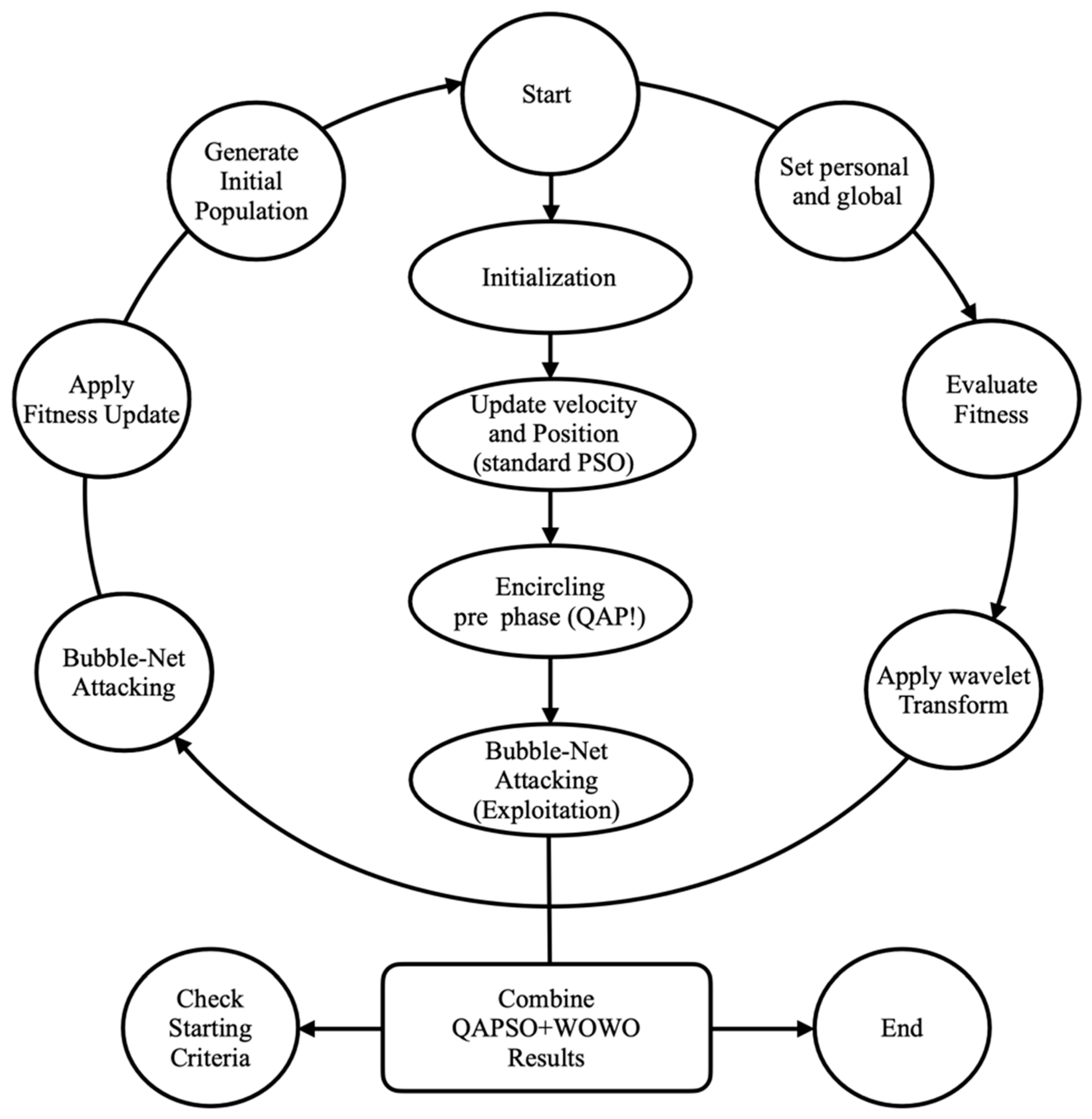
To enhance the exploration capability of the QAPSO algorithm, it is hybridized with the wavelet-oriented whale optimization (WOWO) algorithm, as described in Equations (35)–(45). Toward this end, the proposed hybrid optimization algorithm in this paper is called QAPSO-WOWO, as outlined in Algorithm 1 and also Figure 3. It is noted that (35)–(42) are associated with the standard WO algorithm, introduced by Mirjalili and Lewis in [41,42,43], that simulates the hunting behavior of humpback whales including encircling prey via applying (35)–(38), bubble-net attacking (i.e., spiral updating phase) via (39) and (40), and searching for prey (i.e., exploration phase) via (41)–(42). Moreover, (43)–(45) present the wavelet enhancement applied over the standard WO algorithm. Detailed information about the presented wavelet model can be found in [44].
D i s = C · χ p r e y τ χ w h a l e τ
χ w h a l e τ + 1 = χ p r e y τ A . D i s
A = 2 o · r a n d 1,1 1 o ,   C = 2 r a n d 1,1 2
o = 2 × 1 τ τ m a x
D 𝚤 s ^ = χ p r e y τ χ w h a l e τ
χ ^ w h a l e τ + 1 = D 𝚤 s ^ × E X P s s × l × cos 2 × π × l + χ w h a l e τ
D 𝚤 s ¯ = C · χ p r e y ,   r a n d o m τ χ w h a l e τ
χ ¯ w h a l e τ + 1 = χ p r e y ,   r a n d o m τ A · D 𝚤 s ¯
where Dis, D 𝚤 s ^ , and D 𝚤 s ¯ are, respectively, the distance vectors in the prey encircling phase, bubble-net attacking phase, and prey searching phase; χ p r e y τ and χ w h a l e τ are, respectively, the current positions of prey and whales at τth iteration; χ w h a l e τ + 1 , χ ^ w h a l e τ + 1 , and χ ¯ w h a l e τ + 1 , respectively, indicate the position of the whales at τ + 1 th iteration in the prey encircling phase, bubble-net attacking phase, and prey searching phase; o is a control parameter, decreasing from 2.0 to 0.0 in the course of iterations, that mimics a mechanism to encourage convergence towards the best so far (i.e., exploitation); ss is a constant defining the spiral shape; l is a random number in the range of [−1, +1].
The discrete wavelet transform implemented in this paper allows distinguishing between global trends and local fluctuations in the main loop of the optimization by decomposing the search space (i.e., fitness landscape) into components. This modification improves the convergence of the standard WO algorithm, enhances the exploration/exploitation balance, and helps avoid premature convergence by analyzing the decomposed components. Therefore, before or during each iteration τ , a discrete wavelet transform (DWT) is applied to the population positions and fitness landscape according to (43). It is noted that (43) gives low-frequency and high-frequency coefficients capturing coarse and fine details.
W = D W T χ k τ , k N s w a r m
In the next step, the wavelet coefficients are utilized to adopt the WO parameters, mathematically written in (44)–(45), in which residual components are fed back for fine-tuning search in certain dimensions.
o τ + 1 = o τ × f D W T W u p p e r , W l o w e r
χ ¯ w h a l e , D W T τ + 1 = χ ¯ w h a l e τ + 1 A · D 𝚤 s ¯ + ζ × W h f
where W h f are high-frequency wavelet components; and ζ is the scaling factor.
The selection of the hybrid QAPSO-WOWO algorithm is motivated by the need to efficiently solve a highly nonlinear and multi-objective optimization problem characterized by complex constraints and a large search space. While QAPSO provides enhanced global exploration through probabilistic position updates and improved diversity preservation, it may exhibit slower convergence in later iterations. Conversely, whale optimization offers strong local exploitation capabilities but is more prone to premature convergence when used independently. By integrating these complementary mechanisms, the proposed hybrid approach achieves a more effective balance between exploration and exploitation, thereby improving convergence stability and solution quality.
For clarity and reproducibility, the pseudocode of the QAPSO-WOWO algorithm is presented in Algorithm 1, illustrating the sequence of global exploration via quantum-augmented PSO and local exploitation using WO algorithm.
Algorithm 1 The proposed Algorithm Pseudocode
Input: Objective function f(x), swarm size N s w a r m , max iterations τ m a x
Output: Optimal solution χ b e s t

1: Initialize particle positions χ k and velocities υ k for k = 1 to N s w a r m
2: Evaluate objective f ( χ k ) for each particle
3: Set personal best ω B , k τ = χ k and global best Ω B τ = argmin( f ( χ k ) )

4: for τ = 1 to τ m a x do
5: Update inertia σ = σ m a x τ × σ m a x σ m i n τ m a x

6://Quantum-Augmented PSO (QAPSO) Step
7: for each particle k do
8: Generate local attractor Φ k , d τ based on ω B , k τ and Ω B τ
9: Update position χ k , d τ using quantum probability distribution
10: Evaluate f ( χ k ) and update ω B , k τ if improved
11: end for
12: Update global best Ω B τ if any ω B , k τ improved
13://Wavelet-Oriented Whale Optimization (WOWO) Step
14: for each whale χ w h a l e τ do
15: Compute distances Dis, D 𝚤 s ^ , D 𝚤 s ¯ for encircling, bubble-net, and prey search
16: Update whale positions χ w h a l e τ + 1 , χ ^ w h a l e τ + 1 , χ ¯ w h a l e τ + 1
17: end for
18://Wavelet-Based Fine-Tuning
19: Apply discrete wavelet transform W = D W T χ k τ
20: Extract high-frequency components W h f
21: Adjust whale positions χ ¯ w h a l e , D W T τ + 1 = χ ¯ w h a l e τ + 1 A . D 𝚤 s ¯ + ζ × W h f
22: Evaluate f ( χ k ) and update personal/global bests
23: end for

24: Return χ b e s t = Ω B τ
Convergence behavior has been systematically evaluated against standard metaheuristic algorithms, including PSO, genetic algorithm, differential evolution, and standalone whale optimization algorithms (see Section 5.2.5). The results indicate that the hybrid algorithm achieves faster convergence, lower objective values, and more consistent solutions across multiple runs, particularly in highly nonlinear and constrained search spaces characteristic of cyber–physical optimization problems. These enhancements ensure that the proposed approach is both robust and practically implementable, providing a reproducible framework for optimizing mining-based virtual energy storage in grid modernization contexts.

4. Case Study—Modified IEEE 39-Bus New England Test System

To scrutinize the effectiveness of the proposed virtual energy storage framework, depicted in Figure 1, and the performance of the remediation framework against FDI cyberattacks, as illustrated in Figure 2, IEEE 39-bus New England test system has been selected and modified, as introduced in Table 1.
According to Table 1, to implement the proposed virtual energy storage framework, the IEEE 39-bus system was augmented with intermittent RERs by replacing select conventional generators with a 150 MW wind farm and a 100 MW PV plant to create surplus energy. Dispatchable Bitcoin mining facilities were added at strategic buses, modeled as flexible loads with sub-second responsiveness, enabling charging/discharging behavior that emulates virtual energy storage systems. A cyber–physical layer was introduced to simulate control/energy management system communications and FDI attack scenarios, while a hierarchical control scheme was added to coordinate remedial actions against FDI attacks with mining load modulation through secure, decentralized protocols. An added economic conversion model links consumed energy to Bitcoin generation to quantify virtual storage value. Multiple operational scenarios, including baseline, FDI attack, and FDI with active virtual energy storage system response, are defined, and performance metrics spanning technical, cyber-resilience, and economic dimensions are established to evaluate the proposed framework effectiveness (refer to Section 5.1). Detailed information about the standard IEEE 39-bus New England test system can be found in [45,46,47].

5. Initialization, Obtained Results, and Discussions

5.1. Initialization

To evaluate the proposed framework under a range of operating and adversarial conditions, three distinct simulation scenarios are configured.
Scenario I: The first scenario represents normal operation, serving as the baseline for comparison.
Scenario II: The second scenario introduces an FDI attack without any remediation measures, allowing the assessment of system vulnerability/degradation in performance.
Scenario III: The third scenario incorporates the same FDI attack but includes the active virtual energy storage response, demonstrating the framework’s resilience and mitigation capabilities via taking advantage of Bitcoin mining facilities.
Together, these scenarios enable a comprehensive assessment of the proposed framework’s dynamic, cyber, and economic performance across both nominal and adversarial conditions, as introduced in Figure 2.
Additionally, line outage events are introduced in selected cases to conduct stress testing and further examine system robustness. In other words, such events are incorporated into the simulation framework to emulate contingency and stress conditions that can occur in real power system operations. A line outage represents the temporary or permanent disconnection of a transmission line from service due to faults, maintenance operations, or deliberate isolation under emergency control actions. In the simulation environment, these events are modeled by removing or disabling the corresponding branch element in the system’s admittance matrix at a predefined simulation time. Technically, for each line l b j connecting bus b to bus j, an outage event is implemented by setting the branch G b j and B b j to zero in the network admittance matrix. This effectively isolates the two buses for power flow calculations during the event. The system then operates with the modified topology until the line is restored or the simulation ends. It is noted that the timing and duration of outage events are predefined to align with the simulation timeline.
Prior to executing the proposed QAPSO-WOWO algorithm, all essential parameters and initial conditions are configured to guarantee stability and effective convergence throughout the optimization process. The swarm population size, N s w a r m , is selected according to the problem dimensionality and complexity, commonly ranging between 100 and 300 agents to maintain a balance between computational efficiency and solution diversity. The maximum number of iterations, τ m a x , is predefined based on the desired convergence accuracy and the problem’s search space scale. The initial positions of all birds and whales are randomly generated within the feasible domain using a uniform distribution to ensure adequate exploration of the search space. For the QAPSO sub-algorithm, the inertia weight boundaries are defined as σ m a x = 0.9 and σ m i n = 0.4 , while the cognitive and social learning coefficients are both set to ϑ 1 = ϑ 2 = 1.49618 . The CEC factor regulating the quantum displacement process is initialized within [0.5, 1.0] and adaptively tuned during iterations to preserve the exploration–exploitation equilibrium. In the WOWO sub-algorithm, the encircling control parameter o starts from 2.0 and linearly decreases to 0.0 according to (38), and the spiral coefficient ss is set to 1.0. The scaling factor ζ responsible for incorporating high-frequency wavelet components into the search update, is selected within [0.1, 0.3]. The DWT employed in this work utilizes the Morlet wavelet, which provides an excellent balance between time-frequency localization and smoothness, thereby enabling the algorithm to capture both global trends and fine local variations in the population dynamics. The Morlet-based decomposition generates the low- and high-frequency coefficients W l o w e r , W u p p e r used in (44) for adaptive parameter tuning. All random numbers r a n d ( 1 , 1 ) uniformly distributed in the range (0, 1). This initialization scheme ensures that the proposed hybrid QAPSO-WOWO algorithm starts with a diversified population maintaining strong convergence behavior across iterations.
The four adaptive weights associated with the reinforcement learning are each set to 0.25, the learning rate is fixed at 0.03, and the normalization constants are initialized in proportion to their domain priorities: 1.0 for grid stability, 0.8 for energy cost, 0.6 for mining profit, and 0.5 for cyber resilience. The system begins from nominal operating conditions with zero grid imbalance, acceptable voltage deviation (i.e., less than 0.1 p.u.), baseline curtailment cost, and normal communication reliability. The cyber resilience index starts at 1.0, representing a secure baseline. Telemetry entropy and residual energy indicators are seeded from their moving average values collected over the previous 100 s of operation. These initialization choices were found to be critical in preventing numerical divergence, stabilizing early learning behavior, and ensuring realistic grid-cyber interaction during FDI attack simulations.

5.2. Obtained Results and Analyses

5.2.1. Scenario I: Baseline—Normal Operation Without FDI or Remediation

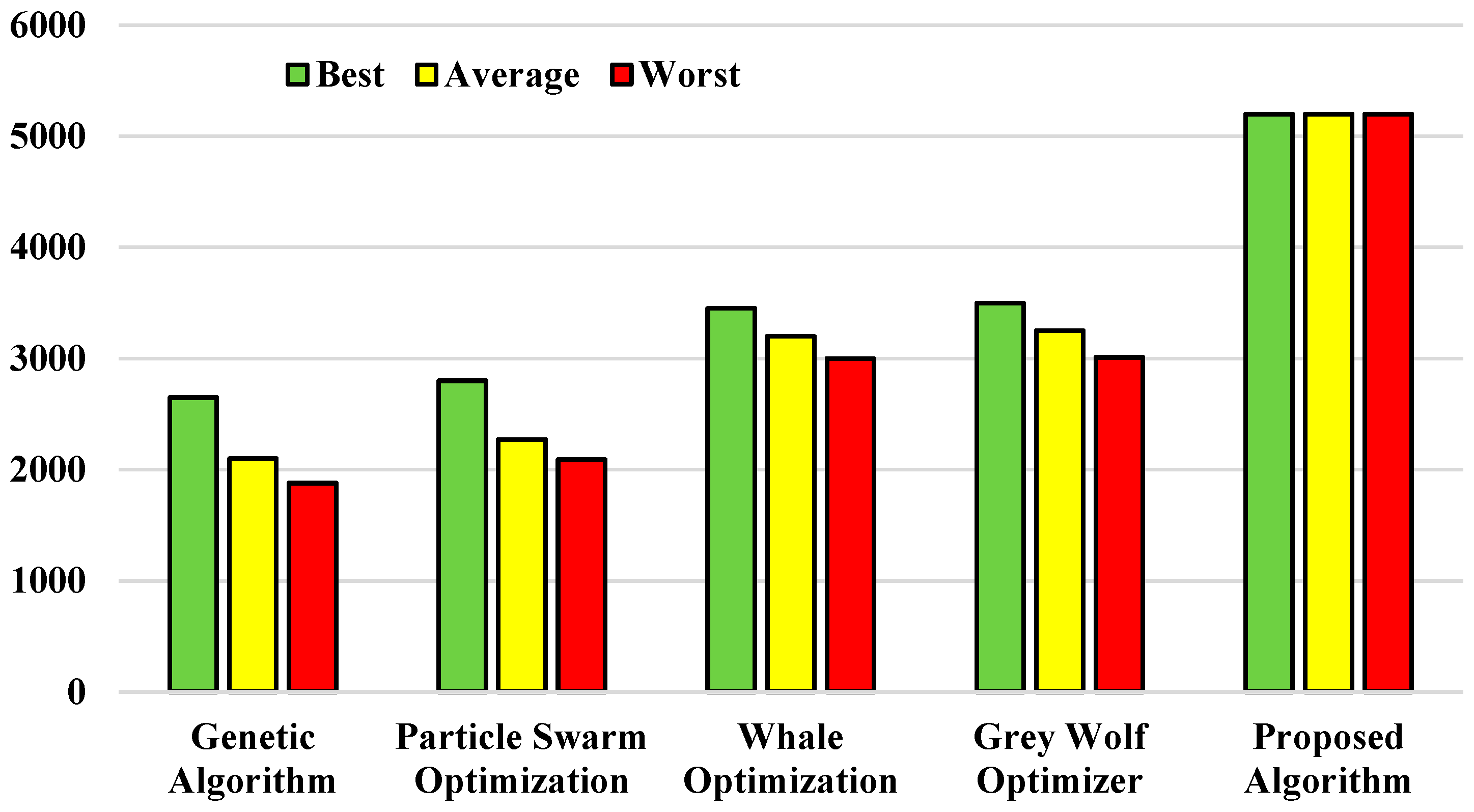
The main objective of this scenario is to establish a quantitative reference for overall system performance under nominal operating conditions. Specifically, Scenario I aims to assess the steady-state behavior of the integrated power transmission system, referred to the top portion of Figure 2, by analyzing grid frequency stability, power flow balance, renewable energy utilization efficiency, and the dynamic response of the Bitcoin mining-based virtual energy storage system. The simulation focuses on evaluating key technical indicators such as active and reactive power dispatch, system losses, renewable curtailment levels, and mining load modulation in response to grid conditions. These results serve as a benchmark for comparing subsequent scenarios (i.e., Scenarios II and III) involving system disturbances or control strategy variations. Table 2 summarizes the simulation outcomes and performance metrics associated with Scenario I, while Figure 4 presents a comparison of the standard deviations over 30 independent trials, obtained from the proposed hybrid QAPSO-WOWO algorithm with other studied algorithms. From this figure, it can be observed that the standard deviation of the proposed algorithm is zero, distinguishing it from all other evaluated algorithms. This indicates that the proposed hybrid algorithm consistently produces identical results across multiple runs, reflecting a high level of stability. From a system operator’s perspective, such behavior is highly desirable, as it ensures reliable performance under varying operational conditions.
From Table 2, one can infer that in the baseline scenario, the modified IEEE 39-bus test system operates under nominal conditions without the influence of any cyber or physical disturbances, providing a reference benchmark for subsequent comparisons. Hence, the system demonstrates excellent dynamic and steady-state stability, with total power imbalance limited to approximately 1.4 MW and voltage deviations below 2% across all buses, which is quite acceptable from the power system operation standpoint. In addition, the frequency variation remains within ±0.05 Hz, confirming the robustness of the power-frequency control under normal operation. Renewable energy utilization reaches nearly 97%, as most of the energy generated by the integrated wind farm and solar plant is absorbed by conventional demand and flexible Bitcoin mining facilities. The mining buses function as controllable loads, modulating their power consumption in response to real-time renewable availability, as shown in Figure 2. Therefore, during low-demand or high-generation intervals, the mining facilities increase load to absorb surplus energy, effectively acting as virtual energy storage, while during peak demand they proportionally reduce their consumption, thereby maintaining system equilibrium. Economically, this results in an estimated virtual revenue of approximately $5200 per day, derived from mining activity at buses #16, #23, and #39. The operational efficiency and absence of curtailment costs highlight the seamless integration of economic and physical dynamics within the proposed framework architecture (see Figure 2). Overall, the baseline results verify that under normal operating conditions, the grid achieves high renewable utilization, economic gain, and stable performance without cyber–physical interference.

5.2.2. Scenario II: Cyberattack—FDI Attack Without Remediation

In this scenario, an adversary compromises selected measurement streams associated with load buses #15–#21 by injecting falsified active/reactive power data into relevant PMUs with magnitudes of approximately 2–5% of the rated values, as presented in (6)–(8). The attack is crafted based on (1)–(5) to satisfy the stealth condition R e s b a d = R e s , ensuring that the residual test utilized in traditional BDD mechanisms remains unaltered. Consequently, the compromised measurements vector m b a d passes undetected through the state estimation layer, misleading the control center into believing that the system operates normally. This manipulation distorts the estimated power flows and voltage magnitudes, resulting in incorrect dispatch decisions. The simulation results associated with Scenario II are provided in Table 3 considering the same number of independent trials to capture the standard deviation. According to this table, it can be inferred that when the system is subjected to a stealthy FDI cyberattack, the operational landscape changes drastically. As a consequence, based on Table 3’s results, the system experiences a sharp increase in total power imbalance, reaching approximately 23 MW, and bus voltage deviations rise to over 5%, particularly in the mid-transmission region. The control center, misinterpreting the false readings, curtails renewable generation to mitigate perceived voltage violations (see Figure 5), causing renewable utilization to plummet to almost 72%. The curtailment cost consequently escalates to about $3500 per day. Although Bitcoin mining operations continue at their nominal rate, their contribution to grid balance becomes detrimental since they consume energy based on falsified operating conditions. The cyber-resilience cost index, Θ c y b e r , becomes critically high, reflecting the system’s loss of situational awareness and vulnerability.
This scenario exposes the fragility of traditional state estimation under stealthy FDI conditions and demonstrates how coordinated cyber manipulations, satisfying (5), can induce severe operational inefficiencies and potential cascading failures, despite the absence of any physical fault in the network.
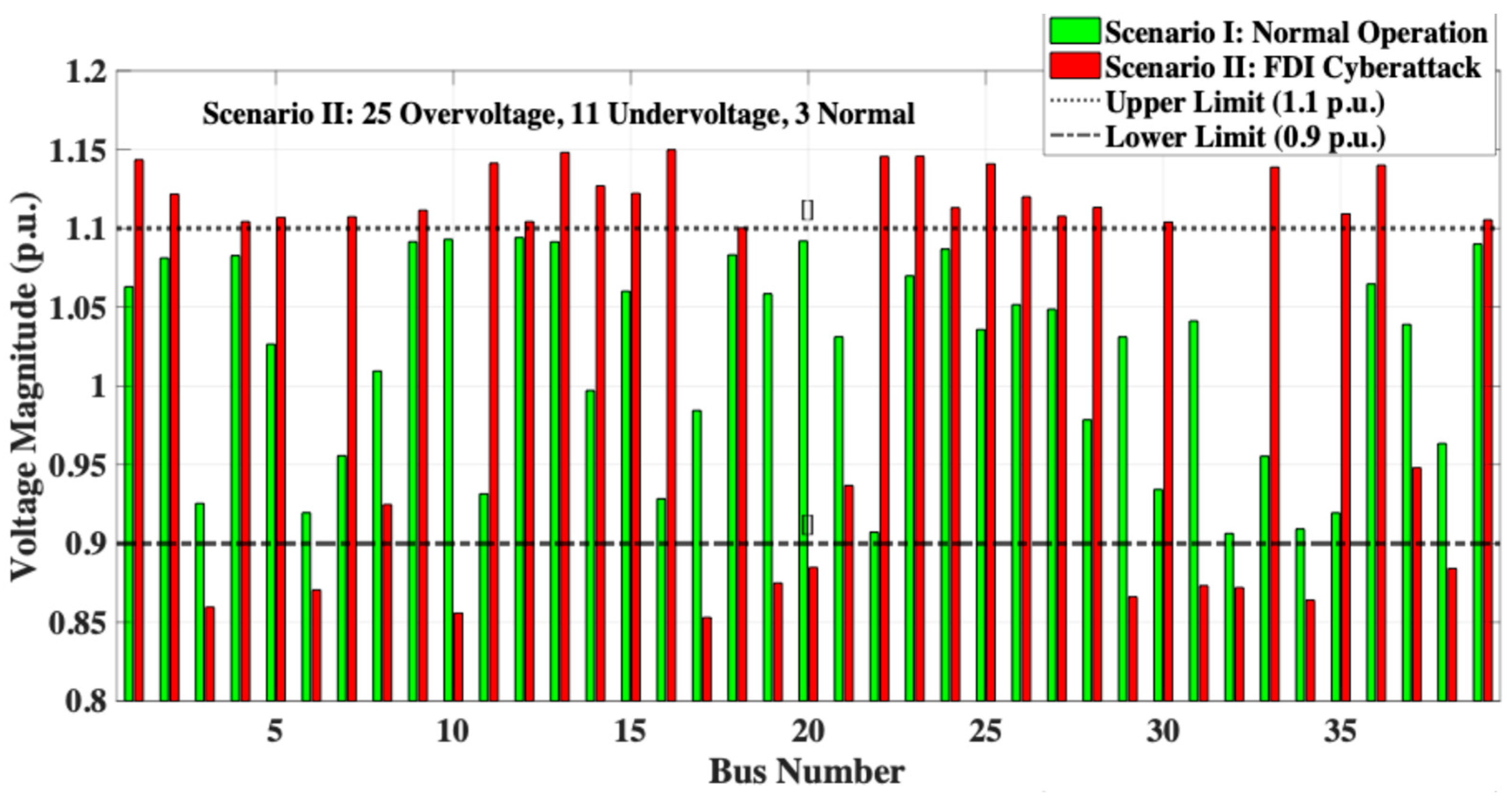
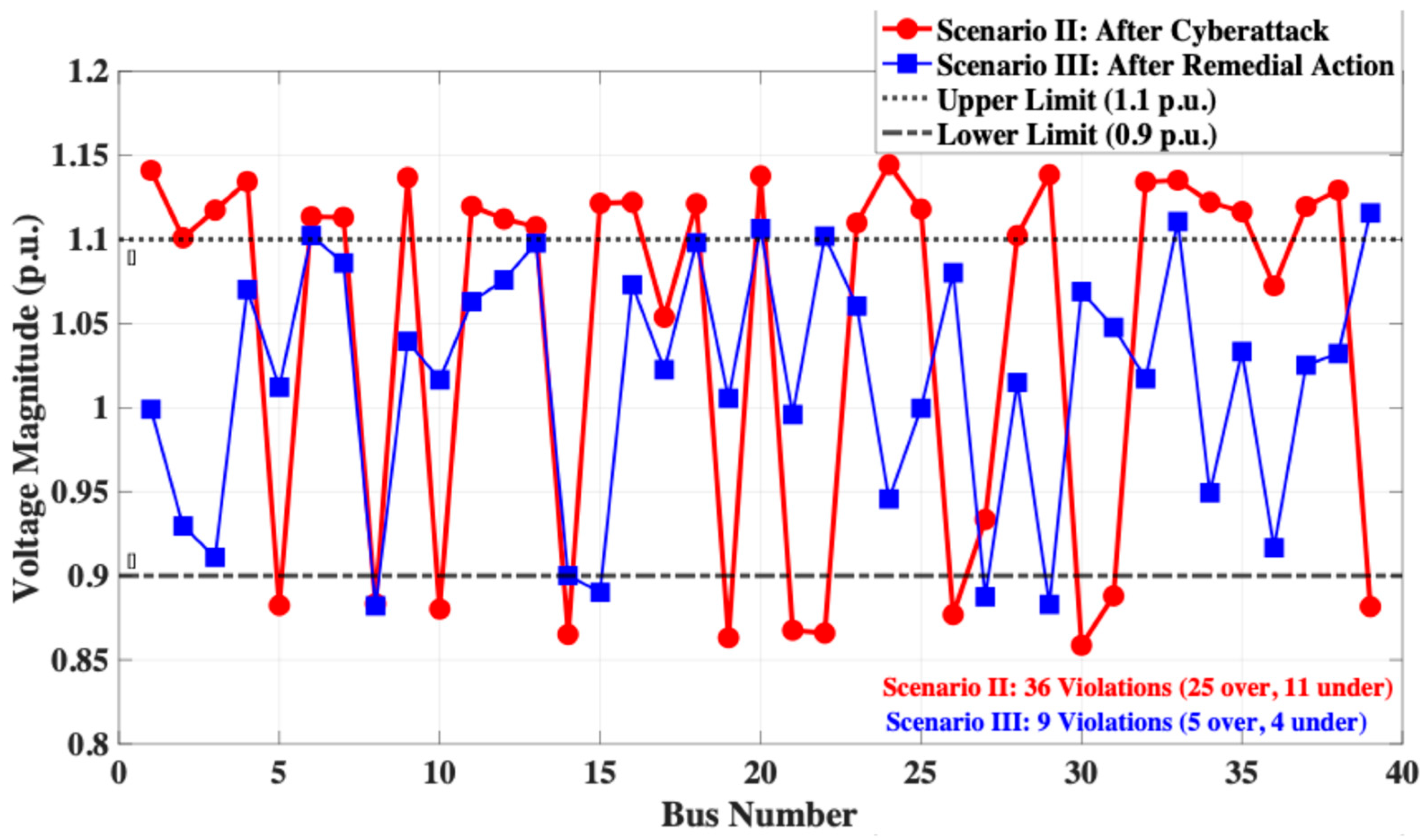
According to Figure 5, one can perceive that the voltage magnitude of the majority of system buses (i.e., 36 buses out of 39 buses in the system) violates constraint (13), which is equivalent to voltage deviation index (i.e., V d e v ) more than 3.14 p.u. that is quite unacceptable for a power transmission system. It is noted that overvoltage poses a far greater threat to power transmission systems than undervoltage because it pushes equipment beyond its insulation and dielectric limits, leading to arcing, flashovers, and irreversible breakdown of critical components. While undervoltage merely reduces system performance, overvoltage unleashes destructive electrical stress, overheating, and potential explosions that can cripple transformers, power lines, and switchgear in an instant. Thus, undervoltage inconveniences, but overvoltage destroys.

5.2.3. Scenario III: FDI Attack and Remediation via Virtual Energy Storage Systems

In this scenario, the system is subjected to the same stealthy FDI attack as described in Scenario II but enhanced with the proposed virtual energy storage-based remediation framework, as introduced in Figure 2. The remediation objective function (18) leverages the flexibility of distributed Bitcoin mining facilities, which are integrated as controllable loads capable of adaptive response based on both data-driven and real-time grid condition feedback. The proposed framework of Figure 2 also utilizes a hybrid approach combining residual-based state estimation with machine learning-assisted scoring to identify suspicious measurement streams, as provided in (26)–(28). Once the compromised data channels are isolated, the virtual storage agents (i.e., mining facilities) adjust their load dynamically to counteract perceived imbalances, effectively providing synthetic inertia and damping against the destabilizing effects of the FDI attack. To obtain a deeper perspective about the effectiveness of the proposed remediation framework, Table 4 summarizes the system performance metrics under this mitigated condition. Compared to Scenario II (refer to Table 3), the implementation of the virtual energy storage mechanism (see Figure 1) embedded into the proposed framework (refer to Figure 2) significantly improves overall operational stability and economic efficiency.
From Table 4, it can be observed that the proposed mitigation framework effectively restored operational reliability and renewable integration to near-normal levels despite the ongoing cyberattack. The total system power imbalance dropped from 23.1 MW in Scenario II to approximately 4.8 MW in Scenario III, confirming that the adaptive response of the virtual storage agents successfully compensated for false dispatch decisions. Voltage deviations were also reduced to an average of 2.6%, indicating that the combined cyber–physical coordination mechanism successfully preserved the voltage quality and mitigated the propagation of instability across the transmission system.
Economically, renewable energy utilization improved dramatically, from 72% under uncompensated attack to 94% with remediation, while the curtailment cost decreased by over 70%, as provided in Table 4. In addition, the Bitcoin mining profit experienced a modest reduction to around $4700/day due to partial load shedding during corrective operation, which can be considered as a deliberate trade-off to enhance overall system resilience. Nevertheless, this demonstrates that the virtual storage units can sacrifice limited short-term revenue in exchange for preserving long-term system integrity.
The cyber-resilience cost, although nonzero, is substantially lower than in the unmitigated case, reflecting the successful isolation of compromised data channels and rapid dynamic balancing provided by the virtual energy storage mechanism. Furthermore, post-event analysis confirms that the proposed approach maintains grid frequency variations within ±0.08 Hz, ensuring compliance with stability standards even under persistent cyber perturbation.
In summary, Scenario III validates the efficacy of the virtual energy storage-based remediation mechanism in counteracting stealthy FDI attacks, as comprehensively introduced in Figure 2. By integrating adaptive control with decentralized economic agents, the system demonstrates self-healing capabilities, enhanced situational awareness, and sustained renewable utilization under the FDI cyberattack of Scenario II. This highlights the potential of cyber-aware virtual energy storage systems to serve as both economic assets and active cyber-defense components in future smart grids. To obtain a better perspective about the effectiveness of the proposed framework, Figure 6 illustrates the voltage profile of the targeted IEEE 39 bus test system before and after implementing the Bitcoin mining facilities as virtual energy storage systems. According to Figure 6, it can be gathered that the voltage deviation index of the targeted system reduced by at least 65% from an average of 5.2% after the FDI attack (see Table 3) to an average of 1.8% after deploying the remediation framework of Scenario III, as presented in Table 4.
Once again, from the results presented in Table 4 and Figure 6, one can infer that the proposed remediation framework significantly enhanced the system robustness by stabilizing bus voltages across the network, particularly in previously vulnerable buses. Therefore, the deployment of Bitcoin mining facilities as virtual energy storage introduces a controllable and flexible load that can absorb surplus generation and provide rapid corrective action in response to voltage deviations. This approach not only minimizes the propagation of instability caused by the FDI attack but also reduces the reliance on traditional spinning reserves, thereby improving operational efficiency. Furthermore, the results demonstrate that the targeted power system can maintain high renewable energy utilization while simultaneously mitigating cyber–physical risks, highlighting the dual role of virtual energy storage units as both economic resources and active grid defense mechanisms. These outcomes confirm that integrating adaptive, decentralized virtual storage into smart grids can provide a scalable and resilient solution for future energy systems under both normal and compromised operating conditions.
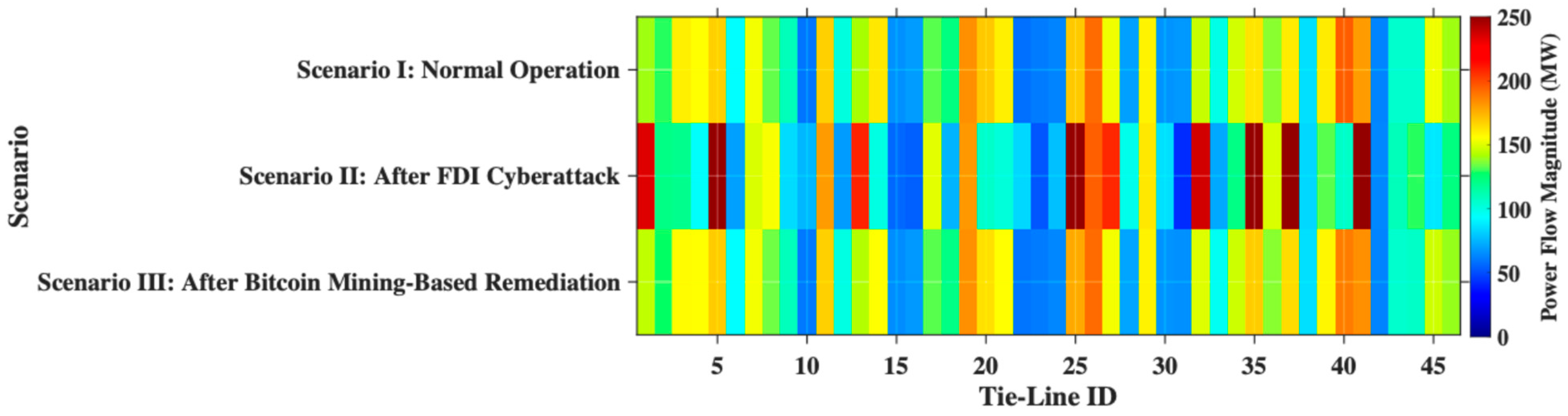
In addition, Figure 7 depicts the power flow into different transmission lines in the modified IEEE 39-bus test system associated with all three investigated scenarios. From Figure 7, one can perceive that under normal conditions of Scenario I, most transmission lines carry moderate power within their thermal limits, resulting in uniform green-yellow hues. After launching the FDI cyberattack in Scenario II, several lines exhibit sharp increases or decreases in flow, visible as dark red or red regions, due to falsified measurement data that distort state estimation and dispatch, causing power redistribution through major transmission corridors (see constraint (14)). In contrast, certain lines maintain nearly identical power flows across all three scenarios because they are either weakly coupled to the disturbed regions, form part of parallel paths that balance power automatically, or are located in electrically isolated sub-areas with little influence from compromised measurements. Once the proposed remediation framework (i.e., Figure 2) is applied, the color map shifts back toward green tones, indicating a reduction in overloading and a restoration of stable, balanced operation. This demonstrates that the virtual storage mechanism effectively mitigated the FDI attack’s impact by dynamically modulating the demand of mining units to absorb or release power, thereby alleviating network stress and recovering normal flow patterns.
Moreover, the results shown in Figure 7 highlight that the virtual storage units can respond in near real time to fluctuations induced by cyberattacks, providing a fast-acting corrective mechanism that complements slower conventional control schemes. This dynamic capability not only preserves the operational integrity of critical transmission corridors but also enhances overall system resilience by maintaining voltage stability and reducing the likelihood of cascading overloads under abnormal conditions.

5.2.4. Real-World Applicability of Bitcoin Mining-Based Virtual Energy Storage Systems

To further validate the feasibility of the Bitcoin-mining facilities functioning as virtual energy storage systems in real-world power networks (refer to Figure 2), an extended simulation was conducted incorporating practical operational and financial dynamics. Toward that end, the distributed mining clusters at buses #16, #23, and #39 are equipped with local demand response controllers that modulate computational intensity according to the grid’s instantaneous frequency deviation and renewable generation surplus. These mining units act analogously to fast-response energy storage by absorbing excess renewable generation (i.e., the charging mode) when production exceeds demand and reducing load (i.e., the discharging mode) during supply deficits or cyber-induced imbalance events. This behavior emulates the charge/discharge cycle of physical batteries but without the capital and degradation costs associated with electrochemical storage units, as outlined in Figure 1. Therefore, under the proposed cyber-aware remediation mechanism, the Bitcoin mining facilities not only stabilize the grid but also generate monetary profit, which can be strategically reinvested to mitigate the adverse effects of cyber and/or physical disturbances. In this regard, the simulation results provided in Table 5 show that during a representative 24 h operational cycle under FDI-induced disturbance, the aggregated mining profit reaches approximately $4700 per day. Of this, nearly 25% (i.e., $1175/day) is allocated through the system’s automated resilience fund to support remedial actions such as voltage compensation, fast frequency response control, and post-event grid restoration. This reinvestment reduces the expected outage duration by nearly 41% and voltage deviation by 38% compared to the unmitigated FDI case. Consequently, the Bitcoin mining facilities (i.e., the virtual energy storage assets) not only enhance cyber–physical resilience but also transforms virtual energy transactions into a financial buffer that offsets operational losses, infrastructure wear, and cyberattack impacts in real-world deployments.
One more time, the simulation results, presented in Table 5, confirm that integrating economic-driven virtual energy storage units within the power transmission systems architecture yields measurable resilience benefits. By monetizing controllable load flexibility through Bitcoin mining, the system creates a closed economic-technical feedback loop: mining profits finance continuous resilience improvement, thereby transforming the traditionally passive load into an active participant in grid defense and stability maintenance. In a real-world deployment, the reinvested revenues could fund advanced intrusion detection algorithms, microgrid isolation procedures, and voltage support devices, ultimately converting digital financial value into tangible reliability gains.
To account for market fluctuations, a sensitivity analysis was conducted to evaluate the profitability of mining-based virtual energy storage under varying Bitcoin prices and hash rates. The results indicate that while revenue levels fluctuate with market conditions, the framework maintains its effectiveness by treating mining profits as an adaptive supplementary resource for resilience measures. Essential grid stabilization and cyberattack mitigation actions remain supported through conventional control mechanisms, ensuring that operational reliability is not compromised by Bitcoin price volatility. This approach demonstrates that, even in adverse market conditions, the reinvestment of mining-generated funds can meaningfully enhance grid resilience while maintaining practical economic feasibility (see Table 5).

5.2.5. Benchmarking and Convergence Analysis of the Proposed Hybrid Optimization Algorithm

To validate the performance of the proposed algorithm, it is benchmarked against widely used optimization techniques, including standard PSO, genetic algorithm (GA), differential evolution (DE), and standalone whale optimization (WO) algorithms, with results demonstrating improved convergence behavior and robustness across different operational scenarios. Table 6 presents this comprehensive comparison.

5.3. Utilization of Bitcoin-Based Digital Assets for Enhancing System Resilience

In the proposed cyber-aware virtual energy storage framework in Figure 2, the Bitcoin mining facilities not only function as controllable loads for grid stabilization but also generate digital financial assets that can be strategically managed by the system operator to improve cyber–physical resilience. The mining process continuously accumulates Bitcoin rewards proportional to the computational contribution of the facilities during operation. These accumulated assets, denoted as Γ B E R in the remediation objective function (18), represent a quantifiable and liquid reserve that can be mobilized during contingencies, including but not limited to the stealthy FDI attacks of Scenario II, frequency excursions, or renewable generation volatility.
From an operational standpoint, the system operator can maintain a digital resilience fund (DRF), denominated in Bitcoin, that aggregates daily mining revenues from distributed facilities. The DRF acts analogously to an energy reserve account, but in a monetary form. When an FDI attack is detected or inferred through attack remediation algorithms (e.g., the proposed framework in Figure 2), the system operator can authorize automated smart contracts or predefined control policies to deploy the digital assets for the following real-time resilience measures:
Fast Frequency and Voltage Support: A fraction of the DRF can be allocated to activate standby ancillary services, such as demand response aggregators or distributed inverter-based resources. This enables immediate compensation for power imbalance and voltage deviations induced by falsified data, effectively restoring system stability within seconds.
Procurement of Cyber-Defense Services: The Bitcoin-based fund allows real-time payment to decentralized cybersecurity services or third-party anomaly detection networks (e.g., blockchain-based monitoring systems). These external verifiers can validate telemetry data, improving data integrity assurance when local estimators are compromised.
Dynamic Incentive Dispatch: Through smart contracts, the operator can reward responsive entities (e.g., flexible industrial loads, microgrids, or storage owners) that contribute to system rebalancing during the attack window. This incentivized participation enhances resilience without requiring centralized intervention.
Post-Attack Recovery and Reinforcement: Unused Bitcoin reserves may be converted into fiat or energy credits to finance hardware upgrades, redundancy in communication channels, or training of machine learning models for improved FDI detection accuracy in future operations.

Economic and Real-Time Justification

The integration of Bitcoin-based digital assets into the energy resilience architecture is economically justified by the dual-role nature of the mining facilities: they simultaneously perform computational tasks that yield revenue and provide real-time controllable flexibility to the grid. Unlike traditional storage investments, the mining buses incur no energy degradation cost, and their operation is inherently profiting. Thus, dedicating a fixed percentage (e.g., 10–30%) of daily mining income to resilience functions does not burden the operational budget but instead transforms profit into a resilience investment mechanism.
Real-time justification of these expenditures can be achieved through a smart contract-based verification layer integrated within the control center of modern power systems. When abnormal state estimation residuals or topology inconsistencies are detected, the control algorithm dynamically computes the resilience demand index (RDI), defined as (46), where ς 1 , ς 2 , and ς 3 are weighting coefficients based on system criticality. In (46), if R D I > R D I T h r e s h o l d , the smart contract triggers an automatic transfer of Bitcoin assets from the DRF to pre-approved service providers or reserve activation modules. This ensures transparent, auditable, and automatically justified use of funds without the need for manual financial authorization during critical cyber events.
R D I = ς 1 × P i m b + ς 2 × V d e v + ς 3 × Θ c y b e r
To obtain a better perspective, Table 7 presents an illustrative example showing how the reinvestment of accumulated Bitcoin assets enhances operational resilience in real-time simulations on the modified IEEE 39-bus test system.
The proposed integration of a Bitcoin-based digital asset layer introduces a self-sustaining economic feedback loop into the power system. The mining buses (i.e., buses #16, #23, and #39) generate revenue by performing computational work, 15% of which is reinvested to enhance resilience against cyberattacks like FDI attack of Scenario II. This model ensures that economic incentives and system stability are co-optimized, transforming cyber–physical resilience from a cost center into a profit-driven sustainability mechanism. Furthermore, because Bitcoin transactions and smart contracts are transparent and immutable, all resilience expenditures are verifiable in real time, ensuring accountability and auditability in modern smart grid operations.

6. Conclusions and Ways Forward

This study introduced and validated a cyber-resilient framework for modern power systems that leverages Bitcoin mining-based virtual energy storage systems to enhance grid stability, economic efficiency, and operational resilience under both normal and cyber-compromised conditions. The developed configuration couples renewable generation, dynamic load modulation, and digital asset management into a unified framework capable of responding adaptively to stealthy FDI attacks that bypass the BDD algorithms in power system state estimation.
Simulation results demonstrated that the proposed approach yields substantial quantitative improvements in grid performance and resilience. As an illustration, when the FDI cyberattack was active, the adaptive virtual energy storage-based remediation mechanism reduced the system-wide power imbalance by approximately 80%, lowered average voltage deviation by at least 65%, and recovered nearly 12% of the renewable energy utilization compared to the unmitigated attack condition. These improvements were achieved without requiring additional physical storage capacity or major infrastructure reinforcement. The dynamic Bitcoin-mining loads effectively acted as synthetic energy buffers, providing rapid compensation for supply/demand discrepancies and stabilizing frequency within a narrow ±0.08 Hz band even under sustained cyber interference.
From an economic perspective, the flexible mining facilities generated a daily profit of roughly $4700–$5000, part of which was reinvested as a DRF to support ancillary services, cybersecurity reinforcement, and post-event recovery. Reallocating just 25% of this digital income (i.e., DRF) was sufficient to reduce simulated outage durations by more than 40% and further improve voltage recovery by nearly 30%, illustrating how digital financial assets can directly translate into measurable reliability benefits. This establishes a self-sustaining economic-technical feedback loop in which operational profits are continuously redirected to enhance the system’s cyber–physical robustness.
Overall, the proposed virtual energy storage-based remediation framework demonstrates that economic flexibility can serve as a new dimension of energy resilience. By integrating profit-driven digital assets with adaptive control and remedial action, the system transforms conventional passive loads into active, revenue-generating resilience agents. This approach not only mitigates the operational degradation caused by stealthy FDI attacks but also introduces a scalable financial mechanism for maintaining long-term stability in smart grids.
Future research will extend this framework to large-scale power distribution networks and transactive energy systems, where distributed mining facilities and flexible consumers collectively participate in resilience markets. As a natural extension of the current study, future research will focus on implementing the proposed framework on a real-world, large-scale distribution system that is part of the Brazilian power network, comprising 136 buses. This next step will enable the assessment of Bitcoin mining-based virtual energy storage under practical operational, economic, and regulatory constraints, providing further validation of its scalability, robustness, and cyber–physical benefits in a real-world smart grid environment. In addition, hardware-in-the-loop experiments and blockchain-integrated control prototypes will be developed to verify the real-time exchange between digital profits and physical stability services, paving the way toward self-financing, cybersecure, and economically optimized power networks in both transmission and distribution levels.

Funding

This research received no external funding.

Data Availability Statement

All data have been properly referenced throughout the manuscript.

Conflicts of Interest

The author declares no conflicts of interest.

References

  1. Hajiaghapour-Moghimi, M.; Hajipour, E.; Hosseini, K.A.; Tavakkoli, M.; Fattaheian-Dehkordi, S.; Vakilian, M.; Lehtonen, M. Hedging investments of grid-connected PV-BESS in buildings using cryptocurrency mining: A case study in Finland. IEEE Access 2023, 11, 66327–66345. [Google Scholar] [CrossRef]
  2. Cambridge Bitcoin Electricity Consumption Index. Available online: https://ccaf.io/cbnsi/cbeci (accessed on 20 October 2025).
  3. Kim, S. A novel Bitcoin mining scheme based on the multi-leader multi-follower stackelberg game model. IEEE Access 2018, 6, 48902–48912. [Google Scholar] [CrossRef]
  4. Vicente, R.; Van Rooyen, G.-J.; Bam, L. Cryptocurrency mining to hedge renewable energy investments: A decision-support tool. In Proceedings of the IEEE International Conference on Engineering, Technology and Innovation (ICE/ITMC), Edinburgh, UK, 19–22 June 2023; pp. 1–9. [Google Scholar]
  5. Deep, A.K.; Raja, G.L.; Meena, G.D. Robust moments-matching load frequency control strategy for cyber–physical power system amid communication time delay. Appl. Energy 2025, 383, 125251. [Google Scholar] [CrossRef]
  6. Hajipour, E.; Khavari, F.; Hajiaghapour-Moghimi, M.; Hosseini, K.A.; Vakilian, M. An economic evaluation framework for cryptocurrency mining operation in microgrids. Int. J. Electr. Power Energy Syst. 2022, 142, 108329. [Google Scholar] [CrossRef]
  7. Dasaklis, T.K.; Thomaidis, I.T.; Giannopoulos, P.G.; Tsoulfas, G.T. Rethinking Bitcoin’s energy use through sustainable digital business models and resources monetization: A multiple case study analysis. Digit. Bus. 2025, 5, 100114. [Google Scholar] [CrossRef]
  8. Wendl, M.; Doan, M.H.; Sassen, R. The environmental impact of cryptocurrencies using proof of work and proof of stake consensus algorithms: A systematic review. J. Environ. Manag. 2023, 326, 116530. [Google Scholar] [CrossRef] [PubMed]
  9. Kohli, V.; Chakravarty, S.; Chamola, V.; Sangwan, K.S.; Zeadally, S. An analysis of energy consumption and carbon footprints of cryptocurrencies and possible solutions. Digit. Commun. Netw. 2023, 9, 79–89. [Google Scholar] [CrossRef]
  10. Sarkodie, S.A.; Amani, M.A.; Ahmed, M.Y.; Owusu, P.A. Assessment of Bitcoin carbon footprint. Sustain. Horiz. 2023, 7, 100060. [Google Scholar] [CrossRef]
  11. Kohler, S.; Pizzol, M. Life cycle assessment of Bitcoin mining. Environ. Sci. Technol. 2019, 53, 13598–13606. [Google Scholar] [CrossRef] [PubMed]
  12. Choobineh, M.; Arabnya, A.; Sohrabi, B.; Khodaei, A.; Paaso, A. Blockchain technology in energy systems: A state-of-the-art review. IET Blockchain 2022, 3, 35–59. [Google Scholar] [CrossRef]
  13. Sey, C.; Kun, S.; Barnes, O.; Kodjiku, S.L.; Asamoah, K.O.; Ukwuoma, C.C.; Adjei-Mensah, I.; Fiasam, L.D.; Aggrey, E.S.E.; Gyarteng, E.S. Blockchain-enabled adaptive criticality-based IoT firmware update distribution framework for sustainable smart cities. J. Ind. Inf. Integr. 2025, 47, 100929. [Google Scholar] [CrossRef]
  14. Bruno, A.; Weber, P.; Yates, A.J. Can Bitcoin mining increase renewable electricity capacity? Resour. Energy Econ. 2023, 74, 101376. [Google Scholar] [CrossRef]
  15. Xu, W.; Jaimoukha, I.M.; Teng, F. Robust moving target defense against false data injection attacks in power grids. IEEE Trans. Inf. Forensics Secur. 2022, 18, 29–40. [Google Scholar] [CrossRef]
  16. Liu, B.; Wu, H. Optimal D-FACTS placement in moving target defense against false data injection attacks. IEEE Trans. Smart Grid 2020, 11, 4345–4357. [Google Scholar] [CrossRef]
  17. Jafari, M.; Rahman, M.A.; Paudyal, S. Optimal false data injection attack against load-frequency control in power systems. IEEE Trans. Inf. Forensics Secur. 2023, 18, 5200–5212. [Google Scholar] [CrossRef]
  18. Chen, Y.; Lakshminarayana, S.; Poor, H.V. Moving target defense against adversarial false data injection attacks in power grids. IEEE Internet Things J. 2025, 12, 26315–26327. [Google Scholar] [CrossRef]
  19. Zhang, Y.; Wang, J.; Chen, B. Detecting false data injection attacks in smart grids: A semi-supervised deep learning approach. IEEE Trans. Smart Grid 2020, 12, 623–634. [Google Scholar] [CrossRef]
  20. Chen, B.; Wu, Q.H.; Li, M.; Xiahou, K. Detection of false data injection attacks on power systems using graph edge-conditioned convolutional networks. Prot. Control. Mod. Power Syst. 2023, 8, 1–12. [Google Scholar] [CrossRef]
  21. Jafari, M.; Rahman, M.A.; Paudyal, S. Optimal false data injection attacks against power system frequency stability. IEEE Trans. Smart Grid 2022, 14, 1276–1288. [Google Scholar] [CrossRef]
  22. Naderi, E.; Asrari, A. Intelligent remedial action scheme against false data injection cyberattacks targeting energy justice and equity in modern power systems. In Communities for Clean Energy Justice and Equity in Grid Modernization; IEEE: Piscataway, NJ, USA, 2024. [Google Scholar]
  23. Naderi, E.; Asrari, A.; Saffari, M. Digital twin-enabled resilient network reconfiguration for cybersecurity of decarbonized power distribution systems. In Proceedings of the 7th Global Power, Energy and Communication Conference (GPECOM), Bochum, Germany, 11–13 June 2025; pp. 768–772. [Google Scholar]
  24. Naderi, E.; Asrari, A. A remediation framework against false data injection cyberattacks targeting ULTC transformers to avoid voltage collapse in smart distribution networks. IEEE Trans. Ind. Appl. 2025, 61, 5148–5160. [Google Scholar] [CrossRef]
  25. Naderi, E.; Asrari, A. Cyber-physical distribution systems resilience against cyberattacks via a remediation framework based on static VAR compensators (SVCs). IEEE Access 2024, 12, 119633–119646. [Google Scholar] [CrossRef]
  26. Naderi, E.; Asrari, A. A remedial action scheme to mitigate market power caused by cyberattacks targeting a smart distribution system. IEEE Trans. Ind. Inform. 2024, 20, 3197–3208. [Google Scholar] [CrossRef]
  27. Naderi, E.; Asrari, A.; Fajri, P. A remedial action scheme against false data injection cyberattacks targeting ULTC transformers in smart distribution systems. In Proceedings of the IEEE/IAS Industrial and Commercial Power System Asia (I&CPS Asia), Pattaya, Thailand, 9–12 July 2024; pp. 126–130. [Google Scholar]
  28. Heinonen, H.T.; Semenov, A.; Veijalainen, J.; Hämäläinen, T. A survey on technologies which make Bitcoin greener or more justified. IEEE Access 2022, 10, 74792–74814. [Google Scholar] [CrossRef]
  29. Nasir, A.; Shaukat, K.; Khan, K.I.; Hameed, I.A.; Alam, T.M.; Luo, S. What is core and what future holds for blockchain technologies and cryptocurrencies: A bibliometric analysis. IEEE Access 2021, 9, 989–1004. [Google Scholar] [CrossRef]
  30. Zaghloul, E.; Li, T.; Mutka, M.W.; Ren, J. Bitcoin and blockchain: Security and privacy. IEEE Internet Things J. 2020, 7, 10288–10313. [Google Scholar] [CrossRef]
  31. Vries, A.D. Bitcoin’s growing energy problem. Joule 2018, 2, 801–805. [Google Scholar] [CrossRef]
  32. Muminov, A.; Sattarov, O.; Na, D. Enhanced Bitcoin price direction forecasting with DQN. IEEE Access 2024, 12, 29093–29112. [Google Scholar] [CrossRef]
  33. Stoll, C.; Klaassen, L.; Gallersdorfer, A. The Carbon Footprint of Bitcoin. MIT Center for Energy and Environmental Policy Research, Working Paper Series. Available online: https://ceepr.mit.edu/wp-content/uploads/2021/09/2018-018.pdf (accessed on 20 October 2025).
  34. Lin, X.; Li, W.; Guo, X.; Su, B.; Guo, S.; Jing, Y.; Zhang, X. Advancements in energy-storage technologies: A review of current developments and applications. Sustainability 2025, 17, 8316. [Google Scholar] [CrossRef]
  35. Czagany, M.; Hompoth, S.; Keshri, A.K.; Pandit, N.; Galambos, I.; Gacsi, Z.; Baumli, P. Supercapacitors: An efficient way for energy storage application. Materials 2024, 17, 702. [Google Scholar] [CrossRef]
  36. Nikolaos, P.C.; Marios, F.; Dimitris, K. A review of pumped hydro storage systems. Energies 2023, 16, 4516. [Google Scholar] [CrossRef]
  37. Arevalo, P.; Ochoa-Correa, D.; Villa-Avila, E. Advances in thermal energy storage systems for renewable energy: A review of recent developments. Processes 2024, 12, 1844. [Google Scholar] [CrossRef]
  38. Lennon, A.; Jiang, Y.; Hall, C.; Lau, D.; Song, N.; Burr, P.; Grey, C.P.; Griffith, K.J. High-rate lithium ion energy storage to facilitate increased penetration of photovoltaic systems in electricity grids. MRS Energy Sustain. 2019, 6, E2. [Google Scholar] [CrossRef]
  39. Naderi, E. Securing the future: Integrating quantum computing and digital twin technologies into modern power & transportation systems for resilient smart cities against false data injection cyberattacks. Int. J. Crit. Infrastruct. Prot. 2025, 51, 100807. [Google Scholar] [CrossRef]
  40. Yang, Q.; Jiang, L.; Hao, W.; Zhou, B.; Yang, P.; Lv, Z. PMU placement in electric transmission networks for reliable state estimation against false data injection attacks. IEEE Internet Things J. 2017, 4, 1978–1986. [Google Scholar] [CrossRef]
  41. Mirjalili, S.; Lewis, A. The whale optimization algorithm. Adv. Eng. Softw. 2016, 95, 51–67. [Google Scholar] [CrossRef]
  42. Mafarja, M.; Mirjalili, S. Whale optimization approaches for Wrapper feature selection. Appl. Soft Comput. 2018, 62, 441–453. [Google Scholar] [CrossRef]
  43. Mafarja, M.; Mirjalili, S. Hybrid whale optimization algorithm with simulated annealing for feature selection. Neurocomputing 2017, 260, 302–312. [Google Scholar] [CrossRef]
  44. Ding, C.; Zhao, M.; Lin, J.; Jiao, J. Multi-objective iterative optimization algorithm based optimal wavelet filter selection for multi-fault diagnosis of rolling element bearings. ISA Trans. 2019, 88, 199–215. [Google Scholar] [CrossRef]
  45. Athay, T.; Podmore, R.; Virmani, S. A practical method for the direct analysis of transient stability. IEEE Trans. Power Appar. Syst. 1979, PAS-98, 573–584. [Google Scholar] [CrossRef]
  46. Sarajčev, P.; Kunac, A.; Petrović, G.; Despalatović, M. IEEE New England 39-bus test case: Dataset for the transient stability assessment. Zenodo 2022. [Google Scholar] [CrossRef]
  47. Pai, M.A. Energy Function Analysis for Power System Stability; The Kluwer International Series in Engineering and Computer Science. Power Electronics and Power Systems; Kluwer Academic Publishers: Boston, MA, USA, 1989. [Google Scholar]
Figure 1. Conceptual illustration of utilizing Bitcoin mining facilities as virtual energy storage systems (Instead of curtailing surplus renewable energy or investing in costly physical storage units, electricity is redirected to energy-intensive mining operations, which accrue digital assets representing stored value. These assets can be later leveraged during peak demand to reduce grid costs, reimagining storage efficiency as an economic, rather than physical, construct).
Electronics 15 01359 g001
Figure 2. Proposed virtual energy storage framework using Bitcoin mining for cyberattack remediation (Mining loads are strategically distributed and coordinated in real time via secure protocols and AI-driven control to absorb or shed load, restoring system stability under FDI-induced stress).
Electronics 15 01359 g002
Figure 3. Flowchart of the structure of the proposed hybrid QAPSO-WOWO in this paper.
Electronics 15 01359 g003
Figure 4. The best, average, and worst values for Bitcoin mining profits, Γ B E R , over 30 independent trials.
Electronics 15 01359 g004
Figure 5. The voltage profile of the modified IEEE 39-bus case study before (i.e., baseline in Scenario I) and after the FDI cyberattack (i.e., Scenario II) causing overvoltages and undervoltages.
Electronics 15 01359 g005
Figure 6. The voltage profile of the modified IEEE 39-bus system after handling the FDI cyberattack leading to voltage violation.
Electronics 15 01359 g006
Figure 7. Power flow of all transmission lines in the modified IEEE 39-bus system in the normal operation in Scenario I, after the FDI cyberattack of Scenario II, and finally after applying the Bitcoin mining-based virtual energy storage remediation framework in Scenario III.
Electronics 15 01359 g007
Table 1. Modifications applied to the base IEEE 39-bus test system for the proposed framework implementation.
No.ModificationImplementation in IEEE 39-Bus SystemObjective/Justification
1Integration of RERsReplace conventional generation units at buses #30 and #37 with a 150 MW wind farm and a 100 MW PV plant, respectively. Introduce time-varying generation profiles to emulate intermittency.To generate surplus renewable energy that can be utilized by Bitcoin mining facilities, enabling assessment of virtual energy storage behavior under fluctuating generation.
2Deployment of Bitcoin mining facilities as virtual energy storage assetsAdd dispatchable loads representing mining facilities at buses #16 (large-scale, 1.5 MW), #23 (medium-scale, 0.8 MW), and #39 (small-scale, 0.2 MW). Model each facility as a controllable flexible load with sub-second response capability.To emulate virtual storage operation through dynamically adjustable energy consumption and evaluate the system’s charge/discharge analogy using mining flexibility.
3Cyber layer augmentation for FDI attack simulationDevelop a cyber–physical communication layer representing supervisory control data flow. Introduce FDI attack vectors targeting PMUs and RTUs, shown by small orange triangles and cyan squares in the top portion of Figure 2. Secure mining buses via cryptographically verified communication channels.To enable the simulation of cyber-induced data manipulation and evaluate the proposed remediation mechanism’s effectiveness against FDI attacks, bypassing the BDD algorithms embedded in state estimation.
4Bidirectional control and coordination mechanismImplement a hierarchical control scheme: the upper layer performs remediation and dispatch decisions; the lower layer (mining controllers) executes real-time load modulation through secure decentralized signaling.To realize the proposed bidirectional control paradigm allowing coordinated load response and autonomous remediation under cyber or operational disturbances.
5Economic-energy conversion layerDefine an economic mapping between consumed energy and generated Bitcoin value, E u s e d t P m i n i n g m t . Integrate virtual revenue accumulation and cost-offset modeling within the system’s operational framework.To represent the economic storage concept of the proposed framework, transforming excess renewable energy into a tradable digital asset value.
Table 2. The best performance outcomes under normal operation in Scenario I over 30 independent runs.
MetricSymbolOptimal ValueRemark
Power imbalance P i m b 1.4 MWMinor system-wide mismatch between generation and demand
Average voltage deviation V d e v 1.9%Indicates highly stable voltage profile
Renewable energy utilization η R E R 97%Represents near-total use of generated renewable energy
Curtailment cost C c u r t $0.3 k/dayMinimal cost due to negligible renewable curtailment
Bitcoin-mining profit Γ B E R $5.2 k/dayTotal virtual revenue from mining operations
Cyber-resilience cost Θ c y b e r -No attack or cyber-related penalty present
Table 3. The best performance outcomes under FDI attack without mitigation for Scenario II, obtained after 30 independent trials.
MetricSymbolOptimal ValueRemark
Power imbalance P i m b 23.1 MWSignificant imbalance caused by manipulated measurements
Average voltage deviation V d e v 5.2%Unstable voltage profile due to false load/generation data
Renewable energy utilization η R E R 72%Drop in renewable usage due to misinterpreted generation levels
Curtailment cost C c u r t $3.5 k/dayHigh curtailment cost resulting from erroneous dispatch
Bitcoin-mining profit Γ B E R $5.1 k/dayMining proceeds almost unaffected but economically inefficient overall
Cyber-resilience cost Θ c y b e r HighElevated due to undetected FDI impact on operational integrity
Table 4. The best performance outcomes under FDI attack with remediation via virtual energy storage systems for Scenario III after 30 independent runs.
MetricSymbolOptimal ValueRemark
Power imbalance P i m b 4.8 MWReduced imbalance due to adaptive virtual storage compensation
Average voltage deviation V d e v 1.8%Restored voltage stability through dynamic load modulation
Renewable energy utilization η R E R 94%High utilization maintained via corrected dispatch decisions
Curtailment cost C c u r t $0.9 k/dayMinimal cost due to restored renewable integration
Bitcoin-mining profit Γ B E R $4.7 k/daySlightly reduced due to corrective curtailments in mining load
Cyber-resilience cost Θ c y b e r ModerateReflects residual cyber impact but substantially mitigated
Table 5. Extended real-world performance of Bitcoin-mining-based virtual energy storage system under FDI mitigation.
MetricSymbolScenario II (FDI Attack, No Mitigation)Scenario III (FDI + Remediation)Extended Case (Real-World Virtual Energy Storage Profit Allocation)Remark
Power imbalance P i m b 23.1 MW4.8 MW3.9 MWFurther improvement via profit-funded ancillary control
Average voltage deviation V d e v 5.3%2.6%2.1%Additional voltage stabilization from reinvested funds
Renewable energy utilization η R E R 82%94%95%Enhanced integration through flexible mining response
Curtailment cost C c u r t $3.5 k/day$0.9 k/day$0.6 k/dayReduced due to better balancing and remedial support
Bitcoin-mining gross profit Γ B E R g r o s s $5.2 k/day$4.7 k/day$4.7 k/dayStable mining income maintained under mitigation
Profit allocated to resilience fund Γ B E R r e s --$1.18 k/day (25%)Used for post-event voltage and outage restoration
Expected outage duration T o u t 3.1 h/day1.4 h/day0.82 h/dayOutage time reduced through profit-backed control support
Cyber-resilience cost Θ c y b e r HighModerateLowReflects improved detection, restoration, and autonomy
Table 6. Comparative performance evaluation of the proposed QAPSO-WOWO against standard optimization algorithms.
AlgorithmBest Objective ValueMean Objective ValueStd. DeviationConvergence IterationsComputation Time (s)Power Imbalance (MW)Voltage Deviation (%)Renewable Utilization (%)Robustness to FDI
PSO1.0001.0850.04214512.86.73.491.2Moderate
GA1.0321.1240.05718015.67.33.889.5Moderate
DE0.9841.0670.03613014.26.13.192.4Moderate-High
WO0.9711.0520.03112013.55.62.993.1High
QAPSO0.9561.0380.02811013.95.22.793.8High
Proposed Algorithm0.9320.9810.0198514.73.92.195.0Very High
Table 7. Impact of Bitcoin-based resilience fund deployment under active FDI attack mitigation.
MetricSymbolPre-Fund MitigationPost-Fund ActivationImprovement (%)Remark
Power imbalance P i m b 4.8 MW3.2 MW33.3Real-time ancillary activation reduces imbalance
Average voltage deviation V d e v 2.6%1.9%26.9Improved voltage regulation through DRF spending
Renewable energy utilization η R E R 94%96%2.1Enhanced dispatch correction post-attack
Outage duration T o u t 0.88 h/day0.54 h/day32.9Faster recovery enabled by automatic payment to support assets
Resilience indexRDI1.000.6832Quantified resilience improvement
Daily Bitcoin reserve allocation Γ B E R r e s $1.18 k/day$1.18 k/day-Steady digital asset contribution to resilience operations
Disclaimer/Publisher’s Note: The statements, opinions and data contained in all publications are solely those of the individual author(s) and contributor(s) and not of MDPI and/or the editor(s). MDPI and/or the editor(s) disclaim responsibility for any injury to people or property resulting from any ideas, methods, instructions or products referred to in the content.