Artificial Intelligence for Infrastructure-as-Code—A Systematic Literature Review


Abstract
1. Introduction
2. Infrastructure-as-Code and DevOps
2.1. IaC Definition
- an activity, which is sometimes also called a process, an ability, or a practice;
- an objective, which can be divided into expected benefits (e.g., to automate or to transition from fixed to software-based flexibility) and foreseen disadvantages or problems that should be avoided (e.g., undocumented manual changes could entail configuration problems),
- a means or a mechanism that is linked to the objective, which aims at realizing the intended benefit, often directly referring to software scripts (generally declarative or procedural) as the most common solution;
- subjects, which are the assets that are affected by both benefits or disadvantages through the application of the means, which in general is the IT infrastructure;
- human agents, or in some cases only an agent, which is generally the organization in charge, or a dedicated developer.
- IaC is an activity/practice.
- The IaC objective is to realize automation and quality benefits and to avoid problems and manual costs caused by complexity.
- The IaC means are digitally stored instructions that can be automatically executed (usually in the form of software scripts).
- The IaC subject is the IT infrastructure.
- The human agents are generally developers or other DevOps teams specifically concerned with a system’s operation.
2.2. IaC Context
2.3. SLR Motivation
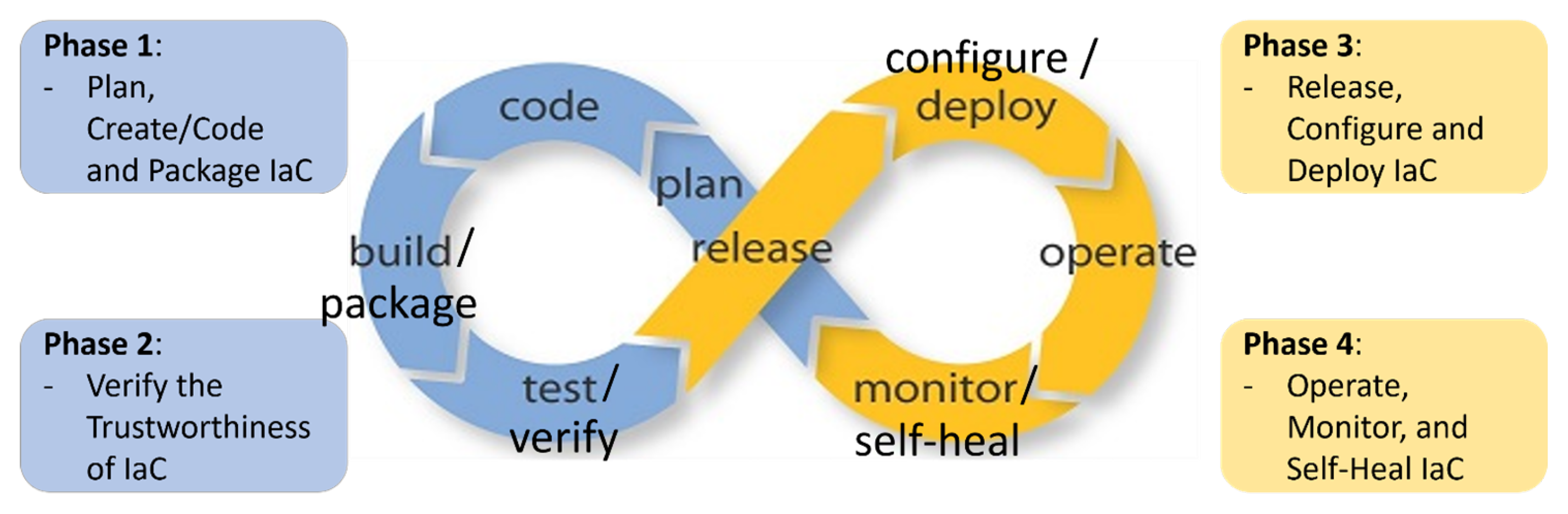
- Planning: Define infrastructure requirements through general planning and structured requirements elicitation with stakeholders.
- Code creation: Create code or scripts that define the required infrastructure resources and their management according to the requirements.
- Building and Packaging: Use software engineering tools to compose, build, and package IaC software.
- Testing and verification: Validate the software using code testing and other suitable verification techniques, such as static code analysis.
- Release, configuration, and deployment: Use deployment automation tools, e.g., Jenkins or Ansible/Terraform, to automate the configuration and deployment of infrastructure resources.
- Operation, monitoring and self-healing: Configure and use monitoring tools, e.g., Prometheus or Nagios, to track the general health, and specifically performance and security of the infrastructure resources, and, where possible, self-heal through remediation actions.

3. SLR—Methodology and Execution
- Plan: identify need, specify RQs, define protocol
- Conduct: select primary studies, extract and synthesize data
- Document: document observations, analyze threats, report
3.1. PRISMA Compliance
3.2. Planning the Review
- Identify the Need for SLR: We have already discussed the need for an SLR, and we also make the general goal and scope of the study explicit using the PICO (Population, Intervention, Comparison, Outcome) criteria; see Table 2.
- Specifying the Research Questions: As the next activity, we define the research questions to help shape the review protocol, see Table 3. This comprises the motivation to use IaC (e.g., to automate a particular IaC lifecycle activity), the identification of the different types of AI generally used (e.g., the specific forms of Generative AI or Machine Learning), and how these AI techniques are used (e.g., in which phase of the lifecycle they are applied) as well as the identification of open research challenges.
- Define and Evaluate Review Protocol: We define a protocol for a literature study based on [3] and our experience with SLRs to define key elements such as the PICO criteria, inclusion/exclusion criteria, as well as the internal extraction and review activities.
3.3. Conducting the Review
- 1.
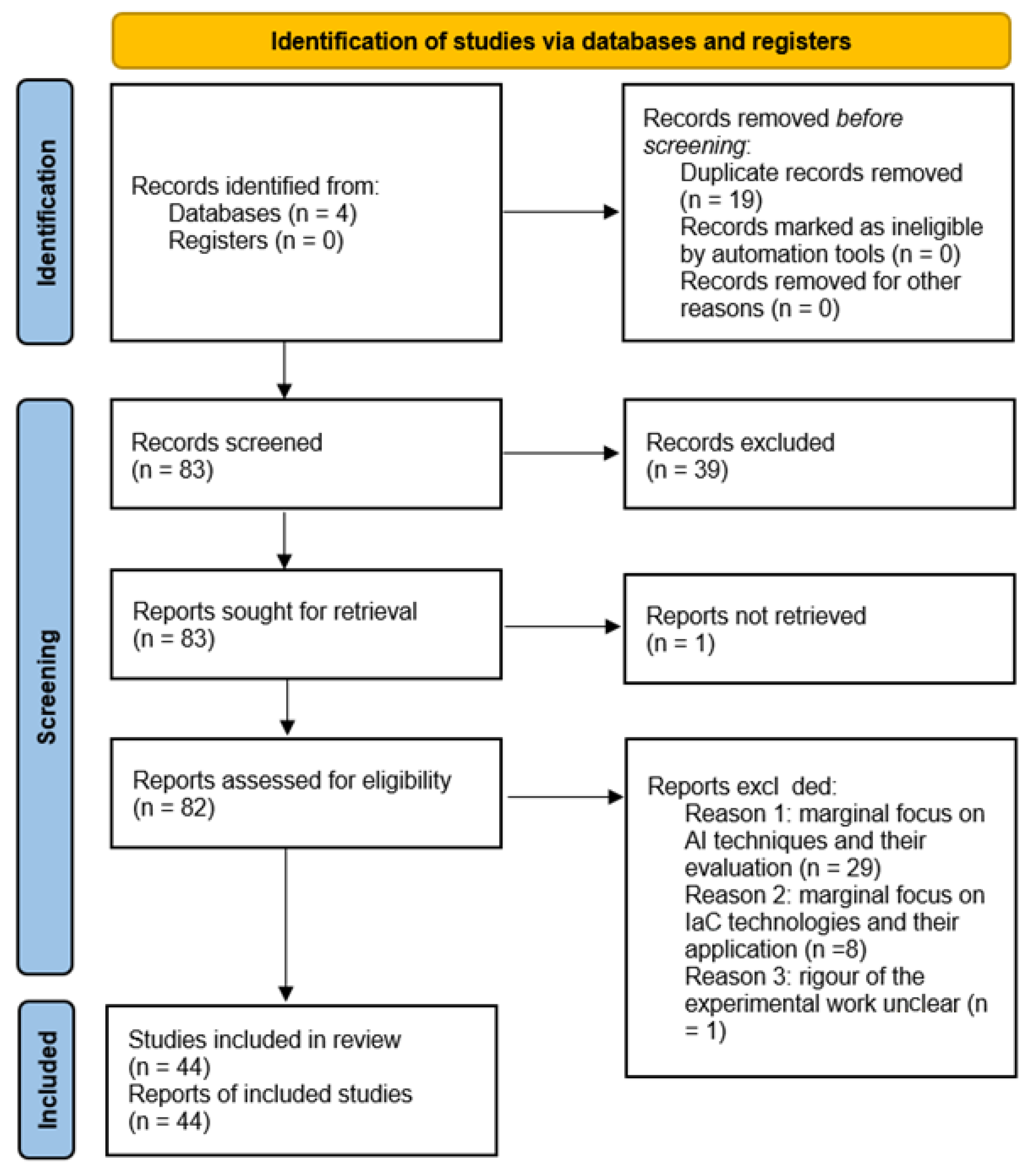
- We extracted initially 102 studies from 2020 to 2025 (until 1 October 2025) from Scopus, SpringerLink, Google Scholar, and IEEE Xplore. No papers published before 2020 were identified during the search.
- 2.
- Removing duplicates from the joined list from the four databases resulted in 83 unique publications.
- 3.
- The application of exclusion criteria in a quality assurance process was carried out in two steps. (i) Firstly, the title, abstract, and keywords were used to remove non-relevant publications. (ii) Secondly, a further manual review of the remaining papers was carried out to assess the significance of the contribution of AI utilization for IaC. This resulted in a final list of 44 publications, which were then categorized into technical contributions and review papers.

| [5] | Openja, M.; Adams, B.; Khomh, F. Analysis of Modern Release Engineering Topics:–A Large-Scale Study using StackOverflow. 2020 |
| [6] | Bhuiyan, F.A.; Rahman, A. Characterizing Co-located Insecure Coding Patterns in Infrastructure as Code Scripts. 2020. |
| [7] | Borovits, N.; Kumara, I.; Krishnan, P.; Palma, S.D.; Di Nucci, D.; Palomba, F.; Tamburri, D.A.; van den Heuvel, W.J. DeepIaC: deep learning-based linguistic anti-pattern detection in IaC. 2020. |
| [8] | Opdebeeck, R.; Zerouali, A.; Velázquez-Rodríguez, C.; Roover, C.D. Does Infrastructure as Code Adhere to Semantic Versioning? An Analysis of Ansible Role Evolution. 2020, 238–248. |
| [9] | Palma, S.D.; Mohammadi, M.; Di Nucci, D.; Tamburri, D.A. Singling the odd ones out: a novelty detection approach to find defects in infrastructure-as-code. 2020. |
| [10] | Rahman, A.; Williams, L. Different Kind of Smells: Security Smells in Infrastructure as Code Scripts. 2021. |
| [11] | Alonso, J.; Orue-Echevarria, L.; Osaba, E.; López Lobo, J.; Martinez, I.; Diaz de Arcaya, J.; Etxaniz, I. Optimization and Prediction Techniques for Self-Healing and Self-Learning Applications in a Trustworthy Cloud Continuum. 2021. |
| [12] | Alnafessah, A.; Gias, A.U.; Wang, R.; Zhu, L.; Casale, G.; Filieri, A. Quality-Aware DevOps Research: Where Do We Stand? 2021. |
| [13] | Recupito, G.; Pecorelli, F.; Catolino, G.; Moreschini, S.; Nucci, D.D.; Palomba, F.; Tamburri, D.A. A Multivocal Literature Review of MLOps Tools and Features. 2022. |
| [14] | Petrovic, N.; Cankar, M.; Luzar, A. Automated Approach to IaC Code Inspection Using Python-Based DevSecOps Tool. 2022. |
| [15] | Borovits, N.; Kumara, I.; Di Nucci, D.; Krishnan, P.; Palma, S.D.; Palomba, F.; Tamburri, D.A.; Heuvel, W.J.v.d. FindICI: Using machine learning to detect linguistic inconsistencies between code and natural language descriptions in infrastructure-as-code. 2022. |
| [16] | Kyryk, M.; Pleskanka, N.; Pleskanka, M.; Kyryk, V. Infrastructure as Code and Microservices for Intent-Based Cloud Networking. 2022. |
| [17] | Quattrocchi, G.; Tamburri, D.A. Predictive maintenance of infrastructure code using “fluid” datasets: An exploratory study on Ansible defect proneness. 2022. |
| [18] | Chiari, M.; De Pascalis, M.; Pradella, M. Static Analysis of Infrastructure as Code: a Survey. 2022. |
| [19] | Myat, H.M.; Phyu, M.P.; Paing, A.M.M. Towards Infrastructure Automation Using IaC in the Era of GenAI. 2025. |
| [20] | Dalla Palma, S.; Di Nucci, D.; Palomba, F.; Tamburri, D.A. Within-Project Defect Prediction of Infrastructure-as-Code Using Product and Process Metrics. 2022. |
| [21] | Srivatsa, K.G.; Mukhopadhyay, S.; Katrapati, G.; Shrivastava, M. A Survey of using Large Language Models for Generating Infrastructure as Code. 2023. |
| [22] | Lanciano, G.; Stein, M.; Hilt, V.; Cucinotta, T. Analyzing Declarative Deployment Code with Large Language Models. 2023. |
| [23] | Opdebeeck, R.; Zerouali, A.; De Roover, C. Control and Data Flow in Security Smell Detection for Infrastructure as Code: Is It Worth the Effort? 2023. |
| [24] | Rahman, A.; Parnin, C. Detecting and Characterizing Propagation of Security Weaknesses in Puppet- Based Infrastructure Management. 2023. |
| [25] | de la Fuente Ruiz, A.E.; Novakova Nedeltcheva, G. Game-theory strategies for open-source Infrastructure-as-Code. 2023. |
| [26] | Cankar, M.; Petrovic, N.; Pita Costa, J.; Cernivec, A.; Antic, J.; Martincic, T.; Stepec, D. Security in DevSecOps: Applying Tools and Machine Learning to Verification and Monitoring Steps. 2023. |
| [27] | Reddy Konala, P.R.; Kumar, V.; Bainbridge, D. SoK: Static Configuration Analysis in Infrastructure as Code Scripts. 2023. |
| [28] | Bär, F.; Leyer, M. YUMA—An AI Planning Agent for Composing IT Services from Infrastructure-as-Code Specifications. 2023. |
| [1] | Diaz-de Arcaya, J.; Torre-Bastida, A.I.; Zárate, G.; Miñón, R.; Almeida, A. A Joint Study of the Challenges, Opportunities, and Roadmap of MLOps and AIOps: A Systematic Survey. 2023. |
| [29] | Abbas, S.I.; Garg, A. AIOps in DevOps: Leveraging Artificial Intelligence for Operations and Monitoring. 2024. |
| [30] | Sokolowski, D.; Spielmann, D.; Salvaneschi, G. Automated Infrastructure as Code Program Testing. 2024. |
| [31] | Begoug, M.; Chouchen, M.; Ouni, A.; Abdullah Alomar, E.; Mkaouer, M.W. Fine-Grained Just-In-Time Defect Prediction at the Block Level in Infrastructure-as-Code (IaC). 2024. |
| [32] | Kon, P.T.J.; Liu, J.; Qiu, Y.; Fan, W.; He, T.; Lin, L.; Zhang, H.; Park, O.M.; Elengikal, G.S.; Kang, Y.; et al. IaC-Eval: A Code Generation Benchmark for Cloud Infrastructure-as-Code Programs. 2024. |
| [33] | Ragothaman, H.; Udayakumar, S.K. Optimizing Service Deployments With NLP Based Infrastructure Code Generation–An Automation Framework. 2024. |
| [34] | Low, E.; Cheh, C.; Chen, B. Repairing Infrastructure-as-Code using Large Language Models. 2024. |
| [35] | Vasileiou, Z.; Kumara, I.; Meditskos, G.; Tokmakov, K.; Radolovi´c, D.; Cruz, J.; Nitto, E.; Tamburri, D.; Heuvel, W.J.; Vrochidis, S. A knowledge-based approach for guided development of Infrastructure as Code. 2025. |
| [36] | Eken, B.; Pallewatta, S.; Tran, N.; Tosun, A.; Babar, M.A. A Multivocal Review of MLOps Practices, Challenges and Open Issues. 2025. |
| [37] | Seth, D.K.; Ratra, K.K.; Sundareswaran, A.P. AI and Generative AI-Driven Automation for Multi-Cloud and Hybrid Cloud Architectures: Enhancing Security, Performance, and Operational Efficiency. 2025. |
| [38] | Opdebeeck, R.; Adams, B.; De Roover, C. Analysing Software Supply Chains of Infrastructure as Code: Extraction of Ansible Plugin Dependencies. 2025. |
| [39] | Peng, J.; Qiu, Y.; Kon, P.T.J.; Zhao, P.; Huang, Y.; Guo, Z.; Wang, X.; Chen, A. Automated Lifting for Cloud Infrastructure-as-Code Programs. 2025. |
| [40] | Senthamarai, N.; Jeyaselvi, M.; Hemamalini, V. Automatic Cloud Formation Using LLM. 2025. |
| [41] | Vorel, R., Generative AI for IaC and Data Provisioning. 2025. |
| [42] | Toprani, D.; Madisetti, V.K. LLM Agentic Workflow for Automated Vulnerability Detection and Remediation in Infrastructure-as-Code. 2025. |
| [43] | Kosbar, S.; Hamdaqa, M. Smells-sus: Sustainability Smells in IaC. 2025. |
| [44] | Muthukrishnan, H.; Viradia, V.; Yadav, D. Unified AI and ML Framework in DevSecOps Practices, Solving Real-World Problems. 2025. |
| [45] | Brojabasi, S.; Paul, S.; Mitra, A. Cloud native engineering: A comprehensive review of principles, practices, and challenges. 2025. |
| [46] | Ramos, R.C.B.; Yoo, S.G. Cybersecurity in DevOps Environments: A Systematic Literature Review. 2025. |
| [47] | Novakova Nedeltcheva, G.; De La Fuente Ruiz, A.; Orue-Echevarria Arrieta, L.; Bat, N.; Blasi, L. Towards Supporting the Generation of Infrastructure as Code Through Modelling Approaches–Systematic Literature Review. 2022. |
4. SLR—Bibliometric Results
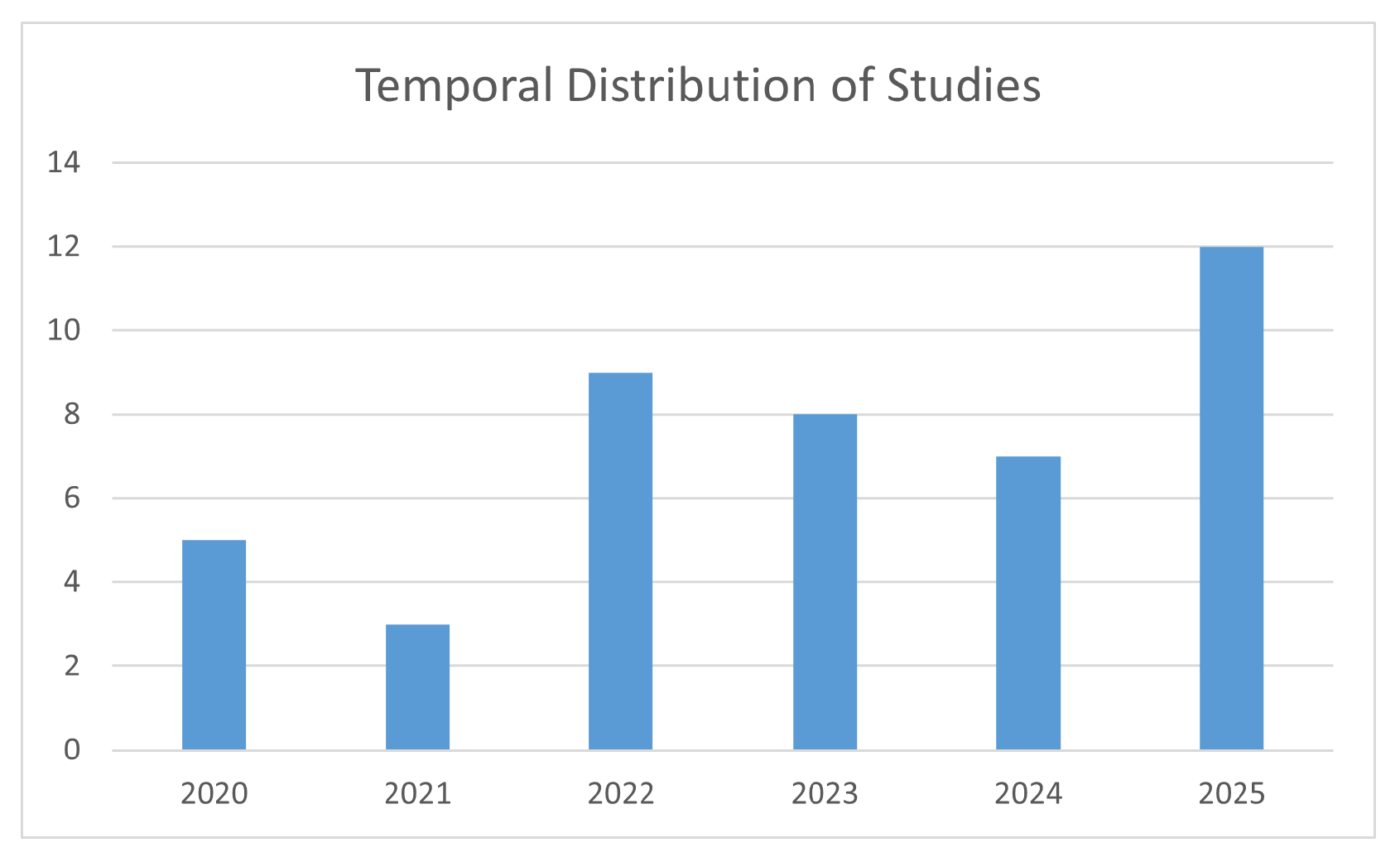
- When did research on AI in IaC become active in the computing community?
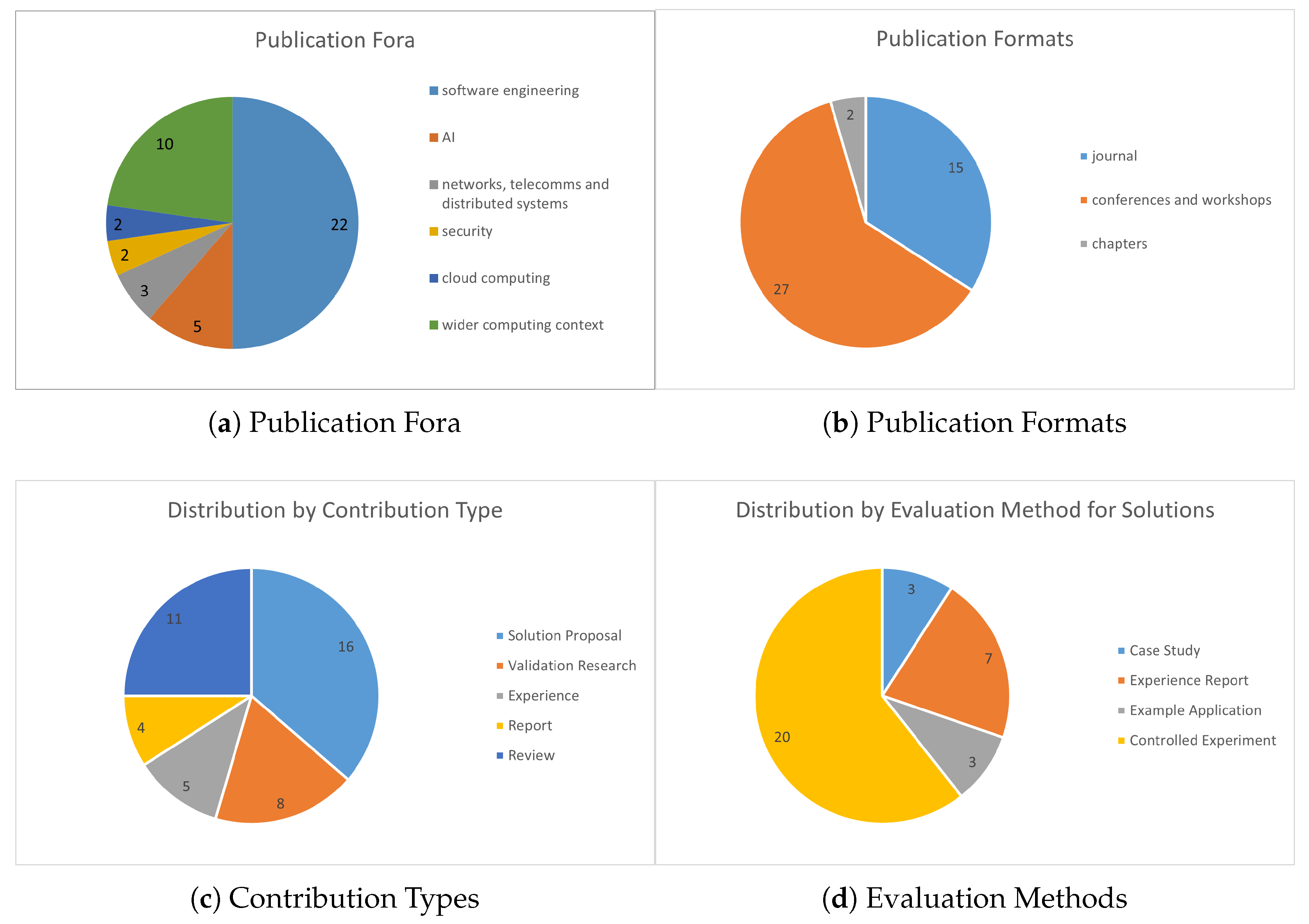
- What are the fora in which research work on AI for IaC has been published? On which communities does the focus lie?
- How is AI for IaC research reported, and what is the maturity level of the research in this field?
4.1. Temporal Overview of Studies

4.2. Publication Fora and Formats
4.3. Research and Evaluation Methods
5. SLR—AI Techniques for IaC
5.1. Key Terms Extraction and Phase Contribution
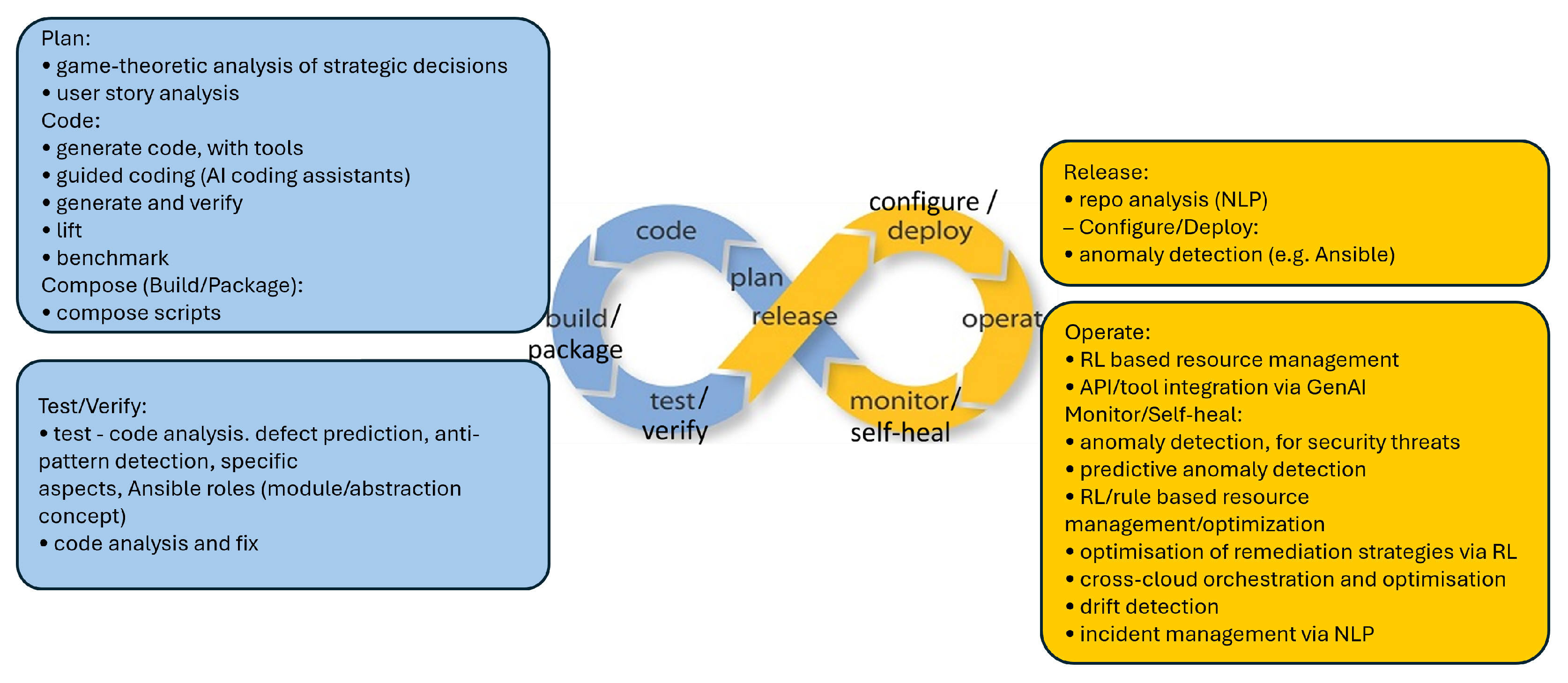
| Plan | (i) game-theoretic analysis of strategic decisions (e.g., type of IaC technology to use), (ii) user story analysis [44]. |
| Code | (i) generate code, with tools, (ii) guided coding (AI coding assistants)—completion, integrated analysis, (iii) generate and verify, (iv) lift, (v) benchmark. |
| Compose | (i) compose scripts. |
| Test/Verify | (i) test–code analysis. defect prediction, anti-pattern detection, specific aspects (platforms (K8s), Ansible roles (module/abstraction concept)), (ii) code analysis and fix |
| Release | (i) repo analysis (NLP). |
| Configure/Deploy | (i) anomaly detection (e.g., Ansible exec env), confirmed by [44]. |
| Operate | (i) RL-based resource management, (ii) API/tool integration via GenAI [37]. |
| Monitor/Self-Heal | (i) anomaly detection, confirmed by [44] for security threats, (ii) predictive anomaly detection [29], (iii) RL/rule-based resource management/optimization, confirmed by [29], (iv) optimization of remediation strategies via RL [44], (v) cross-cloud orchestration and optimization [37], (vi) drift detection [44], (vii) incident management via NLP [37]. |
5.2. Phase 1—Plan, Code, Build
- 1.
- Plan: The IaC platform selection is the first decision, particularly the supported strategy in terms of open-source or proprietary platforms. Platform planning analysis using game theory is presented in [25], which investigates the benefits and risks of different formats.
- 2.
- Code: Automated infrastructure-as-code generation using LLMs as coding assistants is an active direction.
- (a)
- Direct Code Generation: several authors address this concern. In [40], an LLM is used to generate Terraform code. Equally, ref. [33] uses NLP and LLM to generate Terraform code from natural-language queries. Ref. [19] uses the AIaC library (which accesses LLMs) to generate code. Ref. [35] reports on the use of an ontology and SPARQL queries to guide IaC code development as a non-LLM solution.
- (b)
- Code Verification: As a kind of verification for LLM-based generation, ref. [15] uses NLP and ML to detect inconsistencies between natural-language descriptions and IaC code.
- (c)
- Code Benchmarks: The authors in [32] define an LLM benchmark (An evaluation of LLMs for infrastructure as code generation can be found in https://medium.com/gft-engineering/evaluating-llms-for-infrastructure-as-code-9f8b9ac4ca33 (accessed on 23 December 2025), which covers Gemini 1.5, ChatGPT-4, LLAMA 3.8, DeepSeek-V3, and others based on a defined benchmark) for LLM-generated IaC code.
- (d)
- Lift Code to IaC: The aim is to lift low-level cloud states and translate them into corresponding IaC programs, which is a type of legacy migration in a brownfield development context. The Lilac tool enables lifting existing cloud states into IaC using an LLM [39].
- (e)
- Platform LLM Tools: Some IaC platforms already provide LLM support. (1) Ansible Lightspeed is an Ansible-specific code generator that builds on the IBM Watsonx Code Assistant to generate tasks or even full playbooks from a prompt. (2) Pulumi provides the Pulumi AI Assistant, building on LLM technology for IaC generation.
- 3.
- Compose/Build/Package: In [28], an AI planning agent for service composition using live context information is presented.
5.3. Phase 2—Test/Verify
- 1.
- Automated infrastructure testing: Machine-learning algorithms can analyze infrastructure changes and automatically test them for potential issues, reducing manual testing and improving infrastructure quality. In [30], an ACT configuration testing approach is presented.
- 2.
- Code-level syntax analysis: Code analysis specifically using ML techniques is widely used for defect prediction or anti-pattern detection.In [14], an ML-based code analysis method is proposed. Ref. [7] presents an approach using a convolutional neural network (CNN) for anti-pattern detection. Ref. [31] compares six ML models for defect prediction. In [17], ML is used for defect detection and analysis. In [9], different ML models are compared for defect prediction. Ref. [27] introduces a CNN-based method for anti-pattern detection. Ref. [20] also uses ML for defect prediction.
- 3.
- Code-level syntax analysis (beyond core AI) employs various intelligent methods, including graphs, data mining, statistics, ontologies, and model checking. Please note that established work on graph-based analyses, data mining, statistical methods, or model checking exists. We refer to some exemplary publications to indicate these directions: Ref. [38] on call graph analysis Ansible; Ref. [6] on insecure pattern mining via association rule mining; Ref. [23] on graph-based smell detectors for Ansible; Ref. [24] on rule-based code analysis; Ref. [10] on linters for security smell detection; Ref. [43] on statistical methods for smell category identification; Ref. [18] on model checking for code analysis; Ref. [35] on ontologies for smell detection (SPARQL).
- 4.
5.4. Analysis Open Challenges—Phases 1 and 2
- Integration with Existing Tools: LLMs can be integrated with existing IaC tools such as Ansible or Pulumi. For example, Pulumi AI leverages LLMs to author IaC code for various architectures and clouds, enabling users to generate custom configurations tailored to their specific needs.
- Version Control and Collaboration: Version control is a central aspect in IaC management in general, although specific AI uses have not been reported to address change management and consistency. IaC configurations generated by LLMs should be stored in version control systems. This practice enables collaboration, tracking, and, if necessary, rollback, ensuring that changes can be managed and reviewed systematically.
- Benchmarking and Evaluation: Benchmarking frameworks are needed to benchmark the capabilities of specifically LLMs in generating IaC configurations. These evaluations help identify the strengths and limitations of different LLMs, providing insights into their performance and areas for improvement. While quality assurance is important, only one effort is reported.
- 1.
- Phase 1: Generation–Automation and Efficiency: LLMs can automate the generation of IaC scripts, reducing the time and effort required for manual configurations. This can lead to more efficient infrastructure management and deployment processes. While LLMs can generate IaC scripts, it remains essential to review these scripts to ensure compliance and mitigate configuration errors. Currently, the human-in-the-loop approach is needed to maintain the quality and reliability of the generated code.
- 2.
- Phases 2–4: Feedback Loops—Quality through Testing and Monitoring: Implementing explicit, automated feedback loops that return errors and warnings from the generated IaC to the LLM can improve code quality, potentially with less human intervention.
5.5. Phase 3—Release, Configure, Deploy
- 1.
- Automated infrastructure provisioning: Generally, machine learning can analyze infrastructure requirements and automatically provision the necessary resources. This reduces the need for manual intervention and improves the speed and accuracy of provisioning, as demonstrated for non-coded cloud management solutions, such as VM configuration optimization.
- 2.
- Predictive autoscaling for infrastructure resources: Historical data can be used to predict potential infrastructure scaling needs and recommend proactive remediation strategies to address the overall performance and reliability of the infrastructure. Reinforcement learning has already been used for this in cloud resource autoscaling.
- 3.
- Integration of IaC infrastructure objects, specifically for multi/edge/hybrid cloud management, is reported in [37].
5.6. Phase 4—Operate, Monitor, Self-Heal
- 1.
- Continuous infrastructure monitoring: real-time performance and health data can be obtained, enabling the identification of anomalies and the remediation of potential issues before they impact the system.
- 2.
- IaC controllers: ML/RL-based IaC controllers for self-healing, covering the following functions:
- release: Ref. [5] describes an ML-based repository analysis using NLP processing to extract release-related concerns.
- configure: No study was selected, but in an extended abstract, ref. [49] proposes using AI for anomaly detection in configuration specifications.
- full phase 3 and 4 coverage: In [11], a full support model covering deployment, monitoring, analysis, and healing is described.
5.7. Analysis Open Challenges—Phases 3 and 4
- 1.
- Improved incident management: AI can help to detect and diagnose issues more quickly, reducing the mean time to recovery (MTTR) and improving the overall reliability of software. This can be divided into the following specific aspects: monitoring, analysis, and prediction.
- 2.
- Enhanced performance monitoring: Real-time data on application and infrastructure performance can improve processing performance.
- 3.
- Automated root cause analysis: ML can be used to analyze large volumes of data and determine the root cause of incidents.
- 4.
- Predictive analysis and management: historical data can be used to predict potential issues and recommend proactive remediation.
6. A Review of Surveys
6.1. Objective
6.2. Major Surveys
| DevSecOps Activity | Phase | ML Models Used |
|---|---|---|
| User Story Definition | Plan | NLP-based Risk Analysis |
| Development (Code Writing) | Code | Code Completion & Static Analysis (GPTCode) |
| Static Analysis (SAST) | Verify | Random Forest, Decision Trees, XGBoost |
| Build & CI Testing | Verify | Isolation Forest, Autoencoders (Anomaly Detection) |
| Dynamic Analysis (DAST) | Monitor/Self-Heal | Reinforcement Learning, CNN-based Models for Traffic Analysis |
| Deployment Security—Drift detection | Monitor/Self-Heal | LSTM-based Threat Detection, Transformer-based Security Policies |
| Runtime Security & Operations | Monitor/Self-Heal | LSTM, GRU-based Anomaly Detection |
| Incident Response & Remediation | Monitor/Self-Heal | Reinforcement Learning, AutoML-based Threat Mitigation |
6.3. Other Surveys
6.4. Summary
| Publication | Type | Year | Coverage | Taxonomy | Directions |
|---|---|---|---|---|---|
| [29] | literature (non-SLR) | 2024 | 3, 4 | AIOps | basic AI factor taxonomy |
| [21] | literature (non-SLR) | 2023 | 1, 2 | LLM Generation | basic recommendations and challenges |
| [44] | technology | 2025 | 1, 2, 3, 4 | conceptual framework | model selection criteria and DevSecOps challenges |
| [37] | literature (non-SLR) | 2025 | 1, 2 | LLM Generation | detailed best practices summary and future trends |
| [13] | technology (MLR) | 2022 | 3, 4 | AI for MLOps | basic future work |
| [36] | literature (MLR-based) | 2025 | 3,4 | AI for MLOps—practices and techniques | future research directions and evolution of MLOps |
| [12] | literature (SLR-based) | 2021 | 1, 2, 3, 4 | no specific AI focus | general DevOps future directions (not AI-specific) |
| [1] | literature (SLR-based) | 2023 | 3, 4 | Conceptual AIOps and MLOps framework | detailed future research directions and trends in AIOps/MLOps |
| this SLR | literature (SLR-based) | 2025 | 1, 2, 3, 4 | full LLM and ML activity taxonomy | detailed, DevOps-phase based research challenges and directions |
7. Conclusions
7.1. Observations and Directions
- Phase 1: LLMs for Generation: LLMs can further automate the generation of quality IaC scripts, reducing the time and effort for manual configurations.
- Phase 1, 2: LLMs in Feedback Loops: Automated feedback loops that return errors/warnings from generated IaC to the LLM can improve code quality through testing and monitoring.
- Phase 2: Version Control and Collaboration: Version control is a central aspect in IaC management, but specific AI is needed to address change management and consistency.
- Phase 2: Benchmarking and Evaluation: Benchmarking frameworks are needed to benchmark the capabilities of specifically LLMs in generating IaC configurations.
- Phase 3: Performance monitoring: Real-time data on application and infrastructure performance can improve processing performance.
- Phase 3, 4: Root cause analysis: ML can be used to analyze large volumes of data and determine the root cause of incidents.
- Phase 3, 4: Predictive analysis and management: historical data can be used to predict potential issues and recommend proactive remediation.
7.2. Limitations
Author Contributions
Funding
Data Availability Statement
Conflicts of Interest
References
- Diaz-de Arcaya, J.; Torre-Bastida, A.I.; Zárate, G.; Miñón, R.; Almeida, A. A Joint Study of the Challenges, Opportunities, and Roadmap of MLOps and AIOps: A Systematic Survey. ACM Comput. Surv. 2023, 56, 1–30. [Google Scholar] [CrossRef] [Scilit]
- Pahl, C.; Gunduz, N.; Sezen, Ö.C.; Ghamgosar, A.; Ioini, N.E. Infrastructure as Code: Technology Review and Research Challenges. In Proceedings of the 15th International Conference on Cloud Computing and Services Science–Volume 1: CLOSER; SCITEPRESS: Setúbal, Portugal, 2025; pp. 151–158. [Google Scholar]
- Petersen, K.; Feldt, R.; Mujtaba, S.; Mattsson, M. Systematic mapping studies in software engineering. In 12th International Conference on Evaluation and Assessment in Software Engineering, EASE’08; BCS Learning & Development Ltd.: Swindon, UK, 2008; pp. 68–77. [Google Scholar]
- Page, M.J.; McKenzie, J.E.; Bossuyt, P.M.; Boutron, I.; Hoffmann, T.C.; Mulrow, C.D.; Shamseer, L.; Tetzlaff, J.M.; Akl, E.A.; Brennan, S.E.; et al. The PRISMA 2020 statement: An updated guideline for reporting systematic reviews. Br. Med. J. Publ. Group 2021, 372, n71. [Google Scholar] [CrossRef] [Scilit] [PubMed]
- Openja, M.; Adams, B.; Khomh, F. Analysis of Modern Release Engineering Topics: –A Large-Scale Study using StackOverflow–. In 2020 IEEE International Conference on Software Maintenance and Evolution (ICSME); IEEE: Piscataway, NJ, USA, 2020; pp. 104–114. [Google Scholar]
- Bhuiyan, F.A.; Rahman, A. Characterizing Co-located Insecure Coding Patterns in Infrastructure as Code Scripts. In Proceedings of the 2020 35th IEEE/ACM International Conference on Automated Software Engineering Workshops (ASEW); ACM: New York, NY, USA, 2020; pp. 27–32. [Google Scholar]
- Borovits, N.; Kumara, I.; Krishnan, P.; Palma, S.D.; Di Nucci, D.; Palomba, F.; Tamburri, D.A.; van den Heuvel, W.J. DeepIaC: Deep learning-based linguistic anti-pattern detection in IaC. In MaLTeSQuE 2020: Proceedings of the 4th ACM SIGSOFT International Workshop on Machine-Learning Techniques for Software-Quality Evaluation; ACM: New York, NY, USA, 2020; pp. 7–12. [Google Scholar]
- Opdebeeck, R.; Zerouali, A.; Velázquez-Rodríguez, C.; Roover, C.D. Does Infrastructure as Code Adhere to Semantic Versioning? An Analysis of Ansible Role Evolution. In 2020 IEEE 20th International Working Conference on Source Code Analysis and Manipulation (SCAM); IEEE: Piscataway, NJ, USA, 2020; pp. 238–248. [Google Scholar]
- Palma, S.D.; Mohammadi, M.; Di Nucci, D.; Tamburri, D.A. Singling the odd ones out: A novelty detection approach to find defects in infrastructure-as-code. In MaLTeSQuE 2020: Proceedings of the 4th ACM SIGSOFT International Workshop on Machine-Learning Techniques for Software-Quality Evaluation; ACM: New York, NY, USA, 2020; pp. 31–36. [Google Scholar]
- Rahman, A.; Williams, L. Different Kind of Smells: Security Smells in Infrastructure as Code Scripts. IEEE Secur. Priv. 2021, 19, 33–41. [Google Scholar] [CrossRef] [Scilit]
- Alonso, J.; Orue-Echevarria, L.; Osaba, E.; López Lobo, J.; Martinez, I.; Diaz de Arcaya, J.; Etxaniz, I. Optimization and Prediction Techniques for Self-Healing and Self-Learning Applications in a Trustworthy Cloud Continuum. Information 2021, 12, 308. [Google Scholar] [CrossRef] [Scilit]
- Alnafessah, A.; Gias, A.U.; Wang, R.; Zhu, L.; Casale, G.; Filieri, A. Quality-Aware DevOps Research: Where Do We Stand? IEEE Access 2021, 9, 44476–44489. [Google Scholar] [CrossRef] [Scilit]
- Recupito, G.; Pecorelli, F.; Catolino, G.; Moreschini, S.; Nucci, D.D.; Palomba, F.; Tamburri, D.A. A Multivocal Literature Review of MLOps Tools and Features. In 2022 48th Euromicro Conference on Software Engineering and Advanced Applications (SEAA); IEEE: Piscataway, NJ, USA, 2022; pp. 84–91. [Google Scholar]
- Petrović, N.; Cankar, M.; Luzar, A. Automated Approach to IaC Code Inspection Using Python-Based DevSecOps Tool. In 2022 30th Telecommunications Forum (TELFOR); IEEE: Piscataway, NJ, USA, 2022; pp. 1–4. [Google Scholar]
- Borovits, N.; Kumara, I.; Di Nucci, D.; Krishnan, P.; Palma, S.D.; Palomba, F.; Tamburri, D.A.; Heuvel, W.J.v.d. FindICI: Using machine learning to detect linguistic inconsistencies between code and natural language descriptions in infrastructure-as-code. Empir. Softw. Eng. 2022, 27, 178. [Google Scholar] [CrossRef] [Scilit] [PubMed]
- Kyryk, M.; Pleskanka, N.; Pleskanka, M.; Kyryk, V. Infrastructure as Code and Microservices for Intent-Based Cloud Networking. In Future Intent-Based Networking; Klymash, M., Beshley, M., Luntovskyy, A., Eds.; Springer: Cham, Switzerland, 2022; pp. 51–68. [Google Scholar]
- Quattrocchi, G.; Tamburri, D.A. Predictive maintenance of infrastructure code using “fluid” datasets: An exploratory study on Ansible defect proneness. J. Softw. Evol. Process 2022, 34, e2480. [Google Scholar] [CrossRef] [Scilit]
- Chiari, M.; De Pascalis, M.; Pradella, M. Static Analysis of Infrastructure as Code: A Survey. In 2022 IEEE 19th International Conference on Software Architecture Companion (ICSA-C); IEEE: Piscataway, NJ, USA, 2022; pp. 218–225. [Google Scholar]
- Myat, H.M.; Phyu, M.P.; Paing, A.M.M. Towards Infrastructure Automation Using IaC in the Era of GenAI. In Genetic and Evolutionary Computing, Proceedings of the Sixteenth International Conference on Genetic and Evolutionary Computing, Miyazaki, Japan, 28–30 August 2024; Pan, J.S., Zin, T.T., Sung, T.W., Lin, J.C.W., Eds.; Springer: Singapore, 2025; pp. 486–494. [Google Scholar]
- Dalla Palma, S.; Di Nucci, D.; Palomba, F.; Tamburri, D.A. Within-Project Defect Prediction of Infrastructure-as-Code Using Product and Process Metrics. IEEE Trans. Softw. Eng. 2022, 48, 2086–2104. [Google Scholar] [CrossRef] [Scilit]
- Srivatsa, K.G.; Mukhopadhyay, S.; Katrapati, G.; Shrivastava, M. A Survey of using Large Language Models for Generating Infrastructure as Code. In Proceedings of the 20th International Conference on Natural Language Processing (ICON), Goa, India, 14–17 December 2023; Pawar, J.D., Lalitha Devi, S., Eds.; NLP Association of India: Patna, India, 2023; pp. 523–533. [Google Scholar]
- Lanciano, G.; Stein, M.; Hilt, V.; Cucinotta, T. Analyzing Declarative Deployment Code with Large Language Models. In Proceedings of the 13th International Conference on Cloud Computing and Services Science (CLOSER 2023); SCITEPRESS: Setúbal, Portugal, 2023; pp. 289–296. [Google Scholar]
- Opdebeeck, R.; Zerouali, A.; De Roover, C. Control and Data Flow in Security Smell Detection for Infrastructure as Code: Is It Worth the Effort? In 2023 IEEE/ACM 20th International Conference on Mining Software Repositories (MSR); IEEE: Piscataway, NJ, USA, 2023; pp. 534–545. [Google Scholar]
- Rahman, A.; Parnin, C. Detecting and Characterizing Propagation of Security Weaknesses in Puppet-Based Infrastructure Management. IEEE Trans. Softw. Eng. 2023, 49, 3536–3553. [Google Scholar] [CrossRef] [Scilit]
- de la Fuente Ruiz, A.E.; Novakova Nedeltcheva, G. Game-theory strategies for open-source Infrastructure-as-Code. In 2023 IEEE 20th International Conference on Software Architecture Companion (ICSA-C); IEEE: Piscataway, NJ, USA, 2023; pp. 328–332. [Google Scholar]
- Cankar, M.; Petrovic, N.; Pita Costa, J.; Cernivec, A.; Antic, J.; Martincic, T.; Stepec, D. Security in DevSecOps: Applying Tools and Machine Learning to Verification and Monitoring Steps. In ICPE ’23 Companion: Proceedings of the Companion of the 2023 ACM/SPEC International Conference on Performance Engineering; ACM: New York, NY, USA, 2023; pp. 201–205. [Google Scholar]
- Reddy Konala, P.R.; Kumar, V.; Bainbridge, D. SoK: Static Configuration Analysis in Infrastructure as Code Scripts. In 2023 IEEE International Conference on Cyber Security and Resilience (CSR); IEEE: Piscataway, NJ, USA, 2023; pp. 281–288. [Google Scholar]
- Bär, F.; Leyer, M. YUMA—An AI Planning Agent for Composing IT Services from Infrastructure-as-Code Specifications. In Proceedings of the Hawaii International Conference on System Sciences 2023 (HICSS-56); University of Hawai’i at Mānoa: Honolulu, HI, USA, 2023. [Google Scholar]
- Abbas, S.I.; Garg, A. AIOps in DevOps: Leveraging Artificial Intelligence for Operations and Monitoring. In 2024 3rd International Conference on Sentiment Analysis and Deep Learning (ICSADL); IEEE: Piscataway, NJ, USA, 2024; pp. 64–70. [Google Scholar]
- Sokolowski, D.; Spielmann, D.; Salvaneschi, G. Automated Infrastructure as Code Program Testing. IEEE Trans. Softw. Eng. 2024, 50, 1585–1599. [Google Scholar] [CrossRef] [Scilit]
- Begoug, M.; Chouchen, M.; Ouni, A.; Abdullah Alomar, E.; Mkaouer, M.W. Fine-Grained Just-In-Time Defect Prediction at the Block Level in Infrastructure-as-Code (IaC). In MSR ’24: Proceedings of the 21st International Conference on Mining Software Repositories; ACM: New York, NY, USA, 2024; pp. 100–112. [Google Scholar]
- Kon, P.T.J.; Liu, J.; Qiu, Y.; Fan, W.; He, T.; Lin, L.; Zhang, H.; Park, O.M.; Elengikal, G.S.; Kang, Y.; et al. IaC-Eval: A Code Generation Benchmark for Cloud Infrastructure-as-Code Programs. In Proceedings of the Advances in Neural Information Processing Systems; Globerson, A., Mackey, L., Belgrave, D., Fan, A., Paquet, U., Tomczak, J., Zhang, C., Eds.; Curran Associates, Inc.: Red Hook, NY, USA, 2024; Volume 37, pp. 134488–134506. [Google Scholar]
- Ragothaman, H.; Udayakumar, S.K. Optimizing Service Deployments With NLP Based Infrastructure Code Generation—An Automation Framework. In 2024 IEEE 2nd International Conference on Electrical Engineering, Computer and Information Technology (ICEECIT); IEEE: Piscataway, NJ, USA, 2024; pp. 216–221. [Google Scholar]
- Low, E.; Cheh, C.; Chen, B. Repairing Infrastructure-as-Code using Large Language Models. In 2024 IEEE Secure Development Conference (SecDev); IEEE: Piscataway, NJ, USA, 2024; pp. 20–27. [Google Scholar]
- Vasileiou, Z.; Kumara, I.; Meditskos, G.; Tokmakov, K.; Radolović, D.; Cruz, J.; Nitto, E.; Tamburri, D.; Heuvel, W.J.; Vrochidis, S. A knowledge-based approach for guided development of Infrastructure as Code. Softw. Syst. Model. 2025, 1–34. [Google Scholar] [CrossRef] [Scilit]
- Eken, B.; Pallewatta, S.; Tran, N.; Tosun, A.; Babar, M.A. A Multivocal Review of MLOps Practices, Challenges and Open Issues. ACM Comput. Surv. 2025, 58, 39. [Google Scholar] [CrossRef] [Scilit]
- Seth, D.K.; Ratra, K.K.; Sundareswaran, A.P. AI and Generative AI-Driven Automation for Multi-Cloud and Hybrid Cloud Architectures: Enhancing Security, Performance, and Operational Efficiency. In 2025 IEEE 15th Annual Computing and Communication Workshop and Conference (CCWC); IEEE: Piscataway, NJ, USA, 2025; pp. 00784–00793. [Google Scholar]
- Opdebeeck, R.; Adams, B.; De Roover, C. Analysing Software Supply Chains of Infrastructure as Code: Extraction of Ansible Plugin Dependencies. In 2025 IEEE International Conference on Software Analysis, Evolution and Reengineering (SANER); IEEE: Piscataway, NJ, USA, 2025; pp. 181–192. [Google Scholar]
- Peng, J.; Qiu, Y.; Kon, P.T.J.; Zhao, P.; Huang, Y.; Guo, Z.; Wang, X.; Chen, A. Automated Lifting for Cloud Infrastructure-as-Code Programs. In 2025 IEEE/ACM International Workshop on Cloud Intelligence & AIOps (AIOps); IEEE: Piscataway, NJ, USA, 2025; pp. 4–9. [Google Scholar]
- Senthamarai, N.; Jeyaselvi, M.; Hemamalini, V. Automatic Cloud Formation Using LLM. In 2025 International Conference on Intelligent and Cloud Computing (ICoICC); IEEE: Piscataway, NJ, USA, 2025; pp. 1–6. [Google Scholar]
- Vorel, R. Generative AI for IaC and Data Provisioning. In NoOps: How AI Agents Are Reinventing DevOps and Software; Apress: Berkeley, CA, USA, 2025; pp. 133–148. [Google Scholar]
- Toprani, D.; Madisetti, V.K. LLM Agentic Workflow for Automated Vulnerability Detection and Remediation in Infrastructure-as-Code. IEEE Access 2025, 13, 69175–69181. [Google Scholar] [CrossRef] [Scilit]
- Kosbar, S.; Hamdaqa, M. Smells-sus: Sustainability Smells in IaC. In 2025 IEEE/ACM 22nd International Conference on Mining Software Repositories (MSR); IEEE: Piscataway, NJ, USA, 2025; pp. 801–812. [Google Scholar]
- Muthukrishnan, H.; Viradia, V.; Yadav, D. Unified AI and ML Framework in DevSecOps Practices, Solving Real-World Problems. In SoutheastCon 2025; IEEE: Piscataway, NJ, USA, 2025; pp. 1250–1257. [Google Scholar]
- Brojabasi, S.; Paul, S.; Mitra, A. Cloud Native Engineering: A Comprehensive Review of Principles, Practices, and Challenges; Advances in Computers; Elsevier: Amsterdam, The Netherlands, 2025. [Google Scholar]
- Ramos, R.C.B.; Yoo, S.G. Cybersecurity in DevOps Environments: A Systematic Literature Review. IEEE Access 2025, 13, 191959–191979. [Google Scholar] [CrossRef] [Scilit]
- Novakova Nedeltcheva, G.; De La Fuente Ruiz, A.; Orue-Echevarria Arrieta, L.; Bat, N.; Blasi, L. Towards Supporting the Generation of Infrastructure as Code Through Modelling Approaches–Systematic Literature Review. In 2022 IEEE 19th International Conference on Software Architecture Companion (ICSA-C); IEEE: Piscataway, NJ, USA, 2022; pp. 210–217. [Google Scholar]
- Kitchenham, B.; Pearl Brereton, O.; Budgen, D.; Turner, M.; Bailey, J.; Linkman, S. Systematic literature reviews in software engineering—A systematic literature review. Inf. Softw. Technol. 2009, 51, 7–15. [Google Scholar] [CrossRef] [Scilit]
- Diefenbach, A.; Raymond, B.; Esther, D. AI-Driven Configuration Management: Automating Infrastructure as Code (IaC). 2023. Available online: https://www.researchgate.net/profile/Dorcas-Esther/publication/388633079_AI-Driven_Configuration_Management_Automating_Infrastructure_as_Code_IaC/links/67a012d7207c0c20fa72eac5/AI-Driven-Configuration-Management-Automating-Infrastructure-as-Code-IaC.pdf (accessed on 23 December 2025).
- Pahl, C. Research challenges for machine learning-constructed software. Serv. Oriented Comput. Appl. 2023, 17, 1–4. [Google Scholar] [CrossRef] [Scilit]
- Azimi, S.; Pahl, C. Anomaly analytics in data-driven machine learning applications. Int. J. Data Sci. Anal. 2025, 19, 155–180. [Google Scholar] [CrossRef] [Scilit]
- Pahl, C.; Barzegar, H.R.; El Ioini, N. Quality Management for AI-Generated Self-Adaptive Resource Controllers. Machines 2026, 14, 25. [Google Scholar] [CrossRef] [Scilit]
- Pahl, C.; Jamshidi, P.; Weyns, D. Cloud architecture continuity: Change models and change rules for sustainable cloud software architectures. J. Softw. Evol. Process 2017, 29, e1849. [Google Scholar] [CrossRef] [Scilit]


| Dimension | Aspect | Chef | Puppet | Ansible | Pulumi | CloudFormation | Heat | Terraform | TOSCA | DOML |
|---|---|---|---|---|---|---|---|---|---|---|
| Context | Accessibility | Open-Source | Open-Source | Open-Source | Open-Source | Closed-Source | Open-Source | Open-Source | Open-Source | Open-Source |
| Cloud Compatibility | All | All | All | All | AWS | All | All | All | All | |
| Community | Large | Large | Huge | Small | Small | Small | Huge | Large | Small | |
| Maturity | High | High | Medium | Medium | Low | Medium | Medium | Medium | Low | |
| Functionality | Type | Configuration | Configuration | Configuration | Provisioning | Provisioning | Provisioning | Provisioning | Configuration | Provisioning |
| Infrastructure | Mutable | Mutable | Mutable | Immutable | Immutable | Immutable | Immutable | Immutable | Immutable | |
| Language | Paradigm | Procedural | Declarative | Declarative | Declarative | Declarative | Declarative | Declarative | Declarative | Declarative |
| Scope | GPL | DSL | DSL | GPL | DSL | DSL | DSL | GPL | DSL | |
| Architecture | Master Server | Required | Required | Not Required | Not Required | Not Required | Not Required | Not Required | Not Required | Not Required |
| Agent Client | Required | Required | Not Required | Not Required | Not Required | Not Required | Not Required | Not Required | Not Required |
| Concern | Explanation |
|---|---|
| Population | RQ1: Practical motivation, RQ2: AI Techniques, RQ3: AI Application, RQ4: Research challenges and future directions [all detailed below] |
| Intervention | Characterization, Internal/external validation; Extracting data and Synthesis |
| Comparison | A comparison by mapping the primary studies to a characterization framework |
| Outcome | A characterization framework |
| Research Question | Motivation |
|---|---|
| RQ1 What are the main motivations behind using AI for IaC? | The aim is to obtain insight into what the main reasons are for using AI techniques to improve IaC. |
| RQ2 What are the different types of AI techniques used? | The aim is to investigate the technical possibilities for achieving IaC improvements. |
| RQ3 What are the IaC phases and tasks that are specifically supported by AI? | The aim is to identify existing opportunities and progress in specific activities. |
| RQ4 What are the existing research challenges, and what should be the future research agenda? | The aim is to understand and reveal the research gaps and identify future directions. |
| Criteria | Definition |
|---|---|
| Inclusion | (i) Abstract/keywords include key terms (ii) From the abstract, it is clear that a contribution towards IaC and an AI-based contribution is made |
| Exclusion | (i) Type: literature only in the form of an abstract, blog, or presentation is excluded (ii) Papers with AI and IaC terms only in the abstract or with little concrete details |
Disclaimer/Publisher’s Note: The statements, opinions and data contained in all publications are solely those of the individual author(s) and contributor(s) and not of MDPI and/or the editor(s). MDPI and/or the editor(s) disclaim responsibility for any injury to people or property resulting from any ideas, methods, instructions or products referred to in the content. |
© 2026 by the authors. Licensee MDPI, Basel, Switzerland. This article is an open access article distributed under the terms and conditions of the Creative Commons Attribution (CC BY) license.
Share and Cite
Pahl, C.; Sezen, Ö.C.; Hofer, F. Artificial Intelligence for Infrastructure-as-Code—A Systematic Literature Review. Electronics 2026, 15, 755. https://doi.org/10.3390/electronics15040755
Pahl C, Sezen ÖC, Hofer F. Artificial Intelligence for Infrastructure-as-Code—A Systematic Literature Review. Electronics. 2026; 15(4):755. https://doi.org/10.3390/electronics15040755
Chicago/Turabian StylePahl, Claus, Övgüm Can Sezen, and Florian Hofer. 2026. "Artificial Intelligence for Infrastructure-as-Code—A Systematic Literature Review" Electronics 15, no. 4: 755. https://doi.org/10.3390/electronics15040755
APA StylePahl, C., Sezen, Ö. C., & Hofer, F. (2026). Artificial Intelligence for Infrastructure-as-Code—A Systematic Literature Review. Electronics, 15(4), 755. https://doi.org/10.3390/electronics15040755