Article

Analysis and Adaptive Separation of IGBT Switching Noise in PD Monitoring of Flexible HVDC Valves: An Evolutionary Perspective


1
Construction Branch, State Grid Zhejiang Electric Power Co., Ltd., Hangzhou 310014, China
2
State Key Laboratory of Electrical Insulation and Power Equipment, Xi’an Jiaotong University, Xi’an 710049, China
3
Electric Power Research Institute, State Grid Zhejiang Electric Power Co., Ltd., Hangzhou 310014, China
4
State Grid Zhejiang Electric Power Co., Ltd., Hangzhou 310014, China
*
Author to whom correspondence should be addressed.
Electronics 2026, 15(4), 751; https://doi.org/10.3390/electronics15040751
Submission received: 26 December 2025 / Revised: 28 January 2026 / Accepted: 5 February 2026 / Published: 10 February 2026
(This article belongs to the Section Semiconductor Devices)

Abstract

The high-frequency switching noise of insulated-gate bipolar transistors (IGBTs) limits the sensitivity of online partial discharge (PD) monitoring in ultra-high-voltage flexible DC (VSC-HVDC) transmission systems. To address this challenge, this study investigates the underlying mechanisms and evolution of this interference and develops an anti-interference signal separation method. Simulation and experimental results indicate that the energy of IGBT switching noise is concentrated in the 30–180 MHz range, which significantly overlaps with the ultra-high-frequency (UHF) band used for PD detection. This research further reveals the pronounced modulation effect of device aging on the interference spectrum: bond wire aging triggers “spectral reconstruction” via altered parasitic parameters, where severe collector aging leads to an abnormal surge in turn-off interference amplitude. In contrast, gate oxide layer degradation manifests as characteristic “global spectrum attenuation” and a shift in peak frequency toward lower bands. Confronted with the challenges of strong interference and spectrum drift induced by aging, this paper proposes an adaptive signal separation method based on feature optimization of the time–frequency cumulative energy function. This method constructs novel characteristic parameters—namely, oblique intercept width and morphological gradient steepness—to effectively capture the fundamental differences in the energy accumulation process of the signals. Experimental verification demonstrates that even under conditions of varying interference characteristics, the proposed method achieves high-precision separation of PD signals from IGBT noise, outperforming traditional equivalent time–frequency and wavelet principal component analysis methods. This research provides crucial theoretical and technical support for insulation condition monitoring and device aging diagnosis in VSC-HVDC converter valves.

1. Introduction

With the advancement of Modular Multilevel Converter based High-Voltage Direct Current (MMC-HVDC) technology towards higher voltage levels and greater capacity, converter valves, as the core equipment, are facing severe insulation challenges [1,2]. The Insulated-Gate Bipolar Transistor (IGBT), serving as the heart of the converter valve, generates intense broadband electromagnetic interference (EMI) due to its high-speed switching actions accompanied by extremely high voltage change rates (dv/dt) and current change rates (di/dt) [3]. This high-frequency interference not only affects the electromagnetic compatibility of the control system but, more critically, its primary energy is concentrated in the UHF band, which severely overlaps with the frequency band of partial discharge (PD) signals inside the valve [4]. Under such strong background noise, the accurate extraction of weak PD signals from high-frequency switching interference has become a critical bottleneck for online insulation monitoring of converter valves.
Modern UHV VSC-HVDC valves are typically High-Voltage Press-Pack IGBTs (PPIs), rather than the conventional soldered modules widely discussed in general power electronics literature. Unlike wire-bonded modules, PPIs utilize a solder-free pressure-contact packaging technology to ensure the Short-Circuit Failure Mode (SCFM) capability, which is a critical redundancy requirement for series-connected HVDC valves [5]. This unique physical structure results in significantly lower internal stray inductance but introduces complex multi-physics coupling issues, such as uneven internal current distribution and contact electrical–thermal–mechanical stress [6]. Furthermore, PPIs suffer from distinct aging mechanisms like fretting wear at contact interfaces, which differs fundamentally from the bond-wire fatigue of standard modules [7]. Consequently, distinct EMI signatures arise in PPIs compared to standard modules [8]. Therefore, monitoring methods and interference models developed for ordinary low-voltage modules cannot be directly applied; establishing a specialized spectral evolution model that accounts for the unique parasitic parameters of Press-Pack IGBTs is an urgent engineering requirement.
To address this challenge, scholars worldwide have conducted in-depth research from multiple perspectives, including the generation mechanisms of interference and signal separation algorithms [9,10]. In the area of interference generation mechanisms and precise modeling, research has evolved from simple trapezoidal wave approximations to refined physical behavior modeling that accounts for complex parasitic parameters. It is widely recognized that the high dv/dt and di/dt during the switching process are the physical root causes of interference generation. For instance, Huang et al. established an equivalent switching circuit model incorporating parasitic parameters, quantitatively analyzing the direct impact of gate resistance (Rg) on switching trajectories and interference characteristics [11]. Li et al. went a step further, designing an active gate driver strategy that independently suppresses overshoot and oscillation to optimize the switching transients, effectively mitigating EMI at the source [12]. Furthermore, the research on efficient prediction and suppression of EMI in electric drive systems conducted by Tan et al. has improved the modeling accuracy of interference characteristics [13]. In the realm of signal separation, advanced signal processing methods have been comprehensively introduced. Di Fatta et al. applied modified hierarchical clustering for PD separation [14], and Carvalho et al. utilized signal conditioning features for source identification [15]. However, traditional time-frequency analysis methods, such as Short-Time Fourier Transform (STFT) and Wavelet Transform (WT), primarily rely on identifying local energy peaks to separate signals [16]. These methods often suffer from “mode mixing” and false detection in strong switching noise environments. To address this, recent studies have introduced Mathematical Morphology (MM) into PD detection [17]. Yet, classic morphological filters utilize fixed structural elements, which lack adaptability to the spectral drift of aging devices. In contrast to these methods, the Cumulative Energy-based approach reflects the integral characteristic of the signal energy over time, offering superior robustness against stochastic pulse interference compared to instantaneous peak detection [18]. Most existing algorithms rely on preset filters or fixed thresholds; when the interference spectrum dynamically shifts due to device aging, these traditional “static feature” approaches often fail due to feature overlap.
However, existing research exhibits significant limitations when confronting actual operating conditions. Firstly, the vast majority of interference models and suppression strategies are validated under “static” operating conditions, overlooking the dynamic characteristic evolution of IGBTs due to aging during long-term operation. In reality, typical aging mechanisms, such as bond wire lift-off or gate oxide layer degradation, alter the internal parasitic inductance and capacitance of the device, leading to significant drift in the spectral characteristics of switching interference. Secondly, most existing signal separation algorithms rely on preset filters or fixed characteristic thresholds. When the interference spectrum dynamically shifts due to device aging or changes in operating conditions, these traditional algorithms based on “static features” often fail due to feature overlap, unable to meet monitoring requirements throughout the entire lifecycle.
This study offers two primary contributions. First, it reveals the characteristic evolution patterns of IGBT switching interference caused by specific aging modes, systematically analyzing the effects of bond wire aging at the emitter and collector ends, as well as gate oxide degradation. It discovers the characteristic spectral reconstruction and attenuation patterns under different aging modes, providing a new perspective for transforming the interference source into an effective information carrier for condition monitoring. Second, it proposes a novel signal separation method based on feature optimization of the time–frequency domain cumulative energy function. This method constructs new characteristic parameters—oblique intercept width and morphological gradient steepness—and introduces an adaptive optimization process. This approach overcomes the insufficient separation capability of traditional methods in scenarios with strong noise and inconsistent backgrounds, successfully achieving robust decoupling between the strong periodic interference from IGBT switching and the random PD pulses.
To systematically validate these innovations, this paper undertakes the following research work: Firstly, an IGBT behavioral-level simulation model and a double-pulse test circuit are constructed. An experimental platform for partial discharge detection, including a high-voltage square-wave generator and UHF signal acquisition, is established to provide a foundation for research and data acquisition. Building upon this, Section 3 of the paper delves into the generation of IGBT switching interference. Through comparative analysis of simulation and experimental results, it systematically analyzes the modulation effects of different aging states on interference spectral characteristics. Section 4 details the mathematical principles, feature optimization process, and key algorithms of the proposed signal separation method. Its superiority over traditional techniques is verified through the processing of measured mixed signal data. This research aims to provide theoretical and technical support for the electromagnetic compatibility design, IGBT condition monitoring, and insulation diagnosis of UHV VSC-HVDC transmission systems.

2. Methodology: High-Fidelity Modeling and Experimental Setup

To investigate the generation mechanism of high-frequency interference during IGBT switching and its impact on PD detection, this study establishes an integrated research methodology combining high-fidelity simulation and experimental verification. The simulation platform is designed to accurately model the complex electromagnetic transient processes during IGBT switching, while the experimental platform is used to acquire actual interference and PD signals, providing crucial data for model validation and the development of suppression strategies.

2.1. Simulation Platform for High-Frequency Interference Generation During IGBT Switching

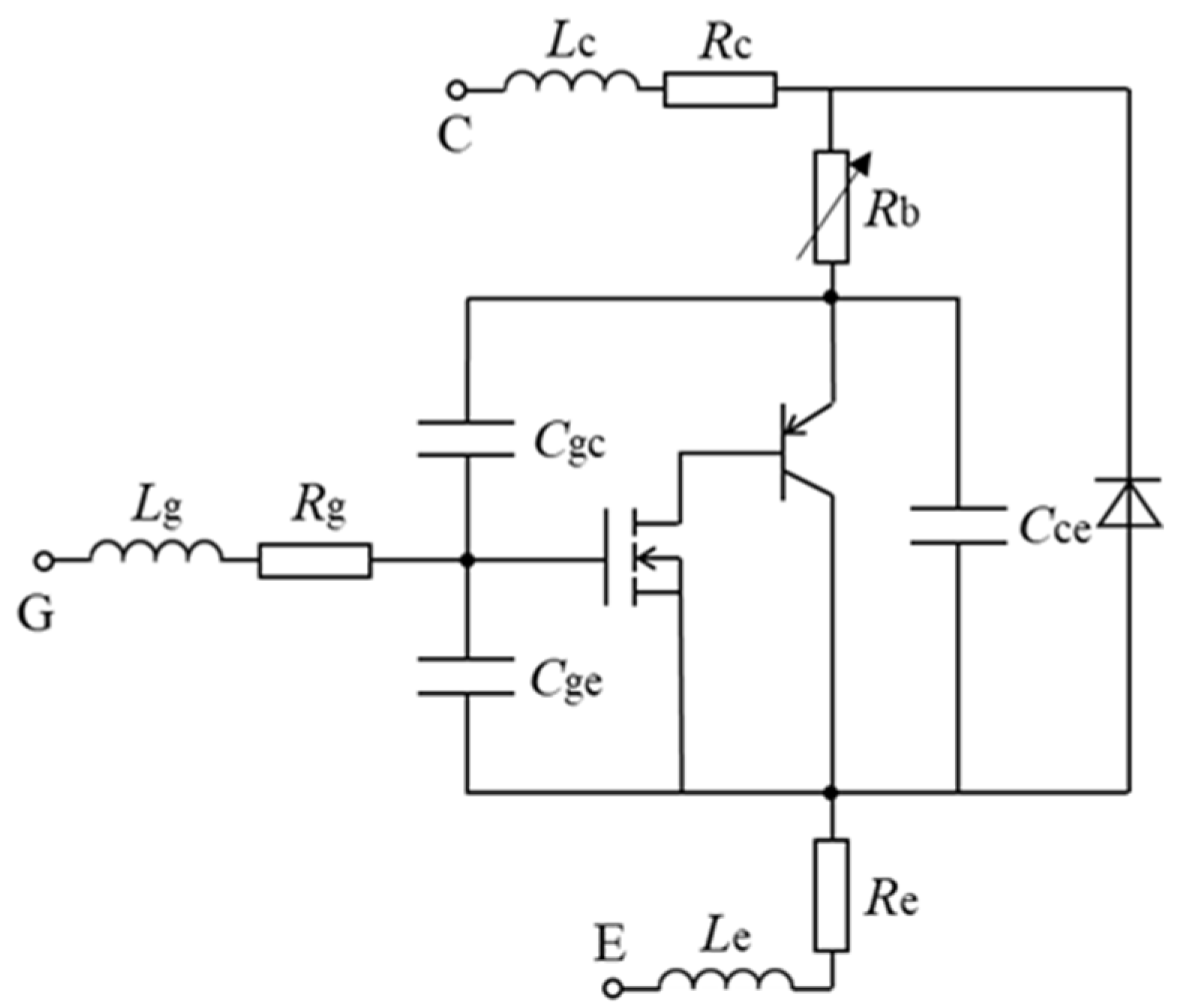
To precisely replicate the high-frequency electromagnetic oscillation characteristics during the IGBT switching transient, a 1200 V/100 A IGBT module (FF100R12KS4, Infineon, Neubiberg, Germany) was selected as the subject of study. While UHV VSC-HVDC valves typically use high-voltage press-pack IGBTs, the 1200 V module serves as a scaled-down platform to investigate the fundamental generation mechanism of switching EMI [6]. The physical principles of parasitic resonance and spectral evolution revealed here are qualitatively applicable to higher voltage devices. Based on the Saber IGBT Tool simulation environment, a physical behavioral-level model incorporating detailed parasitic parameters was constructed, as shown in Figure 1.
The core advantage of this model lies in its comprehensive integration of key parasitic parameters that determine high-frequency performance, which is essential for the accurate prediction of high-frequency EMI. As illustrated in Figure 1, the equivalent circuit not only introduces the non-linear resistor Rb characterizing the conductivity modulation effect in the N-drift region but also precisely quantifies three types of key parasitic parameters to reflect high-frequency dynamic behavior: first, the inter-electrode capacitances (Cgc, Cge, Cce), whose non-linear characteristics dominate the voltage change rate (dv/dt) and Miller plateau features; second, the stray inductances in the gate, collector, and emitter loops (Lg, Lc, Le), which are the primary physical causes of high-frequency ringing and voltage overshoot; and finally, the equivalent contact resistances of bonding wires and terminals (Rg, Rc, Re), which provide the necessary damping for high-frequency oscillations.
The accuracy of the model parameters is fundamental to ensuring simulation credibility. All key parameters in the model were extracted from the device datasheet and meticulously calibrated using curve-fitting algorithms, with specific values detailed in Table 1. It is particularly noteworthy that the values for reverse transfer capacitance Cres and output capacitance Coes in Table 1 show a significant decrease with increasing collector-emitter voltage Vce. This variation intuitively reflects the strong voltage-dependent non-linearity of junction capacitances. Accurately replicating this characteristic in the simulation is crucial for capturing transient details during the dynamic switching process.
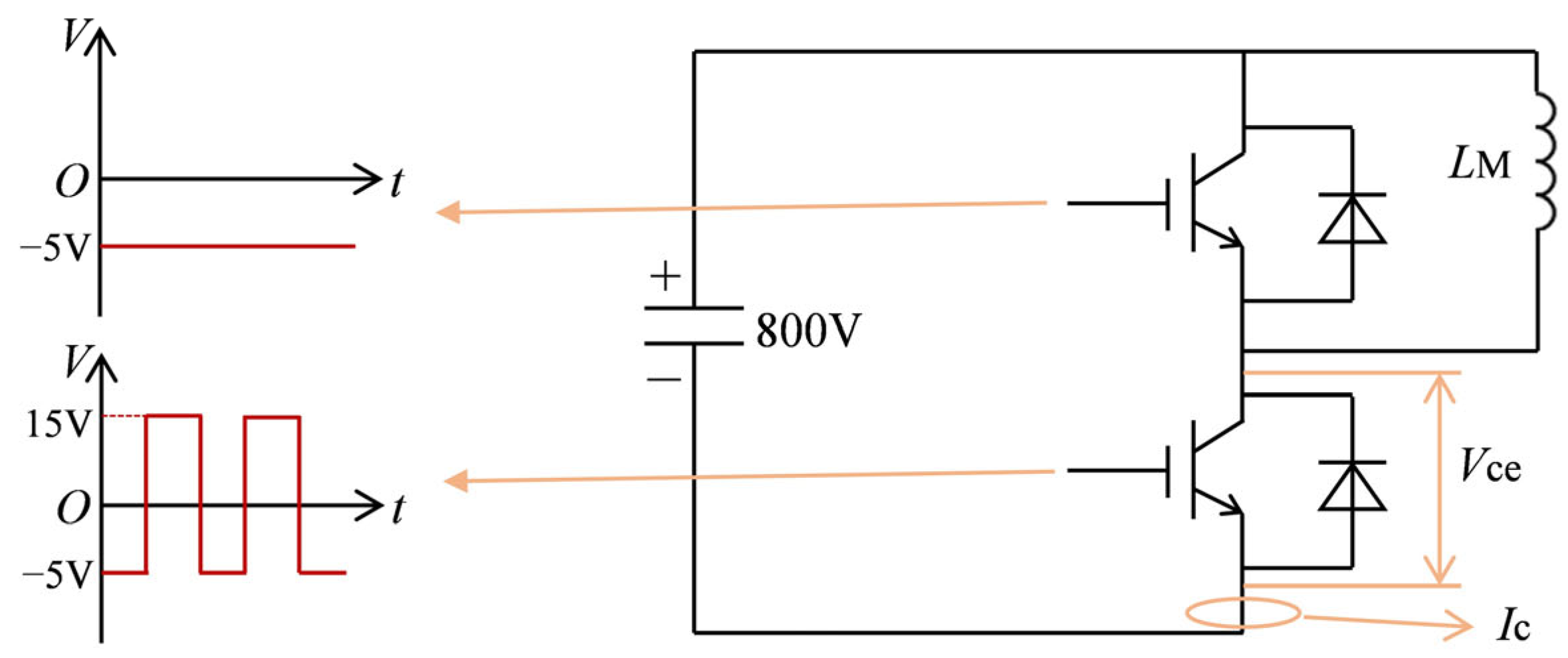
Furthermore, to simulate real converter operating conditions within the simulation environment, a standard Double-Pulse Test (DPT) circuit was constructed (Figure 2). By setting the clamp inductance LM to 250 µH and the DC bus voltage VDC to 800 V, this circuit can simulate the harsh electromagnetic environment under high-current turn-off conditions. This setup enables the model to accurately characterize the broadband interference characteristics driven by extremely high voltage and current change rates, providing a reliable data source for subsequent interference mechanism analysis and signal separation validation.

2.2. Experimental Platform for PD Detection Under High-Frequency Interference

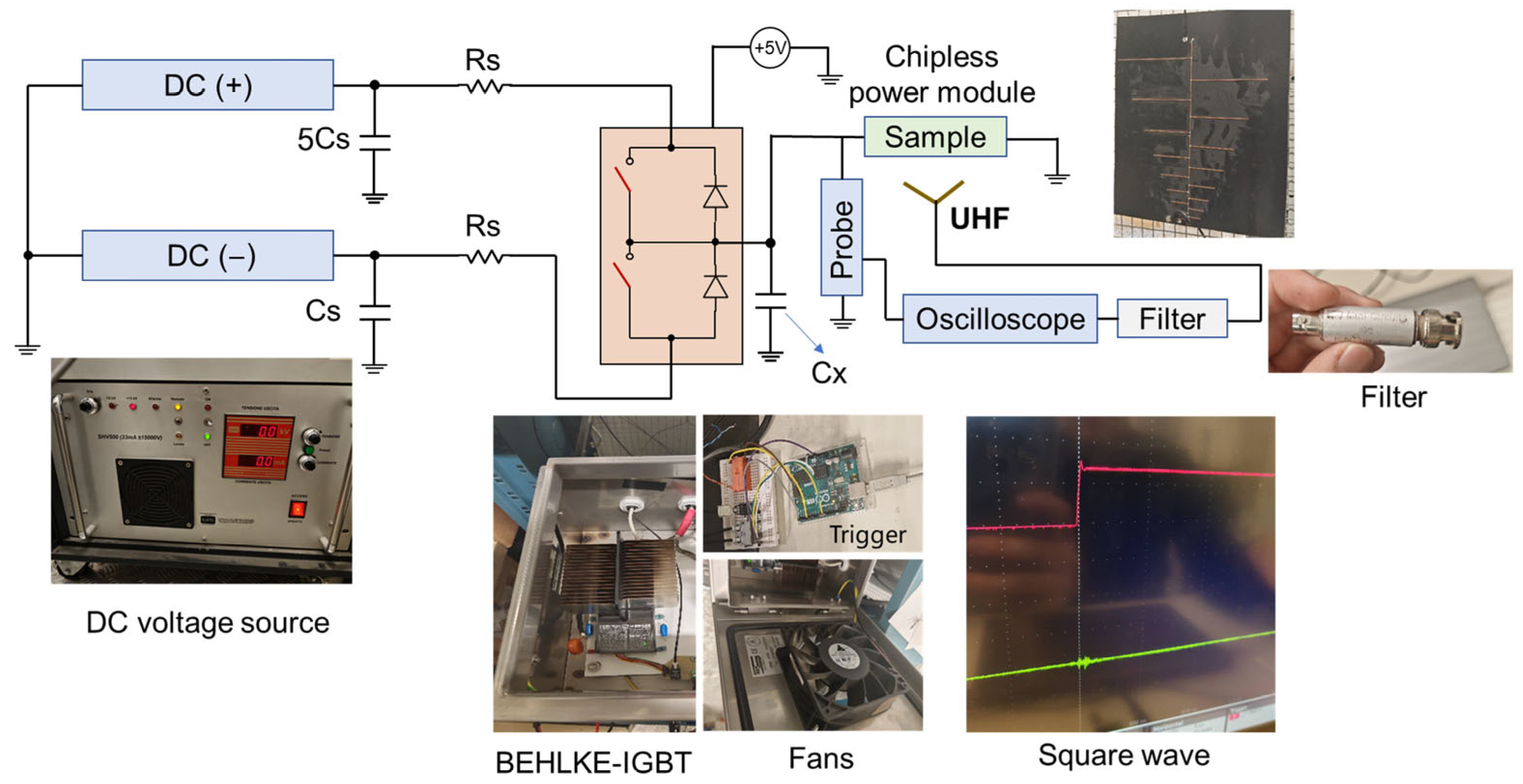
To study partial discharge characteristics in a realistic strong electromagnetic interference environment, a high-voltage pulse PD detection experimental platform was constructed, as shown in Figure 3. This platform consists of three core components: a high-voltage square wave generation unit, an insulation defect model, and an UHF signal acquisition system.
The high-voltage square wave generation unit utilizes a high-voltage half-bridge switch module (HTS-301-03-GSM, BEHLKE, Kronberg im Taunus, Germany) as the core excitation source. This module is composed of numerous IGBTs connected in series and parallel, capable of generating high-voltage square waves with extremely fast rise times (on the nanosecond scale), a maximum output voltage of 15 kV, and a maximum switching frequency of 2 kHz. This device was specifically chosen to precisely simulate the extreme high dv/dt shock environment generated by IGBT actions in VSC-HVDC converter valves, thereby replicating real operational stress.
To simulate a typical corona discharge defect caused by burrs at the edges of wound aluminum foil inside a bushing capacitive core, a needle-plane electrode model was employed. The needle electrode was made of wear-resistant tungsten steel with a tip curvature radius of 40 µm, accurately reproducing the highly non-uniform electric field distribution generated by microscopic burrs. A piece of insulating pressboard with a radius of 40 mm and a thickness of 2 mm was placed between the needle tip electrode and the grounded plane electrode. Stable partial discharge was induced by applying high voltage across the electrodes, serving as the target PD signal to be separated in the subsequent verification of the signal separation algorithm.
For signal acquisition, in accordance with the GB/T 23642-2017 standard [19], a broadband UHF antenna(Custom-designed, Shenzhen, China) was used as the sensor to detect the spatially radiated electromagnetic wave signals. To ensure the complete capture of nanosecond-scale PD pulses as well as the high-frequency oscillation details generated by IGBT switching, a high-bandwidth digital oscilloscope (Tektronix MSO64, Beaverton, OR, USA) was used for data acquisition, featuring a 1 GHz analog bandwidth and a sampling rate of up to 25 GS/s. Furthermore, to eliminate interference from external environmental noise on the weak PD signals, all experiments were conducted within an electromagnetic shielding chamber, guaranteeing the purity and reliability of the data.

3. Generation Mechanism of IGBT Switching-Induced Dynamic Interference and Spectral Evolution Characteristics Under Aging

The high-speed voltage (dv/dt) and current (di/dt) variations during IGBT switching generate intense EMI, which poses a significant challenge to the accurate online monitoring of PD in converter valves. This section conducts a fundamental analysis of the EMI generation mechanism, investigates its spectral characteristics through simulation and experiments, and explores the significant influence of different aging conditions on the interference spectrum. The findings provide a theoretical foundation for interference suppression and condition monitoring.

3.1. Generation Mechanism of EMI During IGBT Switching

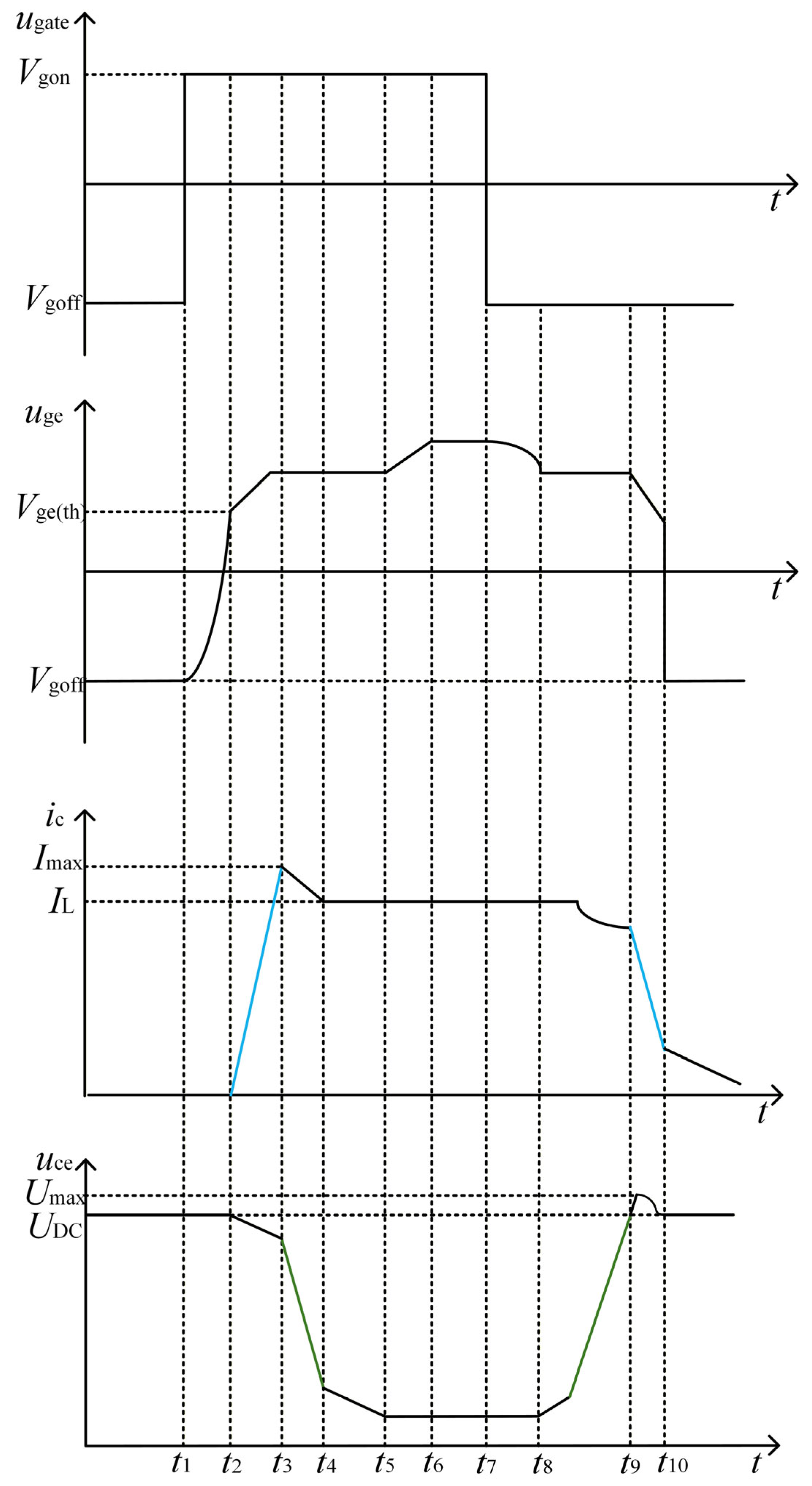
EMI is not generated uniformly throughout the entire switching cycle but is highly concentrated within specific transient stages lasting only nanoseconds to microseconds. The fundamental cause lies in the dynamic interaction between the non-linear charging/discharging of the internal parasitic capacitances of the IGBT and the external circuit’s parasitic inductances, which excites extremely high rates of voltage change (dv/dt) and current change (di/dt). Figure 4 illustrates the typical voltage and current waveforms during the switching process.
During the IGBT turn-on transient (t2t4), it first undergoes the current rise phase (t2t3). In this period, the gate drives current charges the input capacitances Cge and Cgc, while the collector current ic rapidly increases and reaches the maximum load current Imax (superimposed with the diode reverse recovery current). Simultaneously, the gate-emitter voltage Vge rises to the Miller plateau voltage. At this stage, the collector current ic and its rate of change can be expressed as:
i c = g m ( u ge V th )
d i c d t g m ( V gon V plateau ) R g ( C gc + C ge )
where gm is the transconductance, which reflects the gate control capability. The severe current change (high di/dt) during this phase induces a voltage drop across the parasitic inductances (Ls and Le) in the source and emitter paths, causing an initial drop in Vce and constituting the first high-frequency interference source.
In the subsequent Miller plateau and voltage fall phase (t3t4), the gate current primarily flows through the gate resistor Rg and the reverse transfer capacitance Cgc (Miller capacitance), keeping Vge at the plateau level while Vce decreases rapidly. The fall rate of Vce is determined by the gate drive current and the Miller capacitance:
d V ce d t V gon V plateau R g C gc
This extremely high dv/dt generates significant displacement current through the capacitive coupling of Cgc, forming another primary EMI excitation source during turn-on.
During the delay and voltage rise phase (t8t9), the IGBT operates in the saturation region. The extraction of charge from Cgc in the reverse direction initiates the rise in Vce. Notably, Cgc exhibits a non-linear dependence on Vce: it is relatively large when Vce is low and decreases rapidly as Vce increases, eventually stabilizing. This results in a “slow-then-fast” characteristic in the voltage rise slope. The rapid rise in Vce during this process is a key contributor to turn-off interference, and its slope can be expressed as:
d V ce d t = V plateau V goff R g C gc
This is followed by the current fall phase (t9t10). When Vce reaches the DC bus voltage, the freewheeling diode turns on, and ic is abruptly cut off. The extremely high di/dt at this moment induces a strong voltage spike across the loop parasitic inductances, causing significant voltage overshoot in Vce. This not only threatens device safety but also, due to its rich oscillation spectrum, becomes the strongest EMI source during the turn-off process. The current change rate can be approximated as:
d i c d t V plateau V goff R g ( C ies / g m ) + L e
Electromagnetic interference during IGBT switching is not uniformly generated but is highly concentrated in several key transient stages. The core physical processes producing high-frequency interference are the current rise (t2t3) and voltage fall (t3t4) during turn-on, and the voltage rise (t8t9) and current fall (t9t10) during turn-off.
Based on the analysis of the above physical processes, the key factors influencing EMI characteristics primarily include the gate resistance, parasitic parameters, and drive characteristics. The gate resistance Rg is central to controlling the switching speed. Increasing Rg slows down the rate of change in Vge, thereby reducing di/dt and dv/dt, which effectively suppresses EMI at the cost of increased switching losses. The parasitic inductance Le is the physical cause of voltage overshoot and high-frequency oscillations; the voltage spikes induced by rapid current changes across it are a significant source of radiated EMI. The parasitic capacitances Cgc and Cge directly determine the voltage change rates. Larger capacitances lead to slower changes; therefore, selecting devices with low parasitic capacitance or employing active Miller clamp techniques can help improve EMI performance. Furthermore, the magnitude of the gate drive current Ig and the characteristics of the diode reverse recovery also significantly modulate the EMI spectral distribution by influencing the peak current and its rate of change.

3.2. Simulation Analysis and Experimental Validation of High-Frequency Interference Spectrum During IGBT Switching

To quantitatively investigate the characteristics of high-frequency interference generated during IGBT switching, this section performs frequency-domain simulation analysis on the EMI spectrum of turn-on and turn-off transients using the high-fidelity physical model established in Section 2.1. The accuracy of the model is validated through experimental measurements. This analysis aims to clarify the frequency-domain distribution of interference energy, providing a quantitative spectral basis for the subsequent design of anti-interference separation algorithms.

3.2.1. Simulated Spectral Characteristics Analysis

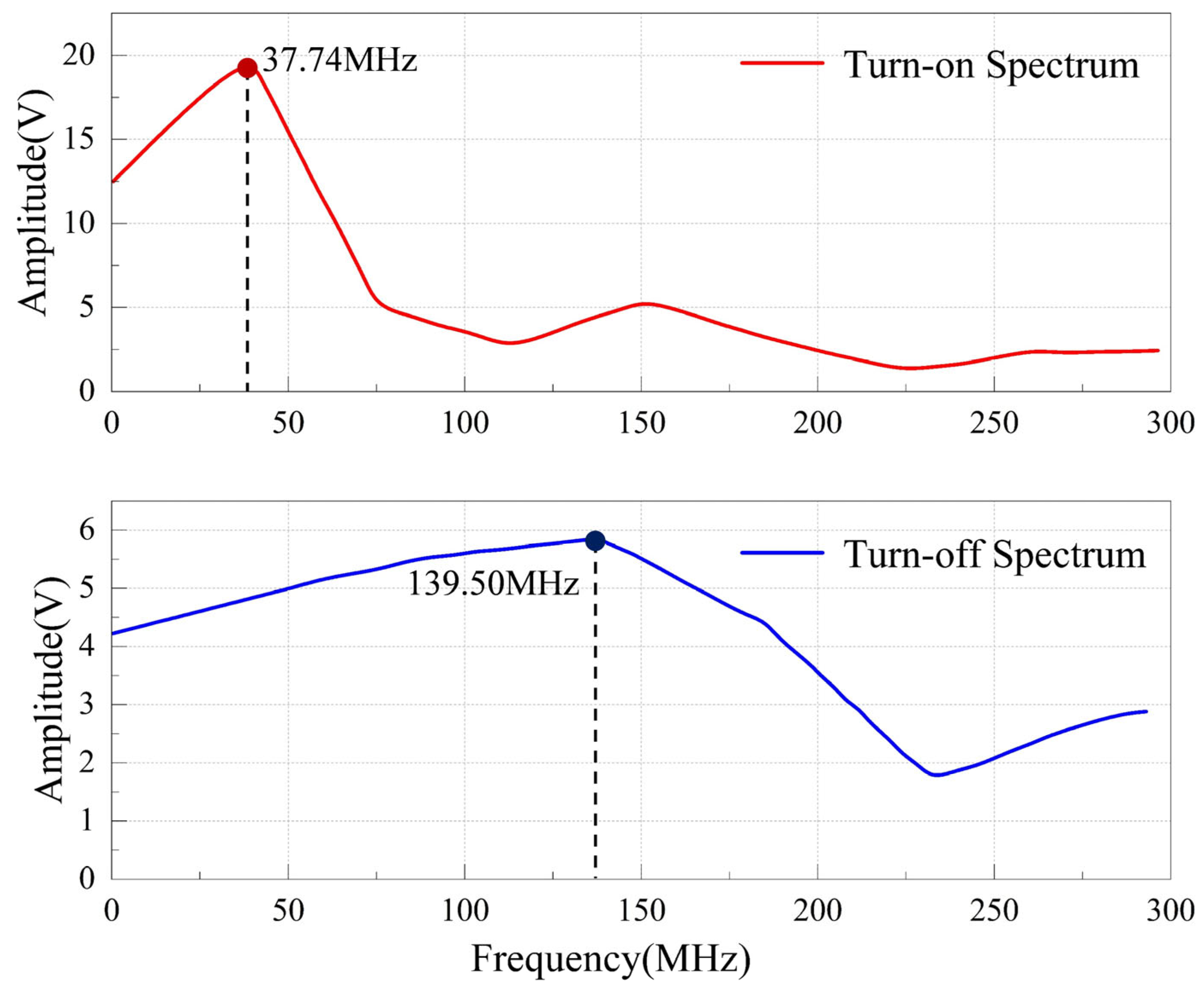
The simulated frequency spectra of the high-frequency interference generated during IGBT turn-on and turn-off are shown in Figure 5. Analysis of Figure 5 reveals that the interference energy is primarily concentrated within the frequency band from 37 MHz to 170 MHz. This band overlaps with the typical frequency range of PD signals inside VSC-HVDC systems. Consequently, such broadband EMI can severely mask weak PD signals, posing a critical challenge to PD online monitoring based on the UHF method.
The simulated spectrum exhibits significant resonant characteristics, with distinct differences in the peak frequencies between the turn-on and turn-off transients: the interference energy peaks at 37.74 MHz during turn-on, whereas the peak frequency occurs at a higher 139.5 MHz during turn-off. This phenomenon directly corresponds to different dominant resonant circuits excited during the switching processes. Combined with the analysis in Section 3.1, the characteristic frequency of each resonant circuit is determined by its inherent parasitic parameters, following the relationship: f 0 = 1 / 2 π L C .
Specifically, the lower-frequency resonance (37.74 MHz) during turn-on is governed by a circuit formed by the stray inductance in the main power loop (Ls, primarily consisting of busbar and lead inductances) and the collector–emitter parasitic capacitance (Cce) of the IGBT. During the current rise stage, the extremely high di/dt generates voltage spikes across this parasitic inductance, thereby exciting this LC resonance. In contrast, the higher-frequency resonance (139.5 MHz) during turn-off is governed more by a circuit involving the internal package inductance (Le) and the Miller capacitance (Cgc). During the voltage rise stage, the extremely high dv/dt produces a substantial displacement current through Cgc, exciting the higher-frequency resonance.
Therefore, the observed peak frequencies accurately reflect the dominant resonant circuits, characterized by different parasitic parameters, excited by distinct physical processes (high di/dt and high dv/dt) during IGBT turn-on and turn-off. The di/dt and dv/dt of the switching transients determine the excitation strength and EMI amplitude, while the inherent LC parasitic parameters of the circuits determine the resonant frequency.

3.2.2. Experimental Validation and Discussion

To empirically validate the aforementioned simulation analysis, IGBT switching experiments were conducted using the partial discharge detection platform illustrated in Figure 3. A needle-plane electrode configuration was employed to establish a highly non-uniform electric field and induce stable PD signals. A high-bandwidth UHF antenna captured the radiated electromagnetic field. The separation algorithm described in Chapter 4 was then effectively applied to isolate and extract the pure switching EMI component from the mixed signals containing PD pulses from the needle-plane electrode, switching EMI, and background noise for analysis.
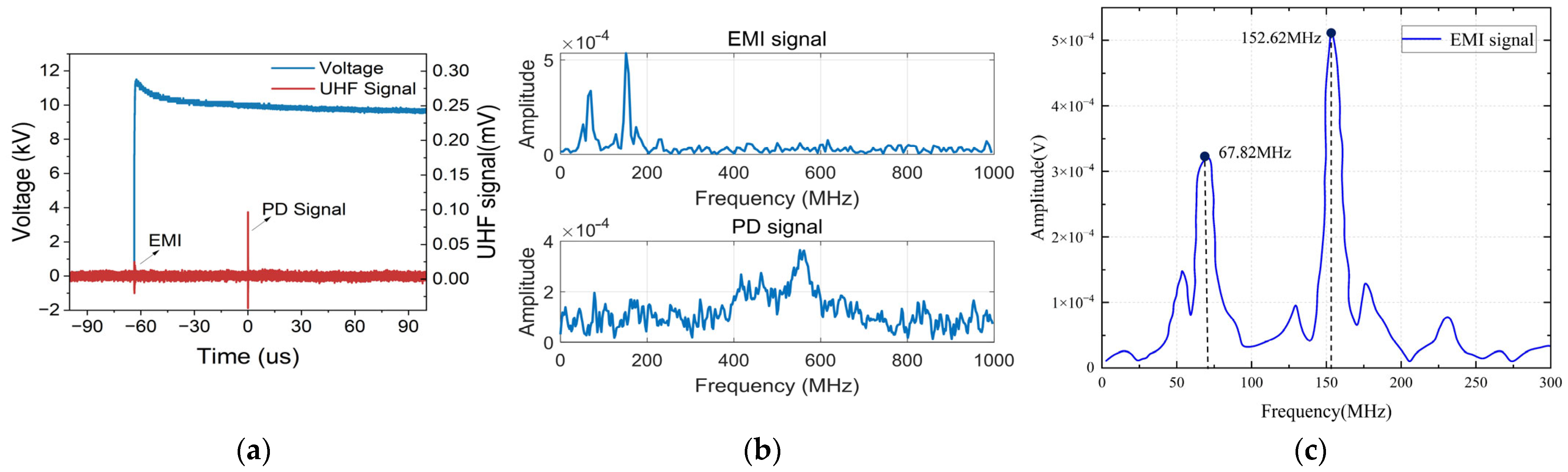
The key experimentally measured waveforms and their joint time-frequency analysis results are shown in Figure 6. Figure 6a synchronously displays the collector-emitter voltage (Vce) transient during switching and the raw UHF sensor signal. It can be observed that following the rapid change in Vce (high dv/dt), both EMI and PD information are generated, with their occurrences closely spaced in time. Figure 6b provides a frequency-domain analysis of this interference, where it is clearly visible that the switching EMI forms a broadband “energy ridge” with high amplitude and short duration after the switching instant. In stark contrast, the genuine PD signals from the needle-plane electrode appear as only weakly energetic and discretely distributed points in the time-frequency domain.
Comparing Figure 6b with the simulation results in Figure 5 reveals that the experimentally measured switching EMI spectrum primarily covers 30 MHz to 180 MHz, which aligns well with the simulated core band of 37–170 MHz. This outcome not only validates the accuracy of the simulation model in predicting the main spectral distribution of the interference but, more importantly, it confirms that IGBT switching interference, as a powerful broadband noise, severely overlaps in frequency with the typical band (also generally within the UHF range) of PD signals from the needle-plane electrode. This experimentally underscores the necessity and challenge of performing effective signal separation.
As shown in Table 2, the simulation and experimental results show good agreement in terms of the core frequency band range and the dual-peak resonant feature. The experiment clearly reproduced the pattern of a “low-frequency peak during turn-on and a high-frequency peak during turn-off,” validating the correctness of the simulation model’s prediction regarding the resonance mechanism. The minor shifts observed in the peak frequencies (e.g., the turn-on peak shifting from 37.74 MHz to approximately 50 MHz) are primarily attributable to the fact that stray capacitances and inductances from PCB traces and connectors in the actual experimental setup cannot be modeled with 100% precision in the simulation. However, these deviations fall within acceptable engineering margins and do not affect the qualitative conclusions regarding the core interference band and its generation mechanism.

3.3. Modulation Characteristics of IGBT High-Frequency Interference Spectrum Under Different Operating Conditions

Throughout the lifecycle operation of VSC-HVDC transmission systems, the spectral characteristics of IGBT EMI are not static but are dynamically governed by the physical state of the device. After enduring long-term thermal cycling and electrical stress, irreversible degradation occurs in the internal packaging structure and chip properties of IGBTs, leading to drift in their parasitic parameters (L, C, R). This parameter drift reshapes the voltage and current trajectories during switching, consequently producing a significant and characteristic “modulation effect” on the high-frequency interference spectrum.
This section focuses on two of the most typical failure modes—bond wire aging and gate oxide layer degradation—systematically revealing the evolution patterns of interference spectra induced by different aging mechanisms.

3.3.1. Bond Wire Aging

Bond wires serve as the primary power path connecting the chip to external terminals. Under thermomechanical stress, when one or more wires among multiple parallel wires lift off or make poor contact with the chip surface (warping), the effective total cross-sectional area of the current path drastically decreases [20]. According to parallel circuit principles, if m out of n bond wires fracture, the equivalent resistance and inductance of that path change from the initial R/n, L/n to R/(nm), L/(nm). This implies that bond wire aging macroscopically manifests as a simultaneous increase in the loop resistance Ron and parasitic inductance Lσ. Since the gate, collector, and emitter bond wires serve different functions in the circuit, their aging effects on the spectrum exhibit significant differences.
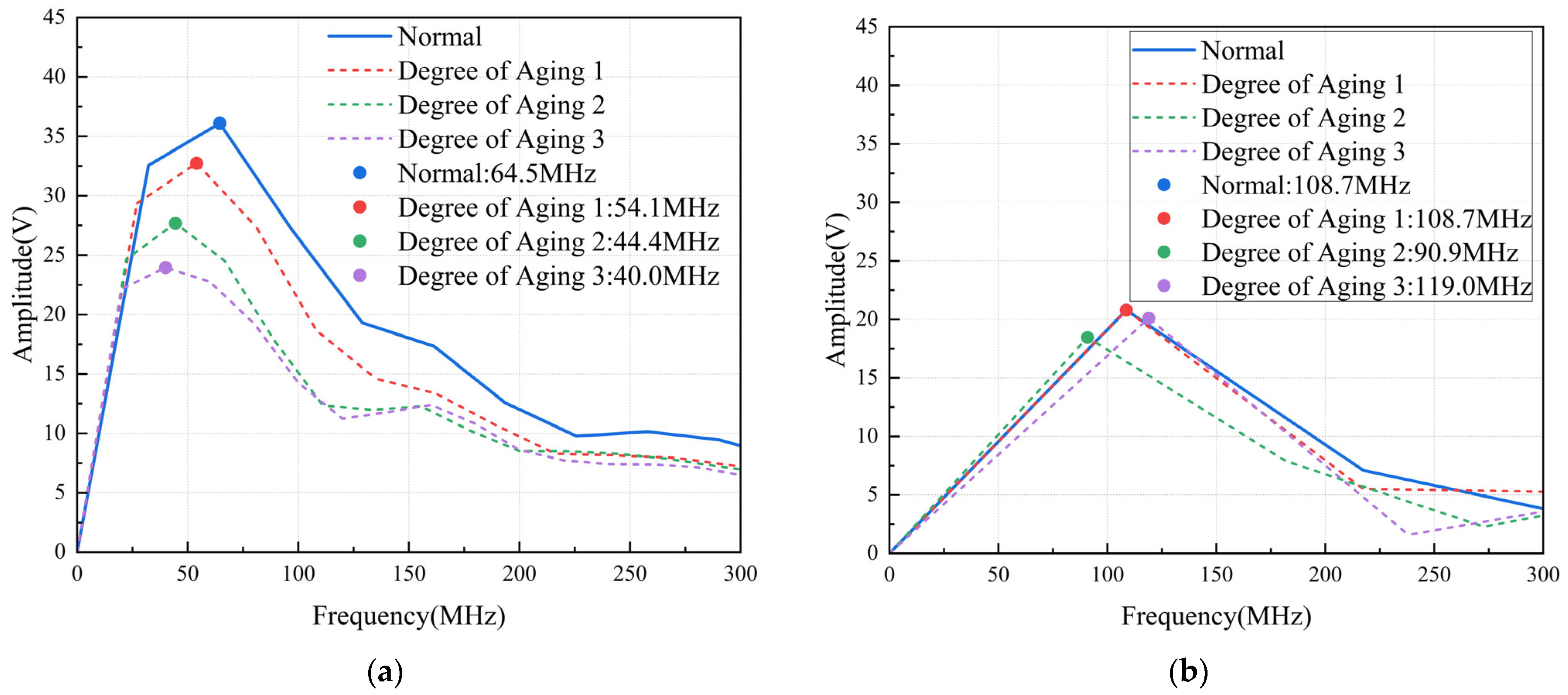
When gate bond wires age, their impact on the turn-on and turn-off spectra is markedly different. Figure 7 shows the measured spectra for turn-on and turn-off under varying degrees of gate bond wire aging.
In Figure 7a, the turn-on interference spectrum shows a highly consistent monotonic attenuation trend with increasing aging. The peak frequency shifts from the initial 64.5 MHz towards lower frequencies to 45.5 MHz, accompanied by a continuous decrease in amplitude. This phenomenon is attributed to the increase in gate loop resistance Rg, which significantly enhances the damping ratio of the RLC oscillatory circuit. The increased damping effect not only dissipates resonant energy but also lowers the system’s natural oscillation frequency. In Figure 7b, the evolution of the turn-off spectrum exhibits complex non-monotonic characteristics. The peak frequency initially increases from 108.7 MHz (healthy state) to 113.6 MHz (aging state 1), then drops sharply to 82.0 MHz at aging state 2, before recovering to 102.0 MHz at state 3. This complexity arises from the interaction between the Miller-effect-dominated switching dynamics and the changing parasitic parameters. The EMI deterioration at aging state 1 may be caused by a specific combination of slightly altered parasitic inductance and resistance, exacerbating gate ringing during the Miller plateau. The subsequent spectral suppression (state 2) is primarily dominated by the damping effect from the significantly increased parasitic resistance. The frequency recovery observed in the final aging state 3 likely indicates that severe structural damage, such as multiple bond wire fractures, leads to substantial changes in the equivalent parasitic inductance, thereby altering the system’s final resonant state once more.
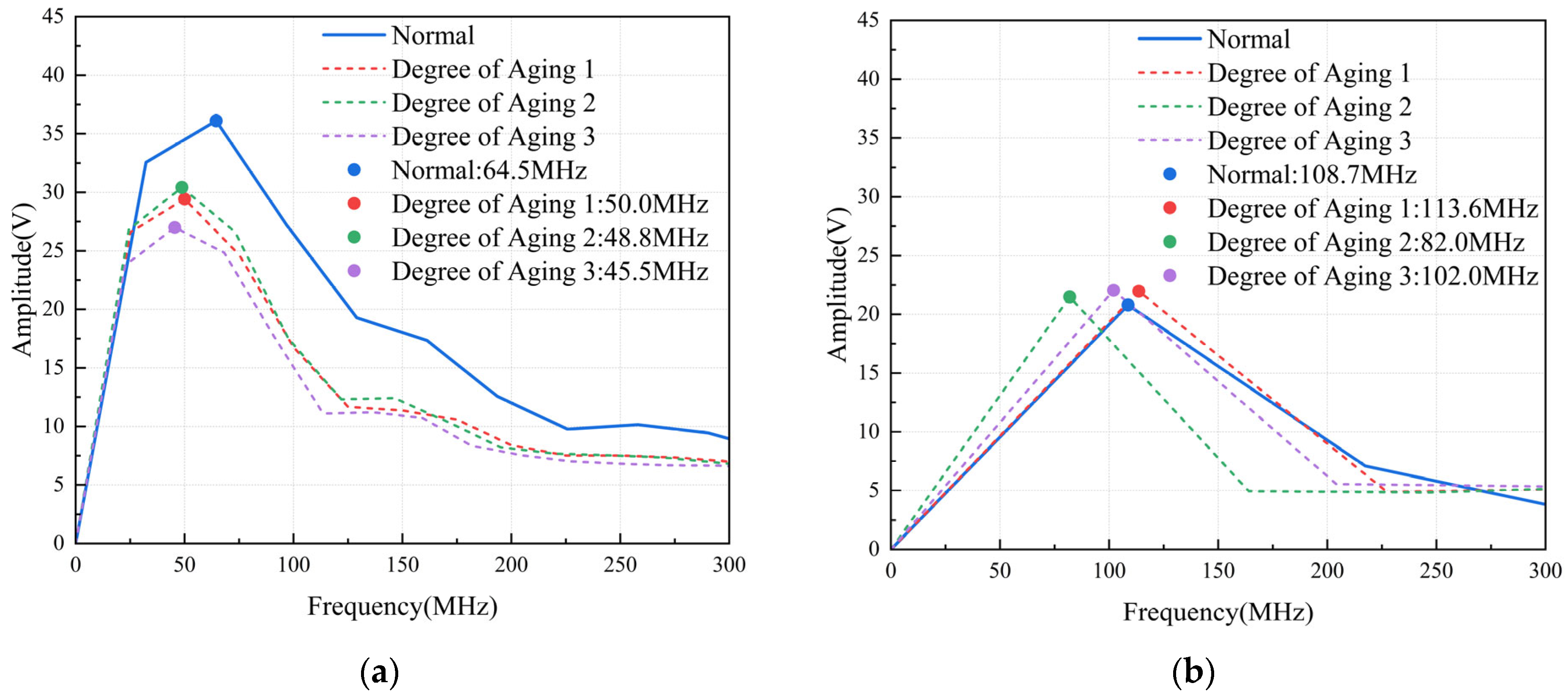
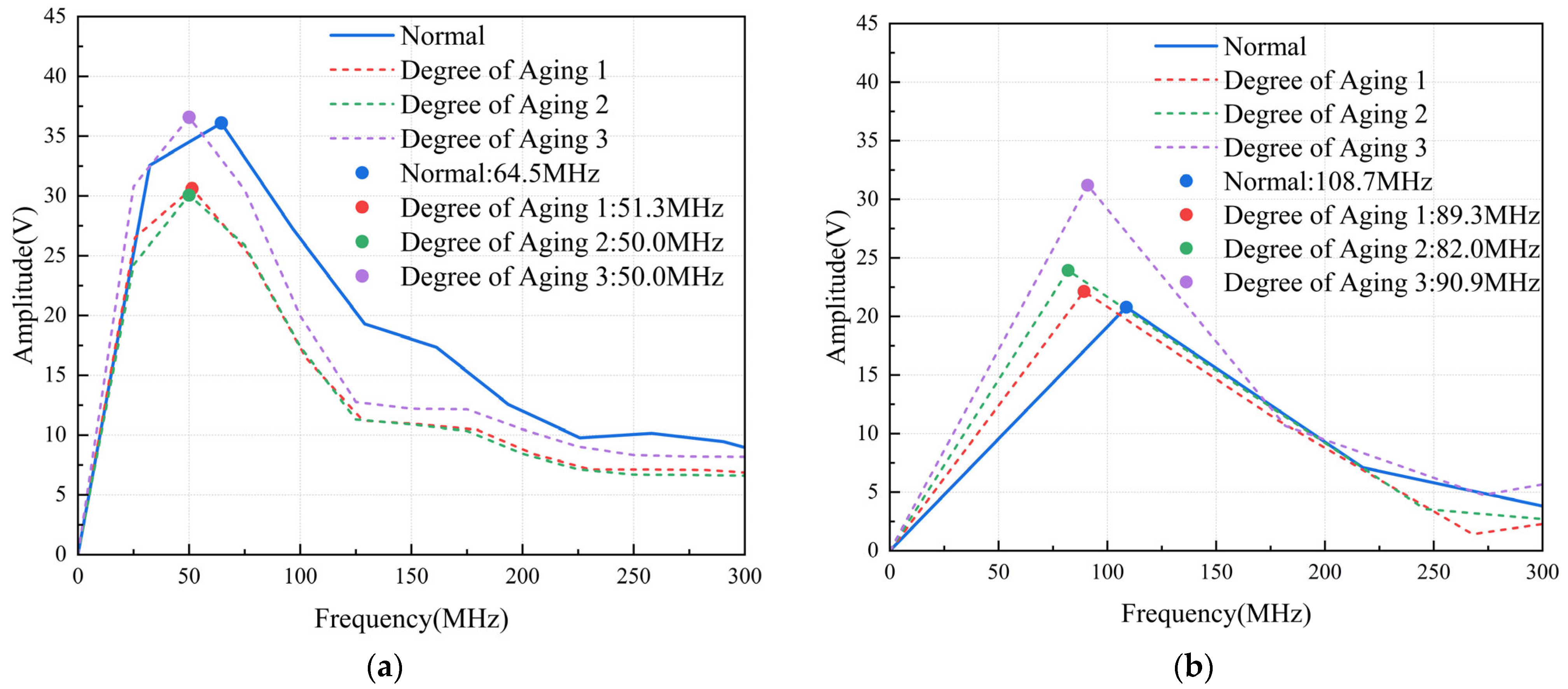
As the main power current path, collector bond wire aging is particularly critical for fault warning. Figure 8 shows the measured spectra for turn-on and turn-off under varying degrees of collector bond wire aging.
In Figure 8a, collector bond wire aging induces a “spectrum compression” phenomenon during turn-on. The peak frequency decreases significantly from the initial 64.5 MHz to approximately 50.0 MHz (aging states 2 and 3) and stabilizes, indicating a fundamental change in the structural stiffness of the main resonant circuit due to aging. Unlike the mechanism of gate aging (where increased resistance leads to enhanced damping), collector bond wires are part of the main power path. Their aging directly causes a significant increase in the equivalent parasitic inductance. This inductance, together with the module’s parasitic capacitance, forms a new resonant circuit whose natural frequency decreases accordingly. Regarding amplitude, aging state 2 shows the lowest amplitude, possibly corresponding to a critical damping state where the equivalent series resistance introduced by aging reaches an optimal damping point, effectively suppressing oscillations. The amplitude recovery in aging state 3 may imply that severe aging increases the inductance enough to alter the distributed parameters of the current path, forming a new, poorly damped resonant path.
In Figure 8b, the peak frequency overall shifts towards lower frequencies, again primarily due to the dominant effect of increased parasitic inductance in the collector loop. However, the most critical indicator appears in aging state 3, where the peak amplitude surges sharply, significantly exceeding that of the healthy state. This phenomenon is closely related to the physics of the turn-off process. During turn-off, the device withstands high voltage and large current. The enormous di/dt across the significantly increased collector parasitic inductance induces extremely high voltage spikes (V = L × di/dt). This overvoltage not only directly causes the EMI amplitude to soar but also poses a serious threat to the long-term reliability of the device. Therefore, an abnormal increase in peak amplitude in the turn-off spectrum is a clear signature that collector bond wires have entered a state of severe aging or are approaching failure.
The emitter bond wire, belonging to both the power loop and the gate drive loop (as common source inductance), exhibits unique coupled aging effects. Figure 9 shows the measured spectra for turn-on and turn-off under varying degrees of emitter bond wire aging.
During the turn-on process, the spectral characteristics exhibit a clear monotonic trend: as aging progresses from State 1 to State 3, the peak frequency continuously shifts from the initial 64.5 MHz toward lower frequencies, reaching 40.0 MHz, accompanied by a systematic attenuation of the peak amplitude. This evolutionary pattern in spectral characteristics can be attributed to the unique role of the emitter as a common return path—aging of its bond wires simultaneously alters the parasitic parameters of both the power loop and the gate loop. Specifically, the increase in parasitic inductance leads to a reduction in resonant frequency, while the increase in parasitic resistance enhances the damping effect of the loop. Together, these changes result in a redistribution and overall suppression of turn-on interference energy.
During the turn-off process, the spectral evolution demonstrates a typical “three-stage” pattern: spectral characteristics remain stable in the early aging stage; a damping-dominated stage emerges in the mid-term aging phase, characterized by frequency reduction and amplitude suppression; and in the severe aging stage, a distinct “high-frequency recurrence” phenomenon appears, featuring a reverse jump in peak frequency to 119.0 MHz, accompanied by a significant increase in peak amplitude and sustained high-frequency interference. This unique spectral evolution pattern stems from fundamental structural changes in the bond wires under severe aging conditions—the narrowing of the current path leads to abrupt changes in local inductance characteristics, potentially exciting new high-frequency resonant modes. Additionally, nonlinear discharges at poor contact points further exacerbate electromagnetic radiation in the high-frequency band.
In the study of electromagnetic interference spectra under bond wire aging in power modules, the gate, collector, and emitter bond wires each exhibit distinct fault signature spectra. Gate bond wire aging primarily affects the drive loop, with the turn-on process showing a controlled damping characteristic where peak frequency and amplitude decrease synergistically. In contrast, the turn-off process exhibits significant non-monotonic evolution due to the complex interaction between the Miller effect and varying parasitic parameters. Collector bond wire aging, as the main power path, causes a systematic low-frequency shift in the peak frequency during turn-on and, in the severe aging stage, presents a typical feature of abnormal peak amplitude surge during turn-off. This directly reflects the risk state of turn-off overvoltage. In comparison, leveraging its unique role as a common return path, emitter bond wire aging demonstrates a systematic suppression phenomenon during turn-on, characterized by synchronous monotonic decreases in peak frequency and amplitude. During turn-off, it displays a distinctive “three-stage” evolution pattern, particularly exhibiting the exclusive “high-frequency recurrence” feature in the severe aging stage, where the peak frequency reverses and jumps upward while high-frequency interference is persistently maintained.

3.3.2. Gate Oxide Layer Degradation

Unlike bond wire aging, which alters “external” structural parameters, gate oxide layer degradation represents a decline in the intrinsic performance of the chip’s “internal” structure. The physical manifestation involves threshold voltage drift and an increase in equivalent gate resistance due to charge trapping at interface states. To simulate this degradation in the model, the equivalent gate resistance was progressively increased.
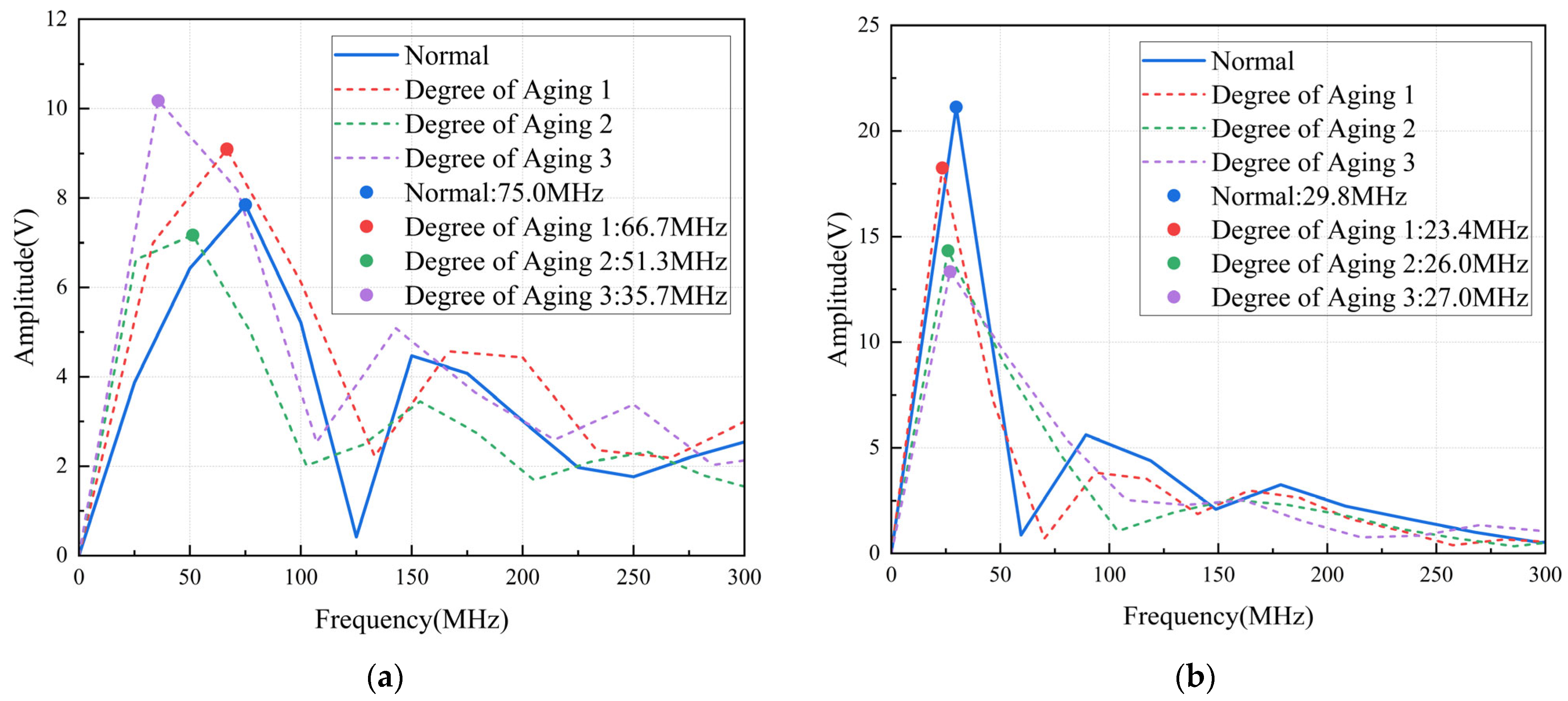
The measured frequency spectra for turn-on and turn-off under different degrees of gate oxide layer degradation are shown in Figure 10.
Analysis of the switching interference spectra during gate oxide degradation reveals that its failure mode is fundamentally distinct from bond wire aging in both physical mechanism and manifestation, exhibiting a characteristic “global spectrum attenuation.” Specifically, during the turn-on process (Figure 10a), as degradation progresses from State 1 to State 3, the peak frequency shifts continuously from 75.0 MHz to 35.7 MHz—a migration exceeding 50%—while simultaneously experiencing systematic attenuation in peak amplitude. This attenuation characteristic is even more pronounced during the turn-off process (Figure 10b): although the peak frequency fluctuates only slightly within the range of 23.4–27.0 MHz, the peak amplitude shows a sharp declining trend, and the entire spectrum in the high-frequency region (>150 MHz) collapses to near the noise floor level.
This unique “dual-process consistent attenuation” phenomenon stems from fundamentally different physical mechanisms. The essence of bond wire aging lies in the alteration of interconnection structural parasitic parameters (L, R), which reshape the EMI spectrum distribution by modifying the impedance characteristics of the resonant network. This may lead to interference enhancement at specific frequencies or the emergence of new resonant modes. In contrast, gate oxide degradation represents a decline in the device’s intrinsic performance, primarily manifested as deterioration in gate dielectric insulation properties and channel mobility. This directly results in reduced charge transport efficiency during switching, thereby systematically suppressing the rates of current and voltage change (di/dt and dv/dt). From a spectral energy perspective, the former involves a redistribution of energy, whereas the latter signifies a global attenuation of the energy source. This fundamental difference causes gate oxide degradation to exhibit a “frequency pulling effect” on the peak and comprehensive amplitude suppression in the spectrum, rather than the spectral reconstruction phenomenon characteristic of bond wire aging.

4. Adaptive IGBT Interference and Partial Discharge Signal Separation Method Based on Feature Optimization of Cumulative Energy Function

In modern power-electronized power systems, IGBT high-frequency switching interference and PD signals exhibit severe overlap in both the time and frequency domains. Traditional separation methods based on fixed frequencies or simple time-frequency thresholds struggle with complex field operating conditions, especially when device aging causes interference spectrum drift. However, an essential distinction exists in their Energy Accumulation Processes (EAP): IGBT interference manifests as controlled, multi-oscillatory energy release, while PD is a sudden, single-pulse energy release caused by dielectric breakdown. Leveraging this fundamental physical difference, this chapter proposes a feature extraction method based on the time-frequency domain Cumulative Energy Function (CEF), followed by constructing a high-dimensional feature fingerprint through an adaptive optimization algorithm to achieve high-precision signal separation under strong interference.

4.1. Discharge Separation Algorithm Process

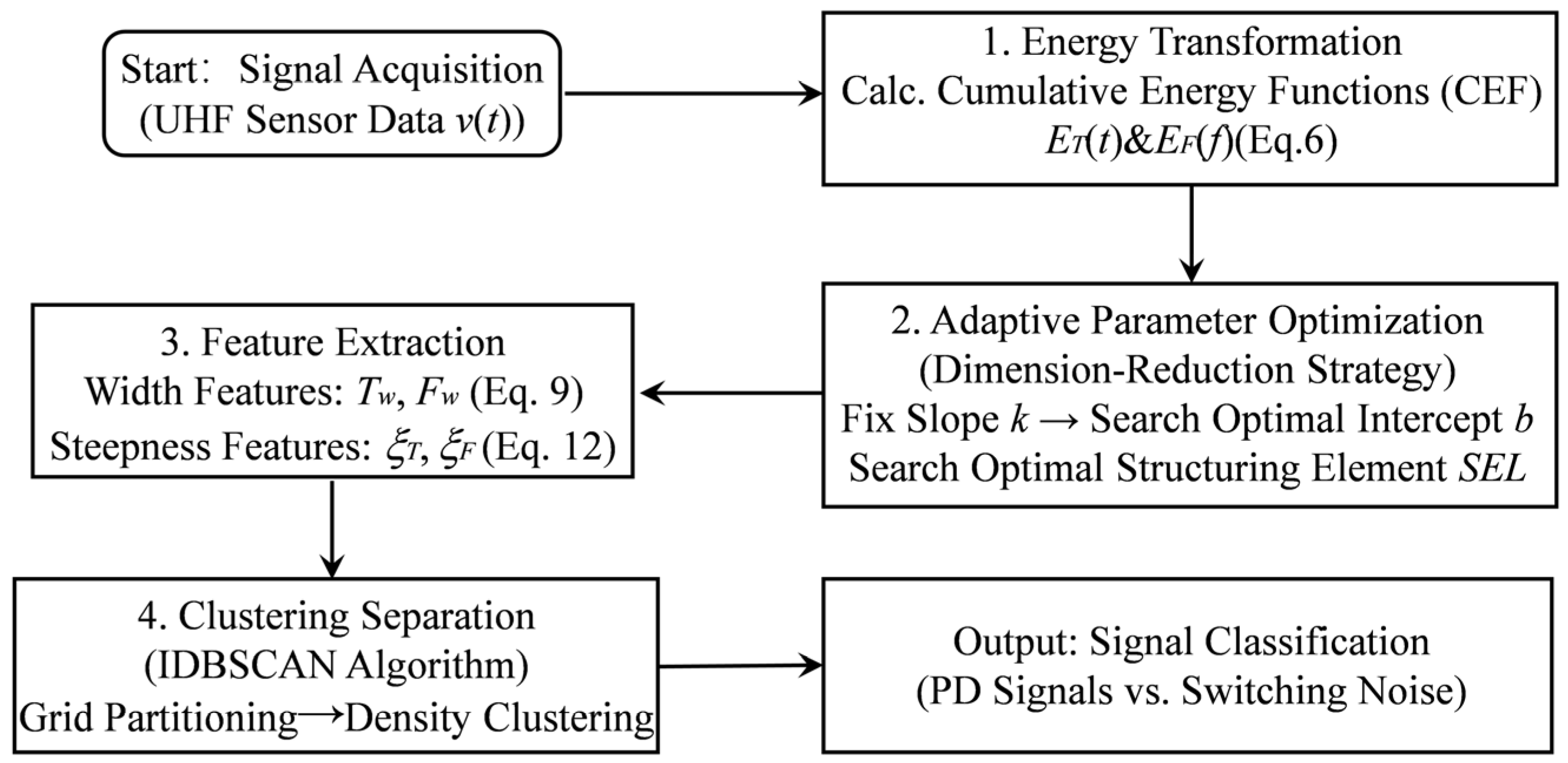
To intuitively demonstrate the complete implementation pipeline of the proposed adaptive separation method, the overall algorithmic framework is illustrated in Figure 11.
  • Time-Frequency Domain Cumulative Energy Function
Assuming the waveform of a single PD UHF signal is v(ti), where i = 1, 2, …, N and N is the number of sampling points, the time-domain and frequency-domain cumulative energy functions, ET(tk) and EF(fk), are calculated as follows:
E T ( t k ) = i = 1 k v ( t i ) 2 / i = 1 N v ( t i ) 2 100                         k = 1 , , N E F f k = i = 1 k F ( f i ) 2 / i = 1 N / 2 F ( f i ) 2 100                         k = 1 , , N / 2
where F(fi) is the spectrum obtained via Fast Fourier Transform (FFT) of v(ti). ET(tk) represents the cumulative energy up to time tk, and EF(fk) represents the cumulative energy up to frequency fk. To eliminate the influence of signal amplitude, both CEFs are normalized by their respective total cumulative energy.
Due to factors like the stochastic nature of PD, the trigger timing varies across captured pulses, causing their positions within the data sample to differ. Since the extracted feature parameters are position-dependent, time compensation is applied: the first sampling point where ET > 20 is defined as the signal start time ts, which is then shifted to time zero for the compensated signal:
t k = t i t s
where ti is the original time sequence and tk is the compensated time sequence.
2.
Width Feature Parameter
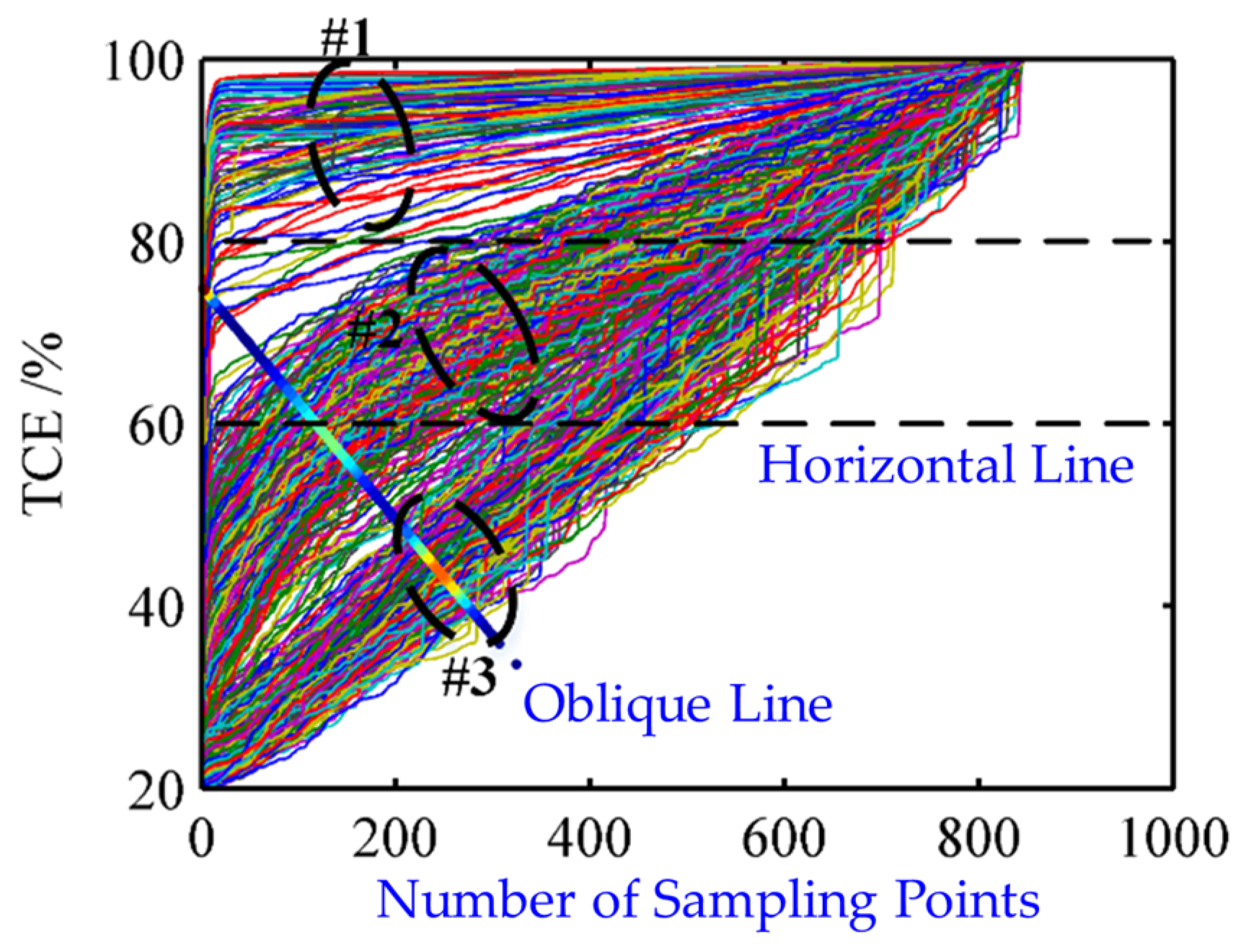
Figure 12 shows the time-domain CEF (ET) for a PD signal measured from a needle tip on an insulation sample. The ET contains three clusters of curves. Initially, the width parameter was defined as T = t|ET=80t|ET=20, i.e., using a horizontal line to intercept the ET curve. As seen in Figure 12, using a horizontal line leads to inseparable clusters: clusters #2 and #3 cannot be separated by the line ET = 80, while clusters #1 and #2 cannot be reliably separated by ET = 60. Observation of multiple mixed-signal ET curves from different experimental subjects revealed that using a properly chosen negatively sloped line to intercept the ET curve generally yields satisfactory separation, with the intersection points serving as effective separation variables, as illustrated by the negatively sloped line in Figure 12.
Let the intersection points between the sloped line and ET be (τi, Ii), where i = 1, 2, …, M and M is the number of captured signals. Since ET data are discrete sampled points, (τi, Ii) is defined as the intersection point between the line formed by the two ET sample points on either side of the sloped line and the sloped line itself. Assuming the sloped line has slope A and intercept b, and the adjacent sample points are (tk, Ek) and (tk+1, Ek+1), the intersection point is calculated as:
τ i = E k E k E k + 1 t k t k + 1 × t k b / A E k E k + 1 t k t k + 1 I i = A × τ i + b
where (τi, Ii) represents the intersection point between the ET curve of the i-th signal and the sloped line, while (tk, Ek) and (tk+1, Ek+1) correspond to the two nearest sampling points to the sloped line, which can be determined by calculating the minimum distance to the line.
Since τi and Ii from Equation (8) are linearly correlated, a coordinate rotation can convert them into a one-dimensional width feature parameter Tw,i:
θ = tan 1 A T w , i = τ i i τ i / M cos θ I i i I i / M sin θ + i τ i / M
where θ is the rotation angle, and i τ i / M , i I i / M is the centroid of all intersection points, set as the center of rotation.
Similarly, the width feature parameter Fw,i can be extracted from the frequency-domain CEF (EF), forming a two-dimensional feature vector (Tw,i, Fw,i) with Tw,i. As implied, the values of these width parameters depend on the chosen sloped line. Therefore, optimizing the slope and intercept of the line is necessary to enhance feature separability.
3.
Steepness Feature Parameter
The energy rise steepness of the signal constitutes the second set of feature parameters, characterized using the Mathematical Morphology Gradient. Mathematical morphology is an image and signal analysis method that collects signal information through operations between a structuring element and the signal, serving purposes like feature extraction and noise suppression. The fundamental operations are dilation and erosion. For a cumulative energy function E, its dilation E g and erosion E Θ g by a structuring element g are defined as:
E g ( n ) = max E n m + g m n m D E , m D g E Θ g ( n ) = min E n + m g m n + m D E , m D g
where DE and Dg are the domains of E and g, respectively. The domains for the time-domain and frequency-domain CEFs are {1, 2, …, N} and {1, 2, …, N/2}, respectively. Experiments showed that a flat structuring element yields optimal separation. Its domain is {−SEL/2, …, 0, …, SEL/2}, where SEL is the length of the structuring element.
The Mathematical Morphology Gradient characterizes the signal’s change steepness and is widely used for edge detection. It is calculated as:
m g n = E g n E Θ g n
The steepness parameter is defined as the maximum value of the MMG for the time-domain and frequency-domain CEFs:
ξ T = max m g T ξ F = max m g F
where mgT and mgF are the time-domain and frequency-domain steepness parameters, respectively. Their values depend on the length of the structuring element.
4.
Clustering Algorithm for Feature Vectors
The extracted feature parameters form a four-dimensional feature space X = x i = T w , i , F w , i , ξ T , i , ξ F , i , i = 1, 2, …, M. Two clustering algorithms are employed: the Fuzzy Maximum Likelihood (FML) method and the Density-Based Spatial Clustering of Applications with Noise (DBSCAN).
The FML algorithm first uses the Fuzzy C-Means (FCM) algorithm to determine initial cluster centers, then refines the results using the Maximum Likelihood Method (MLM). This overcomes FCM’s limitation to spherical data distributions and MLM’s sensitivity to initial values. However, FML performance degrades when data point densities differ significantly between clusters. In such cases, the DBSCAN algorithm is used.
DBSCAN is a density-based clustering algorithm. It compares the number of core points within a hyper-spherical neighborhood of radius Eps to a threshold MinPts to determine if feature points belong to the same cluster, iteratively forming clusters. It is suitable for arbitrarily shaped data distributions. However, DBSCAN requires setting the neighborhood distance Eps and the core point threshold MinPts, which can be challenging. Therefore, this paper proposes an improved IDBSCAN (Improved DBSCAN) algorithm.
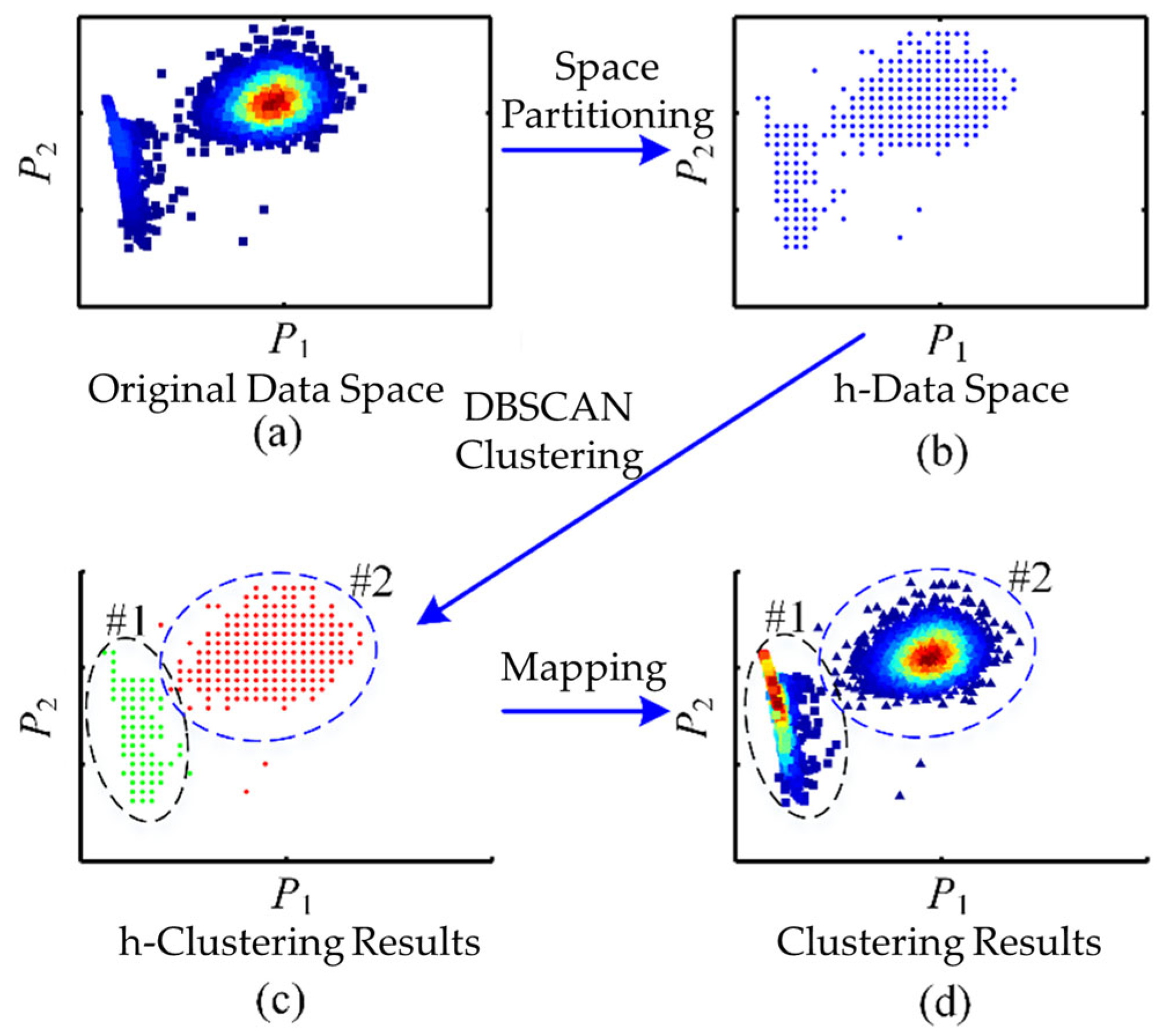
The IDBSCAN process is illustrated in Figure 13. First, the original data space is partitioned into hypercubes. Assuming each feature dimension is divided into Nf grids (Nf = 200 in this work), a new h-space is formed by the centroids of hypercubes containing more than one data point. The DBSCAN algorithm is then applied to cluster the h-space. Finally, the clustering results are mapped back to the original data space based on the data point indices within each hypercube. This space partitioning improves computational efficiency for large datasets and makes the density distribution in the h-space more uniform, allowing fixed values for Eps and MinPts to achieve effective clustering for most data spaces. Results from multiple PD datasets show that for a 4-dimensional feature space, setting Eps = 0.3 and MinPts = 2 consistently yields good clustering results.

4.2. Optimized Feature Parameter Extraction

  • Separation Performance Evaluation Metric
To evaluate the separation performance of different feature parameters, a metric is defined by referencing the density function concept from the DENCLUE (DENsity-based CLUsEtering) algorithm. Using the parameter Tw as an example, the density function is defined as:
f T w = i = 1 M exp T w T w , i σ
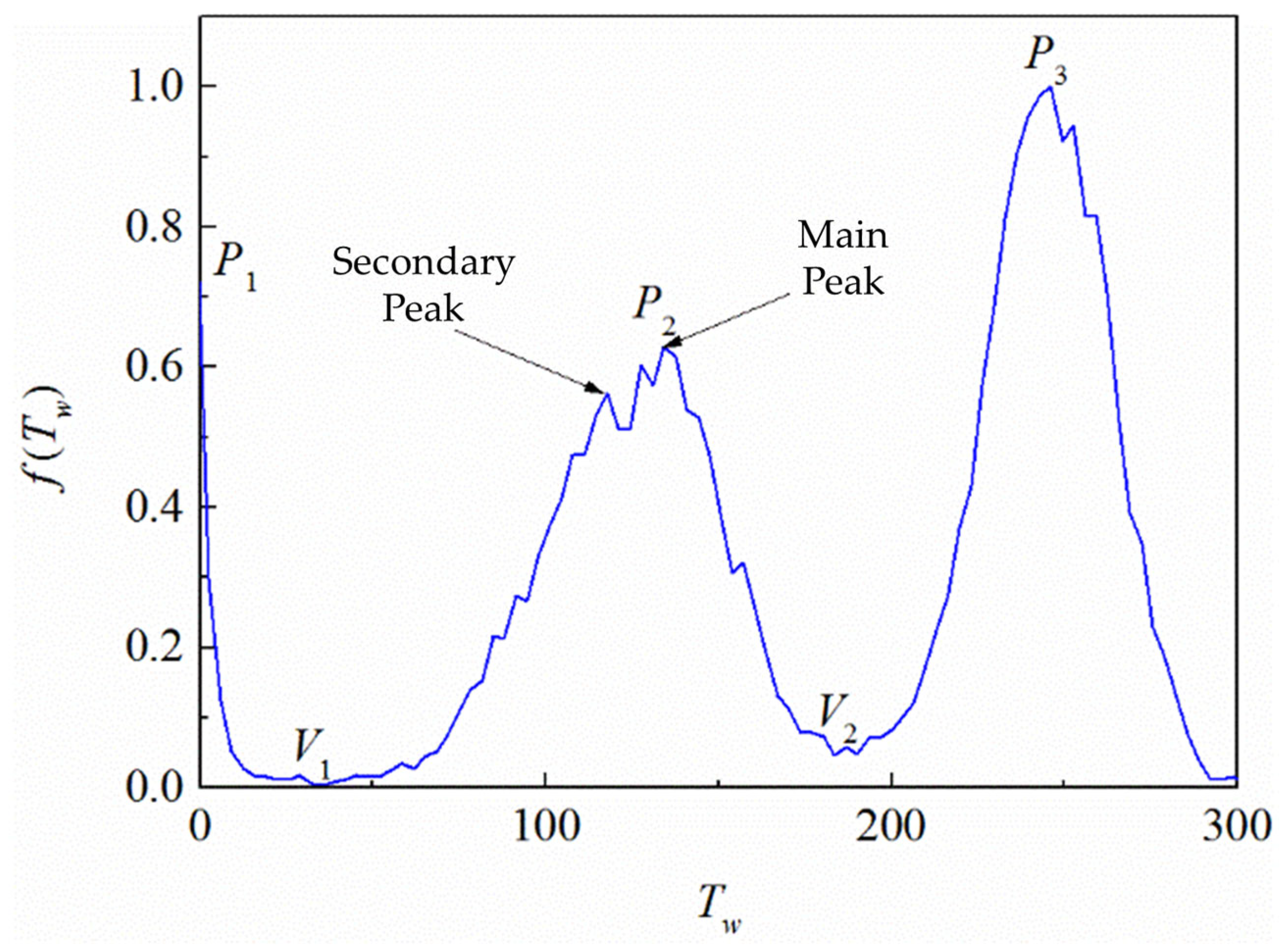
where Tw,i is the time-domain width parameter of the i-th signal; σ reflects the influence range of a data point within its neighborhood and is set to 1. A larger σ indicates a broader influence. Given the vector Tw containing width parameters from all signals, the range [min(Tw), max(Tw)] is divided into TN nodes (TN = 100 herein). The density function is calculated for all nodes to plot the f(Tw) curve, which is then normalized to the range [0, 1].
Figure 14 shows the f(Tw) curve calculated from the ET and sloped line intersection points in Figure 12. The main peaks correspond to cluster centers, and the main valleys correspond to separation regions between clusters. Higher peaks indicate better intra-cluster compactness, and lower valleys indicate better inter-cluster separability, confirming the good separation performance of the sloped line in Figure 11. The separation performance metric is defined as:
J T = N P i = 1 N P 1 P i + P i + 1 / 2 V i
where Pi is the i-th peak of the f(Tw) curve, Vi is the i-th valley, and NP is the number of peaks (number of valleys is NP − 1).
Peaks and valleys are identified using an alternating ascent (hill-climbing)/descent (valley-descending) algorithm. Minor peaks and valleys may appear. If the difference between a valley point and one of its two adjacent peaks is less than 0.1, that valley is considered minor, and the smaller of the two adjacent peaks is considered a minor peak. Minor peaks and valleys are removed. Equation (14) is applied only to the remaining main peaks and valleys to compute JT.
When the number of captured signals is limited, the density function curve lacks regularity, making Equation (14) unsuitable. Therefore, a performance metric for sparse data spaces is defined as:
J T = std T w
where std denotes the standard deviation of the vector Tw. In feature extraction methods like Principal Component Analysis (PCA), sample variance is also used to characterize feature separability.
2.
Optimization of the Sloped Line for Width Feature Calculation
To improve the separation performance of the width feature, the sloped line intercepting ET needs optimization. A line is uniquely defined by its slope A and intercept b. Simultaneously optimizing both parameters is computationally inefficient and unsuitable for real-time separation. Therefore, the slope A is fixed to the following value:
A = 95 / M t 95
where t95 is the time of the first sample point where ET ≥ 95, and Mt95 is the average of t95 across all signals. This slope generally yields good separation. The line equation becomes:
E = 95 M t 95 t + b
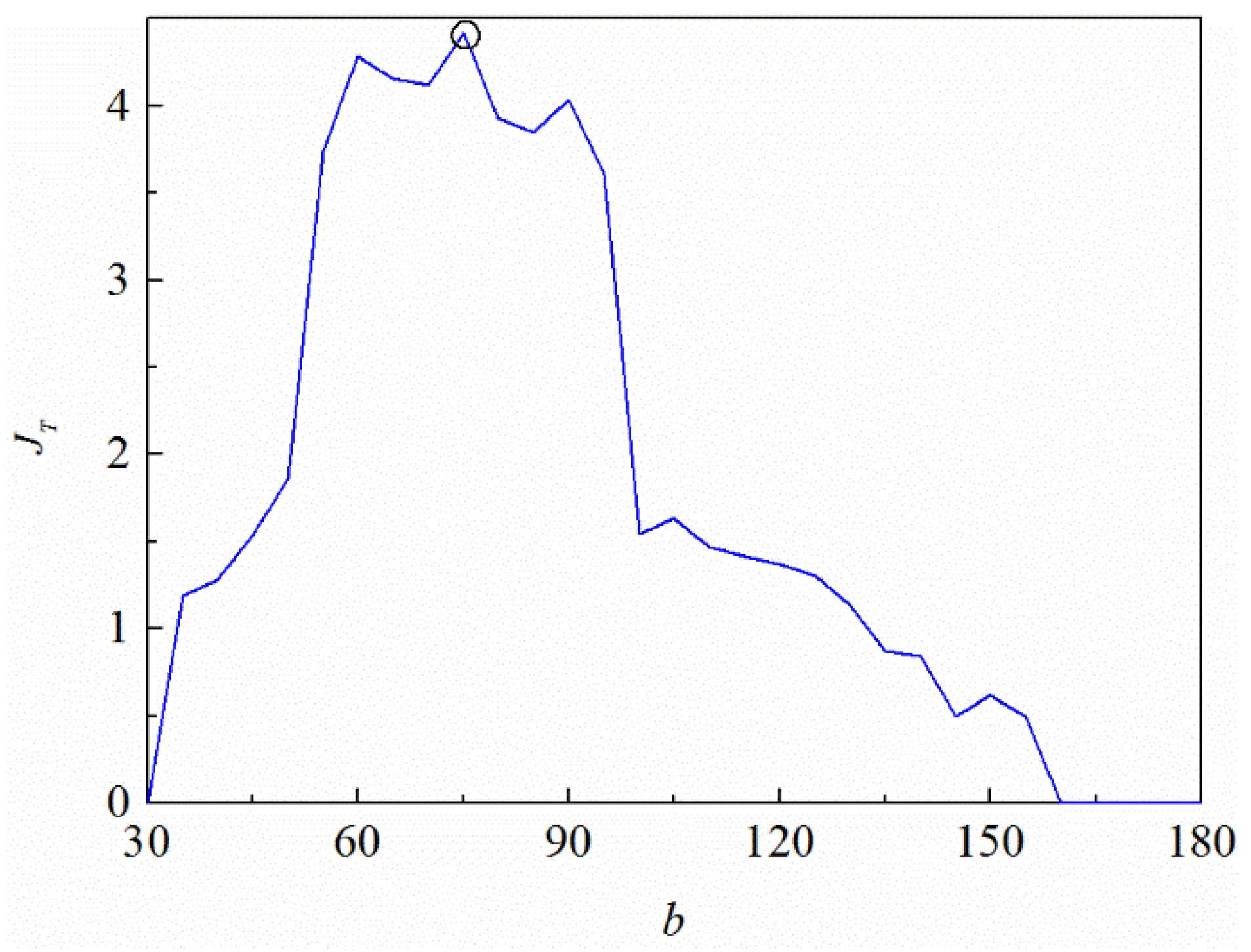
The leftmost and rightmost intersections of this line with ET are (0, 0) and (Mt95, 95), respectively, implying the intercept b ranges from 0 to 200. Experimental results show that JT generally reaches its maximum when b is between 30 and 180. Thus, only the intercept b is optimized to accelerate computation.
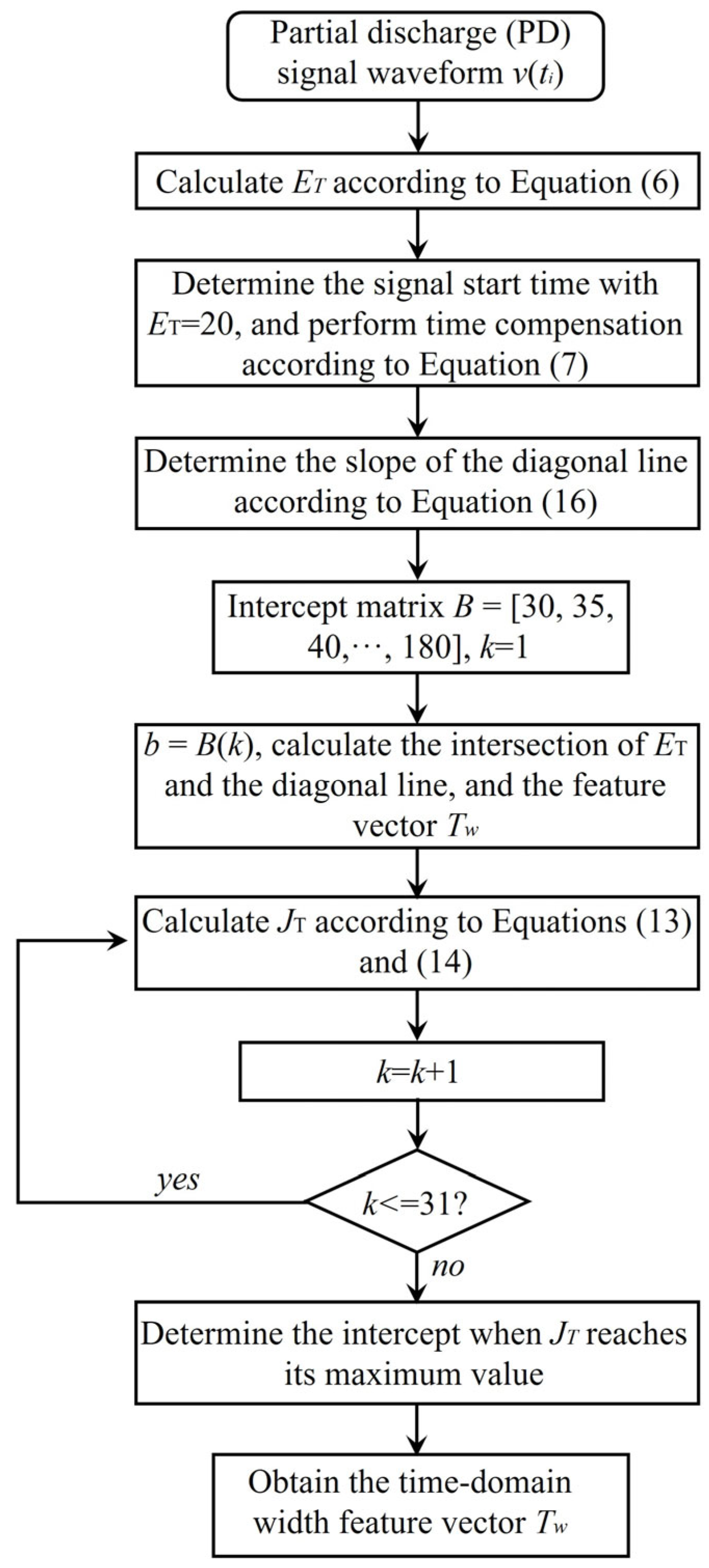
Figure 15 illustrates the optimization process for the time-domain width parameter. To select the optimal sloped line, JT is calculated sequentially for b = 30, 35, 40, …, 180. The b value yielding the maximum JT and its corresponding Tw are chosen as the final separation feature parameters. Figure 16 shows JT for the cumulative energy curves in Figure 10 at different intercepts. JT accurately characterizes the size of the separation region between curves, with b = 75 providing optimal separation. Similarly, for the frequency-domain width parameter Fw,i, the separability index JF can be calculated, and the intercept maximizing JF is selected.
3.
Optimization of Structuring Element Length for Steepness Feature Calculation
The separation performance of the steepness parameters depends on the structuring element length (SEL). Using the density function, separability indices ξ T and ξ F are defined for the time-domain and frequency-domain steepness parameters ξ T and ξ F , respectively. Experiments indicate these indices are generally maximized when SEL is between 2 and 50. Following a process similar to the width parameter optimization, J ξ T and J ξ F are calculated sequentially for SEL = 2, 6, 10, …, 50, and the feature vector corresponding to the maximum index value is selected.

4.3. Experimental Verification and Comparison

  • Experimental Verification
To validate the proposed method’s effectiveness, mixed signals were collected using the experimental platform described in Section 2.2 for separation testing.
In the experiment, a digital oscilloscope captured UHF signal waveforms in single-shot mode, resulting in a limited number of recorded waveforms (tens). Following the feature optimization process described, the separation performance metric for sparse data Equation (15) was used, and the Fuzzy Maximum Likelihood (FML) clustering method was applied.
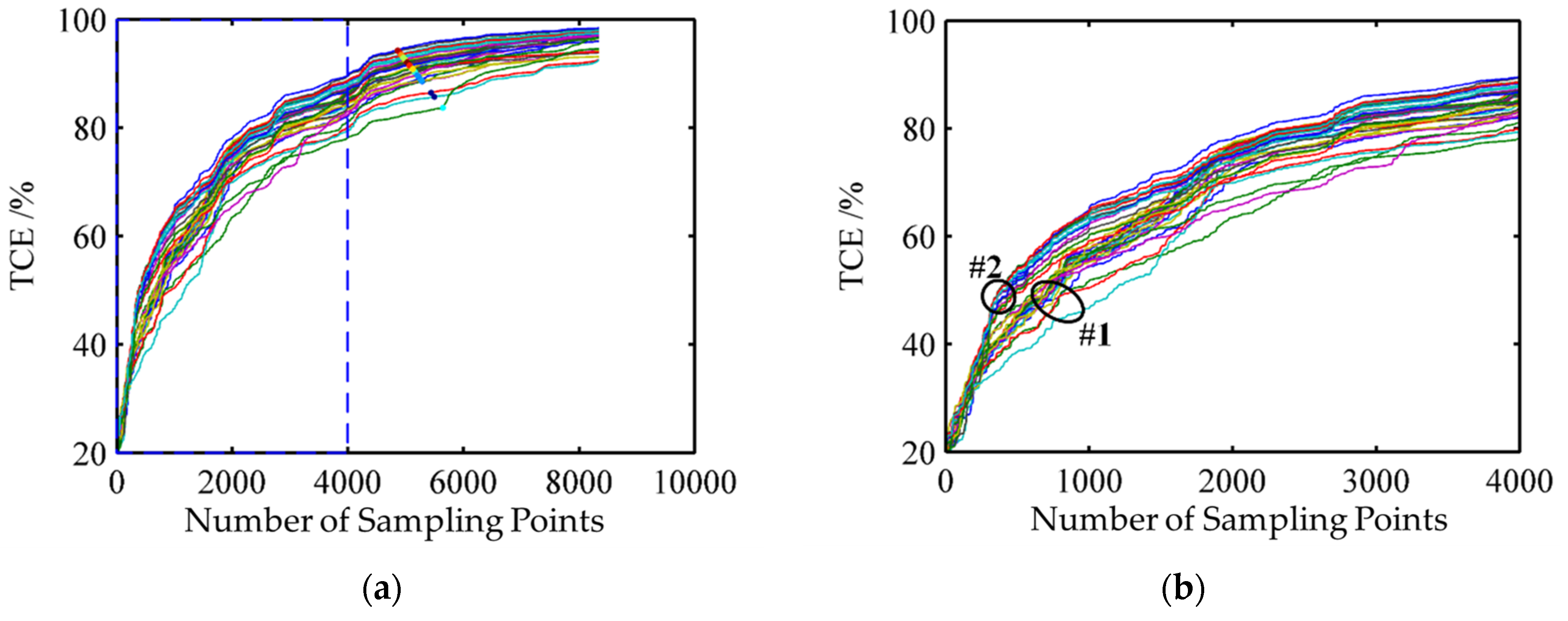
First, taking the broadband UHF antenna signal as an example, observation of the measured signals’ CEF curves revealed that the Time-domain CEF (TCE) and Frequency-domain CEF (FCE) for the two defect types were extremely similar, with only a slight difference in the rise steepness of the TCE, as shown in Figure 17. The figure shows that the optimized sloped line could not separate the two signal types. The reason is that the standard deviation reflects the dispersion of the feature parameters, which can indicate separability to some extent but is not equivalent to it. Therefore, the extracted features may not be optimal in certain cases.
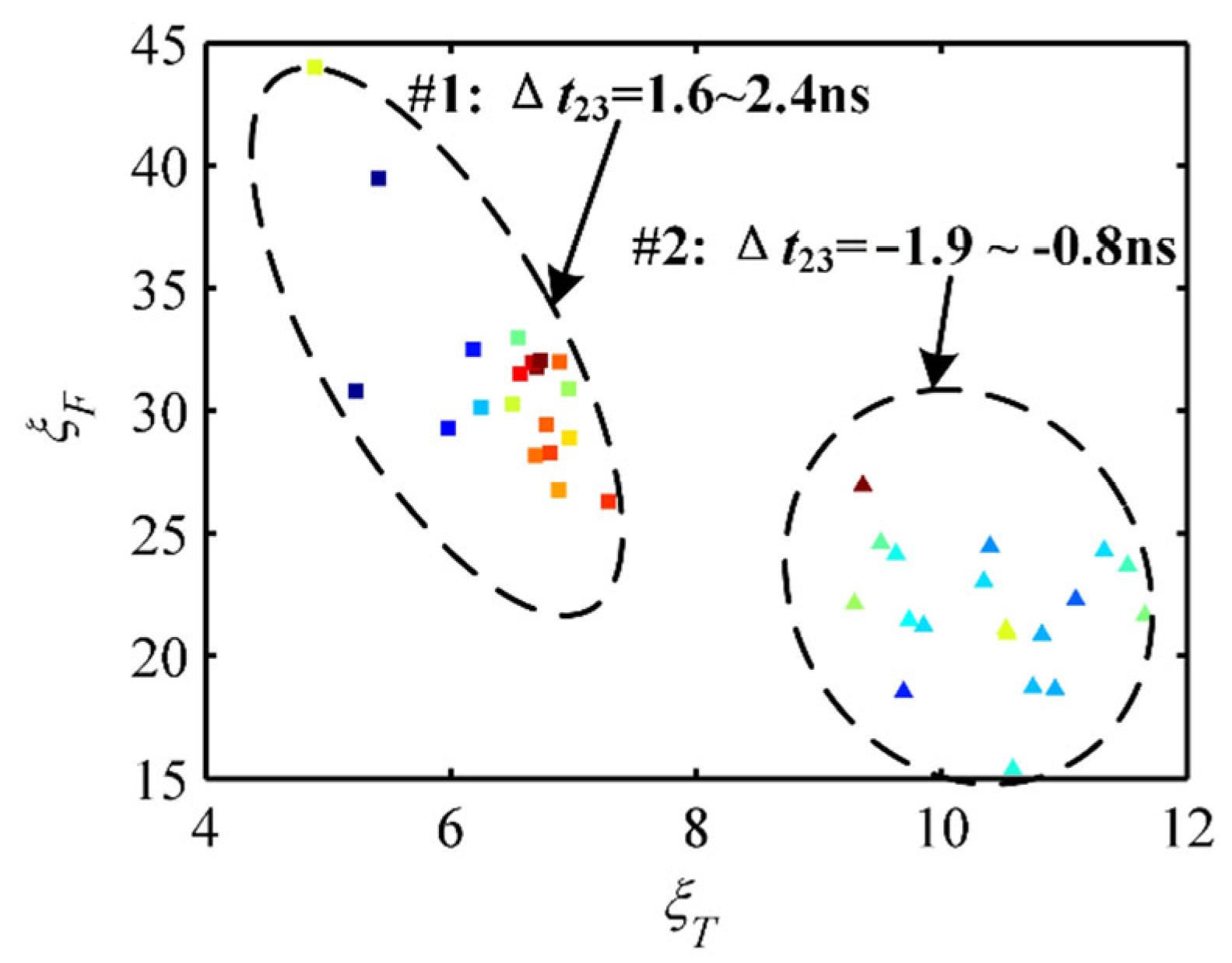
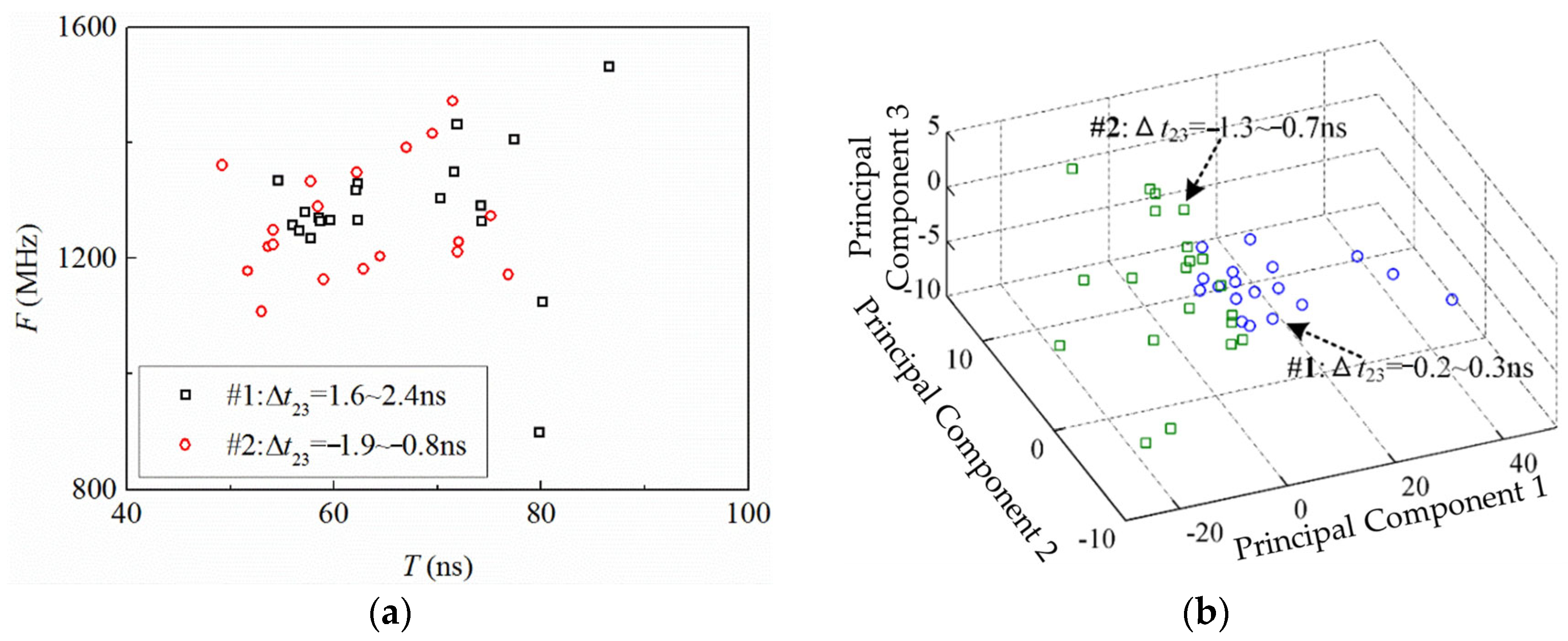
Figure 18 shows the distribution and clustering results of the optimized steepness feature parameters, which were selected for their effectiveness in signal separation. The mixed signals were successfully separated into two clusters. The separated signals of Cluster 1 and Cluster 2 are marked with squares and upward triangles, respectively. The figure also shows the range of time difference Δt23 for each cluster. All signals in Cluster 1 have positive Δt23, while all in Cluster 2 have negative Δt23. Based on the sign of Δt23, Cluster 1 signals are identified as originating from PD near the external sensor, and Cluster 2 signals are identified as originating from IGBT switching.
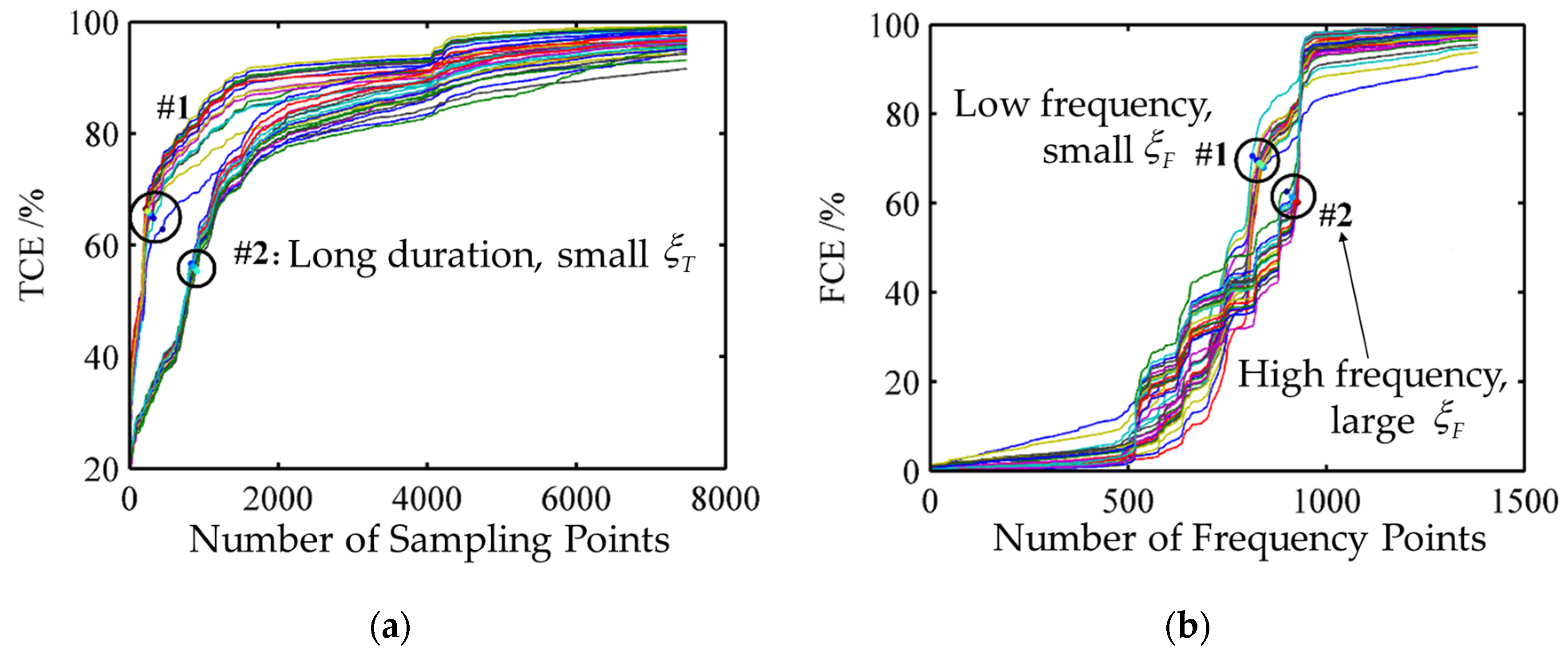
Figure 19 shows the TCE and FCE curves for signals measured by the sensor. Both TCE and FCE can effectively separate the signals into two groups, with clear differences in pulse width, frequency band, and energy rise steepness. The figure marks the intersection points of the optimized sloped line with the CEF curves, demonstrating that the extracted width features possess optimal separability and validating the effectiveness of the feature optimization method.
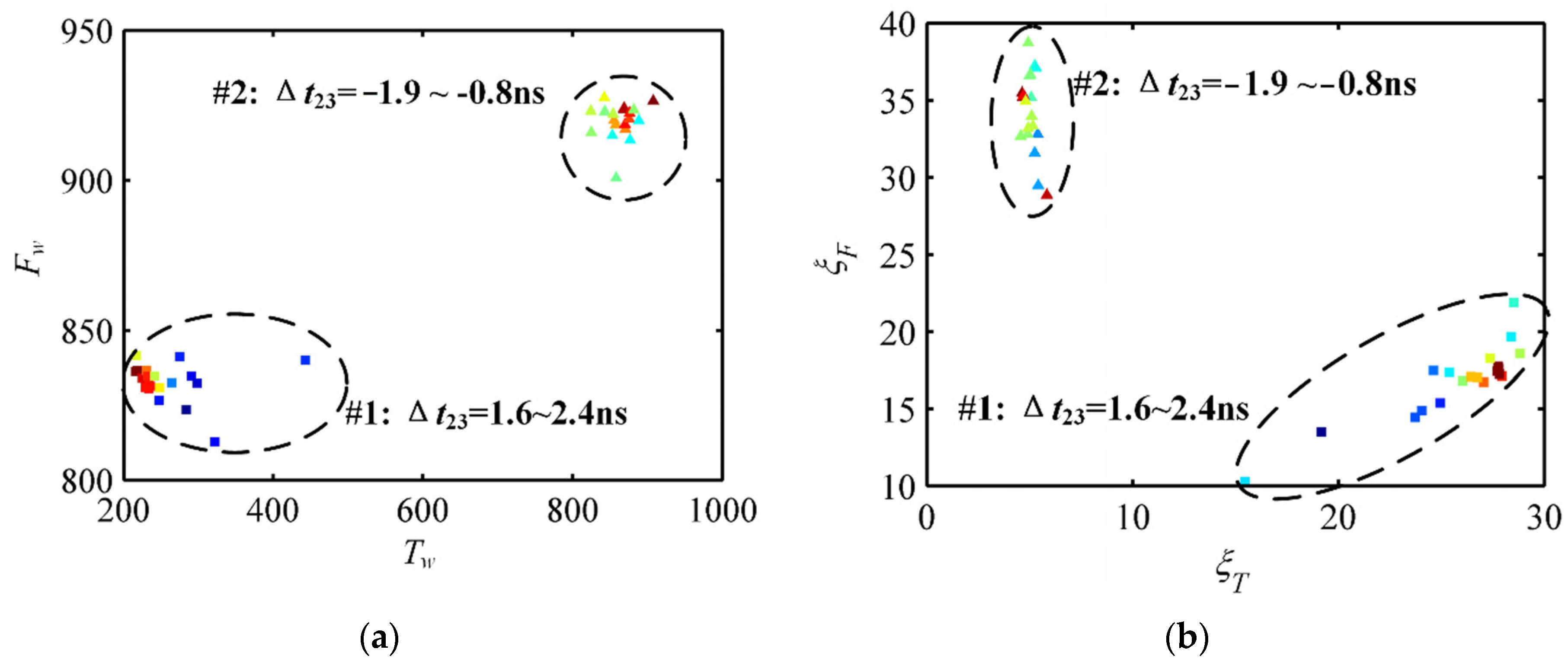
Figure 20 presents the distributions of the extracted width and steepness feature parameters. Both feature sets show good separability. Comparing the clustering results with the time difference signs confirms the accuracy of the final separation.
2.
Comparison with Other Methods
To rigorously verify the effectiveness and adaptive advantage of the proposed method, a comparative study was conducted benchmarking it against two widely established signal separation techniques: Equivalent Time-Frequency (TF) Analysis and Wavelet Decomposition combined with Principal Component Analysis (Wavelet-PCA). As illustrated in the qualitative feature distributions (Figure 21), both traditional methods exhibit severe limitations under strong switching interference (SNR = −5 dB). Specifically, the feature clusters of PD signals in the TF and Wavelet-PCA spaces are largely submerged within the broadband noise, exhibiting severe aliasing and failing to form distinct separation boundaries.
To provide a more intuitive performance assessment, quantitative metrics including Separation Accuracy (Acc) and Misclassification Rate (MR) were calculated based on the pulse classification results. The comparative statistical data are summarized in Table 3. The results indicate that the Equivalent TF Analysis yields the poorest performance with an accuracy of only 62.5%, suffering from severe “mode mixing.” The Wavelet-PCA method improves slightly but still maintains a high misclassification rate of 31.6%, primarily because the principal components of high-frequency oscillation and PD pulses often overlap in the static feature space. In sharp contrast, the proposed TF-CEF method achieves a separation accuracy of 96.8% with a misclassification rate of merely 3.2%. This significant improvement validates that by utilizing the dynamic cumulative energy gradient, the proposed method effectively decouples the deterministic switching interference from random PD signals, ensuring superior robustness for online monitoring applications.

4.4. Complexity Analysis and Real-Time Implementation Strategy

To comprehensively evaluate the feasibility of the proposed method for online monitoring in VSC-HVDC valves, we conducted a rigorous analysis of its time complexity and developed a rapid implementation strategy. The computational burden of the proposed method primarily stems from the Time-Frequency Cumulative Energy Function (TF-CEF) calculation and the morphological gradient extraction, which are essentially sliding window operations. Let N denote the length of the signal window and M denote the length of the structuring element (SE). The time complexity for processing a single frame can be expressed as T(N) ≈ O(M × N). Since the size of the structuring element is fixed and significantly smaller than the signal length in PD monitoring applications, the algorithm exhibits linear asymptotic complexity (O(N)). This is fundamentally more efficient than iterative mode decomposition methods, such as Ensemble Empirical Mode Decomposition (EEMD) or Variational Mode Decomposition (VMD), which typically involve complex iterative sifting processes with non-linear complexity.
Although the core filtering step is efficient, the adaptive optimization of the SE parameters (finding the optimal separating line) can be computationally intensive if a global search is performed. To satisfy strict real-time engineering requirements, we propose a “Dimension-Reduction Optimization Strategy.” Instead of performing a global 2D search for both the slope (k) and intercept (b) of the linear structuring element, we exploit the statistical characteristics of the PD pulses. The slope parameter k is approximated and fixed based on the statistical rise-time of the pulse group, reducing the optimization problem to a 1D local search for the optimal intercept b and length M. Furthermore, this optimization is triggered only periodically (e.g., upon detecting a significant baseline shift), while the continuous data stream utilizes the cached optimal parameters for high-speed filtration.
Table 4 presents a theoretical comparison of computational complexity between the proposed method and traditional techniques. Due to the linear complexity structure and the dimension-reduction strategy, the proposed method incurs minimal computational cost compared to iterative algorithms. This ensures that the signal processing can be completed well within the 20 ms interval of a 50 Hz power frequency cycle, guaranteeing no data loss during online monitoring.

5. Discussion

This study, through a combined approach of constructing a high-fidelity simulation model and experimental validation, systematically reveals the generation mechanism and spectral characteristics of high-frequency interference caused by IGBT switching. Experimental results indicate that the spectrum of IGBT switching interference is primarily concentrated in the 30–180 MHz range, which exhibits severe overlap with the effective frequency band used for UHF-based partial discharge detection. This finding, from an electromagnetic compatibility perspective, explains the root cause of performance degradation in field PD monitoring systems. Notably, the distinct resonant frequency features observed during turn-on and turn-off processes reflect the differential influence of the main power loop and the internal chip packaging parameters on interference characteristics. This provides a crucial basis for designing targeted suppression measures.
In the investigation of aging effects, a significant finding of this work is the distinction between the different modulation mechanisms of bond wire aging and gate oxide layer degradation on the interference spectrum. Bond wire aging primarily alters the loop parasitic parameters, leading to spectral reconstruction. This change is location-dependent: aging of gate, collector, and emitter bond wires exhibits unique spectral evolution patterns. Particularly, the abnormal increase in turn-off interference amplitude during severe collector bond wire aging can serve as a potential fault warning indicator. In contrast, gate oxide layer degradation manifests a fundamentally different impact mechanism. The resulting global spectrum attenuation characteristic reflects the decline in the device’s intrinsic switching capability. This distinction is significant for IGBT condition monitoring, suggesting the potential to identify and differentiate between different aging types by analyzing interference spectral features.
In terms of signal separation, the proposed method based on feature optimization of the Cumulative Energy Function demonstrates significant advantages. Compared to traditional methods, the core innovation lies in extracting feature parameters from the dynamic process of signal energy accumulation. This more effectively captures the essential difference between the periodic nature of IGBT interference and the stochastic nature of PD pulses than features derived solely from the time or frequency domain. The width parameter obtained via sloped-line interception and the steepness parameter based on the morphological gradient together form an effective feature set, while the adaptive optimization process ensures the method’s robustness under varying measurement conditions. Experimental results show that the proposed method achieves accurate signal separation even in scenarios where traditional methods fail, proving the effectiveness of the selected feature parameters.
It should be noted that this study has certain limitations. First, while the established simulation model can predict the general trend of the interference spectrum well, further refinement is needed to precisely simulate the high-frequency characteristics of complex packaging structures. Second, the real-time performance of the signal separation method requires improvement, which is crucial for field engineering applications. Additionally, this study focuses on a specific IGBT model and PD type; the generalizability of the method needs to be validated across a wider range of devices and defect types. Future work will concentrate on developing more accurate simulation models, optimizing the computational efficiency of the algorithm, and validating the method in actual converter station environments to facilitate the translation of related technologies into engineering applications.

6. Conclusions

This paper addresses the critical challenge of utilizing high-frequency switching interference for PD monitoring in VSC-HVDC converter valves. By integrating high-fidelity physical modeling with experimental validation, this study establishes a theoretical framework for non-intrusive aging diagnosis. First, regarding the physical mechanism, we quantitatively decoupled the origins of switching noise, revealing that Turn-on interference (typically <50 MHz) is dominated by the resonance of the power loop stray inductance, whereas Turn-off interference (typically >100 MHz) is governed by the device’s Miller capacitance and package inductance. This frequency-domain decoupling provides the essential physical prerequisite for differentiating aging types from background noise.
Second, a key scientific originality of this work is the mapping of specific failure modes to distinct spectral signatures. The research uncovers that Bond Wire Aging induces a “spectral reconstruction” effect; specifically, emitter bond wire fatigue leads to a resonant frequency redshift and a “high-frequency recurrence” phenomenon due to the Current Constriction Effect. In contrast, Gate Oxide Degradation manifests as a characteristic “global spectrum attenuation” and peak frequency migration, reflecting the degradation of the device’s intrinsic switching capability. These findings validate the feasibility of transforming “harmful switching noise” into a valuable “diagnostic carrier” for condition monitoring.
Third, regarding the signal processing methodology, a novel adaptive separation method based on Cumulative Energy Function (CEF) optimization was proposed to overcome the limitations of static filters under spectrum drift. To satisfy strict real-time engineering requirements, we developed a “Dimension-Reduction Optimization Strategy” that simplifies the parameter search to a linear complexity of O(N). Benchmark tests confirm that this method effectively captures the morphological differences between stochastic PD pulses and deterministic switching noise with a processing speed (<5 ms/frame) suitable for online embedded systems.
Finally, to bridge the gap between theoretical analysis and engineering application, we propose a “Statistical Baseline Deviation Strategy” for aging diagnosis. Recognizing that absolute spectral thresholds vary with operating conditions, we recommend establishing a “Healthy Baseline” during the commissioning phase. A deviation exceeding 3σ (three standard deviations) from this baseline—specifically a 3σ frequency redshift for bond wires or amplitude attenuation for gate drivers—serves as the robust early warning indicator. Furthermore, since destructive testing is prohibited in operational VSC-HVDC stations, we validated the engineering applicability via comparative analysis with recent field literature. The “Spectral Reconstruction” characteristics observed in our model show a high degree of morphological consistency with the experimental findings reported by Noh et al. [20], confirming that the proposed method accurately captures the dominant electromagnetic signatures of aged valves in real-world scenarios.

Author Contributions

Conceptualization, J.S. and H.M.; methodology, M.S.; software, T.B. and H.Y.; validation, B.Y., Y.J. and G.C.; formal analysis, M.S. and Q.B.; investigation, M.S.; resources, J.S. and H.M.; data curation, M.S. and T.B.; writing—original draft preparation, M.S.; writing—review and editing, H.M. and J.S.; visualization, T.B. and H.Y.; supervision, H.M.; project administration, J.S. and H.M.; funding acquisition, J.S. and H.M. All authors have read and agreed to the published version of the manuscript.

Funding

This research was funded by the Science and Technology Project of State Grid Zhejiang Electric Power Co., Ltd., grant number 5211DS250009 (Project Name: Research on Anti-interference Partial Discharge Detection Technology and Device Development for Flexible DC Harmonics of UHV Large Capacity Converter Transformers under Step-by-Step Commissioning Mode). The APC was funded by the Science and Technology Project of State Grid Zhejiang Electric Power Co., Ltd.

Data Availability Statement

The datasets generated during and/or analyzed during the current study are available from the corresponding author on reasonable request.

Conflicts of Interest

The authors Jiangfeng Si, Bing Yu, Yongtao Jin, Guangsheng Cai and Qifeng Bian are employed by State Grid Zhejiang Electric Power Co. The authors declare no conflict of interest. The funders had no role in the design of the study; in the collection, analyses, or interpretation of data; in the writing of the manuscript; or in the decision to publish the results.

References

  1. Yao, Z.; Lei, X.; Du, X. A Comprehensive Review of Condition Monitoring Technologies for Modular Multilevel Converter (MMC) HVDC Systems. Electronics 2025, 14, 3462. [Google Scholar] [CrossRef]
  2. Wen, H.; Abu Talip, M.S.; Othman, M.; Azam, S.M.K.; Mohamad, M.; Ibrahim, M.F.; Arof, H.; Ababneh, A. Advanced Signal Processing Methods for Partial Discharge Analysis: A Review. Sensors 2025, 25, 7318. [Google Scholar] [CrossRef] [PubMed]
  3. Li, P.; Cheng, J.; Chen, X. A IGBT with Floating n-Well Region for High dV/dt Controllability and Low EMI Noise. IEEE Electron Device Lett. 2018, 39, 560–563. [Google Scholar] [CrossRef]
  4. Meadors, J. Partial Discharge Testing and Detection Under PWM Voltage. Master’s Thesis, University of Tennessee, Knoxville, TN, USA, 2021. [Google Scholar]
  5. Wang, H.; Przybilla, J.; Zhang, H.; Schiele, J. A New Press Pack IGBT for High Reliable Applications with Short Circuit Failure Mode. CPSS Trans. Power Electron. Appl. 2021, 6, 107–114. [Google Scholar] [CrossRef]
  6. Han, L.; Liang, L.; Kang, Y. Optimized Design in Current, Temperature and Stress Distributions for Paralleled Chips in Press-Pack IGBT Modules. CSEE J. Power Energy Syst. 2025, 11, 2325–2338. [Google Scholar]
  7. Yao, R.; Duan, Z.; Li, H.; Iannuzzo, F.; Lai, W.; Chen, X. Lifetime Prediction for Press Pack IGBT Device by Considering Fretting Wear Failure. Microelectron. Reliab. 2023, 145, 114984. [Google Scholar] [CrossRef]
  8. Liu, R.; Li, H.; Yao, R.; Lai, W.; Xiao, W.; Tan, H. Overview of Monitoring Methods of Press-Pack Insulated Gate Bipolar Transistor Modules under Different Package Failure Modes. IET Power Electron. 2022, 15, 1239–1256. [Google Scholar] [CrossRef]
  9. Yang, Y.; Li, J.; Chen, Z.; Liu, Y.-C.; Chen, K.; Liu, K.; Xin, D.-L.; Gao, G.; Wu, G. Classification of Partial Discharge in Vehicle-Mounted Cable Termination of High-Speed Electric Multiple Unit: A Machine Learning-Based Approach. Electronics 2024, 13, 495. [Google Scholar] [CrossRef]
  10. Li, G.; Wang, X.; Li, X.; Yang, A.; Rong, M. Partial Discharge Recognition with a Multi-Resolution Convolutional Neural Network. Sensors 2018, 18, 3512. [Google Scholar] [CrossRef] [PubMed]
  11. Huang, H.; Wu, J.; Xu, W.; Lu, T. The Influence of Driving Parameters on Conducted EMI for an IGBT Module. IEEE Trans. Electromagn. Compat. 2020, 62, 2285–2293. [Google Scholar] [CrossRef]
  12. Li, Q.; Yang, Y.; Wen, Y.; Zhang, G.; Xing, W. Active Gate Driver with the Independent Suppression of Overshoot and Oscillation for SiC MOSFET Modules. IEEE Trans. Ind. Electron. 2025, 72, 2325–2335. [Google Scholar] [CrossRef]
  13. Tan, R.; Ye, S.; Peng, Q.; Du, C.; Zhou, Z. Research on Efficient Prediction and Suppression of Electromagnetic Interference in Electric Drive Systems. World Electr. Veh. J. 2025, 16, 201. [Google Scholar] [CrossRef]
  14. Di Fatta, A.; Imburgia, A.; Rizzo, G.; Akbar, G.; Li Vigni, V.; Romano, P.; Ala, G. Modified Hierarchical Clustering Algorithm for Partial Discharge Separation. In Proceedings of the 2023 IEEE Conference on Electrical Insulation and Dielectric Phenomena (CEIDP), East Rutherford, NJ, USA, 15–19 October 2023; pp. 1–4. [Google Scholar]
  15. Carvalho, I.F.; da Costa, E.G.; Nobrega, L.A.M.M.; da Costa Silva, A.D. Identification of Partial Discharge Sources by Feature Extraction from a Signal Conditioning System. Sensors 2024, 24, 2226. [Google Scholar] [CrossRef]
  16. Yoon, S.-H.; Kwon, I.-S.; Lim, J.-S.; Park, B.-B.; Lee, S.-W.; Kim, H.-J. Enhanced Clustering of DC Partial Discharge Pulses Using Multi-Level Wavelet Decomposition and Principal Component Analysis. Energies 2025, 18, 4835. [Google Scholar] [CrossRef]
  17. Petráš, J.; Džmura, J.; Kosterec, M. Partial Discharge Signal De-Noising by Morphological Filters. In Proceedings of the 2018 19th International Scientific Conference on Electric Power Engineering (EPE), Brno, Czech Republic, 16–18 May 2018; pp. 1–5. [Google Scholar]
  18. He, Y.; Fang, Y.; Zhang, Z.; Zhou, D.; Chen, S.; Jing, S. Partial Discharge Pattern Recognition of GIS with Time–Frequency Energy Grayscale Maps and an Improved Variational Bayesian Autoencoder. Energies 2026, 19, 127. [Google Scholar] [CrossRef]
  19. GB/T 23642-2017; Electrical Insulating Materials and Systems—Electrical Measurement of Partial Discharges (PD) Under Short Rise Time and Repetitive Voltage Impulses. Standards Press of China: Beijing, China, 2017.
  20. Noh, J.; Lee, J.; Oh, J.; Kang, J.; Kim, N. Online Monitoring Method for IGBT Bond-Wire Lift-Off of Electric Vehicles via Phase-Current Spectral Analysis. IEEE Access 2025, 13, 189473–189481. [Google Scholar] [CrossRef]
Figure 1. Equivalent circuit diagram of the high-fidelity IGBT behavioral model including parasitic parameters (Lg, Lc, Le) and non-linear drift resistance (Rb).
Electronics 15 00751 g001
Figure 2. Double-pulse test circuit. The orange arrows indicate the gate drive signals sent to the IGBTs and the measurement point for the collector current (Ic). The orange dashed circle highlights the location where the current sensor is installed to measure Ic of the device under test.
Electronics 15 00751 g002
Figure 3. Partial discharge detection platform.
Electronics 15 00751 g003
Figure 4. Schematic diagram of voltage and current variations during IGBT switching. The vertical dashed lines mark the key time instants (t1t10) of the switching transients, while the horizontal dashed lines represent the critical parameter values. The blue solid lines highlight the intervals with high current change rates (di/dt), and the green solid lines indicate the intervals with high voltage change rates (dv/dt).
Electronics 15 00751 g004
Figure 5. Frequency spectrum of high-frequency interference generated during IGBT turn-on and turn-off.
Electronics 15 00751 g005
Figure 6. PD signal and electromagnetic interference signal in the switching experiment. (a) Vce voltage and UHF waveform; (b) Fourier decomposition of the UHF waveform; (c) zoomed-in spectrum (0–300 MHz).
Electronics 15 00751 g006
Figure 7. Interference spectra under different aging conditions of gate parasitic inductance and resistance (1, 2, 3 indicate increasing degree of aging). (a) Spectrum during turn-on; (b) Spectrum during turn-off.
Electronics 15 00751 g007
Figure 8. Interference spectra under different aging conditions of collector parasitic inductance and resistance (1, 2, 3 indicate increasing degree of aging). (a) Spectrum during turn-on; (b) Spectrum during turn-off.
Electronics 15 00751 g008
Figure 9. Interference spectra under different aging conditions of emitter parasitic inductance and resistance (1, 2, 3 indicate increasing degree of aging). (a) Spectrum during turn-on; (b) Spectrum during turn-off.
Electronics 15 00751 g009
Figure 10. Interference spectra under different aging conditions of the gate oxide layer. (States 1, 2, and 3 indicate increasing degrees of aging, with higher numbers corresponding to more severe degradation.) (a) Spectrum of interference generated during turn-on; (b) Spectrum of interference generated during turn-off.
Electronics 15 00751 g010
Figure 11. Algorithm Implementation Flowchart. The arrow indicates the execution sequence of the algorithm steps, proceeding from grid partitioning to density clustering.
Electronics 15 00751 g011
Figure 12. Comparison of intercepts between a sloped line, horizontal lines, and the cumulative energy curve. The dashed horizontal lines represent fixed thresholds at 80% and 60%, with regions #1 and #2 indicating their respective intercepts. The solid blue line represents the proposed negatively sloped line, with region #3 indicating the intercepts obtained by this method. The comparison shows that the oblique line (region #3) achieves better separation of the curve clusters compared to the horizontal lines.
Electronics 15 00751 g012
Figure 13. Flowchart of the IDBSCAN clustering method. (a) The original data distribution in the feature space. (b) The data distribution after space partitioning. (c) The clustering results in the high-density space, where regions #1 (green points) and #2 (red points) represent two distinct clusters identified by the algorithm. (d) The final clustering results mapped back to the original space, where different markers (squares and triangles) indicate the separated clusters corresponding to regions #1 and #2.
Electronics 15 00751 g013
Figure 14. Density function of the time-domain width feature parameter.
Electronics 15 00751 g014
Figure 15. Optimization process for extracting the time-domain width feature parameter.
Electronics 15 00751 g015
Figure 16. Separability indices under different intercepts.
Electronics 15 00751 g016
Figure 17. Time-domain cumulative energy functions of mixed signals from PD and IGBT switching high-frequency interference. (a) TCE; (b) Zoomed-in view of TCE. (a) The global view of the TCE curves, where the multicolored lines represent individual signal samples. The vertical blue dashed line marks the cut-off point (x = 4000) for the zoomed-in view shown in (b). (b) Zoomed-in view of the TCE curves. Regions #1 and #2 highlight two distinct clusters of signal energy accumulation trends observed in the mixed signals.
Electronics 15 00751 g017
Figure 18. Optimized steepness feature parameters and clustering results. The squares represent the signal samples in Cluster #1, and the triangles represent the signal samples in Cluster #2. The distinct separation between these two shapes demonstrates the effectiveness of the optimized steepness features.
Electronics 15 00751 g018
Figure 19. Time-frequency domain cumulative energy function curves for signals measured by the sensor. (a) TCE; (b) FCE. The multicolored curves/dots represent the cumulative energy functions of multiple individual signal samples, illustrating the statistical consistency and variation of the signals in both time and frequency domains.
Electronics 15 00751 g019
Figure 20. Distributions of optimized feature parameters and clustering results. (a) Tw-Fw distribution; (b) ξT-ξF distribution.
Electronics 15 00751 g020
Figure 21. Feature distributions obtained using two other discharge separation methods. (a) TF feature distribution; (b) Wavelet decomposition energy principal component feature distribution. The blue circles represent Cluster #1 and the green squares represent Cluster #2. The significant overlap between the two shapes indicates the limited separation capability of these methods compared to the proposed approach.
Electronics 15 00751 g021
Table 1. Parameters of the IGBT behavioral model (Temp = 25 °C).
ParameterValueUnit
Reverse transfer capacitance Cres34.72 (Vce = 0 V)
0.43 (Vce = 8.45 V)
nF
Input capacitance Cies40.66 (Vce = 0 V)nF
Output capacitor Coes70.31 (Vce = 0 V)
4.20 (Vce = 8.45 V)
nF
Collector Inductance Lc7.80nH
Emitter Inductance Le23.55nH
Gate inductance Lg27.11nH
Collector resistor Rc1.95
Emitter resistor Re14.81
Gate resistor Rg240.72
Initial value of nonlinear base region resistance rb316.94
Nonlinear base region resistance decay time constant taurb242.56ns
Transistor current amplification factor β0.32
Table 2. Comparison of simulated and experimental spectral characteristics.
Spectrum CharacteristicsSimulation ResultsExperimental ResultsConsistency Analysis
Main frequency band37–170 MHz30–180 MHzHighly compatible
Peak Frequency 137.74 MHz67.82 MHzBasically consistent
Peak Frequency 2139.5 MHz152.62 MHzBasically consistent
Table 3. Quantitative performance comparison of different separation methods under strong switching noise (SNR = −5 dB).
MethodFeature TypeSeparation Accuracy (Acc)Performance Evaluation
Equivalent TF AnalysisStatic (Time/Freq Bandwidth)62.5% ± 4.2%Poor: Severe mode mixing observed.
Wavelet-PCAStatic (Principal Components)68.4% ± 3.1%Fair: High overlapping in feature space.
Proposed TF-CEFDynamic (Cumulative Gradient)96.8% ± 1.1%Excellent: Robust decoupling achieved.
Table 4. Theoretical Computational Complexity Comparison.
MethodComplexity OrderComputational CostReal-Time Suitability
Proposed TF-CEFO(N) (Linear)Very LowHigh
Wavelet TransformO(N)LowHigh
EMDO(N × logN)High (Iterative)Low
VMDO(K × N)Very HighLow
Disclaimer/Publisher’s Note: The statements, opinions and data contained in all publications are solely those of the individual author(s) and contributor(s) and not of MDPI and/or the editor(s). MDPI and/or the editor(s) disclaim responsibility for any injury to people or property resulting from any ideas, methods, instructions or products referred to in the content.