Hierarchical Control of EV Virtual Power Plants: A Strategy for Peak-Shaving Ancillary Services


Abstract
1. Introduction
2. Control Characteristics and Cost Analysis of Electric Vehicle Loads
2.1. Day-Ahead Controllable Capacity Aggregation for Electric Vehicles
2.1.1. Controllable Capacity of a Single Electric Vehicle
2.1.2. Aggregate Controllable Capacity of an Electric Vehicle Cluster
2.2. Response Cost Analysis for Electric Vehicle Clusters
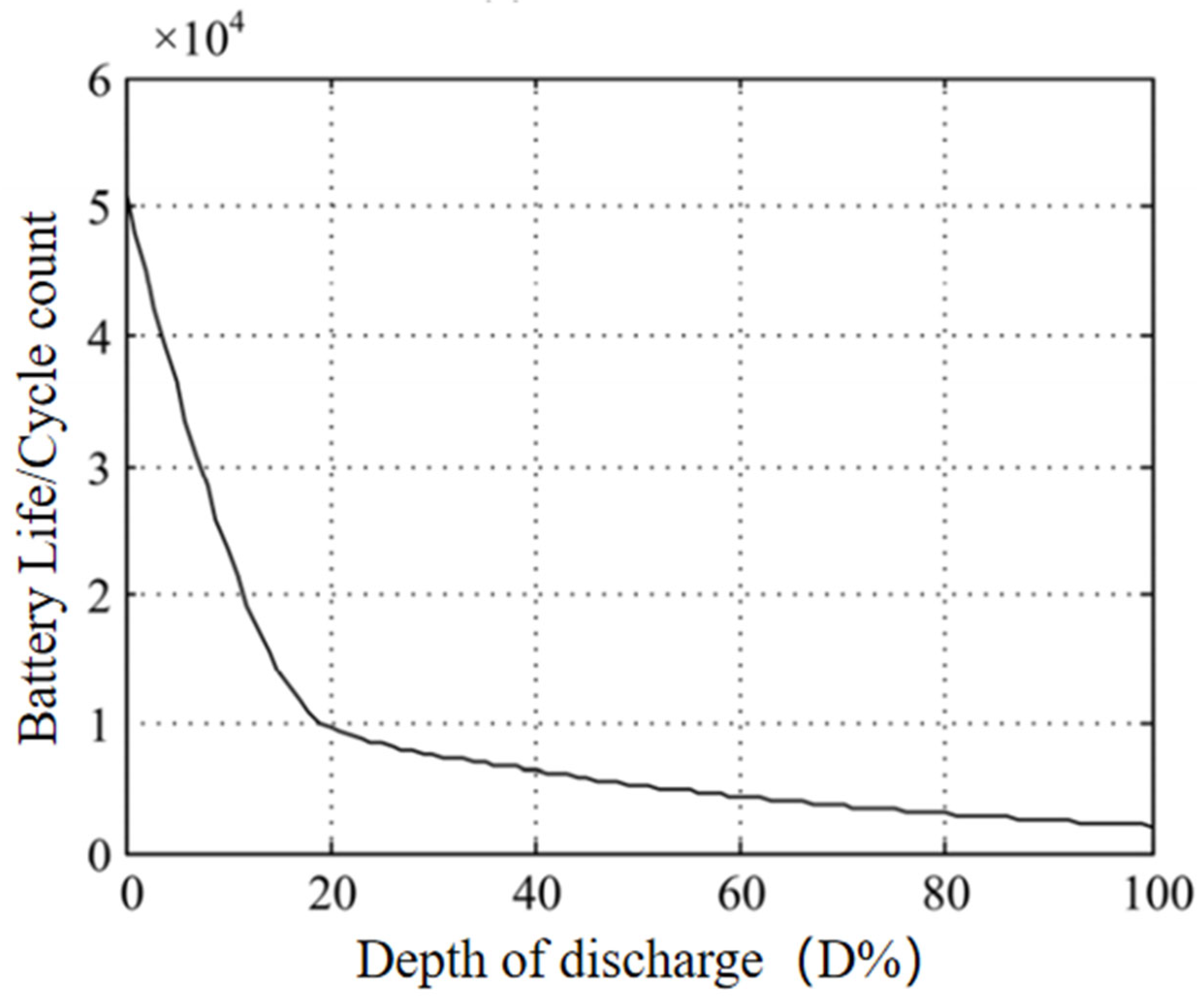
2.2.1. V2G Battery Degradation Model for Electric Vehicles
2.2.2. V2G Response Cost of Electric Vehicle Clusters
- (1)
- Battery Degradation Cost
- Loss of Lithium Ions: Lithium plating and the thickening of the Solid Electrolyte Interphase (SEI) film lead to a decrease in the concentration of available lithium ions.
- Structural Stress: The volume expansion and contraction of electrode particles caused by lithium intercalation/deintercalation induce cracking and particle fragmentation.
- Accelerated Side Reactions: High C-rate charging and discharging cause localized temperature increases, which accelerate electrolyte decomposition and transition metal dissolution.
- (2)
- Grid Interaction Cost
2.2.3. Integration of Cost Model into Hierarchical Control Framework
- Day-ahead layer: Uses the cost model to evaluate bidding strategies and predict total response costs.
- Intraday layer: Dynamically updates cost coefficients based on real-time battery states and grid signals.
- Terminal layer: Adjusts charging/discharging rates to minimize real-time degradation costs while tracking power commands.
3. Control Strategy for Electric Vehicle Load Participation in Peak-Shaving Ancillary Services
3.1. Framework Design for EV Load Participation in Peak-Shaving Ancillary Services
3.1.1. Framework Logic and Hierarchical Architecture with Communication Considerations
- Day-Ahead Pre-Dispatch Layer: Based on the next day’s peak-shaving demand curve and time-of-use (TOU) electricity price signals published by the grid, this layer generates the initial charging and discharging schedule for the EV cluster. This schedule aims to maximize peak-shaving revenue while considering constraints such as battery degradation costs and user incentive costs, thereby establishing a time-segmented power baseline.
- Intraday Rolling Optimization Layer: This layer updates dispatch commands every 15 min during the operating day. Specifically, it constructs a rolling horizon optimization model based on real-time collected data, including EV connection status, State of Charge (SOC), and grid peak-shaving deficit information. Targeting the minimization of deviation penalty costs, it reallocates the charging and discharging power weights among charging stations. Simultaneously, it employs the K-means clustering algorithm to perform group aggregation of the EV cluster, mapping vehicles with similar characteristics (e.g., SOC range, charging/discharging rate) to the same control unit, thereby reducing optimization complexity.
- Terminal Execution Layer: This layer involves the collaborative effort of charging stations and the onboard Battery Management System (BMS) to decompose and execute power commands. The charging station, according to the power command allocated from the upper layer and combined with the real-time status of local EVs, converts the continuous power requirement into charging/discharging rates for individual terminals via a discretization algorithm. The onboard BMS, based on the SOC safety boundary and the State of Health (SOH), dynamically adjusts the upper limits of charging/discharging power, ensuring the dual constraints of meeting user energy needs and protecting battery lifespan.
3.1.2. Multi-Timescale Coordinated Control Strategy
- Day-Ahead Hour-Level Scheduling (T + 24 h to T + 1 h):
- Aggregate schedulable capacity using the Minkowski sum algorithm (Section 2.1).
- Solve a day-ahead optimization model to maximize expected revenue while respecting battery degradation and user travel constraints.
- Generate a baseline charging/discharging power profile for the next operating day.
- 2.
- Intraday Minute-Level Dynamic Adjustment (T + 1h to T + 0):
- Every 15 min, collect real-time data and apply Kalman filtering to smooth load fluctuations.
- Re-optimize power allocation using a rolling horizon model that minimizes deviation penalty costs.
- Perform K-means clustering to group EVs with similar SOC and power characteristics, reducing control dimensionality.
- Update power setpoints for each charging station.
- 3.
- Second-Level Terminal Feedback Control (Real-time):
- Apply PID control to compensate for instantaneous deviations between scheduled and actual cluster output.
- Discretize continuous power commands into actionable charging/discharging rates for each EV.
- Enforce safety constraints via the onboard Battery Management System (BMS).
3.1.3. Adaptive Deviation Penalty Mechanism
- Deviation Prediction: Based on historical data and real-time status, a Long Short-Term Memory (LSTM) network is used to forecast the power deviation trend for the next 15 min, thereby identifying potential exceedance risks in advance.
- Feedback Compensation: If the predicted deviation exceeds the threshold, a reserve capacity pool is activated. The deviation is compensated by dynamically adjusting the charging/discharging rates of the reserve units.
- Correction Optimization: In the next rolling cycle, the power allocation weights are re-optimized, and the composition of the reserve capacity pool is updated, forming a closed-loop correction process.
3.2. Decomposition of Control Signals by Charging Stations
3.2.1. Optimization Objective and Constraints
- Charging/Discharging Power Constraints:
- 2.
- SOC Safety Constraints:
- 3.
- User Participation Probability Constraint:
3.2.2. Two-Stage Optimization Method
4. Case Study
4.1. Simulation Parameter Settings
4.2. Simulation Results Analysis
- (1)
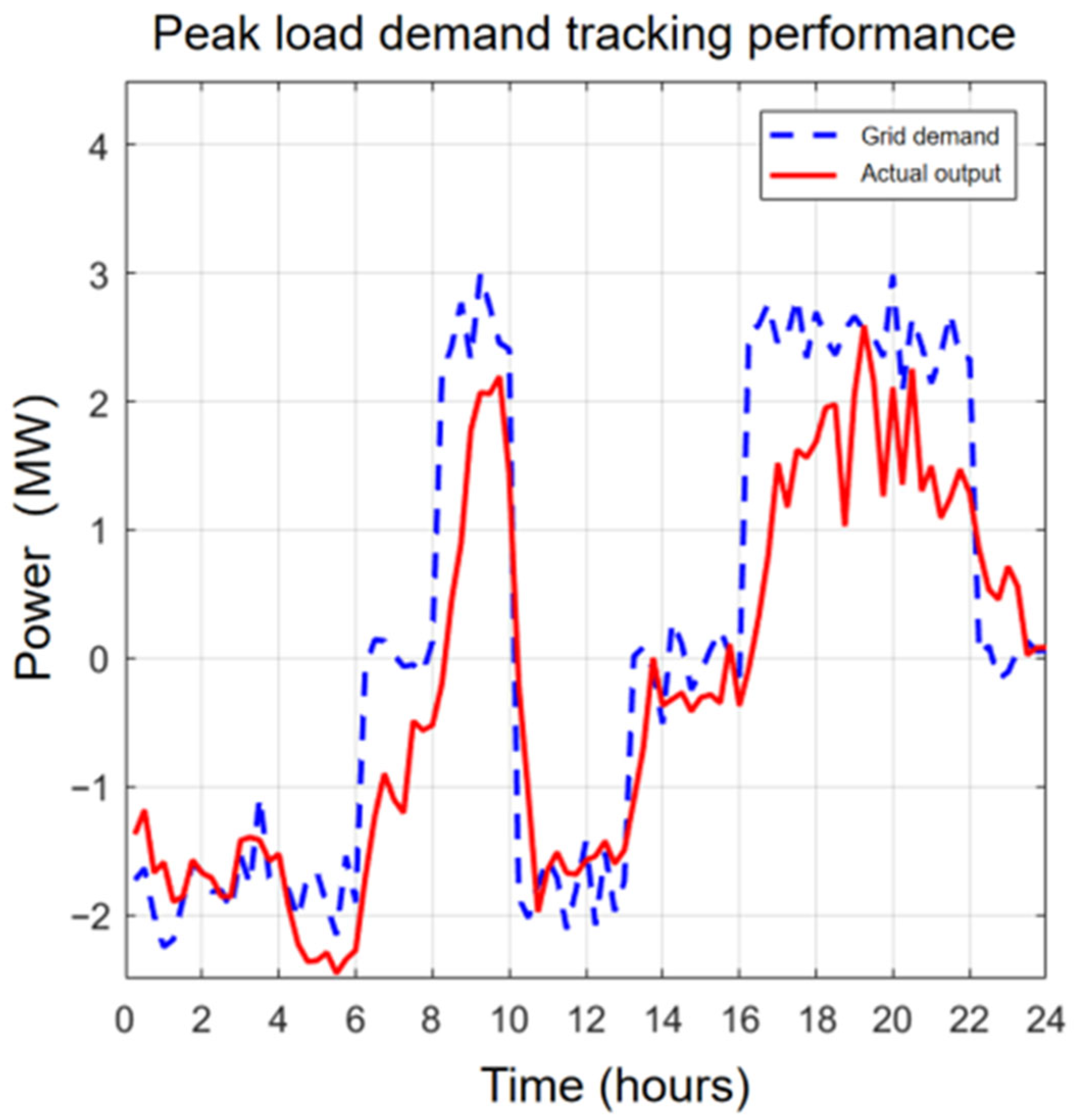
- Dynamic Tracking Performance of Peak-Shaving Demand
- (2)
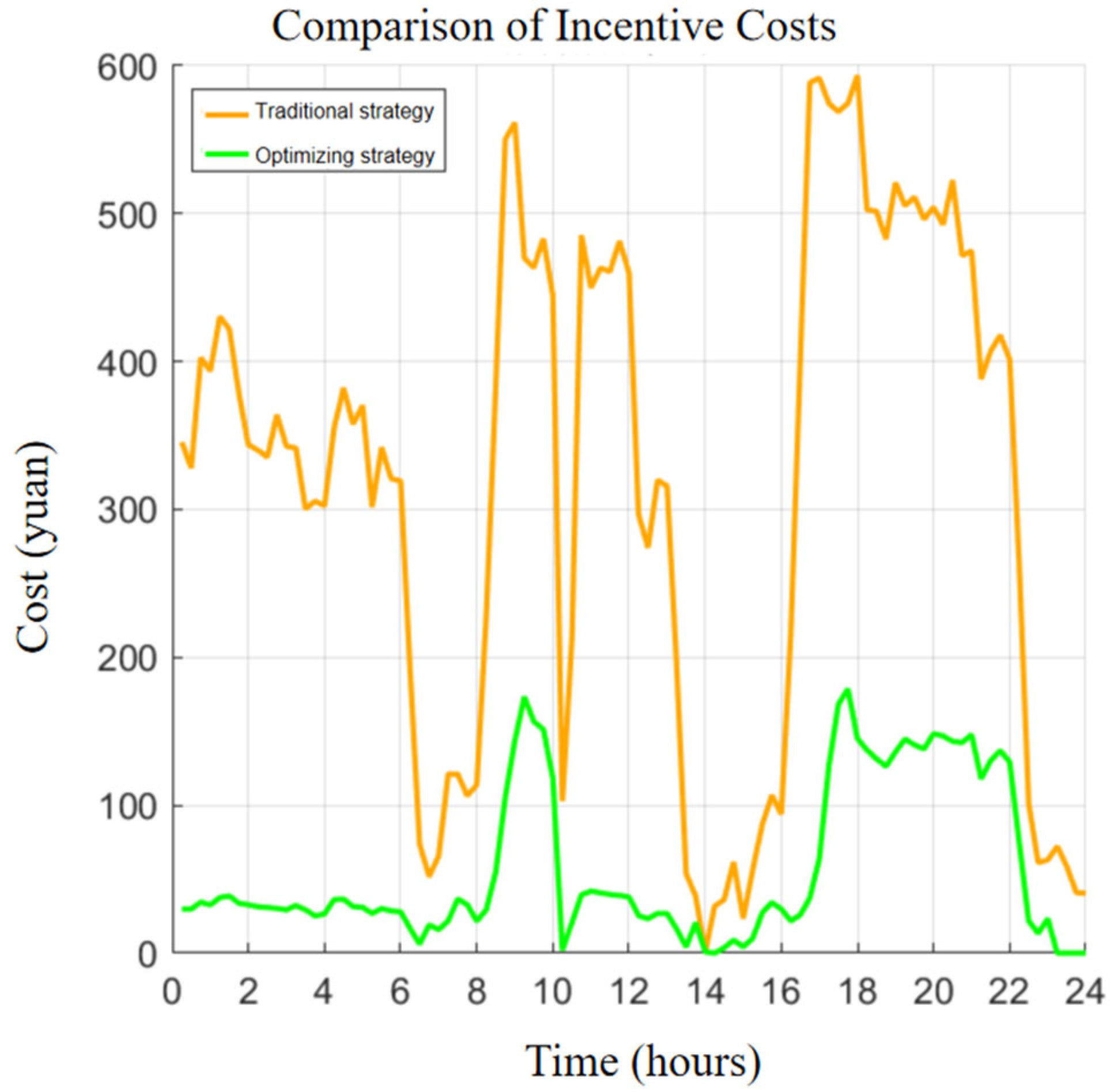
- Economic Optimization Effect
5. Conclusions
- Novel Capacity Aggregation Method: A Minkowski sum-based approach is proposed, mapping individual EV feasible regions into a high-dimensional hypercube. Compared to conventional geometric/convex-hull methods, it reduces computational time by ~40% while maintaining aggregation accuracy above 95%.
- Comprehensive Cost Model: A V2G response cost model incorporating multi-factor battery degradation (DOD, temperature, C-rate) and TOU electricity prices is established. Simulation results show a 12.5% reduction in per-cycle battery aging cost compared to traditional DOD-only models.
- Hierarchical Control Framework: A three-layer architecture (“day-ahead–intraday–terminal”) is designed, integrating PID feedback with gain-scheduling and adaptive penalty mechanisms. The framework maintains output deviation within ±15%, outperforming the market threshold of ±20%, and reduces incentive costs by 68.9% through dynamic compensation and SOC balancing.
- Practical Relevance: The strategy is validated through a 7-day simulation with realistic DSO-level data, demonstrating scalability and robustness under communication delays and user behavior uncertainty. It provides an implementable pathway for large-scale EV-grid integration in renewable-rich power systems, with clear extensibility to TSO-level markets through resource scaling.
Author Contributions
Funding
Data Availability Statement
Conflicts of Interest
Abbreviations
| EV | Electric Vehicle |
| VPPS | Virtual Power Plants |
| VPP | Virtual Power Plant |
References
- Yuan, X.K.; Gong, L.K. The New Energy Vehicle Industry Enters a New Stage of Development. Economic Information Daily, 29 November 2024. [Google Scholar] [CrossRef]
- Li, L.; Wang, Y.; Han, M.Z.; Guo, X.; Zhang, H.; Li, P. A Study on the Coordinated Control of Source-Grid-Load-Storage of Distribution Networks Considering New Energy Proportion Optimization. Power Syst. Clean Energy 2025, 41, 123–129. [Google Scholar]
- Shang, Y.; Liu, M.; Shao, Z.; Jian, L. Internet of smart charging points with photovoltaic Integration: A high-efficiency scheme enabling optimal dispatching between electric vehicles and power grids. Appl. Energy 2020, 278, 115640. [Google Scholar] [CrossRef]
- Berna-Escriche, C.; Álvarez-Piñeiro, L.; Blanco, D. Optimization of Solar Generation and Battery Storage for Electric Vehicle Charging with Demand-Side Management Strategies. World Electr. Veh. J. 2025, 16, 312. [Google Scholar] [CrossRef]
- Yu, B.; Lei, X.; Shao, Z.; Jian, L. V2G Carbon Accounting and Revenue Allocation: Balancing EV Contributions in Distribution Systems. Electronics 2024, 13, 1063. [Google Scholar] [CrossRef]
- Jia, C.; He, H.; Zhou, J.; Li, J.; Wei, Z.; Li, K.; Li, M. A novel deep reinforcement learning-based predictive energy management for fuel cell buses integrating speed and passenger prediction. Int. J. Hydrogen Energy 2025, 100, 456–465. [Google Scholar] [CrossRef]
- Li, K.; Zhou, J.; Jia, C.; Yi, F.; Zhang, C. Energy sources durability energy management for fuel cell hybrid electric bus based on deep reinforcement learning considering future terrain information. Int. J. Hydrogen Energy 2024, 52, 821–833. [Google Scholar] [CrossRef]
- Arévalo, P.; Jurado, F. Impact of Artificial Intelligence on the Planning and Operation of Distributed Energy Systems in Smart Grids. Energies 2024, 17, 4501. [Google Scholar] [CrossRef]
- Li, M.; Wang, Y.; Peng, P.; Chen, Z. Toward efficient smart management: A review of modeling and optimization approaches in electric vehicle-transportation network-grid integration. Green Energy Intell. Transp. 2024, 3, 100181. [Google Scholar] [CrossRef]
- Wang, Y.; Mao, M.; Chang, L. Multi-time scales prediction of aggregated schedulable capacity of electric vehicle fleets based on enhanced Prophet-LGBM algorithm. Appl. Energy 2024, 374, 124018. [Google Scholar] [CrossRef]
- Jain, P.; Das, A.; Jain, T. Aggregated electric vehicle resource modelling for regulation services commitment in power grid. Sustain. Cities Soc. 2019, 45, 439–450. [Google Scholar] [CrossRef]
- Pan, J.; Zhang, N.; Yong, P.; Wang, P. Two-stage Distributed Collaborative Dispatching Method for Massive Flexible Resources. Autom. Electr. Power Syst. 2023, 47, 67–79. [Google Scholar]
- Rezaeimozafar, M.; Eskandari, M.; Savkin, A.V. A Self-Optimizing Scheduling Model for Large-Scale EV Fleets in Microgrids. IEEE Trans. Ind. Inform. 2021, 17, 8177–8188. [Google Scholar] [CrossRef]
- Mao, M.; Zhang, S.; Chang, L.; Hatziargyriou, N.D. Schedulable capacity forecasting for electric vehicles based on big data analysis. J. Mod. Power Syst. Clean. Energy 2019, 7, 1651–1662. [Google Scholar] [CrossRef]
- Yang, X.D.; Ren, S.J.; Zhang, Y.B.; Zhao, B.; Huang, F.; Xie, L. Schedulable Ability Model and Priority-based Intraday Scheduling Strategy for Electric Vehicle. Autom. Electr. Power Syst. 2017, 41, 84–93. [Google Scholar] [CrossRef]
- Huang, W.; Liu, Y.; Zhang, Y.; Yuan, X. Analysis and research on influencing factors of interactive decision-making between electric vehicles and power grids. J. Comput. Methods Sci. Eng. 2025, 25, 3918–3932. [Google Scholar] [CrossRef]
- Ai, Y.; Qiu, Y.; Li, Q.; Huang, L.; Chen, W. A Game Theory-Based Bargaining Model between Electric Vehicles and the Hybrid AC/DC Microgrid. In Proceedings of the 2022 4th International Conference on Smart Power & Internet Energy Systems (SPIES), Beijing, China, 9–12 December 2022; pp. 202–207. [Google Scholar]
- Zhang, Y.; Li, D.; Yang, Q. A Stackelberg Game for Relieving Peak Pressure of Power Grid Using Electric Vehicles with V2G Technology. In Proceedings of the 2021 China Automation Congress (CAC), Beijing, China, 22–24 October 2021; pp. 5099–5104. [Google Scholar]
- Yang, H.; Xu, Y.; Sun, H.; Guo, Q.; Liu, Q. Electric Vehicles Management in Distribution Network: A Data-Efficient Bi-Level Safe Deep Reinforcement Learning Method. IEEE Trans. Power Syst. 2024, 40, 256–271. [Google Scholar] [CrossRef]
- Jia, C.; Liu, W.; He, H.; Chau, K.T. Health-conscious energy management for fuel cell vehicles: An integrated thermal management strategy for cabin and energy source systems. Energy 2025, 333, 137330. [Google Scholar] [CrossRef]
- Lu, D.; Yi, F.; Hu, D.; Li, J.; Yang, Q.; Wang, J. Online optimization of energy management strategy for FCV control parameters considering dual power source lifespan decay synergy. Appl. Energy 2023, 348, 121516. [Google Scholar] [CrossRef]
- Zhang, Q.; Deng, X.; Yue, H.; Sum, T.; Liu, Z. Coordinated Optimization Strategy of Electric Vehicle Cluster Participating in Energy and Frequency Regulation Markets Considering Battery Lifetime Degradation. Trans. China Electrotech. Soc. 2022, 37, 72–81. [Google Scholar] [CrossRef]
- Alamgir, S.; Hassan, S.J.U.; Mehdi, A.; Abdelmaksoud, A.; Haider, Z.; Shin, G.; Kim, C. A comprehensive review of vehicle–to–grid (V2G) technology as an ancillary services provider. Results Eng. 2025, 27, 106813. [Google Scholar] [CrossRef]
- Fioriti, D.; Scarpelli, C.; Pellegrino, L.; Lutzemberger, G.; Micolano, E.; Salamone, S. Battery lifetime of electric vehicles by novel rainflow-counting algorithm with temperature and C-rate dynamics: Effects of fast charging, user habits, vehicle-to-grid and climate zones. J. Energy Storage 2023, 59, 106458. [Google Scholar] [CrossRef]
- Li, S. Optimal Management of Electric Vehicle Interactions with Power Grid Considering Battery Degradation. Ph.D. Thesis, 2023. [Google Scholar]
- Zhang, S.; Sun, Y. Analysis for V2G Response Cost of EV Aggregator Considering Time-of-use Tariffs and Battery Wear. Proc. CSU-EPSA 2017, 29, 39–46. [Google Scholar]



| Parameter 1 | Value | Parameter 2 | Value |
|---|---|---|---|
| Total number of vehicles | 200 | Total time slots | 96 (15 min/slot) |
| Rated power | 60 kw | Charging/discharging efficiency | 0.9 |
| Initial SOC range | U (0.4–0.7) | SOC safety boundaries | 0.2–0.9 |
| Valley-filling subsidy cap | 400 CNY/MW | Peak-shaving subsidy cap | 500 CNY/MW |
Disclaimer/Publisher’s Note: The statements, opinions and data contained in all publications are solely those of the individual author(s) and contributor(s) and not of MDPI and/or the editor(s). MDPI and/or the editor(s) disclaim responsibility for any injury to people or property resulting from any ideas, methods, instructions or products referred to in the content. |
© 2026 by the authors. Licensee MDPI, Basel, Switzerland. This article is an open access article distributed under the terms and conditions of the Creative Commons Attribution (CC BY) license.
Share and Cite
Zheng, Y.; Zhang, H.; Liu, A.; Li, Y.; Hao, S.; Miao, Y.; Liang, Y.; Liao, S. Hierarchical Control of EV Virtual Power Plants: A Strategy for Peak-Shaving Ancillary Services. Electronics 2026, 15, 578. https://doi.org/10.3390/electronics15030578
Zheng Y, Zhang H, Liu A, Li Y, Hao S, Miao Y, Liang Y, Liao S. Hierarchical Control of EV Virtual Power Plants: A Strategy for Peak-Shaving Ancillary Services. Electronics. 2026; 15(3):578. https://doi.org/10.3390/electronics15030578
Chicago/Turabian StyleZheng, Youzhuo, Hengrong Zhang, Anjiang Liu, Yue Li, Shuqing Hao, Yu Miao, Yujie Liang, and Siyang Liao. 2026. "Hierarchical Control of EV Virtual Power Plants: A Strategy for Peak-Shaving Ancillary Services" Electronics 15, no. 3: 578. https://doi.org/10.3390/electronics15030578
APA StyleZheng, Y., Zhang, H., Liu, A., Li, Y., Hao, S., Miao, Y., Liang, Y., & Liao, S. (2026). Hierarchical Control of EV Virtual Power Plants: A Strategy for Peak-Shaving Ancillary Services. Electronics, 15(3), 578. https://doi.org/10.3390/electronics15030578