Article

An SST-Based Emergency Power Sharing Architecture Using a Common LVDC Feeder for Hybrid AC/DC Microgrid Clusters and Segmented MV Distribution Grids


ALGORITMI Research Centre/LASI, Department of Industrial Electronics, University of Minho, 4800-058 Guimaraes, Portugal
*
Author to whom correspondence should be addressed.
Electronics 2026, 15(3), 496; https://doi.org/10.3390/electronics15030496
Submission received: 8 January 2026 / Revised: 20 January 2026 / Accepted: 21 January 2026 / Published: 23 January 2026

Abstract

The growing incorporation of distributed energy resources (DER) in power distribution grids, although pivotal to the energy transition, increases operational variability and amplifies the exposure to disturbances that can compromise resilience and the continuity of service during contingencies. Addressing these challenges requires both a shift toward flexible distribution architectures and the adoption of advanced power electronics interfacing systems. In this setting, this paper proposes a resilience-oriented strategy for medium-voltage (MV) distribution systems and clustered hybrid AC/DC microgrids interfaced through solid-state transformers (SSTs). When a fault occurs along an MV feeder segment, the affected microgrids naturally transition to islanded operation. However, once their local generation and storage become insufficient to sustain autonomous operation, the proposed framework reconfigures the power routing within the cluster by activating an emergency low-voltage DC (LVDC) power path that bypasses the faulted MV section. This mechanism enables controlled power sharing between microgrids during prolonged MV outages, ensuring the supply of priority loads without oversizing SSTs or reinforcing existing infrastructure. Experimental validation on a reduced-scale SST prototype demonstrates stable grid-forming and grid-following operation. The reliability of the proposed scheme is supported by both steady-state and transient experimental results, confirming accurate voltage regulation, balanced sinusoidal waveforms, and low current tracking errors. All tests were conducted at a switching frequency of 50 kHz, highlighting the robustness of the proposed architecture under dynamic operation.

1. Introduction

The accelerating deployment of grid-tied inverters, driven by the massive integration of distributed energy resources (DER), electric mobility, and electrified industrial processes, is profoundly reshaping the structure of modern distribution systems [1]. This transition is, therefore, shifting the electrical grid towards a decentralized, highly flexible, and sustainability-oriented paradigm [2]. Nonetheless, as power systems become increasingly converter-dominated, they are also exposed to faster dynamics, reduced natural inertia, and a wider range of power quality and stability challenges [3]. Therefore, although this energy transition is both crucial and inevitable, it must be supported by resilient distribution architectures, protection mechanisms, and control strategies capable of ensuring secure and continuous power supply under disturbed and abnormal conditions.
In parallel, the power grid is constantly challenged by highly dynamic load profiles, driven by fast load variations, evolving prosumer patterns, and the large-scale penetration of intermittent renewable energy sources (RES) [4]. In this regard, it becomes increasingly important to equip distribution systems with power electronic solutions capable of complementing, or even replacing, conventional and outdated equipment [5]. This innovation must consistently extend from the medium-voltage (MV) distribution level down to end users, fostering new control algorithms, advanced energy management strategies, and the widespread adoption of clean energy production methods [6].
Beyond the adoption of advanced power electronic solutions, effectively addressing the aforementioned challenges also requires a profound reorganization of the electrical grid architecture itself. Rather than relying on strictly centralized structures, future distribution systems are expected to evolve towards decentralized hybrid AC/DC microgrids [7]. In such frameworks, groups of prosumers, DERs, and local loads operate in a coordinated manner, significantly reducing grid overload and relieving the functional constraints imposed on MV feeders [8]. Furthermore, this organization enables islanded operation under disturbed conditions and enhances both flexibility and resilience at the local level. From a system perspective, the clustered microgrid paradigm introduces new degrees of freedom for power routing, local power balancing, and fault containment, thereby complementing the functionalities offered by modern power electronic converters [9].
However, this transition will not occur instantaneously, but rather through evolutionary stages dictated by market maturity, regulatory frameworks, and consumer needs [10]. A clear example is the growing inadequacy of conventional low-frequency transformers (LFTs) to meet the functional requirements imposed by smart grids, namely enhanced controllability, power quality, efficiency, and bidirectional power flow capability [11]. However, these conventional devices lack the intrinsic flexibility required by modern grids. Furthermore, the transformer sector itself is currently facing severe material supply constraints, as widely reported in recent studies [12,13], reinforcing the urgency of migrating towards advanced power electronic interfacing solutions.
Among the alternatives, the solid-state transformer (SST) has gained significant attention as a key enabling technology for future smart grids [14]. By integrating power electronic conversion stages and inherently operating at high-frequency, SSTs provide enhanced controllability, dynamic response, and a broader portfolio of ancillary services. These include, but are not limited to, voltage regulation, fault ride-through capability, and bidirectional power flow control, while still ensuring the fundamental requirements of galvanic isolation and voltage transformation. Moreover, the use of high-frequency isolation substantially increases power density and efficiency when compared with conventional LFTs [15].
From a smart grid perspective, the role of the SST extends across multiple roles in the electrical infrastructure. Its application ranges from MV distribution interfaces to the interconnection of heterogeneous electrical subsystems, such as hybrid AC/DC microgrids [16], RES, electric vehicle charging infrastructures, data centers, and industrial services [17,18]. Based on its inherent modularity, scalability, and multiport capability, the SST emerges as a versatile platform capable of supporting both present and future grid requirements, helping to reinforce the resilience of distribution systems [19]. By exploiting its reconfigurable nature, both at the structural and control levels, the SST can actively support power routing between the MV distribution grid and clustered microgrids, enabling bidirectional power exchange according to local generation, storage availability, and demand conditions. In this context, this technology may become a strategic asset for ensuring the continuity of operation under adverse and disturbed conditions [20].
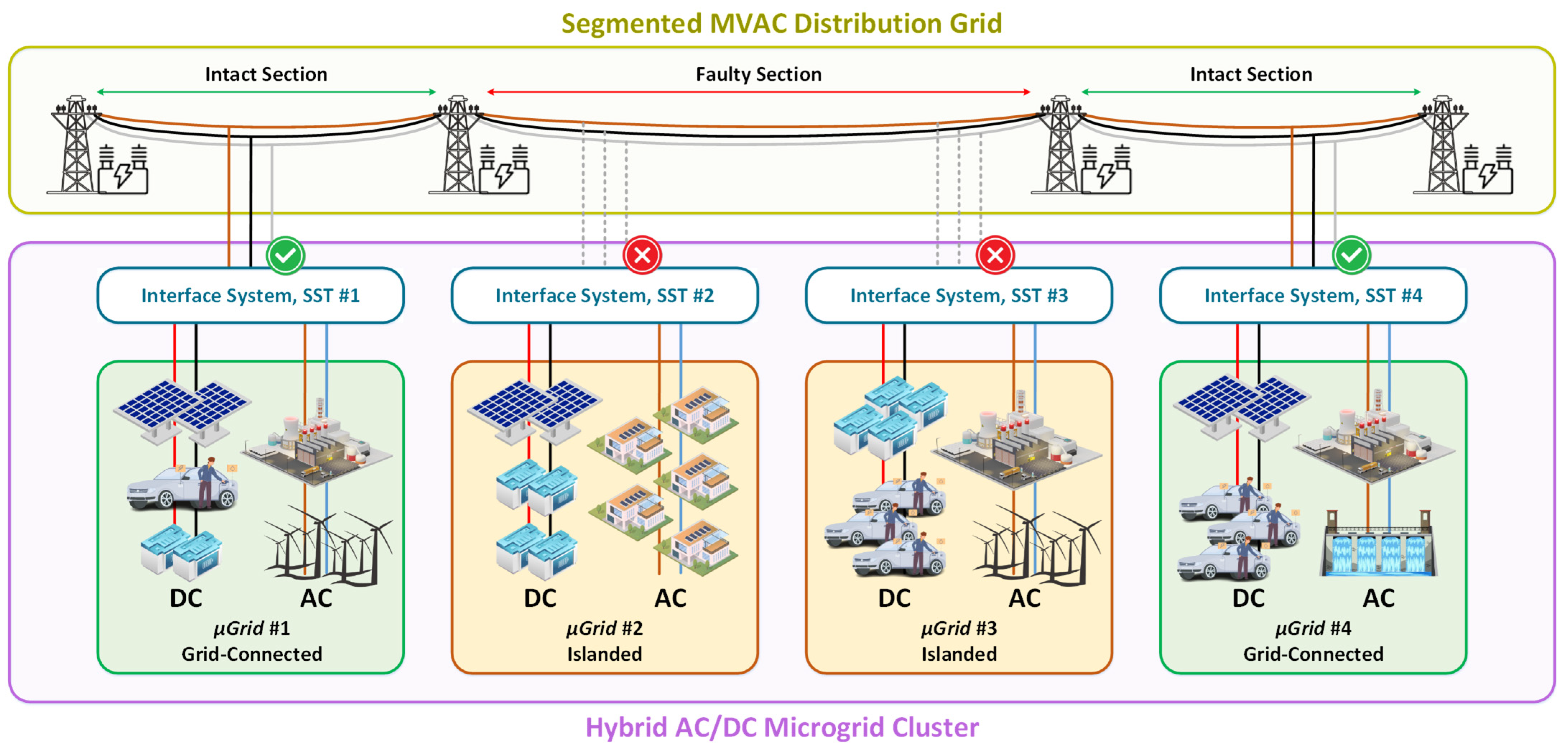
In radial clustered microgrid arrangements, power exchange between neighboring microgrids is mediated through the main MV distribution grid [21]. As perceived in Figure 1, when a fault isolates a given MV segment, adjacent microgrids within the same cluster are unable to support the affected microgrids, even if local surplus generation is available elsewhere in the cluster. This structural limitation reveals a critical vulnerability in some clustered microgrid paradigms and highlights the need for novel resilience-oriented power routing concepts that do not rely exclusively on the upstream MV grid [22]. For this reason, improving the resilience of future distribution systems cannot rely solely on the further deployment of additional DER capacity or oversized storage infrastructure. Instead, it requires the development of new architectural solutions that enhance inter-microgrid power exchange capabilities, enabling flexible and reliable power sharing paths that complement the traditional MV distribution interface.
Recent research has extensively addressed power system resilience against extreme events and large-scale outages, with a particular focus on distribution grid hardening, emergency restoration, and post-contingency operation. Resilience-oriented planning frameworks have been proposed to mitigate the impact of high-impact events [23]. Beyond planning-oriented approaches, several works have focused on emergency operation and outage management following major power interruptions, including coordinated restoration strategies involving repair crews, mobile energy resources, and microgrids that have been developed to accelerate service recovery under multiple outage scenarios [24]. In this context, mobile resources such as electric vehicles and mobile generators, as well as outage management frameworks combining grid reconfiguration and resilience metrics, have been investigated to support critical load restoration [25,26,27].
From a techno-economic perspective, other studies address the optimal operation of microgrids to enhance resilience during grid outages, mainly relying on optimized dispatch of local renewable generation, energy storage, and backup generators to sustain critical loads [28,29]. Similarly, several resilience-oriented strategies have been reported in the literature, including grid reconfiguration and coordinated control of islanded microgrid clusters. In line with the objectives outlined in this paper, ref. [30] provides a comprehensive overview of control, energy storage, and communication strategies aimed at enhancing resilience and service continuity for critical loads under abnormal operating conditions, such as large-scale power outages and extreme climatic events. In turn, ref. [31] investigates an optimal microgrid construction method, explicitly considering not only conventional planning parameters but also the optimal number of microgrids, consumer-side characteristics, fault-recovery mechanisms, and the contingency propagation effects.
Regarding control strategies aimed at improving security and stability in islanded microgrid clusters, ref. [32] proposes a coordination algorithm that enhances interconnection capability by regulating bidirectional power flow while preserving the rated voltage throughout the cluster. Building on similar objectives, ref. [33] develops a novel distributed control framework for islanded microgrid clusters, introducing a containment-based voltage regulation scheme that preserves the voltage levels of sensitive loads during coordinated operation. In [34], a distributed hierarchical control approach is presented to boost voltage and frequency support under grid-forming converter faults.
In [35,36,37], the interconnection of microgrids with back-to-back voltage source converters is explored, improving support during contingencies. In [38], a decentralized control scheme, based on droop and midpoint regulation methods, is proposed to coordinate the power exchange between two adjacent microgrids, enabled by a pair of bidirectional buck-boost converters. In [39], the use of DC feeders to facilitate power sharing among AC microgrids is examined, aiming to improve both resilience and efficiency. Moreover, LVDC microgrids have been proposed as physical power sharing backbones, enabling local self-consumption and efficient energy sharing among aggregated end-users through DC-based architectures and dedicated converter control schemes [40]. From a resilience perspective, LVDC microgrids have also been explored to enhance power system inertia by coordinating energy storage units connected to the DC bus, enabling inertia support and disturbance compensation without relying on real-time communication [41]. Furthermore, resilient fault detection in low-voltage DC (LVDC) microgrids has been investigated using kernel-based cumulative sum and differential cumulative sum techniques, enabling robust identification of faults under different operating conditions [42]. Similarly, ref. [43] presents three approaches for power exchange among DC microgrids, addressing AC-based transfer mechanisms through the distribution system, the creation of additional AC interlinks, and the integration of DC/DC converters to support DC routes.
In [44], a novel interconnection scheme for clustered microgrids is suggested that mitigates power fluctuations caused by RES. The solution relies on suitable power allocation methods and the integration of local energy storage. From a complementary perspective, ref. [45] addresses the optimal sizing of battery energy storage systems and backup generators for microgrids, with the objective of guaranteeing service continuity during extreme events and prolonged grid outages. Similarly, ref. [46] proposes an optimized sizing methodology for energy storage systems to mitigate the impact of multi-directional wake effects on wind turbine frequency support performance, which constitutes a grid contingency condition. With respect to protection and fault mitigation schemes, ref. [47] investigates the integration of superconducting fault current limiters at each point of common coupling (PCC), aiming to improve fault isolation capability.
To further clarify this research gap and facilitate comparison, Table 1 summarizes representative works from the literature with respect to their ability to ensure continuity of power supply to individual microgrids following an upstream MV feeder outage, particularly when local generation and storage resources are insufficient.
While these approaches contribute to fault management and service restoration, only a few studies explicitly address how to guarantee the continuity of power supply to individual microgrids when the upstream MV feeder becomes unavailable, particularly in scenarios where the local generation and storage resources are insufficient to sustain autonomous microgrid operation. Moreover, although the use of SSTs as interface devices between distribution grids and microgrids has been widely investigated, most existing works are primarily focused on improving efficiency and on the number of ancillary services. The inherent reconfigurability and advanced controllability of SST-based architectures are still barely explored as active enablers of resilience at the clustered microgrid level, especially under MV grid segmentation and feeder outage conditions.
In response to this gap and to enhance the overall resilience of clustered microgrid environments under MV segmentation, this paper proposes a novel SST-based emergency power sharing concept. The solution introduces a shared LVDC emergency feeder among the microgrids within a given cluster. These power paths remain inactive during normal operation and are activated under abnormal conditions, enabling controlled power exchange between microgrids when the MV feeder segment is out of service. Given the greater controllability and reconfigurability of the SSTs that interface each hybrid AC/DC microgrid, coordinated power routing is established to ensure the supply of priority loads.
Therefore, this paper puts forward the following contributions:
  • Proposal of a resilience-oriented concept for clustered hybrid AC/DC microgrids, taking advantage of the reconfigurable architecture of SSTs;
  • Introduction of an SST-enabled emergency LVDC power path, maintaining power exchange among microgrids, even when the MV segment is unavailable;
  • A reconfigurable operational framework ensuring continuity of supply without oversizing SSTs or expanding MV infrastructure;
  • Experimental validation of the SST under grid-forming and grid-following operation modes, verifying voltage and current regulation.
Within this context, this paper is organized as follows: Section 2 introduces the fundamental concepts underlying the organization and control of clustered hybrid AC/DC microgrids. Section 3 details the architecture and operation of the proposed SST-based reconfigurable interface. Section 4 describes the adopted topology for the SST and details the experimental prototype implementation. In Section 5, experimental results are presented to validate the performance of the SST. Section 6 indicates the main conclusions.

2. Considerations on Clustered Microgrids

Building upon the resilience challenges identified in the previous section, this chapter discusses the organizational and operational principles of clustered hybrid AC/DC microgrids interconnected to segmented MV distribution feeders. Special attention is given to islanding mechanisms, microgrid clustering strategies, and control structures.

2.1. MV Segmentation and Island Detection

The connection and disconnection of hybrid AC/DC microgrids to the main distribution grid represent some of the most critical transient events in modern power systems [48]. Under both normal and disturbed operating conditions, this condition is essential to guarantee smooth transitions between grid-connected and islanded modes, thus avoiding service interruption and unacceptable voltage and frequency deviations [49,50].
Transitions between modes may occur in a planned or unplanned manner. Planned disconnections arise during scheduled maintenance, peak load mitigation, or congestion management [51], whereas unplanned islanding events are triggered by distribution line faults, protection trips, equipment failures, or human errors [52]. In both situations, timely and reliable islanding detection is critical to preserve system stability. As stipulated by IEEE Std. 1547-2018 [53], DERs within a given microgrid must detect unplanned islanding events and ensure that power flow from the main distribution grid ceases within solely 2 s. Fast detection allows control strategies to be promptly adapted, thereby reducing the impact on sensitive loads and maintaining power quality within acceptable limits.
Island detection techniques are generally classified into local and remote methods [54]. Local detection relies exclusively on microgrid-side electrical measurements, using either passive approaches, based on continuous monitoring of voltage, frequency, phase angle, or impedance, or active methods, which intentionally inject controlled disturbances to assess the grid condition [55]. Although local methods are cost-effective and widely adopted in small-scale systems, their performance may be compromised under specific operating scenarios. Conversely, remote detection methods are based on real-time communication between the distribution system operator and the microgrids. These approaches enable highly reliable and fast fault detection, but at the expense of increased infrastructure and communication costs. For this reason, remote detection schemes are particularly attractive for clustered microgrid environments, where coordinated operation and higher levels of resilience are required [56].
On the other hand, faults at the distribution level are handled through selective protection and isolation mechanisms, such as sectionalizing switches, reclosers, and protection relays. As a result, MV grid segmentation naturally occurs in order to confine faulted areas and protect intact grid sections [57]. While this strategy is essential for accelerating service restoration, it inevitably forces the microgrids connected downstream of the faulted MV segment to operate in islanded mode for potentially extended periods.
Under such conditions, the continuity of service becomes fully dependent on the local balance between generation, storage, and load. If the available DER and energy storage systems are insufficient to sustain autonomous operation, due to fluctuating demand, intermittent renewable generation, and limited storage capacity, the affected microgrids may experience load shedding or partial service interruption, even if surplus generation exists elsewhere in the same microgrid cluster. More critically, although adjacent microgrids may exhibit available excess power, conventional radial MV distribution architectures do not enable direct power exchange once the feeder segment is disconnected. As a result, MV grid segmentation, while indispensable for protection, creates a structural barrier to inter-microgrid power sharing.

2.2. Clustered Microgrid Organization and Classification

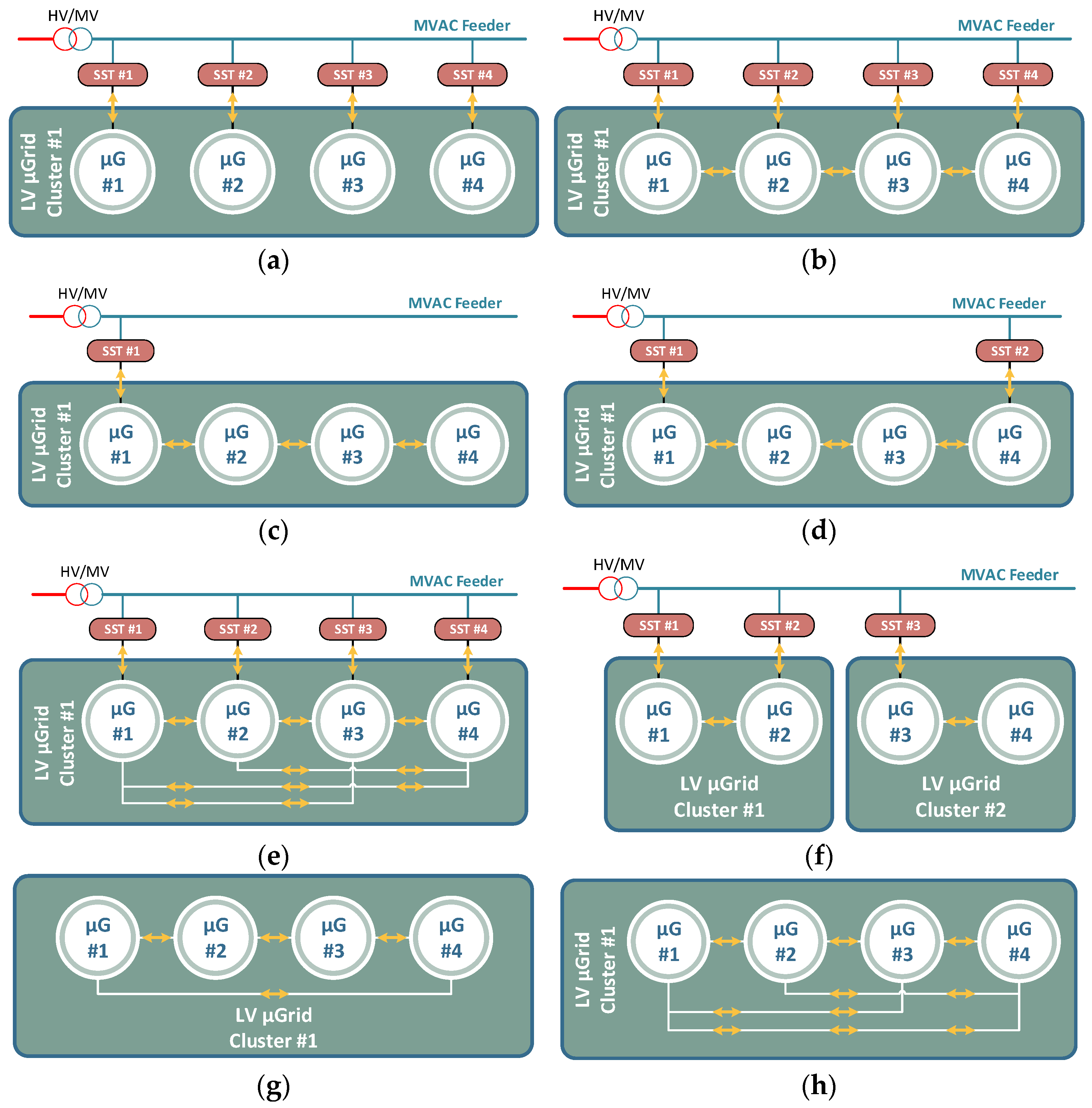
As detailed in Figure 2, to overcome the limitations imposed by a radial clustered microgrid configuration, other power distribution and exchange paradigms are explored. The way microgrids are electrically organized within a cluster has a direct impact on system reliability, fault tolerance, power sharing capability, and control complexity.
As shown in Figure 2a, which presents a radial interconnection scheme, all microgrids are individually connected to a common MV distribution feeder through their respective PCC. This structure offers simplicity in protection, coordination, and centralized control. However, it also introduces a critical single point of failure, since any outage affecting the main MV segmented feeder directly compromises the operation of all downstream microgrids, fully disabling inter-microgrid power exchange [58]. On the other hand, chain-based configurations enable direct power exchange between adjacent microgrids, even when partial isolation from the MV grid occurs. As represented in Figure 2b–d, different levels of resilience and operational flexibility arise depending on the number and location of the PCCs.
In the configuration shown in Figure 2b, each microgrid remains electrically connected to the MV feeder while also establishing interconnections with its neighboring units, allowing power to be exchanged between microgrids #n ± 1. Although this improves local flexibility, the overall system still inherits the vulnerability associated with a single upstream distribution feeder [59]. In the simplified structure of Figure 2c, multiple microgrids share a single PCC with the MV grid, which further preserves the single-point-of-failure characteristic but reduces installation complexity and protection requirements [60]. Conversely, the configuration of Figure 2d interfaces the microgrids with multiple independent MV feeders through several PCCs, slightly enhancing fault tolerance in comparison with single-feeder cascaded strategies. In this case, the loss of one feeder does not necessarily lead to service interruption, as power can be rerouted through alternative paths [61]. Overall, series-based interconnections strengthen resilience, power routing capability, and continuity of service, at the expense of increased control and coordination complexity.
Conversely, the redundancy and resilience are further increased in fully meshed microgrid configurations, as depicted in Figure 2e, where all microgrids are interconnected not only with the MV distribution grid but also among themselves. In such architectures, energy can flow through multiple alternative paths, allowing effective fault mitigation and power redistribution even under severe contingencies. However, this improved reliability comes at the cost of significantly higher implementation, protection, and maintenance complexity, which grows rapidly with the number of interconnected microgrids [62,63].
To compromise between redundancy and complexity, mixed parallel–series configurations are also reported, as exemplified in Figure 2f. In these arrangements, different microgrid groups adopt distinct interconnection schemes, offering increased adaptability to specific applications while avoiding the complexity of a fully meshed structure [64,65].
Ring-based interconnections, observed in Figure 2g, microgrids are interconnected in a closed-loop structure. In this case, power exchange is always mediated through intermediate microgrids, and a fault in one segment does not necessarily interrupt system operation, since power can be rerouted through the opposite side of the ring. Nevertheless, the absence of a direct and stiff interface with the MV distribution grid makes voltage regulation more challenging and increases operational complexity [66,67].
This philosophy is further extended in pure series configurations without any direct connection to the MV grid, as shown in Figure 2h. In these arrangements, multiple microgrids form interconnected chains fully decoupled from the main distribution infrastructure. While this maximizes redundancy and minimizes the impact of localized faults, it also demands highly coordinated control strategies and robust energy management systems to guarantee long-term stability and balance between generation and demand.
Each clustered microgrid organization presents inherent trade-offs between resilience, controllability, scalability, and cost. Although higher interconnection improves fault tolerance and power routing flexibility, it also results in increased protection complexity and control burden. In view of the objectives targeted in this paper, namely, the ability to sustain power exchange under abnormal conditions, series-based clustered microgrid configurations, as illustrated in Figure 2b, emerge as particularly attractive.
However, the clustered organization of microgrids is not dictated solely by topological features. It is also influenced by geographical constraints, load distribution, network expansion planning, and by the electrical nature of microgrids, which may be classified as AC, DC, or hybrid AC/DC. A comparative synthesis of the main advantages and limitations of AC and DC microgrid typologies is provided in Table 2, highlighting the motivation for adopting hybrid architectures in resilience-oriented clusters.
Accordingly, AC microgrids are the mature solution from a technological standpoint, benefiting from standardized practices and straightforward interfacing with the distribution grid. However, they require synchronization and introduce power quality concerns [68]. Conversely, DC microgrids simplify the integration of DERs, while reducing the number of conversion stages and losses, albeit at the expense of demanding protection requirements [69].
Hybrid AC/DC microgrids, which combine both infrastructures, provide superior operational flexibility and energy management potential, enabling higher efficiency under high renewable penetration scenarios, but at the cost of increased complexity and cost [70]. For these reasons, hybrid AC/DC clustered microgrids are particularly relevant for investigating advanced resilience-oriented power routing strategies.

2.3. Control Strategies for Microgrids

The reliable interconnection of microgrids within modern electrical systems requires not only advanced control strategies but also adequate planning [71]. Moreover, ensuring proper synchronization with the distribution grid is also a fundamental requirement for grid-connected operation. Among the available approaches, closed-loop synchronization techniques stand out for their ability to dynamically align voltage, frequency, and phase with improved robustness and lower sensitivity to disturbances [72].
As microgrids can operate as coordinated clusters, their interaction must be carefully designed to ensure secure power and data exchange, operational flexibility, and scalability under both steady-state and transient conditions. Control of microgrids is, therefore, complex, largely due to the dynamic features introduced by the smart grid paradigm [73]. The control objectives and functionalities strongly depend on the electrical nature of the microgrid, i.e., AC, DC, or hybrid AC/DC, as well as on its operating mode, i.e., grid-connected or islanded [74]. Thus, adaptive control strategies are required to guarantee, under all conditions: (i) regulation of voltage, current, and frequency; (ii) smooth transitions between modes; and (iii) coordinated interaction with demand response strategies [75].
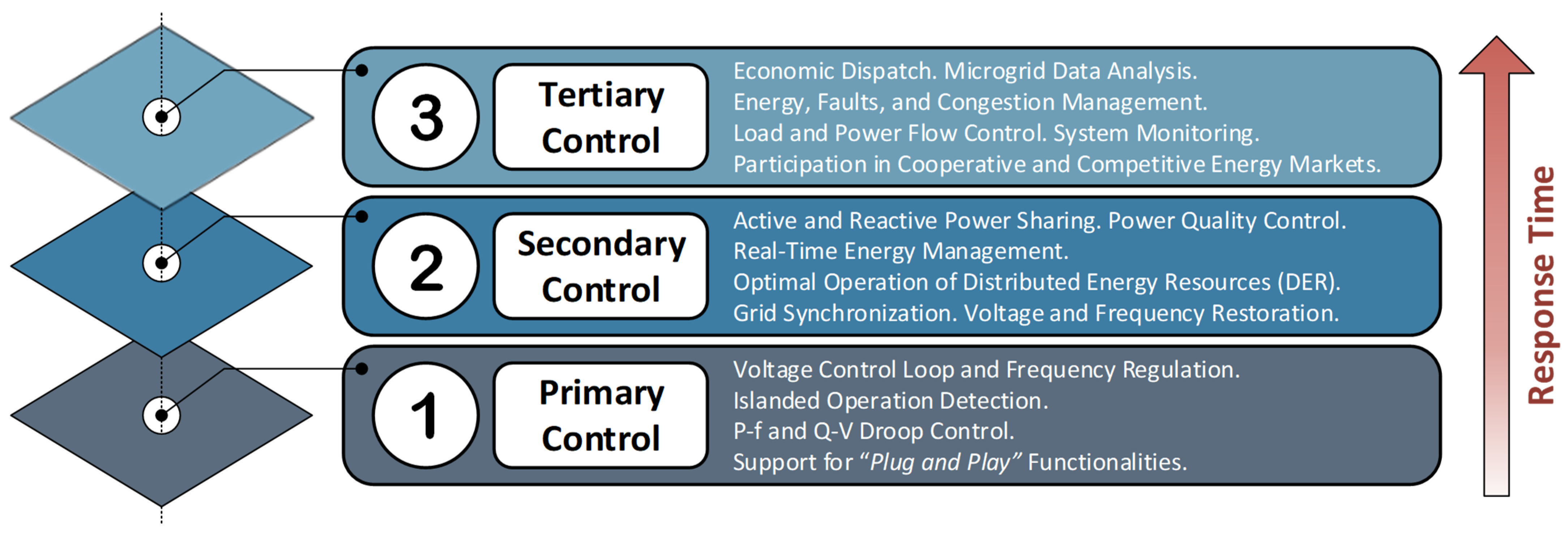
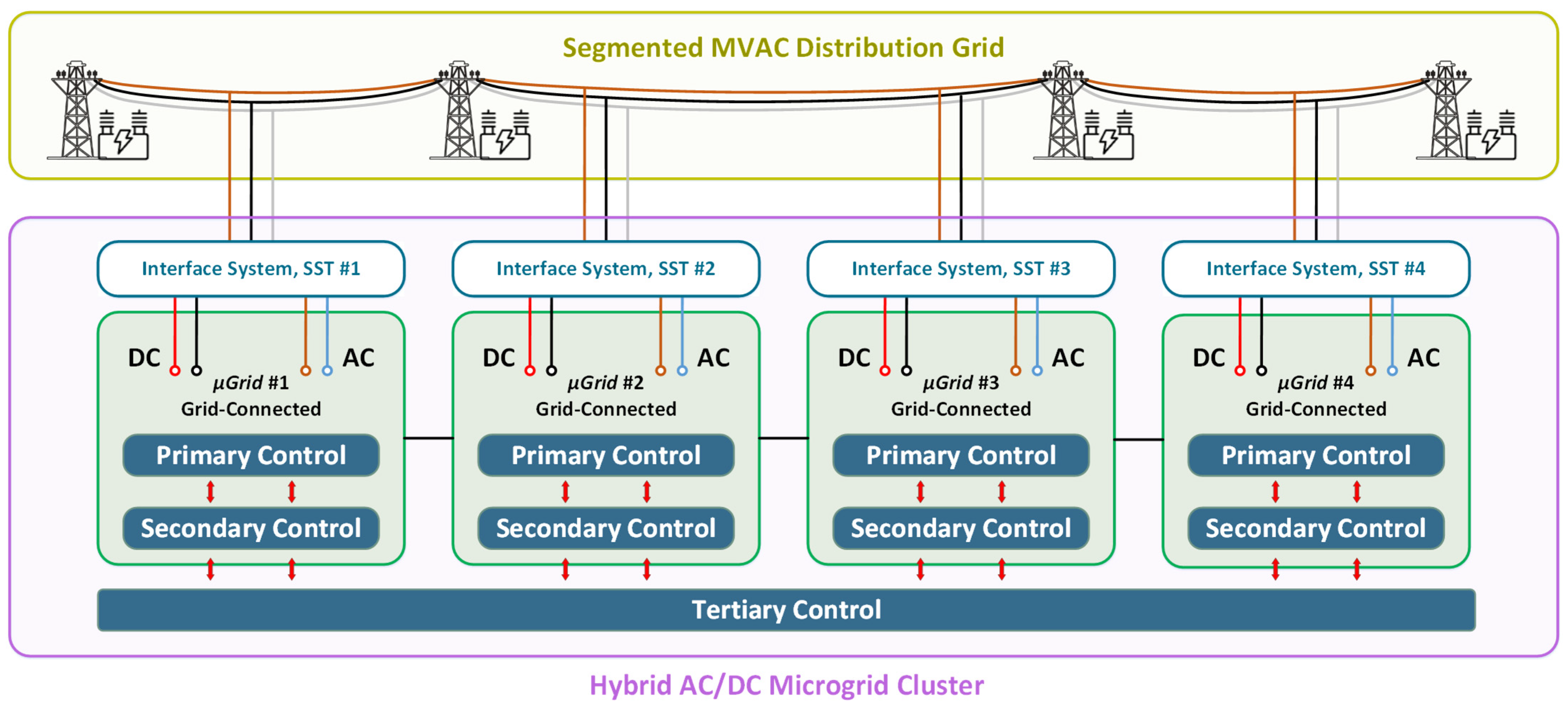
Despite the wide diversity of control approaches, there is a clear convergence towards hierarchical architectures [76,77]. However, coordination among units may follow either master–slave [78] or peer-to-peer [79] paradigms. From a decision-making and communication perspective, i.e., tasks normally associated with the secondary and tertiary layers of the hierarchical approach, microgrids may further adopt centralized, decentralized, or fully distributed control schemes. Additionally, recent studies have begun exploring nested control structures, which remain at an early research stage but show promise for enhancing coordination in complex microgrid clusters [80]. As detailed in Figure 3, the coordination and operation of clustered microgrids are commonly structured according to a three-layer hierarchical control architecture, namely primary, secondary, and tertiary levels, each defining the functional and temporal decomposition of control tasks.
The primary control layer is responsible for the fastest dynamic actions under both grid-connected and island modes. It ensures the regulation of the main electrical variables, as well as the immediate detection of islanding conditions. Typical control strategies at this level include droop-based methods [81], proportional–integral (PI) controllers [82], virtual impedance techniques [83], and model predictive control [84]. In addition, maximum power point tracking strategies [85] are commonly implemented for renewable-based DERs, while more advanced approaches based on multi-agent systems [86] or artificial intelligence and machine learning have also been reported [87,88].
The secondary control layer operates on a slower time scale and focuses on the compensation of steady-state deviations. The main objectives include the restoration of voltage and frequency to nominal values, regulation of active and reactive power, grid synchronization, and the coordination of energy management actions within the microgrid cluster. Although less demanding in terms of computational effort, this layer plays a critical role in ensuring the global stability and power quality of the system.
The tertiary control layer is mainly associated with higher-level optimization and supervisory functions. It typically handles economic dispatch, power flow direction and magnitude, data analytics, fault management, and interaction with energy markets [89]. Forecasting and planning capabilities are also embedded, enabling optimal scheduling of generation and storage resources. As expected, higher forecast accuracy directly translates into improved economic performance and enhanced operational reliability.
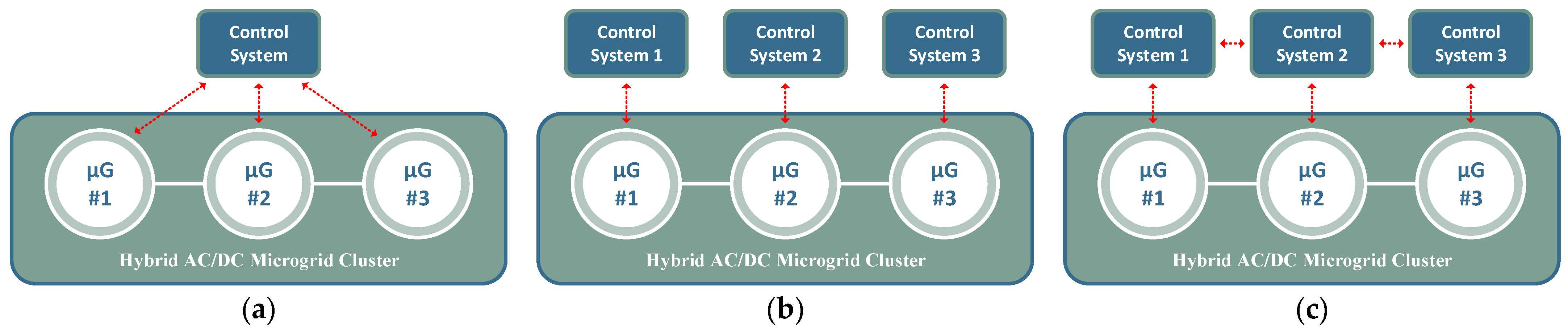
As mentioned above, hierarchical control may be complemented with centralized, decentralized, or distributed architectures, as illustrated in Figure 4. In the centralized approach, a single supervisory controller is responsible for ensuring the coordinated operation and stability of the entire cluster. This structure offers reduced implementation costs and avoids redundancy. However, the heavy computational burden imposed on a single controller increases susceptibility to faults and limits flexibility. Moreover, as new microgrids are integrated into the cluster, the control complexity grows exponentially, requiring continuous reconfiguration and updating of the central processor [90].
To decrease fault vulnerability, decentralized architectures define each microgrid as an autonomous entity equipped with its own local controller, thus increasing robustness. In this case, a fault occurring in one microgrid does not compromise the data processing of the remaining units. Nonetheless, compared to centralized structures, information sharing and global coordination among microgrids tend to be less reliable [91].
Conversely, distributed architectures are seen as highly reliable, redundant, and scalable solutions for clustered microgrid environments. In this framework, each microgrid is managed by a local controller responsible for its internal optimization, while also exchanging operational data with the distribution system operator (DSO). The DSO acts as a global coordination entity, supervising inter-microgrid power exchanges, preventing control conflicts, and ensuring economically optimal operation at the cluster level [92].
To further clarify the distinction between these control classifications, Figure 5 depicts a conventional hierarchical control architecture implemented over a decentralized structure. In this arrangement, the primary and secondary control layers directly interact with each microgrid. The main objective is to stabilize voltage and current values, particularly during transient states.
The primary layer must detect islanding requirements and forward the appropriate operating mode transition commands to the secondary and tertiary control layers, which are then responsible for active and reactive power balancing, economic dispatch, among other high-level features.

3. Proposed SST-Based Reconfigurable Interface for Emergency Power Sharing

Building upon the identified challenges and opportunities, it is essential to define a new architectural solution that enhances the power routing resilience of clustered hybrid AC/DC microgrids. Such a solution must not only address the structural limitations of segmented MV distribution but also be fully compatible with existing infrastructure.

3.1. System-Level Concept

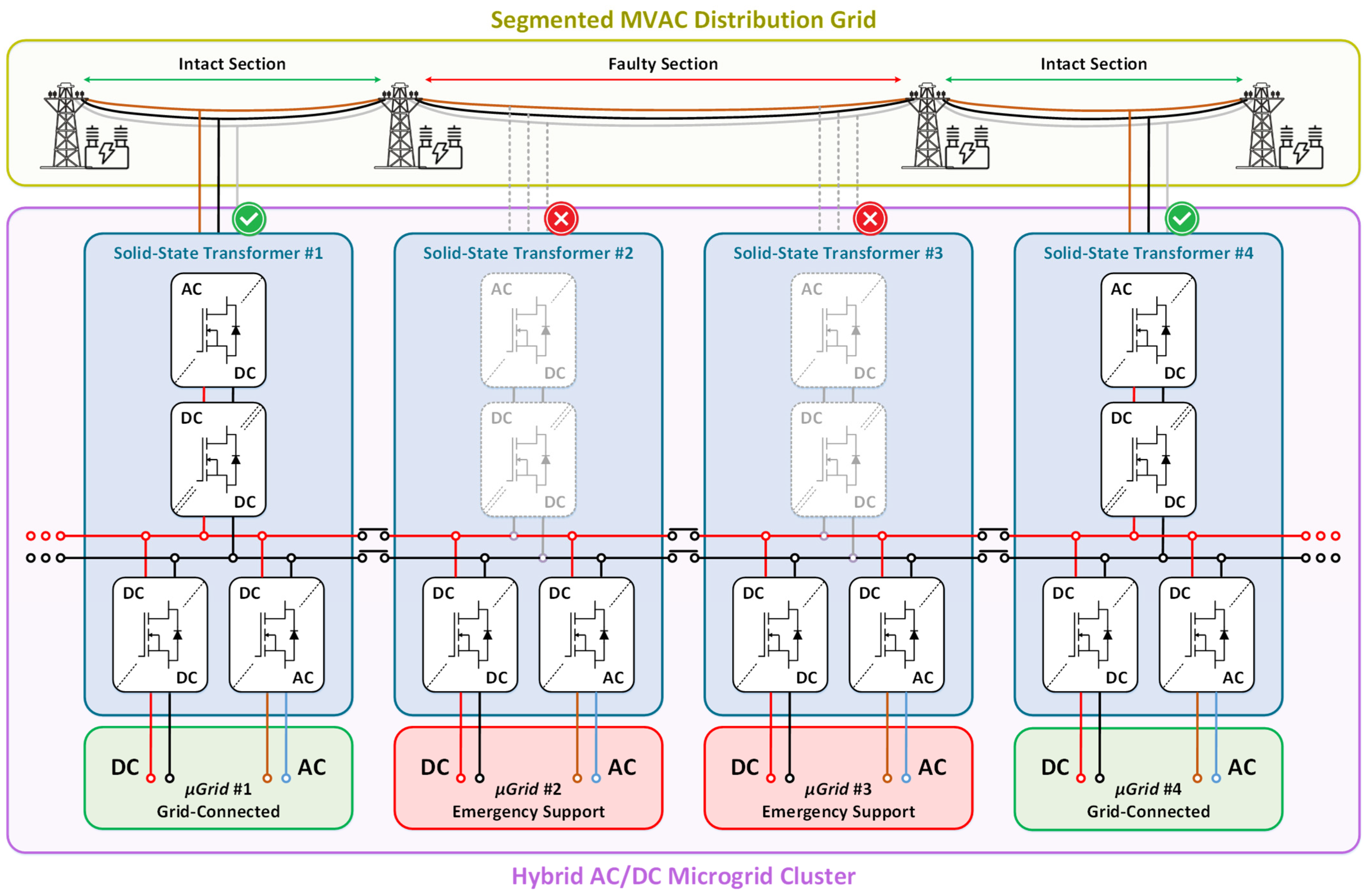
The proposed SST-based clustered microgrid architecture, illustrated in Figure 6, is designed to support resilient operation under both normal and contingency conditions. The control structure is organized to ensure local stability at the microgrid level while enabling coordinated power exchange among multiple microgrids during abnormal operating scenarios.
In this regard, when microgrids #2 and #3 become disconnected from the distribution system due to a fault along the corresponding feeder segment, they initially continue operating autonomously as long as local generation and storage remain sufficient. Only when the affected microgrids exhaust their local energy availability (typically during prolonged MV outages) is the additional LV emergency DC feeder activated, enabling controlled power support from the remaining microgrids within the cluster.
Therefore, this additional LV path partially restores the supply capability, despite the loss of MV support. However, as previously discussed in the introduction, only the priority loads of the islanded microgrids are supplied, since the total demand is inherently constrained by the aggregated admissible capacity of the SSTs connected outside the faulted MV segment In the case of implementing hierarchical control, the secondary and tertiary layers will play a central role, as they enable coordinated power routing, the selective activation of the LV emergency DC feeder, and the real-time prioritization of critical loads during MV outages. These layers would also be responsible for managing load-sharing constraints and the power balance required to sustain the emergency operation.
Among adjacent microgrids within the cluster, power exchange is enabled through the dedicated LV feeder, which operates in line with previously reported back-to-back power-converter schemes. However, unlike the approaches found in the literature, the proposed concept does not rely on additional and redundant AC/DC or DC/DC converters, as it takes advantage of the SST’s multiport and reconfigurable nature. Instead, the power transfer function is naturally implemented through the third conversion stage of each SST, inherently providing bidirectional power processing.
Note that the switching elements shown in the LVDC interconnection are included for illustrative purposes to indicate physical coupling permissiveness, while all power flow regulation and isolation are performed by the SST interfaces.

3.2. Operation Modes and Framework

To ensure proper operation of the proposed emergency power-sharing architecture, the SST must seamlessly transition between grid-following and grid-forming operation modes, supported by appropriate voltage and current regulation strategies.
Under normal grid-connected conditions, each microgrid operates in grid-following mode. For this case, the interfacing SSTs synchronize with the voltage waveform imposed by the upstream MV distribution grid. Active power exchange is regulated through current control, with the injected or absorbed current remaining, respectively, in phase or in phase opposition with the MV grid voltage. In this operating condition, the MV grid is the electrical reference, and the SSTs primarily act as controlled power interfaces between the AC and DC domains.
Conversely, the grid-forming operation becomes critical when the SST must establish an electrical reference in the absence of a fixed voltage source. This occurs: (i) after an MV feeder outage, triggering the islanding of µGrid #2 and µGrid #3; and (ii) when the emergency LV feeder is activated due to insufficient local energy availability within the isolated microgrids. In these scenarios, the SST must both regulate the local DC-level bus voltage and support load variations.
To support these operating modes, appropriate low-level control strategies are implemented at the SST interfaces. Conventional voltage and current regulation schemes are adopted to ensure stable operation under both grid-connected and contingency conditions. Stationary-frame PI controllers are used for DC-side voltage and current regulation, while synchronous-frame PI controllers are employed on the AC side to regulate grid currents and maintain synchronization. These control loops operate at the converter level and are responsible for ensuring fast dynamic response and stability.
Current regulation plays a critical role during emergency power sharing through the LVDC feeder, as it limits the contribution of each SST located in intact MV segments and prevents feeder overloading. Voltage regulation, on the other hand, ensures that priority loads remain supplied even under fluctuating renewable generation, sudden load changes, or asymmetrical conditions across the cluster. Thus, the coordinated use of grid-forming and grid-following modes, together with robust voltage and current control, is the key to enabling self-healing, controlled power routing, and stable recovery of isolated microgrids.
Higher-level coordination mechanisms, detailed in Section 2, are referenced to provide conceptual insight into hierarchical operation. However, the detailed design, tuning, and validation of advanced inter-microgrid control algorithms under highly dynamic conditions are beyond the scope of this paper. The focus is to validate the feasibility of the proposed SST-based architecture and to demonstrate, through a practical laboratory-scale prototype, its capability to actively manage power exchange under contingency scenarios.

4. SST Topology, Sizing, and Prototype Implementation

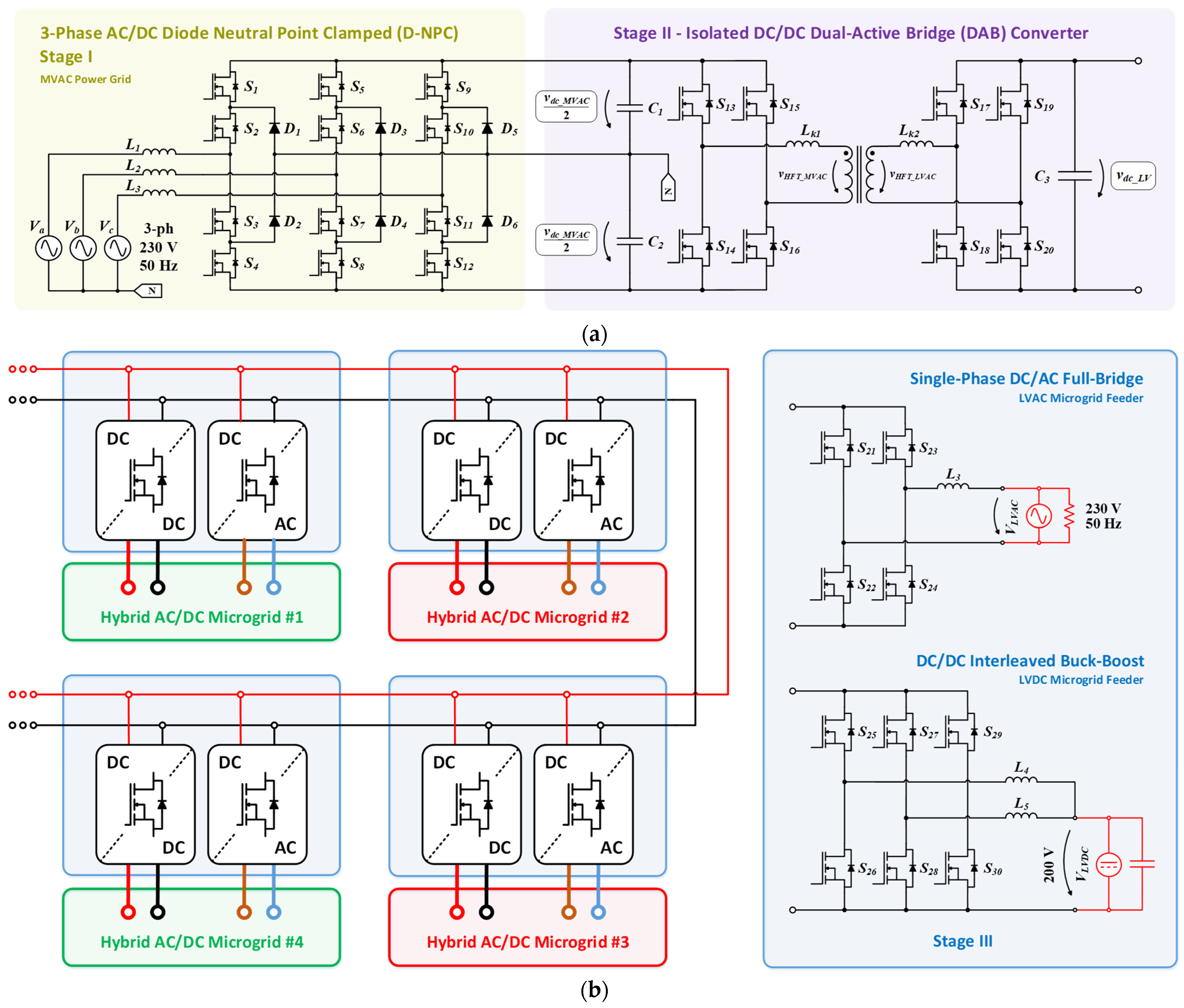
To validate the proposed SST-based reconfigurable architecture for backup power sharing among microgrids, this section presents the adopted power electronic topology and outlines the implementation details of the prototype. As illustrated in Figure 7, the proposed SST follows a well-established three-stage structure, providing controllability, galvanic isolation, independent control of MV and LV ports, and bidirectional power transfer capabilities required by microgrid clusters.
In the first stage, an AC/DC diode neutral-point-clamped (D-NPC) converter is employed to interface with the upstream MV distribution system. Although full-scale MV implementations typically rely on cascaded H-bridge or modular multilevel converter structures, due to their superior scalability and voltage handling capability, the D-NPC topology remains fully adequate for reduced-scale laboratory validation.
The second stage provides high-frequency galvanic isolation and DC-link voltage regulation through a dual-active-bridge (DAB) converter. By incorporating a high-frequency transformer (HFT), this stage significantly enhances power density and enables precise control of power transfer between the MV-side and LV-side DC buses. Under grid-connected operation, this is the SST stage responsible for regulating the bidirectional power flow according to the system-level requirements. Using single-phase-shift (SPS) modulation, the average transferred power, P, is given by:
P = N   V d c 1   V d c 2   2 π 2 f s w   L   φ   ( π φ )  
where fsw is the switching frequency, L denotes the equivalent leakage inductance referred to one side of the HFT, Vdc1 and Vdc2 are the DC-link voltages at the primary and secondary ports, respectively, φ is the phase-shift angle between the bridge voltages, and N represents the HFT turns ratio. Positive values of φ establish power flow from the primary to the secondary, whereas negative values reverse the direction. Under SPS, maximum transferred power (Pmax) occurs at φ = π/2, yielding:
P m a x = N   V d c 1   V d c 2   8   f s w   L
This formulation highlights the importance of proper HFT design, since excessive leakage inductance limits the maximum power transferred, while insufficient leakage inductance increases current ripple and switching losses.
The third stage interfaces with the microgrid’s AC and DC feeders, therefore playing a central role in enabling the emergency LV power path proposed in this paper. Internally, a full-bridge AC/DC converter is used to supply the AC feeder, whereas power exchange with the DC counterpart is performed by an interleaved bidirectional buck-boost converter. Both are controlled to operate either in grid-following or grid-forming mode, depending on the microgrid operating state. The goals are to ensure stable voltage formation, controlled current injection, and coordinated power sharing during MV outages.
In this regard, special attention must be devoted to hardware design, particularly the HFT, that must exhibit: (i) sufficiently low leakage inductance to avoid power transfer limitations; (ii) minimal inter-winding capacitance to preserve waveform quality; and (iii) an optimized turns ratio and core geometry to maintain acceptable magnetic flux density under all operating conditions. Design guidelines for HFT construction, sizing, and material selection are well documented in the literature and have also been addressed in prior work by the authors [93]. Following the topology description, the system was implemented in a modular laboratory prototype built to validate the main functionalities of the proposed SST-based architecture under reduced-scale conditions. Table 3 summarizes the nominal electrical characteristics of the prototype.
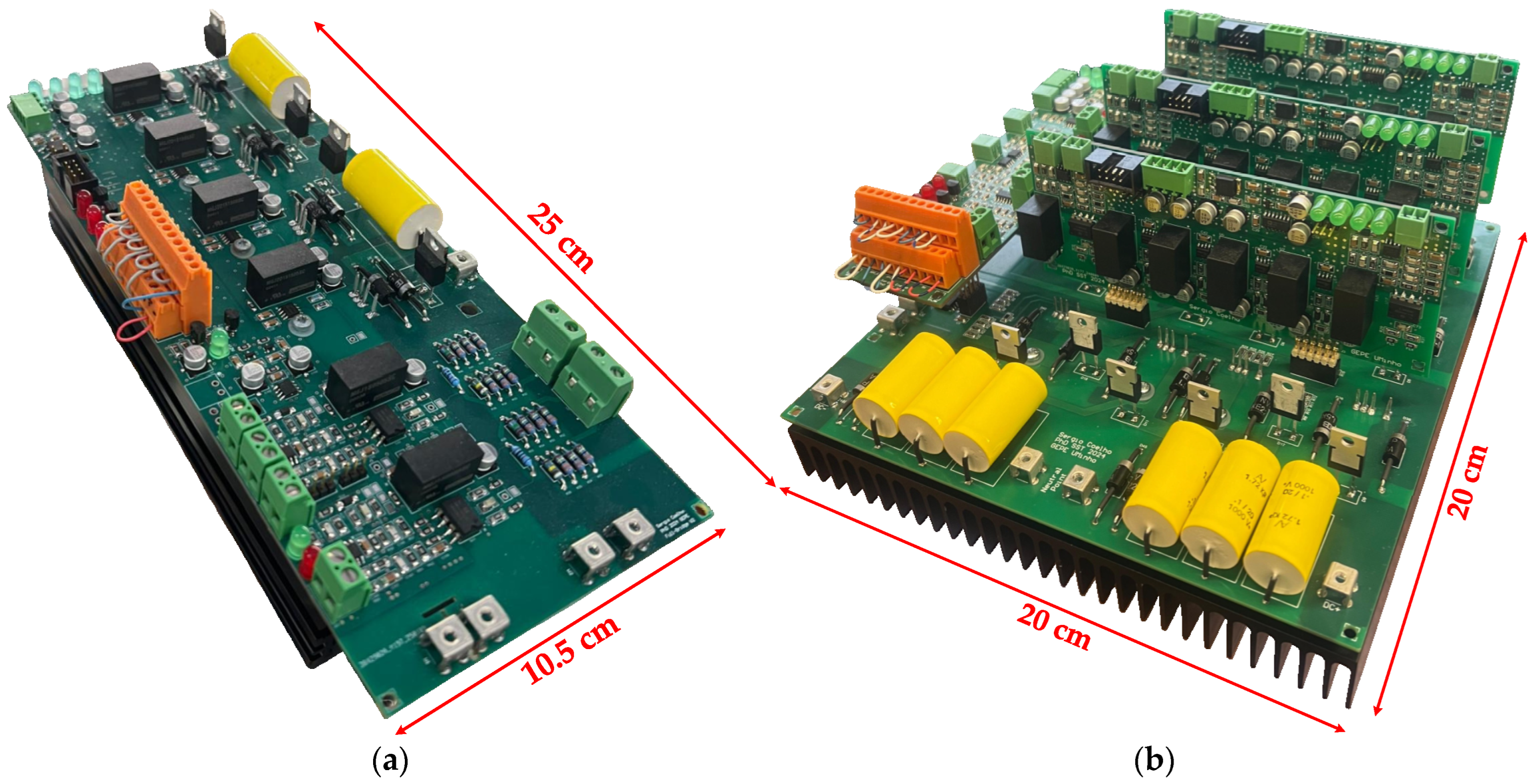
Based on electrical specifications, a SiC-based modular power electronics prototype was developed to experimentally validate the principles of the proposed architecture. Figure 8a presents the PCB developed for the single-phase AC/DC full-bridge converter. Three units are employed within the SST structure, namely two forming the DAB converter and the other for the LVAC feeder interface. On the other hand, Figure 8b shows a reconfigurable power stage PCB, capable of operating either as an interleaved bidirectional DC/DC buck–boost converter with three legs or as a three-phase D-NPC AC/DC converter that connects to the segmented MV distribution grid. For both converter boards, careful selection of SiC MOSFETs, Schottky diodes, and transient-voltage suppressors (TVS) is of critical importance. High-bandwidth voltage and current sensors with surface-mount assembly were adopted to facilitate accurate measurement and compatibility with the fast-switching nature of SiC devices. The gate-driver circuits were likewise selected to support the high dv/dt and di/dt conditions intrinsic to wide-bandgap operation.
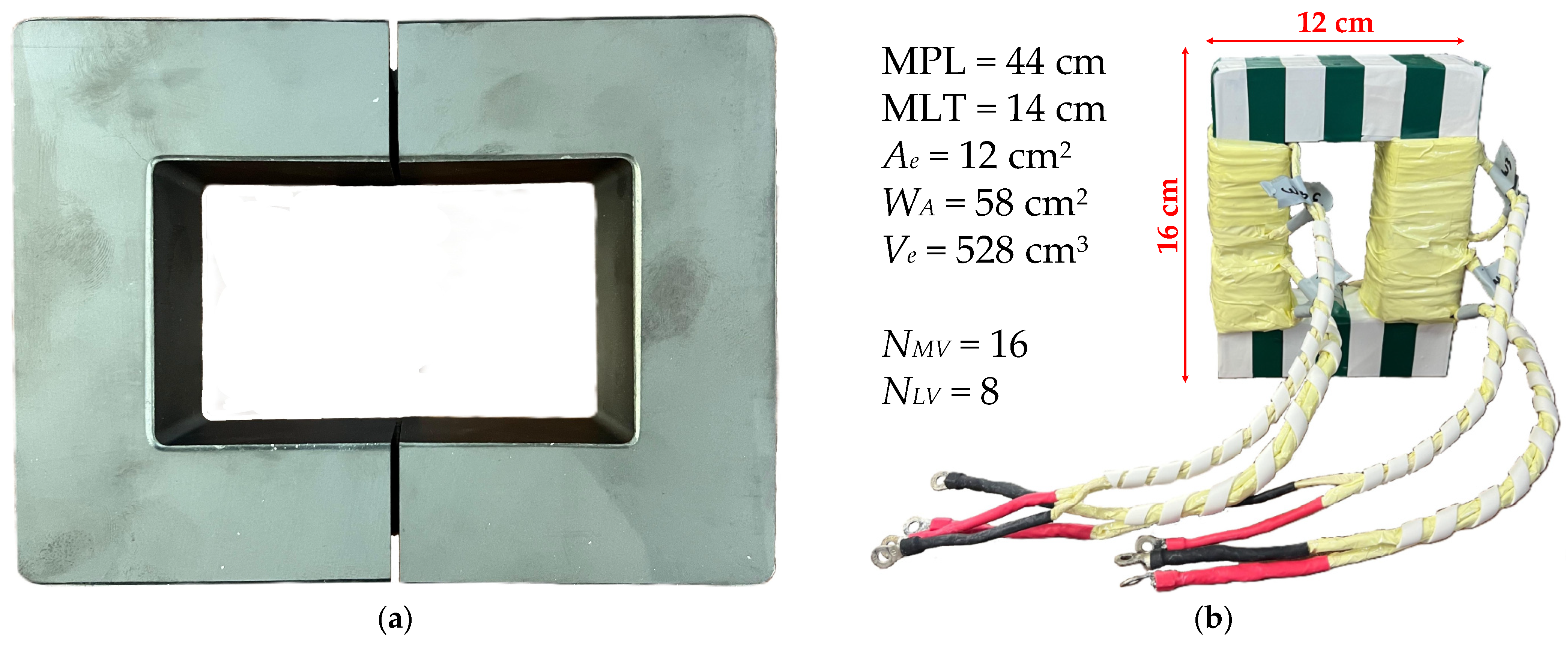
Regarding the development of the HFT, based on the design requirements previously discussed, a pair of Manganese Zinc (MnZn) ferrite cores with reference UF 120/80/40, manufactured by IF Cores, was selected. The two cores are assembled in a UU configuration, as seen in Figure 9a, which provides a well-defined magnetic path, promotes balanced flux distribution, and mitigates leakage inductance asymmetries between windings. The choice of both the core geometry and UU configuration was driven by cost-performance indicators and mechanical integration, whereas the MnZn ferrite was chosen to guarantee sufficient margins against flux saturation and excessive magnetic losses.
Loss minimization is addressed through the calculation of an optimal magnetic flux density (ΔB). Although the optimal analytic value of ΔB is approximately 66.45 mT, a higher operating flux density of 200 mT was deliberately selected in the final design. This choice enabled a reduction in the number of turns, resulting in a more compact HFT that is better suited for experimental validation and proof of concept. Importantly, the selected ΔB remains below the saturation limit of MnZn ferrite materials, typically around 300 mT, thus preserving safe operation. Accordingly, the HFT was designed with 16 turns on the MV side and 8 turns on the LV side, complying with the 2:1 turns ratio.
Although the developed HFT physically accommodates multiple windings, only a single MV-side winding and a single LV-side winding are employed in the experimental validation presented in this work. The additional windings are intentionally included to provide design flexibility, allowing future reconfiguration, parallel or series association of windings, and evaluation of alternative arrangements under different operating scenarios. This approach enhances the reusability of the HFT platform without affecting the validity of the experimental results. Note that a non-overlapped winding arrangement is adopted to reduce parasitic capacitances and improve high-frequency performance.
Figure 9b presents a photograph of the developed HFT integrated into the SST prototype. The main electrical parameters of the HFT are summarized in Table 4, including the total self-inductance, L_i, leakage inductance, Lk_i, and winding resistance, Rs_i, of a given port i, as well as the mutual inductance, MMV_LV, and parasitic capacitance, CMV_LV, between the MV and LV sides of the HFT. The measured values are consistent with the calculated sizing, confirming the suitability of the HFT for bidirectional isolated power transfer within the proposed SST architecture.

5. Experimental Validation

To validate the effectiveness of the proposed ideology, experimental results obtained from each conversion stage of the SST prototype are presented. The analysis covers different operating conditions, with respect to: (i) the three-phase AC/DC D-NPC converter; (ii) the isolated DC/DC DAB stage, evaluated under bidirectional power transfer using SPS modulation; and (iii) the AC/DC full-bridge and the DC/DC interleaved buck-boost, composing the third stage of the SST, responsible for interfacing with the hybrid AC/DC microgrid. This final stage is assessed under both grid-following and grid-forming modes, since the latter is essential for supporting autonomous operation during contingencies and for enabling emergency power sharing. All experiments were conducted with switching and sampling frequencies of 50 kHz. Waveforms were recorded using a Rohde & Schwarz RTH1004 digital oscilloscope, while control was implemented on a Texas Instruments TMDSCNCD28379D digital signal processor (DSP).
To validate the grid-following capability of the SST under normal operating conditions, experimental tests were first performed on the three-phase D-NPC AC/DC converter interfacing the distribution grid. These tests focus on the controlled absorption and injection of active power from and into the MV power grid, where synchronization is mandatory, and grid voltage waveforms exhibit significant harmonic distortion. In the first test, the D-NPC converter operates as an active rectifier. Resistive loads were connected in parallel with each capacitor of the MV-side DC-link, while the three-phase AC supply was fed through an isolation transformer to limit the phase RMS voltage to 25 V. The primary objective of this test is to regulate the MV-side DC-link voltage, vdc_MV, which must remain controlled during integrated SST operation.
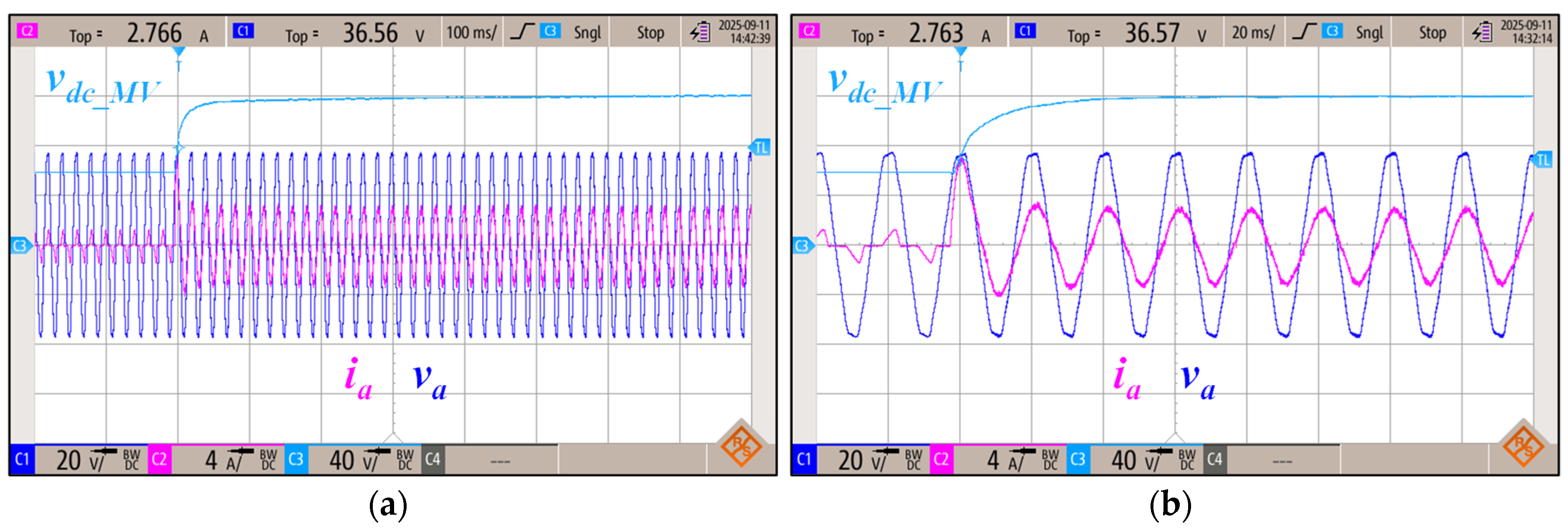
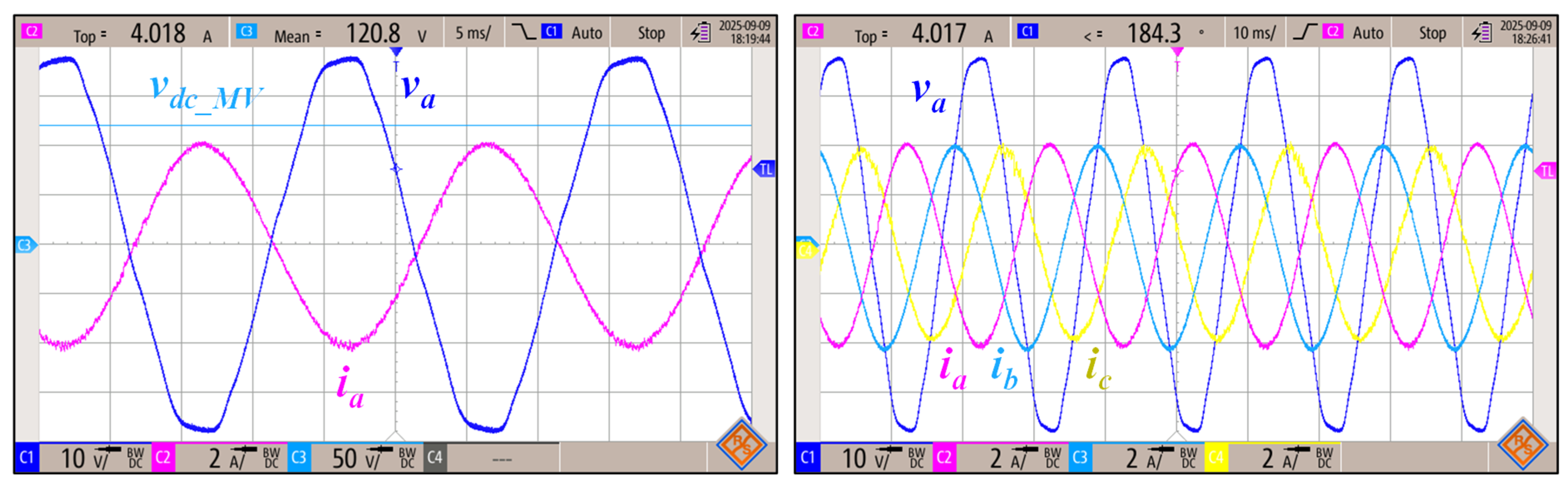
Figure 10 and Figure 11 present experimental results confirming active power absorption from the power grid. Figure 10 illustrates the starting operation of the converter and the subsequent action of the stationary PI controller. The measured waveforms include the phase voltage, va, the corresponding phase current, ia, and vdc_MV, shown at two different time scales. On the left side, a global view of the transient response and convergence of vdc_MV to its reference is provided, while Figure 10b highlights the initial synchronization of va with ia. For clarity, only phase-a electrical waveforms are shown, since vb and vc, along with currents ib and ic, exhibit analogous behavior.
Although direct DC voltage control could be implemented, a power-based theory was adopted instead. In this approach, the reference currents ia*, ib*, and ic* are derived from the desired DC-link voltage, vdc_MV. Consequently, the stationary PI controller acts on the phase currents, ensuring they remain sinusoidal and in-phase with the corresponding grid voltages, va, vb, and vc. As observed in the detailed waveforms, synchronization is not instantaneous, requiring a few grid cycles to reach steady-state operation.
The voltage reference for vdc_MV is set to 120 V, for which stable convergence was obtained. With a resistive load of 52 Ω connected in parallel with each capacitor of the split DC-link, the steady-state amplitude of ia is stabilized at approximately 2.763 A. Prior to converter switching, the phase current profile reflects natural diode conduction through the antiparallel diodes of the active semiconductors, resulting in a passive pre-charging of vdc_MV up to the peak line-to-line voltage, i.e., 25 2 3 V.
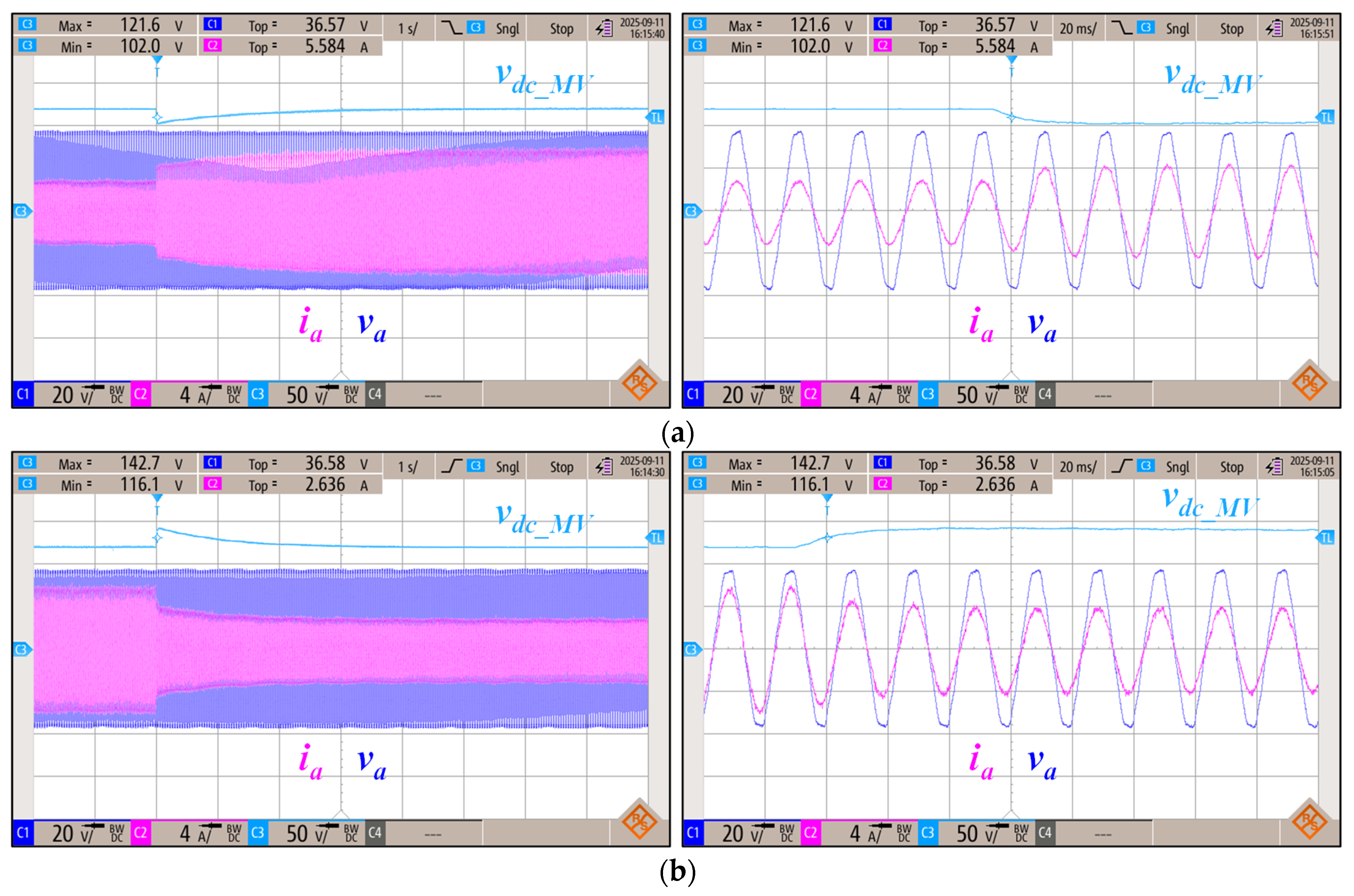
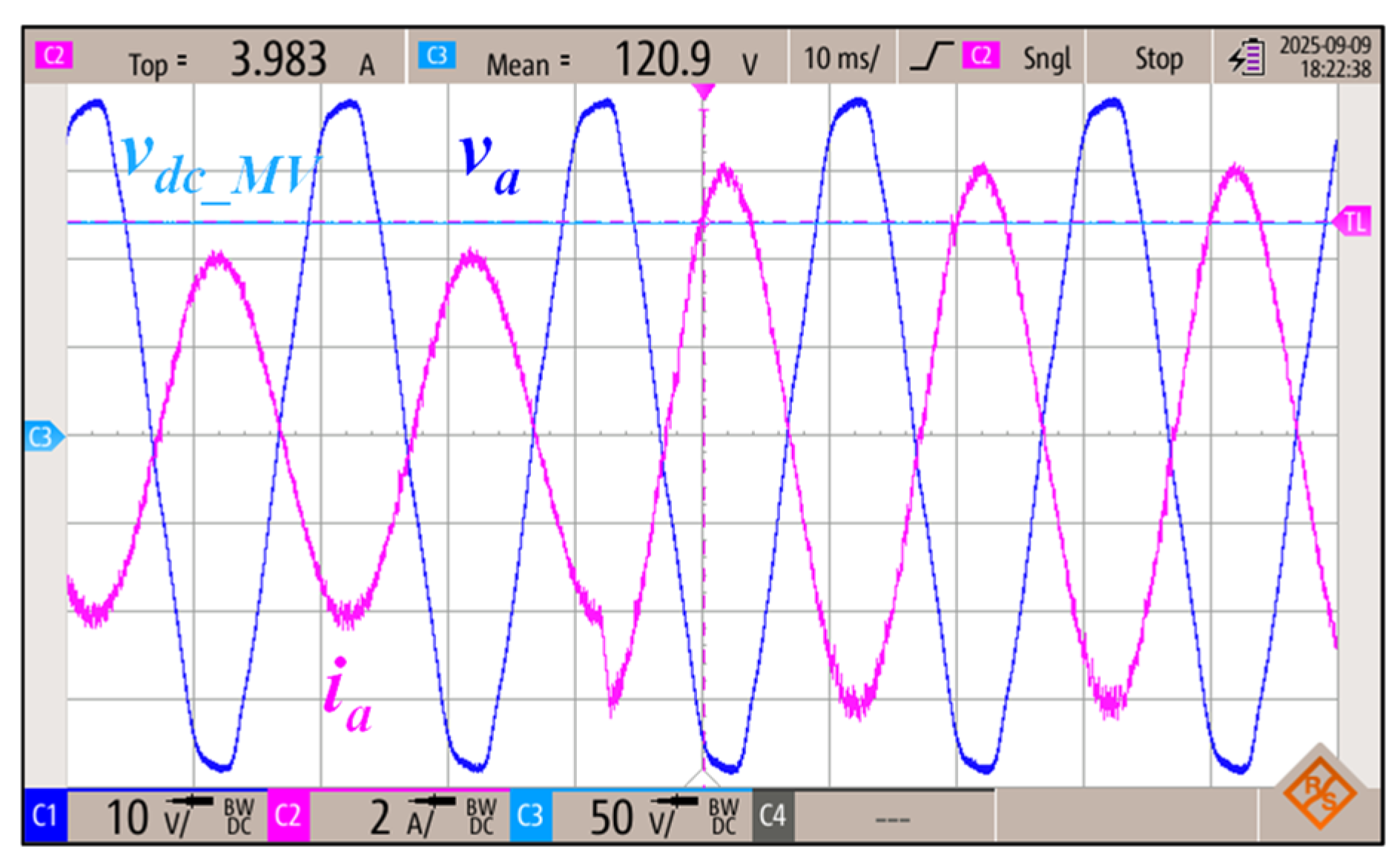
Subsequently, the dynamic response of the three-phase D-NPC converter was evaluated under step variations in the DC-side resistive load. For consistency, Figure 11 presents, once again, the waveforms of va, ia, and vdc_MV. As expected, the amplitude of ia directly follows changes in the load resistance, while vdc_MV is regulated back to its reference value of 120 V. Each test is shown using two complementary time scales, i.e., on the left side a wide temporal window illustrating the convergence toward steady state after the disturbance and, on the right side, a detailed view focused on the transient interval.
In the scenario depicted in Figure 11a, the load was reduced from 52 Ω to 26 Ω. This change caused an increase in the steady-state amplitude of ia to approximately 5.58 A, accompanied by a transient voltage dip in vdc_MV, which momentarily decreased from 121.6 V to 102 V before converging back to the 120 V reference. Conversely, Figure 11b shows the inverse transition, where the load resistance was increased back to 52 Ω. In this case, the amplitude of ia decreased to 2.64 A, while vdc_MV experienced a brief overshoot from 116.1 V to 142.7 V, followed by a stable return to 120 V. These results confirm the robustness of the control strategy in regulating vdc_MV under dynamic loading conditions.
During both tests, both va and ia remained in phase, thus ensuring near-unity power factor operation. Current transitions occurred smoothly, without significant waveform distortion. Although the vdc_MV exhibits a relatively long settling time (on the order of six seconds), this behavior is expected for the adopted test conditions and does not compromise steady-state performance.
In addition to operating as an active rectifier, the three-phase D-NPC converter must also support bidirectional power flow, enabling active power injection from the microgrid side into the MV distribution system. This functionality is essential not only for prosumer operation but also for facilitating power exchange between microgrids within a cluster during grid-connected conditions. In contrast, under islanded operation, such power exchange would rely on grid-forming control strategies rather than grid-following behavior.
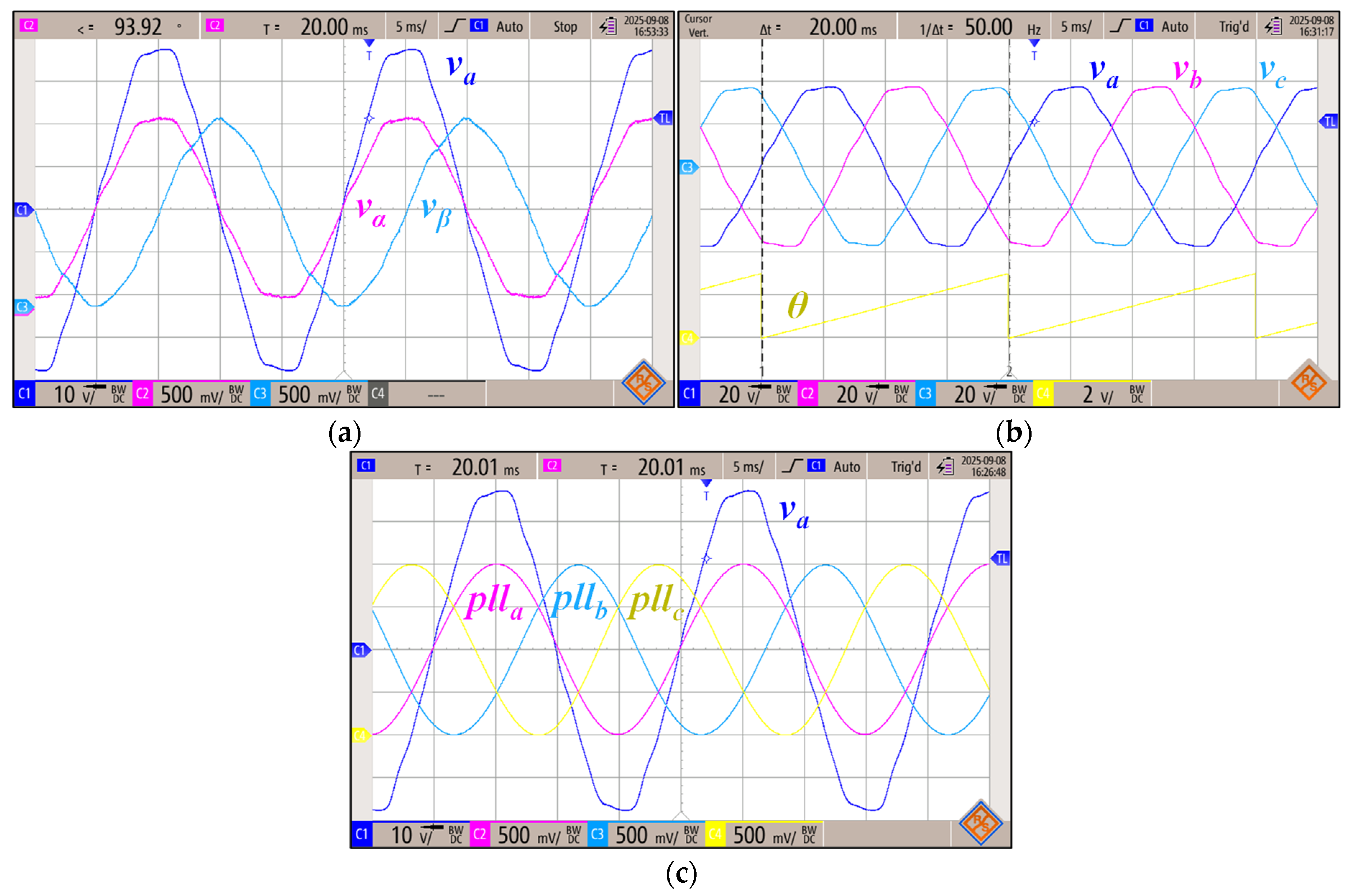
To ensure proper synchronization under grid-connected operation and smooth transitions during contingencies, a synchronous reference frame phase-locked loop (dq-PLL) is implemented at the SST interface. This technique is based on matrix transformations that map the three-phase grid voltages from the stationary abc frame to the synchronous dq reference frame. The dq-PLL is recognized for its robustness under adverse operating conditions, such as frequency deviations, harmonic distortion, and voltage unbalance.
In the implemented scheme, the measured three-phase grid voltages are first transformed into the αβ reference frame using the Clarke transformation. Subsequently, the Park transformation is applied to obtain the vd and vq components. Under ideal synchronization, the d-axis component aligns with the voltage vector magnitude, while the q-axis component converges to zero and acts as the error signal for the internal PI controller of the PLL. The output of this controller provides the estimated phase angle θ, which is used both for feedback within the synchronization loop and for the generation of sinusoidal reference signals required by the current control algorithms.
Figure 12 illustrates the response of the implemented dq-PLL under three-phase grid conditions. The evolution of the estimated phase angle θ demonstrates accurate synchronization with the grid voltage, resulting in balanced unitary reference signals synthesized at the nominal grid frequency of 50 Hz. This behavior confirms the suitability of the selected synchronization method for supporting grid-following operation and ensuring smooth transitions prior to grid-forming mode activation.
In grid-connected mode, the objective is to regulate both the magnitude and waveform of the injected currents, ensuring sinusoidal current references at 50 Hz that are in phase opposition to the corresponding grid voltages. Figure 13 presents experimental results validating the correct implementation of a stationary PI current controller, although synchronous PI control would also represent a suitable alternative. The imposed reference corresponds to a sinusoidal current with an amplitude of 4 A injected into the three-phase grid. The phase voltages va, vb, and vc retain an RMS value of 25 V, vdc_MV is fixed at 120 V, and, on the other hand, the measured phase currents ia, ib, and ic confirm balanced operation and the expected 120° phase displacement.
To further assess the robustness of the control strategy under transient conditions, Figure 14 illustrates the converter response to a step change in the amplitude of the current reference from 4 A to 6 A. The system exhibits a fast and smooth convergence to the new point, without loss of synchronization or noticeable perturbations. For clarity, only the phase-a variables are shown, as the remaining phases exhibit equivalent behavior.
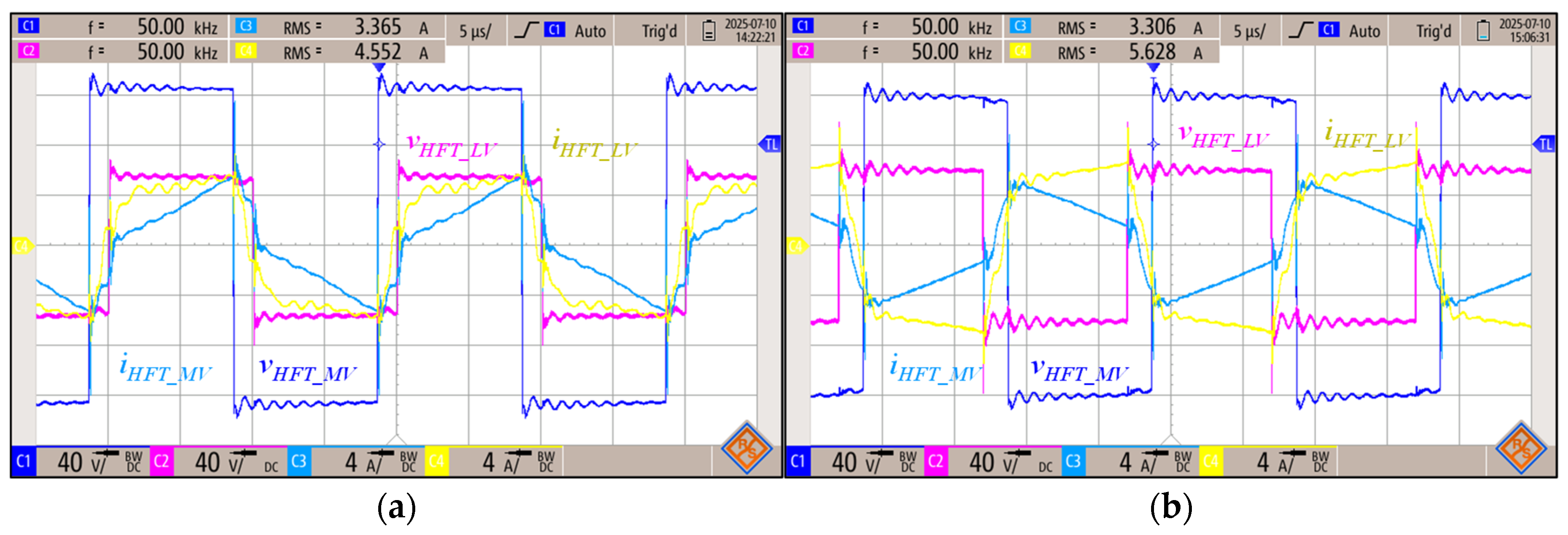
In addition to the three-phase D-NPC converter, bidirectional power flow is also an inherent requirement for the DAB converter. This behavior is reflected by the polarity of the phase shift (φ) between the square-wave voltages applied to the primary and secondary windings of the HFT. Initially, as seen in Figure 15a, the MV DC port is configured as the power source. In this operating condition, vdc_MV is fixed at 120 V, corresponding to power transfer from the MV distribution grid toward the LV microgrid. Consequently, the LV-side DC-link voltage (vdc_LV) is regulated at 60 V, in accordance with the 2:1 turns ratio of the HFT. The voltage waveform at the MV-side HFT terminals (vHFT_MV) is ahead of the LV-side voltage (vHFT_LV), indicating a positive phase shift angle (φ > 0) and confirming the power flow direction. This behavior is obtained by connecting a 13 Ω resistive load in parallel with the LV DC-link capacitors. The corresponding HFT currents (iHFT_MV and iHFT_LV) exhibit the characteristic trapezoidal waveform associated with SPS modulation.
Figure 15b presents the reverse operating condition, where the direction of power flow in the DAB is inverted, i.e., from the LV microgrid side toward the MV distribution power grid. In this case, vdc_LV is fixed at 60 V, while resistive loads of 52 Ω are connected in parallel with each capacitor of the split MV DC-link. The control objective is now to regulate vdc_MV around 120 V. Under this condition, vHFT_MV lags vHFT_LV, resulting in a negative phase shift angle (φ < 0). This inversion is consistently reflected in the polarity of iHFT_MV and iHFT_LV, which is reversed when compared to the previous operating scenario.
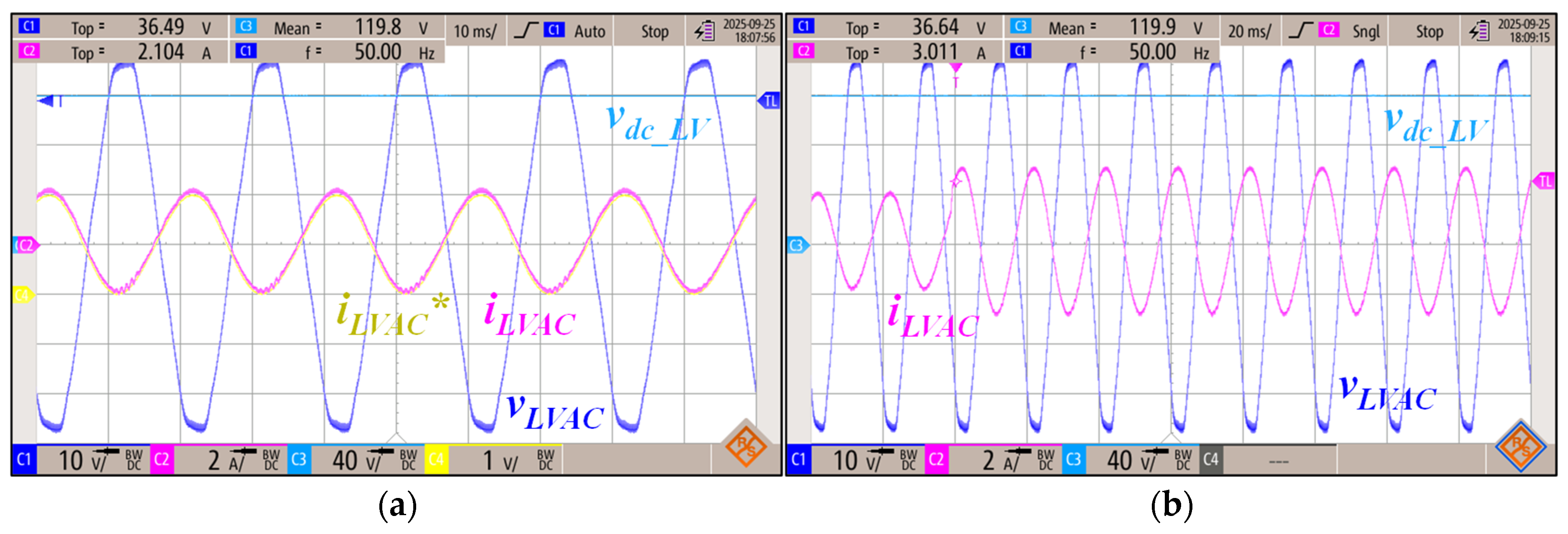
Regarding the third stage of the SST, two distinct operating modes can be identified, depending on the presence or absence of grid-forming elements within the microgrid. In conventional operation, when the microgrid is supplied from the MV distribution power grid, and a local grid-forming unit is available, the SST third stage operates under grid-following control. In this case, the SST regulates the current in both the AC and DC feeders of the hybrid microgrid. Focusing first on the LVAC feeder, vdc_LV is fixed at 120 V, while a sinusoidal current reference (iLVAC*) with an amplitude of 2 A and a frequency of 50 Hz is imposed. The reference is set in phase opposition with respect to the LVAC feeder voltage (vLVAC), thus imposing active power absorption from the power grid. Figure 16a presents the steady-state experimental results, where the injected current (iLVAC) reaches an amplitude of 2.1 A, closely tracking the reference. Subsequently, as shown in Figure 16b, the amplitude of iLVAC* is increased to 3 A. The response confirms a smooth transition, with the measured current reaching an amplitude of 3.01 A, without losing synchronism, thus validating the implementation of the PI current control under grid-following operation.
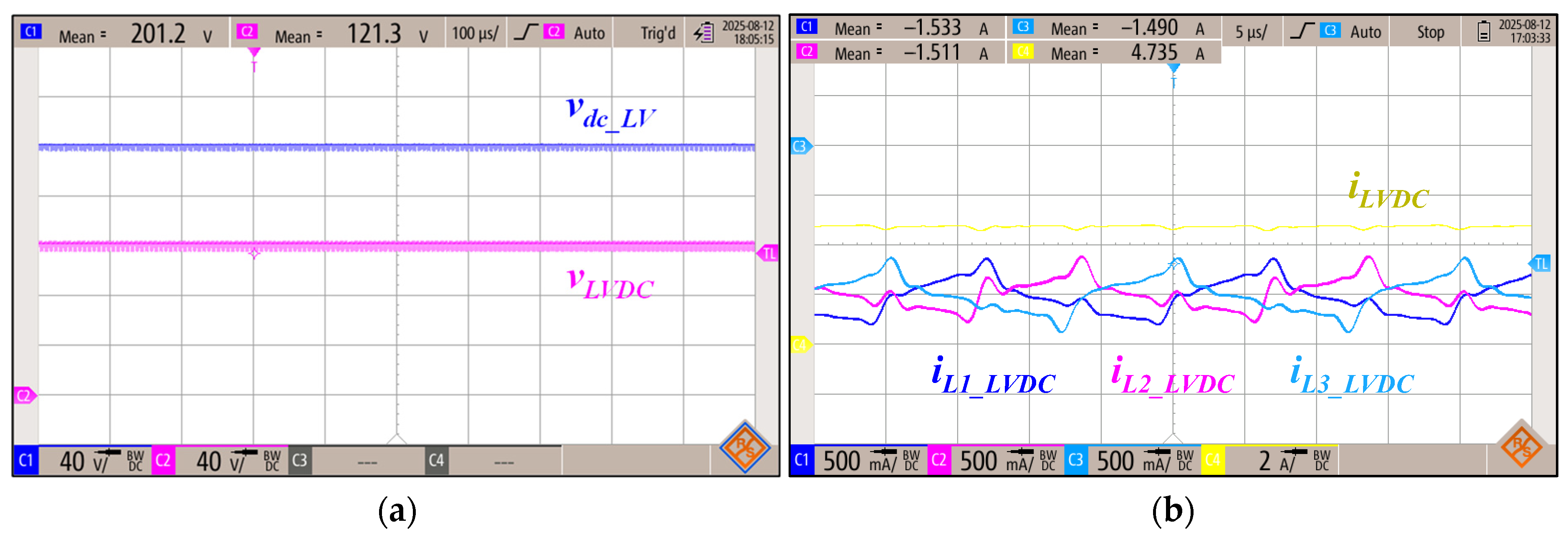
For the DC feeder of the microgrid, the three-leg interleaved bidirectional buck-boost converter operates in buck mode, regulating the output current supplied to the LVDC loads. In the experiment shown in Figure 17a, the DC-link voltage at the high-voltage side of the converter is fixed at 200 V (vdc_LV), while a resistive load of 26 Ω is connected to the LVDC feeder. Under these conditions, a voltage of 121.3 V is measured at the load terminals (vLVDC). Similarly, as shown in Figure 17b, the individual inductor current references of both legs, iL1_LVDC*, iL2_LVDC*, and iL3_LVDC*, are set to 1.5 A, resulting in a total current (iLVDC) of approximately 4.74 A. The implemented control strategy ensures proper current sharing between the three interleaved legs. Experimentally, average current values of 1.53 A, 1.51 A, and 1.49 A are measured for iL1_LVDC, iL2_LVDC, and iL3_LVDC, respectively, confirming accurate tracking of the reference and effective balancing. As expected, the three inductor currents exhibit a phase displacement of 120°.
In accordance with the fundamental operational principles of microgrids, the proposed hybrid AC/DC microgrid system must also be capable of injecting power back into the distribution system. As envisioned in this work, contingency scenarios involving the unavailability of an MV feeder segment and the exhaustion of local energy reserves within an islanded microgrid represent a critical operational condition. Under such circumstances, and to preserve service continuity, the proposed architecture indicates a common emergency LV DC bus across the microgrids within the cluster, thereby allowing coordinated power support from neighboring microgrids that remain operational. In this context, the third conversion stage of the SST plays a fundamental role.
Specifically, during emergency power sharing, the SST associated with a given supporting microgrid must be configured in order to regulate the voltage of the shared LV emergency bus, effectively acting as a local reference source. Conversely, the third stage of the SSTs interfacing the affected microgrids needs to operate as a grid-forming element, imposing and regulating the voltage levels of their respective LVAC and LVDC feeders, ensuring a stable supply to priority loads.
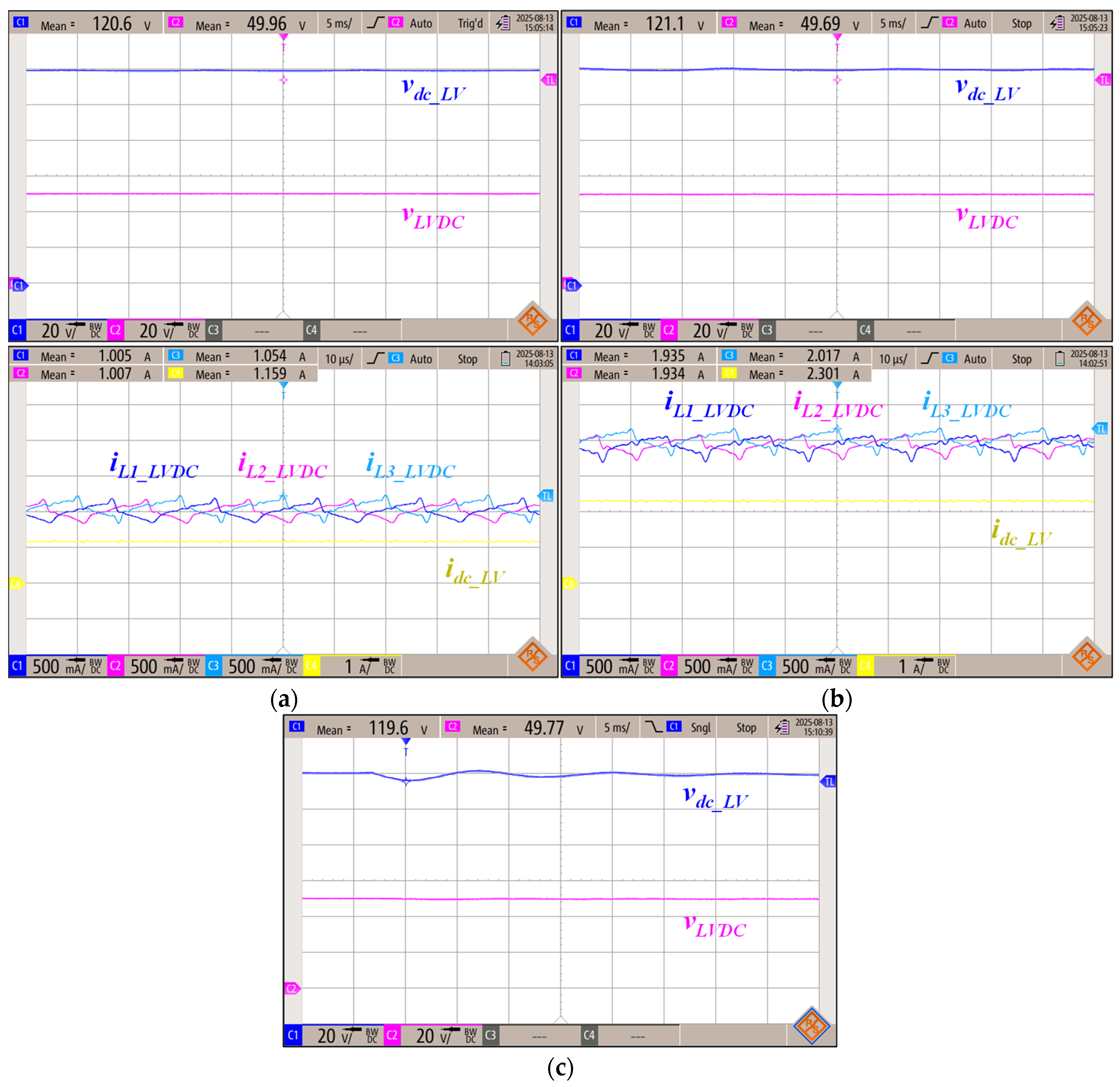
Thus, as an illustrative operating scenario, the regulation of vdc_LV is experimentally validated through the operation of the interleaved bidirectional DC/DC buck-boost converter in boost mode, as shown in Figure 18. It is worth noting that, depending on the system configuration, the regulation of vdc_LV could alternatively be performed by the AC/DC full-bridge conversion stage. In this operating condition, unlike the buck mode previously discussed, the control objective is no longer focused on regulating the individual inductor currents of each interleaved leg. Instead, the control loop acts directly on vdc_LV, which is a critical variable for the proper operation and stability of the SST.
Both in Figure 18a and in Figure 18b, a DC voltage of 50 V is imposed at vLVDC, while a resistive load of 104 Ω is connected at the high-voltage side of the DC/DC converter. Under these conditions, the control algorithm successfully regulates vdc_LV to approximately 120 V, thereby validating the correct boost-mode operation of the interleaved converter. As seen in Figure 18a, the resulting average current at the high-voltage side of the buck-boost stage, idc_LV, is 1.16 A, whereas the individual inductor currents iL1_LVDC, iL2_LVDC, and iL3_LVDC reach average values of 1.01 A, 1.01 A, and 1.05 A, respectively. Note for a slight current imbalance among the interleaved legs, which is attributed to non-idealities in the prototype. Nevertheless, the results confirm stable DC-link voltage regulation and accurate power transfer, showing the suitability of the interleaved buck-boost stage for bidirectional power exchange within the proposed SST-based architecture.
Subsequently, as illustrated in Figure 18b, a step variation in the load conditions is introduced, with the resistive load connected to the high-voltage side shifting from 104 Ω to 52 Ω. In a practical case, this event may be associated with the connection of an additional microgrid to the shared LVDC emergency bus, thereby increasing the overall demand and the number of priority loads to be supplied within energy-deficient microgrids.
Under these circumstances, it is expected an increase in the current, which may be supplied either from an intact MV feeder segment or from a supporting microgrid, the latter considered in this experimental scenario. Despite the sudden load increase, the proposed control strategy must ensure that the DC-link voltage, vdc_LV, remains properly regulated. Therefore, the measured inductor currents rise accordingly, with iL1_LVDC, iL2_LVDC, and iL3_LVDC reaching average values of 1.94 A, 1.93 A, and 2.02 A, respectively, while vdc_LV remains regulated at approximately 121.1 V. Finally, Figure 18c highlights the transient response of vdc_LV during the load step. A short oscillatory behavior is observed immediately after the disturbance. However, no significant voltage deviation occurs, and the system rapidly converges back to steady operation, not compromising SST’s stability.
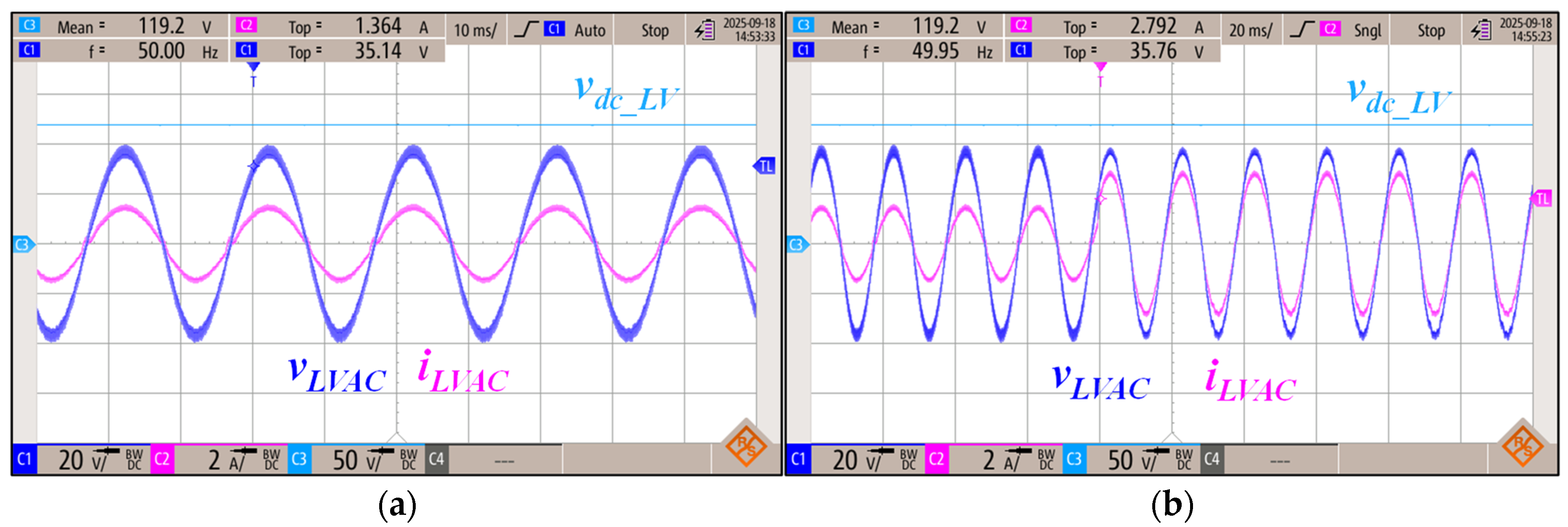
Complementarily, and as previously discussed, during emergency operation, the SST’s third-stage converters of the energy-deficient microgrids must operate in grid-forming mode, using the shared LVDC bus as their power source. In this regard, Figure 19 presents experimental results validating this functionality for the AC feeder of the hybrid microgrid. The shared LVDC bus voltage, vdc_LV, remains regulated at 120 V, while a resistive load of 26 Ω is initially connected to the AC feeder to emulate the supply of priority loads. The control objective is to regulate the AC-side voltage at this point of the circuit. To this end, the single-phase full-bridge inverter synthesizes an AC voltage waveform at vLVAC with predefined amplitude and frequency, following a sinusoidal reference.
Using unipolar PWM modulation and imposing a 50 Hz sinusoidal voltage reference with an amplitude of 35 V, Figure 19a confirms the correct convergence of vLVAC to the desired waveform. Under these load conditions, the peak value of vLVAC reaches 35.14 V, while the load current iLVAC exhibits an amplitude of 1.36 A and remains in phase with vLVAC, in accordance with the adopted sensor orientation. Subsequently, the load resistance is reduced to 13 Ω, simulating an increase in demand that may correspond to the connection of additional priority loads in another energy-deficient microgrid. As illustrated in Figure 19b, the inverter maintains proper voltage regulation around the predefined reference, while the amplitude of iLVAC approximately doubles to 2.79 A.
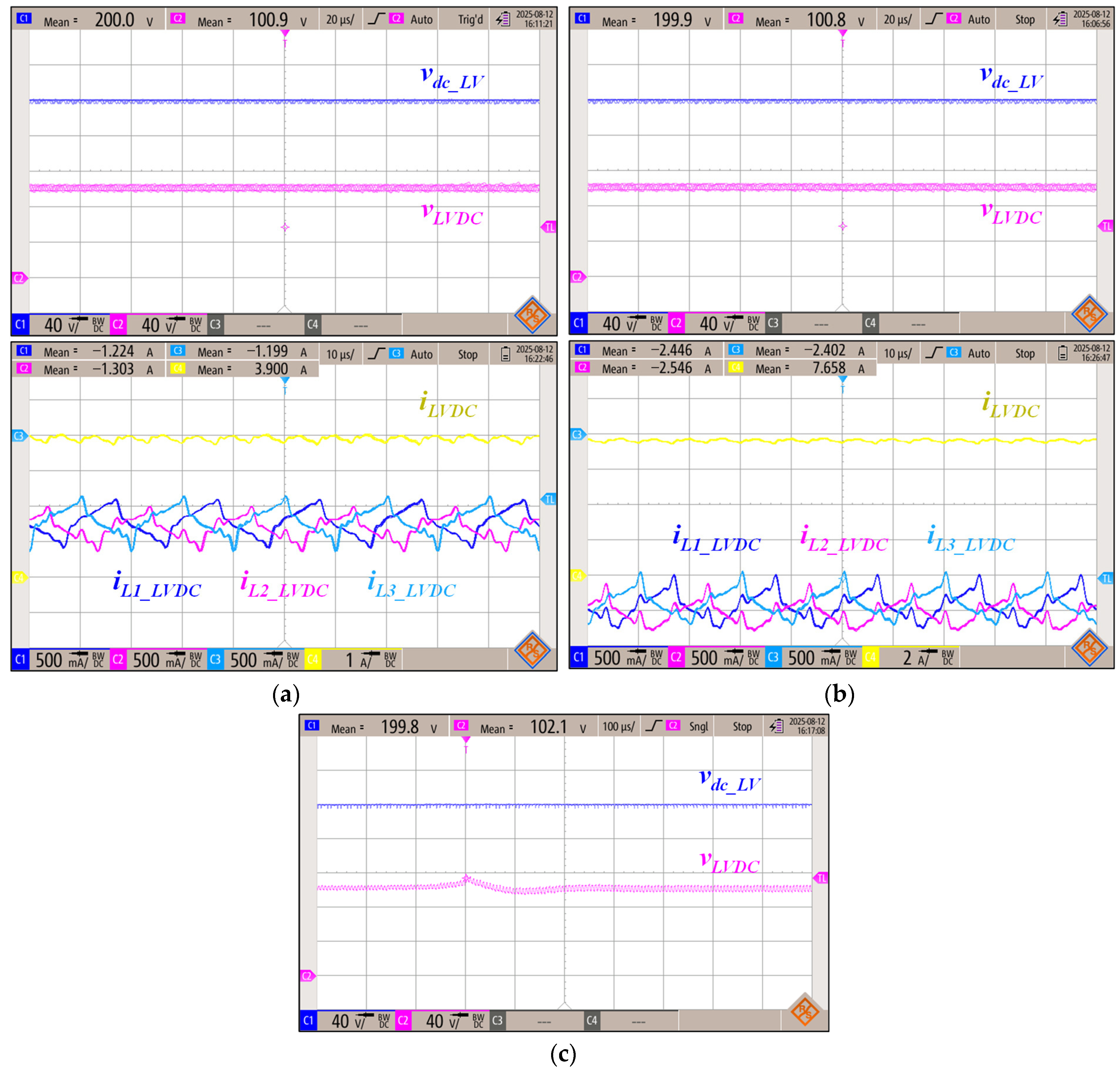
In this operating scenario, a voltage reference must likewise be imposed on the DC feeder of each deficit microgrid, with a control algorithm acting on vLVDC. To further assess the robustness of both the power converters and the implemented control strategies, variations in voltage and load conditions were introduced and shown in Figure 20. Specifically, the DC-link voltage, vdc_LV, was regulated at approximately 200 V, while the DC feeder voltage of the microgrid, vLVDC, must be controlled to 100 V. This operating point represents a more demanding condition, as it corresponds to a duty cycle of 50%, which leads to maximum ripple in a three-leg interleaved buck–boost converter. It should be noted that, for this topology, the most critical ripple conditions occur at duty cycles of 16.67%, 50%, and 83.33%, whereas more favorable ripple cancellation is achieved at 33.33% and 66.66%.
Initially, vdc_LV = 200 V and the same load conditions adopted in previous tests were considered, i.e., a resistive load of 26 Ω connected to the low-voltage side of the DC/DC stage. Under these conditions, the average DC feeder current, iLVDC, reached approximately 3.9 A. As illustrated in Figure 20a, the inductor currents iL1_LVDC, iL2_LVDC, and iL3_LVDC exhibit the expected natural phase displacement of 120°, confirming the correct interleaved operation. Note that iLVDC is evenly shared among the three converter legs.
Subsequently, the load resistance was reduced to 13 Ω, doubling the power demand imposed on the DC/DC converter. In steady state, as shown in Figure 20b, vLVDC remains accurately regulated around the 100 V reference, while the current waveforms exhibit the expected increase in average value, both in iLVDC and in each inductor. Although no explicit current-balancing control loop is implemented for this operating mode, a relatively uniform current distribution is observed among iL1_LVDC, iL2_LVDC, and iL3_LVDC, with average values close to ideal. Moreover, despite the abrupt load step, the power electronics system demonstrates robust vLVDC regulation, as it converges rapidly to its reference with limited damping, as evidenced in Figure 20c.

6. Conclusions

To enhance the operational resilience of future smart grids, this paper addressed a novel power distribution and sharing concept for clustered hybrid AC/DC microgrids interfaced through solid-state transformers (SSTs). In scenarios involving segmented medium-voltage (MV) distribution grids, prolonged outages, and exhaustion of local power reserves, conventional microgrid operation may no longer guarantee autonomous islanded functionality. Under such conditions, maintaining the supply of priority loads becomes a critical requirement. To address such a challenge, this paper proposed an SST-based reconfigurable architecture that enables coordinated emergency power sharing among microgrids through a common low-voltage DC (LVDC) bus. The shared LVDC path is activated exclusively during energy shortage conditions, allowing surplus power from intact MV segments or neighboring microgrids to support deficit microgrids without oversizing the SSTs or reinforcing the existing MV infrastructure.
A comprehensive review of resilience-oriented strategies revealed a limited integration of SST capabilities for inter-microgrid power routing, highlighting a technological gap that this work seeks to address. This paper further discussed clustered microgrid organization, control hierarchies, and coordination mechanisms relevant to such architectures. Finally, a SiC-based SST prototype was designed and experimentally validated, demonstrating grid-following and grid-forming operation across all conversion stages. The experimental results confirm the robustness of the proposed control strategies and validate the feasibility of coordinated emergency power sharing, ensuring the continuity of supply to priority loads during prolonged MV outages.

Author Contributions

Conceptualization, S.C., V.M. and J.L.A.; methodology, S.C.; validation, S.C. and V.M.; investigation, S.C. and V.M.; writing—original draft preparation, S.C.; writing—review and editing, S.C., V.M. and J.L.A.; supervision, V.M. and J.L.A.; funding acquisition, V.M. and J.L.A. All authors have read and agreed to the published version of the manuscript.

Funding

This work has been supported by FCT—Fundação para a Ciência e Tecnologia within the R&D Unit Project Scope UID/00319/2025—Centro ALGORITMI (ALGORITMI/UM). https://doi.org/10.54499/UID/00319/2025. This paper was supported by the Alliance for the Energy Transition (56), co-financed by the Recovery and Resilience Plan (PRR) through the European Union.

Data Availability Statement

The original contributions presented in this study are included in the article. Further inquiries can be directed to the corresponding author.

Acknowledgments

Sergio Coelho is supported by the doctoral scholarship 2021.08965.BD, granted by FCT—Fundação para a Ciência e Tecnologia.

Conflicts of Interest

The authors declare no conflicts of interest.

References

  1. Ebinyu, E.; Abdel-Rahim, O.; Mansour, D.-E.A.; Shoyama, M.; Abdelkader, S.M. Grid-Forming Control: Advancements towards 100% Inverter-Based Grids—A Review. Energies 2023, 16, 7579. [Google Scholar] [CrossRef]
  2. Diahovchenko, I.; Kolcun, M.; Čonka, Z.; Savkiv, V.; Mykhailyshyn, R. Progress and Challenges in Smart Grids: Distributed Generation, Smart Metering, Energy Storage and Smart Loads. Iran. J. Sci. Technol. Trans. Electr. Eng. 2020, 44, 1319–1333. [Google Scholar] [CrossRef]
  3. Li, Y.; Fu, L.; Li, Q.; Wang, W.; Jia, Y.; Dong, Z.Y. Small-Signal Modelling and Stability Analysis of Grid-Following and Grid-Forming Inverters Dominated Power System. Glob. Energy Interconnect. 2023, 6, 363–374. [Google Scholar] [CrossRef]
  4. Gao, S.; Zhang, H.; Meng, X.; Zhang, Y. A Review of Dynamic Voltage Support for Power Grids with Large-Scale Penetration of Renewable Generation. Front. Energy Res. 2025, 13, 1606725. [Google Scholar] [CrossRef]
  5. Hinov, N. From Energy Efficiency to Energy Intelligence: Power Electronics as the Cognitive Layer of the Energy Transition. Electronics 2025, 14, 4673. [Google Scholar] [CrossRef]
  6. Biswas, P.; Rashid, A.; Al Masum, A.; Nasim, M.A.A.; Anas Ferdous, A.S.M.; Gupta, K.D.; Biswas, A. An Extensive and Methodical Review of Smart Grids for Sustainable Energy Management-Addressing Challenges with AI, Renewable Energy Integration and Leading-Edge Technologies. IEEE Access 2025, 4, 1–18. [Google Scholar] [CrossRef]
  7. Panigrahi, R.; Mishra, S.K.; Srivastava, S.C.; Enjeti, P. Microgrid Integration in Smart Low-Voltage Distribution Systems. IEEE Power Electron. Mag. 2022, 9, 61–66. [Google Scholar] [CrossRef]
  8. Dahane, A.S.; Sharma, R.B. Hybrid AC-DC Microgrid Coordinated Control Strategies: A Systematic Review and Future Prospect. Renew. Energy Focus 2024, 49, 100553. [Google Scholar] [CrossRef]
  9. Hamidieh, M.; Ghassemi, M. Microgrids and Resilience: A Review. IEEE Access 2022, 10, 106059–106080. [Google Scholar] [CrossRef]
  10. Leal-Arcas, R. Electricity Decentralization in the European Union: Towards Zero Carbon and Energy Transition; Elsevier: Amsterdam, The Netherlands, 2023; ISBN 978-0-443-15920-6. [Google Scholar]
  11. Coelho, S.; Dionizio, A.; Cunha, J.; Monteiro, V.; Afonso, J.L. Solid-State Transformer: The Catalyst for Resilient and Sustainable Smart Grids. Energy 2025, 327, 136321. [Google Scholar] [CrossRef]
  12. Davis, H.; Cavanaugh, B. The U.S. Needs a Resilience Strategy for Its Transformer Shortage; The Heritage Foundation: Washington, DC, USA, 2023. [Google Scholar]
  13. McKenna, K.; Abraham, S.A.; Wang, W. Major Drivers of Long-Term Distribution Transformer Demand; National Renewable Energy Laboratory (NREL): Golden, CO, USA, 2024. [Google Scholar]
  14. Liserre, M.; Buticchi, G.; Andresen, M.; De Carne, G.; Costa, L.F.; Zou, Z.-X. The Smart Transformer: Impact on the Electric Grid and Technology Challenges. IEEE Ind. Electron. Mag. 2016, 10, 46–58. [Google Scholar] [CrossRef]
  15. Chandran, D.; Kumar, S.; Sanath, D. Solid State Transformers: A Comprehensive Review of Technology, Topologies, Applications, Research Gaps, and Future Directions. J. Power Energy Eng. 2025, 13, 30–64. [Google Scholar] [CrossRef]
  16. Monteiro, V.; Martins, J.S.; Aparício Fernandes, J.C.; Afonso, J.L. Review of a Disruptive Vision of Future Power Grids: A New Path Based on Hybrid AC/DC Grids and Solid-State Transformers. Sustainability 2021, 13, 9423. [Google Scholar] [CrossRef]
  17. Cervero, D.; Fotopoulou, M.; Muñoz-Cruzado, J.; Rakopoulos, D.; Stergiopoulos, F.; Nikolopoulos, N.; Voutetakis, S.; Sanz, J.F. Solid State Transformers: A Critical Review of Projects with Relevant Prototypes and Demonstrators. Electronics 2023, 12, 931. [Google Scholar] [CrossRef]
  18. Rothmund, D.; Guillod, T.; Bortis, D.; Kolar, J.W. 99% Efficient 10 kV SiC-Based 7 kV/400 V DC Transformer for Future Data Centers. IEEE J. Emerg. Sel. Top. Power Electron. 2019, 7, 753–767. [Google Scholar] [CrossRef]
  19. Huang, A.Q. Medium-Voltage Solid-State Transformer: Technology for a Smarter and Resilient Grid. IEEE Ind. Electron. Mag. 2016, 10, 29–42. [Google Scholar] [CrossRef]
  20. Sanduleac, M.; Martins, J.F.; Ciornei, I.; Albu, M.; Toma, L.; Pires, V.F.; Hadjidemetriou, L.; Sauba, R. Resilient and Immune by Design Microgrids Using Solid State Transformers. Energies 2018, 11, 3377. [Google Scholar] [CrossRef]
  21. Gholami, A.; Sun, X.A. Towards Resilient Operation of Multimicrogrids: An MISOCP-Based Frequency-Constrained Approach. IEEE Trans. Control Netw. Syst. 2019, 6, 925–936. [Google Scholar] [CrossRef]
  22. Yang, L.; Hu, Z. Coordination of Generators and Energy Storage to Smooth Power Fluctuations for Multi-Area Microgrid Clusters: A Robust Decentralized Approach. IEEE Access 2021, 9, 12506–12520. [Google Scholar] [CrossRef]
  23. Ma, S.; Su, L.; Wang, Z.; Qiu, F.; Guo, G. Resilience Enhancement of Distribution Grids Against Extreme Weather Events. IEEE Trans. Power Syst. 2018, 33, 4842–4853. [Google Scholar] [CrossRef]
  24. Ding, T.; Wang, Z.; Jia, W.; Chen, B.; Chen, C.; Shahidehpour, M. Multiperiod Distribution System Restoration with Routing Repair Crews, Mobile Electric Vehicles, and Soft-Open-Point Networked Microgrids. IEEE Trans. Smart Grid 2020, 11, 4795–4808. [Google Scholar] [CrossRef]
  25. Malek, A.F.; Mokhlis, H.; Mansor, N.N.; Jamian, J.J.; Wang, L.; Muhammad, M.A.; Malek, A.F.; Mokhlis, H.; Mansor, N.N.; Jamian, J.J.; et al. Power Distribution System Outage Management Using Improved Resilience Metrics for Smart Grid Applications. Energies 2023, 16, 3953. [Google Scholar] [CrossRef]
  26. Xiao, J.; Wu, N.; Han, S.; Wu, X.; Gong, W. Electric Vehicle Support Distribution Grid Emergency Power Protection Strategy after a Major Power Outage. In Proceedings of the 2023 3rd International Conference on Energy Engineering and Power Systems (EEPS); IEEE: New York, NY, USA, 2023; pp. 902–906. [Google Scholar]
  27. Tian, M.-W.; Talebizadehsardari, P. Energy Cost and Efficiency Analysis of Building Resilience against Power Outage by Shared Parking Station for Electric Vehicles and Demand Response Program. Energy 2021, 215, 119058. [Google Scholar] [CrossRef]
  28. Masrur, H.; Sharifi, A.; Islam, M.R.; Hossain, M.A.; Senjyu, T. Optimal and Economic Operation of Microgrids to Leverage Resilience Benefits during Grid Outages. Int. J. Electr. Power Energy Syst. 2021, 132, 107137. [Google Scholar] [CrossRef]
  29. Salehi, M.; Khanali, M.; Ghasemi-Mobtaker, H. Techno-Economic Analysis of Renewable Hybrid System Microgrids for Minimizing Grid Power Outages in Residential Areas. Clean. Eng. Technol. 2025, 25, 100924. [Google Scholar] [CrossRef]
  30. Yadav, M.; Pal, N.; Saini, D.K. Microgrid Control, Storage, and Communication Strategies to Enhance Resiliency for Survival of Critical Load. IEEE Access 2020, 8, 169047–169069. [Google Scholar] [CrossRef]
  31. Daryani, N.; Zare, K.; Tohidi, S.; Guerrero, J.M.; Bazmohammadi, N. Optimal Construction of Microgrids in a Radial Distribution System Considering System Reliability via Proposing Dominated Group Search Optimization Algorithm. Sustain. Energy Technol. Assess. 2024, 63, 103622. [Google Scholar] [CrossRef]
  32. Kumar, M. Development of Control Strategies for Operation of Cluster of Interconnected Hybrid Microgrids in Islanded Mode. IEEE Syst. J. 2023, 17, 1741–1752. [Google Scholar] [CrossRef]
  33. Zhang, C.; Zhao, J.; Dou, X.; Hu, Q.; Leng, J.; Liu, K. Containment-Based Distributed Cooperative Control of Microgrid Clusters: Accurately Constraining the Bus States of Loads and Microgrids. IEEE Trans. Power Syst. 2024, 39, 5741–5754. [Google Scholar] [CrossRef]
  34. Xiao, Q.; Yu, H.; Jin, Y.; Jia, H.; Mu, Y.; Zhang, Y.; Lu, W.; Teodorescu, R.; Guerrero, J.M. Uninterruptable Hierarchical Distributed Coordinated Control Scheme of Islanded AC/DC Microgrid Clusters Under Grid-Forming Converter Faults. IEEE Trans. Smart Grid 2025, 16, 2762–2773. [Google Scholar] [CrossRef]
  35. Goyal, M.; Ghosh, A. Microgrids Interconnection to Support Mutually during Any Contingency. Sustain. Energy Grids Netw. 2016, 6, 100–108. [Google Scholar] [CrossRef]
  36. Udoha, E.; Das, S.; Abusara, M. Power Flow Management of Interconnected AC Microgrids Using Back-to-Back Converters. Electronics 2023, 12, 3765. [Google Scholar] [CrossRef]
  37. Ferdous, S.M.; Shahnia, F.; Shafiullah, G.M. Power Sharing and Control Strategy for Provisionally Coupled Microgrid Clusters through an Isolated Power Exchange Network. Energies 2021, 14, 7514. [Google Scholar] [CrossRef]
  38. Samende, C.; Gao, F.; Bhagavathy, S.M.; McCulloch, M. Decentralized Voltage Control for Efficient Power Exchange in Interconnected DC Clusters. IEEE Trans. Sustain. Energy 2021, 12, 103–115. [Google Scholar] [CrossRef]
  39. John, B.; Ghosh, A.; Goyal, M.; Zare, F. A DC Power Exchange Highway Based Power Flow Management for Interconnected Microgrid Clusters. IEEE Syst. J. 2019, 13, 3347–3357. [Google Scholar] [CrossRef]
  40. Moscatiello, C.; Loggia, R.; di Lorenzo, G.; Palma, A.L.; Kermani, M.; Faranda, R.S.; Oliva, F.; Tironi, E.; Araneo, R.; Martirano, L. A New Proposal for Power Sharing in LVDC Energy Community Microgrids. IEEE Trans. Ind. Appl. 2023, 59, 4951–4963. [Google Scholar] [CrossRef]
  41. Yang, H.; Deng, F.; Zhang, L.; Xiao, Z.; Yao, Z.; Tang, Y. Power System Inertia Enhancement Based on LVDC Microgrids. IEEE Trans. Ind. Electron. 2025, 72, 7639–7644. [Google Scholar] [CrossRef]
  42. Biswal, C.; Rout, P.K.; Sahu, B.K.; Mishra, M. Kernel-Based Cumulative Sum and Differential Cumulative Sum Approaches for Resilient Fault Detection in LVDC Microgrids. Electr. Power Syst. Res. 2024, 234, 110514. [Google Scholar] [CrossRef]
  43. Ma, J.; Zhu, M.; Cai, X.; Li, Y.W. Configuration and Operation of DC Microgrid Cluster Linked through DC-DC Converter. In Proceedings of the 2016 IEEE 11th Conference on Industrial Electronics and Applications (ICIEA); IEEE: New York, NY, USA, 2016; pp. 2565–2570. [Google Scholar]
  44. Zhou, J.; Zhang, J.; Cai, X.; Shi, G.; Wang, J.; Zang, J. Design and Analysis of Flexible Multi-Microgrid Interconnection Scheme for Mitigating Power Fluctuation and Optimizing Storage Capacity. Energies 2019, 12, 2132. [Google Scholar] [CrossRef]
  45. Dong, J.; Zhu, L.; Su, Y.; Ma, Y.; Liu, Y.; Wang, F.; Tolbert, L.M.; Glass, J.; Bruce, L. Battery and Backup Generator Sizing for a Resilient Microgrid under Stochastic Extreme Events. IET Gener. Transm. Distrib. 2018, 12, 4443–4450. [Google Scholar] [CrossRef]
  46. Xiong, L.; Li, T.; Huang, S.; Li, P.; Wang, Z.; Sun, Z.; Niu, T. Optimized Sizing of ESSs in Non-Array Formed Wind Farm for Frequency Support Considering Multi-Directional Wake Effect. IEEE Trans. Sustain. Energy 2025, 1–15. [Google Scholar] [CrossRef]
  47. Chen, L.; Deng, X.; Ding, M.; Chen, H.; Li, G.; Li, Y.; Qiao, X.; Yin, Y.; Wang, L.; He, H. Investigation of Flux-Coupling-Type SFCLs for Enhancing Interconnectivity of Multiple Microgrid Clusters Under Fault Conditions. IEEE Trans. Appl. Supercond. 2021, 31, 1–7. [Google Scholar] [CrossRef]
  48. Ganjian-Aboukheili, M.; Shahabi, M.; Shafiee, Q.; Guerrero, J.M. Seamless Transition of Microgrids Operation From Grid-Connected to Islanded Mode. IEEE Trans. Smart Grid 2020, 11, 2106–2114. [Google Scholar] [CrossRef]
  49. Amoateng, D.O.; Al Hosani, M.; Elmoursi, M.S.; Turitsyn, K.; Kirtley, J.L. Adaptive Voltage and Frequency Control of Islanded Multi-Microgrids. IEEE Trans. Power Syst. 2018, 33, 4454–4465. [Google Scholar] [CrossRef]
  50. Dhua, R.; Goswami, S.K.; Chatterjee, D. An Optimized Frequency and Voltage Control Scheme for Distributed Generation Units of an Islanded Microgrid. In Proceedings of the 2021 Innovations in Energy Management and Renewable Resources (52042); IEEE: New York, NY, USA, 2021; pp. 1–6. [Google Scholar]
  51. Selakov, A.; Bekut, D.; Sarić, A.T. A Novel Agent-Based Microgrid Optimal Control for Grid-Connected, Planned Island and Emergency Island Operations. Int. Trans. Electr. Energy Syst. 2016, 26, 1999–2022. [Google Scholar] [CrossRef]
  52. Nwaulu, E.; Masaud, T.M.; El-Saadany, E. Stochastic Risk-Managed Reserve Dispatch for Seamless Microgrid Islanding during Unplanned Events. J. Eng. 2025, 2025, e70035. [Google Scholar] [CrossRef]
  53. IEEE 1547-2018; IEEE Standard for Interconnection and Interoperability of Distributed Energy Resources with Associated Electric Power Systems Interfaces. IEEE Standards Association IEEE: New York, NY, USA, 2018. [CrossRef]
  54. Li, C.; Cao, C.; Cao, Y.; Kuang, Y.; Zeng, L.; Fang, B. A Review of Islanding Detection Methods for Microgrid. Renew. Sustain. Energy Rev. 2014, 35, 211–220. [Google Scholar] [CrossRef]
  55. Monteiro, V.; Exposto, B.; Ferreira, J.C.; Afonso, J.L. Improved Vehicle-to-Home (iV2H) Operation Mode: Experimental Analysis of the Electric Vehicle as Off-Line UPS. IEEE Trans. Smart Grid 2017, 8, 2702–2711. [Google Scholar] [CrossRef]
  56. Bullich-Massagué, E.; Díaz-González, F.; Aragüés-Peñalba, M.; Girbau-Llistuella, F.; Olivella-Rosell, P.; Sumper, A. Microgrid Clustering Architectures. Appl. Energy 2018, 212, 340–361. [Google Scholar] [CrossRef]
  57. Guillod, T.; Krismer, F.; Kolar, J.W. Protection of MV Converters in the Grid: The Case of MV/LV Solid-State Transformers. IEEE J. Emerg. Sel. Top. Power Electron. 2017, 5, 393–408. [Google Scholar] [CrossRef]
  58. Aghmadi, A.; Hussein, H.; Polara, K.H.; Mohammed, O. A Comprehensive Review of Architecture, Communication, and Cybersecurity in Networked Microgrid Systems. Inventions 2023, 8, 84. [Google Scholar] [CrossRef]
  59. Nguyen, H.K.; Khodaei, A.; Han, Z. A Big Data Scale Algorithm for Optimal Scheduling of Integrated Microgrids. IEEE Trans. Smart Grid 2018, 9, 274–282. [Google Scholar] [CrossRef]
  60. Liu, W.; Gu, W.; Wang, J.; Yu, W.; Xi, X. Game Theoretic Non-Cooperative Distributed Coordination Control for Multi-Microgrids. IEEE Trans. Smart Grid 2018, 9, 6986–6997. [Google Scholar] [CrossRef]
  61. Rahbar, K.; Chai, C.C.; Zhang, R. Real-Time Energy Management for Cooperative Microgrids with Renewable Energy Integration. In Proceedings of the 2014 IEEE International Conference on Smart Grid Communications (SmartGridComm); IEEE: New York, NY, USA, 2014; pp. 25–30. [Google Scholar]
  62. Yan, M.; Shahidehpour, M.; Paaso, A.; Zhang, L.; Alabdulwahab, A.; Abusorrah, A. Distribution Network-Constrained Optimization of Peer-to-Peer Transactive Energy Trading Among Multi-Microgrids. IEEE Trans. Smart Grid 2021, 12, 1033–1047. [Google Scholar] [CrossRef]
  63. Qiu, H.; You, F. Decentralized-Distributed Robust Electric Power Scheduling for Multi-Microgrid Systems. Appl. Energy 2020, 269, 115146. [Google Scholar] [CrossRef]
  64. Liu, Y.; Qu, Z.; Xin, H.; Gan, D. Distributed Real-Time Optimal Power Flow Control in Smart Grid. IEEE Trans. Power Syst. 2017, 32, 3403–3414. [Google Scholar] [CrossRef]
  65. Hans, C.A.; Braun, P.; Raisch, J.; Grüne, L.; Reincke-Collon, C. Hierarchical Distributed Model Predictive Control of Interconnected Microgrids. IEEE Trans. Sustain. Energy 2019, 10, 407–416. [Google Scholar] [CrossRef]
  66. Nikmehr, N.; Najafi Ravadanegh, S. Reliability Evaluation of Multi-Microgrids Considering Optimal Operation of Small Scale Energy Zones under Load-Generation Uncertainties. Int. J. Electr. Power Energy Syst. 2016, 78, 80–87. [Google Scholar] [CrossRef]
  67. John, T.; Ping Lam, S. Voltage and Frequency Control during Microgrid Islanding in a Multi-Area Multi-Microgrid System. IET Gener. Transm. Distrib. 2017, 11, 1502–1512. [Google Scholar] [CrossRef]
  68. Aljafari, B.; Vasantharaj, S.; Indragandhi, V.; Vaibhav, R. Optimization of DC, AC, and Hybrid AC/DC Microgrid-Based IoT Systems: A Review. Energies 2022, 15, 6813. [Google Scholar] [CrossRef]
  69. Binqadhi, H.; Hamanah, W.M.; Shafiullah, M.; Alam, M.S.; AlMuhaini, M.M.; Abido, M.A. A Comprehensive Survey on Advancement and Challenges of DC Microgrid Protection. Sustainability 2024, 16, 6008. [Google Scholar] [CrossRef]
  70. Charadi, S.; Chaibi, Y.; Redouane, A.; Allouhi, A.; El Hasnaoui, A.; Mahmoudi, H. Efficiency and Energy-Loss Analysis for Hybrid AC/DC Distribution Systems and Microgrids: A Review. Int. Trans. Electr. Energy Syst. 2021, 31, e13203. [Google Scholar] [CrossRef]
  71. Che, L.; Zhang, X.; Shahidehpour, M.; Alabdulwahab, A.; Abusorrah, A. Optimal Interconnection Planning of Community Microgrids with Renewable Energy Sources. IEEE Trans. Smart Grid 2017, 8, 1054–1063. [Google Scholar] [CrossRef]
  72. Atmaca, Ö.; Karabacak, M. Frequency, Phase, and Magnitude Difference Locked-Loop Based Linear Synchronization Scheme for Islanded Inverters and Microgrids. IEEE Access 2023, 11, 61748–61772. [Google Scholar] [CrossRef]
  73. Abbasi, M.; Abbasi, E.; Li, L.; Aguilera, R.P.; Lu, D.; Wang, F. Review on the Microgrid Concept, Structures, Components, Communication Systems, and Control Methods. Energies 2023, 16, 484. [Google Scholar] [CrossRef]
  74. Roslan, M.F.; Hannan, M.A.; Ker, P.J.; Uddin, M.N. Microgrid Control Methods toward Achieving Sustainable Energy Management. Appl. Energy 2019, 240, 583–607. [Google Scholar] [CrossRef]
  75. Olivares, D.E.; Mehrizi-Sani, A.; Etemadi, A.H.; Cañizares, C.A.; Iravani, R.; Kazerani, M.; Hajimiragha, A.H.; Gomis-Bellmunt, O.; Saeedifard, M.; Palma-Behnke, R.; et al. Trends in Microgrid Control. IEEE Trans. Smart Grid 2014, 5, 1905–1919. [Google Scholar] [CrossRef]
  76. Huang, S.; Wang, L.; Xiong, L.; Zhou, Y.; Gao, F.; Huang, W.; Li, Y.; Guo, H.; Wang, F. Hierarchical Robustness Strategy Combining Model-Free Prediction and Fixed-Time Control for Islanded AC Microgrids. IEEE Trans. Smart Grid 2025, 16, 4380–4394. [Google Scholar] [CrossRef]
  77. Zhang, J.; Fan, S.; Deng, C.; Wang, B.; Xie, X. Distributed Resilient Secondary Control for AC Microgrids Against Hybrid Attacks. IEEE Trans. Circuits Syst. I Regul. Pap. 2024, 71, 5211–5220. [Google Scholar] [CrossRef]
  78. Wang, C.; Yang, P.; Ye, C.; Wang, Y.; Xu, Z. Improved V/f Control Strategy for Microgrids Based on Master–Slave Control Mode. IET Renew. Power Gener. 2016, 10, 1356–1365. [Google Scholar] [CrossRef]
  79. Werth, A.; André, A.; Kawamoto, D.; Morita, T.; Tajima, S.; Tokoro, M.; Yanagidaira, D.; Tanaka, K. Peer-to-Peer Control System for DC Microgrids. IEEE Trans. Smart Grid 2018, 9, 3667–3675. [Google Scholar] [CrossRef]
  80. Ambia, M.N.; Meng, K.; Xiao, W.; Dong, Z.Y. Nested Formation Approach for Networked Microgrid Self-Healing in Islanded Mode. IEEE Trans. Power Deliv. 2021, 36, 452–464. [Google Scholar] [CrossRef]
  81. Felisberto, K.D.R.; de Godoy, P.T.; Marujo, D.; de Almeida, A.B.; de Barros Iscuissati, R. Trends in Microgrid Droop Control and the Power Sharing Problem. J. Control Autom. Electr. Syst. 2022, 33, 719–732. [Google Scholar] [CrossRef]
  82. Hussien, A.M.; Kim, J.; Alkuhayli, A.; Alharbi, M.; Hasanien, H.M.; Tostado-Véliz, M.; Turky, R.A.; Jurado, F. Adaptive PI Control Strategy for Optimal Microgrid Autonomous Operation. Sustainability 2022, 14, 14928. [Google Scholar] [CrossRef]
  83. Xiao, J.; Wang, L.; Bauer, P.; Qin, Z. Virtual Impedance Control for Load Sharing and Bus Voltage Quality Improvement in Low-Voltage AC Microgrid. IEEE Trans. Smart Grid 2024, 15, 2447–2458. [Google Scholar] [CrossRef]
  84. Hu, J.; Shan, Y.; Guerrero, J.M.; Ioinovici, A.; Chan, K.W.; Rodriguez, J. Model Predictive Control of Microgrids—An Overview. Renew. Sustain. Energy Rev. 2021, 136, 110422. [Google Scholar] [CrossRef]
  85. Fernão Pires, V.; Cordeiro, A.; Foito, D.; Fernando Silva, J. Control Transition Mode from Voltage Control to MPPT for PV Generators in Isolated DC Microgrids. Int. J. Electr. Power Energy Syst. 2022, 137, 107876. [Google Scholar] [CrossRef]
  86. Han, Y.; Zhang, K.; Li, H.; Coelho, E.A.A.; Guerrero, J.M. MAS-Based Distributed Coordinated Control and Optimization in Microgrid and Microgrid Clusters: A Comprehensive Overview. IEEE Trans. Power Electron. 2018, 33, 6488–6508. [Google Scholar] [CrossRef]
  87. Elkholy, M.H.; Yona, A.; Ueda, S.; Said, T.; Senjyu, T.; Lotfy, M.E. Experimental Investigation of AI-Enhanced FPGA-Based Optimal Management and Control of an Isolated Microgrid. IEEE Trans. Transp. Electrif. 2024, 10, 3670–3679. [Google Scholar] [CrossRef]
  88. Joshi, A.; Capezza, S.; Alhaji, A.; Chow, M.-Y. Survey on AI and Machine Learning Techniques for Microgrid Energy Management Systems. IEEE/CAA J. Autom. Sin. 2023, 10, 1513–1529. [Google Scholar] [CrossRef]
  89. Li, S.; Oshnoei, A.; Blaabjerg, F.; Anvari-Moghaddam, A. Hierarchical Control for Microgrids: A Survey on Classical and Machine Learning-Based Methods. Sustainability 2023, 15, 8952. [Google Scholar] [CrossRef]
  90. Ouammi, A.; Zejli, D. Centralized Controller for the Optimal Operation of a Cooperative Cluster of Connected Microgrids Powered Multi-Greenhouses. Sustain. Comput. Inform. Syst. 2022, 33, 100641. [Google Scholar] [CrossRef]
  91. Gao, H.; Liu, J.; Wang, L.; Wei, Z. Decentralized Energy Management for Networked Microgrids in Future Distribution Systems. IEEE Trans. Power Syst. 2018, 33, 3599–3610. [Google Scholar] [CrossRef]
  92. Velasquez, M.A.; Torres-Pérez, O.; Quijano, N.; Cadena, Á. Hierarchical Dispatch of Multiple Microgrids Using Nodal Price: An Approach from Consensus and Replicator Dynamics. J. Mod. Power Syst. Clean Energy 2019, 7, 1573–1584. [Google Scholar] [CrossRef]
  93. Coelho, S.; Monteiro, V.; Sousa, T.J.C.; Barros, L.A.M.; Pedrosa, D.; Couto, C.; Afonso, J.L. A Unified Power Converter for Solar PV and Energy Storage in Dc Microgrids. Batteries 2022, 8, 143. [Google Scholar] [CrossRef]
Figure 1. Conceptual illustration of an SST-based hybrid AC/DC microgrid radial cluster connected to a segmented MV distribution grid. Under a fault affecting the corresponding MV feeder segment, µGrid #2 and µGrid #3 become islanded while the remaining maintain the grid-connected operation.
Electronics 15 00496 g001
Figure 2. Configurations for the organization of clustered microgrids: (a) radial; (b) series; (c) single-feeder cascade; (d) multi-feeder cascade; (e) fully meshed; (f) hybrid series–parallel; (g) ring; (h) stand-alone series clustered.
Electronics 15 00496 g002
Figure 3. Typical structure and level functionalities of hierarchical control in clustered microgrids.
Electronics 15 00496 g003
Figure 4. Energy management in clustered microgrids, considering different control architectures (a) Centralized; (b) Decentralized; and (c) Distributed.
Electronics 15 00496 g004
Figure 5. Energy management of a hybrid AC/DC microgrid cluster, imposing a hierarchical and decentralized control structure.
Electronics 15 00496 g005
Figure 6. Proposed SST-based emergency power-sharing architecture for clustered hybrid AC/DC microgrids. During prolonged MV outages, an LVDC feeder is selectively activated to enable bidirectional power support between microgrids without requiring additional conversion stages.
Electronics 15 00496 g006
Figure 7. Selected three-stage SST topology: (a) Stage I performs MV AC/DC conversion through a D-NPC converter, and Stage II provides galvanic isolation and regulated DC/DC power transfer using a DAB converter. (b) Stage III interfaces with the hybrid AC/DC microgrid through a full-bridge AC/DC converter and an interleaved buck-boost DC/DC converter.
Electronics 15 00496 g007
Figure 8. Developed SiC-based prototype: (a) Single-phase AC/DC full-bridge converter (DAB stage and LVAC feeder interface). (b) Reconfigurable three-leg power converter, used either as an interleaved bidirectional DC/DC buck-boost (LVDC feeder interface) and as a D-NPC AC/DC converter, used as the SST’s first stage (MV grid interface).
Electronics 15 00496 g008
Figure 9. Developed HFT for the proposed SST prototype: (a) Selected ferrite core (IF Cores, reference UF 120/80/40). (b) Assembled HFT, used for experimental validation.
Electronics 15 00496 g009
Figure 10. Experimental transient results validating active power absorption from the MV distribution grid by the three-phase D-NPC converter operating in grid-following mode. The phase-a voltage and current waveforms (va, ia), as well as the MV DC-link voltage (vdc_MV), are shown. Proper ia-va synchronization and vdc_MV convergence to its reference are observed for: (a) Global view of the transient response. (b) Detailed view of the converter response following the enable switching actions.
Electronics 15 00496 g010
Figure 11. Experimental transient results validating active power absorption from the MV distribution grid by the three-phase D-NPC converter, emphasizing MV DC-link voltage (vdc_MV) regulation under load step variations. The phase-a voltage and current waveforms (va, ia), as well as vdc_MV, are shown. Correct ia-va synchronization and convergence of vdc_MV to its reference are observed for: (a) a load transition from 52 Ω to 26 Ω; (b) a load transition from 26 Ω to 52 Ω.
Electronics 15 00496 g011
Figure 12. Experimental validation of the dq-PLL synchronization technique, evidenced through the measured waveforms: (a) phase-a grid voltage (va) and the corresponding orthogonal components vα and vβ; (b) three-phase grid voltages (va, vb, vc) and the estimated phase angle (θ); (c) unitary sinusoidal reference signals (plla, pllb, pllc) generated from θ, respectively, in phase with va, vb, and vc.
Electronics 15 00496 g012
Figure 13. Experimental results under steady-state conditions validating active power injection into the MV grid under grid-following operation. The PI current controller ensures accurate tracking of the imposed current reference and synchronization with the grid voltages. The phase voltage va, the three-phase currents ia, ib, and ic, and the MV DC-link voltage, vdc_MV, are shown. Obtained results when imposing a sinusoidal current reference with an amplitude of 4 A and a frequency of 50 Hz.
Electronics 15 00496 g013
Figure 14. Experimental transient results validating active power injection into the MV power grid under grid-following operation. The PI current controller ensures tracking of the imposed reference and synchronization with the grid voltage. The MV DC-link voltage (vdc_MV) and the phase-a voltage and current (va, ia) are shown for a step change in the current reference amplitude from 4 A to 6 A.
Electronics 15 00496 g014
Figure 15. Experimental steady-state results validating the bidirectional operation of the isolated DC/DC DAB converter under SPS modulation. The waveforms at the MV and LV sides of the HFT (vHFT_MV and vHFT_LV), as well as the corresponding currents (iHFT_MV and iHFT_LV) are shown for: (a) positive phase shift (φ > 0), with a resistive load of 13 Ω connected to the LV side; (b) negative phase shift (φ < 0), with a resistive load of 52 Ω connected to the MV side.
Electronics 15 00496 g015
Figure 16. Experimental results of the bidirectional single-phase AC/DC full-bridge converter operating as an inverter under stationary PI current control, in grid-following mode. The microgrid’s AC feeder current (iLVAC) tracks its sinusoidal reference (iLVAC*), set at 50 Hz with an amplitude of 2 A. A 180° phase displacement between iLVAC and the microgrid’s AC feeder voltage (vLVAC) is observed, while the LV DC-link voltage (vdc_LV) is fixed at 120 V. Operation under: (a) steady-state conditions; (b) transient response following a step change in the amplitude of iLVAC* to 3 A.
Electronics 15 00496 g016
Figure 17. Experimental results of the three-leg interleaved bidirectional DC/DC buck-boost converter operating in buck mode under current control. Steady-state operation is shown, with the inductor currents of each leg (iL1_LVDC, iL2_LVDC, and iL3_LVDC) regulated to 1.5 A, using a 26 Ω resistive load and a fixed LV DC-link voltage (vdc_LV) of 200 V. Presented waveforms include: (a) the voltages at both sides of the converter (vdc_LV and vLVDC); (b) the total output current (iLVDC), as well as iL1_LVDC, iL2_LVDC, and iL3_LVDC.
Electronics 15 00496 g017
Figure 18. Experimental results of the three-leg interleaved bidirectional DC/DC buck-boost converter operating in boost mode under voltage control. Steady-state operation is evaluated by showing the voltage waveforms on both sides of the DC/DC converter (vdc_LV and vLVDC), the total output current (idc_LV), and the individual inductor currents (iL1_LVDC, iL2_LVDC, and iL3_LVDC). vLVDC is fixed at 50 V and vdc_LV is regulated at 120 V for different load conditions: (a) resistive load of 104 Ω in parallel with the LV DC-link capacitors; (b) resistive load of 52 Ω in parallel with the LV DC-link capacitors; (c) detail of the transient response impact on vdc_LV during the load change.
Electronics 15 00496 g018
Figure 19. Experimental results validating the grid-forming operation of the third SST stage, particularly of the single-phase AC/DC full-bridge converter operating under stationary PI voltage control. The expected behavior is evaluated by showing the regulated LVAC feeder voltage of the hybrid AC/DC microgrid (vLVAC), the corresponding current (iLVAC), and the LV DC-link voltage (vdc_LV), fixed at 120 V. It is observed: (a) steady-state vLVAC regulation, synthesizing a sinusoidal reference with 35 V amplitude and 50 Hz frequency, supplying a 26 Ω resistive load connected to the LVAC feeder; (b) control algorithm robustness under transient conditions, associated with a load step from 26 Ω to 13 Ω.
Electronics 15 00496 g019
Figure 20. Experimental results of the three-leg interleaved bidirectional DC/DC buck-boost converter operating in buck mode under voltage control. Steady-state operation is evaluated by showing the voltage waveforms on both sides of the DC/DC converter (vdc_LV and vLVDC), the total output current (iLVDC), and the individual inductor currents (iL1_LVDC, iL2_LVDC, and iL3_LVDC). vdc_LV is fixed at 200 V, and vLVDC is regulated at 100 V for different load conditions: (a) resistive load of 26 Ω; (b) resistive load of 13 Ω; (c) detail of the transient response impact on vLVDC during the load change.
Electronics 15 00496 g020
Table 1. Comparison of representative microgrid-oriented approaches addressing continuity of supply under grid contingencies.
Ref.Main FocusAddresses a Power OutageAddresses µGrid
Resource
Depletion
Inter-Microgrid Power Sharing
[24]Distribution system restorationYesNoPartial
[31]Optimal construction and planning of
microgrids considering reliability
YesNoNo
[32]Control strategies for clusters of
islanded hybrid microgrids
NoNoYes
[33]Distributed cooperative control of
microgrid clusters
NoNoYes
[34]Hierarchical coordinated control of islanded
AC/DC microgrid clusters under faults
NoNoYes
[35]Interconnection of microgrids for mutual
support during contingencies
PartialPartialYes
[36]Power flow management of interconnected AC microgrids using back-to-back convertersNoNoYes
[37]Power sharing in provisionally coupled
microgrid clusters
NoNoYes
[38]Decentralized voltage control in
interconnected DC microgrid clusters
NoNoYes
[39]DC power exchange for interconnected
microgrid clusters
PartialNoYes
[40]Power-sharing architectures for LVDC
energy community microgrids
PartialNoPartial
[41]Power system inertia enhancement based on
LVDC microgrids
PartialNoNo
[42]Resilient fault detection techniques for
LVDC microgrids
NoNoNo
[43]Configuration and operation of DC
microgrid clusters via DC/DC converters
NoNoYes
This workSST-based LVDC emergency power-sharingYesYesYes
Table 2. Key functional and operational characteristics of AC and DC microgrids.
DC MicrogridsAC Microgrids
Power ConversionFacilitatedComplex
DC Load IntegrationEfficient and StraightforwardInefficient
SynchronizationNot RequiredRequired
Frequency RegulationNo Frequency50 or 60 Hz
Voltage ControlSimplified−Constant Voltage LevelPhase and Amplitude Control
Skin EffectAbsentPresent
Transmission and DistributionShort-DistanceLong-Distance
Power Quality IssuesVery LimitedMultiple
Standards and RegulationsNot Yet Fully EstablishedWell Established
Protection DevicesExpensive and under DevelopmentLow-Cost and Mature
Technological MaturityLowerHigher
Associated CostsVariableVariable
EfficiencyHigh (Low Conversion Losses)Higher Global Losses
Flexibility and ScalabilityEfficient at Small ScaleScalable to Large-Scale Grids
Typical ApplicationsEVs, ESS, Consumer Electronics,
Short-Distance Grids
Large-Scale Grids and
Renewable Power Plants
Table 3. Nominal electrical specifications of the proposed SST prototype.
VariableDefinitionValue
VLVDCRated Voltage of the Microgrid’s LVDC Feeder200 V
VLVACRated Voltage of the Microgrid’s LVAC Feeder230 V
Vdc_LVLV DC-Link Rated Voltage400 V
Vdc_MVMV DC-Link Rated Voltage800 V
Vx, x = {a,b,c}MVAC Grid Rated Phase-to-Neutral Voltage230 V
fswSwitching Frequency50 kHz
fsaSampling Frequency50 kHz
Table 4. Electrical characterization of the HFT, including measured leakage inductance, winding resistance, interwinding capacitances, and mutual coupling inductance.
DAB PortSymbolDesignationValue
MVL_MVMV Total Inductance239.25 µH
Lk_MVMV Leakage Inductance34.23 µH
Rs_MVMV Winding Resistance53.6 mΩ
LVL_LVMV Total Inductance62.88 µH
Lk_LVMV Leakage Inductance9.94 µH
Rs_LVMV Winding Resistance4.4 mΩ
MV-LVMMV_LVMV-LV Mutual Inductance110.94 µH
CMV_LVMV-LV Parasitic Capacitance30.5 pF
Disclaimer/Publisher’s Note: The statements, opinions and data contained in all publications are solely those of the individual author(s) and contributor(s) and not of MDPI and/or the editor(s). MDPI and/or the editor(s) disclaim responsibility for any injury to people or property resulting from any ideas, methods, instructions or products referred to in the content.