Article

Large-Signal Stability Analysis of VSC-HVDC System Based on T-S Fuzzy Model and Model-Free Predictive Control

1
School of Electrical Engineering, Chongqing University, Chongqing 400044, China
2
State Grid Gansu Electric Power Company Economic and Technological Research Institute, Lanzhou 730000, China
*
Author to whom correspondence should be addressed.
Electronics 2026, 15(2), 492; https://doi.org/10.3390/electronics15020492
Submission received: 12 December 2025 / Revised: 19 January 2026 / Accepted: 21 January 2026 / Published: 22 January 2026

Abstract

Voltage source converter-based–high voltage direct current (VSC-HVDC) systems exhibit strong nonlinear characteristics that dominate their dynamic behavior under large disturbances, making large-signal stability assessment essential for secure operation. This paper proposes a large-signal stability analysis framework for VSC-HVDC systems. The framework combines a unified Takagi–Sugeno (T–S) fuzzy model with a model-free predictive control (MFPC) scheme to enlarge the estimated domain of attraction (DOA) and bring it closer to the true stability region. The global nonlinear dynamics are captured by integrating local linear sub-models corresponding to different operating regions into a single T–S fuzzy representation. A Lyapunov function is then constructed, and associated linear matrix inequality (LMI) conditions are derived to certify large-signal stability and estimate the DOA. To further reduce the conservatism of the LMI-based iterative search, we embed a genetic-algorithm-based optimizer into the model-free predictive controller. The optimizer guides the improved LMI iteration paths and enhances the DOA estimation. Simulation studies in MATLAB 2023b/Simulink on a benchmark VSC-HVDC system confirm the feasibility of the proposed approach and show a less conservative DOA estimate compared with conventional methods.

1. Introduction

With the rapid integration of renewable energy sources, the modern power system has undergone a significant transformation. Consequently, large-signal transient stability analysis has become increasingly important, as renewable variability leads to more frequent and more severe disturbances [1,2,3]. Meanwhile, different disturbances, including sudden power imbalances, grid faults, and unplanned line or substation outages, may result in severe system deviations that can cause loss of synchronism, leading to cascading failures or even large-scale blackouts. Moreover, the intrinsic nonlinearity of power electronic devices further amplifies the complexity of system dynamics, making robust transient stability assessment essential for ensuring reliable system operation [4,5].
Voltage source converter (VSC)-based–high voltage direct current (HVDC) systems offer several advantages, including independent control of active and reactive power [6], the capability to supply power directly to remote networks, and immunity to commutation failures. Owing to these benefits, the VSC-HVDC technology has seen widespread deployment in large-capacity, long-distance power transmission applications.
Recently, significant advances have been made in the large-signal stability analysis of VSC-HVDC systems. Early studies relied on time-domain simulations [7], which numerically solve system dynamics to verify stability under specific disturbances. While straightforward and reflective of actual behavior, this approach lacks theoretical generality and fails to provide analytic stability criteria. To overcome these limitations, the phase plane method was introduced for low-order systems [8,9]. These studies utilized phase portraits to visualize state-space trajectories and gain an intuitive understanding of nonlinear behavior. However, this method is limited to second-order dynamics, rendering it unsuitable for complex, high-order networks such as a multi-terminal HVDC system. To establish the more general analytical framework, Lyapunov-based methods have been extensively explored in the literature [10,11]. These works construct Lyapunov energy functions to certify global or asymptotic stability, with strategies ranging from heuristic energy formulations to optimization-based techniques. Despite their theoretical rigor, the absence of a standardized construction procedure often leads to inconsistent results, especially in high-dimensional systems [12,13,14]. Meanwhile, the mixed potential theory has been explored to model the energy exchanges and non-conservative forces in nonlinear circuits [15,16,17]. This approach formulates a global energy function incorporating electrical, magnetic, and control-related variables. While it provides a unified modeling perspective, its reliance on complex symbolic differentiation can obscure critical control parameters such as the PI integral gain and undermine model interpretability.
The concept of domain of attraction (DOA) is increasingly studied in the literature [18,19,20] as a geometric visualization tool to identify the region in state space from which system trajectories converge to a stable equilibrium. Although not a standalone analytical method, the DOA still serves as a valuable objective for evaluating large-signal stability. To estimate the DOA of VSC-HVDC systems, recent studies [21,22,23] have applied the Takagi–Sugeno (T-S) fuzzy modeling approach to approximate nonlinear dynamics through fuzzy rules and expand the estimated DOA boundary in a non-adaptive manner until the Lyapunov condition is violated. However, due to the lack of integrated optimization mechanisms, the estimations remain overly conservative and impractical. This limitation restricts its scalability to high-order systems, indicating the need for more adaptive and less conservative estimation strategies.
To address the aforementioned limitations, model predictive control introduces the predictive framework that combines dynamic forecasting with constraint-aware optimization [24]. It offers key advantages, including effective handling of nonlinear and multivariable dynamics, explicit constraint satisfaction, and enhanced robustness against model uncertainties. Furthermore, its structure supports real-time implementation and extensions to distributed control or learning-based strategies [25]. However, the performance of model predictive control depends heavily on model accuracy, which is often compromised by time-varying dynamics and unmeasured disturbances [26,27]. To eliminate this reliance, MFPC has emerged as a data-driven alternative [28,29,30,31,32]. It estimates system behavior using real-time input-output data and algebraic identification techniques, constructing ultra-local models that adapt online without prior system knowledge [33,34,35]. Despite avoiding explicit modeling, MFPC still requires efficient control optimization. In this regard, the genetic algorithm, with its gradient-free, global search capability and robustness against non-convexity problems, is well-suited for this task [36]. Nevertheless, the integration of MFPC with a genetic algorithm in large-signal stability analysis of VSC-HVDC systems remains uninvestigated, which is precisely the research gap this study aims to address.
This paper presents a comprehensive analysis of the large-signal stability of the VSC-HVDC system used for long-distance power transmission under significant disturbances, focusing on DOA estimation using the T-S fuzzy model and MFPC. The main contributions are summarized as follows:
(i)
To capture the essential nonlinear characteristics of the VSC-HVDC system across varying operating conditions, we construct a unified T-S fuzzy model by aggregating all the sub-models, which facilitates a more accurate and structured representation of the system dynamics without resorting to linearization or incurring dimensional collapse.
(ii)
The Lyapunov theorem is employed in combination with the linear matrix inequality (LMI) to reformulate the large-signal stability verification problem into a tractable LMI-based iterative procedure, which enables a systematic and computationally efficient estimation of the DOA.
(iii)
The genetic algorithm adopted as the optimization solver within the MFPC scheme is incorporated to enhance the LMI iteration process and determine the optimal iterative trajectory, which aims to maximize the estimated DOA and effectively alleviate the conservatism inherent in large-signal stability assessment.

2. State-Space Model of the Voltage Source Converter-HVDC System

2.1. Modeling VSC-HVDC System

This study considers a representative two-terminal VSC-HVDC system (as shown in Figure 1) for long-distance power transmission. Two VSCs are interconnected through a DC link represented using a π -type equivalent model. The rectifier station regulates the DC voltage and reactive power using a conventional double-loop PI control, while the inverter station employs the Grid-Forming (GFM) control strategy to maintain voltage and frequency stability. For analytical simplicity, the AC grids are assumed to be strong, balanced, and free of control delays.
Based on Figure 1, the averaged model of the rectifier station in the stationary a b c reference frame is described as
L r d i a r d t = v g a r R s r i a r v k a r L r d i b r d t = v g b r R s r i b r v k b r L r d i c r d t = v g c r R s r i c r v k c r C d c r d v d c r d t = i = a , b , c i i r s i ( t ) i d c c
Here, the switching function is defined as s i t = v t j r * / V t r i , where v t j r * is the modulating waveform in the Pulse Width Modulation (PWM), and V t r i is the peak value of the triangular carrier. By applying the Park-Clarke transformation, Equation (1) can be reformulated in the rotating d q -reference-frame as
L r d i d r d t = ν g d r + ω L r i q r R s r i d r ν k d r L r d i q r d t = ν g q r ω L r i d r R s r i q r ν k q r C d c r d ν d c r d t = 3 ν k d r i d r + ν k q r i q r 2 ν d c r i d c c
The average state-space representation of the inverter station can also be expressed in the rotating d q -reference-frame as
L i d i d i d t = ν k d i + ω L i i q i R z i i d i ν g d i L i d i q i d t = ν k q i ω L i i d i R z i i q i ν g q i C d c i d ν d c i d t = i d c c 3 ν k d i i d i + ν k q i i q i 2 ν d c i
The DC transmission line is depicted in Figure 1 using an inductance L c and a series resistance R s c , with its dynamics described by
L c d i d c c d t = v d c r R s c i d c c v d c i

2.2. Control Strategy

The rectifier station employs a standard double-loop control architecture, consisting of an outer-loop voltage and reactive power regulator and an inner-loop current PI controller. The outer loop stabilizes the DC voltage and controls reactive power by generating reference signals for the inner current loop as
i d r r e f = k v p d r ( V d c r r e f v d c r ) + k v i d r m 1 , d m 1 d t = V d c r r e f v d c r i q r r e f = k v p q r ( Q r r e f Q r ) + k v i q r m 2 , d m 2 d t = Q r r e f Q r Q r = 3 2 ( v g q r i d r v g d r i q r )
The i d r r e f and i q r r e f denote the current references generated by the outer-loop PI controllers. V d c r e f is the reference value of the DC voltage at the rectifier station, while Q r e f represents the reactive power reference. Q r is the actual reactive power, calculated from feedback voltage and current measurements.
The coupling terms ω L r i d r and ω L r i q r appear in the d -axis and q -axis components of the rectifier station’s inner current control loop, which hinder the independent design of the current controllers. To address this issue, a conventional feedforward decoupling strategy is employed, expressed as
v t d r = v g d r + ω L r i q r ( k i p d r ( i d r r e f i d r ) + k i i d r m 3 ) , d m 3 d t = i d r r e f i d r v t q r = v g q r ω L r i d r ( k i p q r ( i q r r e f i q r ) + k i i q r m 4 ) , d m 4 d t = i q r r e f i q r
The rectifier station maintains phase synchronization with the main power grid through a phase-locked loop (PLL).
The inverter station adopts the GFM strategy based on a virtual synchronous generator (VSG) in the power control to achieve grid synchronization and provide voltage and frequency support (See Equation (7)). A feedforward decoupled voltage and current double closed-loop control scheme is implemented to ensure control convergence. The control equations for the outer voltage loop and inner current loop are given in Equations (8) and (9), respectively.
J d ω m d t = P r e f + K p f ( ω n ω m ) ω n P o u t ω n D p ( ω m ω n ) V = V o + K q v ( Q r e f Q o u t )
i d i r e f = k v p d i ( V g d i r e f v g d i ) + k v i d i m 5 , d m 5 d t = V g d i r e f v g d i i q i r e f = k v p q i ( V g q i r e f v g q i ) + k v i q i m 6 , d m 6 d t = V g q i r e f v g q i
v t d i = v g d i ω L i i q i + ( k i p d i ( i d i r e f i d i ) + k i i d i m 7 ) , d m 7 d t = i d i r e f i d i v t q i = v g q i + ω L i i d i + ( k i p q i ( i q i r e f i q i ) + k i i q i m 8 ) , d m 8 d t = i q i r e f i q i

3. Large-Signal Stability Analysis Based on the Model-Free Predictive Control Method

3.1. T-S Fuzzy Model Approach

The DOA is the set of initial states from which the system asymptotically converges to its equilibrium point. Estimating this domain provides a practical measurement of system stability and robustness to disturbances. However, for high-order nonlinear systems, the boundary of the true domain of attraction Ω o (hereafter referred to as the true large-signal stability boundary) generally cannot be obtained in closed form; therefore, the DOA is typically assessed via iterative computational procedures that yield an estimated domain of attraction Ω . As a consequence, such estimates are inherently conservative: Ω is always a subset of Ω o . Thus, while convergence is guaranteed for initial conditions within Ω , stability outside Ω cannot be assured solely from the estimation. In this paper, “DOA boundary” refers to the boundary of the estimated DOA Ω produced by the proposed algorithm, which serves as an approximation to the true large-signal stability boundary.
The T-S fuzzy model approximates a nonlinear system by blending multiple local linear models, each valid in a fuzzy subspace of the state space. These models are combined using membership functions, enabling accurate representation of nonlinear dynamics with manageable complexity.
A general nonlinear system can be represented in Equation (10), where A x and B ( x ) are state-dependent matrices. Assuming constant inputs, the T-S fuzzy approach partitions the state space using a set of fuzzy rules R i , each defining a local linear model. This results in a piecewise representation that captures the system’s nonlinear dynamics.
Rule R i : If z 1 is F 1 i , , and z q is F q i ,
Then, the system can be formulated as
x ˙ ( t ) = A i x ( t ) + B i u ( t ) y ( t ) = C i x ( t )
Here,   z j   ( j = 1 ,     ,   q ) denotes the decision variables, which include state and input variables, or other system parameters. F j i   ( i = 1 ,   ,   r ) represents the affiliation function associated with the fuzzy rules. The total number of fuzzy rules in the model is   2 r ,   corresponding to all possible combinations of the activation states of the r   nonlinear terms. The matrices   A i , B i and C i are constant system matrices associated with the i -th rule and define the local linear dynamics within each fuzzy subspace.
Subsequently, based on the degree of membership of the decision variable z j ( t ) to the fuzzy subset F j i , the weight function w i is assigned to each fuzzy rule R i . These weights are then normalized to ensure a convex combination. As a result, the complete T-S fuzzy model is constructed as follows:
x ˙ ( t ) = i = 1 2 r h i ( z ( t ) ) ( A i x ( t ) + B i u ( t ) ) y ( t ) = i = 1 2 r h i ( z ( t ) ) C i x ( t )
Based on the T-S fuzzy model, a Lyapunov function is constructed to evaluate the large-signal stability of the system. According to Lyapunov’s direct method, the system is asymptotically stable if V ˙ ( x ) 0 , which can be verified through LMI. To satisfy this criterion, it requires that all local system matrices A i and the aggregated matrix A = i = 1 2 r A i are Hurwitz. The corresponding stability conditions are formulated as a set of LMIs, as presented in Equations (12) and (13). If these LMIs are feasible, a symmetric positive definite Lyapunov matrix M exists, allowing for the explicit construction of the Lyapunov function.
V ( x ) = x T M x
M = M T < 0 A i T M + M A i < 0
The procedure for estimating the maximum DOA is illustrated in Figure 2. Starting with initial bounds ( x i m i n ,   x i m a x ) , the corresponding matrix A i is computed and tested for LMI feasibility. If feasible, a Lyapunov matrix M is obtained. The bounds are then iteratively expanded by increasing x i m a x and decreasing x i m i n until the LMI becomes infeasible. The last feasible bounds and matrix M are then used to define the largest estimated DOA.

3.2. The Proposed Model-Free Predictive Control Method

The complexity of the T-S fuzzy model approach increases exponentially with the number of nonlinear variables, leading to the so-called “curse of dimensionality”. As a result, its application is typically confined to systems with few nonlinear variables. For the VSC-HVDC system, which exhibits high-order dynamics and strong nonlinear characteristics, especially when incorporating advanced power electronic control strategies, applying the T-S fuzzy model for large-signal stability analysis often requires simplifying assumptions. These assumptions, such as neglecting reactive power flow, PLL dynamics, and regulation processes on both the AC and DC sides, are often introduced to keep the modeling and the associated LMI-based analysis computationally tractable. However, the resulting analysis may not fully capture certain dynamic interactions outside the corresponding operating envelope; therefore, it inevitably restricts the applicability of derived DOA results outside this envelope, which should be considered when using these results to guide system design. Moreover, the conventional T-S fuzzy modeling approach does not integrate an explicit optimization mechanism for DOA estimation. Instead, it relies on straightforward iteration procedures to determine the stability boundary, which can lead to overly conservative assessments and limited practical relevance. In practice, the conservatism mainly comes from two sources. First, the LMI-based DOA certificate is derived under convex relaxations, which typically yields an inner approximation of the true DOA. Second, in high-dimensional nonlinear systems, the iterative enlargement of the certified region is sensitive to the chosen search direction and update path; an “uninformed” iteration may waste computational effort on directions that contribute little to DOA expansion. This motivates introducing an optimization-guided mechanism to steer the iteration toward directions that enlarge the certified DOA more effectively, while still preserving the certificate-based nature of the LMI feasibility test.
Geometrically, the LMI condition yields an invariant ellipsoidal set of the form Ω = { x x T · M · x 1 } , where the eigenvectors of the Lyapunov matrix M represent the principal directions of the high-dimensional DOA, while the corresponding eigenvalue determines the semi-axis lengths. Therefore, enlarging the certified DOA can be understood as enlarging the ellipsoid along its principal axes under the stability certificate. To quantify “how large” the DOA is in a way that is comparable across iterations, we use the ellipsoid super-volume as a scalar metric (proportional to d e t ( M ) 1 / 2 for a fixed dimension). This choice provides a monotonic and physically interpretable measure for the size of the certified region and enables the subsequent optimization to be expressed through a single quantitative objective.
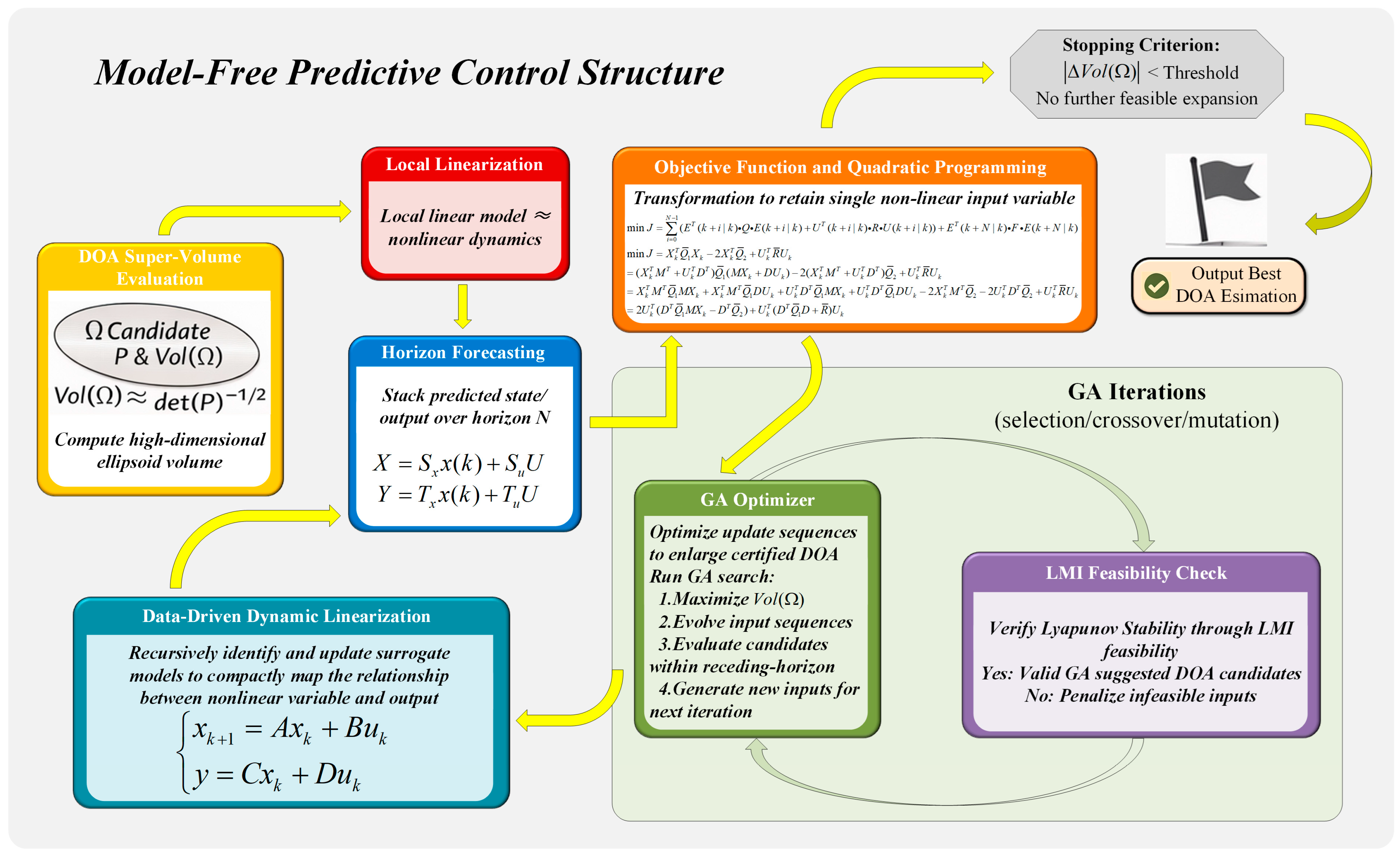
To address the excessive conservatism inherent in the T-S fuzzy model approach due to the lack of an optimal control algorithm, this study proposes a data-driven MFPC strategy integrated with a genetic algorithm. It is important to emphasize that the proposed MFPC + GA scheme is an offline analysis/optimization tool that operates on the LMI-based DOA enlargement iteration to determine an optimal iterative path; it is not implemented as the real-time closed-loop controller in the VSC–HVDC time-domain simulations (which retain the PI/VSG-based control structure), and the simulations are used primarily for validating the correctness of the DOA-based stability judgment. The optimization objective is defined as the high-dimensional spatial volume of DOA computed by the super-volume Formula (14). By maximizing this volume, the proposed method aims to provide a more accurate and significantly enlarged estimation of large-signal stability DOA for the VSC-HVDC system.
V n ( r ) = π n 2 Γ ( n 2 + 1 ) r n
It is important to clarify the roles of the three components. The LMI feasibility test remains the core mechanism that provides a certificate-based DOA estimate: for each iteration, solving the LMI yields a Lyapunov matrix M and thus a certified invariant ellipsoid Ω = { x x T · M · x 1 } , which is a valid inner approximation of the true DOA. The MFPC component does not model the physical VSC–HVDC plant dynamics for online control; instead, it provides an auxiliary predictive model that quantifies how the chosen update/iteration sequence affects the LMI-derived DOA size, where the DOA size is evaluated by the super-volume computed from the LMI solution M . In other words, the “output” of this predictive layer is not a measured electrical variable, but the scalar DOA-size metric obtained from the LMI iteration. The GA is employed as the optimizer because, once the LMI feasibility and the super-volume evaluation are embedded, the overall DOA-enlargement objective is generally non-convex and non-smooth: feasibility may switch discontinuously (feasible/infeasible), and the super-volume depends on the LMI solution M , which is not a simple differentiable function of the decision variables. GA therefore provides a robust derivative-free mechanism to explore candidate iteration/update sequences and steer the LMI enlargement toward directions that enlarge the certified DOA more effectively.
Based on the established relationship between the nonlinear iterative quantity and the DOA via the super-volume formula, the incorporation of an optimization algorithm requires an auxiliary mathematical model to facilitate computation. To this end, a data-driven, dynamically linearized model, as shown in Equation (15), is constructed from iteration data generated by the LMI-based DOA computation. Specifically, each LMI iteration (under a chosen update/iteration sequence) produces a certified Lyapunov matrix M and hence a DOA ellipsoid Ω , whose size is quantified by the super-volume formula. We use these iteration input–output pairs—namely, the chosen nonlinear iterative quantity/update sequence as the “input” and the resulting LMI-derived DOA super-volume as the “output”—to fit an auxiliary transfer relation for predictive optimization. This auxiliary model is therefore an abstract surrogate of the LMI-iteration mapping rather than an analytical averaged model of the VSC–HVDC plant.
x k + 1 = A x k + B u k y = C x k + D u k
Concretely, each candidate input sequence induces a predicted state evolution over the horizon, which in turn determines a candidate iteration trajectory for updating the local model information used in the LMI feasibility test. Solving the LMI yields a Lyapunov matrix M and thus an estimated DOA, whose super-volume serves as a scalar “output” reflecting the current large-signal stability margin. The optimization then seeks an input sequence that maximizes this DOA-size metric under practical input constraints, thereby producing a less conservative DOA estimate through an optimization-guided iteration.
For clarity, the variables x k , u k , and y in the predictive formulation denote the abstracted iteration-state, iteration-decision input, and DOA-size output of the auxiliary surrogate used to steer the LMI enlargement process, rather than the physical states and control signals of the VSC–HVDC system. Collect the state variables and control inputs at time step k + i   within the prediction horizon N , as predicted at time step k . The predicted state and control sequence are stacked as X = [ x k + 1 k T , , x k + N k T ] T and U = [ u k + 1 k T , , u k + N 1 k T ] T , respectively. Similarly, the stacked predicted output is Y = [ y k + 1 k T , , y k + N 1 k T ] T . These stacked forms allow the prediction model to be written compactly and enable the objective in Equation (18) to be expressed as a quadratic function of a single decision variable (the control sequence or the control-increment sequence, depending on the formulation adopted below).
X k = X ( k | k ) X ( k + 1 | k ) X ( k + 2 | k ) X ( k + N 1 | k ) X ( k + N | k ) , U k = U ( k | k ) U ( k + 1 | k ) U ( k + 2 | k ) U ( k + N 2 | k ) U ( k + N 1 | k )
Substitute the predicted state value X k into the dynamically linearized model; it can be reformulated only involving constant parameters and the input variable u k .
X k = X ( k | k ) X ( k + 1 | k ) X ( k + 2 | k ) X ( k + N | k ) = I n × n A n × n A n × n 2 A n × n N x k + 0 0 0 B 0 0 A B B 0 A N 1 B A N 2 B B U ( k | k ) U ( k + 1 | k ) U ( k + 2 | k ) U ( k + N 1 | k )
Let R denote the reference signal of the output, and define the tracking error as E = R y . In this context, the output variable represents the spatial volume of the large-signal DOA computed by the super-volume formula, while the reference signal R is assumed to be constant. Accordingly, the objective function is formulated as follows:
min J = i = 0 N 1 ( E T ( k + i | k ) Q E ( k + i | k ) + U T ( k + i | k ) R U ( k + i | k ) ) + E T ( k + N | k ) F E ( k + N | k )
To interpret Equation (18) in an intuitive way, the first term evaluates the predicted deviation of the chosen output from its reference over the prediction horizon, while the second term penalizes the control effort (or control increments) to avoid aggressive inputs and maintain implementability. Importantly, although the formulation follows the standard MFPC structure, the “output” in our application is associated with the DOA-enlargement target through the super-volume evaluation: the optimization is designed to steer the predicted evolution toward trajectories that lead to a larger certified Ω after the LMI feasibility test.
A quadratic program requires only a single decision variable; therefore, the state variable x k is eliminated, retaining only the input variable u k . To rewrite Equation (18) into a standard quadratic form, we express the stacked prediction as an affine mapping from the current state and the decision vector. Specifically, by recursively propagating the locally linearized prediction model along the horizon, we obtain X = S x x k + S u U and Y = T x x k + T u U , where S x , S u , T x   a n d   T u are the prediction (transfer) matrices determined by the model at the current step and the selected horizons. Substituting Y and Equation (17) into Equation (18) eliminates the explicit state dependence in the optimization and yields an objective that depends only on U . Expanding the quadratic terms leads to the standard QP representation in Equation (19), where the Hessian and linear terms are explicitly constructed from T u , the weighting matrices, and the reference signal. This step makes clear that the role of Equation (19) is to provide a compact, computable criterion for evaluating candidate control sequences in the subsequent optimization loop.
Substitute the above expression to eliminate the state variable x k and reformulate the objective function into the quadratic programming form. This formulation is then embedded within a genetic algorithm framework to compute the optimal solution. The objective function is ultimately formulated as
min J = X k T Q ¯ 1 X k 2 X k T Q ¯ 2 + U k T R ¯ U k = ( X k T M T + U k T D T ) Q ¯ 1 ( M X k + D U k ) 2 ( X k T M T + U k T D T ) Q ¯ 2 + U k T R ¯ U k = X k T M T Q ¯ 1 M X k + X k T M T Q ¯ 1 D U k + U k T D T Q ¯ 1 M X k + U k T D T Q ¯ 1 D U k 2 X k T M T Q ¯ 2 2 U k T D T Q ¯ 2 + U k T R ¯ U k = 2 U k T ( D T Q ¯ 1 M X k D T Q ¯ 2 ) + U k T ( D T Q ¯ 1 D + R ¯ ) U k
In addition to the quadratic objective, practical constraints can be incorporated in the same compact form, such as bounds on the control inputs and/or on control increments (e.g., actuator saturation and ramp-rate limits). These constraints are naturally expressed as linear inequalities in the stacked decision vector, and therefore can be evaluated consistently together with the quadratic objective. Nevertheless, once the LMI feasibility test and the DOA super-volume evaluation are coupled with the candidate sequence, the overall optimization landscape becomes non-smooth and may exhibit discontinuous feasibility, which motivates using GA as a robust derivative-free optimizer rather than relying on a purely convex-QP solver.
In the GA-based search, each chromosome encodes a candidate decision vector U (or Δ U ). For each candidate, Equation (19) is used to evaluate the predictive-control cost, while the LMI feasibility test is performed to obtain a certified M and thus an estimated DOA Ω . If the LMI is infeasible, the candidate is discarded or assigned a large penalty to prevent the algorithm from moving toward uncertified regions. The iteration proceeds until the DOA super-volume improvement becomes negligible (below a predefined threshold) or no further feasible enlargement can be achieved, at which point the obtained Ω is regarded as the maximum estimated DOA under the proposed procedure.
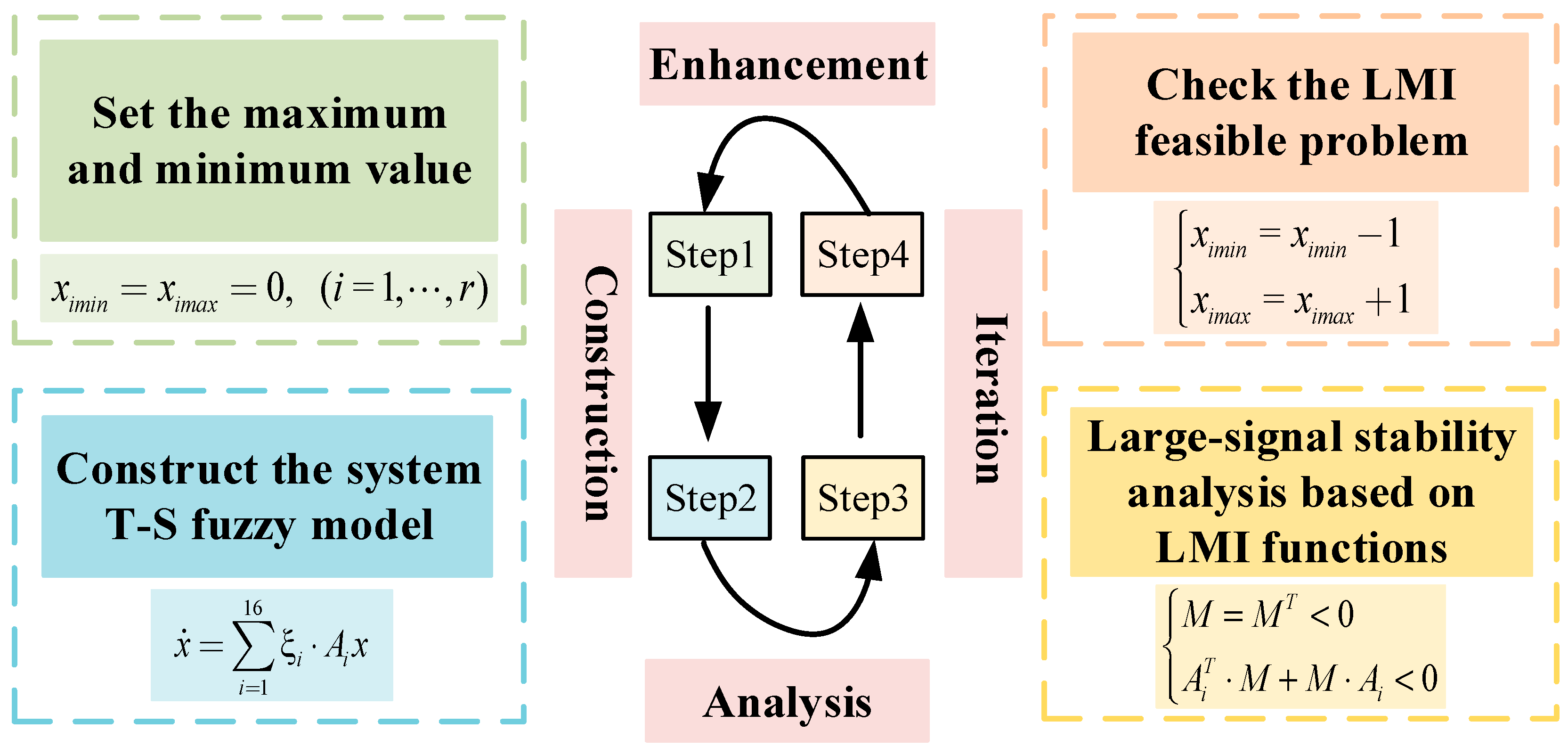
Finally, since the principle of predictive control strategy applies only the first predicted input at each step and the system prediction point shifts accordingly, the system model and the associated transfer matrices must be updated synchronously. This process is then repeated iteratively until the estimated DOA boundary is reached. The resulting trajectory represents the optimal iteration path and yields the maximum estimated DOA. The detailed workflow is illustrated in Figure 3, and the complete procedure is summarized in Algorithm 1.
Algorithm 1. Offline data-driven optimization algorithm for DOA enlargement based on MFPC and genetic algorithm
1.Initialization.
2. Define   the   prediction   length   N ,   the   maximum   number   of   iterations   k s t e p s , the optimization step size and the reference signal.
3.While the nonlinear system remains within the large-signal stability region, do
(a)
Obtain the initial discrete model, after that, derive a data-driven dynamically linearized model each time.
(b)
Predict the system state variables within the defined prediction horizon based on the current state.
(c)
Formulate the objective function and optimize it with predictions based on genetic algorithm.
(d)
Update the linearized model using the first predicted input and repeat the iteration process.
(e)
After reaching the estimated DOA boundary, output the final optimal iterative path and compute the maximum domain of attraction.
4.End
5.Plot the estimated large-signal stability domain of attraction based on the final results and compare its conservativeness.

3.3. Large-Signal Stability Analysis of the VSC-HVDC System

In this section, the large-signal stability/DOA analysis is conducted under a strong-grid and balanced-operating assumption (e.g., SCR > 4), together with a reduced-order modeling choice that neglects PLL dynamics, suppresses d q -axis coupling, and focuses on the dominant d -axis dynamics. These simplifications are introduced for two reasons. First, DOA (large-signal) stability analysis is meaningful only when the equilibrium is locally (small-signal) stable; in weak-grid conditions, synchronization-related mechanisms (especially PLL–grid interaction) may lead to loss of synchronism or instability even under small disturbances, in which case the “large-signal stability margin around that equilibrium” is no longer the primary question. Therefore, we deliberately target operating conditions where the system is sufficiently stable in small signal and where large disturbances (e.g., short-circuit faults) can meaningfully challenge stability, making DOA estimation practically relevant. Second, in our simulation/control implementation, feedforward decoupling is adopted to compensate for the major d q coupling terms, which supports treating the inner-loop dynamics as approximately decoupled for tractable DOA computation. Meanwhile, simplifying the q -axis dynamics substantially reduces the number of state variables and, consequently, the number of fuzzy rules in the unified T–S modeling, alleviating the “curse of dimensionality” and enabling a scalable certificate-based DOA estimation for complex converter-dominated systems. We emphasize that, for weak grids and/or asymmetric (unbalanced) faults where PLL dynamics, negative-sequence effects, and d q coupling can become significant [37,38,39], the model should be extended accordingly; the present results should therefore be interpreted within the stated operating envelope. Under these preconditions, the T-S fuzzy model of the VSC-HVDC system is constructed following the modeling procedure outlined in Section 3.1. Once simplified, the system retains 11 state variables with r = 4 nonlinear state variables contained, and the unified T–S fuzzy model contains 2 r = 16 fuzzy rules. Each nonlinear state variable is partitioned by two sector-bounded piecewise-linear (triangular) membership functions. The average-value model has been previously derived from Equations (1)–(9), and to shift the operating point to the origin, the coordinate transformation defined in Equation (20) is applied. The transformed system centered at the origin is expressed in Equation (22), where four nonlinear terms corresponding to x 1 , x 2 , x 4 , and x 5 are indicated in Equation (21). The system state variables I d r , V d c r , I d c c , V d c i , I d i , M 1 , M 3 , M 5 , M 7 , V g d i   a n d   W m denote the respective steady-state values.
x 1 = i d r I d r ,   x 2 = v d c r V d c r x 3 = i d c c I d c c ,   x 4 = v d c i V d c i x 5 = i d i I d i ,   x 6 = m 1 M 1 x 7 = m 3 M 3 ,   x 8 = m 5 M 5 x 9 = m 7 M 7 ,   x 10 = v g d i V g d i x 11 = ω m W m
f 1 ( x 1 ) = x 1 + I d r ,   x 1 [ x 1 min ,   x 1 max ] f 2 ( x 2 ) = x 2 + V d c r ,   x 2 [ x 2 min ,   x 2 max ] f 3 ( x 4 ) = x 4 + V d c i ,   x 4 [ x 4 min ,   x 4 max ] f 4 ( x 5 ) = x 5 + I d i ,   x 5 [ x 5 min ,   x 5 max ]
x ˙ 1 = 1 L r ( R s r k i p d r f 2 ( x 2 ) V t r i ) x 1 + R s r I d r v g d r k i p d r k v p d r f 2 ( x 2 ) L r V t r i x 2 + k i p d r k v i d r L r V t r i f 2 ( x 2 ) x 6 + k i i d r L r V t r i f 2 ( x 2 ) x 7 x ˙ 2 = 3 2 V t r i C d c r [ k v p d r f 1 ( x 1 ) + v g d r R s r I d r ] x 1 + 3 k v p d r k i p d r 2 V t r i C d c r f 1 ( x 1 ) x 2 x 3 C d c r 3 k i p d r k v i d r 2 V t r i C d c r f 1 ( x 1 ) x 6 3 k i i d r 2 V t r i C d c r f 1 ( x 1 ) x 7 x ˙ 3 = 1 L c x 2 R s c L c x 3 1 L c x 4 x ˙ 4 = x 3 C d c i + 3 ( v g d i + R s i I d i ) 3 k i p d i f 4 ( x 5 ) 2 V t r i C d c i x 5 + 3 k i p d i k v i d i f 4 ( x 5 ) 2 V t r i C d c i x 8 + 3 k i i d r 2 V t r i C d c i f 4 ( x 5 ) x 9 3 k i p d i k v p d i f 4 ( x 5 ) 2 V t r i C d c i x 10 x ˙ 5 = V g d i R s i I d i L i V t r i x 4 + ( k i p d i L i V t r i f 3 ( x 4 ) R s i L i ) x 5 k i p d i k v i d i L i V t r i f 3 ( x 4 ) x 8 k i i d i L i V t r i f 3 ( x 4 ) x 9 + ( 1 + k i p d i k v p d i L i V t r i f 3 ( x 4 ) 1 L i ) x 10 x ˙ 6 = x 2 ,   x ˙ 7 = x 1 k v p d r x 2 + k v i d r x 6 x ˙ 8 = x 10 ,   x ˙ 9 = x 5 + k v i d i x 8 k v p d i x 10 x ˙ 10 = 1 C i x 5 1 R l o a d C i x 10 ,   x ˙ 11 = K p f ω n + D p J x 11
After constructing the T-S fuzzy model, the proposed MFPC approach is applied to carry out the optimization procedure. Specifically, four nonlinear iterative quantities are designated as the system input variables, and eleven modeling-related physical quantities are identified as the system state variables. The spatial volume of high-dimensional DOA is defined as the system output variable. By applying the algorithm introduced in the preceding section, the extremum vector of the nonlinear variables x m i n , along with the associated constant positive definite matrix M , is derived. Here, x m i n denotes the extremum (bound) vector associated with the maximum estimated DOA obtained by the proposed enlargement procedure. Specifically, x m i n R 11 collects the lower-bound components of the 11-state vector in Equation (20) (including the selected nonlinear variables). Its entries consist of two parts: (i) for the state components that are not updated during the enlargement iteration, the corresponding bounds remain at their fixed values determined by the operating-point initialization; (ii) for the iterated nonlinear components, the bounds are updated to the largest extremal values that still satisfy the LMI feasibility (Lyapunov certificate) conditions, yielding the extremum vector that corresponds to the maximum certified DOA reported in Equation (24). Therefore, the “ x m i n bounds” in Equation (24) should be interpreted as the boundary-related extremum values of the 11-dimensional state vector associated with the final certified solution, rather than arbitrary constant limits.
Genetic Algorithm (GA) settings and rationale. In this study, the GA is employed as a derivative-free optimizer because each candidate update sequence must pass a certificate-based feasibility evaluation (i.e., the LMI feasibility test in Section 3.1), and the resulting DOA size is computed from the LMI-derived Lyapunov matrix M . This embedded feasibility/certificate step can introduce discontinuous feasible/infeasible transitions, making gradient-based tuning unreliable and rendering the overall search landscape effectively non-smooth. Therefore, the GA hyperparameters are chosen to balance exploration capability and computational tractability under expensive feasibility evaluations [40,41,42]. Specifically, we use P o p u l a t i o n S i z e = 50 , M a x G e n e r a t i o n s = 80 , C r o s s o v e r F r a c t i o n = 0.8 , an adaptive feasibility-oriented mutation operator (MATLAB default for constrained continuous variables), and F u n c t i o n T o l e r a n c e = 10 6 as the termination tolerance. These choices follow established guidance that (i) moderate population sizes and generation budgets (typically on the order of 10 to 100) offer a practical compromise between solution quality and runtime when fitness evaluations are expensive, and (ii) feasibility-aware constraint handling is crucial for evolutionary optimization with embedded feasibility checks. To further confirm that the selected parameters provide a stable trade-off, we also include a small sensitivity study (Table 1) that reports the influence of population size, generation budget, and operator settings on DOA enlargement accuracy and computational efficiency. In the implementation, the GA search is executed by MATLAB Global Optimization Toolbox, and the LMI feasibility problems throughout the DOA estimation/enlargement are solved using the MATLAB LMI Toolbox.
Metric definitions: Let V ( Ω ) denote the certified DOA super-volume computed from the LMI-derived Lyapunov matrix. The normalized DOA metric is defined as J V ( Ω ) / V ( Ω ) S 2 , where V ( Ω ) S 2 is the value obtained under the baseline GA setting S2. For each GA setting, we repeat the optimization with multiple random seeds and report: (i) best normalized DOA metric (max): max J across repeated runs; (ii) normalized DOA metric (mean ± std): mean and standard deviation of J across repeated runs; (iii) success rate (% runs): percentage of runs achieving an LMI-feasible improvement over the baseline DOA metric; (iv) feasible-candidate ratio (% evals): fraction of evaluated chromosomes whose embedded LMI feasibility test is feasible; (v) feasible-generation rate (% gens): percentage of generations containing at least one LMI-feasible candidate; (vi) runtime (minute): wall-clock time per run (mean ± std); and (vii) throughput (eval/s): total evaluations divided by runtime. These indicators jointly characterize accuracy (DOA enlargement), efficiency (computational burden under embedded certificate checks), and robustness (run-to-run variability under stochastic search). As shown in Table 1, increasing P o p   S i z e / M a x   G e n generally improves the best-achieved DOA metric due to enhanced exploration, but it also increases runtime nearly proportionally because each fitness evaluation requires an embedded LMI feasibility certification; thus, the selected baseline represents a balanced setting that maintains adequate feasible-solution generation while keeping the computational cost tractable.
Rationale for selecting GA versus faster online QP solvers. Although Equations (15)–(19) adopt a standard MPC-style quadratic objective, the optimization solved in this work is not a conventional real-time QP for closed-loop control of the VSC–HVDC plant. Rather, the decision variables represent an iterative update sequence that steers the LMI-based DOA enlargement procedure, and each candidate sequence must be evaluated through an embedded LMI feasibility (certificate) test (Section 3.1) followed by DOA-size computation from the resulting Lyapunov matrix M . Consequently, the effective objective landscape becomes implicit and non-smooth: feasibility may switch discontinuously (feasible/infeasible) as the update sequence changes, and the DOA-size metric depends on the certificate solution M in a way that does not admit a reliable gradient or a fixed convex formulation. Under these conditions, “faster” online QP solvers (local or global) are not directly applicable to the full problem because they require a smooth, explicitly parameterized objective and constraints that are evaluated without such certificate-driven discontinuities. We therefore adopt a genetic algorithm as a derivative-free global-search heuristic that is robust to non-smooth fitness evaluations and discontinuous feasibility induced by the certificate embedding, and that can explore multiple competing update sequences to mitigate sensitivity to initialization and local search bias. This choice is consistent with the fact that the proposed MFPC + GA module is used as an offline analysis/optimization tool for DOA enlargement rather than as an online real-time controller.
By substituting the system parameters listed in Table 2, the corresponding constant positive definite matrix M and the expression for the maximum domain of attraction at the operating point can be obtained, as given in Equations (23) and (24).
M = 6.88 e 4 3.47 e 2 4.86 e 6 4.86 e 5 7.14 e 12 6.81 6.90 e 2 7.33 e 7 3.20 e 8 1.11 e 7 0 3.47 e 2 9.45 e 1 2.88 2.88 e 1 1.06 e 8 3.47 e 2 1.02 e 1 4.74 e 2 1.86 e 3 4.20 e 2 0 4.86 e 6 2.88 3.20 e 1 3.20 1.17 e 9 4.39 e 1 2.98 e 4 5.08 e 3 2.07 e 4 4.70 e 3 0 4.86 e 5 2.88 e 1 3.20 3.20 e 1 1.10 e 8 4.40 2.98 e 3 5.08 e 2 2.08 e 3 4.72 e 2 0 7.14 e 12 1.06 e 8 1.17 e 9 1.10 e 8 3.64 e 6 7.02 e 8 8.63 e 6 1.96 e 10 1.70 e 10 6.70 e 10 0 6.81 3.47 e 2 4.39 e 1 4.40 7.02 e 8 6.75 e 4 6.76 e 2 1.35 e 2 4.48 e 5 7.55 e 3 0 6.90 e 2 1.02 e 1 2.98 e 4 2.98 e 3 8.63 e 6 6.76 e 2 1.37 e 1 7.37 e 5 4.05 e 6 1.06 e 5 0 7.33 e 7 4.74 e 2 5.08 e 3 5.08 e 2 1.96 e 10 1.35 e 2 7.37 e 5 7.77 e 1 7.87 e 2 5.50 0 3.20 e 8 1.86 e 3 2.07 e 4 2.08 e 3 1.70 e 10 4.48 e 5 4.05 e 6 7.87 e 2 1.29 e 2 3.49 e 1 0 1.11 e 7 4.20 e 2 4.70 e 3 4.72 e 2 6.70 e 10 7.55 e 3 1.06 e 5 5.50 3.49 e 1 3.06 e 1 0 0 0 0 0 0 0 0 0 0 0 1.41 e 3
Ω = { x | V ( x ) x m i n T M x m i n = 3.3395 × 10 10 }
Given the presence of 11 state variables, the domain of attraction forms a convex polyhedron in an 11-dimensional space. For visualization purposes, this high-dimensional region can be projected onto the three-dimensional space or the two-dimensional plane, such as the v d c r v d c i v g d i space or the v d c r v d c i plane.
From an operational perspective, the DOA provides a quantitative large-signal stability margin at the considered operating point. Each dimension of the DOA corresponds to a selected physical state variable of the VSC–HVDC system, and the DOA boundary represents the maximum admissible deviation in these physical quantities for which the post-disturbance trajectory still converges back to the equilibrium. Therefore, a greater (estimated) DOA indicates that the system can tolerate larger deviations in key physical quantities under large disturbances (e.g., deeper voltage dips or larger frequency/power perturbations) without losing large-signal stability, which is of practical value for grid-support functionalities such as low-voltage ride-through and frequency/power support.

4. Simulation Verification

The proposed method utilizes the concept of the DOA to evaluate the transient stability of the system under large-signal disturbances at the operating point. Specifically, during a transient response, if the system’s trajectory originates within the DOA, it will asymptotically converge to the steady-state operating point. In contrast, if the trajectory begins outside the DOA, it may cause sustained oscillations or instability. Time-domain simulations are performed in MATLAB/Simulink to demonstrate that the proposed MFPC approach achieves significantly larger DOA compared to the conventional method. The model parameters are presented in Table 2.

4.1. Case Study

Large-signal disturbances commonly encountered in the VSC-HVDC system include short-circuit fault shocks, random fluctuations in transmission power, and perturbations caused by circuit parameter changes. Representative disturbances selected in this study are three-phase grounded faults and transmission power fluctuations. Time-domain simulations combined with the state trajectory tracking are employed to investigate the system’s stability under these large-signal disturbances.
  • Case 1: Three-phase short-circuit fault
The three-phase short-circuit fault induces a voltage dip in the main grid, which persists for 1 s before clearance. It is important to note that even during voltage dip conditions, the VSC-HVDC system does not trigger the overcurrent protection in the transient state due to the low power load. To analyze large-signal stability during this phase, the post-fault steady-state operating point is first determined.
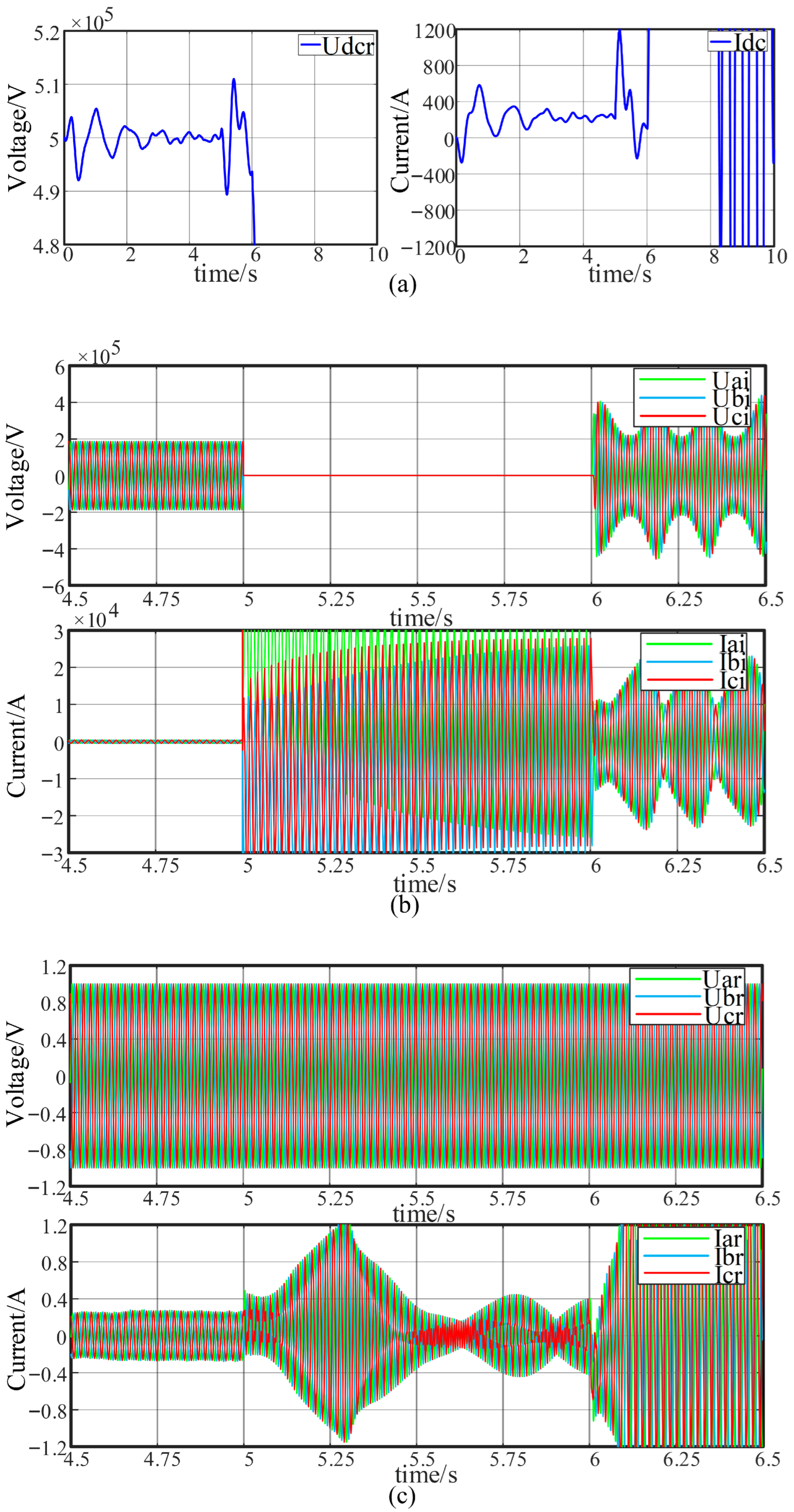
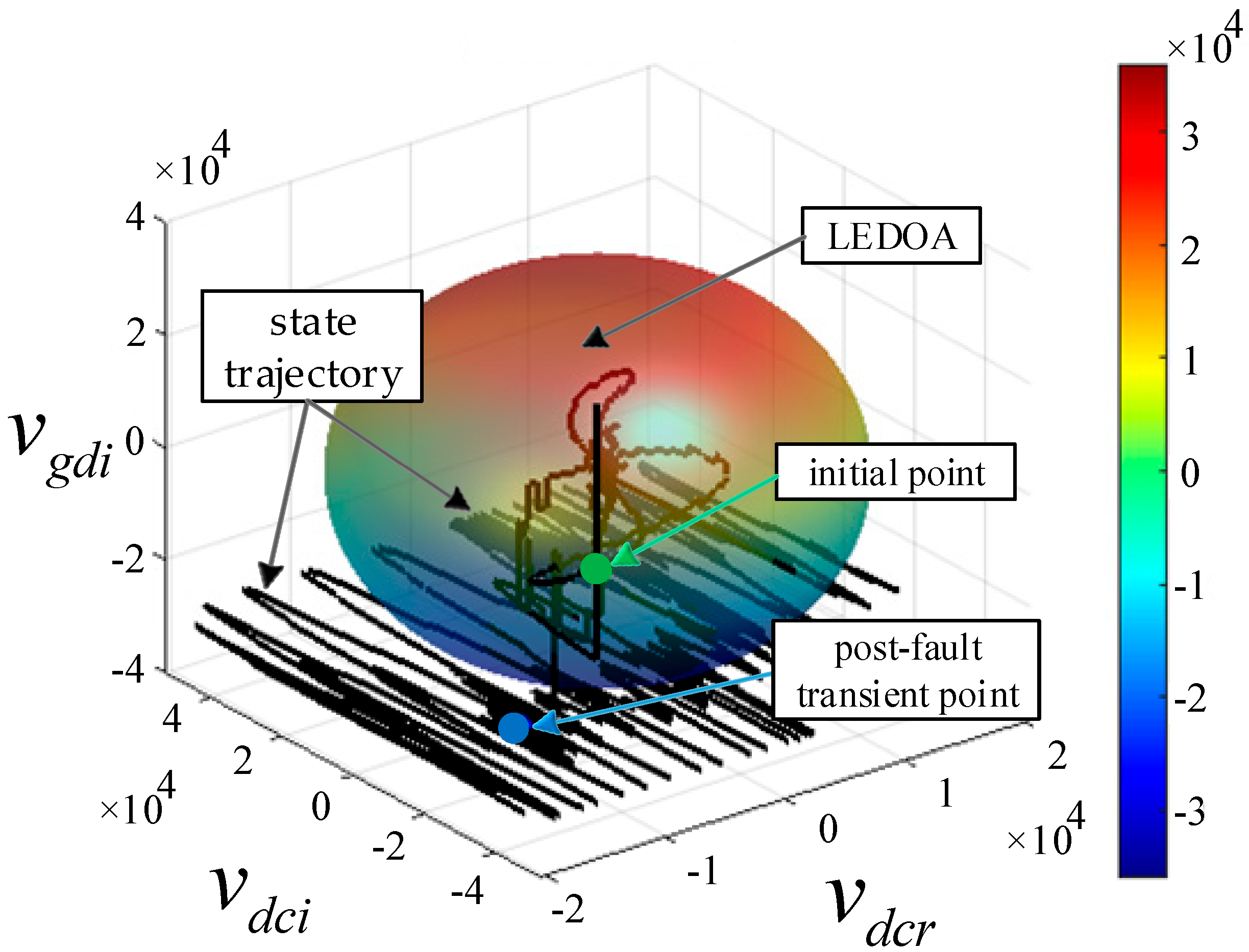
The corresponding domain of attraction is then estimated and projected onto the v d c r v d c i v g d i space, as illustrated in Figure 4. The initial operating point prior to the disturbance (green point) and the post-fault state (blue point) are both marked in Figure 4. It is evident that the post-fault state lies outside the estimated DOA, indicating that the system fails to converge to the final equilibrium point after a prolonged transient process. Time-domain simulations are subsequently conducted, and the corresponding transient waveforms are presented in Figure 5. Specifically, Figure 5a presents the voltage magnitude of the DC capacitor on the rectifier side and the current flowing through the DC transmission line. Figure 5b,c depict the voltage and current magnitudes of the AC grids at both converter terminals, respectively. The values in Figure 5c are normalized with base values of 500 M W and 220 k A . As observed, the fault is cleared at t = 6   s , and the inverter station fails to reach a stable state. Meanwhile, the rectifier station also experiences significant perturbations with noticeable current oscillations. In addition, the capacitor voltage drops steeply, and the transmission current exhibits considerable fluctuations. The system’s state trajectory during the entire process is also depicted in Figure 4.
Based on these observations, this case demonstrates that the VSC-HVDC system exhibits large-signal instability during the three-phase short-circuit fault. Meanwhile, the post-fault state lies outside the estimated DOA, indicating that the proposed MFPC approach does not trade reliability for reduced conservatism. Instead, it maintains a reliable stability margin and yields correct judgments for cases that are truly unstable.
  • Case 2: Transmission power fluctuation
Since the VSC-HVDC system is subject to transmission power fluctuations rather than constant power load assumptions, it is feasible to analyze large-signal stability under load variations. In this case, the load power increases from 100 M W to 350 M W . The steady-state operating point at 100 M W is used as the initial condition. Both the instantaneous state after the load ramps up to 350 M W and the final equilibrium point are marked as operating points accordingly. Both operating points are verified to be small-signal stable.
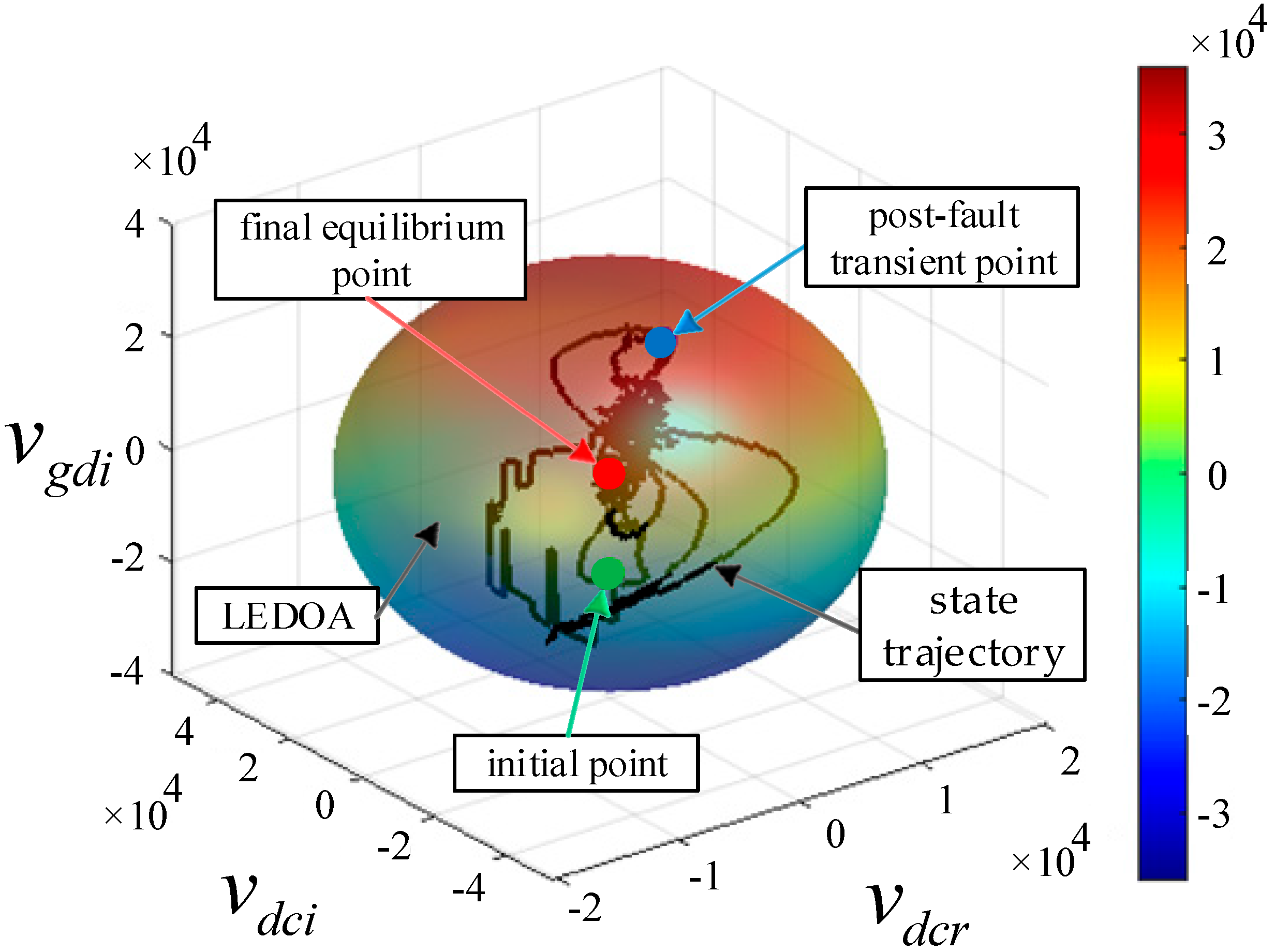
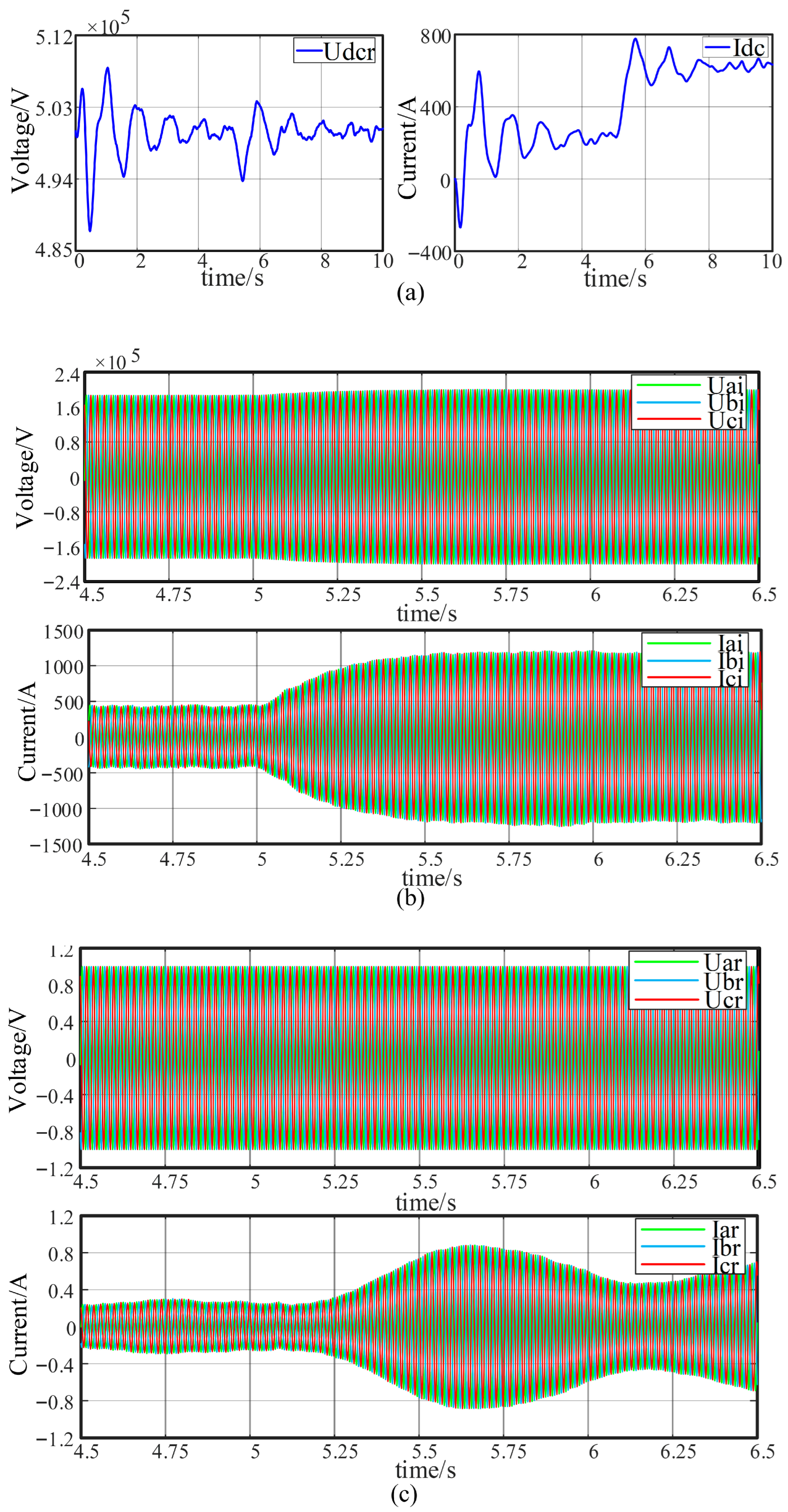
The domain of attraction associated with the initial operating point ( P l o a d = 100   M W ) is estimated and projected, as shown in Figure 6. The initial point (green), the post-disturbance transient state (blue), and the final equilibrium point (red) are all marked in the figure. As illustrated, the initial point lies within the DOA, indicating that the transition from the initial to the final operating point is large-signal stable. To verify this conclusion, time-domain simulations are conducted, and the results are presented in Figure 7. The waveform quantities depicted in Figure 7 are consistent with those in Figure 5, including the DC capacitor voltage, DC line current, and AC-side voltage and current at both terminals. As observed, the load power increases from 100 M W to 350 M W at t = 5   s , causing minor fluctuations in the DC capacitor voltage and transmission current, followed by a corresponding increase in output current from both the inverter and rectifier stations. By observing the state trajectory in Figure 6, it is evident that after a transient period, the system gradually settles into the new steady state, confirming the large-signal stability of the transition as predicted and validating the effectiveness of the proposed MFPC method. Furthermore, the system’s state trajectory during the entire transition process is shown in Figure 6. The state trajectory remains strictly within the interior of the estimated DOA and gradually converges to the final equilibrium point over time.
This case verifies that the proposed MFPC approach reliably characterizes the large-signal stability under load power disturbances, highlighting the precise DOA estimation of the proposed method to assess the dynamic stability and quantify stability margins for the HVDC systems.

4.2. Conservatism Comparison

The MFPC strategy, integrated with a genetic algorithm, constitutes a novel and advanced approach for the domain of attraction estimation. By incorporating the optimization techniques into the conventional T-S fuzzy model method, this approach significantly reduces the conservatism typically associated with the Largest Estimated Domain of Attraction (LEDOA).
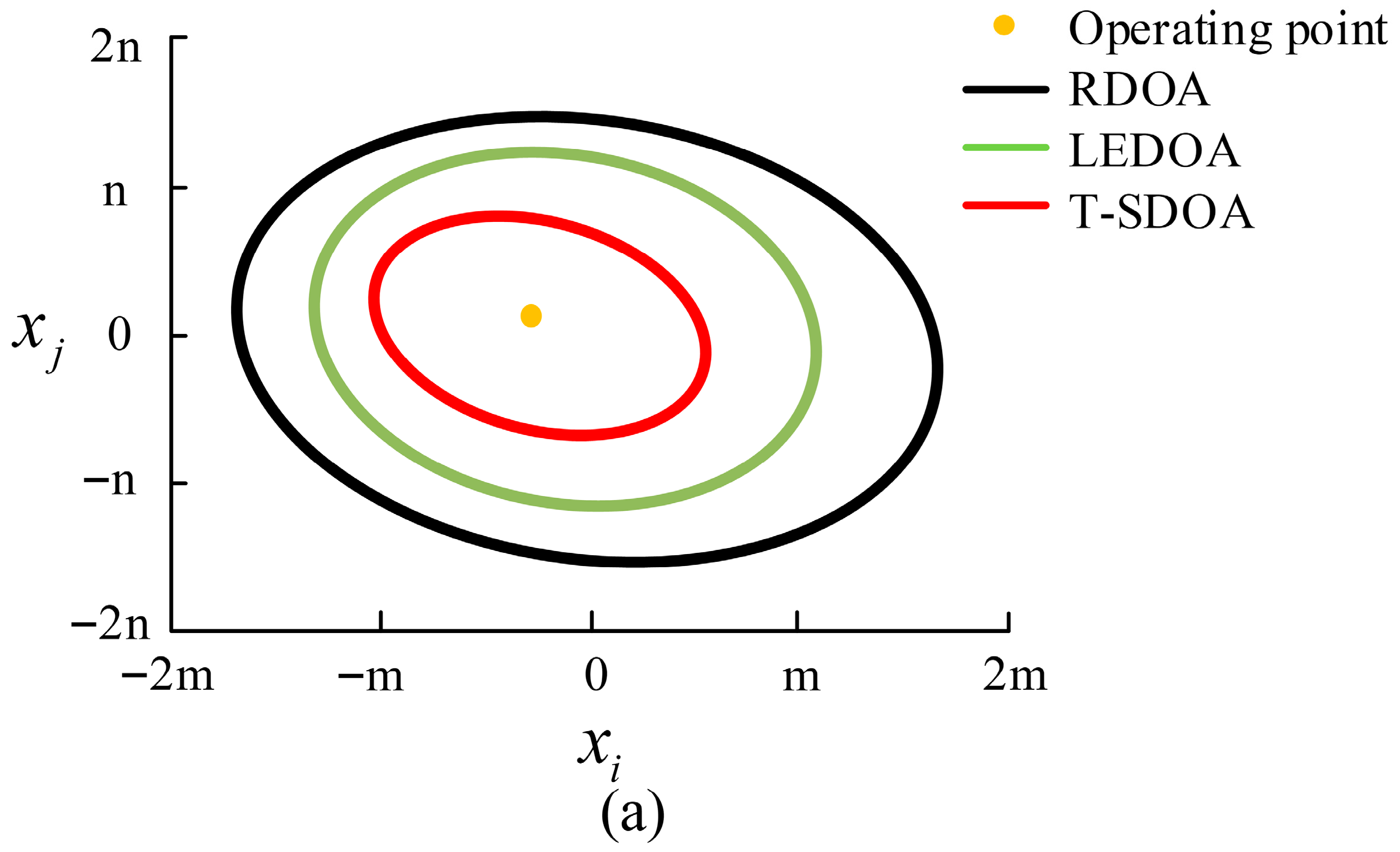
Under the operating scenarios of both Case 1 and Case 2, the domains of attraction are estimated using the conventional T-S fuzzy model method and the proposed MFPC approach. Specifically, Figure 8a provides a conceptual illustration of the relative sizes among the real domain of attraction (RDOA), the DOA estimated via the T-S fuzzy model (T-SDOA), and the DOA obtained from the proposed approach (LEDOA). Although the LEDOA remains conservative with respect to the RDOA, it significantly outperforms the T-SDOA in terms of coverage, indicating that the proposed optimization-enhanced approach yields less conservative and more accurate estimations.
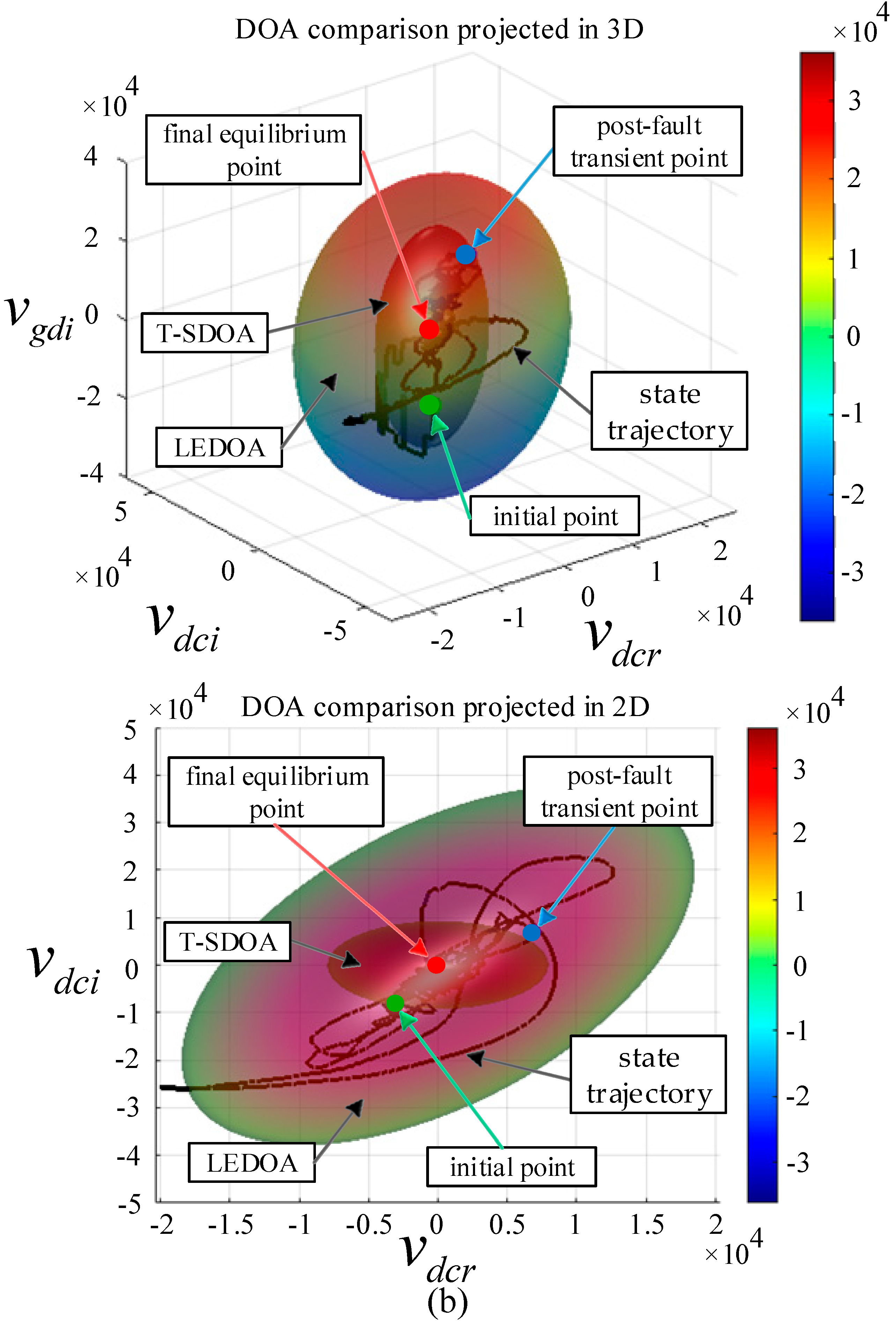
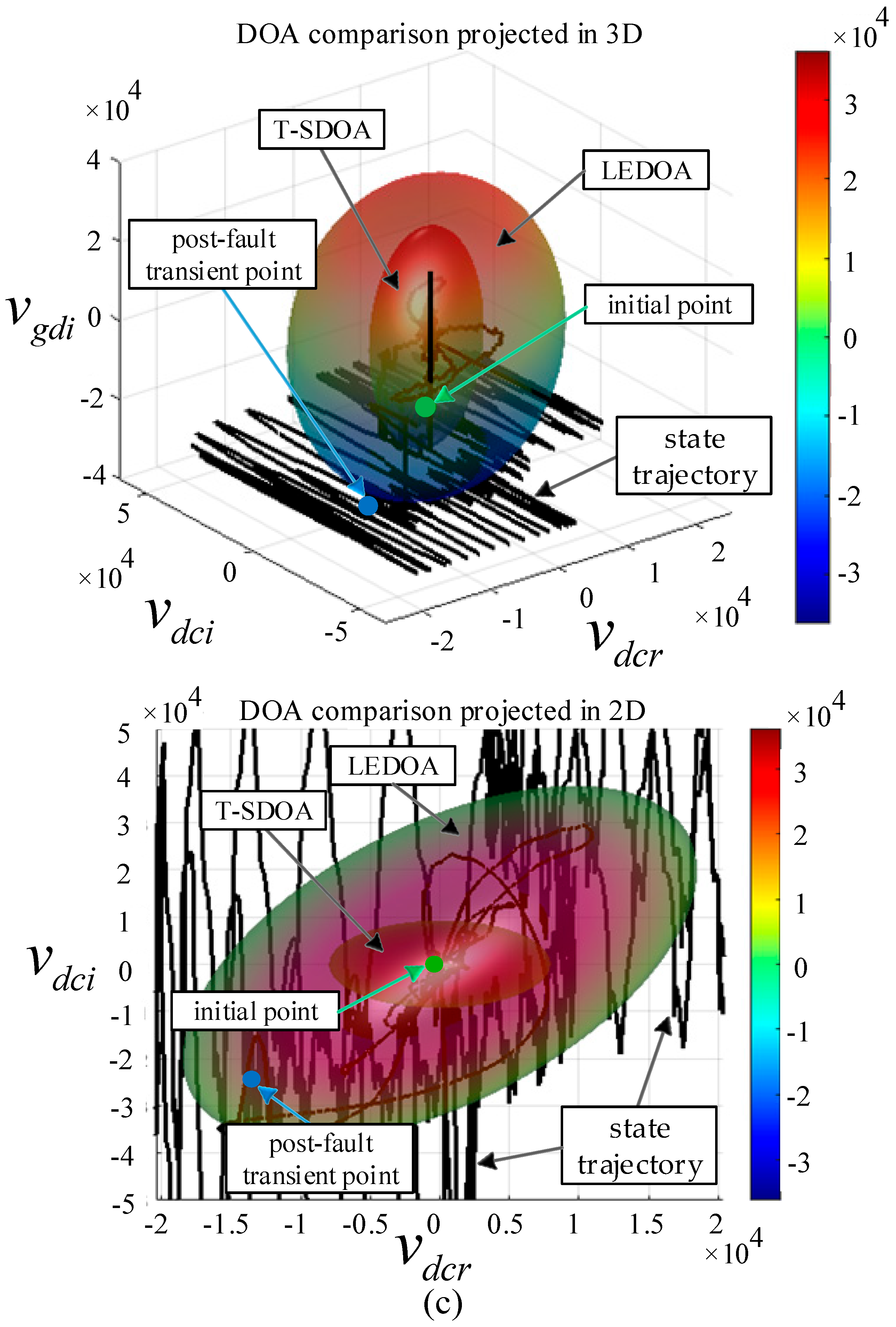
Furthermore, Figure 8b,c present the actual estimation results for Case 2 and Case 1, respectively, in both 3-D and 2-D projections. In each subplot, the LEDOA and the T-SDOA are explicitly delineated for direct comparison. To further validate the estimation accuracy, the system’s state trajectory during the dynamic transition is superimposed onto the plots. As shown in Figure 8b, corresponding to Case 2, the blue test point is located inside the LEDOA but outside the T-SDOA. Its associated state trajectory progressively converges toward the equilibrium point at the origin, demonstrating that regions outside the T-SDOA can still retain asymptotic stability. This observation suggests that the T-SDOA result is overly conservative. In contrast, Figure 8c, corresponding to Case 1, shows that the blue test point is simultaneously positioned outside both the LEDOA and the T-SDOA, with its state trajectory clearly diverging away from the equilibrium. This indicates that the space outside the LEDOA cannot maintain stability under the given disturbance scenario. At the same time, the preceding result in Case 2 demonstrates that the operating condition situated within the interior of the LEDOA exhibits stable behavior. Taken together, these results provide consistent evidence for the validity of the LEDOA: Case 2 verifies that the interior of the LEDOA guarantees convergence, while Case 1 demonstrates that its exterior fails to preserve stability. The visual evidence in both cases verifies the correctness and effectiveness of the proposed MFPC estimation approach in characterizing the real large-signal stability region.

4.3. Influence of Parameter Adjustments on System Stability

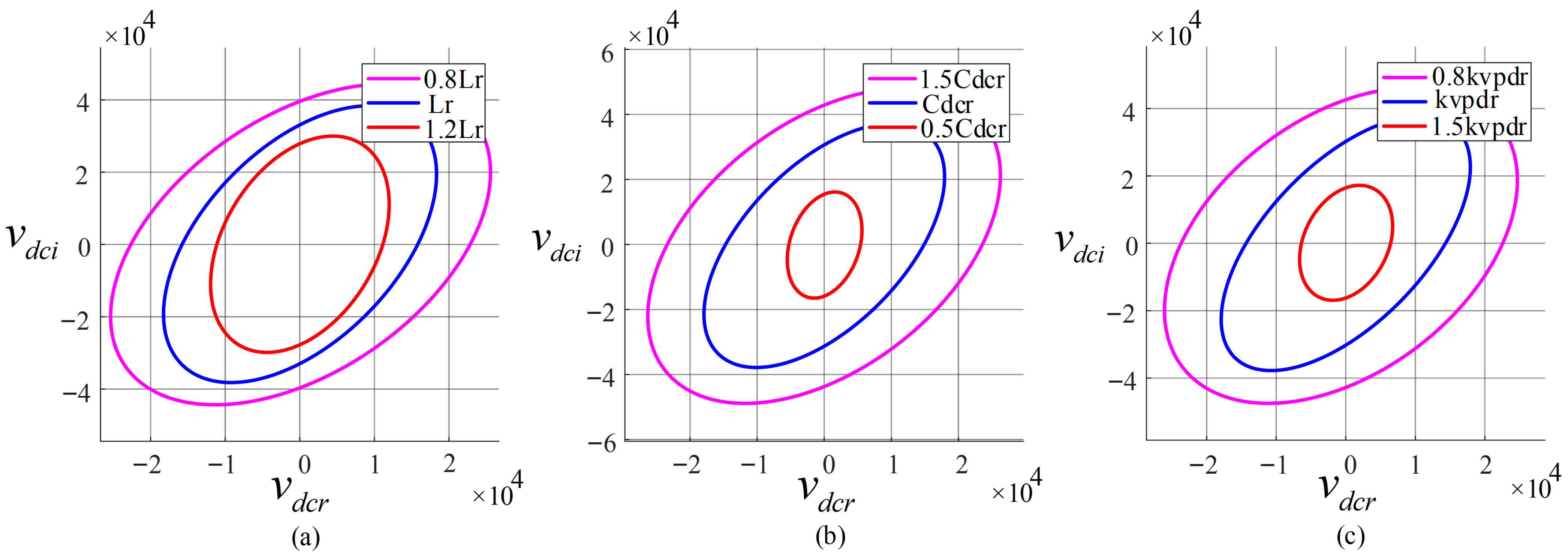
When the VSC-HVDC system exhibits instability, as illustrated in Case 1, system stability can be restored through appropriate tuning of specific system parameters. In this study, parameter adjustments are guided by insights from prior research, aiming to expand the DOA around the desired operating point and thereby facilitate stable system operation. Take the rectifier station side DC capacitance C d c r as an example: Figure 9 demonstrates that increasing C d c r effectively enlarges the DOA. Similarly, modifications to other system parameters, such as the rectifier-side inductance L r and the proportional gain of the rectifier-side voltage loop k v p d r , can either enlarge or reduce the DOA depending on the specific adjustment. As long as the system’s state trajectory remains within the estimated DOA under large-signal perturbations, stable operation can be maintained. Therefore, analyzing the influence of parameter variations on the DOA provides a practical and effective strategy for mitigating large-signal instability in the VSC-HVDC system.

5. Conclusions

This study analyzes the large-signal stability characteristics of the VSC-HVDC system in the context of long-distance power transmission. By constructing a T-S fuzzy model based on the state-space averaging representation of the simplified VSC-HVDC configuration, a framework for estimating the DOA was established. Building upon this, an MFPC approach enhanced with a genetic algorithm is implemented to estimate and expand the DOA. This method successfully provides a less conservative and more accurate characterization of the system’s large-signal stability. Simulation results clearly demonstrate that the incorporation of an optimization algorithm enhances the DOA, thereby providing a solid theoretical basis for future DOA-based stability analyses and applications. For clearer positioning with respect to other representative large-signal stability assessment methods, Table 3 provides a qualitative comparison and highlights why the T–S fuzzy/LMI framework (and the proposed MFPC + GA enhancement) is particularly suitable for high-dimensional converter-dominated nonlinear systems. Extending the present certificate-based T–S fuzzy/LMI framework to more complex HVDC or multi-terminal systems would primarily translate into higher modeling and computational burdens due to the exponential growth of the rule base with added nonlinear variables; therefore, improving solver efficiency and reducing fuzzy rules constitute the most practical directions for future work.

Author Contributions

Conceptualization, Z.S., Y.H. and L.X.; methodology, Z.S., Y.H., Z.C. and J.J.; software, Z.S., T.L., P.T. and K.M.; validation, Y.H., Z.C., J.J. and S.G.; formal analysis, Z.S., T.L. and P.T.; investigation, Z.S., T.L., P.T., K.M. and S.G.; resources, L.X. and Y.H.; data curation, T.Y. and J.Z.; writing—original draft preparation, Z.S.; writing—review and editing, Z.S., Y.H., Z.C., J.J. and L.X.; visualization, T.L., P.T., K.M. and T.Y.; supervision, L.X.; project administration, L.X. and Y.H.; funding acquisition, L.X. All authors have read and agreed to the published version of the manuscript.

Funding

This research was funded by State Grid Gansu Electric Power Company Self-Managed Science and Technology Projects, grant number 52273025001; the National natural science foundation of China, grant number 52007015; and the National natural science foundation of China, grant number 52377074.

Data Availability Statement

Data are contained within the article.

Conflicts of Interest

Authors Yalan He, Zhe Cao, and Jingrui Jiang were employed by the State Grid Gansu Electric Power Company. The remaining authors declare that the research was conducted in the absence of any commercial or financial relationships that could be construed as a potential conflict of interest. The authors declare that this study received funding from State Grid Gansu Electric Power Company Self-Managed Science and Technology Projects with grant number 52273025001, the National natural science foundation of China with grant number 52007015, and the National natural science foundation of China with grant number 52377074. The funder was not involved in the study design, collection, analysis, interpretation of data, the writing of this article, or the decision to submit it for publication.

Nomenclature

A. Abbreviations
AC/DCAlternating Current/Direct Current
VSCVoltage Source Converter
HVDCHigh Voltage Direct Current
DFIGDoubly Fed Induction Generator
GFM/GFLGrid-Forming/Grid-Following
VSGVirtual Synchronous Generator
PLLPhase-Locked Loop
PWMPulse Width Modulation
DOADomain of Attraction
LMILinear Matrix Inequality
T–STakagi–Sugeno
LEDOALargest Estimated Domain of Attraction
RDOAReal Domain of Attraction
MPC/MFPCModel Predictive Control/Model-Free Predictive Control
GAGenetic Algorithm
B. Mathematical Symbols
v g a b c r ,   v k a b c r Three phase power source voltage and port voltage
Ω , Ω o Certified estimated DOA, Real large-signal stability DOA
h i ( z ) Normalized membership weight
V Ω Implicit expression constant term in high-dimensional space formula
V n Super-volume   of   Ω
d e t ( ) Determinant
M Positive definite Lyapunov matrix
N Prediction horizon length
X , U , Y Stacked predicted state/input/output vectors
Q , R Weighting matrices in the quadratic cost
H , E Hessian matrix and linear term in QP objective
S x , S u , T x , T u Prediction transfer matrices
x m i n Extremum state vector

References

  1. Sajadi, A.R.; Kolacinski, M.; Clark, K.; Loparo, K.A. Transient stability analysis for offshore wind power plant integration planning studies. IEEE Trans. Ind. Appl. 2019, 55, 182–192. [Google Scholar] [CrossRef]
  2. Pape, M.; Kazerani, M. A generic power converter sizing framework for series-connected DC offshore wind farms. IEEE Trans. Power Electron. 2022, 37, 2307–2320. [Google Scholar] [CrossRef]
  3. Xiong, L.; Li, T.; Huang, S.; Li, P.; Wang, Z.; Sun, Z.; Niu, T. Optimized sizing of ESSs in non-array formed wind farm for frequency support considering multi-directional wake effect. IEEE Trans. Sustain. Energy, 2025; in press. [Google Scholar] [CrossRef]
  4. Ayalew, B.; Moursi, M.S.; El-Saadany, E.F. Enhanced DC voltage regulation and transient response for multi-terminal VSC-HVDC system using direct power control. IEEE Trans. Power Syst. 2022, 37, 2538–2548. [Google Scholar] [CrossRef]
  5. Xiong, L.; Huang, S.; Li, P.; Wang, Z.; Khan, M.W.; Niu, T. Hidden Markov jump system based robust control of inverter-fed power systems with asynchronous sliding mode observer. IEEE Trans. Ind. Electron. 2025, 72, 13287–13299. [Google Scholar] [CrossRef]
  6. Wu, W.; Chen, Y.; Zhou, L.; Zhou, X.; Yang, L.; Dong, Y.; Luo, A. A virtual phase-lead impedance stability control strategy for the maritime VSC-HVDC system. IEEE Trans. Ind. Informat. 2018, 14, 5475–5486. [Google Scholar] [CrossRef]
  7. Shu, H.; Liu, T.; Lei, S.; Hu, Y. Single-ended protection of VSC-HVDC outgoing line based on backward traveling wave time-domain weighted optimization. IEEE Trans. Ind. Electron. 2024, 71, 15044–15053. [Google Scholar] [CrossRef]
  8. Liao, J.; Zhou, N.; Wang, Q. DC grid protection method based on phase planes of single-end common and differential mode components. IEEE Trans. Power Deliv. 2021, 36, 299–310. [Google Scholar] [CrossRef]
  9. Gu, X.; Li, J.; Liu, K.; Zhu, Y.; Tao, X.; Shang, Y. A precise minor-fault diagnosis method for lithium-ion batteries based on phase plane sample entropy. IEEE Trans. Ind. Electron. 2024, 71, 8853–8861. [Google Scholar] [CrossRef]
  10. He, J.; Zhang, X.; Ma, H.; Cai, C. Lyapunov-based large-signal control of three-phase stand-alone inverters with inherent dual control loops and load disturbance adaptivity. IEEE Trans. Ind. Electron. 2021, 68, 8391–8401. [Google Scholar] [CrossRef]
  11. Houari, A.; Renaudineau, H.; Nahid-Mobarakeh, B.; Martin, J.; Pierfederici, S.; Meibody-Tabar, F. Large-signal stability analysis and stabilization of converters connected to grid through LCL filters. IEEE Trans. Ind. Electron. 2014, 61, 6507–6516. [Google Scholar] [CrossRef]
  12. Vu, T.L.; Turitsyn, K. Lyapunov functions family approach to transient stability assessment. IEEE Trans. Power Syst. 2016, 31, 1269–1277. [Google Scholar] [CrossRef]
  13. Wang, T.; Wang, X.; Liu, G.; Wang, Z.; Xing, Q. Neural networks based Lyapunov functions for transient stability analysis and assessment of power systems. IEEE Trans. Ind. Appl. 2023, 59, 2626–2638. [Google Scholar] [CrossRef]
  14. Qiu, Z.; Duan, C.; Yao, W.; Zeng, P.; Jiang, L. Adaptive Lyapunov function method for power system transient stability analysis. IEEE Trans. Power Syst. 2023, 38, 3331–3344. [Google Scholar] [CrossRef]
  15. Zheng, H.; Zhou, L.; Sun, P.; Lu, W. Large-signal stability analysis for VSC-HVDC systems based on mixed potential theory. IEEE Trans. Power Deliv. 2020, 35, 1939–1948. [Google Scholar] [CrossRef]
  16. Jiang, J.; Liu, F.; Pan, S.; Zha, X.; Liu, W.; Chen, C. A conservatism-free large-signal stability analysis method for DC microgrid based on mixed potential theory. IEEE Trans. Power Electron. 2019, 34, 11342–11351. [Google Scholar] [CrossRef]
  17. Xie, W.; Han, M.; Cao, W.; Guerrero, J.M.; Vasquez, J. System-level large-signal stability analysis of droop-controlled DC microgrids. IEEE Trans. Power Electron. 2021, 36, 4224–4236. [Google Scholar] [CrossRef]
  18. Ge, J.; Han, Y.; Zhao, E.; Liu, Y.; Zalhaf, A.S.; Yang, P.; Wang, C. Nonlinear dynamic modeling and large-signal stability analysis of isolated microgrids. IEEE Trans. Energy Convers. 2025, 40, 1125–1139. [Google Scholar] [CrossRef]
  19. Kim, H.; Kang, S.; Seo, G.; Jang, P.; Cho, B. Large-signal stability analysis of DC power system with shunt active damper. IEEE Trans. Ind. Electron. 2016, 63, 6270–6280. [Google Scholar] [CrossRef]
  20. Loop, B.P.; Sudhoff, S.D.; Zak, S.H.; Zivi, E.L. Estimating regions of asymptotic stability of power electronics systems using genetic algorithms. IEEE Trans. Control Syst. Technol. 2010, 18, 1011–1022. [Google Scholar] [CrossRef]
  21. Zheng, H.; Yuan, X.; Cai, J.; Sun, P.; Zhou, L. Large-signal stability analysis of DC side of VSC-HVDC system based on estimation of domain of attraction. IEEE Trans. Power Syst. 2022, 37, 3630–3641. [Google Scholar] [CrossRef]
  22. Duan, Z.; Meng, Y.; Wang, T.; Zhang, H.; Wang, X. Large-signal stability analysis using Takagi–Sugeno fuzzy model theory for fractional frequency transmission system under grid faults. IEEE Trans. Power Syst. 2024, 39, 2227–2238. [Google Scholar] [CrossRef]
  23. Duan, Z.; Meng, Y.; Duan, Y.; Zhang, H.; Wang, X.; Wang, X. Large-signal stability analysis and enhancement of modular multilevel matrix converter under power fluctuation based on T–S fuzzy model theory. IEEE Trans. Power Electron. 2023, 38, 14601–14613. [Google Scholar] [CrossRef]
  24. Wang, W.; Jiang, Y.; Sun, L.; Wang, Z.; Hua, W.; Cheng, M. Phase model predictive voltage control for half-centralized open-end winding permanent-magnet linear motor traction systems. IEEE Trans. Ind. Electron. 2022, 69, 12201–12212. [Google Scholar] [CrossRef]
  25. Huang, S.; Wang, Q.; Xiong, L.; Zhou, Y.; Gao, F.; Huang, W.; Zhu, L.; Li, Y. Dynamic event-triggered-based privacy-preserving secondary control for AC microgrids with optimal power allocation via state decomposition. IEEE Trans. Ind. Appl. 2025. accepted. [Google Scholar] [CrossRef]
  26. Zhang, X.; Zhang, L.; Zhang, Y. Model predictive current control for PMSM drives with parameter robustness improvement. IEEE Trans. Power Electron. 2019, 34, 1645–1657. [Google Scholar] [CrossRef]
  27. Yang, H.; Li, M.; Zhang, Y.; Xu, A. FCS-MPC for three-level NPC inverter-fed SPMSM drives without information of motor parameters and DC capacitor. IEEE Trans. Ind. Electron. 2024, 71, 3504–3513. [Google Scholar] [CrossRef]
  28. Rui, T.; Feng, Z.; Hu, C.; Yin, Z.; Cao, W.; Lu, G.; Holmes, D. Double-vector model-free predictive current control method for voltage source inverters with sampling noise suppression. IEEE Trans. Ind. Electron. 2024, 71, 5797–5806. [Google Scholar] [CrossRef]
  29. Sun, X.; Shen, Q.; Wu, S. Fuzzy supervised learning-based model-free adaptive fault-tolerant spacecraft attitude control with deferred asymmetric constraints. IEEE Trans. Aerosp. Electron. Syst. 2023, 59, 8884–8900. [Google Scholar] [CrossRef]
  30. Kong, D.; Li, S.; Liu, C.; Zhang, Z.; Sun, Y.; Kennel, R.; Marcelo, L.H. Model-free predictive control based on data-driven for fast and accurate power allocation in solid-state DC transformers. IEEE Trans. Power Electron. 2025, 40, 1925–1935. [Google Scholar] [CrossRef]
  31. Ipoum-Ngome, P.G.; Mon-Nzongo, D.L.; Flesch, R.C.C.; Tang, J.; Jin, T.; Lai, C. Multi-objective model-free predictive control for motor drives and grid-connected applications: Operating with unbalanced multilevel cascaded H-bridge inverters. IEEE Trans. Power Electron. 2023, 38, 3014–3028. [Google Scholar] [CrossRef]
  32. Huang, S.; Wang, L.; Xiong, L.; Zhou, Y.; Gao, F.; Huang, W.; Zhu, L.; Li, Y.; Guo, H.; Wang, F. Hierarchical robustness strategy combining model-free prediction and fixed-time control for islanded AC microgrids. IEEE Trans. Smart Grid 2025, 16, 4380–4394. [Google Scholar] [CrossRef]
  33. Jin, N.; Chen, M.; Guo, L.; Li, Y.; Chen, Y. Double-vector model-free predictive control method for voltage source inverter with visualization analysis. IEEE Trans. Ind. Electron. 2022, 69, 10066–10078. [Google Scholar] [CrossRef]
  34. Zhang, Y.; Jiang, T.; Jiao, J. Model-free predictive current control of a DFIG using an ultra-local model for grid synchronization and power regulation. IEEE Trans. Energy Convers. 2020, 35, 2269–2280. [Google Scholar] [CrossRef]
  35. Ma, C.; Li, H.; Yao, X.; Zhang, Z.; Belie, F.D. An improved model-free predictive current control with advanced current gradient updating mechanism. IEEE Trans. Ind. Electron. 2021, 68, 11968–11979. [Google Scholar] [CrossRef]
  36. Awad, A.; Hawash, A.; Abdalhaq, B. A genetic algorithm (GA) and swarm-based binary decision diagram (BDD) reordering optimizer reinforced with recent operators. IEEE Trans. Evol. Comput. 2023, 27, 535–549. [Google Scholar] [CrossRef]
  37. Buragohain, U.; Mir, A.S.; Senroy, N. Adequacy of reduced-order DFIG models for dynamic stability assessment. IEEE Trans. Circuits Syst. 2025, 72, 3706–3717. [Google Scholar] [CrossRef]
  38. Buragohain, U.; Senroy, N. Reduced order DFIG models for PLL-based grid synchronization stability assessment. IEEE Trans. Power Syst. 2023, 38, 4628–4639. [Google Scholar] [CrossRef]
  39. Mishra, Y.; Mishra, S.; Tripathy, M.; Senroy, N.; Dong, Z.Y. Improving stability of a DFIG-based wind power system with tuned damping controller. IEEE Trans. Energy Convers. 2009, 24, 650–660. [Google Scholar] [CrossRef]
  40. Eiben, A.E.; Hinterding, R.; Michalewicz, Z. Parameter control in evolutionary algorithms. IEEE Trans. Evol. Computat. 1999, 3, 124–141. [Google Scholar] [CrossRef]
  41. Deb, K. An efficient constraint handling method for genetic algorithms. Comput. Methods Appl. Mech. Eng. 2000, 186, 311–338. [Google Scholar] [CrossRef]
  42. Tacchi, M.; Lian, Y.; Jones, C.N. Robustly learning regions of attraction from fixed data. IEEE Trans. Automat. Contr. 2025, 70, 1576–1591. [Google Scholar] [CrossRef]
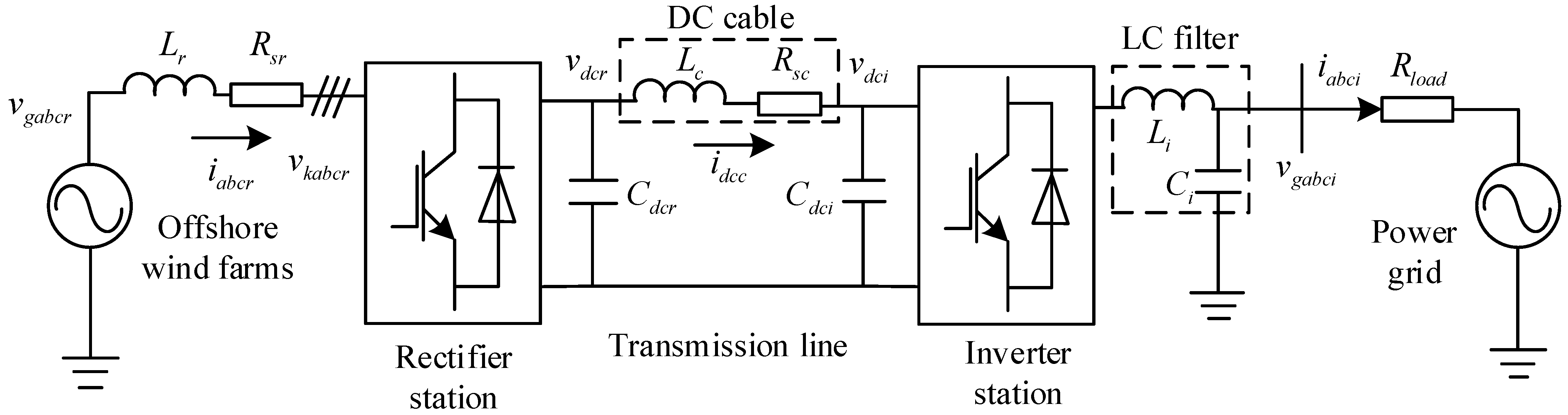
Figure 1. Configuration of the two-terminal VSC-HVDC system.
Electronics 15 00492 g001
Figure 2. The process of estimating the DOA.
Electronics 15 00492 g002
Figure 3. The MFPC + GA DOA enlargement procedure.
Electronics 15 00492 g003
Figure 4. DOA and state trajectory projected on the v d c r v d c i v g d i space during a three-phase short-circuit fault.
Electronics 15 00492 g004
Figure 5. VSC-HVDC system waveform during three-phase short-circuit fault. (a) DC line voltage and current. (b) Inverter side voltage and current. (c) Rectifier side voltage and current.
Electronics 15 00492 g005
Figure 6. DOA and state trajectory projected on v d c r v d c i v g d i space during transmission power fluctuation.
Electronics 15 00492 g006
Figure 7. VSC-HVDC system waveform during transmission power fluctuation. (a) DC line voltage and current. (b) Inverter side voltage and current. (c) Rectifier side voltage and current.
Electronics 15 00492 g007
Figure 8. Comparison for large-signal stability DOA of different methods. (a) Abstract illustration for conservatism. (b) Experimental validation of Case 2. (c) Experimental validation of Case 1.
Electronics 15 00492 g008aElectronics 15 00492 g008bElectronics 15 00492 g008c
Figure 9. The influence of system parameters on the large-signal stability DOA. (a) The influence of L r . (b) The influence of C d c r . (c) The influence of k v p d r .
Electronics 15 00492 g009
Table 1. GA hyperparameter sensitivity for the MFPC + GA DOA enlargement.
SettingsS1 (Low-Budget)S2 (Baseline) S 3   ( Pop - Gen ) S 4   ( Pop - Gen )S5 (Cross
over↓)
S6 (Cross
over↑)
Pop Size305080405050
Max Gen6080501008080
Crossover Fraction0.80.80.80.80.60.9
Mutation operatoradaptive–feasibleadaptivefeasibleadaptive–feasibleadaptive–feasibleadaptive–feasibleadaptive–feasible
Evaluations (Pop × Gen)180040004000400040004000
Best normalized DOA metric (max)0.961.081.021.031.011.05
Normalized DOA metric (mean ± std)0.86 ± 0.051.00 ± 0.030.94 ± 0.040.95 ± 0.030.90 ± 0.050.91 ± 0.07
Success rate (% runs)0.3%4.0%4.8%2.3%9.9%
Feasible-candidate ratio (%)4%6%5%5%7%3%
Feasible-generation ratio (%)70.6%95.5%98.3%87.1%97.3%78.2%
Runtime (m) (mean ± std)171 ± 28366 ± 38398 ± 32325 ± 35349 ± 33377 ± 37
Throughput (eval/s)0.175 ± 0.0290.182 ± 0.0190.168 ± 0.0130.205 ± 0.0220.191 ± 0.0180.177 ± 0.017
Table 2. Parameters for the VSC-HVDC system.
ParametersValues
Short circuit ratio>4
AC   voltage   U a c r ,   U a c i 220 kV
DC   voltage   U d c 500 kV
Reactor   inductance   L r , L i 0.1 H, 0.04 H
Reactor   resistance   R r ,   R i 0.1   Ω
DC   resistance   R c 0.1   Ω
DC   inductance   L c 0.08 H
DC   capacitor   C d c 50 , 000   μ F
Inverter   filter   capacitor   C i 80   μ F
Base   frequency   f 50 Hz
Switching   frequency   f s w 20,000 Hz
Current   loop   gain   ( k i p r ,   k i i r )10, 1000
Voltage   loop   gain   ( k v p r ,   k v i r )50, 10,000
Current   loop   gain   ( k i p i ,   k i i i )200, 1000
Voltage   loop   gain   ( k v p i ,   k v i i )20, 200
Virtual   moment   of   inertia   J 3
Virtual   Damping   Factor   D p 200
Table 3. Qualitative comparison of representative large-signal stability assessment methods.
MethodsWhat It ProvidesApplicabilityKey Limitations
Time-domain simulationTrajectories for specific contingenciesGeneral, model-dependentNo analytic certificate; difficult to generalize across disturbance space; does not directly yield DOA boundary
Phase-plane methodGeometric intuition via portraitsMainly low-order (≈2nd-order) dynamicsNot scalable to high-order nonlinear systems
Direct Lyapunov function constructionCertificate if a Lyapunov function is foundModel-specificNo standardized construction procedure; increasingly difficult and non-reproducible in high-dimensional nonlinear settings
Mixed potential energy functionEnergy/potential-based stability characterizationSystems with control loops that are not overly complexHeavy symbolic operations; can obscure critical control parameters and reduce interpretability for complex controls (e.g., GFM)
T–S fuzzy/LMI framework with MFPC + GA enhancementSystematic, computable DOA estimate with a certificateBroadly applicable to nonlinear systems approximated by T–S fuzzy rulesConservatism (alleviated by proposed algorithm) and computational burden grow with nonlinearity/dimension
Disclaimer/Publisher’s Note: The statements, opinions and data contained in all publications are solely those of the individual author(s) and contributor(s) and not of MDPI and/or the editor(s). MDPI and/or the editor(s) disclaim responsibility for any injury to people or property resulting from any ideas, methods, instructions or products referred to in the content.