Efficient Adaptive Matrix Spatial Filter with Nulling


Abstract
1. Introduction
2. Methods
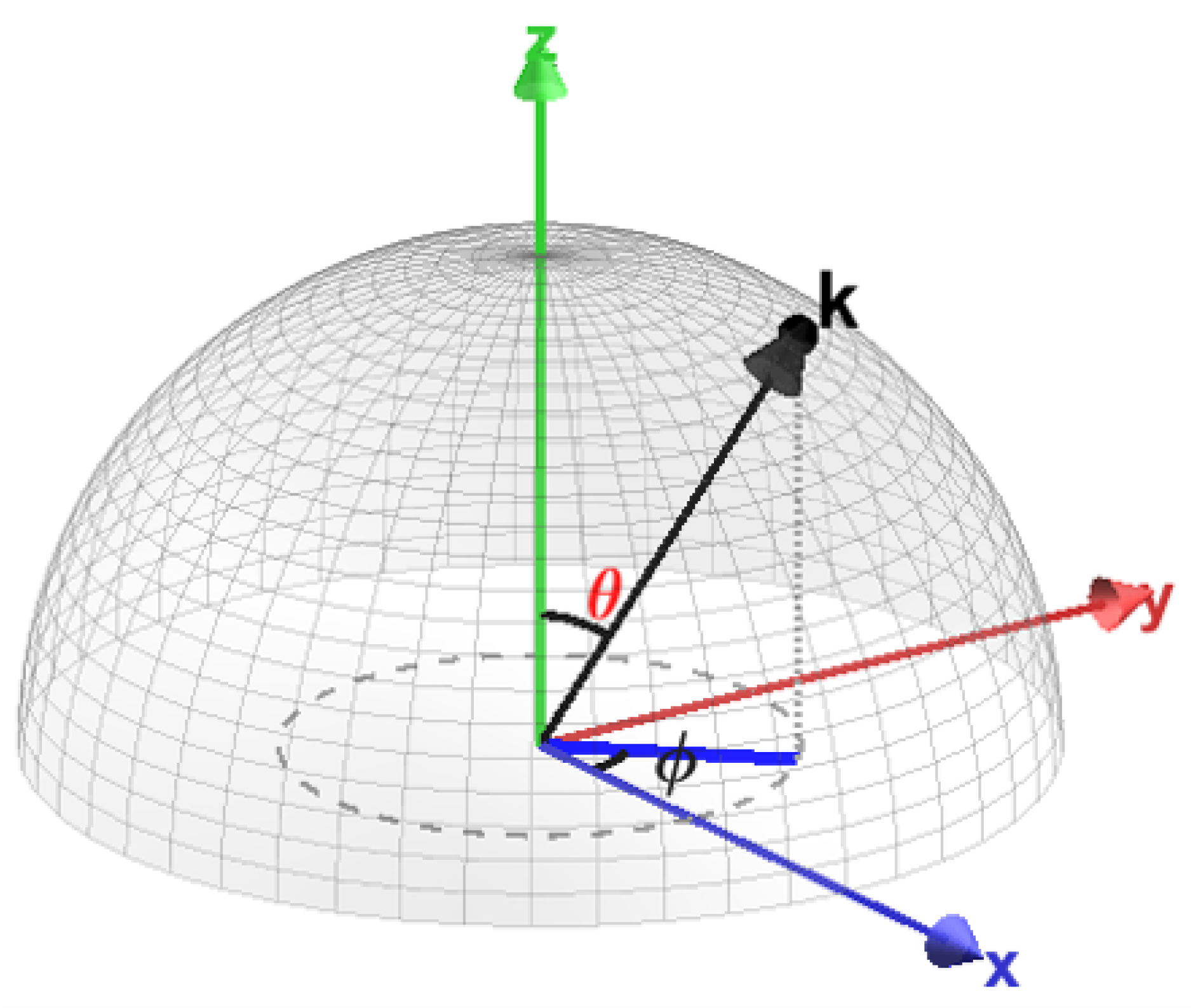
2.1. System Modeling
2.2. Beamspace Matrix Spatial Filtering
2.3. Further Reducing Computational Complexity via the Dual-Update RLS Algorithm
2.4. Ripple Analysis and Steady-State Error Bounds
2.5. Scope and Applicability
2.6. Hyperparameter Selection Strategy
3. Simulations
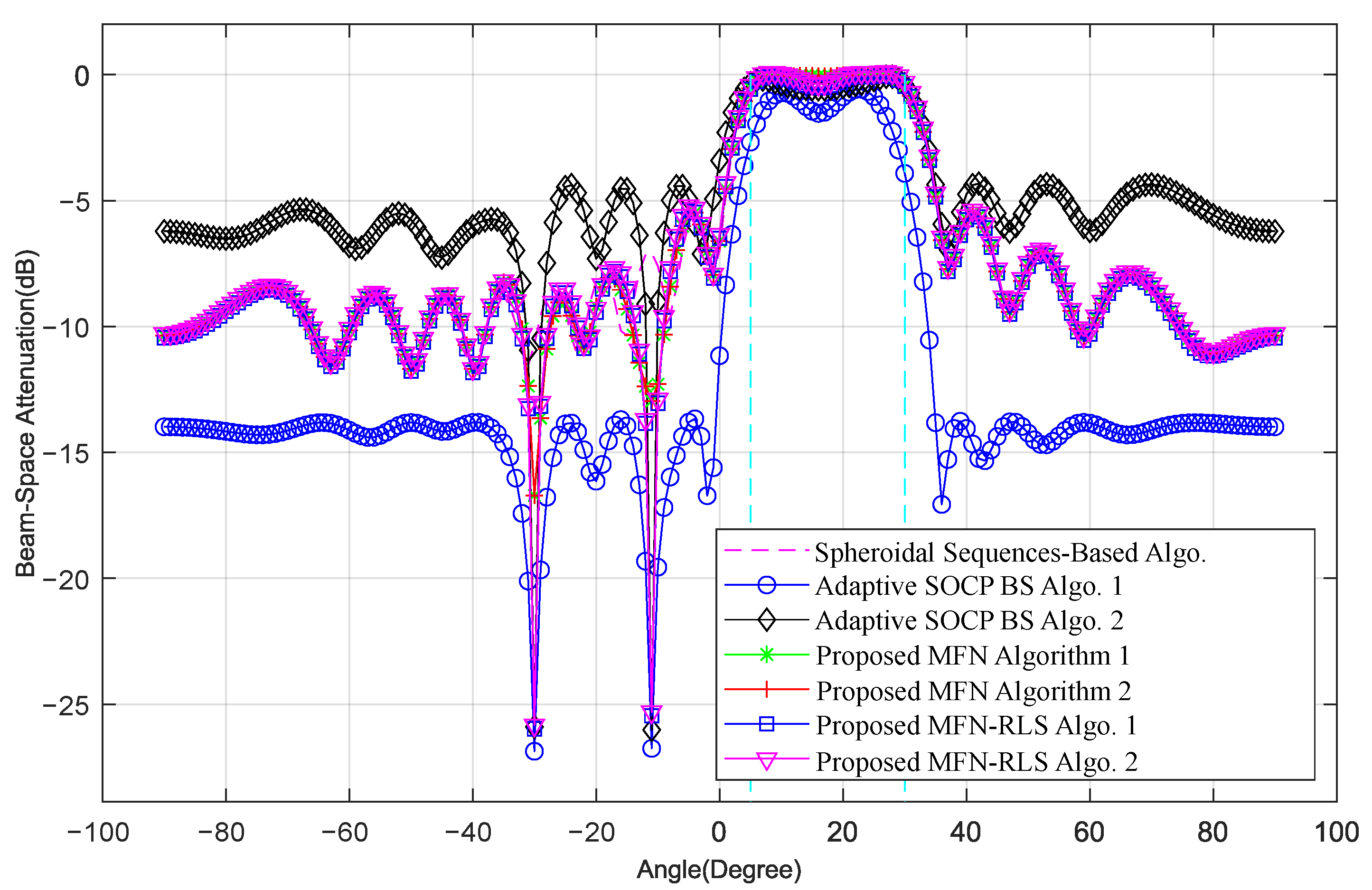
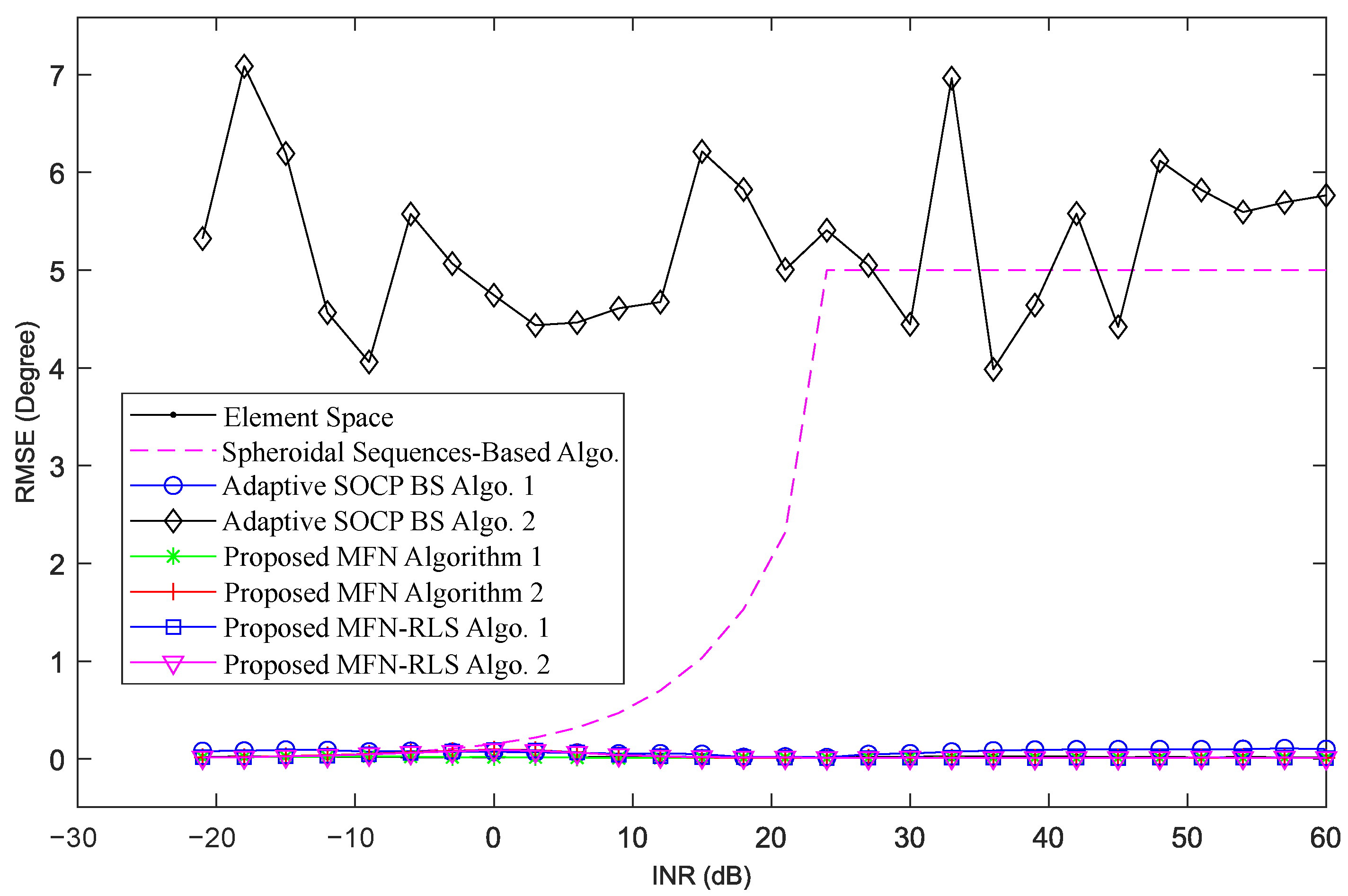
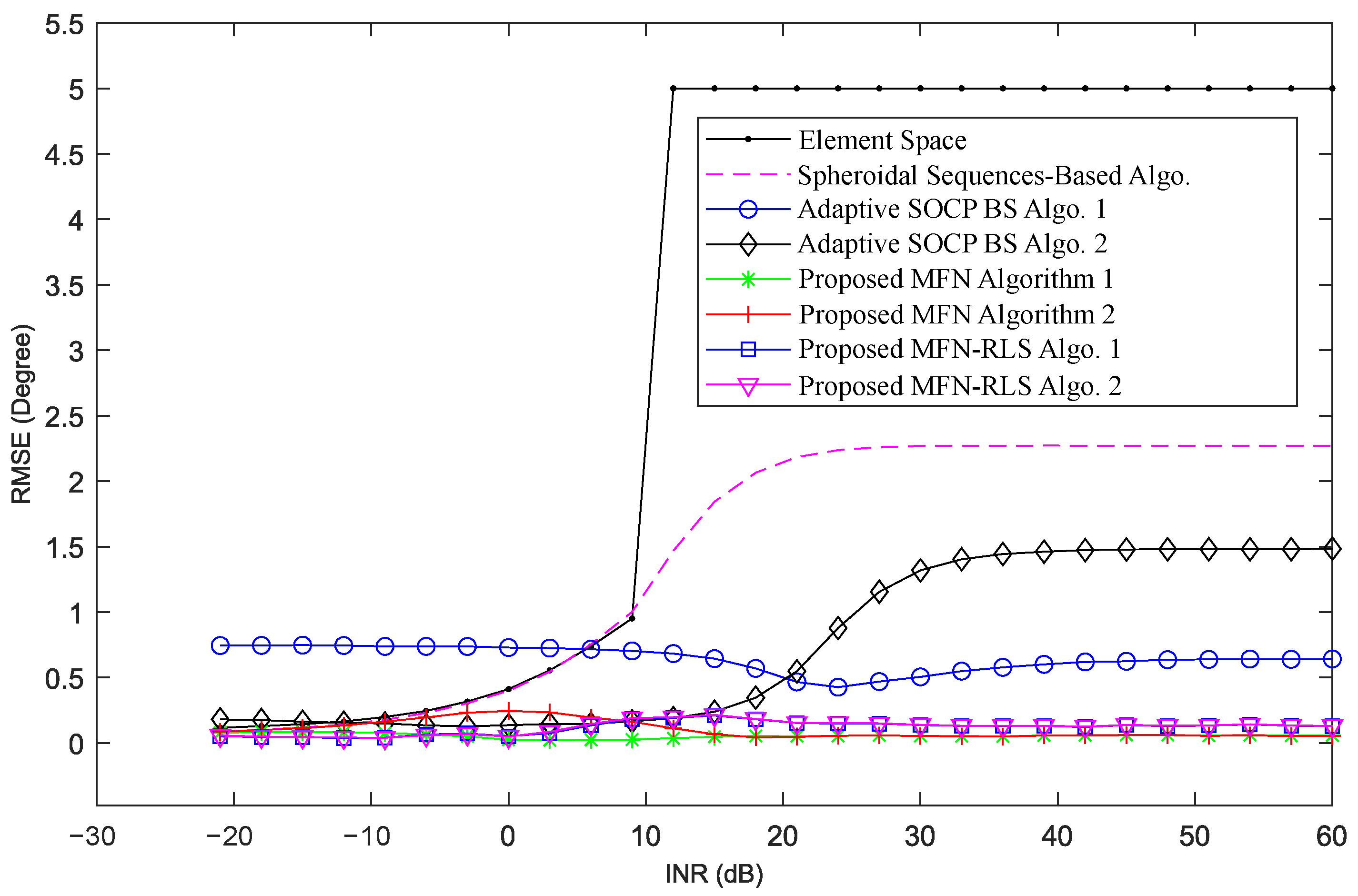
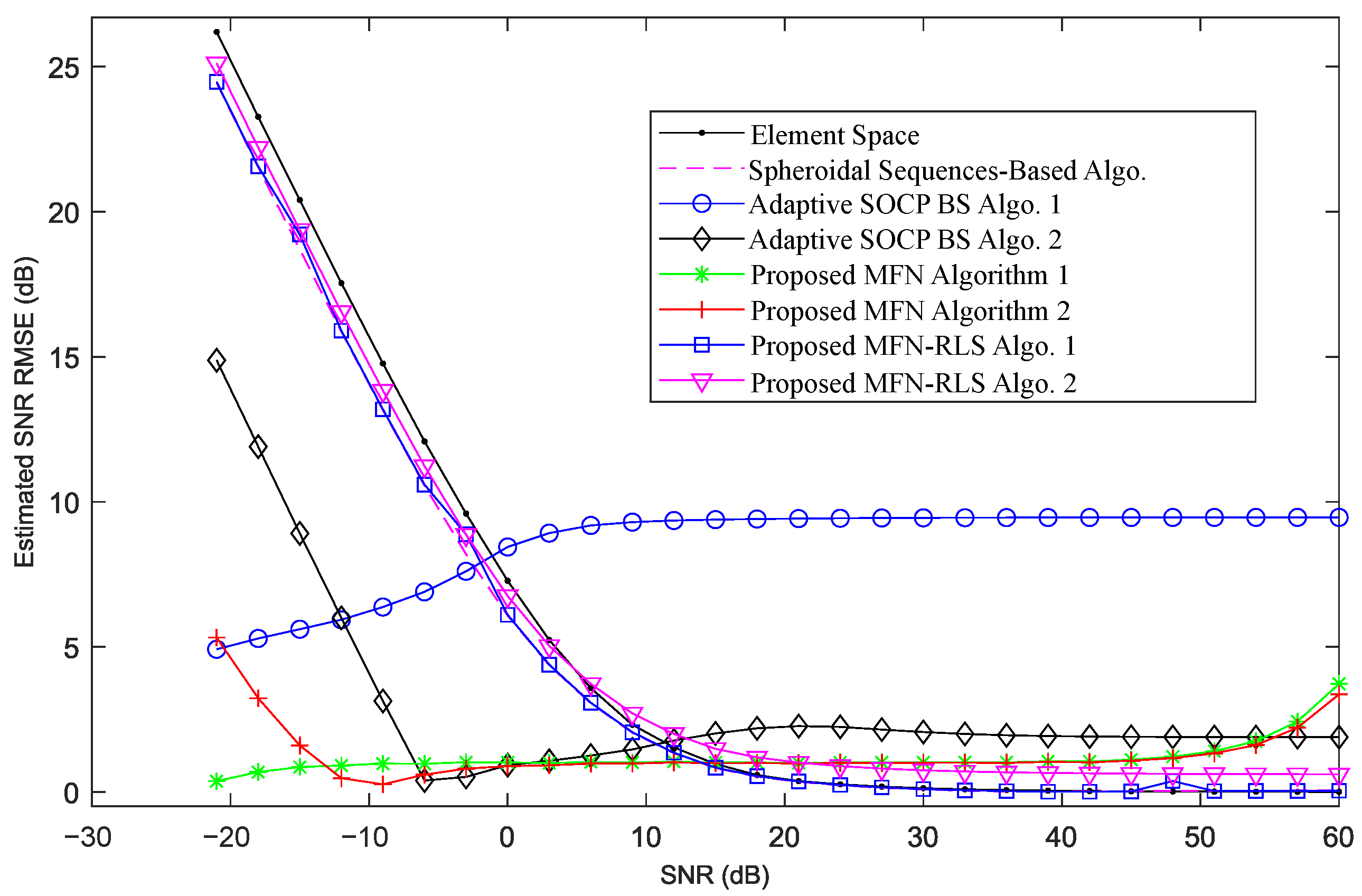
- Element Space: The baseline processing method without spatial filtering.
- Spheroidal Sequences-Based Algorithm: A fixed (non-adaptive) spatial filter as proposed in [1].
- Adaptive SOCP Beamspace Algorithm 1: The adaptive filter from [10], formulated as an SOCP that jointly optimizes passband flatness and stopband attenuation.
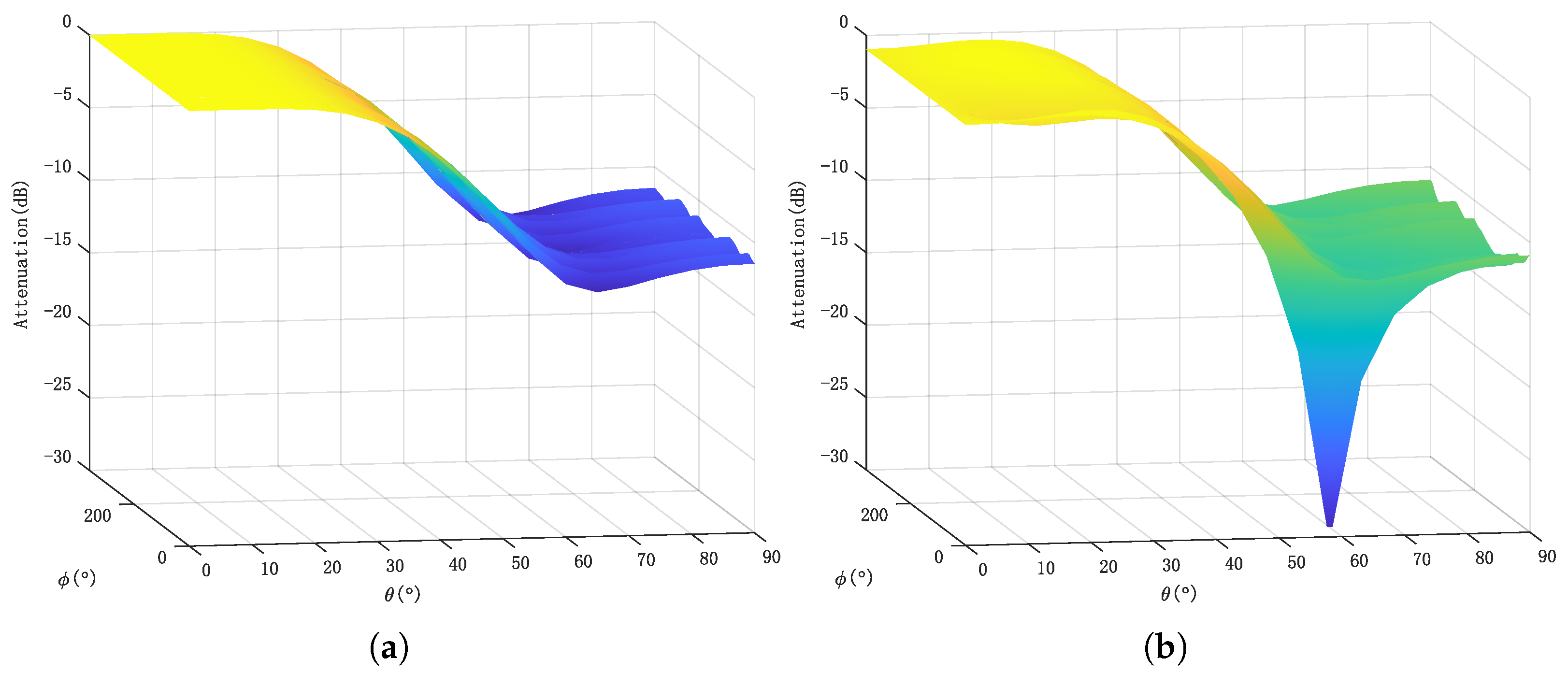
- Proposed MFN Algorithm 1: Our proposed Matrix Filter with Nulling (MFN) as derived in (10).
- Proposed MFN Algorithm 2: An extension of MFN based on (18), which explicitly incorporates stopband attenuation constraints.
- Proposed MFN-RLS Algorithm 1: The dual-sequential recursive update implementation of the MFN framework in (10), utilizing the dual-sequential update for enhanced computational efficiency.
- Proposed MFN-RLS Algorithm 2: The recursive version of (18), incorporating an explicit stopband attenuation constraint.
3.1. Comparison of Spatial Filtering and Adaptive Nulling Performance
3.2. Comparison of Second-Stage DOA Estimation Performance
3.3. Comparison of Passband Signal Power Estimation Performance
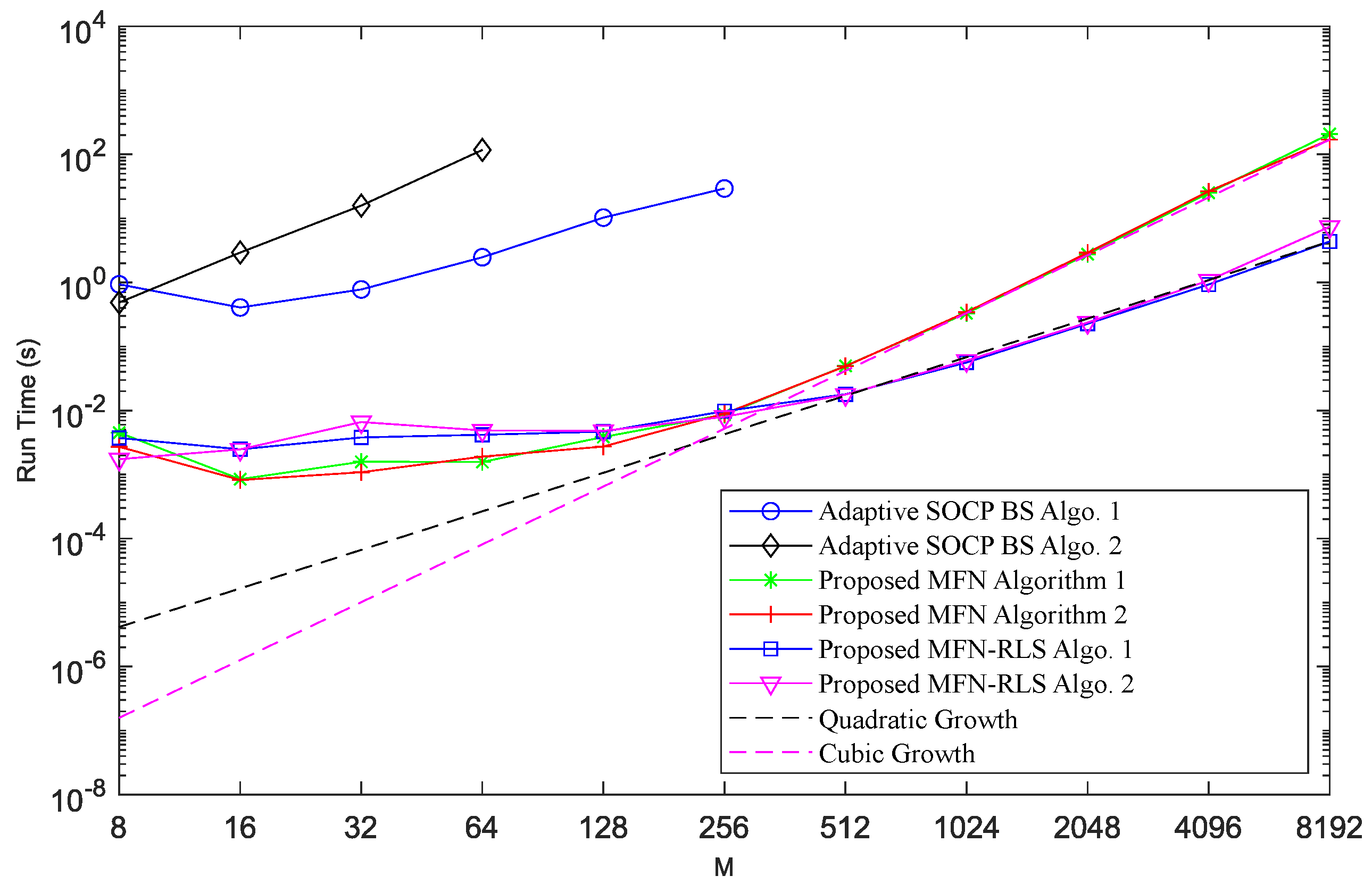
3.4. Computational Complexity Evaluation
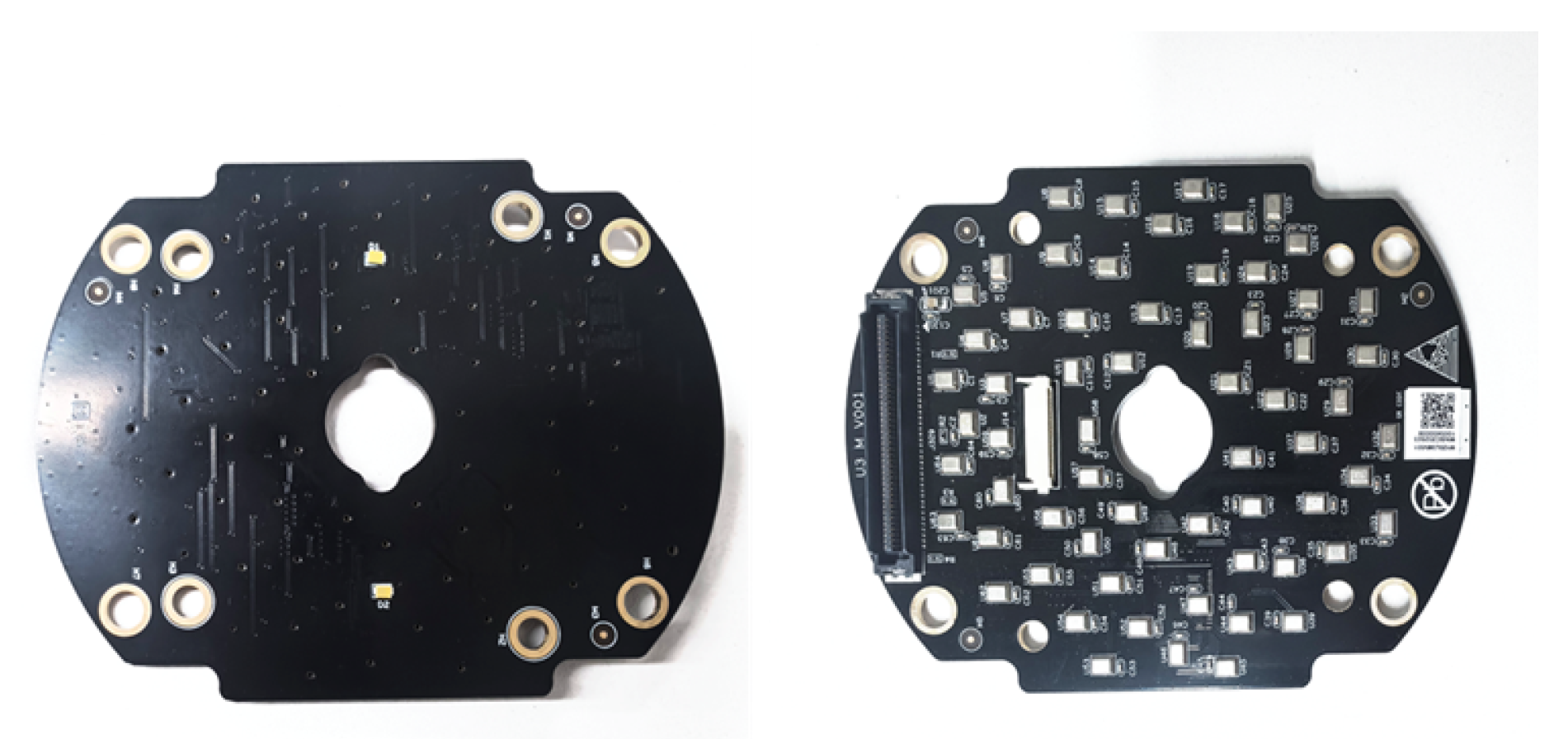
4. Experimental Validation
5. Conclusions and Future Work
Author Contributions
Funding
Data Availability Statement
Conflicts of Interest
References
- Forster, P.; Vezzosi, G. Application of spheroidal sequences to array processing. In Proceedings of the IEEE International Conference on Acoustics, Speech, and Signal Processing, Dallas, TX, USA, 6–9 April 1987; ICASSP’87; IEEE: New York, NY, USA, 1987; Volume 12, pp. 2268–2271. [Google Scholar]
- Van Veen, B.; Williams, B. Structured covariance matrices and dimensionality reduction in array processing. In Proceedings of the Fourth Annual ASSP Workshop on Spectrum Estimation and Modeling, Minneapolis, MN, USA, 3–5 August 1988; IEEE: New York, NY, USA, 1988; pp. 168–171. [Google Scholar]
- Xu, X.L.; Buckley, K.M. A comparison of element and beam space spatial-spectrum estimation for multiple source clusters. In Proceedings of the International Conference on Acoustics, Speech, and Signal Processing, Albuquerque, NM, USA, 3–6 April 1990; IEEE: New York, NY, USA, 1990; pp. 2643–2646. [Google Scholar]
- Lee, H.B.; Wengrovitz, M.S. Resolution threshold of beamspace MUSIC for two closely spaced emitters. IEEE Trans. Acoust. Speech Signal Process. 1990, 38, 1545–1559. [Google Scholar] [CrossRef]
- Anderson, S. On optimal dimension reduction for sensor array signal processing. Signal Process. 1993, 30, 245–256. [Google Scholar] [CrossRef]
- Vaccaro, R.J.; Harrison, B.F. Optimal matrix-filter design. IEEE Trans. Signal Process. 1996, 44, 705–709. [Google Scholar] [CrossRef]
- Vaccaro, R.J.; Harrison, B.F. Matrix filters for passive sonar. In Proceedings of the 2001 IEEE International Conference on Acoustics, Speech, and Signal Processing, Salt Lake City, UT, USA, 7–11 May 2021; Proceedings (cat. No. 01CH37221); IEEE: New York, NY, USA, 2001; Volume 5, pp. 2921–2924. [Google Scholar]
- Vaccaro, R.J.; Chhetri, A.; Harrison, B.F. Matrix filter design for passive sonar interference suppression. J. Acoust. Soc. Am. 2004, 115, 3010–3020. [Google Scholar] [CrossRef]
- Liu, J.; Gershman, A.B.; Luo, Z.Q.; Wong, K.M. Adaptive beamforming with sidelobe control: A second-order cone programming approach. IEEE Signal Process. Lett. 2003, 10, 331–334. [Google Scholar] [CrossRef]
- Hassanien, A.; Elkader, S.A.; Gershman, A.B.; Wong, K.M. Convex optimization based beam-space preprocessing with improved robustness against out-of-sector sources. IEEE Trans. Signal Process. 2006, 54, 1587–1595. [Google Scholar] [CrossRef]
- Hassanien, A.; Vorobyov, S.A. A robust adaptive dimension reduction technique with application to array processing. IEEE Signal Process. Lett. 2008, 16, 22–25. [Google Scholar] [CrossRef]
- Yang, Y.; Zhang, Y.; Yang, L. Wideband sparse spatial spectrum estimation using matrix filter with nulling in a strong interference environment. J. Acoust. Soc. Am. 2018, 143, 3891–3898. [Google Scholar] [CrossRef] [PubMed]
- Sturm, J.F. Using SeDuMi 1.02, A Matlab toolbox for optimization over symmetric cones. Optim. Methods Softw. 1999, 11, 625–653. [Google Scholar] [CrossRef]
- MOSEK ApS. The MOSEK Optimization Toolbox for MATLAB: Version 10.1; MOSEK ApS: Copenhagen, Denmark, 2023. [Google Scholar]
- Toh, K.C.; Todd, M.J.; Tütüncü, R.H. SDPT3—A Matlab software package for semidefinite programming, Version 1.3. Optim. Methods Softw. 1999, 11, 545–581. [Google Scholar] [CrossRef]
- Nesterov, Y.; Nemirovskii, A. Interior-Point Polynomial Algorithms in Convex Programming; SIAM: Philadelphia, PA, USA, 1994. [Google Scholar]
- Lobo, M.S.; Vandenberghe, L.; Boyd, S.; Lebret, H. Applications of second-order cone programming. Linear Algebra Its Appl. 1998, 284, 193–228. [Google Scholar] [CrossRef]
- Fan, Q.; Yu, Y.; An, L.; Cao, H.; Zhu, C. Fast and accurate wideband sparse spatial spectrum estimation in an underwater strong interference environment. J. Acoust. Soc. Am. 2023, 154, 3810–3820. [Google Scholar] [CrossRef] [PubMed]
- Chu, J.; Cheng, L.; Xu, W. Spatial power spectrum estimation under strong interferences using beam-space fast nonnegative sparse bayesian learning. IEEE J. Ocean. Eng. 2024, 49, 692–712. [Google Scholar] [CrossRef]
- Wang, C.; Cui, X.; Liu, G.; Lu, M. Two-stage spatial whitening and normalized MUSIC for robust DOA estimation of GNSS signals under jamming. IEEE Trans. Aerosp. Electron. Syst. 2024, 61, 2557–2572. [Google Scholar] [CrossRef]
- Zhang, Y.; Liang, N.; Yang, Y.; Yang, Y. Fast sparse Bayesian learning based on beamformer power outputs to solve wideband DOA estimation in underwater strong interference environment. Electronics 2024, 13, 1456. [Google Scholar] [CrossRef]
- Haykin, S.S. Adaptive Filter Theory, 4th ed.; Pearson Education India: New Delhi, India, 2002. [Google Scholar]



| Method | Optimization Algorithm | Computational Complexity | Real-Time Applicability |
|---|---|---|---|
| SOCP Beamspace algorithms | SOCP | no | |
| Proposed MFN algorithms | Closed-form equation | yes | |
| Proposed MFN-RLS algorithms | RLS | yes |
| Method | PRV (↓) | Max Attenu. (↑) | SMS ) |
|---|---|---|---|
| Spheroidal Sequences-Based Algorithm [1] | 0.0018 | 11.7121 | 9.1553 |
| Adaptive SOCP Beamspace Algorithm (19) [10] | 0.3339 | 26.1789 | 14.0716 |
| Adaptive SOCP Beamspace Algorithm (13) [12] | 0.0074 | 25.5760 | 5.6021 |
| Proposed MFN Algorithm (10) | 0.0025 | 16.6576 | 9.3191 |
| Proposed MFN Algorithm (18) | 0.0025 | 16.6575 | 9.3194 |
| Proposed MFN-RLS Algorithm (10) | 0.0269 | 26.3024 | 9.4811 |
| Proposed MFN-RLS Algorithm (18) | 0.0289 | 26.3219 | 9.4831 |
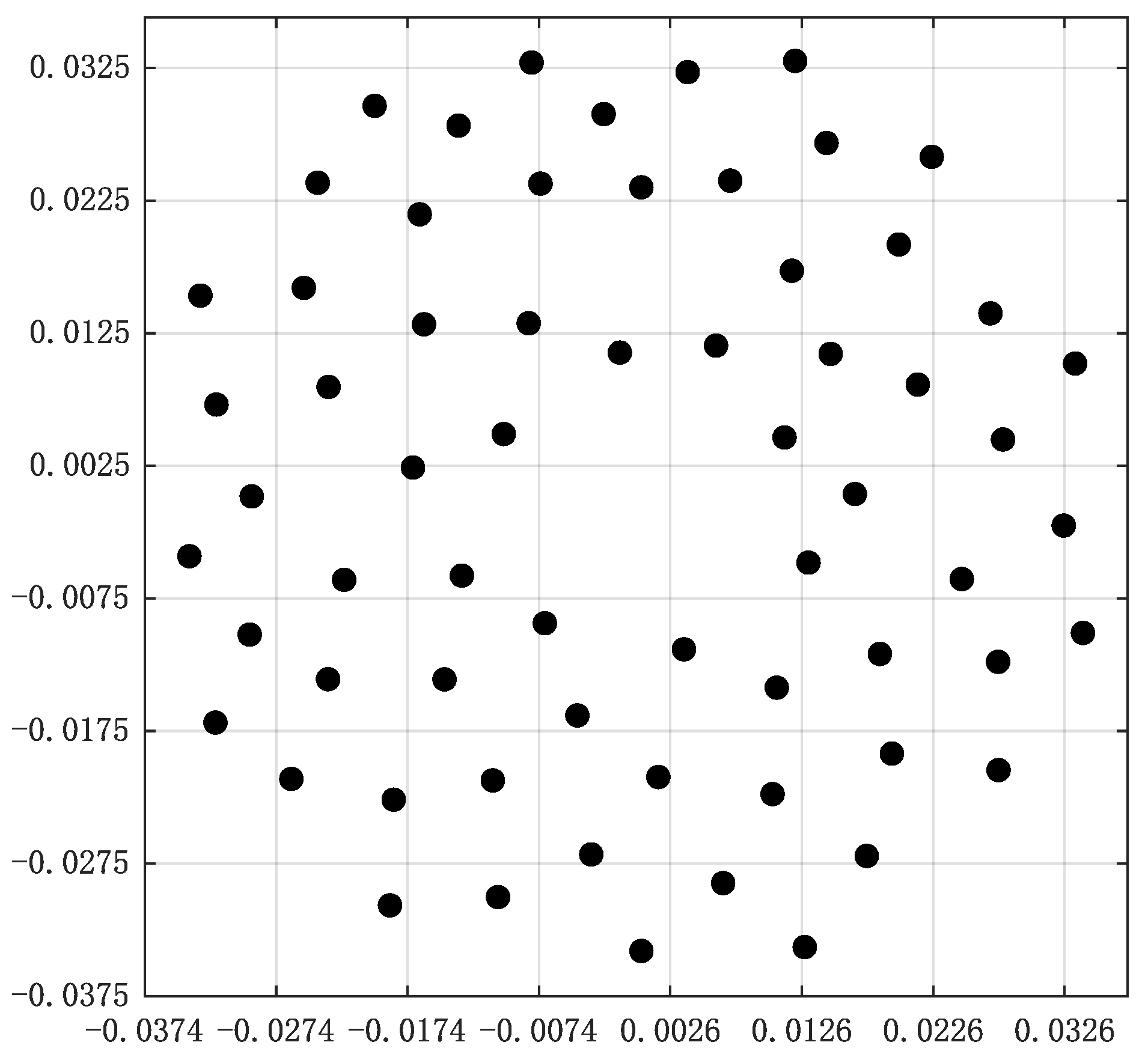
| No. | X Coord. | Y Coord. | No. | X Coord. | Y Coord. | No. | X Coord. | Y Coord. |
|---|---|---|---|---|---|---|---|---|
| 1 | −0.0080 | 0.0329 | 2 | −0.0146 | −0.0136 | 3 | 0.0275 | −0.0123 |
| 4 | −0.0025 | 0.0290 | 5 | −0.0235 | −0.0136 | 6 | 0.0340 | −0.0101 |
| 7 | −0.0073 | 0.0237 | 8 | −0.032 | −0.0169 | 9 | 0.0325 | −0.0020 |
| 10 | −0.0135 | 0.0281 | 11 | −0.0262 | −0.0212 | 12 | 0.0248 | −0.0061 |
| 13 | −0.0199 | 0.0296 | 14 | .0185 | −0.0227 | 15 | 0.0166 | 0.0003 |
| 16 | −0.0242 | 0.0238 | 17 | −0.0109 | −0.0213 | 18 | 0.0113 | 0.0046 |
| 19 | −0.0165 | 0.0214 | 20 | −0.0034 | −0.0268 | 21 | 0.0148 | 0.0109 |
| 22 | −0.0332 | 0.0153 | 23 | −0.0105 | −0.0301 | 24 | 0.0214 | 0.0086 |
| 25 | −0.0253 | 0.0159 | 26 | −0.0187 | −0.0307 | 27 | 0.0279 | 0.0044 |
| 28 | −0.0162 | 0.0131 | 29 | 0.0004 | −0.0341 | 30 | 0.0334 | 0.0102 |
| 31 | −0.0082 | 0.0132 | 32 | 0.0128 | −0.0338 | 33 | 0.0269 | 0.0140 |
| 34 | −0.0101 | 0.0049 | 35 | 0.0066 | −0.0290 | 36 | 0.0200 | 0.0192 |
| 37 | −0.0170 | 0.0023 | 38 | 0.0175 | −0.0270 | 39 | 0.0118 | 0.0172 |
| 40 | −0.0234 | 0.0084 | 41 | 0.0104 | −0.0223 | 42 | 0.0061 | 0.0115 |
| 43 | −0.0319 | 0.0071 | 44 | 0.0017 | −0.0210 | 45 | −0.0013 | 0.0110 |
| 46 | −0.0293 | 0.0002 | 47 | 0.0194 | −0.0192 | 48 | 0.0004 | 0.0235 |
| 49 | −0.0340 | −0.0044 | 50 | 0.0276 | −0.0205 | 51 | 0.0071 | 0.0240 |
| 52 | −0.0294 | −0.0103 | 53 | 0.0107 | −0.0143 | 54 | 0.0145 | 0.0268 |
| 55 | −0.0222 | −0.0061 | 56 | 0.0036 | −0.0114 | 57 | 0.0225 | 0.0258 |
| 58 | −0.0133 | −0.0058 | 59 | 0.0131 | −0.0048 | 60 | 0.0121 | 0.0330 |
| 61 | −0.0070 | −0.0094 | 62 | 0.0185 | −0.0117 | 63 | 0.0039 | 0.0321 |
| 64 | −0.0045 | −0.0164 | ||||||
Disclaimer/Publisher’s Note: The statements, opinions and data contained in all publications are solely those of the individual author(s) and contributor(s) and not of MDPI and/or the editor(s). MDPI and/or the editor(s) disclaim responsibility for any injury to people or property resulting from any ideas, methods, instructions or products referred to in the content. |
© 2026 by the authors. Licensee MDPI, Basel, Switzerland. This article is an open access article distributed under the terms and conditions of the Creative Commons Attribution (CC BY) license.
Share and Cite
Wang, Y.; Duan, Y.; Li, X. Efficient Adaptive Matrix Spatial Filter with Nulling. Electronics 2026, 15, 2622. https://doi.org/10.3390/electronics15122622
Wang Y, Duan Y, Li X. Efficient Adaptive Matrix Spatial Filter with Nulling. Electronics. 2026; 15(12):2622. https://doi.org/10.3390/electronics15122622
Chicago/Turabian StyleWang, Yu, Yufa Duan, and Xiaolu Li. 2026. "Efficient Adaptive Matrix Spatial Filter with Nulling" Electronics 15, no. 12: 2622. https://doi.org/10.3390/electronics15122622
APA StyleWang, Y., Duan, Y., & Li, X. (2026). Efficient Adaptive Matrix Spatial Filter with Nulling. Electronics, 15(12), 2622. https://doi.org/10.3390/electronics15122622