Article

A Novel Multipolarity Decoupled Magnetic Coupler Applied to Multiple-Receiver Wireless Charging System with Load-Independent CV and CC Outputs


1
School of Electrical Engineering, China University of Mining and Technology, Xuzhou 221116, China
2
Department of Electrical Engineering, City University of Hong Kong, Hong Kong 999077, China
3
Department of Electrical Engineering, Federal University of Campina Grande, Campina Grande 58429-900, Brazil
4
Department of Energy, Politecnico di Milano, 20156 Milan, Italy
*
Author to whom correspondence should be addressed.
Electronics 2026, 15(12), 2623; https://doi.org/10.3390/electronics15122623 (registering DOI)
Submission received: 1 June 2026 / Revised: 11 June 2026 / Accepted: 12 June 2026 / Published: 14 June 2026

Abstract

Simultaneously enabling wireless charging for multiple electronic devices is a distinctive advantage of wireless power transfer (WPT). Nevertheless, the development of dual-receiver WPT systems is constrained by several challenges, including undesired cross-coupling effects, suboptimal spatial utilization, complex control strategies, and insufficient system stability. To overcome the limitations, this article develops a multipolarity decoupled four-coil WPT system with constant voltage (CV) and constant current (CC). The proposed system suppresses undesired cross-coupling to negligible levels, thereby reducing the system complexity. In addition, the compensation network can be designed in a straightforward manner, providing improved design flexibility. A detailed mathematical derivation is presented to rigorously demonstrate the load-independent CV and CC output characteristics. Meanwhile, the inverter can achieve zero phase angle (ZPA), thereby improving the power factor of the WPT system. In addition, the multipolarity decoupled mechanism of the four-coil magnetic coupler is analyzed in detail theoretically. Finally, an experimental prototype is built and tested. The experimental results demonstrate a strong agreement with the theoretical analysis, ensuring load-independent CV and CC outputs of 68 V and 3.5 A, respectively. The system achieves a measured peak efficiency of 85.97%.

1. Introduction

The proliferation of electronic devices has made intelligent and diversified charging methods a prevailing trend in future technology development. Wireless power transfer (WPT) eliminates the need for direct electrical connections between power sources and devices, thereby addressing the safety concerns associated with the conventional wired charging method in harsh environments [1,2]. Due to its superior reliability, safety, flexibility, and user-friendliness, WPT has demonstrated significant application potential in a wide range of scenarios, including implantable medical devices [3,4], industrial robots [5,6], underwater equipment [7], wearable devices [8,9], autonomous aerial vehicles [10], and electric vehicles [11].
Compared to the wireless charging of a single electronic device, WPT systems offer even greater advantages when applied to simultaneously charging multiple devices [12]. On one hand, extensive research has been conducted on single-receiver WPT systems, focusing on aspects such as modeling, analysis, parameter identification, optimization, and control at the magnetic-coupler and system-topology levels [13]. For instance, transmitter array configurations with star-shaped coils have been explored in order to achieve orientation-tolerant power transfer for free-moving objects in IoT and biomedical applications [14]. On the other hand, dual-receiver WPT systems featuring different output characteristics have also garnered research attention, particularly those capable of delivering constant voltage (CV) and constant current (CC) outputs simultaneously [15,16]. However, one of the key limitations in the current research lies in the difficulty of sufficiently suppressing unnecessary cross-coupling, especially the coupling interference of the receivers. Such undesired coupling can interfere with the independence of multiple output ports and degrade the overall efficiency of the system [17,18]. Accordingly, how to provide different types of output according to the load requirements without unnecessary cross-coupling becomes a significant design bottleneck for developing a dual-receiver WPT system.
In the existing research, the cross-coupling among receivers is negligible when the receiver coils are relatively small in size and sufficiently spaced apart [19]. Nevertheless, this approach lacks theoretical decoupling and becomes invalid as the system power level increases, where the influence of cross-coupling becomes non-negligible. In [20], a WPT system with multiple load-independent CV outputs is proposed. Although paralleling multiple double-T resonant circuits at the common AC terminal of the receivers can mitigate coupling interference, maintaining CV outputs require wireless communication modules and PI controllers, which leads to increased system complexity. In addition, PT-symmetric WPT mechanisms have been investigated for improving positional robustness and achieving a flexible current–ratio adjustment [21]. However, such PT-symmetric schemes mainly focus on robustness enhancement or current–ratio regulation, rather than receiver-to-receiver decoupling and simultaneous load-independent CV/CC outputs. Mai et al. [22] propose a decoupling circuit topology that suppresses cross-coupling by employing additional inductors or capacitors. However, these passive components must be precisely configured between the receivers, and the extra components require additional physical space, thereby limiting the system’s mobility. In [23], a single-transmitter WPT system with dual-channel CC outputs is proposed, where dual CC outputs are achieved by modulating specific control parameters. However, the two receivers cannot be operated at the same resonant frequency. An auxiliary circuit for power flow control is proposed in [24] to mitigate cross-coupling interference. However, the necessity for operating the receivers at multiple frequencies imposes inherent constraints on system design and control. The frequency bifurcation approach and the power division control method are proposed for the multi-receiver WPT system [25,26]. However, when the operating frequencies are closely spaced, unwanted power transfer between receivers may occur, thereby compromising the independence and stability of each receiver’s CV and CC output.
The objective of suppressing cross-coupling can also be addressed through the design of a magnetic coupler. In [27], a magnetic shielding plate is employed in the WPT system, and, thus, only the coupling coefficients between adjacent coils are considered in the analysis, with the cross-coupling effects between other coils being neglected. However, the incorporation of DC/DC converters in each repeater unit for output current regulation introduces increased costs and additional power losses, and poses significant challenges in achieving a broad range of parameter adjustments. Notably, decoupled-double D (DDD) coils with dual-resonating-frequency (DRF) compensation [28] and concentric bucking planar coils (BPCs) [29] have been investigated to suppress the cross-coupling in dual-receiver WPT systems. The DDD-based method requires frequency overlay modulation (FOM) to enable dual-channel power transfer at distinct operating frequencies, which may increase the excitation and parameter-design complexity. In contrast, the BPC-based method achieves receiver decoupling through the flux cancellation produced by the bucking-coil layout, but it requires the careful configuration of the winding structure and geometric parameters, which may constrain the independent optimization of the coupling coefficient and coil quality factor. In addition, load-independent CV and CC outputs and zero phase angle (ZPA) are seldom addressed in these approaches. In [15], a dual-receiver WPT system realizes CC and CV outputs through magnetic-coupler and mutual-inductance design. However, its output characteristics and decoupling performance depend on specific coil structures and mutual-inductance configurations. In [16], two mutually perpendicular solenoid coils are adopted as receivers to achieve natural decoupling and load-independent CC/CV outputs. However, this structure does not include the relay coil adopted in this work, and the transmitter mainly transfers power to the two receivers through direct coupling paths. This leads to a difference in spatial arrangement flexibility compared with the proposed scheme.
To address the existing limitations in dual-receiver WPT systems, such as the insufficient suppression of coupling interference [19,25], circuit and control complexity [20,22], robustness-oriented PT operation without simultaneous receiver decoupling [21], interference caused by non-uniform operating frequencies [23,24], and limited design flexibility in magnetic couplers [27,28,29], a WPT system with load-independent CV and CC outputs is proposed in this article. The Q-shaped structure is adopted as the transmitter coil. Two spatially orthogonal helical coils are employed as the two receivers. A Q-shaped coil connected in series with the two orthogonal helical coils forms the relay coil. The proposed magnetic coupler exhibits natural-decoupling characteristics and suppresses the undesired cross-coupling within the system to negligible levels. Simultaneously, the system enables load-independent CV and CC outputs along with the ZPA characteristic. The main contributions of this work are summarized as follows:
  • A multipolarity-decoupling mechanism based on the spatial coil orientation is proposed. This mechanism suppresses undesired cross-couplings to negligible levels without additional passive decoupling components or active control circuits. Compared with turn-count-based or inner-radius-based decoupling approaches, the proposed mechanism provides greater flexibility in magnetic-coupler design.
  • A four-coil topology is developed to achieve load-independent CV and CC outputs without wireless communication or feedback control. Different from existing passive-decoupling CC/CV schemes, the proposed topology introduces a relay coil to form two independent coupling paths, thereby suppressing undesired direct coupling from the transmitter to the receiver coils and improving the spatial arrangement flexibility of the dual-receiver system.
The manuscript is organized as follows. In Section 2, a comprehensive mathematical framework is developed for the proposed WPT system. Theoretical derivations are carried out to establish the conditions for realizing load-independent CV and CC outputs, as well as the ZPA characteristic. Section 3 introduces the four-coil magnetic coupler, and a multipolarity-decoupling mechanism is analyzed in detail. Section 4 presents simulation results that verify the CV and CC output characteristics as well as the ZPA behavior of the WPT system. In Section 5, to further verify the feasibility and accuracy of the dual-receiver WPT system, a miniaturized experimental prototype is built and tested. Finally, a conclusion is drawn in Section 6.

2. Circuit Analysis

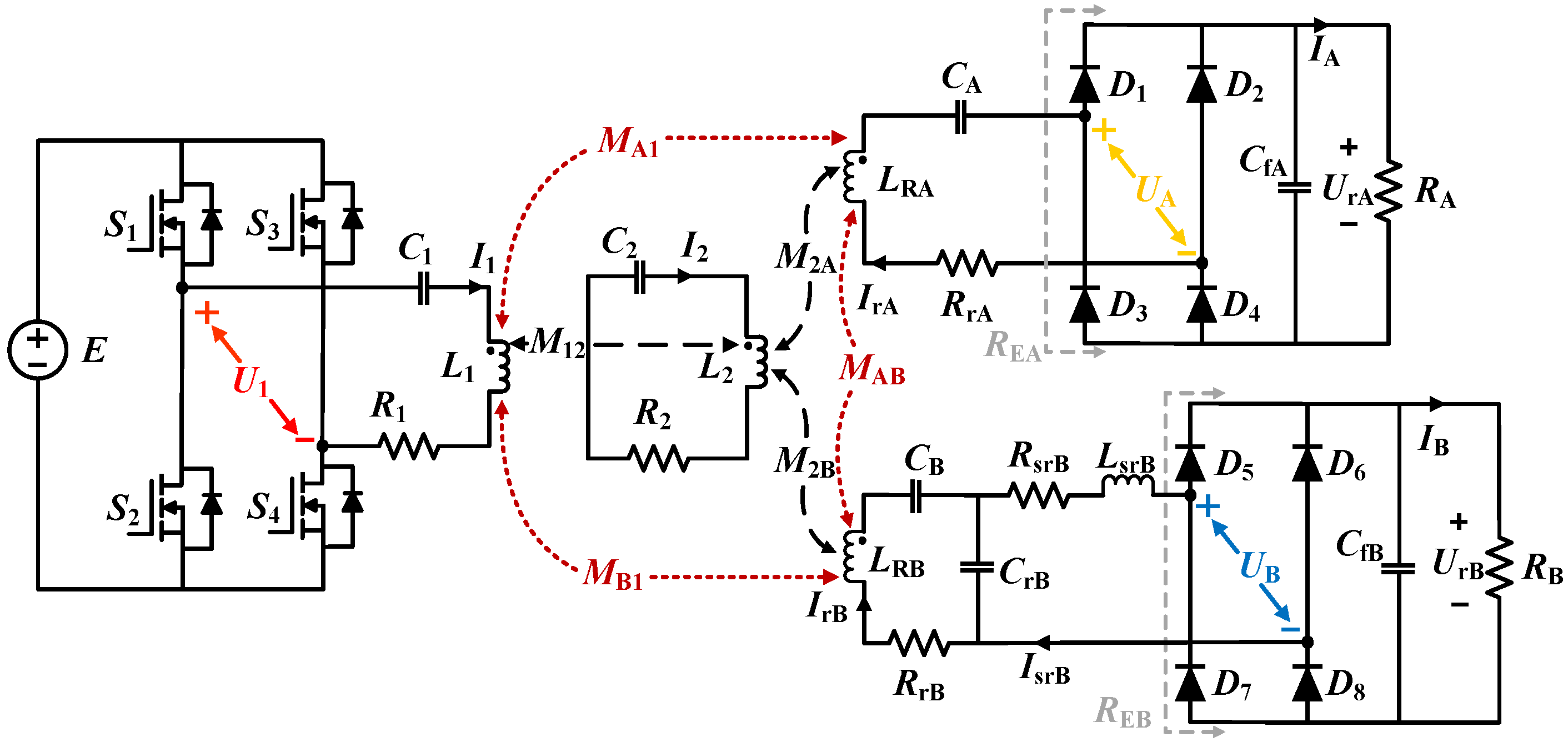
The entire circuit topology diagram of the proposed dual-output-port WPT system based on integrated multipolarity-decoupling four coils is shown in Figure 1. E is the system input DC voltage of the single-phase full-bridge inverter composed of four MOSFETs (S1S4). Such an inverter is equipped at the source side to generate AC power for feeding the transmitter coil. The fundamental harmonics approximation method is used to analyze the proposed WPT system. The fundamental component of the output voltage of the inverter can be expressed as follows:
u 1 t = 4 π E sin ω t
where ω = 2πf0. The operating frequency f0 is configured to be 85 kHz according to SAE J2954.
Therefore, the root mean square (RMS) value of u1(t) can be expressed as follows:
U 1 = 2 2 π E 0 °
Inductances L1, L2, LRA, and LRB are the self-inductances of the transmitter coil, relay coil, first-stage receiver coil, and second-stage receiver coil. LsrB is the second-stage receiver compensation inductance. R1, R2, RrA, RrB, and RsrB are the parasitic resistances of each coil. RA and RB are the equivalent resistances of the two loads, respectively. I1, I2, IrA, IrB, and IsrB are the current phasors flowing through each circuit loop, respectively. C1, C2, CA, CB, and CrB are the resonant capacitors of the circuit. CfA and CfB are the filter capacitors of two receivers, respectively. M12, MA1, MB1, M2A, M2B, and MAB represent the mutual inductances between the four coils. Owing to the multipolarity-decoupling mechanism, the undesired mutual inductances MA1, MB1, and MAB can theoretically be minimized toward zero under ideal geometric symmetry, while only small residual values remain in the practical prototype. Therefore, for the dominant output-characteristic analysis, only the three main mutual inductances, namely, M12, M2A, and M2B, are considered in the following circuit analysis. This will be further explained in the magnetic coupler section, where the design methodology of the decoupling mechanism is discussed.
The two receivers are connected correspondingly by full-bridge rectifiers composed of diodes (D1D4) and (D5D8), in order to convert the AC current IrA and IsrB into DC charging currents IA and IB to power the receiver loads. To ensure that resonance conditions are provided on each side of the entire circuit architecture, all inductors and capacitors should satisfy the following equation:
L 1 = ω 2 C 1 1               L 2 = ω 2 C 2 1 L RA = ω 2 C A 1         L srB = ω 2 C rB 1 L RB = ω 2 C B 1 + ω 2 C rB 1
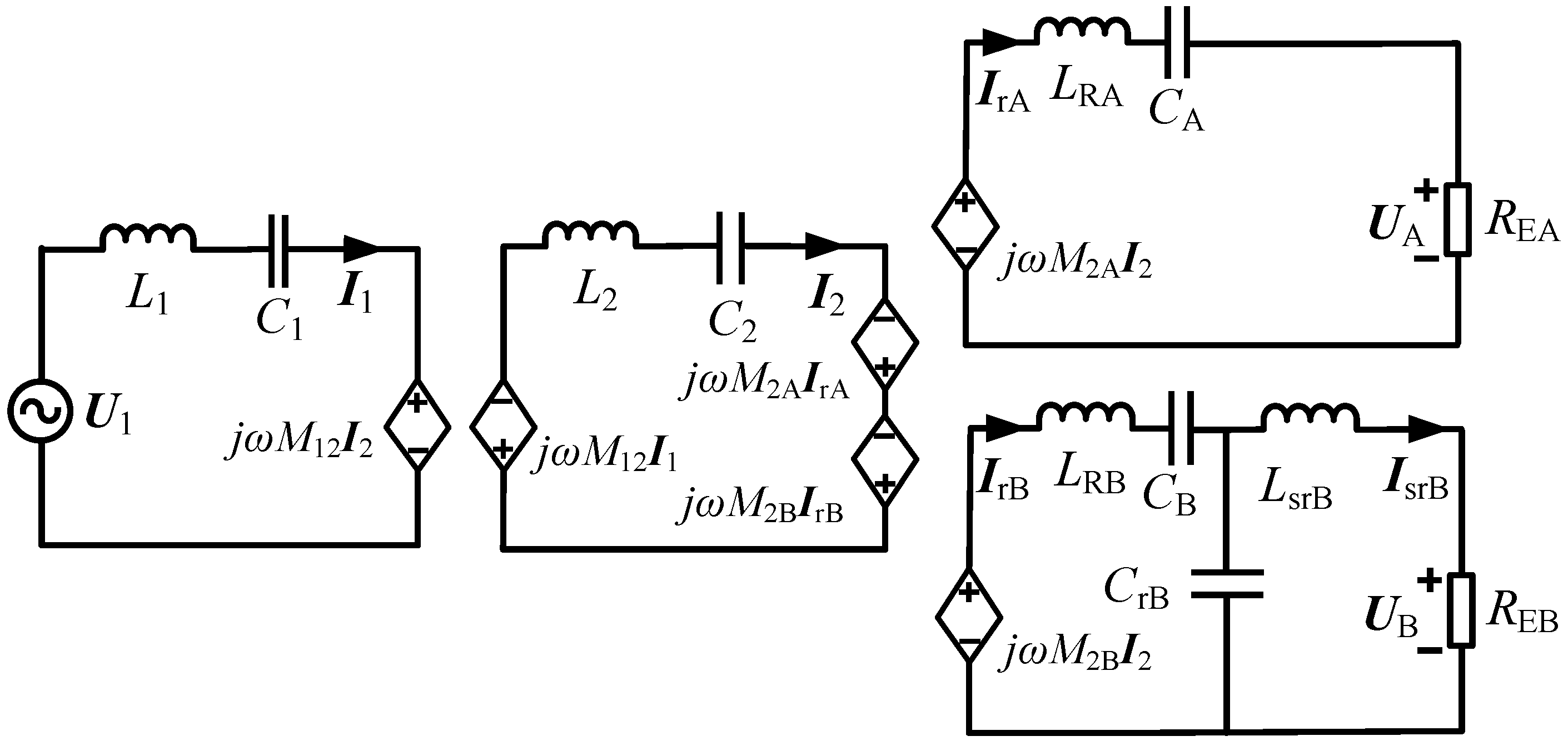
To facilitate the subsequent analysis of the output characteristics of the WPT system, the minor parasitic resistances of the coils are neglected. To justify this approximation, the parasitic resistance in each coil branch is compared with the dominant effective impedance in the corresponding loop. In the worst case, the combined parasitic resistance on the CC-side receiver, RrB + RsrB = 0.15 Ω, is approximately 3.7% of the minimum equivalent load resistance REB,min. Therefore, its influence on the dominant output-characteristic analysis is limited. Moreover, the experimental prototype still achieves the expected CV output of 68 V and CC output of 3.5 A, which further validates this approximation. The equivalent circuit diagram of the proposed WPT system is shown in Figure 2.
In Figure 2, REA and REB are equivalent output load resistances reflected to the input sides of two rectifiers, respectively. Their mathematical relationship can be calculated as follows:
R EA = 8 π 2 R A R EB = 8 π 2 R B
According to Kirchhoff’s voltage law (KVL), the voltage relationship of each circuit loop in the WPT system can be expressed as follows:
U 1 = ( j ω L 1 + 1 j ω C 1 ) I 1 + j ω M 12 I 2 0 = j ω M 12 I 1 + ( j ω L 2 + 1 j ω C 2 ) I 2 j ω M 2 A I rA j ω M 2 B I rB 0 = j ω M 2 A I 2 + j ω L RA + 1 j ω C A + R EA I rA 0 = j ω M 2 B I 2 + j ω L RB + 1 j ω C B + 1 j ω C rB I rB 1 j ω C rB I srB 0 = 1 j ω C rB + j ω L srB + R EB I srB 1 j ω C rB I rB
where the relationships between ac inputs (UA, UB, IrA, and IsrB) and dc outputs (UrA, UrB, IA, and IB) can be obtained from the following equation:
U A = 2 2 π U rA U B = 2 2 π U rB I rA = 2 π 4 I A I srB = 2 π 4 I B
By solving Equations (2)–(6), the input current phasor I1, the first-stage receiver charging voltage UrA, and second-stage receiver charging current IB can be calculated as follows:
I 1 = ω 2 C rB 2 M 2 B 2 R EA R EB + M 2 A 2 R EA M 12 2 U 1 U rA = M 2 A E M 12 I B = 8 M 2 B E π 2 ω L srB M 12
Accordingly, the following conclusion can be directly inferred from Equation (7): the first-stage receiver is capable of achieving load-independent CV output, whereas the second-stage receiver enables load-independent CC output. Furthermore, Equation (7) indicates that UrA is directly proportional to M2A and inversely proportional to M12, while IB is directly proportional to M2B and inversely proportional to M12. Therefore, under small perturbations with the other parameters fixed, UrA exhibits a positive normalized sensitivity of +1 to M2A and a negative normalized sensitivity of −1 to M12. Similarly, IB exhibits a positive normalized sensitivity of +1 to M2B and a negative normalized sensitivity of −1 to M12. When multiple mutual inductances vary simultaneously, the output deviation is determined by the combined perturbations of these parameters. Thus, the allowable deviations of the mutual inductances should be determined according to the required output regulation accuracy in practical applications, rather than by a fixed universal tolerance. The allowable deviations of the compensation capacitors cannot be directly derived from Equation (7), because capacitor tolerances disturb the resonance conditions in Equation (3); their quantitative tolerance analysis will be investigated in future work.
Moreover, the input impedance of the proposed WPT system is defined as Zin = U1/I1. Based on Equation (7), the input impedance Zin of the system is expressed as follows:
Z in = R EA M 12 2 ω 2 C rB 2 M 2 B 2 R EA R EB + M 2 A 2
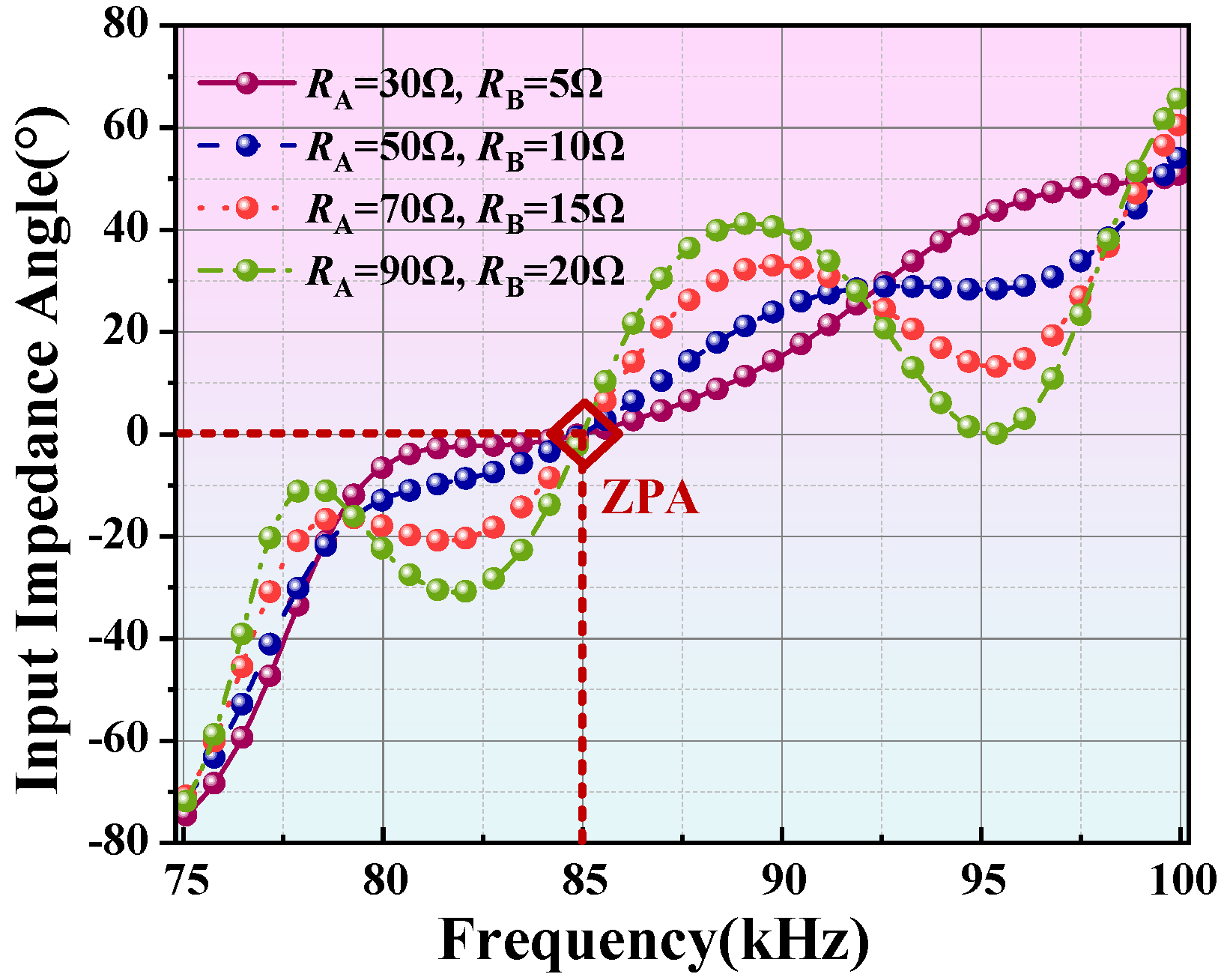
From Equation (8), Zin seen from the inverter is purely resistive, which implies that the proposed circuit structure can realize ZPA operation at the designated operating frequency f0 by incorporating the appropriate resonant compensation elements. As a result, the inverter is responsible solely for delivering active power to the loads, which means that it can enhance the system efficiency and reduce the power losses.

3. Design of Magnetic Coupler

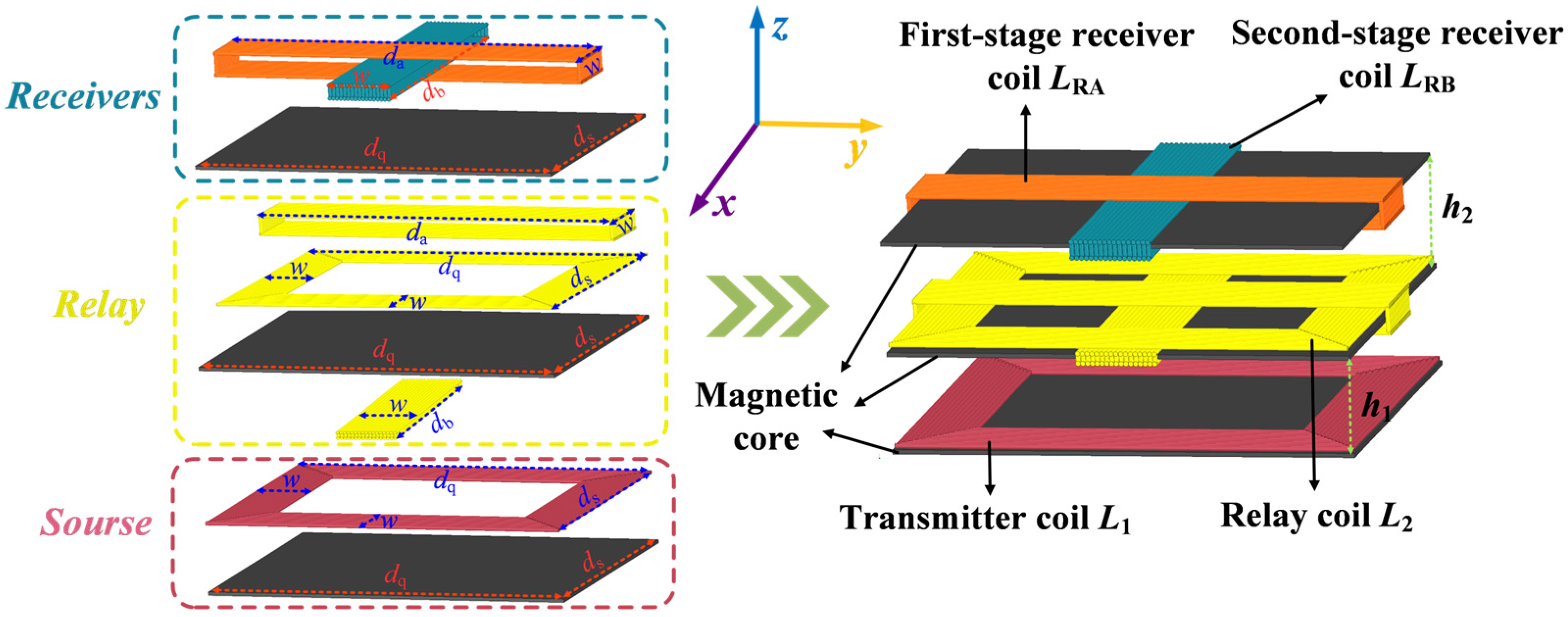
The diagram of the proposed magnetic coupler with multipolarity-decoupling characteristics is illustrated in Figure 3. The first-stage receiver coil LRA and second-stage receiver coil LRB are wound perpendicularly onto the receiver-side magnetic core, where the wires are arranged in horizontal and vertical orientations, respectively. The Q-shaped transmitter coil L1 is selected to establish the main power-transfer path while suppressing the undesired direct couplings from L1 to the receiver coils through geometric flux cancellation. As analyzed below, the Y–Z-plane flux component generated by L1 does not intersect LRA, whereas the X–Z-plane flux components pass through LRA from opposite directions and cancel each other, thereby suppressing MA1. The same spatial-symmetry mechanism suppresses MB1 for LRB. The relay coil L2 consists of a Q-shaped coil connected in series with two spatially orthogonal helical coils. The Q-shaped part maintains the main coupling with L1, while the two helical coils independently establish the coupling paths M2A and M2B with LRA and LRB, respectively.
To elucidate the multipolarity-decoupling characteristics of the proposed magnetic coupler structure, this paper conducts a detailed theoretical analysis based on electromagnetic field theory. As the proposed dual-receiver WPT system necessitates magnetic decoupling between coils LRA and LRB, the mutual inductance MAB is expected to approach zero under ideal geometric symmetry. Upon the application of excitation currents IrA and IrB to the coils LRA and LRB, respectively, the magnetic flux generated by coil LRA is oriented parallel to the X–Z plane, while the magnetic flux generated by coil LRB is oriented parallel to the Y–Z plane. For further analysis, the mutual magnetic flux linkage ψAB, representing the portion of magnetic flux generated by coil LRB that links with coil LRA, can be mathematically expressed as follows:
ψ AB = B RB d S A
where BRB represents the magnetic flux density vector generated by coil LRB, and SA represents the effective surface area of the coil LRA that is oriented perpendicular to the magnetic field vector. The magnetic flux distribution indicates that the magnetic flux produced by the coil LRB does not intersect with the coil LRA. Therefore, SA evaluates to zero, and ψAB also theoretically approaches zero. The mutual inductance MAB between coils LRA and LRB is determined by the following equation:
M AB = ψ AB I rB
The calculated result shows that MAB theoretically approaches zero under ideal geometric symmetry, thereby confirming that the proposed structure is capable of achieving the decoupling characteristic between coils LRA and LRB.
Furthermore, the proposed WPT system necessitates a decoupling mechanism between the transmitter coil L1 and the receiver coils (LRA and LRB), such that the mutual inductances MA1 and MB1 should be suppressed to near-zero levels under ideal geometric symmetry. When excitation currents I1, IrA, and IrB are added to coils L1, LRA, and LRB, respectively, the magnetic flux generated by coil L1 is oriented parallel to the X–Z plane and Y–Z plane, while the magnetic flux generated by coil LRA is oriented parallel to the X–Z plane. For further analysis, the mutual magnetic flux linkage ψA1, representing the portion of magnetic flux generated by coil L1 that links with coil LRA, can be expressed as follows:
ψ A 1 = B 1 d S A
where B1 represents the magnetic flux density vector generated by coil L1. The magnetic flux generated by L1 that is oriented parallel to the Y–Z plane does not intersect with the coil LRA. Meanwhile, the magnetic flux components parallel to the X–Z plane intersect coil LRA from opposite directions, resulting in positive and negative mutual magnetic flux linkages that cancel each other out. As a result of the above analysis, it can be concluded that ψA1 theoretically approaches zero. The mutual inductance MA1 between coils L1 and LRA is determined by the following equation.
M A 1 = ψ A 1 I 1
Under ideal geometric symmetry, the calculated result indicates that MA1 theoretically approaches zero, demonstrating the decoupling tendency between coils L1 and LRA. By utilizing the analogous analytical method, it can be concluded that the mutual inductance MB1 between coils L1 and LRB also theoretically approaches zero. Therefore, the proposed structure successfully realizes the decoupling characteristic between coils L1 and LRB. It is worth emphasizing that variations in the height of the receiver coils have no impact on the analytical results regarding the mutual magnetic flux linkages. The dimensional parameters of the magnetic coupler are listed in Table 1.
To suppress the adverse impact of the skin effect, high-frequency Litz wire consisting of 400 strands with an overall bundle diameter of 2.8 mm is selected for fabricating the coils. Ferrite plates PC95 with a thickness of 2.5 mm are selected as the magnetic core to improve magnetic coupling. h1 and h2 are the separation distance between the magnetic cores.

4. Simulation Verification

4.1. Multipolarity Decoupling Characteristics Validation

In order to validate the design concept of the proposed WPT system, this paper designs a set of circuit parameters, as shown in Table 2.
In Table 2, the mutual inductances MA1, MB1, and MAB are 0.008 μH, 0.009 μH, and 0.012 μH, respectively. This result provides a compelling validation of the multipolarity-decoupling characteristics inherent to the proposed magnetic coupler.

4.2. Load-Independent CC and CV Validation

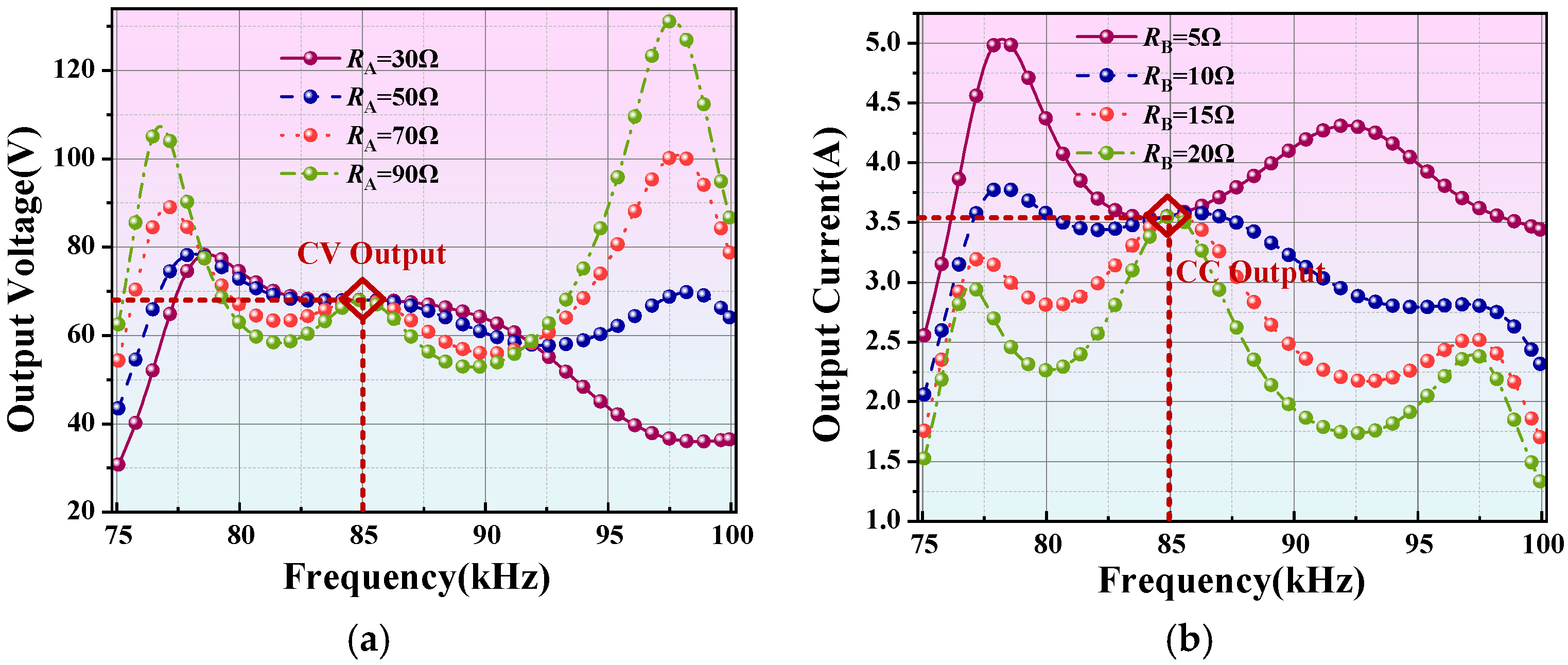
According to the designed parameters, the relationship curves of the first-stage receiver output voltage UrA and the second-stage receiver output current IB under different loads and the frequency are drawn, as shown in Figure 4.
As illustrated in Figure 4, at the operating frequency of 85 kHz, UrA and IB are maintained at constant values of 68 V and 3.5 A, respectively. Therefore, the proposed WPT system can enable load-independent CV and CC outputs.

4.3. ZPA Validation

The frequency sweep curves of the input impedance angle of the system under different load conditions are obtained, as shown in Figure 5. The simulation result is consistent with the theoretical analysis, thereby validating the system’s ability to operate under the condition of achieving ZPA operation.

5. Experimental Verification

5.1. Experimental Setup

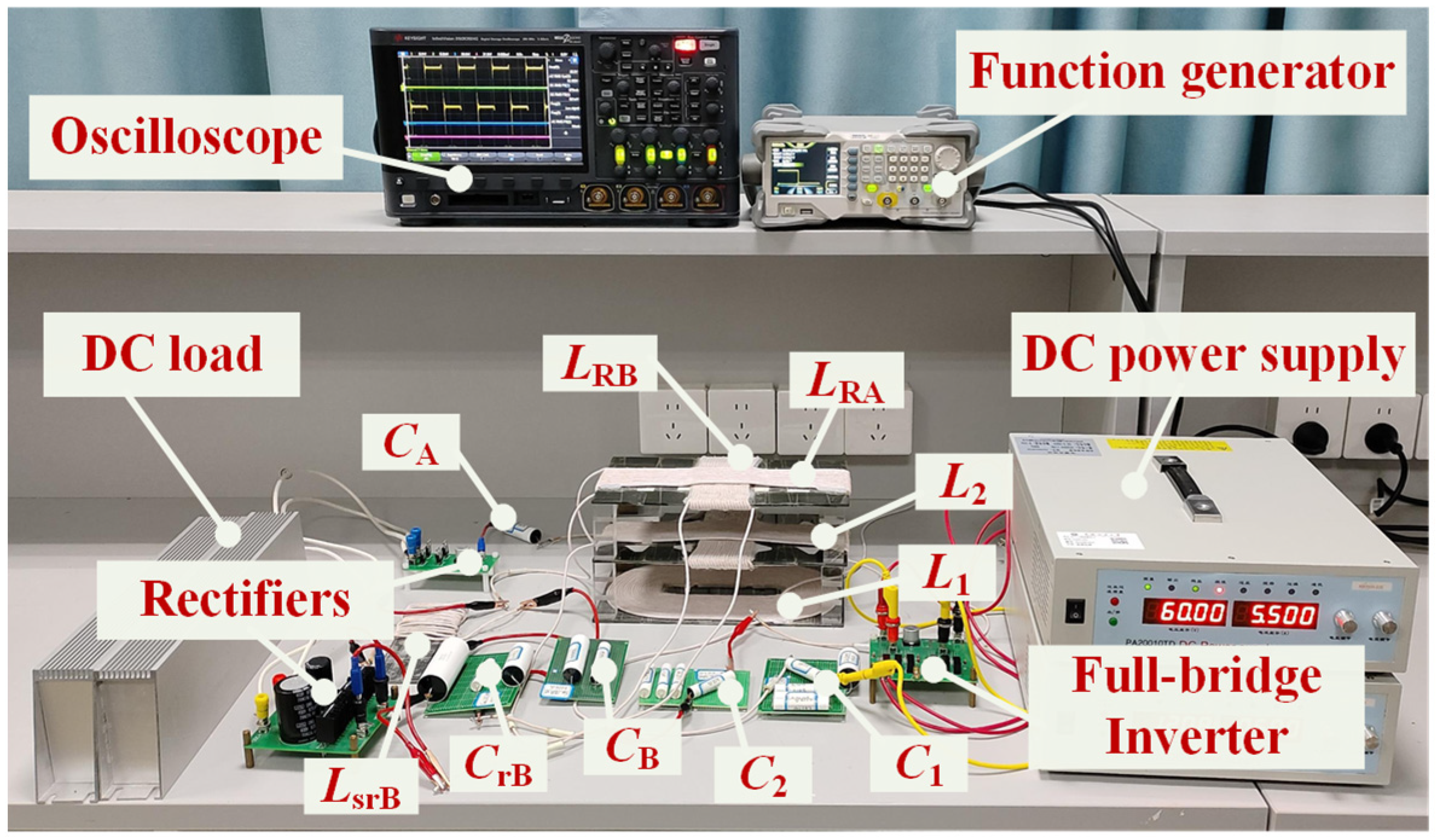
As depicted in Figure 6, a miniaturized experimental prototype of the proposed WPT system is built. This laboratory prototype is mainly utilized to verify the correctness of the theoretical analysis. Although the proposed topology is scalable in principle, a practical extension to higher power levels requires the careful consideration of engineering limitations, including magnetic-core saturation, thermal management, coil losses, the voltage/current stress of resonant components, electromagnetic compatibility, safety constraints, and misalignment sensitivity. These issues are beyond the scope of the present proof-of-concept prototype and will be investigated in future work targeting higher-power implementations.
The experimental setup consists of the following components: a DC power supply (PA20010-TD, PINTECH, Guangzhou, China); a full-bridge inverter composed of four power MOSFETs (C2M0045170D, Wolfspeed, Inc., Durham, NC, USA); a function/arbitrary waveform generator (DG1032, RIGOL Technologies Co., Ltd., Suzhou, China) for generating drive signals; a magnetic coupler; two rectifiers comprising SiC Schottky-barrier diodes (C3D16060D, Wolfspeed, Inc., Durham, NC, USA); two DC load resistors RA and RB; and an oscilloscope (DSOX3024G, Keysight Technologies, Santa Rosa, CA, USA). The inductance and capacitance values were measured using a ZX8590-10M LCR meter (ZXP, Changzhou, China). The reported output powers and efficiencies are calculated directly from the measured voltages and currents, without further instrument-uncertainty propagation analysis. The detailed experimental prototype parameters are listed in Table 3. The measured residual mutual inductances MA1, MB1, and MAB are 0.086 μH, 0.093 μH, and 0.382 μH, respectively, accounting for only 0.15%, 0.17%, and 0.68% of the dominant coupling inductance M2A. These residual mutual inductances are much smaller than the main power-transfer mutual inductances M12, M2A, and M2B. Moreover, the simulation results based on near-zero cross-couplings and the experimental results with the measured residual mutual inductances both confirm the expected CV output of 68 V and CC output of 3.5 A. This confirms that the residual mutual inductances have a negligible influence on the main output performance of the proposed system.

5.2. Experimental Results of ZPA

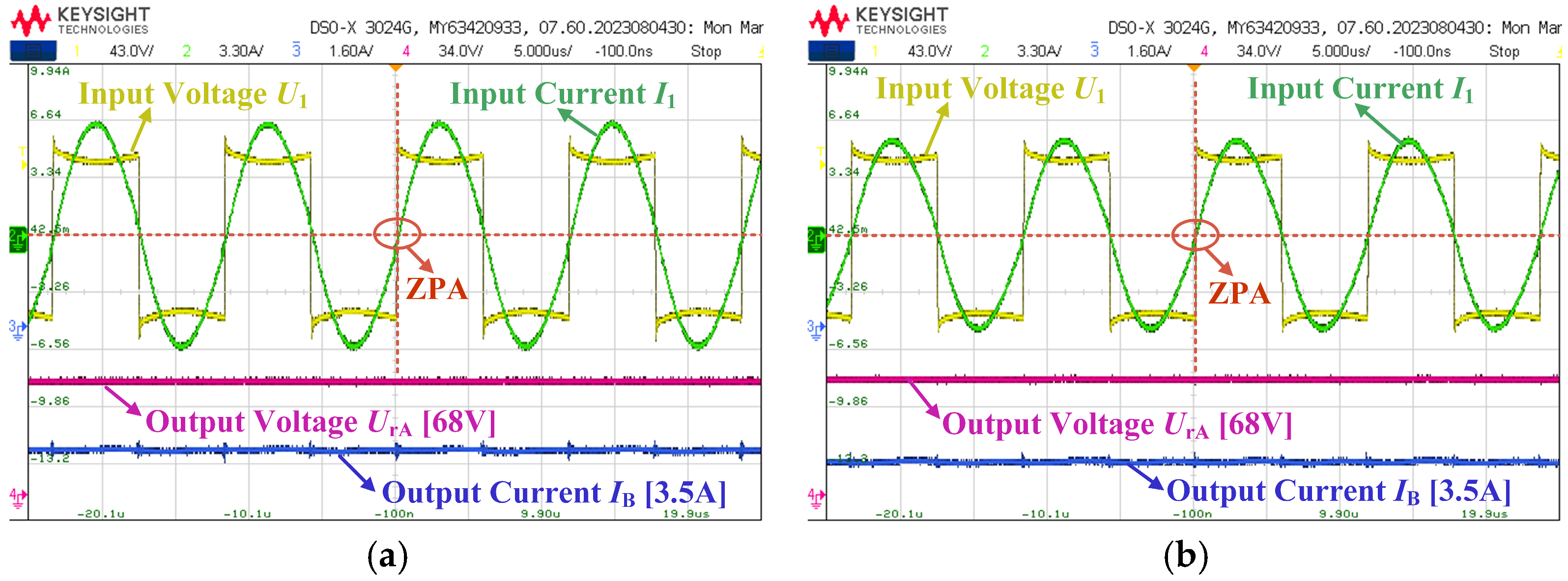
The experimental waveforms of the first-stage receiver output voltage UrA, the second-stage receiver output current IB, and the output voltage U1 and output current I1 of the inverter are illustrated in Figure 7. In Figure 7a, the loads RA and RB are set to 60 Ω and 10 Ω, respectively. In Figure 7b, the loads RA and RB are set to 45 Ω and 5 Ω. As demonstrated in the waveform results, the system maintains the constant output voltage of 68 V and the constant output current of 3.5 A, which confirm the load-independent CC and CV characteristics. Furthermore, the coincidence of the zero-crossing points of U1 and I1 indicates that the system can operate under the ZPA conditions.

5.3. Misalignment Analysis at Specific Symmetric Positions

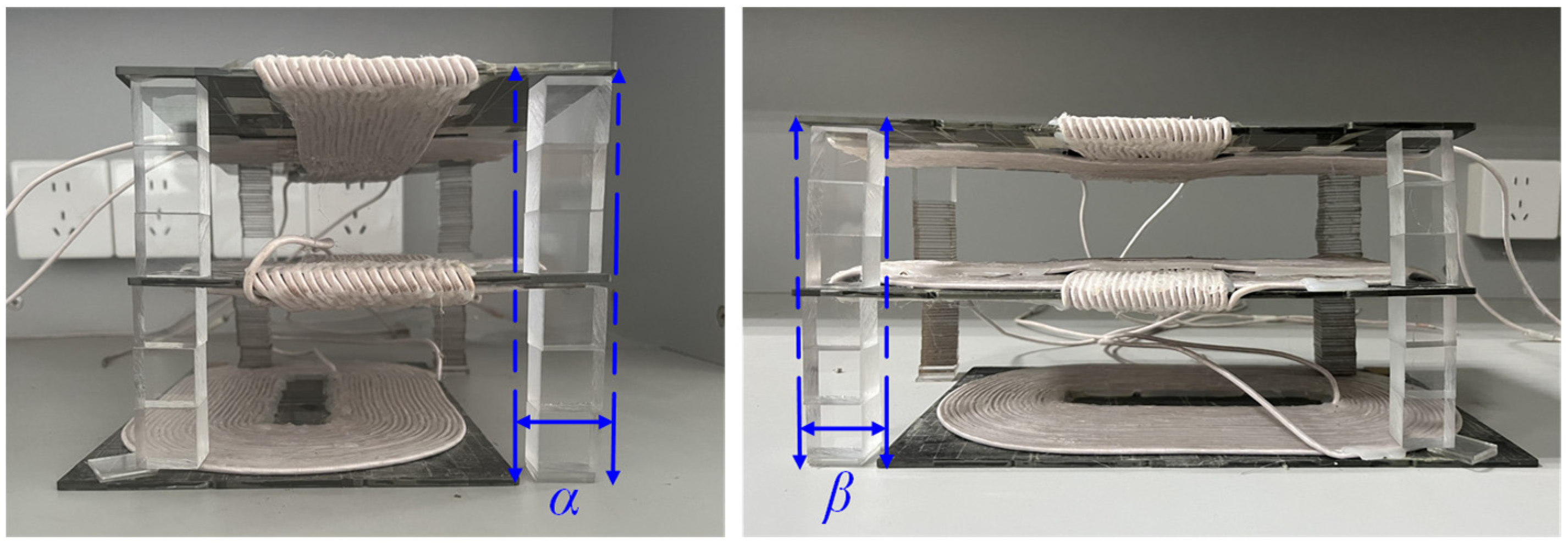
When the magnetic coupler is misaligned, the mutual inductance between coils also varies accordingly. The magnetic coupler misalignment along X-axis and Y-axis direction is shown in Figure 8.
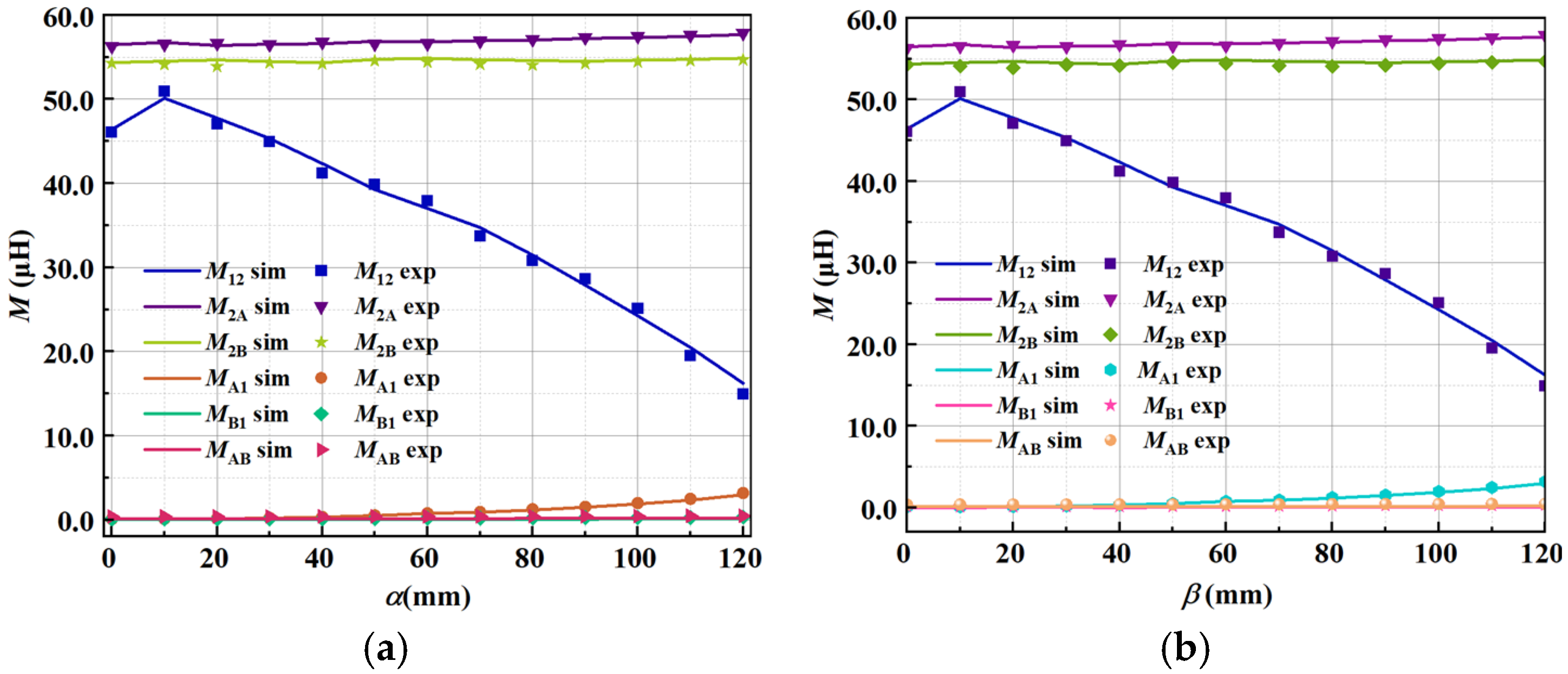
During the displacement, the relative positions among the relay coil and the two receiver coils remain fixed, and the assembly is shifted as a whole. In Figure 8, α and β represent the axial misalignment distances along the X-axis and Y-axis, respectively. With the increase in α and β, the variations in mutual inductances are illustrated in Figure 9.
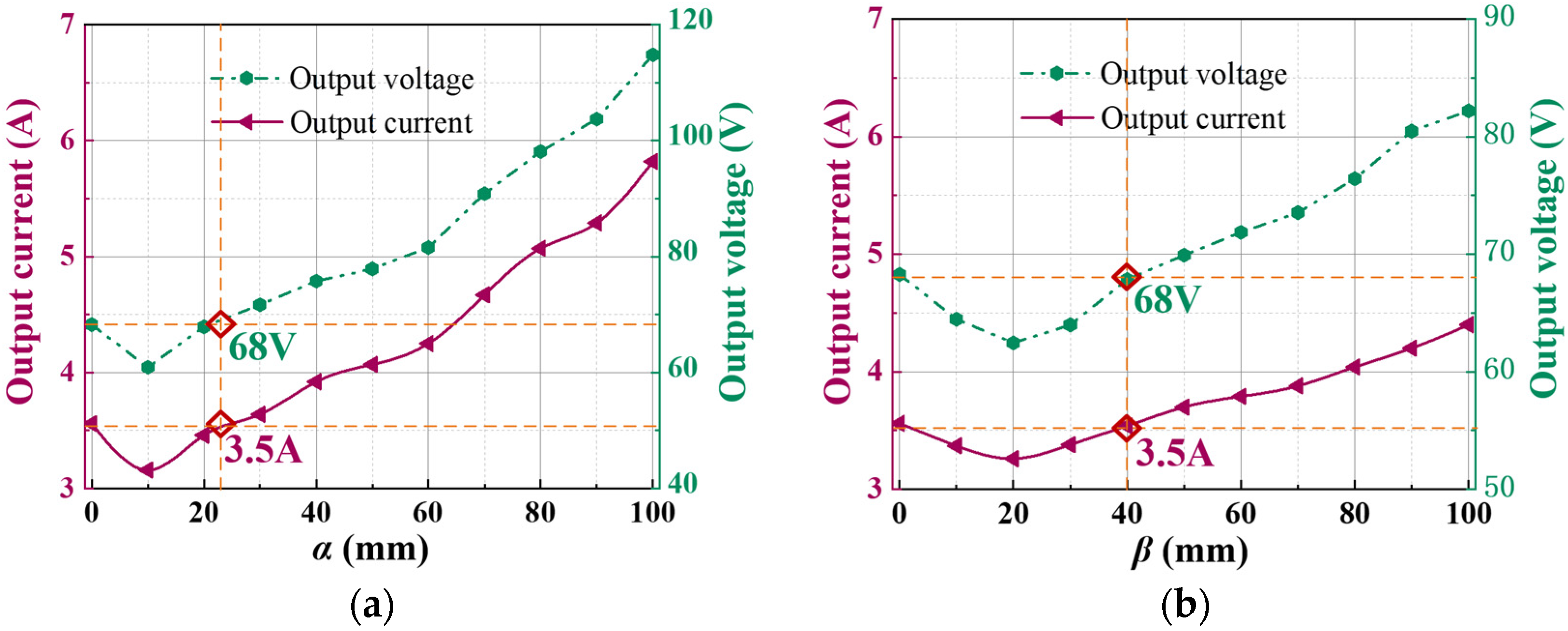
In Figure 9, M12 initially increases and then decreases, reaching a value equal to that under the aligned condition at a misalignment of 22 mm and 40 mm, respectively. In contrast, MA1 and MB1 exhibit a monotonically increasing trend. M2A, M2B, and MAB remain approximately constant during the variation of α and β. The impact of mutual inductance variations on the system output voltage and current is illustrated in Figure 10. The system output voltage UrA and current IB initially decrease and then increase with misalignment. Based on the original experimental data in Figure 10, the percentage deviations of UrA and IB from their nominal values of 68 V and 3.5 A are further calculated. Within the tested X-axis displacement range of α = 0–100 mm, the percentage deviation ranges from −10.41% to +68.82% for UrA and from −9.71% to +66.29% for IB. Within the tested Y-axis displacement range of β = 0–100 mm, the percentage deviation ranges from −8.16% to +20.85% for UrA and from −6.86% to +25.71% for IB. These results indicate that the nominal outputs are recovered only near specific symmetric misalignment positions, rather than over the entire lateral displacement range.
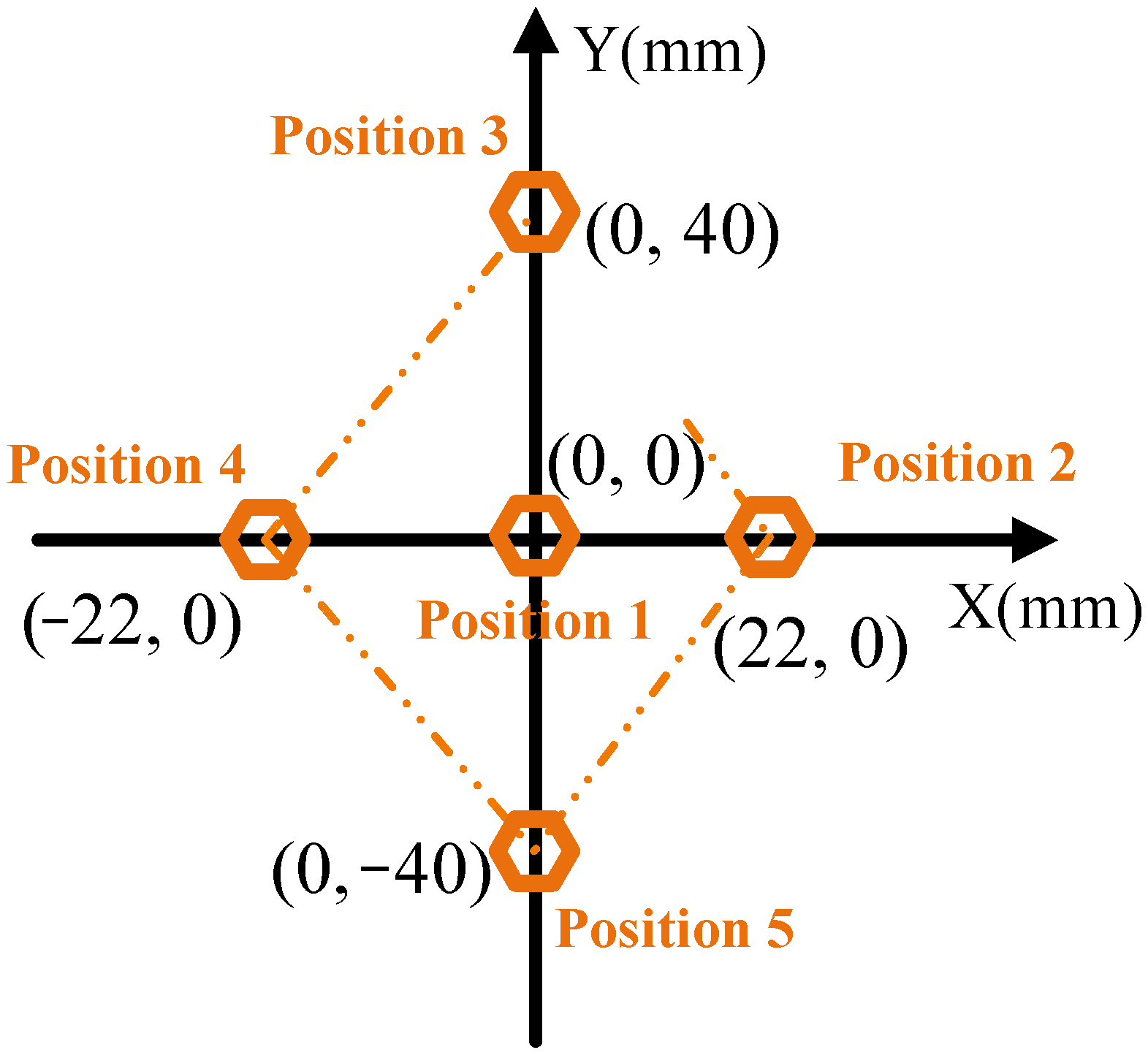
The variation trends in Figure 10 are consistent with the sensitivity analysis derived from Equation (7). Since M2A and M2B remain approximately constant during misalignment, whereas M12 varies with displacement, UrA and IB mainly follow the variation of M12 and deviate from or recover to their nominal values accordingly. As shown in Figure 9, when α exceeds 70 mm or β exceeds 110 mm, MA1 or MB1 exceeds 1 μH, indicating that the residual direct coupling becomes noticeably larger than that under the aligned condition. In this case, the theoretical prerequisite of the proposed decoupling mechanism is no longer strictly satisfied. Therefore, α ≤ 70 mm and β ≤ 110 mm are defined as the misalignment ranges within which the decoupling condition remains approximately valid for the experimental prototype, rather than the regulation ranges for maintaining the nominal CV and CC outputs. Within these ranges, the output values still vary with M12, and the nominal outputs of 68 V and 3.5 A are recovered only near the specific symmetric positions shown in Figure 11.
At the specific symmetric positions 2–5, M12, M2A, M2B, and MAB remain close to their values under the aligned condition, while MA1 and MB1 increase by less than 0.5 μH. Therefore, the multipolarity-decoupling characteristics are still approximately maintained at these specific positions, and the measured UrA and IB recover to 68 V and 3.5 A, respectively. It should be emphasized that this output recovery occurs only at the specific symmetric positions, namely, positions 2 and 4 under an X-axis misalignment of α = ±22 mm and positions 3 and 5 under a Y-axis misalignment of β = ±40 mm. This behavior is caused by the geometric symmetry of the proposed magnetic coupler, rather than indicating general lateral misalignment tolerance. At other non-symmetric misalignment positions, UrA and IB vary with M12 and deviate from their nominal values.

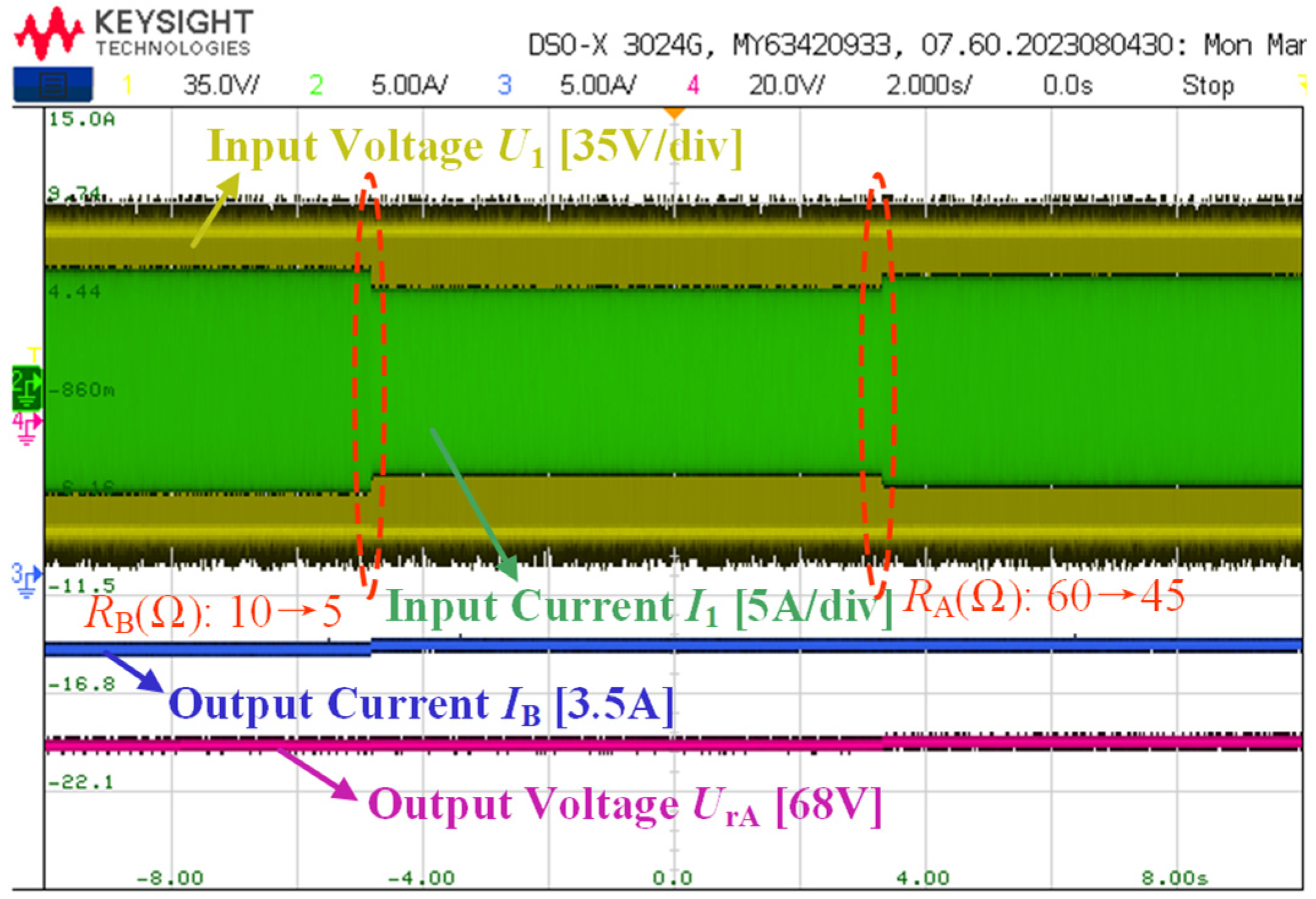
5.4. Dynamic Experimental Response

To assess the robustness and stability of the CV and CC outputs under varying load conditions, the dynamic experimental response waveforms of U1, I1, UrA, and IB are shown in Figure 12. In the first load variation, with RA held constant at 60 Ω and RB varying abruptly from 10 Ω to 5 Ω, the output current IB deviation is as low as 1.3% and the output voltage UrA remains unchanged. In the second load variation, with RB held constant at 5 Ω and RA varying suddenly from 60 Ω to 45 Ω, the output voltage UrA deviation is as low as 0.6%. Accordingly, throughout the dynamic response, UrA and IB fluctuate little and remain nearly stable at 68 V and 3.5 A, respectively. The dynamic experimental result demonstrates that the WPT system can achieve independent CV and CC outputs across the dual output ports without mutual interference. For simultaneous load variations at the two receivers, Equation (7) indicates that, when the residual cross-couplings are negligible, UrA and IB do not directly depend on the load resistance of the other receiver. Therefore, the two output ports are expected to respond independently to their respective load disturbances. The present dynamic tests verify this port independence through two representative single-port load-step cases. Simultaneous load-step transients at both receivers have not been experimentally tested in this work and will be further investigated in future studies. In addition, the open-circuit tests in Section 5.5 show that one receiver can remain functional when the other receiver is disconnected. However, the transient process of fast receiver disconnection and reconnection has not been separately tested and will be considered in future dynamic reliability experiments. The wider load ranges of RA = 30–70 Ω and RB = 5–21 Ω are evaluated through the static tests in Section 5.5, while wider-range dynamic load-step tests remain part of future work.

5.5. Efficiency Analysis

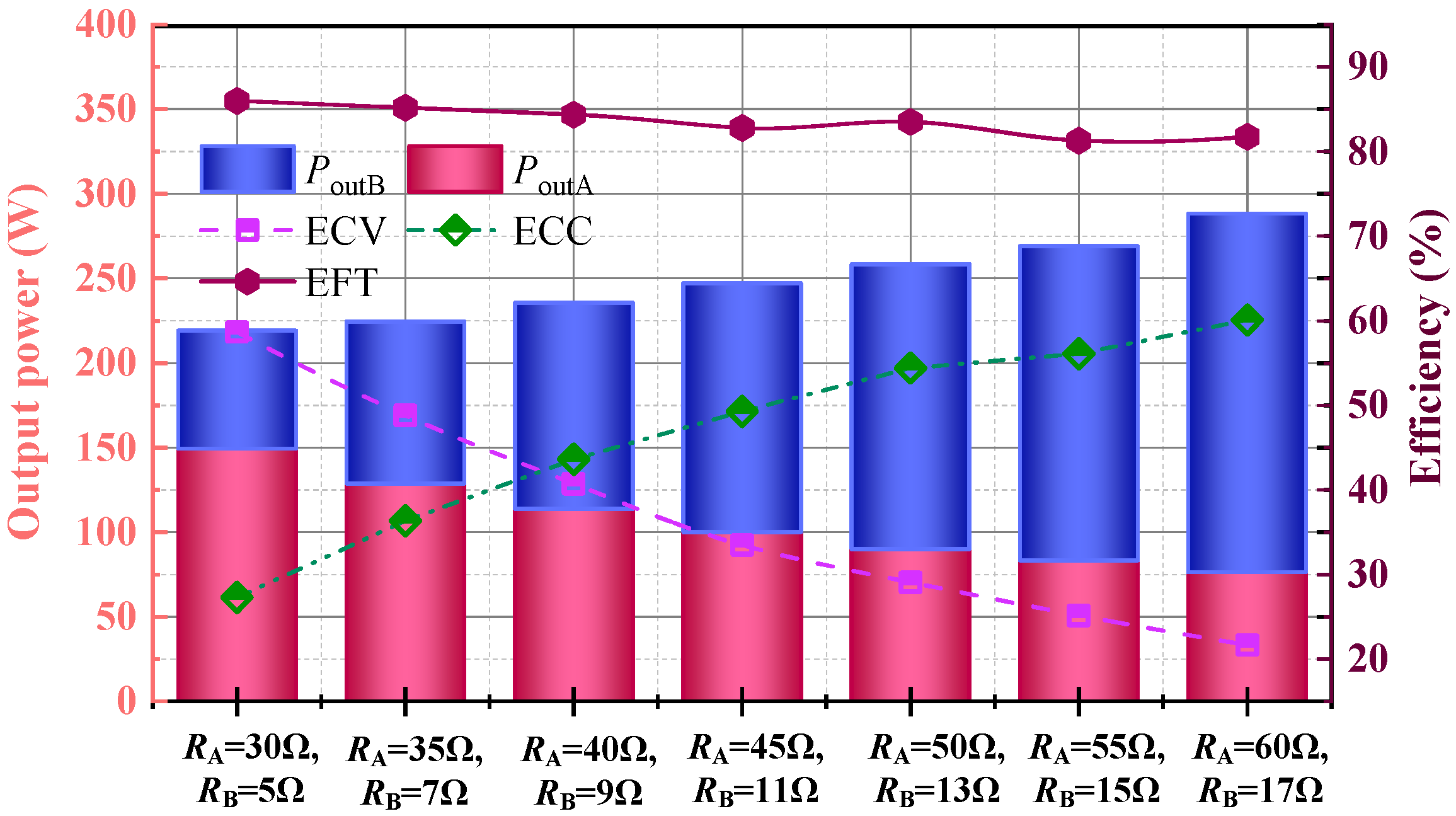
According to the experimental results under different load-resistance conditions, the system efficiency and output power are depicted in Figure 13. PoutA and PoutB are the output power from RA and RB, respectively. The system efficiency is defined as the DC-to-DC efficiency from the DC input of the full-bridge inverter to the DC outputs of the two rectifiers, where Pin = E × Iin, PoutA = UrA2/RA, and PoutB = IB2 × RB. Here, Iin is the measured DC input current. This efficiency includes the losses along the measured power-conversion path, including inverter switching and conduction losses, coil copper losses, ferrite-core losses, compensation-capacitor ESR losses, and rectifier-diode conduction losses. The CV-port efficiency, CC-port efficiency, and total efficiency are defined as ECV = PoutA/Pin × 100%, ECC = PoutB/Pin × 100%, and EFT = (PoutA + PoutB)/Pin × 100%, respectively. The reported efficiencies are calculated directly from the measured voltages and currents, without including the instrument uncertainty propagation. Within the measured load range, the system achieves a peak efficiency of 85.97% at a total output power of 219.01 W.
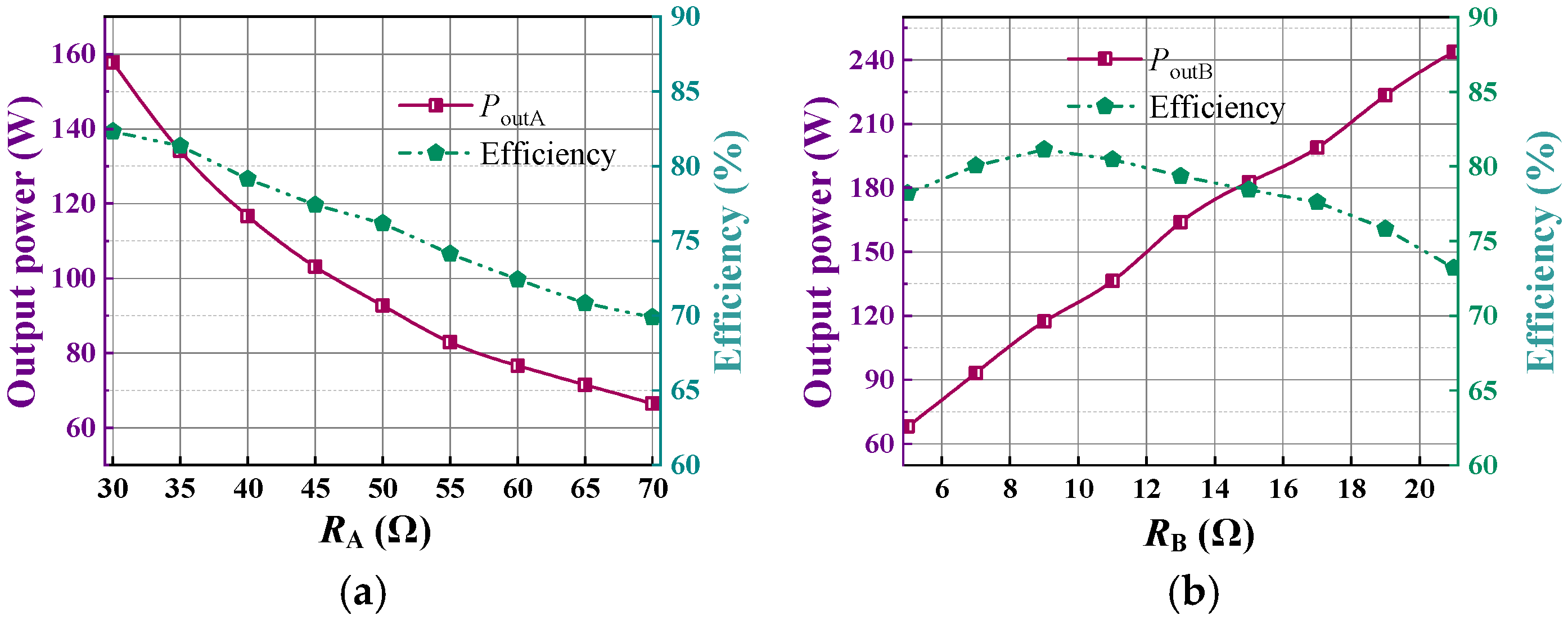
Owing to the absence of direct electrical interconnection and mutual inductive coupling between the two receivers, the system ensures the independent operation of each receiver. Consequently, the disconnection of one receiver does not impair the functionality of the other. Figure 14 shows the variation curves of the output power and the system efficiency at different RA and RB values. Under the condition where the second-stage receiver is an open circuit, PoutA and the system efficiency gradually degrade with the rising RA. Under the condition where the first-stage receiver is an open circuit, PoutB increases progressively with the rise in RB, while the system efficiency initially improves due to better impedance matching and subsequently declines as the load deviates further from the optimal condition. To further benchmark the proposed system against representative multi-receiver WPT systems, Table 4 summarizes the operating frequency, coil number, output type, decoupling method, extra control requirement, and peak efficiency of existing methods and this work.

6. Conclusions

This paper proposes a WPT system based on integrated multipolarity-decoupling four coils. The measured residual mutual inductances MA1, MB1, and MAB account for only 0.15%, 0.17%, and 0.68% of the dominant coupling inductance M2A, respectively, indicating that the proposed magnetic coupler exhibits effective natural-decoupling characteristics. With the undesired cross-couplings suppressed to negligible levels, the system achieves load-independent CV and CC outputs without observable mutual interference. The proposed multipolarity-decoupling method depends on the geometric winding configuration of the coils rather than the precise design of the turns or the inner radius, thereby offering greater design flexibility for the magnetic coupler. Furthermore, the integration of the coils onto the magnetic cores not only improves the space utilization but also contributes to the compactness and practicality of the proposed magnetic coupler. Under varying load conditions, the system maintains CV and CC outputs at two receivers, respectively, indicating strong robustness and stability. Within the designed load range, the experimental results show that the system can obtain a maximum efficiency of 85.97%.

Author Contributions

Conceptualization, Z.L. and C.R.; methodology, Z.L. and H.G.; software, X.W. and J.Z.; validation, Z.L., H.G. and Y.W.; formal analysis, Z.L.; investigation, Z.L. and H.G.; resources, M.A.V. and M.L.; data curation, R.H., H.W. and Y.L.; writing—original draft preparation, Z.L.; writing—review and editing, R.H., M.A.V., M.L. and C.R.; visualization, X.W., J.Z. and Y.W.; supervision, C.R.; project administration, C.R.; funding acquisition, C.R. All authors have read and agreed to the published version of the manuscript.

Funding

This work was supported by the Fundamental Research Funds for the Central Universities (No. JS250008).

Institutional Review Board Statement

Not applicable.

Informed Consent Statement

Not applicable.

Data Availability Statement

The original contributions presented in the study are included in the article; further inquiries can be directed to the corresponding author.

Conflicts of Interest

The authors declare no conflicts of interest.

Abbreviations

The following abbreviations are used in this manuscript:
WPTWireless Power Transfer
CVConstant Voltage
CCConstant Current
ZPAZero Phase Angle
RMSRoot Mean Square
KVLKirchhoff’s Voltage Law
FOMFrequency Overlay Modulation
BPCBucking Planar Coil

References

  1. Deng, Z.; Hu, H.; Su, Y.; Chen, F.; Xiao, J.; Tang, C.; Lin, T. Design of a 60-kW EV dynamic wireless power transfer system with dual transmitters and dual receivers. IEEE J. Emerg. Sel. Top. Power Electron. 2024, 12, 316–327. [Google Scholar] [CrossRef]
  2. Rong, C.; Chang, J.; Liu, Y.; Ling, Z.; Xu, Y.; Lu, Q.; Liu, Y.; Zhao, H.; Wang, H.; Xia, C. A novel coil array compensation structure design with high-misalignment tolerance for UAV-enable WPT system. Electr. Eng. 2025, 107, 2569–2579. [Google Scholar] [CrossRef]
  3. Karimi, M.J.; Dehollain, C.; Schmid, A. Power feedback control unit for closed-loop wirelessly powered biomedical implants. IEEE Trans. Circuits Syst. II Express Briefs 2023, 70, 1674–1678. [Google Scholar] [CrossRef]
  4. Rong, C.; Yan, L.; Gao, H.; Ji, H.; Chen, M.; Duan, X.; Wang, Q.; Xia, C. A novel equivalent parameter extraction method of cross-frequency metasurface for WPT system. IEEE Antennas Wirel. Propag. Lett. 2024, 23, 3812–3816. [Google Scholar] [CrossRef]
  5. Zhang, C.; Lu, W.; Zhao, J.; Wu, X.; Chen, H.; Xu, D. A novel asymmetric magnetic coupler applied to multiple-receiver wireless charging system for automated guided vehicles. IEEE Trans. Power Electron. 2023, 38, 14761–14775. [Google Scholar] [CrossRef]
  6. Rong, C.; He, X.; Zeng, Y.; Lu, C.; Liu, M. High-efficiency orientation insensitive WPT systems using magnetic dipole coil for low-power devices. IEEE Trans. Power Electron. 2022, 37, 4985–4990. [Google Scholar] [CrossRef]
  7. Da, C.; Li, F.; Nie, M.; Li, S.; Tao, C.; Wang, L. Undersea capacitive coupled simultaneous wireless power and data transfer for multiload applications. IEEE Trans. Power Electron. 2025, 40, 2630–2642. [Google Scholar] [CrossRef]
  8. Xu, Z.; Rodriguez-Villegas, E. A wireless power transfer mattress based system for perpetually operating physiological monitoring wearables. IEEE Trans. Biomed. Circuits Syst. 2024, 18, 460–473. [Google Scholar] [CrossRef]
  9. Rong, C.; Chen, M.; Duan, X.; Liu, Y.; Wu, J.; Zeng, Y.; He, X.; Liao, Z.; Xia, C. Optimized design of passive array coils for high-efficiency and anti-misalignment WPT system. IEEE Trans. Power Electron. 2024, 39, 6504–6514. [Google Scholar] [CrossRef]
  10. Rong, C.; Duan, X.; Chen, M.; Wang, Q.; Yan, L.; Wang, H.; Xia, C.; He, X.; Zeng, Y.; Liao, Z. Critical review of recent development of wireless power transfer technology for unmanned aerial vehicles. IEEE Access 2023, 11, 132982–133003. [Google Scholar] [CrossRef]
  11. Rong, C.; Wang, Q.; Chen, M.; Guo, Y.; Xu, Y.; Xia, C.; Zhang, X.; Jie, H. Optimized design of opened quasi-static cavity for omnidirectional wireless charging systems. IEEE Trans. Power Electron. 2025, 40, 8859–8868. [Google Scholar] [CrossRef]
  12. Fu, M.; Zhang, T.; Zhu, X.; Luk, P.C.K.; Ma, C. Compensation of cross coupling in multiple-receiver wireless power transfer systems. IEEE Trans. Ind. Inform. 2016, 12, 474–482. [Google Scholar] [CrossRef]
  13. Wang, X.; Mo, L.; Jiang, C.Q.; Chen, C.; Ren, S.; Zhu, Z. Front-end multiparameter identification method based on current decomposition of wireless power transfer system. IEEE Trans. Ind. Electron. 2026, 73, 8443–8454. [Google Scholar] [CrossRef]
  14. Pahlavan, S.; Shooshtari, M.; Ashtiani, S.J. Star-shaped coils in the transmitter array for receiver rotation tolerance in free-moving wireless power transfer applications. Energies 2022, 15, 8643. [Google Scholar] [CrossRef]
  15. Wang, H.; Cheng, K.W.E. A dual-receiver inductive charging system for automated guided vehicles. IEEE Trans. Magn. 2022, 58, 8700905. [Google Scholar] [CrossRef]
  16. Yang, L.; Dong, K.; Wang, Y.; Cai, C. Analysis and design of a dual-receiver WPT system with constant current and constant voltage dual-type outputs. IEEE Trans. Transp. Electrif. 2025, 11, 4060–4069. [Google Scholar] [CrossRef]
  17. Wang, H.; Cheng, K.W.E. Analysis, design, and validation of a decoupled double-receiver wireless power transfer system with constant voltage outputs for industrial power supplies. IEEE Trans. Ind. Inform. 2023, 19, 362–370. [Google Scholar] [CrossRef]
  18. Wang, H.; Cheng, K.W.E.; Li, X.; Hu, J. A special magnetic coupler structure for three-coil wireless power transfer: Analysis, design, and experimental verification. IEEE Trans. Magn. 2021, 57, 8002108. [Google Scholar] [CrossRef]
  19. Zhang, Y.; Lu, T.; Zhao, Z.; Chen, K.; He, F.; Yuan, L. Wireless power transfer to multiple loads over various distances using relay resonators. IEEE Microw. Wirel. Compon. Lett. 2015, 25, 337–339. [Google Scholar] [CrossRef]
  20. Li, Y.; Hu, J.; Li, X.; Cheng, K.W.E. A flexible load-independent multi-output wireless power transfer system based on cascaded double T-resonant circuits: Analysis, design and experimental verification. IEEE Trans. Circuits Syst. I Regul. Pap. 2019, 66, 2803–2812. [Google Scholar] [CrossRef]
  21. Guo, G.-S.; Liao, Z.-J.; Lang, Z.-X.; Wang, Y.-J.; Sun, P.; Xia, C.-Y. A novel high-power, wide-range PT symmetric wireless power transfer system with reconfiguration-free arbitrary current ratio adjustment. IEEE Trans. Power Electron. 2026. early access. [Google Scholar] [CrossRef]
  22. Mai, R.; Luo, Y.; Yang, B.; Song, Y.; Liu, S.; He, Z. Decoupling circuit for automated guided vehicles IPT charging systems with dual receivers. IEEE Trans. Power Electron. 2020, 35, 6652–6657. [Google Scholar] [CrossRef]
  23. Gong, Y.; Zhang, Z.; Chang, S. Single-transmitter-controlled multiple-channel constant current outputs for in-flight wireless charging of drones. IEEE Trans. Ind. Electron. 2024, 71, 3606–3616. [Google Scholar] [CrossRef]
  24. Zhong, W.; Hui, S.Y.R. Auxiliary circuits for power flow control in multifrequency wireless power transfer systems with multiple receivers. IEEE Trans. Power Electron. 2015, 30, 5902–5910. [Google Scholar] [CrossRef]
  25. Zhang, Y.; Lu, T.; Zhao, Z.; He, F.; Chen, K.; Yuan, L. Selective wireless power transfer to multiple loads using receivers of different resonant frequencies. IEEE Trans. Power Electron. 2015, 30, 6001–6005. [Google Scholar] [CrossRef]
  26. Narayanamoorthi, R.; Juliet, A.V.; Chokkalingam, B. Cross interference minimization and simultaneous wireless power transfer to multiple frequency loads using frequency bifurcation approach. IEEE Trans. Power Electron. 2019, 34, 10898–10909. [Google Scholar] [CrossRef]
  27. Cheng, C.; Lu, F.; Zhou, Z.; Li, W.; Zhu, C.; Deng, Z.; Chen, X.; Mi, C. A multiload inductive power transfer repeater system with constant load current characteristics. IEEE J. Emerg. Sel. Top. Power Electron. 2020, 8, 3533–3541. [Google Scholar] [CrossRef]
  28. Pang, H.; Chau, K.T.; Han, W.; Liu, W.; Zhang, Z. Decoupled-double D coils based dual-resonating-frequency compensation topology for wireless power transfer. IEEE Trans. Magn. 2022, 58, 8000407. [Google Scholar] [CrossRef]
  29. Pratik, U.; Varghese, B.J.; Azad, A.; Pantic, Z. Optimum design of decoupled concentric coils for operation in double-receiver wireless power transfer systems. IEEE J. Emerg. Sel. Top. Power Electron. 2019, 7, 1982–1998. [Google Scholar] [CrossRef]
Figure 1. Entire circuit topology diagram of the proposed WPT system.
Electronics 15 02623 g001
Figure 2. Equivalent circuit diagram of the proposed WPT system.
Electronics 15 02623 g002
Figure 3. The proposed magnetic coupler with multipolarity-decoupling characteristics.
Electronics 15 02623 g003
Figure 4. Frequency sweep curves under different loads; (a) output voltage UrA of the first-stage receiver; and (b) output current IB of the second-stage receiver.
Electronics 15 02623 g004
Figure 5. Frequency sweep curve of the input impedance angle under different loads.
Electronics 15 02623 g005
Figure 6. Experimental setup of the proposed WPT system.
Electronics 15 02623 g006
Figure 7. Experimental waveforms of U1, I1, UrA, and IB under ZPA conditions: (a) RA and RB are 60 Ω and 10 Ω; and (b) RA and RB are 45 Ω and 5 Ω.
Electronics 15 02623 g007
Figure 8. Diagram of magnetic coupler misalignment along X-axis and Y-axis direction.
Electronics 15 02623 g008
Figure 9. Variation curves of mutual inductances under different misalignment conditions: (a) X-axis misalignment; and (b) Y-axis misalignment.
Electronics 15 02623 g009
Figure 10. Variation curves of output voltage UrA and current IB under (a) X-axis misalignment (displacement α) and (b) Y-axis misalignment (displacement β).
Electronics 15 02623 g010
Figure 11. Diagram of misalignment positions along the X-axis and Y-axis.
Electronics 15 02623 g011
Figure 12. Dynamic experimental response waveforms of U1, I1, UrA, and IB with load changes: RA = 60 Ω and RB is changed from 10 Ω to 5 Ω; and RB = 5 Ω and RA is changed from 60 Ω to 45 Ω.
Electronics 15 02623 g012
Figure 13. Measured values of system efficiency and output power at different load-resistance conditions.
Electronics 15 02623 g013
Figure 14. Measured values of output power and system efficiency at different RA and RB: (a) second-stage receiver is open circuit; and (b) first-stage receiver is open circuit.
Electronics 15 02623 g014
Table 1. The dimensional parameters of the proposed magnetic coupler.
ParametersValueParametersValue
dq265 mmds159 mm
da272 mmdb163 mm
w65 mmh160 mm
h260 mm----
Table 2. Theoretical circuit parameters.
ParametersValueParametersValue
L1125.97 μHL2585.91 μH
LRA233.93 μHLRB203.78 μH
LsrB28.04 μHC127.74 nF
C25.91 nFCA15.08 nF
CB19.87 nFCrB125.32 nF
CfA300 μFCfB300 μF
M1246.39 μHM2A56.47 μH
M2B54.28 μHMA10.008 μH
MB10.009 μHMAB0.012 μH
f085 kHzE60 V
Table 3. Experimental circuit parameters.
ParametersValueParametersValue
L1125.68 μHL2585.67 μH
LRA233.71 μHLRB204.12 μH
LsrB28.04 μHC127.81 nF
C25.89 nFCA14.99 nF
CB19.83 nFCrB125.29 nF
CfA920 μFCfB920 μF
R10.1 ΩR20.43 Ω
RrA0.13 ΩRrB0.13 Ω
RsrB0.02 ΩM1246.11 μH
M2A56.29 μHM2B54.28 μH
MA10.086 μHMB10.093 μH
MAB0.382 μHf085 kHz
E60 V----
Table 4. Quantitative comparison with representative multi-output and multi-receiver WPT systems.
Ref.Freq.CoilsOutput TypeDecoupling MethodExtra ControlPeak η (%)
[15]200 kHz3CC + CVMagnetic-coupler/mutual-inductance designNo84.5
[16]100 kHz4CC + CVNatural decoupling of perpendicular solenoid coilsNo92.83
[20]85 kHz2Multi-CVCascaded double-T resonant circuitsYes91.12
[22]85 kHz3Dual independent voltage outputsPassive L/C decoupling circuitNo93
[23]100/300 kHz3Multi-CCMFRC and band-pass filteringYesN/R
[28]100/300 kHz4Dual-frequency dual-channel transferOrthogonal DD coils with DRF compensationFOM required83
[29]85 kHz3N/RConcentric bucking coil/BPCNoN/R
This work85 kHz4CC + CVSpatial multipolarity geometryNo85.97
N/R = not reported in the referenced work.
Disclaimer/Publisher’s Note: The statements, opinions and data contained in all publications are solely those of the individual author(s) and contributor(s) and not of MDPI and/or the editor(s). MDPI and/or the editor(s) disclaim responsibility for any injury to people or property resulting from any ideas, methods, instructions or products referred to in the content.