Article

Study on the Fabrication and Performance of BiSbO4-Doped ZnO Varistor Ceramics

1
Nanyang Jinniu Electric Co., Ltd., Nanyang 473000, China
2
College of Materials and Chemical Engineering, Zhengzhou University of Light Industry, Zhengzhou 450000, China
*
Authors to whom correspondence should be addressed.
Electronics 2026, 15(12), 2575; https://doi.org/10.3390/electronics15122575
Submission received: 15 April 2026 / Revised: 6 June 2026 / Accepted: 8 June 2026 / Published: 11 June 2026

Abstract

By synthesizing BiSbO4 material with a molar ratio of Bi2O3 to Sb2O3 of 0.6:1 and calcining it at 700 °C, a relatively pure compound was obtained. Additionally, the effects of varying BiSbO4 content on the microstructure and electrical properties of ZnO varistor ceramics were investigated. Results indicate that as BiSbO4 content increased from 0% to 3%, the voltage gradient of the varistor rose with increasing BiSbO4 content while leakage current gradually decreased. The nonlinear coefficient continued to rise, while the residual voltage ratio first decreased then increased. At a BiSbO4 content of 2%, outstanding electrical properties were achieved: voltage gradient (E1mA) = 346 V·mm−1, leakage current JL = 0.14 μA·cm−2, nonlinear coefficient α = 32, and residual voltage ratio K = 1.73. Furthermore, after undergoing a 100 kA surge, the U1mA value remained at 93.5% of its initial value, demonstrating outstanding surge stability. This provides a new approach for fabricating high-gradient, high-stability varistors.

1. Introduction

ZnO varistors are widely used due to their excellent nonlinear voltage-current characteristics, low leakage current density and robust surge handling capability [1,2,3,4]. Recently, with the rapid development of global power transmission and distribution systems, grid systems have increasingly stringent performance requirements for surge arresters [5,6,7]. Being the core component of surge arresters, ZnO varistors directly impact the electrical performance of the arresters [8,9,10,11]. Therefore, it is essential to further enhance the nonlinear V-I characteristics of ZnO varistors, reduce their residual voltage ratio, and improve their current-carrying capacity and aging resistance [12,13,14,15,16]. This will enable them to protect electrical equipment in a safer and more stable manner. Investigations indicate that the current-carrying capacity of ZnO varistor ceramics is primarily influenced by the uniformity of their microstructure and the density of the ceramic body [17,18,19,20]. Generally, the more uniform the composition and microstructure of the varistor ceramic, and the higher its density, the greater the current-carrying capacity [21,22]. Presently, during mass production of varistors, Bi2O3 and Sb2O3 are typically added as single powders directly into the raw materials [23]. Due to their relatively low melting points (Bi2O3 at 825 °C and Sb2O3 at 656 °C), these oxides readily volatilize during high-temperature sintering (≥1000 °C), leading to surface porosity in the varistor. Furthermore, Bi2O3 doping is considered essential for fabricating ZnO varistors. Bi2O3-rich phases predominantly concentrate at ZnO grain boundaries, forming a double Schottky barrier that significantly influences electrical performance [24,25]. The Sb2O3, serving as a key raw material for producing spinel in ZnO varistor ceramics, plays a vital role in enhancing both the voltage gradient and nonlinear coefficient of the varistor ceramic. Its volatilization inevitably leads to a reduction in the useful components within the varistor ceramic, causing a deterioration in its performance [26,27,28]. Therefore, minimizing the volatilization of low-melting-point oxides during the preparation of ZnO varistor ceramics is of great significance for improving the electrical properties of the varistor ceramic. On the other hand, the application of high-gradient ZnO-based varistors is essential for developing high-performance, miniaturized surge arresters. To enhance the potential gradient of varistors, the primary approach involves increasing the number of ZnO grains per unit thickness and refining the ZnO grain structure [29,30]. Over recent years, researchers have achieved this goal by doping with rare-earth metal oxides possessing larger ionic radii than Zn2+. Liu et al. investigated the effects of SrCO3 doping on the microstructure and electrical properties of ZnO-Pr6O11-Co2O3-La2O3-based varistors. Due to the significantly larger ionic radius of Sr2+ compared to Zn2+, substantial Sr2+ enrichment occurs at grain boundaries. At a 0.50 mol % SrCO3 doping concentration, the samples exhibited optimal comprehensive performance: the nonlinear coefficient α increased from 8 to 41, and the voltage gradient rose from 615 V/mm to 862 V/mm [31]. Cao et al. prepared Er2O3-doped ZnO-Cr2O3-SrCO3 varistors via solid-state sintering and conducted systematic investigations into their microstructure and electrical properties. At an Er2O3 doping concentration of 0.25 mol %, ZnO varistor samples were successfully synthesized, exhibiting a nonlinear coefficient α of 52, a breakdown electric field E1mA of 629 V/mm, and a leakage current density JL as low as 0.03 μA/cm2 [32]. Due to the high cost of rare earth metals, they are rarely used in mass production. Therefore, exploring a low-cost method for fabricating high-gradient varistors is particularly urgent.
In this study, low-melting-point Bi2O3 and Sb2O3 were first pre-synthesized into high-melting-point BiSbO4 material. Subsequently, this material was uniformly mixed with ZnO and other additives to prepare high-gradient, high-performance varistors. The effects of different BiSbO4 concentrations on the microstructure and electrical properties of the varistors were compared, providing a feasible strategy for the development of high-gradient ZnO-based varistors.

2. Materials and Methods

Preparation of BiSbO4 Material: All chemical reagents used in this experiment were prepared using electronic-grade materials in the specified proportions: accurately weigh 279.576 g of Bi2O3 (Yuehua, Xianyang, China) and 291.52 g of Sb2O3 (STA, Yiyang, China) (molar ratio: 0.6:1, taking into account the potential partial loss of antimony oxide due to volatilization during synthesis at 700 °C) on an electronic scale. Transfer the weighed powders to a ball mill, add 500 mL of deionized water, and ball mill for 3 h until all raw materials are uniformly mixed (Weight ratio of powder to balls = 1:1). Transfer the mixed slurry to a 100 °C oven for drying for 8 h. Remove and grind using a high-speed pulverizer. Place the crushed powder into an alumina crucible and position it in a muffle furnace. Heat at a rate of 2 °C·min−1 to 700 °C, hold for 3 h, then cool naturally to room temperature. Grind using a high-speed pulverizer and sieve through a 120-mesh stainless steel screen to obtain BiSbO4 powder.
Preparation of BiSbO4-doped ZnO varistor ceramics: Precisely weigh 97.93-X % ZnO (molar fraction, same below, Zhiyi, Changzhou, China), 0.62% Co2O3 (Shudu, Chengdu, China), 0.75% SiO2 (Shudu, Chengdu, China), 0.21% Mn3O4 (HSM, Changsha, China), 0.34% NiO (Taihe Metal, Taizhou, China), 0.14% Cr2O3 (Naiju, Shanghai, China), 0.01% Al(NO3)3 (GCRF, Guangzhou, China), and X % BiSbO4 (X = 0, 1, 2, 3). After weighing, transfer the raw materials to a ball mill. Mix with deionized water (Weight ratio of powder to balls = 1:1), 0.5% dispersant, and 0.8% polyvinyl alcohol. Ball mill in a stirred mill for 4 h to obtain a uniform slurry. Dried in a 100 °C oven for 10 h, then crushed through a 100-mesh screen. Added 0.5% lubricant and 1.4% deionized water, mixed thoroughly, passed through a 40-mesh screen, and aged for 6 h. The aged powder was placed in a press and compacted at 100 MPa into green compacts with a diameter of 42 mm and thickness of 18 mm. After holding at 500 °C for 5 h to remove organic matter, the powder was placed in a sealed ceramic crucible. In a muffle furnace, the temperature was raised at 2 °C/min to 1130 °C, held for 6 h for sintering, then cooled at 1 °C/min to room temperature. Finally, grind the top and bottom surfaces and coat them with a 41 mm diameter aluminum electrode. The sides are coated with epoxy resin glaze and cured in an oven at 180 °C for 3 h to obtain the varistor ceramic. ZnO varistor ceramic samples doped with 0%, 1%, 2%, and 3% were designated as B0, B1, B2, and B3, respectively.
The crystal structure of the samples was characterized using an X-ray diffractometer (XRD, Bruker-D8, with a CuKα radiation source and an incident wavelength λ = 0.154056 nm). The microstructure of the sample cross-sections was observed using a field emission scanning electron microscope (JEOL JSM-7001F FESEM, Tokyo, Japan), and the particle size distribution was statistically analyzed. The elemental distribution of the sample was analyzed using EDS (Oxford Ultim Max 40e, Oxford, UK, accelerating voltage 10 kV). A DC parameter tester for surge arrester disks (Tianyuan MOA-III, Suizhou, China) was employed to measure the samples’ voltage sensitivity, leakage current, and nonlinearity coefficient. A multifunctional impulse current generator (Dianyou ICT5-100 model, Xi’an, China) was used to test the samples’ 8/20 μs residual voltage ratio and 4/10 μs surge current capacity. To minimize the impact of variations between samples, the electrical parameters (U0.1mA, U1mA, E1mA, JL, α, K, (U1mA − ΔU1mA)/U1mA) are averages obtained from measurements of five samples, thereby ensuring the reliability of the electrical performance data. An electrochemical workstation (SHIRUISI RST5200F, Zhengzhou, China) was employed to analyze the impedance characteristics of the samples. The nonlinearity coefficient of the varistor ceramics samples was defined as α = 1/lg(U1mA/U0.1mA), where U1mA and U0.1mA represent the voltages corresponding to currents of 1 mA and 0.1 mA, respectively. Potential gradient E1mA = U1mA/thickness; leakage current JL measured at 0.75 U1mA. Residual voltage ratio K = U10kA/U1mA, where U10kA is the residual voltage across varistor ceramics at a current of 10 kA. The aging properties of varistors were tested at 135 °C and 85% U1mA/√2 AC voltage. The aging performance of varistors is evaluated by the aging coefficient (k), k = P168h/P1h, where P168h and P1h are the power losses at 168 h and 1 h, respectively.

3. Results

Figure 1a displays the XRD pattern of the synthesized BiSbO4 material. It can be observed that the diffraction peaks in the XRD pattern perfectly match those of the standard PDF card for BiSbO4 (PDF#86-0126), indicating the successful preparation of relatively pure-phase BiSbO4 material. Figure 1b presents the XRD patterns of ZnO varistor ceramics with varying BiSbO4 additions. The results reveal that without BiSbO4 addition, secondary phases are essentially absent in the ceramics; in this case, the lattice constants of ZnO are a = b = 0.3250 nm and c = 0.5207 nm. Upon the addition of BiSbO4, Bi2O3 and Zn2.33Sb0.67O4 phases gradually form in the ceramics. Detailed analysis of the XRD spectra revealed that as the BiSbO4 doping concentration increased, the content of the spinel phase (Zn2.33Sb0.67O4) formed during sintering also increased. The phase compositions of B1, B2, and B3 are presented in Table 1. As the BiSbO4 content increases, the characteristic ZnO peak first shifts to the left, the lattice constants of ZnO then become a = b = 0.3253 nm and c = 0.5207 nm, then to the right, and finally shifts to the left again (Figure 1c). This phenomenon may occur because, at low doping concentrations, trace amounts of bismuth (Bi) and antimony (Sb) ions may partially dissolve into the zinc oxide lattice, leading to an increase in lattice size and consequently a leftward shift in the peak position. As the BiSbO4 content increases, a large amount of spinel phase (Zn2.33Sb0.67O4) is formed during sintering, Bi precipitates from the ZnO lattice into the grain boundaries to form a Bi-rich phase, causing the lattice size to decrease and the peak position to shift to the right [33].
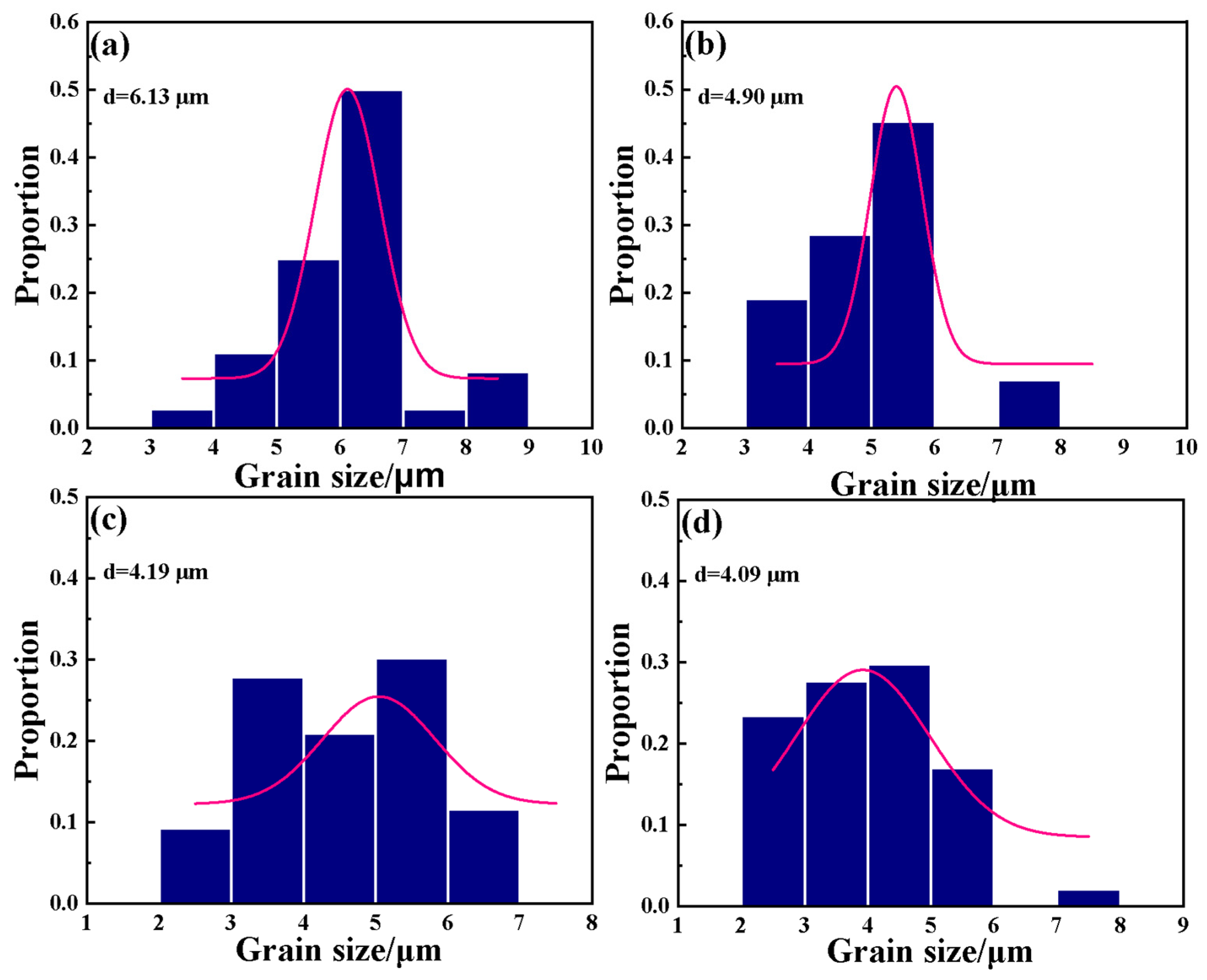
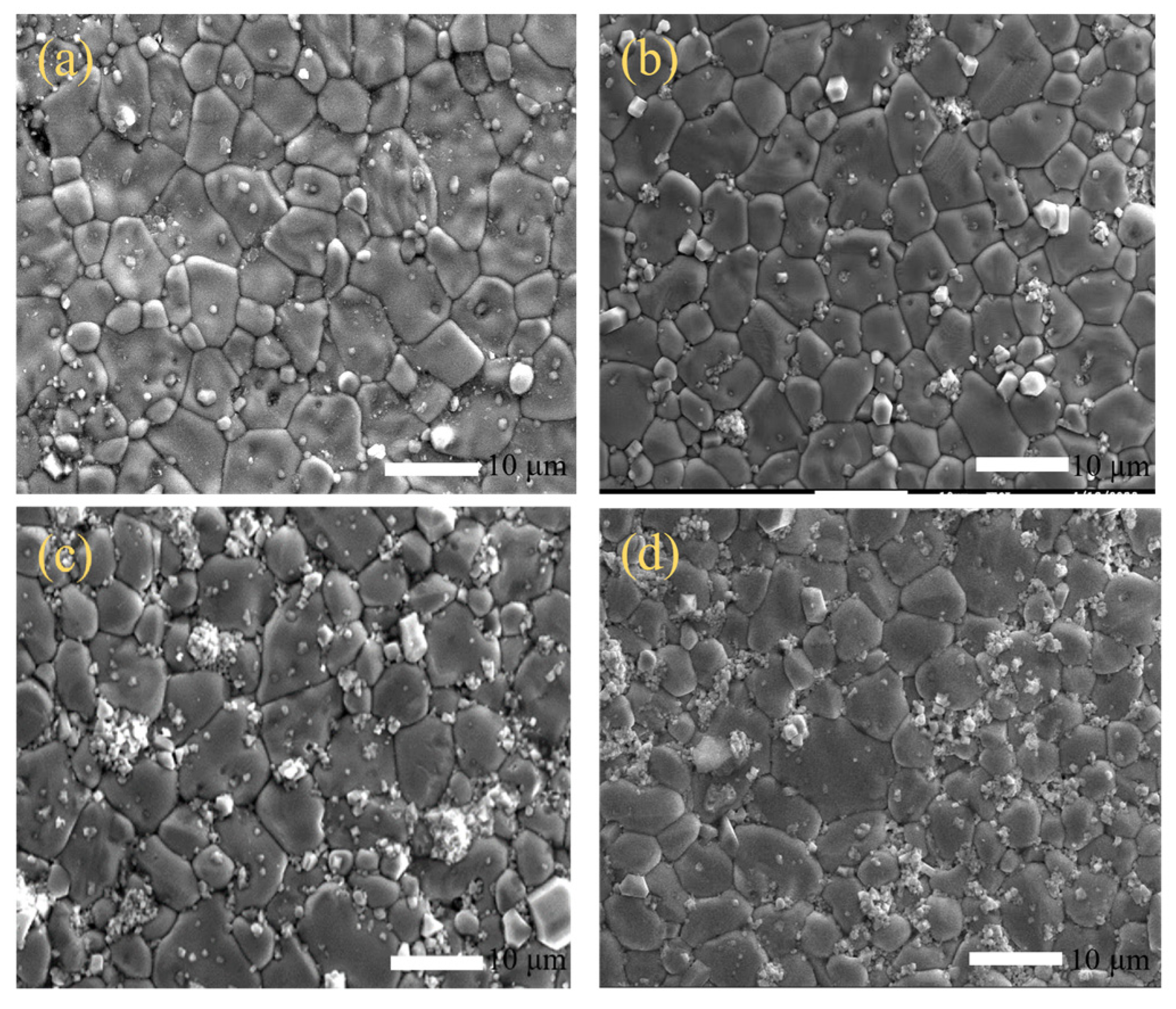
Figure 2 displays FESEM images of varistor ceramics with varying BiSbO4 additions. The figure reveals that when BiSbO4 is not added to the varistor ceramic formulation, only a small number of secondary phases appear in the ceramic samples. This is primarily because Bi and Sb elements are essential components of spinel in secondary phases, and without these elements, spinel formation is difficult [34]. As the BiSbO4 content increases, the number of secondary phases around ZnO grain boundaries gradually increases, and the size of ZnO grains gradually decreases. To determine the average ZnO grain size, the size distribution of 100 ZnO grains across different regions was calculated (Figure 3). The average grain sizes for various samples are shown in Table 2. The ZnO grain size distribution reveals that the d value decreased from 6.13 μm to 4.09 μm with increasing BiSbO4 doping concentration. Additionally, the distribution range of ZnO grain sizes narrowed with increasing doping content. At a 3% addition, ZnO grains were predominantly distributed uniformly between 2 and 6 μm, indicating enhanced grain size uniformity. This is primarily because the addition of BiSbO4 promotes the formation of Zn2.33Sb0.67O4 spinels. These spinels distribute along grain boundaries, creating a “pinning effect” that inhibits grain growth and enhances grain uniformity. The uniform grain distribution of the ZnO varistor ceramic facilitates a more even internal current distribution, thereby improving both the energy absorption capacity under high currents and the voltage gradient [35].
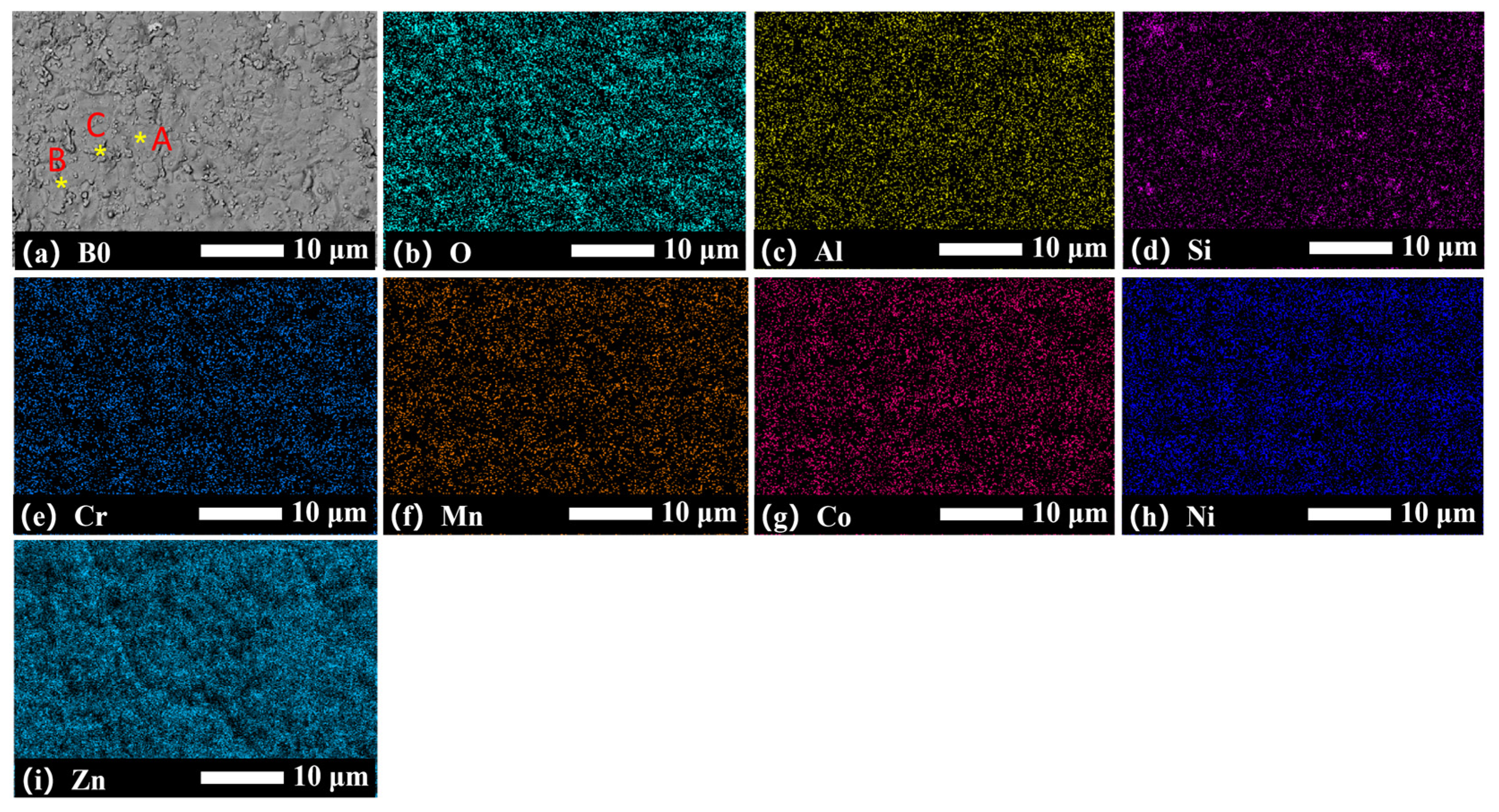
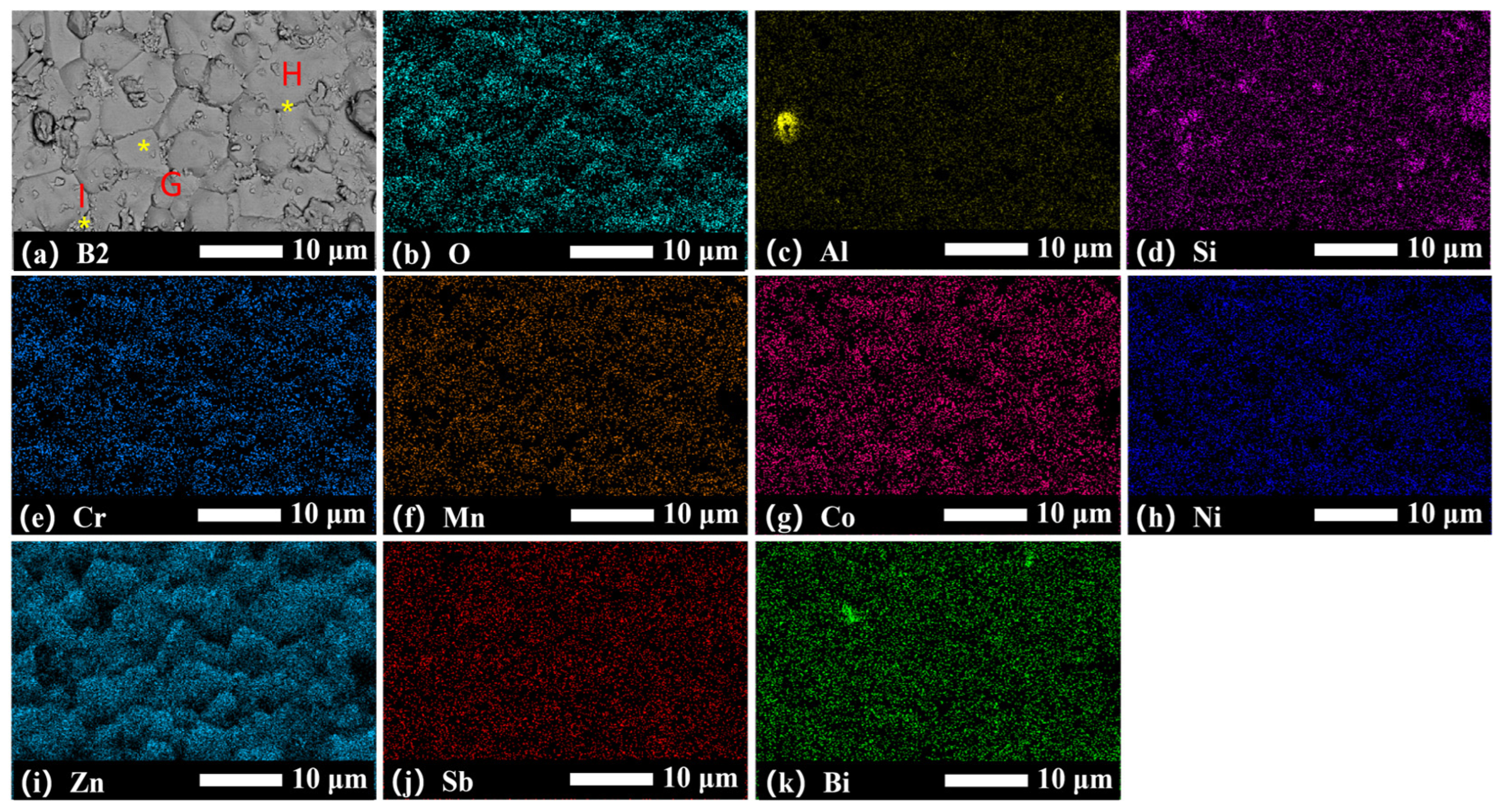
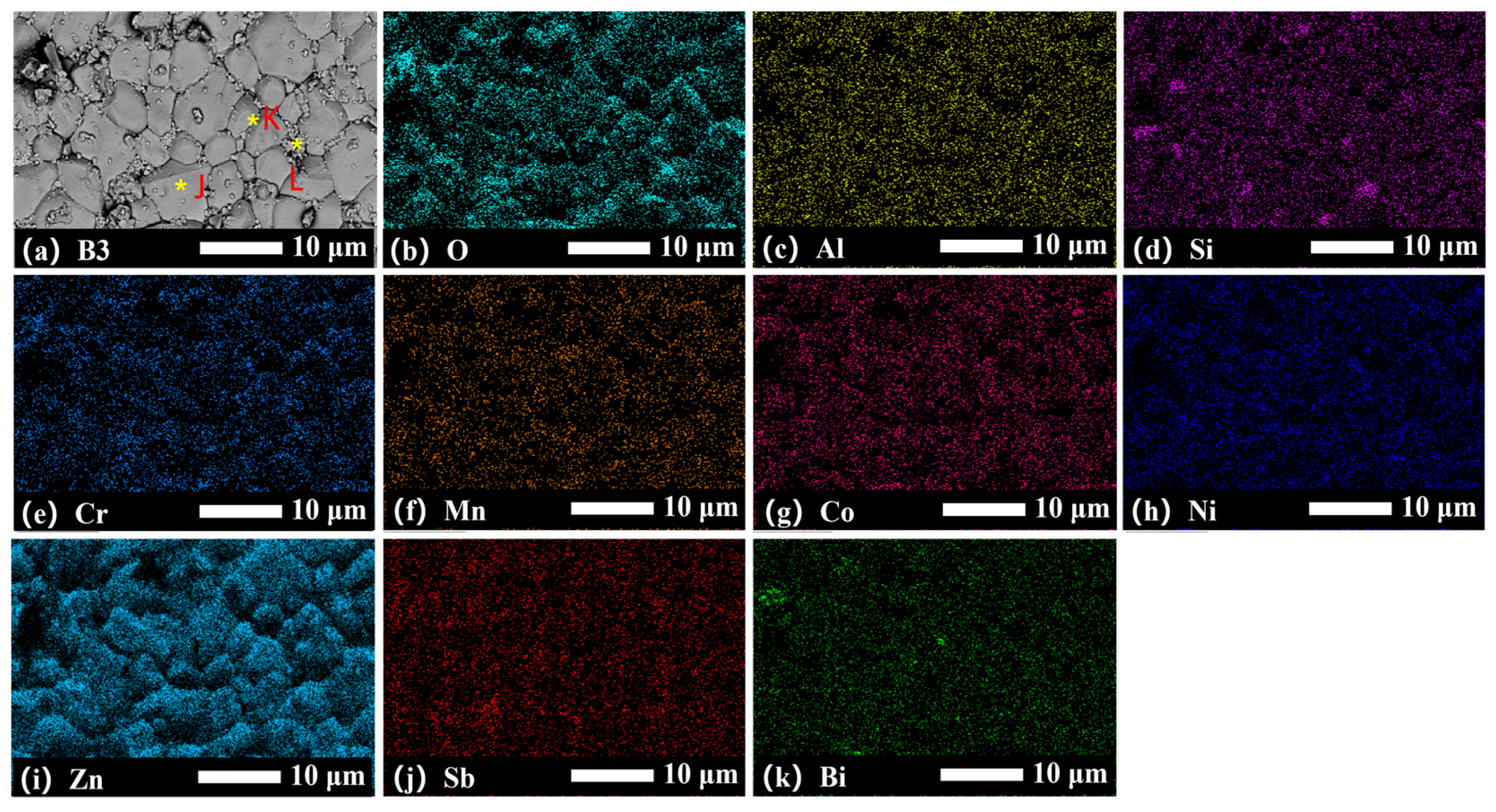
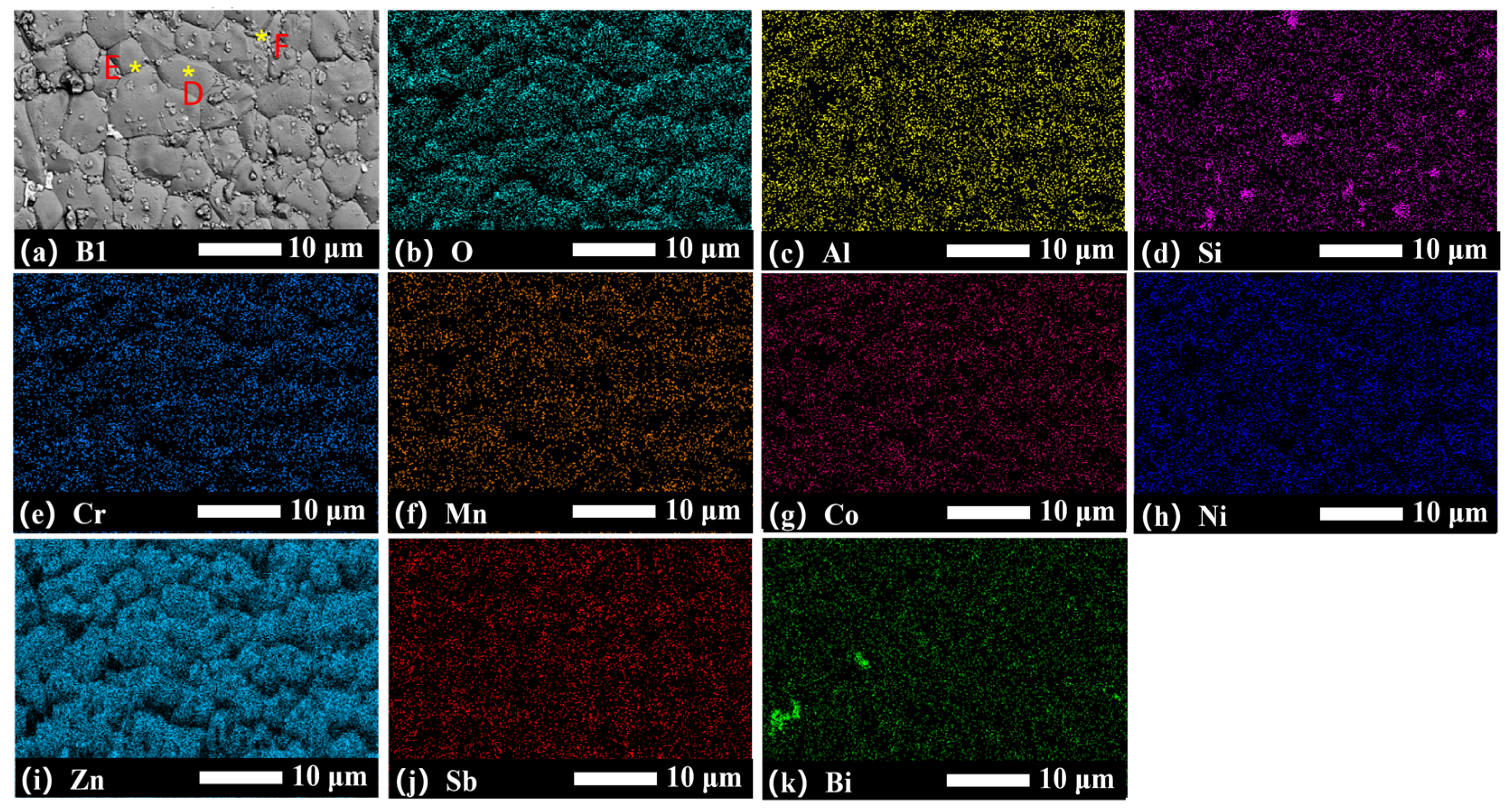
The elemental distribution in the grains, grain boundaries, and secondary phases of ZnO varistor samples was investigated by performing EDS elemental analysis on the samples. The results indicate that the primary elements in the ZnO grains are Zn and O, while additives such as Bi, Sb, Co, Mn, and Ni are present in large quantities in the triangular regions and in small amounts at the grain boundaries. The elemental concentrations at different locations within the samples are shown in Figure 4, Figure 5, Figure 6 and Figure 7. It can be seen that the Zn2.33Sb0.67O4 phase and the Bi2O3-rich phase are primarily located at grain boundaries, where they inhibit the growth of ZnO grains and increase the potential gradient. The overall elemental composition is shown in Table 3, and the elemental distribution in ZnO grains (A, D, G, J), grain boundaries (B, E, H, K) and triangular zones (C, F, I, L) is shown in Table 4.
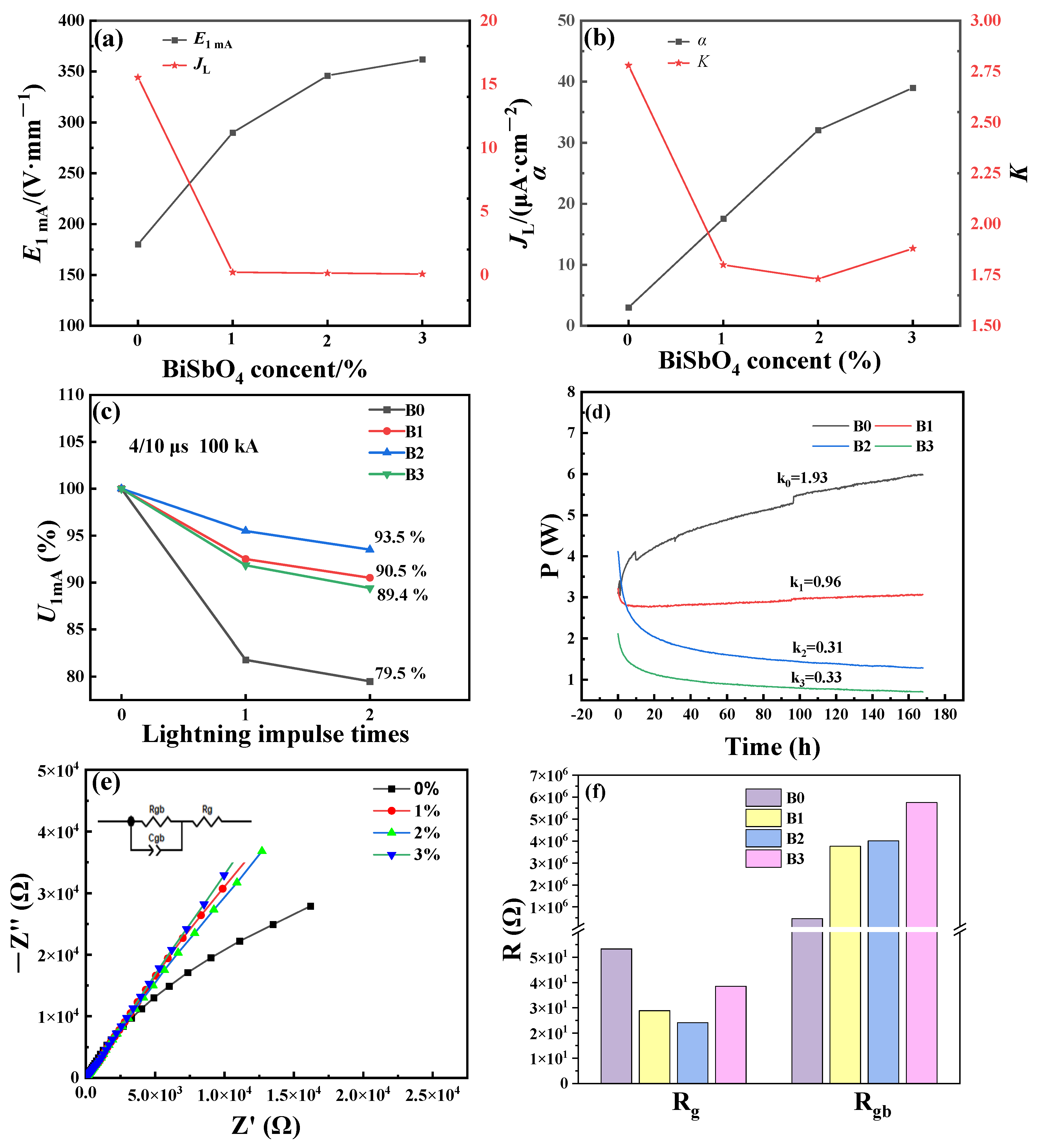
Figure 8 shows the effect of different BiSbO4 doping levels on the electrical properties of the varistor ceramics. Figure 8a presents the voltage gradient versus leakage current variation curves for the samples. The figure indicates that the voltage gradient of the ZnO varistor ceramic samples gradually increases with rising BiSbO4 doping levels. This phenomenon primarily stems from the formation of secondary phases during BiSbO4 addition, which suppresses ZnO grain growth. Smaller ZnO grains result in higher voltage gradients. Without BiSbO4 addition, the varistor exhibits a high leakage current of 15.53 μA·cm−2. When BiSbO4 content reaches 1%, leakage current significantly decreases to 0.21 μA·cm−2 and continues to reduce with further increases in BiSbO4 content. This indicates that BiSbO4 addition enhances grain boundary resistance and stabilizes the grain boundary layer.
Figure 8b shows the variation curves of the nonlinear coefficient and residual voltage ratio for the varistor samples. As the BiSbO4 doping concentration increases, the nonlinear coefficient of the varistor gradually rises from 3 to 39, indicating that BiSbO4 addition significantly enhances the nonlinearity of the varistor. The residual voltage ratio first decreases and then increases. At a BiSbO4 doping level of 2%, the residual voltage ratio of the varistor reaches its minimum value of 1.73, exhibiting superior overall electrical performance at this point. The reduction in residual voltage ratio coupled with the increase in nonlinear coefficient will enhance the protection level during application, thereby improving the operational safety of surge arresters in power lines. After two 100 kA lightning current tests on the varistor samples at a 4/10 μs lightning waveform, the lightning impulse stability curve is shown in Figure 8c. The figure indicates that as the BiSbO4 doping level increases, the lightning impulse stability of the varistor ceramic first increases and then decreases. At a 2% doping level, the U1mA value remains at 93.5% of its original value after withstanding two 100 kA lightning current impacts. thus indicating that BiSbO4 addition can enhance the stability of the varistor to a certain extent. Figure 8d shows the aging curves of different ZnO varistor ceramic samples at 135 °C. The power consumption of sample B0 (without BiSbO4 doping) gradually increases with extended operating time; that of sample B1 first rises and then declines; while the power consumption of samples B2 and B3 progressively decreases over time. The aging coefficients for samples B0, B1, B2, and B3 are 1.93, 0.96, 0.31, and 0.33, respectively. Figure 8e presents the equivalent circuit diagram and impedance characteristic curve from the varistor impedance test. The data shows that the grain boundary resistance of varistors gradually increases, while the grain resistance first decreases and then increases. The specific values of grain resistance and grain boundary resistance are shown in Figure 8f. This behavior aligns with the reduced residual voltage ratio and decreased leakage current observed during electrical performance testing, demonstrating excellent application potential.
To investigate the influence of the microstructure of varistors on their electrical properties, the barrier height (ΦB), barrier width (ω), donor concentration (Nd), and interface state (Ns) of varistors were calculated based on the grain boundary defect model established by Gupta and Carlson [6,36]. The calculation equations are expressed as follows:
J = A T 2 e x p β E 1 2 Φ B K T
ω = 1 β 2 n 2 e 3 4 π ε 0 ε r
N d = 2 Φ B ε 0 ε r e 2 ω 2
N s = N d ω
where A, K, and T represent the Richardson constant, the Boltzmann constant, and the absolute temperature, respectively. ΦB can be calculated using Equation (4). εr and ε0 are the vacuum permittivity and the relative permittivity of ZnO, respectively. e is the electron charge. n is the number of grains per unit length. ω, Nd, and Ns are calculated from Equations (1)–(4), respectively. The measured data for the barrier height (ΦB), barrier width (ω), donor concentration (Nd), and interface state density (Ns) are summarized in Table 5. As the BiSbO4 doping concentration increases, the barrier height, donor concentration, and interfacial state density gradually increase, while the barrier width first decreases and then increases; among these, sample B2 exhibits the smallest barrier width. Increasing the BiSbO4 doping concentration allows more Bi and Sb to enter the grains and grain boundaries, thereby gradually increasing the donor concentration and the density of interface states. At the same time, the formation of a large amount of spinel phase at the grain boundaries increases the barrier height, which in turn causes the voltage gradient to increase with increasing BiSbO4 doping. The barrier width, however, may be related to the nonlinearity and stability of the ZnO varistor.

4. Discussion

In this study, high-purity BiSbO4 material was prepared by calcining a 0.6:1 (molar ratio) mixture of Bi2O3 and Sb2O3 at 700 °C. Unlike the equimolar mixing scheme commonly used in existing studies, this experiment employed a design with an excess of Sb2O3 to compensate for the significant volatilization of Sb components at the calcination temperature, thereby effectively ensuring the formation of pure-phase BiSbO4 and eliminating residual impurity phases [1]. Based on this foundation, this study systematically investigated the effects of different doping concentrations of BiSbO4 on the microstructure and electrical properties of ZnO varistors. Experiments demonstrated that as the doping concentration of BiSbO4 increased from 0 wt% to 3 wt%, the electrical performance of the ZnO varistors continued to improve: the potential gradient and nonlinearity coefficient gradually increased, the leakage current decreased significantly, and the residual voltage ratio exhibited a trend of first decreasing and then increasing.
At present, most existing studies on high-gradient ZnO varistor ceramics focus on doping with rare-earth metal oxides [31,37]. Differently, the present work adopts BiSbO4 pre-synthesized from conventional raw oxides without introducing any extra foreign elements. This strategy improves the voltage gradient of ZnO varistors without deteriorating other critical electrical parameters, providing an alternative route for developing high-gradient varistor ceramics and showing practical application prospects in overvoltage protection of power systems. For further investigation, subsequent work can optimize the calcination parameters of BiSbO4 to further restrain the high-temperature volatilization of Bi and Sb. Moreover, the synergistic modification effect via co-doping of pre-synthesized BiSbO4 and rare-earth oxides can be explored to further enhance the overall electrical performance and operational reliability of varistor ceramics.

5. Conclusions

Using a solid-state method, BiSbO4-doped ZnO varistor ceramics were prepared, and the effects of BiSbO4 doping concentration on the microstructure and electrical properties of the ZnO varistor ceramics were investigated. Results indicate that BiSbO4 addition generates the Zn2.33Sb0.67O4 phase, which is predominantly distributed at grain boundaries. This phase suppresses ZnO grain growth via a pinning effect, thereby increasing the voltage gradient. At the optimal doping ratio of 2% BiSbO4, the voltage gradient E1mA increased from 180 V/mm to 346 V·mm−1, the nonlinear coefficient α rose from 3 to 32, and leakage current decreased to 0.14 μA·cm−2. The successful fabrication of high-gradient ZnO varistor ceramics with outstanding comprehensive properties provides new insights for developing high-performance ZnO varistor ceramics.

Author Contributions

Writing—original draft, J.H.; Methodology, J.H. and Y.T.; Investigation, J.H.; Formal analysis, J.H.; Data curation, J.H.; Project administration, Y.T.; Validation, Y.T.; Software, Y.T.; Supervision, H.H.; Conceptualization, H.H.; Funding acquisition, H.H. and Y.G.; Writing–review and editing, Y.G.; Resources, Y.G. All authors have read and agreed to the published version of the manuscript.

Funding

The Henan Provincial Science and Technology Research and Development Joint Fund (245101610042) and the Henan Provincial Key Research and Development Special Project (251111240200).

Data Availability Statement

Data will be made available on request.

Acknowledgments

The authors acknowledge financial support from the Henan Provincial Science and Technology Research and Development Joint Fund (245101610042) and the Henan Provincial Key Research and Development Special Project (251111240200) for this work.

Conflicts of Interest

Authors Junyi Huang, Yuansheng Tu and Hai Huang ware employed by the company Nanyang Jinniu Electrical Co., Ltd. The remaining authors declare that the research was conducted in the absence of any commercial or financial relationships that could be construed as a potential conflict of interest.

References

  1. Xu, B.; Wang, L.; Yang, M.F.; Xiang, Y.; Liu, L.Y. Effect of Co-doping of Al3+, In3+, and Y3+ on the electrical properties of zinc oxide varistors under pre-synthesizing BiSbO4. Materials 2024, 17, 1401. [Google Scholar] [CrossRef] [PubMed]
  2. Xiao, X.Y.; Lu, Z.J.; Yang, L.J. Unipolar impulse ageing characteristics and non-uniform ageing mechanism of zinc oxide varistors. Electr. Power Syst. Res. 2026, 255, 112740. [Google Scholar] [CrossRef]
  3. Lin, W.W.; Xu, Z.J.; Wang, Z.H.; Yang, J.H.; Zhu, C.X.; Chu, R.Q. Influence of Bi3Zn2Sb3O14 pre-synthesis phase on electrical properties of the ZnO-Bi2O3 based varistor ceramics. J. Alloys Compd. 2020, 834, 155070. [Google Scholar] [CrossRef]
  4. Cui, F.F.; Bai, H.R.; Hu, R.; Ren, Z.K.; Xu, Z.J.; Qiao, Z.H. Fabricating luminescent functionalized ZnO-Bi2O3-based varistor ceramics through Er3+ pre-introduction. Ceram. Int. 2025, 51, 59871–59877. [Google Scholar] [CrossRef]
  5. Grigoraș, G.; Raboaca, M.S.; Dumitrescu, C.; Manea, D.L.; Mihaltan, T.C.; Niculescu, V.-C.; Neagu, B.C. Contributions to power grid system analysis based on clustering techniques. Sensors 2023, 23, 1895. [Google Scholar] [CrossRef]
  6. Roy, T.K. Grain growth kinetics microhardness and nonlinear electrical properties of ZnO-V2O5-Nb2O5 varistor ceramics. Solid State Commun. 2026, 409, 116295. [Google Scholar] [CrossRef]
  7. Liu, J.K.; Liang, X.C.; Cao, W.B.; Xu, H.P.; Zheng, X.Q. Effect of NiO doping on microstructure and electrical properties of ZAMTS linear resistive ceramics. Ceram. Int. 2025, 51, 55000–55010. [Google Scholar] [CrossRef]
  8. Arafat, E.; Ghassemi, M. Shielding failure analysis of extra high voltage unconventional transmission lines with increased power delivery capability. Sci. Rep. 2025, 15, 29247. [Google Scholar] [CrossRef]
  9. Trung, H.N.; Van, T.N.; Thi, K.; Hong, C.T.; Thi, X.N.; Nguyen, T.A.; Nguyen, T.A.; Dai, L.T.; Van, C.T.; Van, D.L. Tailoring morphological and electrical properties of nanoplate-ZnO varistors via sintering temperature. RSC Adv. 2025, 15, 19546–20354. [Google Scholar] [CrossRef]
  10. Zhu, Y.F.; Gui, Y.H.; Tu, Y.S.; Huang, H.; Zhao, S.S. Effect of Y2O3 and CeO2 co-doping on microstructure and electrical properties of ZnO-Bi2O3-based varistors. Ceram. Int. 2025, 51, 31646–31655. [Google Scholar] [CrossRef]
  11. Guo, M.; Orr, G.; Lan, P.; Zhao, X.; Glasser, S.; Ishai, P.B. Defect dynamics in ZnO varistors under electrical stress: A potential method to improve electrical properties. J. Eur. Ceram. Soc. 2025, 45, 117159. [Google Scholar] [CrossRef]
  12. Meng, P.; Yuan, C.; Xu, H.; Wan, S.; Xie, Q.; He, J.; Zhao, H.; Hua, J.; He, J. Improving the protective effect of surge arresters by optimizing the electrical property of ZnO varistors. Electr. Power Syst. Res. 2020, 178, 106041. [Google Scholar] [CrossRef]
  13. Begum, S.; Karim, A.N.M.; Fawzia, S.; Hashmi, M.S.J. Alternative process and design opportunities for ZnO-based surge arrester: An investigation oriented roadmap. Encycl. Mater. Electron. 2023, 3, 464–483. [Google Scholar] [CrossRef]
  14. Shu, H.; Lou, W.; Tang, Y.; Yang, Z.; Ha, Y. Research study on the multi-strike energy model and control strategy optimization of controllable arrester. Electr. Power Syst. Res. 2025, 241, 111349. [Google Scholar] [CrossRef]
  15. Sakoda, T.; Kub, K.; Mizutani, M.; Chiba, T.; Kasuga, Y.; Fukano, T. Influence of impulse Corona discharge on discharge time lag of a surge arrester with a spark gap. J. Electrost. 2023, 121, 103783. [Google Scholar] [CrossRef]
  16. Xiao, Y.J.; Yang, Y.; Kang, S.L.; Li, Y.C.; Hou, X.Y.; Ren, C.J.; Wang, X.L.; Zhao, X.T. Cold-sintered ZnO ceramic composites Co-doped with polytetrafluoroethylene and oxides. Molecules 2024, 29, 129. [Google Scholar] [CrossRef]
  17. Malaoui, Y.; Kharchouche, F.; Sari, B.; Bernik, S. Optimization of dopants proportions in Bi2O3 doped ZnO-based varistor using neural networks technique for enhanced non-linear coefficient and performance. Ceram. Int. 2025, 51, 48618–48632. [Google Scholar] [CrossRef]
  18. Tian, T.; Zhang, F.; Bernik, S.; Li, G.R.; Ruan, X.Z.; Zheng, L.Y. Fabrication of high-breakdown-voltage Sb2O3-doped ZnO-Cr2O3-based varistors using different sintering temperatures. J. Alloys Compd. 2025, 1039, 182890. [Google Scholar] [CrossRef]
  19. Wang, Q.; Zhao, X.T.; Xiao, Y.J.; Li, Y.C.; Kang, S.L.; Guo, J.; Wu, K.N.; Wang, X.L.; Li, J.Y.; Yang, L.J.; et al. Cold sintering of large-sized ZnO varistor ceramics: Unlocking superior non-ohmic behavior and breakdown strength via targeted thermal treatment. Rare Met. 2025, 44, 8979–8994. [Google Scholar] [CrossRef]
  20. Yan, P.; Si, M.; Liu, Y.; Ren, Y.; Ding, Q.; Jiang, W.; Fan, Y.; Jiang, W. Large internal stress induced nonlinear current-voltage behavior in nanodiamond strengthened ZnO ceramics. Nat. Commun. 2024, 15, 9812. [Google Scholar] [CrossRef]
  21. Wang, Y.; Hou, Z.; Li, J.; Wu, K.; Song, J.; Chen, R.; Li, K.; Hao, L.; Xu, C. Simultaneously enhanced potential gradient and nonlinearity of ZnO varistor ceramics by MnO doping with nano-sized ZnO powders. Materials 2021, 14, 7748. [Google Scholar] [CrossRef]
  22. Abdullah, W.R.W.; Zakaria, A.; Ghazali, M.S.M. Synthesis mechanism of low-voltage praseodymium oxide doped zinc oxide varistor ceramics prepared through modified citrate gel coating. Int. J. Mol. Sci. 2012, 13, 5278–5289. [Google Scholar] [CrossRef]
  23. Lungu, M.V. Effects of dopants and processing parameters on the properties of ZnO-V2O5-based varistors prepared by powder metallurgy: A Review. Materials 2023, 16, 3725. [Google Scholar] [CrossRef] [PubMed]
  24. Abdollahi, Y.; Zakaria, A.; Aziz, R.S.; Tamili, S.N.A.; Matori, K.A.; Shahrani, N.M.M.; Sidek, N.M.; Dorraj, M.; Abdollahi, S.M. Optimizing Bi2O3 and TiO2 to achieve the maximum non-linear electrical property of ZnO low voltage varistor. BMC Chem. 2013, 7, 137. [Google Scholar] [CrossRef]
  25. Yang, W.; Peng, Z.; Qi, W.; Wang, C.; Fu, X. High-performance varistors simply by hot-dipping zinc oxide thin films in Pr6O11: Influence of temperature. Sci. Rep. 2017, 7, 41994. [Google Scholar] [CrossRef]
  26. Mendes, M.R.; Fernades, I.J.; Moraes, C.A.M.; Santos, L.A.L.; Almeida, W.L.; Sousa, V.C. Microstructural and electrical properties of the ZnO-Bi2O3-MnO2 system doped with silica obtained from rice husk ash. Ceram. Int. 2025, 51, 9398–9411. [Google Scholar] [CrossRef]
  27. Tian, T.; Zheng, L.; Podlogar, M.; Zeng, H.; Li, G. Novel ultrahigh-performance ZnO-based varistor ceramics. ACS Appl. Mater. Interfaces 2021, 13, 35924–35929. [Google Scholar] [CrossRef]
  28. Xie, P.; Wang, Z.; Wu, K. Evolution of intrinsic and extrinsic electron traps at grain boundary during sintering ZnO based varistor ceramics. Materials 2022, 15, 1098. [Google Scholar] [CrossRef]
  29. Meng, P.F.; Yin, Y.; Wang, L.; Guo, J.K.; Li, Z.; Zhou, K.; Zhu, G.Y.; Xu, Y.F. Analysis of the failure mechanism of ZnO varistors influenced by high-resistance media based on multi-field coupling simulation. High Volt. 2025, 10, 673–679. [Google Scholar] [CrossRef]
  30. Palos, C.M.M.; Pech-Canul, M.I.; Hernández, M.B.; Cienfuegos-Pelaes, R.F.; Aguilar-Martínez, J.A. Impact of the particle size on the non-ohmic properties of doped ZnO ceramic varistor materials synthesized via mechanosynthesis. Ceram. Int. 2025, 51, 3559–3567. [Google Scholar] [CrossRef]
  31. Liu, J.K.; Zheng, X.Q.; Cao, W.B.; Xu, H.P.; Liang, X.C. Effect of SrCO3 doping on the microstructure and electrical properties of ZnO-Pr6O11-Co2O3-La2O3-based varistors. Ceram. Int. 2026, 52, 4331–4342. [Google Scholar] [CrossRef]
  32. Cao, W.B.; Xu, H.P.; Liu, J.K.; Li, W.T.; Gou, C.Y.; Ren, B.; Zheng, X.Q.; Liang, X.C.; Wang, X.Y.; Zhang, X.H. Preparation and electrical properties of Er2O3-doped ZnO-Cr2O3-SrCO3-based varistors with low leakage current density and high aging resistance. Ceram. Int. 2025, 51, 49602–49611. [Google Scholar] [CrossRef]
  33. Cui, W.Z.; Zhao, M.; Chen, M.M.; Liu, Z.C.; Chen, H.; Deng, L.B. Effect of Mn on the ZnBiMnO varistor ceramics sintered at a low-temperature of 875 °C. Ceram. Int. 2024, 50, 7597–7604. [Google Scholar] [CrossRef]
  34. Shen, Y.M.; Len, M.C.; Hsiang, H.I. Effect of pre-calcination of Bi2O3 and Sb2O3 on the densification and varistor properties of low-temperature sintered ZnO-Bi2O3 ceramics. J. Mater. Sci. Mater. Electron. 2023, 34, 1750. [Google Scholar] [CrossRef]
  35. Hsiang, H.I.; Chen, C.C.; Kao, C.C. Effect of ZnBi2O4 and Bi2O3 addition on the densification, microstructure, and varistor properties of ZnO varistors. Ceram. Int. 2023, 49, 2244–2249. [Google Scholar] [CrossRef]
  36. Roy, S.; Das, D.; Roy, T.K. Two stage sintering behaviour of Er2O3 doped high performance ZnO varistors. J. Eur. Ceram. Soc. 2021, 41, 5184–5192. [Google Scholar] [CrossRef]
  37. Gou, C.Y.; Cao, W.B.; Liu, J.K. Er2O3 doped ZnO-Cr2O3-based varistors with high voltage gradient. Ceram. Int. 2024, 50, 37761–37770. [Google Scholar] [CrossRef]
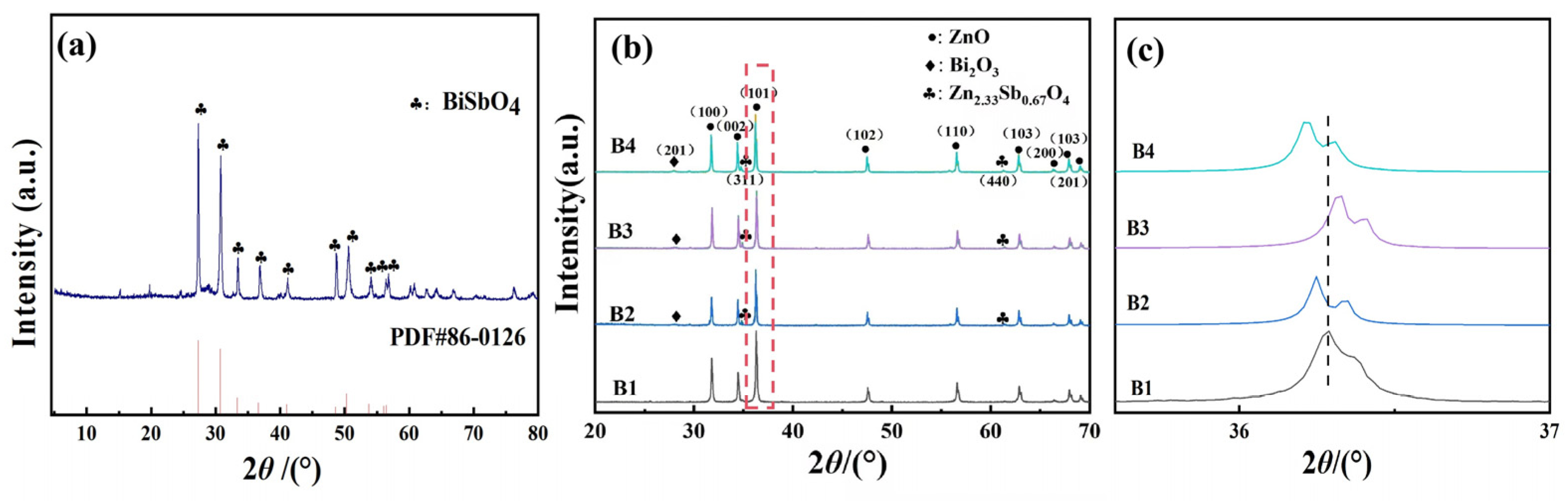
Figure 1. (a) XRD patterns of the synthesized BiSbO4 material; (b) XRD patterns of varistor ceramics with different BiSbO4 additions; (c) the enlarged XRD patterns in 2θ range of 36°~37°.
Electronics 15 02575 g001
Figure 2. FESEM images of varistor ceramics with different BiSbO4 additions (a) B0; (b) B1; (c) B2; (d) B3.
Electronics 15 02575 g002
Figure 3. Grain size distribution diagram of varistor ceramics with different BiSbO4 additions (a) B0; (b) B1; (c) B2; (d) B3.
Electronics 15 02575 g003
Figure 4. (a) FE-SEM diagram and (bi) EDS element distribution diagrams of sample B0. A–C*: EDS point scan.
Electronics 15 02575 g004
Figure 5. (a) FE-SEM diagram and (bk) EDS element distribution diagrams of sample B1. D–F*: EDS point scan.
Electronics 15 02575 g005
Figure 6. (a) FE-SEM diagram and (bk) EDS element distribution diagrams of sample B2. G–I*: EDS point scan.
Electronics 15 02575 g006
Figure 7. (a) FE-SEM diagram and (bk) EDS element distribution diagrams of sample B3. J–L*: EDS point scan.
Electronics 15 02575 g007
Figure 8. Electrical properties of varistor ceramics with different BiSbO4contents (a) voltage gradient E1mA and leakage current JL curves; (b) residual voltage ratio K and nonlinear coefficient α; (c) lightning impact stability; (d) aging curves; (e) equivalent circuit diagram impedance test and impedance curves at different frequencies; (f) grain resistance (Rg) and grain boundary resistance (Rgb).
Electronics 15 02575 g008
Table 1. Phase distribution of samples B1, B2, and B3.
SampleZnO
/wt%
Zn2.33Sb0.67O4/wt%Bi2O3
/wt%
R/%E/%R/E
B196.62.61.119.8713.751.45
B293.94.41.718.5614.451.28
B390.37.81.819.2115.631.23
Table 2. Electrical performance parameters of ZnO varistor ceramics doped with different BiSbO4.
Sampled/μmU0.1mA (kV)U1mA (kV)E1mA
/V·mm−1
JL/
μA·cm−2
αK(U1mA − ΔU1mA)
/U1mA/%
B06.131.473.1618015.5332.7879.5
B14.904.515.122900.21181.890.5
B24.195.756.183460.14321.7393.5
B34.096.106.473620.07391.8889.4
Table 3. Results of the contents of elements in samples B0, B1, B2 and B3.
No.OAlSiCrMnCoNiZnSbBi
B013.640.451.291.431.011.490.9079.79//
B113.510.681.260.590.863.111.1475.902.750.00
B212.690.310.751.150.641.880.0080.331.990.27
B312.650.320.731.421.042.721.4676.042.980.64
Table 4. Results of the element content in points A-L.
No.OAlSiCrMnCoNiZnSbBi
A12.210.170.000.160.380.652.0784.37//
B11.250.220.180.120.310.373.9983.58//
C17.671.112.110.000.001.560.0077.54//
D14.450.090.210.220.221.100.0083.72//
E13.400.200.290.140.801.682.9480.240.310.00
F8.450.140.2225.0910.095.708.3225.7310.166.11
G8.150.180.210.000.000.454.8986.120.000.00
H2.781.690.771.430.0012.660.0076.990.003.69
I21.580.990.796.704.800.902.1944.4817.580.00
J8.980.540.010.000.075.290.0085.110.000.00
K15.154.490.950.000.742.0310.7063.482.470.00
L12.630.920.294.274.243.840.3747.1721.444.84
Table 5. Barrier height (ΦB), barrier width (ω), donor concentration (Nd), and interface state (Ns) of ZnO varistor samples.
No.ΦB/(eV)ω/(nm)Nd/(1026·m−3)Ns/(1017·m−3)
B00.98125.51.410.36
B11.14919.02.990.56
B21.3992.9415.34.48
B31.4952.9915.74.69
Disclaimer/Publisher’s Note: The statements, opinions and data contained in all publications are solely those of the individual author(s) and contributor(s) and not of MDPI and/or the editor(s). MDPI and/or the editor(s) disclaim responsibility for any injury to people or property resulting from any ideas, methods, instructions or products referred to in the content.