Article

Robustness Estimation in TEAM 35 Problem with Interacting Geometric and Current-Density Uncertainties


Department of Propulsion Technology and Power Electronics, Széchenyi István University, 9026 Győr, Hungary
Electronics 2026, 15(12), 2552; https://doi.org/10.3390/electronics15122552 (registering DOI)
Submission received: 12 May 2026 / Revised: 2 June 2026 / Accepted: 5 June 2026 / Published: 9 June 2026

Abstract

This paper revisits Problem A of the TEAM 35 benchmark from the viewpoint of robustness estimation under manufacturing uncertainty. Rather than treating the original extremal-position-based sensitivity metric as the formulation to be improved, it is used only as a baseline for comparison with other metrics. In this work, robustness is evaluated as the largest degradation of the nominal magnetic-field homogeneity objective observed over prescribed sets of admissible manufacturing perturbations. In addition to turn-position uncertainties, the present study also includes uncertainty in the excitation current density. While turn-position errors affect each turn individually, current-density uncertainty affects the error contributions of all turns simultaneously through a common term. This common-mode excitation uncertainty represents an extension of the original benchmark formulation and is one of the paper’s main focal points. Several Design of Experiments (DoE) methodologies, as well as search-based robustness estimation strategies, are compared in terms of error in estimated robustness and computational demand. The results show that the original extremal-position-based approximation can substantially underestimate the sampled robustness of the nominal field-homogeneity objective. Including current-density uncertainty further increases the discrepancy between the original metric and the sampled robustness estimates.

1. Introduction

The Compumag website offers a set of benchmark problems for testing electromagnetic analysis methods (referred to as TEAM problems) [1]. The results of these problems are usually validated either by analytical solutions with a solid theoretical basis or by openly published measurement data. Some of them describe realistic inverse problems, where the goal is to determine the optimal parameters of a superconducting magnetic energy storage system (TEAM 22) [2], a die press model (TEAM 25) [3], or a solenoid (TEAM 35) [4,5]. A common part of these problems is that a computationally intensive numerical model must be solved repeatedly during optimization, making them suitable benchmarks for comparing optimization strategies.
This work focuses on Problem A of the official TEAM 35 benchmark, where the two objectives are field uniformity and an extremal-position-based sensitivity metric related to manufacturing tolerances [5]. The benchmark is formulated for a 20-turn solenoid and, in its original form, exploits symmetry so that only ten turn-radius parameters are optimized. A substantial part of the TEAM 35 literature was shaped by Paolo Di Barba, Maria Evelina Mognaschi, and their co-authors, who introduced the original benchmark formulation and then developed several follow-up directions around the same problem family [4,6,7,8,9]. Since the original benchmark paper [4], TEAM 35 and its close reformulations have been revisited from several directions: improved Pareto-front estimation and expensive multi-objective optimization [6,10,11], time-harmonic and three-objective variants [7,12], full-coil asymmetric evaluation [12], inverse or source-identification formulations based on current synthesis [9,13], and computational acceleration through superposition-based or neural metamodeling ideas [8,14]. Moreover, the broader electromagnetic-design literature has explored a wide spectrum of robust and computationally efficient optimization strategies, including Kriging-assisted robust optimization, surrogate genetic programming, gradient-based worst-case search, hybrid random–interval uncertainty handling, and a range of less conventional metaheuristics such as wind-driven optimization, island-biogeography-inspired search, and social-network-based optimization [15,16,17,18,19,20,21,22,23,24].
Besides the novel optimization strategy benchmarks, several works have also reconsidered the mathematical or computational formulation of the TEAM 35 problem itself. Instead of directly optimizing the turn radii under the original benchmark definition, some authors considered inverse or source-identification variants in which the current distribution is synthesized for fixed positions [9,13]. This line was later connected to broader reviews of machine-learning approaches to inverse problems and optimal design in electromagnetism [25,26]. Other works explored alternative modeling techniques to solve the TEAM 35 problem more efficiently or accurately. These include a semi-analytical solution-based and hp-adaptive finite element solver-based surrogate model approach [14], neural metamodeling approaches [8], and reduced-order modeling strategies that accelerate the optimization workflow while preserving consistency with the full-order finite-element model [27]. Recently, TEAM 35 has also been used as a test case for deep-learning-guided and data-driven optimization strategies [28,29]. Extending the official benchmark problem, adjacent solenoid design papers have also moved toward genuinely three-dimensional field-homogenization problems [30,31]; these papers are methodologically relevant, but they should not be conflated with peer-reviewed reformulations of TEAM 35 itself.
Another line of research was presented in [32], where the impact of different robustness metrics on the obtained solutions was investigated. That study showed that the metric used in the original problem specification, which evaluates sensitivity based on only two extreme perturbation patterns, can yield overly optimistic robustness estimates compared with design-of-experiments (DoE)-based alternatives. This consideration is especially relevant in nonlinear problems, where the largest deterioration of a nominal design does not necessarily occur at the two all-positive and all-negative extremal-position layouts implied by the original metric. However, while the original metric requires only three evaluations of the finite-element-model-based test problem, the alternative methods require significantly more function evaluations. Among them, the central composite design can approximate the reference uncertainty with good accuracy, but it typically requires about one thousand model evaluations, resulting in a high computational cost. In contrast, the primary conclusion of that study was that the Plackett–Burman design can significantly improve the accuracy of uncertainty estimation at a still acceptable numerical cost, requiring only about two to three times more computations than the original metric.
The present paper builds on these observations by focusing on the robustness information provided by the original extremal-position-based metric. This metric is retained as the official TEAM 35 baseline, but its reliability is examined under an extended uncertainty model. Besides the original turn-position tolerances, a bounded perturbation of the excitation current density is also introduced. Unlike turn-wise geometric deviations, this perturbation acts as a common-mode uncertainty source because it affects the field contribution of all turns simultaneously.
The objective is not to replace the original TEAM 35 formulation with a new certified robustness approach but rather to determine under which conditions the extremal-position-based robustness approximation remains informative and when it becomes too optimistic. For this purpose, the original metric is compared with robustness estimates obtained from larger structured and search-based perturbation sets. The current-density perturbation is treated as a simplified global excitation uncertainty, not as a detailed conductor-level current-distribution model.
The analysis is extended in two directions. First, the impact of the common-mode current-density perturbation is evaluated together with the original geometric tolerances. Second, the symmetry constraint is removed in a separate robustness evaluation in order to assess whether asymmetric perturbation patterns change the practical conclusions. The contributions of this paper are threefold: the original extremal-position metric is distinguished from broader perturbation-set-based robustness estimates; the effect of a common-mode excitation-current uncertainty is quantified; and several structured sampling and search-based estimators are compared in terms of their robustness estimates and finite-element evaluation cost.

2. Methodology

2.1. Optimization Problem

The official TEAM 35 benchmark defines two bi-objective formulations for magnetic field optimization in a simple coil. In the present paper, we focus on Problem A, where the first objective ( F 1 ) describes the field uniformity in the control region Ω shown in Figure 1, while the second objective ( F 2 ) quantifies sensitivity to manufacturing uncertainties. The original formulation serves here as the benchmark baseline against which alternative sampled robustness estimators are assessed.
The required absolute value of the homogeneous magnetic flux density in the controlled zone is 2 mT, with a width of 5 mm and a height of 10 mm. The field is generated by a solenoid consisting of 20 turns. Each turn has the same rectangular cross-section, with a width of 1.0 mm and a height of 1.5 mm. The turns are connected in series; therefore, the current density is set to 3.0 A/ mm 2 during the simulations.
The original TEAM 35 problem exploits the geometry’s symmetry. Only the upper half of the geometry is modeled, and the radii of the ten upper turns are optimized. In this case, the z-axis is assigned a Neumann boundary condition, while the other outer edges of the geometry are prescribed by a Dirichlet boundary condition ( A = 0 ).
Finite-element model and numerical implementation. The direct electromagnetic problem is solved here by a two-dimensional axisymmetric, linear magnetostatic finite-element model, consistently with the standard TEAM 35 formulation and with earlier implementations reported for the same benchmark family [4,5,14,27]. In this setting, the current-carrying turns are represented in the meridional cross-section, and the field solution is obtained from the magnetic vector potential formulation. Using the usual magnetostatic assumptions, the governing boundary-value problem can be written as
× ν × A = J ,
where ν = 1 / μ denotes the magnetic reluctivity, A is the magnetic vector potential, and  J is the impressed current density [5,14]. Since the present benchmark is treated as an air-core, linear magnetostatic problem, μ = μ 0 holds in the computational domain, and the above expression reduces to
× × A = μ 0 J .
After solving for A , the magnetic flux density is evaluated in post-processing as
B = × A .
Agros Suite addresses this formulation on a two-dimensional meridional section within an axisymmetric plane. The optimization workflow and repeated robustness evaluations are implemented in Python v.3.8 using the Artap interface [14,27].
Agros Suite and Artap are open-source finite-element environments developed at the University of West Bohemia. Its core utilizes hp-adaptive solvers based on the deal.II finite-element library [33,34,35]. In this study, the two-dimensional axisymmetric magnetostatic solver was employed to address the TEAM 35 field problem. Robustness estimation and the optimization workflow were conducted in Python using the Artap interface. All software dependencies and package versions required to reproduce the simulations, including Agros Suite and Artap, are specified in the pyproject.toml file and related configuration files in the public project repository. The finite-element model, optimization workflow, and post-processing scripts utilized for these results are available in the project repository at https://github.com/tamasorosz/TEAM35-DOE (accessed on 4 June 2026).
The field uniformity is evaluated from the magnetic flux density values calculated at n = i · j measurement points in Ω :
F 1 = sup k = 1 , , n | B k | B 0 ,
where B 0 = 2 mT is the target field value. In the present study, the control region is divided into n = 100 measurement points, with i = 10 horizontal and j = 10 vertical subdivisions.
In the original problem formulation, robustness is calculated from two extreme layouts, where all positional errors ( Δ x = 0.5 mm) are added to the nominal turn positions either with a positive or a negative sign:
F 2 = max j = 1 , , 100 B j + B j + B j B j .
where B + and B denote the magnetic flux density values at the measurement points for the two extremal perturbed layouts. In the original TEAM 35 formulation, F 2 is an extremal-position-based robustness approximation. It is evaluated from two prescribed perturbation layouts, in which all turn-position deviations are applied either with a positive or with a negative sign. In the following, the term “extremal-position approximation” denotes this original two-layout metric, whereas “sampled robustness estimate” denotes the maximum objective-value variation observed over a prescribed set of admissible perturbations.

2.2. Manufacturing Uncertainty Estimation

The main purpose of this study is not only to solve the original optimization problem but also to evaluate the largest change of the field-homogeneity objective caused by admissible manufacturing uncertainties. For a fixed nominal layout, the nominal field-homogeneity objective is first computed as F 1 ( r , J 0 ) . Perturbed layouts are then generated by modifying the turn positions and, in the extended case, the excitation current density. The robustness estimate is obtained as the largest objective variation observed over the perturbation set generated by the selected sampling or search strategy.
Let δ q denote one sampled vector of turn-position deviations, and let Δ J q denote the corresponding current-density perturbation. The perturbed objective value is written as
F 1 , q = F 1 ( r + δ q , J 0 + Δ J q ) .
For a given sampling or search strategy m, the sampled worst-case robustness estimate is defined as
F ^ 2 , m ( r ) = max q S m F 1 ( r + δ q , J 0 + Δ J q ) F 1 ( r , J 0 ) ,
where S m is the perturbation set generated by the corresponding method, such as the extremal-position approximation, PB, BB, CCD, Sobol sampling, or the NSGA-II-based search baseline. In the original geometric-only case, Δ J q = 0 for all samples.
The estimate above depends on the chosen perturbation set S m . It represents the largest objective variation identified by the selected sampling or search strategy, not a certified global bound over the full uncertainty domain. Consequently, the largest observed degradation does not necessarily correspond to the all-positive or all-negative extremal-position layouts used in the original benchmark metric. In nonlinear problems, mixed positive and negative turn deviations may produce a larger deterioration of the nominal field-homogeneity objective than these two prescribed layouts.
If a discrete uncertainty model is assumed, each turn can be displaced by 0.5 mm, 0 mm, or + 0.5 mm. The geometric tolerance of ± 0.5 mm follows the original TEAM 35 Problem A specification and is therefore retained here to keep the results comparable with the benchmark formulation. The current-density perturbation is not part of the original benchmark; it is introduced as an additional parametric excitation uncertainty. In the simulations, the perturbation range is Δ J [ 0.05 , + 0.05 ] A/ mm 2 , which corresponds to approximately ± 1.67 % of the nominal value J 0 = 3 A/ mm 2 . This value is not claimed to represent a universal manufacturing tolerance but is used to study the effect of a small common-mode excitation uncertainty on the robustness estimates. The three-level discrete representation used by the DoE methods is an approximation of the admissible uncertainty domain. It may miss critical intermediate perturbation combinations, especially if the largest degradation occurs away from the prescribed levels. For this reason, the reported DoE values are interpreted as sampled robustness estimates rather than certified global robustness bounds. In the ten-parameter formulation, this leads to 3 10 = 59 , 049 possible combinations, which makes exhaustive evaluation impractical in an optimization workflow. For this reason, several approximate robustness estimation strategies are considered in this paper: Box–Behnken (BB), Plackett–Burman (PB), Central Composite Design (CCD), a Sobol-sequence-based quasi-random approach, and an NSGA-II-based search.
The original robustness metric must be modified when the uncertainty of the excitation current density is also taken into account. In that case, four extremal layouts are evaluated instead of two because the positive and negative current-density perturbations must be combined with the positive and negative extremal positional perturbations.
In the extended case, the turn-position uncertainties of the original TEAM 35 tolerance model are retained, and the current-density uncertainty is added as an additional scalar excitation perturbation. Thus, the extended model combines turn-wise geometric deviations with a common-mode perturbation of the imposed current density. This current-density perturbation is not intended to represent a detailed spatial current-distribution model inside the conductors; it is used to examine how a global excitation-related uncertainty source affects the robustness estimates.
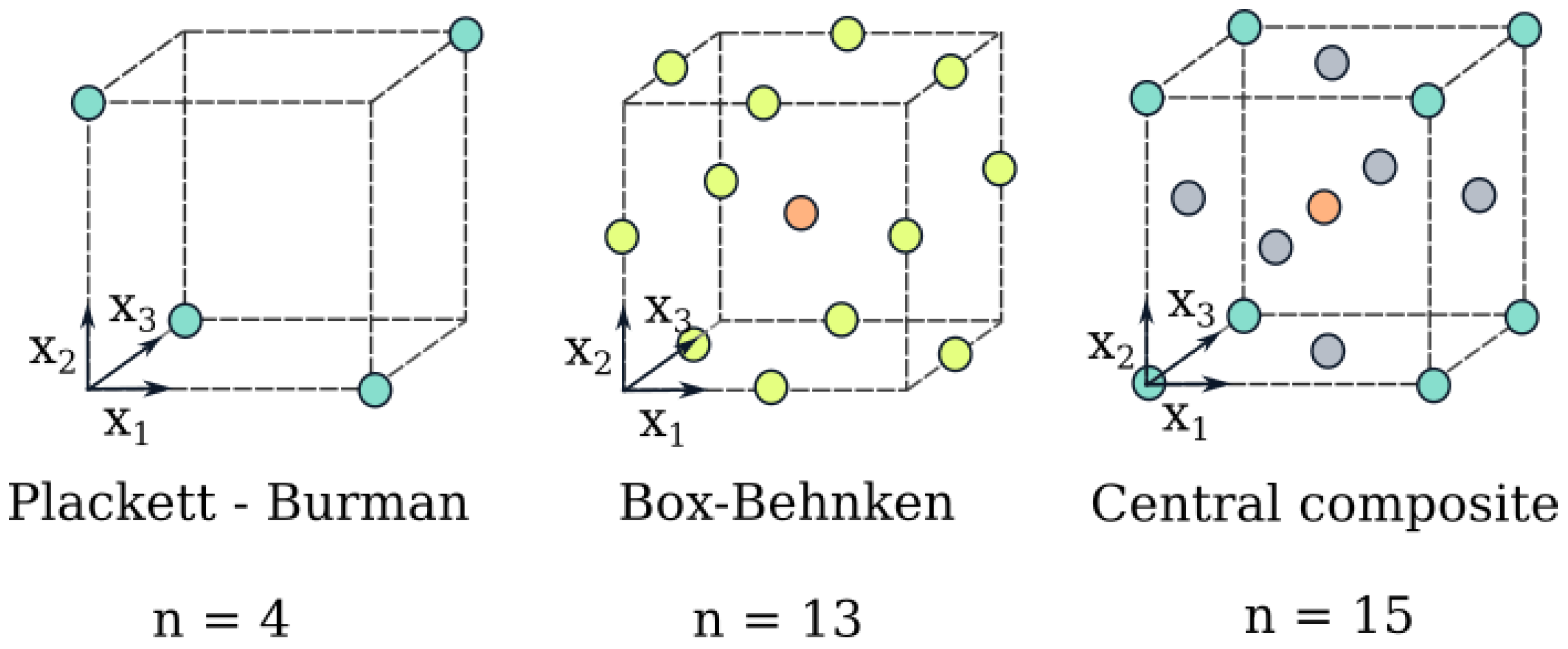
In the following analysis, the same three DoE methodologies as in [32] are used to estimate the robustness degradation: Plackett–Burman, Box–Behnken, and Central Composite Design. In this work, the DoE schemes are not used to construct response-surface surrogate models. Instead, they are used as structured sampling plans in the uncertainty space. For each perturbation point generated by PB, BB, or CCD, the finite-element model is evaluated directly, and the corresponding value of F 1 is computed. The DoE-based robustness estimate is then obtained as the maximum absolute deviation from the nominal value of F 1 over the generated sample set. Therefore, the reported DoE values are sampled robustness estimates, not optima of fitted response-surface models. The corresponding computational effort is summarized in Table 1. All considered DoE methods and the original extremal-position approximation are incomplete factorial designs defined on three levels, where the uncertain parameters take values from the set { 0.5 , 0.0 , + 0.5 } .
The dominant computational cost of all robustness estimation methods is the repeated solution of the same finite-element model and the subsequent evaluation of the field-homogeneity objective F 1 . Therefore, in the present implementation, the wall-clock time scales approximately linearly with the number of finite-element evaluations. If the average time required for one finite-element solve and post-processing step is denoted by t FE , the total runtime of a given estimator can be approximated as
t tot N eval t FE ,
where N eval is the number of perturbed finite-element evaluations reported in Table 1. The additional overhead of generating the DoE sample points or running the metaheuristic search is small compared with the finite-element solution time. For this reason, the computational demand is reported primarily in terms of finite-element evaluations, which provides a hardware-independent and reproducible measure of cost. Absolute wall-clock times depend on the workstation, operating system, software version, mesh settings, and Python environment; therefore, they are not used as a separate ranking criterion in this study.
The numbers in Table 1 denote perturbed finite-element evaluations required for the robustness estimation of one fixed nominal layout. The nominal evaluation used to compute F 1 ( r , J 0 ) is common to all methods and is not included in the reported counts.
It should also be noted that the DoE methods are one-shot structured sampling plans, whereas the NSGA-II-based search is iterative (Figure 2). Therefore, the comparison in Table 1 should be interpreted as a comparison of practical finite-element evaluation budgets, not as a strict algorithmic efficiency ranking between methods of the same type.
The Sobol sequence is selected as a quasi-Monte Carlo method to generate a deterministic low-discrepancy set of perturbations for each uncertain parameter in the range [ 0.5 , + 0.5 ] . In the present study, 32 and 64 parameter sets are used because substantially larger sample sizes would make the robustness evaluation impractical in a multi-objective optimization setting. In addition, an NSGA-II-based search with 900 evaluations is applied as a high-budget numerical search baseline for both the original and the extended uncertainty models. The result of this search is not interpreted as a mathematically verified global worst case or as a certified upper bound. Instead, it is used as an algorithm-dependent approximation of a severe perturbation case against which the lower-cost sampled estimators can be compared.
These approaches are designed for situations where many variables interact and exhaustive evaluation is prohibitively expensive. Their main advantage is that several parameters can be varied simultaneously while the influence of each factor can still be estimated. Consequently, they enable a more efficient use of computational resources and provide more information than the original two-point robustness approximation.

3. Results and Discussion

3.1. Case-Study Analysis

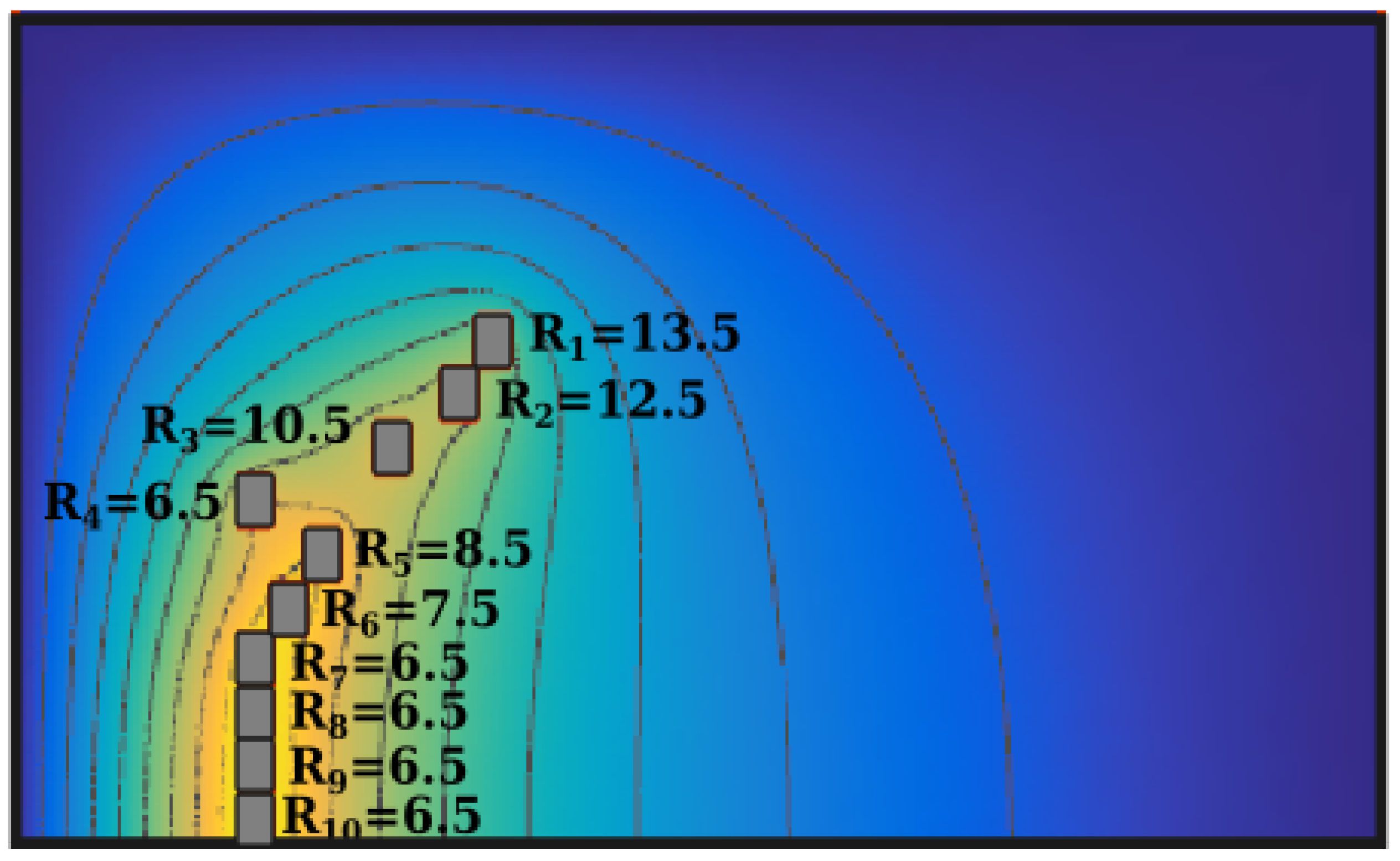
An example layout was selected to compare the robustness values obtained by the different uncertainty estimation methods. The finite element solution for this layout, together with the chosen radius values, is shown in Figure 3. The figure displays only the upper half of the modeled geometry; however, the full geometry is considered during the calculations. All 20 turns are included in the field solution, even though only ten independent radius parameters are optimized in the symmetric formulation.
In this example, the goal is to identify the combination of manufacturing tolerances that produces the maximum deviation from the value of F 1 calculated for the nominal geometry. Due to the nonlinear dependence of F 1 on the perturbations, this maximum deviation does not necessarily occur for a symmetric distribution of the measurement errors.
To investigate this question, the 10-parameter uncertainty problem is first explored for both symmetric and asymmetric perturbation formulations using an NSGA-II-based search. In this setup, the manufacturing tolerance of each turn varies in the interval [ 0.5 , + 0.5 ] mm. The search is performed using a population of 30 individuals over 30 generations, which results in 900 finite-element evaluations per case. The extended 11-parameter problem is then analyzed by additionally considering the uncertainty of the current density, which is varied in the range [ 0.05 , + 0.05 ] around its nominal value. As discussed above, the NSGA-II result is used only as a high-budget numerical search baseline and not as a mathematically certified worst-case value.
For the selected layout, the value of F 1 is relatively large, namely F 1 = 1.82 mT. Therefore, this case is not practically attractive as a design solution; it is used only as a representative example for comparing robustness estimators. The resulting robustness values are summarized in Table 2, where F 2 is given as a percentage of F 1 .
The results indicate that there is no meaningful difference between the maximum F 2 values obtained for the symmetric and asymmetric cases. Therefore, the simpler symmetric formulation appears sufficient for the present benchmark from the viewpoint of robustness estimation. Another important observation is that including current-density uncertainty increases the estimated robustness by more than 20%, even though the magnitude of the current-density perturbation is below 2% of the nominal value. This can be explained by the fact that current-density uncertainty affects the field generated by all turns simultaneously.
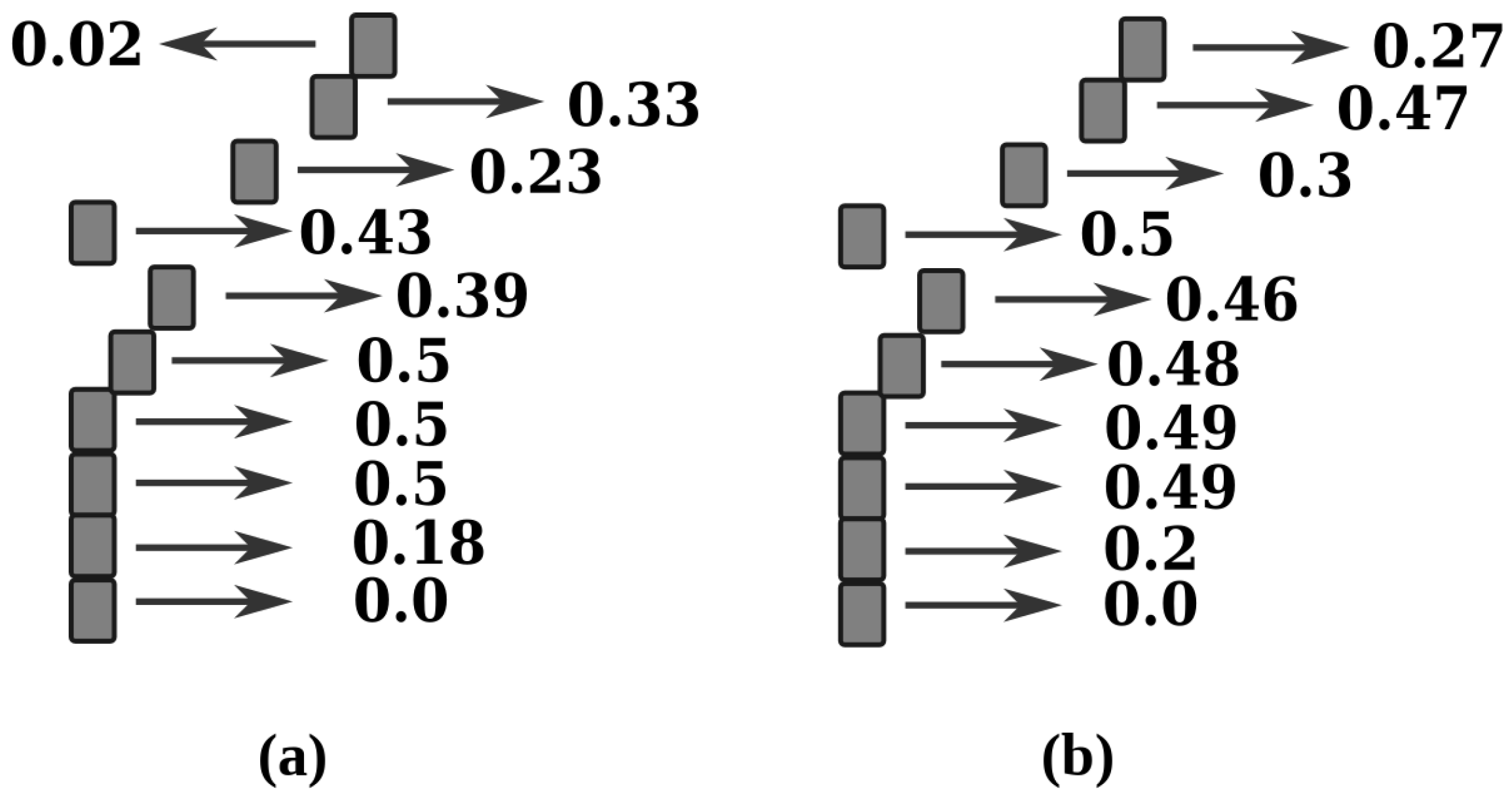
The Sobol-sequence-based estimates significantly underestimate the robustness in both cases. This behavior can be explained by the dimensionality and the extreme-value nature of the robustness estimation problem. Sobol sequences provide low-discrepancy coverage of the uncertainty domain, but they are not specifically designed to locate rare extreme perturbation combinations. In the present problem, the uncertainty space has 10 variables in the original case and 11 variables in the extended case. With only 32 or 64 samples, the high-dimensional perturbation space is covered only sparsely. If the largest degradation occurs near a narrow boundary region or requires a specific correlated pattern of positive and negative turn deviations, such a small Sobol sample may not contain a sufficiently severe perturbation point. Therefore, the low Sobol values should be interpreted as sparse-sampling underestimates, not as evidence that the design is more robust. Among the investigated DoE methods, the CCD method gives the closest agreement with the high-budget NSGA-II search baseline. For the extended problem, its estimate is very close to the NSGA-II-based sampled value. For the original problem, however, the CCD value remains below the NSGA-II search baseline (Figure 4). This difference should not be interpreted as a proven error with respect to the true global worst case because the NSGA-II result is also an algorithm-dependent sampled estimate. It rather indicates that different sampling or search strategies may identify different severe perturbation patterns in the high-dimensional uncertainty space.
If both accuracy and computational effort are taken into account, the Plackett–Burman method appears to offer the most practical compromise. It requires only 12 additional evaluations and reaches an accuracy level comparable to the much more expensive Box–Behnken design. By contrast, the original extremal-value-based estimate is computationally attractive but too optimistic to be used as a stand-alone worst-case robustness estimator for this nonlinear problem. At most, it can be used as a cheap lower-bound-type screening indicator; even in this limited role, it should be interpreted with caution.

3.2. Pareto-Front Analysis

The previous example focused on a single, randomly chosen layout. In this subsection, the problem is approached from the perspective of the full bi-objective optimization process. In the original formulation, the Pareto search is carried out for
min r F 1 ( r ) , F 2 ( r ) ,
where r denotes the vector of optimized turn radii and F 2 is the original extremal-value-based sensitivity metric. In the extended formulation, the first objective remains unchanged, while the second objective is replaced by the reformulated worst-case robustness measure that also accounts for current-density uncertainty:
min r F 1 ( r ) , F ˜ 2 ( r ) .
Two optimization runs are therefore compared: one based on the original metric and one based on the extended robustness definition. In both cases, an NSGA-II algorithm with a population size of 30 and 30 generations is applied, resulting in 900 finite-element evaluations per run. This comparison is meant to show not only how the estimated robustness values change but also whether the preferred robust optimum itself shifts when a dependent uncertainty source is included in the model. These runs are not intended to prove the true Pareto fronts. They are used as equal-budget numerical optimization runs to generate representative non-dominated layouts, which are then compared and post-processed in the subsequent analysis.
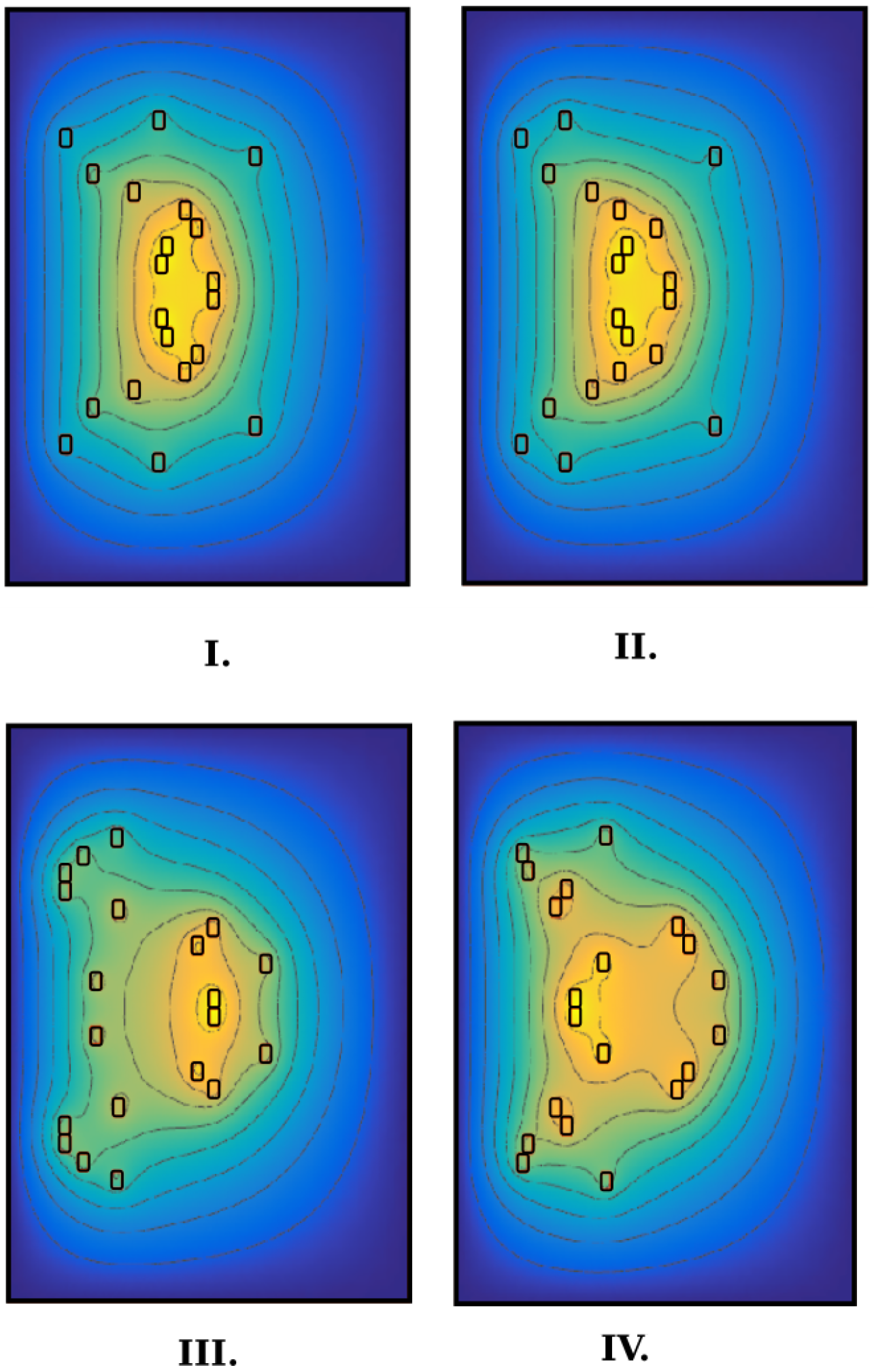
The non-dominated sets obtained in the two optimization runs are shown in Figure 5, where all objective values are normalized by B 0 = 2 mT. The figure illustrates how the obtained robustness–field-uniformity trade-off changes when the original extremal-position-based metric is replaced by the extended robustness metric including current-density uncertainty. Four representative layouts are highlighted to connect the front-level trade-off with the corresponding winding geometries. Cases I–III are selected from the optimization based on the original robustness metric and represent different regions of the field-uniformity–robustness trade-off. Case IV is selected from the extended optimization and illustrates the type of layout obtained when the common-mode current-density perturbation is included in the robustness evaluation. Since the second objective is reformulated in the extended case, the comparison emphasizes the qualitative shift in the obtained non-dominated layouts rather than a point-by-point dominance relation between the two curves.
  • Case I corresponds to a layout with a low field error, F 1 / B 0 = 0.71 %, but relatively weak robustness, F 2 / B 0 = 1.41 %.
  • Case II is a more balanced solution, where the two objective values are of similar magnitude: F 1 / B 0 = 0.90 % and F 2 / B 0 = 1.50 %.
  • Case III is a robust solution with a very low robustness value, F 2 / B 0 = 0.05 %, but at the expense of a larger field error, F 1 / B 0 = 5.01 %.
  • Case IV is selected from the optimization in which current-density uncertainty is also considered.
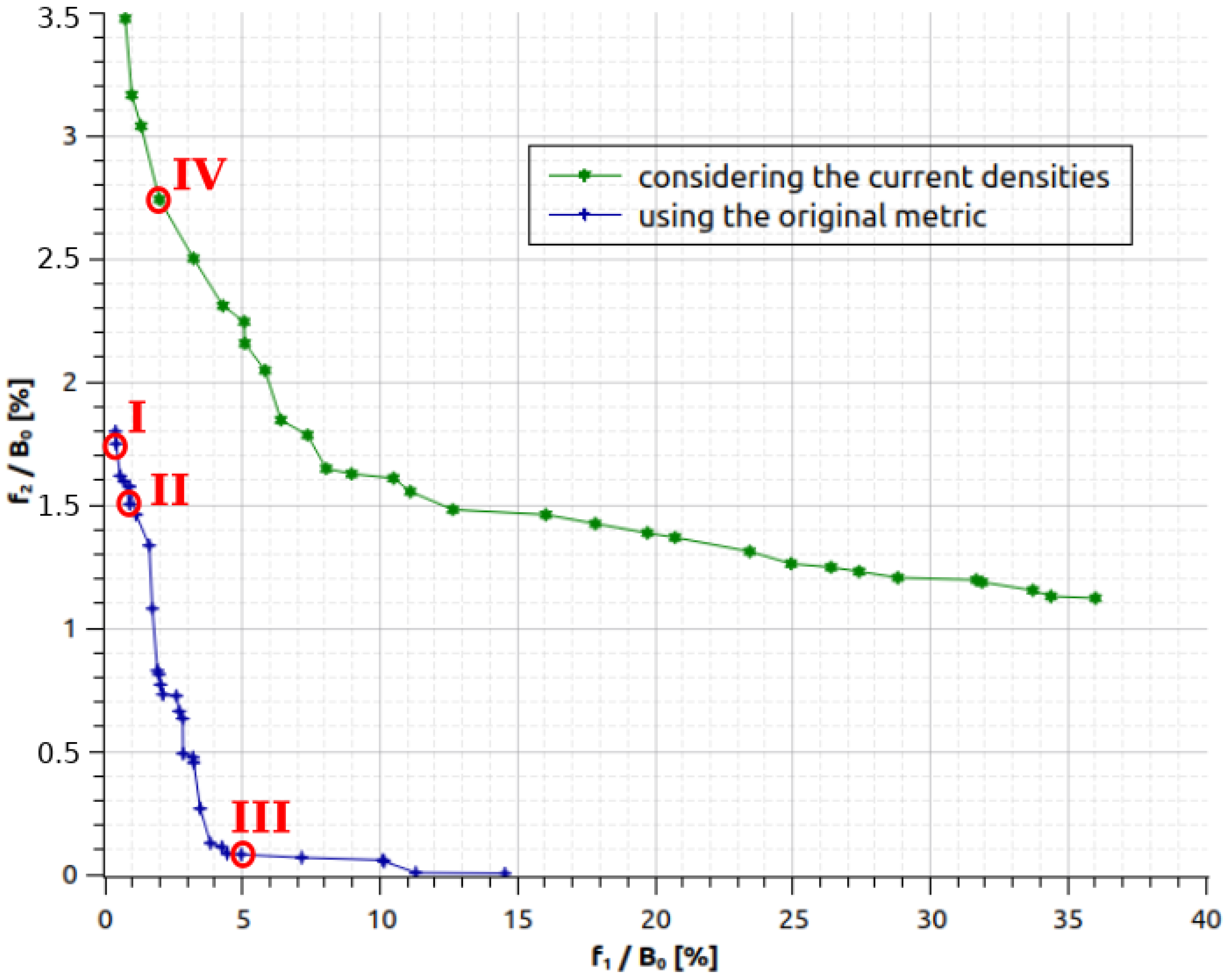
Figure 5. Non-dominated layouts obtained with the original extremal-position-based robustness metric and with the extended metric including current-density uncertainty. The objective values are normalized by B 0 = 2 mT. The figure illustrates the shift in the set of representative non-dominated layouts when current-density uncertainty is included. Roman numerals I–IV denote selected representative layouts shown in the corresponding insets.
Electronics 15 02552 g005
The corresponding layouts and magnetic field distributions are shown in Figure 6. Beyond the numerical objective values, the figure also highlights how far the Pareto-optimal layouts can move from each other in the design space. Cases I and II are geometrically similar, but even small shifts in a few turns already lead to a measurable change in the trade-off between field homogeneity and robustness. By contrast, Case III is clearly separated from the first two layouts and represents a qualitatively different design pattern associated with the robust end of the Pareto front rather than a small local correction of Cases I or II.
A second qualitative observation concerns the relative role of the inner and outer turns. The selected layouts suggest that the innermost turns behave as high-gain design variables: owing to their smaller radii, they appear to provide a stronger leverage on the generated magnetic field and on the attainable field homogeneity. However, this benefit is paid for by a higher sensitivity to geometric and excitation uncertainties. In this sense, the inner turns seem to offer the largest contribution to field shaping but at the price of a larger robustness penalty when the design relies on them too strongly. The robust layouts can therefore be interpreted as configurations that distribute the task of field shaping more conservatively and do not depend excessively on the most sensitive inner turns. Case IV, obtained when current-density uncertainty is included in the optimization, supports the same interpretation: the additional uncertainty source does not merely penalize the same nominal optimum more strongly but appears to shift the preferred solution toward a different winding arrangement. This observation is consistent with the idea that current-density uncertainty changes the effective cost of relying on the most influential turns and therefore modifies the geometry of the robust optimum itself.
Only one case is highlighted from the extended optimization because the two Pareto fronts already show a visible separation. Although the objective values are not directly comparable point by point due to the different robustness definitions, the results suggest that the inclusion of current-density uncertainty leads to a stricter and computationally more demanding optimization problem.
Table 3 reports estimator-specific sampled robustness values for the four selected layouts. Each value is the maximum objective variation observed within the perturbation set generated by the corresponding method. Since PB, BB, CCD, and the extremal-position approximation use different sampling structures, the resulting values reflect both the selected estimator and the particular perturbation combinations included in its sample set.
The comparison between the “with current” and “without current” rows should be interpreted in the same way. These rows are obtained from perturbation sets generated in different uncertainty spaces: the geometric-only case varies the turn positions, whereas the extended case also includes the current-density perturbation. Therefore, the table is used primarily to show how the apparent robustness ranking of the selected layouts depends on the chosen uncertainty model and robustness estimator.
The comparison in Table 3 confirms that the ranking of candidate layouts can depend strongly on the robustness estimator. This observation is important from a practical design perspective because a layout that appears attractive under the original metric may become less competitive when current-density uncertainty is also considered.

4. Conclusions

This paper revisited Problem A of the TEAM 35 benchmark from the viewpoint of sampled worst-case robustness estimation under geometric and excitation-current uncertainty. The original extremal-position-based metric was retained as the official benchmark baseline, but it was distinguished from a general worst-case estimate. The results show that this two-layout extremal approximation can substantially underestimate the sampled degradation of the nominal field-homogeneity objective for the investigated cases.
The excitation current-density uncertainty was introduced as a simplified common-mode perturbation in addition to the original turn-position uncertainties. The results indicate that even a small global excitation perturbation can noticeably increase the estimated robustness degradation because it affects the field contribution of all turns simultaneously.
The DoE schemes were used as structured sampling plans rather than as response-surface models. Among the investigated structured sampling methods, CCD provided the closest agreement with the high-budget NSGA-II search baseline in the analyzed cases, while PB offered a low-cost screening alternative. Since the NSGA-II result is not a certified global optimum and the DoE sample sets are not nested, these conclusions should be interpreted as comparisons between sampled estimators rather than as validation against the true worst-case bound.
Overall, the results confirm that the choice of robustness estimator can influence both the estimated uncertainty level and the apparent ranking of candidate layouts. Therefore, the robustness definition and the uncertainty-sampling strategy should be treated as primary modeling decisions in robust electromagnetic design optimization.

Funding

Project no. 147030 was implemented with support provided by the National Research, Development, and Innovation Fund of Hungary, financed under the FK funding scheme.

Institutional Review Board Statement

Not applicable.

Informed Consent Statement

Not applicable.

Data Availability Statement

The finite element model, optimization workflow, and post-processing scripts used in this study are publicly available at https://github.com/tamasorosz/TEAM35-DOE (accessed on 4 June 2026). Additional data supporting the reported results are available from the author on reasonable request.

Acknowledgments

The author gratefully acknowledges the developers of Agros Suite and Artap for providing the open-source tools used in this work.

Conflicts of Interest

The author declares no conflict of interest.

References

  1. Society, C. Testing Electromagnetic Analysis Methods. Available online: http://www.compumag.org/jsite/team.html (accessed on 28 September 2022).
  2. Schonwetter, G.; Magele, C.; Preis, K.; Paul, C.; Renhart, W.; Richter, K.R. Optimization of SMES Solenoids with Regard to Their Stray Fields. IEEE Trans. Magn. 1995, 31, 1940–1943. [Google Scholar]
  3. Lebensztajn, L.; Coulomb, J.L. TEAM Workshop Problem 25: A Multiobjective Analysis. IEEE Trans. Magn. 2004, 40, 1402–1405. [Google Scholar] [CrossRef]
  4. Di Barba, P.; Mognaschi, M.E.; Lowther, D.A.; Sykulski, J.K. A Benchmark TEAM Problem for Multi-Objective Pareto Optimization of Electromagnetic Devices. IEEE Trans. Magn. 2018, 54, 9400604. [Google Scholar] [CrossRef]
  5. Di Barba, P.; Mognaschi, M.E.; Lowther, D.A.; Sykulski, J.K. Multi-Objective Pareto Optimization of a Solenoid. Available online: https://www.compumag.org/wp/wp-content/uploads/2021/07/problem-35.pdf (accessed on 28 September 2022).
  6. Di Barba, P.; Mognaschi, M.E.; Lowther, D.A.; Sykulski, J.K. Improved Solutions to a TEAM Problem for Multi-Objective Optimisation in Magnetics. IET Sci. Meas. Technol. 2020, 14, 964–968. [Google Scholar] [CrossRef]
  7. Di Barba, P.; Dughiero, F.; Forzan, M.; Lowther, D.A.; Mognaschi, M.E.; Sieni, E.; Sykulski, J.K. A Benchmark TEAM Problem for Multi-Objective Pareto Optimization in Magnetics: The Time-Harmonic Regime. IEEE Trans. Magn. 2020, 56, 7504304. [Google Scholar] [CrossRef]
  8. Di Barba, P.; Mognaschi, M.E.; Wiak, S. Neural Metamodelling of Fields: Towards a New Deal in Computational Electromagnetics. Int. J. Appl. Electromagn. Mech. 2022, 69, 127–137. [Google Scholar] [CrossRef]
  9. Barmada, S.; Di Barba, P.; Fontana, N.; Mognaschi, M.E.; Tucci, M. A Source Identification Problem in Magnetics Solved by Means of Deep Learning Methods. Mathematics 2024, 12, 859. [Google Scholar] [CrossRef]
  10. Xiao, S.; Liu, G.; Zhang, K.Z.; Jing, Y.Z.; Duan, J.; Di Barba, P.; Sykulski, J.K. Multi-Objective Pareto Optimization of Electromagnetic Devices Exploiting Kriging with Lipschitzian Optimized Expected Improvement. IEEE Trans. Magn. 2018, 54, 7504304. [Google Scholar] [CrossRef]
  11. Lim, D.K.; Woo, D.K.; Yeo, H.K.; Jung, S.Y.; Ro, J.S.; Jung, H.K. A Novel Surrogate-Assisted Multi-Objective Optimization Algorithm for an Electromagnetic Machine Design. IEEE Trans. Magn. 2015, 51, 8200804. [Google Scholar] [CrossRef]
  12. Gadó, K.; Orosz, T. Robust and Multi-Objective Pareto Design of a Solenoid. Electronics 2021, 10, 2139. [Google Scholar] [CrossRef]
  13. Alotto, P.; Di Barba, P.; Formisano, A.; Lozito, G.M.; Martone, R.; Mognaschi, M.E.; Repetto, M.; Salvini, A.; Savini, A. Synthesizing Sources in Magnetics: A Benchmark Problem. COMPEL: Int. J. Comput. Math. Electr. Electron. Eng. 2021, 40, 1084–1103. [Google Scholar] [CrossRef]
  14. Karban, P.; Pánek, D.; Orosz, T.; Doležel, I. Semi-Analytical Solution for a Multi-Objective TEAM Benchmark Problem. arXiv 2020, arXiv:2008.06954. [Google Scholar] [CrossRef]
  15. Xia, B.; Ren, Z.; Koh, C.S. Utilizing Kriging Surrogate Models for Multi-Objective Robust Optimization of Electromagnetic Devices. IEEE Trans. Magn. 2014, 50, 693–696. [Google Scholar] [CrossRef]
  16. Mendes, M.H.S.; Soares, G.L.; Coulomb, J.L.; Vasconcelos, J.A. A Surrogate Genetic Programming Based Model to Facilitate Robust Multi-Objective Optimization: A Case Study in Magnetostatics. IEEE Trans. Magn. 2013, 49, 2065–2068. [Google Scholar] [CrossRef]
  17. Chiariello, A.G.; Formisano, A.; Martone, R.; Pizzo, F. Gradient-Based Worst Case Search Algorithm for Robust Optimization. IEEE Trans. Magn. 2015, 51, 7205004. [Google Scholar] [CrossRef]
  18. Salimi, A.; Lowther, D.A. On the Role of Robustness in Multi-Objective Robust Optimization: Application to an IPM Motor Design Problem. IEEE Trans. Magn. 2016, 52, 8102304. [Google Scholar] [CrossRef]
  19. Zheng, T.; Yang, S.; Bai, Y.; Liu, Z. A Robust Methodology for Design Optimizations of Electromagnetic Devices under Uncertainties. Int. J. Appl. Electromagn. Mech. 2019, 59, 71–78. [Google Scholar] [CrossRef]
  20. Ma, B.; Zheng, J.; Zhu, J.; Wu, J.; Lei, G.; Guo, Y. Robust Design Optimization of Electrical Machines Considering Hybrid Random and Interval Uncertainties. IEEE Trans. Energy Convers. 2020, 35, 1815–1824. [Google Scholar] [CrossRef]
  21. Di Barba, P. Multi-Objective Wind-Driven Optimisation and Magnet Design. Electron. Lett. 2016, 52, 1216–1218. [Google Scholar] [CrossRef]
  22. Di Barba, P.; Mognaschi, M.E.; Savini, A.; Wiak, S. Island Biogeography as a Paradigm for MEMS Optimal Design. Int. J. Appl. Electromagn. Mech. 2016, 51, S97–S105. [Google Scholar] [CrossRef]
  23. Di Barba, P.; Liu, B.; Mognaschi, M.E.; Venini, P.; Wiak, S. Multiphysics Field Analysis and Evolutionary Optimization: Design of an Electro-Thermo-Elastic Microactuator. Int. J. Appl. Electromagn. Mech. 2017, 54, 433–448. [Google Scholar] [CrossRef]
  24. Grimaccia, F.; Gruosso, G.; Mussetta, M.; Niccolai, A.; Zich, R.E. Design of Tubular Permanent Magnet Generators for Vehicle Energy Harvesting by Means of Social Network Optimization. IEEE Trans. Ind. Electron. 2018, 65, 1884–1892. [Google Scholar] [CrossRef]
  25. Li, Y.; Lei, G.; Bramerdorfer, G.; Peng, S.; Sun, X.; Zhu, J. Machine Learning for Design Optimization of Electromagnetic Devices: Recent Developments and Future Directions. Appl. Sci. 2021, 11, 1627. [Google Scholar] [CrossRef]
  26. Formisano, A.; Tucci, M. Machine Learning Approaches for Inverse Problems and Optimal Design in Electromagnetism. Electronics 2024, 13, 1167. [Google Scholar] [CrossRef]
  27. Kiss, K.L.; Orosz, T. Numerical Modelling of a Solenoid Optimization Problem with a Superposition-Based Model Order Reduction Method. Comput. Struct. 2025, 316, 107906. [Google Scholar] [CrossRef]
  28. Jin, L.; Guo, S.; Song, J.; Liu, L. Deep Learning-Based Field-Guided Optimization Method. AIP Adv. 2023, 13, 125309. [Google Scholar] [CrossRef]
  29. Li, Y.; Fei, Z.; Yang, S. A Data-Driven Multi-Objective Optimization Algorithm for Computationally Expensive Electromagnetic Designs. Int. J. Appl. Electromagn. Mech. 2025, 78, 223–227. [Google Scholar] [CrossRef]
  30. Vinko, D.; Bilandžija, D.; Mandrić Radivojević, V. Optimization of a Two-Layer 3D Coil Structure with Uniform Magnetic Field. Wirel. Power Transf. 2021, 8, 3628. [Google Scholar] [CrossRef]
  31. Zhu, X.; Xing, M.; Ye, J.; Liu, X.; Ren, Z. Design and Optimization of a Novel Solenoid with High Magnetic Uniformity. Sci. Rep. 2024, 14, 24650. [Google Scholar] [CrossRef]
  32. Orosz, T.; Pánek, D.; Kuczmann, M. Performance Analysis of a Robust Design Optimization of a Solenoid with Different Sensitivity Metrics. J. Comput. Appl. Math. 2023, 424, 115021. [Google Scholar] [CrossRef]
  33. Arndt, D.; Bangerth, W.; Bergbauer, M.; Feder, M.; Fehling, M.; Heinz, J.; Heister, T.; Heltai, L.; Kronbichler, M.; Maier, M.; et al. The deal. II library, version 9.5. J. Numer. Math. 2023, 31, 231–246. [Google Scholar] [CrossRef]
  34. Karban, P.; Pánek, D.; Orosz, T.; Petrášová, I.; Doležel, I. FEM based robust design optimization with Agros and Ārtap. Comput. Math. Appl. 2021, 81, 618–633. [Google Scholar] [CrossRef]
  35. Karban, P.; Panek, D.; Kaska, J. Open-source platform for simulation of physical fields: Agros. J. Comput. Appl. Math. 2025, 465, 116589. [Google Scholar] [CrossRef]
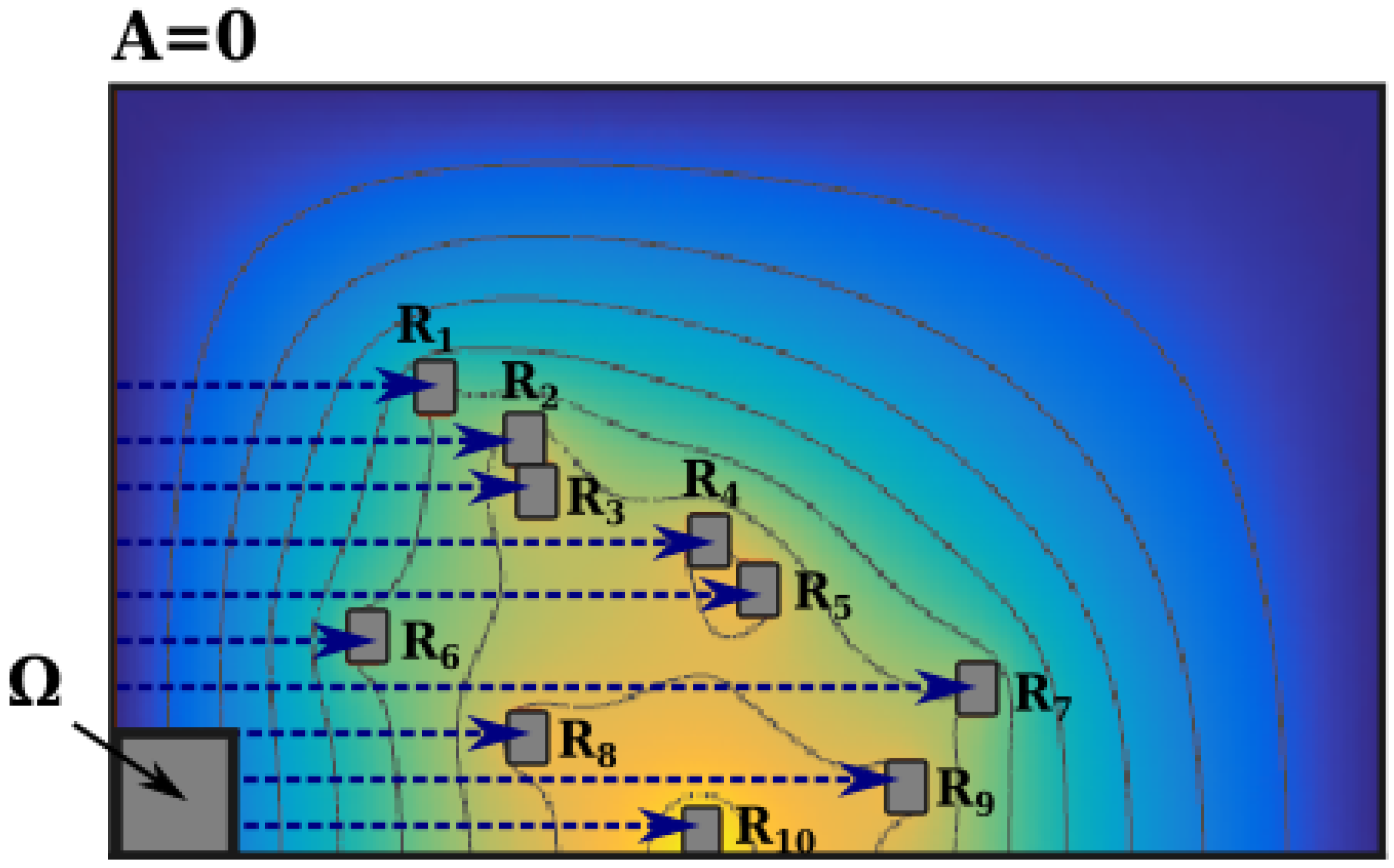
Figure 1. Geometry of one optimized coil layout for the TEAM 35 benchmark problem. The colored background shows the magnitude of the magnetic flux density in the modeled domain, and the contour lines illustrate the corresponding field distribution. The small rectangular regions denote the current-carrying coil turns, while the central region Ω is the control region in which the field-homogeneity objective is evaluated. The labels R 1 R 10 indicate the optimized coil-radius parameters in the symmetric formulation, and A = 0 denotes the applied Dirichlet boundary condition on the outer boundary.
Electronics 15 02552 g001
Figure 2. The selected DoE methodologies for robustness estimation [32]. The colored markers denote sampling points in the normalized uncertainty space; the colors are used only to distinguish the sampling-point locations in the schematic.
Electronics 15 02552 g002
Figure 3. Magnetic flux-density distribution for the selected case-study layout. The colored background indicates the magnitude of the magnetic flux density, the contour lines illustrate the corresponding field distribution, and the rectangular regions denote the current-carrying turns. The labels R 1 R 10 give the selected turn radii in millimeters.
Electronics 15 02552 g003
Figure 4. Distribution of manufacturing defects for the worst robustness value in the two cases studied. (a) Original 10-variable problem. (b) Extended problem including current-density uncertainty. All distances are given in millimeters.
Electronics 15 02552 g004
Figure 6. Turn layouts and magnetic field distributions for the four selected cases. The figure shows that Pareto-optimal solutions may be widely separated in the design space even when their objective values are of similar magnitude. Cases (I,II) differ only by a few turn shifts, whereas Case (III) represents a geometrically distinct robust layout. Case (IV) illustrates the change in the preferred winding arrangement when current-density uncertainty is included in the optimization. The comparison also suggests that the innermost turns act as high-gain but high-risk design variables: they make a strong contribution to field shaping, but their use is associated with increased sensitivity, which becomes more costly when robustness is emphasized.
Electronics 15 02552 g006
Table 1. Robustness estimation methods and their computational demand for one fixed nominal layout. The original case includes only turn-position uncertainties, while the extended case additionally includes excitation current-density uncertainty. The notation F ^ 2 , method denotes the sampled robustness estimate obtained by the corresponding method.
NotationOriginal ProblemExtended Problem
Number of Evaluations Number of Evaluations
Extremal-position approximation F ^ 2 , EV 24
Plackett–Burman F ^ 2 , PB 1212
Box–Behnken F ^ 2 , BB 190232
Central Composite Design F ^ 2 , CCD 10452071
Sobol sequence F ^ 2 , S 32/6432/64
NSGA-II search baseline F ^ 2 , NSGA 900900
Table 2. Robustness values obtained by different methodologies. Here, F 2 is reported as a percentage of F 1 .
Original ProblemExtended Problem
F 2 / F 1 [%] F 2 / F 1 [%]
NSGA-II, symmetric19.023.0
NSGA-II, asymmetric19.023.0
Extremal-values-based approximation5.588.06
Plackett–Burman11.1815.05
Box–Behnken10.1617.14
Central Composite Design13.3222.99
Sobol sequence3.956.52
Table 3. Robustness estimates of the four selected layouts obtained with different perturbation-set-based estimators. Each value corresponds to the maximum objective variation observed within the perturbation set of the given method, allowing the sensitivity of the layout ranking to the selected robustness estimator to be compared.
Case ICase IICase IIICase IV
F 2 / B 0 [%] F 2 / B 0 [%] F 2 / B 0 [%] F 2 / B 0 [%]
Min–max without current1.751.500.041.14
Min–max with current3.453.131.632.74
PB with current4.052.323.593.59
PB without current2.054.342.391.65
BB with current1.062.312.462.42
BB without current2.221.191.511.05
CCD with current4.905.055.665.06
CCD without current2.933.073.812.66
Disclaimer/Publisher’s Note: The statements, opinions and data contained in all publications are solely those of the individual author(s) and contributor(s) and not of MDPI and/or the editor(s). MDPI and/or the editor(s) disclaim responsibility for any injury to people or property resulting from any ideas, methods, instructions or products referred to in the content.