Article

Measurement-Aware Frequency Support in DFIG-Based Low-Inertia Systems Under Variable Load Profiles

by
William Aguilar-Blacio
1 and
Paul Arévalo-Cordero
1,2,*
1
Faculty of Engineering, Department of Electrical Engineering, Electronics and Telecommunications (DEET), University of Cuenca, Balzay Campus, Cuenca 010107, Ecuador
2
Department of Electrical Engineering, University of Jaen, EPS Linares, 23700 Jaen, Spain
*
Author to whom correspondence should be addressed.
Electronics 2026, 15(11), 2407; https://doi.org/10.3390/electronics15112407
Submission received: 13 May 2026 / Revised: 28 May 2026 / Accepted: 29 May 2026 / Published: 1 June 2026

Abstract

Converter-interfaced wind generation reduces the effective inertial response of modern power systems and makes frequency dynamics more sensitive to load variability, measurement processing, and support-control tuning. This paper proposes a data-driven and measurement-aware framework to evaluate frequency support in a low-inertia system with doubly fed induction generator-based wind generation. Measured load and wind-speed data are converted into a reproducible scenario library and evaluated with an aggregated frequency model including droop support, synthetic inertia, reserve limitation, filtering, delay, and rate of change of frequency estimation. Results show that unsupported operation produces the largest frequency degradation, with a median nadir-point deviation of 2.208 Hz, while conventional droop reduces it to 0.714 Hz. Droop plus inertia and the proposed robust setting reduce this value to 0.493 Hz and 0.502 Hz, respectively, indicating comparable performance under the selected measurement- ware assessment, with a median rate of change of frequency close to 0.040 Hz/s. The load-model analysis shows that frequency-dependent load behavior changes the final frequency deviation, reducing it from 0.329 Hz to 0.318 Hz in the tested cases.

1. Introduction

Converter-interfaced renewable generation is changing the time scale and observability requirements of power-system frequency control. As synchronous machines are displaced by wind and photovoltaic resources, the stored kinetic energy naturally available after a disturbance is reduced, and frequency deviations become more sensitive to net-load fluctuations, control delays, and measurement uncertainty. This transition has made fast frequency response, synthetic inertia, and measurement-aware control increasingly important for wind-dominated systems, especially when doubly fed induction generator (DFIG) wind plants are expected to contribute to primary frequency support rather than operate only under maximum power point tracking.
The central difficulty is that the apparent quality of a frequency-support setting is not determined only by its droop or inertial gain. The same tuning may appear satisfactory under a constant-power load and an ideal derivative of frequency, yet produce a different ranking when the load is frequency-dependent, when rate of change of frequency (ROCOF) is estimated through a finite window or a filter, or when the support action is affected by an equivalent measurement delay. This issue is relevant for DFIG-based wind plants because their contribution to frequency support is mediated by converter controls, deloading reserves, rotor-speed constraints, and sampled measurement chains. Therefore, a robust assessment must include not only the electromechanical frequency response, but also the scenario data, load representation, ROCOF estimator, and multi-metric performance criteria used to compare the resulting trajectories.
Classical power-system stability studies established the frequency-security foundations on which present low-inertia analyses are built [1]. Sauer and Pai provided the dynamic-system perspective that remains useful for expressing frequency behavior in compact state-space form [2]. Ulbig et al. showed that reduced rotational inertia modifies both operational margins and frequency-control requirements in modern grids [3]. Milano et al. framed low-inertia operation as a structural challenge involving dynamics, control, and measurement rather than a simple reduction in aggregate inertia [4]. Tielens and Van Hertem clarified why the relevance of inertia depends on disturbance size, frequency response, and system operating conditions [5]. Tamrakar et al. reviewed virtual-inertia concepts and showed that converter control can emulate part of the lost inertial behavior, although implementation details strongly affect the response [6]. Fang et al. discussed inertia in more-electronics power systems and emphasized that the physical interpretation of inertia changes when power converters become dominant [7]. Fernandez-Guillamon et al. reviewed frequency-control strategies for renewable-rich systems and highlighted the need to coordinate inertia emulation, primary support, and reserve availability [8]. He et al. provided a recent review of frequency-stability analysis and control in low-inertia systems, noting that measurement, control, and model assumptions remain coupled open issues [9].
Early wind-frequency studies showed that variable-speed wind turbines can contribute to frequency support if their controls are modified. Ekanayake and Jenkins compared fixed-speed and DFIG wind turbines under frequency changes, demonstrating that converter decoupling affects the natural inertial contribution [10]. Morren et al. proposed wind-turbine inertia emulation and primary support, establishing one of the reference concepts for active-power frequency assistance from variable-speed turbines [11]. Conroy and Watson compared the frequency-response capability of full-converter wind turbines with conventional generation, showing that converter-interfaced resources require explicit control logic to deliver support [12]. Mauricio et al. studied frequency-regulation contribution through variable-speed wind energy conversion systems and showed that supplementary control can release kinetic energy during frequency events [13]. Ullah et al. analyzed temporary primary-frequency support by variable-speed wind turbines and highlighted the need to consider recovery after kinetic-energy extraction [14]. Margaris et al. examined autonomous power systems with high wind penetration and showed that wind-power controls can influence both transient and quasi-steady frequency behavior [15]. Wu and Infield developed aggregate inertial-response modeling for wind plants, which is relevant when plant-level studies are needed without full turbine-level detail [16]. Vidyanandan and Senroy proposed variable-droop primary regulation from deloaded wind turbines, connecting reserve allocation and frequency-support tuning [17]. Muljadi et al. discussed inertial and frequency response from wind power plants and emphasized that turbine controls and operating point determine the available support [18]. Aziz et al. reviewed frequency-regulation capabilities in wind power plants and consolidated the roles of inertial response, droop, and deloaded operation [19].
For DFIG-based systems, several works have moved from conceptual inertia emulation to control-oriented modeling and comparative assessment. Ghosh et al. proposed a DFIG-based wind-farm control framework for inertial and primary response that can operate across sub- and super-synchronous speed ranges [20]. Ochoa and Martinez developed a simplified DFIG model for fast-frequency-response studies and assessed its impact on grid-level dynamics [21]. Yang et al. studied temporary DFIG frequency support under high wind penetration, emphasizing the tradeoff between frequency-nadir improvement and rotor-speed recovery [22]. Attya et al. analyzed frequency support using doubly fed induction and reluctance wind turbine generators, identifying practical limitations of simplified support strategies when wind conditions and turbine constraints vary [23]. Ruttledge and Flynn examined gain scheduling and resource coordination for emulated inertial response, suggesting that robust support requires operating-condition awareness [24]. Asad and Milano analyzed frequency regulation from DFIG-based variable-speed turbines using inertial emulation and droop control, illustrating the need for coordinated support design [25]. Recent synthetic-inertia studies have also argued that local measurement structure and available turbine states can constrain what support can be implemented in practice [26].
The behavior of frequency support cannot be isolated from the load model. Arif et al. reviewed load modeling and showed that static and dynamic load assumptions can substantially affect power-system dynamic studies [27]. Ahmadyar et al. proposed a framework for renewable integration limits with respect to frequency performance and included load-model effects as part of the stability boundary [28]. Adrees and Milanovic investigated the impact of load models on angular and frequency stability in low-inertia networks, showing that load representation can alter stability conclusions [29]. Bokhari et al. experimentally determined ZIP coefficients for modern loads, providing evidence that practical loads cannot always be treated as constant power [30]. Pasiopoulou et al. reviewed the effect of load modeling on stability studies and reinforced the need to report the load model used in dynamic simulations [31]. Tofighi-Milani et al. compared the effect of different electrical load types on frequency response in low-inertia systems, directly motivating the need to connect load representation with nadir and ROCOF metrics [32].
Measurement is the second dimension that affects the apparent support performance. Ortega and Milano showed that frequency estimation can change the behavior of VSC-based devices with primary frequency control, indicating that the control input is not independent of the estimator [33]. Frigo et al. analyzed PMU-based ROCOF measurement uncertainty and showed that ROCOF values depend on windowing, signal model, and metrological assumptions [34]. Deng et al. reviewed ROCOF estimation techniques and emphasized that ROCOF is both physically meaningful and numerically fragile in low-inertia systems [35]. Andic et al. used filtering and adaptive model predictive control for real-time inertia estimation and virtual-inertia support, demonstrating that measurement noise suppression and dynamic estimation are inseparable in low-inertia studies [36]. Abouyehia et al. reviewed inertia-estimation methods in low-inertia systems and identified PMU-based tracking as an important but model-sensitive tool [37]. Marchi et al. formulated plant-controller communication time-delay estimation for renewable wind plants, reinforcing the need to include communication delay in renewable plant control studies [38,39].
Several adjacent studies reinforce the need for robust and multi-metric evaluation. Miller et al. documented frequency-response behavior in a large interconnection and provided a practical reference for system-level frequency assessment [40]. Sorensen et al. studied power fluctuations from large wind farms, showing that wind variability has to be represented statistically rather than through a single trajectory [41]. Gautam et al. analyzed the effect of DFIG penetration on system stability and showed that turbine controls interact with network conditions [42]. These works support the idea that a single nadir or ROCOF value is insufficient to characterize the robustness of a DFIG frequency-support setting under variable wind, load, and measurement conditions.
Despite the breadth of this literature, the focused comparison in Table 1 shows that representative closely related studies usually address only one or two of the dimensions considered here. DFIG frequency-support papers typically focus on droop, deloading, or inertia emulation but do not jointly test load-model sensitivity and ROCOF-estimator dependence. Load-model studies quantify frequency-response changes but generally do not assess DFIG support tuning under alternative measurement chains. ROCOF and PMU studies characterize estimation uncertainty or delay, but they seldom propagate those effects into the ranking of wind-frequency-support parameters. This paper connects these lines by evaluating DFIG-based support settings over data-driven scenarios, load models, ROCOF estimators, equivalent delay, and multi-metric robustness criteria.
The contributions of this paper are therefore threefold. First, a measured-data-informed scenario library is built from load and wind-speed profiles and coupled with a reduced-order DFIG-based low-inertia frequency model. Second, the assessment explicitly includes constant-power and ZIP load representations together with multiple ROCOF estimation methods and equivalent delay, allowing the measurement chain to affect the support action. Third, a multi-metric robust ranking is used to compare no support, conventional droop, droop plus inertia, and optimized support settings using nadir, ROCOF, settling behavior, and control-energy indicators. For clarity, the remainder of this paper is organized as follows. Section 2 presents the data-driven scenario construction, the reduced-order DFIG frequency-support model, the ROCOF estimation chain, and the robust multi-metric assessment procedure. Section 3 reports the simulation results, including the ensemble frequency response, load-model sensitivity, ROCOF-estimator sensitivity, and robustness ranking. Section 4 discusses the implications and limitations of the proposed assessment framework. Finally, Section 5 summarizes the main conclusions.

2. Materials and Methods

This section describes the simulation framework used to assess frequency-support tuning in a DFIG-based low-inertia system under variable load and wind profiles. The proposed methodology combines measured load and wind data, a reduced-order frequency model, a configurable support controller, a measurement-aware ROCOF estimation chain, and a multi-metric robust ranking procedure. The purpose of the framework is not to reproduce a specific transmission network in full electromagnetic detail but to isolate how the apparent best support tuning changes when the load model and the ROCOF measurement chain are varied under the same disturbance library. All simulations and post-processing routines were implemented in MATLAB (MathWorks, Natick, MA, USA; https://www.mathworks.com/products/matlab.html, accessed on 28 May 2026).

2.1. Data-Driven Scenario Construction

The input data consist of measured load and wind-speed series. The load data are used to construct representative demand perturbations, while the wind-speed data are used to define operating segments and wind-availability variations. Since the measured demand magnitude does not correspond directly to the nominal 2 MW DFIG base used in the study, the profiles are used as temporal shapes and then scaled to per-unit disturbances. Let d ( t ) and v ( t ) denote the measured load and wind-speed series. Their normalized forms are defined as:
d ˜ ( t ) = d ( t ) P 50 ( d ) P 90 ( d ) P 10 ( d ) + ϵ d , v ˜ ( t ) = v ( t ) P 50 ( v ) P 90 ( v ) P 10 ( v ) + ϵ v ,
where P q ( · ) is the q-th percentile and ϵ d , ϵ v > 0 avoid ill-conditioned normalization. A scenario s S is obtained by mapping these normalized signals into load and wind excitations,
Δ P L ( s ) ( t ) = A L ( s ) G L ( s ) { d ˜ ( t ) } , P av ( s ) ( t ) = Π [ 0 , 1 ] P av , 0 + A v ( s ) G v ( s ) { v ˜ ( t ) } ,
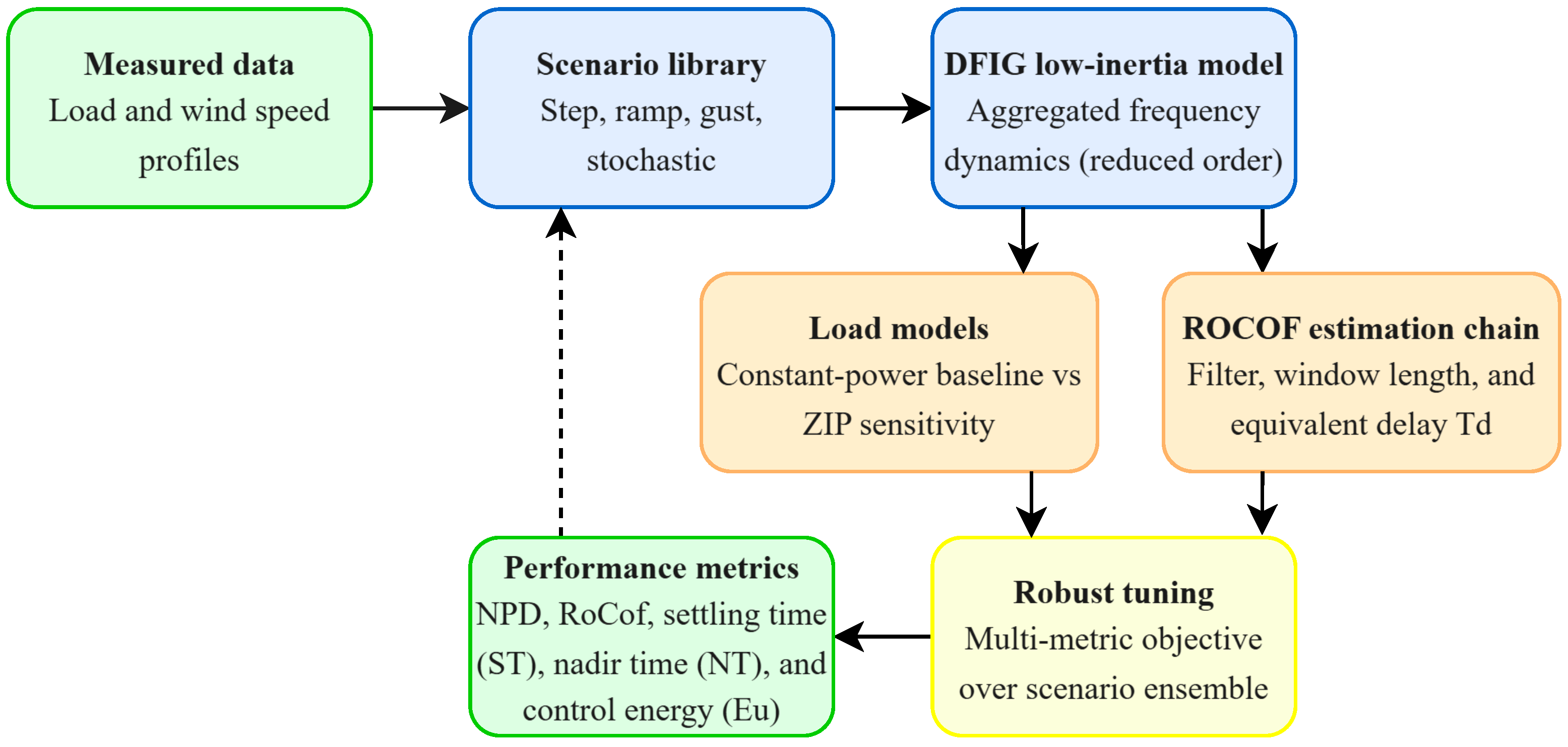
where A L ( s ) and A v ( s ) are scaling factors, G L ( s ) generates step, ramp, or stochastic load profiles, G v ( s ) generates constant, ramp, or gust-like wind profiles, and  Π [ 0 , 1 ] ( · ) is a saturation operator in per-unit power. This construction keeps the experiment reproducible while preserving the measured variability of the data. The overall scenario-building and assessment workflow is summarized in Figure 1.
The electrical load is represented using a constant-power baseline and a frequency-dependent active-load approximation inspired by ZIP-type aggregate behavior. Assuming that voltage variations are regulated around the nominal value, the active load model used in the frequency study is expressed as
P L , ZIP ( t , f ) = P L , 0 ( t ) 1 + k ZIP Δ f ( t ) , Δ f ( t ) = f ( t ) f 0 ,
where P L , 0 ( t ) is the scheduled or disturbed active load, f 0 is the nominal frequency, and  k ZIP is the aggregate frequency-sensitivity coefficient. The constant-power case is recovered with k ZIP = 0 . This compact formulation should be interpreted as a frequency-sensitive active-load approximation, rather than as a full voltage-dependent ZIP load model. It allows the same disturbance profile to be evaluated under different load-frequency sensitivities without changing the rest of the system model.

2.2. Reduced-Order DFIG Frequency-Support Model

The low-inertia system is modeled through an aggregated frequency state coupled with a first-order support actuator. Let the state vector be
x ( t ) = Δ f ( t ) p s ( t ) ,
where Δ f ( t ) is the frequency deviation and p s ( t ) is the active-power support delivered by the wind plant. The frequency dynamics are written in per-unit form as
Δ f ˙ ( t ) = f 0 2 H p s ( t ) + Δ P av ( t ) Δ P L , eff ( t ) D f Δ f ( t ) ,
where H is the equivalent inertia constant, D f is the aggregate damping coefficient, Δ P av ( t ) represents wind-availability variation around the operating point, and  Δ P L , eff ( t ) is the effective load disturbance after applying the selected load model. The support actuator is modeled as
p ˙ s ( t ) = 1 τ a p s ( t ) + 1 τ a Π [ 0 , R d ] K d Δ f d ( t ) + K i f ˙ ^ d ( t ) ,
where τ a is the actuator time constant, R d is the deloaded reserve, K d is the droop gain, K i is the synthetic-inertia gain, and the subscript d denotes delayed measurement signals. The saturation operator enforces the available support reserve, which prevents the controller from requesting more active power than can be supplied by the deloaded wind plant.
Equations (5) and (6) can be compactly expressed as the nonlinear state-space model
x ˙ ( t ) = F x ( t ) , u m ( t ) , w ( s ) ( t ) ; θ , y ( t ) = f ( t ) f ˙ ^ ( t ) p s ( t ) ,
where u m ( t ) contains the measured frequency and ROCOF signals, w ( s ) ( t ) = { Δ P L ( s ) ( t ) , P av ( s ) ( t ) } is the scenario input, and 
θ = K d K i τ f T w T d R d
is the tuning vector. This reduced-order representation was selected because it allows large scenario ensembles to be evaluated consistently while preserving the main interactions among inertia, droop support, ROCOF processing, load-frequency dependence, and reserve saturation.
The ROCOF signal is obtained from a measurement chain rather than from the exact derivative of the simulated frequency. The measured frequency is first filtered as
τ f f ˙ m ( t ) + f m ( t ) = f ( t ) ,
and then delayed by an equivalent time T d . Three ROCOF estimators are considered:
f ˙ ^ diff [ k ] = f m [ k ] f m [ k 1 ] T s ,
τ r f ˙ ^ filt [ k ] + f ˙ ^ filt [ k ] = f m [ k ] f m [ k 1 ] T s ,
and
f ˙ ^ win [ k ] = f m [ k ] f m [ k N w ] N w T s , N w = T w T s ,
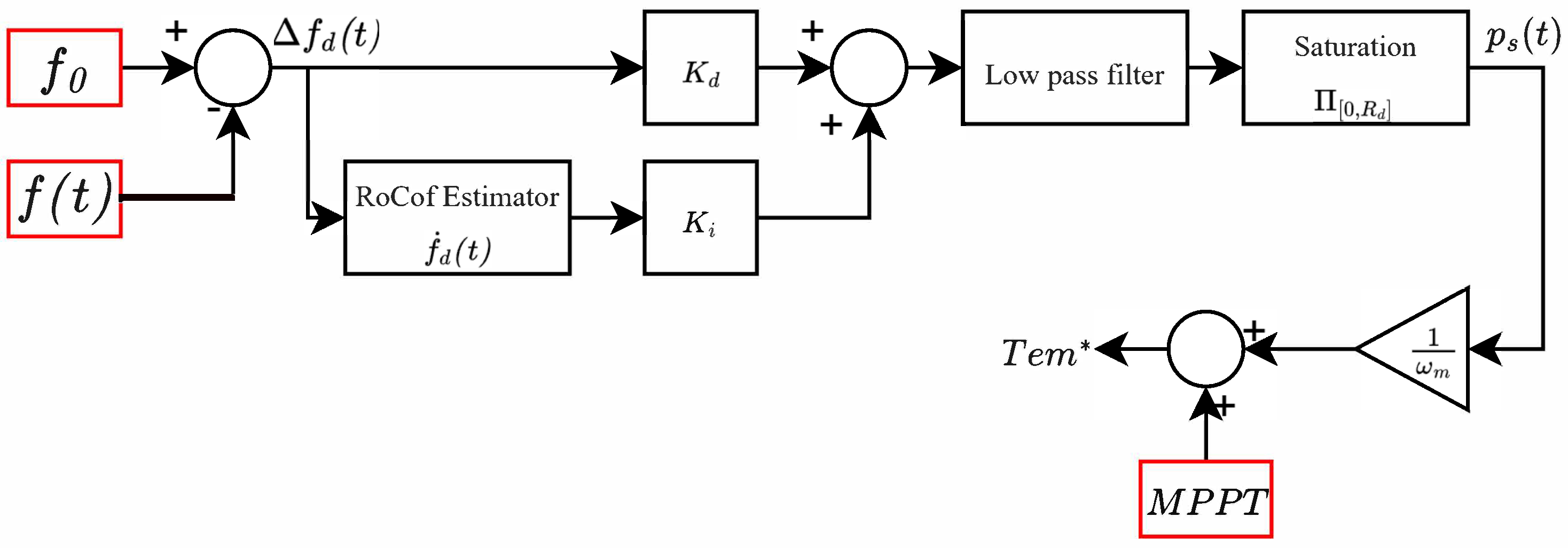
where T s is the simulation sampling time, τ r is the derivative-filter time constant, and  T w is the window length. These alternatives represent the fact that ROCOF is not a unique physical quantity once it is implemented as a sampled, filtered, or windowed signal. The same controller gains can therefore lead to different support actions depending on the estimator used. The different processing stages of the DFIG-based support controller are shown in Figure 2. The diagram includes the frequency measurement, filtering, ROCOF estimation, equivalent delay, droop and synthetic-inertia branches, reserve saturation, and active-power support injection.

2.3. Robust Tuning and Performance Assessment

For each scenario s S and tuning vector θ , the simulation returns a trajectory y ( s ) ( t ; θ ) from which the performance indicators are extracted. The nadir-point deviation, maximum ROCOF, settling-frequency deviation, settling time, nadir time, and control-energy index are defined as
NPD ( s ) ( θ ) = f 0 min t t e f ( s ) ( t ; θ ) ,
RoCoF ( s ) ( θ ) = max t [ t e , t e + T r ] f ˙ ^ ( s ) ( t ; θ ) ,
SFD ( s ) ( θ ) = f ss ( s ) ( θ ) f 0 , f ss ( s ) ( θ ) = 1 T tail T end T tail T end f ( s ) ( t ; θ ) d t ,
ST ( s ) ( θ ) = inf τ t e : f ( s ) ( t ; θ ) f ss ( s ) ( θ ) ε f , t τ t e ,
NT ( s ) ( θ ) = arg min t t e f ( s ) ( t ; θ ) t e , E u ( s ) ( θ ) = t e T end p s ( s ) ( t ; θ ) 2 d t ,
When the recovery criterion in (16) is not satisfied before the end of the simulation horizon, the settling time is reported as T end t e . Therefore, values equal to the maximum reported horizon should be interpreted as censored indicators rather than exact settling times.
The robust tuning problem is formulated as a normalized multi-metric minimization over the scenario ensemble:
θ = arg min θ Θ J ( θ ) , J ( θ ) = m M ω m R s S N m M m ( s ) ( θ ) + μ P ( θ ) ,
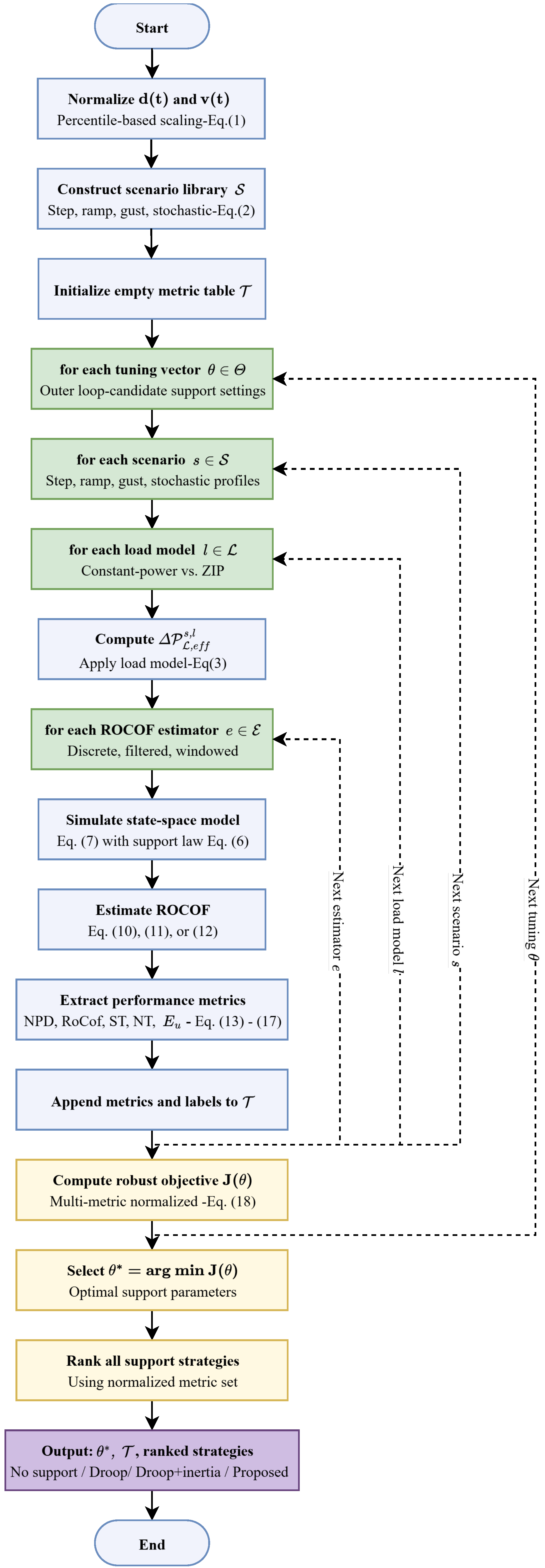
where M = { SFD , RoCoF , NPD , ST , NT , E u } is the metric set, M m ( s ) is the value of metric m in scenario s, ω m is its weight, N m ( · ) is a min–max normalization over the candidate set, and  R s S { · } is a robust aggregation operator, taken as the median or upper percentile depending on the comparison. The penalty P ( θ ) accounts for infeasible or saturated responses, and  Θ denotes the admissible range of controller and measurement-chain parameters. The same metric extraction and normalization procedure is applied to the baseline strategies, allowing the proposed tuning to be compared with no support, conventional droop, and conventional droop-plus-inertia support. The complete algorithmic workflow used to perform the data-driven and measurement-aware robust assessment is shown in Figure 3.
The computational procedure is summarized in Algorithm 1. The algorithm first constructs the scenario library from the measured data, then evaluates each candidate support configuration under all combinations of load profiles, load models, wind segments, ROCOF estimators, and delay settings. After extracting the metric set from every simulation, the robust objective is computed and the final ranking is obtained. This structure ensures that the selected support setting is not tuned to a single disturbance or to an idealized derivative of frequency.
Algorithm 1 Data-driven and measurement-aware robust frequency-support assessment
Input: Measured load d ( t ) , measured wind speed v ( t ) , admissible tuning set Θ , scenario set S , estimator set E , load-model set L
Output: Robust tuning θ , metric table T , ranked support strategies
  1:
Normalize d ( t ) and v ( t ) using percentile-based scaling in (1)
  2:
Construct S from step, ramp, stochastic, constant-wind, and gust scenarios using (2)
  3:
Initialize empty metric table T
  4:
for each tuning vector θ Θ  do
  5:
      for each scenario s S  do
  6:
            for each load model L  do
  7:
                  Compute Δ P L , eff ( s , ) ( t ) using (3)
  8:
                  for each ROCOF estimator e E  do
  9:
                        Simulate the state-space model (7) with the support law (6)
10:
                        Estimate ROCOF using (10), (11), or (12)
11:
                        Extract SFD , RoCoF , NPD , ST , NT , and  E u using (13)–(17)
12:
                        Append metrics and labels to T
13:
                  end for
14:
             end for
15:
      end for
16:
      Compute J ( θ ) from (18)
17:
end for
18:
Select θ = arg min θ Θ J ( θ )
19:
Rank all support strategies using the same normalized metric set
20:
return  θ , T , ranked support strategies

3. Results

3.1. Scenario Data and Assessment Workflow

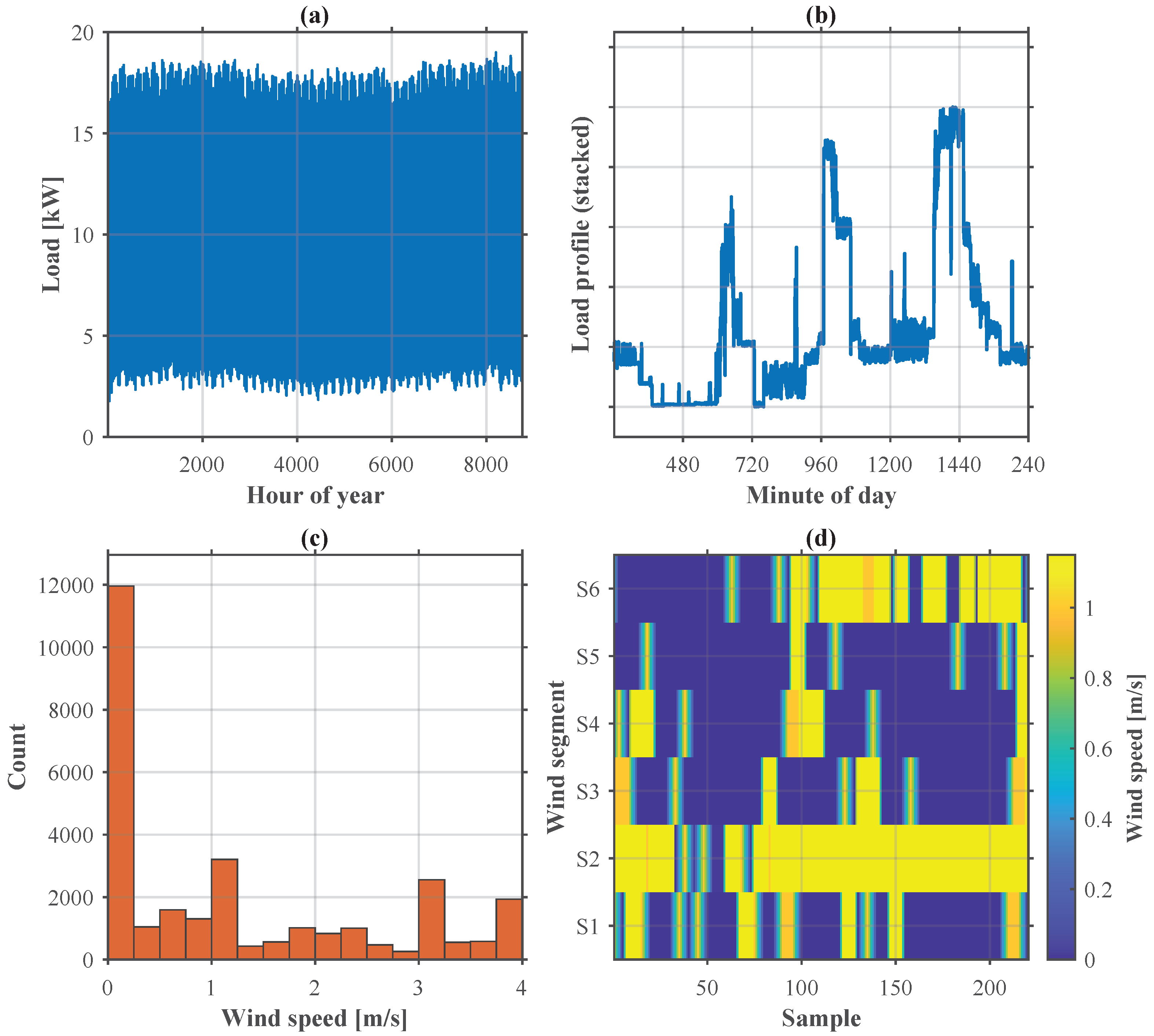
The simulation campaign was organized to evaluate whether the apparent performance of frequency-support tuning changes when the load representation and ROCOF estimation chain are modified. The measured profiles used to construct the scenario library are summarized in Figure 4 and Table 2. The annual load profile had a mean value of 8.83 kW, with a median of 7.91 kW and a 90th percentile of 16.32 kW. The wind-speed measurements showed a mean value of 2.64 m/s, with a strongly skewed distribution: the 10th percentile was 0 m/s and the 90th percentile reached 7.20 m/s. For this reason, the wind data were used to construct representative variability segments rather than being imposed directly as absolute wind-power injections. This avoided forcing unrealistic operating points in the reduced-order DFIG frequency model while preserving the measured temporal variability of the available dataset.
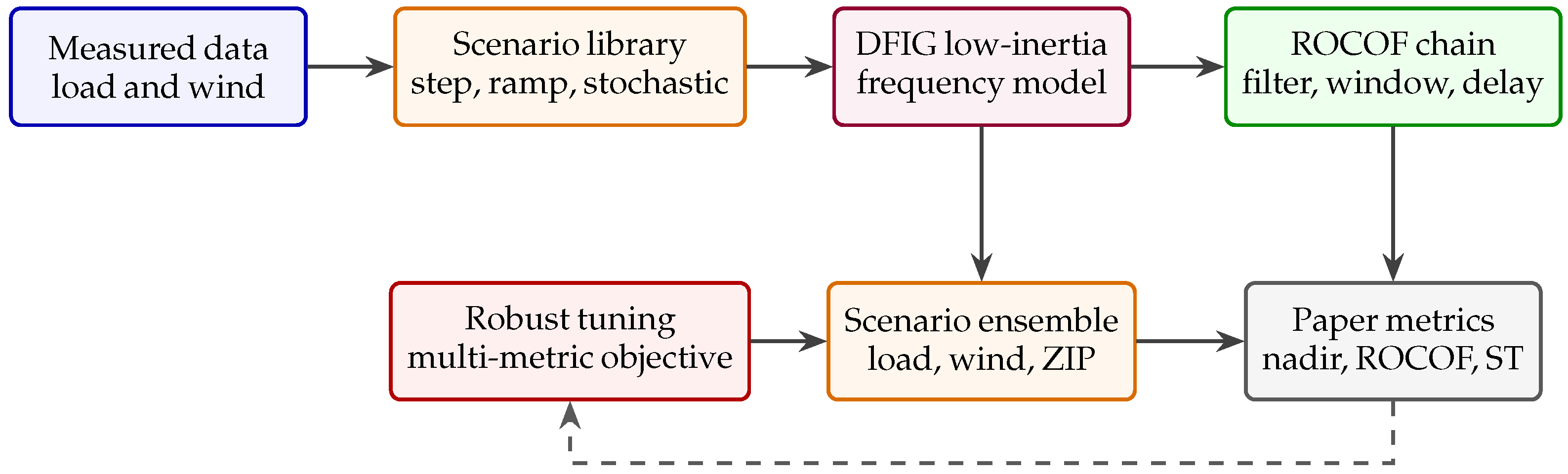
Figure 5 summarizes the computational workflow used in the study. The measured load and wind data are first transformed into a scenario library that combines step, ramp, and stochastic load profiles with representative wind variability. These scenarios are applied to a DFIG-based low-inertia frequency model with configurable frequency-support action. The measurement chain is explicitly represented through ROCOF estimation, filtering, windowing, and delay. The controller parameters are then assessed with a multi-metric objective that combines nadir-related performance, ROCOF, settling behavior, and support effort.

3.2. Robust Tuning and Ensemble Frequency Response

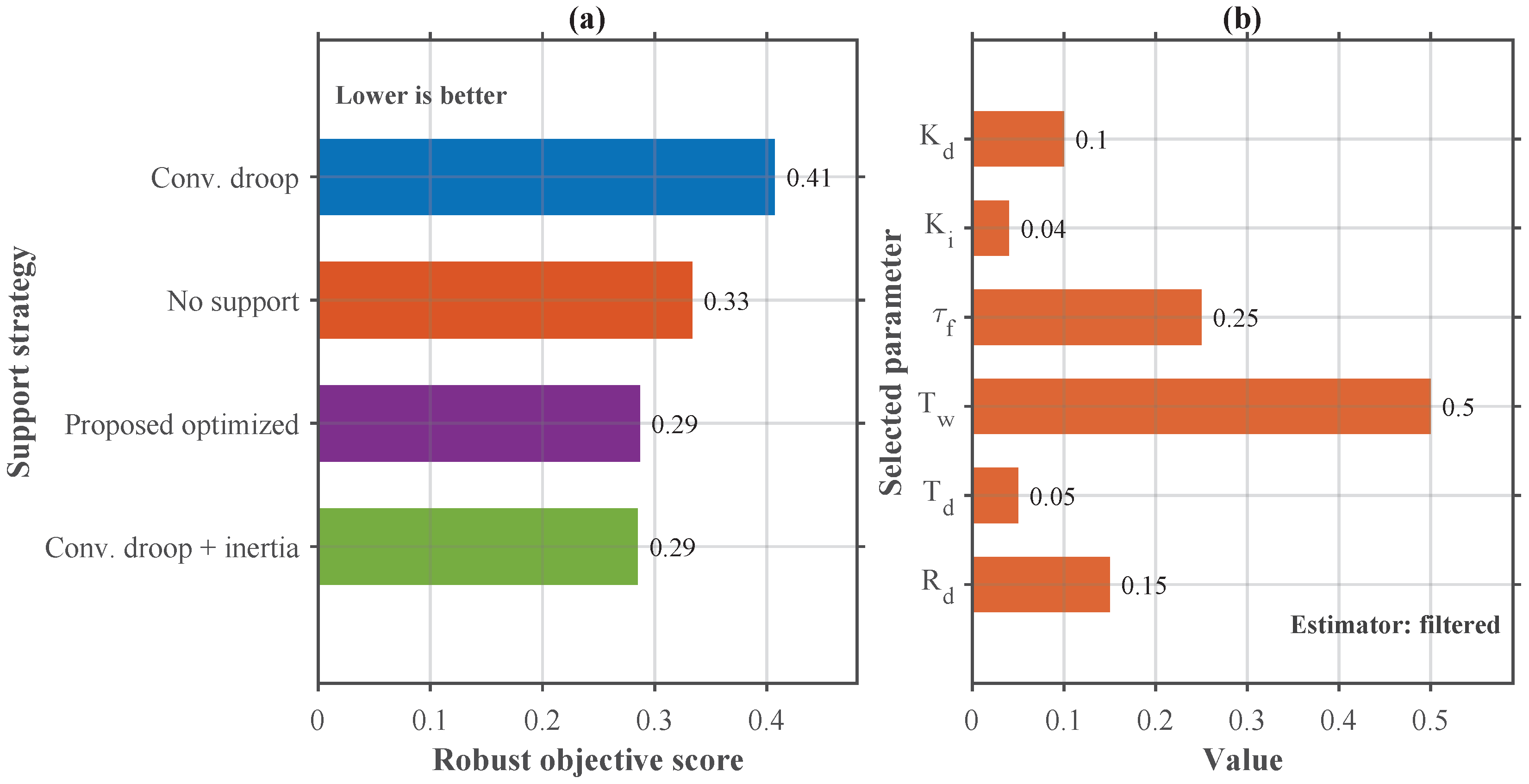
The robust tuning outcome is shown in Figure 6. The selected configuration used a droop gain of 0.10, an inertial gain of 0.04, a filtering time constant of 0.25 s, a ROCOF window of 0.50 s, an equivalent delay of 0.05 s, and a deloading reserve of 0.15 p.u. The objective scores indicate that the proposed optimized support and the conventional droop-plus-inertia case reached similar global performance, both below the no-support and conventional-droop alternatives. The result indicates that, within the explored parameter ranges, the relevant operating region is defined by the combined effect of droop action, ROCOF processing, delay, and reserve constraints, rather than by the inertial gain alone.
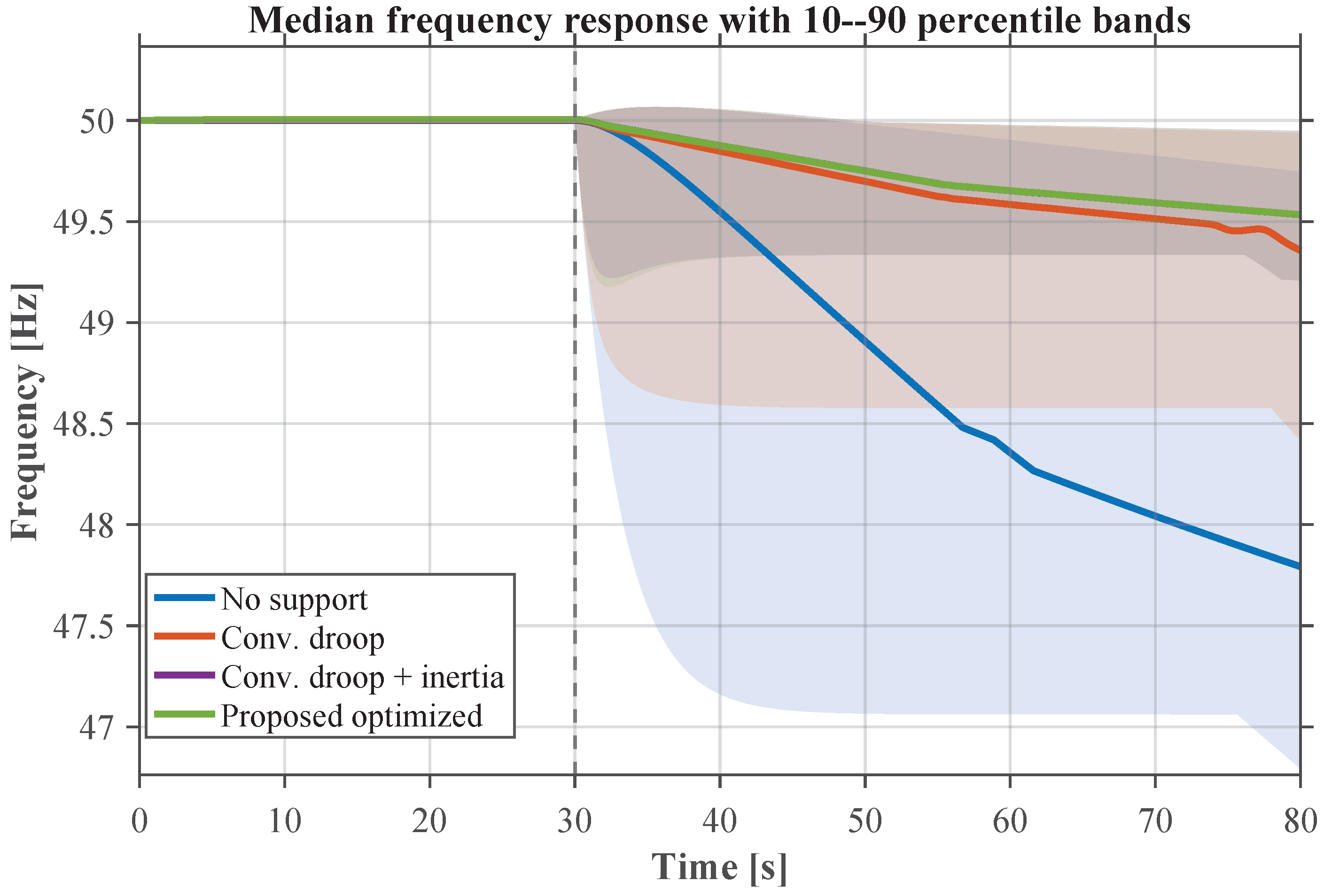
The ensemble frequency responses in Figure 7 confirm the same tendency. The no-support case exhibits the deepest frequency degradation and the widest percentile band after the disturbance. Conventional droop reduces the frequency excursion but remains more dispersed than the inertial-support cases. The droop-plus-inertia and proposed optimized strategies keep the median trajectory closer to nominal frequency, with narrower post-event bands. The main difference between these two controlled strategies is not a large change in median frequency, but the way in which the response is obtained under the selected measurement and actuation assumptions.
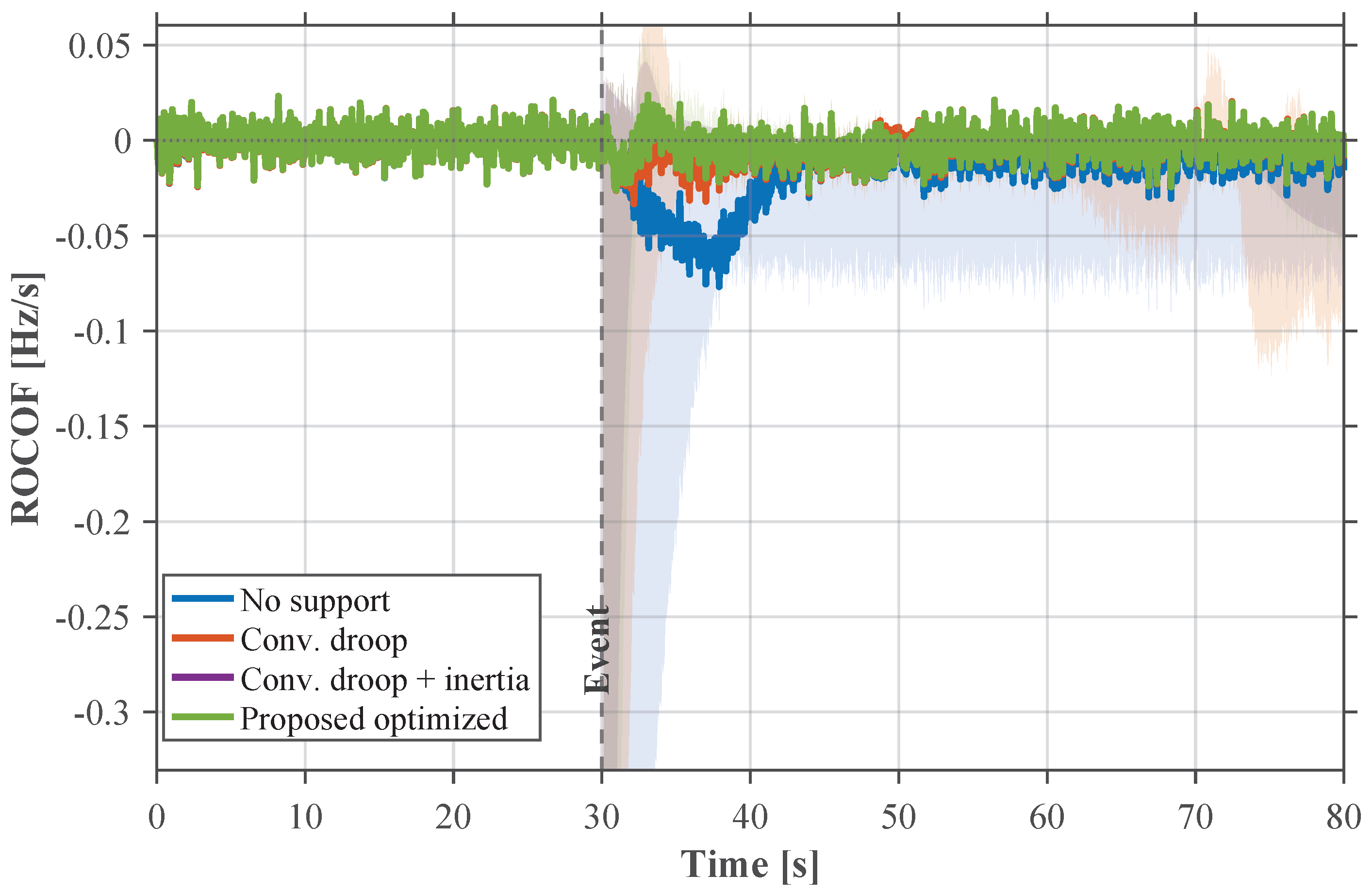
Figure 8 shows the corresponding ROCOF response. The no-support case presents the largest negative excursion and the widest lower percentile band. The supported strategies reduce the magnitude and duration of the ROCOF deviation. The proposed optimized setting remains close to the droop-plus-inertia response, which is consistent with the selected tuning. Therefore, the ROCOF-processing block should be treated as part of the controller design, rather than as a post-processing step used only for reporting frequency-security indicators.
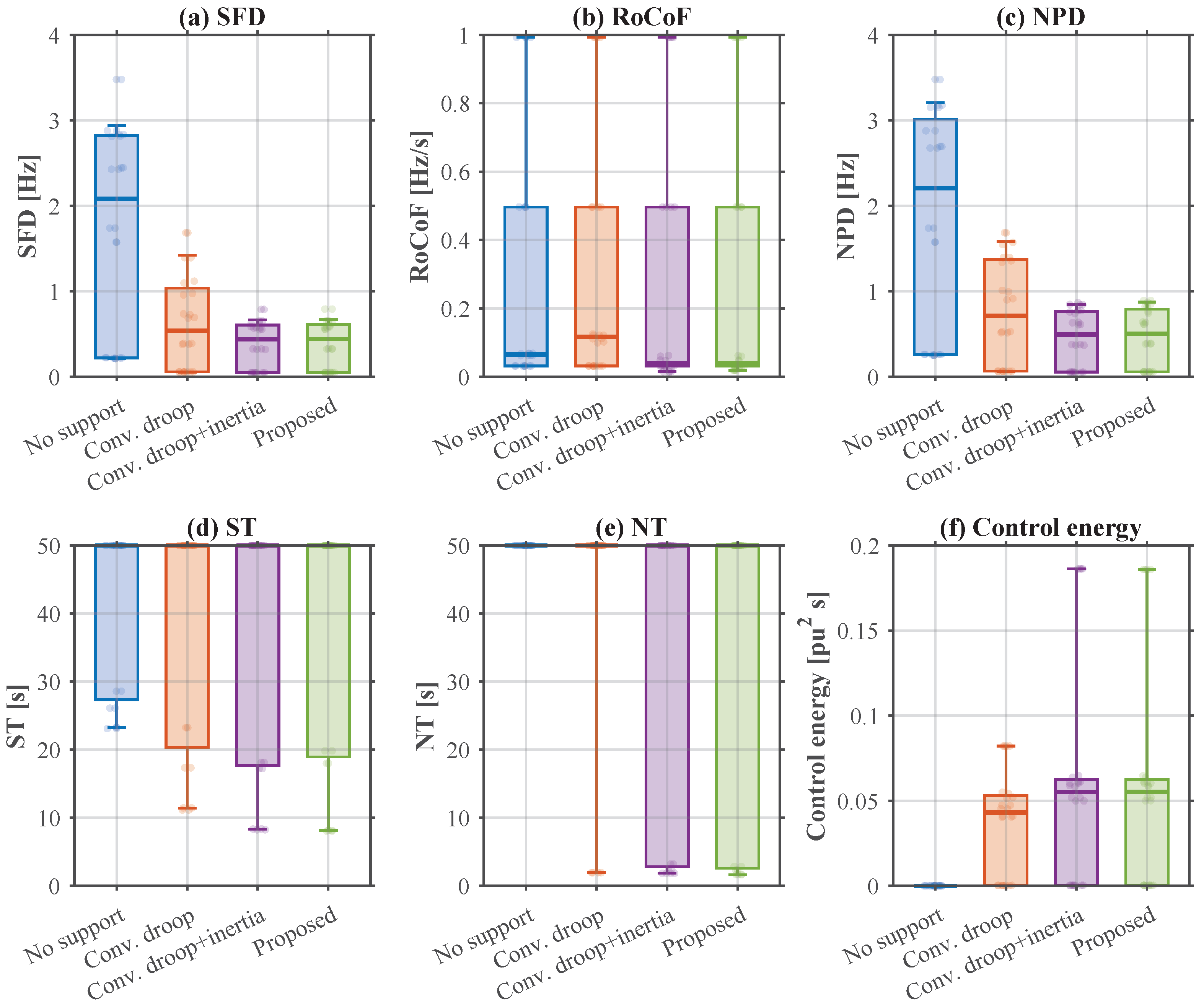
The distribution of the main indicators is shown in Figure 9. The no-support case has the largest dispersion in settling-frequency deviation and nadir-point deviation, which indicates high sensitivity to the load and wind scenarios. Conventional droop improves the nadir-related metrics, but it does not provide the best ROCOF behavior. Adding the inertial component reduces ROCOF and improves the nadir-related indicators, at the expense of higher support energy. The proposed optimized configuration behaves similarly to the droop-plus-inertia strategy in the central metrics, confirming that the selected parameters provide a balanced response rather than a dominant improvement in every single indicator.
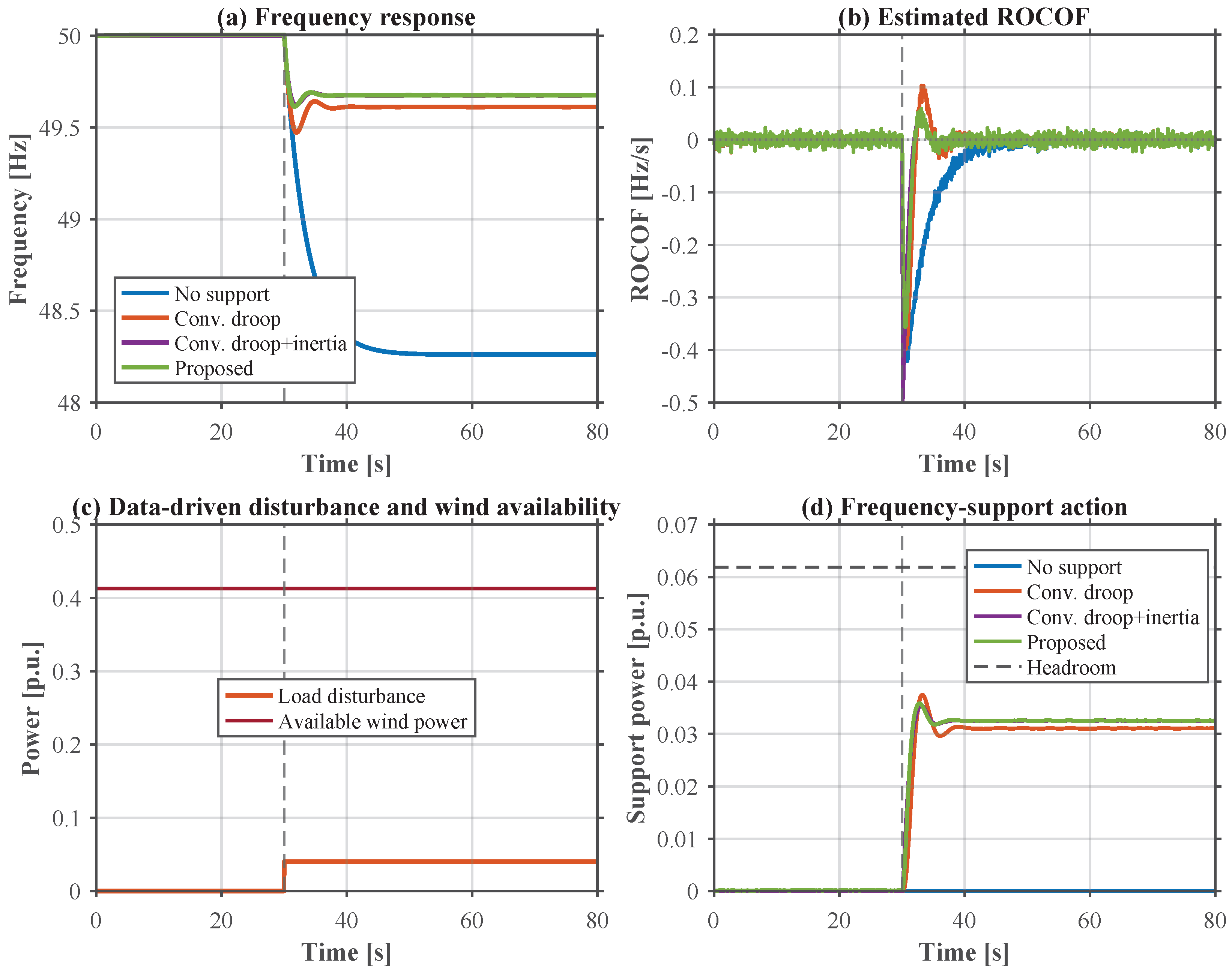
A representative event is reported in Figure 10. The uncontrolled case exhibits a rapid post-event frequency drop and settles far below the controlled responses. The droop-based cases arrest the frequency deviation shortly after the event, while the proposed configuration remains within the available headroom. The ROCOF panel shows that the largest excursion occurs immediately after the event, followed by a damped recovery. The load disturbance and available wind-power profiles confirm that the support action is activated under a bounded data-derived disturbance rather than under an arbitrary idealized input.

3.3. Sensitivity to Load Representation and ROCOF Estimation

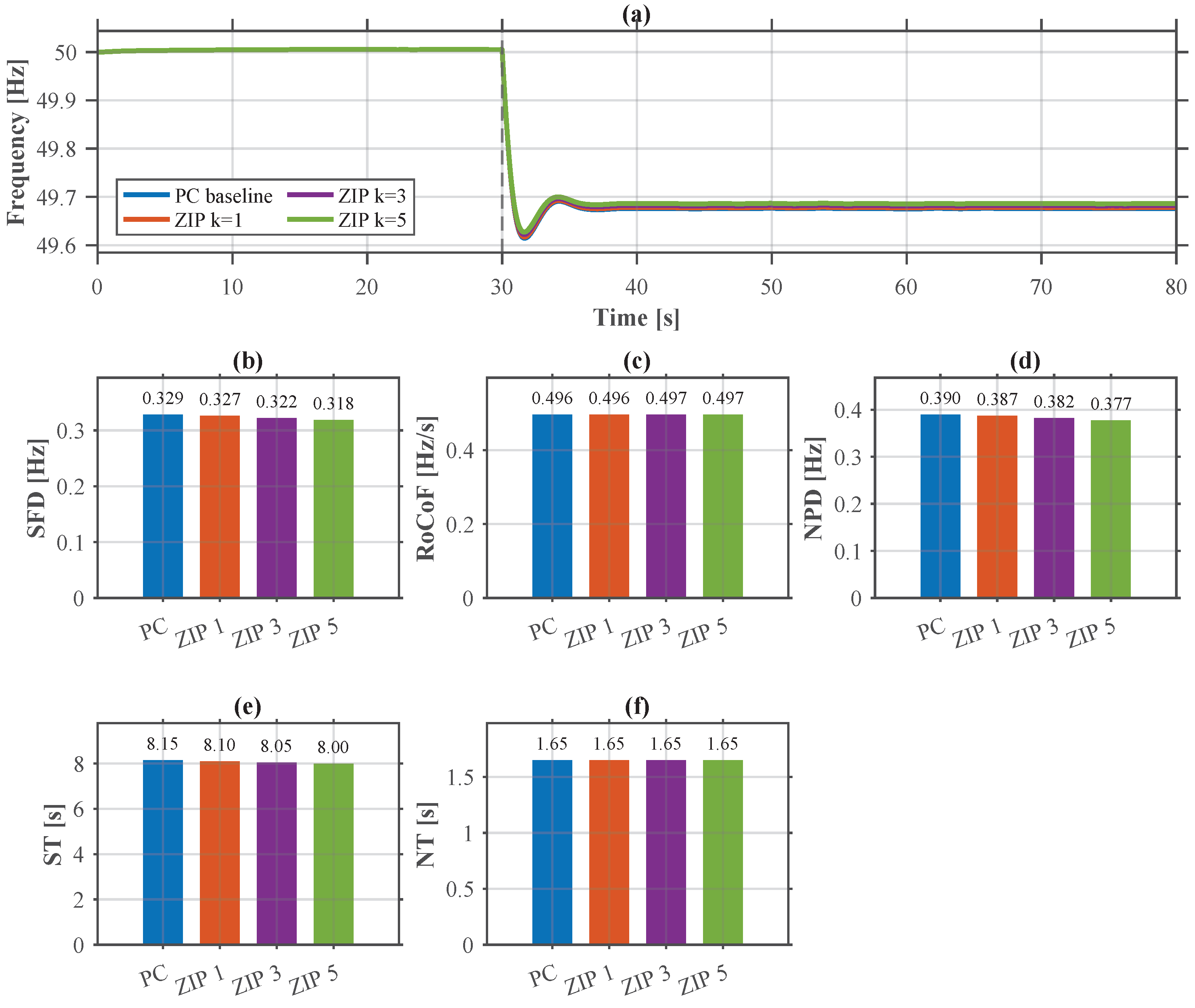
The following sensitivity tests correspond to representative events and are not directly comparable with the ensemble medians reported in Table 3. Replacing the constant-power load with ZIP load behavior slightly reduces the final frequency deviation and the nadir-point deviation. In the tested step scenario, the SFD decreases from 0.329 Hz in the constant-power baseline to 0.318 Hz for ZIP with k = 5 . The NPD decreases from 0.390 Hz to 0.377 Hz over the same range. The ROCOF remains almost unchanged, around 0.496–0.497 Hz/s, while the settling time decreases from 8.15 s to 8.00 s. These results indicate that, for this event, the load model mainly affects the depth and final offset of the frequency response rather than the initial rate of change. The sensitivity of the frequency response to the selected load representation is shown in Figure 11.
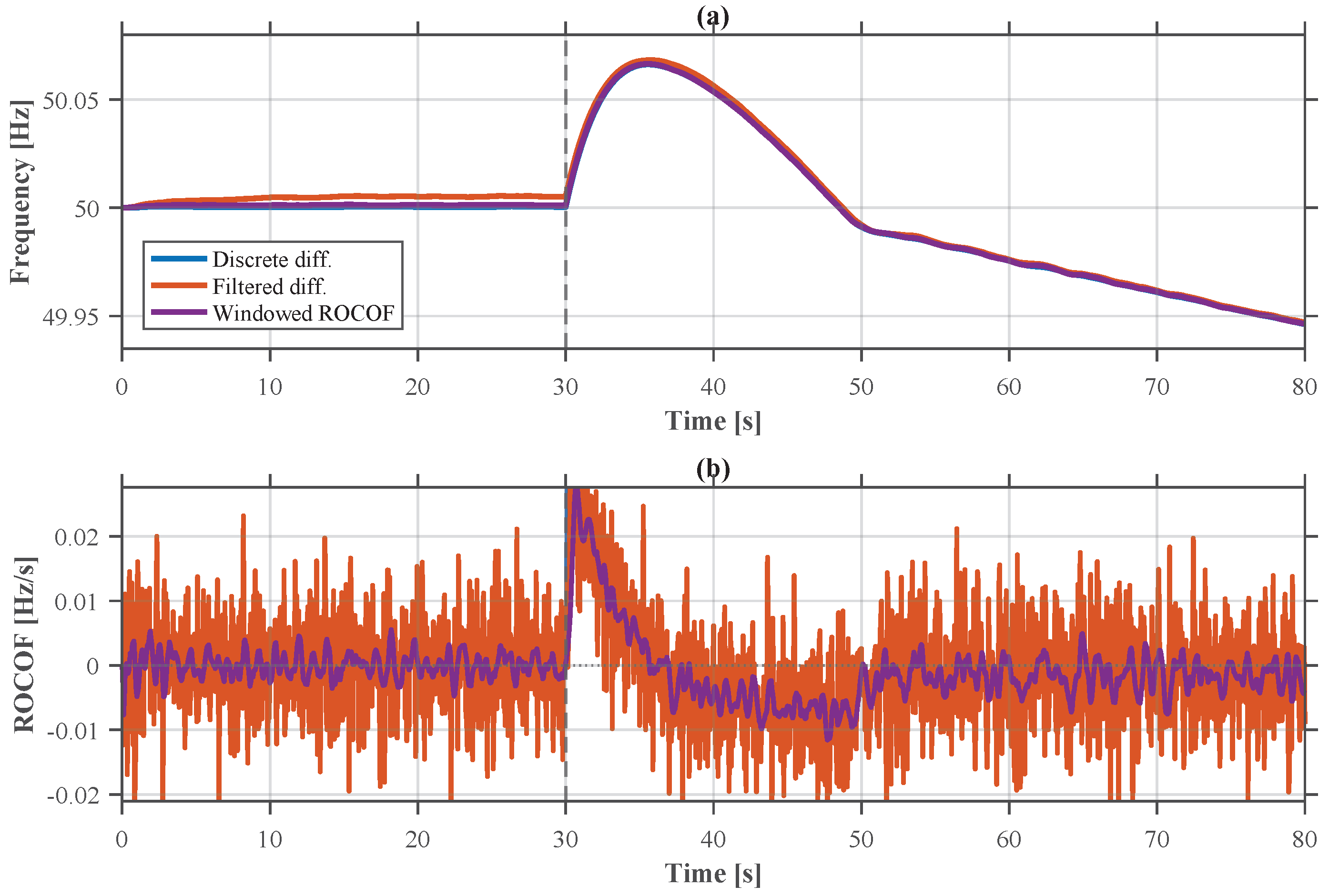
The influence of the ROCOF estimator is shown in Figure 12 and Table 4. The load-model sensitivity results are summarized in Table 5. The frequency trajectories are nearly identical because the same physical event is applied in all cases. The relevant difference appears in the estimated ROCOF signal: the discrete differentiator produces a noisier derivative, while the filtered and windowed alternatives smooth the response. The resulting indicators remain close, with NPD values between 0.054 Hz and 0.057 Hz and ROCOF values around 0.032 Hz/s. Although these differences are small in this representative case, they are relevant for controller tuning because the ROCOF signal can also be used as a feedback variable. A tuning assessed with an ideal or raw derivative may therefore not be equivalent to one assessed with a filtered or window-based implementation.
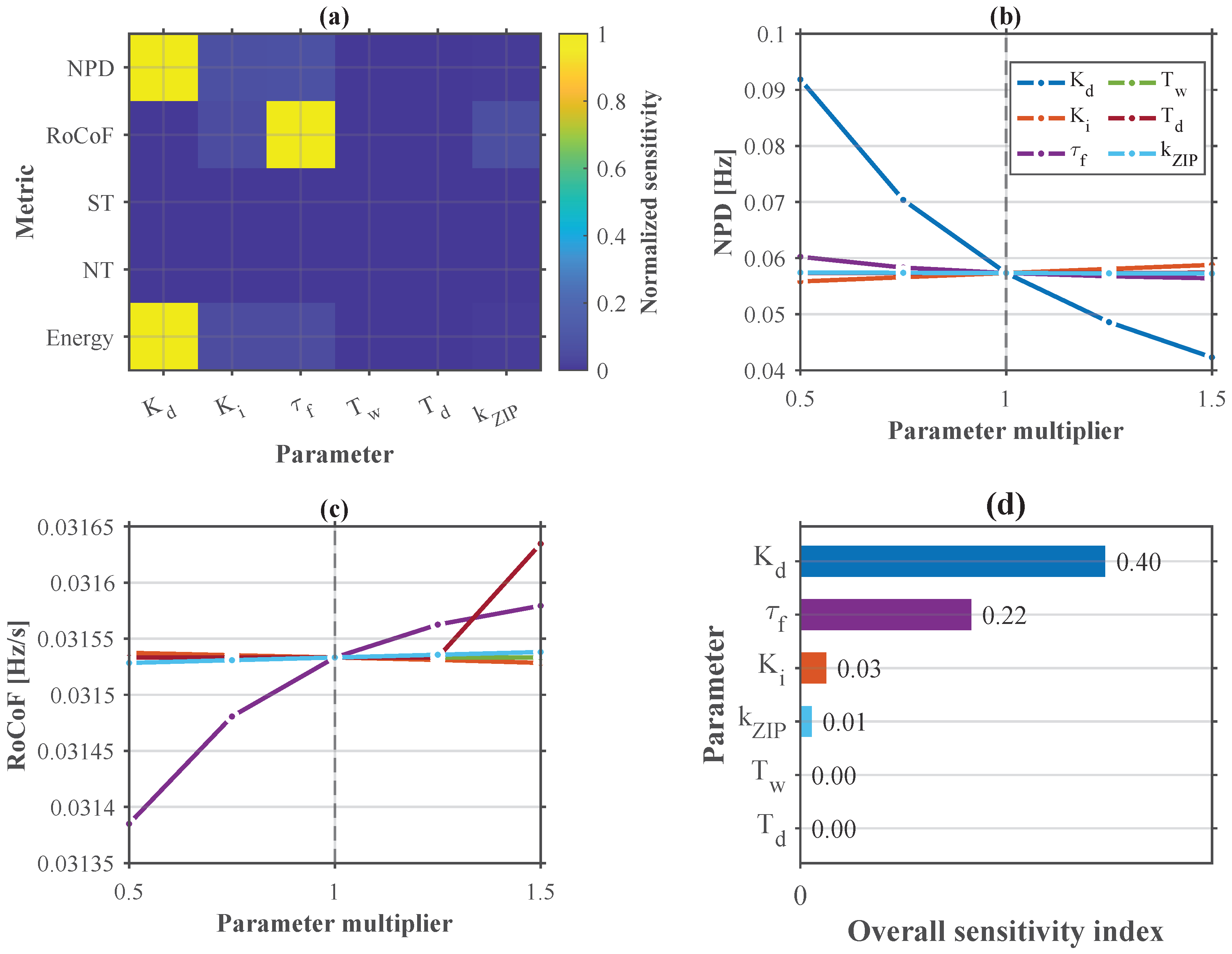
A complementary local sensitivity analysis around the selected robust setting is shown in Figure 13. The results indicate that the nadir-related indicators are mainly affected by the droop gain and the filtering time constant, while the remaining parameters have a smaller influence within the tested multiplier range. This analysis helps identify which controller and measurement-chain parameters have the largest effect on the reported robustness metrics.

3.4. Robustness Ranking and Synthesis

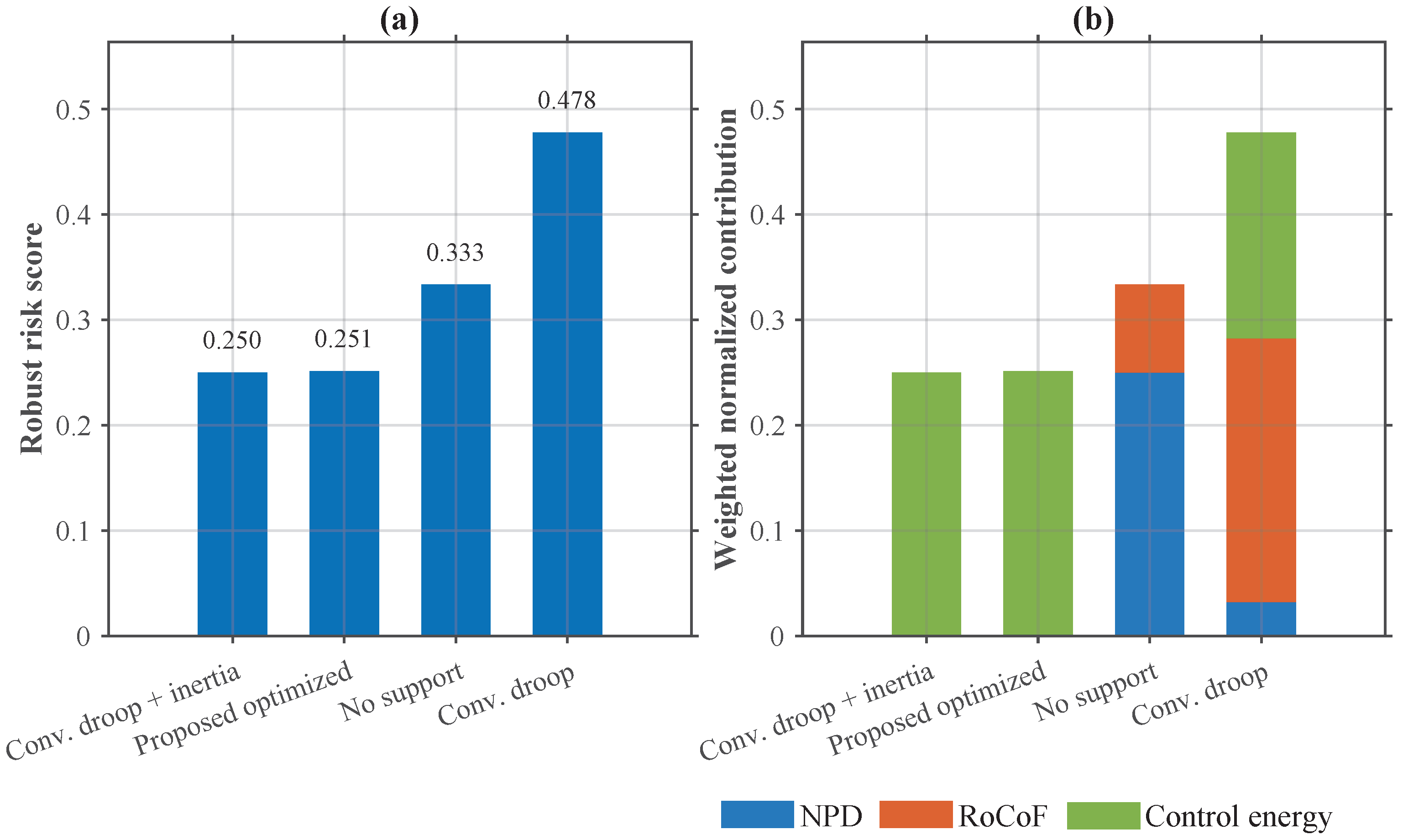
The final multi-metric ranking is summarized in Figure 14 and Table 6. The conventional droop-plus-inertia and proposed optimized strategies obtain nearly identical robust risk scores, 0.250 and 0.251, respectively. The no-support case reaches 0.333, while conventional droop gives the highest score, 0.478, because its improvement in nadir-related behavior is offset by a larger ROCOF contribution. The score decomposition confirms that no single metric determines the ranking. Control energy penalizes the inertial-support cases, while nadir-point deviation and ROCOF penalize the no-support and droop-only alternatives. The proposed configuration is therefore best interpreted as a measurement-aware robust compromise, rather than as a uniformly superior controller under every metric.
Overall, the results show that the relative quality of a frequency-support setting depends on the scenario representation and on the measurement chain used to estimate ROCOF. The load-model test shows that ZIP behavior changes the depth and final deviation of the frequency response, while the ROCOF-estimator test shows that the derivative signal is sensitive to filtering and windowing even when the frequency trajectories are similar. The ensemble results further show that a single nadir or ROCOF metric is insufficient to select a robust configuration. A balanced multi-metric assessment is needed, particularly when DFIG-based wind generation is expected to provide frequency support under low-inertia conditions.

4. Discussion

The results confirm that DFIG-based frequency support should be evaluated as a coupled control, load, and measurement problem. The comparison among the four support strategies shows that unsupported operation leads to the largest degradation in frequency nadir, whereas droop and droop-plus-inertia strategies substantially improve the post-event response. However, the droop-only case does not provide the most favorable ROCOF behavior, which indicates that nadir improvement alone is not a sufficient criterion for selecting frequency-support parameters. The inertial channel reduces the ROCOF-related indicators, but it also increases the control-energy requirement. This tradeoff explains why the proposed optimized configuration performs as a compromise rather than as a dominant solution in every metric.
The similarity between the conventional droop-plus-inertia case and the proposed optimized case deserves specific attention. Their close risk scores indicate that, under the selected scenario library and parameter ranges, the baseline droop-plus-inertia configuration is already near the best attainable region of the search space. This does not weaken the value of the proposed assessment framework. Instead, it shows that the robust ranking procedure can identify when an apparently more complex tuning does not provide a large additional benefit over a well-selected conventional configuration. In practical terms, this is relevant for system operators and plant controllers because it avoids over-interpreting small improvements obtained under a single disturbance or an ideal measurement assumption.
The load-model sensitivity results show that frequency-dependent load behavior modifies the final frequency deviation and the nadir-point deviation. Although the differences are moderate in the representative step event, they remain relevant because low-inertia systems operate with reduced dynamic margins. A support setting selected under a constant-power load assumption may therefore produce slightly different performance when the aggregate demand includes frequency-sensitive components. This result is consistent with the broader load-modeling literature, which has shown that static and dynamic load assumptions can alter frequency and stability conclusions. For this reason, the load model should be explicitly reported in DFIG frequency-support studies, particularly when numerical comparisons are used to justify a control strategy.
The ROCOF-estimator analysis further shows that the measurement chain can affect both the estimated indicator and the support signal used by the controller. The frequency trajectories obtained with the discrete, filtered, and windowed estimators remain similar in the representative case, but the estimated ROCOF signal changes with the processing method. This confirms that ROCOF should not be treated as an ideal derivative in studies where it is used as a feedback variable. The selected window length, filter time constant, and equivalent delay can affect the activation and magnitude of synthetic-inertia support. Consequently, controller comparisons based on ideal ROCOF may not transfer directly to realistic measurement implementations.
The proposed framework also has limitations. The DFIG plant is represented through a reduced-order frequency-support model rather than a detailed electromagnetic or switching model. This choice enables large scenario ensembles and transparent multi-metric comparisons, but it does not capture all converter-level, protection-level, or aerodynamic dynamics. The measured load and wind data are used to construct normalized scenario shapes, not to reproduce a specific grid or wind farm in full operational detail. In addition, the ZIP representation captures frequency sensitivity in a compact way, but it does not replace detailed composite load models when motor dynamics, voltage recovery, or distribution-network effects are central to the study. These limitations should be considered when transferring the results to plant-specific controller design.
Future work should extend the framework in three directions. First, the reduced-order DFIG model should be linked with a more detailed turbine and converter representation to assess rotor-speed recovery, pitch-control interaction, and saturation effects. Second, the load-model layer should include composite dynamic loads and voltage-dependent behavior so that the interaction between distribution-level demand and frequency support can be evaluated more completely. Third, the measurement-aware layer should be validated using phasor measurement unit data or hardware-in-the-loop emulation, especially for assessing delay, windowing, and noise effects in the ROCOF channel. These extensions would strengthen the practical relevance of the proposed robust assessment procedure.

5. Conclusions

This paper proposed a data-driven and measurement-aware framework for assessing frequency support in a DFIG-based low-inertia system under variable load and wind profiles. The framework combines measured-data scenario construction, a reduced-order frequency-support model, constant-power and ZIP load representations, ROCOF estimation alternatives, equivalent delay, and multi-metric robust ranking.
The results show that unsupported operation produces the largest degradation in frequency nadir, with a median nadir-point deviation of 2.208 Hz. Conventional droop reduces this value to 0.714 Hz, while conventional droop-plus-inertia and the proposed optimized configuration reach comparable values of 0.493 Hz and 0.502 Hz, respectively. The inclusion of the inertial channel also improves the ROCOF-related metric, reducing the median value to approximately 0.040 Hz/s. However, this improvement is accompanied by a higher support-energy requirement, confirming the need for a multi-metric evaluation instead of a single-indicator comparison.
The load-model sensitivity analysis shows that ZIP behavior modifies the depth and final offset of the frequency response. In the representative event, the final frequency deviation decreases from 0.329 Hz in the constant-power case to 0.318 Hz for the highest ZIP sensitivity considered. The ROCOF-estimator analysis shows that discrete, filtered, and windowed implementations can produce different estimated derivative signals even when frequency trajectories remain similar. These findings confirm that the apparent quality of DFIG frequency support depends not only on the support gains, but also on load representation and measurement processing.
The proposed framework provides a reproducible way to compare frequency-support strategies under measured-data-informed variability and realistic measurement assumptions. Its main value is to make explicit the dependence of tuning decisions on load models, ROCOF estimation, delay, reserve limits, and performance metrics. This is particularly important for low-inertia systems in which DFIG-based wind plants are expected to provide fast and reliable frequency support.


Author Contributions

Conceptualization, W.A.-B. and P.A.-C.; methodology, W.A.-B. and P.A.-C.; software, W.A.-B.; validation, W.A.-B. and P.A.-C.; formal analysis, W.A.-B.; investigation, W.A.-B.; resources, P.A.-C.; data curation, W.A.-B.; writing—original draft preparation, W.A.-B.; writing—review and editing, P.A.-C.; visualization, W.A.-B.; supervision, P.A.-C.; project administration, P.A.-C. All authors have read and agreed to the published version of the manuscript.

Funding

This research received no external funding.

Institutional Review Board Statement

Not applicable.

Informed Consent Statement

Not applicable.

Data Availability Statement

The data supporting the reported results are available from the corresponding author upon reasonable request.

Acknowledgments

The authors thank Universidad de Cuenca, Ecuador, for easing access to the facilities of the Micro-Grid Laboratory, Faculty of Engineering, for allowing the use of its equipment, and for providing technical support for the descriptive literature analysis included in this article. This article reports the findings of the project titled “Desarrollo de Herramientas Computacionales para la Gestión y Optimización de Microrredes Inteligentes”, winner of the “Convocatoria para la Aprobación y Financiamiento de Proyectos de Investigación Exclusiva para Docentes Contratados DIDE 2025–2026” of the Universidad Técnica de Ambato, Ecuador, and partially supported by the Vicerrectorado de Investigación e Innovación of the Universidad de Cuenca, Ecuador. This research work is part of the project titled “Innovative Solutions for Integrating Energy Communities into Active Distribution Networks (INNOVEC)“, with ref. PID2024-156036OB-C31, and its subproject titled “Optimal planning and operation of active distribution networks hosting energy communities (OptNetEC)“, supported by Ministerio de Ciencia, Innovación y Universidades, Agencia Estatal de Investigación, FEDER, UE (MCIU/AEI/10.13039/501100011033/FEDER, UE), within the Call for Knowledge Generation Projects (2024).

Conflicts of Interest

The authors declare no conflicts of interest.

Abbreviations

The following abbreviations are used in this manuscript:
DFIGDoubly fed induction generator
GSCGrid-side converter
MPPTMaximum power point tracking
NPDNadir-point deviation
NTNadir time
PCCPoint of common coupling
PMUPhasor measurement unit
p.u.Per unit
ROCOFRate of change of frequency
RSCRotor-side converter
SFDSettling frequency deviation
STSettling time
ZIPConstant impedance, constant current, and constant power load model

References

  1. Kundur, P. Power System Stability and Control; McGraw-Hill: Columbus, OH, USA, 1994. [Google Scholar]
  2. Sauer, P.W.; Pai, M.A. Power System Dynamics and Stability; Prentice Hall: Hoboken, NJ, USA, 1998. [Google Scholar]
  3. Ulbig, A.; Borsche, T.S.; Andersson, G. Impact of Low Rotational Inertia on Power System Stability and Operation. IFAC Proc. Vol. 2014, 47, 7290–7297. [Google Scholar] [CrossRef]
  4. Milano, F.; Dörfler, F.; Hug, G.; Hill, D.J.; Verbič, G. Foundations and Challenges of Low-Inertia Systems. In Proceedings of the 2018 Power Systems Computation Conference (PSCC), Dublin, Ireland, 11–15 June 2018; pp. 1–25. [Google Scholar] [CrossRef]
  5. Tielens, P.; Van Hertem, D. The Relevance of Inertia in Power Systems. Renew. Sustain. Energy Rev. 2016, 55, 999–1009. [Google Scholar] [CrossRef]
  6. Tamrakar, U.; Shrestha, D.; Maharjan, M.; Bhattarai, B.P.; Hansen, T.M.; Tonkoski, R. Virtual Inertia: Current Trends and Future Directions. Appl. Sci. 2017, 7, 654. [Google Scholar] [CrossRef]
  7. Fang, J.; Li, H.; Tang, Y.; Blaabjerg, F. On the Inertia of Future More-Electronics Power Systems. IEEE J. Emerg. Sel. Top. Power Electron. 2019, 7, 2130–2146. [Google Scholar] [CrossRef]
  8. Fernandez-Guillamon, A.; Gomez-Lazaro, E.; Muljadi, E.; Molina-Garcia, A. Power Systems with High Renewable Energy Sources: A Review of Inertia and Frequency Control Strategies over Time. Renew. Sustain. Energy Rev. 2019, 115, 109369. [Google Scholar] [CrossRef]
  9. He, C.; Geng, H.; Rajashekara, K.; Chandra, A. Analysis and Control of Frequency Stability in Low-Inertia Power Systems: A Review. IEEE/CAA J. Autom. Sin. 2024, 11, 2363–2383. [Google Scholar] [CrossRef]
  10. Ekanayake, J.; Jenkins, N. Comparison of the Response of Doubly Fed and Fixed-Speed Induction Generator Wind Turbines to Changes in Network Frequency. IEEE Trans. Energy Convers. 2004, 19, 800–802. [Google Scholar] [CrossRef]
  11. Morren, J.; de Haan, S.W.H.; Kling, W.L.; Ferreira, J.A. Wind Turbines Emulating Inertia and Supporting Primary Frequency Control. IEEE Trans. Power Syst. 2006, 21, 433–434. [Google Scholar] [CrossRef]
  12. Conroy, J.F.; Watson, R. Frequency Response Capability of Full Converter Wind Turbine Generators in Comparison to Conventional Generation. IEEE Trans. Power Syst. 2008, 23, 649–656. [Google Scholar] [CrossRef]
  13. Mauricio, J.M.; Marano, A.; Gómez-Expósito, A.; Martínez Ramos, J.L. Frequency Regulation Contribution Through Variable-Speed Wind Energy Conversion Systems. IEEE Trans. Power Syst. 2009, 24, 173–180. [Google Scholar] [CrossRef]
  14. Ullah, N.R.; Thiringer, T.; Karlsson, D. Temporary Primary Frequency Control Support by Variable Speed Wind Turbines—Potential and Applications. IEEE Trans. Power Syst. 2008, 23, 601–612. [Google Scholar] [CrossRef]
  15. Margaris, I.D.; Papathanassiou, S.A.; Hatziargyriou, N.D.; Hansen, A.D.; Sørensen, P. Frequency Control in Autonomous Power Systems with High Wind Power Penetration. IEEE Trans. Sustain. Energy 2012, 3, 189–199. [Google Scholar] [CrossRef]
  16. Wu, L.; Infield, D. Towards an Assessment of Power System Frequency Support from Wind Plant: Modeling Aggregate Inertial Response. IEEE Trans. Power Syst. 2013, 28, 2283–2291. [Google Scholar] [CrossRef]
  17. Vidyanandan, K.V.; Senroy, N. Primary Frequency Regulation by Deloaded Wind Turbines Using Variable Droop. IEEE Trans. Power Syst. 2013, 28, 837–846. [Google Scholar] [CrossRef]
  18. Muljadi, E.; Gevorgian, V.; Singh, M.; Santoso, S. Understanding Inertial and Frequency Response of Wind Power Plants. In Proceedings of the 2012 IEEE Power Electronics and Machines in Wind Applications, Denver, CO, USA, 16–18 July 2012; pp. 1–8. [Google Scholar] [CrossRef]
  19. Aziz, A.; Than Oo, A.M.; Stojcevski, A. Frequency Regulation Capabilities in Wind Power Plant. Sustain. Energy Technol. Assess. 2018, 26, 47–76. [Google Scholar] [CrossRef]
  20. Ghosh, S.; Kamalasadan, S.; Senroy, N.; Enslin, J. Doubly Fed Induction Generator (DFIG)-Based Wind Farm Control Framework for Primary Frequency and Inertial Response Application. IEEE Trans. Power Syst. 2016, 31, 1861–1871. [Google Scholar] [CrossRef]
  21. Ochoa, D.; Martinez, S. Fast-Frequency Response Provided by DFIG-Wind Turbines and Its Impact on the Grid. IEEE Trans. Power Syst. 2017, 32, 4002–4011. [Google Scholar] [CrossRef]
  22. Yang, D.; Kim, J.; Kang, Y.C.; Muljadi, E.; Zhang, N.; Hong, J.; Song, S.H.; Zheng, T. Temporary Frequency Support of a DFIG for High Wind Power Penetration. IEEE Trans. Power Syst. 2018, 33, 3428–3437. [Google Scholar] [CrossRef]
  23. Attya, A.B.T.; Dominguez-Garcia, J.L.; Anaya-Lara, O. Frequency Support Using Doubly Fed Induction and Reluctance Wind Turbine Generators. Int. J. Electr. Power Energy Syst. 2018, 101, 403–414. [Google Scholar] [CrossRef]
  24. Ruttledge, L.; Flynn, D. Emulated Inertial Response from Wind Turbines: Gain Scheduling and Resource Coordination. IEEE Trans. Power Syst. 2016, 31, 3747–3755. [Google Scholar] [CrossRef]
  25. Asad, M.; Sánchez-Fernández, J.Á. Frequency Regulation Provided by Doubly Fed Induction Generator Based Variable-Speed Wind Turbines Using Inertial Emulation and Droop Control in Hybrid Wind–Diesel Power Systems. Appl. Sci. 2025, 15, 5633. [Google Scholar] [CrossRef]
  26. Barrueto, A.; Fuentes, C.; Chavez, H.; Barbosa, K.; Ramirez-Gonzalez, M. Structure-Constrained Output Feedback Synthetic Inertia Decentralized Control for Two Area Power System. Int. J. Electr. Power Energy Syst. 2025, 173, 111440. [Google Scholar] [CrossRef]
  27. Arif, A.; Wang, Z.; Wang, J.; Mather, B.; Bashualdo, H.; Zhao, D. Load Modeling—A Review. IEEE Trans. Smart Grid 2018, 9, 5986–5999. [Google Scholar] [CrossRef]
  28. Ahmadyar, A.S.; Riaz, S.; Verbič, G.; Chapman, A.; Hill, D.J. A Framework for Assessing Renewable Integration Limits with Respect to Frequency Performance. IEEE Trans. Power Syst. 2018, 33, 4444–4453. [Google Scholar] [CrossRef]
  29. Adrees, A.; Milanovic, J.V. Effect of Load Models on Angular and Frequency Stability of Low Inertia Power Networks. IET Gener. Transm. Distrib. 2019, 13, 1520–1526. [Google Scholar] [CrossRef]
  30. Bokhari, A.; Alkan, A.; Dogan, R.; Diaz-Aguilo, M.; de Leon, F.; Czarkowski, D.; Zabar, Z.; Birenbaum, L.; Noel, A.; Uosef, R.E. Experimental Determination of the ZIP Coefficients for Modern Residential, Commercial, and Industrial Loads. IEEE Trans. Power Deliv. 2014, 29, 1372–1381. [Google Scholar] [CrossRef]
  31. Pasiopoulou, I.D.; Kontis, E.O.; Papadopoulos, T.A.; Papagiannis, G.K. Effect of Load Modeling on Power System Stability Studies. Electr. Power Syst. Res. 2022, 207, 107846. [Google Scholar] [CrossRef]
  32. Tofighi-Milani, M.; Fattaheian-Dehkordi, S.; Lehtonen, M. Investigating the Impact of Electrical Load Types on the Frequency Response of Low Inertia Power Systems. IEEE Access 2024, 12, 59771–59781. [Google Scholar] [CrossRef]
  33. Ortega, A.; Milano, F. Impact of Frequency Estimation for VSC-Based Devices with Primary Frequency Control. In Proceedings of the 2017 IEEE PES Innovative Smart Grid Technologies Conference Europe (ISGT-Europe), Turin, Italy, 26–29 September 2017; pp. 1–6. [Google Scholar] [CrossRef]
  34. Frigo, G.; Derviškadić, A.; Paolone, M. PMU-Based ROCOF Measurements: Uncertainty Limits and Metrological Significance in Power System Applications. IEEE Trans. Instrum. Meas. 2019, 68, 3810–3822. [Google Scholar] [CrossRef]
  35. Deng, X.; Geng, H.; Yang, G.; Chandra, A. Review of RoCoF Estimation Techniques for Low-Inertia Power Systems. Energies 2023, 16, 3708. [Google Scholar] [CrossRef]
  36. Andiç, C. Real-Time Inertia Estimation and Adaptive-Model-Predictive-Control-Based Virtual Inertia Support for Frequency Control in Low-Inertia Systems. Appl. Sci. 2026, 16, 2161. [Google Scholar] [CrossRef]
  37. Abouyehia, M.; Egea-Àlvarez, A.; Ahmed, K.H. Evaluating Inertia Estimation Methods in Low-Inertia Power Systems. Renew. Sustain. Energy Rev. 2025, 217, 115794. [Google Scholar] [CrossRef]
  38. Marchi, P.; Gill Estevez, P.; Otero, A.; Galarza, C. Estimation of the Plant Controller Communication Time-Delay Considering PMSG-Based Wind Turbines. arXiv 2024, arXiv:2412.01751. [Google Scholar] [CrossRef]
  39. Marchi, P.; Gill Estevez, P.; Otero, A.; Galarza, C. Communication Delay Estimation for Wind Power Plant Controllers Based on PMU Measurements. Int. J. Electr. Power Energy Syst. 2025, 172, 111228. [Google Scholar] [CrossRef]
  40. Miller, N.W.; Shao, M.; Pajic, S.; D’Aquila, R. Eastern Frequency Response Study; Technical report; National Renewable Energy Laboratory: Golden, CO, USA, 2013. [Google Scholar]
  41. Sørensen, P.; Cutululis, N.A.; Vigueras-Rodríguez, A.; Jensen, L.E.; Hjerrild, J.; Donovan, M.H.; Madsen, H. Power Fluctuations from Large Wind Farms. IEEE Trans. Power Syst. 2007, 22, 958–965. [Google Scholar] [CrossRef]
  42. Gautam, D.; Vittal, V.; Harbour, T. Impact of Increased Penetration of DFIG-Based Wind Turbine Generators on Transient and Small Signal Stability of Power Systems. IEEE Trans. Power Syst. 2009, 24, 1426–1434. [Google Scholar] [CrossRef]
Figure 1. Methodological workflow used to construct the data-driven scenario library and evaluate measurement-aware frequency-support tuning.
Electronics 15 02407 g001
Figure 2. Control diagram of the DFIG-based frequency-support loop, including frequency measurement, filtering, ROCOF estimation, communication delay, droop action, synthetic-inertia response, reserve limitation, and active-power support injection.
Electronics 15 02407 g002
Figure 3. Algorithmic workflow for the data-driven and measurement-aware robust frequency-support assessment.
Electronics 15 02407 g003
Figure 4. Measured data used to construct the scenario library. (a) Annual load profile. (b) Representative daily load profile. (c) Wind-speed distribution. (d) Selected wind-speed segments.
Electronics 15 02407 g004
Figure 5. Simulation and assessment framework used to evaluate data-driven and measurement-aware frequency support.

Electronics 15 02407 g005
Figure 6. Robust-support selection. (a) Robust objective score by support strategy. (b) Selected robust-support parameters.
Electronics 15 02407 g006
Figure 7. Median frequency response with 10–90 percentile bands for the evaluated scenario ensemble.
Electronics 15 02407 g007
Figure 8. Median ROCOF response with 10–90 percentile bands for the evaluated scenario ensemble.
Electronics 15 02407 g008
Figure 9. Distribution of performance indicators over the scenario ensemble. (a) Settling frequency deviation. (b) ROCOF. (c) Nadir-point deviation. (d) Settling time. (e) Nadir time. (f) Control energy.
Electronics 15 02407 g009
Figure 10. Representative frequency event. (a) Frequency response. (b) Estimated ROCOF. (c) Data-driven load disturbance and available wind power. (d) Frequency-support action.
Electronics 15 02407 g010
Figure 11. Sensitivity to the load model. (a) Frequency response for constant-power and ZIP load cases. (b) Settling frequency deviation. (c) ROCOF. (d) Nadir-point deviation. (e) Settling time. (f) Nadir time.
Electronics 15 02407 g011
Figure 12. Effect of the ROCOF estimation method on the representative scenario. (a) Frequency response. (b) Estimated ROCOF response.
Electronics 15 02407 g012
Figure 13. Local parameter-sensitivity analysis around the selected robust setting. (a) Normalized sensitivity map by metric and parameter. (b) NPD variation under parameter multipliers. (c) ROCOF variation under parameter multipliers. (d) Overall sensitivity index.
Electronics 15 02407 g013
Figure 14. Multi-metric robustness assessment. (a) Robust risk score by support strategy. (b) Score decomposition by normalized metric contribution.
Electronics 15 02407 g014
Table 1. Focused comparison with representative closely related studies.
StudyWind SupportLoad ModelROCOF ChainData ProfilesRanking
Ghosh et al. [20]
Ochoa and Martinez [21]
Yang et al. [22]
Tofighi-Milani et al. [32]
Frigo et al. [34]
This work
Table 2. Summary of the measured input data used to construct the simulation scenarios.
QuantityValue
Yearly load mean [kW]8.83
Yearly load P10 [kW]3.15
Yearly load P50 [kW]7.91
Yearly load P90 [kW]16.32
Wind-speed mean [m/s]2.64
Wind-speed P10 [m/s]0.00
Wind-speed P90 [m/s]7.20
Table 3. Median performance over the scenario ensemble.
Support StrategyNPD [Hz]RoCoF [Hz/s]ST [s]Control Energy [p.u.2s]
No support2.2080.06550.00.000
Conventional droop0.7140.11650.00.043
Conventional droop + inertia0.4930.04050.00.055
Proposed optimized0.5020.04050.00.055
Table 4. Sensitivity to the ROCOF estimation method.
EstimatorSFD [Hz]RoCoF [Hz/s]NPD [Hz]ST [s]NT [s]
Discrete differentiator0.0470.0320.05450.050.0
Filtered differentiator0.0500.0320.05750.050.0
Windowed ROCOF0.0480.0320.05550.050.0
Table 5. Load-model sensitivity under the representative step event.
CaseSFD [Hz]RoCoF [Hz/s]NPD [Hz]ST [s]NT [s]
PC baseline0.3290.4960.3908.151.65
ZIP k = 1 0.3270.4960.3878.101.65
ZIP k = 3 0.3220.4970.3828.051.65
ZIP k = 5 0.3180.4970.3778.001.65
Table 6. Robustness ranking and median performance indicators over the scenario ensemble.
StrategyRisk ScoreNPD [Hz]RoCoF [Hz/s]ST [s]Energy [p.u.2s]
Conv. droop + inertia0.2500.4930.04050.00.055
Proposed optimized0.2510.5020.04050.00.055
No support0.3332.2080.06550.00.000
Conv. droop0.4780.7140.11650.00.043
Disclaimer/Publisher’s Note: The statements, opinions and data contained in all publications are solely those of the individual author(s) and contributor(s) and not of MDPI and/or the editor(s). MDPI and/or the editor(s) disclaim responsibility for any injury to people or property resulting from any ideas, methods, instructions or products referred to in the content.