1. Introduction
The global transformation of the energy sector is accompanied by a steady transition from centralized generation to distributed energy systems, in which energy production and consumption are converged at the end-user level. Recent research shows that this architecture improves energy supply resilience, reduces grid losses, and facilitates the integration of renewable energy sources into local building and small facility networks [
1]. Local renewable-based systems are of particular interest for residential buildings, as they reduce dependence on the external power grid, increase power reliability during outages, and reduce operating costs. A review of modern residential microgrids notes that the building sector is becoming one of the key consumers of intelligent energy-management systems in the coming decade [
2]. Small wind turbines occupy an important place among local renewable energy sources. Unlike solar generation, wind systems are capable of producing electricity in the evening and night hours, making them particularly valuable for covering household loads outside of the daytime. Research on the use of small wind turbines in residential hybrid systems confirms the high potential of such solutions when the operating mode is properly selected [
3]. An additional advantage of small wind energy systems is the ability to operate in conjunction with photovoltaic panels and battery storage. A study on hybrid renewable systems for buildings demonstrated that combining wind and solar generation can significantly reduce seasonal fluctuations in power generation and increase the facility’s autonomy [
4].
However, the practical efficiency of a small wind turbine is determined not only by the turbine’s aerodynamics but also by the quality of energy-flow management between the generator, battery, load, and the external grid. According to modern research on energy-management systems, supervisory control is increasingly becoming the dominant factor in overall system efficiency in distributed generation architectures [
5]. For residential systems, the control task is complicated by high load variability. The residential energy consumption profile is characterized by pronounced morning and evening peaks, stochastic short-term load switching, and variations between weekdays and weekends. A study on smart household demand response showed that ignoring the dynamics of household demand significantly reduces the efficiency of local renewable systems [
6]. An equally significant problem is the variable nature of the wind resource. Wind speed varies over time and depends on local topography, building density, and turbulence. Work on stochastic wind-resource modeling for small installations shows that the use of static assumptions about the wind regime leads to an overestimation of expected generation and an incorrect selection of system parameters [
7]. For this reason, modern publications are increasingly focusing on battery energy storage systems. The battery acts as a buffer between generation and load, allowing for the compensation of short-term power dips and the transfer of excess energy to periods of increased demand. A review of battery-integrated renewable systems emphasizes that the storage subsystem is often the key determinant of practical autonomy in small-scale energy systems [
8]. At the same time, irrational use of the battery can lead to accelerated aging, increased cycling depth, and an increase in the cost of system ownership. A study on battery management in residential microgrids shows that even a moderate reduction in the number of deep cycles significantly extends the battery life [
9]. Therefore, modern control algorithms must consider not only the current energy balance but also the battery’s state of charge, acceptable operating conditions, and long-term service life. A number of recent studies consider battery-aware control as a mandatory element of advanced energy-management architectures [
10].
The development of distributed energy has received additional impetus from Internet of Things (IoT) technologies. The IoT approach enables continuous data collection, remote monitoring, cloud analytics, and the ability to adaptively update control algorithms. A study on IoT-enabled smart energy platforms demonstrated that digital infrastructure can significantly improve the observability and manageability of distributed energy systems [
11]. This is especially important for small wind turbines since such facilities often operate without the constant presence of maintenance personnel. Practical work on remote monitoring of small wind turbines demonstrated that low-cost IoT architectures can successfully replace expensive proprietary SCADA solutions in compact applications [
12]. However, in most reported IoT-based architectures, monitoring remains passive and is limited to telemetry transmission, remote visualization, or alarm notification. The measured diagnostic variables rarely participate directly in supervisory energy-management decisions or adaptive operating-mode selection. Therefore, the interaction between IoT monitoring and intelligent real-time control remains weakly developed in existing small-scale wind energy studies.
In terms of energy efficiency, monitoring the technical condition of equipment is becoming increasingly important. Power converter overheating, battery degradation, vibration defects, and electrical faults can lead to loss of autonomy or emergency shutdown of the system. A recent review of AI-based fault diagnosis for wind systems confirms the high effectiveness of data-driven monitoring approaches for early anomaly detection [
13].
However, much existing work considers diagnostics as a separate task, not directly related to the selection of the energy system operating mode. In addition, many existing residential energy-management studies optimize only power-flow distribution while neglecting converter thermal stress, progressive equipment degradation, and fault-sensitive operational constraints. As a result, energy efficiency is often improved at the expense of long-term operational reliability and thermal safety. This limitation becomes especially important for compact residential wind systems, where power electronics and storage subsystems operate under highly variable loading conditions. A publication on predictive maintenance for wind assets notes that many modern frameworks stop at alarm generation and do not close the loop toward operational decision-making [
14]. A similar situation is observed in the field of thermal safety. Research on converter reliability shows that thermal overloads are one of the main causes of accelerated degradation of power electronics in renewable power systems [
15]. Therefore, an effective control system for a small wind turbine must consider not only energy indicators but also the operational safety constraints of the equipment. Modern engineering reviews emphasize the need to move from single-objective control to multi-criteria supervisory architectures [
16]. Despite significant progress in smart microgrids, battery management, IoT monitoring, and fault diagnostics, the literature remains plagued by significant limitations. Many studies examine either large microgrids, solar systems, or individual subsystems without integrating them into a unified control model. For small residential wind systems, such comprehensive studies are significantly fewer [
17]. Particularly rare are simultaneous analyses of system static characteristics, evening deficit modes, stochastic disturbances, and developing power node failure scenarios within a single computational model. Meanwhile, it is precisely the combination of such modes that most closely approximates the actual operation of a residential distributed energy system [
18].
Therefore, an important practical and scientific challenge is the development of an intelligent IoT-oriented monitoring and control system for small residential wind energy applications. Unlike the majority of existing studies, which separately analyze either wind-resource estimation, battery management, IoT monitoring, or techno-economic optimization, the proposed approach considers the residential wind energy system as a unified cyber–physical energy-management structure with coupled energy, diagnostic, and thermal dynamics. The proposed framework differs from conventional supervisory controllers in three principal aspects.
First, the study introduces a nonlinear hybrid discrete–time model that simultaneously combines wind-power generation, battery energy exchange, grid interaction, converter thermal dynamics, and diagnostic-condition assessment within a single computational structure. In contrast to conventional static energy-balance models, the proposed formulation explicitly includes mode-dependent state transitions and operational constraints.
Second, the developed supervisory controller performs real-time multi-objective mode selection based not only on power-balance conditions but also on battery state, converter thermal loading, diagnostic anomaly indicators, and predicted operational admissibility. Unlike traditional rule-based residential EMS architectures, the proposed controller minimizes a unified multi-criteria functional under hybrid switching constraints.
Third, the proposed IoT-oriented architecture closes the loop between monitoring and control. Existing IoT-based residential wind energy studies mainly employ monitoring for visualization, remote telemetry, or alarm generation. In the proposed system, diagnostic and thermal indicators directly influence energy-management decisions and operating-mode transitions in real time.
Therefore, the novelty of this work is not limited to the integration of IoT technologies themselves but consists of the development of integrated supervisory framework combining energy management, diagnostic awareness, thermal protection, and adaptive operating-mode coordination.
The main contributions of this study can be summarized as follows:
Development of a nonlinear hybrid discrete–time model integrating wind generation, battery storage, thermal converter dynamics, grid interaction, and diagnostic-condition evaluation within a unified cyber-physical framework;
Development of a multi-objective supervisory control algorithm for adaptive operating-mode selection under energy, thermal, and diagnostic constraints;
Integration of IoT-based monitoring signals directly into the operational decision-making loop rather than using IoT only for passive visualization or telemetry;
Comparative numerical analysis of traditional and proposed control architectures under steady-state, stochastic, deficit, and fault-development operating scenarios;
Quantitative evaluation of system-level indicators including useful supplied power, grid dependency, overall efficiency, thermal loading, and operational robustness.
The aim of this work is to develop and numerically study an intelligent control system for a small residential wind turbine, ensuring increased energy efficiency and operational stability in both steady-state and transient operating conditions.
2. State of the Art
Current research on small wind energy systems for buildings and local facilities has already generated a fairly broad, yet internally heterogeneous, body of knowledge. However, despite the large number of published studies, the existing literature remains highly fragmented. Most published works focus on isolated aspects of residential wind energy systems, such as aerodynamic optimization, wind-resource estimation, economic feasibility, battery sizing, or standalone monitoring. As a result, many important interactions between energy management, thermal loading, equipment degradation, and diagnostic-aware supervisory control remain insufficiently investigated.
Another important limitation of the current literature is that many studies evaluate the system only under idealized steady-state simulation conditions, without considering stochastic disturbances, developing faults, thermal overload scenarios, or practical IoT-driven operational feedback. Consequently, the majority of existing frameworks remain either energetically focused or purely monitoring oriented, without forming a closed-loop intelligent cyber–physical control architecture. On the one hand, issues of aerodynamics, structural integration of turbines into buildings, wind-resource assessment, and the technical and economic viability of such solutions are well-developed. On the other hand, there is a significantly weaker representation of studies that consider small wind turbines as part of a unified intelligent cyber–physical system, including battery storage, grid support, equipment condition diagnostics, and adaptive operating mode selection. Below, we review key publications from recent years that shape the current state of the field.
A review article [
19] on building-integrated wind turbines examines in detail the technical, economic, and environmental aspects of integrating wind turbines into building architecture. The authors demonstrate that the BIWT approach has the potential to reduce grid dependence, minimize transmission losses, and increase the site’s local autonomy, especially when integrating generation directly at the point of consumption. It is particularly emphasized that the building’s architectural form can not only limit but also enhance wind flow and therefore influence turbine performance no less than its geometry itself [
19]. However, the article focuses primarily on the conceptual-level and building-level integration, while high-level control mechanisms for generation, storage, and the external grid are practically not analyzed. This makes the review important as a framework but insufficient as a basis for real-time supervisory control of a small residential wind system. The work [
20] focuses on the integration of several types of vertical-axis wind turbines into residential buildings and evaluates their applicability in an urban context. The authors compare helical, IceWind, and combined configurations, analyzing their energy efficiency, cost, and suitability for residential buildings [
20]. The study is valuable in that it demonstrates a real engineering trade-off between performance and cost rather than just theoretical aerodynamic advantages. It is shown that for an urban environment, the determining factor is not maximum power per se but the turbine’s ability to operate stably in variable and turbulent flow. However, the article is limited to turbine-level assessment and does not consider how the energy produced should be coordinated with the battery and grid import in the building system. Consequently, it adequately addresses the issue of wind technology selection but not its intelligent operation as part of an integrated energy architecture.
Research into methods for assessing wind resources in urban environments played a significant role in the development of this topic. In the analytical review by [
21], the paper systematizes modern wind assessment tools for urban environments, including field measurements, reduced-order approaches, and CFD-based methods. The authors convincingly demonstrate that without a preliminary assessment of the urban wind regime, the integration of small turbines into buildings often leads to inflated generation expectations. Particularly important is the conclusion that urban wind-resource assessment should be conducted not based on averaged climate data but rather taking into account local aerodynamics, shielding, and roof-level acceleration [
21]. However, the study remains within the resource assessment framework and does not move on to an analysis of the system’s operational logic after the turbine has already been installed. In other words, it satisfactorily answers the question “is there sufficient wind resource here” but does not answer “how to utilize this resource in an intelligently managed energy system.” A similar research niche is occupied by a review by Chu et al. on the application of CFD in urban wind-resource assessments [
22]. The authors thoroughly examine the strengths and weaknesses of CFD approaches in analyzing flow around buildings, local flow accelerations, the influence of block shape, and the microscale heterogeneity of the urban environment. This publication is particularly important in that it directly demonstrates that the quality of generation forecasts for a small wind turbine in an urban environment is determined not only by meteorological statistics but also by the correctness of wind–building interaction modeling. However, even here, the research output is limited to assessing the available wind potential. Issues related to storage system operation, load coverage quality, and the impact of operational constraints on the overall energy efficiency of the facility are not addressed in this review. Consequently, this work provides a strong aerodynamic foundation but does not address the problem of system control for a small wind-battery-grid architecture. Therefore, the reviewed aerodynamic and wind-resource assessment studies provide important information regarding turbine placement, urban airflow conditions, and local wind availability. However, they remain primarily focused on the physical and aerodynamic levels of the system and do not address supervisory coordination between generation, storage subsystems, thermal limitations, and adaptive operating-mode control. As a result, the interaction between aerodynamic efficiency and intelligent energy-management logic remains insufficiently investigated. Actual system behavior in evening shortage, stochastic, and emergency modes as well as the inclusion of diagnostic and thermal signals in decision-making are not the central subject of the study.
A practically oriented approach is represented by the work [
23], who conducted experimental studies and CFD modeling of a rooftop vertical-axis wind turbine for urban settings. The authors demonstrate that small rooftop turbines can indeed be viable for residential, institutional, and commercial applications if their design and placement are based on a combination of wind-resource assessment, design optimization, and experimental verification. The article’s particular value lies in its combination of modeling and physical verification, which is significantly less common in the literature than purely numerical studies [
23]. However, even this more applied study focuses primarily on the physical performance of the rooftop VAWT and its aerodynamic optimization. The energy management of the building in which the installation is embedded, including the battery, grid-tie input, and adaptive operating modes, remains outside the scope of the analysis.
The study [
24] examines the aerodynamic performance of buildings with balconies and roof-mounted wind harvesting features. The authors analyze how passive flow-control elements, balcony overhangs, and façade roughness can influence local wind velocity redistribution and thereby improve roof-level harvesting efficiency. The study demonstrates that the performance of a small turbine in an urban environment can depend not only on its own design but also on the micro-details of the building envelope. This makes the idea of co-designing a building and wind-harvesting subsystem promising [
24]. However, the publication essentially considers wind capture as an extension of façade and roof aerodynamics and does not extend the concept to the level of the building’s energy system. In particular, there is no analysis of how additional local generation should be used in conjunction with storage and grid support modes. A more architecturally oriented approach is presented in the work of [
25] on responsive kinetic façades as decentralized wind energy harvesting systems. The authors consider the kinetic façade not only as an architectural skin but also as an active energy interface capable of converting wind impact into useful energy through motion-induced or piezoelectric mechanisms. This work expands the understanding of the building-integrated wind concept, demonstrating that wind generation can be integrated not only as a classic turbine but also as an adaptive building envelope [
25]. However, this study is primarily conceptual and engineering in nature and does not include an analysis of battery-coupled operation, grid interaction, or operational mode control. Consequently, it is important as evidence of the expansion of the technological base for building wind harvesting but is insufficient for solving the problem of intelligent energy management posed in this article.
An important area of research has emerged, evaluating small wind systems from the perspective of technical and environmental optimization. In the article by [
26], a technical and environmental optimization framework for electricity provided by a small wind turbine is proposed, aimed at reducing the environmental footprint while ensuring an acceptable level of generation. This work is valuable in that it extends system evaluation beyond purely economic or aerodynamic criteria and incorporates environmental considerations as part of the design decision [
26]. However, it focuses primarily on optimizing the characteristics of the small turbine itself and its lifecycle rather than on the operating mode of a distributed household system in which the turbine is connected to a battery, load, and the grid. Thus, the article enhances understanding of the long-term sustainability of SWT but does not address real-time supervisory operation.
The study [
27] proposed a MILP-based approach for sizing a grid-connected hybrid renewable energy system for a smart home, considering PV generation, battery storage, grid energy exchange, dynamic pricing, and harmonic contents of residential appliances measured experimentally [
27]. This study is relevant because it demonstrates that residential hybrid energy system design should account not only for renewable generation and storage capacity but also for the actual behavior of household loads and power-quality effects. However, the work focuses mainly on optimal sizing and economic planning of a PV–battery smart-home system, whereas real-time supervisory control of a small wind turbine with diagnostic-aware and thermal-aware mode selection is not considered. Therefore, it supports the need for more integrated residential energy-management frameworks that combine storage coordination, grid interaction, and operational constraints in real time.
A practical residential case is analyzed in the work by [
28], which evaluates the feasibility of a home wind power plant based on real wind data and NPV/IRR analysis. The authors conduct energy and investment calculations for two locations and demonstrate that the efficiency of a home wind turbine depends heavily on the local wind regime and the accuracy of the forecast model. This publication is useful in that it brings the discussion back from general frameworks to the specific level of household application [
28]. However, the primary focus is on the methodology for assessing wind potential and the market value of the investment; the system’s operational strategy is presented very limitedly. As a result, the question of how an intelligent control algorithm can compensate for some of the resource limitations and increase the actual autonomy of a home remains open. Of critical importance is the work [
29], which examines the energy potential and economic viability of small-scale wind turbines as a complement to residential PV systems based on six-year hourly data series at 269 stations. The authors demonstrate that small-wind feasibility in Central Europe is extremely sensitive to local low-elevation wind conditions and high spatial and temporal resource variability. The strength of the paper is the scale of the data and the rejection of overly optimistic assumptions. At the same time, this work highlights a fundamental problem: even where the wind resource is imperfect, properly integrated SWT can be useful as a complement to PV, but only with a well-designed system architecture [
29]. A limitation of this study in the context of this paper is that it focuses on resource-driven feasibility rather than on intelligent coordination of energy flows in real time.
In the paper [
30], a comparative analysis of PV and hybrid PV–wind supply for a smart-building-associated wastewater treatment plant is performed. The authors demonstrate that adding a wind component to a building-level PV system increases the renewable fraction, reduces annual grid purchases, and improves the system’s environmental performance. The work demonstrates the specific benefits of hybridization in a facility connected to a smart building ecosystem [
30]. However, the wind subsystem in the article is used as one element of the overall HOMER-based optimization configuration, rather than as an object of separate intelligent control. Furthermore, fault-aware and thermal-aware constraints, which are essential for real-world upper-layer control, are absent. Therefore, the article confirms the usefulness of hybridization but leaves open the need for more in-depth research into supervisory control of the wind branch.
A similar approach is developed by [
31] on a hybrid solar–wind system suitable for roofs and terraces of buildings. The authors explore a new roof-/terrace-level hybrid generation configuration, analyzing its behavior and advantages for building applications. The article is important as an engineering demonstration that buildings can use not only PV surfaces but also small wind turbines in the overall on-site generation architecture [
31]. However, the system in the publication is described primarily in terms of design and overall operational suitability, rather than in terms of multi-criteria online energy management. In particular, the issue of coordinating generation with battery storage and diagnostic-related constraints is not addressed separately. The work by [
32] is particularly relevant because it examines optimized dimensioning and economic assessment of a residential energy supply system, including a small wind turbine, PV, heat pump, battery storage, and EV. The authors apply detailed simulation models and a genetic algorithm to various sites in Germany and Canada, demonstrating how bidirectional charging and local conditions influence optimal system dimensions and feasibility [
32]. This is one of the studies most closely related to the topic of this article, as it considers wind generation not as an isolated device but as part of a complete residential energy ecosystem. However, the focus remains on sizing and techno-economic optimization. Actual system behavior in evening shortage, stochastic, and emergency modes as well as the inclusion of diagnostic and thermal signals in decision-making are not the central subject of the study. Consequently, existing hybrid residential renewable-energy studies mainly focus on sizing optimization, annual energy balance, or techno-economic feasibility. Although such approaches improve renewable penetration and building autonomy, they rarely investigate real-time adaptive supervisory control under thermal, diagnostic, and operational safety constraints. In addition, most reported frameworks evaluate the system under quasi-steady-state conditions without detailed consideration of stochastic disturbances or developing fault scenarios.
Finally, turbine-level engineering continues to actively build on the works [
33,
34]. The first article presents the results of a mechanical design and experimental study of a small wind turbine, confirming the feasibility of low-scale installations and their applicability for local generation in buildings [
33]. The second examines the optimization of small wind turbine design with an emphasis on horizontal-axis energy efficiency and design variables [
34]. These publications are important in that they create a solid physical foundation for the entire field of small wind systems: without a reliable rotor design and adequate turbine-level performance, proper system-level integration is impossible. However, their limitation is fundamental: they focus on the turbine itself, not on the intelligent coordination level of “generation-load-storage-grid.” Consequently, they enhance turbine engineering but do not address the issue of supervisory operation in residential conditions. Therefore, despite the significant maturity of turbine-level engineering research, the intelligent coordination layer between generation, storage, monitoring, thermal protection, and operational decision-making remains comparatively underdeveloped. Existing studies predominantly optimize isolated subsystem performance rather than the overall cyber–physical behavior of the residential wind energy system.
Thus, the modern literature on residential wind energy systems demonstrates substantial progress in turbine integration, urban wind assessment, hybrid renewable architectures, and IoT-based monitoring platforms. Nevertheless, a critical analysis reveals several unresolved limitations. First, many existing studies focus exclusively on energy-flow optimization without considering converter thermal dynamics, degradation-sensitive battery operation, or the development of fault conditions. Second, a significant part of the literature remains limited to steady-state or idealized simulation environments without incorporating stochastic disturbances and real-time operational uncertainty. Third, IoT technologies are predominantly used for passive monitoring and visualization rather than as active elements of supervisory control and adaptive mode coordination. Finally, most published residential EMS approaches rely on simplified rule-based logic and do not employ unified hybrid mathematical formulations with operational admissibility constraints.
Therefore, there remains a need for an integrated cyber-physical framework capable of simultaneously combining energy management, thermal protection, diagnostic awareness, IoT-based monitoring, and adaptive multi-objective supervisory control within a unified residential wind energy architecture. The present work addresses this research gap by developing a hybrid IoT-enabled intelligent control system with integrated operational and diagnostic decision-making. A critical analysis of the reviewed literature shows that the majority of existing studies are limited to one of four isolated directions: (i) aerodynamic or resource-oriented analysis of small wind turbines, (ii) techno-economic sizing of hybrid residential systems, (iii) standalone IoT monitoring platforms, or (iv) local battery-management strategies. At the same time, the interaction between diagnostic monitoring, converter thermal state, battery degradation constraints, and adaptive supervisory energy management remains insufficiently investigated for small residential wind energy applications. Furthermore, most existing residential EMS approaches are based on static rule switching or simplified power-balance logic and do not employ unified hybrid state-space formulations with operational admissibility constraints.
Consequently, there remains a lack of computational frameworks capable of simultaneously reproducing steady-state, stochastic, deficit, and fault-development scenarios while preserving the coupling between energy efficiency, equipment condition, and operational safety. The present work addresses this research gap by developing a hybrid IoT-enabled supervisory architecture with integrated multi-objective control and diagnostic-aware mode selection.
3. Materials and Methods
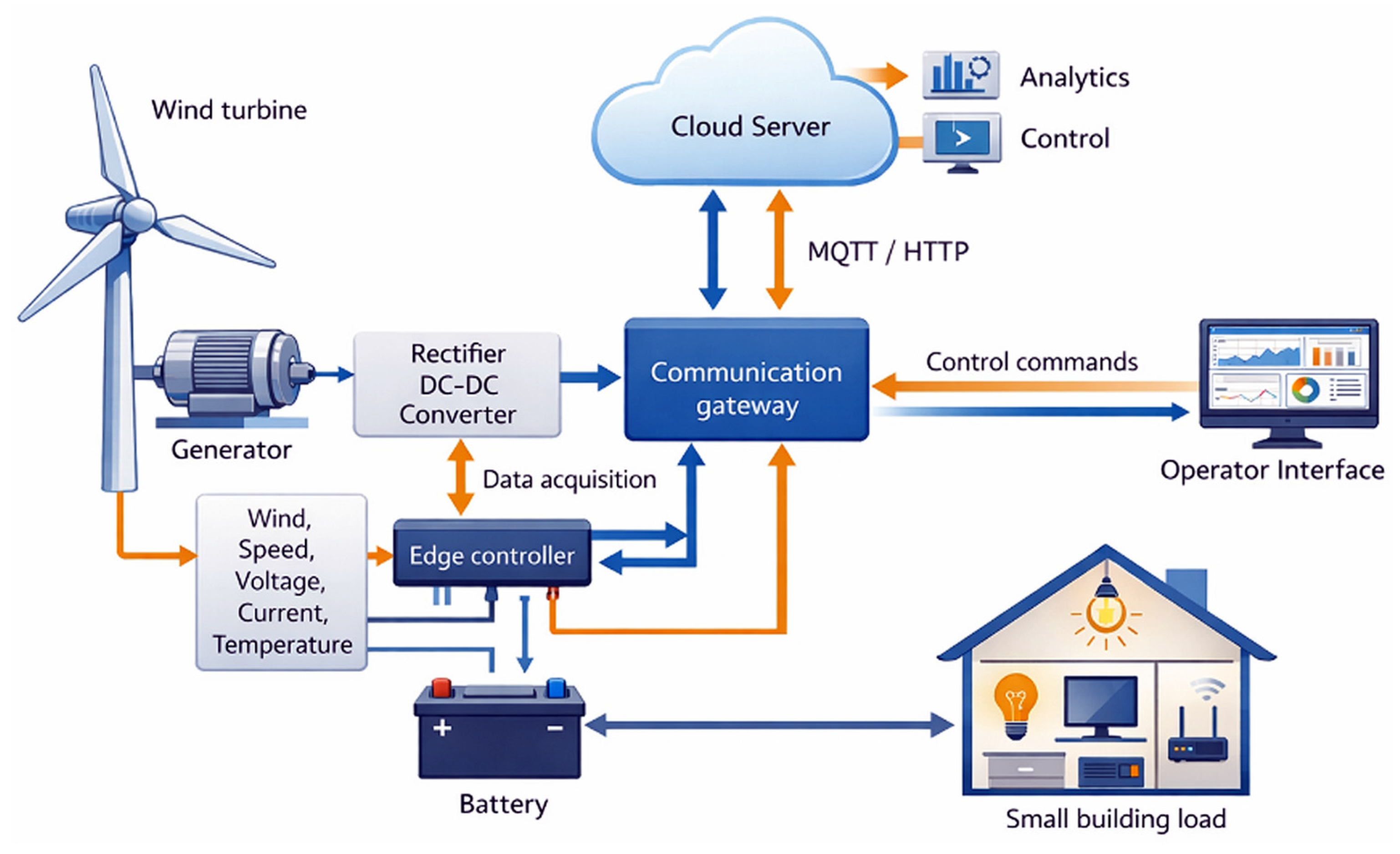
The object of this study was an IoT-oriented system for monitoring and intelligent control of a small wind turbine designed to supply power to a small building with a variable household load. The system under study included a wind turbine, an electric generator, a rectifier, a DC-DC converter, a battery-storage unit, an edge controller, a communication gateway, and an operator interface. The proposed architecture was developed not only as a theoretical numerical framework but also with consideration of practical embedded implementation constraints typical for low-power residential wind energy systems. In the intended practical configuration, the supervisory algorithm can be executed on low-cost edge computing platforms such as Raspberry Pi or ESP32-class industrial IoT controllers, while communication between monitoring modules and the supervisory layer can be implemented using standard MQTT- or Modbus-based protocols. The Raspberry Pi controller used in the experimental/control setup was specified as Raspberry Pi 4 Model B, manufactured by Raspberry Pi Ltd. (Cambridge, UK). The STM32 microcontroller board was specified as STM32F407 Discovery development board, manufactured by STMicroelectronics (Geneva, Switzerland). The selected sampling intervals, computational structure, and supervisory logic were therefore intentionally designed to remain compatible with real-time embedded implementation requirements. The supervisory control cycle in the numerical implementation was selected as Δt = 1 s, which is consistent with typical low-power IoT-based residential energy-management applications and provides sufficient responsiveness for wind-speed fluctuations, battery-state monitoring, and thermal-condition supervision without excessive computational load. In the proposed implementation architecture, the sensor layer includes wind-speed sensors, DC voltage and current sensors, converter temperature sensors, battery SOC estimation modules, and vibration-monitoring channels for diagnostic evaluation. The local data-acquisition layer performs signal preprocessing and moving-average filtering before transmitting the measurements to the edge supervisory controller. The edge layer executes the hybrid operating-mode selection algorithm in real time and generates control commands for the converter and battery-management subsystem. The cloud layer is intended primarily for historical data storage, remote visualization, long-term diagnostics, and parameter updating, while the primary energy-management decisions remain localized at the edge level to reduce communication latency and improve operational robustness. The overall structure of the system is shown in
Figure 1. This paper considered a small horizontal-axis wind turbine, which corresponded to the scope of IEC 61400-2 [
35] and typical conditions of low-voltage distributed generation for small buildings. This choice was due to the higher aerodynamic efficiency of the HAWT compared to most vertical-axis designs and its practical feasibility as part of a local cyber-physical energy system.
In the intended practical operating scenario, the monitoring subsystem continuously acquired wind-speed, generated power, battery state, converter temperature, and load-demand measurements. These data were transmitted to the edge supervisory controller through lightweight industrial communication protocols, after which the hybrid decision algorithm evaluated the admissible operating modes and generates updated converter-control and battery-management commands. The cloud subsystem was not required for fast control loops and therefore performed only supervisory-level monitoring, visualization, and long-term analytics.
To reduce the model’s complexity without losing physical meaning, the following assumptions were made: air density was assumed constant; the influence of turbulence and wind gusts was taken into account through the input time function of wind speed without involving a CFD model; mechanical and electrical losses were accounted for as integral efficiency coefficients; the battery was described through its state of charge and integral energy balance; and the control algorithm was implemented in discrete time based on current measurements and a short-term forecast. This level of detail was sufficient for a study focused on the intelligent control algorithm rather than on detailed aerodynamic identification of the turbine. The airflow power passing through the rotor sweep area A was determined by the following expression [
36]:
where
is the air density,
;
—is the rotor sweep area,
; and
is the wind speed measured in m/s.
The useful mechanical power on the turbine shaft was described by the following ratio [
37]:
where
—wind energy efficiency factor.
Taking into account the combined mechanical and electrical losses, the output electrical power of a wind turbine was determined as follows:
where
—the integral efficiency of the generator and power unit.
To determine the rotor’s geometric parameters, the condition used for achieving rated electrical power was
at nominal wind speed
[
38]:
At
W,
/s,
,
, and
obtained the following:
Therefore, a small wind turbine with a rotor diameter of approximately 2.23 m was adopted for the simulation, which was consistent with the estimated power of 1 kW and typical parameters of small turbines [
39].
The system under study used a 48-volt DC bus. At a nominal power of 1 kW, the bus current was as follows:
This is acceptable for a low-power, low-voltage system and provides a reasonable compromise between electrical safety, current reduction, and hardware feasibility. The admissible battery operating current was limited
, while the converter output current was restricted to
in order to prevent excessive thermal loading and unrealistic operating regimes during stochastic disturbance scenarios. A LiFePO
4 battery with high cyclic stability was used as the energy storage device. The battery’s state-of-charge dynamics were discretely described by the relationship [
40]:
where
—state of charge at the
k-th step;
—battery current;
—nominal capacity;
—sampling step; and
—charge/discharge efficiency factor.
The system power balance was written as follows:
where
—is the wind generator’s power;
—is the battery’s power;
—is the external source’s power;
—is the load’s power; and
—is the total losses. The baseline scenarios considered a partial autonomy mode, in which the wind turbine and storage covered the bulk of the load and the external source was used only during power shortages or in protective modes.
At each sampling step, the monitoring system generated a state vector:
where
—is the wind speed;
—is the rotor angular velocity;
and
—are the voltage and current;
—is the temperature of the monitored element;
—is the battery state of charge;
—is the load power; and
—is the anomaly index. A moving average was used to smooth the measurement data:
where
—length of the averaging window.
Instantaneous electrical power was defined as follows:
and the accumulated energy over the observation interval was calculated using the following formula:
To assess the technical condition of the system, an anomaly index was used [
41]:
where
—is the vibration index;
—is the temperature;
—is the current power;
,
,
—are the reference values;
—are the weighting coefficients; and
—is a small regularizing parameter. When the condition
was met, the system generated a warning or switches to protection mode.
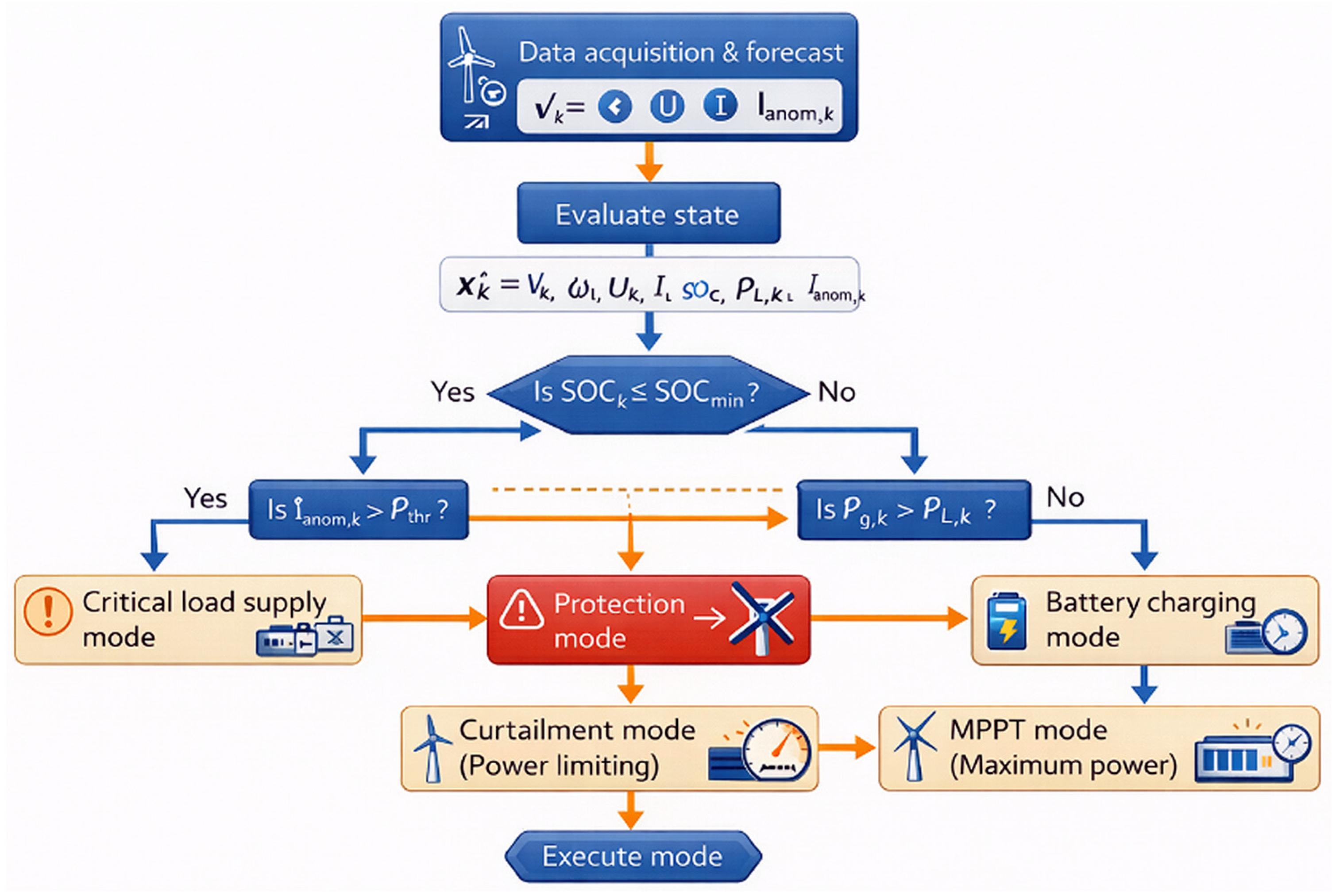
The proposed methodology was based on the operating mode selection algorithm shown in
Figure 2. The algorithm used current measurements, calculated energy indicators, and diagnostic indices to select one of the acceptable modes: MPPT mode, battery charging mode, curtailment mode, critical-load supply mode, and protection mode. The switching conditions between these modes were specified using explicit admissibility thresholds. MPPT mode was allowed when the wind speed exceeded the turbine start-up speed of 3.0 m/s, the battery state of charge was within the admissible interval 0.20 ≤ SOC ≤ 0.90, the converter temperature was below 70 °C, and the diagnostic index satisfied I < 0.65.
Battery charging mode was activated when generated power exceeded the current load by more than 0.10 kW and SOC < 0.85. Curtailment mode was activated when SOC ≥ 0.88 and the generated wind power exceeded the load demand. Critical-load supply mode was selected when SOC ≤ 0.25 or when the power deficit exceeded 0.15 kW. Protection mode was activated when the diagnostic index reached Ithr = 0.75 or when the converter temperature exceeded 80 °C.
Mode selection was formulated as a functional minimization problem [
42]:
where
m denotes the admissible operating mode, Δ
Pdef,ₘ(
k) is the load-supply power deficit,
Pgrid,ₘ(
k) is the required grid-import power,
Bₘ(
k) is the battery operating-condition penalty,
Iₘ(
k) is the diagnostic anomaly index, and Θ
ₘ(
k) is the normalized converter thermal-loading penalty.
The individual components of the objective function were defined as follows:
where
is the load demand,
is the supplied load power,
is the wind-generation power,
is the battery power,
is the preferred battery charge level,
and
are the admissible SOC limits,
is the maximum admissible battery power,
is the warning temperature threshold, and
is the converter protection temperature.
In the numerical implementation, the weighting coefficients of the multi-objective functional were selected as λ1 = 0.35, λ2 = 0.20, λ3 = 0.20, λ4 = 0.15, and λ5 = 0.10. Here, λ1 corresponds to load-supply deficit minimization, λ2 to grid-import minimization, λ3 to battery operating-condition preservation, λ4 to diagnostic-risk reduction, and λ5 to converter thermal-loading limitation.
The largest weight was assigned to load-supply continuity because uninterrupted residential power supply was the primary control objective. Battery preservation and grid-import reduction were assigned equal intermediate weights, while diagnostic and thermal penalties were used as protective terms that become dominant near their constraint boundaries. The weights satisfied the normalization condition λ1 + λ2 + λ3 + λ4 + λ5 = 1.00.
Unlike conventional weighted optimization schemes used only for economic scheduling, the proposed supervisory formulation additionally incorporated thermal-protection logic, diagnostic admissibility constraints, and adaptive operating-mode switching within the real-time supervisory layer.
When the diagnostic index exceeds the warning threshold Iwarn = 0.65, the controller limited aggressive battery charging/discharging and avoided high thermal-load modes. When the diagnostic index reached the abnormal threshold Ithr = 0.75, the system switched to protection mode. The value Ithr = 0.75 was selected because it corresponded to a combined normalized deviation of approximately 75% from the admissible reference diagnostic range and allowed for progressive abnormal behavior to be detected before the converter temperature reached the hard safety limit of 80 °C.
The presented supervisory algorithm combined energy-balance evaluation, diagnostic-condition assessment, and thermal-admissibility verification within a unified operating-mode selection procedure. The operating-mode transitions were determined not by a single parameter but by the simultaneous analysis of wind conditions, battery state, converter temperature, and anomaly indicators.
The algorithm’s practical logic included a sequential analysis of the drive’s state, diagnostic index, and energy balance. At a low SOC, discharge was limited, and only the critical load was powered, or an external source was connected. At
, protection mode was activated. When there was an energy surplus and the SOC level was acceptable, battery charging mode was selected. If the battery was close to the upper limit and generation exceeded the load, curtailment mode was activated. In the absence of limitations, the system operated in MPPT mode. Thus, the algorithm combined energy, operational, and diagnostic criteria. The main parameters of the model are presented in
Table 1. Their selection was based either on the calculations performed in this study or on published data on small wind power systems and LiFePO
4 batteries. In the computational implementation, the calculation model included a wind-driven generation unit, a wind turbine energy model, a battery model, a monitoring module, and a control mode selection algorithm. At each simulation step, wind speed, generation power, load power, temperature, and battery state of charge were calculated, after which the anomaly index was calculated, and a control decision was made. This approach ensured reproducibility of results and comparability of control modes on a single calculation basis. All supervisory thresholds, weighting coefficients, thermal parameters, current limits, and disturbance assumptions used in the numerical experiments were explicitly summarized in the revised manuscript to improve transparency and reproducibility of the proposed computational framework. The main model parameters are presented in
Table 1. Their selection was based either on the calculations performed in this study or on published data on small wind power systems and battery-storage systems.
Table 2 summarizes the numerical parameters used in the hybrid supervisory switching logic of the proposed IoT-oriented wind energy-management system. The presented thresholds and hysteresis margins defined the admissibility conditions for transitions between MPPT, battery charging, curtailment, critical-load supply, and protection modes. The selected values were used as engineering tuning parameters for the considered 1 kW residential wind energy system and were chosen based on the adopted battery operating limits, converter thermal safety constraints, and preliminary sensitivity-oriented numerical experiments. The introduction of hysteresis margins and switching confirmation intervals allowed for the reduction of oscillatory mode transitions caused by stochastic wind-speed fluctuations and measurement noise, thereby improving the stability and robustness of the supervisory control algorithm. In addition, the diagnostic and thermal thresholds ensured that the operating-mode selection process simultaneously considered energy efficiency, equipment protection, and operational reliability.
The numerical values used in the present study correspond to a representative low-power residential wind energy installation and were selected using manufacturer-oriented engineering ranges and published small-scale wind energy system parameters reported in recent literature. The adopted operating assumptions were intentionally bounded to physically realistic residential conditions to ensure numerical reproducibility and engineering consistency of the developed supervisory framework.
4. Mathematical Modeling of an IoT-Enabled Wind Energy System
To ensure a strict connection between the system’s physical architecture, intelligent control algorithm, and the results of computational experiments, the proposed power plant was represented as a single nonlinear discrete–time hybrid model. This approach allows for the interconnected description of the processes of wind turbine energy generation; power redistribution between the load, battery, and external grid; equipment thermal state; diagnostic assessment of technical condition; and selection of the optimal operating mode. Unlike the local engineering dependencies presented in the
Section 3, this formulation focuses directly on numerical modeling and the generation of output variables, which are used in the
Section 5.
The system state at the
kth simulation step is defined by an extended state vector:
where
—battery charge state;
—power converter unit temperature;
—accumulated energy transferred to the load;
—accumulated energy produced by the wind turbine;
—integral energy exchange of the battery channel;
—diagnostic index of technical condition; and
—current active operating mode of the system.
The vector of external influences is defined as follows [
43]:
where
—wind speed;
—instantaneous building load power;
—ambient temperature; and
—set of random disturbances, including turbulent wind changes, measurement noise, and model parameter uncertainties.
The wind-speed and residential load profiles used in the simulations were generated as bounded representative daily operating trajectories corresponding to small residential wind energy installations. The wind-speed profile included low-speed nighttime intervals, daytime growth regions, and stochastic evening disturbances, while the residential load profile incorporated typical evening consumption peaks associated with residential appliance usage. The disturbance amplitudes were intentionally constrained within realistic residential operating ranges in order to avoid nonphysical operating conditions.
The overall dynamics of the system is described by a hybrid operator equation [
44]:
where
—is the control mode selected at the current step and
is the set of acceptable operating modes:
Thus, the object under study belongs to the class of switchable hybrid systems, in which continuous energy processes are combined with discrete decision-making logic.
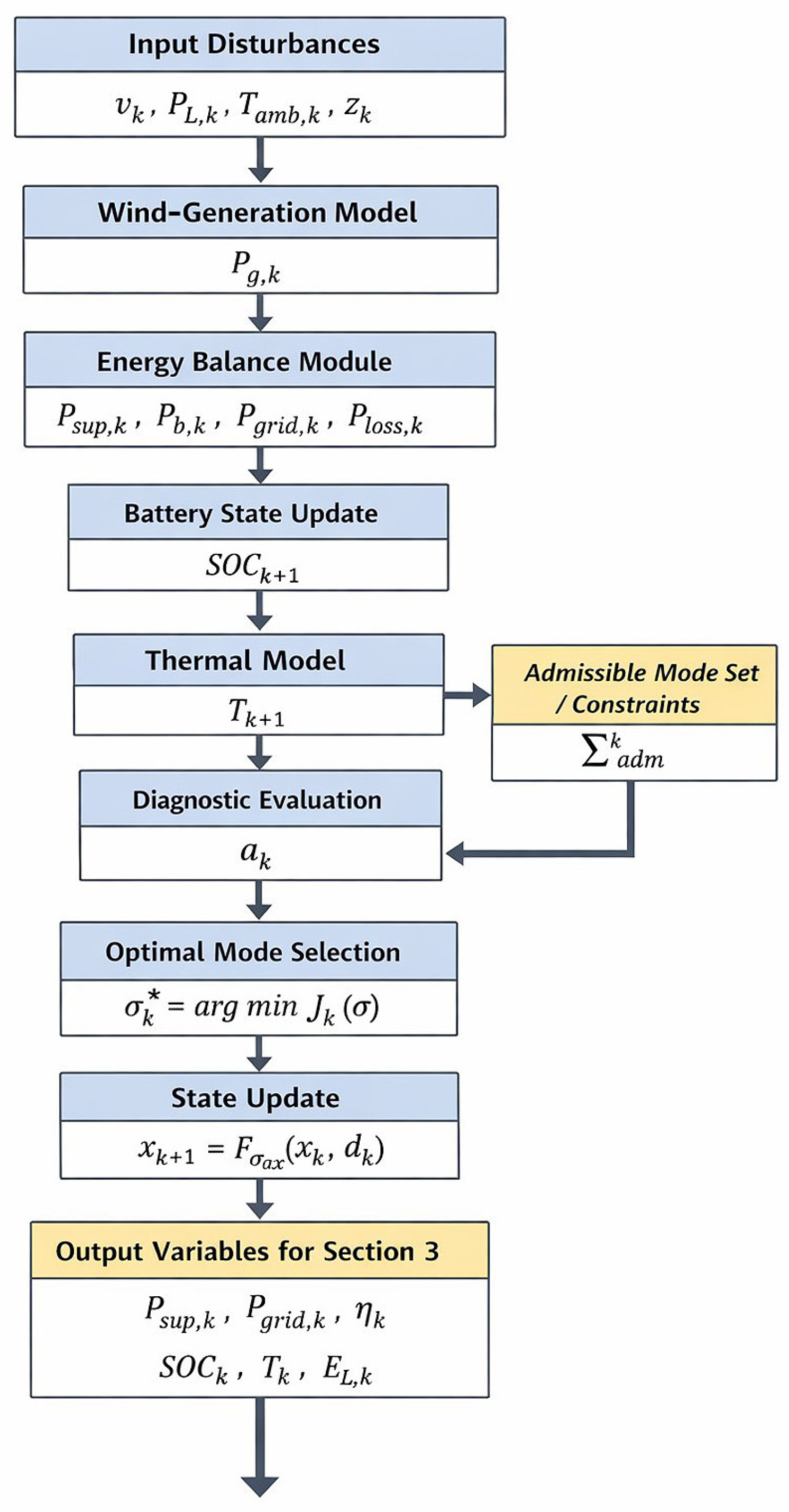
According to the computational structure presented in
Figure 3, at each simulation step, the input signals are first processed, after which the available generated power of the wind turbine
is determined. Next, the system’s energy balance is calculated, including the power supplied to the load
, the power of the battery channel
, the power imported from the external grid
, and the total losses
. This stage is described by the following relation:
This equation is the basic condition for the energy consistency of the system and is used to calculate all operating modes.
After determining the energy flows, the battery state is updated. The charging dynamics are described by the following expression:
where
is the nominal energy capacity of the storage device;
and
are the charge and discharge powers, respectively; and
and
are the efficiency factors of the charge and discharge processes. This notation allows for the change in the battery’s functional role depending on the active mode of the system: energy storage, compensation for a power deficit, or limiting energy exchange.
The next step is to calculate the thermal state of the power unit. A first-order lumped thermal model is used for this [
45]:
where coefficient
characterizes the conversion of energy losses into heat flow,
accounts for additional heating during intensive charging or discharging of the battery, and
describes heat dissipation into the environment. This model allows for the simulation of both normal operating processes and scenarios of developing malfunctions with increasing temperature.
In the numerical implementation, the equivalent thermal capacitance and thermal dissipation coefficient were selected as Cth = 420 J/°C and Rth = 1.85 C/W, respectively, corresponding to a compact, low-power converter enclosure under forced-air cooling conditions typical of residential energy-conversion systems.
Based on the current state of the system, a diagnostic index of technical condition is calculated:
where
,
,
,
are reference values of the parameters and
weight coefficients satisfy the condition:
The use of a quadratic form eliminates mutual compensation of deviations in individual diagnostic features and increases the algorithm’s sensitivity to cumulative degradation effects.
After this, a set of acceptable modes
is generated that satisfy the operational constraints [
46]:
If the predicted next state of the system falls outside the boundaries of the set
, the corresponding regime is excluded from further consideration. Thus, the following equation is used:
To avoid chattering between neighboring modes under stochastic wind-speed fluctuations and measurement noise, hysteresis margins and a confirmation delay were introduced. A new operating mode was accepted only if its switching condition remained valid for τsw = 3 s. The SOC hysteresis margin was set to ΔSOC = 0.03, the temperature hysteresis margin to ΔT = 5 °C, and the power-deficit hysteresis margin to ΔP = 0.05 kW. Therefore, for example, transition from MPPT to battery charging mode was allowed only when the surplus power remained higher than 0.10 kW for at least 3 s, while return to MPPT was allowed only after the surplus decreased below 0.05 kW. Similarly, protection mode was entered at Ithr = 0.75 or Tconv ≥ 80 °C and was released only after I < 0.65 and Tconv < 75 °C.
From a set of admissible modes, the optimal control solution is selected by minimizing the multi-criteria quality functional:
where
The first term of the functional minimizes the load’s power shortage, the second minimizes dependence on the external grid, the third keeps the battery within a reasonable operating range, the fourth reduces technical risk, and the fifth limits equipment overheating. This structure ensures multi-criteria optimization of the operating mode, rather than local improvement of a single parameter.
After selecting the
mode, the system state is updated according to the following equation:
after which a vector of output variables is formed:
where the current efficiency coefficient is defined as follows:
These variables were directly used to construct the graphs presented below in the
Section 5, including the dependences of supplied power, grid dependence, overall efficiency, battery charge dynamics, temperature response, and stored energy.
The numerical simulation was performed stepwise with a fixed interval
. At each step, the following were sequentially performed: input of external factors, calculation of generated power and energy balance, updating of battery and thermal subsystem status, diagnostic evaluation, selection of an acceptable set of modes, optimization of the control action, and updating of the state vector. This unified computational structure, presented in
Figure 3, ensures comparability of all numerical experiments and a strict connection between the mathematical model, control algorithm, and study results.
The developed mathematical model forms a unified computational basis for analyzing a smart wind energy system in steady-state, transient, and emergency operating modes. Unlike a localized analysis of individual subsystems, the proposed hybrid model allows for simultaneous consideration of energy flows, battery-storage status, equipment thermal dynamics, diagnostic indicators, and mode-dependent control under operational constraints. This ensures accurate reproduction of real-world operating scenarios and enables quantitative comparison of various control strategies using a unified methodological framework. The resulting model output variables are directly used in the
Section 5 to plot graphs and evaluate the effectiveness of the proposed IoT-oriented approach. Although the present study focuses on numerical validation, the developed hybrid model was intentionally formulated using physically interpretable state variables, engineering operating constraints, and implementation-oriented supervisory logic rather than purely abstract optimization relationships. This makes the proposed framework suitable for subsequent hardware-in-the-loop and experimental validation. In addition, the selected parameters of the wind turbine, storage system, converter limitations, and operational thresholds correspond to realistic low-power residential wind energy configurations reported in the literature.
Thus, the hybrid switching mechanism was not implemented as an instantaneous rule-based selector but as a constrained supervisory logic with numerical admissibility thresholds, hysteresis margins, and confirmation delay. This made it possible to ensure smooth transitions between MPPT, battery charging, curtailment, critical-load supply, and protection modes without artificial oscillations caused by short-term wind fluctuations or measurement noise.
It should be emphasized that the methodological contribution of the present study is not associated with the isolated use of standard power-balance or battery-state equations themselves since such formulations are commonly employed in residential energy-management studies. The methodological novelty instead lies in the integrated supervisory coordination framework, where energy-flow optimization, converter thermal admissibility, diagnostic-condition assessment, and IoT-oriented mode adaptation are dynamically coupled within a unified hybrid decision-making architecture. In contrast to conventional rule-based or purely economic supervisory strategies, the proposed approach introduces adaptive operating-mode transitions driven simultaneously by energy, thermal, and diagnostic indicators under stochastic residential operating conditions.
5. Results and Discussion
For clarity of interpretation, all comparative scenarios were evaluated using identical wind-speed and residential load trajectories for traditional, proposed IoT, and ideal-reference supervisory strategies.
All computational experiments were performed in Python 3.11 using NumPy 1.26 and Matplotlib 3.8 libraries based on the unified nonlinear hybrid model developed in
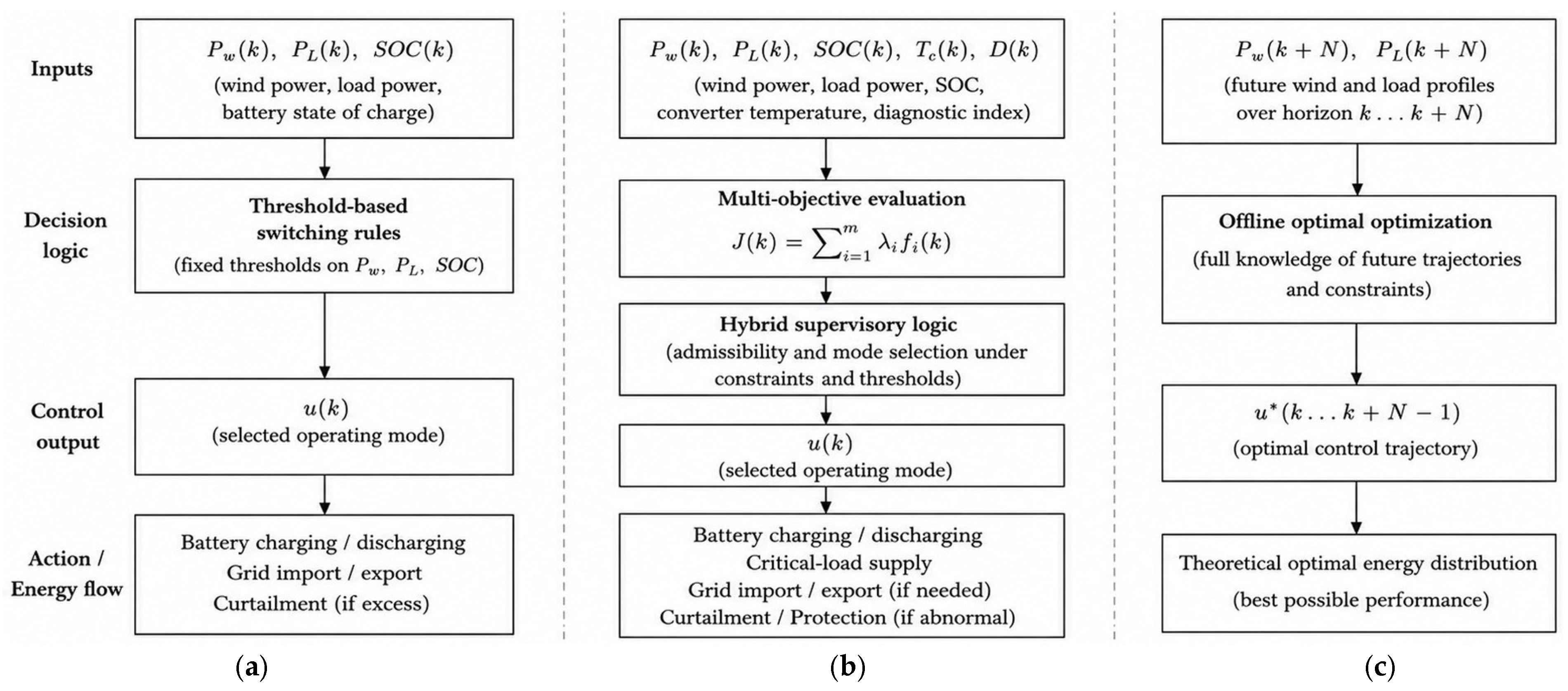
Section 2. To improve the engineering relevance of the computational experiments, all simulations were performed using physically bounded operational constraints, realistic residential load levels, converter thermal limitations, battery operating restrictions, and stochastic wind disturbances corresponding to practical small-scale wind energy operation conditions. The simulation framework was therefore intended not as an abstract optimization environment but as a numerically reproducible approximation of a deployable residential cyber–physical energy-management system. Three control strategies were compared across all scenarios: traditional control (a traditional scheme with local switching rules), proposed IoT control (a proposed intelligent, top-level multi-objective algorithm), and ideal reference (a theoretical reference mode assuming full information about the future generation and load profile). To improve the transparency of the comparative analysis,
Figure 4 summarizes the structural differences between the evaluated control strategies, including the available information, decision-making principles, and practical implementation assumptions underlying each supervisory approach.
As shown in
Figure 4a, the traditional control is based on local threshold-switching rules using only instantaneous measurements of wind power, load demand, and battery SOC. This approach does not include diagnostic feedback, thermal-awareness mechanisms, or predictive supervisory coordination.
Figure 4b illustrates the proposed IoT-oriented supervisory framework, in which the operating mode is selected using a multi-objective hybrid decision logic incorporating real-time monitoring variables, converter temperature, diagnostic indicators, and admissibility constraints.
In contrast,
Figure 4c presents the ideal reference benchmark, which assumes complete prior knowledge of future wind-generation and load-demand trajectories and therefore represents a theoretical upper-bound optimization benchmark rather than a physically realizable real-time controller.
Therefore, the comparison with the ideal reference should be interpreted only as an evaluation of the achievable performance gap relative to the theoretical optimum and not as a comparison with a deployable control algorithm.
The latter option was used not as a physically implemented controller but as an upper bound on the achievable control quality, necessary to assess how closely the proposed IoT-oriented algorithm approaches the theoretically best energy-flow distribution. The simulation parameters were fully consistent with
Section 3 and
Section 4: the wind turbine nominal power was 1.0 kW, the turbine start-up speed was 3 m/s, the nominal wind speed was 11 m/s, the DC bus voltage was 48 V, the battery capacity was 2.4 kW h, and the permissible battery charge range was assumed to be
. The electrical power of the wind generator in the computational implementation was determined by the following dependence [
47]:
where
,
,
, and
. After substituting the system parameters, we obtain a numerical approximation:
where
is expressed in kW with
m/s. At
, the expression yields a value close to 1.0 kW, i.e., it reproduces the accepted nominal point of the turbine. For a 48-volt DC bus, the calculated nominal current of the system c confirms the consistency of the energy and electrical parameters of the model.
For quantitative comparison of the controllers, the following relative indicators were used [
48]:
In addition, along with instantaneous indicators, the integral criterion of the overall efficiency of the system was analyzed:
where
is a small regularization coefficient. This allowed us to evaluate not only the specific advantages of the proposed algorithm but also the systemic quality of energy management.
For ease of interpretation, the results are divided into two complementary blocks. The first block analyzes static energy characteristics under varying wind speed, allowing us to determine the system’s limiting properties and evaluate the algorithm’s fundamental efficiency. The second block examines dynamic scenarios—evening shortages, developing faults, and stochastic disturbances—to test the proposed strategy’s robustness in conditions as close as possible to real-world operation.
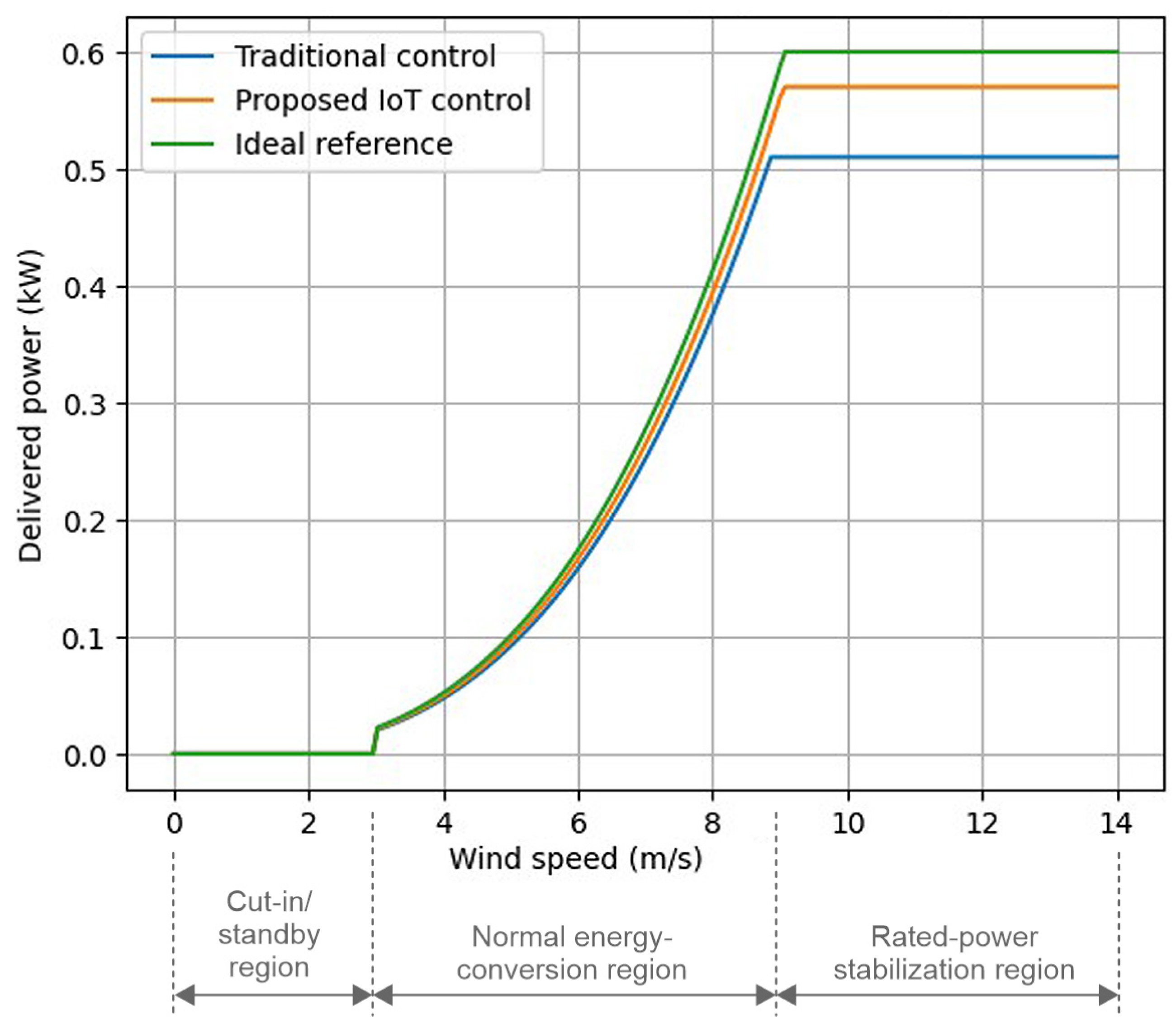
The first block of experiments focused on studying the system’s behavior under smooth wind-speed variations in the range from 0 to 14 m/s with a fixed load of 0.60 kW. This scenario allows us to determine the controller’s fundamental properties without the influence of random temporary disturbances and therefore serves as a baseline for all subsequent dynamic experiments.
Figure 4 shows the dependence of the useful power directly supplied to the load on wind speed. At speeds below 3 m/s, all the curves virtually coincide and tend to zero, which is explained by the insufficient aerodynamic torque for stable rotor rotation. This fully corresponds to the turbine start-up speed parameter adopted in
Section 2 and confirms the physical correctness of the calculation model.
The generation transition zone begins in the 3–6 m/s range. Here, the differences between the algorithms become noticeable. The traditional control ramps up output power more slowly due to a more coarse switching mode between the generator, battery, and grid. In contrast, the proposed IoT control connects local generation to load coverage earlier and more efficiently, reducing energy losses that occur due to inefficient power distribution in the near-threshold region.
The most informative range is 6–10 m/s, where the wind resource is already sufficient, and the differences between the controllers are determined not by the availability of energy per se but by the quality of its distribution. In this zone, the proposed IoT control consistently outperforms the traditional control. In particular, in the region close to the nominal mode, values of approximately 0.57 kW are achieved for the proposed IoT control versus 0.51 kW for the traditional control, while the ideal reference reaches approximately 0.60 kW. Therefore, the relative gain of the proposed algorithm is as follows:
This means that the proposed algorithm does not change the maximum installed capacity of the wind turbine but rather increases the actual utilization of the available wind resource. Thus, the proposed controller improves the utilization of the available wind resource without changing the hardware configuration.
For a more rigorous interpretation of the result, we additionally introduce a load coverage factor:
where
is the power supplied to the load and
kW is the fixed load of the static scenario under consideration. Then, in the region close to the nominal mode, we obtained the following:
Therefore, the proposed algorithm increases the share of covered load by 10 percentage points compared to the traditional control and eliminates the gap between the traditional control, and the theoretically ideal mode is revealed. This demonstrates that the advantage of the proposed IoT control lies not only in the increase in absolute power but also in the more complete utilization of the available wind resource, specifically in terms of power supply to the final load:
With further increases in wind speed, all curves reach saturation. However, even in this zone, the traditional control maintains a lower level of useful power, indicating less efficient internal coordination of operating modes and insufficiently efficient use of available generation. Thus,
Figure 5 demonstrates that the proposed algorithm improves not only the transient mode but also the steady-state utilization of the wind resource over a wide operating range.
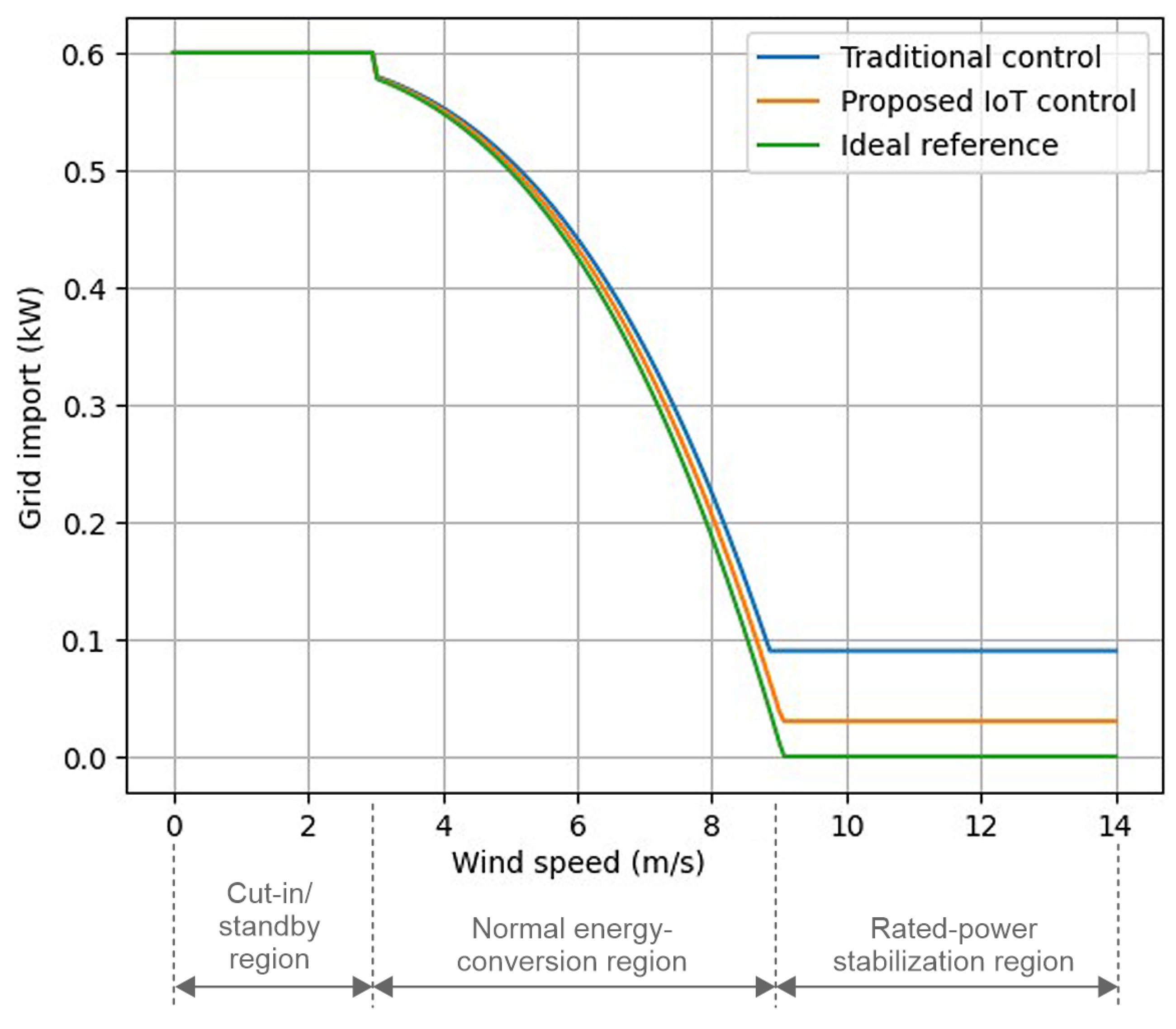
Figure 6 shows the dependence of power imported from the external grid on wind speed. While
Figure 5 characterizes the system’s ability to convert wind power into useful load power,
Figure 6 shows the extent to which this leads to a real reduction in dependence on external power supply. For small residential wind energy systems, this characteristic is of fundamental practical importance.
At zero and low wind speeds, all modes naturally utilize the external grid almost entirely since local generation is virtually nonexistent. This corresponds to the physics of the process and serves as an additional test of the internal consistency of the model. In the range of 3–7 m/s, the most intense reduction in grid import is observed. This is where the proposed IoT control demonstrates its greatest advantage: the controller more actively utilizes local generation and more efficiently connects the battery, reducing the share of energy necessarily drawn from the grid. In the high-speed range, the traditional control maintains a residual import of approximately 0.09 kW, while the proposed IoT control reduces it to 0.03 kW, and the ideal reference virtually eliminates it. Consequently, the relative reduction in grid dependence is as follows:
In practice, this means that with unchanged equipment, the proposed algorithm can significantly increase the facility’s autonomy without additional capital expenditures. It is particularly important that the traditional control, even under favorable wind conditions, maintains a significant grid demand, indicating an inefficient use of on-site generation and confirming the limitations of the traditional control scheme.
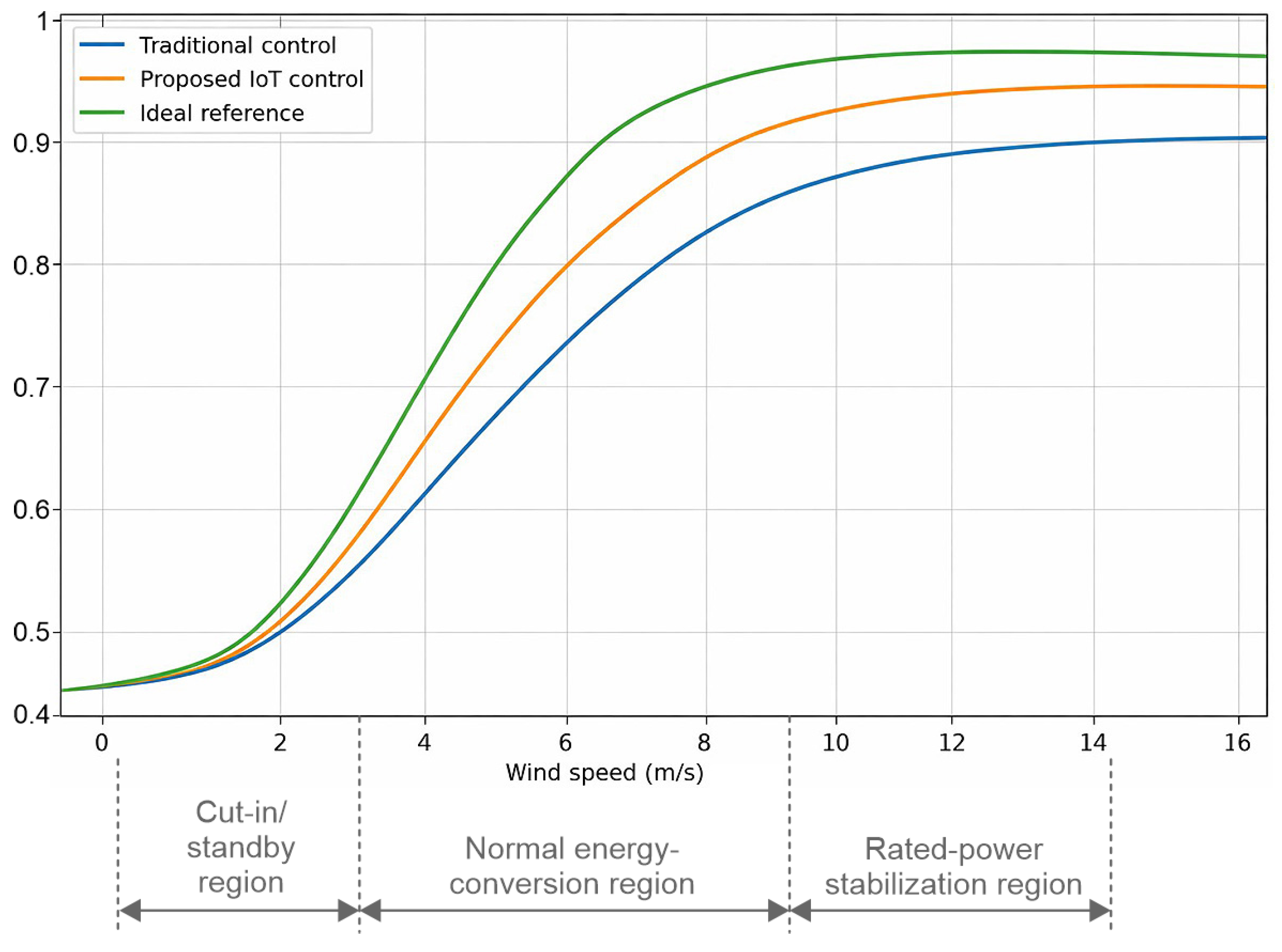
Figure 7 presents the integrated system efficiency as a function of wind speed. Unlike the previous two figures, this one analyzes not a single energy variable but an aggregated indicator of the entire system’s performance, taking into account the efficient use of wind generation, the reduction of grid imports, and the efficient distribution of power flows between the generator, storage, and load.
In the 0–2 m/s range, the differences between the modes are minimal, as the system is limited by the energy resource itself. In the absence of wind, even the best algorithm is unable to generate power, so all three curves are close to each other. Starting at approximately 3 m/s, the proposed IoT control begins to consistently outperform the traditional control. This is due to the controller’s multi-criteria mode selection: it simultaneously takes into account battery status, current load, available generation, grid import, and diagnostic limitations.
In the 5–9 m/s range, the most dramatic increase in efficiency is observed. It is in this range that the wind turbine is already capable of covering a significant portion of the load, and control quality becomes the determining factor. In the steady-state region, the values are approximately 0.85 for the traditional control, 0.93 for the proposed IoT control, and 0.98 for the ideal reference. The relative gain of the proposed algorithm is as follows:
This result is particularly important because efficiency takes into account not a single variable, but a set of energy processes. Therefore, the gains of the proposed IoT control are systemic and not limited to improving any one particular relationship.
To quantitatively analyze the proximity of real algorithms to the theoretically best performance, we introduce the efficiency deficit relative to the ideal reference.
Then, the following is used:
Therefore, the transition from the traditional control to the proposed IoT control reduces the efficiency deficit relative to the ideal mode by the following:
To summarize the static results,
Table 3 summarizes the key indicators characterizing the system’s energy efficiency under varying wind speeds. The table confirms that the proposed algorithm improves all key static indicators simultaneously: it increases useful power, reduces residual grid dependence, and improves the overall system efficiency.
The results obtained in the static analysis show that the proposed IoT-oriented algorithm already provides significant performance improvements over the traditional scheme at the quasi-steady-state level. However, this is insufficient for a thorough assessment of control quality. For a small residential wind energy system, not only are the ultimate steady-state characteristics crucial but also the system’s behavior in deficit, transient, and emergency modes. Therefore, the next stage of the study is an analysis of the storage system’s daily dynamics, thermal response during a developing fault, and evening stochastic scenarios, in which the advantage of multi-criteria control should manifest itself not only in average efficiency but also in the system’s resilience to real operational disturbances.
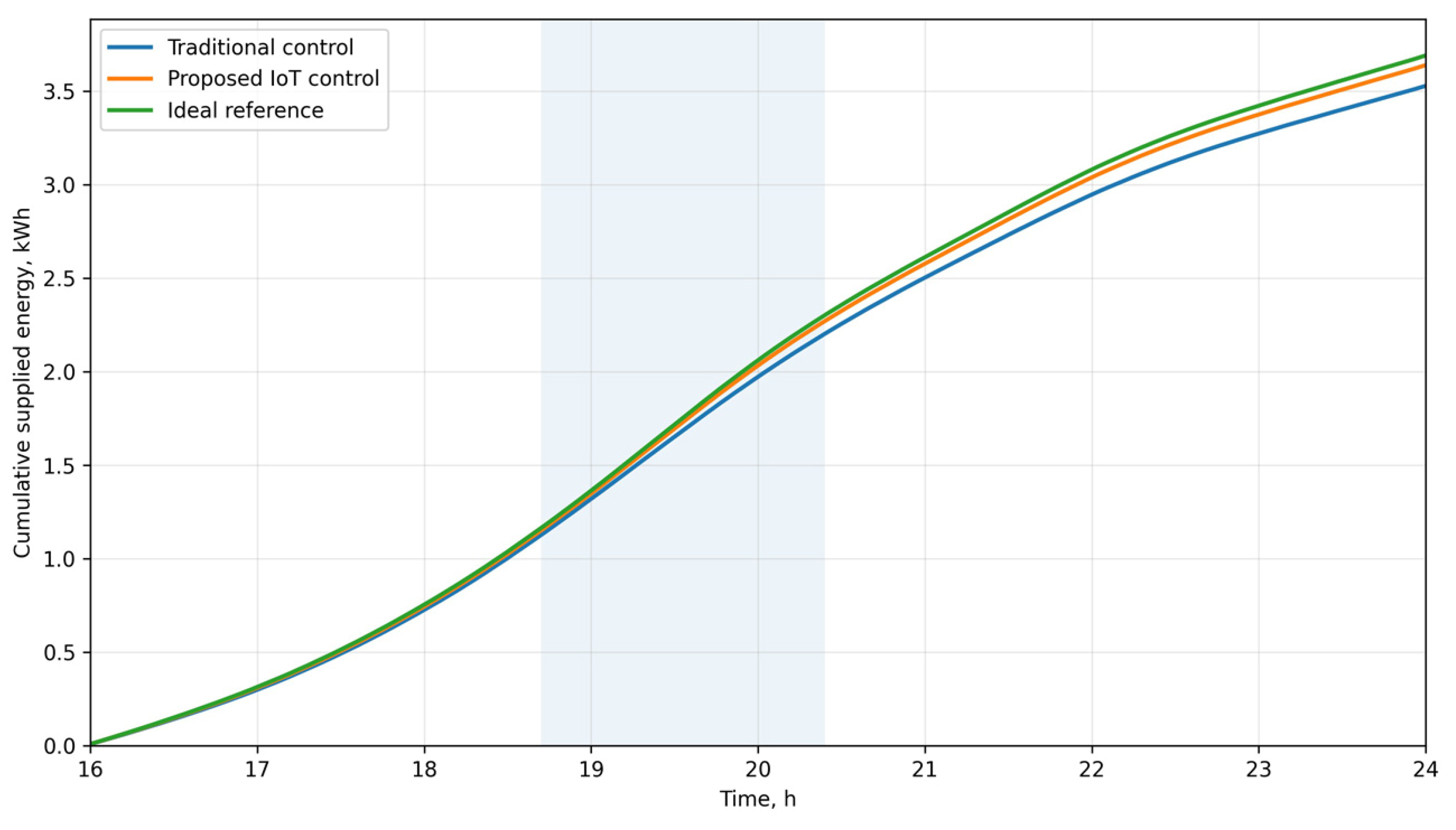
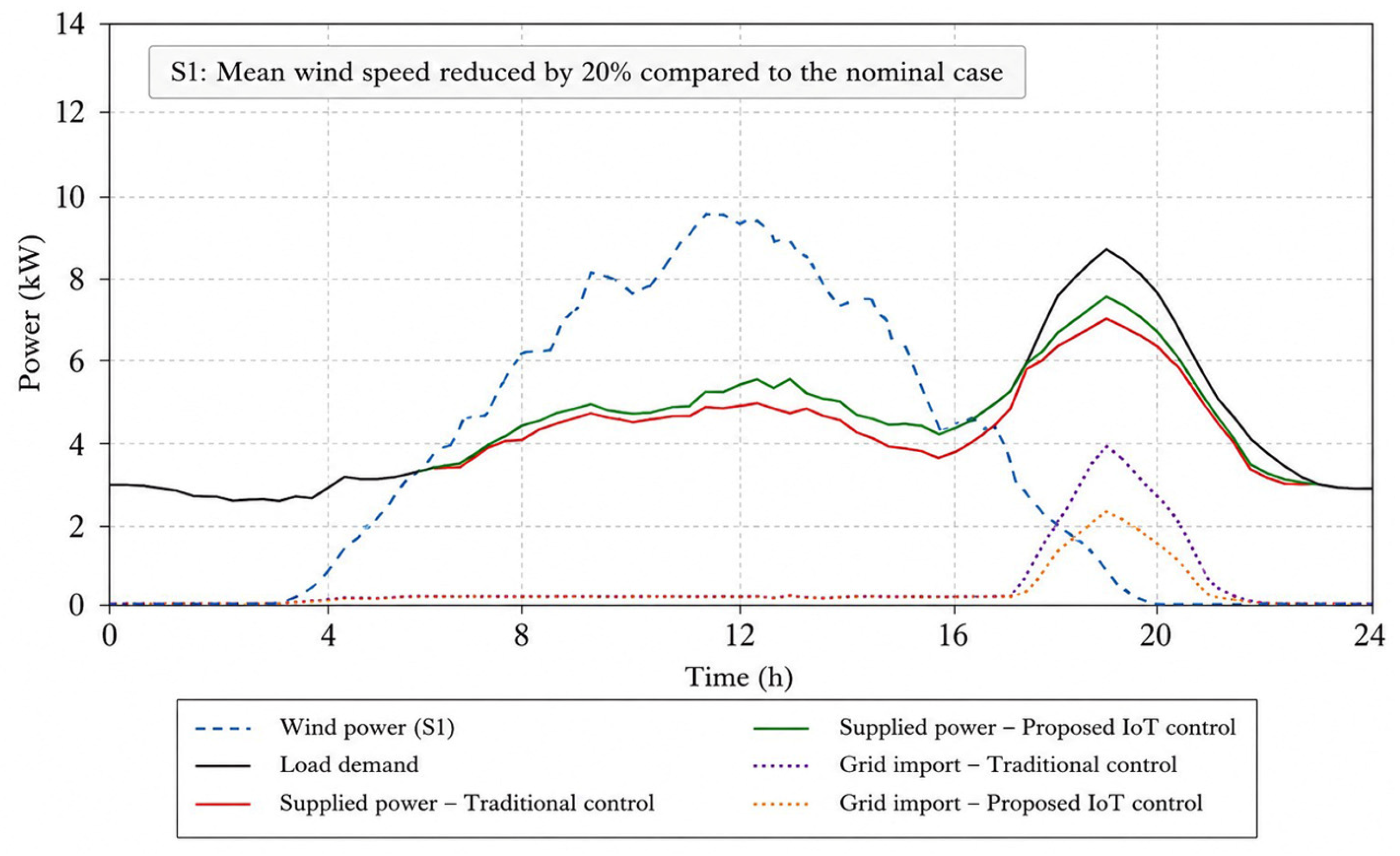
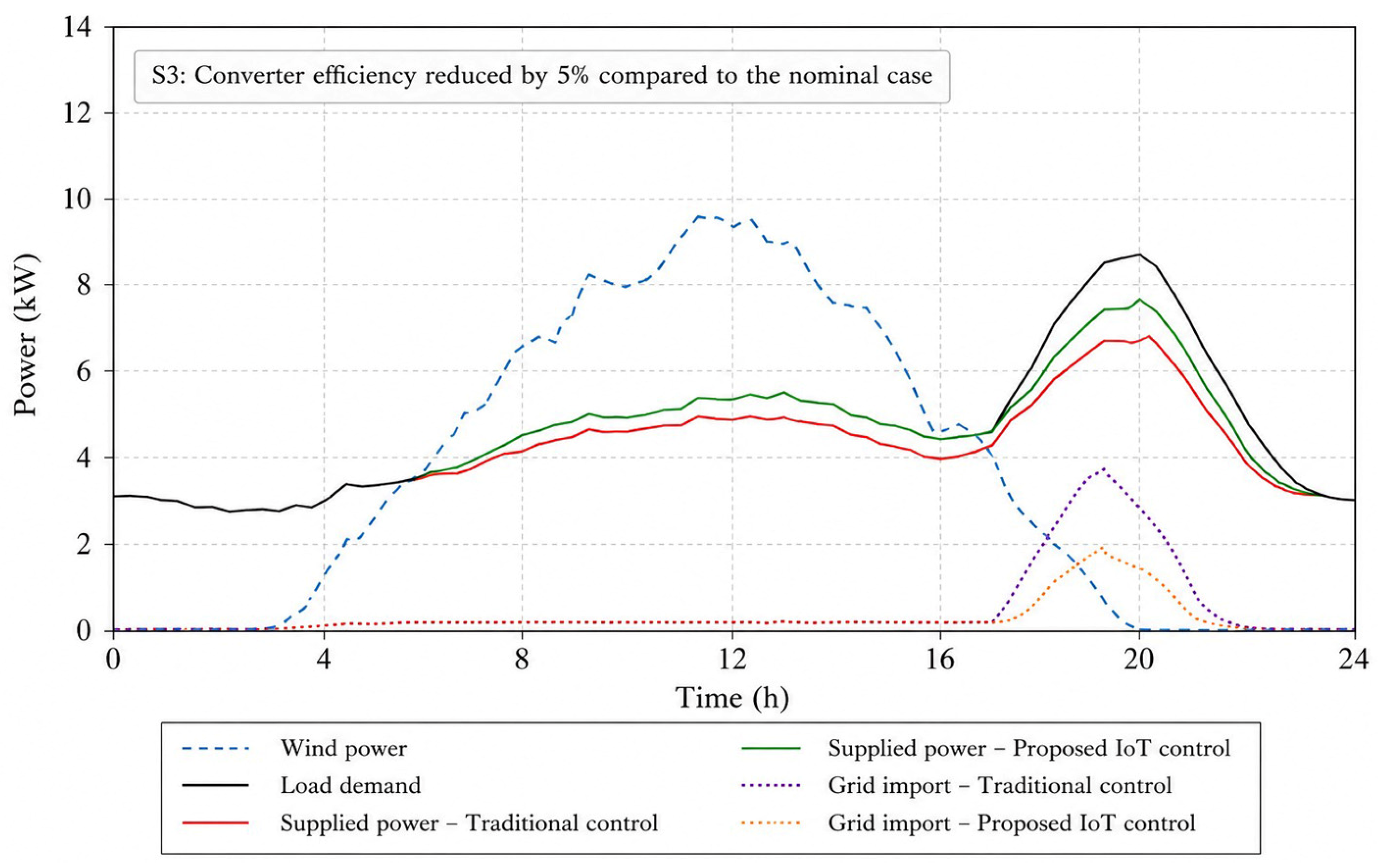
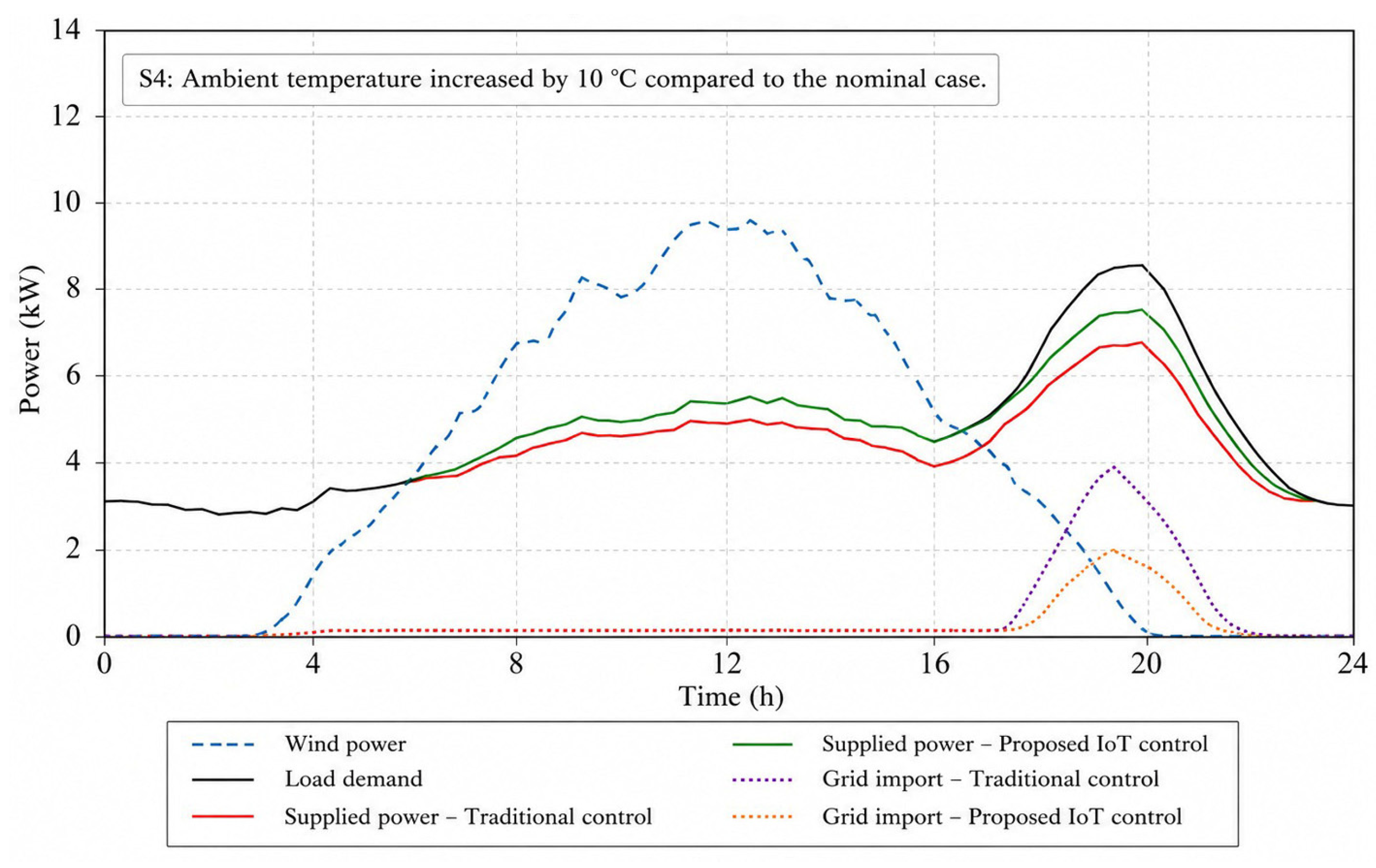
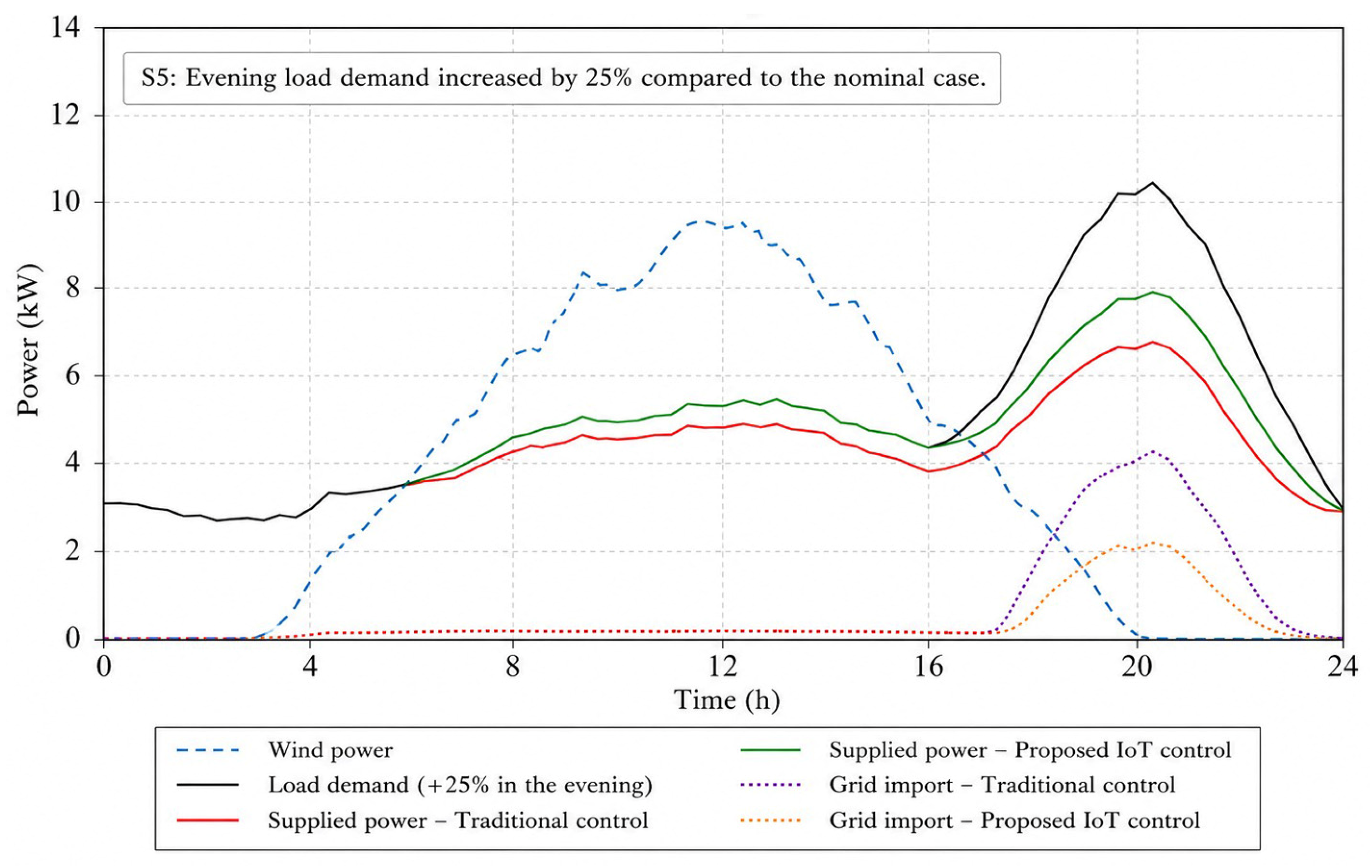
To strengthen the quantitative interpretation of the dynamic scenarios, the analysis was extended beyond peak-value comparison. The time–domain curves shown in
Figure 7,
Figure 8,
Figure 9 and
Figure 10 were additionally processed to estimate transient and statistical indicators, including minimum SOC, mean SOC during the evening deficit interval, maximum converter temperature, thermal recovery time, peak grid import, mean grid import, standard deviation of grid import during the stochastic interval, and cumulative supplied energy. Since the present study is based on representative stochastic numerical trajectories rather than repeated Monte Carlo ensembles, the statistical indicators were calculated from the simulated time-series data within the selected disturbance windows.
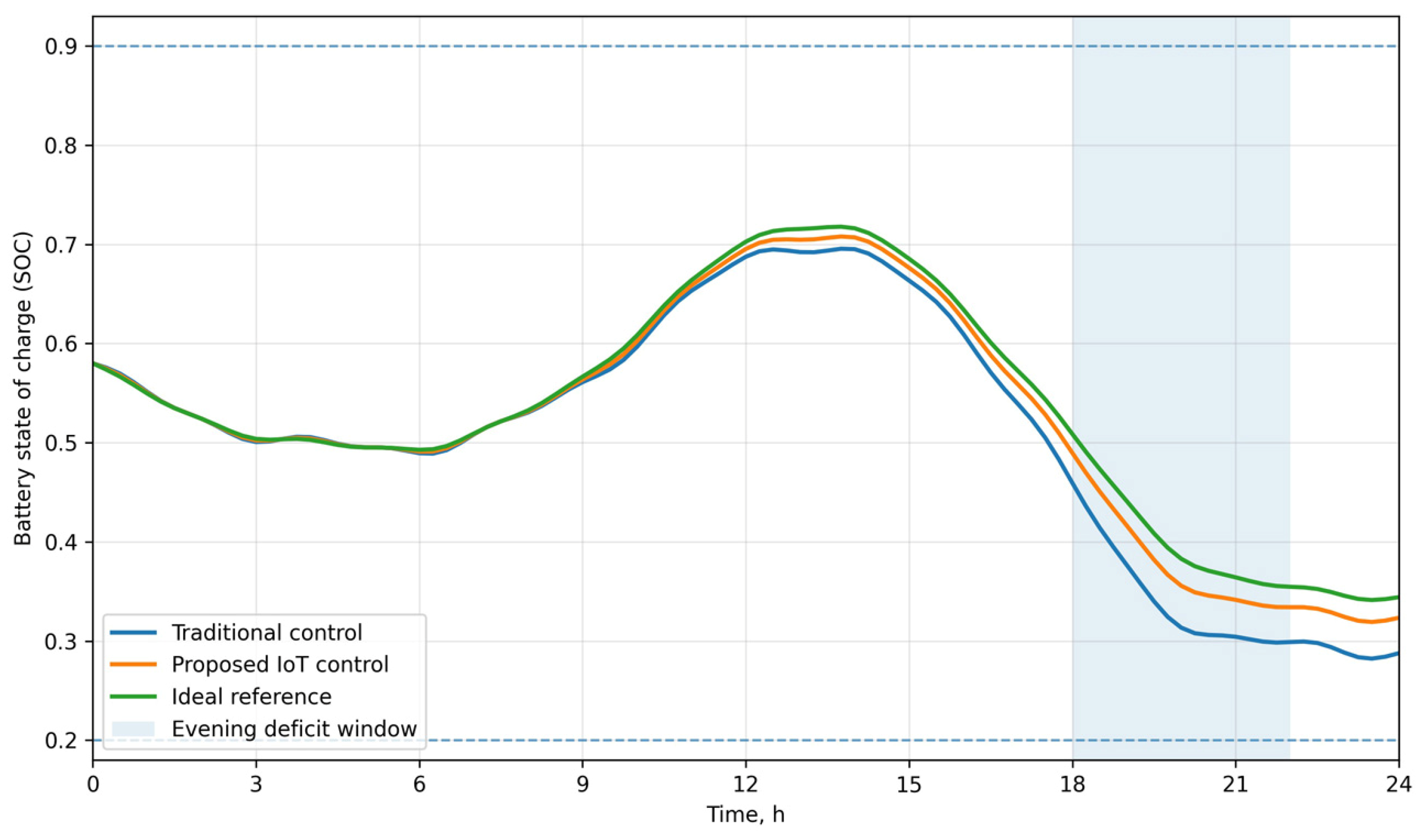
Figure 8 shows the battery’s state of charge over the course of a day and allows one to evaluate how effectively various control algorithms preserve energy reserves for the most critical evening interval The blue shaded area indicates the main evening peak-load interval. In this scenario, not only the absolute SOC value but also the trajectory shape are of particular importance, as it reflects the energy consumption and recovery strategy throughout the day.
In the 0:00–6:00 AM window, a gradual decrease in SOC is observed, as nighttime generation is limited and the load is partially covered by the battery. In this interval, the differences between the strategies are small, which is natural for a mode in which all controllers are forced to use previously accumulated energy reserves. In the 6:00–2:00 PM window, as wind activity increases, charge recovery occurs. All modes show an increase in SOC, but the proposed IoT control achieves a slightly higher value due to a more efficient redistribution of generation and a reduction in unnecessary energy consumption in intermediate intervals.
The most important is the evening deficit window (6:00–10:00 PM), highlighted in the graph. It is during this interval that the load increases and generation decreases, creating the most challenging conditions for energy management. The traditional control depletes the battery reserve faster and reaches a level of 0.29–0.30 by the end of the window. The proposed IoT control maintains a level of 0.32–0.33, and the ideal reference maintains a level of 0.34–0.35. To assess the operational stability of a drive, it is necessary to analyze not only the absolute minimum SOC but also the reserve to the lower permissible limit .
Let us introduce the remaining battery reserve indicator:
Then, for the end of the evening deficit interval, we derive the following:
Consequently, the proposed IoT control increases the operational charge margin by approximately 30–44% compared to the traditional control. From an engineering perspective, this means that the proposed algorithm does not simply “keep the SOC slightly higher” but rather creates a significantly larger reserve before the critical discharge point, reducing the risk of the system entering emergency low-power mode.
The additional energy reserve for the proposed IoT control is as follows:
to
Compared with this gain with the battery’s total energy capacity, , the resulting additional reserve corresponds to 3–4% of the storage device’s nominal energy capacity. For a small stand-alone system, this increase is not insignificant, as it determines the system’s ability to survive an evening power shortage without prematurely connecting to the external grid.
Although the absolute value of this reserve seems modest, for a small stand-alone system, it has direct engineering significance: such a reserve can extend the supply of critical loads, reduce the risk of prematurely reaching the lower SOC threshold, and shorten the battery’s depth of discharge, which positively impacts its lifespan. Consequently, the proposed IoT control improves not only the instantaneous efficiency but also the long-term energy stability of the system, which is especially important for real-world household applications.
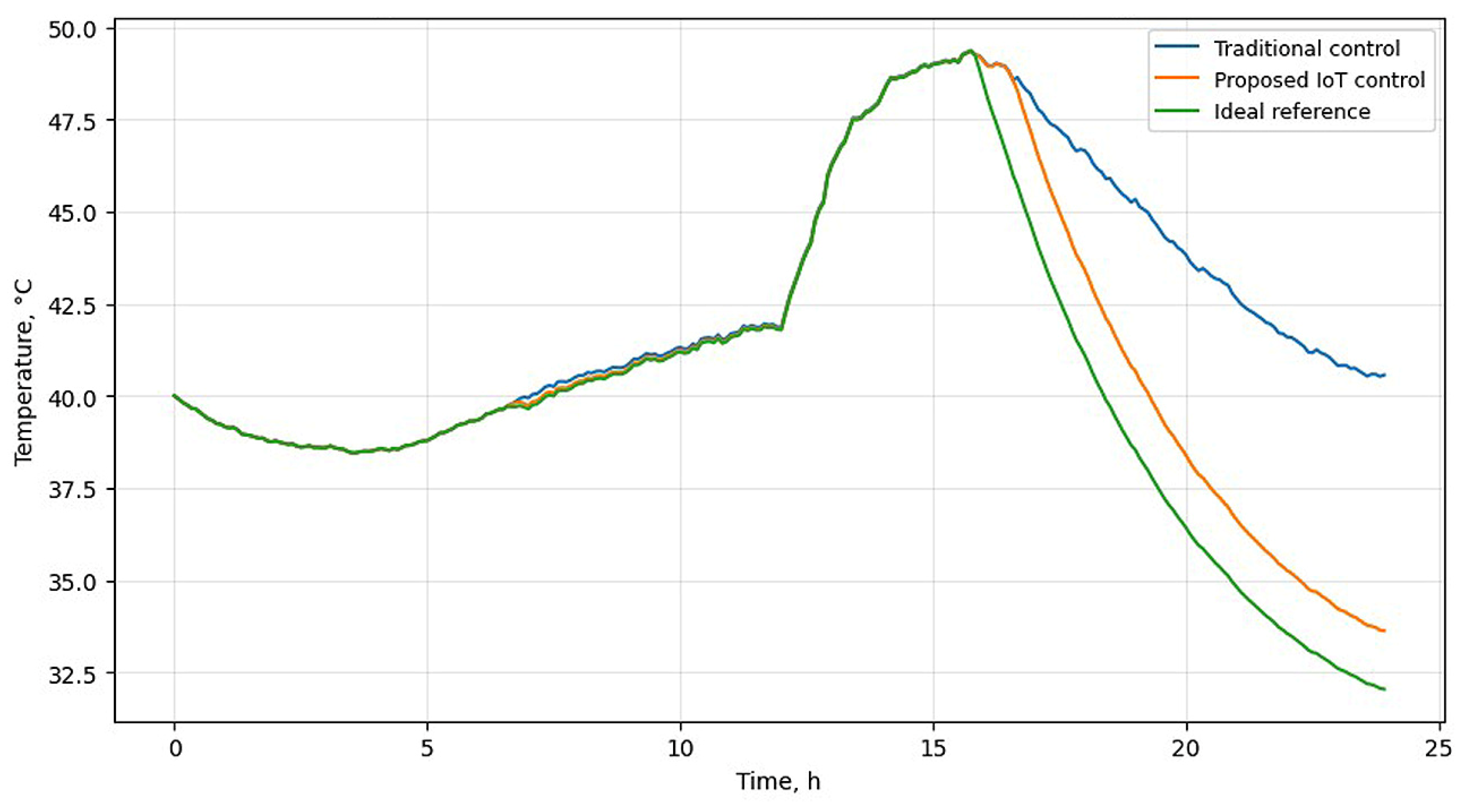
Figure 9 shows the temperature dynamics of the power converter during a developing fault. This scenario is fundamentally important, as it allows us to assess the extent to which the proposed algorithm impacts not only energy performance but also the operational reliability of the system.
Until the fault scenario occurs, the curves are virtually identical, confirming the identical initial simulation conditions and the absence of an artificial bias favoring one of the controllers. After the onset of the fault, the traditional control shows the most intense temperature increase, reaching 51.9 °C. The proposed IoT control limits heating to 46.4 °C, while the ideal reference control limits it to 43.4 °C.
The maximum temperature reduction for the proposed algorithm is as follows:
However, the peak value is not the only important aspect. The shape of the temperature trajectory after a fault develops is equally significant. The proposed IoT control limits unfavorable conditions earlier, brings the system out of the thermally dangerous zone more quickly, and thereby reduces accumulated thermal stress. In other words, the gain is associated not only with a reduction in the maximum temperature but also with a reduction in the time the system spends in the zone of increased thermal load.
From an engineering perspective, this means a reduction in the intensity of thermal aging of power electronics, a reduced risk of insulation material degradation, and an increase in the overall service life of the system. Consequently, the proposed algorithm ensures not only increased energy efficiency but also improved fault resilience, which is especially important for a serious journal article focused on a comprehensive assessment of a smart energy system.
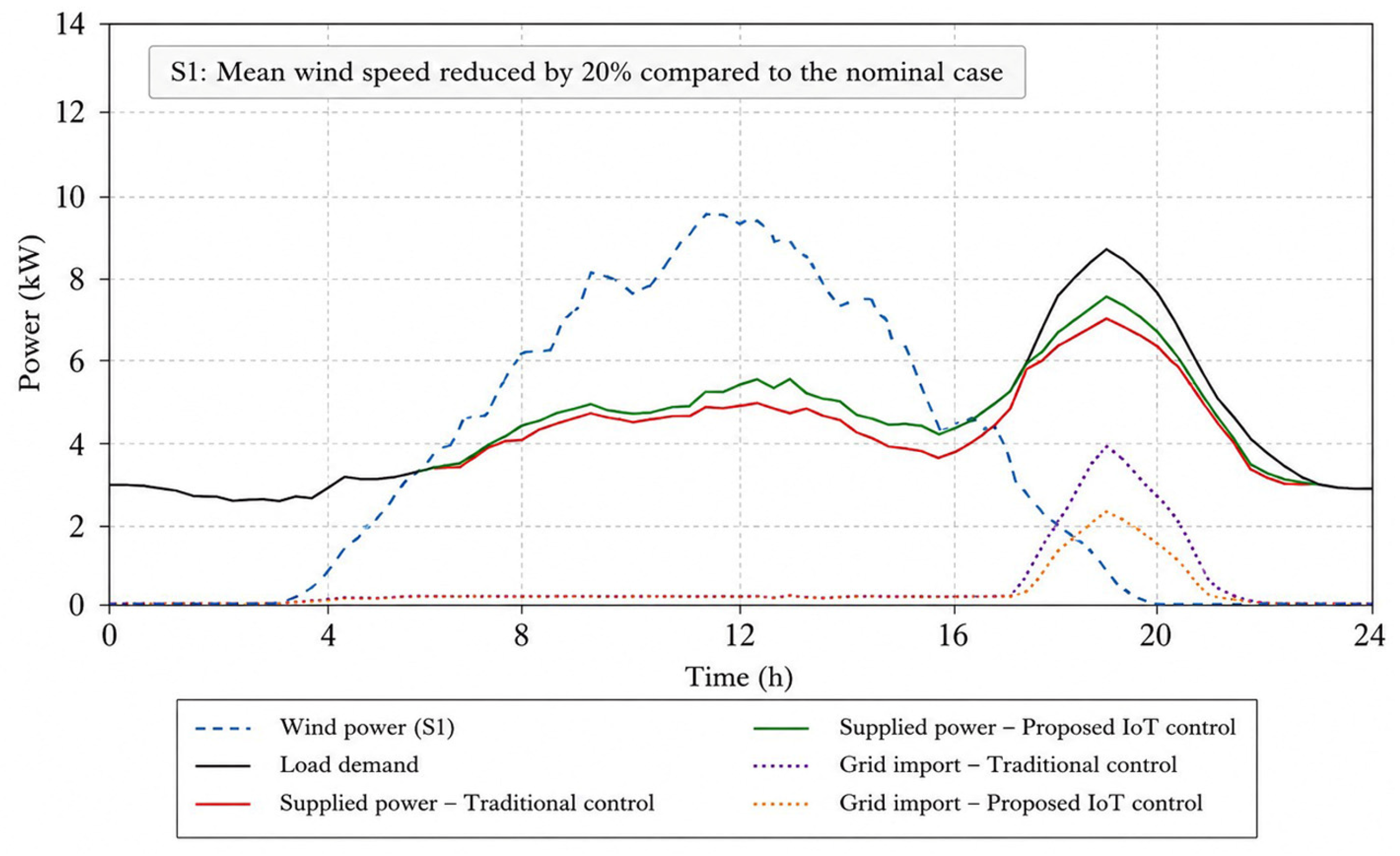
The next set of experiments is aimed at assessing the system’s behavior under conditions as close as possible to real-world operation. For this purpose, an evening scenario was considered, in which a decrease in wind generation, an increase in load, and random parameter fluctuations simultaneously occur. This scenario is most indicative for residential properties, as it is during the evening hours that a coincidence of increased consumption and deteriorating local generation conditions typically occurs.
To quantitatively interpret the stochastic evening scenario, in addition to a visual analysis of time dependencies, the following integral and extreme indicators are introduced:
Here, characterizes the total dependence on the external grid over the considered interval, is the total useful energy transferred to the load, is the maximum load on the external power source, and is the average level of grid support in the disturbed mode. Introducing these metrics allows us to move from a qualitative visual comparison of curves to a quantitative assessment of the stability of control algorithms.
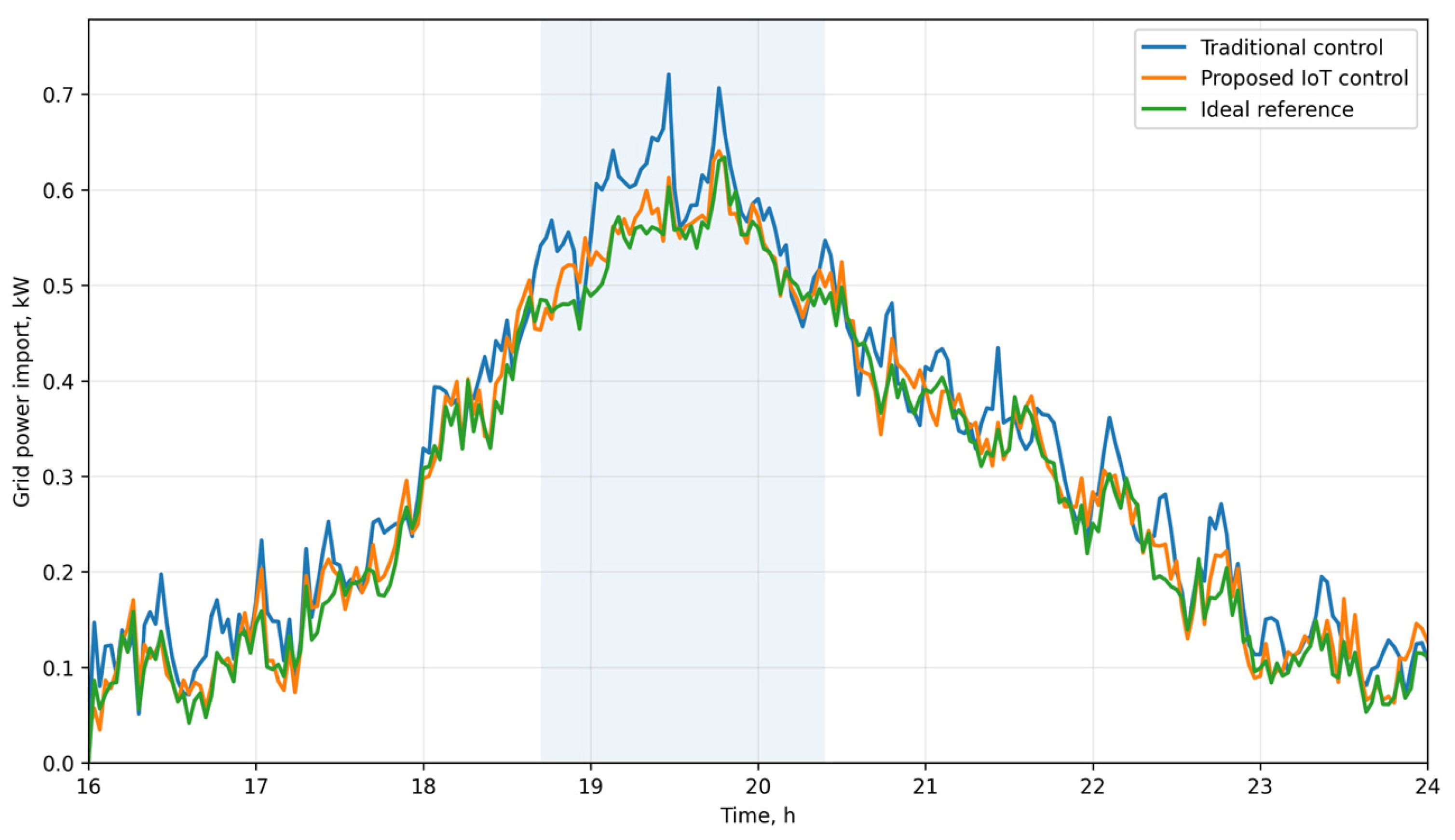
Figure 10 shows the real-time grid import in this stochastic scenario. The traditional control generates the highest import peaks around 7:00–8:00 PM, indicating insufficient ability to adapt to a sharp deterioration in the power balance. The proposed IoT control demonstrates a smoother trajectory and smaller peak amplitudes. This means the system more efficiently redistributes energy between the battery and the generator before connecting to the external grid, thereby reducing the load on the external power source.
It is especially important to note that even in the presence of stochastic fluctuations, the proposed IoT control remains consistently close to the ideal reference. This indicates not a specific improvement in a single curve, but the robustness of the proposed approach. Unlike static dependencies, the result is achieved under random disturbances, which gives the study significantly greater practical significance.
Figure 11 shows the accumulated useful energy transferred to the load in the same evening stochastic scenario. The blue shaded area indicates the main evening peak-load interval. Although the differences between the curves develop gradually, by the end of the interval, the proposed IoT control consistently remains above the traditional control. This means that the control improvement does not produce a localized short-term effect but leads to a real increase in the total useful energy delivered to the load.
Crucially, this gain was achieved simultaneously with the reduction in grid imports shown in
Figure 10. Consequently, the advantage is not due to aggressive use of the external grid or the “shifting” of load to other subsystems. Instead, it is achieved through more efficient coordination of the system’s internal resources—the generator, battery, and control logic.
To quantitatively compare the results obtained in deficit, emergency, and stochastic modes,
Table 4 summarizes the key dynamic performance indicators of the control systems under study. Unlike
Table 3, which analyzed the quasi-stationary energy properties of the plant,
Table 4 characterizes the system’s operational stability, that is, its ability to maintain battery reserves, limit thermal overload, and ensure high-quality power supply during the most intense transient conditions.
As
Table 4 shows, the advantage of the proposed IoT control manifests itself simultaneously across several physically independent criteria: preserving battery energy reserves, limiting excessive overheating, and improving power quality in a disturbed mode. Since these metrics relate to different subsystems and different process timescales, their simultaneous improvement cannot be explained by the individual adjustment of a single parameter. This confirms the systemic nature of the proposed control architecture.
To address the dynamic quality of the proposed controller more rigorously, additional error-based and statistical indicators were calculated from the simulated trajectories shown in
Figure 8,
Figure 9,
Figure 10 and
Figure 11. For the stochastic grid-import scenario, the error was defined relative to the ideal reference trajectory as
The corresponding root-mean-square error was calculated as
For the evening SOC scenario, the SOC error was calculated relative to the ideal reference trajectory as
For stochastic variability evaluation, the mean value, standard deviation, and 95% confidence interval of the mean were estimated within the selected disturbance window.
The obtained dynamic indicators are summarized in
Table 5.
The additional indicators confirm that the proposed IoT-oriented controller improves not only peak values but also the dynamic quality of the system response. Compared with the traditional control, the proposed strategy reduced SOC tracking error by approximately 61.6%, thermal deviation from the ideal reference by approximately 69.7%, and grid-import RMSE by approximately 61.2%. In the stochastic disturbance interval, the standard deviation of grid import decreased by approximately 32.4%, indicating smoother power exchange with the external grid and improved disturbance rejection. Therefore, the proposed supervisory logic provides better transient behavior, reduced variability, and improved stabilization quality under dynamic operating conditions.
7. Conclusions
This paper develops and analyzes an IoT-based intelligent control system for a small wind turbine designed to power a residential building. Unlike traditional localized systems, the proposed approach integrates wind-generation control, battery-storage coordination, grid interaction, and technical condition diagnostics within a single hybrid control architecture. This enables the selection of an operating mode not based on a single individual characteristic but on a multi-criteria approach that simultaneously considers the effective power supply to the load, reduced grid dependence, battery-storage resource conservation, and equipment thermal safety.
The numerical simulation results demonstrated a sustainable and systemic advantage of the proposed strategy over a traditional control scheme. In static experiments, with varying wind speed, the useful power supplied to the load increased from 0.51 to 0.57 kW, representing an increase of approximately 11.8%, while residual energy import from the grid at high wind speeds decreased from 0.09 to 0.03 kW or approximately 66.7%. At the same time, the system’s integrated efficiency increased from 0.85 to 0.93, confirming a comprehensive, rather than local, improvement in the energy balance.
Dynamic scenarios further confirmed the robustness of the developed algorithm. In the evening, low-power mode, the system maintained a higher battery charge level compared to conventional control, corresponding to an additional energy reserve of approximately 0.072–0.096 kWh for a 2.4 kWh battery. In the developing converter unit failure scenario, the maximum temperature dropped from 51.9 °C to 46.4 °C, indicating a significant reduction in thermal overload and a faster exit from the hazardous operating zone. In the stochastic evening scenario, the proposed algorithm simultaneously reduced power import from the external grid and increased the total useful energy transferred to the load. This is particularly important, as it demonstrates the achievement of greater autonomy without degrading the quality of power supply. Thus, the proposed IoT control architecture should be viewed not as a partial improvement over classical control methods but as a top-level coordinating system that simultaneously improves energy efficiency, autonomy, battery reserve preservation, and operational reliability. The practical significance of this work lies in the potential application of the developed approach in autonomous and semi-autonomous residential power supply systems, local microgrids, and distributed low-power energy systems, where reducing grid dependence, efficient use of energy storage, and resilience to emergency conditions are critical.
However, the study is computational in nature and is based on lumped models of the wind and thermal subsystems. Therefore, further research should focus on experimental verification of the algorithm on a physical prototype, expanding the battery and power electronic model to an electrothermal level, and integrating modules for forecasting wind speed and consumer load. Implementation of these approaches will further enhance the adaptability of the control system and expand its practical application in the smart energy systems of the future.
The present study is limited to numerical investigation of the proposed supervisory architecture and does not yet include full-scale experimental validation or hardware-in-the-loop implementation. Therefore, the obtained results should be interpreted primarily as a computational proof of concept demonstrating the feasibility and effectiveness of the proposed hybrid IoT-oriented control framework under realistic operating constraints. Nevertheless, the developed model incorporates physically meaningful system dynamics, practical operational limitations, thermal constraints, and diagnostic logic, which increases its engineering relevance compared to purely theoretical optimization studies.
Despite the demonstrated advantages of the proposed IoT-oriented supervisory framework, several limitations of the present study should be noted. First, the current investigation is based on numerical simulation and representative stochastic operating trajectories rather than full-scale experimental validation or hardware-in-the-loop implementation. Second, the adopted stochastic disturbances correspond to bounded synthetic operating scenarios and do not yet include long-term measured wind datasets or experimentally observed uncertainty distributions. Third, the weighting coefficients of the multi-objective supervisory functional were selected as engineering tuning parameters for the considered residential configuration and may require additional adaptation for larger-scale or application-specific installations. Furthermore, the present study primarily focuses on supervisory energy-management logic and does not include detailed electrochemical battery aging models or communication-delay analysis for distributed IoT infrastructure.
Future work will focus on real-time implementation of the supervisory algorithm on embedded IoT hardware platforms, integration with physical sensor modules, hardware-in-the-loop testing of the hybrid switching logic, and experimental validation using measured wind-speed and residential load profiles. Particular attention will be devoted to verification of thermal protection mechanisms, communication latency effects, and robustness under real stochastic operating conditions.






 ,
,