Article

MDR–SLAM: Robust 3D Mapping in Low-Texture Scenes with a Decoupled Approach and Temporal Filtering


Faculty of Geosciences and Environmental Engineering, Southwest Jiaotong University, Chengdu 611756, China
*
Author to whom correspondence should be addressed.
Electronics 2025, 14(24), 4864; https://doi.org/10.3390/electronics14244864

Submission received: 29 October 2025 / Revised: 7 December 2025 / Accepted: 8 December 2025 / Published: 10 December 2025
(This article belongs to the Special Issue Recent Advance of Auto Navigation in Indoor Scenarios)

Abstract

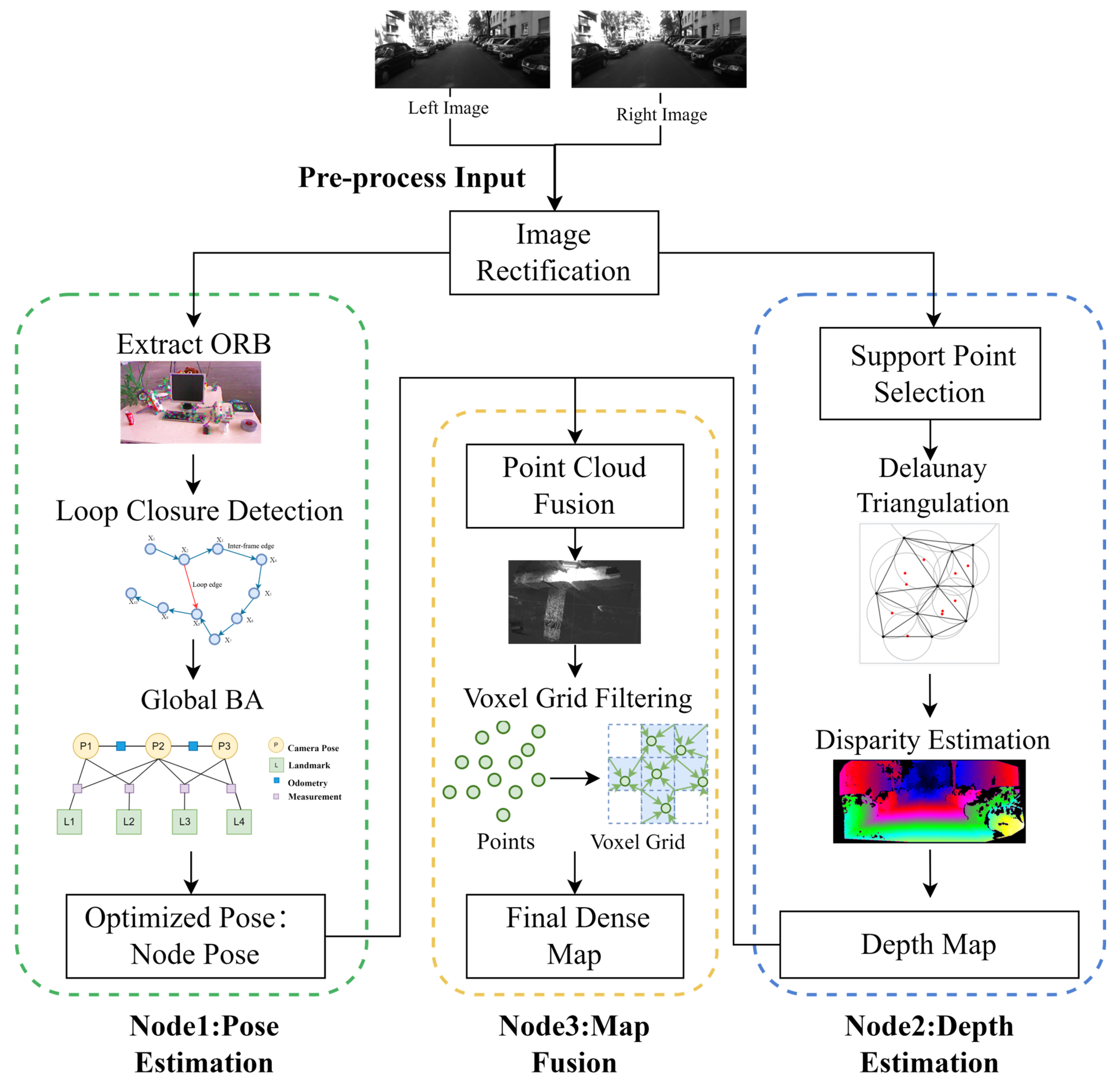
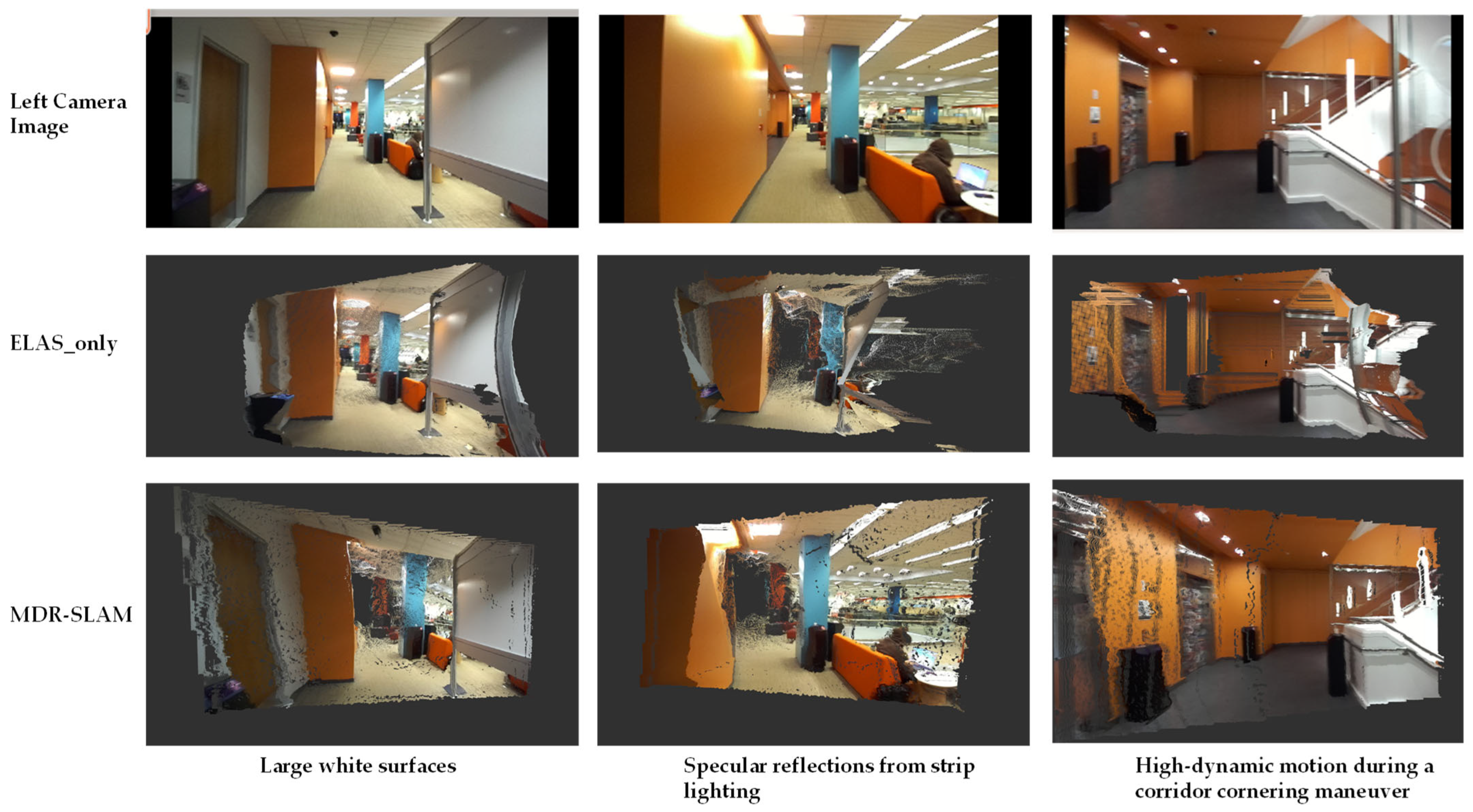
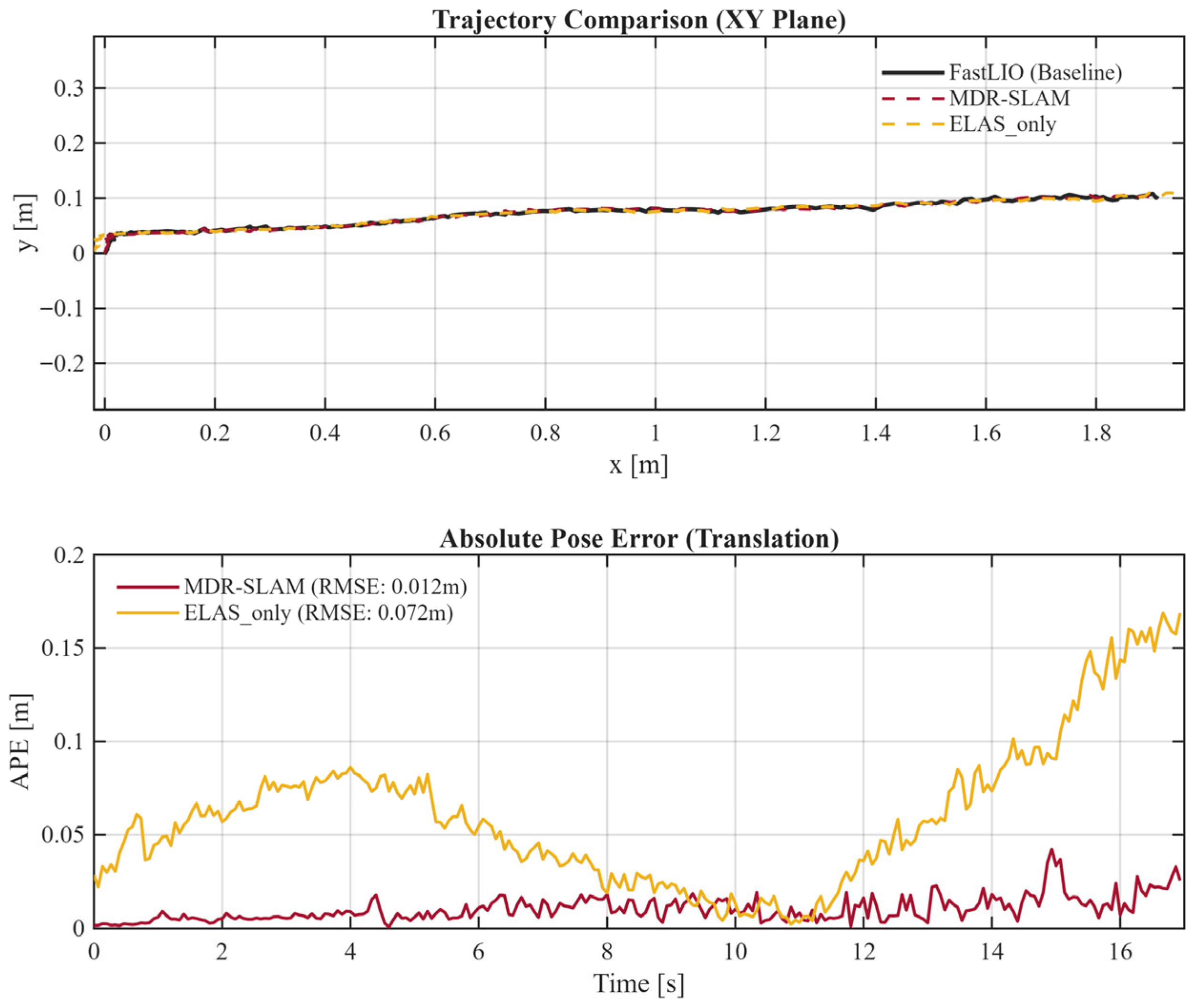
Realizing real-time dense 3D reconstruction on resource-limited mobile platforms remains a significant challenge, particularly in low-texture environments that demand robust multi-frame fusion to resolve matching ambiguities. However, the inherent tight coupling of pose estimation and mapping in traditional monolithic SLAM architectures imposes a severe restriction on integrating high-complexity fusion algorithms without compromising tracking stability. To overcome these limitations, this paper proposes MDR–SLAM, a modular and fully decoupled stereo framework. The system features a novel keyframe-driven temporal filter that synergizes efficient ELAS stereo matching with Kalman filtering to effectively accumulate geometric constraints, thereby enhancing reconstruction density in textureless areas. Furthermore, a confidence-based fusion backend is employed to incrementally maintain global map consistency and filter outliers. Quantitative evaluation on the NUFR-M3F indoor dataset demonstrates the effectiveness of the proposed method: compared to the standard single-frame baseline, MDR–SLAM reduces map RMSE by 83.3% (to 0.012 m) and global trajectory drift by 55.6%, while significantly improving map completeness. The system operates entirely on CPU resources with a stable 4.7 Hz mapping frequency, verifying its suitability for embedded mobile robotics.
Keywords: 3D mapping; low-texture scenes; software architecture; computer vision 3D mapping; low-texture scenes; software architecture; computer vision