3D-IMB-APDR: Inertial-Geomagnetic-Barometric-Based Adaptive Infrastructure-Free 3D Pedestrian Dead Reckoning Method


Abstract
1. Introduction
- (1)
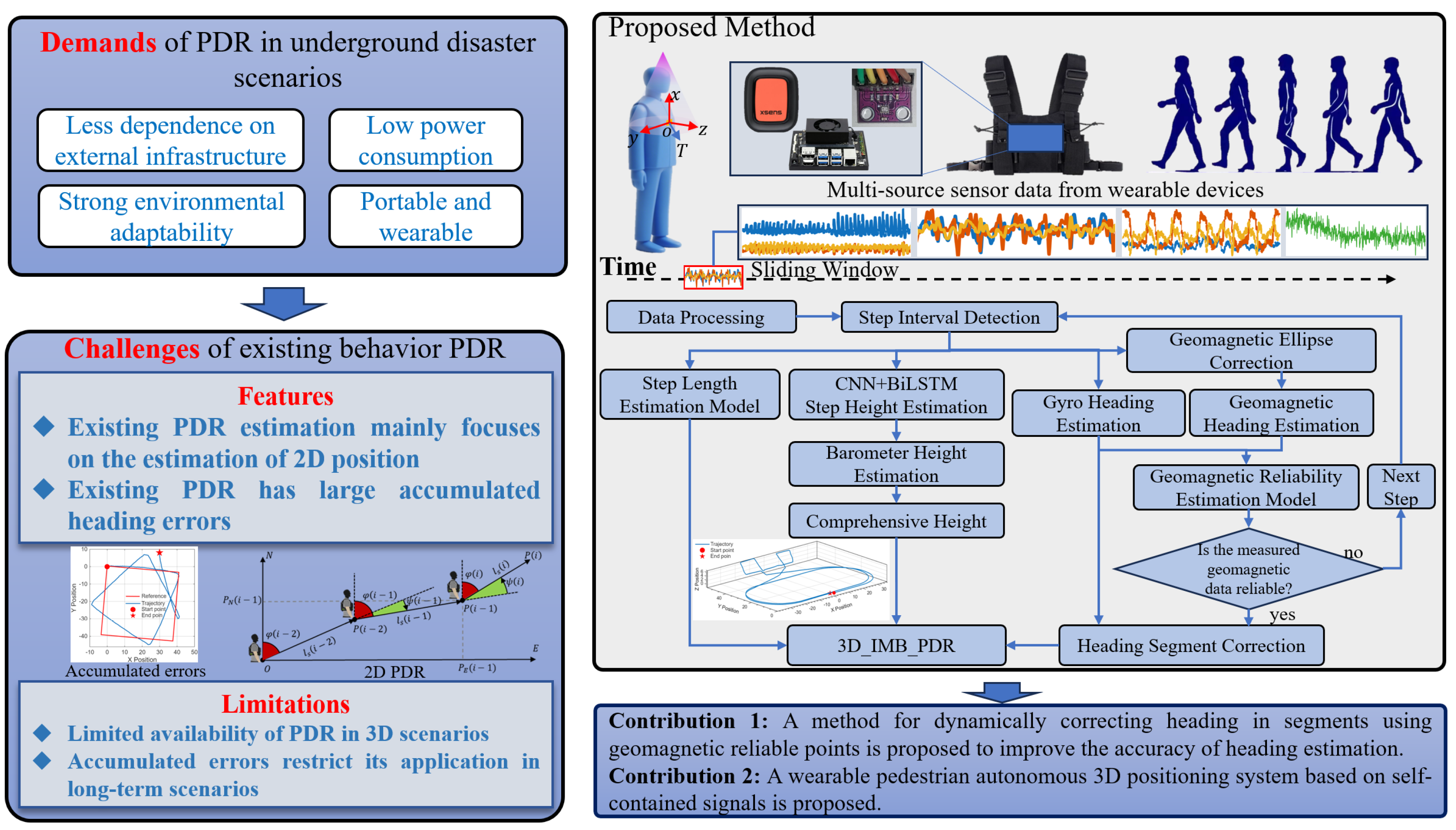
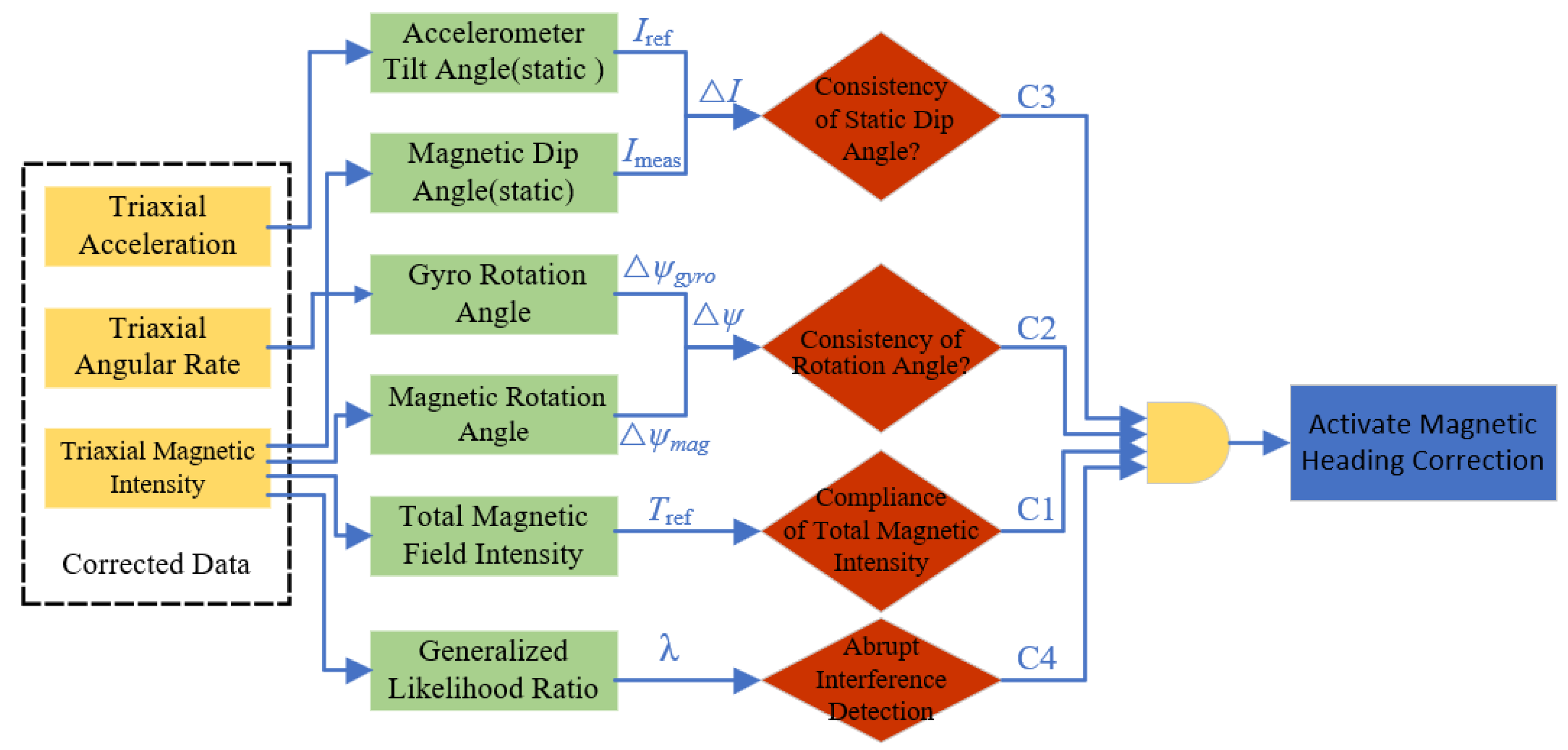
- Dynamic Geomagnetic Reliability Evaluation Model: A dynamic geomagnetic reliability evaluation model under multi-criteria constraints is proposed to determine in real time the validity of geomagnetic signals, addressing the issue that traditional methods cannot distinguish dynamic interference.
- (2)
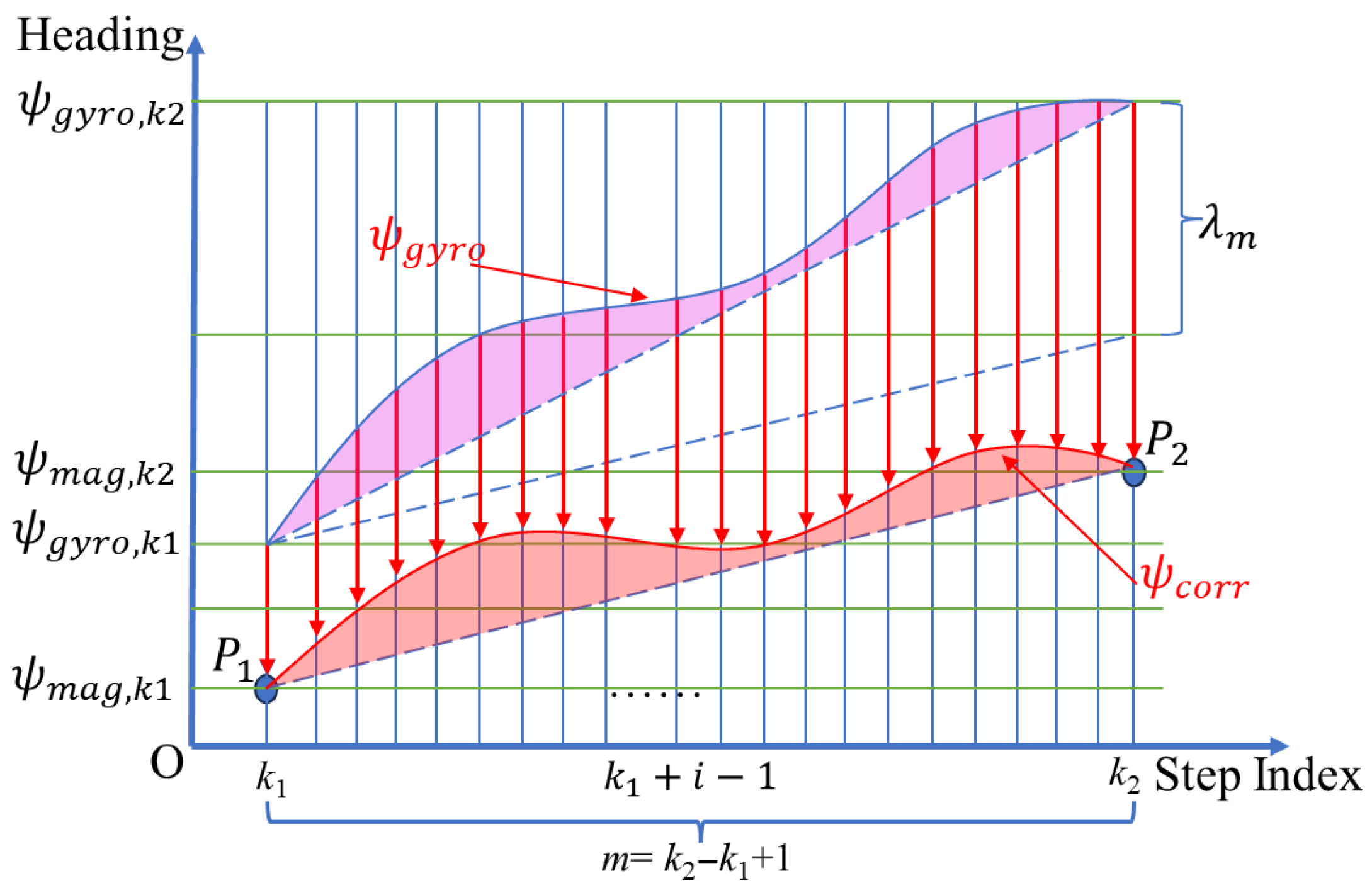
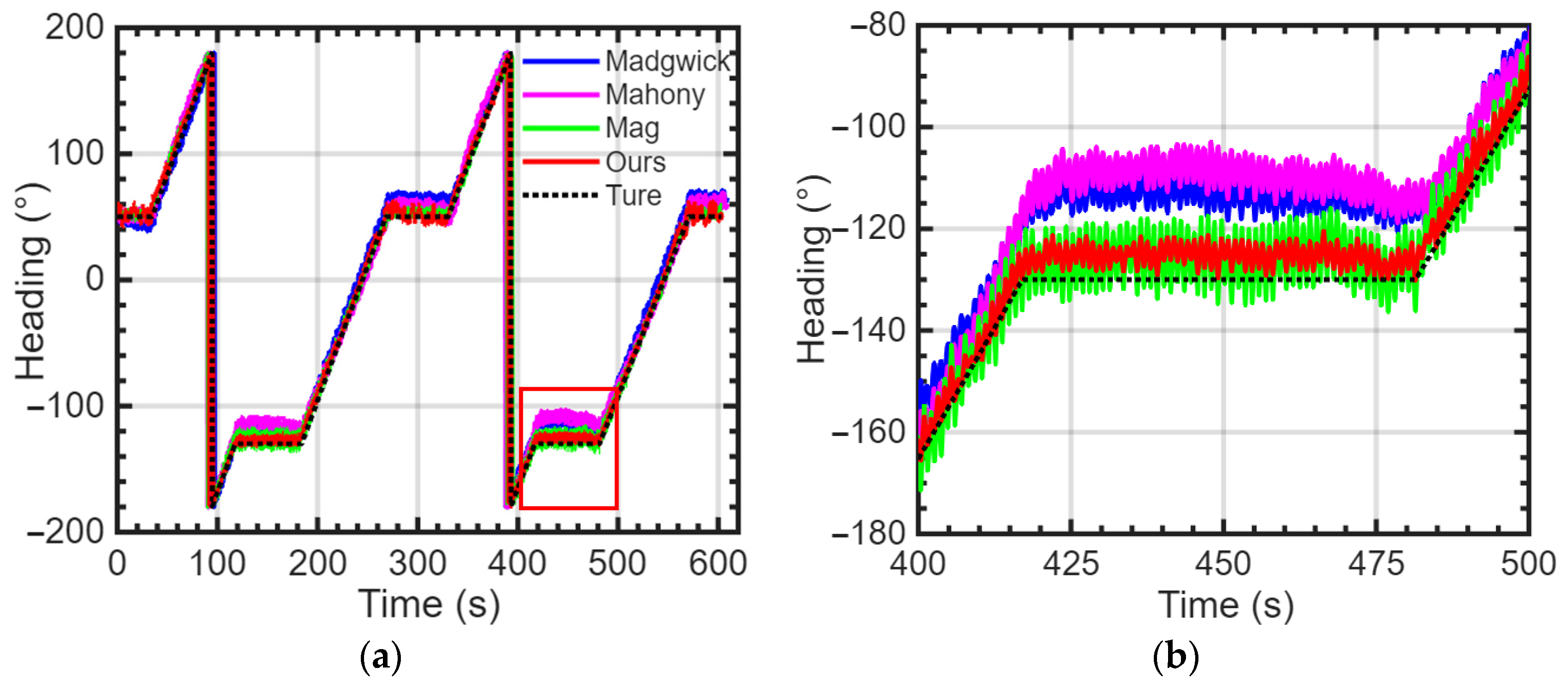
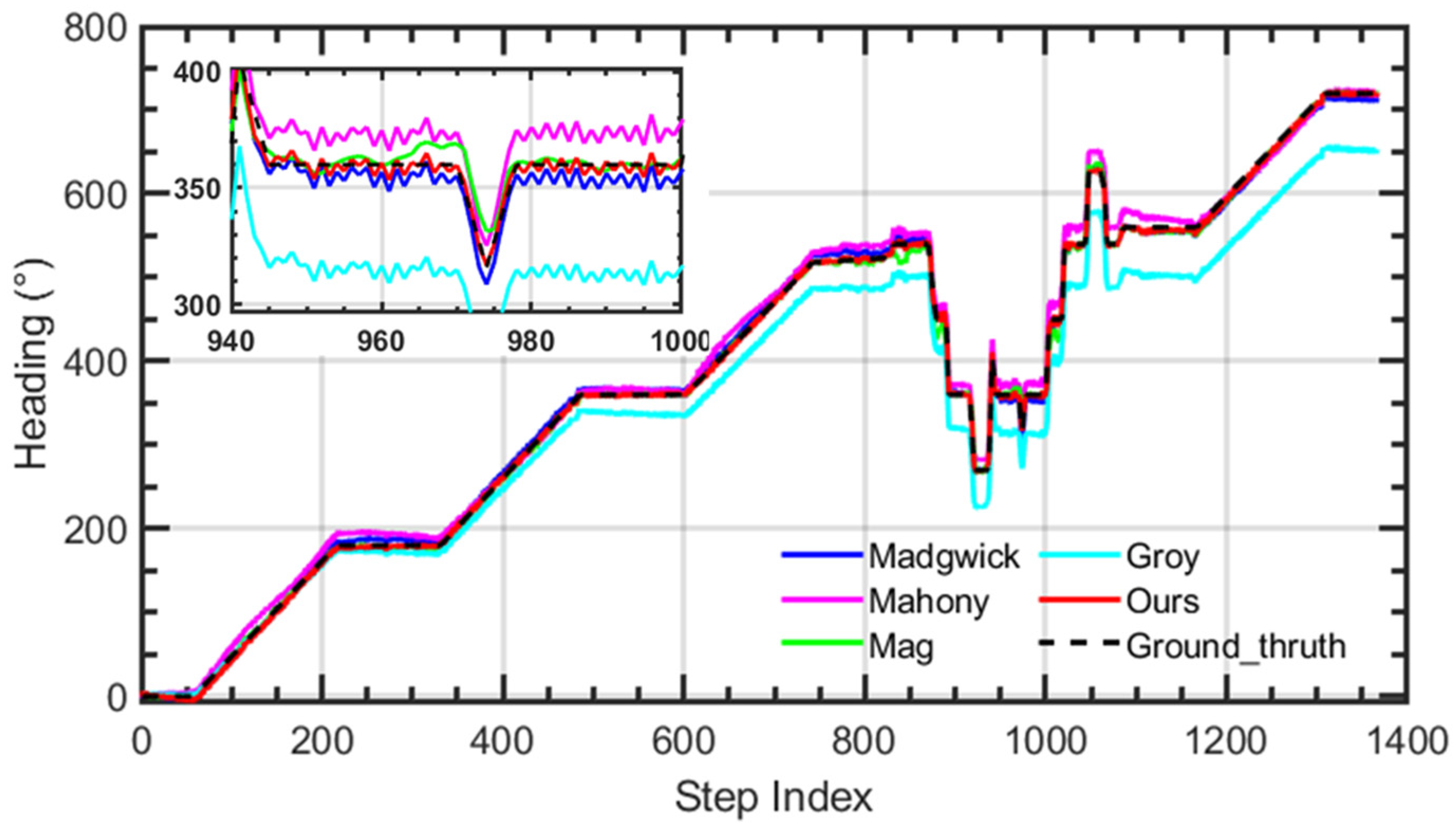
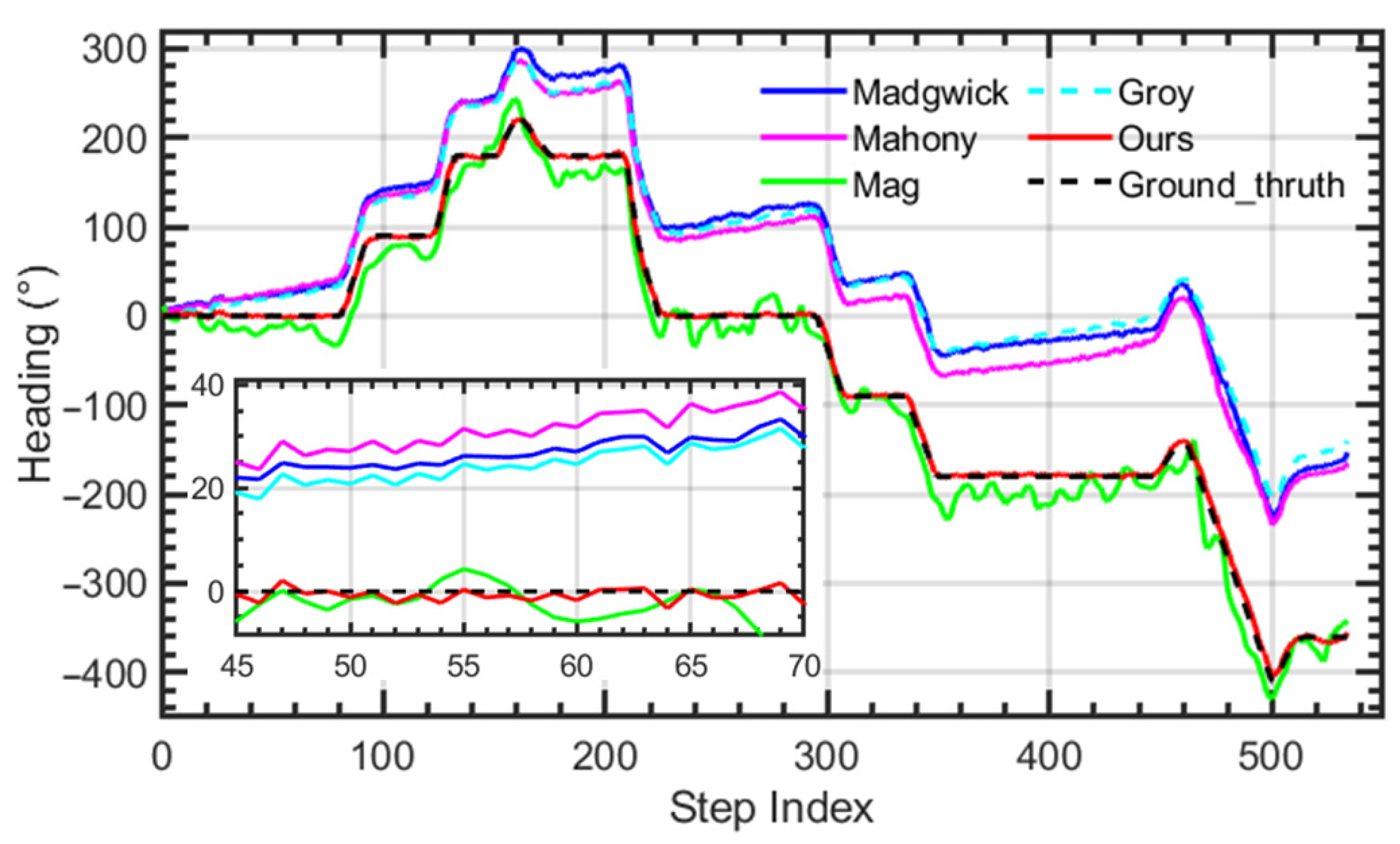
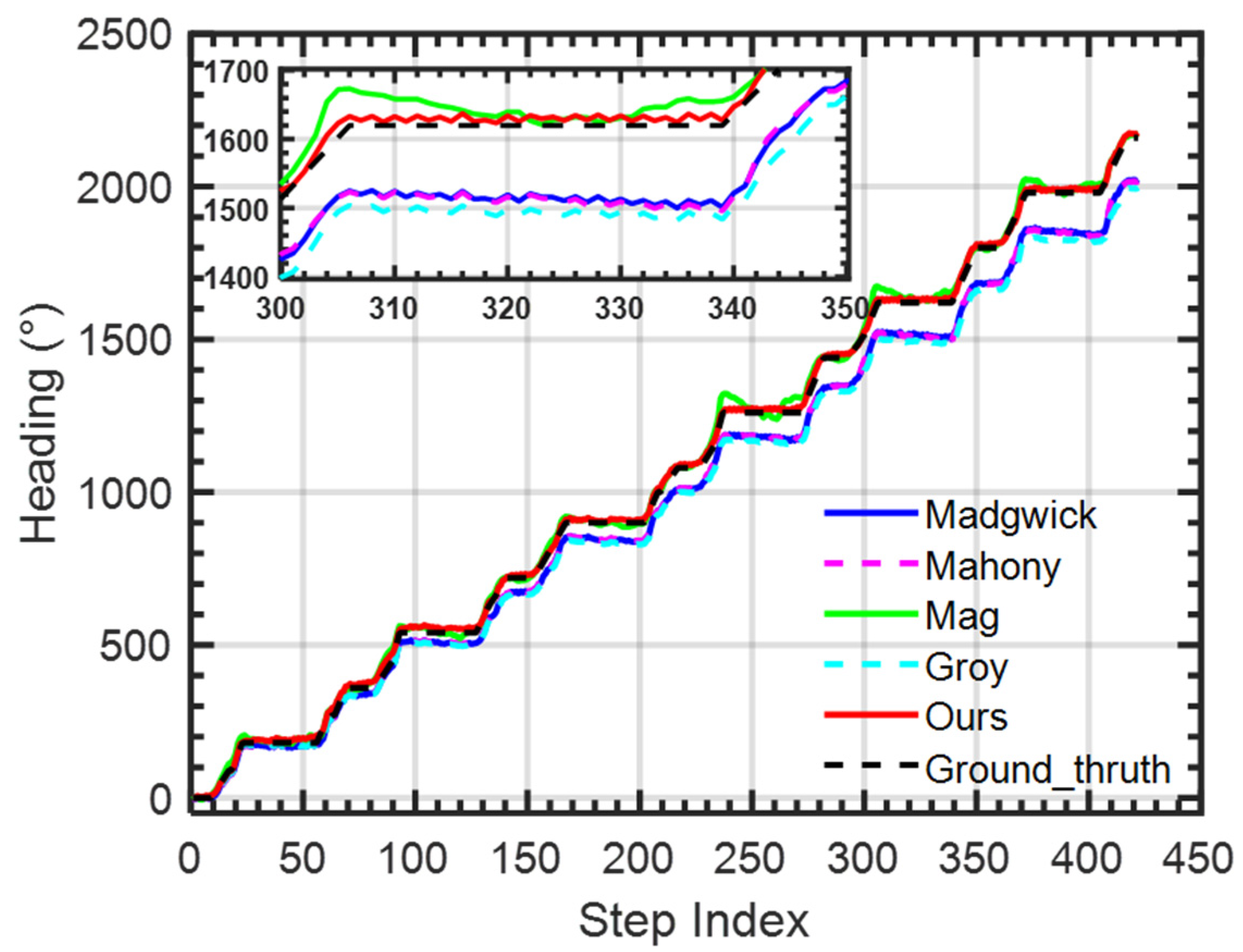
- Segmental Heading Correction Method Based on Geomagnetic Reliability: Based on the detection results of geomagnetic signal reliability, a heading correction benchmark is established between two geomagnetically reliable points to correct the heading of the corresponding segment. It fully utilizes the global characteristics and accuracy of heading at geomagnetically reliable points while retaining the short-term dynamic tracking capability and accuracy of gyroscopes in heading estimation. As a result, the root mean square error (RMSE) of heading in magnetically disturbed environments is reduced by 35.5% compared with traditional methods, effectively improving the continuity and accuracy of heading estimation in complex scenarios.
- (3)
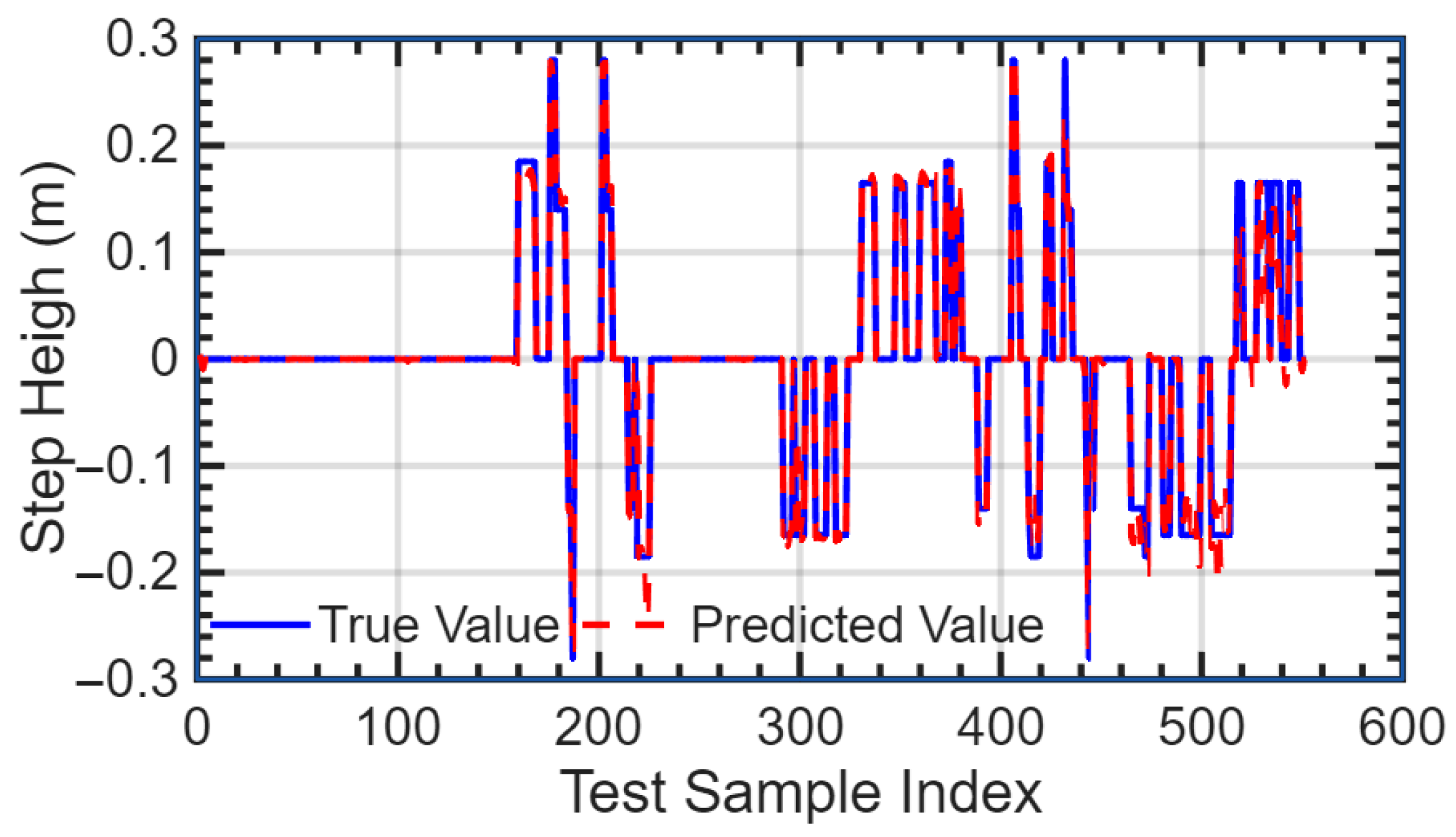
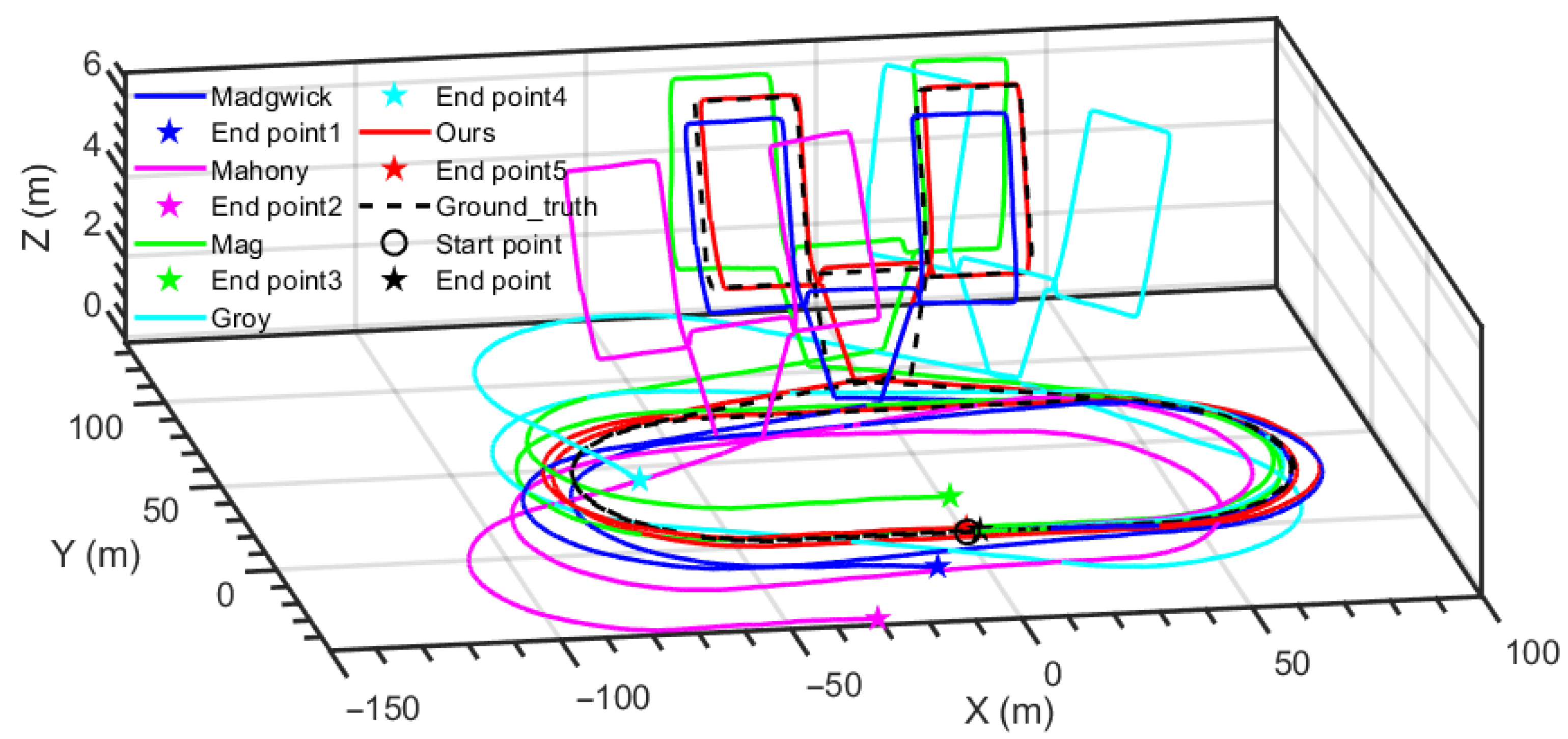
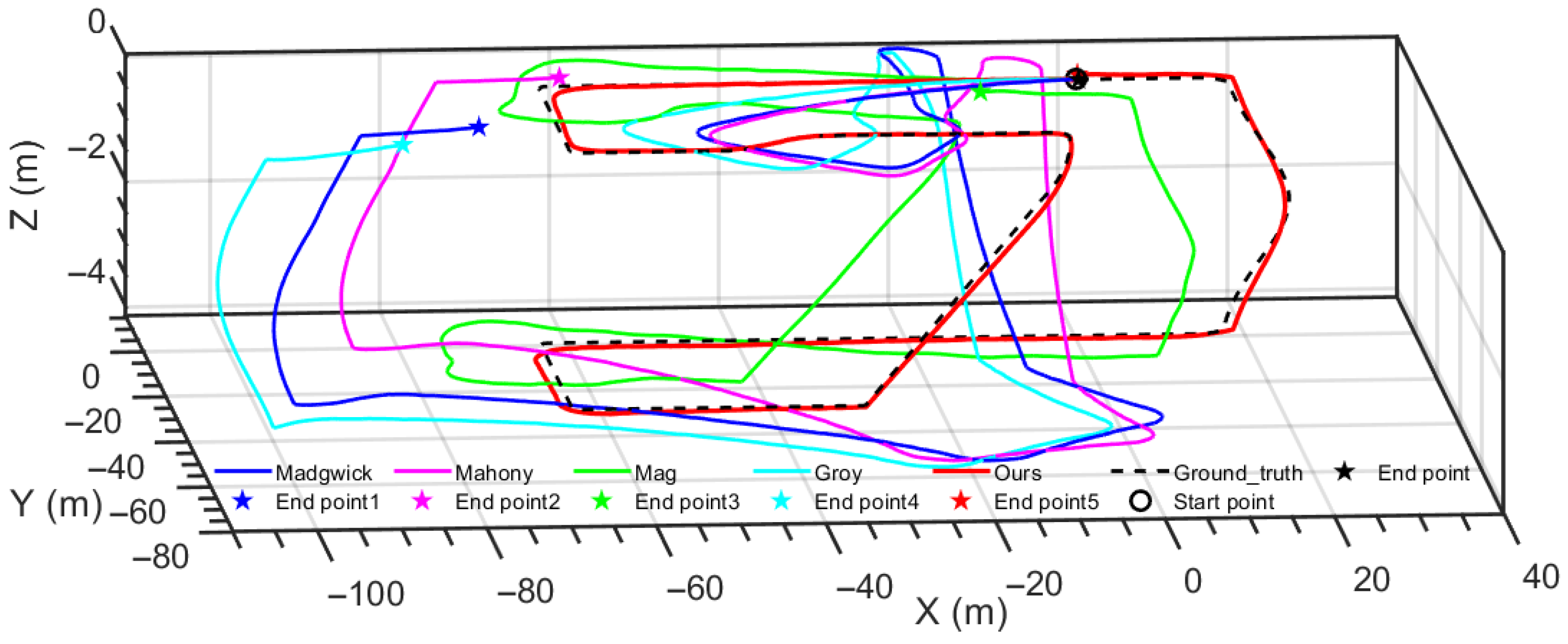
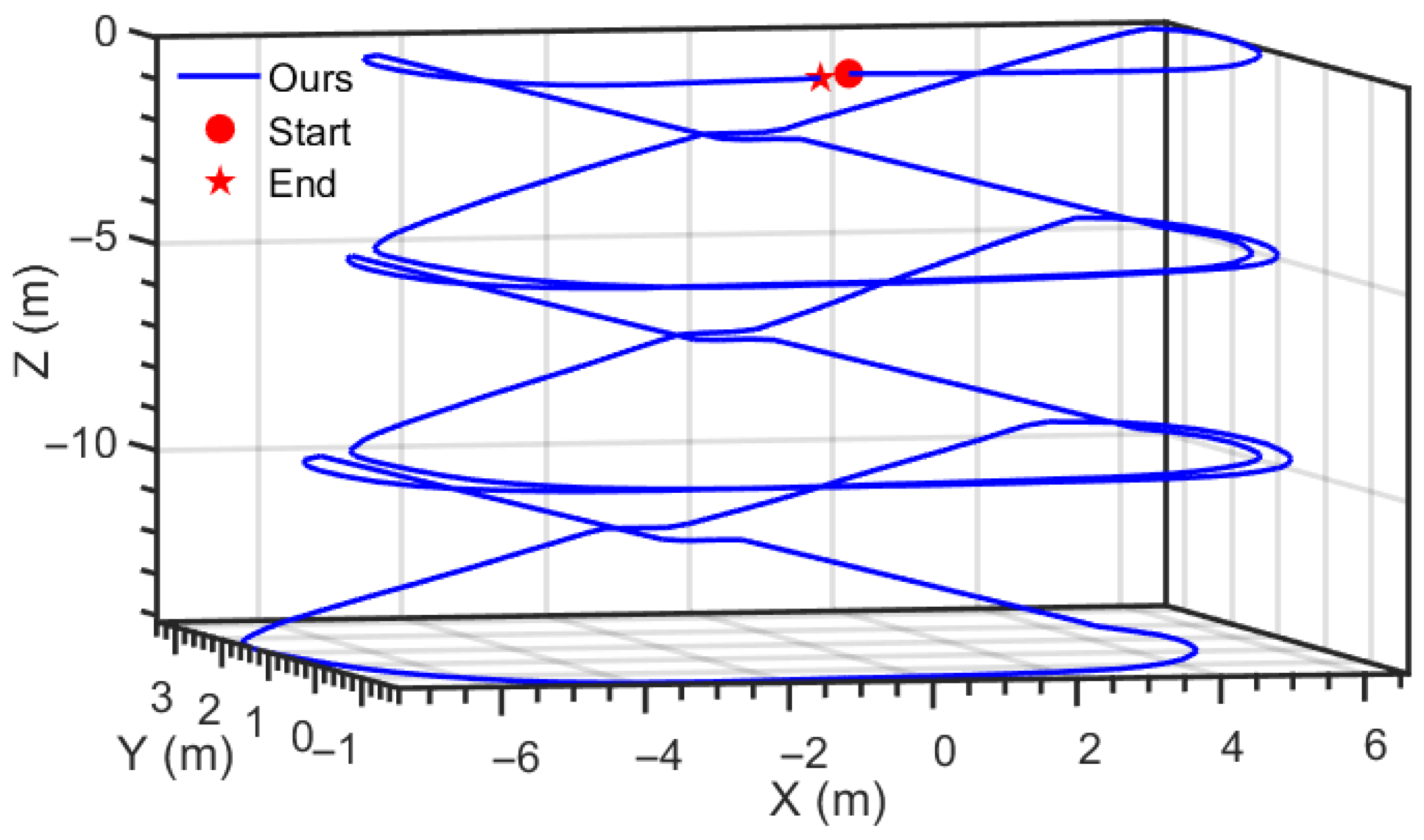
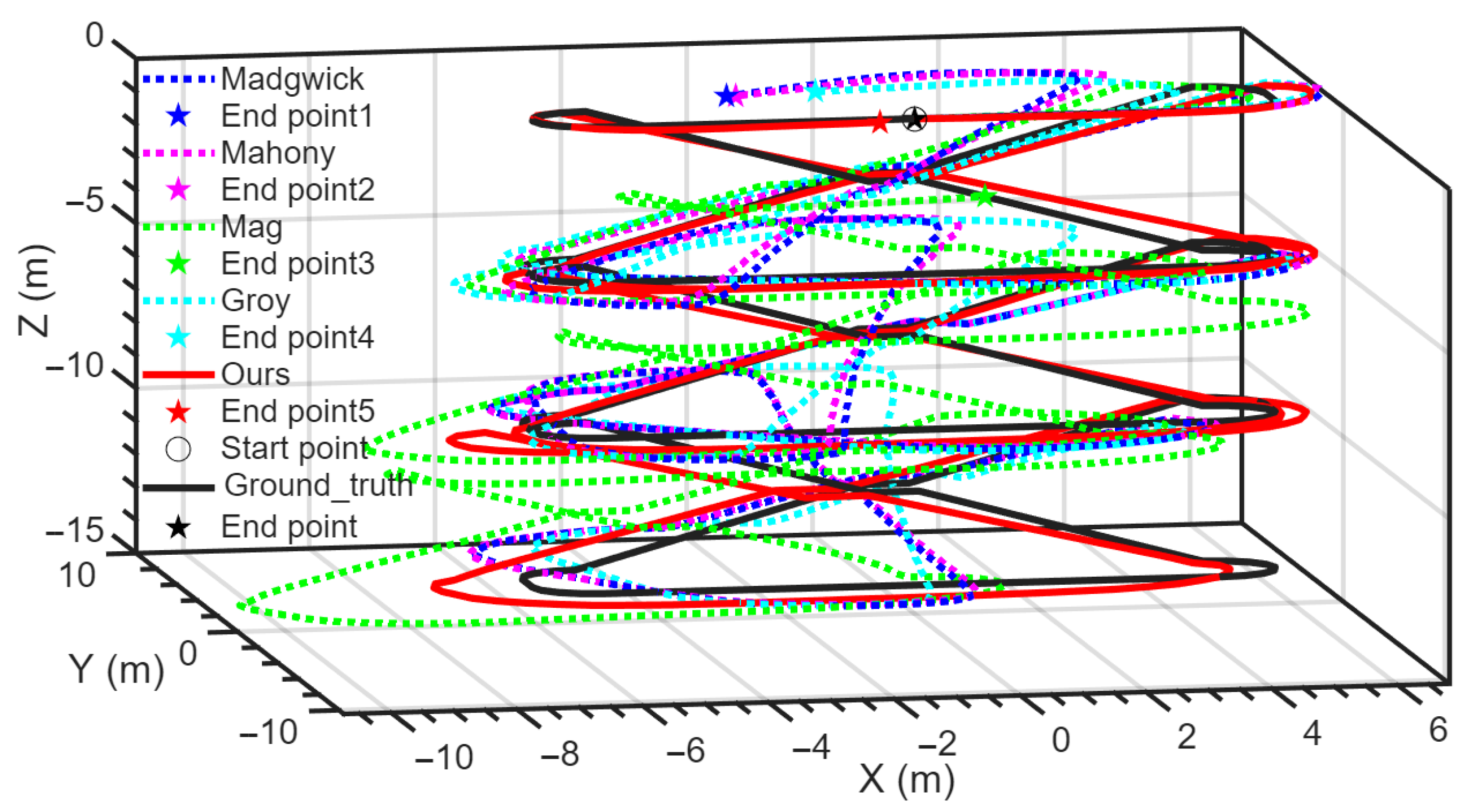
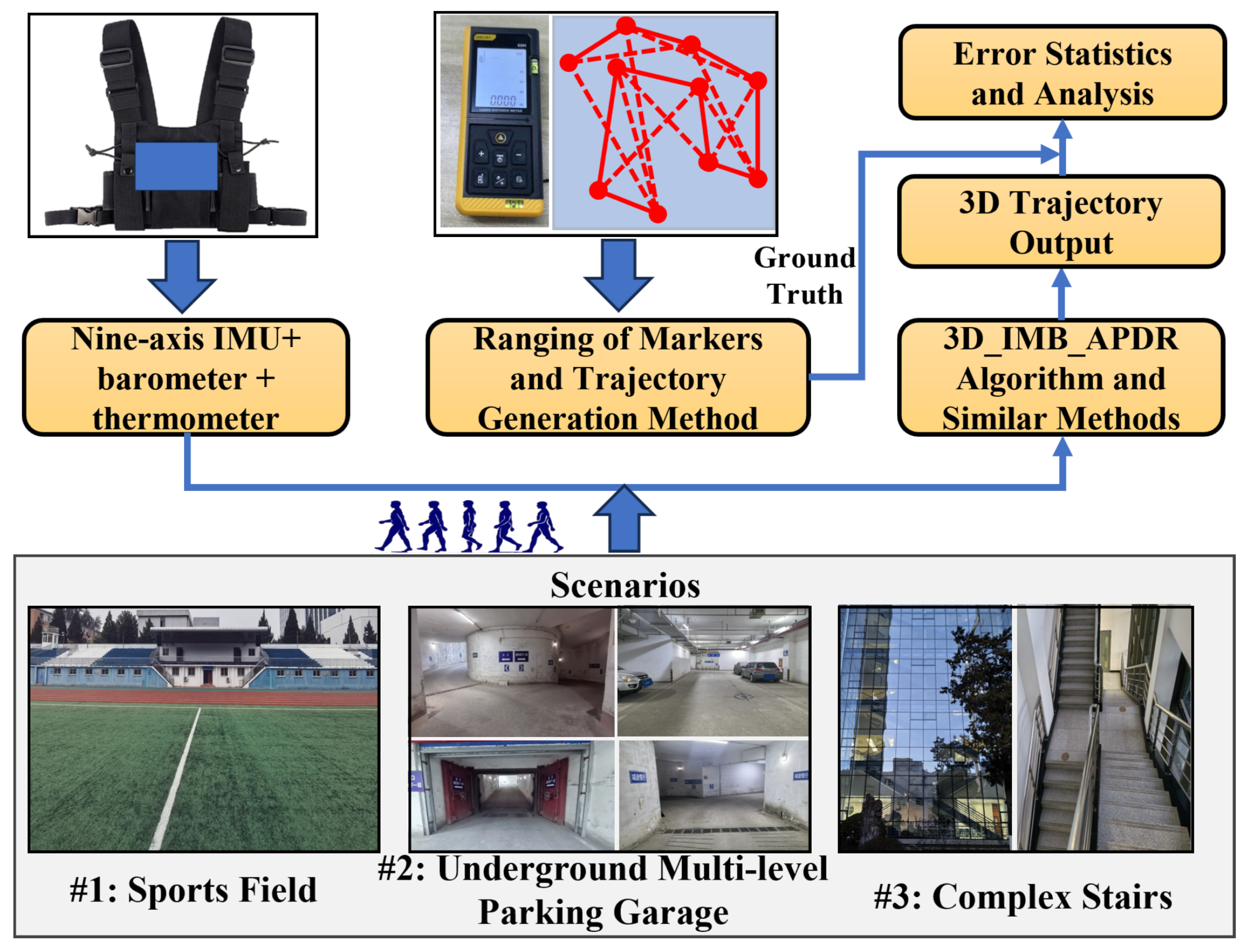
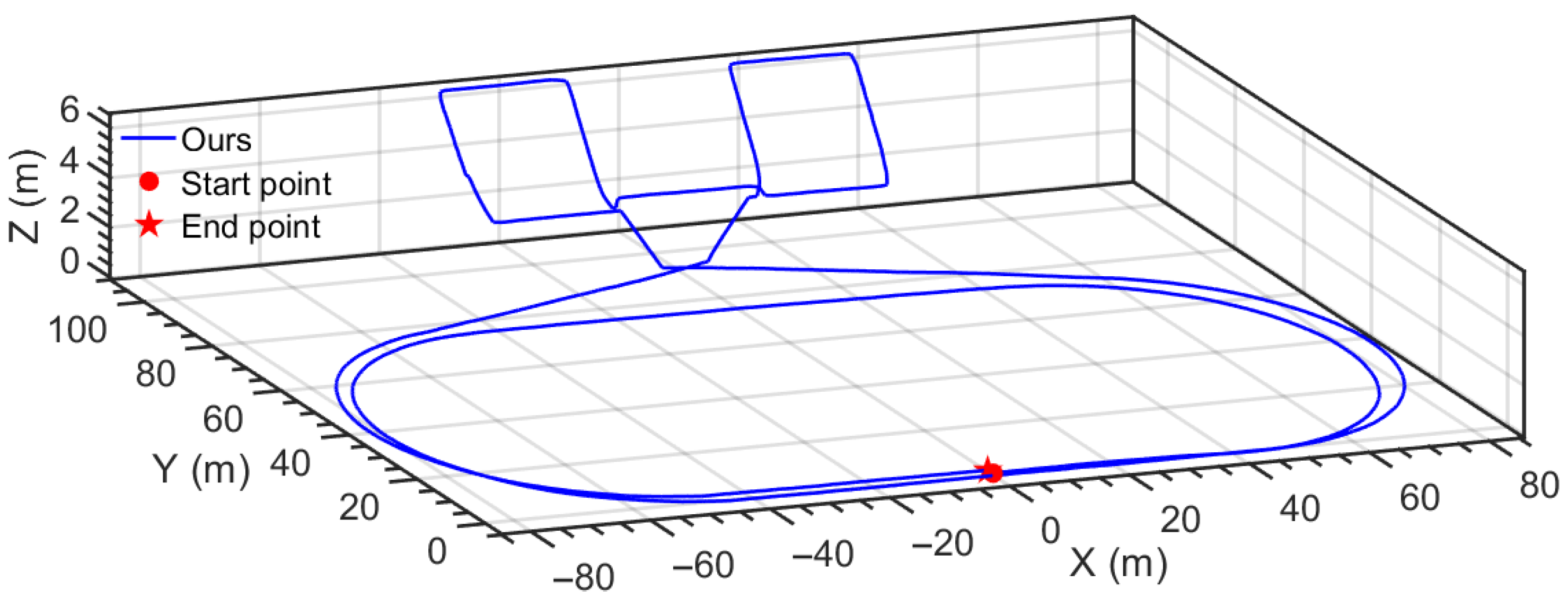
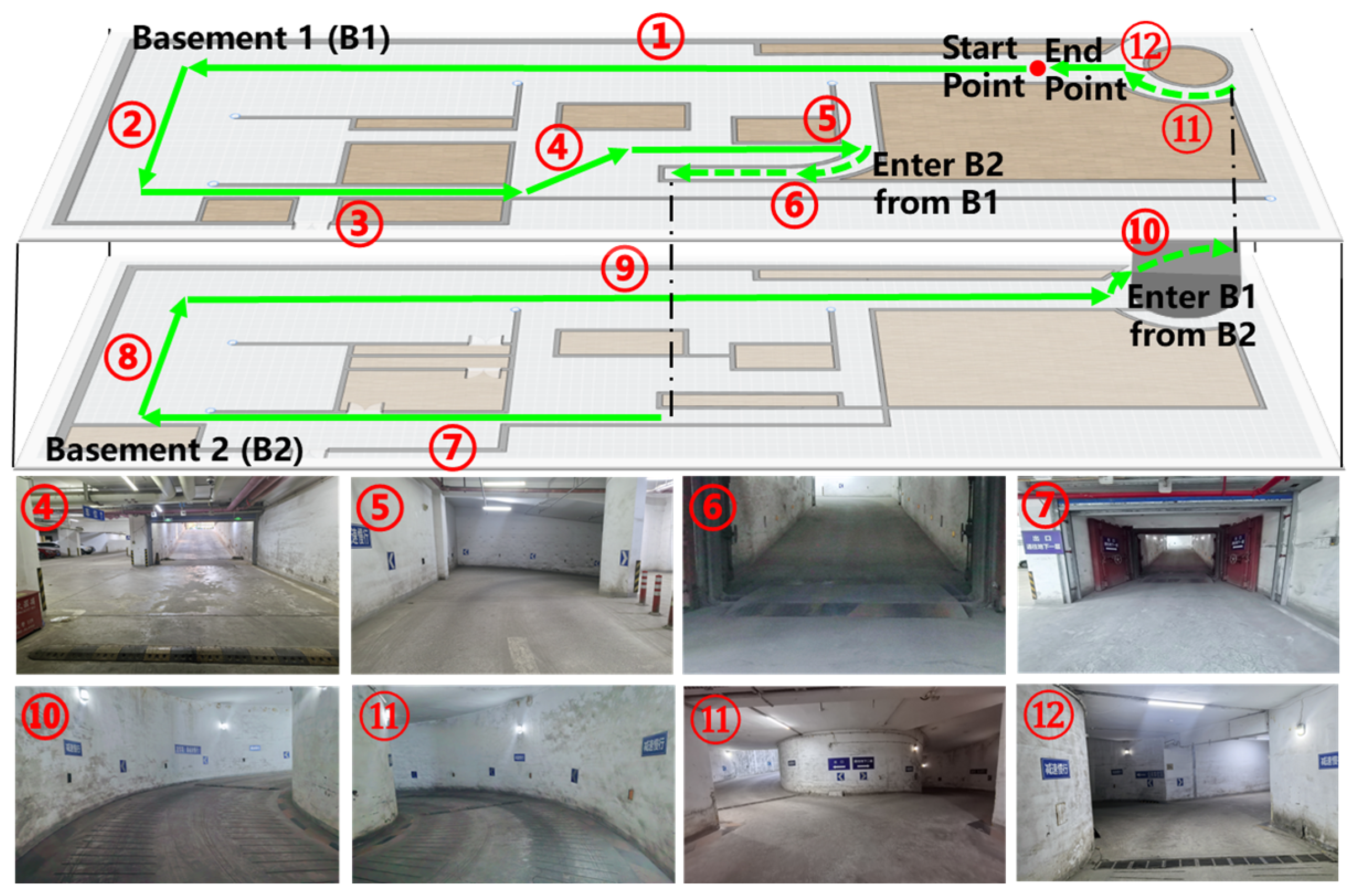
- Coarse-Fine Fusion Step Height Estimation Model: Adopting the architecture of barometer-based coarse estimation and inertial time-series fine correction, the model first performs coarse altitude estimation via a barometer, then processes inertial data with a lightweight CNN-BiLSTM model for fine relative step height estimation, and finally completes dynamic fusion of the two via the adaptive extended Kalman filter (AEKF). The proposed method yields superior positioning accuracy relative to typical existing approaches across three typical scenarios: outdoor sports fields, underground multi-story parking garages, and multi-floor teaching buildings.
2. Related Work
2.1. Pedestrian Dead Reckoning Technology
2.2. Pedestrian Altitude Estimation
2.3. Magnetic Interference Suppression and Geomagnetic Reliability Evaluation
3. Overview of the Proposed Method
4. Methodology
4.1. Data Processing
4.1.1. Data Filtering and Dominant Signal Extraction
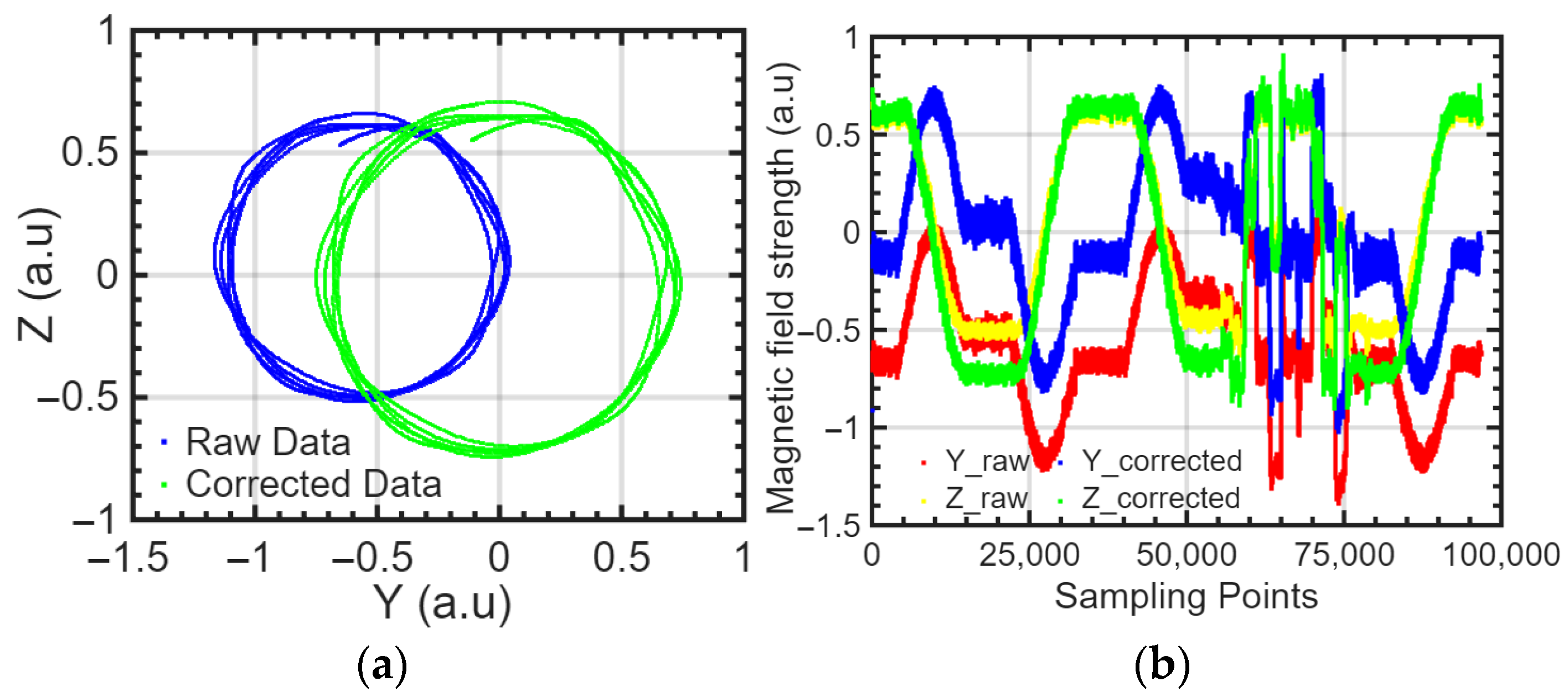
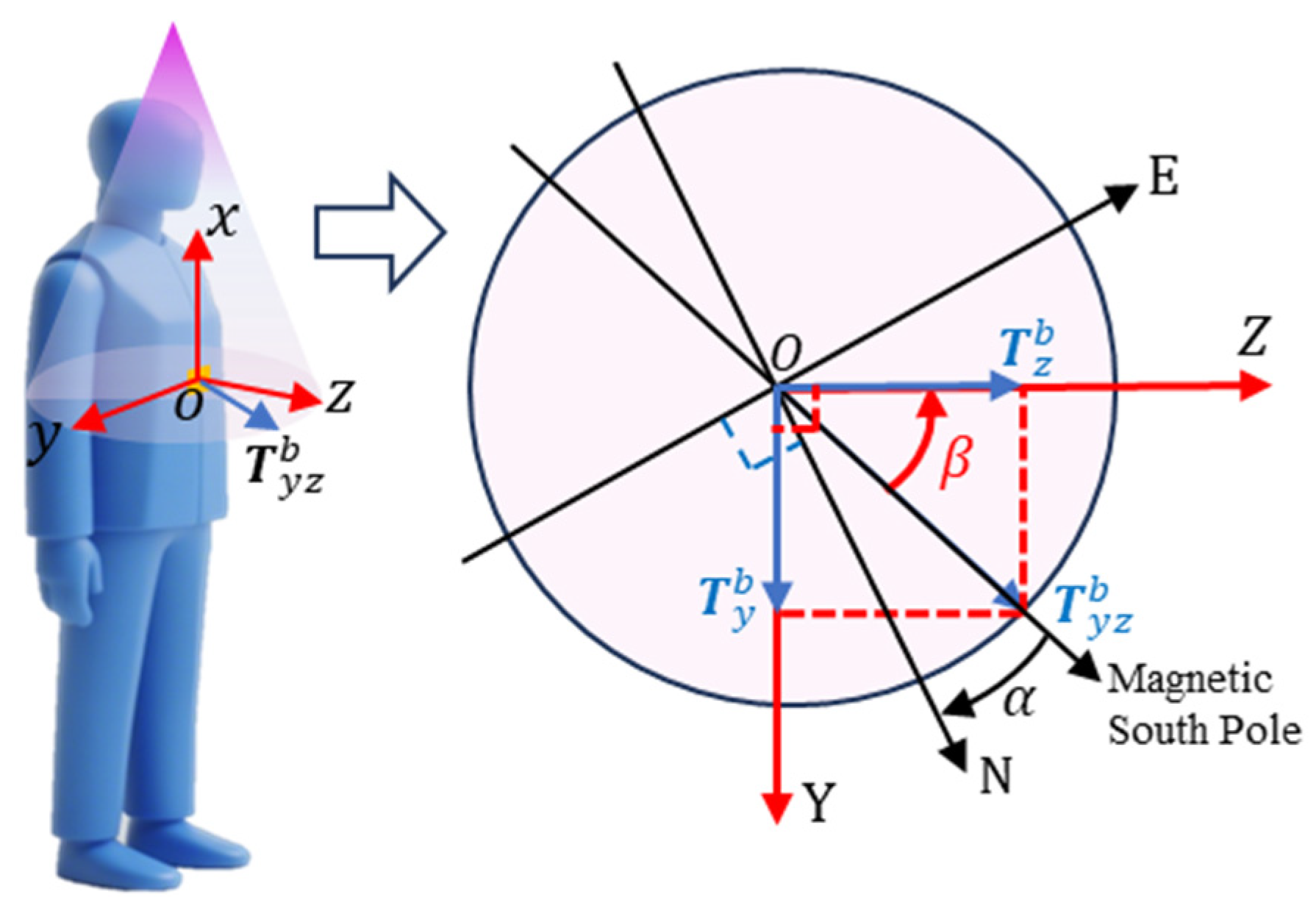
4.1.2. Geomagnetic Ellipse Correction and Magnetic Yaw Angle Estimation
- Geomagnetic Model
- 2.
- Geomagnetic Ellipse Correction
- 3.
- Geomagnetic Heading Estimation
4.2. Geomagnetic Heading Optimization
4.2.1. Dynamic Evaluation of Geomagnetic Reliability
- Dynamic Geomagnetic Reliability Evaluation Model
- (1)
- Total Magnetic Field Intensity Constraint (Near-Field Hard Magnetic Interference Detection)
- (2)
- Rotation Angle Consistency (Near-Field/Dynamic Interference Detection)
- (3)
- Static Inclination Consistency (Static Interference Detection)
- (4)
- Generalized Likelihood Ratio Test Sudden Interference Detection
- 2.
- Activation Mechanism of the Heading Correction Algorithm
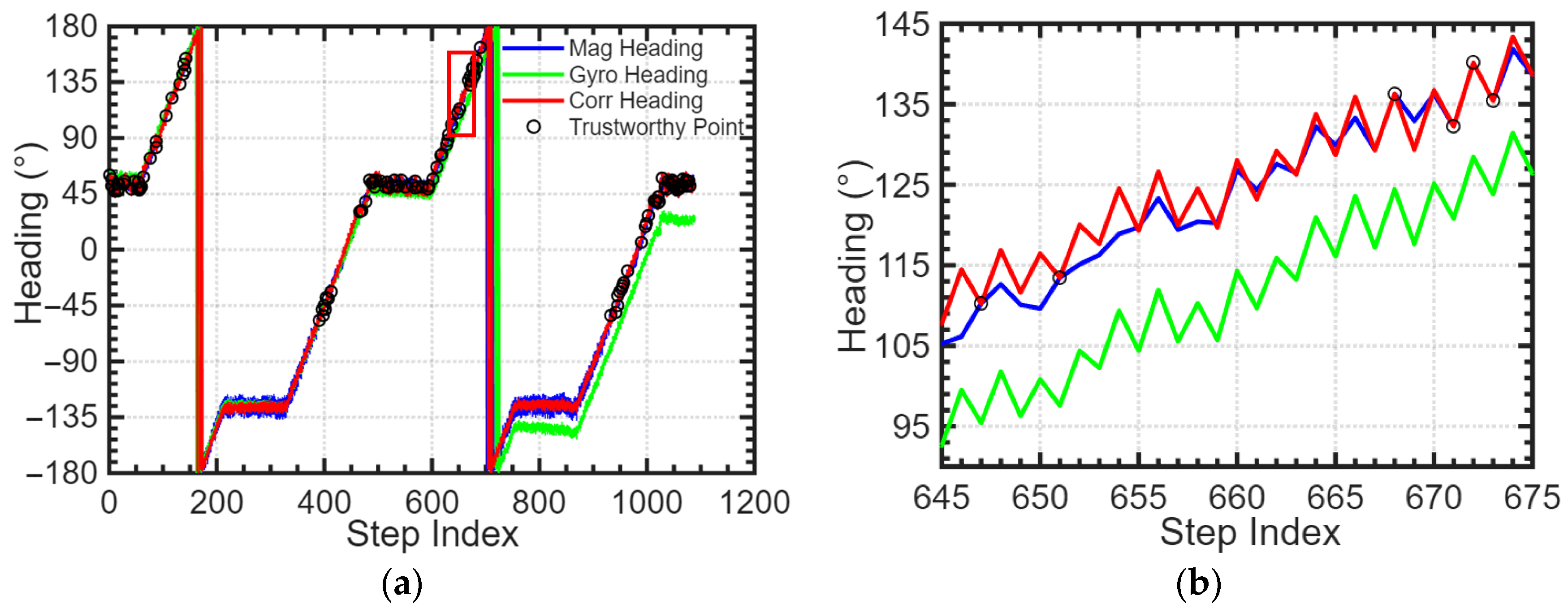
4.2.2. Segmental Heading Optimization Method Between Geomagnetic-Reliability Points
- Determination of Geomagnetic Reliable Points
- 2.
- Calculation of Interval Parameters
- 3.
- Correction of Segment Heading
4.2.3. Comparison of Performance with Similar Heading Estimation Methods
4.3. “Coarse-Fine” Joint Step Height Estimation
4.3.1. Barometer-Based Coarse Altitude Estimation
4.3.2. IMU-Based Fine Step Height Estimation
- Input Feature Selection
- 2.
- Lightweight Network Structure
- 3.
- Lightweight Optimization Measures
- 4.
- Lightweight CNN-BiLSTM Network
4.3.3. Step Height Fusion Based on Kalman Filter
- State Vector and Equations
- 2.
- Observation Equation
- 3.
- Adaptive Extended Kalman Filter Process
- (1)
- Prediction Step
- (2)
- Observation Trigger Judgment
- (3)
- Update Step
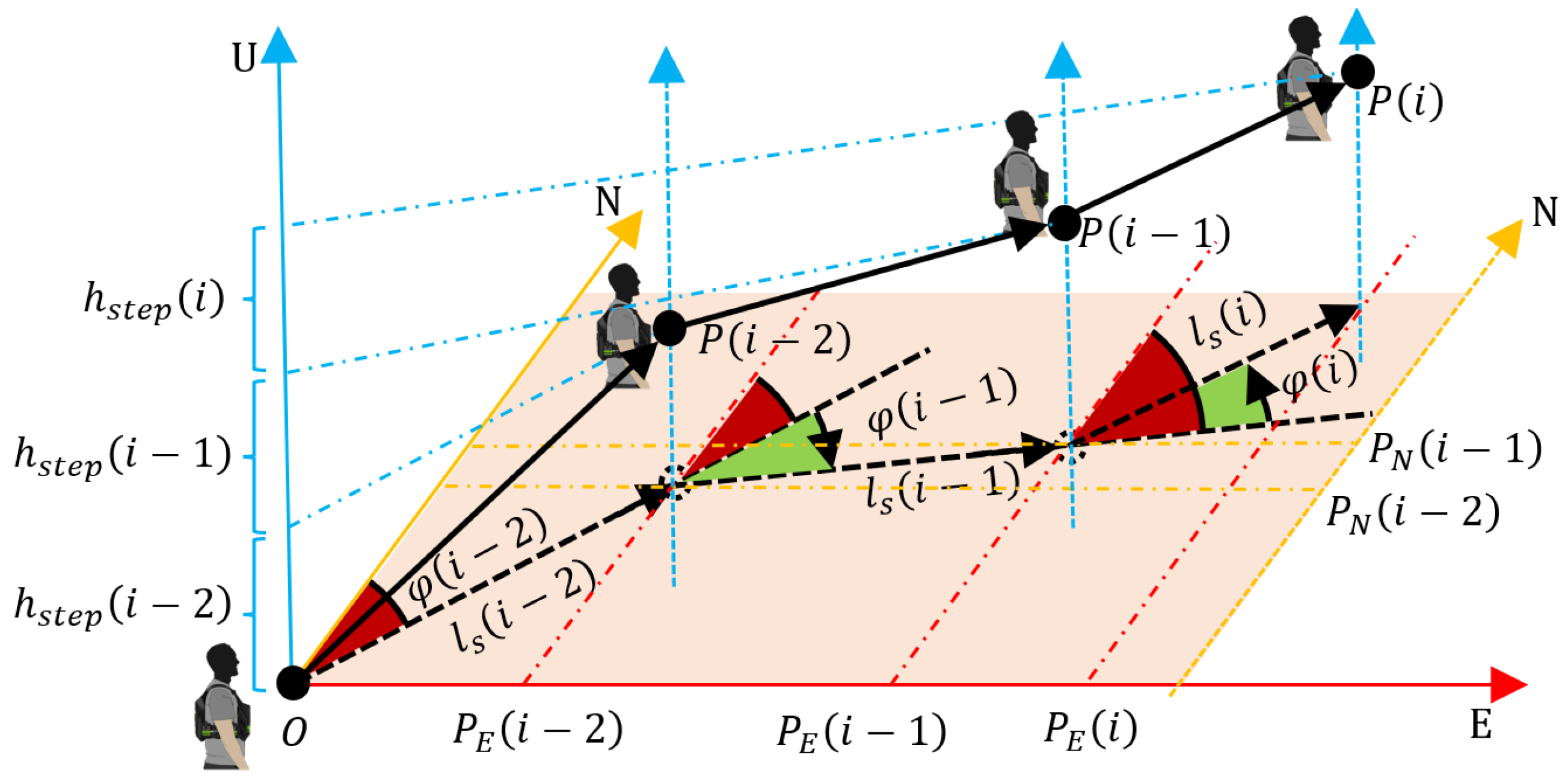
4.4. Dead Reckoning
4.4.1. Step Length Estimation
4.4.2. 3D Pedestrian Dead Reckoning
5. Experiments and Analysis
5.1. Experimental Setup
5.2. Experimental Validation and Performance Evaluation
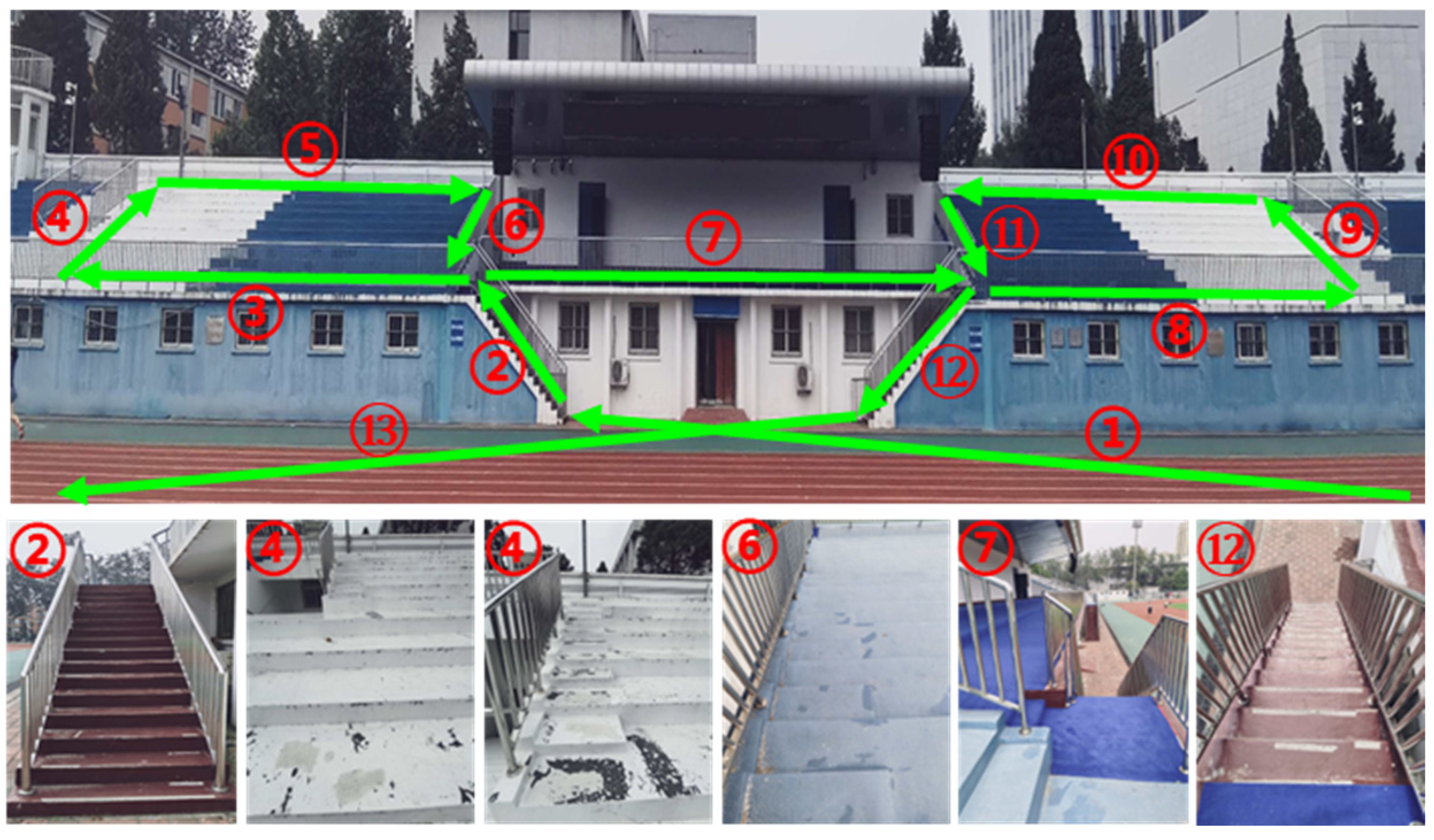
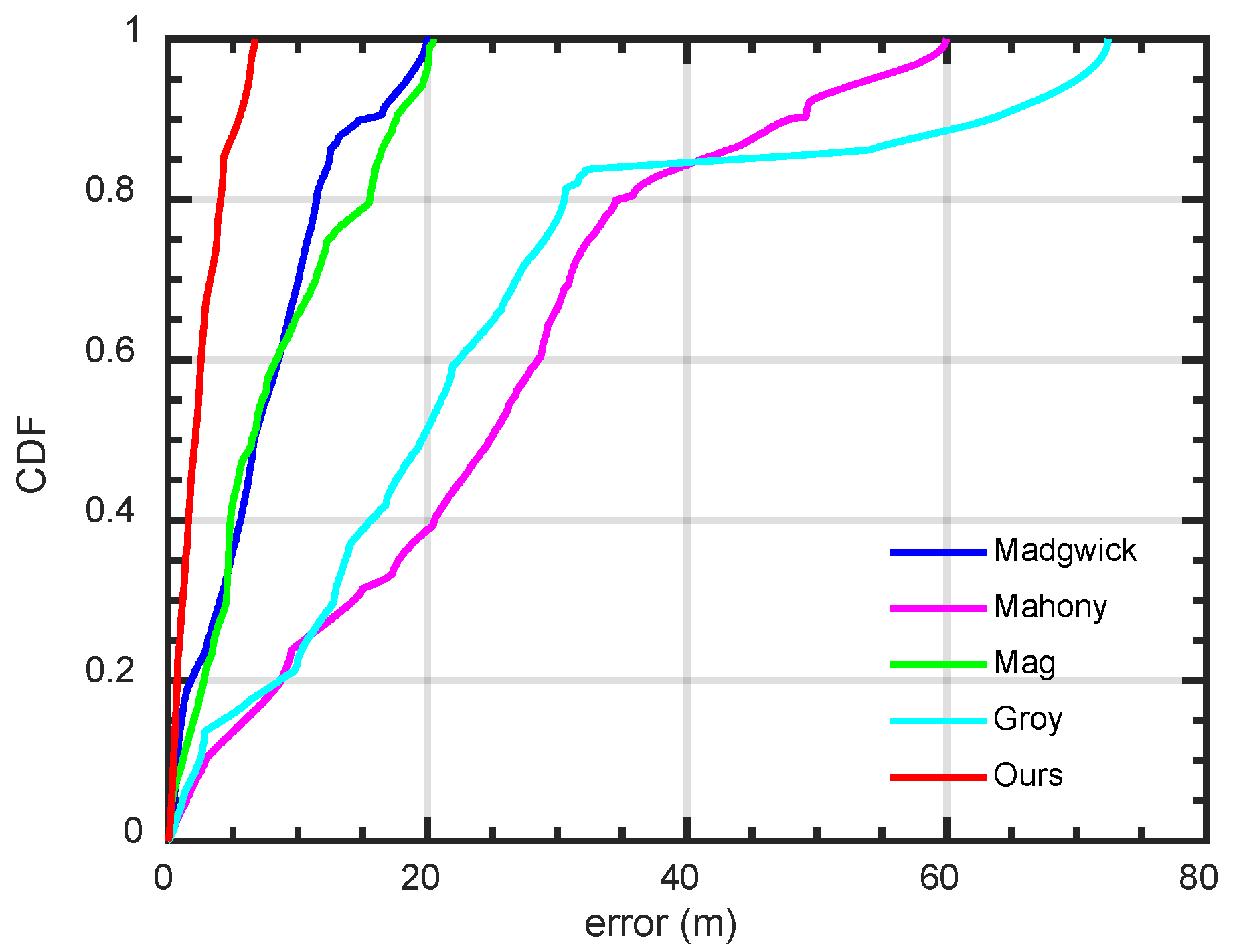
- Path #1: Campus Sports Fields
- 2.
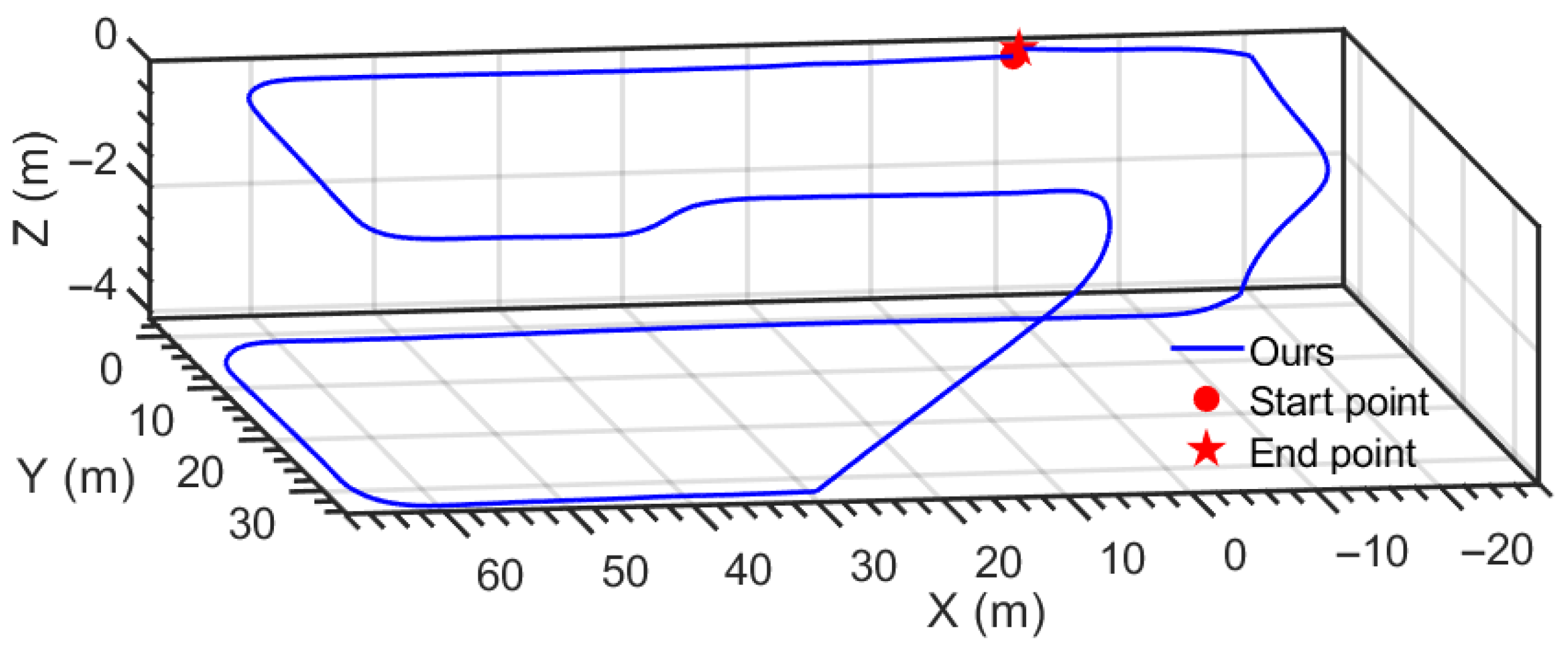
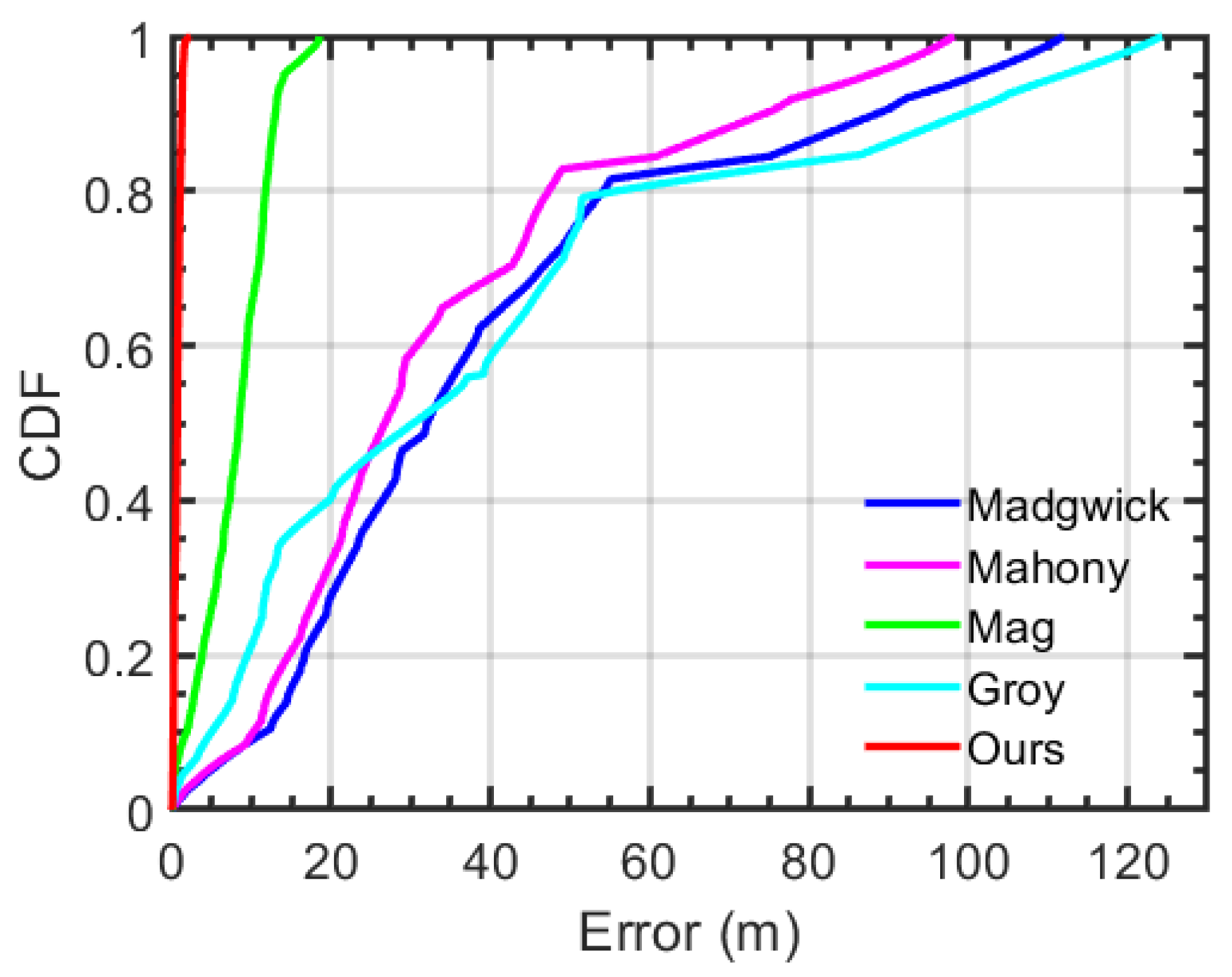
- Path #2: Underground Multi-Story Parking Garage
- 3.
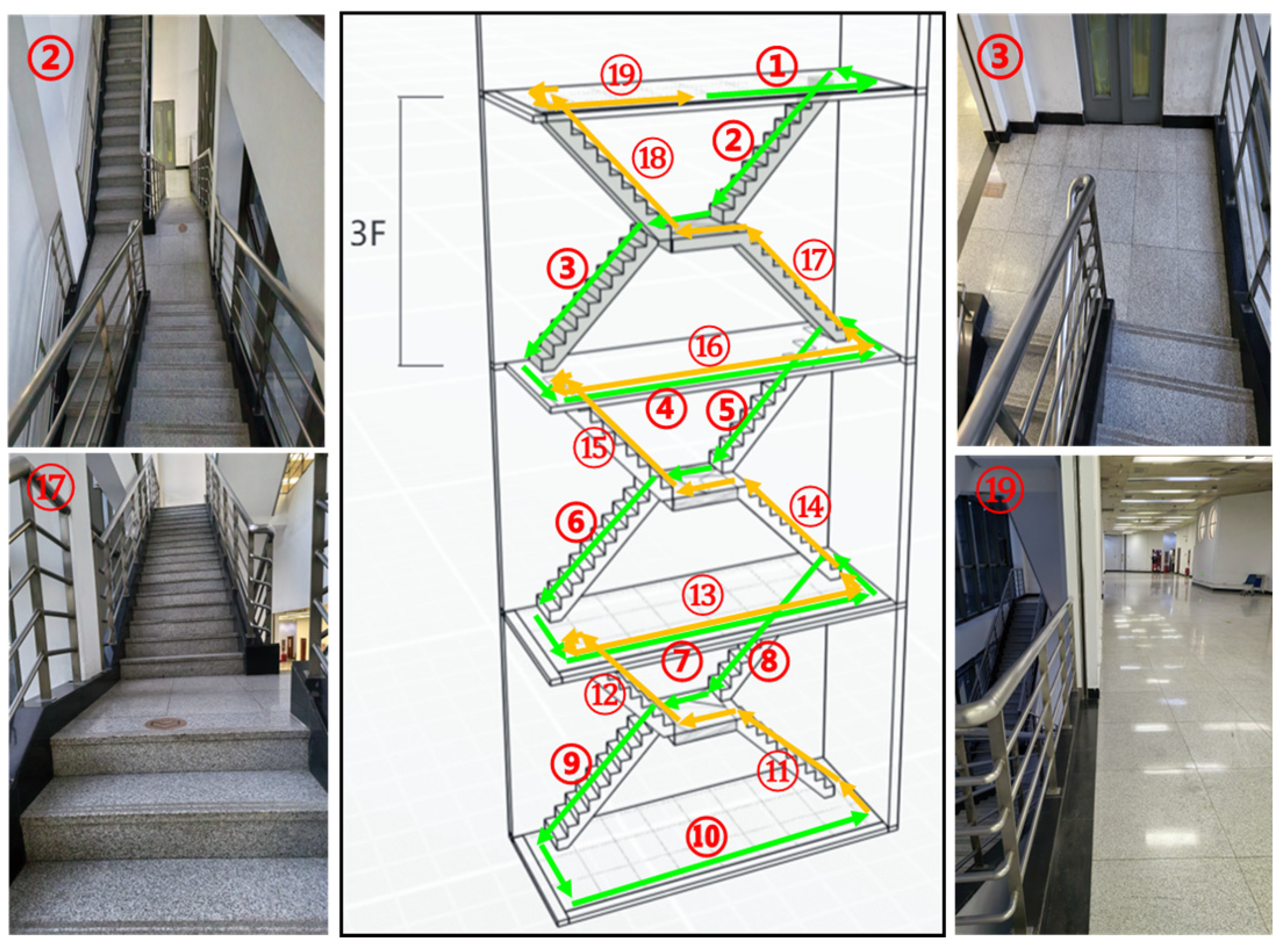
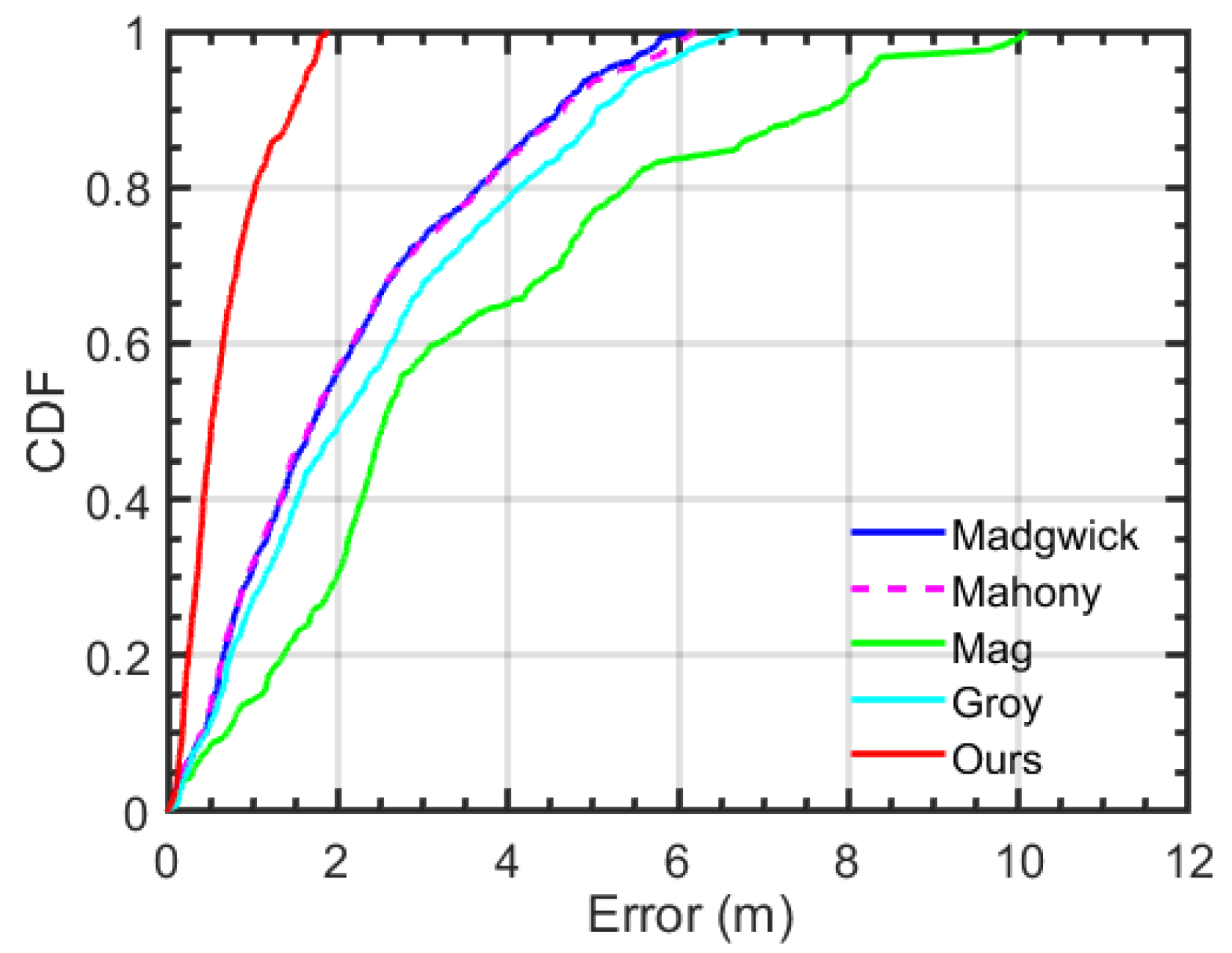
- Path #3: Teaching Building Complex Staircases
6. Conclusions and Future Work
Author Contributions
Funding
Informed Consent Statement
Data Availability Statement
Conflicts of Interest
Abbreviations
| PDR | Pedestrian dead reckoning |
| 3D-IMB-APDR | 3D-PDR method fusing inertial, geomagnetic, and barometric |
| UWB | Ultra-wideband |
| IMU | Inertial measurement unit |
| FFT | Fast Fourier transform |
| CNN | Convolutional neural networks |
| BiLSTM | Bi-directional long short-term memory |
| AEKF | Adaptive extended Kalman filter |
| RMSE | Root mean square error |
| WMM | World magnetic model |
| MinE | Minimum error |
| MaxE | Maximum error |
| ME | Mean error |
| FHE | Final heading error |
| FPE | Final position error |
| ZUPT | Zero-velocity update |
| CDF | Cumulative distribution function |
References
- Hou, X.Y.; Bergmann, J. Pedestrian Dead Reckoning with Wearable Sensors: A Systematic Review. IEEE Sens. J. 2021, 21, 143–152. [Google Scholar] [CrossRef]
- Liu, H.; Zhang, Z.H.; Dong, J.Q.; Benndorf, J.; Jia, X.W.; Wang, X.F.; Wu, X.; Chen, G.L. A review of positioning technologies for personnel and equipment in underground mines. Int. J. Digit. Earth 2025, 18, 2506493. [Google Scholar] [CrossRef]
- Tuna, T.; Nubert, J.; Nava, Y.; Khattak, S.; Hutter, M. X-ICP: Localizability-Aware LiDAR Registration for Robust Localization in Extreme Environments. IEEE Trans. Robot. 2024, 40, 452–471. [Google Scholar] [CrossRef]
- Khurshid, M.; Shahzad, M.; Khattak, H.A.; Malik, M.I.; Fraz, M.M. Vision-Based 3-D Localization of UAV Using Deep Image Matching. IEEE J. Sel. Top. Appl. Earth Obs. Remote Sens. 2024, 17, 12020–12030. [Google Scholar] [CrossRef]
- Citroni, R.; Mangini, F.; Frezza, F. Efficient Integration of Ultra-low Power Techniques and Energy Harvesting in Self-Sufficient Devices: A Comprehensive Overview of Current Progress and Future Directions. Sensors 2024, 24, 4471. [Google Scholar] [CrossRef]
- Bai, S.Y.; Wen, W.S.; Li, Y.; Shi, C.; Hsu, L.T. Toward Persistent Spatial Awareness: A Review of Pedestrian Dead Reckoning-Centric Indoor Positioning with Smartphones. IEEE Trans. Instrum. Meas. 2024, 73, 8507828. [Google Scholar] [CrossRef]
- Sun, M.; Wang, Y.; Zheng, N.; Chen, G.; Li, Z.; Bi, J.; Yang, H. Smartphone-Based Indoor Localization System Using Wi-Fi RTT/Magnetic/PDR Based on an Improved Particle Filter. IEEE Trans. Instrum. Meas. 2025, 74, 9507616. [Google Scholar] [CrossRef]
- Jeon, W.S.; Lee, H.S.; Jeong, D.G. Design of a Peer-to-Peer 3-D Pedestrian Positioning System Based on UWB and Sensor Fusion. IEEE Trans. Instrum. Meas. 2025, 74, 5500819. [Google Scholar] [CrossRef]
- Kong, X.T.; Wu, C.; You, Y.; Yuan, Y.F. Hybrid Indoor Positioning Method of BLE and PDR Based on Adaptive Feedback EKF with Low BLE Deployment Density. IEEE Trans. Instrum. Meas. 2023, 72, 9500912. [Google Scholar] [CrossRef]
- Dinh, T.M.T.; Duong, N.S.; Sandrasegaran, K. Smartphone-Based Indoor Positioning Using BLE iBeacon and Reliable Lightweight Fingerprint Map. IEEE Sens. J. 2020, 20, 10283–10294. [Google Scholar] [CrossRef]
- De Cillis, F.; Faramondi, L.; Inderst, F.; Marsella, S.; Marzoli, M.; Pascucci, F.; Setola, R. Hybrid Indoor Positioning System for First Responders. IEEE Trans. Syst. Man Cybern.-Syst. 2020, 50, 468–479. [Google Scholar] [CrossRef]
- Ruan, W.J.; Sheng, Q.Z.; Yao, L.N.; Li, X.; Falkner, N.J.G.; Yang, L. Device-free human localization and tracking with UHF passive RFID tags: A data-driven approach. J. Netw. Comput. Appl. 2018, 104, 78–96. [Google Scholar] [CrossRef]
- Seguel, F.; Palacios-Játiva, P.; Azurdia-Meza, C.A.; Krommenacker, N.; Charpentier, P.; Soto, I. Underground Mine Positioning: A Review. IEEE Sens. J. 2022, 22, 4755–4771. [Google Scholar] [CrossRef]
- Zeeshan, M.; Chavda, M.; Ehshan, K.M.; Nayek, R.; Malik, S. A Review on Non-RF Underground Positioning Techniques for Mining Applications. IEEE Trans. Instrum. Meas. 2023, 72, 9510217. [Google Scholar] [CrossRef]
- Noh, Y.; Yamaguchi, H.; Lee, U. Infrastructure-Free Collaborative Indoor Positioning Scheme for Time-Critical Team Operations. IEEE Trans. Syst. Man Cybern.-Syst. 2018, 48, 418–432. [Google Scholar] [CrossRef]
- Wang, T.; Han, L.; Kong, Q.; Li, Z.; Li, C.; Han, J.; Bai, Q.; Chen, Y. An improved particle filter indoor fusion positioning approach based on Wi-Fi/PDR/geomagnetic field. Def. Technol. 2024, 32, 443–458. [Google Scholar] [CrossRef]
- Moreno, D.; Ochoa, S.F.; Meseguer, R. A Context-Aware Model to Provide Positioning in Disaster Relief Scenarios. Sensors 2015, 15, 25176–25207. [Google Scholar] [CrossRef]
- Chen, J.; Zhang, W.; Wei, D.; Sun, X. Visual inertial localization method assisted by pedestrian motion features. Measurement 2025, 240, 115593. [Google Scholar] [CrossRef]
- Naser, R.S.; Lam, M.C.; Qamar, F.; Zaidan, B.B. Smartphone-Based Indoor Localization Systems: A Systematic Literature Review. Electronics 2023, 12, 1814. [Google Scholar] [CrossRef]
- Chen, C.; Pan, X. Deep Learning for Inertial Positioning: A Survey. IEEE Trans. Intell. Transp. Syst. 2024, 25, 10506–10523. [Google Scholar] [CrossRef]
- Li, M.D.; Wang, J.H.; Guo, L.W.; Meng, Q.G.; Li, M.Q.; Hou, J.L. A novel fusion denoising algorithm of spectral subtraction and Wiener filtering for MEMS magnetic signal in PDR positioning. Alex. Eng. J. 2023, 75, 139–150. [Google Scholar] [CrossRef]
- Bai, S.; Wen, W.; Su, D.; Hsu, L.-T. Graph-Based Indoor 3D Pedestrian Location Tracking with Inertial-Only Perception. IEEE Trans. Mob. Comput. 2025, 24, 4481–4495. [Google Scholar] [CrossRef]
- Hou, X.Y.; Bergmann, J. ROCIP: Robust continuous inertial position tracking for complex actions emerging from the interaction of human actors and environment. Appl. Intell. 2025, 55, 494. [Google Scholar] [CrossRef] [PubMed]
- Wang, Y.; Kuang, J.; Li, Y.; Niu, X.J. Magnetic Field-Enhanced Learning-Based Inertial Odometry for Indoor Pedestrian. IEEE Trans. Instrum. Meas. 2022, 71, 2512613. [Google Scholar] [CrossRef]
- Liu, A.; Wang, W.; Yuan, C. GIPos: A Geomagnetism/IMU Fusion Positioning Method to Address Geomagnetic Mismatching. IEEE Sens. J. 2025, 25, 3431–3443. [Google Scholar] [CrossRef]
- Wei, L.; Shang, J.N.; Zehua, L.; Lu, C.D.; Su, M.K. A PDR and magnetic fingerprint fusion positioning based on local covariance constrained multi-objective optimization. Measurement 2025, 253, 117557. [Google Scholar] [CrossRef]
- Li, J.; Zhou, X.; Qiu, S.; Mao, Y.; Wang, Z.; Loo, C.K.; Liu, X. Learning-Based Stance Phase Detection and Multisensor Data Fusion for ZUPT-Aided Pedestrian Dead Reckoning System. IEEE Internet Things J. 2024, 11, 5899–5911. [Google Scholar] [CrossRef]
- Liu, X.; Zhang, Y.; Li, N.; Huang, Y.; Zhao, Y. A Novel Pedestrian Dead-Reckoning Algorithm with Self-Estimates of IMU Biases. IEEE Trans. Instrum. Meas. 2025, 74, 8503709. [Google Scholar] [CrossRef]
- Wang, H.; Xing, S.; Wang, Z.; Min, M.; Li, S. Multi-System Fusion Positioning Method Based on Factor Graph. IEEE Signal Process. Lett. 2024, 31, 3025–3029. [Google Scholar] [CrossRef]
- Mahony, R.; Hamel, T.; Pflimlin, J.-M. Nonlinear complementary filters on the special orthogonal group. IEEE Trans. Autom. Control 2008, 53, 1203–1218. [Google Scholar] [CrossRef]
- Madgwick, S.O.H.; Harrison, A.J.L.; Vaidyanathan, A. Estimation of IMU and MARG orientation using a gradient descent algorithm. In Proceedings of the 2011 IEEE International Conference on Rehabilitation Robotics, Zurich, Switzerland, 29 June 2011–1 July 2011; pp. 1–7. [Google Scholar] [CrossRef]
- Wang, J.X.; Chen, W.; Weng, D.J.; Ding, W.H.; Li, Y.X. Barometer assisted smartphone localization for vehicle navigation in multilayer road networks. Measurement 2023, 211, 112661. [Google Scholar] [CrossRef]
- Tao, X.L.; Zhu, F.; Hu, X.; Liu, W.K.; Zhang, X.H. An enhanced foot-mounted PDR method with adaptive ZUPT and multi-sensors fusion for seamless pedestrian navigation. Gps Solut. 2022, 26, 13. [Google Scholar] [CrossRef]
- Wang, Q.; Fu, M.X.; Wang, J.Q.; Sun, L.; Huang, R.; Li, X.D.; Jiang, Z.Q.; Huang, Y.; Jiang, C.H. Free-walking: Pedestrian inertial navigation based on dual footmounted IMU. Def. Technol. 2024, 33, 573–587. [Google Scholar] [CrossRef]
- Chen, X.T.; Xie, Y.X.; Zhou, Z.H.; He, Y.Y.; Wang, Q.L.; Chen, Z.M. An Indoor 3D Positioning Method Using Terrain Feature Matching for PDR Error Calibration. Electronics 2024, 13, 1468. [Google Scholar] [CrossRef]
- Guo, Q.; Xia, M.; Yan, D.; Wang, J.; Shi, C.; Wang, Q.; Li, T. Motion Pattern Recognition for Indoor Pedestrian Altitude Estimation Based on Inertial Sensor. IEEE Sens. J. 2024, 24, 8197–8209. [Google Scholar] [CrossRef]
- Du, Z.H.; Ji, S.P.; Khoshelham, K. 3-D LiDAR-Based Place Recognition Techniques: A Review of the Past Ten Years. IEEE Trans. Instrum. Meas. 2024, 73, 2529024. [Google Scholar] [CrossRef]
- Zhao, X.; Li, Q.; Wang, C.; Dou, H.; Liu, B. Robust Depth-Aided RGBD-Inertial Odometry for Indoor Localization. Measurement 2023, 209, 112487. [Google Scholar] [CrossRef]
- Xie, P.J.; Li, L.K.; Wang, J.L.; Liu, Y.H. Passive Visible Light Tag System for Localization and Posture Estimation. IEEE Trans. Mob. Comput. 2024, 23, 8541–8556. [Google Scholar] [CrossRef]
- Wang, J.L.; Shi, C.; Xia, M.; Zheng, F.; Li, T.; Shan, Y.F.; Jing, G.F.; Chen, W.; Hsia, T.C. Seamless Indoor-Outdoor Foot-Mounted Inertial Pedestrian Positioning System Enhanced by Smartphone PPP/3-D Map/Barometer. IEEE Internet Things J. 2024, 11, 13051–13069. [Google Scholar] [CrossRef]
- Liu, H.G.; Gao, Z.Z.; Wang, L.; Xu, Q.Z.; Yang, C. Reliable Positioning Model of Smartphone Sensors and User Motions Tightly Enhanced PDR. IEEE Internet Things J. 2024, 11, 30925–30938. [Google Scholar] [CrossRef]
- Wang, J.H.; Meng, Q.G.; Li, M.D.; Wang, S.N.; Hou, J.L. Blind Source Unmixing Algorithm of MEMS Magnetic Signal of Multisource Sensor in PDR Positioning. IEEE Sens. J. 2023, 23, 20916–20927. [Google Scholar] [CrossRef]
- Liu, G.X.; Fan, H.J.; Ji, Y.; Huang, L.; Li, L. Adaptive Integrated Particle Filter for Lightweight Matching Localization Based on Magnetic Map and Inertial Sensors. IEEE Internet Things J. 2025, 12, 9348–9359. [Google Scholar] [CrossRef]
- Guo, Z.; Li, Y.B.; Wang, Q.Y.; Cui, X.F. Investigation of Data-Driven Calibration and Intelligent Filtering Technique for Robust Foot-Mounted Pedestrian Localization. IEEE Trans. Instrum. Meas. 2025, 74, 8511716. [Google Scholar] [CrossRef]
- Shao, K.F.; Li, Z.K.; Sun, M.; Zhao, Z.S.; Guo, Q. Smartphone-Based Multimode Geomagnetic Matching/PDR Adaptive Fusion Positioning and Integrity Monitoring in a Variable Corridor Environment. IEEE Internet Things J. 2025, 12, 7472–7486. [Google Scholar] [CrossRef]
- Chen, W.R.; Li, X.M.; Zhang, H.F.; Jia, P.S.; Zou, F.Q.; Lyu, W.; Sang, S.T. A heading correction technology based on magnetometer calibration and adaptive anti-interference algorithm. Sens. Actuators A-Phys. 2023, 363, 114726. [Google Scholar] [CrossRef]
- Yao, Y.; Liu, Y.; Zhou, Z.; Xu, X. A Magnetic Interference Detection-Based Fusion Heading Estimation Method for Pedestrian Dead Reckoning Positioning. IEEE Sens. J. 2023, 23, 677–688. [Google Scholar] [CrossRef]
- Khedr, M.E.; El-Sheimy, N. SBAUPT: Azimuth SBUPT for Frequent Full Attitude Correction of Smartphone-Based PDR. IEEE Sens. J. 2022, 22, 4853–4868. [Google Scholar] [CrossRef]
- Thio, V.; Ånonsen, K.B.; Bekkeng, J.K. Relative Heading Estimation for Pedestrians Based on the Gravity Vector. IEEE Sens. J. 2021, 21, 8218–8225. [Google Scholar] [CrossRef]
- Li, Z.; Deng, Z.H.; Meng, Z.D.; Zhang, P. Coriolis-Based Heading Estimation for Pedestrian Inertial Localization Based on MEMS MIMU. IEEE Internet Things J. 2024, 11, 27509–27517. [Google Scholar] [CrossRef]
- Xie, D.; Jiang, J.; Yan, P.; Wu, J. A Dual Foot-Mounted Pedestrian Navigation Scheme Based on Dynamic Step Width Constrain Using Inertial/Magnetometer Sensor. IEEE Sens. J. 2023, 23, 29442–29450. [Google Scholar] [CrossRef]
- Liu, J.; Yan, Y.; Yan, S.; Li, X. A Hybrid Calibration Method for a Three-Axis Magnetometer in Limited-Range Attitudes. IEEE Sens. J. 2022, 22, 203–210. [Google Scholar] [CrossRef]
- Li, X.; Song, B.Q.; Wang, Y.J.; Niu, J.H.; Li, Z. Calibration and Alignment of Tri-Axial Magnetometers for Attitude Determination. IEEE Sens. J. 2018, 18, 7399–7406. [Google Scholar] [CrossRef]
- Gebre-Egziabher, D.; Elkaim, G.H.; Powel, J.D.; Parkinson, B.W. Calibration of strapdown magnetometers in magnetic field domain. J. Aerosp. Eng. 2006, 19, 87–102. [Google Scholar] [CrossRef]
- Ouyang, G.L.; Abed-Meraim, K. A Survey of Magnetic-Field-Based Indoor Localization. Electronics 2022, 11, 864. [Google Scholar] [CrossRef]
- Siebler, B.; Sand, S.; Hanebeck, U.D. Localization with Magnetic Field Distortions and Simultaneous Magnetometer Calibration. IEEE Sens. J. 2021, 21, 3388–3397. [Google Scholar] [CrossRef]
- Shi, F.Y.; Xu, X.B.; Zhu, Y.H.; Zhang, Y.A. Adaptive Heading Estimation Method for Pedestrian Dead Reckoning with Magnetic Interference. IEEE Trans. Instrum. Meas. 2025, 74, 8506711. [Google Scholar] [CrossRef]
- Yin, G.; Zhang, L. Magnetic heading compensation method based on magnetic interferential signal inversion. Sens. Actuators A-Phys. 2018, 275, 1–10. [Google Scholar] [CrossRef]
- Lu, W.X.; Wu, F.; Zhu, H.; Zhang, Y.J. A Step Length Estimation Model of Coefficient Self-Determined Based on Peak-Valley Detection. J. Sens. 2020, 2020, 8818130. [Google Scholar] [CrossRef]















| Method | MinE (°) | MaxE (°) | ME (°) | RMSE (°) | FHE (°) |
|---|---|---|---|---|---|
| Madgwick | −8.6512 | 21.2763 | 10.6790 | 6.3829 | 14.9325 |
| Mahony | −4.7575 | 25.9422 | 10.3335 | 6.5634 | 10.7947 |
| Mag | −7.4806 | 15.3383 | 2.9750 | 4.9556 | 3.9784 |
| Ours | −6.9220 | 14.3768 | 2.2728 | 2.7660 | 3.9784 |
| Layer | Configuration | Function |
|---|---|---|
| Input Layer | Batch size = 32; seq length = 120; feature dim = 9 | Receive preprocessed 9-dimensional IMU temporal features and unify input format |
| Multi-scale 1D-CNN Layer | 32 filters/branch; kernel sizes = 3/5/7; ReLU; batch norm | Extract local dynamic features across multiple time scales; enhance feature representation |
| Max Pooling Layer | Pooling kernel size = 2, Stride = 2 | Reduce feature dimension; retain key information; lower computational overhead |
| Feature Concatenation Layer | Concatenate outputs of 3 branches, Dropout rate = 0.2 | Fuse multi-scale features and suppress overfitting |
| BiLSTM Layer | 64 hidden units; bidirectional; independent params | Capture long-range temporal dependencies of gait cycles |
| Fully Connected Layers | 128 → 256 → 64 units; ReLU; dropout = 0.3 | Fuse temporal features; focus on step height-related core information |
| Output Layer | 1 unit, linear activation | Predict step height (m) |
| Regression Layer | MSE loss | Guide model training |
| Path | Method | MinE (°) | MaxE (°) | ME (°) | RMSE (°) | FHE (°) |
|---|---|---|---|---|---|---|
| Path #1 | Madgwick | −26.6660 | 18.2960 | 1.3304 | 6.4182 | −9.1660 |
| Mahony | −12.1743 | 36.1724 | 8.1556 | 8.1336 | −2.7373 | |
| Mag | −34.4245 | 20.9252 | −1.8522 | 4.8041 | 0.4585 | |
| Groy | −74.3929 | 6.3181 | −30.6307 | 22.0800 | −70.1379 | |
| Ours | −23.8288 | 18.5725 | −1.2410 | 3.8078 | −2.0158 | |
| Path #2 | Madgwick | 7.2904 | 206.5991 | 109.1697 | 54.7376 | 206.5991 |
| Mahony | 4.8888 | 194.8467 | 96.4483 | 49.3341 | 194.8467 | |
| Mag | −55.3317 | 28.4537 | −14.0357 | 14.0784 | 18.5205 | |
| Groy | 0.1436 | 219.7974 | 108.1996 | 62.0761 | 219.7974 | |
| Ours | −9.6053 | 13.0738 | 1.1958 | 3.4221 | 4.6481 | |
| Path #3 | Madgwick | −158.4360 | 2.0528 | −66.4563 | 40.9689 | −136.1408 |
| Mahony | −166.0783 | 2.0532 | −66.4627 | 42.1682 | −141.7676 | |
| Mag | −15.1940 | 79.9228 | 20.1929 | 16.6555 | 19.2017 | |
| Groy | −180.7144 | 5.9014 | −79.3791 | 50.5141 | −162.6951 | |
| Ours | −16.8568 | 33.1240 | 11.4660 | 7.4618 | 16.3954 |
| Path | Method | MinE (m) | MaxE (m) | ME (m) | RMSE (m) | FPE (m) |
|---|---|---|---|---|---|---|
| Path #1 | Madgwick | 0.0486 | 20.1929 | 7.4110 | 5.2884 | 20.1929 |
| Mahony | 0.0631 | 59.9527 | 24.4225 | 15.6551 | 48.9156 | |
| Mag | 0.0342 | 20.4661 | 8.2115 | 6.0128 | 20.1418 | |
| Groy | 0.0668 | 69.7522 | 23.0742 | 19.2174 | 52.2291 | |
| Ours | 0.0543 | 6.7145 | 2.4579 | 1.8104 | 1.4046 | |
| Path #2 | Madgwick | 0.0948 | 112.8997 | 38.9441 | 28.4754 | 75.4712 |
| Mahony | 0.0793 | 99.1079 | 33.3077 | 24.2598 | 61.0675 | |
| Mag | 0.0839 | 18.5869 | 8.0530 | 4.2819 | 13.4636 | |
| Groy | 0.0308 | 124.3519 | 38.7210 | 34.0717 | 86.7400 | |
| Ours | 0.0282 | 3.0773 | 0.7314 | 0.6035 | 2.5593 | |
| Path #3 | Madgwick | 0.0296 | 6.0863 | 2.1216 | 1.5712 | 3.4183 |
| Mahony | 0.0285 | 6.2408 | 2.1330 | 1.6148 | 3.4092 | |
| Mag | 0.0323 | 10.4565 | 3.5556 | 2.5326 | 9.7858 | |
| Groy | 0.0323 | 6.7014 | 2.4282 | 1.7437 | 3.6314 | |
| Ours | 0.0276 | 1.8920 | 0.6641 | 0.4716 | 0.3244 |
Disclaimer/Publisher’s Note: The statements, opinions and data contained in all publications are solely those of the individual author(s) and contributor(s) and not of MDPI and/or the editor(s). MDPI and/or the editor(s) disclaim responsibility for any injury to people or property resulting from any ideas, methods, instructions or products referred to in the content. |
© 2026 by the authors. Licensee MDPI, Basel, Switzerland. This article is an open access article distributed under the terms and conditions of the Creative Commons Attribution (CC BY) license.
Share and Cite
Tian, T.; Hu, Y.; Hu, B.; Wang, Y.; Zhao, X. 3D-IMB-APDR: Inertial-Geomagnetic-Barometric-Based Adaptive Infrastructure-Free 3D Pedestrian Dead Reckoning Method. Electronics 2026, 15, 1669. https://doi.org/10.3390/electronics15081669
Tian T, Hu Y, Hu B, Wang Y, Zhao X. 3D-IMB-APDR: Inertial-Geomagnetic-Barometric-Based Adaptive Infrastructure-Free 3D Pedestrian Dead Reckoning Method. Electronics. 2026; 15(8):1669. https://doi.org/10.3390/electronics15081669
Chicago/Turabian StyleTian, Tianqi, Yanzhu Hu, Bin Hu, Yingjian Wang, and Xinghao Zhao. 2026. "3D-IMB-APDR: Inertial-Geomagnetic-Barometric-Based Adaptive Infrastructure-Free 3D Pedestrian Dead Reckoning Method" Electronics 15, no. 8: 1669. https://doi.org/10.3390/electronics15081669
APA StyleTian, T., Hu, Y., Hu, B., Wang, Y., & Zhao, X. (2026). 3D-IMB-APDR: Inertial-Geomagnetic-Barometric-Based Adaptive Infrastructure-Free 3D Pedestrian Dead Reckoning Method. Electronics, 15(8), 1669. https://doi.org/10.3390/electronics15081669